Journal of Physics: Conference Series
PAPER • OPEN ACCESS
Technology-enhanced mathematics learning: A perspective from
Cognitive Load Theory
To cite this article: Ouhao Chen and Geoff Woolcott 2019 J. Phys.: Conf. Ser. 1320 012064
View the article online for updates and enhancements.
ISIMMED2018
IOP Conf. Series: Journal of Physics: Conf. Series 1320 (2019) 012064
IOP Publishing doi:10.1088/1742-6596/1320/1/012064
Technology-enhanced mathematics learning: A perspective
from Cognitive Load Theory
Ouhao Chen1,*, Geoff Woolcott2
1National Institute of Education, Nanyang Technological University, Singapore 2School of Education, Southern Cross University, Lismore, Australia
Abstract. Cognitive load theory is an instructional theory used to guide the design of effective instruction. The cognitive architecture that underpins cognitive load theory can be described by five principles, essential components that form the basis of many well-tested and well-known cognitive load effects. One of these documented effects, the worked example effect, indicates that showing novices worked solutions rather than asking them to generate solutions could facilitate learning by reducing levels of cognitive load. This paper will demonstrate how the worked example effect can be used in designing interactive podcasts to improve mathematics skills.
1. Introduction
With the development of electronic media and associated computer technology, technology-enhanced mathematics learning has become a burgeoning area of research applied widely in educational contexts [1]. The characteristics of technology-enhanced learning that make it attractive to learning designers may be summarized in terms of flexibility, effectiveness and convenience [2]. A distinctive feature is that technology-enhanced learning can provide new opportunities for learners to engage in coursework learning wherever they are and at any time, for example in online learning contexts. Designing online courses that are effective and efficient in promoting user learning, however, remains challenging for both educators and researchers.
It is critical, therefore, for researchers to continue testing instructional design theories or models in a variety of technology-enhanced learning environments to provide suitable guidance for designers and educators as well as end-users [3]. Instructional design issues and human cognitive architecture are inseparably intertwined [4]. The design of instructional tends to be effectively random without knowledge of human cognitive architecture. Instructional design, in turn, heavily influences our knowledge of human cognitive architecture. Knowing how students learn and solve problems through understanding of this duality, therefore, tells us how we should organize learning environments [4]. Cognitive load theory has been a significant development in understanding this duality and has become one of the most cited learning theories in modern educational design [5].
ISIMMED2018
IOP Conf. Series: Journal of Physics: Conf. Series 1320 (2019) 012064
IOP Publishing doi:10.1088/1742-6596/1320/1/012064
2
This paper reports on an experiment using cognitive load theory in the design of a series of podcasts embedded in an online-based learning environment. The podcasts tested a well-known cognitive load theory effect, the worked example effect, that is found when the pairing of a worked example with a problem solving exercise (with no working provided) results in better test performance than problem solving alone. The responses of students to podcasts were used to test the effectiveness of the instructional design. The purpose of this report is to provide data and analyses that inform the design of podcasts that use paired worked example and problem solving tasks in a technology-enhanced online learning environment.
2. Human Cognitive Architecture
Cognitive load refers to the effort being used in working memory while learning is taking place, and cognitive load theory is based on a human cognitive architecture which deals with the relations between working memory and long-term memory [6][7]. The cognitive architecture that underpins cognitive load theory can be described by the following five principles: (1) The Information Store Principle: A very large amount of information is stored in long-term memory, (2) The Borrowing and Reorganizing Principle: Almost all of the knowledge in our long-term memory is borrowed from other people, (3) The Randomness as Genesis Principle: When information is not available for borrowing externally, it must be generated randomly and then tested for effectiveness during problem solving, (4) The Narrow Limits of Change Principle: Randomly generated, novel information based on the randomness as genesis principle is not well organized and only a limited amount of novel, unorganized information can be handled in working memory [8][9] for a limited time [10], and (5) The Environmental Organizing and Linking Principle: Environmental information triggers working memory to activate appropriate information held in long-term memory, there is no known limit to the amount of organized knowledge held in long-term memory that can be transferred to working memory to govern behavior that is suitable for that environment.
3. Types of Cognitive Load
Three types of cognitive load are introduced in cognitive load theory [11]: (1) Intrinsic load is based on the nature of learning materials, and reflects the complexity of information that the learner needs to acquire. This type of load is relevant to student learning, therefore, and instruction should be designed to maximize this load. Although the nature of learning materials influences the level of intrinsic load, learner expertise is also an influence. (2) Extraneous load is imposed by the manner of instructional design, including suboptimal design, and is, therefore, irrelevant to learning. Instructional design needs to minimize or even eliminate this type of load. (3) Germane load refers to the actual amount of working memory resource allocated to deal with intrinsic load during the processing, construction and automation of schemas in long-term memory. Instructional design needs to minimize the amount of this resource used for extraneous load and increase the amount for intrinsic load.
As working memory has very limited capacity, the total amount of cognitive load must be kept within that capacity. The worked example effect discussed in the next section illustrates how extraneous load can be reduced by applying worked examples in teaching and learning.
4. The Worked Example Effect
The worked example effect can be demonstrated when students who are given examples with full solutions perform better than when they are asked to self-generate solutions during problem solving. The rationale of this effect can be explained via human cognitive architecture [12]. According to the Borrowing and Reorganizing Principle, the most efficient way of obtaining knowledge is to borrow from others. Worked examples showing full solutions allows learners to directly borrow well-structured information from others, whereas, problem solving requires learners to randomly generate
ISIMMED2018
IOP Conf. Series: Journal of Physics: Conf. Series 1320 (2019) 012064
IOP Publishing doi:10.1088/1742-6596/1320/1/012064
solutions via the Narrow Limits of Change Principle, which imposes a very heavy cognitive load. The worked example effect is important in technology-enhanced learning, particularly in multimedia learning [6][13][14], but there has been little research on this effect for interactive podcasts [15].
Sweller and Copper were the first to investigate the effectiveness of using worked examples, based primarily in algebra learning [16][17]. Participants in these two studies learned by using given worked examples or solving problems without the worked examples. The results revealed that using worked examples facilitated problem solving on a post-test with less time and decreased number of mathematical errors. Chen et al. assigned students to worked example group and problem solving group for calculating the area of composite figures [6]. Students in worked example group were presented with a worked example on how to calculate the area of composite figures followed by solving a similar problem. Participants in the problem solving group were required to solve two problems identical to those used in worked example group, but without any solutions shown. Results again confirmed the worked example effect. Van Gog, Kester and Paas [18] compared problem-example, example-problem pairs as well as problem solving only in groups comprising only novice learners, with the addition of a scale for measuring the levels of cognitive load [19]. Results showed not only the worked example effect but also indicated that using worked examples first, followed by problem solving examples reduced levels of cognitive load.
Worked examples have been shown, therefore, to not only reduce levels of cognitive load but could also facilitate learning on the basis that more working memory resources are available. Although some of the studies of the worked example effect above were based in multimedia experiments, most evidence for the effect is from paper-based design. This paper, therefore, looks at how the worked example effect might work if included as part of the design of an interactive podcasts based on improve learners’ mathematic skills.
5. Methods
5.1. Participants
All participants were volunteers from an undergraduate mathematics course designed for students with only a limited knowledge of mathematics. There were 34 voluntary participants taking part in this phase of a broader project designed to improve the mathematics skills of regional, rural and remote students in eastern Australia. This phase consisted of online podcasts developed around course materials as five interactive online Modules, with this report focusing on two of these: one in algebra; and, one in geometry. Of the 34 participants, 18 were randomly assigned to an experimental treatment group provided paired worked example while the remaining 16 were assigned to a control group that did not receive the worked examples, but received the same problem solving tasks as the experimental group.
5.2. Materials
The podcast series reported here comprised two Modules aimed directly at such beginning mathematics competencies, Module 1 one covering algebra and Module 2 covering geometry, based on questions that students had found difficult in the course previously. The Modules were designed for delivery online as an optional resource. In order to counter some of the effects of the teaching otherwise offered in the course, after completing Module 1, participants in the experimental group were then assigned as the control group for Module 2. Similarly, the control group for Module 1 became the experimental group for Module 2. Each Module was made up of five sections each with two video podcast subsections dedicated to a particular aspect of the topic. Each section was designed around a participant being able to complete a pattern of two pairs of worked example and problem solving tasks, as well as being able to try their newly acquired knowledge in a post-test included at the end of each section.
ISIMMED2018
IOP Conf. Series: Journal of Physics: Conf. Series 1320 (2019) 012064
IOP Publishing doi:10.1088/1742-6596/1320/1/012064
4
The Module design was sequenced so that each of the first four sections built knowledge and skills such that a participant would then be able to complete the tasks in the final section. The tasks in the first four sections were, therefore, backward mapped from the tasks in the final section. In section 5, Module 1 (the final task in the algebra Module), for example, participants were required to simplify the expression, 9 + 2(y - 3) - 7y. The preceding Sections were constructed, therefore, to enable student to learn, for example, how to:
• evaluate multiplication of a positive and negative number (section 1), for example, 2 × (-3) = -6;
• expand an expression across brackets (section 2), for example, 2(y - 3) = 2y - 6;
• add a sequence of positive and negative numbers together (section 3), for example, 9 – 6 + 2 = 5;
• collect like terms that are algebraic (section 4), for example, 7y - 2y + 3y = 8y.
5.3. Podcast Production
After initial determination of the content of each Section as outlined above, scripts were produced to ensure that there was integration of and consistency in both the video footage and accompanying audio commentary. Podcasts were produced from these scripts using the online software Camtasia (version 8, TechSmith) to create video screencasts with accompanying audio, using both production and editing facilities. The worked examples were animated to provide coherence with the audio commentary, with handwriting sequences being the preferred method of animation (Figure 1). The post-tests and cognitive load surveys were then added to the podcasts for each scripted section. All scripts, post-tests and sections were independently audited for mathematics, production and other errors.
Figure 1. A screen image of a worked example showing handwritten style
5.4. Experimental Design
Participants who were in the experimental group received two pairs of worked example and problem solving tasks in each section, a total of ten pairs for the five sections in each Module. The participants in the control group were presented with two pairs of problem solving tasks that were identical to the problems used for worked example group, but with no worked examples provided. Therefore, there was also a total of ten pairs of problems for the five sections in each Module for the control group. Equal durations were allowed for each of the matching problems in the podcasts, so that the experimental and the control group were given the same amount of time for the same problem, whether or not a worked example was presented.
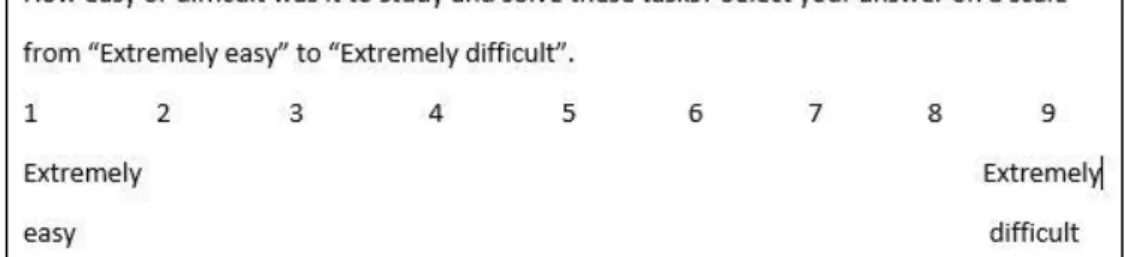
In order to measure cognitive load, a subjective rating survey was placed after each pair of tasks in each Section for both experimental and control groups (Figure 2). An online comment box was included at the end of each Module, with no word limit.
ISIMMED2018
IOP Conf. Series: Journal of Physics: Conf. Series 1320 (2019) 012064
IOP Publishing doi:10.1088/1742-6596/1320/1/012064
Figure 2. A screen image of the cognitive load survey
There was a post-test of six multiple-choice questions at the end of each section, and, therefore, a total of five post-tests for each Module. These questions were based on the problems presented in the sections and provided an opportunity for participants to practice, as well as providing for assessment of learning. The multiple choice questions in each test were randomized, a feature included in the online learning system, as were the multiple choice answer options. The post-tests provided 30 multiple choice test results for each participant in each Module, allowing a determination of learning effectiveness.
5.5. Experimental Procedure
The Modules were offered within a four-week window in order to coincide with material presented in lectures, with Module 1 (algebra) presented first and Module 2 (geometry) second. All participants were given an online algebra lecture in week one of the worked example experiment. In week two, participants were randomly assigned to either the experimental or control groups and were able to access the Online Learning System with a unique identifier that was retained throughout the procedure to use the podcasts for Module 1. In week three, all participants were taught geometry, also by an online lecture, and were then reassigned to a different group in week four when accessing Module 2. The use of the Online Learning System also allowed the researchers to collect data from a participant’s initial attempts and ignore data from subsequent repeated attempts, since the modules were designed for interactivity and repeated use.
Data were downloaded directly from the Online Learning System as an Excel spreadsheet identifying each student’s responses to the post-tests, survey questions and comments. Data were de-identified prior to analysis as per ethics considerations. The scores for the post-test were recorded as 1 = correct and 0 = incorrect. Since there were five post-tests for each Module, this gave ten post-tests in total for each participant. The data for the cognitive load surveys was recorded as a score of 1 through 6 as per the Likert scale used. Comments recorded by participants at the end of the Sections were downloaded directly as text.
6. Results and Discussion
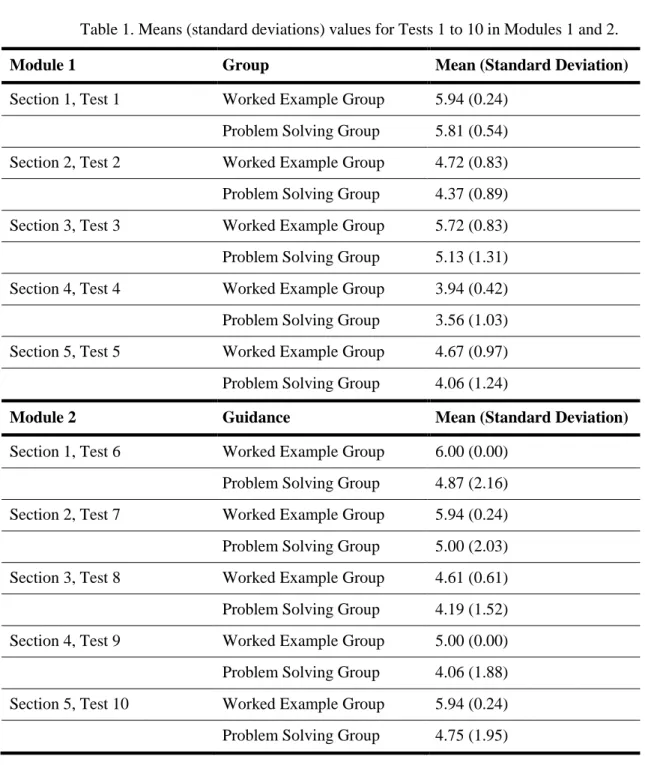
The total post-test scores for each participant in each section and the scores for the cognitive load survey were recorded and analyzed to test for significant differences between groups using analysis of variance. The repeated measures analysis was conducted on the 10 tests for the two modules with group (worked examples vs. solving problems) as the independent variable. Means and standard deviations may be found in Table 1.
ISIMMED2018
IOP Conf. Series: Journal of Physics: Conf. Series 1320 (2019) 012064
IOP Publishing doi:10.1088/1742-6596/1320/1/012064
6
Table 1. Means (standard deviations) values for Tests 1 to 10 in Modules 1 and 2.
Module 1 Group Mean (Standard Deviation)
Section 1, Test 1 Worked Example Group 5.94 (0.24)
Problem Solving Group 5.81 (0.54)
Section 2, Test 2 Worked Example Group 4.72 (0.83)
Problem Solving Group 4.37 (0.89)
Section 3, Test 3 Worked Example Group 5.72 (0.83)
Problem Solving Group 5.13 (1.31)
Section 4, Test 4 Worked Example Group 3.94 (0.42)
Problem Solving Group 3.56 (1.03)
Section 5, Test 5 Worked Example Group 4.67 (0.97)
Problem Solving Group 4.06 (1.24)
Module 2 Guidance Mean (Standard Deviation)
Section 1, Test 6 Worked Example Group 6.00 (0.00)
Problem Solving Group 4.87 (2.16)
Section 2, Test 7 Worked Example Group 5.94 (0.24)
Problem Solving Group 5.00 (2.03)
Section 3, Test 8 Worked Example Group 4.61 (0.61)
Problem Solving Group 4.19 (1.52)
Section 4, Test 9 Worked Example Group 5.00 (0.00)
Problem Solving Group 4.06 (1.88)
Section 5, Test 10 Worked Example Group 5.94 (0.24)
Problem Solving Group 4.75 (1.95)
A repeated measure of analysis revealed that the main effect of test was significant F(1, 9) = 19.37, MSe = .81, p < .01, ηp2 = .377, indicating that the means of tests for module 2 were higher than those of module 1. The main effect of group was not significant, but the performance of worked example group was slightly higher than that of problem solving group. The interaction between guidance and test was not significant. The Cronbach alpha value of the post-tests was .743, indicating their high reliability. A significant issue in interpretation of these results arose from a lack of means of differentiation of indications of non-completions versus zero scores in tests, with the data analysis above eliminating those tests with apparent zero scores.
ISIMMED2018
IOP Conf. Series: Journal of Physics: Conf. Series 1320 (2019) 012064
IOP Publishing doi:10.1088/1742-6596/1320/1/012064
The Likert scale data obtained from the cognitive load surveys did not yield significant results when subject to analysis in ANOVA. Those participants who chose to use the comment box provided at the end of each Section were generally positive about the paired worked example and problem solving tasks. For example: “Yes, I would say this has helped.”, “Yes this was beneficial for my learning, thank you.” By way of contrast, some of the participants in the control group suggested that there should be worked examples provided. For example: “Has this helped me in my math learning? Not really. The videos needed to show the working out. A step by step guide would of been appreciated.”, “Somewhat helped, it would be better if it provided step by step instructions for questions as I got stuck on a few somewhat helpful but does not explain how to arrive at the correct answer.” Qualitative analysis of student comments from this and other phases of the broader project is ongoing.
7. Conclusion
The experimental procedure outlined in this paper investigated the worked example effect in online interactive podcasts directed at undergraduate mathematics learning, where the podcasts were designed in accord with principles based in human cognitive architecture. This experimental procedure has enabled some insights, despite the limited number of participants and deletion of zero scores, on the establishment of the use of cognitive load principles in design of interactive online podcasts and into the relevance to student learning of effective online design that is based in human cognitive architecture. The results indicate that there may be advantages in further examining the worked example effect in interactive podcasts, as well as other technology-enhanced environments, preferably using a randomized, controlled experimental design. This would contribute to the body of literature already available demonstrating the effect in paper-based experimental setups.
In combination with an analysis of the design and implementation of the modules in the broader project (published elsewhere), analysis of Phase 1 Module appeared to favor the worked example condition being trialed, although there was insufficient data for a significant treatment effect to be proven. The high dropout rates, characteristic of optional online resources suggested that larger samples would be needed for later phases of the project. This was reinforced by pre-test and post-test results, which were inconclusive in determining the effect of the limited content coverage of the trial modules compared to the total subject content coverage. Feedback from these trials indicated also that system delivery needed to be fully automated and accessible through a widely accessible internet portal rather than an internal university Online Learning System.
Despite these issues, the results reported here indicate that structuring online instruction with worked examples has potential to improve mathematics learning through the use of interactive podcasts, provided a large study sample is used. The study also indicates that human cognitive architecture should be considered when designing online learning environment.
References
[1] Bolliger, D. U., Supanakorn, S., & Boggs, C. 2010 Impact of podcasting on student motivation in
the online learning environment Computers & Education 55 714-722[2] Richardson, J., & Swan, K. 2003 Examining social presence in online courses in relation to students' perceived learning and satisfaction J. of Asynchronous Learning Networks 7 68-88 [3] Snyder, M. M. 2009 Instructional-design theory to guide the creation of online learning
communities for adults TechTrends 53 48-56
[4] Sweller, J. 2004 Instructional design consequences of an analogy between evolution by natural selection and human cognitive architecture Instructional Science 32 9-31
ISIMMED2018
IOP Conf. Series: Journal of Physics: Conf. Series 1320 (2019) 012064
IOP Publishing doi:10.1088/1742-6596/1320/1/012064
8
[6] Chen, O., Kalyuga, S. & Sweller, J. 2015 The worked example effect, the generation effect, and element interactivity J. of Educ. Psy. 107 689-704
[7] Chen, O., Kalyuga, S., & Sweller, J. 2016 When instructional guidance is needed The Educational and Developmental Psychologist 33 149-162
[8] Cowan, N. 2001 Metatheory of storage capacity limits Behavioral and Brain Sciences 24 154-176 [9] Miller, G. A. 1956 The magical number seven, plus or minus two: Some limits on our capacity for
processing information Psychological Review 63 81-97
[10] Peterson, L., & Peterson, M. J. 1959 Short-term retention of individual verbal items J. of Experimental Psychology 58 193-198
[11] Sweller, J. 2010 Element interactivity and intrinsic, extraneous, and germane cognitive load Educ. Psy. Review 22 123-138
[12] Sweller, J., Ayres, P., & Kalyuga, S. 2011 Cognitive load theory (New York, NY: Springer) [13] Renkl, A. 2014a Toward an instructionally oriented theory of example-based learning Cognitive
Science 38 1-37
[14] Renkl, A. 2014b The worked examples principle in multimedia learning. In R. E. Mayer (Ed.),
The Cambridge handbook of multimedia learning, 2nd ed., pp. 391-412 (New York, NY: Cambridge University Press)
[15] Chen, O., Woolcott, G., & Sweller, J. 2017 Using cognitive load theory to structure MOOCs and other computer-based learning J. of Computer Assisted Learning 33 293-305
[16] Cooper, G., & Sweller, J. 1987 Effects of schema acquisition and rule automation on mathematical problem-solving transfer J. of Educ. Psy. 79 347-362
[17] Sweller, J., & Cooper, G. A. 1985 The use of worked examples as a substitute for problem solving in learning algebra Cognition and Instruction 2 59-89
[18] Van Gog, T., Kester, L., & Paas, F. 2011 Effects of worked examples, example-problem, and problem-example pairs on novices’ learning Contemporary Educ. Psy. 36 212-218
[19] Paas, F. G. 1992 Training strategies for attaining transfer of problem-solving skill in statistics: A cognitive-load approach J. of Educ. Psy. 84 429-434
Acknowledgements
Results reported in this paper are based on the project, Bite size maths: Building mathematics capability of low SES students in regional/remote Australia, funded by the Australian Government.