The Effectiveness of Interventions
to Increase Physical Activity
A Systematic Review
Emily B. Kahn, PhD, MPH, Leigh T. Ramsey, PhD, Ross C. Brownson, PhD, Gregory W. Heath, DHSc, MPH, Elizabeth H. Howze, ScD, Kenneth E. Powell, MD, MPH, Elaine J. Stone, PhD, MPH, Mummy W. Rajab, MS, Phaedra Corso, PhD, and the Task Force on Community Preventive Services
Overview: The Guide to Community Preventive Service’s methods for systematic reviews were used to evaluate the effectiveness of various approaches to increasing physical activity: informa-tional, behavioral and social, and environmental and policy approaches. Changes in physical activity behavior and aerobic capacity were used to assess effectiveness. Two informational interventions (“point-of-decision” prompts to encourage stair use and community-wide campaigns) were effective, as were three behavioral and social interven-tions (school-based physical education, social support in community settings, and individ-ually-adapted health behavior change) and one environmental and policy intervention (creation of or enhanced access to places for physical activity combined with informational outreach activities). Additional information about applicability, other effects, and barriers to implementation are provided for these interventions. Evidence is insufficient to assess a number of interventions: classroom-based health education focused on information provision, and family-based social support (because of inconsistent findings); mass media campaigns and college-based health education and physical education (because of an insufficient number of studies); and classroom-based health education focused on reduc-ing television viewreduc-ing and video game playreduc-ing (because of insufficient evidence of an increase in physical activity). These recommendations should serve the needs of research-ers, plannresearch-ers, and other public health decision makers.
Medical Subject Headings (MeSH): exercise, leisure activities, physical fitness, physical endurance, decision making, evidence-based medicine, economics, preventive health services, public health practice, meta-analysis, review literature (Am J Prev Med 2002;22(4S):73–107)
Introduction
R
egular physical activity is associated with en-hanced health and reduced risk of all-cause mortality.1– 4 Beyond the effects on mortality,physical activity has many health benefits, including reduced risk of cardiovascular disease,5,6 ischemic stroke,7–9 non–insulin-dependent (type 2) diabe-tes,10 –16 colon cancers,17–20osteoporosis, 21–23 depres-sion,24 –27and fall-related injuries.28 –31Despite the ben-efits of regular physical activity, only 25% of adults in the United States report engaging in the recommended amounts of physical activity (i.e., 30 minutes of moder-ate-intensity activity on 5 or more days per week, or 20 minutes of vigorous-intensity activity on 3 or more days per week)32; 29% report no leisure-time regular physi-cal activity33; and only 27% of students (grades 9 through 12) engage in moderate-intensity physical ac-tivity (30 minutes, 5 or more days per week).32
InHealthy People 2010,32physical activity is ranked as a leading health indicator. Healthy People 2010 has developed goals to improve levels of physical activity among adults, adolescents, and children and to reduce sedentary behavior among adolescents (Table 1).
Recommendations to increase physical activity have been made for individuals and clinical settings but not for community settings. Increased physical activity has From the Division of Prevention Research and Analytic Methods,
Epidemiology Program Office (Kahn, Ramsey, Rajab, Corso), Divi-sion of Nutrition and Physical Activity, National Center for Chronic Disease Prevention and Health Promotion, Centers for Disease Control and Prevention (Heath), Atlanta, Georgia; the Task Force on Community Preventive Services and St. Louis University, School of Public Health (Brownson), St. Louis, Missouri; Division of Health Education and Promotion, Agency for Toxic Substances and Disease Registry (Howze), Atlanta, Georgia; Epidemiology and Prevention Branch, Georgia Department of Human Resources (Powell), Atlanta, Georgia; and National Heart, Lung, and Blood Institute, National Institutes of Health (Stone), Bethesda, Maryland
Dr. Stone is currently affiliated with the Department of Physical Performance and Development, University of New Mexico, Albuquer-que, New Mexico.
The names and affiliations of the Task Force members are listed in the front of this supplement and at www.thecommunityguide.org.
Address correspondence and reprint requests to: Peter A. Briss, MD, Community Guide Branch, Centers for Disease Control and Prevention, 4770 Buford Highway, MS-K73, Atlanta, GA 30341. E-mail: [email protected].
been linked not only to behavioral and social correlates but also to physical and social environmental corre-lates. Therefore, the role of community-based interven-tions to promote physical activity has emerged as a critical piece of an overall strategy to increase physical activity behaviors among the people of the United States. In 1996, the American College of Sports Medi-cine and the Centers for Disease Control and Preven-tion (CDC) recommended that every adult in the United States accumulate 30 minutes or more of mod-erate-intensity physical activity on most, preferably all, days of the week.34That same year, the U.S. Preventive Services Task Force recommended that healthcare pro-viders counsel all patients on the importance of incor-porating physical activity into their daily routines.35To date, community-based interventions to increase phys-ical activity have not been summarized in an evidence-based process.
The Guide to Community Preventive Services
The systematic reviews in this report represent the work of the independent, nonfederal Task Force on Com-munity Preventive Services (the Task Force). The Task Force is developing the Guide to Community Preventive Services (theCommunity Guide) with the support of the U.S. Department of Health and Human Services (DHHS) in collaboration with public and private part-ners. The Centers for Disease Control and Prevention (CDC) provides staff support to the Task Force for development of theCommunity Guide. A special supple-ment to the American Journal of Preventive Medicine, “Introducing the Guide to Community Preventive Services:
Methods, First Recommendations, and Expert Com-mentary,” published in January 2000, presents the background and the methods used in developing the
Community Guide.36
Healthy People 2010 Goals and Objectives for Increasing Physical Activity
The interventions reviewed in this article should be useful in reaching the objectives set in Healthy People 2010.32The two main foci of theHealthy People preven-tion objectives are to increase (1) the amount of moderate or vigorous physical activity performed by people in all population subgroups and (2) opportuni-ties for physical activity through creating and enhanc-ing access to places and facilities where people can be physically active. This article provides information on interventions that relate to both of these foci, which can be used by communities to help increase levels of exercise and fitness. The specific objectives are listed in Table 1.
Recommendations from Other Advisory Groups The U.S. Preventive Services Task Force
In 1996, in theGuide to Clinical Preventive Services,35the U.S. Preventive Services Task Force (USPSTF) recom-mended that healthcare providers counsel their pa-tients to incorporate regular physical activity into their daily routines. This recommendation was based on the accepted health benefits of such activity rather than the proven effectiveness of clinician counseling. The Table 1. Selected objectives for increasing physical activity (PA),Healthy People 201032
Percentage of population
Objective Population Baselinea 2010 objective
No leisure-time PA Adult 40% (1997) Reduce to 20%
At least 30 minutes of moderate physical activity regularly, preferably daily
Adult 15% (1997) Increase to 30%
At least 30 minutes of moderate physical activity onⱖ5 of previous 7 days
Adolescents 27% (1999) Increase to 35%
Vigorous PA that promotes the development and maintenance of cardiorespiratory fitness
ⱖ3 days per week for 20 minutes/occasion
Adult 23% (1997) Increase to 30%
Vigorous PA that promotes the development and maintenance of cardiorespiratory fitness
ⱖ3 days per week for 20 minutes/occasion
Adolescents 65% (1999) Increase to 85%
Daily school physical education Adolescents 29% (1999) Increase to 50%
View televisionⱕ2 hours on a school day Adolescents 57% (1999) Increase to 75%
Trips ofⱕ1 mile made by walking Adults 17% (1995) Increase to 25%
Trips to school ofⱕ1 mile made by walking Children and adolescents 31% (1995) Increase to 50%
Trips ofⱕ5 miles made by bicycling Adults 0.6% (1995) Increase to 2%
Trips to school ofⱕ2 miles made by bicycling Children and adolescents 2.4% (1995) Increase to 5% aYears indicate when the data were analyzed to establish baseline estimates. Some of the estimates are age adjusted to the year 2000 standard
population.
Source: U.S. Department of Health and Human Services. Healthy people 2010: conference edition. Washington, DC: U.S. Department of Health and Human Services, 2000.32
USPSTF found that problems associated with establish-ing the effectiveness of counselestablish-ing included lack of information about long-term compliance and the typi-cal problems of generalizing to a broad population. The USPSTF is revisiting the effectiveness of clinical interventions for promoting long-term changes in phys-ical activity, and a revised recommendation will be released later this year.
American College of Sports Medicine/CDC A panel of scientists convened by the American College of Sports Medicine and CDC developed a consensus statement recommending that every adult in the United States accumulate 30 minutes or more of mod-erate-intensity physical activity on most, preferably all, days of the week.34This recommendation was modified to emphasize that physical activity does not need to be continuous or strenuous to produce health benefits. The Surgeon General’s Report37 and the National Institutes of Health Consensus Statement38support this recommendation.
Methods for Conducting the Review
The general methods used to conduct systematic re-views for theCommunity Guide have been described in detail elsewhere.39,40The specific methods for conduct-ing this review, includconduct-ing intervention selection, out-come determination, and search strategy for interven-tions to increase physical activity, are presented in Appendix A. The conceptual approach to the review, critical both for describing the methods and for under-standing the results of the review, is described below.
Conceptual Model
The general conceptual model (also called the “logic framework”) used to evaluate the effectiveness of inter-ventions to increase physical activity is shown in Figure 1. This framework illustrates the relationships between physical activity, several indicators of physical fitness, and morbidity and mortality outcomes. For example, a large body of literature shows that increasing physical activity results in physiologic improvements, affecting endurance, strength, body composition, insulin sensi-tivity, and lipid levels.37 In turn, these improvements have been shown to result in improved health and quality of life across a variety of conditions. Those who are physically active have a reduced risk of developing cardiovascular disease,41– 44 type 2 diabetes (formerly called non–insulin-dependent diabetes),14 –16 colon cancers,17–20 osteoporosis,21–23 and depression,25–27 and of having fall-related injuries.28 –31
Selection of Interventions for Review
The relationships between increased physical activity and health were assumed by the coordination team to be well established and, subsequently, were not the focus of the systematic review. Instead, the coordina-tion team focused on intervencoordina-tions to increase physical activity behaviors. By using the categories of behavioral precedents established in the logic framework, the coordination team (defined in Appendix A, see author list) initially developed the following three categories of interventions:
● Informational approaches to change knowledge and attitudes about the benefits of and opportunities for physical activity within a community;
● Behavioral and social approaches to teach people the behavioral management skills necessary both for suc-cessful adoption and maintenance of behavior change and for creating social environments that facilitate and enhance behavioral change; and
● Environmental and policy approaches to change the structure of physical and organizational environ-ments to provide safe, attractive, and convenient places for physical activity.
Within these three categories, the coordination team generated a comprehensive list of candidate interven-tions (Appendix A, Table A-1) for inclusion that ad-dressed each of the modifiable determinants (i.e., individual level factors, social environment, and physi-cal environment). This list was put in priority order for review through a process of polling the coordination team, consultation team,a and other specialists in the field about their perception of the public health impor-tance (number of people affected), the practicality of application, and the need of those promoting physical activity for information on each intervention. Interven-aConsultants for the systematic review on increasing physical activity
were Terry Bazzarre, PhD, Robert Wood Johnson Foundation, Prince-ton, NJ; Carl J. Caspersen, PhD, National Center for Chronic Disease Prevention and Health Promotion, CDC, Atlanta, GA; Diana Cassady, DrPH, California Department of Health Services, Sacramento; Carlos J. Crespo, DrPH, State University of New York School of Medicine and Biomedical Sciences, Buffalo; Steve Hooker, PhD, California Department of Health Services, Sacramento; Jonathan Fielding, MD, MPH, MBA, University of California Los Angeles School of Public Health; Barbara Fraser, RD, MS, Nebraska Department of Health and Human Services, Lincoln; George J. Isham, MD, HealthPartners, Minneapolis, MN; Abby C. King, PhD, Stanford University School of Medicine, Stanford, CA; I-Min Lee, MD, ScD, Harvard Medical School/Brigham and Women’s Hospital, Boston, MA; Denise G. Simons-Morton, MD, PhD, National Heart, Lung, and Blood Insti-tute, National Institutes of Health, Bethesda, MD; Reba A. Norman, MLM, National Center for Chronic Disease Prevention and Health Promotion, CDC, Atlanta, GA; Cindy Porteous, MA, Indianapolis Park Foundation, Indianapolis, IN; Michael Pratt, MD, MPH, Na-tional Center for Chronic Disease Prevention and Health Promotion, CDC, Atlanta, GA; Thomas Schmid, PhD, National Center for Chronic Disease Prevention and Health Promotion, CDC, Atlanta, GA; Christine G. Spain, MA, The President’s Council on Physical Fitness and Sports, Washington, DC; Wendell C. Taylor, PhD, MPH, University of Texas Health Science Center at Houston.
tions reviewed were either single component (i.e., using only one activity to achieve desired outcomes) or multicomponent (i.e., using more than one related activity). Some interventions fell into more than one category.
Selection of Outcomes for Review
Many of the studies included in the body of evidence targeted other behavioral risk factors in addition to physical inactivity, most often poor diet and smoking. Many of the physiologic benefits observed in those studies could be the result of improvements in these other behaviors rather than improvements in physical activity. To be able to estimate the effectiveness of an intervention in increasing physical activity, the team decided to base recommendations on changes in phys-ical activity behavior. However, self-reported measure-ment of behavior change, particularly in children, is prone to significant measurement error; objective mea-sures are needed (e.g., heart rate monitoring, acceler-ometers) to enhance reliability and validity.45 Addition-ally, many of the studies did not attempt to measure
behavior even when the intervention targeted behavior, measuring instead physiologic changes as an indicator of behavior. The team chose to use measures of aerobic capacity as well as behavioral measures as outcomes on which recommendations would be based. Aerobic ca-pacity is defined as the maximum amount of oxygen that can be transported from the lungs to the tissues during exercise.46Maximal oxygen uptake (VO
2max) or a measure of VO2max is commonly used to measure changes in fitness level associated with increased activ-ity (behavior change).
Results: Part I. Informational Approaches to Increasing Physical Activity
Informational approaches are designed to increase physical activity by providing information necessary to motivate and enable people to change their behavior, as well as to maintain that change over time. The focus is mainly on the cognitive skills thought to precede behavior. The interventions use primarily educational approaches to present both general health informa-Figure 1. Logic framework illustrating the conceptual approach used in this review.
tion, including information about cardiovascular dis-ease prevention and risk reduction, as well as specific information about physical activity and exercise. These programs were originally developed to complement a medical model of disease management by involving communities in understanding the cognitive anteced-ents of behavior.
The provision of information is intended to change knowledge about the benefits of physical activity, in-crease awareness of opportunities within a community for increasing physical activity, explain methods for overcoming barriers and negative attitudes about phys-ical activity, and increase participation in community-based activities. Interventions reviewed here are (1) “point-of-decision” prompts to encourage use of stairs as an alternative to elevators or escalators, (2) community-wide education campaigns, (3) mass media campaigns, and (4) classroom-based health ed-ucation focused on information provision and skills related to decision making.
Point-of-Decision Prompts
Point-of-decision prompts are signs placed by elevators and escalators to motivate people to use nearby stairs. Messages on the signs recommend stair use for health benefits or weight loss. Signs are thought to be effective in one of two ways: by reminding people already predisposed to becoming more active, for health or other reasons, about an opportunity at hand to be more active or by informing them of a health benefit from taking the stairs. All interventions evaluated in this category were single-component interventions, in which placement of the sign was the only intervention activity.
Reviews of evidence
Effectiveness. Our search identified six reports (one paper reported two studies)47–51on the effectiveness of point-of-decision prompts. All studies were of moderate suitability, using time-series designs. All were con-ducted between 1980 and 2000. Two of the studies (reported in one paper)49were of good execution; the remaining four47,48,50,51 were rated as fair. All were included in the body of evidence. Details of the six qualifying studies are provided at the website (www.thecommunityguide.org).
Baseline rates of stair use were generally low, with all but one under 12% (range, 4.8% to 39.6%). In five studies47– 49,51the median increase in stair-climbing was 53.9%. The remaining study50showed an unspecified increase in stair-climbing and also found that the signs were effective in getting those who were less active (as measured by responses to a brief survey) to take the stairs. The range of effect sizes varied from a 5.5% net increase to 128.6%.
Applicability. The body of evidence used to evaluate the applicability of this intervention was the same as that used to evaluate effectiveness. Four studies were conducted in the United States,47,49,51 and one study each was conducted in England50and Scotland.48The studies included in this review were implemented in shopping malls,47,49,50train and bus stations,48,49and a university library.51 Three studies47,48,51 measured ef-fectiveness separately among men and women and found that signs were effective in both groups.
Two studies47,49reported effectiveness separately for obese and nonobese people. Although the signs were effective in both groups, the median net increase in the percentage of people taking the stairs was greater among the obese group. Among obese people, a sign that linked stair use to the potential for weight loss showed a higher increase in stair use than the sign linking stair use to general health benefits.
The same two studies47,49reported results separately for blacks and found mixed evidence of effectiveness. One study47 showed a decline in the percentage of blacks taking the stairs when the sign contained a generic message. A message specifically designed for a black population, however, was effective in increasing the percentage of stair users.
This type of intervention is likely to be effective across diverse settings and population groups, provided that appropriate care is taken to adapt the messages.
Other positive or negative effects. None of the studies measured outcomes other than the percentage of peo-ple using the stairs.
Economic. No studies were found that met the require-ments for inclusion in aCommunity Guidereview.40
Barriers to intervention implementation. Stairways in many buildings and facilities are often difficult to find and poorly lit, maintained, or secured. As a result they may appear to be, or actually be, unsafe. Additionally, some stairwells are locked, preventing user access to them.
Conclusion. According to Community Guide rules of evidence,39 sufficient evidence shows that point-of-de-cision prompts are effective in increasing levels of physical activity, as measured by an increase in the percentage of people choosing to take the stairs rather than an elevator or escalator. Findings from several of the studies suggest that tailoring the prompts either by specifying the benefits of stair use or by customizing the sign to appeal to specific populations may increase intervention effectiveness.
Community-Wide Campaigns
Community-wide campaigns involve many community sectors in highly visible, broad-based, multiple interven-tion approaches to increasing physical activity. In
addi-tion to addressing sedentary behavior, most of the studies in this body of evidence also addressed other cardiovascular disease risk factors, particularly diet and smoking. Communication techniques were a common element in all of the campaigns. Campaign messages were directed to large and relatively undifferentiated audiences through diverse media, including television, radio, newspaper columns and inserts, direct mailings, billboards, advertisements in transit outlets, and trailers in movie theaters. Messages were communicated in the form of paid advertisements, donated public service announcements, press releases, the creation of feature items, or a combination of two or more of these approaches.
In addition to incorporating substantial communica-tion activities through mass media, intervencommunica-tions in this review typically included some combination of social support, such as self-help groups; risk factor screening, counseling, and education about physical activity in a variety of settings, including worksites, schools, and community events; and environmental or policy changes such as the creation of walking trails. These interventions were evaluated as a “combined package” because it was impossible to distinguish the relative contributions of each component.
Reviews of evidence
Effectiveness. Our search identified ten reports52– 61 on the effectiveness of community-wide campaigns. All studies were used in the body of evidence. Two stud-ies52,53 had the greatest suitability of study design and good execution. The remaining eight studies had fair execution. Of those, five54 –58 had the greatest suitability of study design and three59 – 61were of moderate suitabil-ity. Details of the ten qualifying studies are provided at the website (www.thecommunityguide.org).
Many of the interventions52–58 were designed to decrease levels of cardiovascular disease morbidity and mortality throughout a community over a period of several years. Activities were directed both at increasing levels of physical activity and improving dietary behav-iors. These interventions included many activities sup-ported by media efforts but conducted independently. In the remaining studies,59 – 61the duration of interven-tion activities ranged from 6 weeks to 6 months, and activities were more circumscribed, although still pre-sented community-wide.
Six arms from five studies52,53,55,56,60 measured change in the percentage of people being active, with a median net increase of 4.2% (range,⫺2.9% to 9.4%). Three arms from two studies54,58 measured change in energy expenditure with a median net increase of 16.3% (range, 7.6% to 21.4%). Five arms from four studies53,58 – 60 reported other measures of physical ac-tivity; all but one showed increases in physical activity.
Applicability. The body of evidence used to evaluate the applicability of this intervention was the same as that used to evaluate the effectiveness. Five studies were conducted in the United States,52,54,56,58,59 and one study each was conducted in Sweden,57 Denmark,55 Australia,60Scotland,61and Wales.53Studies were con-ducted in rural, suburban, and urban areas and encom-passed all socioeconomic groups. Two studies reported results for black populations,56,59 and two studies re-ported results for Hispanic or Latino populations.54,59 This type of intervention is likely to be effective across diverse settings and population groups, provided that appropriate care is taken to adapt the interven-tions to the target populainterven-tions.
Other positive or negative effects. Seven arms from five studies52–54,56,59 examined weight change among people in the communities receiving the interventions. Measures included body mass index (BMI), weight, relative weight (i.e., ideal weight/actual weight), and the percentage of people who were overweight. Three arms from three separate studies52,56,59showed weight losses, two arms from two studies52,54 showed no changes, and two arms from one study53showed slight weight gains over the course of the intervention. Across the body of evidence, the net decrease in weight was 0.6%. Four arms from two studies54,58reported positive changes in knowledge about exercise, with a median increase of 19.9%. Three studies55,61,62with seven study arms reported physical activity intentions, that is, the percentage of people either intending to increase activity or actually doing so. Five of the arms reported an increase in intention to increase physical activity, one showed no change, and one reported a decrease.
In addition to increased physical activity, other health benefits may result from the interventions. Most of the studies in this body of evidence also addressed other cardiovascular disease risk behaviors, particularly diet and smoking. Although these results were not systematically reviewed, improvements were evident in some studies. Community-wide education campaigns may also produce other benefits that can improve health and build social capital in communities. For example, through working together communities may develop a greater sense of cohesion and collective self-efficacy. Social networks may also be developed or strengthened to achieve intervention goals, and com-munity members may become involved in local govern-ment and civic organizations, thereby increasing social capital.
Economic. No studies were found that met the require-ments for inclusion in aCommunity Guidereview.40
Barriers to intervention implementation. Community-wide campaigns require careful planning and coordi-nation, well-trained staff, and sufficient resources to carry out the campaign as planned. Success is greatly
enhanced by community buy-in, which can take a great deal of time and effort to achieve. Insufficient resources may result in exposure to messages and other planned campaign interventions that is inadequate to achieve the “doses” necessary to change knowledge, attitudes, or behavior over time, especially among high-risk pop-ulations. Inadequate resources and lack of profession-ally trained staff may affect how completely and appro-priately interventions are implemented and evaluated.
Conclusion. According to Community Guide rules of evidence,39strong evidence exists that community-wide campaigns are effective in increasing levels of physical activity, as measured by an increase in the percentage of people engaging in physical activity, energy expendi-ture, or other measure of physical activity.
Mass Media Campaigns
Mass media campaigns are interventions that address messages about physical activity to large and relatively undifferentiated audiences. The campaigns are de-signed to increase knowledge, influence attitudes and beliefs, and change behavior. Messages are transmitted by using channels such as newspapers, radio, television, and billboards singly or in combination. In this review, interventions that use mass media and include other components (e.g., support groups, risk factor screening and education, and community events) are classified as community-wide campaigns and are discussed else-where (see Community-Wide Campaigns section).
Reviews of evidence
Effectiveness. Our search identified three stud-ies54,59,63 evaluating the effectiveness of mass media campaigns. All studies had fair execution. The study designs were a nonrandomized community trial,54 a time-series,59 and a before-and-after design with no concurrent comparison group.63 These designs were rated as having greatest, moderate, and least suitable study designs, respectively. Details of the three qualify-ing studies are provided at the website (www.thecommunityguide.org).
Effectiveness measures were (1) the change in the percentage of people doing a specified level of activity (i.e., walking, moderate- and vigorous-intensity physical activity, aerobic and nonaerobic activity),59,63 (2) change in energy expenditure,54and (3) the per-centage of the population categorized as sedentary.63 Overall, some but not all measures suggested a modest trend toward increasing physical activity, especially at lower levels of physical activity. According toCommunity Guide rules of evidence,39we concluded that, because of small numbers of available studies and limitations in the designs and execution of the available studies, insufficient evidence was available to assess the
effec-tiveness of mass media campaigns, when used alone, to increase physical activity or improve fitness.
Applicability. Evidence about applicability was not as-sessed for this intervention because effectiveness was not established.
Other positive or negative effects. Two studies54,59 examined the effects of mass media campaigns on adiposity: One59showed a decrease in weight over the 3-month intervention period and the other54found no effect. Significant and substantial improvements in knowledge and beliefs were seen in two studies.54,63 Mass media campaigns might play important roles in changing awareness of opportunities for and benefits of physical activity, helping to build support for environ-mental and policy changes that improve physical activ-ity behavior and fitness, or both. Our reviews, however, did not assess the effect of mass media campaigns on such outcomes.
Economic. Evidence about economic effectiveness was not collected because effectiveness of the intervention was not established.
Barriers to intervention implementation. Evidence about barriers to implementation of this intervention was not collected because effectiveness was not established.
Conclusion. Available studies provide insufficient evi-dence to assess the effectiveness of mass media cam-paigns, when used alone, to increase physical activity or improve fitness. Media campaigns are, however, a com-ponent of other effective interventions (see Communi-ty-Wide Campaigns section) and might provide addi-tional benefits. Until more and better information becomes available, communities might choose to make decisions about the use of education-only programs on grounds other than the evidence found in available studies.
Classroom-Based Health Education Focused on Information Provision
Health education classes that provide information and skills related to decision making are usually multicom-ponent, with the curriculum typically addressing phys-ical activity, nutrition, smoking, and cardiovascular disease. Health education classes, taught in elementary, middle, or high schools, are designed to effect behavior change through personal and behavioral factors that provide students with the skills they need for rational decision making. Many of the classes in the studies reviewed had a behavioral skills component (e.g., role-play, goal-setting, contingency planning) but did not add time spent in physical activity to the curriculum. In most cases, comparison groups received the standard health education curriculum.
Reviews of evidence
Effectiveness. Our search identified 13 studies64 –76 evaluating the effectiveness of classroom-based health education focused on information provision. Of these, three studies had limited quality of execution and were not included in our review.74 –76 The ten remaining studies had greatest suitability of study design. One had good execution64 and nine had fair execution.65–73 Details of the ten qualifying studies are provided at the website (www.thecommunityguide.org).
Most of the interventions were designed to reduce the risk of developing chronic disease. Four interven-tions65,71–73 were designed with the use of the Know Your Body curriculum. (The Know Your Body curricu-lum is designed to provide children with the skills needed to adopt behaviors that reduce the risk of developing cardiovascular disease. The classes focus on nutrition, physical fitness, and preventing cigarette smoking.) One intervention68focused on prevention of type 2 diabetes by encouraging students to eat low-fat foods and to exercise regularly. The duration of the intervention activities ranged from 3 months to 5 years. The studies reviewed showed variable effects of these interventions on time spent in physical activity outside the school setting: three study arms from two studies showed increases in activity,66 – 68 and five study arms from two studies showed decreases in self-reported activity.64,66 Other measures of physical activity were also varied: five study arms from one study found positive changes in self-reported behavior,66 and 11 study arms from two studies found no change or negative changes in self-reported behavior.64,66Aerobic capacity was not measured in any of these studies.
Applicability. Evidence about applicability was not as-sessed for this intervention because effectiveness was not established.
Other positive or negative effects. Although these studies did not show changes in activity, four of five study arms from three studies showed increases in general health knowledge, exercise-related knowledge, and self-efficacy about exercise.64,67,68 Effects on adi-posity were mixed,69showing decreases in BMI among both boys and girls but decreases in skinfold measure-ments among boys only.
Economic. Evidence about economic effectiveness was not collected because effectiveness of the intervention was not established.
Barriers to intervention implementation. Evidence about barriers to implementation of this intervention was not collected because effectiveness was not established.
Conclusion. According to Community Guide rules of evidence,39 the studies reviewed provided insufficient
evidence to assess the effectiveness of classroom-based health education focused on information provision in increasing levels of physical activity or improving fitness because of inconsistent results among studies.
Results. Part II. Behavioral and Social Approaches to Increasing Physical Activity
Behavioral and social approaches focus on increasing physical activity by teaching widely applicable behav-ioral management skills and by structuring the social environment to provide support for people trying to initiate or maintain behavior change. Interventions often involve individual or group behavioral counseling and typically include the friends or family members that constitute an individual’s social environment. Skills focus on recognizing cues and opportunities for phys-ical activity, ways to manage high-risk situations, and ways to maintain behavior and prevent relapse. Inter-ventions also involve making changes in the home, family, school, and work environments.
Interventions reviewed here are (1) school-based physical education (PE), (2) college-based health edu-cation and PE, (3) classroom-based health eduedu-cation focused on reducing television viewing and video game playing, (4) family-based social support interventions, (5) social support interventions in community settings, and (6) individually-adapted health behavior change programs.
School-Based PE
Interventions that used this approach modified curric-ula and policies to increase the amount of time stu-dents spend in moderate or vigorous activity while in PE classes. This can be done in a variety of ways, including (1) adding new (or additional) PE classes, (2) lengthening existing PE classes, or (3) increasing moderate to vigorous physical activity (MVPA) of stu-dents during PE class without necessarily lengthening class time. Examples of the last approach include changing the activities taught (e.g., substituting soccer for softball) or modifying the rules of the game so that students are more active (e.g., having the entire team run the bases together if the batter makes a hit). Many of these interventions also included the presentation of information on cardiovascular disease prevention, ren-dering it difficult to separate the effects of health education and modified PE.
Reviews of evidence
Effectiveness. Our search identified 16 articles (one study was reported in two papers)77–93reporting on 17 studies that evaluated the effectiveness of modified school-based PE curricula and policies. Of these, four studies had limited quality of execution and were not
included in our review.78,84,85,92Twelve of the remain-ing thirteen studies (one study reported in two papers) had greatest suitability of study design.77,79 – 83,86 –91,93 The remaining study79had a least suitable design. Four had good execution80,81,83,89,93 and nine had fair exe-cution.77,79,82,86 – 88,90,91 Details of the 13 qualifying studies are provided in Appendix B and at www. thecommunityguide.org.
Reported behavioral outcomes were energy expendi-ture,80,81,90 percentage of class time spent in MVPA,80,81,90,91 minutes spent in MVPA,80,81,90,91 ob-served activity score,77,90 and self-reported type and frequency of physical activities outside of school.80,81,86,89,90,94Eleven studies also reported aero-bic capacity as estimated maximal oxygen uptake (VO2 max),77,79results from timed runs,77,80,81,88,90,93or en-durance testing (step test or shuttle runs).82,89,93These studies showed consistent increases in time spent in physical activity at school. Five arms from four studies showed increases in the amount77,91,94 and percent-age80,81,90,91of time spent in MVPA in PE classes. The net increase in the amount of PE class time spent in MVPA was 50.3% (range, 6.0% to 125.3%; because one study91 reported an increase from 0, percentage in-crease from baseline could not be calculated). The net increase in the percentage of class time in MVPA was 10% (range, 3.3% to 15.7%), with an additional study reporting a 762% increase from a very small baseline value. Three arms from two studies80,81,90 showed in-creases in energy expenditure as well. Fourteen arms from eleven studies77,79 – 84,88 –90,93 showed increases in aerobic capacity with a median of 8.4% (interquartile range, 3.1% to 18.9%).
Applicability. The body of evidence used to evaluate the applicability of this type of intervention was the same as that used to evaluate effectiveness. Nine studies were conducted in the United States,77,82,83,86 – 88,90,91,94 one in Crete,89 and two in Australia.79,93 Ten studies (one study was reported in two papers)77,79 – 81,86 –91,93 were conducted among elementary school students, and two studies were conducted among high-school students.82,83 The intervention was successful among both elementary and high school students.
Overall results indicate that this type of intervention is likely to be effective across diverse settings and population groups, provided that appropriate care is taken to adapt the intervention to the target population.
Other positive or negative effects. Ten stud-ies77,79,82,83,88 –90,93–95 examined weight change. Mea-sures included BMI, skinfold measurements, percent-age of body fat, and weight. BMI estimates mostly showed small decreases or no change; one study arm showed a small increase of 1.2%. Skinfold estimates showed a median change of ⫺4.4% (interquartile range, ⫺6.0% to ⫺0.7%). Changes in percentage of
body fat showed inconsistent results, with some in-creases and some dein-creases.
Indicators of physical fitness other than aerobic capacity also showed improvements. Flexibility, as mea-sured through sit-and-reach tests, showed improve-ments in two87,89 of three studies.87,89,90 Muscular en-durance also increased in most arms in the two studies89,90reporting this measurement; the exception was for girls performing pull-ups in one study.90These interventions were also associated with increases in knowledge about exercise,86,87 fitness,89 nutri-tion,80,81,87,88 and general health,83,89 as well as self-efficacy about physical activity.80,81
Although there is a perception that the time spent in PE may harm academic performance, both an exami-nation of the literature included in this review and the results of a systematic search of other studies on the effects of PE on academic performance found no evidence of this harm.
Economic. No studies were found that met the require-ments for inclusion in aCommunity Guidereview.40
Barriers to intervention implementation. The primary barrier to implementation exists within the school systems. PE is mandated in almost every state, but requirements for the amount of PE instruction are generally low (e.g., four semesters, two to three times per week or two semesters of daily PE). Few middle and high schools require daily PE, and schools face increas-ing pressure to eliminate PE to make more time available for academic subjects.
Conclusion. According to Community Guide rules of evidence,39 there is strong evidence that school-based PE is effective in increasing levels of physical activity and improving physical fitness.
College-Based Health Education and PE
College-based health education and PE interventions aim to set long-term behavioral patterns during the transition to adulthood. To this end, they use didactic and behavioral education efforts to increase physical activity levels among college students. The physical education classes do not have to be offered by PE or wellness departments in college and university settings, but they do include supervised physical activity in the class.
The studies in our review included lecture classes that addressed the benefits and potential risks of phys-ical activity, the current recommendations about the amount and type of physical activity one should get, and behavioral management techniques. Students ap-plied these lessons in “laboratory”-type sessions in which they engaged in supervised physical activity, developed goals and activity plans, and wrote term papers based on their experiences. Students also re-ceived social support and phone calls from each other
and made behavioral contracts for an agreed-on amount of physical activity.
Reviews of evidence
Effectiveness. Our search identified five studies (one study was reported in two papers)96 –101evaluating the effectiveness of college-based health education and PE classes. Three96,98,101 of the five studies were not in-cluded in the review of effectiveness because they had limited quality of execution. The designs of the two remaining studies were categorized as greatest suitabil-ity. One study, reported in two papers,99,100 had good execution and an initial intervention period of 15 weeks; participants were followed for an additional 2 years to examine maintenance of effect after the inter-vention ended. The other study97was fair in execution and measured a 5-week intervention period. Details of the two qualifying studies are provided at the website (www.thecommunityguide.org).
The studies generally showed consistent increases in physical activity and aerobic capacity in the short term. The 2-year follow-up showed declines in activity back to previous levels and did not find the desired effects on the proposed mediators of behavioral change. Accord-ing toCommunity Guide rules of evidence,39because of the small number of qualifying studies, limitations in some of the studies’ design and execution, and some inconsistency in the results (with positive results mostly limited to very short follow-up times), insufficient evi-dence was available to assess the effectiveness of col-lege-based health education and PE interventions to increase physical activity behavior and fitness.
Applicability. Evidence about applicability was not as-sessed for this intervention because effectiveness was not established.
Other positive or negative effects. One study, reported in two papers,99,100measured effects on several hypoth-esized mediators of behavioral change. Among men, there was some evidence of an increase in the social support of friends and family for physical activity and of self-efficacy for resisting relapse into physical inactivity. Some evidence was available of a decrease in the perceived barriers to being physically active. Among women, increases were found in the use of experiential and behavioral processes of change and statistically nonsignificant increases in enjoyment, social support, self-efficacy, and perceived benefits and barriers.
Economic. Evidence about economic effectiveness was not collected for this intervention because effectiveness was not established.
Barriers to intervention implementation. Evidence about barriers to implementation was not collected for this intervention because effectiveness was not established.
Conclusion. Available studies provided insufficient ev-idence to assess the effectiveness of college-based health education and PE interventions to increase physical activity and fitness.
Classroom-Based Health Education Focused on Reducing Television Viewing and Video Game Playing
In elementary school classrooms, as part of a general health curriculum, regular classroom teachers taught classes that specifically emphasized decreasing the amount of time spent watching television and playing video games. Classes included instruction in behavioral management techniques or strategies such as self-mon-itoring of viewing behavior, limiting access to television and video games, and budgeting time for television and video. All studies included a “TV turnoff challenge” in which the students were encouraged not to watch television for a specified number of days. Activities that required greater energy expenditure than watching television or playing video games were not specifically recommended. Parental involvement was a prominent part of the intervention, and all households were given automatic television use monitors.
Reviews of evidence
Effectiveness. Our search identified three studies102– 104 evaluating health education focused on reducing television viewing and video game playing. All studies had fair execution and greatest suitability of design, incorporating a concurrent comparison group and taking measurements before and after the intervention. Two studies102,103 occurred over a 2-year intervention period, and one study104took place during a 6-month intervention period. All studies measured the time spent watching television and playing video games as the primary outcome of interest. One study104 also measured time spent in other sedentary behavior. The main effectiveness measure from these studies used in our review was the time spent in vigorous,103moderate or vigorous,102 or unspecified104 physical activity per day.
The studies showed a consistent and sizable decrease in television viewing and video game playing for both boys and girls according to children’s self-report102–104 and parental report.104Time spent in other sedentary behaviors also decreased in a single study.104 Reduc-tions in television viewing and video game playing did not, however, consistently correspond with increases in physical activity. Six measures of physical activity showed inconsistent results, with two measures showing increases and four measures showing decreases.
According to Community Guide rules of evidence,39 available studies provide insufficient evidence to assess the effectiveness of health education classes focused on
reducing television viewing and video game playing to increase physical activity behavior, because of inconsis-tent results for that outcome.
Applicability. Evidence about applicability was not as-sessed for this intervention because effectiveness was not established.
Other positive or negative effects. Two of the stud-ies102,104 examined effects on adiposity. One study104 showed significant decreases in both BMI (2.3%) and skinfold measurements (11.5%). One study102showed a 24.2% reduction in the prevalence of obesity among girls and no change among boys, as well as higher rates of obesity remission in the intervention group com-pared with the control group. (Obesity remission oc-curs when a child who is defined as obese “grows into” his or her weight: body weight does not decrease but the child grows in height, thus reducing the BMI to a level that is no longer considered obese.) Because there was no evidence of effect on levels of physical activity, it is thought that reductions in adiposity might be the result of lower levels of snacking while watching televi-sion. An alternative explanation is that the interven-tions caused an increase in light physical activity that was not captured by the methods used.
Economic. Evidence about economic effectiveness was not collected for this intervention because effectiveness was not established.
Barriers to intervention implementation. Evidence about barriers to implementation of this intervention was not collected because effectiveness was not established.
Conclusion. Available studies provide insufficient evi-dence to assess the effectiveness of classroom-based health education focused on reducing television view-ing and video game playview-ing to increase physical activity. Such classes do, however, have additional benefits in terms of reducing television watching and may lower levels of adiposity. More research is needed into the links between reducing time spent watching television or playing video games and increasing physical activity. Family-Based Social Support
Family-based interventions attempt to change health behavior through the use of techniques that increase the support of family members for behavior change. The family is a major source of influence for children in the modeling of health behaviors and is, therefore, an appropriate target for intervention. Many disease risk factors, both behavioral and physiologic, aggregate within families. Moreover, a supportive social environ-ment has been shown to increase maintenance of behavior change.
These interventions target factors in the social envi-ronment and interpersonal and behavioral patterns
that are likely to influence physical activity behaviors. Interventions may be targeted to families with children or to spouses or partners without children. Programs typically include joint or separate educational sessions on health, goal-setting, problem-solving, or family be-havioral management and will often incorporate some physical activities.
Interventions in this category targeted to children and their families are often implemented as part of a larger strategy that includes other school-based inter-ventions, such as school-based PE or classroom-based health education. In this setting, the family component is often conceptualized as an adjunct home curriculum to the school activities, involving take-home packets, reward systems, and family record keeping. They may also include family-oriented special events (e.g., the CATCH [Child and Adolescent Trial for Cardiovascular Health] program has Family Fun Nights, which are “mini-health fairs” for family and peers that offer games, prizes, food, and beverages).
Reviews of evidence
Effectiveness. Our search identified 12 stud-ies67,80,81,87–90,105–110 on the effectiveness of family-based social support interventions. Of these, one had limited quality of execution and was not included in our review. One of the reviewed studies109had a least suitable study design. The remaining 11 stud-ies67,80,81,87–90,105–108,110generally indicated no change, with some studies showing increases in activity and others showing decreases. This inconsistency of results across the body of evidence can also be seen in the physiologic measures. Results were considered incon-sistent because many of the studies had multiple arms with varying results. Four studies reported an increase in energy expenditure, and four arms from one study re-ported a decrease in energy expenditure. Both increases and decreases also were seen in aerobic capacity and flexibility. Details of the 11 qualifying studies are pro-vided at the website (www.thecommunityguide.org).
The 11 studies included in this review can be broadly divided into those that were implemented as part of a school-based program67,87–90,94,107and those that were implemented as independent studies in the community setting.105,106,108,110 Studies that were implemented as part of a school-based program had slightly greater evidence of effectiveness, but the combination of tech-niques makes it impossible to attribute that success to the family-based social support intervention. In addi-tion, studies that compared home and school interven-tions with school-only interveninterven-tions showed no differ-ences in effectiveness.
Applicability. Evidence about applicability was not as-sessed for this intervention because effectiveness was not established.
Other positive or negative effects. Eight arms from six studies67,87– 89,107,108 showed increases in knowledge about disease risk factors, fitness, exercise, and health among both children and adults. One study94showed evidence of an increase in self-efficacy for physical activity. One study108showed an increase in satisfaction with the amount of family activity.
Economic. Evidence about economic effectiveness was not collected for this intervention because effectiveness was not established.
Barriers to intervention implementation. Evidence about barriers to implementation of this intervention was not collected because effectiveness was not established.
Conclusion. According to Community Guide rules of evidence,39 available studies provide insufficient evi-dence to assess the effectiveness of family-based social support interventions in increasing levels of physical activity or improving fitness, because of inconsistent results among the studies.
Social Support Interventions in Community Settings
These interventions focus on changing physical activity behavior through building, strengthening, and main-taining social networks that provide supportive relation-ships for behavior change. This change can be achieved either by creating new social networks or working within pre-existing networks in a social setting outside the family, such as the workplace. Interventions typi-cally involved setting up a “buddy” system, making a “contract” with others to achieve specified levels of physical activity, or setting up walking or other groups to provide companionship and support while being physically active.
Reviews of evidence
Effectiveness. Our search identified nine reports59,111– 118on the effectiveness of social support interventions in community settings. All studies were used in the body of evidence. One study116had the greatest suitability of design and good execution. The remaining eight studies had fair execution. Of those, seven111–115,117,118had great-est suitability of study design and one59 was of moderate suitability. Details of the nine qualifying studies are pro-vided at the website (www.thecommunityguide.org).
The typical intervention reviewed involved recruiting people into voluntary groups in which members pro-vided companionship and support for attaining self-selected activity goals. Each study participant received phone calls from other participants and from study staff members to monitor progress and to encourage con-tinuation of activities. Some studies involved formal discussion groups in which barriers to exercise and
negative perceptions about activity were addressed. The measured outcomes were varied and included the frequency and duration of exercise episodes (e.g., blocks walked daily, flights of stairs climbed daily, frequency of attendance at exercise sessions, frequency of jogging episodes, participation in exercise and orga-nized sports, or minutes spent in activity).
Five arms from four studies59,111,112,117measured change in time spent in physical activity with a median net increase of 44.2% (interquartile range, 19.9% to 45.6%). Six arms from three studies111,114,118measured change in frequency of exercise or physical activity with a median net increase of 19.6% (interquartile range, 14.6% to 57.6%). Fitness also improved: five arms from three studies111–113 showed a median net increase in aerobic capacity of 4.7% (interquartile range, 3.3% to 6.1%).
One study116 found that those who received more frequent support were more active than those who received less frequent support, although both highly structured and less formal support were equally effec-tive in getting people to be more aceffec-tive.
Applicability. The body of evidence used to evaluate the applicability of this intervention was the same as that used to evaluate effectiveness. Seven studies were conducted in the United States,59,111–116 one in Cana-da,118 and one in Australia.117 Six stud-ies59,111,112,115,117,118were conducted in community set-tings, including community centers and churches. One study was conducted at a worksite113 and two were conducted in university settings.114,116
Six studies111,112,114 –116,118 exclusively or primarily reported results for women, and three studies59,113,117 also included men in their study populations. Study populations for most studies were middle-aged; one study111included women aged 18 years or older, and one study115focused on “older” women (aged 50 to 65 years). Three studies111,112,114 restricted their popula-tions to those that were sedentary at the beginning of the study; the rest included people at any initial level of activity. Given the diversity of countries, settings, and populations included in this body of evidence, these results should be applicable to diverse settings and populations, provided appropriate attention is paid to adapting the intervention to the target population.
Other positive or negative effects. Five arms from four studies59,111,112,117 reported changes in adiposity among those enrolled in social support interventions. BMI, waist-to-hip ratio, and percentage of body fat and weight were measured. Ten of eleven measurements showed decreases in adiposity, with a median net change of ⫺7.3% (interquartile range, ⫺8.1% to ⫺6.8%). Four arms from three studies111,112,117showed increases in confidence about exercise and in knowl-edge of and social support for exercise.
Economic. No studies were found that met the require-ments for inclusion in aCommunity Guide review.40
Barriers to intervention implementation. No barriers were identified to the implementation of social support in community settings to promote physical activity.
Conclusion. According to Community Guide rules of evidence,39there is strong evidence that social support interventions in community settings are effective in increasing levels of physical activity, as measured by an increase in the percentage of people engaging in physical activity, energy expenditure, or other measure of physical activity.
Individually-Adapted Health Behavior Change Programs
Individually-adapted health behavior change programs are tailored to the individual’s readiness for change, specific interests, and preferences. These programs teach participants specific behavioral skills that enable them to incorporate moderate-intensity physical activity into daily routines. Behaviors may be planned (e.g., a daily scheduled walk) or unplanned (e.g., taking the stairs when the opportunity arises). Many or most of these interventions use constructs from one or more established health behavior change models such as Social Cognitive Theory,119the Health Belief Model,120 or the Transtheoretical Model of Change.121 All pro-grams incorporated the following behavioral approach-es: (1) setting goals for physical activity and self-moni-toring of progress toward goals, (2) building social support for new behavioral patterns, (3) behavioral reinforcement through reward and positive self-talk, (4) structured problem-solving geared to mainte-nance of the behavior change, and (5) prevention of relapse into sedentary behaviors. All of the interven-tions evaluated were delivered to people either in group settings or by mail, telephone, or directed media. Reviews of evidence
Effectiveness. Our search identified 20 reports on the effectiveness of individually-adapted health behavior change programs.60,122–140 Of these, two studies138,139 had limited quality of execution and were not included in our review. Seven studies had good execution; of these, four,128,130,132,134 two,125,126 and one129 had greatest, moderate, and least suitable study design, respectively. Eleven studies had fair execution.60,122–124,127,131,133,135– 137,140 Of those, seven,60,123,124,127,135–137 two,122,133 and two131,140 had greatest, moderate, and least suitable de-signs, respectively. Details of the 18 qualifying studies are provided at the website (www.thecommunityguide.org).
The typical intervention reviewed involved recruiting people into voluntary groups working toward physical activity goals. Members provided companionship and
support for attaining self-selected activity goals. Study participants received phone calls from each other and from study staff members to monitor progress and to encourage continuation of activities. Some studies in-volved formal discussion groups in which barriers to exercise and negative perceptions about activity were addressed. The measured outcomes were varied and included the frequency and duration of exercise epi-sodes (i.e., blocks walked daily, flights of stairs climbed daily, frequency of attendance at exercise sessions, frequency of jogging episodes, participation in exercise and organized sports, and minutes spent in activity).
Twenty arms from ten studies60,124 –128,131,134 –136 measured change in the time spent in physical activity with a median net increase of 35.4% (interquartile range, 16.7% to 83.3%). Thirteen arms from four studies125,126,132,136measured change in VO
2max with a median increase of 6.3% (interquartile range, 5.1% to 9.8%; Figure 2). Fifteen arms from four studies125– 127,129measured change in energy expenditure with a net median increase of 64.3% (interquartile range, 31.2% to 85.5%). Other measures of physical activity, including attendance at exercise sessions,135the num-ber of prescribed exercise sessions completed,132 the percentage of people starting exercise programs,122 and the frequency of physical activity60,136increased as well.
Although we did not attempt a single quantitative summary across the diverse effect measures because they could not be transformed to the same scale, the results of the various effect measures support a gener-ally similar narrative conclusion: the preponderance of the evidence suggests that this type of intervention is effective in increasing physical activity.
Applicability. The body of evidence used to evaluate the applicability of this intervention was the same as that used to evaluate effectiveness. Seventeen studies were conducted in the United States122–137,140and one in Australia.60 Fourteen studies were conducted in community settings.60,123–134,140Four studies were con-ducted at worksites,59,112,122,125 two at schools or uni-versities,135,136 and one at a telecommunications company.137
These studies typically included volunteer samples, which limit generalizing to the entire population. Three studies123,124,131 reported results only for women. The remainder provided combined results for men and women. Study populations for most studies were middle-aged; four studies128,130,132,135focused on people age 50 years or older.
Given the diversity of settings and populations in-cluded in this body of evidence, these results should be applicable to diverse settings and populations, provided appropriate attention is paid to adapting the interven-tions to the target populainterven-tions.
Other positive or negative effects. Fourteen of sixteen measurements from six studies125,126,129,131,140,141 re-ported a decrease in body weight, with a median net change of⫺3.9% (interquartile range,⫺7.2% to⫺0.7%). All six measurements from three studies125,126,141 re-ported a decrease in percentage of body fat, with a median of ⫺4.1% (interquartile range, ⫺5.9% to ⫺2.3%). Seven of nine measurements from two stud-ies130,141reported an increase in strength, with a median of 7.8% (interquartile range, 4.1% to 11.0%). Two mea-surements from two studies130,141reported an increase in flexibility.
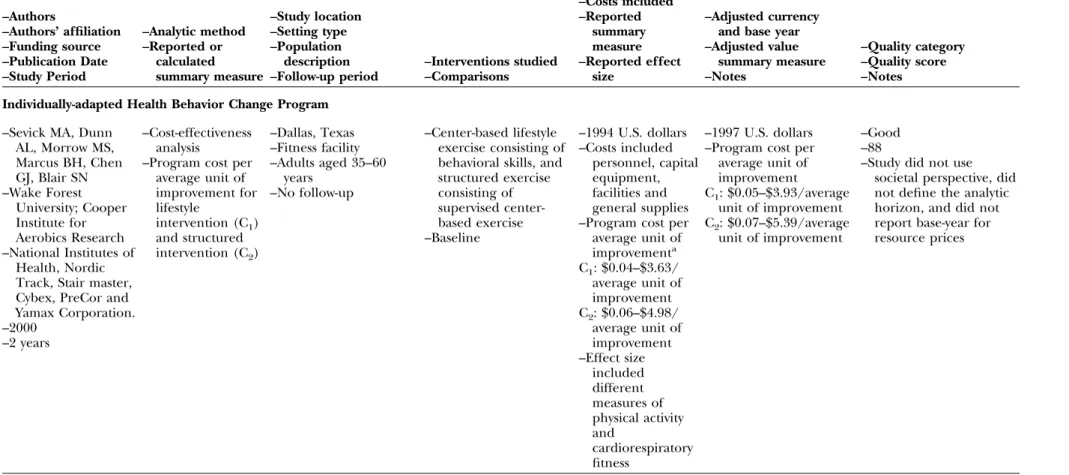
Economic. Our search identified one economic evalu-ation of individually-adapted health behavior change programs. This 2-year study,142 conducted at a fitness facility in Dallas, Texas, evaluated the cost-effectiveness of two physical activity interventions (lifestyle and struc-tured interventions) provided to adults aged 35 to 60 years. The lifestyle intervention consisted of behavioral skills training to integrate moderate-to-intense physical activity into the lives of participants. Behavior modifi-cation and cognitive-behavior modifimodifi-cation techniques were used for behavior change. The structured exercise intervention consisted of supervised center-based exer-cise, in which participants received an exercise intensity prescription of 50% to 85% of maximum aerobic power and exercise of 20 to 60 minutes at each session. Outcome measures included energy expenditure,
mod-erate activity and hard activity (kilocalories per kilo-gram per day), sitting (hours per week), walking (min-utes per day), stair climbing (flights per day), VO2max (milliliters per kilogram per minute), and treadmill time (minutes). The effect size for these outcome measures ranged between 0.23 (additional minutes on the treadmill) and 13.07 (walking minutes per day), and 0.33 (additional kilocalorie per kilogram expendi-ture of moderate activity) to 26.75 (walking minutes per day for lifetime and structured interventions). Program costs included personnel, capital equipment, facilities, and general supplies, but research costs, re-cruitment costs, and value of participants’ time were not included. The adjusted cost-effectiveness ratio for each intervention arm ranged between $0.05 to $3.94 and $0.07 to $5.39 per average unit (as defined in the outcomes measured above) of improvement for life-style and structured intervention, respectively. This study was classified as good, based on the quality assessment criteria used in theCommunity Guide.40The economic summary table for the study is provided in Appendix A, Table A-3, and at the website (www.thecommunityguide.org).
Barriers to intervention implementation. Individually-adapted health behavior change programs require careful planning and coordination, well-trained staff members, and resources sufficient to carry out the program as planned. Inadequate resources and lack of Figure 2. Individually-adapted health behavior change: net percentage change in maximal oxygen consumption (VO2 max)
from baseline in individuals being taught health behavior change strategies. con, control; ex, exercise; inten, intensity; lo, low; v, versus.