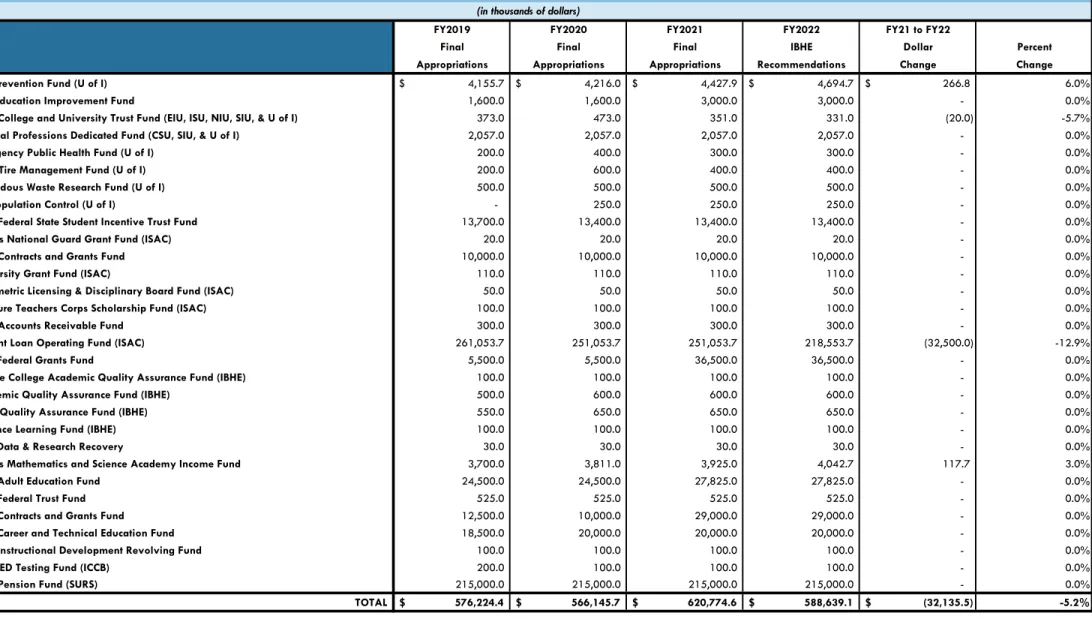
Item #E-1 January 13, 2021
FISCAL YEAR 2022 HIGHER EDUCATION BUDGET RECOMMENDATIONS FOR OPERATIONS, GRANTS, AND CAPITAL IMPROVEMENTS
Submitted for: Action.
Summary: This item recommends approval of the Fiscal Year 2022 Budget
Recommendations for higher education operations, grants, and capital improvements.
Action Requested: That the Illinois Board of Higher Education approve the Fiscal Year 2022 Budget Recommendations for operations, grants, and capital improvements.
APPROVED
Item #E-1 January 13, 2021
FISCAL YEAR 2022 HIGHER EDUCATION BUDGET RECOMMENDATIONS FOR OPERATIONS, GRANTS, AND CAPITAL IMPROVEMENTS
The Illinois Board of Higher Education is pleased to present its Fiscal Year 2022 Budget Recommendations. This budget is the first to be presented by the Board after it has launched its Strategic Planning process and represents an initial investment in the priorities established for the plan. It is also a budget that reflects the tremendous disruptions to society and higher education due to the COVID-19 pandemic, the systemic racial injustices recognized this past summer, and the need to rebuild and invest in a stronger path forward.
Investing in a Vision and Strategic Direction for Higher Education
In late Winter, 2020, the Board – in cooperation with the Illinois Community College Board and the Illinois Student Assistance Commission – prepared to launch its strategic planning process with an emphasis on equity. But within weeks, the pandemic was declared and all attention turned to keeping the state’s students, faculty, and staff safe while keeping learning on track. Higher education leaders, faculty, and staff throughout the state pivoted quickly—faster than many thought possible-- to online learning. But clearly the world of learning had changed, and the impact on low-income students and students of color was particularly devastating.
Then in May, the killing of George Floyd, echoing that of so many others, rallied the country to end systemic racism. The Board saw these significant disruptions as exactly the time to launch a strategic planning process charting a path forward and squarely focused on closing equity gaps.
Throughout the fall, the Board analyzed the state of postsecondary degree and credential attainment, the disparities by race, ethnicity, gender, and income, and how those equity gaps were manifested throughout the higher education system. Board discussion, driven by the data, presented in August and September, including new interactive data maps, and broad stakeholder engagement led the Board to establish the overarching Strategic Direction in December.
Working Vision Statement
Illinois has an equitable, accessible, innovative, nimble, and aligned higher education ecosystem that ensures individuals, families, and communities across the state thrive.
Working Priorities Statement
To fulfill this Vision, over the next 10 years, Illinois must implement a set of strategies and an accountability system aligned with the Core Principles that:
• Increase Postsecondary Credential and Degree Attainment to Develop the Talent that Drives the Illinois Economy: Estimates are that over 60 percent of jobs in Illinois will require a postsecondary degree or credential by the year 2025 and that need will only grow. • Close Equity Gaps: Too many students are left behind by our current higher education
changing demographics of the state, an economic imperative to adapt our system to meet their needs.
• Improve Affordability, Increase Access, and Manage Costs: Affordability is too often seen as the biggest barrier to access and attainment. To increase attainment and close equity gaps we must ensure access, address the underlying affordability issues, and consider the cost structure of higher education. This includes opportunities to improve efficiency and equitable and adequate ways to fund the system.
The Board’s Fiscal Year 2022 budget recommendation makes investments to support three priorities, even as the Strategic Plan with more specific strategies is being developed.
• Increase funding by $50M for MAP to help low-income students afford college. The state’s Monetary Award Program (MAP) is one of the most powerful ways the state invests in low-income students and closing equity gaps. This additional investment will increase the number of students MAP can serve and/or the amount of the grant each student will receive. While MAP needs much more to be fully funded, this investment is an important next step. • Provide an additional $23M for Public Universities to help low-income students and
take a step toward funding equity. The public universities are a vital economic engine and essential in building the state’s future on many dimensions – intellectually, economically, culturally, socially, among others. Investing in our public universities is essential so that students of all ages can reach their goals and flourish. This year the budget reflects a special focus on helping serve low-income students and closing equity gaps, as the universities will have to address students’ heightened academic and social-emotional needs resulting from the pandemic. The additional $23 million is allocated to institutions based on the percentage of Pell students they serve.
• Provide $1M to support roll-out of the Common App to streamline applications to the
state’s public universities. Through this program, students will be able to submit basic information one time to complete multiple public university college applications. Implementation of the Common App will simplify the application process, which will be particularly helpful to students who are first in their families to go to college and attract others who may not be aware of all the public university options in Illinois.
• Maintain AIM HIGH scholarship funding at $35M. The AIM HIGH program provides funding to public universities to offer merit-based scholarships. Universities have used the flexibility allowed in the program to also embed equity. ISAC’s report on the first year of this pilot program found that of the just over 7,400 grant recipients, 32% had a family income under $30,000 and 64% under $75,000. Additionally, 58% of the recipients were also Pell eligible. Approximately 50% of the recipients were White, 17% Latinx, 17% African American, 7% Asian, 9% Two or more/Other. Maintaining state support for AIM HIGH will enable these students to continue to receive awards.
• Provide an additional $5.3M to support Community Colleges. The pandemic has hit low-income communities and communities of color particularly hard and many jobs eliminated during the pandemic will not come back. The Community Colleges play an essential role in
be essential in supporting the state’s economic and educational recovery. We know that students of all ages have been negatively impacted by the pandemic both academically and socially/emotionally. Colleges will need enhanced resources not just to meet these new needs but to “build back better” and provide supports that will close equity gaps permanently.
• Provide $10M toward College Illinois! to step toward financial stability. The state’s pre-paid tuition program has an unfunded liability of $482 million as tuition and fee costs have exceeded contract costs and program investments. This initial contribution of state funds will take a step toward offsetting the unfunded liability.
• Provide $2.9M to support IMSA, student outreach and other services. The proposal includes a $0.4M increase for the Illinois Mathematics and Science Academy to address COVID-related costs and a $2.5M increase across agencies to invest in student outreach, strategic plan implementation, and essential data systems.
Investing in Higher Education to Support Illinois’ Post-Pandemic Economy
As noted in the introduction to the fall opening guidance document, higher education in the state of Illinois and across the country is central to society. Students with some form of higher education earn more money over their lifetime and have a lower probability of unemployment. They also are more likely to live healthy lifestyles, to vote, to be leaders in their communities, and to volunteer for service. Beyond these individual benefits, higher education provides a rich set of benefits to cities and to the state. Our universities are engaged in cutting-edge research and scholarship that saves lives and transforms societies. Indeed, the research being conducted at Illinois universities now includes the epidemiological modeling of the virus transmission, the design and creation of ventilators and other healthcare devices to help COVID-19 patients, the active participation in a number of clinical trials of new drug treatments, and the creation of effective ways to test and track the virus. Quite literally, our institutions are at the forefront of science and discovery during this important time.
Higher education institutions often serve as the cultural and social anchor of their communities, providing important services and expertise to residents, schools, medical facilities, and non -profit organizations, to name a few. In addition, higher education institutions are among the most important economic engines both locally and in the state of Illinois. A quick glance at some numbers underscores this point. Collectively, higher education:
• Educates nearly 775,000 students annually;
• Employs approximately 165,000 people across the state;
• Serves every county in the state with extension offices and other outreach activities;
• Trains most of the doctors, dentists, social workers, nurses, other healthcare workers, as well as many other essential workers in the state; and
• Represents more than $50 billion annual impact on the state’s economy.
The great strength of Illinois’ higher education system is the diversity in size, academic offerings and institutional missions, service to historically underrepresented populations, and the wide geographic distribution of institutions throughout the state.
All of this reminds us why now is the time to invest in higher education in Illinois, not despite but because of the state’s fiscal situation. Higher education can and will be an engine to lead the state to economic recovery.
Recognizing the COVID-19 Impact on Illinois Higher Education
The COVID-19 pandemic has had a profoundly negative impact on a many sectors of the economy, including higher education. As of the end of November 2020, the estimated impact on higher education in Illinois has surpassed $1.5 billion and continues to increase. Although federal relief has been provided, the combined relief from the CARES federal program and the recently passed second round of higher education emergency relief still will cover only a fraction of the impact.
Figure 1
Higher Education COVID-19 Impact by Sector
$1.6 B
Figure 28
University & IMSA COVID-19 Costs by Category
$793M
Private Sector $575,000,000
Public Universities, IMSA & UCLC $792,992,415 Community Colleges $209,332,291 Refunds $99,186,887 Added Costs $234,017,505 Lost Revenues $459,788,023
Figure 3
University, IMSA, & UCLC COVID-19 Impact
$ in Millions
As of the end of November, 2020, public universities have identified impact of $793.0 million, including $459.8 million in lost revenues, $234.0 million in additional costs, and $99.2 million in refunds, mostly from the original closing of campus in the spring. Community colleges’ impact is estimated at $209.3 million, $111.0 million in lost revenues and $96.4 million in additional costs. Although they are not formally tracking the impact on the private sector, the Federation of Independent Illinois Colleges and Universities recently estimated the impact on their members would likely exceed $575 million.
Federal reimbursements will cover only a fraction of the impact. Public universities received a total of $72.5 million to cover institutional costs from the CARES Act. That is just 9.1 percent of the impact identified. The American Council on Education has estimated the maximum amount each eligible higher education institution will receive from the recently passed second COVID-19 aid package. They estimate Illinois public universities will receive an additional $144.6 million, community colleges are eligible for an additional $224.7 million, and the private sector will receive an additional $130.3 million. In total, the maximum federal relief will be $217.1 million, which is 27.4 percent of the identified impact as of November 30, 2020. Costs are expected to continue to increase, at least through the end of the academic year for all three sectors.
$0 $100 $200 $300 $400 $500 $600 $700 $800 $900 Private Not-for-Profit Federal Estimate Private Not-for-Profit Impact Community College Federal Estimate Community College Impact Public University Federal Estimate Public University Impact
Figure 4
American Council on Education Estimates
Second Federal COVID-19 Relief Package for Illinois Higher Education
Simulated Total
Allocation % of IL Total
Estimated Minimum Amount
for Student Grants
% for Student Grants Maximum Institutional Amount % for Institutions Illinois Total $ 706,630,000 $ 207,023,740 29% $ 499,606,260 71% Public Universities $ 215,442,000 30% $ 70,812,841 33% $ 144,629,159 67% Community Colleges $ 289,663,000 41% $ 65,004,912 22% $ 224,658,088 78% Private Sector $ 201,525,000 29% $ 71,205,987 35% $ 130,319,013 65% $ in Thousands
COVID-19 losses are a problem for higher education nationwide, but they are particularly difficult for Illinois public universities and community colleges, still struggling to recover from the budget impasse. For public universities that amounted to a loss of $851.2 million. For community colleges it was $211.8 million.
Helping Students in a Time of COVID-19
As the pandemic unfolded, it became clear that the impact on students and families would be profound, especially those who were already at risk of not enrolling or completing college – low-income students, first-generation students, rural students, and students of color. IBHE partnered with ICCB and ISAC on a multi-part strategy to ameliorate some of the initial impacts and responded quickly as new issues emerged.
• Student Emergency Grants. One of the first challenges to emerge was that students needed funds for a variety of emergency needs, including technology access as courses moved online, food, rent, child care costs, and the like. Together, the IBHE Board and agencies raised over $700,000 in private support to provide student emergency grant funding to each community college and public university. We also ensured that these grants funds could support students not eligible for the subsequent federal CARES Act funds, such as undocumented students or international students.
• “Stay the Course” Public Education Campaign. In partnership with pro-bono partner Kivvit, IBHE developed a public awareness campaign to encourage students to “Stay the Course” on their college journey. It was an effort to counter a media narrative that encouraged taking a “gap year” if the Fall, 2020 semester would be online. For many already vulnerable students, a gap year could mean never starting or completing college. The campaign involved a digital ads that directed students to a dedicated Stay the Course website where they could find resources and connections to the ISACorps near-peer mentors for help.
State Board of Education, school district superintendents, and enrollment management leaders from community colleges and public universities to create a resource guideto help school districts, institutions, and policymakers best support students.
• WiFi Hotspot Map. The digital divide emerged as one of the major equity gaps in education. After Southeastern Illinois College, a community college, came up with the idea of making their parking lot a WiFi hotspot and others followed, IBHE worked with state agency partners to create a drive-up WiFi hotspot map in English and in Spanish.
• Equity-Driven Distribution of Governor’s Emergency Education Relief (GEER) Funds. Through the support and commitment to higher education of Governor JB Pritzker, higher education in Illinois received $48 million in GEER funds out of $108 million. IBHE and ICCB jointly developed a methodology to distribute the funding to public universities and community colleges so that institutions with higher percentages of Pell students received disproportionately more funding. The agencies required institutions to use the funds to support students at risk of not enrolling or continuing due to the pandemic. Institutions have used the funds in innovative ways. Of the total, $3 million was set aside for competitive grants open to private and public universities, similarly to provide supports for at-risk students.
• Fall Opening Committee and Guidance. Soon after the transition to online learning occurred and it was clear that widespread in-person coursework would not continue, attention turned to plans for opening campuses for the Fall, 2020 semester. IBHE convened a Fall Opening Committee composed of public university, private university, and community college presidents, faculty, and staff, along with public health experts to develop Guidance
for opening higher education campuses safely in the fall. Concurrently, ICCB convened a complementary committee, which developed community college-specific Guidance that was fully aligned to the IBHE guidance.
The challenges students, families, and our colleges and universities face will continue long after the pandemic ends. The impact on students’ learning, their social emotional needs and their finances, the financial loss higher education institutions have faced and the new costs necessary to effectively meet students’ need will continue. IBHE recognizes this and has done its best in these Fiscal Year 2022 budget recommendations to invest funds where students have faced the greatest impact.
Budget Recommendation Summary
As summarized in Figure 5 below, the Board is recommending a general funds operating appropriation increase of $92.3 million as well as an incremental $105.7 million to cover the amounts certified by the State University Retirement System and contributions to community college health insurance program.
The Board’s priority is to have the capital projects funded through Rebuild Illinois launched. However, to ensure Illinois students have 21st century learning environments, IBHE also recommends
$510.1 million for capital renewal, plus $1.273 billion for regular capital, cost escalations, and emergencies.
equitable economic recovery that will leave Illinois even stronger after the pandemic than it was before it.
Figure 5
IBHE Fiscal Year 2022 Recommended Budget Changes
Operations Funding
General Revenue* Approp. FY 21 Recommended Change Recommendation FY 22 Change %
Universities $ 1,157,861,000 $ 23,157,200 $ 1,181,018,200 2.0%
Community College Base & Equalization, and City College of
Chicago $ 264,409,500 $ 5,288,200 $ 269,697,700 2.0%
Monetary Award Program $ 451,341,900 $ 50,000,000 $ 501,341,900 11.1%
AIM HIGH $ 35,000,000 $ - $ 35,000,000 0.0%
College Illinois! State Contribution $ - $ 10,000,000 $ 10,000,000 NEW
ISAC Operations $ 6,997,700 $ 2,002,300 $ 9,000,000 28.6%
ICCB Operations/Server
Replacement $ 2,083,900 $ 250,000 $ 2,333,900 12.0%
IBHE Ops./Strategic Planning
Implementation $ 2,424,100 $ 250,000 $ 2,674,100 10.3%
IMSA $ 18,943,900 $ 378,900 $ 19,322,800 2.0%
Common App $ - $ 1,000,000 $ 1,000,000 NEW
All Other Operations and Grants $ 109,414,900 $ - $ 109,414,900 0.0%
General Revenue Sub-total $ 2,048,476,900 $ 92,326,600 $ 2,140,803,500 4.5%
Other Funds
Governor' Emergency Ed. Relief $ 50,000,000 $ - $ 50,000,000 0.0%
ISAC Other Funds Grants and
Operations $ 242,004,700 $ (32,500,000) $ 209,504,700 -13.4%
All Other Operations and Grants $ 113,769,900 $ 364,500 $ 114,134,400 0.3%
Operations All Funds Total $2,454,251,500 $ 60,191,100 $ 2,514,442,600 2.5%
State University Retirement System
State Contribution (GRF) $ 1,780,767,000 $ 105,512,000 $ 1,886,279,000 5.9%
Community College Health
Insurance (EAF) $ 4,622,773 $ 211,448 $ 4,834,221 4.6%
State Contributions $ 215,000,000 $ - $ 215,000,000 0.0%
Narrative by Budget Area PUBLIC UNIVERSITIES
Fiscal Year 2022 Recommended Funding: $1,181,018,200
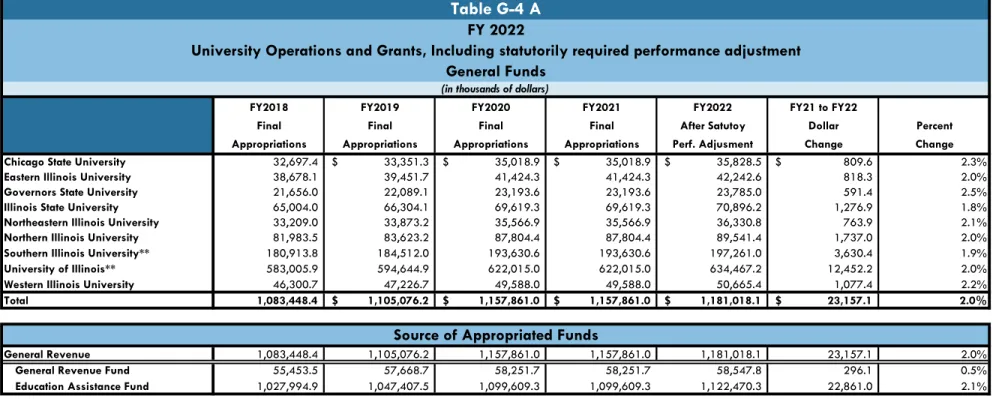
The Board is recommending a $23.2 million (2 percent) increase for Fiscal Year 2022.
The Board’s recommended increase signals the Public Universities’ importance at a time when the state’s budget is under enormous strain due to the pandemic. Throughout the pandemic, universities have been asked and provided support in a myriad of ways, from epidemiological modeling, donating PPE and supplies for testing, setting up programs to train contact tracers, and helping communities in rebuilding after civil unrest. Among the most notable contributions is the COVID-19 saliva test, developed and used by the University of Illinois to provide rapid test results that enabled them to safely return students to campus. Soon, the saliva test will be available to public university campuses across the state. Next attention will turn to rolling out the COVID-19 vaccine and public universities will likely play an important role.
At the same time, the strain on students will continue, with low-income and students of color disproportionately impacted by COVID.
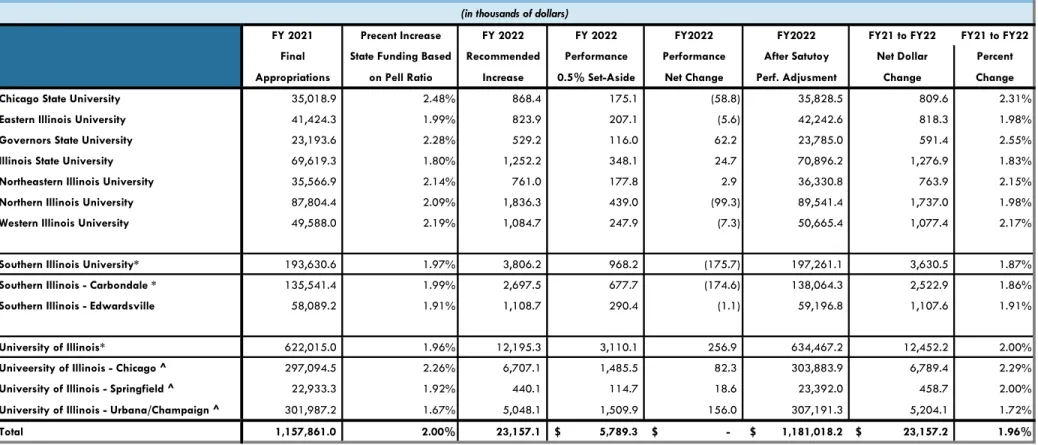
IBHE has kept at the forefront of its budget recommendations closing equity gaps in access, persistence, and completion, a strategic plan priority. IBHE recognizes that Universities will be called on to provide additional academic and social-emotional supports to ensure students’ success and resources required to meet their specific needs. Therefore, we are recommending that the additional $23.2 million be allocated based on the percentage of Pell students each institution serves, a step toward equity in funding.
IBHE recognizes that a new formula for funding public universities that drives toward adequate and equitable funding will require intense collaboration and complex analysis, based on core principles to be developed during the strategic planning process. The allocation proposed for Fiscal Year 2022 is not intended to replace this process nor is it intended to be a new formula. Instead, it is a one-year allocation approach that takes a step toward equitable allocation of new resources, as the table below shows.
Figure 6
Fiscal Year 22 Funding Allocation based on % Pell
School Appropriation FY 21 % PELL Recommended FY 22 Increase Appropriation % Diff. FY 21
CSU $ 35,018.9 63.6% $ 868.4 2.48% EIU 41,424.3 38.6% 823.9 1.99% GSU 23,193.6 53.5% 529.2 2.28% ISU 69,619.3 28.8% 1,252.2 1.80% NEIU 35,566.9 46.2% 761.0 2.14% NIU 87,804.4 43.8% 1,836.3 2.09% SIUC* 135,541.4 38.6% 2,697.5 1.99% SIUE 58,089.2 34.5% 1,108.7 1.91% UIC 297,094.5 52.3% 6,707.1 2.26% UIS 22,933.3 35.0% 440.1 1.92% UIUC 301,987.2 22.4% 5,048.1 1.67% WIU 49,588.0 48.7% 1,084.7 2.19% Total $ 1,157,861.0 37.0% $ 23,157.2 2.00%
1. SIUC includes funding for Southern Illinois School of Medicine 2. Does not include adjustment for performance funding
$ in thousands
The allocation is based on each institution’s percentage of Pell students in its undergraduate student body compared to the statewide percent of Pell students. Those institutions that serve higher than average percentages of Pell students receive a higher percentage increase. The allocation shown above is presented before the statutorily-required performance funding adjustment, which is presented in Tables 4A and 4B in Appendix G.
This small step toward equity reflects the Board’s efforts to begin to provide resources aligned to student needs and for institutions to close equity gaps.
ILLINOIS COMMUNITY COLLEGE BOARD
Fiscal Year 2022 Recommended Funding: $360,331,500 Community College Operating Grants
Fiscal Year 2022 Recommended Funding: $269,697,700
IBHE recommends Fiscal Year 2022 funding for the Base Operating, Equalization and City Colleges of Chicago be increased $5.3 million.
• Base Operating: $183,539,000, an increase of $3,598,800 • Equalization: $72,628,000, an increase of $1,424,100
The pandemic has hit low-income communities and low-skilled workers particularly hard. We must continue to invest in our community college system to create the opportunities for people throughout the state to access affordable degree options, upskilling, and reskilling opportunities, and essential training, all to support the state’s economic recovery. Colleges will also need enhanced resources to meet the academic and social-emotional needs of students returning to school and ensure they stay on track.
Adult Education and Postsecondary Career and Technical Education Fiscal Year 2022 Recommended Funding: $51,957,100
IBHE recommends Fiscal Year 2022 funding be maintained at the Fiscal Year 2021 levels for ICCB adult education and career and technical education programs administered under the Workforce Innovation and Opportunity Act (WIOA).
• Basic grants: $22,651,000, no change
• Performance Based grants: $11,236,700, no change
• Career and Technical Education Programs: $18,069,400, no change
Adult Education programs provide critical services to adults with less than a 12th grade education, adults for whom English is a second language, and high school and adult students pursuing career and technical (CTE) training. CTE programs offered by the colleges provide students with opportunities in over 100 career & technical fields. These programs include integrated academic and technical instruction, work-based learning, dual credit opportunities and potential for continuing education at the baccalaureate level. Federal grants for programs like adult education flow through the state appropriation process. This state funding provides the required maintenance of effort to qualify for the federal funds.
ICCB Other Grants and Operations
Fiscal Year 2022 Recommended Funding: $36,342,800
IBHE recommends Fiscal Year 2022 funding for all the grants listed below at the same level as Fiscal Year 2021
• Performance based funding was legislated by the Illinois General Assembly in June, 2012 with Public Act 97-320, which requires public higher education institutions to have a performance funding component in their budget annually. For community colleges, performance is defined not only by graduation rates, but by entered employment, certificate attainment, persistence, and success towards college level coursework: $359,000, no change
• Small College Grants. This grant is designed to recognize that small colleges have fixed costs, particularly in administrative areas, and that these costs should be recognized to some extent in funding: $584,000, no change
• Lincoln’s Challenge Scholarships. The program is a military-style boot camp for at-risk teenagers who have not completed high school. Students successfully completing the program are eligible to receive a scholarship to attend a community college through this grant: $60,200, no change
• East St. Louis Higher Education Center. Funding for the East St. Louis Community College Center provides support to fund higher education consortium activities at the center. Higher education training has been offered at the Center since 1999 after the closing of Metropolitan Community College: $1,457,900, no change
• Veterans Shortfall Grants. This grant is provided for offsetting the mandated tuition and fee waiver for veterans enrolling at community colleges. This grant only covers a small portion of costs waived by community colleges and goes to those colleges who face the greatest burden by waiving veteran tuition and fees: $4,264,600, no change
• Alternative Schools Network. This grant funds the Alternative Schools Network to re-enroll high school dropouts in a program that will ultimately allow them to receive a high school diploma: $3,000,000, no change
• P-20 Council. The mission is to deliberate and make recommendations to the Governor, Illinois General Assembly, and state agencies for developing a seamless and sustainable statewide system of quality education and support, from birth through adulthood, to maximize students’ education attainment, opportunities for success in the workforce, and contributions to their local communities. The Council is composed of members appointed by the Governor representing business leaders, local government, university administrators, school boards, unions, nonprofits, teachers, faculty, independent colleges, and parents. ICCB administers grant funds on behalf of the Council: $150,000, no change
• Competitive Equity Grant Program provides funding to 47 grantees, including many of the state’s community colleges and fifteen community-based organizations, to address education, workforce, and equity gaps for minority populations. The item includes ICCB’s Workforce Equity Initiative (WEI) that specifically targets African American students through the development of occupational programs at community colleges. African American students must comprise a minimum of 60% of the students served in the WEI program. $23,794,400, no change
• Grants for Transitional Math and English Development. The Postsecondary and Workforce Readiness Act (PWR Act) includes Transitional Math and Transitional English, which is built around courses that increase college readiness for high school seniors. Students who successfully complete the course are guaranteed placement in credit-bearing math courses upon enrolling at any Illinois community college or accepting Illinois university. Community colleges and high schools work in partnership to create the courses that incorporate the required competencies and policies. $1,000,000, no change
The recommendation also includes $2,33,900 for the ICCB Operating budget, an increase of $250,000 to replace an outdated server supporting important community college functions.
ILLINOIS STUDENT ASSISTANCE COMMISSION (ISAC) Fiscal Year 2022 Recommended Funding: $566,643,500
IBHE recommends a Fiscal Year 2022 budget of $566.6 million an increase of $62.0 million above Fiscal Year 2021. This is comprised of $50 million for the Monetary Award Program, $10 million for a cash payment to College Illinois!, and $2 million for agency operations and outreach. Recommended funding for the AIM HIGH program remains at Fiscal Year 2021 levels.
ISAC Scholarship and Grant Programs Monetary Award Program
Fiscal Year 2022 Recommended Funding: $501,341,900
The Fiscal Year 2022 recommendation is a $50 million increase in MAP to continue to close the gap in postsecondary enrollment and completion between low-income and non-low-income students. MAP is a key part of the Board’s strategy to close equity gaps and help the state reach its higher education attainment goals.
Unfortunately, until recently, investments in MAP have not kept up with rising costs leading to a long decline in the proportion of tuition and fees a MAP award covered. The maximum value of an award remained almost constant from Fiscal Year 2002 until adjustments were made with a 10 percent increase in funding in Fiscal Year 2018 and a 12.5 percent increase in Fiscal Year 2020. However, even with these adjustments, the proportion of public university tuition and fees covered by a MAP grant has fallen from 100 percent in Fiscal Year 2002 to 33% in Fiscal year 2021. This directly impacts low-income students’ ability to afford college.
Figure 7
MAP Coverage: Maximum Grant vs. Weighted Public University Tuition
Source: ISAC
But there are additional challenges. In Fiscal Year 2020 ISAC was only able to fund 52% of eligible students, because funds ran out. First generation college students, who may apply later, as well as community college students who tend to make decisions later, are the students most often left out because the grants are awarded in order of application.
And as Figure 7 shows, there is a decline in the number of students eligible for MAP. Unfortunately, this is because fewer low-income families are completing the FAFSA financial aid form, which also
Figure 8
Monetary Award Program Eligibility History: Fiscal Years 2009 to 2020
More robust MAP funding will be an important part of the Board’s strategy to increase postsecondary attainment, close equity gaps, and increase affordability.
AIM HIGH
Fiscal Year 2022 Recommended Funding: $35,000,000
The IBHE Fiscal Year 2022 recommendation is to maintain AIM HIGH funding at the Fiscal Year 2021 level. This will allow current program participants to continue to receive awards and a limited new cohort of students to receive awards.
AIM HIGH, first funded in Fiscal Year 2019, is a merit-based, pilot scholarship program. Recipients can have a maximum income of 6 times the poverty level (about $148,000 for a family of 4). Once an AIM HIGH grant is made, the university must pledge to continue support to the student for up to four years, as long as the student meets continued eligibility requirements. In addition, Universities must match state appropriated funds to provide additional scholarships. The match requirement has been a problem for several universities that serve a high proportion of low-income and minority students. Legislation passed the General Assembly on January 11, 2021, that will reduce the matching requirement for all universities and even more universities that serve the highest proportion of low-income students, allowing more low-income students to benefit.
In an analysis of the first year of the program, ISAC found that grants were awarded to 7,401 students, with an average grant of $3,517. About 64 percent of grant recipients had a family income under $75,000, with 32 percent of those below $30,000. Approximately 58 percent of recipients were also Pell eligible. Grant recipient demographics were 50 percent White, 17 percent Latinx, 17 percent African American, 7 percent Asian. Approximately 86 percent of first-time freshmen recipients had a GPA between 3.0 – 4.0.
Universities have reported that the AIM HIGH program has been instrumental in attracting Illinois 50,000 100,000 150,000 200,000 250,000 300,000 350,000 400,000 2009 2010 2011 2012 2013 2014 2015 2016 2017 2018 2019 2020
College Illinois! State Contribution
Fiscal Year 2022 Recommended Funding: $10 million NEW
IBHE is recommending a $10 million Fiscal Year 2022 appropriation. College Illinois! has not previously received state appropriations.
The College Illinois! program is Illinois’ pre-paid tuition program. Families were able to buy either community college or university contracts over time that would guarantee one or more semesters of tuition and fees when the child enters college. Benefits can be used at public or private colleges and universities in-state and out-of-state, with a value up to the mean-weighted-average tuition and mandatory fees at the state schools in the plan.
Over time, the increase in tuition and fees at Illinois public universities substantially exceeded the projections embedded in the contract cost and growth in program investments. An estimated $480 million is needed to fully cover the costs of the current contract holders. The program is closed to new enrollments.
The recommended $10 million appropriation would begin to offset this liability.
ISAC Operational Support and Outreach
Fiscal Year 2022 Recommended Funding: $9 million
The Fiscal Year 2022 recommended increase of $2 million will allow ISAC to continue its core operation of state grant and scholarship programs and outreach and education to students and families on financing college.
Although this is an increase in state-funded appropriations, this does not represent an increase in spending. Rather, it makes-up for declining federal loan support revenues. Between 2006 and 2014, the operations of all ISAC programs were paid for with revenue from ISAC’s Student Loan Operating Fund (SLOF), which, according to ISAC, saved the state at least $150 million. However, revenues from SLOF come from the federal student loan program, which was discontinued, with no new loans serviced since 2010. While ISAC’s student loan operations remain self-sustaining, they cannot continue to fully fund the rest of the agency’s core operations and maintain funds to cover the winddown of the program once it final loans have been closed.
Other ISAC Programs
Fiscal Year 2022 Recommended Funding: Same as Fiscal Year 2021 Funding Levels.
IBHE recommends Fiscal Year 2022 funding be maintained at the Fiscal Year 2021 levels for the following ISAC grant programs:
• Teacher/Child Care Provider Loan Repayment Program. The Illinois Teachers and Child Care Providers Loan Repayment Program provides awards to encourage academically talented Illinois students to teach in Illinois schools in low-income areas and to enter the early childcare profession and serve in low-income areas in Illinois. If these obligations are met by a Federal Stafford loan borrower who has qualified for the federal government’s loan forgiveness programs, Illinois may provide an additional matching award of up to $5,000 to the qualifying teacher to repay their student loan debt: $439,900, no change
• Minority Teachers of Illinois (MTI) Scholarship. The MTI Scholarship Program encourages academically talented minority students to pursue careers as teachers at Illinois preschool, elementary and secondary schools. The program also aims to provide minority children with access to a greater number of positive minority role models. The scholarship awards up to $5,000 per academic year for a maximum of four years. Students receiving this scholarship must fulfill a teaching commitment at an Illinois public, private, or parochial preschool, elementary or secondary school at which no less than 30 percent of the enrolled students are minority students for each year of scholarship assistance: $1,900,000, no change • Dependents Grant. If a correctional officer employed by the Illinois Department of
Corrections in a security position or an Illinois police or fire officer is killed or sustains an injury resulting in a permanent disability in the line of duty, the officer’s spouse and children may receive grant assistance under this program, without regard to financial need: $1,237,300, no change
• Nurse Educator Loan Repayment. To address the shortage of nurses and the lack of instructors to staff courses teaching nursing in Illinois, the Nurse Educator Loan Repayment Program encourages longevity and career change opportunities. The program is intended as an incentive to nurse educators in maintaining their teaching careers within the State of Illinois. The annual awards to qualified nurse educators may be up to $5,000 to repay their student loan debt and may be received for up to a maximum of four years: $264,000, no change
• Veterans’ Home Nurse Loan Repayment. This program provides for the payment of eligible educational loans as an incentive for nurses to pursue and continue their careers at State of Illinois veterans’ homes. The annual award to qualified registered professional nurses and licensed practical nurses may be up to $5,000 to repay their student loan debt. This award may be received up to a maximum of four years: $26,000, no change
• Golden Apple Scholars of Illinois Program. The Illinois Student Assistance Commission provides pass-through funding to the Golden Apple Scholars of Illinois Program. The program is a public-private partnership that recruits and prepares talented and diverse high school graduates for successful teaching careers in high-need schools throughout Illinois and provides scholarships to students pursuing teaching degrees: $6,498,000, no change • Golden Apple Accelerators Program, a new teacher residency and licensure program that
will expedite the preparation of highly-qualified teachers in southern, central, and western Illinois.: $750,000, no change
• Grant Program for Exonerees provides grant assistance to an individual who has been issued a pardon by the governor of the State of Illinois on the grounds of innocence of the crime for which that person had been imprisoned, or who received a certificate of innocence from a circuit court. The grant provides assistance toward tuition and mandatory fees for no more than two semesters per regular school year (the grant is not available for summer terms) for undergraduate or graduate study at Illinois public colleges and community colleges. Recipients may receive assistance for a maximum of the equivalent of four regular school years (eight semesters) of full-time enrollment: $150,000, no change
• Veterans Home Loan Repayment program provides for the payment of eligible educational loans as an incentive for medical providers to pursue and continue their careers at State of Illinois veterans' homes. The annual award to qualified physicians, certified nurse practitioners, registered professional nurses, certified nursing assistants and licensed practical nurses may be up to $5,000 to repay their student loan debt. This award may be received for up to a maximum of four years: $26,400, no change
ILLINOIS MATHEMATICS AND SCIENCE ACADEMY
Fiscal Year 2022 Recommended Funding: $19,322,800 (General revenue)
IBHE recommends a total appropriation of $24.4 million for Fiscal Year 2022, including $19.3 million in general revenue and $4.0 million from the IMSA Income Fund This represents an increase of $378,900 in general revenue and $117,700 in the IMSA Income Fund. This two percent general revenue increase will cover most inflationary costs. It will not allow for any increase in programs and services.
IMSA was established in 1985 to provide a uniquely challenging education for Illinois students talented in mathematics and science and to serve as a catalyst for the advancement of STEM (Science, Technology, Engineering, and Mathematics) development and education across Illinois. The enrollment for the Fall 2020 was 652. As with most residential schools, IMSA was forced to send students home and move to virtual learning in March. Like universities and community colleges IMSA has experienced additional costs and lost revenues due to the COVID-19 response.
STATE UNIVERSITIES CIVIL SERVICE SYSTEM (SUCSS) Fiscal Year 2021 Recommended Funding: $1,114,700
The Fiscal Year 2022 recommendation for SUCSS represents an appropriation equal to the Fiscal Year 2021 appropriation.
SUCSS provides a statewide personnel administration system at the 12 public universities and at five affiliated agencies. They administer, develop, and maintain the basic rules and procedures related to the employment of professional (non-academic), technical, and support staff. This includes rewriting job descriptions and auditing positions to assure appropriate alignment within the rules.
ILLINOIS BOARD OF HIGHER EDUCATION
Fiscal Year 2022 Recommended Funding: $12,372,800
The Fiscal Year 2022 general funds recommendation for IBHE includes $250,000 to help the Board implement the new strategic plan. The Strategic Plan implementation will be launched in Fiscal Year 2022 and IBHE anticipates that support will be needed to achieve the three priorities outlined in the initial strategic direction:
• Increase postsecondary degree and credential attainment to develop the talent that drives Illinois’ economy
• Close equity gaps for those who have been underserved by the higher education system • Improve affordability, increase access and manage costs
IBHE Operational Grants Supporting Student, Academic Programs and Research Common Application
Fiscal Year 2022 Recommendation: $1,000,000, New
The Board is recommending $1 million to cover the costs of implementing the Common App, an online program that allows students to complete college applications for multiple schools without filling out the same information multiple times. This system is currently used by 915 schools across the country. Thirty-four Illinois schools are members of Common App, including Chicago State University, Northern Illinois University, and the University of Illinois at Chicago. This appropriation would expand services and provide funding as Common App is rolled out at all public universities in Illinois.
Having a Common App will simplify the college application process, helping more low-income students and first-generation college goers to access college and encouraging more students to consider Illinois public universities.
This initiative was proposed by Governor JB Pritzker in his Fiscal Year 2021 budget, but it was not funded. The IBHE is recommending that it be included in Fiscal Year 2022.
Diversifying Higher Education Faculty in Illinois (DFI) Fiscal Year 2022 Recommendation: $1,456,500
The Board is recommending maintaining the Fiscal Year 2022 appropriation at the same level as Fiscal Year 2021.
IBHE provides competitive fellowships to eligible underrepresented students pursing graduate and professional degrees at Illinois public and private institutions of higher education. As a condition of their award, recipients agree upon completing their graduate degree to accept a teaching or staff position at an Illinois higher education institution or governing board, or an education -related position in a state agency for five years. For Fiscal Year 2021, DFI is funding 104 fellowships and will be an important part of the Board’s effort to close equity gaps.
Cooperative Work Study Grants
Fiscal Year 2022 Recommendation: $980,500
The Board is recommending Fiscal Year 2022 funding at the same level as Fiscal Year 2021 funding.
IBHE awards grants to public and nonpublic institutions of higher education to provide internship experiences in business, industry, and government for undergraduate students. For Fiscal Year 2020, IBHE funded projects at 32 schools which provided approximately 1,000 students with internships statewide. In Fiscal Year 2022, IBHE will re-focus the grants to help close equity gaps in internship opportunities.
MyCreditsTransfer Project
Fiscal Year 2022 Recommendation: $183,300
The Board is recommending Fiscal Year 2022 funding at the same level as Fiscal Year 2021. The MyCreditsTransfer Project is a statewide web-based tool to aid students who intend to transfer among Illinois higher education institutions. Students create personal accounts to track their progress toward specific degrees at institutions where they have not yet matriculated.
Having this information is a powerful way to ensure students successfully move across and through the higher education system toward their degrees, making the most of their time and money. It is another tool that especially helps first-generation, low-income, and minority students successfully navigate the higher education system, helping to close equity gaps.
In addition to the IBHE grant, MyCreditsTransfer is supported by the University of Illinois, the iTransfer.org project, and the participating institutions.
More information on MyCreditsTransfer can be found at mycreditstransfer.com.
Illinois Mathematics and Science Academy Fusion Program Fiscal Year 2022 Recommendation: $95,900
The Board is recommending Fiscal Year 2022 funding remain at the Fiscal Year 2021 level. IMSA Fusion is an after-school enrichment program for Illinois students, with a special focus on students historically underrepresented and underserved in mathematics and science. It provides services to students in late elementary (grades 4-5) and middle school (grades 6-8) who are talented, interested and motivated in mathematics and science. Fusion also serves as a professional development program for participating Illinois teachers.
IMSA Fusion has four major goals:
• To maintain or increase students’ interest, involvement and literacy in science and mathematics.
• To enhance the knowledge and skills of middle school science and mathematics teachers; • To stimulate excellence in middle schools’ science and mathematics programs; and
• To help increase access to programming for students who are historically underrepresented in mathematics and science, and for all areas of the state.
Grow Your Own (GYO) Teacher Education Initiative Fiscal Year 2022 Recommendation: $2,466,300
The Board is recommending Fiscal Year 2022 funding at the same level as Fiscal Year 2021. IBHE provides awards under the Grow Your Own Teacher Education Initiative (GYO) through Grow Your Own-Illinois. This program recruits and prepares parent and community leaders and para-educators statewide to become effective teachers 1) in hard to staff schools serving a substantial percentage of low-income students, and 2) in hard to staff teaching positions in schools serving a
Beginning in Fiscal Year 2020 administration and oversight of the programs throughout the state was transferred to GYO-Illinois. GYO-Illinois provides services directly in conjunction with Northeastern Illinois University and provides funding to programs operated out of Eastern Illinois University and Southern Illinois University.
Nursing School Grant Program
Fiscal Year 2022 Recommendation: $373,900
The Board is recommending Fiscal Year 2022 funding at the same level as Fiscal Year 2021. Nursing School grants expand or improve existing registered nursing programs to help address Illinois’ nurse shortage. Funds are used to expand partnerships across institutions to increase the opportunities for Registered Nurses with associate degrees to earn baccalaureate degrees in nursing. Funds are also used to improve student retention and improve the student pass rates on national licensure examinations.
For Fiscal Year 2022, it is anticipated the program will provide grants to seven programs.
Nursing Educator Fellowships
Fiscal Year 2022 Recommendation: $197,400
The Board is recommending Fiscal Year 2022 funding at the same level as Fiscal Year 2021. The Nurse Educator Fellowships assists Illinois institutions of higher education with retention of their well-qualified nursing faculty members through a combination of professional and financial recognition.
With salaries increasing for nurses in health care settings, incentives are needed to keep nurse faculty in higher education. Achieving the status of Nurse Educator Fellow is highly competitive and requires a proposal on how the Fellowship will help the candidate achieve their professional goals in nursing education, research, or outreach. Fellows conclude the program with a presentation and discussion with the members of the Advisory Board for the Illinois Center for Nursing. In Fiscal Year 2022, IBHE will assess how the program can better support faculty of color.
Creating Pathways and Access for Student Success Foundation (CPASS) Fiscal Year 2022 Recommendation: $1,433,600
The Board is recommending Fiscal Year 2022 funding at the same level as Fiscal Year 2021.
The Creating Pathways and Access program aims to increase the number of underrepresented students in major healthcare and related STEM professions by providing a strong education foundation and access to resources. Hands-on programs focus on STEM and STEM education for middle, high school, and college students.
In Fiscal Year 2021 the program anticipates serving over 900 students.
University Center of Lake County
Fiscal Year 2022 Recommendation: $1,055,700
The Board is recommending Fiscal Year 2022 funding at the same level as Fiscal Year 2021 for the University Center of Lake County.
Established by IBHE in 1998, the University Center of Lake County (UCLC) is a consortium of 16 public and private colleges and universities that deliver more than 127 bachelor completion, master’s degrees, and certificate and workforce development programs to an underserved northeast suburban Chicago. The 91,000 square foot state-owned UCLC facility was built with county, state, and federal funds on land donated by the College of Lake County in Grayslake. More information on the UCLC can be found at ucenter.org.
Quad-Cities Graduate Study Center
Fiscal Year 2022 Recommendation: $73,800
IBHE is recommending Fiscal Year 2022 funding at the same level as Fiscal Year 2021.
The Quad-Cities Graduate Study Center (Grad Center) is an academic consortium that was founded in 1969 by members of the business, government, and education communities to increase access to high quality graduate-level programming and foster local economic growth. The Grad Center is designed for students whose work and family responsibilities make traditional on-campus study difficult. The Grad Center strives to develop convenient and diverse program offerings for students. The Grad Center works with 5 member institutions to offer graduate programs with certificate, masters, doctorate, and non-credit options to students.
More information on the Quad-Cities Graduate Center can be found at gradcenter.org. STATE UNIVERSITIES RETIREMENT SYSTEM (SURS)
Fiscal Year 2021 Recommended Funding for All Funds: $2,106,113,221
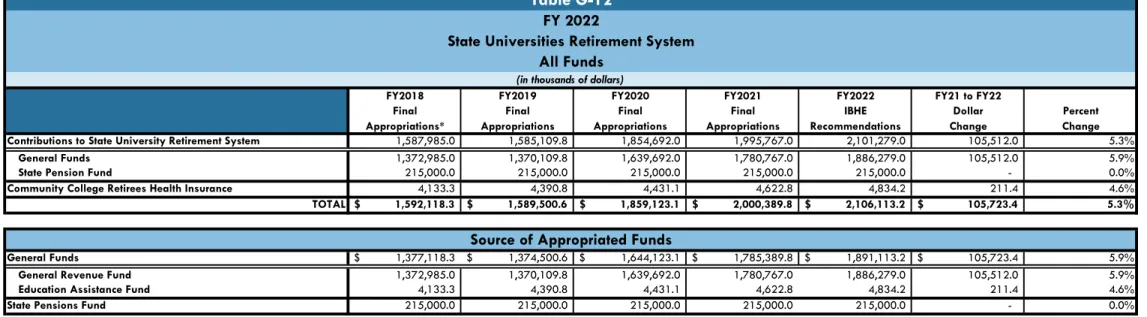
The Board is recommending Fiscal Year 2022 SURS funding at the full certified level, a $105.5 million increase over Fiscal Year 2021, and the Community College Health Insurance fund at a $211,448 increase.
State Universities Retirement System. It is sometimes noted that funding for higher education has increased because the state has sharply increased contributions to the State University Retirement System (SURS). SURS contributions are projected to be 808 percent higher in Fiscal Year 2022 than in Fiscal Year 2002. This is primarily due to the implementation of the legislatively mandated pension ramp, to address underfunding of past liabilities. The goal of the ramp is to reach 90 percent funding of obligations by 2045. However, SURS indicates the actuarial value of their assets was only 42.23 percent of obligations at the end of Fiscal Year 2020. Annual contributions are expected to continue to increase rapidly until 2045 due to the back-loading of the pension ramp.
Figure 9
SURS Funding Compared to Higher Education Funding Fiscal Years 2000-2021 (General Funds)
On the other hand, due to the implementation of less generous Tier II benefits for new employees in 2011, the normal cost of covering pensions for current employees is decreasing and is expected to continue to decline each year. The normal pension cost is the amount of money necessary to cover the contributions necessary to fund 100 percent of the eventual payouts of current workers based on current actuarial assumptions. The proportion of total SURS contributions that cover normal costs decrease each year and has already fallen to less than one-fourth of total contributions. Past liabilities will account for 80.5 percent of the total in Fiscal Year 2022.
The Board of Trustees of the State Universities Retirement System has certified that the state mandated contribution to SURS for Fiscal Year is just over $2.1 billion, an increase of $105.5 million over the Fiscal Year 2021 appropriated amount. Only $445.1 million (20.1 percent) of the certified amount will go to cover the normal/current cost of employees’ earning benefits in Fiscal Year 2022 and 1.1 percent goes for the expenses of administering the program. The remaining $1.7 billion (78.8 percent) goes to cover past unfunded liabilities.
Community College Health Insurance Security Fund. The State also appropriates funds to SURS for the Community College Health Insurance Security Fund, a retiree health insurance program. SURS has also certified the Fiscal Year 2022 contribution amount to the Community College Retiree Health Insurance Fund at $4,834,221, an increase of $211,448.
$0 $500,000 $1,000,000 $1,500,000 $2,000,000 $2,500,000 00 01 02 03 04 05 06 07 08 09 10 11 12 13 14 15 16 17 18 19 20 21 Fiscal Year
Capital Improvements
Higher Education Capital: Background, including Rebuild Illinois
Each year, the Illinois Board of Higher Education collects and analyzes detailed information regarding the capital needs of public colleges and universities and makes annual budget recommendations to the Governor and General Assembly. Overall, the Board uses a set of established priority-setting criteria to make its recommendations which place priority on: (1) protecting the state’s capital investments; (2) completing projects for which planning or partial funding has been provided; (3) addressing life, health and safety issues; (4) supporting Board of Trustees top priorities; (5) supporting priority needs for the state; and (6) meeting academic program requirements.
During the 2019 legislative session, the Rebuild Illinois program was passed and signed into law. Included was $2.9 billion in new funding for higher education, which included $400 million for private colleges and universities plus $1.4 billion for reappropriated projects.
Rebuild Illinois includes funds granted to the Capital Development Board (CDB) which can use the funds for other state building projects. The majority of the funds are for new construction at public universities, community colleges and IMSA. Eleven percent of the funding will go to private colleges and universities. The remaining will be for capital renewal and emergency projects at state owned facilities. That includes the CDB funding noted previously.
Releasing the Rebuild Illinois funding in a steady and planned manner is the top recommendation of IBHE for capital for Fiscal Year 2022.
Figure 10
Rebuild Illinois – Higher Education Funding Summary
New Projects Emergency & Cap. Renewal Total
Universities $943,740.50 Universities $653,526.50 $1,597,267.00
Community
Colleges $285,693.60 Community Colleges $188,447.80 $474,141.40
IMSA $8,675.80 IMSA $6,680.00 $15,355.80
Statewide
(CDB)* 0 Statewide (CDB)* $188,000.00 $188,000.00
Private Col. &
Univ. $505,000.00 Private Col. & Univ. 0 $505,000.00
Total Rebuild
Illinois $1,743,109.90 Total Rebuild Illinois $1,036,654.30 $2,779,764.20
Reappropriations – Pre Rebuild Illinois* $1,385,042.81
$ in Thousands
Statewide CDB is for all projects - Some could be allocated to CCs and Universities
Rebuild Illinois funding is particularly welcomed and important because the only substantial capital appropriations between Fiscal Year 2004 and Fiscal Year 2010 was Illinois JobNow!. It included
120 higher education capital construction and renovation projects and funding for capital renewal. While appropriations were approved for these projects, the actual release of funding was not immediately forthcoming due to the lack of available bond proceeds and the limited amount bonding authority. While funding was repeatedly reappropriated, most of it was not released. With effectively no capital renewal support from the state since Fiscal Year 2004 and shrink ing operations support from the state, the backlog of deferred maintenance has ballooned from $2.7 billion in Fiscal Year 2005 to $6.7 billion at the end of Fiscal Year 2020.
Figure 11
Public Higher Education Deferred Maintenance
In millions
Capital Renewal Need and Recommendations
Starting in Fiscal Year 2000, capital renewal funding has been the top-ranked priority item in the Board’s capital budget recommendations. Capital renewal funding provides support for critical remodeling and infrastructure improvements that maintain and protect the state's investment in educational facilities. An industry standard long acknowledged by IBHE is that facilities have a 50-year replacement cycle. This means that there needs to be an investment of two percent of the facility replacement cost annually to avoid building deferred maintenance backlog. The estimated total value of state-owned higher education facilities is $26.8 billion. However, 36.3 percent of that value is in ancillary facilities, such as dorm and athletic facilities, which are not supported with state funds. These are facilities that generate economic activity but not at taxpayer expense. State funds do support $17.1 billion dollars in higher education facilities, including IMSA and the University Center of Lake County. This means that there should be an investment of $341.4 million in Fiscal Year 2022 to meet the industry standard and avoid building a deferred maintenance backlog at state owned facilities, plus $188.1million for community colleges, which are local governments, and thus not state owned. (Community colleges must pay 25% of the cost of projects funded with state support.
$0 $1,000 $2,000 $3,000 $4,000 $5,000 $6,000 FY 2005 FY 2006 FY 2007 FY 2008 FY 2009 FY 2010 FY 2011 FY 2012 FY 2013 FY 2014 FY 2015 FY 2016 FY 2017 FY 2018 FY 2019 FY 2020 FY 2021 Public University Total Community College Total
Very little state funding was provided to build or maintain higher education facilities between Fiscal Year 2004 and Fiscal Year 2018. This lack of capital appropriations prevents colleges and universities from constructing new facilities to meet programmatic needs, forcing institutions to crowd classrooms and laboratories and inhibiting them from meeting student demand for courses and services.
Figure 12
Needed Public University Capital Renewal Investment
Total Square Feet 79,053,929
Avg. $/Square Foot $ 336.33
Total Value of University Facilities $ 26,588,032,029
State Supported Square Feet 50,177,975
Avg. $/Square Foot $ 336.18
Est. Value of State Supported Fac. $ 16,868,984,267
2% Capital Renewal Request $ 337,379,800
1% Catch-up Funding $ 168,689,800
FY 21 Deferred Maintenance $ 4,675,921,073
Est. Years to Recovery @1% 27.7
Non-State Supported Facilities 28,875,954
Avg. $/Square Foot $ 336.58
Est. Value of Non-State Supported $ 9,719,047,762
% Non-State Supported Facilities 36.6%
While Rebuild Illinois will provide the most significant support for higher education capital renewal in history, it will only amount to about one percent of replacement cost over the six years of the program. This will mean that universities will have to continue to draw on their limited operations budgets to maintain facilities. It is unlikely the deferred maintenance backlog will be reduced but hopefully it will not grow over the six years of the Rebuild Illinois program. The table above shows that if there was an investment of one percent more than the industry standard two percent, it would require an investment of $168.9 million per year. At that rate it would take 27.7 years to eliminate the backlog.
The effect is even more profound on existing, aging facilities, as small problems grow into bigger problems and bigger problems eventually turn into emergency treats to health and safety or failure resulting in partial or even full campus closures. In recognition of how significant the problems had grown; the Fiscal Year 2019 budget included a $75 million line-item for emergency projects, plus $25 million for emergencies and cost escalations, and that funding has carried into Fiscal Year 2021. There have been three releases to address emergency capital projects, but 59 public university projects are on the current list, valued at $209.1 million, plus community college projects. Those costs increase over time and it is anticipated additional projects will reach the point of constituting an emergency unless there are significant releases of Rebuild Illinois emergency and capital renewal funding.
Regular Capital Recommendation
The Illinois Board of Higher Education’s Fiscal Year 2022 regular capital budget recommendations total $1.273 billion for 15 public university projects, two IMSA projects and 40 community college projects and $48 million for cost escalations and emergencies. The majority of university and IMSA projects have been on IBHE’s recommended list for over a decade. Some changes have been made to reflect changes in university priorities and needs. The list of projects is found in Table 15. The community college list is found on Table 15A.
Cost Escalation and Emergencies
The Fiscal Year 2022 capital recommendations also include $48 million for unanticipated cost escalation and emergencies. Funds designated for this purpose are utilized by the Governor’s Office of Management and Budget (GOMB) and the CDB to fund annual inflationary cost increases that may occur because of projects on-hold, a lengthy construction process, or delays in the release of funds. Funds may also be utilized for emergency situations. Similar funding is included in Rebuild Illinois but, due to the long delay between when projects were originally approved in Illinois JobsNow! and Rebuild Illinois, cost escalations are greater than normally would have been the case. This is even more true for capital renewal projects, where small project costs grow as conditions deteriorated.
Selection and Prioritization of Recommended Regular Capital Projects
The Board’s Higher Education Statewide Capital Policies and Priorities, adopted in April 2004, serves as a guideline in selecting projects to be included in the budget recommendations. This ensures that recommended projects are consistent with and advance state and institutional priorities. Capital projects recommended for funding shall address a clearly demonstrated need related to special programmatic requirements, enrollment demands, and/or the condition of existing space. Once projects are selected for inclusion in the recommendations, a priority list is developed, indicating the order in which projects should be funded. Factors considered in developing these lists include whether:
• A commitment for a project has been made through prior appropriation(s) or authorizations. • The status of an ongoing project for which planning, or construction funds have been appropriated necessitates that funding be provided to complete the project in a timely fashion.
• The project addresses an emergency infrastructure problem, e.g., problems caused by fire or tornado damage; construction defects; or compliance with life, health, and safety code requirements.
• The project received a high ranking on a public university governing board’s priority list, ICCB’s priority list of community college projects, or IMSA’s priority list;
• The location of the project on the IBHE’s prior year’s priority list to encourage multi-year, statewide planning through a “living priority” list. After a project is recommended to the Governor and General Assembly for funding, the Board endeavors to advance its position on the list until it is funded; and
• External funding sources are available or whether enrollment needs, academic/program needs, and statewide needs are evident.
IBHE staff works with the CDB to develop cost guidelines that provide colleges and universities with guidance on escalation rates by geographic region that are built into project cost estimates on an annual basis. Project cost estimates can be modified to reflect cost escalation factors, as well as changes in project scope and other unforeseen circumstances. Projects are rare ly added or removed from the list unless an emergency need, or situation arises, or a university receives funding received through alternative sources or decides to withdraw the project.
Capital Improvement Projects – Institutional Detail
The following pages provide additional information regarding the Fiscal Year 2022 recommended capital projects for public universities, the University Center of Lake County, and IMSA. It does not provide detail on the request for community colleges forwarded by the Illinois Community College Board.
CHICAGO STATE UNIVERSITY Fiscal Year 2022 Total Recommendation
$13.7 million Regular Capital Projects $8.3 million Capital Renewal Projects $5.4 million
Regular Capital
Library Exterior Repair ($5.4 million). The University received a total of $35.0 million in Fiscal Year 2000 and Fiscal Year 2002 to construct a new academic library. The new building was delivered over two years late with pending litigation between consultants, contractors and the Capital Development Board. The project incurred cost increases and a significant portion of the construction was value engineered leaving the need to remediate building functionality deficiencies, construction omissions, design omissions, code compliance and water infiltration issues which have now caused deterioration and unsafe conditions. The library areas contain safety hazards which need remediation, including exterior building materials which are inappropriate for outdoo r use. These materials, due to exposure and improper drainage, are deteriorating and falling from the exterior. The university is requesting $5.2 million to address these problems. The total project cost is $16.3 million.
Capital Renewal Capital Renewal Projects($8,336,100)
This recommendation includes funding to address infrastructure repair and maintenance requirements and to upgrade academic and instructional space. Specific projects included in the University’s Fiscal Year 2022 request include installation of an integrated fire and security system, replacement of sinking light poles, and roof repair and replacement.