arXiv:quant-ph/9907063v2 12 Dec 1999
Nuclear Magnetic Resonance Quantum Computing
Using Liquid Crystal Solvents
Costantino S. Yannoni, Mark H. Sherwood, Dolores C. Miller,
and Isaac L. Chuang
IBM Almaden Research Center, San Jose, CA 95120
Lieven M.K. Vandersypen
Solid State and Photonics Laboratory, Stanford University, Stanford, CA 94305-4075, and IBM Almaden Research Center, San Jose, CA 95120
Mark G. Kubinec
College of Chemistry, D62H Hildebrand Hall, University of California Berkeley, Berkeley, CA 94720-1460
Abstract
Liquid crystals offer several advantages as solvents for molecules used for nuclear magnetic resonance quantum computing (NMRQC). The dipolar cou-pling between nuclear spins manifest in the NMR spectra of molecules oriented by a liquid crystal permits a significant increase in clock frequency, while short spin-lattice relaxation times permit fast recycling of algorithms, and save time in calibration and signal-enhancement experiments. Furthermore, the use of liquid crystal solvents offers scalability in the form of an expanded library of spin-bearing molecules suitable for NMRQC. These ideas are demonstrated with the successful execution of a 2-qubit Grover search using a molecule (13
C1
HCl3) oriented in a liquid crystal and a clock speed eight times greater
than in an isotropic solvent. Perhaps more importantly, five times as many logic operations can be executed within the coherence time using the liquid crystal solvent.
Quantum computations have been done using NMR techniques to manipulate ensembles of coupled nuclear spins (qubits) in molecules in solution. [1] Isotropic solvents are favorable for NMRQC experiments since the narrow, well-resolved NMR lines satisfy the dual require-ments of individual spin addressability and long coherence time. [2] However, the quantum computer clock is slow, since the time required to execute logic gates is approximately 1/2J seconds [3] where J, the strength of the spin-spin scalar coupling that persists in isotropic solution, is typically less than 300 Hz for organic solutes. [4] In liquid crystal solvents, how-ever, the solute molecules become partially oriented against a background of rapid Brownian motion, resulting in well-resolved NMR spectra characterized by dipolar coupling between nuclear spins, which can be as large as 10 kHz. [5] Thus, the NMRQC clock in liquid crystal solvents can be much faster. Several other advantages of using liquid crystals for NMRQC experiments are outlined below.
The behavior of N coupled spins in a molecule dissolved in an isotropic liquid in an external magnetic field is given by the Hamiltonian
Hiso/h= N X i νiIzi+ N X i<j Jij(IxiIxj +IyiIyj+IziIzj) (1)
where νi is the resonance frequency (Hz), Izi is the z component of the angular momentum
operator, and Jij is the strength of the scalar coupling (Hz). [6] For two spins A and B,
which yield a first order NMR spectrum, i.e. |νA−νB|>>|J|, Eq.(1) becomes ) [6]
H◦
iso/h=νAIzA+νBIzB +JIzAIzB. (2)
The time evolution of spins underH◦
liq permits the use of relatively simple pulse sequences to
do NMR quantum computing. [3] The clock frequency,fclock, for an NMR quantum computer
based on a two-spin system with a scalar coupling of 200 Hz is given by 2|J| ≈ 400 Hz. The Hamiltonian for N spins in a molecule dissolved in a liquid crystal solvent is Hlc/h= N X i ν′ iIzi+ N X i<j Jij(IxiIxj +IyiIyj+IziIzj) + N X i<j Dij 2IziIzj− 1 2(IxiIxj+IyiIyj) . (3)
A dipolar term now appears because the molecules are partially oriented and the resonance frequency ν′
i includes the effects of molecular orientation and chemical shift anisotropy. [5]
The dipolar coupling strength D, which also depends on the orientation, is typically 100 Hz to 10 kHz. However, the pulse sequences used for NMRQC in isotropic liquids can not be applied because of the form of the spin operators in Eq.(3). [7] For a 2-spin system with a first order spectrum, Eq.(3) becomes [8]
H◦
lc/h=νA′ IzA+νB′ IzB+ (J+ 2D)IzAIzB. (4)
Since Eq.(4) has the same form as Eq.(2), the pulse sequences that have been used success-fully for NMRQC in isotropic solution [1] can be applied directly to liquid crystal solutions, permitting computations withfclock= 2|(J+ 2D)|Hz, a frequency that can be much higher
than 2|J|.
This is borne out in Table I which shows the 13
C - 1
H coupling strength, spin-lattice relaxation time (T1) and spin-spin relaxation (decoherence) time (T2) for
13
C and 1
H in chloroform (13
C1
HCl3) in both liquid crystal and isotropic solution at ambient temperature.
[9]
The 13
C-1
H coupling in the liquid crystal (ZLI-1167 [10]) is eight times larger than the scalar coupling in acetone-d6, corresponding to a computer with a clock that is eight times
faster. The product of the shortest coherence time and the clock frequency T2fclock= 2T2J,
which approximates the number of gates that can be executed while maintaining coherence, may be used as a figure of merit. The data in Table I show that Tlc
2 fclocklc ≈ 5T2isofclockiso ,
meaning that more complex algorithms requiring five times as many logic operations can be executed using this solute/liquid-crystal-solvent system. The chloroform 13
C and 1
H spin-lattice relaxation times are about 12 times shorter in ZLI-1167 than in acetone-d6.
Since all NMRQC algorithms as well as NMR experiments used to set up and calibrate the spectrometer require a polarization time of 5T1 s, an order of magnitude savings in time can
be significant, and will become more so as the number of qubits increases. This advantage will also be manifest when the sensitivity must be increased by co-addition of the signal
from several successive NMRQC experiments, or when procedures which require multiple experiments such as quantum state tomography [11] are used to diagnose the operation of quantum algorithms.
Another advantage of using liquid crystals as solvents for NMRQC is that they permit a wider choice of spin-bearing molecules that may be suitable for NMRQC. Dipolar cou-pling, which is manifest in the NMR spectra of oriented molecules, requires only proximity between the spins of interest. As a result, two spins that are separated by several bonds and which have no scalar coupling may, if spatially proximate, have dipolar coupling suffi-ciently large for quantum computation. The ability to control the degree of orientation of the solute molecule by varying the solvent temperature and solute concentration [5] provides the experimentalist with means of tailoring the NMR spectrum to meet the requirements for NMRQC. In addition, magic-angle spinning and multiple pulse methods can be used to preferentially scale the dipolar splitting in the spectrum of a liquid-crystal-oriented molecule to convert it to first order. [12]
Complications do arise with the use of liquid crystal solvents: (1) the NMR lines of small molecules dissolved in liquid crystal solvents are susceptible to a broadening mechanism not found in isotropic solution, most likely due to variations in the degree of orientation caused by thermal gradients in the sample. Nonetheless, resonance line widths < 2 Hz (13
C) and < 3 Hz (1
H) were obtained for 13
C1
HCl3 in ZLI-1167; (2) the large dipolar couplings may
cause unwanted evolution of the spins during the relatively long pulses required for selective excitation in homonuclear spin systems.
In order to show that quantum computations can be done successfully using liquid-crystal solution NMR, we have implemented the Grover search algorithm [13] using13
C1
HCl3
dissolved in ZLI-1167. The goal of the search is as follows: given a function f(x), find the unknown elementx0 among four possible elements 00,01,10,11 - represented by the four
spin-product states |00i,|01i,|10i,|11i - which satisfies f(x0) = 1, where f(x) = 0 for the other
three elements. Classically, this would take an average of 2.25 attempts, while one query is sufficient using the Grover algorithm. The carbon and proton spins were first prepared in an
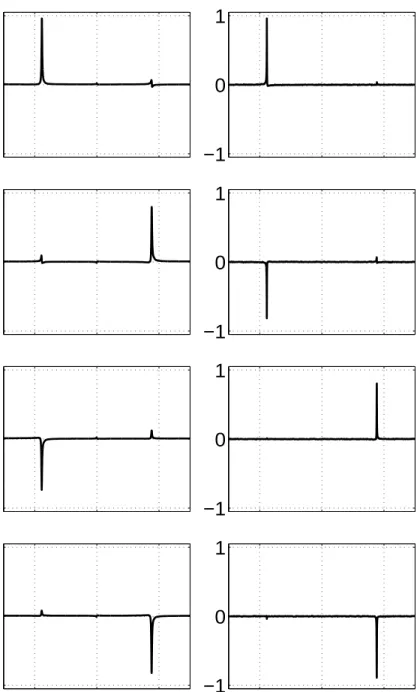
effective pure state created by temporal labeling [14] followed by a previously used Grover protocol. [15] The prediction is that the algorithm will put the spins in the state |x0i. The 13
C and 1
H readout spectra for the four possible x0 are shown in Fig. 1. As predicted for
two spins in an effective pure state, the value ofx0 is clearly indicated by the amplitude and
phase of the two resonance lines in the 13
C and 1
H spectra. Measurement of the deviation density matrix using quantum state tomography [11], confirms the output states to be as theoretically predicted; Fig. 2 shows that forx0 = 11, the final state of the spins is the state
|11i.
An immediate advantage of using liquid crystal solvents becomes clear from the savings in experimental time. A wait-time (5T1) between experiments of only 8 s sufficed, compared
with 105 s in acetone-d6. [1] The increase in spin coupling strength more than compensated
for the shorter coherence time and permitted successful completion of the algorithm. The use of liquid crystals as solvents in NMR quantum computing has been proposed and demonstrated. Due to the large 13
C-1
H dipolar coupling, the speed of the NMR quantum computer was increased by a factor of 8 while the short spin-lattice relaxation times resulted in significant time saved in setting up the spectrometer and in executing the Grover search algorithm. This demonstration of the utility of liquid crystals as NMRQC solvents expands the library of potential quantum computing molecules.
The authors would like to acknowledge helpful discussions on liquid crystal solvents with B. M. Fung. The support and encouragement of Nabil Amer, James Harris and Alex Pines are also appreciated. L.V. Acknowledges a Yansouni Family Stanford Graduate Fellowship. This work was performed under the auspices of the DARPA NMRQC initiative.
REFERENCES
[1] (a) I. L. Chuang, N. Gershenfeld and M. G. Kubinec, Phys. Rev. Lett. 80, 3408 (1998); (b) I. L. Chuang, L. M. K. Vandersypen, X. Zhou, D. W. Leung and S. Lloyd, Nature 393, 143 (1998); (c) D. G. Cory, M. D. Price, W. Maas, E. Knill, R. Laflamme, W. H. Zurek and T. F. Havel, Phys. Rev. Lett. 81, 10 (1998); (d) J. A. Jones, M. Mosca and R. H. Hansen, Nature 393, 344 (1998); (e) J. A. Jones and M. Mosca, J. Chem. Phys. 109, 1648 (1998); (f) N. Linden, H. Barjat and R. Freeman, Chem. Phys. Lett. 296, 1 (1998).
[2] D. P. DiVincenzo, Science 270, 255 (1995).
[3] I. L. Chuang and N. Gershenfeld, Science 275, 350 (1997); D. G. Cory, T. F. Havel and A. F. Fahmy, Proc. Natl. Acad. Sci. 94, 1634 (1997).
[4] G. C. Levy, R. L. Lichter and G. L. Nelson, Carbon-13 Nuclear Magnetic Resonance Spectroscopy, 2nd edition (John Wiley & Sons, New York, 1980).
[5] J. W. Emsley and J. C. Lindon, NMR Spectroscopy Using Liquid Crystal Solvents (Pergamon Press, Oxford, 1975).
[6] A. Abragam, The Principles of Nuclear Magnetism (Oxford University Press, London, 1961).
[7] W. S. Warren, Science 277, 1688 (1997).
[8] A. Saupe, G. Englert and A. Povh, ACS Adv. in Chem. Ser. 63, 51 (1967).
[9] Experiments were carried out at the IBM Almaden Research Center on a Varian
UNITY
Inova 500 MHz spectrometer using a Nalorac Probe. Measurements of T1 and
T2 were made using inversion-recovery and Carr-Purcell Meiboom-Gill sequences,
re-spectively.
[11] I. L. Chuang, N. Gershenfeld, M. G. Kubinec and D. W. Leung, Proc. Roy. Soc. Lond. A 454, 447 (1998).
[12] (a) J. Courtieu, D.W. Alderman and D.M. Grant, J. Am. Chem. Soc. 103, 6783 (1981); (b) J-M. Ouvrard, B. N. Ouvrard, J. Courtieu, C. L. Mayne and D. M. Grant, J. Magn. Reson. 93, 225 (1991).
[13] L. Grover, Phys. Rev. Lett. 79, 325 (1997).
[14] E. Knill, I. L. Chuang and R. Laflamme, Phys. Rev. A 57, 3348 (1998).
[15] L. M. K. Vandersypen, C. S. Yannoni, M. H. Sherwood and I. L. Chuang, Phys. Rev. Lett. 83, 3085 (1999).
TABLE I. 13
C-1
H spin coupling and relaxation times for 13
C1
HCl3 in isotropic and liquid
crystal (ZLI-1167) solution. Times are in seconds and couplings in Hz.
solvent J J + 2D T1 ( 13 C) T1 ( 1 H) T2 ( 13 C) T2 ( 1 H) acetone-d6 215 25 19 0.3 7 ZLI-1167 1706 2 1.4 0.2 0.7
FIGURE CAPTIONS
FIG. 1. Spectral readout of the results of the 2-qubit Grover search using 13
C1
HCl3 in a liquid
crystal solvent showing absorption and emission peaks which clearly indicate x0 equal to 00, 01,
10, and 11 (from top to bottom). The real part of the1
H (left) and13
C(right) spectra are shown,
with NMR lines atνH±JCH/2 andνC±JCH/2 (shown in kHz relative toνH andνC). The vertical
scale is arbitrary.