A U G U S T 2 0 1 2
Examining Risk-based Approaches to
Transportation Asset Management
RepoRt 2:
Managing asset risks at Multiple
Notice
this document is disseminated under the sponsorship of the u.s. Department of transportation in the interest of information exchange. the u.s. government assumes no liability for the use of the information contained in this document.
the u.s. government does not endorse products or manufactur ers. trademarks or manufacturers’ names appear in this report only because they are considered essential to the objective of the document.
Quality Assurance Statement
the Federal Highway administration (FHWa) provides high-quality information to serve government, industry, and the public in a manner that promotes public understanding. standards and policies are used to ensure and maximize the quality, objectivity, utility, and integrity of its information. FHWa periodically reviews quality issues and adjusts its programs and processes to ensure continuous quality improvement.
NoTe from The DirecTor
the Federal Highway administration (FHWa) continuously seeks innovative ways to improve the management of the nation’s highway infrastructure. the office of asset Manage ment offers this series of reports on risk management as another means by which transportation agencies can better understand and manage their highway assets.
the use of risk management among u.s. transportation agencies largely is limited to managing risk at the project level generally focused during construction. risk manage ment at the project level helps to identify threats and oppor tunities to projects’ cost, scope and schedule. However, we at the FHWa along with our partners at state and local transportation agencies recognize the growing need for a better understanding of risk management at program and organizational levels.
today, the leading international transportation, banking and insurance organizations have explored the benefits of risk management at the program and enterprise level and use it as a tool to protect their investments. Based on those prac tices, the office of asset Management is offering this series of reports on how risk management can be scaled up to asset management programs, and to the entire enterprise of a transportation agency.
it’s important for highway agency officials to consider incorporating risk management in the decision-making process for several reasons. First, they have seen the ben efits of risk management at the project level. second, they have heard from their international colleagues that risk management can pay dividends when used at the broader program and enterprise level, particularly when agencies don’t have enough funding to address their priorities. third, managing risk is an integral step in following a
comprehensive asset management framework as described in the AASHTO Asset Management Guide—A Focus on Implementation. Finally, the u.s. congress has proposed that states develop “risk-based transportation asset management plans.” these factors convinced the office of asset Management to offer this series of reports.
We believe you will find these reports helpful as you develop your asset management program and make investment decisions. this series of reports will help the transportation agencies to meet the increasingly complex challenges involved in making decisions and communicating them effectively to the public.
sincerely,
Butch Wlaschin
Director of the Office of Asset Management
contents
Introduction . . . 1
the Mandate for Risk Management. . . 2
Approaches to Risk Management . . . 3
international approaches to risk Management . . . 6
Definitions . . . 6
Multi-tier risk Management in international agencies . . . 9
current state of implementation of risk Management in u.s. transportation agencies . . . 11
Minnesota Dot . . . 13
Washington Dot . . . 15
utah Dot. . . 16
other Dots . . . 17
Multi Level Risk Management. . . 17
risk Management at the agency level. . . 17
some specific examples of agency risk. . . 19
risk Management at the program level . . . 27
transportation asset Management and application of program risk Management . . . 29
risk Management of Bridge programs . . . 33
program level governance risks . . . 36
program level Forecasting risks . . . 38
Data access risks to programs . . . 38
skilled personnel risk . . . 39
Minnesota Dot: trail Blazing in implementation of Holistic risk Management . . . 40
risk Management at project level. . . 46
ohio Dot. . . 47
risks at asset category and individual asset levels . . . 49
individual asset risks . . . 51
operational risks . . . 52
1 iv Risk-Based Transportation Asset Management
Background
as risk-based transportation asset management becomes mandatory in the united states, agencies will need to understand how managing risks can help them improve decision making in asset management programs. this second of five reports in the series examines risk-based approaches to managing assets. it provides us and interna tional examples of managing risks to assets at multiple levels in a transportation agency
Risk-Based Asset Management
introduction
this is the second in a series of five reports discussing risk management and its application to transportation asset Management (taM) in the united states. report 1, titled “overview of risk Management”, defines risk and provides an
overview of risk management as applied to managing trans portation assets. this second report discusses some of the frameworks implemented in the u.s. and in other countries to enhance and assist transportation agency decision makers in the management of risks at different levels.
globally, transportation agencies are attempting to address very similar kinds of risks. these include risks to transporta tion assets, public safety, and those associated with failure to accomplish important goals, such as achieving lowest possible lifecycle costs, meeting infrastructure targets, and protecting the environment.
risks to transportation assets can be triggered by multiple sources and circumstances and affect different transporta tion agencies differently. Fortunately, the application of risk management is not about “one-size fits all”. risks can be considered at the organizational, program, project, asset category and individual asset levels. Multiple approaches and models for addressing risks to assets at these different levels have been used worldwide.
it has been amply noted that u.s. transportation agencies have relatively mature and formal strategies and procedures for implementing project level risk management, whereas their implementations of risk management at asset class, program, or agency level are relatively informal. Hence this report focuses more on the latter and less on project level or individual asset risk level management.
the Mandate for risk Management
the need for formal risk-based asset management is a reality in the united states. the language in the new transportation Bill, Moving ahead for progress for the
21st century act (Map 21) reads as follows:
“IN GENERAL—A State shall develop a risk-based asset management plan for the National Highway System to improve or preserve the condition of the assets and the performance of the system.”
Map 21 will require u.s. transportation agencies to integrate risk management into their asset management plans. in new Zealand, transportation agencies are mandated by law to implement and report on risks and management of risks to assets. in new Zealand and australia, the intent of risk-based asset management is to systematically apply management policies, procedures and practices seamlessly to manage risks from multiple sources across the organizational hierar chy. it includes the management of risks both across and along asset hierarchies to effectively manage potential threats and opportunities. implementations in both countries illustrate how risk-based asset management can be integrat ed into u.s. transportation agency practices.
u.s. transportation agencies have for decades applied risk management strategies at the project level.
application of risk management at multiple levels will mean extending the principles and tactics used at the project level to broad programs such as asset management, maintenance, data collection or measuring asset performance.
approaches to risk Management
the intent of risk management is to make more informed and better decisions to address existing or potential risks to agency objectives while understanding the likely outcomes and results of the actions. risk management is not a one time activity. it is an ongoing, continuous process of monitoring and managing all kinds of risks.
risk management is a required governance activity in Queensland, australia. the Queensland, australia, Depart ment of transit and Main roads (tMr) states in its risk Framework that, “Risk management contributes to good corporate governance. It provides reasonable assurance to executive management that organisational objectives will be achieved within a tolerable degree of risk. It also provides for the identification of factors that may impact on the Department of Transport and Main Roads (TMR) ability to deliver its services and promote opportunities through a process of risk identification, analysis, evaluation, effective treatment and review.”[i]
like tMr, the new Zealand highway agency also has a risk management framework. the agency does proactive risk management and defines risk management as “the cultures, processes and structures that are directed towards the effec tive management of potential opportunities and threats”.[ii]
in new Zealand, the transportation agency manages risks at three levels. these are the 1) strategic, 2) portfolio and network and 3) at the project and operational levels. the tMr in australia manages risks at six levels. these are the
1) strategic, 2) portfolio, 3) divisional, 4) program, 5) projects and 6) operational levels.
4 Risk-Based Asset Management 5
the project Management institute (pMi) provides approaches to the management of portfolio and project management risks. these have been an integral part of the development, delivery and management of information technology and software solutions for decades. these practices and manage ment strategies are now evolving and slowly becoming part of a transportation agency’s management practices. some logical tiers or levels at which risks can be managed are:
1. at the agency
2. at the program level 3. at the corridor level 4. at the project level 5. at the asset class level 6. at the individual asset level.
an agency may choose to manage risks at only a subset of the six suggested levels.
a u.s. international scan team sponsored by the Federal Highway administration (FHWa) summarized best practices in risk management in australia, new Zealand, netherlands, germany, scotland and england. the scan findings were summarized in a 2012 trB annual conference paper that recommended the following steps to deploy enterprise risk management:
◗◗◗Formalizing risk management approaches;
◗◗◗embedding risk management in existing business
processes;
Risk-Based Asset Management
◗◗◗using risk management to build trust with transporta
tion stakeholders;
◗◗◗Defining leadership and organizational responsibilities
for risk management;
◗◗◗identifying risk owners;
◗◗◗supporting risk allocation strategies, and;
◗◗◗reexamining existing policies, processes and standards
through a rigorous risk management analysis. Figure 1, shows how the trB paper represents enterprise risk Management as addressing risks at the agency, program and project levels.
AgeNCy
pRogRAM
pRojeCt
reSpoNSibiliTy: executives
Type: risks that impact achievement of agency goals and objectives and involve multiple functions
STrATeGieS: Manage risks in a way that optimizes the success of the organization rather than the success of a single business unit or project.
reSpoNSibiliTy: program managers
Type: risks that are common to clusters of projects, programs, or entire business units
STrATeGieS: set program contingency funds; allocate resources to projects consistently to optimize the outcomes of the program as opposed to solely projects. reSpoNSibiliTy: project managers
Type: risks that are specific to individual projects STrATeGieS: use advanced analysis techniques, contin gency planning, and consistent risk mitigation strategies with the perspective that risks are managed in projects. Figure 1. Levels of Enterprise Risk Management (Agency, Program and Projects). source: trB paper
this second report in the series will examine international
examples of risk management and then cite some developing u.s. practices.
International Approaches to Risk Management
transportation departments in australia and new Zealandprovide mature examples of risk-based asset management plans. the Queensland, australia, guide notes that, “Risk Management is not a ‘one-size-fits-all’ approach and neither is it simply about compliance. Good risk management is sensitive to business needs, operating environment and internal capacity.”[iii]
the australian government has formalized risk management and has created committees to support and report on the progress and maturity of risk management activities in various government agencies.
For example, the government has an audit and risk committee, which is one of four governance committees that provide support to the tMr Board in Queensland. the responsibilities of the committee include assisting
the Director general responsible for the performance of transportation and infrastructure in his oversight of “the process relating to internal risk management and control systems”.[iv]
the 2010-2012 annual Queensland tMr report lists, “review of the progress reports on the risk management framework, policy and guidelines, risk registers (strategic and divisional), risk management activities and risk management maturity” as one of the activities of the committee.
DeFINItIoNS
across countries and industries, the terms used to define risk vary. the following descriptions define the terms used to refer to the various kinds of risk in this report
eNTerpriSe riSk
this report uses the term enterprise risk to refer to all levels of risk being managed by a state department of transportation.
AGeNcy riSk
this report refers to agency risk as the highest level of risk within an organization that affects a Dot’s ability to accomplish its mission and achieve its strategic goals and objectives.
proGrAm riSk
program risks are ones that could affect the achieve ment of program objectives. programs generally are defined as collections of related projects or on-going efforts to ensure achievement of specific organiza tional objectives
projecT riSk
project risks are those that effect the successful accomplishment of project objectives.
the victorian government in australia has its own process to manage risks in agencies within its jurisdiction and defines the following as the 11 principles of risk management:[v]
8 Risk-Based Asset Management 9
1. risk management creates and protects value; 2. is an integral part of the agency’s processes; 3. is part of decision making;
4. explicitly addresses uncertainty; 5. is systematic, structured and timely; 6. is based on best available information; 7. is tailored;
8. takes human and cultural factors into account; 9. is transparent and inclusive;
10. is dynamic, iterative and responsive to change, and; 11. Facilitates continual improvement of the agency. as discussed earlier in this report, the tMr, australia man ages risks at six levels and the new Zealand transportation agency manages risks at three levels. irrespective of the levels of application of risk management, the intent is similar in both countries. the intent of application as stated in the new Zealand transport agency asset Management plan is to “manage the state highway risks relating to both asset improvement and asset management”.[vi]
review of practices in both countries shows that risk-based asset management is best achieved when there is alignment in the management of risks associated with assets from the topmost to the lowest level of an organization. risks at the
Risk-Based Asset Management
corporate level cascade down to the project level and to individual assets. similarly, risks at the project and asset level eventually bubble up and impact the agency’s strategic objectives if they become widespread.
the 2011 transportation agency enterprise risk Management international scan report identified the following as areas that were given consideration by other countries in their risk–based decisions:[vii]
◗◗
◗asset management ◗◗◗Bridge inspection
◗◗◗cost and schedule control
◗◗◗performance measures
◗◗◗program investment decisions
◗◗◗program and project delivery methods
◗◗◗reliability centered maintenance
◗◗
◗tunnel safety and general safety planning.
as u.s agencies formalize risk-based asset management, these components could be considered for inclusion in the risk analysis checklist.
Multi-Tier Risk Management in International Agencies
risk management has long been a primary factor in all tiers of private industry decision making. continuous evaluation of financial and business risks and implementation of actions to eliminate or minimize “threat risks” and capitalize on
“opportunity risks” is routine in private industry. the breadth
of risk responsibilities and the levels of risk management vary across industries and across countries.
case studies and best practices in new Zealand indicate that risk management is integrated into the asset Management plans and is an important input to decision-making. the expectation is that “the results of the risk analysis should permeate, or at least flavour, other sections of the Asset Management Plan. For example, the ‘Life cycle’ section, ‘Levels of service’ section, and especially the Improvement
Plan’ should all reflect how the risks to various assets and services are to be addressed. Risk management is increas ingly seen by councils as an integral input into Asset Manage ment Planning. Councils should not let risk management alone drive asset-related decisions, but use it to assist in making sound, defensible decisions”.[viii]
the new Zealand, state Highway asset Management plan (nZ, sHaMp) covers all infrastructure assets that form the road network. the 2010 sHaMp has a section entirely devoted to managing risks. an internal study report of the risk-based asset management practices in new Zealand recommended that risk management be integrated in to every section of the sHaMp.
in the 2010 sHaMp, Strategic Risk Management addresses risks due to lack of funding or deferred funding, and risks due to unanticipated occurrences of natural events, e.g., flood, earthquake, bush fire, avalanche, earthquake. the second level of Portfolio and Network Level Risk Manage ment addresses risks with catastrophic failures of a network structure, damage to an asset, premature deterioration or obsolescence of an asset, risk of pollution, and other risks to performance or condition of assets on the state highway. it addresses many aspects that would be considered in the
risk management of corridors. the third level of risk management occurs at the Project and Operational Level, and addresses risks such as project schedule slippage, suboptimal material or design or construction practices, risk of failure to gain property access for projects, and risk of poor contract execution.
the risk Management Framework of tMr, Queensland, australia divides risks into Strategic, Portfolio, Divisional, Program, Projects and Operational level risks. these six levels of risk are central to its framework. the framework reflects the importance of managing risks and links them to the corporate vision, mission, objectives and values. its risk reporting process also shows that the accomplishment of the government priorities and corporate objectives are tied to various other factors such as, strategic positioning, adaptive capabilities, application of information technology and decision making. the framework demonstrates that tMr’s ability to plan and manage future risks and opportunities is closely linked to the success and failure of its assets and strategic objectives.
Current State of Implementation of Risk
Management in U.S. transportation Agencies
Figure 2 (see next page), shows the results of a national cooperative Highway research program (ncHrp) survey of state transportation agencies about implementation of risk management practices in the u.s. according to the report, “ixthe survey results showed that of the 43 respondents, only 13 have formalized agency level risk manage ment and fewer had risk management at the agency, program and project level.” [ix]
u.s. transportation agency personnel work on very complex projects and coordinate a myriad of complex tasks and
Figure 2. The dark color shows U.S. transportation agencies that have formal risk management.
12 Risk-Based Asset Management Risk-Based Asset Management 13
Following the august 2007 collapse of the interstate 35 bridge in Minneapolis, Minnesota, public and congressional focus on risk management of critical transportation assets reached a new high. this led to a renewed focus and review of risks to transportation assets by Dots. MnDot, the Washington state Dot (WsDot) and utah Dot (uDot) are examples of agencies that have offices that focus on certain aspects of risk management.
Minnesota DOT
MnDot is pursuing formal risk management that addresses multiple levels of risks to transportation assets. agency executives echoed the agency perspective that, “Integrated risk management is a continuous, proactive, and systematic process to understand, manage, and communicate risk from an organization-wide perspective. It is about making strate gic decisions that contribute to the achievement of an organization’s overall corporate objectives”.
MnDot has routinely being implementing risk management at the project level and is in the process of extending the implementation to other levels similar to those implemented activities and intuitively manage risks in their day-to-day by tMr, australia. MnDot’s office of risk Management has work. However, per the survey, few apply formal risk conducted many workshops to train and assist agency per-management at levels other than at the project level. sonnel with developing and implementing risk management
at the agency (organization), program and operational levels. organizations such as the american association of state
Highway transportation officials (aasHto) have produced MnDot uses risk management in decision making on topics several reports to assist states in implementing risk manage- ranging from organizational design to project elements. ment at different levels. steps detailed in the aasHto report tim Henkel, assistant commissioner MnDot, when discuss-titled, “Allocation in Highway Construction Management Risk ing the Dot’s risk management journey reiterated that Manual” indicates that efforts are already under way to assist “Enterprise Risk Management helps the Department identify state and local transportation agencies in applying risk potential future events and enables agency managers to management to programs such as inspection and innovative evaluate the probability and magnitude of future events that
of life of Minnesotans, and the trust and confidence the
public has in MnDOT”.
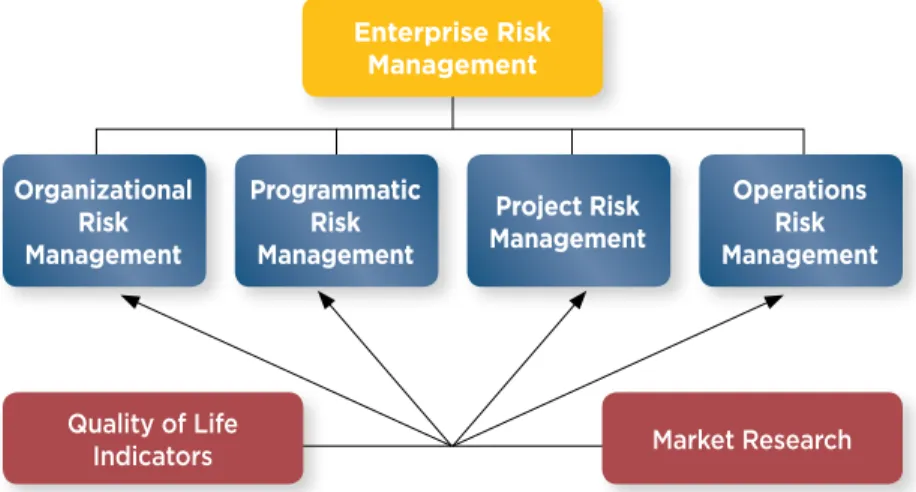
Figure 3. Components of Minnesota DOT Enterprise Risk Management. source: Minnesota Dot
enterprise Risk Management organizational Risk Management programmatic Risk Management project Risk Management operations Risk Management Quality of life
indicators market research
Figure 3, shows a graphical representation of MnDot’s enterprise risk Management approach. it shows that enter prise or overall risk management in MnDot addresses risk at the organizational, program, project and operational levels. the MnDot risk management process includes the following:
◗◗◗identification of risks to Mission;
◗◗
◗analysis of probability and impact of risks; ◗◗◗performance targets and Financial information;
◗◗◗identification of customers/stakeholders;
◗◗◗Development of risk strategy (Budget);
◗◗
◗analysis of risk Mitigation effectiveness;
◗◗◗performance and Financial information analysis;
◗◗◗re-alignment, and;
◗◗◗cost effectiveness and strategy adoption.
according to MnDot, enterprise risk manage ment should do the following:
◗◗◗support organizational vision;
◗◗◗improve internal communication;
◗◗◗Maximize capital investment;
◗◗◗Maximize operational investment;
◗◗◗optimize organizational resources;
◗◗◗optimize size of the organization, and;
◗◗◗provide for nimble responsiveness.
philip Barnes, MnDot assistant Director coordinating the risk management effort for the Dot, shared the agency’s perspective that for MnDot, “Risk Management (RM) is a systematic approach to setting the best course of action under uncertainty by identifying, assessing, understanding, acting on, and communicating risk issues”.
Washington DOT
the state of Washington has an office that focuses on enterprise risk management. though the state focuses on a narrow aspect of risk management (relating to liability arising from accidents on state roadways alleged to have been caused by negligent design, signage or failure by the state to properly maintain the highway), it has catalyzed
16 Risk-Based Asset Management 17
state agencies on the steps involved in risk management. this can be seen in WsDot’s implementation of risk manage
ment at multiple levels including risks due to climate change and safety.
While the primary focus of the risk management office of the WsDot is on audit and financial risks due to lawsuits, it assists other agency business units that are developing formal risk management procedures. WsDot has imple mented some form of risk management at the corridor level to mitigate and minimize the risk of closure of the critical i-5 and i-90 corridors due to flooding and avalanches. paula Hammond, secretary of the WsDot, in a 2011 report for FHWa discussing vulnerabilities to climate change, noted that,” WSDOT has a responsibility to look ahead and ensure we protect our infrastructure and prepare for potential risks. Our transportation structures are critical to keep people and goods moving and the economy growing.”[x] the report
discussed how the agency has been addressing infrastruc ture risks by building and maintaining highways and bridges to last for decades. to address climate change issues, the agency has also been planning and retrofitting bridges against earthquakes and is in the process of updating design and other policies to protect the transportation infrastructure from climate change impacts.
Utah DOT
the mission of uDot’s risk management office is on “looking after the safety of our employees, contractor employees, and the public at large. This is done through loss report analysis, managing all of the Government Record Access Management requests to UDOT, procurement of insurance for UDOT, management of the Owner Controlled Insurance Program, and the emergency management program for UDOT”. However, uDot manages risks to its transportation assets at multiple tiers, though these implementations are not formally
Risk-Based Asset Management
documented or managed by its office of risk management. risk management is implemented at the project, district and division levels. For example, the agency’s program and funding prioritization includes risk analysis and tradeoffs across its programs.
Other DOTs
currently, several other Dots have efforts under way to develop procedures and formal documentation to train and empower their dispersed transportation agency staff to proactively manage the threats to the transportation assets and operations. the north carolina Dot (ncDot) has implemented risk management that addresses risks to organizational objectives, asset conditions, achieving performance targets and complying with environmental regulations.
Multi level risk Management
Risk Management at the Agency Level
corporate, agency or organizational risks (used interchange ably in this series of five reports) can occur due to uncertain ties that can affect the achievement of the agency’s strategic objectives. these include internal and external risks due to factors such as the economy, business environment, commu nity issues, financial environment, natural disasters, climate change and other environmental issues. the agency level risks for Dots affect the successful achievement of strategic transportation objectives.1 these also include risks to agency
resources or risks to the achievement of important public 1some authors refer to these types of risk as strategic risks, or enterprise risks while others consider enterprise risk management as the management of the risks at all tiers. Because risk management is still evolving in the transportation sector, definitions vary among authors.
policies. though agency level risk management is about implementing planned actions to take advantage of opportu nities and proactively address threats, often risks cannot be completely eliminated and trade-offs have to be made while ensuring that risks do not exceed the agency’s acceptable tolerance limits.
agency risks are generally stratified based on their severity, likelihood and potential consequences; sphere of impact or influence; period of impact; and effect on the agency’s ability to accomplish its strategic objectives. some examples of risks at the agency level are:
a. local or global price volatility that affects the planning or delivering of products and services by Dots;
b. physical loss of major assets;
c. Failure to meet public safety objectives;
d. Failure to meet the operational expectations of the public for activities such as, snow clearance, opening roads after avalanches, floods and other disasters and disruptions;
e. overall financial risk caused by rising costs and declining asset investment revenue;
f. lack of direction due to leadership or political changes; g. loss of institutional knowledge due to personnel
turnovers, technology changes or delay in training; h. lack of business intelligence and decision support
information because of poor data systems or poor data management, and;
i. negative media coverage, loss of credibility for failing to comply with regulations, failure to deliver projects or meet other asset condition and perfor mance goals.
Documenting and formalizing risk management at the agency level helps provide the strategic vision necessary for agency-wide consistent and sustainable risk-based asset management. this formal approach is helpful in the continuation of strategic agency objectives during periods of change in senior leadership. it also facilitates cross collaboration and alignment across organizational silos in the treatment of risks. additionally, it helps dispersed staff understand what is expected of them and what actions need to be performed to mitigate these high level risks. as opposed to muddling through challenges, agency-risk management provides guidance, tools and strategies that help to anticipate these challenges and proactively address them. For example, it provides the necessary tools and strategies to anticipate and address negative media coverage of the agency, its management of asset conditions or performance, staff layoffs, financial risks and other such agency level risks that affect the management of transpor tation assets. transportation agencies that have formal agency level risk management are better equipped to anticipate, prepare for and address these challenges and therefore are better able to minimize the impact to the agency’s mission and credibility.
Some Specific Examples of Agency Risk
Price Volatility
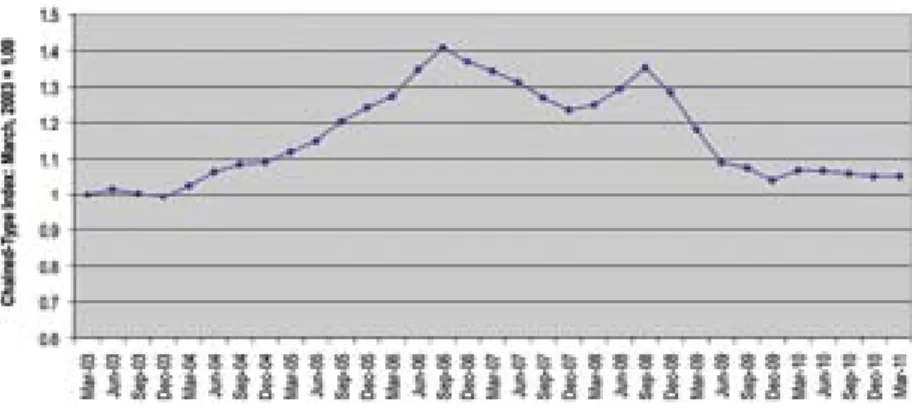
an example of external risk to an agency can be seen in the impact of the volatility of construction costs from 2003 to 2009 shown by FHWa in Figure 4 (see next page).
20 Risk-Based Asset Management 21
Figure 4. Volatility of Construction Costs. source FHWa the increase of national Highway construction cost index
(nHcci) from early 2004 to end 2006 eroded the purchas ing power of Dots resulting in cancellations or delays to projects and causing major problems for Dot programs. the subsequent fluctuations in the nHcci from 2007 to 2009 also caused uncertainties and difficulties in forecasting and planning of funds for Dot programs.
these price variations generally were attributable to global energy prices, primarily petroleum. rising fuel prices spurred by a strong global economy, particularly in asia, raised petroleum prices. that in turn increased the cost of diesel which is an essential commodity for all heavy highway construction, from the quarrying of aggregates, to excava tion, to the delivery of materials to a construction site the price sensitivity of the international markets illustrates
that global events pose risks to the ability of u.s. transporta tion agencies in achieving their asset management objec tives. in the above example, although prices relatively stabi lized after June 2009, the past volatility raises the question of what may happen in five to 10 years when the global economy eventually emerges from the current recession.
Risk-Based Asset Management
Political Risk
Decisions made by political leadership at the national or state level can impose risks at various levels to an agency.
continuity of Agency leadership
an important agency risk is the fact that senior state trans portation agency executives are often hired and fired at the will of the governor. state political leadership change often translates into changes in senior leadership in state transpor tation agencies, causing disruption in continuity of important agency initiatives. some Dots have detailed and formal succession planning to manage such agency risks. such formal agency level risk management provides much needed direction and enables the agency to continue meeting its strategic objectives and delivering important transportation services during such times of change.
federal funding for Agencies
another important example of a risk to Dots is the uncer tainty associated with passage of the national transportation bill and amounts that states could expect each year from the federal government. the safe, accountable, Flexible, efficient transportation equity act: a legacy for users (saFetea-lu), expired on september 30, 2009.[xi] the bill
was extended eight times till March 2012. the uncertainty and the short term extensions that occurred since the initial expiration of the bill till the passing of the bill in July 2012 made forecasting and planning of asset management activi ties extremely difficult for Dots. these uncertainties not only posed many risks to the Dots’ ability to plan for the rehabili tation of degraded assets, but also to long-term planning of preservation and maintenance activities necessary to halt the degradation of assets in good condition.
Figure 5. Net volumes taxed by year. source FHWa
Tax Revenue Risk
Figure 5 shows the fluctuation in the net gallons taxed between 1961 and 2010, an indicator of net revenues avail able to transportation agencies.[xii] the uncertainty and
fluctuation in the expected revenues pose risks to long term transportation planning that is necessary for sustaining the performance and condition of transportation assets.
Aging Infrastructure Risk
Discussions with Dots and FHWa show that both at the federal and the state level, the concerns about aging infra structure and other transportation asset risks have been at the forefront of executive thinking and decisions. one of the top priorities for u.s. transportation agencies across the nation is addressing the aging infrastructure of bridges that are in use beyond their expected life and expensive to replace. Figure 6, shows that approximately 400,000 bridges are less than 50 years of age while half as many (205,000) are 50 years or older. this aging infrastructure requires
maintenance, rehabilitation and costly replacements. the lack of long-term predictable and sustainable transportation funding to address these aging assets presents many risks to asset management targets nationwide.
Figure 6. The Number of Bridges by Age. source: FHWa
Climate Change Risk
one complex agency risk that Dots face is the impact of climate change on transportation infrastructure. Discussing the situation, a 2012 report titled, “climate change impact assessment for surface transportation in the pacific north west and alaska”[xiii] explains that many transportation
practices and procedures were developed without full con sideration for the impact of climate change on the transpor tation infrastructure. it notes that floods, high intensity precipitation and climate change events can cause unpredict able failure of roads and bridges. the report states that “DOTs could experience hundreds of millions of dollars in
24 Risk-Based Asset Management 25
infrastructure damage that potentially could be avoided with more robust data collection, planning and design tools/ methods for managing risks”. the report identifies critical infrastructure vulnerable to climate change impact and potential impact of climate change on the regional transpor tation systems. it urges Dots to use high-resolution climate change models, geographical information systems and transportation asset Management (taM) to incorporate
climate change into current and long-term planning process es. there are many uncertainties associated with the inputs, assumptions and with predicting the occurrence of these events. the report says that the data and refined models will improve the understanding of these risks and enrich the decision-making process. the risk of climate change perme ates multiple levels in an agency and agencies develop detailed agency and program level mitigation strategies to address them.
at the agency level addressing such risks often involves working closely with multiple agencies or organizations. an example is the intergovernmental and interagency coordination of strategies and approaches necessary between state, federal and local transportation agencies and other organizations when addressing emergencies such as wildfires, floods, tornadoes and hurricanes. Dots have the responsibility of maintaining the critical roadway assets essential for transportation and for evacuation during these emergencies. over the last decade both public and private organizations have been collaborating to proactively manage such risks effectively.
Natural Disaster Risk
two examples of Dots that have agency-level risk manage ment plans to address natural disasters are the Florida Dot (FDot) and WsDot. in 2010, FDot working with several regional and state agencies developed a multi-agency risk
Risk-Based Asset Management
mitigation plan to address risks due to tropical storms, hurricanes, coastal and inland flooding and other natural disasters and land use issues.
During floods in 2007, section of i-5 were completely
flooded and had to be closed to traffic. in response, WsDot closely monitored the risks and allowed select vehicles to deliver emergency and perishable goods. the agency developed and implemented a detailed risk mitigation plan and also conducted outreach to educate the public and the trucking community on the strategies that will be implemented during similar future events.[xiv]
the fifth report in the series will go into greater details of risk mitigation to address natural disasters so this report will not elaborate on risk mitigation of natural disasters.
FHWA Corporate Risk Management
nationally, FHWa has been addressing risk management at multiple levels for many years. the FHWa 2010 corporate risk assessment identified the need for consistency between the headquarters and divisions, the use of more analysis and information in decision making, and the need to tie the risk management process to the strategic planning process.[xv]
the corporate risk assessment report identified seven areas of “threat risks” and four areas of “opportunity risks”. the corporate risks detailed in the report were intended to drive collective thinking and risk management by senior managers. the threat risks included the following:
◗◗◗risks due to infrastructure failure;
◗◗◗internal FHWa capacity failure (lack of succession plan
ning and skilled people, knowledge and systems), and;
◗◗◗lack of data integration and security that could
the opportunity risks detailed in the FHWa report included:
◗◗◗addressing mobility and freight;
◗◗◗continuing to address safety and decreasing deaths
and injuries on national roads;
◗◗◗deploying innovations and accelerating technology to
continue to shorten project delivery periods, and;
◗◗◗increasing transparency and fiscal accountability
in investment decisions affecting condition and performance of the transportation system.
the report discusses the impact of the threats and opportu nities but did not provide specific guidance on “how to address” each of the identified risks. it also provided tem plates to enable each FHWa division to identify risks and forward to the corporate risk assessment team as input to the overall agency risk assessment.
Risks from Loss of Institutional Knowledge
Federal, state and local transportation agencies have been losing institutional knowledge due to personnel retirements coupled with the inability to hire new staff. in addition, the recent economic downturn (since 2008) has led to states having to lay off personnel and delay training and implemen tation of newer technologies. these agency risks result in below optimum management, monitoring and treatment of assets that can result in asset failures, poor asset conditions and performance.
the 2010 FHWa corporate risk assessment report notes that the “A major concern is the austere fiscal environment and resulting loss of personnel by State Highway and Trans
portation Agencies.” the report stated that not maintaining sufficient organizational capacity (people, knowledge and system) will affect the future delivery of the transportation program. agencies like ncDot are developing data ware houses, virtual libraries and document management systems to capture the existing institutional knowledge and mitigate such risks. they are also implementing training and mentor ing programs to document the business intelligence and facilitate knowledge transfer to address the risk of such loss of institutional knowledge.
Information Risk
an often ignored agency level risk is in the area of informa tion needed for decision making. antiquated data systems, lack of system integration and insufficient resources to upgrade or integrate data systems can result in inconsistent information that can hamper effective decision making. Data inconsistency because of poor data and poor integration between different data systems is a risk for decision makers. to help Dots address such risks, FHWa included funding for
development of management systems and data collection to its asset management strategy.
Risk Management at the program Level
a program, as defined by tMr, Queensland, refers to “a group of related projects or activities managed in a coordi nated way to obtain benefits and controls not available from managing them individually”.[xvi] the pMi definition of pro
gram risk as “an event, or series of events or conditions that, if they occur, may affect the success criteria of the program” is very pertinent to transportation agencies.
as explained by pMi and used in Dots, “Programs are the primary method of delivering projects, therefore
28 Risk-Based Asset Management 29
considerable amount of program risk management is focused at the project level.” [xvii] often Dot performance
and accomplishments are summarized at the program level. program risks are primarily the bubbling up of risks from the projects and asset categories that make up the program or the cascading down of agency risks. For example, an agency risk of increases in material prices will impact all the projects. By anticipating these risks, the agency can make informed decisions and plan to mitigate the impact at the program level thus minimizing the impact that could cascade to the project level. it can also help an agency to prioritize, make trade-offs across programs, and identify projects within programs that need immediate action or those where the risks can be tolerated and hence delayed.
in new Zealand, total asset Management planning is an integral part of the government’s strategic management framework.[xviii] the new Zealand taM Manual requires that
risk management be done at all stages of the asset life cycle, whenever a significant decision has to be taken. it requires that “risk Management be formally applied and documented during (the) total asset Management process when develop ing and evaluating programs and projects.”
state transportation agencies in the united states manage 164,000 miles[xix] of the national Highway system and
approximately [xx]48.1 percent of the over 600,000 bridges.
proactively managing the transportation infrastructure is a complex and often onerous task. program level risk management highlights some of these challenges that agencies deal with every day.
Risk-Based Asset Management
Transportation Asset Management and Application of Program Risk Management
application of program risk management is often closely tied to the agencies’ approach to asset management. agencies differ in the experience and expertise to risk-based asset management. some examples of programmatic risks to pavements that agencies are facing include:
◗◗◗inadequate budgets;
◗◗◗poor construction and testing procedures;
◗◗◗improper treatment selection;
◗◗◗lack of training of pavement management, construction
and inspection personnel;
◗◗◗inaccurate or incomplete pavement condition data, and;
◗◗◗inaccurate pavement condition forecasts.
the ncHrp report 523 notes that from the 1960s through the 1970s, during the decade of the expansion of the interstates, state transportation agencies had programs focused around construction. By the 1980s the focus changed to pavement preservation and preventive maintenance. the report states that the “analysis of data shows that available funds were allocated to treating pavements on a “worst-first” basis. This resulted in a decline in the total number of miles that could be treated because of a decline in the overall condition of the pavement network”. this is not to say that agencies have not implemented preventive maintenance. agencies that have implemented specific preventive maintenance programs to address risks due to pavement failures and poor pavement conditions have seen good long term results.
one strategy that the FDot has effectively implemented to
proactively manage risk to assets is by proactive preserva tion and maintenance of transportation assets. as shown in Figure 7, the FDot approach resulted in consistent good condition of infrastructure assets.
Figure 7. FDOT Bridges, Pavements and Roadway Assets meeting performance goals.
taM programs are generally intended to achieve major organizational goals. they tend to be complex, their success is reliant on many functions, and they tend to cut across organizational silos. as such, taM programs can be at risk because of multiple factors including program type, environmental factors, and program complexity. Manage ment of asset risks at the program level takes into account the impact of other programs and risks due to changes to resource allocation and competition for limited resources, changes to the program’s priority in relation to other programs, organizational strategy issues and the political environment. examples include:
◗◗◗lack of internal support or authority for taM at the
program level;
◗◗◗lack of staff or resources for complex taM tasks;
◗◗◗lack of sufficient internal infrastructure such as data
systems and asset inventories, and;
◗◗◗overall lack of adequate funds for asset programs.
lack of necessary resources to address infrastructure pro gram needs is a common concern for most Dots and several have found innovative ways to address these challenges.
Illinois DOT
Working with FHWa and the agency leadership, the illinois Dot has implemented a method to manage and focus on high-risk bridges. this program allows the Dot to inspect a large number of bridges that meet a list of criteria for bridg es at “no” risk at 48-month intervals instead of at 24-month intervals. this in turn allows the agency to reassign and allocate more resources to focus on inspection of the high risk bridges.
Washington DOT
another example of risk management in addressing the lack of resources in the bridge inspection program can be seen in a set of practices implemented by the WsDot Bridge preservation office to manage risks to bridges. the Dot has practices similar to those used by illinois for “no” risk bridges. the agency applies specific criteria for inspection of bridges
and bridge components that allows it to move resources from inspecting structures at “no” risk to others at differing levels of higher risk based on a range of condition ratings. the agency’s risk management strategy also includes the
requirement for the inspection team leader training to be taken every three years. the team leaders also have to be licensed professional engineers in the state of Washington.
32 Risk-Based Asset Management 33
UDOT
the utah Dot that operates a mature, sophisticated asset management program had to make tradeoffs based on its risk tolerance when addressing management of assets across its Bridge and pavement preservation programs.
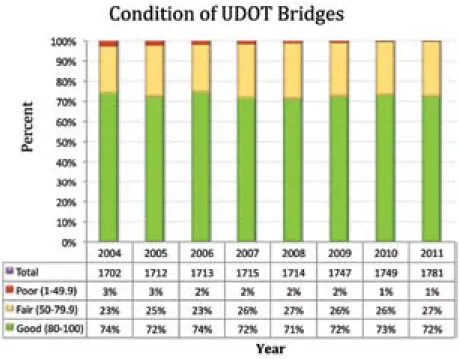
Figure 8. Bridges rated in fair condition remain because of Preservation and bridges rated in good condition are increasing due to new construction. source uDot
Figure 8 shows the utah Bridges in fair condition remaining unchanged due to preservation efforts and those in good condition increasing after 2007 due to new construction. While Figure 9 shows the impact of some tradeoffs the agency had to make to accommodate the funding limitations that affected the lower-volume level 2 pavements. it shows that the agency was unable to preserve and improve all asset classes and had to take declining conditions on its rural level 2 pavements to preserve its existing bridges and higher priority pavements and continue construction of new bridges.
Risk-Based Asset Management
Level 2 System Ride Quality—forecasted with 10 million/year (2,735 miles)
Figure 9. Based on funding projects Level 2 Pavement conditions continue a downward trend.
Risk Management of Bridge Programs
a major program risk that transportation agencies face is due to the large number of aging bridges and risk of bridge failures. Most Dots have Bridge program Managers respon sible for the monitoring, inspection and maintenance of bridges. they also prioritize bridge projects based on the overall health of the bridge. some of the reasons identified for the bridge risks that agencies face are:
◗◗◗large numbers of aging bridges are still in use;
◗◗◗lack of close correlation between funding and
performance of bridges;
◗◗◗lack of funding as well as the lack of a focused
and a sustainable bridge program, and;
◗◗◗increased costs to sustain the bridge inventory
the ncHrp 397 report notes that “The collapse of the I-35 W
Bridge in Minneapolis in August 2007 catalyzed a number of more far-reaching national level influences on future direc tions in bridge program management.”[xxi] the report states
that the bridge collapse led to a review of decision making and identification of program level risk management strate gies in the Highway Bridge program (HBp). this included:
◗◗◗updates to the Federal Highway Bridge program
decision making and how the national Bridge inspection standards sufficiency and deficiency ratings are applied as program criteria;
◗◗
◗a comprehensive review of national Bridge inspection
standards and oversight of structurally deficient bridges;
◗◗◗FHWa oversight of the national Highway system
bridges nationwide, and;
◗◗◗state Dots having some more flexibility in use of federal
bridge funds to correct structural deficiencies. addressing the same risks, the u.s. government account ability office (gao) report on the Federal Highway Bridge program, a program that provides funding to states to improve the condition of their highway bridges, recom mended that “ways to align HBP funding more closely with performance be done to support a more focused and sustainable bridge program”. some of the strategies that agencies are considering in addressing risk management of bridge program are:
◗◗◗ensuring that good bridge inspection data is used in
decision making. For example, ncDot has quality checks on the bridge inspection data that it uses as input for decision making.
◗◗◗Formal risk management is becoming an integral part of
managing bridge assets.
◗◗◗since bridges are complex structures with multiple
components and failure of nonredundant components can have significant negative implications, agencies are moving towards using management systems and higher computing power to analyze, compare and contrast the large numbers of bridges and bridge components to assist with decisions on prioritization and trade-offs. several Dots are developing trade-off analysis tools to assist them in making trade-off decisions.
◗◗
◗agencies are linking bridge program funding decisions
to the types and number of deficient bridges and replacement, rehabilitation and maintenance priorities.
◗◗
◗agencies are linking prioritization to acceptable levels
of bridge program risks.
◗◗◗Bridge inspections are being linked to risk factors.
For example, some Dots (Michigan Dot, illinois Dot, and Washington Dot) inspect high risk bridges more frequently and more thoroughly than required by federal law.
an example of proactive program level risk management for bridges is reflected in the Florida Dot operating policy to “Program for construction, all structurally deficient bridges and bridges posted for weight restriction within 6 years of deficiency identification”. the policy also requires that all other bridges “which require structural repairs but which are more cost effective to replace” are to be replaced within 9 years of deficiency identification. another proactive risk management of the program is evidenced in the Florida Dot’s funding prioritization that requires that first priority
36 Risk-Based Asset Management 37
on Bridges off the State Highway System and off the Federal
[xxii]
Aid Highways be given for the bridge inspection program. some agencies such as virginia Dot, caltrans and oregon Dot have program level risk management strategies and tools that enable agencywide monitoring of seismic activity and strain in load or fatigue, scours of bridges and bridges experiencing relative rapid settlement due to mine subsid ence and other reasons. an example of tapping technology to track bridges at high risk is done by the idaho Dot using its “Bridge Watch” system. the Dot uses hydrologic gauges in streams and advanced weather prediction to identify storms that could create scour risks. While bridges with good waterway adequacy and channel protection or low traffic and shorter detour lengths are considered low risk, bridges over water with unknown foundations are consid ered high risk and are tracked closely. the system tracks high risk assets and alerts agency personnel enhancing the coordination across the agency and facilitating agency-wide consistent response to high risks.
Program Level Governance Risks
another program risk that agencies have to consider is that caused by governance issues. in many state transportation agencies, program management is centralized, program policies, standards and procedures are developed centrally, and guidance for application to all projects within the program is provided to the districts. Managing risks at the program level facilitates the consistent application, imple mentation and management of policies, funding mechanisms and procedures to all projects in the program.
For example, well documented best practices for pavement preservation recommend strategies that consider the pave ment type and functional class in the decisions regarding the application of treatments. it also recommends specific times
Risk-Based Asset Management
in the life of the pavement when treatments should be applied to get the longest useful life with the lowest-possible life-cycle cost. this can be seen in Figure 10 which shows uDot’s approach to extending pavement life through systematic preservation and timely pavement treatments.
Figure 10. UDOT’s Approach to Extending Pavement Life through Timely Preservation and Treatments. source uDot By applying the pertinent strategies consistently across all pavements, an agency can effectively and efficiently manage the risk of pavement failures. However, if decentralization and/or delegation of responsibility lead to different agency districts or regions applying pavement treatments at points in the life of the pavement that differ from those recom mended, then managing risk of pavement failures becomes more complex. other risks factors to consider are 1) the lack of clear governance as to who is responsible for managing the assets, and 2) the lacks of coordination between units as
to who will deliver the program, e.g., monitor, treat and manage the assets.
Program Level Forecasting Risks
another program level risk that agencies are grappling with is the inability to do reasonably accurate forecasting. under standing the past, current and future condition, performance and overall health of transportation assets is important to forecasting potential risks. the ncHrp 397 peer exchange report on data and information noted that “although useful ness of forecasting became clear, the reluctance of decision makers to rely on models was a contradictory theme, moti vated by concerns about model complexity and obscurity and risk of forecasting errors”. a survey of state Dots shows that pontis, the aasHto Bridge Management software, is primarily used by states as an inventory system and not for forecasting scenarios or projecting bridge related risks. a 2011 FHWa survey showed that more than 70% of state Dots did not use any form of Bridge Management systems to track performance or predict future bridge conditions. they attributed these shortcomings to 1) lack of staff; 2) lack
of dedicated funding; 3) lack of training; and 4) lack of upper management support. to address some of these issues, FHWa has identified assisting states with training, providing dedicated funding, and initiating discussions with DOT upper management as focus areas to mitigate some of the program risk to bridges. aasHto is also trying to assist states by updating pontis to make it more convenient for states to do bridge related risk analysis.
Data Access Risks to Programs
agencies are facing program risks due to lack of easy access to reasonably priced, good quality data: a critical input to transparency in decision making that is being demanded of transportation executive by congress and the public. on the
issue of data, the office of inspector general in its findings of FHWa’s implementation of risk based bridge inspection, noted that the, “lack of detailed bridge data limited
[xxiii]
efforts to identify bridge safety risks”.
Data program risks have been discussed by Dots since the early 1990s. a 2010 FHWa report titled, “Data integration challenges” details the need for data integration and the benefits of integrated decision-making—how it supports core taM needs. the report also identified the many challenges to data integration faced by transportation agencies. informed taM decisions rely on data and though state and federal
transportation agencies understand the importance of data and the risk to data programs, with critical infrastructure needs competing for limited resources, addressing data program risks continue to be a lower priority for Dots. since risks about data, data collection, business intelligence and information have been discussed at length in other publica tions, this report will not go into more detail, but note that these issues pose risks to decision making and can be systematically addressed at the data program level.
Skilled Personnel Risk
an important risk that is becoming a necessity in transporta tion agencies is the lack of skilled personnel to conduct risk analysis. transportation agencies will need to understand the application of risk management at multiple levels. this will require agencies to develop the additional skills needed to successfully extend risk management routinely used by agencies at the project level to the program and enterprise level. the techniques and practices of risk management— risk identification, assessment and analysis, mitigation and planning, and monitoring and updating used in project level risk management are applicable to managing the risks at the program level, corporate level, as well to other levels in an
40 Risk-Based Asset Management
agency. thus, with the availability of necessary skilled professionals, successfully applying risk management to the program level is an accomplishable task.
Minnesota DOT: Trail Blazing in Implementation of Holistic Risk Management
in recognition of the significant strides made by MnDot in implementing a formal risk management program, this report discusses some of highlights of the MnDot implementation to provide an appreciation to other Dots interested in understanding the approach. the information presented will enable these peers to selectively follow-up on specific areas that may be of interest to their own Dot risk management implementation efforts.
Minnesota Dot is one of the agencies in the process of implementing a holistic approach to asset based risk management. Figure 3 represents the different levels at which the agency is implementing risk management. to ensure agency-wide consistency in understanding and
identifying different types of risks and in implementing risk-based asset management, the Dot’s
risk Management office has developed detailed definitions of risks, identified and documented five levels of risk impacts (shown in the text Box 1) and four levels of risk response strategies.
in 2010, the Dot conducted a series of risk assessment and strategic recommendation (rasr) Workshops. the outcome is a statewide perspective of risk and strategy for five major programs that included Regional and Community Investment priorities, Mobility, Bridge Preservation, Pave ment Preservation, and Safety. the workshops also resulted in the creation of plans to manage likely and impactful
Risk-Based Asset Management 41
1. Little noticeable impacts on the system a. system works in almost similar fashion b. little or no public pressure
c. public mostly unaware
2. Some noticeable impacts on the system a. system has some noticeable difference in
performance although localized b. general complaints exist
c. public beginning to become aware (mostly accepts) 3. Noticeable impacts on the system performance
a. system is impacted and portions of system performance is poor
b. problems becoming more widespread c. complaints are slightly more than localized
and some intense
d. public aware of the problem, especially involved stakeholders and questions capabilities
4. Somewhat large impacts to overall system performance a. system is impacted and large portions of the system
is performing poor
b. complaints are regional throughout the District and becoming intense
c. public is well aware and are concerned about problem and/or of financial stewardship
5. Catastrophic impact to the overall system performance a. system is largely impacted and overall in poor
condition and not performing
b. complaints are widespread, intense and common c. public has lost most trust and confidence in MnDot—
upset and questions intent, integrity, performance priority setting, and capability of the Department. d. MnDot will see re-organization or changes, and
costly to recover from
text Box 1.
the Minnesota Dot risk impact is categorized into five levels as follows:
program risks. these plans were then used by each district
to identify risks, develop risk tolerance levels and risk management strategies.
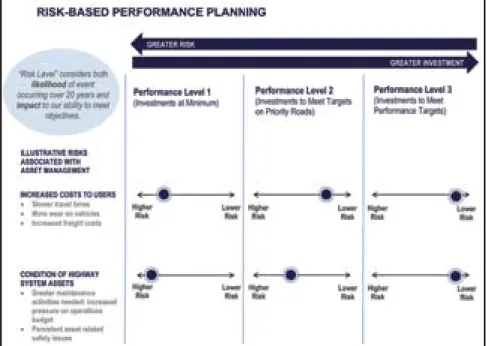
Figure 11, shows the Minnesota Dot’s approach to risk-based performance planning for management of assets. the figure shows that as the investments decrease the performance of the asset drop and the risks increase. the risk-based plan ning considers the likelihood of event occurrence, the impact of risk on assets and the impact to the agency’s ability to meet different levels of asset performance.
Figure 11. Risk based performance planning showing increas ing risk and cost to users, and lower condition of highway asset as investment levels decrease.
MnDOT Program Level Risks and Mitigation Strategies
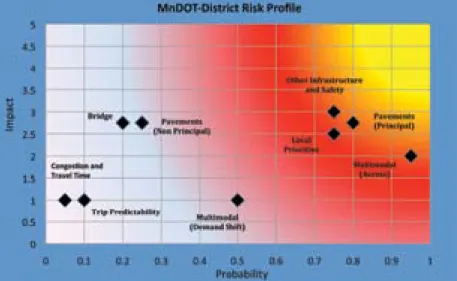
Figure 12, shows the average risks to various MnDot programs. it shows risk to the bridge program dropping to the second lowest as a result of the agency’s intense focus on the bridge program since 2007. However the risk to the principal pavements has risen to the highest. to address these high pavement risks, the Dot developed a detailed plan to move resources systematically for a fixed period of time from low risk programs to the higher risk principal pavements. thus working with the limited funds available, the agency is proactively addressing the risk to the principal pavement program.
the Dot has also proactively engaged its agency personnel in identifying risks and in developing and implementing risk mitigation strategies when necessary. in determining pro gram level risks, MnDot districts are requested to look at
44 Risk-Based Asset Management 45
the probability that an event will 1) occur in the next 10 years, 2) is currently occurring, 3) if the occurrence is every day and 4) if there is some certainty that the event will occur at all. this information is used to estimate the likelihood of the risk occurring.
the Figure 13 shows the graphical representation of the risk analysis that considered the risk probability and impacts to major programs in one of Minnesota Dot’s districts. a similar exercise is conducted in all eight districts and the metro region.
Figure 13. An example of a MnDOT District Risk Profile. the agency has identified four risk response strategies
(rrs) for risk mitigation. these are shown in text Box 2. using the detailed and summarized agency-wide risk analy sis and the rrs strategies, the agency is able to develop detailed risk mitigation to address the identified risks and is better prepared to direct resources to the districts and
Risk-Based Asset Management
programs where risk mitigation is necessary. Minnesota Dot notes that programs tend to have different levels of risk tolerance. risk treatments and risk responses are tailored to address these different levels of risk tolerances.
MnDot Definition of Risk tolerance
are the specific risk levels beyond which the Dot will not knowingly go over under any circumstances? published widely, risk tolerances establish absolute limits of acceptable risk and risky behaviors.
the Minnesota Dot identifies the following four Risk Response Strategies (RRS)
1. Avoidance: remove the opportunity for the risk event to happen. this is normally the strategy of last resort. For example, avoiding a high risk right-of-way option when developing a roadway.
2. transfer: transferring the consequences of a risk event to someone or something else. For example, having contractors take liability insurance for design-build-financing projects
3. Mitigate: taking a series of actions to lessen the impact or likelihood of occurrence of the risk event. investing in proactive pavement preservation and maintenance to ensure that the pavement does not degrade to a point of requiring complete rehabilitation.
4. Acceptance: accepting the risk. this is normally done for risks that are acceptable or whose impacts are understood and can be tolerated. an example is when resource constraints necessitate the less frequent clearing of snow on lower volume roads.