e-Journal of English Language Teaching Society (ELTS) Vol. 3 No. 2 2015 t ISSN 2331-1841 Page 1
TEACHING COMMUNICATIVE SENTENCE
PATTERN PRACTICE TO THE SEVENTH YEAR STUDENTS
THROUGH SHORT READING TEXT
Muhammad Irwan1, Konder Manurung2, Josef Englebertus Ohoiwutun3
Abstract
This research was to prove that the use of short reading text technique can improve the structure mastery of the seventh year students at SMPN 14 Pasangkayu. This research applied pre-experimental research design. Therefore, there was only one class which given pre-test and post-test. The sample was selected by using the purposive sampling technique. The data were analyzed by using a statistical
DQDO\VLV LQ RUGHU WR NQRZ WKH VLJQLILFDQW GLIIHUHQFH RI WKH VWXGHQWV¶ DFKLHYHPHQW
both in pre-test and post-test. The result of data analysis showed that the mean score of the post-test (76.32) was higher than the mean score of pre-test (40.26). It also showed that the t-counted (1.595) was greater than the t-table (1.708) by applying 0.05 level of significance and degree of freedom (df) (26-1) = 25. It can be concluded that the use of short reading text effective in teaching sentence pattern to the seventh year students at SMPN 14 Pasangkayu.
Keywords: Teaching Communicative Sentence; Pattern Practice Mastery; Short Reading Text
INTRODUCTION
English is one of the languages that widely used by large number of people in different countries around the world. There are some skills in English that have to be mastered by students namely: speaking, listening, reading, and writing. It is supported by Departement Pendidikan Nasional of Junior High School 2006 states that English has been learned language consist of elements such as: listening, reading, speaking, and writing.
From the above statement, it can be concluded that before mastering language skills, students need to master language components. English skills are supported by language components, such as vocabulary, pronunciation, and structure. Vocabulary must be firstly mastered by the
VWXGHQW¶V ZKR ZDQW WR OHDUQ RU PDVWHU (QJOLVK %\ KDYLQJ RU NQRZLQJ VXIILFLHQW VWRFN RI
words, they can communicate well. It can make them easier to understand reading material or passage and what the speaker says as well as to convey ideas or thought in English.
1
Prodi Pendidikan Bahasa Inggris FKIP Universitas Tadulako - email: [email protected]
2
email: [email protected] 3
e-Journal of English Language Teaching Society (ELTS) Vol. 3 No. 2 2015 t ISSN 2331-1841 Page 2 Considering interrelationship of languages skills and language component, Thornbury
DUJXHV ³:LWKRXW JUDPPDU YHU\ OLWWOH FDQ EH FRQYH\HG ZLWKRXW YRFDEXODU\ QRWKLQJ FDQ EH FRQYH\HG´ 7KLV VWDWHPHQW DSSHDUV WKDW YRFDEXODU\ LV DQ LPSRUWDQW WKLQJ WKDW VKRXOG
be mastered by students in learning English as a foreign language. They could communicate well with other people in a foreign language if they acquire a number of words and know how to use them accurately.
From the statements above, learning grammar is an important element to be mastered. Every students should be able to use English in correct construction so that the people understand what they are talking about. However, in studying grammar the students should provide any kinds of roles, pattern, tenses.
Verb is one of the main parts of sentences, and it sometimes changes, and the students still have problems about tenses. When speaking English, some of students were not confident to express what they want to say. The students were difficult to learn English grammar because the English structure is different from Indonesia.
Based on the problem mentioned previously, the researcher wants to conduct a research in SMPN 14 Pasangkayu. The researcher used short reading text to teach communicative sentence pattern practice. The researcher believes that the use of short reading text would make students feel easier and more excited. Therefore, they can increase their communicative sentence pattern practice mastery. The use of short reading text made the students think critically. When they are think critically, their long term memories made activated. In this circumstance, when teacher teaches them the communicative sentence pattern practice, they can conceive and remember some conduction longer. In conducting the research, the research used short reading text in teaching communicative sentence pattern practice to the seventh year students at SMP N 14 Pasangkayu. This research title is teaching communicative sentence SDWWHUQ SUDFWLFH WR WKH VHYHQWK \HDU VWXGHQW¶V WKURXJK VKRUW UHDGLQJ
text. In relation to the background above, the researcher formulated the research question as follows: &DQ WKH XVH RI VKRUW UHDGLQJ WH[W LPSURYH WKH PDVWHU\ RI WKH VWXGHQW¶V
communicative sentence pattern practice to the seventh year students at SMP Negeri 14 Pasangkayu? It was to find out whether the short reading text technique can improve the
e-Journal of English Language Teaching Society (ELTS) Vol. 3 No. 2 2015 t ISSN 2331-1841 Page 3
METHODOLOGY
In this research, the researcher applied pre-experimental research design. Therefore, in this research there was one group only; an experimental group. The research conducted based on the research design recommended by Arikunto (2002:78) as follows:
pre-test treatment post-test
Q1 X Q2
Where: Q1 = pre-test X = treatment Q2 = post-test
Based on the title, there were two variables of this research. Arikunto (2006:97)
GHILQHV ³$OO H[SHULPHQWV KDYH RQH IXQGDPHQWDO LGHD EHKLQG WKHP WR WHVW WKH HIIHFW RI RQH RU
more independent variables on a dependent variable. It is possible to have more than one
GHSHQGHQW YDULDEOH LQ H[SHULPHQWV´ 5HIHUULQJ WR $ULNXQWR¶V VWDWHPHQW WKH GHSHQGHQW
variable in this research was the structure mastery of the seventh year students at SMP Negeri 14 Pasangkayu. Thus, the independent variable was teaching communicative sentence pattern practice through short reading text.
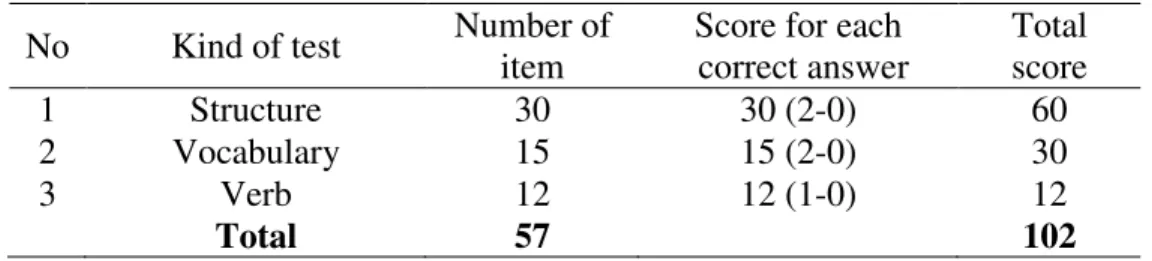
In conducting this research, the researcher used test to collect the data. Before conducting treatment to the students, the researcher administered pre-test to the students. He had designed the pre-test into three forms. They were stucture test, vocabulary test, and verb test. Structure test consisted of 30 items, vocabulary test consisted of 15 items and verb test consisted of 12 items. The information about test distribution was presented in the following table:
Table 1: The scoring system of the tests
No Kind of test Number of item
Score for each correct answer Total score 1 Structure 30 30 (2-0) 60 2 Vocabulary 15 15 (2-0) 30 3 Verb 12 12 (1-0) 12 Total 57 102
After giving the pre-test, the researcher gave the treatment by using short reading text as a medium to the experimental group for eight meetings. The meeting was held based on school schedule and each meeting took 80 minutes or 2 x 40 minutes. After conducting the treatment, the researcher was giving the post-test. The aim of doing post-test was to prove that the treatment was effective or not by comparing the result of pre-test and post-test. The
e-Journal of English Language Teaching Society (ELTS) Vol. 3 No. 2 2015 t ISSN 2331-1841 Page 4 test had the same form as the test in pre-test which means the instruction was alike, but the question was different.
To analyze the result of both pre-test and post-test, the researcher used statistical analysis in order to get the final result. The researcher analyzed the data by using statistical analysis. Then, the researcher calculated the individual score by using formula recommended by Arikunto (2002:276): ™ =z„žÚÙÙ Where: ™ = standard score X = total score N = maximum score 100 = constant score
After obtaining their standard score, the researcher counted the mean score of the class. To get the mean score, the researcher added all scores and divided the sum by the number of scores. To compute this, the researcher used the formula proposed by Arikunto (2006:307) as follows: M
=
Ä ” Where: M = average score ÃT = total score N = number of studentsIn addition, after obtaining the mean scores, the researcher counted mean deviation by using formula proposed by Arikunto (2002:276), which could be seen as follows:
Md
=
Êz
Where:
Md = mean of different pre-test with post- test Ã@ = number of deviation
N = number of students
After that, the researcher computed the square deviation by using the formula stated by Arikunto (2002:277) as follows:
™[2G ™G ±(Ã )Û z
e-Journal of English Language Teaching Society (ELTS) Vol. 3 No. 2 2015 t ISSN 2331-1841 Page 5 Where:
™[2d = number of quadrate deviation
™G = number of deviation N = number of students
After getting the mean score, the researcher used t-test to prove the treatment was effective. To get the t-test, he used a formula proposed by Arikunto (2002: 275):
t = yŠ
§zÃ(zÛFÚ) Where:
t = t-test score
Md = mean of different pre-test with post-test Xd = deviation for subject
™;2d = number of quadrate deviation N = number of students
FINDINGS
The researcher administered tests to the students. The result of tests showed that the mean score of the pre-test was 40.26 and mean score of the post-test was 76.32. It also showed that the t-counted was 11.595 and the t-table was 1.708
The result was presented clearly on the table 2. The mean computation was as follows:
Mpre= ÑT0 M =1046 .93
26
M= 40.26
After giving the treatment, the researcher administered post-test to the students. After
FRPSXWLQJ WKH PHDQ VFRUH RI WKH VWXGHQWV¶ SRVW-test, the researcher totaled the students mean score in post-test. The result presentation of the test can be seen in the table 3.
e-Journal of English Language Teaching Society (ELTS) Vol. 3 No. 2 2015 t ISSN 2331-1841 Page 6
Table 2: Results of Pre-test
No
Students Initial
Kinds of test Total
Score Maximum Score (102) Students Score (0-100) Structure (60) Vocabulary (30) Verb (12) 1. AAA 30 13 5 48 102 47.05 2. ASY 30 11 6 47 102 46.07 3. ARD 29 12 5 46 102 45.09 4. AMR 29 14 8 51 102 50.00 5. ABR 30 7 7 44 102 43.13 6 DWY 28 10 7 45 102 44.11 7 DRW 4 7 5 16 102 15.68 8 EMA 34 13 9 56 102 54.90 9 HIR 8 11 7 26 102 25.49 10 HZA 31 10 7 48 102 47.07 11 HAS 29 13 8 50 102 49.01 12 IDW 8 8 5 21 102 20.58 13 MRW 22 11 6 39 102 38.23 14 MHM 12 13 7 32 102 31.37 15 MRF 20 11 7 38 102 37.25 16 MRS 28 13 8 49 102 48.03 17 MSH 17 9 8 34 102 33.33 18 NRM 6 6 6 18 102 17.64 19 NHL 28 10 6 40 102 39.21 20 RFY 17 8 5 30 102 29.41 21 RBA 26 10 5 41 102 40.19 22 SKM 29 14 9 52 102 50.98 23 SMI 24 10 8 42 102 41.17 24 SRP 29 10 8 47 102 46.07 25 SMR 20 7 8 35 102 34.31 26 TNN 17 7 5 29 102 28.43 Total 585 255 178 1024 - [
Table 3: Results of Post-test Scores
No
Students Initial
Kinds of test Total
Score Maximum Score (102) Students Score (0-100) Structure (60) Vocabulary (30) Verb (12) 1. AAA 46 25 12 83 102 81.37 2. ASY 47 23 12 82 102 80.39 3. ARD 49 24 11 86 102 85.29 4. AMR 46 26 13 85 102 83.33 5. ABR 47 21 12 80 102 78.43 6 DWY 45 22 12 79 102 77.45 7 DRW 47 20 10 77 102 75.49 8 EMA 48 25 11 84 102 82.35 9 HIR 34 27 10 71 102 69.60 10 HZA 44 27 13 84 102 82.35 11 HAS 48 26 13 87 102 85.29 12 IDW 40 24 10 74 102 72.54 13 MRW 47 28 12 87 102 85.29 14 MHM 42 22 12 76 102 74.50 15 MRF 45 25 11 81 102 79.41 16 MRS 46 27 12 85 102 83.33 17 MSH 47 24 11 83 102 81.37 18 NRM 46 19 10 75 102 73.52 19 NHL 42 24 13 79 102 77.45 20 RFY 37 20 10 67 102 65.68 21 RBA 33 28 13 66 102 64.70 22 SKM 32 24 12 68 102 66.66 23 SMI 39 23 11 74 102 72.54 24 SRP 36 20 13 67 102 65.68 25 SMR 37 23 12 71 120 69.60 26 TNN 38 24 11 73 102 71.56 Total 1170 3021 267 2182 - [
e-Journal of English Language Teaching Society (ELTS) Vol. 3 No. 2 2015 t ISSN 2331-1841 Page 7 After computing the mean score of WKH VWXGHQWV¶ SRVW-test, the researcher counted the
VWXGHQWV¶ PHDQ VFRUH LQ SRVW-test. The formula used was the same as in pre-test. Mpost = ÑT0
M = 1984.19
26
M = 76.32
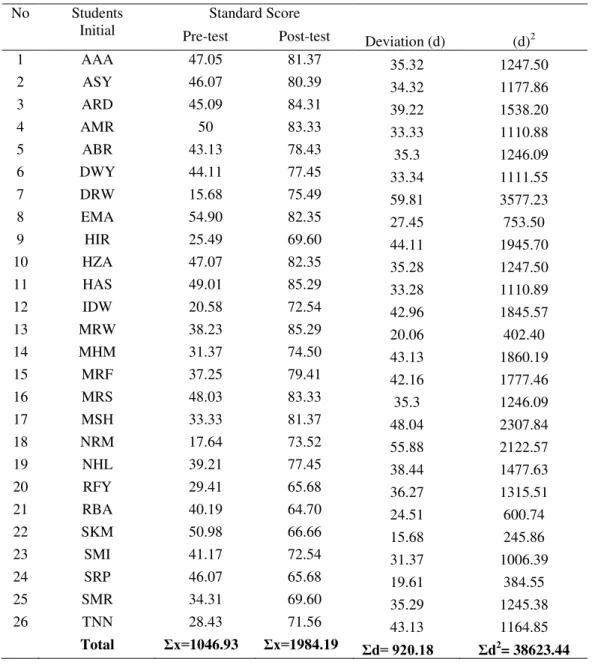
$IWHU FDOFXODWLQJ WKH PHDQ VFRUH RI WKH VWXGHQWV¶ SUH-test and post-test, the researcher computed the deviation and square deviation of the students score in pre-test and post-test. The result was presented on the table 4.
Table 4: Results of Test and Deviation
No Students Initial Standard Score Deviation (d) (d)2 Pre-test Post-test 1 AAA 47.05 81.37 35.32 1247.50 2 ASY 46.07 80.39 34.32 1177.86 3 ARD 45.09 84.31 39.22 1538.20 4 AMR 50 83.33 33.33 1110.88 5 ABR 43.13 78.43 35.3 1246.09 6 DWY 44.11 77.45 33.34 1111.55 7 DRW 15.68 75.49 59.81 3577.23 8 EMA 54.90 82.35 27.45 753.50 9 HIR 25.49 69.60 44.11 1945.70 10 HZA 47.07 82.35 35.28 1247.50 11 HAS 49.01 85.29 33.28 1110.89 12 IDW 20.58 72.54 42.96 1845.57 13 MRW 38.23 85.29 20.06 402.40 14 MHM 31.37 74.50 43.13 1860.19 15 MRF 37.25 79.41 42.16 1777.46 16 MRS 48.03 83.33 35.3 1246.09 17 MSH 33.33 81.37 48.04 2307.84 18 NRM 17.64 73.52 55.88 2122.57 19 NHL 39.21 77.45 38.44 1477.63 20 RFY 29.41 65.68 36.27 1315.51 21 RBA 40.19 64.70 24.51 600.74 22 SKM 50.98 66.66 15.68 245.86 23 SMI 41.17 72.54 31.37 1006.39 24 SRP 46.07 65.68 19.61 384.55 25 SMR 34.31 69.60 35.29 1245.38 26 TNN 28.43 71.56 43.13 1164.85 Total [ 1046.93 [ 1984.19 G G2= 38623.44
Having counted the mean deviation, the researcher then calculated the square deviation which was presented below:
e-Journal of English Language Teaching Society (ELTS) Vol. 3 No. 2 2015 t ISSN 2331-1841 Page 8 [2G G2 ±:Ñ@;2 0 [2d = 38623.44 ±(920.18)2 26 [2d = 38623.44 -846731.23 26 [2d = 38623.44 ± 32566.58 = 6056.86
Based on computation above, it was found that the mean deviation of pre-test and post-test was 35.39 and the sum of square deviation was 6056.86. Moreover, the researcher needed to statistically analyze the data in order to know the significant difference between pre-test and post-test. The computation was as follows:
t = /@ ¾ÑT²@ 0 (0F1) t = 35.39 §6056.86 26 (26F1) t = 35.39 §6056.86 650 t =35.39 ¾9.31 t = 35.39 3.05 = 11.595 (t counted value)
After computing the post-WHVW WKH PHDQ RI WKH VWXGHQWV¶ SRVW-test was 76.32. The standard score of English subject at that school was 65. Therefore it can be concluded that improve at the seventh year students at SMP Negeri 14 Pasangkayu in structure and vocabulary was very well.
$IWHU FDOFXODWLQJ WKH PHDQ VFRUH RI WKH VWXGHQWV¶ SUH-test and post-test, the researcher
FRPSXWHG WKH GHYLDWLRQ DQG VTXDUH GHYLDWLRQ RI WKH VWXGHQWV¶ VFRUH LQ SUH-test and post-test. The researcher computed the mean of square deviation in order to know significant difference score between pre-test and post-WHVW 7KH FRPSXWDWLRQ RI WKH VWXGHQWV¶ PHDQ GHYLDWLRQ ZDV
The mean computation was 35.39.
DISCUSSION
The researcher limited her research focus on the teaching of communicative sentence pattern practice in simple present and simple past tense by using short reading text the
e-Journal of English Language Teaching Society (ELTS) Vol. 3 No. 2 2015 t ISSN 2331-1841 Page 9
UHVHDUFKHU LQYHVWLJDWHG WKH VWXGHQWV¶ DFKLHYHPHQW LQ VSHDNLQJ RI WKUHH DVSHFWV WKH\ ZHUH
structure, vocabulary, and verb. The standard score of English in the school was 65. Based on the result of pre-test in both groups, WKHUH ZHUH RI VWXGHQWV ZKR JRW • DQG RI WKHP ZKR JRW ” In other words, none of the students could get the standard score. Related to the result of pre-test in both groups, the students only got score 1 until 2 for each component of communicative sentence pattern practice, while the maximal score was 10. The results of pre-WHVW VKRZV WKDW WKH VWXGHQWV¶ ZKR JRW VFRUH ZHUH LQ VWUXFWXUH
in vocabulary, and 61.90% in verb. It shows that the students had some problems on the aspects of communicative sentence pattern practice. The most difficult one for the students based on the result was in score component of communicative sentence pattern practice. Most students were not passed in communicative sentence pattern practice.
In the treatment, the researcher asked the students to find out tenses that have relation with teaching materials. After that the researcher treated them by using communicative sentence pattern practice in order to make them more enjoyable, easier and interest to learn structure. For each meeting, the researcher asked them to find out the verb of words which were taken from the answer of short reading text. After that the researcher asked them to identify sentence and verb. It aimed at improving their structure mastery.
The researcher conducted the post-test after the researcher gave them treatment. The result of the post-test showed that both groups had progress, but the progress itself was different. It can be seen by using the result percentage of the test. There were 76.32 % of students in post-WHVW ZKR JRW • DQG RI WKHP ZKR JRW ” 7KHUH ZHUH VRPH
students who got score 2 in post-test, but the score increased to 4 in post-test. It can be seen by using the result percentage of the test. The result of post-test shows that the student who got score 4 were 23.81% in structure, 47.62% in vocabulary, and 80.71% in verb.
Based on the result above, the researcher can conclude that the most dominant made by the students was verb. Therefore, the result verified that the researcher could improve the
PDVWHU\ RI WKH VWXGHQWV¶ FRPPXQLFDWLYH VHQWHQFH SDWWHUQ SUDFWLFH E\ DSSO\LQJ VKRUW UHDGLQJ
text. In addition, the researcher found out that there was a significant difference between pre-test and post-pre-test. The result of the pre-test showed that the hypothesis of this research was accepted and null hypothesis was rejected. It indicates that the objective of this research was proved.
Furthermore, the researcher compared his research finding with previous research which had been done by Salim (2004). The result of the research showed that there was a significant improvement in reading skill by using short reading text. Referring to the
e-Journal of English Language Teaching Society (ELTS) Vol. 3 No. 2 2015 t ISSN 2331-1841 Page 10 previous research, the researcher applied short reading text in improving communicative sentence pattern practice in SMP Negeri 14 Pasangkayu. The researcher found that short
UHDGLQJ WH[W ZDV HIIHFWLYH LQ LPSURYLQJ VWXGHQWV¶ VWUXFWXUH PDVWHU\ RI 603 1HJHUL
Pasangkayu.
CONCLUSION AND SUGGESTIONS
Based on the result of the pre-test and the post-test, the researcher concludes that
ILUVWO\ WKH XVH RI VKRUW UHDGLQJ WH[W FDQ LPSURYH WKH PDVWHU\ RI WKH VWXGHQWV¶ FRPPXQLFDWLYH
sentence pattern practice to the seventh year students at SMP Negeri 14 Pasangkayu. It could
be seen by the mean deviation of pre-test and post-test was 35.39 and the sum of square
deviation was 6056.86, and WKH QXPHULFDO GDWD RI WKH VWXGHQWV¶ PHDQ VFRUH LQ WKH SRVW-test (76.32) which is higher than in the pre-test (40.26). It is also proven that the tcounted value (11.595) is higher than the ttable value (1.708). It shows there is a significant difference between the pre-test and the post-test of the students and the hypothesis is accepted.
Referring to the finding, the researcher would like to suggest the teachers that they should apply the technique when they are teaching especially in communicative sentence pattern practice. They also should motivate, stimulate, and give more chances to the students in teaching learning process in order to make the students get significant improvement in communicative sentence pattern practice.
REFERENCES
Azar, BS.1983. Understanding and Using English Grammar. Practice Hall Regents: Englewood Cliffs, New Jersey.
Arikunto, S. (2002). Prosedur Penelitian: Suatu Pendekatan Praktis. Jakarta: Binarupa Aksara.
. (2006). Prosedur Penelitian: Suatu Pendekatan Praktis. Jakarta: Binarupa Aksara.
Best, JW. (1981). Research in Education. New Jersey: Prentice-Hall, Inc.
Cobuild, C, 1990. English Grammar. Collin Birmingham University, International Language Data Base: London
Departemen Pendidikan Nasional, (2006). Kurikulum Standar Kompetensi Mata Pelajaran Bahasa Inggris: Sekolah Menengah Pertama. Jakarta: Departemen Pendidikan Nasional.
Salim. (2004). TeaFKLQJ WKH VLPSOH SDVW WHQVH RI WKH VHYHQWK \HDU VWXGHQWV¶ DW 6031
e-Journal of English Language Teaching Society (ELTS) Vol. 3 No. 2 2015 t ISSN 2331-1841 Page 11 Thornbury, S. (2002). How to Teach Vocabulary. United Kingdom: Bluestone Press.