CDC Informatics Research and Development Unit (IRDU) Guide to
Health Informatics Structured
V1.0.1 – May 2011
This document serves as a guide for completing a structured
health community. Each section of the outline describes how specific be performed.
The scope of this tool is to examine specific technology
to provide specific value to the public health community. The tool is not designed to evaluate public health programs. Though suboptimal, it can be used to evaluate public health surveillance systems. There are, however much more specific
component technologies within a larger system (e.g., a surveillance system).
Appendix C includes an empty template to be completed with the results of your evaluati
1.
Overview
1.1At a Glance
This section provides a brief summary of the entire evaluation. It includes small graphics to indicate the overall rating of the technology using 1
place on the adoption curve.
1.2Keywords
List any keywords associated with this technology. Keywords should associate the technology with one or more categories to relate to other evaluations.
1.3Introduction
The introduction includes a description of the overall technology/ and background on the evaluation.
1.4Public Health Business Process Alignment
Describe the activities and business processes of public health where this technology is useful. exhaustive set of processes has been arti
1
Public Health Informatics Institute and Association for Public Health Laboratories, Robert Wood Johnson Foundation Common Ground Initiative
Information Systems. http://www.phii.org/resources/doc_details.asp?id=109
German RR, Lee LM, Horan JM, Milstein RL, Pertowski CA, Waller MN; Guidelines Working Group Centers for Disease Control and Prevention (CDC).,
recommendations from the Guidelines Working Group., MMWR Recomm Rep. 2001 Jul 27;50(RR
CDC Informatics Research and Development Unit (IRDU) Guide to
Structured Technology Evaluations
for completing a structured technology evaluation – for the public Each section of the outline describes how specific portions of the evaluation
The scope of this tool is to examine specific technology-based tools or resources that have the capacity to provide specific value to the public health community. The tool is not designed to evaluate public health programs. Though suboptimal, it can be used to evaluate public health surveillance systems.
more specific tools to achieve this task.1 This tool is best used to evaluate the component technologies within a larger system (e.g., a surveillance system).
includes an empty template to be completed with the results of your evaluati
This section provides a brief summary of the entire evaluation. It includes small graphics to indicate the overall rating of the technology using 1-5 stars and to show where the technology is according to its
List any keywords associated with this technology. Keywords should associate the technology with one or more categories to relate to other evaluations.
The introduction includes a description of the overall technology/service(s), product(s), purpose/need
Public Health Business Process Alignment
Describe the activities and business processes of public health where this technology is useful.
exhaustive set of processes has been articulated by Common Ground: A National Program of the Robert
Public Health Informatics Institute and Association for Public Health Laboratories, Robert Wood Johnson Foundation Common Ground Initiative - Towards Measuring Value: An Evaluation Framework for Public Health
http://www.phii.org/resources/doc_details.asp?id=109 March 31, 2004
German RR, Lee LM, Horan JM, Milstein RL, Pertowski CA, Waller MN; Guidelines Working Group Centers for Disease Control and Prevention (CDC)., Updated guidelines for evaluating public health surveillance systems: recommendations from the Guidelines Working Group., MMWR Recomm Rep. 2001 Jul 27;50(RR
CDC Informatics Research and Development Unit (IRDU) Guide to Public
for the public of the evaluation should
r resources that have the capacity to provide specific value to the public health community. The tool is not designed to evaluate public health programs. Though suboptimal, it can be used to evaluate public health surveillance systems.
This tool is best used to evaluate the
includes an empty template to be completed with the results of your evaluation.
This section provides a brief summary of the entire evaluation. It includes small graphics to indicate the 5 stars and to show where the technology is according to its
List any keywords associated with this technology. Keywords should associate the technology with one
product(s), purpose/need
Describe the activities and business processes of public health where this technology is useful. A non-Common Ground: A National Program of the Robert
Public Health Informatics Institute and Association for Public Health Laboratories, Robert Wood Johnson Towards Measuring Value: An Evaluation Framework for Public Health
German RR, Lee LM, Horan JM, Milstein RL, Pertowski CA, Waller MN; Guidelines Working Group Centers for Updated guidelines for evaluating public health surveillance systems: recommendations from the Guidelines Working Group., MMWR Recomm Rep. 2001 Jul 27;50(RR-13):1-35
Wood Johnson Foundation2 that defines 21 business processes for public health that serve as requirements for select public health information systems:
• Conduct Exercise To Evaluate Organizational Response Capacity • Conduct Syndromic Surveillance
• Conduct Notifiable Disease Surveillance • Conduct Active Surveillance
• Conduct Public Health Investigation • Initiate Alerts
• Develop And Report Situational Information • Manage Resources
• Develop And Initiate Risk Communication • Administer Medical Countermeasures (MCMS) • Data Collection
• Data Management
• Process, Store, And Analyze Data • Conduct Epidemiological Research • Community Health Assessment • Develop Strategic Plan
• Identify And Deploy Health Guidelines • Deliver Programs And Services
• Develop Public Health Intervention
• Link Individuals/Populations To Programs/Services • Develop And Implement Program Evaluation
While this selection of processes serves as a guide, evaluators should feel free to list additional likely business processes that this technology will impact. By aligning to specific business processes within public health, technologies can be grouped and searched according to expected function within the public health work force.
1.5Determination of Evaluation Dimensions and their Weighting
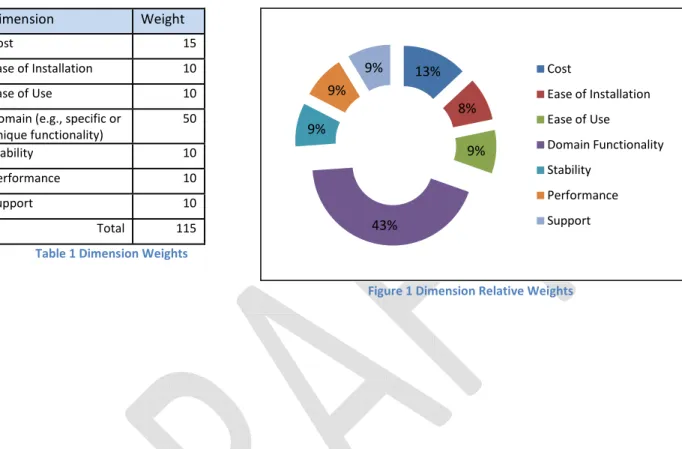
Dimensions are described in Section 2 with assessments and scores. This section describes the relative weights assigned to each dimension and a justification based on the business process and type of technology/service/product. For example, if an evaluator of a data analysis tool places a very high priority on functionality, then the functionality dimension is given a higher weight than the others. The weight represents the highest possible score for a dimension and the dimension’s relative importance when compared to other dimensions within this evaluation. The default weights are shown below in Table 1. The evaluator should modify the weights as needed. In general, the higher the score the closer it is to the ideal value of the dimension.
2
If the evaluation requires a domain specific dimension, this section of the review should list and describe the one or more components which make up the domain specific dimension. The table below (Table 1) should be updated as appropriately- if a domain specific dimension is used. The weighting chart (Figure 1) depicts the relative weights graphically.
Dimension Weight
Cost 15
Ease of Installation 10
Ease of Use 10
Domain (e.g., specific or unique functionality) 50 Stability 10 Performance 10 Support 10 Total 115
Table 1 Dimension Weights
Figure 1 Dimension Relative Weights
Some dimensions may be potentially unknowable. If so, this section should explain why and give the dimension a weight of zero and note a value of “Not Applicable” on visualizations.
1.6Alternatives
List and briefly describe similar or related technologies that were used as reference for this evaluation. This section identifies parallel efforts that may be of interest to public health practitioners. If available, brief reasons should be stated that describe the differences between these alternatives and the technology being evaluated.
1.7Legal / license issues
Briefly describe the license of this technology and any legal or policy issues that may be relevant. Please include the type of licensing model (e.g., site, named, concurrent user, role-based, transaction-based, perpetual, etc.) for COTS/GOTS software or the license type for OSS (e.g., GPL, LGPL, Apache, EPL, BSD, etc.)
2.
Evaluation
Provide a detailed description of the dimensions. For each dimension, list a numerical score (based on the maximum weight defined in section 1.2) using the best data available in combination with subject
13% 8% 9% 43% 9% 9% 9% Cost Ease of Installation Ease of Use Domain Functionality Stability Performance Support
matter expertise. It is understood that this score is a subjective value based on the author’s perspective and experience in combination with objective data and evidence where available.
2.1Cost
Describe the cost of the technology as relevant to the evaluation. This evaluation component should include licensing cost, training costs, support costs, implementation costs.
2.2Ease of installation
Describe the ease of installation of the technology. This should reflect the supported operating systems and platforms, as well as relevancy to CDC and public health environments.
2.3Ease of use
Describe the ease of use of the technology including the learning curve necessary to begin to be
effective as well as to proficient in the tool (e.g., is this tool useful for a casual user and/or for an expert user). Take into account if a particular tool is targeted toward novice or expert skill level users within the technology category.
2.4Domain (e.g., Functionality)
Describe the most relevant feature set of the technology. Specifically, compare the technology to available alternatives in use at CDC, partners and/or industry. Describe the flexibility, scalability, interoperability, security, modularity, extensibility and other factors that affect the usefulness of the technology for public health. Over time some of these domain functionalities may evolve into independent dimensions. Since different technology categories have vastly different required functionality, initially this category will describe the different functionalities and how they affect the dimension score. The initial reasoning is that not all technologies will require functionalities such as modularity (i.e., some mobile apps are self-contained and do not require the function to have their components switched out modularly).
Describe how this technology implements and / or supports relevant standards and policies. Briefly reference the standard and describe the type (e.g. open, proprietary, community) and relevant alternatives for this technology.
If applicable describe how the technology receives data and how it outputs / shares data with other tools and users. Functionality is closely linked to how portable data is within the technology. Portability will vary depending on the technology category.
Different technology domains may have dimensions that are relevant only to these domains. This section should describe additional dimensions relevant to the evaluation and a description of the technology according to these dimensions. List a numerical score.
2.5Stability
Describe the maturity and stability of the technology. Specifically describe the age of the technology and market penetration (both within public health and within other industries).
2.6Performance
Describe the level of performance and responsiveness of the technology.
2.7Supportability
Describe the support and level of community activity that is available for this technology. Describe the platform that the technology uses and how it affects the supportability of the technology.
2.8Scoring & Visualization
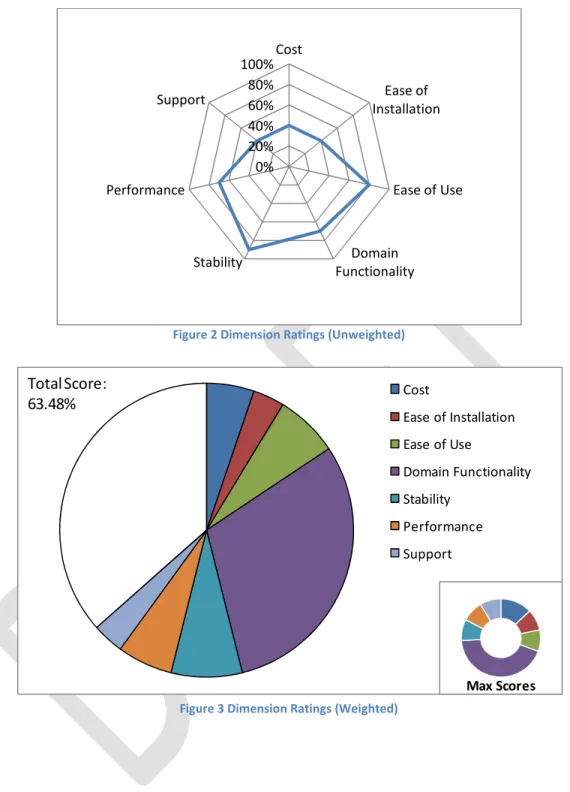
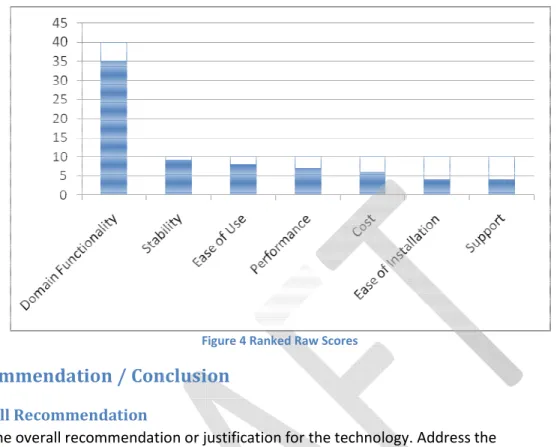
Collect the scores from the above sections into a summary scoring table (Table2) comparing to the overall weight assigned to each dimension. Figure 2 shows the unweighted dimension scores while Figure 3 shows the overall score as a weighted percentage. If particular dimensions are unknowable, note the score and weight as N/A and adjust the visualizations as necessary. Add additional
visualizations as necessary.
Dimension Score / Weight
Cost 6 15 Ease of Installation 4 10 Ease of Use 8 10 Domain Functionality 35 50 Stability 9 10 Performance 7 10 Support 4 10 Total 73/115 (63.48%)
Figure 2 Dimension Ratings (Unweighted)
Figure 3 Dimension Ratings (Weighted) 0% 20% 40% 60% 80% 100% Cost Ease of Installation Ease of Use Domain Functionality Stability Performance Support Cost Ease of Installation Ease of Use Domain Functionality Stability Performance Support Total Score: 63.48% Max Scores
3.
Recommendation / Conclusion
3.1Overall Recommendation
Describe the overall recommendation
stakeholders/groups within public health informatics that will be most interested / impacted.
3.2Adoption timeline
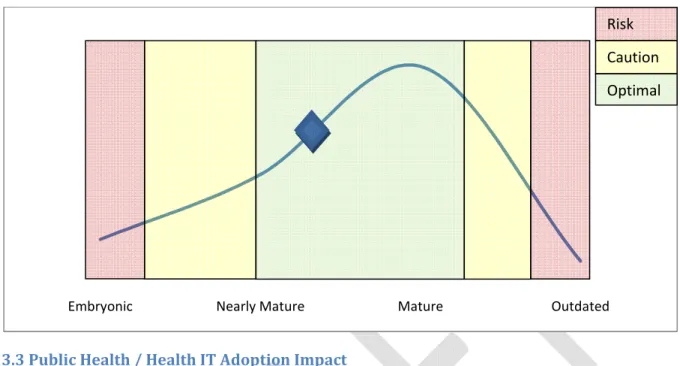
Describe the current state for adoption
embryonic, nearly mature, mature, old / outdated.
# years) for the technology to become mature or transition from obsolescence to end of life. the diamond on Figure 5 to mark the
Figure 4 Ranked Raw Scores
Recommendation / Conclusion
Describe the overall recommendation or justification for the technology. Address the
stakeholders/groups within public health informatics that will be most interested / impacted.
for adoption of the technology. Classify its adoption according to very early / embryonic, nearly mature, mature, old / outdated. When possible, provide an estimate of the time (e.g., # years) for the technology to become mature or transition from obsolescence to end of life.
the technology adoption level.
stakeholders/groups within public health informatics that will be most interested / impacted.
of the technology. Classify its adoption according to very early / When possible, provide an estimate of the time (e.g., # years) for the technology to become mature or transition from obsolescence to end of life. Position
Figure 5 Technology Position on Adoption Curve
3.3Public Health / Health IT Adoption Impact
Describe the potential impact of this technology to public health informatics. Describe whether the impact will be low, moderate, high or transformational in both the short term and the long term.
Appendix A - Peer Review
The evaluation should be peer reviewed by subject matter experts and practitioners relevant to the technology and category of technology. Describe the peer review process used for this evaluation. Include the field of expertise and number of reviewers, not necessarily the name and title of the reviewers.
Appendix B – Excel Worksheet Aides
Structured Evaluation Aides.xlsx
Appendix C – Structured Evaluation Template
Structured
Evaluation Template-0.1.doc
Embryonic Nearly Mature Mature Outdated
Risk Caution Optimal