Portland Cement Dust
Hazard assessment document
EH75/7FOREWORD
This Hazard Assessment Document has been published by the UK Health and Safety Executive (HSE). It is aimed at a technical audience and reports on the scientific information which underpins the hazard assessment of a specific substance.
In Great Britain, substances which cause harm to health are subject to the Control of Substances Hazardous to Health Regulations (COSHH) 2002 (as amended). The Regulations require employers to prevent or, if that is not reasonably practicable, adequately control employees’ exposure to hazardous substances.
Hazard Assessment Documents are produced to facilitate the development of HSE’s regulatory position on a specific health-related issue, which may relate to an individual hazardous substance, or may involve consideration of more general issues related to chemicals and ill health. The documents in this series cover issues relating only to toxicological hazards; other document series address issues which involve consideration of occupational exposure and risk:
• Exposure Assessment Document – EH74 series; • Risk Assessment Document – EH72 series.
The data in Hazard Assessment Documents are assessed and endorsed by the Working Group on the Assessment of Toxic Chemicals (WATCH). WATCH makes recommendations to the Advisory Committee on Toxic Substances (ACTS) on all aspects of chemical hazard and risk assessment and risk management issues, including recommendations for occupational exposure limits (OELs) and other aspects of occupational health risk management, as part of its assessment of the substance under discussion. Hazard Assessment Documents are published after their endorsement by WATCH.
Contents Page
1. Summary 6
2. Introduction 7
3. The Health Effects Literature 9
3.1 Effects of single exposure 9
3.2 Irritation 10
3.3 Skin sensitisation 10
3.4 Effects of repeated exposure to cement dust 12
3.4.1 Recent studies of non-malignant respiratory 12
disease in workers with long-term exposure to
cement dust
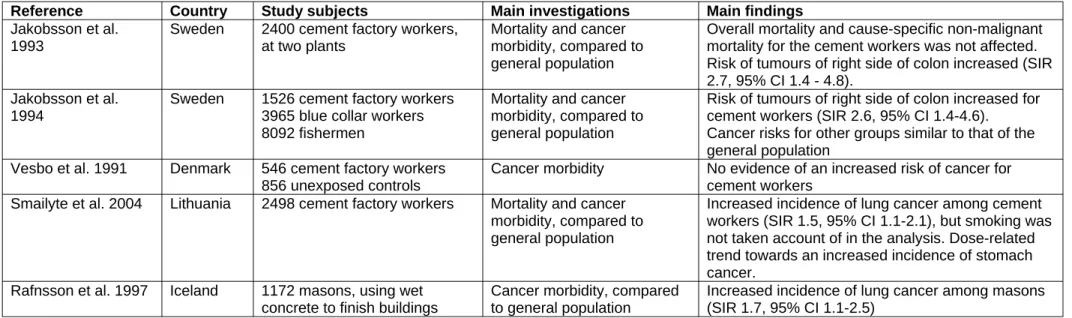
3.4.2 Mortality and cancer studies involving workers 28
with long-term exposure to cement dust
4. References 46
Table 1 Summary of recent studies of non-malignant respiratory 51
disease in workers with long-term exposure to cement dust
Table 2 Summary of mortality and cancer morbidity studies in 52
cement manufacturing workers or masons
Table 3 Summary of German case control studies for cancers 53
CI GLOSSARY
ATS American Thoracic Society
Confidence interval
COPD Chronic obstructive lung disease
FEF Forced expiratory flow
FEV1 Forced expiratory volume in one second
FVC Forced vital capacity
MRC Medical Research Council (UK)
MVV Maximum voluntary ventilation
OR Odds ratio
PEFR Peak expiratory flow rate
RR Relative risk
SD Standard deviation of the mean
SE Standard error of the mean
SIR Standardised incidence ratio
SMR Standardised mortality ratio
TWA Time weighted average
VC Vital capacity
1. SUMMARY
This hazard assessment updates the health effects sections of an earlier HSE review of Portland cement (HSE 1994). The latter is taken to represent an accurate assessment of the literature available up to 1991. This assessment concentrates on the evidence for non-malignant respiratory disease and carcinogenicity. The primary literature on skin sensitisation has not been reviewed because the potential for cement to cause such reactions, due to the presence of hexavalent chromium, has been established by other reviews. Toxicological endpoints such as reproductive toxicity and mutagenicity have not been considered because there are no data.
Concerning non-malignant respiratory disease, HSE (1994) noted evidence that repeated exposure to Portland cement has produced chronic bronchitis and impaired pulmonary function, but firm conclusions could not be drawn because of limitations of the available studies. The effects of long-term
exposure remain poorly studied, particularly because there are no longitudinal prospective studies in workers exposed to cement. However, many of the 15 recent studies, all conducted outside of the UK, provide evidence of the presence of respiratory problems among cement factory workers, consistent with the earlier literature. Overall, the pattern of evidence clearly indicates that occupational exposure to cement dust has produced deficits in respiratory function. However, the evidence available at the present time is insufficient to establish with any confidence the dose-response relationship for these effects. HSE (1994) concluded that there was no convincing evidence for an
increased incidence of any site-specific cancer resulting from cement exposure, but acknowledged that the data available at that time were not consistently and reassuringly negative. Since the early 1990s, a number of relevant cancer cohort and case control studies have been published,
conducted in groups exposed to cement either through employment in cement factories or in the construction industry. Among these and earlier studies, increased incidences of cancers at several sites (stomach, lungs, colon, pharynx and larynx) were noted, but taking account of limitations in the strength of the observed associations, it is concluded that a causal
association between Portland cement exposure and cancer has not been established. Nevertheless, the findings of the recent studies reviewed in this document maintain the uncertainty concerning a possible risk of cancer raised by the earlier data reviewed by HSE (1994).
2. INTRODUCTION
This hazard assessment document updates the health effects sections of an earlier HSE review of Portland cement (HSE 1994). The latter is taken to represent an accurate assessment of the literature available up to 1991. Consequently this hazard assessment concentrates mainly on literature published after this time, although certain pre-1991 studies are considered in some detail where they help with the interpretation of the recent literature. A copy of the earlier HSE (1994) review is provided as Annex 2 to the
WATCH/2005/03.
There were two reasons for producing this updating document. Firstly, work related chronic obstructive pulmonary disease (COPD) is a priority within HSE’s Occupational Respiratory Disease (ORD) sub-programme. The evidence-base for this sub-programme indicates that occupational exposure to dusts in general leads to an increased risk of COPD. Cement dust is a particularly alkaline and irritant dust, and might therefore be considered to pose a greater risk of respiratory tract damage than many other poorly soluble dusts (generically often referred to as “low toxicity dusts”). The HSE (1994) review described evidence for an increased risk of chronic bronchitis and impairment of pulmonary function (consistent with COPD) in cement dust exposed workers, but there was a lack of data on dose-response
relationships. Hence, one reason for undertaking this updating assessment was to see whether the scientific literature on cement dust published over the last 10 years is now better able to characterise the risks of COPD, and
consequently to help determine whether or not cement dust should be
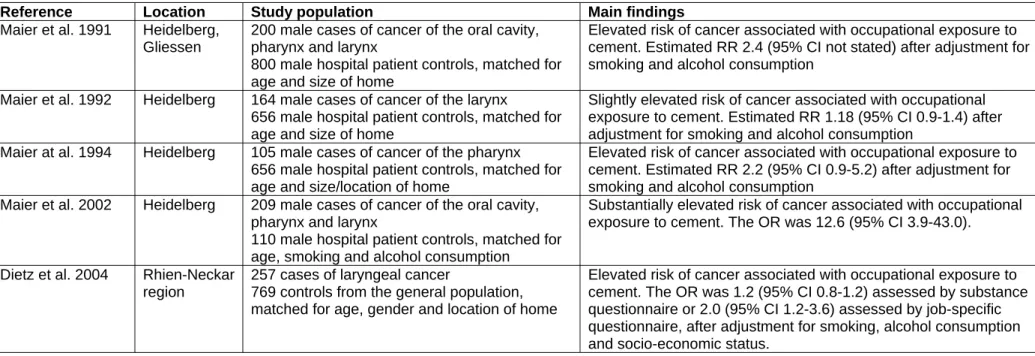
regarded as a particular priority for action within HSE’s ORD sub-programme. In addition, it has been drawn to the attention of HSE that in recent years a number of case-control studies have been published suggesting that exposure to cement dust may be a cause of laryngeal and pharyngeal cancer. It was felt important to examine the evidence from these studies particularly as the earlier HSE review of Portland cement (HSE 1994) noted that the evidence for carcinogenicity with cement dust was not reassuringly negative, albeit largely based on concerns for stomach cancer. Given the widespread occupational exposure to cement dust, it was felt important that HSE develop an updated position in relation to carcinogenicity.
Annex 1 provides a detailed explanation of the composition and manufacture of Portland cement. In brief, Portland cement is produced by crushing and grinding calcareous materials (e.g. limestone, chalk) and argillaceous materials (e.g. clay, shale), as a wet slurry or in a dry state. The mixture is calcined in a rotary kiln and the resulting clinker is finely ground. The product is composed largely of calcium silicates, aluminates, and alumino-ferrites. Other constituents are then added, depending on the desired concrete properties.
Hexavalent chromium (Cr (VI)) can be present in cement. The sources of chromium are in the raw materials, refractory bricks in the kiln and chromium
steel grinders. Because of concerns about Cr (VI) sensitisation (see section 2.3), during recent years several countries have introduced measures to limit the amount of Cr (VI) in cement products. This can be achieved by the
addition of ferrous sulphate to cement, which transforms Cr (VI) to form Cr (III) compounds. In 2003 the European Commission introduced new legislation to restrict the marketing and use throughout the EU of cement products
containing soluble Cr (VI) at a concentration of more than 2 ppm.
This document focuses mainly on the evidence for non-malignant respiratory disease and carcinogenicity. Studies published between 1990 and 2004 were identified from a literature search using TOXLINE and PubMed, or from report reference lists. All relevant reports have been critically appraised. The primary literature on skin sensitisation was not reviewed because the hazardous properties of cement in relation to this adverse health effect had been
established in the pre-1991 literature, and the primary literature has been the subject of two very recent critical reviews (summarised in section 3.3). Other toxicological endpoints such as reproductive toxicity and mutagenicity have not been considered.
Information on the adverse health effects of cement dust comes from observations of its effects in humans. As noted in the earlier HSE (1994) review, animal data are extremely limited in terms of their scope and quality and do not provide any useful information.
A number of the available epidemiology studies were conducted in Portland cement production plant workers. It is noted that these workers can be exposed to the raw materials of cement production, which include limestone, chalk, clay and shale, to clinker, as well as to Portland cement dust. The exact nature of the dust exposures experienced by cement plant workers has not been characterised in any of the studies. Consequently, one cannot exclude the possibility that any observed adverse health may have been due, at least in part, to the raw materials and intermediates of cement production.
Among the available epidemiological studies, dust exposures have been expressed either in terms of respirable dust, or “total dust”, or both. This raises two issues, one concerning the ratio between total and respirable dust (given that cement dust is very fine and one might expect a high proportion of the total dust to be respirable), and the other concerning the meaning of “total” dust. In the study of Noor et al. (2000), the ratio of total to respirable dust was reported as 8.5 mg.m-3 to 5.7 mg.m-3. In contrast, in the study of Fell et al., the ratio of total to respirable dust was 7.4 mg.m-3 to 0.9 mg.m-3. The differences in these ratios may be a consequence of measuring dust at different stages of the manufacturing process. One might expect a higher proportion of respirable dust at the later stages of the manufacturing process as opposed to the earlier stages where the raw materials are handled.
It should be noted that the metrics “total” and “total inhalable” dust are not equivalent. In many countries, “total dust” is measured using the NIOSH method that involves a 37 mm closed face cassette. This is known to under sample for “inhalable dust” as measured using the IOM sampler (25 mm forward facing cassette). Although not generally specified, it is likely that the
“total” dust levels reported in the studies on cement dust refer to
measurements taken with the NIOSH method, and the results will not be equivalent to the UK “total inhalable dust” metric. Overall therefore, the exposure data reported in the following studies need to be interpreted with care.
3. THE HEALTH EFFECTS LITERATURE 3.1 Effects of single exposure
HSE (1994) reported that there were no data on the effects of a single exposure to cement by relevant routes of exposure.
Only one recent study looking at short-term effects of cement exposure was identified. Changes in pulmonary function during a work shift were
investigated in workers at three Portland cement factories in Saudi Arabia (Ali et al. 1998). From the payrolls, 150 exposed male workers were selected randomly for the study, in a manner that ensured that all production areas were represented. Their mean age (± SE) was 38.0 ± 0.8 years. As an unexposed control group, 355 male workers were randomly chosen from among administrative staff in the cement, ammonia, petrochemical and asbestos industries. The control group was slightly younger, with a mean age of 34.3 ± 0.5, and their ethnicity was Arab (68%), Indian subcontinent (22%) and South East Asia (9%). Personal information was collected by
questionnaire. The proportion of current smokers, ex-smokers and non
smokers was similar in the control and exposed groups. Respirable dust was measured using a gravimetric method for a total of 97 samples collected from various production areas; the report does not state the sampling time or whether these were personal or static samples. Spirometry was conduced immediately before and after the morning shift. The highest values from three acceptable expirations for FEV1, FVC and FEF25-75% were recorded and the FEV1/FVC ratio was calculated.
The geometric mean concentration (± SD) of respirable dust ranged from 20 ± 1 mg.m-3 in the quarry to 7 ± 2 mg.m-3 in the kiln area. Spirometry data were reported as mean cross-shift changes. The spirometry readings did not
appear to have been adjusted for height. Reductions in FEV1, FEV1/FVC ratio and FEF25-75% occurring during the workshift were significantly greater in the exposed workers. For example, the mean (± SE) reduction in FEV1 was 0.022 ± 0.008 l for the control group, compared with 0.077 ± 0.011 l for the exposed group. For FEV1/FVC the mean reduction was 0.011 ± 0.165% and 1.316 ± 0.319% for the control and exposed group. Regression analysis demonstrated no relationship between cross-shift pulmonary changes and age or smoking status.
The results of this study suggest that bronchoconstriction had occurred during the workshift for the cement workers, who were exposed to relatively high dust concentrations. The health significance of this effect is uncertain.
3.2 Irritation
HSE (1994) concluded that cement has irritant and corrosive properties, especially when wet, towards the skin. Also, it was concluded that due to its alkalinity, moistened cement would also produce eye irritation.
As these properties of cement are well established, no further evaluation of the literature has been conducted for these adverse health effects in the present review.
Portland cement is generally considered to be a respiratory tract irritant, although there are no data on this aspect in the scientific literature. 3.3 Sensitisation
HSE (1994) stated, based on a review of the pre-1979 literature (Fleetwood and Soutar 1979), ‘that there have been many cases of cement dermatitis appearing to arise as a result of skin sensitisation to hexavalent chromium (Cr(VI)) in cement’. Concerns for sensitisation relate in the main to contact with the wet cement.
Recently the National Institute of Occupational Health, Norway (NIOH, 2003) conducted a detailed critical review of the literature, to address these
questions:
1. Does Cr(VI) in wet cement cause allergic dermatitis (skin sensitisation) in construction workers?
2. Is there any causal association between the reduction of Cr(VI) in cement and the occurrence of allergic dermatitis?
Twenty four papers published between 1975 and 2001 were systematically reviewed. These were selected as studies of chromate allergy in humans, especially those involving construction workers, which included the conduct of patch tests for chromate allergy. Most of the investigations were cross
sectional studies based on patients attending dermatology clinics, in the general population, or in groups of construction workers. Some studies provided limited comparative information on the prevalence of Cr(VI) sensitisation in groups of workers exposed to cement with ‘high’ and ‘low’ (less than 2 ppm) Cr(VI) content, conducted in countries where the practice of reducing the Cr(VI) content of cement by the addition of ferrous sulphate has been introduced.
All the studies reviewed were considered by NIOH to have significant
limitations, notably the absence of exposure characterisation, problems with the chromate allergy diagnosis, subject selection bias and the lack of
prospective follow-up. Nevertheless, the reviewers identified a consistently high prevalence of Cr(VI) allergy in studies of construction workers. Also, in general population studies, the prevalence of allergy was found to be higher in construction workers than in other occupational groups. Furthermore,
analyses of patients attending dermatology clinics with a diagnosis of chromate allergy revealed a high proportion of patients with occupations involving contact with cement.
In view of the consistency and strength of the associations it was concluded that, despite their limitations, the available studies supported the hypothesis of a causal relationship between Cr(VI) in wet cement and allergic contact
dermatitis in construction workers.
In answer to the second question, it was concluded that there is insufficient information to decide if there is a causal association between the reduction of Cr(VI) in cement and a reduced occurrence of allergic dermatitis. However, the information that is currently available supports such a relationship. Furthermore, it is biologically plausible that that a reduction in exposure to Cr(VI) will lead to a lower risk of allergic contact dermatitis.
Recently the European Commission’s Scientific Committee on Toxicology, Ecotoxicology and the Environment (SCTEE, now the Scientific Committee on Health and Environmental Risks) expressed an opinion of the risks to health from Cr(VI) in cement (European Commission, 2002). On the basis of a selective review of the published literature, SCTEE concluded that Cr(VI) compounds in cement induce sensitisation and cause serious allergic reactions in construction workers. Also they concluded that water-soluble Cr(VI) compounds penetrate the skin to a much greater extent than the less water-soluble Cr (III) compounds, and that Cr(VI) readily penetrates wet leather gloves. SCTEE also concluded that, based on studies in Denmark (Avenstorp, 1989a,b, 1991, 1992), a reduction of Cr(VI) compounds in cement to less than 2 ppm will reduce the prevalence of allergic cement eczema in workers, and will reduce the risk of becoming sensitised to chromate. They also emphasised that education and the use of personal protective measures would also contribute to a lower frequency of skin sensitisation due to Cr(VI). Subsequently the European Commission introduced new legislation, through an amendment (2003/53/EC) to the Marketing and Use Directive
(76/769/EEC), to restrict the marketing and use of cement and cement
containing preparations where the level of soluble Cr(VI) is more than 2 ppm. Overall, it can be concluded that contact with wet cement can cause
sensitisation reactions to Cr(VI) in the cement and, though not proven, is likely that reducing the Cr(VI) content of cement will reduce the risks of Cr(VI)
3.4 Effects of repeated exposure to cement dust
3.4.1 Recent studies of non-malignant respiratory disease in workers with long-term exposure to cement dust
HSE (1994) noted evidence that repeated exposure of humans to Portland cement has produced rhinitis, chronic productive cough (chronic bronchitis), slight abnormalities on chest radiography and impaired pulmonary function. However, it was considered that the quality of studies indicating adverse effects on pulmonary function was such that the evidence for a true effect of cement dust is inconclusive. From the limited exposure data available, and from subjective descriptions of working conditions, the respiratory effects appeared to be associated with very dusty working conditions. Although no firm conclusion could be drawn about the dose-response relationship for the respiratory effects, attention was drawn to several studies which reported no significant effects associated with airborne concentrations of cement dust of 2.9 mg.m-3 total dust and 0.57 mg.m-3 respirable dust (geometric means), up to 5 mg.m-3 total dust and 1.1 mg.m-3 respirable dust, or 2-7.8 mg.m-3 total dust and 1-2.2 mg.m-3 respirable dust.
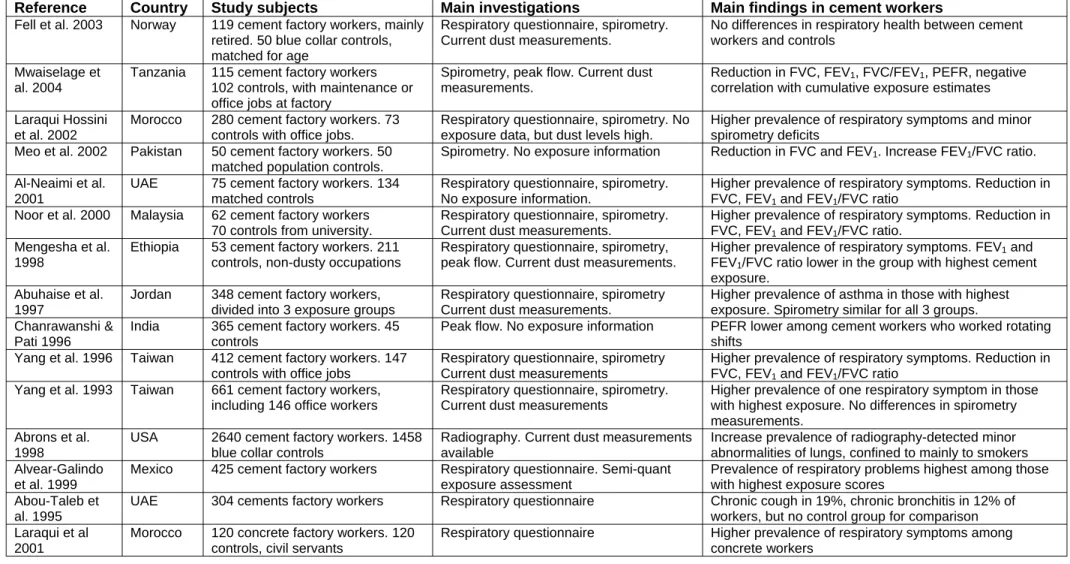
The literature search conducted in 2004 identified a number of recently published cross sectional studies, together with one retrospective cohort study, of non-malignant respiratory disease conducted in workers at cement production plants. In 11 studies, pulmonary function testing was conducted and information on the presence of self-reported respiratory symptoms was usually collected. Pulmonary function testing was by spirometry, except for one study that used a peak flow meter. One cross sectional study investigated workers using chest radiography. A further 3 studies in cement production workers looked only at self reported respiratory symptoms. All these 15 studies are appraised below, and summarised in Table 1.
Two general health surveys of populations of construction workers are
available (Petersen and Zelling 1998 and Arndt et al. 1996) but these studies do not provide any information on health that can be related to cement dust exposure so these studies were not included in this review.
3.4.1.1 Retrospective cohort study, which included pulmonary function testing
Fell et al. (2003) conducted a retrospective cohort study in 119 Norwegian cement factory workers. A respiratory questionnaire was administered and spirometry was conducted. Current dust level measurements were available and a semi-quantitative cumulative exposure matrix was developed. The study showed no differences in the respiratory health of the cement workers exposed to average respirable dust levels of at least 1 mg.m-3 when compared with matched blue-collar controls
In a recent retrospective cohort study, pulmonary function and the presence of respiratory symptoms were investigated in a group of Norwegian Portland cement factory workers (Fell et al. 2003). The investigation was conducted in 1998 and 1999. The study population comprised men born between 1918 and 1938 who had worked at a particular cement-producing factory for at least one year; presumably most of the study population were retired. A total of 226
workers fulfilling these criteria were identified, of which 148 were still alive. No information was available on the cause of death of those who had died. After exclusions due to white collar work, workplace exposures to paint or welding fume, medical conditions unrelated to work that would affect ability to undergo spirometry testing, refusal to participate or not being contactable, 119 workers were available for the study. Only 4 workers refused to participate. They had a mean age of 69 years, and a mean of 21.8 years exposure to cement dust. As controls, a group of 94 men born between 1918 and 1938 and who had
worked at an ammonia plant for at least one year were identified; 63 were still alive at the time of the study. The ammonia plant was located about 10 km from the cement plant. It used closed processes, so the workers were not exposed to ammonia. None of the control workers had ever experienced exposure to ammonia at levels sufficient to cause symptoms of sensory irritation. After exclusions due to refusal to participate or not being contactable, 50 controls, of mean age 67 years were available for
investigation. The percentage of deceased workers in the cement workers and controls was similar, at about 35%. The proportion of current smokers was slightly higher among the cement workers (35%) than the controls (26%). Previous dust exposures for particular work processes were estimated from documented information on changes in work practice and from detailed
interviews with a subgroup of workers. Four levels of historical exposure were established, and assigned semiquantitative exposure numbers. Cumulative exposure indices were calculated for each worker for an exposure-response analysis. Contemporary dust exposure was measured by personal sampling, over 8 hour periods on three days of work; 20 person-related measurements were conducted. Silica levels were measured in the three samples showing the highest amounts of dust. Information on respiratory symptoms was gathered, using a Norwegian modification of the MRC questionnaire, answered at home. Also, information on job history, cement dust exposure level estimates, asbestos exposure and smoking habits were gathered. Spirometry was conducted in accordance with ATS guidelines by an
investigator who was only ‘partially’ blinded to exposure status. A diagnosis of COPD was made in subjects with a history of chronic cough, phlegm when coughing, breathlessness and/or wheezing and also with FEV1/FVC ratio of less than 70%.
In the contemporary workplace air samples the mean concentration for total dust was 7.4 mg.m-3 (range 0.4 - 53.7 mg.m-3) and for respirable dust 0.91 mg.m-3 (all respirable dust measurements were below the Norwegian
exposure limit of 5 mg.m-3). Silica was not detected in two samples and was 0.06 mg.m-3 in the third sample, below the local limit. The prevalence of respiratory symptoms was slightly higher in the cement workers, and positively associated with cumulative exposure index for three of the
symptoms; however, there were no statistically significant differences between the control and exposed workers. There were no significant differences for the spirometry parameters, after adjustment for age, height, tobacco use and asbestos exposure. For the controls and exposed workers, FVC was 86 and 89% of predicted (according to age, height and gender), FEV1 was 85 and 90% of predicted and FEV1/FVC ratio was 73 and 74%, respectively. Among
the cement workers the spirometry results were similar for the workers within the highest and lowest cumulative exposure quartiles. The prevalence of COPD was 14% for controls and 14.3% for exposed workers.
Overall, this study showed no differences in the respiratory health of surviving workers exposed to cement plant dust and a comparable group of non
exposed workers. This study included an assessment of workers who had left the cement plant, so the potential for selection bias due to the exclusion of individuals who may have left the cement plant because of work related ill health was reduced. However, no information on the causes of death among the 35% of workers who were deceased was available so the possibility of selection bias resulting from the exclusion of individuals who died of respiratory disease cannot be excluded. Nevertheless, the percentage of deaths in the two groups was similar suggesting that if selection bias was present it was minimal. A weakness of the semi-quantitative dose-response assessment is that this relied on estimates of cumulative exposure in the absence of historical dust measurement. Inaccuracies in the exposure
estimation would result in a tendency for the masking any exposure-response relationship, if present.
One limitation of this study is that it is not possible to draw firm conclusions about the maximum airborne concentration of cement plant dust that would not be associated with adverse respiratory health because of the absence historical quantitative exposure measurements. Nevertheless, if it is assumed that historical exposures were at least as high as contemporary exposures, the study provides reassurance that the control of cement dust levels to around 1 mg.m-3 (respirable dust) will provide protection against adverse effects on respiratory health.
3.4.1.2 Cross sectional studies which included pulmonary testing
Mwaiselage et al. (2004) studied 115 Tanzanian cement factory workers. Pulmonary function was investigated by spirometry and peak flow measurement. Current total dust exposure measurements were available, from which cumulative exposures were estimated. Lung function was poorer in the occupational goups with current mean dust exposure of 3.2 mg.m-3 and above (cumulative dust exposure 36 mg.m-3year and
above).. The risk of developing a notable obstructive impairment, represented by a FEV1/FVC ratio <0.7, was significantly increased for cumulative dust exposures in
excess of 300 mg.m-3year.
In a recent study, pulmonary function was investigated in male workers at Tanzanian Portland cement factory (Mwaiselage et al. 2004). The exposed study population was all 126 production workers at the plant. A control group was made up of all 88 maintenance workers and 32 randomly selected administrative workers. After exclusions because of refusal to participate (about 4%), unsatisfactory spirometry performance, physician diagnosed asthma or the presence of other diseases that could affect pulmonary function, 115 exposed subjects and 102 controls were available for the final analysis. The mean duration of employment for the exposed group was 12 years and for the controls 15 years. Information on personal characteristics, smoking, use of personal protective equipment and occupational history were
obtained by standardised questionnaire. Spirometry was conducted during the morning, and to ATS guidelines. PEFR was measured by Vitalograph peak flow meter. FEV1, FVC and PEFR were expressed as absolute values and as % of predicted with reference to age and height adjusted values for the male Tanzanian population. A person was considered to have airflow limitation if the FEV1/FVC ratio was <0.7. A contemporary dust exposure assessment was based on 120 full-shift personal samples of total dust, collected from 52 exposed and 28 control subjects. Dust exposures were also expressed for each occupational group as a cumulative mean, calculated as the product of the geometric mean concentration and the number of years worked in the particular group.
Smoking was more prevalent in the exposed group, with 32% being ever smokers, compared with 25% among controls. Mean cumulative total dust exposure was 11 mg.m-3year (range 0.3-38) for the controls and 69 mg.m-3 year (range 3-926) for the exposed group. Approximately 30% of production and maintenance works reported wearing disposable protective face masks regularly, although the quality and effectiveness of these masks could not be determined. The report stated that there was no correlation between face mask use and lung function, but no data were presented.
A summary of the dust exposure and lung function data is presented in following table. FEV1% and FEV1/FVC ratio was much lower and the
prevalence of airways obstruction was higher in the occupational goups with current mean dust exposure of 3.2 mg.m-3 and above (cumulative 36 mg.m-3 and above).
Admin Mainten Raw mill Kiln Cement Crusher Packing Crane (n=19) -ance (n=17) (n=26) mill (n=18) (n=30) (n=13) (n=83) (n=11) Mean current 0.3 1 1.8 2.9 3.2 13.5 21.3 38.6 total dust (0-2) (0-10) (1-4) (1-10) (1-8) (0-63) (23-230) (8-140) exposure mg.m-1 (range) Mean 4 14 21 12 36 158 230 378 cumulative total (0-10) (1-38) (9-43) (3-87) (22-74) (41-405) (43-639) (77-926) dust exposure mg.m-1 (range) Smoking (pack 3.4 2.4 1.7 0.9 3.0 3.2 1.9 1.4 years) FEV1 % 97 ± 15 100 ± 12 96 ± 16 91 ± 10 77 ± 8 79 ± 14 74 ± 14 78 ± 12 predicted (±SD) FEV1/FVC 0.86 ± 0.87 ± 0.90 ± 0.81 ± 0.75 ± 0.74 ± 0.72 ± 0.72 ± (±SD) 0.12 0.07 0.1 0.06 0.0.05 0.09 0.10 0.06 Number with 1 (5%) 5 (6%) 1 (7%) 1 (4%) 2 (18%) 5 (28%) 14 (47%) 3 (23%) airflow limitation (%)
A statistical comparison of the results for all exposed workers were compared with the maintenance/administrative controls. Percentage predicted FEV1 for the exposed group (mean ± SD, 82% ± 15) was lower than for controls (99% ±
12). Similarly, FEV1/FVC for the exposed group (0.77 ± 0.1) was lower than for controls (0.87 ± 0.1), as was PEFR (80% ± 5 vs. 88% ± 7). These
differences were statistically significant. Similar differences were observed for comparisons between ever smokers of the exposed and control groups (after adjusting for number of packs smoked) and never smokers of the exposed and control groups. Linear regression analysis, taking account of height, age and smoking, showed a negative correlation between cumulative dust
exposure and the following lung function parameters: FEV1, FVC, FEV1/FVC ratio and PEF.
. The OR relating to FEV1/FVC ratio <0.7 for occupational groups in the
cumulative exposure band 100-300 mg.m-3 year was 1.6 (95% CI 0.5-5.1) and for >300 mg.m-3 year was 9.9 (95% CI 3.5-27.8), after adjustment for age and smoking.
To conclude, this study demonstrated reduced lung function in cement
production workers in comparison with a control group with relatively low dust exposure. A strength of this study is that a meaningful analysis for dose
response relationships was possible because subgroups with very contrasting dust exposure levels were identified. This analysis demonstrated that lung function was poorer in the occupational goups with current mean dust
exposure of 3.2 mg.m-3 and above (cumulative dust exposure 36 mg.m-3year and above). and that the risk of developing a notable obstructive impairment (i.e. represented by a FEV1/FVC ratio <0.7) was significantly increased for cumulative total dust exposures in excess of 300 mg.m-3 year. A weakness of this study is that only contemporary exposure data were available and so the reliability of the cumulative exposure estimates is uncertain. The authors stated that conditions at the factory and production capacity had changed little since opening in 1965, and they considered it was reasonable to assume that dust exposure levels had remained constant, but questions still remain. The report did not mention whether workers changed jobs within the factory; if this did occur, then exposure group misclassification is possible, which would have the effect of masking a dose response relationship. Overall, this study provided evidence of an association between reduced lung function and current total dust exposures in excess of 3 mg.m-3 and an obstructive impairment associated with cumulative cement exposures likely to be in excess 300 mg.m-3year.
Laraqui Hossini et al. (2002) investigated the respiratory health of 280 Moroccan
cement factory workers by respiratory questionnaire and spirometry. No dust exposure measurements were taken, but levels were described as being relatively high. There was a higher prevalence of respiratory symptoms and minor spirometry deficits among the cement workers, compared with controls.
Pulmonary function and the presence of respiratory symptoms were
investigated in workers at a Moroccan cement factory (Laraqui Hossini et al. 2002). The study population was 280 workers exposed to cement dust, of mean (± SD) age 41 ± 6 years and duration of employment 14 ± 4 years. As a control group, 73 non-exposed administrative workers from the same factory were recruited, of mean age and duration of employment of 37 ± 7 and 13 ± 4 years, respectively. Recruitment methods were not described. All exposed and control subjects had been employed at the factory for at least 2 years,
and none were found with respiratory or cardiac symptoms at a pre employment medical examination. The proportion of current, ex- and non smokers in the two groups was similar. Demographic information and medical histories were obtained using a standardised questionnaire based on those of the MRC and WHO. Chronic bronchitis was defined as productive cough for at least 3 months of the year, for at least 2 years. Respiratory function was assessed by spirometry, using standard methods. The highest values from three expirations for FVC and FEV1 were recorded and FEV1/FVC ratio was calculated. Workers with deficits were graded as having an ‘alveolar’, slight (FEV1 71-80% of predicted), moderate (FEV1 61-70% of predicted), serious (FEV1 41-60% of predicted) or severe (FEV1 below 40% of predicted) deficit according to an official French government grading system. Cement plant dust exposure for the exposed group was graded in a semi-quantitative manner as low, moderate and high, depending on the job within the plant.
Dust concentration in the workplace was not measured, but in the crushing shop, production plant and packing areas the concentration was such that vision was impeded and dust was deposited on hair and clothing. The
prevalence of respiratory symptoms was higher among the exposed workers, with 65% reporting symptoms compared with 35% of controls. Most common symptoms were coughing, phlegm, dyspnoea and rhinitis. Approximately 30% of exposed workers were considered to have chronic bronchitis compared to 10% of controls, with the prevalence being greatest for workers with the highest dust exposure, those employed for more than 10 years, and among current and ex-smokers. Abnormal spirometry results were found in 22% of exposed workers compared with 14% of controls, although most (78%)
abnormalities were graded as an ‘alveolar’ or slight deficit. There was no clear relationship between the level of exposure and spirometry results.
This study shows an increased prevalence of respiratory symptoms and deficits in spirometry in cement exposed workers in comparison with the control group. A key weakness of this study is the lack of quantitative exposure data. Also, the cement dust exposed group were compared to administrative workers, who may have a different respiratory health status irrespective of the influence of cement exposure.
Meo et al. (2002) conducted spirometry in 50 Pakistani cement mill workers. No information on dust exposure levels was available. FVC and FEV1 were reduced and
FEV1/FVC ratio was increased for the cement workers, in comparison with matched
controls.
Pulmonary function was investigated in a group of 50 male workers from a Karachi cement mill (Meo et al. 2002). The study subjects were volunteers, selected at random. They were described as apparently healthy, aged 20 - 60 years (mean 36.9), and had been exposed to cement dust for a mean of 13 years. The control group comprised 50 healthy males, selected from the local Karachi population. They were matched with the exposed group for age, height, weight and socio-economic status. Subjects with a range of medical conditions or who smoked or abused drugs were not included in the study.
Spirometry was conducted in accordance with ATS guidelines. The highest values from three expirations of the following parameters were recorded: FVC, FEV1, FEV1/FCV ratio, PEF and FEF25-75% and MVV.
Mean FVC and FEV1 were significantly reduced in the group of cement workers. For the controls and cement workers FVC (mean ± SE) was 4.03 ± 0.09 and 3.18 ± 0.11 litres and FEV1 was 3.04 ± 0.08 and 2.54 ± 0.10 litres, respectively. FEV1/FCV ratio was significantly increased for the cement workers; the ratios were 75.8 ± 1.4 and 81.5 ± 2.3% in controls and cement workers, respectively. PEF and MVV were significantly lower in the cement workers, but FEF25-75% was similar to the controls.
The reductions in FVC and FEV1 accompanied by an increase in FEV1/FVC ratio seen in the cement workers are consistent with the presence of a restrictive impairment of lung function. Overall, this study suggests that long term exposure to cement dust can cause an impaired respiratory function, consistent with the previous study. However, a limitation of this study is that the exposed and control subject selection procedures were not adequately described, so it is not possible to judge if selection bias was introduced.
Another limitation of the study is that there is no information on dust exposure, or a description of the working conditions at the cement mill so it is not
possible to relate the lung function differences to dust exposure levels in a quantitative manner.
Al-Naomi et al. (2001) investigated the respiratory health of 75 cement factory workers in the United Arab Emirates by respiratory questionnaire and spirometry. No
information on cement dust exposure levels was available. Among the cement workers there was a higher prevalence of respiratory symptoms and a reduction in spirometry measurements, in comparison with matched controls.
Pulmonary function and the presence of respiratory symptoms were investigated in a group of workers of Pakistani or Bangladeshi origin at a United Arab Emirates cement-producing factory (Al-Naomi et al. 2001). All 75 workers at the factory were invited to participate. Eight workers did not
participate, either because they were on leave at the time of the study, or were senior management personnel. None reported a history of allergic or chronic respiratory disease prior to joining the cement industry. A control group was selected as a group of similar age, nationality and socio-economic status, and with no history of chronic respiratory disease or history of
occupational exposure to dust chemicals fumes or gases. They were selected from those seeking a certificate of good health from a medical clinic so that they could renew their residency permit; the report described them as ‘retail salesmen’. Of the136 unexposed workers invited to participate, 134 accepted. Information on general and respiratory heath and lifestyle was collected using an interviewer-administered modification of the MRC standardised
questionnaire on respiratory symptoms. It was not stated if the interviewer was blinded to exposure status. Also, information on the use of personal protective equipment was collected. Body mass index (BMI) was calculated from height and weight measurements, and blood pressure was measured. Smoking was analysed as ‘pack-years’ (smoking 20 cigarettes a day for one
year was defined as a pack-year). Spirometry was conducted according to ATS recommendations.
The control and exposed groups were similar with respect to age (mean ± SD 44.4 ± 7.5 and 44.2 ± 9.9 years, respectively, although elsewhere in the report the mean age of the control group is given as 32.1 years), BMI, blood
pressure and education. However, there was a large and statistically
significant difference in cigarette consumption; pack-years were 0.5 ± 0.05 for controls and 4.6 ± 1.1 for the exposed group. The percentage of workers self reporting the following chronic respiratory symptoms were higher in the exposed group: cough (10% in control vs. 30% in exposed group), phlegm (5% vs. 25%), wheeze (3% vs. 8%), dyspnoea (5 vs. 21%), sinusitis (11% vs. 27%). Asthma was higher in the exposed group (3% vs. 6%). Bronchitis, defined by the presence of phlegm/cough for at least 3 months of the year, was reported in 4% of controls compared with 13% of exposed workers. All spirometry parameters were significantly lower in the exposed group. In the control and exposed groups, respectively, FVC was (mean ± SE) 3.42 ± 0.05 and 3.17 ± 0.08 l, FEV1 was 2.99 ± 0.04 and 2.59 ±0.07 l/s, and FEV1/FVC ratio was 87.64 ± 0.58 and 81.78 ± 1.11%. Within the group of exposed workers, spirometry values were lower among supervisors (13 workers), attendants (5) and machine operators (23) who were said to work on the factory floor longer than maintenance workers. The percentages of exposed workers with a mild impairment of FEV1 (defined as below the lower 95% CI for the predicted value but >60% of predicted) were greater than the controls (43% in controls vs. 67%). Only one subject in the study, who was in the exposed group, had a more severe impairment. A comparison of the
spirometry results for exposed workers who were smokers and non-smokers showed few differences, suggesting the smoking did not have an effect on the spirometry results (although the report text described ‘significantly lower values’ for smokers which were not apparent in the results table). Overall, this study showed a higher prevalence of chronic respiratory symptoms and reduced pulmonary function in cement workers, compared with a group of workers who were not exposed to dusts and chemicals. However, there are inconsistencies in the reporting of the study, and uncertainties regarding the role of smoking in the differences observed between the cement workers and controls. Consequently the reliance that can be accorded to this study is limited.
Noor et al. (2000) investigated 62 Malaysian cement factory workers. A respiratory questionnaire was administered and spirometry was conducted. Current dust
measurements were available. There was a higher prevalence of respiratory symptoms and a reduction of FVC, FEV1 and FEV1/FVC ratio among the cement workers compared
with controls that were university staff or students.
In a briefly reported study, pulmonary function and respiratory symptoms were investigated in workers at a Malaysian Portland cement-producing factory (Noor et al. 2000). Subject selection procedures were not described. Sixty-two cement workers were selected for study; 32 were non-smokers with a mean age of 35 years and 30 were smokers with mean age of 37. They had worked at the factory for between 0.5 and 38 years. Seventy university students and staff, all not current smokers with mean age of 37, served as controls.
Airborne dust levels were determined from 2 hour samples taken at six static sampling points in the cement factory and one at the university. Dust was fractionated into ‘fine’ (diameter <10 µm) and ’course’ diameter <10 µm
particles. Spirometry was conducted according to standard methods. Lifestyle and medical information were collected using an ATS questionnaire.
Dust measurements in the cement factory were highest in a packing area, with total dust concentrations of 10.2 mg.m-3 of which 8.0 mg.m-3 were fine particles. In other areas the total dust concentrations ranged from 3.4 to 0.2 mg.m-3. FEV1 and FEV1/FVC ratio, unadjusted for height and age, were reduced in both non-smoking and smoking cement workers, in comparison with the control group. These differences were more marked when the analysis was limited to subjects aged 30 – 40. For these subgroups, for controls, non-smoking and smoking cement workers, respectively, mean (± SE) FEV1 was 3.0 ± 0.1, 2.7 ± 0.1 and 2.7 ± 0.2 l and FEV1/FVC ratio was 95.5 ± 1.1, 85.4 ± 1.6 and 81.1 ± 3.7%. The differences between the controls and both groups of cement workers were statistically significant. The height distribution within each of these subgroups was similar. Mean FEV1 when expressed as a percentage of predicted (using a Malaysian reference population) was reduced in both non-smoking and smoking cement workers compared with controls; values for the control and two respective control groups were 102 ± 2, 92 ± 4 and 96 ± 4%. The cement workers were stratified according to whether they worked in areas with high (mean of 8.5 mg.m-3), medium (2.8 mg.m-3) or low (0.58 mg.m-3) dust concentrations and it was found the spirometry parameters generally had the lowest mean values in the high exposure group. The prevalence of three respiratory symptoms was significantly higher among cement workers. These were morning cough (in 6% of controls vs. 25% of cement workers), morning phlegm (11% vs. 24%) and chest tightness (6% vs. 19%).
Overall, this study showed a higher prevalence of chronic respiratory
symptoms and reduced pulmonary function in cement workers, compared with university students/staff. One weakness of the design of this study is that the exposed and control groups were unlikely to be equivalent in terms of socio economic status, a possible confounding factor. Nevertheless, among the cement workers the effects on pulmonary function were most marked for those with the highest dust exposures, suggesting that cement exposure can affect respiratory health.
Mengesha et al. (1998) administered a respiratory questionnaire and conduced spirometry and peak flow measurements in 53 Ethiopian cement factory workers. Current dust measurements were available. There was a higher prevalence of
respiratory symptoms among cement workers, compared with controls. FVC, FEV1 and
FEV1/FVC ratio were lower for the group with the highest dust exposures.
Pulmonary function and the presence of respiratory symptoms were
investigated in persons working in dusty environments in Ethiopia (Mengesha et al. 1998). Among those investigated were 53 cement factory workers, all non-smokers, chosen at random. No information on their age, gender or duration of employment was reported. The control group was 111 males and 100 females, all non-smokers who worked in areas free of dusts. They were
said to live in the same area and to be of the same socio-economic status as the exposed workers. The method of recruiting the controls was not stated. Information on respiratory symptoms was gathered using a modification of the MRC and ATS questionnaires and used to identify respiratory conditions referred to as chronic cough, chronic bronchitis and bronchial asthma. Spirometry was conducted using standard methods for 71 controls and 28 cement workers prior to commencing a work shift. PEFR was determined using a Wright peak flow meter. Current respirable airborne dust
concentrations were determined from personal air samples. A total of 11 samples, taken over 6 - 8 hour periods, were analysed.
The mean dust level (± SD, presumably a 4 - 6 h TWA) for rotary kiln workers was 3.2 ± 3.5 mg.m-3 and for packing workers 43.1 ± 35.3 mg.m-3. The
prevalence of respiratory conditions was significantly higher among the cement workers; the percentage of workers in the control and exposed groups, respectively, was 9% and 30% with chronic cough, 9 and 26% with chronic bronchitis and 8% and 32% with bronchial asthma. The spirometry results for the controls and cement dust workers were not presented in a way that allowed a comparison. However, it was possible to compare the results for 12 operators of the rotary kiln with those for 16 cement packers. Mean FVC was similar, FEV1 was slightly lower for the packers (91% vs. 98% of predicted) and FEV1/FVC was significantly lower for the packers (90% vs. 98%). PEFR was lower for the packers, but the difference was not statistically significant (92% vs. 98% of predicted). Study shows increased prevalence of respiratory symptoms in cement workers, compared with the unexposed controls, and poorer lung function test results in the cement workers with the highest current dust exposure.
Abuhaise et al. (1997) investigated the respiratory health of 348 Jordanian cement factory workers, who were divided into three groups exposure groups, based on current dust exposure measurements. A respiratory questionnaire was administered and spirometry was conducted. There was a higher prevalence of asthma in the group with the highest dust exposure, but the spirometry results were similar for all three groups.
Pulmonary function and respiratory symptoms were investigated in workers at a Jordanian Portland cement-producing factory (Abuhaise et al. 1997). All workers employed at the factory for more than 3 years were invited to participate; 442 (73%) agreed. After exclusions due to family or pre
employment history of respiratory disease, being an ex-smoker (only smokers and non-smokers were included), participation in other activities involving dust exposure, unacceptable spirometry performance, 348 workers were available for study. They were predominantly middle-aged men, with a mean age of 41 years and most had worked at the plant for between 3 and 14 years. There was no unexposed control group. Demographic information and occupational and medical histories were collected using a modification of the MRC and ATS questionnaire on respiratory symptoms. Spirometry was conducted once during a workshift using procedures that were in accordance with ATS
recommendations. Observed readings were reported as percentage of predicted. Current respirable dust exposure levels were measured by personal sampling. Between 3 and 5 workers in each of 4 plant areas were
sampled. Three exposure groups were identified; group 1, the lowest exposure group, included administrative and transport workers; group 2 included maintenance staff, clinker workers and foremen; group 3 included packers and cement mill workers.
The measured geometric mean (± SE) respirable dust concentrations (presumably 8 h TWAs) were 0.5 (±2.1), 1.6 (±2.6) and 3.9 (±4.0) mg.m-3 in exposure groups 1, 2 and 3, respectively. Overall, 58% of workers reported no respiratory symptoms during the last 3 years. The most frequent symptoms were cough reported by 19% and dyspnoea by 18%. About 16% were
considered to have asthma and about 15% were considered to have chronic bronchitis (defined as phlegm/cough for at least 3 months each year for at least 2 years). The prevalence of asthma was higher in group 3 (27%), but for other respiratory symptoms and conditions there were no meaningful
differences between the groups. Age or duration of employment had no influence on questionnaire responses. The prevalence of respiratory symptoms was higher among smokers. Mean FEV1, FVC, FEF25-75% and FEV1/FVC ratio were similar for all three exposure groups. Overall, this study did not provided any convincing evidence that the exposure conditions at this factory were causing respiratory problems in the workforce. Because there were considerable overlaps in the dust exposure concentration ranges for the three study groups the power of the study to detect a dose-response
relationship would be low. The participation rate of 73% raises the possibility that the study population was not representative of the workforce.
Chanrawanshi and Pati (1996): this study does not contribute any useful information on the effects of cement dust.
PEFR was measured in Indian cement-producing factory workers, with the primary aim of assessing the effects of shift work on pulmonary function (Chanrawanshi and Pati 1996). The results showed poorer lung function in shift workers, but no exposure data was provided and no conclusions regarding cement can be drawn.
Yang et al. (1996) administered a respiratory questionnaire and conducted spirometry on 412 Taiwanese cement factory workers. They were exposed to mean respirable dust levels of about 4 mg.m-3. The prevalence of respiratory symptoms was higher and FVC and FEV1 were reduced, in comparison with controls.
In Taiwan, pulmonary function and respiratory symptoms were investigated in workers at four cement factories (Yang et al. 1996). The study considered all male workers who had been employed for more than 5 years at one of these factories. After a small number of exclusions because of refusal to participate or unacceptable spirometry performance, 412 production workers were investigated. Their mean age was 44 years and their mean duration of employment was 17 years. A group of 179 administrative workers at these plants served as controls. Their ages, duration of employment and prevalence of smokers was similar to the exposed group. Demographic information and employment histories were obtained by interview. Information on respiratory symptoms was obtained using a modification of the ATS questionnaire. Chronic bronchitis was defined as cough/phlegm on most days for at least 3
months of the year. Spirometry was conducted according to ATS recommendations. It was not stated if the interviewer and spirometry
technicians were blinded to exposure status. Current respirable dust exposure levels were measured from personal air samples, for persons working in all the principal job categories. A total of 198 samples, taken over 4 - 8 hour periods, were analysed.
Geometric mean (± SD) respirable dust concentration for control subjects was 0.41 ± 0.98 mg.m-3 and for the exposed group, 3.58 ± 4.89 (range 1.28-8.12) mg.m-3. The prevalence of cough (19 vs. 12%) and phlegm (18 vs. 13%) was significantly higher in the exposed group. However, the prevalence of
wheezing, dyspnoea and chronic bronchitis was similar in the two groups. After adjustment for smoking, age and height, FVC (3.80 l for controls vs. 3.54 l for exposed), FEV1 (2.98 vs. 2.73 l) and FEV1/FVC (78.42 vs. 77.12%) were significantly reduced in the exposed group, in comparison with the controls. There were similar reductions in FEF50, and FEF75. The study showed an increase prevalence of respiratory symptoms and reduced pulmonary function in workers exposed to cement dust. A potential weakness of this study is that there may have been socio-economic differences between the cement
exposed workers and administrative controls, which could have contributed to the observed differences between the groups.
Yang et al. (1993) administered a respiratory questionnaire and conducted spirometry on 661 Taiwanese cement factory workers. Current dust measurements were available. The prevalence of cough was greater in the group with the highest current respirable dust exposure of 1.24 mg.m-3.
The respiratory health of cement workers at the four plants in Taiwan was investigated (Yang et al. 1993). It is possible that some of the respiratory and exposure data reported in this publication was also used in the Yang et al. (1996) report, summarised above. This earlier report provides information on respiratory symptoms and spirometry for 661 cement factory workers. The workers were classified into three groups according to respirable dust
exposure concentration. Group 1 were 146 administrative workers, with mean dust exposures of 0.22 (range 0.03-1.4) mg.m-3. Group 2 were 140
maintenance workers, machine operators and drivers, with mean dust exposure of 0.55 (0.13-1.94) mg.m-3. Group 3 were 375 workers in jobs with the highest exposures, for example packing or preparing raw materials; mean dust concentration was 1.24 (0.38-8.12) mg.m-3. The mean age and duration of employment of the three groups were similar, although the percentage of smokers was higher in groups 2 and 3. Current respirable dust exposure levels were determined by personal breathing zone sampling over 4 to 8 hour periods. Between 48 and 78 samples were taken for each exposure group. The only indication of a difference in respiratory health between the groups was the prevalence of cough, which was higher for group 3 (17% compared with 11% for groups 1 and 2); this difference was statistically significant after adjusting for smoking. The prevalence of other symptoms, chronic bronchitis and spirometry results were similar for all groups. Overall, this study showed an increased prevalence of one respiratory symptom (cough) in workers with current respirable dust exposure of 1.24 mg.m-3.
3.4.1.3 Study using chest radiography
Abrons et al. (1998) conducted chest radiography in 2640 US cement factory workers. Information on current dust exposure levels was available. A slight increase in the prevalence of minor pulmonary radiographic abnormalities, which seems to be
confined to current smokers, was observed for the cement workers in comparison with blue collar controls. Very few of the cement workers had radiographic findings that were indicative of significant pulmonary disease.
In a cross sectional study, chest radiography was conducted in 2640 randomly selected workers from 16 US Portland cement producing factories (Abrons et al. 1997). This is a report of an additional investigation conducted on the same subjects as a study reported in 1988, which showed no convincing evidence of a relationship between cement dust exposure and the presence of
respiratory symptoms or and changes in pulmonary function (Abrons et al 1988, cited in HSE 1994). These factories, were a random sample of the 153 US cement factories. All workers were invited to participate, and 87% agreed. The mean age of the exposed group was 41 years, and 95% were male. The control group comprised of 1458 blue-collar workers drawn from the food, textile and electrical equipment manufacturing industries, judged on the basis of workplace inspections by a hygienist not to have been exposed to known respiratory hazards. Only 55% of the unexposed workers invited to participate agreed. There were age and gender differences in comparison to the exposed group; for controls, the mean age was 34 years, and 50% were male.
Standard posterio-anterior chest radiographs were assessed according to the 1971 ILO-U/C system, by three independent, qualified, readers. Demographic information and medical and employment histories (including information on asbestos exposure) were obtained by an interviewer-administered
questionnaire. Current dust exposure levels were determined by personal full shift sampling.
The overall geometric mean levels of respirable (211 samples) and total dust (1011 samples) were 0.57 mg.m-3 (range 0.01-46.22) and 2.90 mg.m-3 (range 0.01-78.61) (presumably an 8 h TWA), respectively. Crystalline silica was detected in about 15% of personal respirable dust samples, and levels in about 10% of these exceeded a limit of 0.05 mg.m3. Additionally, no asbestos fibres were found in any area air samples taken, or in bulk material samples. Radiography revealed low prevalence of abnormalities for both exposed and control workers. Rates for both rounded and irregular small opacities
(category 1 profusion or greater) were about 1% among cement workers compared with about 0.1% for the control group. Three cement workers had rounded small opacities of category 2; all other cases of opacity were
category 1. The prevalence of pleural abnormalities was about 1.6% in exposed workers and 0.2% in controls. These differences were statistically significant, and remained so after adjustment for age and smoking. The prevalence of abnormalities for the subset with limited previous exposure to other agents was similar to that of the whole group of cement workers. A comparison of the findings for this subset with controls by smoking status indicated that that the significant differences were confined to current
smokers. An analysis that took account of duration of employment in current and previous current job and cement exposure levels based on current measurements indicated a positive relationship between exposure and with pleural abnormalities, but not with opacities.
This study indicates an association between employment in the cement industry and a slight increase in the prevalence of minor pulmonary
radiographic abnormalities, which seems to be confined to current smokers. It is noted that very few of the cement workers had radiographic findings that were indicative of significant pulmonary disease. Because current exposure levels covered such a wide range, and historical exposure data were not available, no information on dose-response relationships can be gained from this study.
Laraqui et al. (2001) found a higher prevalence of respiratory symptoms together with spirometry deficits among Moroccan concrete manufacturing workers, compared with controls.
Laraqui et al. (2001) investigated the prevalence of respiratory problems in workers at two ready-made concrete production plants in Morocco. This study is considered briefly, as the workers would have been exposed to gravel and sand (and hence silica) as well as to cement dust. The study population was 120 concrete workers, who were compared with 120 civil servants. No quantitative airborne dusts measurements were available. A higher
prevalence of respiratory symptoms, rhinitis, conjunctivitis and dermatitis was reported among the concrete workers. Also, the proportion of workers with spirometry deficits, as defined by an official French government grading system, was higher among the concrete workers.
3.4.1.4 Studies investigating symptoms only
Alvear-Galindo et al (1999) administered a respiratory questionnaire to 425 Mexican cement factory workers. A semi-quantitative dust exposure assessment was
conducted. The prevalence of respiratory symptoms was highest among those with the highest exposures.
The association between levels of exposure to cement dust and respiratory symptoms was studied in workers at a Mexican Portland cement-producing factory (Alvear-Galindo et al. 1999). The study population was 425 workers at a factory, representing 95% of the workforce. Their mean age was 39 years. All had worked at the factory for their entire working life. Six semi-quantitative levels of dust exposure were established from interviews with a small group of experienced workers, taking account of time spent at various work positions and the visibility in those areas. Each level was given a score of 1 (the lowest) to 6. A list of 85 work positions were drawn up and exposure scores were assigned to each position. Information on the work history was obtained by questionnaire, and a cumulative exposure score was calculated for each worker. It was stated that exposure to other respiratory tract irritants, including tobacco smoke, was minimal. Information on respiratory symptoms was
gathered using the ATS questionnaire. Also, information on respiratory illness history was available in personnel records. An occupational health physician
considered the information from these two sources to make an assessment of the presence of respiratory disease. Some workers were said to have
received compensation for occupational diseases.
Most workers had been exposed to levels of 4, 5 or 6 for most of their working life. Very few workers under the age of 25 reported respiratory symptoms. However, 8% of workers aged 25-44 years and 16% aged 45 or more were diagnosed with bronchitis; 72% and 83%, respectively, had dyspnoea and 24% and 32% had wheezing. A diagnosis of ‘occupational respiratory disease’ (the diagnostic criteria were not described) was made for 32% and 52% of workers from the two respective age groups. The prevalence of respiratory problems was greatest among those with the highest cumulative exposure scores, after adjusting for age.
This study reported a high prevalence of respiratory problems at the cement factory, which was positively associated with the estimated cumulative dust exposure. A limitation to the value of this study is that quantitative exposure information was not available.
Abou-Taleb et al. (1993) administered a respiratory questionnaire to 304 cement factory workers in the United Arab Emirates. Chronic bronchitis was present in 12% of
workers, but there was no control group for comparison.
The respiratory health of a sample of United Arab Emirates cement workers was assessed (Abou-Taleb et al. 1995). From four cement productions factories, 304 workers were selected at random. These represented about 50% of the workers from each factory. Their mean age was 38 years, and 88% were of Indian nationality. Demographic and lifestyle information and medical histories were obtained by interviewer-administered questionnaire. Respiratory health problems most frequently reported were chronic cough in 19% of workers and chronic bronchitis (diagnostic criteria were not stated) in 12%. Other health problems reported in a minority of workers included sneezing with runny or stuffy nose, burning eyes, dermatitis, headache and fatigue. Is not possible to draw firm conclusions from this study as it is difficult to assess the contribution of cement dust to the reported health problems in the absence of either an unexposed group or groups with contrasting dust exposure levels for comparisons.
3.4.1.5 Summary of information on the effects of long-term exposure on non-malignant respiratory disease
HSE (1994) noted evidence that repeated exposure to Portland cement has produced chronic bronchitis and impaired pulmonary function, but firm conclusions could not be drawn because of limitations in the available data. The effects of long-term exposure remain poorly studied, particularly because there are no longitudinal prospective studies.
Of the 15 recent studies available, most were cross sectional in design, conducted in Portland cement production plants outside of Europe. The exception was a retrospective cohort study of a relatively small number of
Norwegian cement plant workers (Fell et al. 2003). This study provided evidence that long-term exposure to an average of respirable dust
concentration of about 1 mg.m-3 is not associated with deficits in lung function or with an excess of COPD. Of the remaining studies, all had significant design limitations. Notably, due to the cross sectional design the adverse effects of cement may be underestimated because this type of study cannot take account of workers that may have left the industry due to work-related health problems. Another key weakness of theses studies is that a number lacked quantitative exposure data and none included historical exposure data. Nevertheless, many of these studies provide a consistent picture of the
presence of respiratory symptoms, reports of bronchitis, and pulmonary function deficits in workers exposed to cement plant dust. Typical symptoms associated with cement plant work were cough, phlegm and dyspnoea. Deficits of lung function were usually seen as a reduction in FEV1, FVC and FEV1/FVC ratio, suggesting an obstructive impairment. In studies that provided some information on dust exposure conditions, the lowest current dust exposure concentrations associated with poorer lung function were about 3 mg.m-3 total dust (Mwaiselage et al 2004), or about 2 - 4 mg.m-3 respirable dust (Noor et al. 2000, Yang et al 1996). The lowest concentration associated with in increase in respiratory symptoms was 1.2 mg.m-3. However, no reliable conclusions about dose-response relationships can be drawn because of the limitations of these studies. Nevertheless, the evidence provided by the recent studies qualitatively strengthens the picture presented in the earlier HSE (1994) review.
Overall, the pattern of evidence clearly indicates that occupational exposure to cement dust has produced deficits in respiratory function. However, the
evidence available at the present time is insufficient to establish with any confidence the dose-response relationship for these effects.