An Agent-based Middleware for Adaptive Systems
Nauman A. Qureshi, Anna Perini
Software Engineering Research Group
Fondazione Bruno Kessler - IRST
Via Sommarive, 18, 38050 Trento, Italy
{
qureshi, perini
}
@fbk.eu
Abstract
New generation distributed software systems are ex-pected to be able to meet changing user needs and to man-age the variability of the open environment they operate in. This motivates current research on developing adaptive software applications, which recognizes a prominent role to middleware. In this paper, we discuss requirements for an agent-based middleware that enables adaptation. We illus-trate these requirements as a result of modelling an appli-cation scenario that will be supported by our middleware, using an agent-oriented methodology. Middleware is con-ceived as web of agents, to overcome the challenge of run-time adaptation in an open environment.
1. Introduction
New generation distributed software systems are ex-pected to be able to autonomously integrate with each other in various ways, while operating in an open and heteroge-neous environment. While currently, distributed software systems are mainly subject to maintenance by human ad-ministrators, increasing the cost of maintenance, users of new generation systems require quick and effortless solu-tions to configure or align them to their current needs.
It is envisioned that these systems could manage them-selves in the future without human intervention, realizing the so called autonomic computing paradigm, which is in-spired from biological system properties [6, 10]. Auto-nomic software is characterized in terms of a set of prop-erties, namely configuration, optimization, self-healing, self-protection, collectively proposed as self-managing or self-* properties. If we envisage systems as self-managing then a system which can modifies itself satisfying the above mentioned qualities are said to be Self-adaptive.
Many different definitions of Self-adaptive systems have been proposed so far. According to [1], computer-based
system capable of recognizing that the environment with which it shares an interface has changed and then of modi-fying its own behavior for adapting to these changing condi-tions is called dynamically adaptive systems. Self-adaptive systems are able to adapt to changing user needs and re-source requirements at run-time, according to [4]. Systems adapting themselves toward changing environment provid-ing dependability and robustness without human interven-tion are called Self-adaptive systems in [5].
In this work, we adopt the following definition for Self-adaptive system:
A software system that, at run-time, either maintains its state or adopts a different behavior with respect to the initial one as a consequence of change in user needs and operat-ing environment.
Here, we can assume from our definition, that a distributed software system may adapt by running a new configuration variant, in response to user and environmental changes. The main focus of our work is to define appropriate software en-gineering methods and techniques complemented by agent technology to develop Self-adaptive software.
The main idea is to motivate the use of externalized adap-tation mechanism, following previous proposals in software architecture research [3], by introducing an agent-based middleware to develop adaptive systems. Middleware, in classical sense, is considered to be a software layer that op-erates between operating system and applications. To us it is a software layer acting as a mediator between operating system and user applications as a web of interacting agents. Having assigned it this role, middleware can provide a so-lution to the problem of variability in software system us-age, that is when we have various users with different and diverse set of skills, and we have to understand their pref-erences in using a particular software system. In this pa-per we will focus on adaptivity as a propa-perty which enables software Self-configurability.
High-variability in user preferences with respect to changing environment may lead to complex system be-haviors. Goal-oriented requirement engineering [14], has
proved to be suitable to specify the alternative designs for the software. On the other side, Multi-Agent Sys-tems [15] offer complementary techniques to take this vari-ability from design to implementation, by using an agent-oriented methodology [11, 7].
In this paper we introduce an example to help illustrat-ing variability in software usage and how it can be ad-dressed enabling software Self-configuration. Using a suit-able agent-oriented methodology and goal modelling tech-niques helps us to understand the requirements for our in-tended agent-based middleware, as a solution to realize Self-configuration. The role of this middleware in providing externalized adaptation mechanism to the modelled system is further discussed.
The paper is organized as follows. Section 2 presents related work. Section 3 outlines our motivation for using agents. Section 4 introduces the example that we use for highlighting the requirements for a middleware. Section 5 describes the middleware we propose. We then conclude in Section 6 with some future work.
2. Related work
The middleware we present, inspires from several in-teresting work realized so far, which leverage Architec-ture based approaches, Component Based (Middleware), Multi-Agent Systems (MAS) and Requirements Engineer-ing paradigms.
For example, requirement engineering approaches for Self-adaptive software are presented in [1, 8]. By lever-aging the analysis of goal alternatives, goal-oriented re-quirements engineering [14] is helpful in capturing the user need variability and helps in modelling the system as a fam-ily of products [7]. Moreover, by using the goal-oriented analysis it is meaningful to map user’s high level prefer-ences into software agents, which may select goals to be achieved and switch from a behaviour to a most appropriate one, accordingly [11].
Architecture based approaches are motivated in [3] -Rainbow project1, providing an architectural model, which introduces the concept of externalized adaptation mecha-nism and reuse of adaptation properties. The idea of separa-tion of adaptasepara-tion concerns from the applicasepara-tion concerns is followed in [5] with the focus to use a middleware (QuA)2 to manage Self-adaptivity by mirror-based reflection.
In [4], MADAM3 middleware is used to reason about the architectural models generated at run-time. Moreover, it emphasizes the application’s variants and their proper-ties by addressing coarse grained and fine grained
vari-1http://www.cs.cmu.edu/ able/research/rainbow/ 2http://simula.no/research/networks/projects/QuA 3http://www.ist-music.eu/MUSIC/madam-project/madam
ability. MADAM’s further extension is MUSIC4 - an open source platform for building mobile applications sup-ported by tools and middleware. The architecture based ap-proaches are supported by component based (Middleware) and uses the concept of (monitoring-evaluating-adapting) adaptation loop, but the challenge lies in answering ques-tions like what, why, when and how to perform adaptation.
Following [6], we believe that software agents can pro-vide a useful paradigm and technology to answer these questions when realizing autonomic computing systems.
The agent paradigm has been used to define and imple-ment distributed system architectures called Multi-Agent Systems (MAS) [15] and as a relevant abstraction for mod-elling distributed software system.
In [13] the Unity platform for autonomic computing is an example of how MAS can be used in practice for en-abling self-* properties. This architectural model adopts software agents implemented in Java. It is emphasized that an agent-oriented middleware in systems made of agents is a suitable choice for seamless integration both at model and infrastructure level [9]. This paper provides motivation for our work. More recently, [12] illustrates the suitability of agents as core artefact. to model system dynamics entailing a requirements driven approach to develop self organizing MAS by expressing adaptivity in them.
Main aim of our work, is to find a synergy between soft-ware engineering methods and agent technology, to model and develop adaptive systems. We exploit the idea of ex-ternalizing adaptation mechanism and propose the use of an agent-based middleware as a solution to run-time adap-tation, taking into account variability in user and environ-mental changes.
3. Agents as Adaptation Metaphor
Software agent can be viewed as a social, autonomous, proactive and reactive computational entity situated in an environment, capable of performing autonomous actions on behalf of its user by presenting flexible behaviors to fulfill the goals for which it has been designed [15].
From the above definition agents can be used as “Adap-tation Metaphor”. This supports the choice of an agent-based middleware to enable adaptivity. An agent in our pro-posed middleware acts as an adaptation mediator to support the notion of externalized adaptation and reuse.
This idea of agent-based middleware development also poses a challenge on how to define an appropriate design process5, which not only supports the development, but also
4http://www.ist-music.eu/
5A preliminary description on design process for developing
Self-adaptive systems can be found in a Technical report no. FBK-IRST TR#080405, Titled as Towards a Design Framework for Self-adaptive
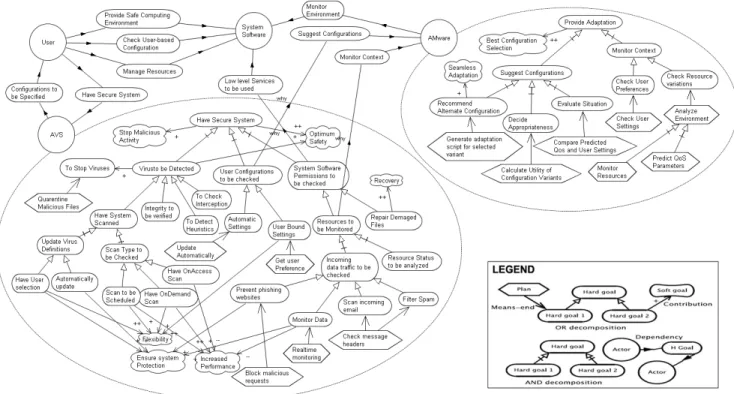
Figure 1. Tropos Late Requirements Model: Antivirus System and Adaptation Middleware
provides an extensible and maintainable mechanism to align requirements and environmental variability at run-time.
4. Illustrative Example
The scenario mentioned below will help in identifying potential requirements for detailing the middleware:
Scenario: Mr. Chen is a corporate professional, who is
working as a financial consultant in a firm. Chen is using a company’s laptop machine for his office and home usage. He often travels to various places to attend business meet-ings. Chen has different profile settings for using his lap-top machine from home, office and elsewhere. At home, his computer is also sometimes used by his wife and daughter to browse and check their emails. But at home he has nor-mal internet connection from a company. How Mr. Chen can ensure that his important office data and his computer system is safe from the digital pests i.e. viruses, malwares, spywares, trojans and worm when his family uses his com-puter.6
Before further analyzing the scenario, it is important to consider the quality of service (QoS) parameters, which an Antivirus system (AVS) and an Adaptation Middleware
6This scenario is not taken to model the security aspect rather to model high-variability in user needs and operating environmental changes which generates the need for externalized adaptation mechanism using middle-ware.
(AMWare) have to meet. For simplicity we consider only three of the following parameters:
1. Bandwidth: Either increase/decreased, it is required to update the antivirus components;
2. System Performance: Antivirus operations may be resource consuming, so this factor fluctuates letting the AMware to decide which among alternative configura-tions, better fit the current system performance needs; 3. Flexibility: Taking into account the user working
con-text and preferences, AMware selects the best applica-tion configuraapplica-tion.
4.1
Goal-oriented Modelling
This section, illustrates a goal-oriented analysis of the scenario, which has been performed using the Tropos methodology [2]. Late requirements analysis in Tropos fo-cuses mainly on the system-to-be (in our case: AMware, shown as an actor).
In Figure 1, the Antivirus System (AVS) is modelled as an actor (depicted as a circle), whom the user delegates a high level goal, namely Have Secure System. The AVS hard and soft goals are analyzed from the point of view of the AVS itself, in the diagram balloon (left). In par-ticular, the delegated goal - Have Secure System, con-tributes positively to the high level soft goal - Optimum
Safety. The goal Have Secure Systemis (AND) decom-posed into three sub goals: Virus to be detected, User configurations to be checked, and System Software Permission to be checked. As antivirus programs oper-ates, the AVS system must prevent the system from external threats and provide appropriate notification to the user and detects and repair damaged files. Virus to be detected
is further decomposed into typical goals for an antivirus to detect viruses using (OR) decomposition ( Have system scanned... To check interception).
Moreover, the User configurations to be checkedhas further two alternatives: User Bound Settingand Auto-matic Settingswith means-end plans to accomplish them. The System Software Permission to be checkedgoal is (OR) decomposed in two alternatives, namely the Re-sources to be Monitored and Repair Damaged Files
sub goals, the latter giving (+) positive contribution to the soft goal Recovery. Here, goal Resources to be Moni-toredis further decomposed subsequently as shown in Fig-ure 1.
The internal goals of the AMware represents adaptivity requirements. Goal delegation from the system actor (that is the AVS application) to AMware represent the external-ization of basic adaptivity requirements of the AVS appli-cation itself (Suggest Configurationsand Monitor Con-textgoals). These delegated goals are internalized into the AMware and integrated with its top goal (Provide Adapta-tion) decomposition, which contributes positively to a high level soft goal Best Configuration Selection. Further-more, Monitor Context is decomposed using (OR) de-composition with sub goals as Check User Preferences
accomplished by a plan Check users Settingsand goal
Check Resource Variations with plan Analyze Envi-ronment. This Analyze Environmentplan is (AND) de-composed by Monitor Resourcesand Predict QoS Pa-rameters. The plan Predict QoS Parameterspredicts the variations in the QoS parameters values as mentioned.
Simultaneously, Suggest Configurations is decom-posed in three sub goals using (AND) decomposition,
Evaluate Situation with the plan Compare Predicted QoS and User Settings, Decide Appropriatenesswith the plan Calculate Utility of Configuration Variants
and Recommend Alternate Configurationwith the plan
Generate Adaptation Script for Selected Variant con-tributing positively to a soft goal Seamless Adaptation.
Here, AMware is responsible to monitor the context by predicting the QoS parameters, further evaluations and de-cision is made on the basis of comparison and calculation of of the configuration variant by using Utility functions (
Calculate Utility of Configuration Variantsplan). Utility functions provides, a recursive mechanism to reason about the alternatives, by determining the ”Best” option. Lastly, AMware recommends the best configuration for AVS by
generating an adaptation script to be enforced by the AVS at run-time.
So far, we have analyzed the goal delegation between AVS and AMware and decomposition of their goals, con-tributing to high level soft goals. In goal models alternate goal decomposition helps the architect to better analyze the variability by addressing the WHY for adaptation. This leads to high-variability design for run-time adaptation [11]. This modelling experience helped us to derive some re-quirements which are seminal for our intended agent-based middleware.
4.2. Identifying Requirements for
Middle-ware
To this stage, we use goal models, which provides a mechanism to evaluates alternate ways for examining the user’s requirements and sources of variability. Re-visiting the existing architecture based (Middleware) ap-proaches [3, 4, 5] in the light of this modelling experience, we have derived the following important questions that our intended middleware should allow to answer:
Q1: What adaptation concerns are to be externalized? Q2: What to monitor in application and in operating
envi-ronment?
Q3: What adaptation properties can be considered to reuse? Q4: What level of control an agent can exercise while
mon-itoring and deciding as an external entity?
By decomposing the system in the form of agents - in our case decomposing the AMware into a web of agents -we end up with the layered view depicted in Figure 2.
5. Agent-Based Middleware
In this section we sketche the AMware middleware, as a suitable option for providing externalized adaptation mech-anism and enabling the seamless mapping of user require-ments and environmental variability to the run-time needs. To detail this, we can see that the typical middleware ser-vices spans from traditional brokerage serser-vices to recently context-aware applications. Here, we present our middle-ware architecture as web of agents as shown in Figure 3.We start by defining the agents role to address the (HOW) and (WHEN) question about adaptation.
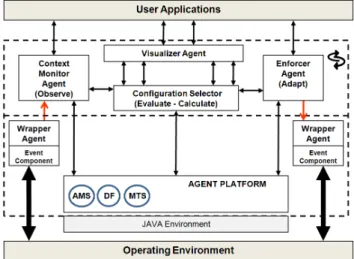
In Figure 2, we have decomposed the AMware into three layers as web of agents. The first layer is a composition of four main agents namely Context Monitor Agent, Configu-ration Selector Agent, Enforcer Agent and Visualizer Agent simulating the adaptation loop (Monitor-Evaluate-Adapt). Second layer composes wrapper agents which encapsulate
some monitoring components, providing information about changes occurring from or to the operating environment. Fi-nally, the third layer is the agent platform, providing white and yellow page services to the upper layers. In this
pa-Figure 2. Layered View of Middleware per, we will discuss the roles and responsibilities of all the layered agents by referring to the requirements identified earlier in section 4. Layer 1 agents coordinates with each others and with layer 2, to provide adaptation mechanism. Layer 2 agents, provides wrapper agents [9] to mask low level information components - providing event details for higher agents to evaluate. Layer 3 agents provides infras-tructural services to the other two layers. We now further see the individual roles of these agents.
5.1. Context Monitor Agent
The main aim of the Context Monitor Agent is to observe the changes in the environment and user needs as configura-tion settings. For example as shown in Figure 1, this agent observes the environmental changes by predicting the QoS parameters and by exploiting the use of wrapper agents as shown in Figure 3. The wrapper agents are in fact low level system components, which provides event level informa-tion about the operating environment to the context monitor agent. This partially fulfill the requirements (Q2, Q4).
This agent starts monitoring the current context of the environment by knowing the current state of the system and application settings using wrapper agents. For example, the system state can be the current bandwidth, memory usage, processor performance etc. also user profile settings hav-ing access rights and user application setthav-ings etc. To get this information at run-time, this agent properly notifies the configuration selector agent by sending an appropriate mes-sages about the evaluation and decision about the latest vari-ations. It keeps record for the latest and run-time variations to observe some patterns of events.
5.2. Configuration Selector Agent
The goal of this agent is to plan and evaluate. The agent evaluates by comparing the predicted information provided
by the context monitor agent as shown in Figure 3. To cal-culate the utilities of the selected configurations for the ap-plication system as shown in Figure 1. The process of cal-culating the utility is recursive, hence this agent judges the selected configuration variants by assigning weights in a re-cursive manner.
This mechanism helps in reasoning about the alternatives in more deterministic way. In the end, the configuration variant having the highest weight will be selected. Here, our focus is to map and evaluate the user preferences by re-evaluating the configurations of the application system.
This agent starts knowing the variable configurations that can be selected under certain circumstances i.e. Configura-tion selector selects the configuraConfigura-tions based on the infor-mation sent by the context monitor agent and also referenc-ing to the environment. Exploitreferenc-ing this information by eval-uating it and plans to inform the enforcer agent to generate the adaptation script thus satisfying the requirements (Q1, Q4).
Figure 3. Agent-based Middleware Architec-ture
5.3. Enforcer Agent
Enforcer Agent provides seamless integration of the se-lected and evaluated configuration variants. This agent ex-ploits the information provided by the configuration selector agent. The main aim includes continued service delivery to the user by generating a adaptation script as shown in Fig-ure 1. Based on the configuration variant selected for the system to adapt. Enforcement mechanism includes twofold process, one is the generation of automatic script and sec-ond is to enforce or run the adaptation script during run-time without compromising the system operations thus partially fulfilling the requirements (Q3, Q4).
This agent implements the current set-tings/configurations selected by the configuration selector i.e. In order to enforce the latest configurations the enforcer agent uses wrapper agent as shown in the Figure 3 to enforce the generated adaptation script. This assures that the system is optimized by shifting to the best selected configurations. It also ensures the satisfaction of the con-figurations selection and helps user with proper messages by publishing notification messages and writing log about the enforcement process details.
5.4. Visualizer Agent
Visualizer agent holds the minimal role as compared to other agents, so far the role of this agent is to display the information for the user to visualize the adaptation pro-cess, notifications and other information generated during the whole working of the middleware. This agent gets the information mainly from the configuration selector agent but indirectly from other agents as well.
6. Conclusion & Future Work
In this paper, we have discussed an agent-based middle-ware which meets Self-adaptivity requirements, exemplified in an illustrative example that we modelled according to a goal-oriented approach. We claim that using agents as mid-dleware allows to address reuse and scalability issues. This provides a way to have many other agents with focused roles, which can be introduced at needs. The middleware we have introduced can be generalized to provide an exter-nalized adaptation mechanism to multiple applications.
As our future research, we will be considering much finer details about our middleware for developing it and evaluating with much realistic examples. This will strengthen our intended approach towards Self-adaptive systems and will enable us to better exploit the design pro-cess for mapping requirements and environmental variabil-ity at run-time. As a further extension users can also be facilitated to specify policies for adaptation at high-level using our visualizer agent. The user policies can be en-forced automatically, hence the system will be driven by automated policies rather then by humans relieving them from the decision-making processes related to adaptation or control loop tasks.
References
[1] D. M. Berry, B. H. Cheng, and J. Zhang. The four lev-els of requirements engineering for and in dynamic adaptive systems. In 11th International Workshop on Requirements
Engineering: Foundation for Software Quality (REFSQ05),
pages 95–100, 2005.
[2] P. Bresciani, A. Perini, P. Giorgini, F. Giunchiglia, and J. Mylopoulos. Tropos: An agent-oriented software devel-opment methodology. Autonomous Agents and Multi-Agent
Systems, 8(3):203–236, 2004.
[3] S.-W. Cheng, A.-C. Huang, D. Garlan, B. R. Schmerl, and P. Steenkiste. Rainbow: Architecture-based self-adaptation with reusable infrastructure. In ICAC, pages 276–277. IEEE Computer Society, 2004.
[4] J. Floch, S. O. Hallsteinsen, E. Stav, F. Eliassen, K. Lund, and E. Gjørven. Using architecture models for runtime adaptability. IEEE Software, 23(2):62–70, 2006.
[5] E. Gjørven, F. Eliassen, K. Lund, V. S. W. Eide, and R. Staehli. Self-adaptive systems: A middleware managed approach. In A. Keller and J.-P. Martin-Flatin, editors,
Self-Man, volume 3996 of Lecture Notes in Computer Science,
pages 15–27. Springer, 2006.
[6] J. O. Kephart and D. M. Chess. The vision of autonomic computing. IEEE Computer, 36(1):41–50, 2003.
[7] S. Liaskos, A. Lapouchnian, Y. Yu, E. Yu, and J. Mylopou-los. On goal-based variability acquisition and analysis. In
Proceedings of the 14th IEEE International Conference on Requirements Engineering (RE’06). IEEE Computer
Soci-ety, September 2006.
[8] M. Morandini, L. Penserini, and A. Perini. Towards goal-oriented development of self-adaptive systems. In
Pro-ceedings of (SEAMS ’08)Workshop on Software engineering for adaptive and self-managing systems, pages 9–16. ACM,
2008.
[9] A. Omicini and G. Rimassa. Towards seamless agent mid-dleware. In WETICE, pages 417–422. IEEE Computer So-ciety, 2004.
[10] M. Parashar and S. Hariri. Autonomic computing: An
overview. In J.-P. Banˆatre, P. Fradet, J.-L. Giavitto, and O. Michel, editors, UPP, volume 3566 of Lecture Notes in
Computer Science, pages 257–269. Springer, 2004.
[11] L. Penserini, A. Perini, A. Susi, and J. Mylopoulos. High variability design for software agents: Extending tropos.
TAAS, 2(4), 2007.
[12] J. Sudeikat and W. Renz. Toward requirements engineering for self - organizing multi- agent systems. In SASO, pages 299–302. IEEE Computer Society, 2007.
[13] G. Tesauro, D. M. Chess, W. E. Walsh, R. Das, A. Se-gal, I. Whalley, J. O. Kephart, and S. R. White. A multi-agent systems approach to autonomic computing. In
AA-MAS, pages 464–471. IEEE Computer Society, 2004.
[14] A. van Lamsweerde. Goal-oriented requirements engineer-ing: A guided tour. In 5th IEEE International Symposium on
Requirements Engineering (RE), page 249. IEEE Computer
Society, 2001.
[15] M. Woolridge. Multi-Agent Systems: An Introduction. John Wiley & Sons (Chichester, England), 2001.