UNFCCC
RESOURCE GUIDE
MODULE 3: NATIONAL G R E E N HOU S E GAS I NVE NTOR I E SFOR PREPARING THE
NATIONAL COMMUNICATIONS
OF NON-ANNEX I PARTIES
MODULE 3
NATIONAL GREENHOUSE GAS
INVENTORIES
United Nations Framework Convention on Climate Change
Produced by the Financial and Technical Support Programme of the UNFCCC.
RESOURCE GUIDE FOR PREPARING
THE NATIONAL COMMUNICATIONS OF
NON-ANNEX I PARTIES
MODULE 3:
NATIONAL GREENHOUSE GAS INVENTORIES
UN
FCCC
UNFCCC RESOURCE GUIDE
MODULE 3: NATIONAL GREENHOUSE GAS INVENTORIES
I. INTRODUCTION 4
1.1 Greenhouse Gases and Climate Change 4 1.2 About the Module 4 1.3 Main sources of related information 4
II. WHAT IS A NATIONAL GREENHOUSE GAS INVENTORY? 5
III. THE INVENTORY PROCESS 7
3.1 Planning 7
3.2 Preparation 9
3.3 Reporting 11
3.4 Documentation and Archiving 11 3.5 Inventory Improvement Strategy 11
IV. SECTOR-SPECIFIC METHODOLOGIES 12
4.1 Energy 12
4.2 Industrial Processes 20
4.3 Agriculture 22
4.4 Land Use, Land-Use Change and Forestry 24
4.5 Waste 26
V. QUALITY CONTROL AND COMPLETENESS 28
VI. UNCERTAINTY 29
VII. NATIONAL COMMUNICATIONS OF NON-ANNEX I PARTIES 30
7.1 UNFCCC Guidelines for non-Annex I National Communications and User Manual 30 7.2 Financial and Technical Assistance 30
VIII. UNFCCC NON-ANNEX I GREENHOUSE GAS INVENTORY SOFTWARE 31
UNFCCC RESOURCE GUIDE
MODULE 3: NATIONAL GREENHOUSE GAS INVENTORIES
1.1 GREENHOUSE GASES AND CLIMATE CHANGE
The UNFCCC defines climate change as a change of climate that is attributed directly or indirectly to human activity that alters the composition of the global atmosphere and which is in addition to natural climate variability observed over comparable time periods. Human activities are changing the atmospheric concentrations and distributions of greenhouse gases (GHGs) and aerosols (i.e. airborne solid or liquid particles). These changes can cause radiative forcing by changing the reflection or absorption of solar radiation, or the absorption or emission of terrestrial radiation (IPCC 1996). The objective of a national GHG inventory is to determine the magnitude of national GHG emissions and removals that are directly attributable to human activity.
As required by decision 17/CP.8, each Party not included in Annex I to the Convention (Non-Annex I Party) shall, as appropriate and to the extent possible, provide in its national inventory, on a gas-by-gas basis and in units of mass, estimates of anthropogenic emissions of carbon dioxide (CO2), methane (CH4) and nitrous oxide (N2O)
by sources and removals by sinks. Non-Annex I Parties are encouraged, as appropriate, to provide information on anthropogenic emissions by sources of hydrofluorocarbons (HFCs), perfluorocarbons (PFCs) and sulphur hexafluoride (SF6).
I. INTRODUCTION
1 Available at <http://unfccc.int/essential_background/ background_publications_htmlpdf/items/2625.php>. 2 Available at <http://unfccc.int/national_reports/non-annex_i_natcom/ guidelines_and_user_manual/items/2607.php>. 3 Available at <http://www.ipcc-nggip.iges.or.jp/public/gl/invs1.html>. 4 Available at <http://ncsp.undp.org/docs/461.pdf>. 5 Available at <http://unfccc.int/resource/cd_roms/na1/start.htm>.1.2 ABOUT THE MODULE
This module was developed as a guide to assist non-Annex I Parties in the preparation of the GHG inventories for their national communications. It forms part of the Resource Guide for Preparing the National Communications of
Non-Annex I Parties(hereinafter referred to as the Resource
Guide).1 It aims to provide a brief overview of some
of the main methods, tools and data being used by non-Annex I Parties to prepare their national GHG inventory. After reading this module, readers should be able to understand a number of key issues related to GHG inventories, including sector-specific emission estimation considerations.
1.3 MAIN SOURCES OF RELATED INFORMATION
Main sources of information used throughout the module are listed below. Further sources are also provided where relevant, within each section.
• Reporting on Climate Change: User Manual for
the Guidelines on National Communication from Non-Annex I Parties2
• Intergovernmental Panel on Climate Change (IPCC)
Methodologies for National GHG Inventories3
• Managing the National Greenhouse Gas Inventory
Process: National Communications Support Unit Handbook;4
• Materials for the hands-on training workshops of the Consultative Group of Experts on national communications from Parties not included in Annex I to the Convention (CGE) (hereinafter referred to as the CGE GHG Inventory Handbook).5
UNFCCC RESOURCE GUIDE
MODULE 3: NATIONAL GREENHOUSE GAS INVENTORIES
6
Available at <http://www.ipcc-nggip.iges.or.jp/public/gp/english/>.
A national GHG inventory is a key element of the national communication. In the context of the UNFCCC, it is a comprehensive listing, by source, of annual GHG emissions and removals resulting directly from human activities. An inventory may estimate emissions and removals for one year or a number of years. A GHG inventory could contain the following information:
• Tables of annual emission and removal estimates by source, with estimates expressed in units of mass per year, and the year or years represented clearly noted; • Worksheets (i.e. calculation sheets) showing how
emissions are calculated, including all parameters used for calculations;
• For each source, a description of the methodology, the sources of data (e.g. activity data, emission factors (EFs), methodologies), the actual data and a description of uncertainties, including, if possible, quantitative assessment of uncertainties; and • Other informative background data (e.g. a national
energy balance, a description of GHG sources that are believed to be important but cannot be estimated).
The IPCC inventory guidance applicable to non-Annex I Parties (IPCC Guidelines: 1997, 2000 and 2003) defines six inventory sectors: Energy; Industrial Processes; Solvent and Other Product Use; Agriculture; Land Use, Land-Use Change and Forestry (LULUCF); and Waste. Nonetheless, no method for the calculation of GHGs from solvent and other product use is available. Within these sectors, individual source and sinks categories are defined. Parties to the UNFCCC are required to report their inventories in line with the definitions and structure of these sectors, and the source and sink categories within each sector, so that reporting is comparable across Parties. Updated guidance for the development of national GHG inventories can be found in the 2006 IPCC Guidelines for National Greenhouse
Gas Inventories(hereinafter referred to as the 2006 IPCC
Guidelines), although these are not yet adopted for use by Parties to the UNFCCC.
II. WHAT IS A NATIONAL
GREENHOUSE GAS
INVENTORY?
In order to ensure precision and reliability, national GHG inventories are required to fulfil certain criteria, as laid out in the IPCC Good Practice Guidance and Uncertainty Management in National Greenhouse Gas Inventories (hereinafter referred to as the IPCC good practice guidance).6 Thus, the inventories must be transparent,
consistent, comparable, complete and accurate (TCCCA). In the context of the UNFCCC “Guidelines for the preparation of national communications from Parties not included in Annex I to the Convention” (hereinafter referred to as the UNFCCC reporting guidelines for non-Annex I Parties), and specifically the section addressing national GHG inventories:
• Transparencymeans that the assumptions and
methodologies used for an inventory are clearly explained to facilitate replication and assessment of the inventory by users of the reported information. The transparency of inventories is fundamental to the success of the process for the communication and consideration of information;
• Consistencymeans that an inventory is internally
consistent in all its elements with inventories of other years. An inventory is consistent if the same methodologies are used for the base and all subsequent years and if consistent data sets are used to estimate emissions or removals from sources or sinks. Under certain circumstances, an inventory using different methodologies for different years can be considered to be consistent if it has been recalculated in a transparent manner, in accordance with the IPCC good practice guidance;
• Comparabilitymeans that estimates of emissions and
removals reported by Parties in their inventories are comparable;
• Completenessmeans that an inventory covers all
sources and sinks, as well as all gases, included in the IPCC Guidelines, as well as other existing relevant source/sink categories which are specific to individual Parties and, therefore, may not be included in the IPCC Guidelines. Completeness also means full geographic coverage of sources and sinks of a Party;
WHAT IS A NATIONAL GREENHOUSE GAS INVENTORY?
UNFCCC RESOURCE GUIDE
MODULE 3: NATIONAL GREENHOUSE GAS INVENTORIES
• Accuracyis a relative measure of the exactness of an
emission or removal estimate. Estimates should be accurate in the sense that they are systematically neither over nor under true emissions or removals, as far as can be judged, and that uncertainties are reduced as far as practicable.
According to the IPCC good practice guidance, inventory estimates should be the best attainable, given current scientific knowledge and available resources. The IPCC good practice guidance (i.e. 2000 and 2003) manuals assist countries in meeting these requirements by providing guidance on:
• Choice of estimation method;
• Quality assuranceand quality controlprocedures to
provide cross-checks during inventory compilation; • Dataand information to be documented, reportedand
archivedto facilitate assessment of emission estimates; • Quantification of uncertaintiesat the source level and
for the inventory as a whole, so that the resources available for research can be directed toward reducing uncertainties over time, and the improvement can be tracked;
• Determination of the most significant sourcesso that appropriate decisions can be made about the allocation of resources for inventory improvements.
UNFCCC RESOURCE GUIDE
MODULE 3: NATIONAL GREENHOUSE GAS INVENTORIES
7
For more detailed information, see <http://ncsp.undp.org/docs/461.pdf>.
3.1 PLANNING
There are two components to the planning process: • Planning the overall preparation of the inventory; • Planning the preparation of individual source and
sink categories.
The outputs of the first component are an inventory workplan and the overall inventory preparation instructions. The output of the second component is the source(s) preparation instructions.
Each component of planning includes a set of tasks:7
III. THE INVENTORY
PROCESS
Figure III-1. Steps for planning of GHG inventory
Complete Overall Inventory Preparation Instructions and Distribute with Supporting Materials Complete and Distribute Workplan
Prepare Budget
Establish Major Legal and/or Collaboration Arrangements Establish Overall Inventory Preparation Schedule Establish Rules of Procedure for Overall Inventory Preparation
Assign Other Inventory Personnel
Define Inventory Products and Plan Results Dissemination Appoint "National Entity" and "Inventory Co-ordinator"
THE INVENTORY PROCESS
UNFCCC RESOURCE GUIDE
MODULE 3: NATIONAL GREENHOUSE GAS INVENTORIES
Figure III-2. Source-Specific Planning Tasks
Complete Overall Inventory Preparation Instructions and Distribute with Supporting Materials Establish Source(s) Preparation Schedule
Establish Rules of Procedures for Source Preparation Asses Sources, Determine Priorities and and Assign Staff Responsibilities
Box III-1. Tasks in the Planning Phase8
In general, inventory planning tasks will need to be completed before the category-specific planning tasks can begin. However, in cases where the inventory team is mature, i.e. the team has completed several versions of the inventory; the category-specific tasks may be started in parallel to with the overall inventory tasks.
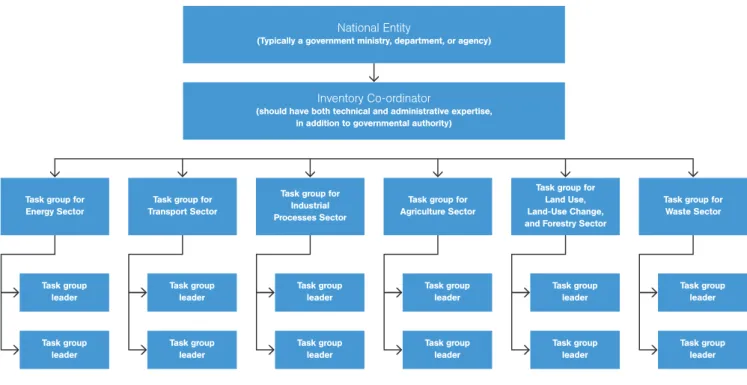
Typically, the institution with the legal responsibility for producing the inventory, which is referred to here as the “National Entity”, will appoint an overall “Inventory Coordinator”, who oversees the entire inventory. The Inventory Coordinator is responsible for planning the overall preparation of the inventory (except the first task) and, as the inventory is prepared, provides overall coordination, management and technical oversight. In addition, there are individual source(s) team leaders, each of whom is responsible for inventory planning for his or her source(s), as well as overseeing the inventory preparation for his or her source(s).
During planning, the schedule for completion of the inventory and the procedures that are to be followed by category team leaders are set, and the resource budget is established. In some countries, category team leaders may have control over their own separate budgets. Therefore, the overall planning, in effect, drives the category-specific planning.
Completing both the inventory planning tasks and the category-specific planning tasks requires an understanding of not only how to administer a large and complex analytical process, but also the technical requirements of compiling a national GHG inventory. Therefore, the Inventory Coordinator and the category team leaders should possess both administrative and technical expertise. In addition, they should confer with one another throughout the planning process to ensure that the planning is internally coordinated, complete and logical.
THE INVENTORY PROCESS
UNFCCC RESOURCE GUIDE
MODULE 3: NATIONAL GREENHOUSE GAS INVENTORIES
3.2 PREPARATION
3.2.1 EMISSIONS ESTIMATION
Once the inventory planning tasks have been performed and data collection is under way, it is time to begin the process of calculating emission estimations. In its most basic form, the method commonly used to estimate emissions or removals from a specific source category is as follows:9
In many cases, the activity data available are not exactly what is required given the particular emission factors that will be used. In these cases, the activity data must be derived by applying “conversion factors”to other data, which are referred to here as “proxy activity data”. In this case, the basic method is:
Figure III-3. Possible structure for GHG inventory team
Task group for Energy Sector
Task group for Land Use, Land-Use Change, and Forestry Sector Task group for
Transport Sector
Task group for Industrial Processes Sector
Task group for Agriculture Sector
Task group for Waste Sector Task group leader Task group leader Task group leader Task group leader Task group leader Task group leader Task group leader Task group leader Task group leader Task group leader Task group leader Task group leader Inventory Co-ordinator
(should have both technical and administrative expertise, in addition to governmental authority)
National Entity
(Typically a government ministry, department, or agency)
Equation 1 – Emissions estimate
Emissions estimate = Activity data x Emission factor
where:
Activity data describe the annual, national magnitude of an activity (e.g. tonnes of coal mined nationally in a given year); and the Emission factor is the mass of GHG emitted per unit of activity (e.g. Gg CH4per tonne of coal mined).
Equation 2 – Emissions estimate using proxy activity data
Emissions estimate =
[Proxy activity data x Conversion Factor(s)] x Emission
8
Managing the National Greenhouse Gas Inventory Process,page 9,
<http://ncsp.undp.org/docs/461.pdf>.
9
THE INVENTORY PROCESS
UNFCCC RESOURCE GUIDE
MODULE 3: NATIONAL GREENHOUSE GAS INVENTORIES
3.2.2 TIERS
Different methods can be used to estimate emissions or removals from most source and sink categories. The selection of a particular method will depend on the desired degree of estimation detail, the availability of activity data and emission factors, and the financial and human resources available to complete the inventory. In IPCC terminology, the lowest ranking or simplest method is “Tier 1”, while more elaborate methods are “Tier 2” and “Tier 3.”
Tier 1 methods typically utilize IPCC default emission factors and require the most basic, and least disaggregated, activity data. Higher tiers usually utilize more elaborate methods and source-specific, technology-specific, region-specific and/or country-region-specific emission factors, which are often based on measurements, and normally require more highly disaggregated activity data. Tier 2 and 3 methods require more detailed data and/or measurements for their application. In cases where a national
methodology exists, which is consistent with the IPCC Guidelines, it is highly advisable to use the national methodology. This methodology should be fully documented in order to allow the reader to understand why this particular method is better than the default one proposed by the IPCC.
3.2.3 GHG PROFILES
A GHG profile is a summary of most representative GHG data for a Party. It contains the following elements: • Data table;
• Graph with trends for GHG totals;
• Graph with sectoral changes in GHG emissions; • Graph with the GHG shares by gas;
• Graph with the GHG shares by sector; • Graph with the GHG shares by category.
In order to allow the comparison of emissions between different years of the inventory, the GHG profile must be internally consistent; i.e. the methods, emission factors and assumptions should be the same for all inventory years. Ideally, the data sources used for activity data will be the same for all years.
3.2.4 UNCERTAINTY ANALYSIS
Proper estimates of uncertainty associated with GHG emission quantification are essential; not to dispute estimations, but to improve future estimations and allow for better comparison. The use of the IPCC good practice guidance is encouraged by the UNFCCC reporting guidelines for non-Annex I Parties in order to assess the uncertainty related to their national GHG inventories. The IPCC good practice guidance provides Parties with two tiers for combining individual source category uncertainties into an uncertainty estimate for the inventory as a whole, and identifies the following three sources of uncertainty:
• Uncertainties from definitions;
• Uncertainties from natural variability of the process that produces an emission or uptake;
• Uncertainties resulting from the assessment of the process or quantity, including, depending on the method used:
a) Uncertainties from measuring; b) Uncertainties from sampling;
c) Uncertainties from reference data that may be incompletely described;
d) Uncertainties from expert judgement.
The IPCC good practice guidance provides extensive detail on both identifying uncertainties which may be associated with a national GHG inventory, and methods for estimating identified uncertainties for source categories, as well as the complete inventory.
3.2.5 RECALCULATIONS
An inventory may be recalculated for different reasons. Sometimes, improved methodologies, emission factors and/or activity data become available; e.g. as a result of new research or emission measurements. In addition, earlier estimates are sometimes found to have been based on wrong assumptions or miscalculations. If improved methods or emission factors are used, they should be used to recalculate the entire inventory time series. To avoid confusion, it is important to report and document recalculations clearly, including when recalculations were performed and which methods, emission factors and activity data were used in the different versions of the inventory.
THE INVENTORY PROCESS
UNFCCC RESOURCE GUIDE
MODULE 3: NATIONAL GREENHOUSE GAS INVENTORIES
10
<http://unfccc.int/national_reports/non-annex_i_natcom/items/2979.php>. 3.2.6 KEY CATEGORIES
A key category is one that is prioritized within the national inventory system because its estimate has a major influence on a country’s total inventory of direct GHGs in terms of the absolute level of emissions, or trends in emissions, or both. By identifying these key categories, Parties can prioritize their efforts and resources in order to improve their overall estimates. Such a process will lead to improved quality, as well as greater confidence in the emissions/removal estimates that are calculated. It is good practice for each Party to identify its national key categories in a systematic and objective manner.
3.3 REPORTING
One of the main purposes for compiling a national GHG inventory is to report to national or international entities. Reported information should be transparent and complete, with all the information required to produce the national inventory estimates documented and archived. It is not practical to include all this information in the inventory report; however summary information and references to source data could be included.
The IPCC good practice guidance is a beneficial tool, as it provides useful advice for selecting methods (tiered approaches), emission factors and activity data. Furthermore, it can aid the selection of appropriate methods and emission factors, the quantifying and analysis of uncertainty, the determination of key categories, the recalculation of emissions data, and the development of quality assurance and quality control plans.
The IPCC good practice guidance can be found at
<http://www.ipcc-nggip.iges.or.jp/public/gp/gpgaum.htm>
3.4 DOCUMENTATION AND ARCHIVING
Once the GHG inventory and other components of the national communications are completed, the document(s) must be submitted to the Conference of the Parties (COP) in both hard copy and soft (electronic) format. The information must be submitted as a single document with an executive summary (maximum 10 pages) outlining the information contained in the full document. Non-Annex I Parties may submit their national communications in any of the official languages of the United Nations, but are encouraged to translate the document into English; however, the executive summary must be translated into English. Often, a Party will have additional information which supports or adds to the national communication; such documents may be submitted as technical annex(es) or as an addendum.
Once submitted to the UNFCCC, national communications from non-Annex I Parties are held by the UNFCCC and made publicly available through the Convention website.10
3.5 INVENTORY IMPROVEMENT STRATEGY
Improvements may arise from various aspects of the national communication process and, may or may not be, immediately feasible. In addition to sources of improvement which may be identified during the uncertainty assessment, non-Annex I Parties should describe any constraints and gaps and related financial, technical and capacity needs, associated with the implementation of activities and preparation and improvement of national communications.
UNFCCC RESOURCE GUIDE
MODULE 3: NATIONAL GREENHOUSE GAS INVENTORIES
4.1 ENERGY
4.1.1 COMBUSTION
The Energy sector includes two major combustion-related activities:
1) Stationary combustion;
2) Transport or mobile combustion.
Each of these activities includes various sources that emit CO2, CH4and N2O.
Stationary combustion source categories include: • Energy industries, which includes activities such
as energy extraction, energy production and transformation, electricity generation, petroleum refining, etc. Emissions due to autoproduction11
of electricity are included in this source category, and are attributed to the industrial categories in which the generation activity occurs;
• Manufacturing industries and construction, which includes activities such as iron and steel production, non-ferrous metal production, chemical
manufacturing, pulp, paper and print, food processing, beverages and tobacco, etc.; • Other sectors such as Commercial/Institutional,
Residential, and Agriculture/Forestry/Fisheries. Mobile source categories include:
• Civil aviation;
• Road transportation (cars, light duty trucks, heavy duty trucks and buses, motorcycles, etc.); • Railways;
• Navigation;
• Other transportation activities, such as gas pipeline transport.
IV. SECTOR-SPECIFIC
METHODOLOGIES
International bunker fuels, which include navigation and civil aviation fuel emissions from international transport activities (i.e. bunker fuels), should be reported separately and excluded from national totals.
Carbon Dioxide emissions result from the oxidation of the carbon in fuels during combustion. In perfect combustion conditions, the total carbon content of fuels would be converted into CO2. However, real combustion
processes are not perfect, and result in small amounts of partially oxidized and unoxidized carbon.
The carbon content of a fuel is an inherent chemical property (i.e. mass of carbon atoms relative to total mass of the fuel).
The energy content (i.e. calorific value or heating value) of fuels is also an inherent chemical property. However, calorific values vary more widely between and within fuel types, as they are dependent upon the composition of chemical bonds in the fuel. Given these variations and the relationship between carbon content and calorific values, carbon content values for estimating CO2emissions from
fossil fuel combustion are expressed in terms of carbon per energy unit. This form generally provides more accurate emission estimates than if carbon content factors were expressed in terms of mass or volume, assuming reasonably accurate calorific values are available to convert fuel statistics into energy units.
Net calorific values (NCVs) measure the quantity of heat liberated by the complete combustion of a unit volume or mass of a fuel, assuming that the water resulting from combustion remains as a vapour, and the heat of the vapour is not recovered. In contrast, gross calorific values (GCVs are estimated assuming that this water vapour is completely condensed and the heat is recovered, and are therefore slightly larger. Default data in the Revised 1996 IPCC Guidelines for National Greenhouse Gas Inventories (hereinafter referred to as the Revised 1996 IPCC Guidelines) are based on NCVs.
Due to incomplete combustion of hydrocarbons in fuel, small proportions of carbon are released as carbon monoxide (CO), CH4or non-methane volatile organic
compounds (NMVOCs), all of which eventually oxidize to CO2in the atmosphere. In addition, combustion
SECTOR-SPECIFIC METHODOLOGIES
UNFCCC RESOURCE GUIDE
MODULE 3: NATIONAL GREENHOUSE GAS INVENTORIES
11
Autoproduction refers to electricity, heat or steam produced by an industrial facility for its own consumption or sale to other consumers or to the electricity grid. Autoproduction is sometimes also called autogeneration, self-generation or self-production.
Unlike CO2, emission estimates of CH4, N2O, NOX, CO and
NMVOCs require detailed process information. Accurate estimation of their emissions depends on knowledge of several interrelated factors, including combustion conditions, size and age of the combustion technology, maintenance, operational practices, emission controls, as well as fuel characteristics. The methods should be applied at a detailed activity/technology level so as to take, to the extent possible, these factors into account.
The reference approach (Tier 1) estimates only CO2emissions
from fuel combustion. The reference approach for CO2
can be performed quickly, provided that the basic energy balance sheet for a country is available. CO2emissions
may also be calculated at the more detailed (i.e. sectoral) level. Non-Annex I Parties are encouraged to estimate and report CO2emissions using both the sectoral and
reference approaches, and explain any large differences between the two approaches.
The reference approach provides a potentially useful way of cross-checking emission estimates of CO2with those
calculated using the sectoral approach and thus helps to identify inconsistencies or mistakes. The sectoral approach provides greater detail on the combustion activities responsible for emissions.
4.1.1.1 ESTIMATION STEPS
The estimation process for estimating CO2emissions from
fuel combustion using the Tier 1 reference or the Tier 2 or 3 sectoral approaches can be divided into the following steps:
1. COLLECTION OF FUEL CONSUMPTION DATA
The first step of the IPCC reference approachis to estimate apparent consumption of fuels within the country. This step requires a balance of primary fuels produced, plus imports, minus exports, minus international bunkers and the net changes in stocks. Carbon is brought into the country from energy production and imports (adjusted for stock changes) and removed from the country through exports and international bunkers. In order to avoid double counting, it is important to distinguish between primary fuels, which are fuels found in nature, such as coal, crude oil and natural gas, and secondary fuels or fuel products,
such as gasoline and lubricants, which are derived from primary fuels. Note that “apparent consumption” of secondary fuels can result in negative numbers when a net export or stock of a particular fuel type increases for the country. “Apparent consumption” of secondary fuels should be added to the “apparent consumption” of primary fuels. The production of secondary fuels through refining processes should be ignored in the calculations, because the carbon in these fuels will already have been included in the calculation of the primary fuels from which they were derived.
Similarly, the first step for the sectoral approachis to collect actual consumption statistics by fuel type and economic sector (e.g. public electricity and heat production, petroleum refining, manufacture of solid fuels and other energy industries).
The first step for a Tier 2 or 3 method is to collect actual fuel consumption statistics by fuel type, economic sector and combustion technology type. Tier 3 methods use activity data (e.g. kilometres travelled) as a proxy to estimate fuel consumption or CO2emissions directly using
emission factors. Tier 3 methods are generally used for estimating only non-CO2emissions, because using actual
fuel data is more accurate in most cases for estimating CO2emissions.
2. CONVERSION OF FUEL DATA TO A COMMON ENERGY UNIT
In the Organisation for Economic Co-operation and Development/International Energy Agency, Energy Statistics and other national energy data, compilations of production and consumption of solid and liquid fuels are generally specified in tonnes, and gaseous fuels in cubic metres. For consistency purposes, original units should be converted into energy units using NCVs (i.e. heating values). Where available, different calorific values for production, imports and exports should be used. For transparency purposes, the calorific values used should be reported. Some countries may report GC Vs, depending on their national statistics systems.
SECTOR-SPECIFIC METHODOLOGIES
UNFCCC RESOURCE GUIDE
MODULE 3: NATIONAL GREENHOUSE GAS INVENTORIES
3. SELECTION OF CARBON CONTENT FACTORS FOR EACH FOSSIL FUEL/PRODUCT TYPE AND ESTIMATION OF THE TOTAL CARBON CONTENT OF FUELS CONSUMED
There is considerable variation in the energy and carbon content by weight and volume of fuels. However, expressing carbon content on a per-unit-of-energy basis reduces this variation because of the close link between the carbon content and energy value of the fuel. Carbon content factors may vary considerably both between and within primary fuel types.
4. SUBTRACTION OF THE AMOUNT OF CARBON STORED IN PRODUCTS FOR LONG PERIODS OF TIME (E.G. NON-ENERGY USES).
The reference approach requires information on the consumption of fuels used for non-energy purposes where carbon may be stored (i.e. not oxidized and emitted to the atmosphere). The reference approach uses a simple assumption: once carbon is brought into a national economy in the form of a fuel, it is either saved in some way (e.g. in increases of fuel stocks, stored in products, or left unoxidized in ash), or it is emitted into the atmosphere. Some of the fuels supplied to an economy can be used for non-energy purposes or as raw materials (i.e. feedstocks) for the manufacture of products. A wide variety of products are produced from oil refineries, including asphalt and bitumen for road construction, naphthas, lubricants, plastics and fertilizers. Natural gas is used for ammonia production. Liquified petroleum gas (LPG) is used to produce solvents and synthetic rubber. By-products of the coking process, such as oils and tars, are used in the chemical industry. In some of these cases, the carbon in these fuels is oxidized to CO2within the non-energy process (e.g. carbon from
natural gas used in ammonia production). In other cases, the carbon is indefinitely stored (i.e. sequestered), although the carbon in some products may be oxidized as the product ages or is disposed of. The amounts stored for long periods are called stored carbon and should be deducted from the carbon emissions calculation. Several approaches for estimating the amount of carbon stored in products are contained in the Revised 1996 IPCC Guidelines. The IPCC recommends that, whenever possible, Parties should use country-specific data and assumptions instead of relying on IPCC default factors.
The basic equation for estimating the amount of carbon stored in products is given below:
The IPCC default storage factors for fossil fuels that have been sold for non-energy or feedstock use are given below. It is important to note that these default factors are based on expert opinion of the likely global average. National practices may differ greatly. Countries should focus their efforts on collecting accurate non-energy use fuel consumption data and, where possible, investigate the use and fate of the carbon in the fuels consumed for non-energy purposes.
5. MULTIPLICATION BY AN OXIDATION FACTOR TO ACCOUNT FOR THE SMALL AMOUNT OF UNOXIDIZED CARBON THAT IS LEFT IN ASH OR SOOT.
Parties should use oxidation factors that match their national circumstances. Several countries have commented that the amount of carbon remaining unoxidized can vary greatly from the general assumption of 1 per cent across all oil-related fuels. For example, it has been noted that the amount of unburned carbon varies depending on several factors, including type of fuel consumed, type of combustion technology, age of the equipment, and operation and maintenance practices.
6. CONVERSION OF CARBON TO FULL MOLECULAR WEIGHT OF CO2 AND SUMMATION ACROSS ALL FUELS.
To express the results as CO2, the quantity of carbon
oxidized should be multiplied by the molecular weight ratio of CO2to C (i.e. 44/12).
Equation 3 – Total Carbon Stored12
Total Carbon Stored (Gg C) =
Non-Energy Use (103t)
x Conversion Factor (TJ/103t) x Emission Factor (t C/TJ) x Fraction Carbon Stored x 10-3
SECTOR-SPECIFIC METHODOLOGIES
UNFCCC RESOURCE GUIDE
MODULE 3: NATIONAL GREENHOUSE GAS INVENTORIES
In addition to the steps described above, emissions of CO2
from international bunker fuels and biomass used as a fuel should be handled as follows:
• Bunker fuels: CO2emissions arising from fuels used
in ships or aircraft for international transport should not be included in the national total. The quantities of fuels delivered to and consumed by international bunkers should be subtracted from the fuel supply to the country. The calculated bunker fuel emissions should be mentioned as a memo item.
• Biomass fuels: Biomass fuels are included in the
national energy and emissions accounts for completeness only. The resultant CO2emissions
should not be included in national CO2emissions
from fuel combustion. The release of carbon due to biomass used as energy should be accounted in the LULUCF sector. Non-CO2emissions from biomass
combustion, however, should be reported under the Energy sector.
Because of the difficulties many Parties have in allocating marine and aviation transport emissions between international and domestic categories, the IPCC has provided a detailed decision tree and guidance for each in the IPCC good practice guidance. The CGE GHG Inventory Handbook, Energy sector – Fuel Combustion document contains decision trees and a table describing how to distinguish individual travel segments between international and domestic, starting on page 15. It is understood that many Parties will have difficulty strictly applying this guidance due to lack of detailed data. Non-CO2emissions. The methods (i.e. tiers) for estimating
non-CO2emissions require different levels of detail for
activities and technology.
Tier 1. Emissions from all sources of combustion are
estimated by multiplying the quantity of fuel consumed by an average emission factor. Tier 1 methods do not require detailed activity data.
Tiers 2/3. Emissions are estimated by multiplying the
quantity of fuel consumed by detailed fuel type and technology-specific emission factors.
Tier 1 methods rely on widely available fuel supply data that assume an average combustion technology is used. The difference between Tiers 2 and 3 is mainly an increase in the degree of detail required by the method. In
general, Tier 2 methods use fuel consumption data that are disaggregated according to technology types and that are sufficiently homogenous to permit the use of representative emission factors. Tier 3 methods generally estimate emissions according to activity types (km travelled or tonne-km carried) and specific fuel efficiency, fuel rates, emission factor or factors expressed directly in terms of a unit of activity.
All tier methods rely on the same fundamental equation:
Alternatively, countries may use national emission models or continuous emission measurement of CH4and N2O,
which is consistent with good practice. However, in most cases, continuous emission measurements are not justified because of the high cost of performing the measurements. It is good practice to use the most disaggregated technology-specific and country-technology-specific emission factors available, particularly those derived from direct measurements for stationary combustion sources. Using a Tier 2 approach, there are three possible types of emission factors:
• National emission factors; • Regional emission factors;
• IPCC default emission factors, provided that a careful review of the applicability of these factors to the country’s conditions has been made. IPCC default factors may be used when no other information is available.
Equation 4 – Total Carbon Stored13
Emissions =
∑
(Emission Factora b cx Fuel Consumptiona b c) Where:a = fuel type b = sector activity c = technology type
12
Materials for the hands-on training workshops of the CGE Energy sector – Fuel Combustion, page 12. Available at <http://unfccc.int/resource/cd_roms/na1/ghg_inventories/index.htm>.
13
Materials for the hands-on training workshops of the CGE Energy sector – Fuel Combustion, page 20.
SECTOR-SPECIFIC METHODOLOGIES
UNFCCC RESOURCE GUIDE
MODULE 3: NATIONAL GREENHOUSE GAS INVENTORIES
4.1.1.2 STATIONARY COMBUSTION
Default emission factors for CH4, N2O, NOX, CO and NMVOCs
by major technology and fuel types are presented in the Revised 1996 IPCC Guidelines, Reference Manual – Volume 3. Data are also presented on typical sulphur contents of fossil and biomass fuels. Alternative control technologies, with representative percentage reductions are also shown. These data show the range and variation of sources and emission rates, as well as the impact of the control technologies.
Of particular importance for many countries are CH4
emissions from various types of open burning and biomass combustion because of the highly inefficient nature of the combustion process in many cases. In particular, charcoal production is likely to produce methane emissions at a rate that is several orders of magnitude greater than other combustion processes.
4.1.1.3 MOBILE COMBUSTION
Emissions of GHGs from mobile sources can be estimated by major transport activity (road, air, rail and ships). However, as road transportation accounts for the majority of mobile-source fuel consumption, followed by air transport, greater priority has been attached to the development of emission models and inventories for road vehicles and aircraft. The diversity of mobile sources and the range of characteristics that affect emission factors are demonstrated and can be seen in the tables included in the Revised 1996 IPCC Guidelines.
Of particular importance for many countries are N2O
emissions from road transportation, which are considerably affected by the type of emission control technologies in use. Some catalyst-type control technologies can increase the rate of N2O emissions relative to an uncontrolled
vehicle. Non-Annex I Parties should focus their efforts on collecting data on the number of vehicles with catalytic emission-control devices that operate in their country. The type of catalytic control equipment can often be approximated by the age and make of the vehicle if it is not known. As shown in the table on page 26 of the Materials for the hands-on training workshops of the CGE, GHG Inventory: Energy Sector – Fuel Combustion document, N2O emission rates can vary dramatically (i.e.
by an order of magnitude) due to the effect of different vehicle control technologies.
4.1.2 FUGITIVES
In the Energy sector, fugitive emissions from fuels can be divided into source categories related to solid fuels (primarily coal) and oil and natural gas systems. The dominant GHG emitted from all of these source categories is CH4, although
smaller amounts of CO2are also emitted from some sources.
For solid fuels, venting and disposal of coal-bed methane is the primary source of fugitive emissions. Most of these emissions occur at the mine with some residual emissions occurring from post-mining handling/processing activities.
4.1.2.1 COAL MINING
There are two types of coal mines: surface and underground. The specific emission rates from coal mining depend primarily on the relative contribution of surface and underground mining to a country’s total coal production. CH4emissions from surface mines are usually an order of
magnitude lower than from those underground mines. For underground mines, the amount of emissions tends to increase with the depth of the mine. For both types of mines, the potential for emissions is determined by the gas content of the coal. Some gas may remain in the coal until combustion; however, most (60 % – 75 %) is released during the mining activity. Emissions from coal handling are related to the type of mine from which the coal was produced, and are primarily associated with crushing operations. Emissions from coal mines may continue after the mines have stopped producing coal (i.e. abandoned mines). Typically, the amount of emissions declines rapidly once deep mine coal production stops; however, in some cases, CH4emissions from the surrounding strata may be
substantial and continue for years afterwards. Coal waste or reject piles are only a minor source of CH4emissions.
There are practicable options for controlling emissions from coal mining and handling. These may include the use of degasification wells with either conservation or flaring of the produced gas or the use of catalytic combustors on the outlet of ventilation systems for underground mines. Useful monitoring and activity data for developing emissions estimates including the CH4content of
exhausted ventilation air, coal production, imports and exports by type of coal, and information on the depth of each mine, may be available.
SECTOR-SPECIFIC METHODOLOGIES
UNFCCC RESOURCE GUIDE
MODULE 3: NATIONAL GREENHOUSE GAS INVENTORIES
4.1.2.2 OIL AND NATURAL GAS
Oil and natural gas systems are potentially very complex and diverse. Specific fugitive emission rates may vary greatly according to:
1) The type of oil or gas being produced, processed or handled (e.g. conventional crude oil, heavy oil, crude bitumen, dry gas, sour gas, associated gas); 2) The stage of the system;
3) The type and age of facility;
4) Operating, maintenance and design practices; 5) Local regulatory requirements and enforcement. The primary types of fugitive emission sources at oil and gas facilities are fugitive equipment leaks, process venting and flaring, evaporation losses (e.g. from product storage and handling, particularly where flashing losses occur), and accidental releases or equipment failures.
Accidental releases are difficult to predict, but can be a substantial contributor where major well blowouts or pipeline ruptures have occurred. Accidental releases or equipment failures can include:
• Well blowouts; • Pipeline breaks; • Tanker accidents; • Tank explosions;
• Gas migration to the surface around the outside of wells;
• Surface casing vent blows: a surface casing vent blow may be caused by a leak from the production casing into the surface casing or by fluid migration up into the surface casing from below;
• Leakage from abandoned wells: emissions from abandoned wells result from unsuccessful abandonment procedures.
Gas migration to the surface may be caused by a leak in the production string at some point below the surface casing or by the migration of material from one or more of the hydrocarbon-bearing zones that were penetrated (e.g. a coal seam).
Storage losses are primarily a source of non-methane hydrocarbons, but can contribute substantial amounts of CH4emissions where flashing or boiling losses occur.
Such losses occur when a hydrocarbon liquid is sent from
a pressure vessel where it has been in contact with a gas phase, which is the case at most production facilities. Thereafter, the hydrocarbon liquids contain little CH4.
In general, the amount of fugitive emissions from oil and gas activities tends to correlate poorly with production levels or system throughputs. It is more closely related to the amount, type, and age of process infrastructure (i.e. equipment); the characteristics of the hydrocarbons being produced, processed or handled; and the industry design, operating and maintenance practices. Emissions from venting and flaring depend on:
• The amount of process activity; • Operating practices;
• On-site utilization opportunities; • Economic access to markets; • The local regulatory environment.
With the exception of petroleum refineries, integrated oil sands mining and upgrading operations, oil and gas systems tend to be characterized more by multiple smaller facilities and installations rather than a few large ones. Moreover, while reasonable information is typically available for the larger facilities, it is usually the smaller facilities that contribute most of the fugitive emissions, and information on these smaller facilities is much less likely to be available.
Generally, the relative amount of fugitive emissions depends on many factors, but emissions tend to increase as you go upstream through a system, and decrease with the concentration of hydrogen sulphide (H2S) in the produced
oil and gas. Typically, raw natural gas and crude oil both contain a mixture of hydrocarbons and various impurities including H2O, N2), argon (Ar), hydrogen sulphide (H2S)
and CO2. If natural gas contains more than 10 ppmv
(parts per million by volume) of H2S it is generally referred
to as sour gas, and otherwise is called sweet gas. The impurities are removed by processing, treating or refining, as appropriate. The raw CO2that is removed from
hydrocarbons is normally vented into the atmosphere and is a source of fugitive emissions. This fact has been overlooked by some countries. Contributions of raw CO2emissions occur primarily at sour gas processing
plants. Offshore production and production from foothills or mountainous regions tends to be sour or have high CO2concentrations. The concentration of H2S tends to
SECTOR-SPECIFIC METHODOLOGIES
UNFCCC RESOURCE GUIDE
MODULE 3: NATIONAL GREENHOUSE GAS INVENTORIES
Two major issues concerning the reported fugitive emissions from oil and gas systems are:
1) The generally poor quality and completeness of available venting and flaring data;
2) The fact that much of the infrastructure
contributing to equipment leaks is at minor facilities for which statistics are either unavailable or
incomplete (e.g. well-site facilities and field facilities).
FUGITIVE EQUIPMENT LEAKS
Unintentional leaks from equipment components include, but are not limited to: valves, flanges and other connections, pumps, compressors, pressure relief devices, process drains, open-ended valves, pump and compressor seal system degassing vents, accumulator vessel vents, agitator seals, and access door seals. Fugitive sources tend to be continuous emitters and have low to moderate emission rates. Essentially, all equipment components leak to some extent; however, only a few per cent of the potential sources at a site leak a sufficient amount to require repair or replacement. If the number of leakers is less than 2 % of the total number of potential sources, the facility is normally considered to be well maintained and fugitive equipment leaks, properly controlled. Fugitive leaks from equipment are a large, if not the largest, source of methane and non-methane hydrocarbon emissions at oil and gas facilities. Some of the common trends identified in the available leak data are as follows: • Components on fuel gas systems tend to leak more than components on process gas systems. This likely reflects a lower level of care and attention and use of lower quality components in fuel gas applications; • The potential for leaks tends to decrease as the value
or toxic nature of the process fluid increases, and where gas has been odorized. Thus, leak frequencies for equipment components in sour service are much lower than for components in sweet service. At sour gas plants, often only a small portion of the plant is actually in sour service;
• The stem packing on control valves tends to leak more than on block valves;
• Hydra-mechanical governors14on compressor
engines tend to be the most leak-prone component in control valve service;
• Components tend to have greater average emissions when subjected to frequent thermal cycling,
VENTING AND FLARING
Flare and vent systems exist in essentially all segments of the oil and gas industry and are used for two basic types of waste gas disposal: intermittent and continuous. Intermittent applications may include:
• The disposal of waste volumes from emergency pressure relief episodes;
• Operator initiated or instrumented depressurization events (e.g. depressurization of process equipment for inspection or maintenance, or depressurization of piping for tie-ins);
• Plant or system upsets; • Well servicing and testing; • Pigging events;
• Routine blowdown of instruments, drip pots and scrubbers.
Continuous applications may include:
• Disposal of associated gas and/or tank vapours at oil production facilities where gas conservation is uneconomical or until such economics can be evaluated;
• Casing gas at heavy oil wells, process waste or by-product streams that either have little or no value or are uneconomical to recover (e.g. vent gas from glycol dehydrators, acid gas from gas sweetening units, and sometimes stabilizer overheads); • Venting gas from gas-operated devices where natural
gas is used as the supply medium (e.g. instrument control loops, chemical injection pumps, samplers). Typically, waste gas volumes are flared if they pose an odour, health or safety concern; in all other cases, they are vented.
There are often inconsistencies in what individual companies include in their reported vented and flared volumes. In some cases, this is due to differences in reporting requirements between jurisdictions. In other cases, it is due to a lack of specificity in the current requirements, inconsistent industry practice and only superficial auditing of the results.
All measured quantities are likely to be fully accounted. However, flow meters are normally only installed on larger continuous vent or flare systems, if at all. Where
SECTOR-SPECIFIC METHODOLOGIES
UNFCCC RESOURCE GUIDE
MODULE 3: NATIONAL GREENHOUSE GAS INVENTORIES
flow meters are installed on intermittent flares, they are usually sized, due to limitations in their operating range, to measure only peak flow rates. As a result, there is the potential for substantial leakage into vent and flare systems to persist undetected.
Where there is no measurement data the volumes must be estimated using expert judgment. The main problems with this approach are the lack of detailed estimation guidelines, the lack of any formal tracking of the activity data needed to make many of these judgments (e.g. frequency and details of equipment or piping blowdown events, frequency of compressor engine starts), and differences regarding which sources individual operators take into account.
Historically, there has been a problem with some vented volumes being reported as flared. The actual split has a substantial impact on the total CO2equivalent emissions
from these activities because unburned CH4contributes
approximately 7.6 times more radiative forcing on a 100 year time horizon than fully combusted CH4(i.e. the oxidized
carbon from 1 tonne of CH4produces 2.75 tonnes of CO2in
the atmosphere, but when weighted by their global warming potential (GWP) values, the CO2has 7.6 times less
cumulative radiative forcing impact than the methane).
ACID GAS
Acid gas is a by-product of the sweetening process at sour gas processing plants and refineries, and may contain large amounts of raw CO2extracted from process gas
(typically, from 20 to 95 mol per cent CO2). The rest of the
acid gas tends to be mostly H2S. The amount of acid
gas production is usually metered and the CO2content,
although not normally tracked by regulatory agencies, is known by the facility operators. Regardless of whether the acid gas is processed by a sulphur recovery unit, flared or vented, the raw CO2passes through the system
unchanged and is ultimately released into the atmosphere.
STORAGE LOSSES
Storage tanks are typically only a source of CH4emissions
where boiling or flashing losses occur (i.e. the product contains some natural gas in solution). This occurs at production and processing facilities where a hydrocarbon liquid flows directly from a pressure vessel, where it has been in contact with natural gas (e.g. an inlet separator or
oil treater), to an atmospheric storage tank. Once placed in storage tanks, the solution gas quickly volatilizes, leaving a weathered, more stable product that is essentially free of CH4. Pipeline and marine terminals and refineries
normally receive weathered products.
Other less recognized and often unaccounted for contributors to atmospheric emissions of CH4from
storage tanks may include the following:
• Leakage of process gas or volatile hydrocarbon liquids past a closed drain or blowdown valves into the product header leading to the tanks;
• Inefficient separation of gas and liquid phases upstream of the tanks allowing some gas carry through (by entrainment) to the tanks. This usually occurs where inlet liquid production (e.g. produced water) has increased substantially over time resulting in a facility’s inlet separators being undersized for current conditions;
• Piping changes resulting in the unintentional placement of high vapour pressure product in tanks not equipped with appropriate vapour controls; • Displacement of large volumes of gas to storage
tanks during pigging operations;
• Malfunctioning or improperly set blanket gas regulators and vapour control valves can result in excessive blanket gas consumption and, consequently, increased flows to the end control device (e.g. vent, flare or vapour recovery compressor). The blanket gas is both a carrier of product vapours and a potential pollutant itself (i.e. natural gas is usually used as the blanket medium for blanketed tanks at gas processing plants).
4.1.2.3 OTHER FUGITIVE SOURCES
Other less common sources of fugitive emissions from fuels include peat production and geothermal energy-related emissions. Checks should be performed to determine if these additional sources occur, and if so, whether their emissions have been reported.
14
The engine governor controls engine speed, and in some generator applications, generator load. Hydra-mechanical governors sense engine speed mechanically, and use the engine’s oil pressure to hydraulically move the actuator controlling fuel flow to the cylinders.
SECTOR-SPECIFIC METHODOLOGIES
UNFCCC RESOURCE GUIDE
MODULE 3: NATIONAL GREENHOUSE GAS INVENTORIES
All fugitive source categories tend to emit substantial quantities of CH4and/or CO2, but are only minor
contributors of N2O, if at all. Fugitive emissions of N2O can
result from flaring activities. Some emission factors are available in the literature for estimating N2O emissions
from flaring; these are generally comparable to or less than the values published for small heaters and boilers.
4.2 INDUSTRIAL PROCESSES
The chemical reactions involved in the source categories listed below are described in the specified sections of the Revised 1996 IPCC Guidelines, Volume 3. The respective
chemical equations generally indicate energy/heat requirement initiation and/or sustaining the chemical reaction kinetically and thermodynamically. The emissions associated with the energy input are not regarded as Industrial Process sector emissions and therefore are not included in the emission factor estimation. They are accounted for under source category 1A2 – Manufacturing industries and construction in the Energy sector. To avoid double counting, it is recommended that the non-energy use (NEU) related emissions reported in the Industrial Processes sector be calculated based on the use of reducing agents, particularly for the source categories in metal production:
Cement Production (2.3.1)
Lime production (2.4.1)
Soda ash production and use (2.6.1)
Ammonia production (2.8.1 and 2.8.2)
Silicon carbide (2.11.1)
Calcium carbide (2.11.2)
Iron and steel (2.13.3.2)
Ferroalloys (2.13.5.1)
Aluminium (2.13.5.1)
The most important source of non-energy industrial process emissions. CO2is produced during the
production of clinker and intermediate product from which cement is made, as clinker is produced from raw materials at high temperatures inside a kiln. Calcium carbonate from a calcium-rich material forms lime and CO2during the calcination process.
CO2emissions are released during the production of calcined limestone as it is formed by heating at high temperatures in a rotary kiln.
Soda ash, which is used as a raw material in many industries, emits CO2during both its production and
use. Emissions from the production of soda ash vary greatly according to the manufacturing method, as four different processes are commercially used. CO2is emitted during the production of soda ash
because the reaction produces more CO2than is stoichiometrically required. CO2emissions are also released during the use of soda ash for processes such as the manufacture of glass, chemicals, soaps, detergents and flue gas desulphurization. A 1:1 ratio of soda ash use to CO2emissions is assumed by the United States Environmental Protection Agency.
Ammonia is typically produced by catalytic steam reforming of natural gas (CH4) or other fossil fuels,
which results in the production of CO2.
CO2is released as a by-product of the reaction between quartz and carbon during the production
of silicon carbide. More carbon than is indicated in the stoichiometric reaction is actually required for silicon carbide production, with the excess carbon being oxidized during the process. Petrol coke, which is often used as a carbon source, may contain volatile compounds which form CH4that may escape into the atmosphere. Some carbon (about 35 %) is sequestered in the product.
Calcium carbide is produced through a two-step process which includes heating calcium carbonate and then reducing calcium oxide (CaO) with carbon, both of which lead to CO2emissions. Furthermore,
the use of calcium carbonate (typically for acetylene production) releases CO2emissions. While some
carbon is sequestered in the product, it may be ignored as this is for a short time only.
Iron production requires raw ore to be heated to form molten pig ore through heating in the presence of carbon and oxygen. Steel may be produced in one of four types of furnaces, with different carbon contents associated with each.
Ferroalloys (alloys of iron and one or more metals) are produced by smelting together raw ore, coke and slagging materials. The smelting process results in significant CO emissions, which are assumed to be converted to CO2within days afterwards.
Aluminium is made in a two-step process. Bauxite ore is ground, purified and calcined to produce
Description Source (IPCC Guidelines, Volume 3)
SECTOR-SPECIFIC METHODOLOGIES
UNFCCC RESOURCE GUIDE
MODULE 3: NATIONAL GREENHOUSE GAS INVENTORIES
The general approach to estimation of Industrial Processes emissions is the application of the equation below:
4.2.1 CHOICE OF METHODS
For certain industrial processes, more than one estimation methodology is presented. These are:
1) Simplified approach, referred to as Tier 1;
2) More detailed methodology, referred to as Tier 2. Several options are also provided for certain industrial processes under Tier 1, as Tier 1a, 1b and 1c, based on data availability and suitability of methods. In such cases, the order of preference for Tier 1 methods is 1a>1b>1c. Typical selected tiers by sub-source categories in the Revised 1996 IPCC Guidelines are summarized as follows: a) 2B1 – Ammonia production (CO2)
Tier 1a – AD as natural gas consumption (m3
) and EF (kgC/m3)
Tier 1b – AD as ammonia production (tonnes) and EF (tonne CO2/tonne NH3);
b) 2C5 – Calcium carbide production (CO2)
Tier 1a – Consumption of petroleum coke (tonne) and EF (tonne C/tonne coke type)
Tier 1b – Production of carbide;
c) 2C – Metal production (iron and steel, Al, ferro-alloys) Tier 1a – Consumption of reducing agent (tonne) and EF (tonne C/tonne reducing agent)
Tier 1b – Production of the metal (tonnes) and EF (tonne CO2/tonne metal);
d) PFCs from aluminium production Tier 1a – Direct plant emissions data
Tier 1b – Estimation based on plant measurements and empirical estimation
Tier 1c – Based on aluminium production (tonnes) and default emission factor (kg/tonne Al);
e) 2F – HCFC manufacture (HFC-23 release)
Tier 1 – AD total production (tonnes) and Default EF (% of total production)
Tier2 – Direct emissions from plant-specific measurements using standard methods;
f) 2E – Consumption of Ozone Depleting Substances (ODS) substitutes (HFCs, PFCs and SF6)
Tier 1a and Tier 1b – Potential emissions Tier 2 – Actual emissions.
4.2.2 CHOICE OF ACTIVITY DATA
Activity data sources include:
• Plant-level measurements or direct emissions reports with documented methodologies; • Where direct measurements are not available,
estimations are based on calculation with plant-specific data;
• International data set (United Nations data sets and industry associations);
• National databases, where available from appropriate government ministries (e.g. statistics services, environmental protection agencies); • Standard production statistics from national
statistical publications. Equation 5 – Industrial Processes Emissions Estimation15
TOTALi j= Activity Data x Emission Factor Where:
TOTALi j= process emission (tonne) of gas i from industrial sector j
Activity Data = amount of activity or production of process material (AD) in industrial sector j (tonne/yr)
Emission Factor = emission factor associated with gas i per unit of activity in industrial sector j (tonne/tonne)
15
SECTOR-SPECIFIC METHODOLOGIES
UNFCCC RESOURCE GUIDE
MODULE 3: NATIONAL GREENHOUSE GAS INVENTORIES
4.2.3 CHOICE OF EMISSION FACTORS
The various types of emission factors can be classified as follows:
• Process-reaction-based EFs (stoichiometric ratios); • Production-based EFs;
• Technology-specific EFs;
• Reported country/region-specific plant-level measurements.
4.3 AGRICULTURE16
The Agriculture sector includes all anthropogenic emissions associated with agriculture activities except for fuel combustion and sewage emissions, which are covered in Energy and Waste sectors, respectively.
The following categories are included in this sector: • Enteric fermentation;
• Manure management; • Rice cultivation; • Agricultural soils;
• Prescribed burning of savannahs; • Field burning of agricultural residues; • Other.
Details of each category are contained in the following: Enteric fermentation (4A): CH4production from herbivores
as a by-product of enteric fermentation, a digestive process by which carbohydrates are broken down by micro-organisms into simple molecules for absorption into the bloodstream. Both ruminant (e.g. cattle, sheep) and non ruminant animals (e.g. pigs, horses) produce CH4,
although ruminants are the largest source (per unit of feed intake). Information to be reported under this category is organized by animal groups: Cattle (Dairy and Non-dairy), Buffalo, Sheep, Goats, Camels and Llamas, Horses, Mules and Asses, Swine, Poultry, and Other.
Manure management (4B): CH4and N2O are produced from
the decomposition of manure under low oxygen or anaerobic conditions. These conditions often occur when large numbers of animals are managed in a confined area (e.g. dairy farms, beef feedlots, and swine and poultry farms), where manure is typically stored in large piles or disposed of in lagoons and other types of manure
management systems. This category includes the same subcategories as 4A, plus the following Anaerobic, Liquid systems, and Solid storage and Drylot.
Rice cultivation (4C): The anaerobic decomposition of
organic material in flooded rice fields produces CH4, which
escapes into the atmosphere by ebullition (bubbling up) through the water column, diffusion across the water-air interface and transport through the rice plants. It is suggested that these CH4emissions be based on lowland
rice ecosystems without organic amendments relating to water regime, where lowland refers to fields flooded for a significant period of time. Correction factors for soils with organic amendments should be applied as necessary. Any N2O emissions from the use of nitrogen-based fertilizers
in rice cultivation should be reported under category 4D Agricultural soils. This category encompasses the following subcategories: Irrigated (both Continuously flooded and Intermittently flooded), Rain fed (Flood-prone and Drought-prone), Deepwater and Other.
Agricultural soils (4D): Emissions and removals of CH4and
N2O from agricultural soil/land and NMVOCs from crops.
These are influenced by irrigation practices, climatic variables, soil temperature and humidity. CO2emissions
from, and removals by, agricultural soils are reported under the LULUCF sector. Any N2O emissions from the use
of nitrogen-based fertilizers in rice cultivation should be reported here. N2O emissions may be related to the use of
both organic and inorganic fertilizers, biological nitrogen fixation, and return of crop residues to the field or to animal production. Non-CO2GHG emissions associated with the
use of compost and human waste as fertilizers should also be recorded in this category. Emissions of N2O from sewage
are to be reported under Waste (6B) and N2O emissions from
animal waste management systems other than grazing, under manure management (4B). Emissions of N2O from
manure used for fuel are reported under Energy (1A). Prescribed burning of savannas (4E): Emissions of CH4, CO,
N2O and NOXfrom the burning of savannas (tropical
and subtropical formations with continuous grass cover, occasionally interrupted by trees and shrubs). Savannas are burned to control the growth of vegetation, remove pests and weeds, promote the nutrient cycle and encourage the growth of new grass for animal grazing. CO2from prescribed savanna burning is noted for
information purposes, but is not included in the inventory total, since it is assumed that an equivalent amount of CO2