Court e¢ ciency and procurement performance
work in progress - this version: May 2011
Decio Coviello, Giancarlo Spagnolo, Paola Valbonesi
Paris, Conference on
"Contracts, Procurement, and Public-Private Arrangements"
THIS PAPER’S AIM:
to study the relation between
the enforcement of ppc & the e¢ ciency of courts of law.
EMPIRICAL EVIDENCE:
# AVCP sample, about 32.000 procurement contracts, 2000-2006: 88% of contracts are delivered with delays
# Consip sample, 4.457 procurement contracts, 2004-2006: 36% of contracts records at least one infringment
- among all these, 82% refers also to delays in delivery - in only 3% of these, penalties have been enforced
Court ine¢ ciency may lead Contracting Authorities to refrain from
applying contractual penalties for late delivery to avoid costly
trials: this, in turn, leads Contractor Firms to strategically delay
the deliver of contract.
Public Procurement Contracts (ppc
s)
Explicit contracting
is a crucial governance instrument
- in E.U. ppc
s, accountability rules and market
integration concerns strongly limit the scope for:
# relational contracting
# reputational forces
==
>
The preeminent role played by explicit contracting
E¢ ciency of court enforcement
Contract enforcement by courts is often signi…cantly costly
(Djankov et al. 2003, QJE) and mainly related to:
- uncertainty linked to judicial mistakes
-
lenght of the trials
(Cooter&Rubinfeld, 1989, JEL)
High legal costs for ppc
senforcement by court may reduce:
- the parties willingness to exercise their contractual rights
- the credibility from the threat of contractual remedies for
…rms’poor performance
Duration of trials in Italian provinces
Cross-sectional variation - ISTAT (2000-07), average lenght of trials in civil courts: 926 days (min 205; max 2221) 500 1000 1500 500 1000 1500 2000 2007 2000 20072000 2007 North West North East Centre
South Islands Ave rage duratio n o f tria ls, days Year Graphs by macro
Delays in the execution of Italian ppc
sAVCP sample, about 32.000 procurement contracts, 2000-2006: 88% of contracts are delivered with delays (average delay: 157 days)
Empirical model
Average duration of trial as a proxy for the probability of enforcement of time incentives in ppc; we estimate
D
igt=
α
+
β
1T
gt+
β
2T
gt2+
X
10,itδ
+
X
20,gtγ
+
η
g+
v
t+
ε
igt(1)
where,
D
is the number of extra days to complete contract(
i
)
, in province(
g
), in year
(
t
)
;
T
represents the average duration of trials in days in the province the work takes place and in the year when the contract is awarded;
X
1 andX
2 are works and province speci…c observable characteristicsand include as regressors: population, starting value, competitive auction, private invitation, simpli…ed restricted procedure,
design-and-construct, private negotiation, type of CA; type of work;
Estimation results
Dependent Variable Delays Delays Delays Delays Delays Delays
Mean outcome 157 157 157 157 157 157 (1) (2) (3) (4) (5) (6) Duration of Trials: T 0.002 0.081** 0.001 0.097*** -0.007 -0.073** (0.007) (0.031) (0.007) (0.030) (0.008) (0.033) Duration of Trials2:T2 -0.000*** -0.000*** -0.000*** (0.000) (0.000) (0.000) Dur.Trials*Starting Value 0.001** 0.001** (0.001) (0.001) Starting Value 6.743*** 6.744*** 7.400*** 7.403*** 5.536** 5.534*** (0.420) (0.419) (0.178) (0.178) (0.620) (0.614) Restr.Proc. 2.278 2.350 -8.076 -7.863 1.618 1.689 (6.483) (6.461) (4.870) (4.869) (6.484) (6.461) Simpl.Restr.Proc. -23.191*** -23.230*** -13.183*** -13.230*** -23.042*** -23.080*** (5.072) (5.138) (4.59) (4.869) (5.057) (5.123) Design-and-C. 9.500 9.763 8.325 8.405 9.015 9.281 (32.070) (32.120) (31.245) (31.240) (31.512) (31.563) Negotiation -9.307 -9.251 -16.408*** -16.281*** -9.518 -9.461 (7.555) (7.552) (3.604) (3.604) (7.553) (7.550)
Type of CA fe Yes Yes Yes Yes Yes Yes
Cat. of work fe Yes Yes Yes Yes Yes Yes
Province fe Yes Yes No No Yes Yes
CA fe No No Yes Yes No No
Year fe Yes Yes Yes Yes Yes Yes
Obs. 32449 32449 32449 32449 32449 32449
Violation of contract terms & duration of trials (Consip)
Consip sample, 4.457 procurement contracts, 2004-2006: 36% of contracts records at least one infringment
- among all these, 82% refers also to delays in delivery
-
in only 3% of these, penalties have been enforcedDependent Variable Prob. of violation Prob. of violation Prob. of violation Prob. of violation
Mean outcome 36.2% 36.2% 36.2% 36.2% (1) (2) (3) (4) Duration of Trials: T 0.0001 0.00044*** 0.0001 0.00041** (0.000) (0.000) (0.000) (0.000) Duration of Trials2:T2 -0.00000*** -0.00000*** (0.000) (0.000) Population 0.01284 0.01341 0.01613 0.01675 (0.013) (0.012) (0.013) (0.013) GDP per capita 0.03653 0.04456 0.02330 0.03121 (0.051) (0.048) (0.052) (0.049) Social capital -0.00151 -0.00121 -0.00163 -0.00132 (0.003) (0.003) (0.003) (0.003)
Type of CA fe Yes Yes No No
Type of CA, detailed, fe No No Yes Yes
Type of good and service fe Yes Yes Yes Yes
Year fe Yes Yes Yes Yes
Obs. 4457 4457 4457 4457
Summary of the empirical results
AVCP sample:
- An increase of a st.dev. in the lenght of trials is associated with an increase of 3% - 5% in the delays of the execution of ppc.
- Heterogeneous e¤ects when we interact the starting value: an increase of a st.dev. in the lenght of trials is associated with an increase in the delays of the execution of ppc 35% higher for contracts with a starting value of 600,000 euros when compared with projects of 200,000 euros.
- Results are robust to the exclusion of the South.
CONSIP sample:
- An increase of a standard deviation in the lenght of trials is associated with a 12% increase in the probability of violation of the terms of contracts for procurement of goods and services.
A very simple model (in progress)
CA awards the ppc to F
-
F earnsπ
; gainsv
(
d
,
π
)
fromdelaying; F pays
p
(
d
,
π
)
aspenalty for delay
-
CA obtainsB
(
π
)
if F does notdelay, su¤ers a loss
s
(
d
,
π
)
if Fdelays
-
CA has discretional power in enforcingp
(
d
,
π
)
- simmetric legal costs
L
CA(
γ
) +
G
CAL
F(
γ
) +
G
FL
(
γ
) +
G
CA=
L
(
γ
) +
G
F -α
(
γ
)
± F F ± NO Delay Delay Ÿ ±contract CA CADoesn t withdraw penalty
Withdraws penalty ± ±
F
FDoesn t open a trial Opens a trial π ( )π π+vd, ( )π s(d,π) B − ( )π B ) , ( ) , ( π π π+vd −pd ( )π s(d,π) p(d,π) B − + F wins F looses ( ) [π+ πvd, −GF] ( ) ( ) (Bπ−s(d,π)−GCA−Lγ) ( ) ( ) (Bπ−s(d,π)+pd,π−GCA) ( ) ( ) ( ) [π+vd,π−pd,π−GF−Lγ] 3
( )
γ α( )
(
1−αγ)
1 2 4Game Tree
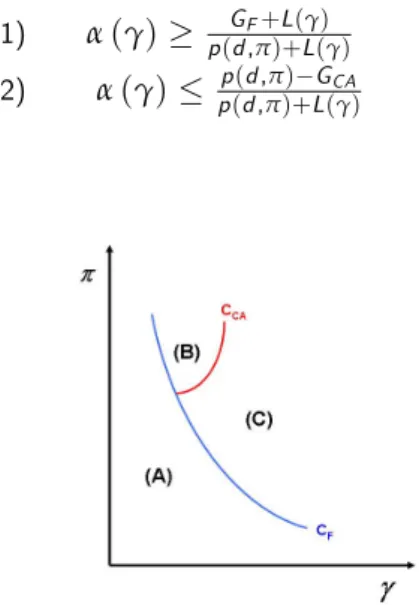
Proposition 1
Parameter Region (A), low
α
(
γ
). Condition (1) is not
satis…ed, F chooses no strategic delay. Parameter Region (B), intermediate
α
(
γ
). Both
(1) and (2) are satis…ed: F delays, CA enforces penalties and F goes to trial
.
Parameter Region (C), high
α
(
γ
). (1) is satis…ed but
(2) is not: penalties are not enforced and F always maximizes strategic delay because
π
+
v
(
d
,
π
)
π
.
(1)
α
(
γ
)
p(GdF,π)++L(γ)L(γ)(2)
α
(
γ
)
pp((dd,,π)+π) LG(γ)CAWhere we are ...
Contract enforcement: crucial issue for the ppc’s design
Court e¢ ciency: very important for the ppc’s outcome
OUR RESULTS FROM
- Theoretical Model:
# Parameter Regions: in (C) the …rm will strategically delay and the CA does not enforce the penalty
- Empirical Analysis:
# ine¢ ciency of court & high value ppc: larger probability of F’s delays (AVCP)
# ine¢ ciency of court & number of infringiments in ppc: positive correlation (Consip)
and where we are going ...
-
Theoretical Model:
- Develop the simple model to investigate reimbursable &
asymmetric legal costs (i.e. asymmetry in F and CA size)
- Empirical Analysis:
- Test further the predictions on F’s and CA’s size and on
contract dimension
- Moving towards causality (higher prob of contract
enfocement):
- exploit the law determining the presence of a court on
the base of population in the municipality
- compare municipalities with similar population, but
di¤erent w.r.t the presence of a court (Litschig and Zamboni,
2011)
Related literature
E¢ ciency of Courts: Djankov, La Porta, Lopez-de-Silanes and Shleifer, (2003)
Time incentives in procurement: Bajari & Lewis (2010), D’Alpaos et al. (2010)
Discretional enforcement of contract: Chakravarty & MacLeod (2009), Doornik (2010), Iossa and Spagnolo (2011)
Judicial Enforc. & Credit Market: Jappelli, Pagano, Bianco, (2005) Literatures on private bargaining with contract as threat point and on renegotiation: Aghion, Dewatripont and Rey (1994), etc., Cooter & Rubinfeld, (1989), but renegotiation strongly limited in public procurement
Court as an active player in judicial enforcing: Gennaioli & Shleifer (2006), Gennaioli & Rossi (2009); Anderlini & Felli (2009)
Institutional setting
ppc in Italy, Jan 2000-Aug 06, governed by:
1) the Law on Public Procurement: No.109/1994;
2) the Public Procurement Code (acknowledging the EU
Directives 2004/17/EC and 2004/18/EC);
3) the Ministerial Decree 145/2000 on General Terms for
Procurement Works Contracts
These rules de…ne:
the adoption of di¤erent awarding procedures (open
procedure, restricted procedure, private negotiation, etc.),
according to the starting value of the contract and some other
technical features.
contractual conditions (i.e.: conditions for subcontract,
disputes, time incentives, etc.)
Time incentives in Italian ppc
RULES
- penalties for delay should be included in the initial contract, set
in the range 0,03% and 0.1% of the contract value, and calculated
on daily basis
- in total, penalties for delay to be paid by the F should not
execeed the 10% of the contract value.
Data
AVCP: public procurement data
(15 regions for 2000-2006,
about 32.000 recorded contracts).
-
53% of the sample include municipalities as CAs.- The starting values (at current prices) of the ppc range from 150,000 to 30,000,000 euro (average: 628,000 euro).
- More than 70% awarded through competitive auctions; 11% through negotiations.
We de…ne delays as the di¤erence between expected end and
actual end of the work.
-
88% of works show delays in the execution, with an average of 157 days (max of 1578 days).ISTAT: duration of trials.
Our measure of courts’ine¢ ciency is the average duration of
trials at provincial level.
Robustness checks
Dependent Variable Delays Delays Delays Delays Rebates Rebtes
Mean outcome 146 146 146 146 15.4 15.4 (1) (2) (3) (4) (5) (6) Duration of Trials: T 0.005 0.145** -0.001 0.131* -0.001 -0.002 (0.016) (0.070) (0.015) (0.073) (0.001) (0.002) Duration of Trials2:T2 -0.000** -0.000* 0.000 (0.000) (0.000) (0.000) Dur.Trials*Starting Value 0.001* 0.001* (0.001) (0.001) Starting Value 5.366*** 5.374*** 4.550*** 4.586*** 0.147*** 0.147*** (0.332) (0.332) (0.540) (0.547) (0.012) (0.012) Restr.Proc. 3.294 3.387 3.085 3.180 -1.601*** -1.602*** (11.372) (11.400) (11.394) (11.421) (0.404) (0.404) Simpl.Restr.Proc. -24.850*** -24.894*** -24.626*** -24.676*** -1.441** -1.441** (8.841) (8.845) (8.860) (8.858) (0.673) (0.672) Design-and-C. -9.957 -9.105 -11.864 -10.990 -2.799 -2.804 (38.444) (38.880) (37.843) (38.320) (1.952) (1.949) Negotiation -18.277*** -18.482*** -18.120*** -18.320*** -5.411*** -5.412*** (4.681) (4.727) (4.707) (4.753) (0.596) (0.595)
Type of CA fe Yes Yes Yes Yes Yes Yes
Cat. of work fe Yes Yes Yes Yes Yes Yes
Province fe Yes Yes Yes Yes Yes Yes
Year fe Yes Yes Yes Yes Yes Yes
Obs. 14595 14595 14595 14595 32449 32449
Dispute between F and CA
Once F delays and CA enforces penalties, F can start a trial
expecting
i)
to convince the court that the delay belongs not to her
fault (in which case penalties should not be levied) and thus
Dispute and legal costs
F is the plainti¤, CA the defendant
0
γ
1 measures the ine¢ ciency of the local court, it is
observable, and higher court ine¢ ciency means a higher
γ
α
(
γ
)
and
(
1
α
(
γ
))
are the F’s prob of winning and of losing
the trial, respectively, weakly increasing in
γ
DISCUSS HERE
Cost of the trial for F and CA respectively
(
G
F+
L
F(
γ
))
and
(
G
CA+
L
CA(
γ
))
:
-
G
F andG
CA are …xed cost-
L
F(
γ
)
andL
CA(
γ
)
are documented costs that arerecovered in case of a favorable verdict; they are increasing in the ine¢ ciency of the court
γ
,
and we let total recoverable cost beBackward materials 1
Rewrite condition (1) and (2) respectively as
C
F=
α
(
γ
) (
p
(
d
,
π
) +
L
(
γ
))
G
FL
(
γ
)
0
.
(2)
C
CA=
α
(
γ
) (
p
(
d
,
π
) +
L
(
γ
))
p
(
d
,
π
) +
G
CA0
(3)
Corollary
Comparative statics on (2) and on (3) shows that, under mild
assumptions:
∂CF ∂γ>
0
,
∂CF ∂π>
0
,
∂CF ∂L0
,
∂CF ∂GF<
0
and
∂2CF ∂π∂γ>
0
∂CCA ∂γ>
0
,
∂CCA ∂π0
,
∂CCA ∂GCA>
0
,
∂CCA ∂L>
0
and
∂2CCA ∂π∂γ>
0
Predictions from our simple model (in progress)
the higher the ine¢ ciency of the courts, the higher the delays
for la arge value/complex ppc w.r.t. a small value/simple one
for high ine¢ ciency of the courts and large value/complex
ppc, penalty are never enforced
the higher the ine¢ ciency of the courts,
ceteris paribus
, the
higher the legal costs, and the smaller the probability F delays
and goes to trial, as well as the CA enforces the penalty
asymmetry in size of F and CA determines asymmetry in legal
cost, so that:
- small Fs deliver relatively earlier than large ones
- small CAs enforce penalties relatively less than large ones - in a setting where a large F faces a small CA, the probability to have delays in delivering and no enforcement of penalty is higher than in a setting with a small F facing a large CA.