M
M
E
E
E
E
T
T
I
I
N
N
G
G
T
T
H
H
E
E
N
N
E
E
E
E
D
D
S
S
O
O
F
F
S
S
E
E
L
L
F
F
-
-
R
R
E
E
P
P
R
R
E
E
S
S
E
E
N
N
T
T
E
E
D
D
L
L
I
I
T
T
I
I
G
G
A
A
N
N
T
T
S
S
:
:
A
A
2
2
J
J
A
A
U
U
T
T
H
H
O
O
R
R
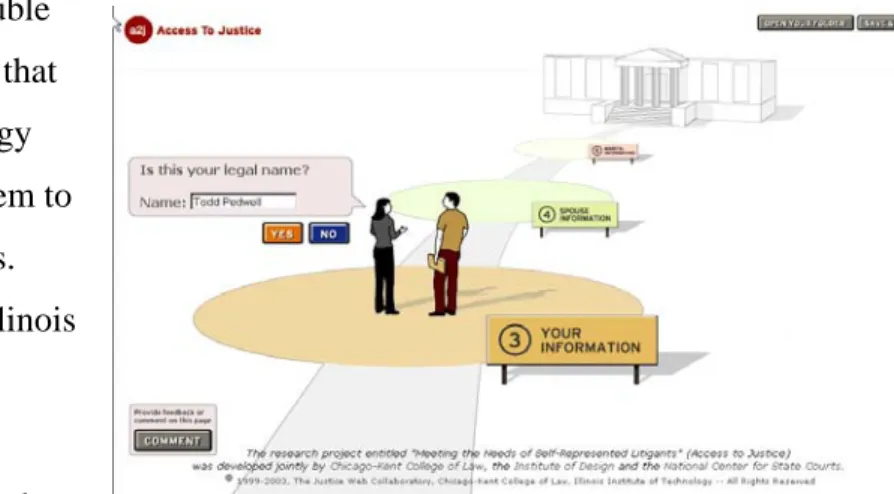
Figure 1: JSDM Prototype guided support module
Access to Justice Author (“A2J Author”)1 is a software tool that delivers greater access to justice for self-represented litigants by enabling non-technical authors from the courts, clerk’s offices, legal services programs, and website editors rapidly to build and implement customer friendly web-based interfaces for document assembly. The guided interviews created with A2J Author remove many of the barriers faced by self-represented litigants, allowing them to easily complete court documents that are ready to be filed with the court system.
From 1999-2001, the Access to Justice, Meeting the Needs of Self-Represented Litigants: A Consumer Based Approach (“Meeting the Needs”) Project2
successfully identified the major barriers to access to justice for self-represented litigants. A key insight of the Meeting the Needs Project was that the simple act of filling out forms raises unique challenges that the many low income self-represented litigants have trouble
overcoming. The project also determined that special care would be required if technology were to be introduced into the justice system to meet the needs of self represented litigants. These findings led to the creation of the Illinois Joint Simplified Dissolution of Marriage Prototype (“JSDM Prototype”).
This prototype was custom-designed software that provided a web-based interface for
pro se litigants to complete the forms required for a joint simplified dissolution of marriage in Illinois. The JSDM interface has been tested by users from the Illinois statewide legal services website (www.Illinois-LegalAid.org) and evaluated by user interface specialists at the Illinois Institute of Technology Usability Lab. The user interface developed for the JSDM Prototype is
1
Access to Justice Author was developed under grants from the State Justice Institute (SJI grant number SJI-04-N-121), Chicago Kent College of Law, Center for Computer-Assisted Legal Instruction (CALI), Center for Access to the Courts through
Technology, and Legal Services Corporation (LSC). The points of view expressed are those of the authors and do not necessarily represent the official position or policies of the SJI, Center for Access to the Courts through Technology, Chicago-Kent, CALI, or the LSC.
2
The Meeting the Needs of Self Represented Litigants: A consumer based approach was a study completed by the National Center for State Courts (NCSC), and the Illinois Institute of Technology’s Chicago-Kent College of Law and the Institute of Design, and was funded by grants from the State Justice Institute (SJI-00-N-248), the Open Society Institute (No. 20001562), the Center for Access to the Courts through Technology, and the Illinois Institute of Technology.
elegant, simple and powerfully effective – it is the “front-end” needed to make court document assembly and electronic filing more widely accessible to self represented litigants. Though the JSDM Prototype proved to be a powerful tool, creating a customized user interview was time consuming and costly.
In 2004 Chicago-Kent College of Law’s Center for Access to Justice and Technology partnered with the Center for Computer-Assisted Legal Instruction (“CALI”) to create A2J Author - a factory or a software machine to make hundreds of these front-ends for court forms, at a very low cost. A2J Author capitalizes on the front-end interface developed in the JSDM
Prototype, while providing enhanced functionality that allows authors to create interviews on their own. A2J Author includes a desktop authoring tool and a web-based player that combine to enable rapid, low costconstruction of customer friendly interfaces for web-based guided data collection and document assembly without the need of a professional software developer. The resulting web interface created with A2J Author gently leads unsophisticated end users through a guided interview with visual and audio cues.
In addition to being user friendly for the consumer, A2J Author is also designed to make it easy (perhaps fun) for court staff and
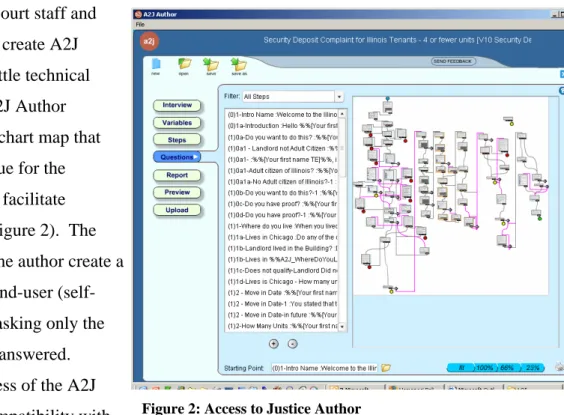
public interest lawyers to create A2J Author interviews with little technical assistance or training. A2J Author includes a graphical flowchart map that displays the entire dialogue for the interview to the author to facilitate complex branching (see figure 2). The "branching" feature lets the author create a dialogue that assists the end-user (self-represented litigants) by asking only the questions that need to be answered.
Much of the success of the A2J Author stems from its compatibility with
the Automated Documents Online (“ADO”) Server for Nonprofit Legal Services. The ADO server provides internet-based document assembly services powered by the HotDocs software by
LexisNexis. After an A2J Author interview is completed, the A2J interview is uploaded to the ADO server and combined with its corresponding HotDocs form template to create an A2J interactive interview for court forms. The HotDocs template is a digital representation of a blank court form that allows information gathered from the A2J interviews to be manipulated and inserted in the proper position of that form.
The completed A2J modules are made available over the internet through court and statewide websites. The “front-end” software, A2J Author, developed by Chicago-Kent and CALI, joined with the “back-end”
technologies of the ADO server, LexisNexis HotDocs and ADO management tools, provide a full end-to-end solution (see figure 3). This combined effort makes it possible to provide user-friendly assistance to thousands of self-represented litigants in a rapid and cost effective manner and make the help available wherever there is internet access.
The Center for Access to Justice & Technology has field tested A2J Author by
building guided support modules for the project’s pilot partners in Illinois (Illinois Legal Aid Online and the Cook County Courts) and in California (California Administrative Office of the Courts). The Illinois A2J modules include “Security Deposit Complaint” interviews for tenants and an “Application for Waiver of Court Fees and Costs”. The Security Deposit complaint interview has been made available to the public on www.IllinoisLegalAid.org. Three California modules have been built and are in the final stages of review by the California AOC, including: “Petition for Adult Name Change,” “Application for Waiver of Court Fees and Costs,” and an “Application for an Order for Service of Summons by Posting and Mailing.”
Legal aid offices in a variety of States have begun using the A2J Author tool on their own. For example, Idaho Legal Aid Services, Inc. has completed a number of A2J interviews including a “Landlord Eviction Notice”, “Landlord Eviction Complaint,” “Tenant Answer to Eviction Complaint,” Tenant Repairs Notice,” Tenant Repairs Complaint,” and “Adult Name Change Forms.” Illinois Legal Aid Online has also completed and published a “Post Judgment
Access To Justice Website
Customer Data
Document Assembly Server
E-Filing at Courthouse Server XML XML Figure 3: Information Transfer
Collections Guide” A2J interview that guides users through the process of collecting court judgments and an “Expungements” module that is used in connection with a new expungement help desk in Chicago’s Cook County courthouse in the Daley Center.
In addition, the following organizations have planned to build A2J modules or have expressed a high level of interest in using A2J Author on their own to create online guided interfaces:
• Washington Courts, Administrative Office of the Courts (AOC)
• New York City Civil Courts
• Legal Assistance of the Finger Lakes
• Atlanta Legal Aid Society
• North Penn Legal Services
• Washington State Access to Justice Technology Bill of Rights Committee A2J Author is available for free to interested courts, legal service organizations, and members of the HotDocs development community for non-commercial use. A2J Author is made possible by funding from the State Justice Institute, Center for Access to the Courts through Technology, Chicago-Kent College of Law, CALI, and the Legal Services Corporation. For sample interviews created with A2J Author visit www.kentlaw.edu/cajt/A2JAuthor.html. To learn more about A2J Author and how to download the latest version, contact:
Jay C. Carle Project Manager
Center for Access to Justice and Technology Chicago-Kent College of Law
565 W. Adams St., Suite 775 Chicago, Illinois 60661 Tel: (312) 906-5328 Fax: (312) 906-5165 www.kentlaw.edu/cajt/ [email protected] Ronald Staudt
Assoc. Vice President, Law, Business & Technology and Professor of Law Center for Access to Justice and Technology
Chicago-Kent College of Law 565 W. Adams St., Suite Chicago, Illinois 60661 Tel: (312) 906-5326 Fax: (312) 906-5280 www.kentlaw.edu/cajt/ [email protected]