Development of a tool for the evaluation and improvement of the energy
management in small and medium enterprises (SMEs)
I. Morales1,*, J.P. Jiménez2
1 Andalusia Institute of Technology, Málaga, Spain 2
Andalusia Institute of Technology, Málaga, Spain
* Corresponding author. Tel: +34 952 02 87 10, Fax: +34 952 02 04 80, E-mail: [email protected]
Abstract: A new tool is presented in this article. The main objective is the improvement of the small and medium companies’ energy management systems in order to obtain energy savings and the adaptation of the organizations according to the recognized standard UNE-EN 16001:2010. The application of the tool lets companies reduce their energy consumption and improve their processes in an energy efficiency perspective. The methodology is based in questionnaires and tests which will report information in order to identify all standard requirements. In a near future, the expected benefits are going to be a knowledge about the companies’ EMS situation, information to prioritize actions to improve, identification of critical areas, comparison between different EMS evaluation results (for example: company’ EMS with industry average, etc.), improve companies knowledge about energy, energy efficiency, etc.
Keywords: Energy, Management, System, software, companies.
Nomenclature
EMS Energy Management System SME: Small and medium enterprise
IAT: Instituto Andaluz de Tecnología (Andalusia Institute of Technology: company name). 1. Introduction
In the last few years, society, governments and companies have changed their philosophy in order to protect and preserve the environment. Nowadays, instead of being watched as an economical consumption, this philosophy has become in a competitive factor.
At the same time, laws have included topics related to environment which gives an answer to the general interest.
The purpose of this paper is to introduce a tool (named EVALENER) that offers companies the possibility of evaluating the management system focused on energy efficiency according to the recognized standard UNE-EN 16001:2010 “Energy Management System – Requirements with guidance for use´” (Spanish version of EN 16001:2009).
UNE-EN 16001:2010 [1] standard just became an European standard, so not many other evaluating software has been developed to help companies and no relevant result have been set. Even more so for SMEs. In Spain only few companies has got its EMS certified and most of them are big organizations.
Another important aspect is the fact that the tool is focused to be applied in small and medium enterprises (SMEs) since they do not have as much economical resources as big companies have. So the tool’s main objective is helping SMEs to achieve an effective EMS carrying out their own evaluations and measuring the impact of the development improvements in the organizations.
2. Methodology
EVALENER has been based in recognized standard UNE-EN 16001:2010 ‘Energy
Management Systems - Requirements with guidance for use’ that provided a model of
excellent energy management to the organization to compare their energy management system with the model one.
The methodology for developing EVALENER has been the same following for the Instituto Andaluz de Tecnología (www.iat.es) to develop other evaluating tools that exist in its organization. IAT has wanted to provide companies (emphasized in small and medium companies) with a set of tools to evaluate different aspects into the organization with the same aspect and the same operation. The results are shown in the same way as well to help companies understand the results.
The methodology for developing the tool in order to evaluate the Energy Management System (EMS in advance) has been the following:
1.- A questionnaire has been developed to cover all standard requirements.
This questionnaire has several questions for each UNE-EN 16001 aspect. Each question is accompanied for evidences examples to help the evaluator to find into his/her organization what they are doing to compliance the aspect asked.
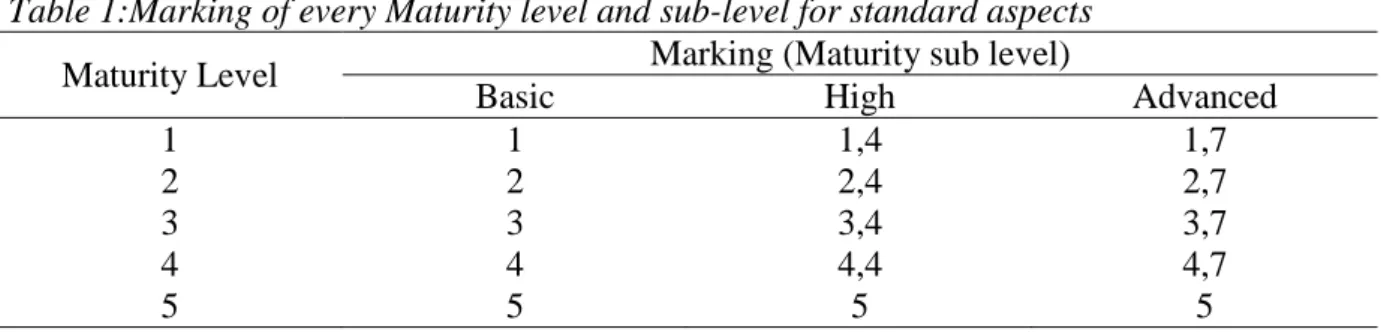
2.- Question weighting has been developed to reach a value for each standard requirement. The evaluator will have to mark each question between 1 and 5 to show the maturity level as shown in Table 1.
Table 1:Marking of every Maturity level and sub-level for standard aspects
Maturity Level Marking (Maturity sub level)
Basic High Advanced
1 1 1,4 1,7
2 2 2,4 2,7
3 3 3,4 3,7
4 4 4,4 4,7
5 5 5 5
Table 2:Maturity Level of every standard aspect
Maturity
level Approach Performance Improvement
1 It isn’t very sound
It isn’t done
systematically and not always as planning.
It is done just to repair problems
2
It is sound and it is based in a recognized standard, model, etc.
It is done systematically and not always as planning.
Non conformities are detected in order to plan and to star improvement actions
3
It support the management policy and established targets
It is done regularly and in many relevant areas
Improvement actions are set to avoid future
problems. Effectiveness of these actions is measured
4
It consider the influence of all management areas and relevant stakeholders.
It is done in nearly all relevant areas
Results are analyzed and compared with company targets in order to get information to improve activities, process, etc.
5 It is done considered internal and external data
It is done in all relevant areas to guarantee good results for all stakeholders
Best practices and comparison with other companies results are taken into account to set up improvement plans.
This table may be used to set the Maturity Level: The user will mark approach, performance and improvement levels (one mark in each columns). Maturity base level will be given by the lower value.
To find the maturity sub-level (Table 1) the following criteria are considered:
Basic: the 3 marks in the array have the same level.
High: one of the mark (approach, performance or improvement) is above the basic level.
Advanced: 2 of the 3 marks are above the basic level.
Marking (Maturity sub level) Maturity Level
Basic High Advanced
1 1 1,4 1,7
2 2 2,4 2,7
3 3 3,4 3,7
4 4 4,4 4,7
5 5 5 5
Table3:E.g. of setting Maturity level.
Maturity
level Approach Performance Improvement
1
2 X X
3 X
4 5
Maturity level will be 2 in this example
Set the maturity sub-level: In the above example: sub-level is “high”, therefore this question points with a value of 2,4 (Fig.1) using Table 1 to set it.
Fig.1. Example of setting the question value
Thus, for each question the user get a value between 1 and 5.
3.- Some tests have been passed to the tool in order to identify errors and to check the smooth running of it.
4.- The tool has been validated in 15 real cases to assure it provides companies key focus areas and the possibility to compare its EMS evolution throughout the time.
EMS EVALUATION
User, during the evaluation, will answer several questions within each part of the standard. The screen layout of the tool for each question is the following (Fig. 2):
Comments Strengths Improvement areas/points Fig.2. Screen layout of EVALENER
Furthermore, the user could highlight strengths and improvement areas by clicking the Notes button (Fig. 2), which will help detecting during the global analysis the most important areas to be improved. All this information will be shown in a report named “evaluator's notebook” (Fig. 3)
Fig.3. Example of Evaluator’s Notebook report
standard requirements Question Examples and evidences Mark
It is possible not to answer the question if it is not applied into the organization
Maturity Level
Sub-level
Notes
Fig.4. Example of Evaluation Report
3. Results
Companies that took part in this project were SMEs. Some of them have set their own environment management systems (according ISO 14001) but some others don't. None of them have got EMS, although some would consider its use in a future.
A varied set of companies participated during the tool's validation process, companies like a pharmacy, manufactures, or a health care company.
Those companies that have decided to become certified according to UNE-EN 16001:2010 standard want to show customers that these companies are consistent with their business (for example engineering and/or architecting firms that works with energy efficiencies ) and others to get more points going to qualify for government public tenders.
Those which are using an environment management system have achieved better scores and found easier during the evaluation understanding the question and evidences compared to those companies that don't use any environment management system. The companies that don't use it even found hard to understand concepts like operational control and significant energetic aspects, besides they achieved low scores in the auto evaluation.
All of the participants used the experience to think about their use of energy, considering new metrics and, the most important, improvement areas in the aspects that they could afford given the current economical circumstances (change machines to other that consume less energy, change to LED technology, used better enclosures, changes in human behavior…) 4. Conclusions
SMEs in Andalusia are currently passing through an economical delicate moment, as in the rest of Spain but increased by a weakest regional and local industry.
In this scenario, an efficient energy management is a must in order of reducing costs and looking after the environment, taking part of the European compromises for reducing the greenhouse effect, consumption, etc.
The main obstacle for these SMEs is the access to information related with energy management, contracting experts to help with it or even economically afford some of the improvement options available in the market.
Because of the mentioned reasons, this tool tries to help small companies that cannot make use of any EMS because of a lack of resources. The software has been organized following the standard requirements with the purpose of helping companies approach to the standard and it has been adopted the question-evidences formula to ease its understanding.
The option of evaluator's notebook makes considerably easy bringing up improvement areas after finishing auto-evaluation as well as highlighting the strengths of the company.
Beside of evaluator's notebook, EVALENER offers the chance to de companies to compare evaluations and see the EMS evolution. This information will be useful to know how efficient were the improvement actions undertaken by the company and will help with the continuous improvement of the organization.
In any case, the system has to be improved because it has been revealed as not very flexible (it doesn't allow weighting each question or section) and not very intuitive in the use of both tables (Tables 1 and 2). The way of looking for the score for every question (Table 2) requires using an auxiliary paper sheet as it is not automated in the software, and makes it hard until further practice had been acquired. For this reason, this functionality should be improved in a second version of the tool (now developing by IAT and to be integrated with other evaluation tools that have been developed by IAT).
The software could be enhanced by adding help tags and screens to let the evaluator a better understanding of each question or standard aspect.
Despite all, the goal of approaching EMS to SMEs and letting them, in an affordable way, analyze and reflect on their way of use of energy and consider actions for improvement has been achieved.
References
[1] Standard UNE-EN 16001:2010 “Energy Management System – Requirements with guidance for use”, AENOR, 2010