<
WORKING PAPERS
Country Operations Latin America and the CaribbeanRegional Offlice, Country Department 11
The World Bank June 1990
WPS
424
Mexico's External
Debt
Restructuring
in
1989-90
Sweder van Wijnbergen
Who in thie
enidprof'ited
miost
fromi
the official resources devoted
to Mexico's last debt restructUring: Mlexico or its commercial
creditors? Mexico. BuIt in establishing the basis for long-ternn
growth thie package seemis a reasonable comipromilse
betweenl
thieconftlictinig
interests of Mexico and its commercial creditors.
[hne Po, I. X c,dn?,~
~CrrdA
X! .V'a,~'
Crxx lC;r k.tX %k-i An.g 'Npcm o1s'!n,tcih.ec d,i,, uvga'd t nora'c L :~ "C .arI V-k ot1C41 11,r -4 l .Cft';cvt, inC irevkeI de IC KtI p'.Cnt S Cc. ',IsllX I>.sp;T Can tre C I' "' othe au~ rv , "ce, t -I ( I C. I
~'`'.
6' -''d * I '. Ve!A!! -~.'ing: l%':.v ngC :T:..'.a2i2,''' n'0Public Disclosure Authorized
Public Disclosure Authorized
Public Disclosure Authorized
Country Operations
WFS 424
I his paper is a prodluct ol tlhc Country Operationis Division, Latin America and the Caribbean Re. onal Olfice, Country Department 11. Copies are available frec 1romm LtCe World Bank, 1818 If Sirect NW,
Washinoton DC 2(A33. Please contact Margaret Stroude, roomI 18-1 63, extension 38831 (33 pages sK ith figures and tables plus 2I pagcs ot annex).
Mexico's suspension ot ldebt service payments in w ho in thlc end proflitcd most Irom the ofticial August 1982 ushercdi in tlhc interniational debt resources devoted to the deal: Msexico or its crisis. In two consecutive debt rcstructurinri commercial creditors? He concludies: packages, in 1984 and 1987. Mexico bcgan
vigorous structural rct'orm unider thc so-called Mlexico made elftficieint use ot tile official Baker plan. Miexico s cxpericence vividly f'undcs available lor debt reduction. Tlhc market denioiistrates the strength ofthat plan an; d tile value of' lth claims before enhancement dccli lcd reasons lor its cv cnualt Failure ---- thc fact thatl it by close to tile full amiloulit ot tthe value ofl the
wlas inherently a short-term process. additional foreign ofticial resourccs devoted to thc packaec. TIhc rate ot rctuni on ltlc use on In December 19S8, Mcxico's Prcsidcnt offiicial resources far exceecis thie initerest rate at
Salinas annriouniced that extenral creditor-s vcre \0hich dtei' %ere extcnide(l.
10 COnItribIte to a1 meIdiUml-IClI
SOIlu-tion. In Marchi NS'). tte nc. tiL-.S. TreasUr -k TIhe market \aluc after errhan&'enient as
SeCretar;\ Bdi'r , el ti'. civ l Citimi/ed th IIsicaiall the samt as the market \. alue ol th.e
'.ord debt relicF in a sIpcchI thalt openle2d h the outltldlillng claims before the dCaIl so
I.l 1or theI C I'9 (IC det re\trnctLri a1rl. erenlnt MC\I icos cornmicrciail cre(litors not at fiir dil . th1at \ a1 n Wi l anaer. !11cd\ ' /S hlere. 'I[lie crldit erdiallcellnclit b\ ain large :ii e ulp for thlc dieht relic. fil nlt) no eill t thlt tire
Thatt anreeret.l oflfercd commerciil creditors oficiail cred(itors' mione\ hbenefited Me\ico the choic btxt \kcen exvehantnine old debt in,airu- rather tlan its commercial creditors. 'It'lc World
mrct s for nce%' inistrumilents i' olv irli debt xrelict Bank, the IMF. and thte (Gocninlcnt of Ja'p,n do'. er inrtcrest rates or prillncipall b Nit a;lli'% ('AhInch pro'0\. ided tiIe official lrsoulrcs) aICii'.Ce(d
seeLtrC d. ith coil a.eral: nr unsecurc( instrumrilits thlcir ohjevctivc of helping Mexico: theC additional
itWOnLt debt rciiet. buit '.t it a ev. nio11ton re sourc (sldid tIt aiccrue to the creditors, 'i. rich
omilillitmlielnt tlliltlcd. man'. feared and soImeC (iccme(d inevitalhc.
.z\ctve idehates o tire rlcer;ts ol thiis packae lhail .oil the blasis ol availab!le ct.\ idice.
reV oftell Confused.na Ill Lill C\tCnsiVC CCOnollic this pCke cstablishcidlIc haksis tor sustairabie
nalsi si .Lin \Wijrrbrergen addrcsses tife Luestionl: _ ro'.tf iii Mlc\ico.
! i I'8i' 0!' 'A l'.,ir 4eii: L!:a's A tilt: iX. .11 Pk'11 !! ' .1
Mexico's External Debt
Restructuring in 1989-90
Sweder van Wijnbergen
I am indebted above all to my colleagues in the World Bank'- Latin America Vice Presidency and the Mexico Division of the IMF for many helpful
discussions and comments. I have furthermore benefited from disn.ussions with
Augustin Carstens, Stijn Claessens, Daniel Cohen, Manuel Galan, Reuben Lamdany, Ricardo Martin, Sergio Pena and Luis Tellez. Much of the work presented here is based on joint work with Sergio Pena and with Stijn Claessens.
II ECONOMIC BACKGROUND . . . 3
II.1 Macroeconomic Developments . . . 3
A. The Period Leading Up to the Scabilization Program 88/89 . . . i . . . 3
B. Macroeconomic Stabilization . . . 4
II.2 The Process of Structural Reform . . . 5
A. Rationalized Private Sector Incentives . . . 5
B. Reorientation of Public Spending . . . 5
II.3 The Case for Debt Relief . . . 6
III THE DEBT AGREEMENT BETWEEN MEXICO AND THE COMMERCIAL BAIKS . . . . 7
III.1 Structure of the Debt and Pre-Deal Financing Gap. 7 A Structure of the Debt . . . 7
B. Financing Requirements and Financing Plan 1989-94 . . . 8
III.2 Economic Considerations Underlying the Package . . . 10
III.3 Negotiating Mexico's External Debt: a Brief Chronology of Events . . . 12
III.4 Terms of the Agreement . . . 13
A Debt and Debt Service Reduction Options . . . 13
B New Money Options . . . 14
C Debt-Equity Conversion . . . 16
D Recapture Clause . . . 16
E Credit Enhancement . . . 16
III.5 Subscription by the Commercial Banks . . . 19
IV EVALUATION OF THE AGREEMENT: DEBT RELIEF . . . 21
IV.1 How much Debt Relief? . . . 21
IV.2 Is there Enough Debt Relief? Rate of Return Approach . . . . 22
V IS THERE ENOUGH DEBT RELIEF? MARKET EVALUATION . . . 23
V.1 Market Valuation of the New Instruments . . . 23
V.2 Market Valuation of the Debt Package: Did Mexico Strike a Good Bargain? . . . 25
VI IMPACT OF THE DEAL ON THE FINANCING GAP, CREDITWORTHINESS AND GROWTH . . . 26
VI.1 Impact on Financing Gap and Creditworthiness indicators . . 26
VI.2 Impact on Economic Growth . . . 28
VII CONCLUSIONS . . . 31
REFERENCES .. 32
ANNEXES . . . 1
I GROWTH. DEBT RELIEF AND THE REAL EXCHANGE RATE IN MEXICO . . . 2
II SECONDARY MARKET PRICING AND THE VALUATION OF THE RECAPTURE CLAUSE: AN OPTION PRICING APPROACH . . . 12
I INTRODUCTION
Mexico has throughout the eighties been at centerstage in the debates and events shaping the sovereign debt problem. Caught between a sudden collapse of its terms of trade and rising world interest rates, Mexico's
suspernsion of debt service payments in August 1982 ushered in what has since
become known as the debt crisis. In the years that followed, it became the de facto paragon of the approach of Mr. Baker, at the time the US Treasury
secretary, to th. debt crisis; after initial retrenchment and consolidation, Mexico started a vigorous process of structural reform, relying on
international capital markets to support that process through rescheduling and new money in two consecutive debt restructuring packages (83/84 and 86/87). Mexico's experience over those years vividly demonstrates the strength of that approach; but equally clearly on display are the reasons for the eventual
failure of the Baker plan.
While the reform process promised tangible benefits over the medium term. reschedulings and new money commitments came on a short term basis only, and each time after tortuous negotiations. This inherently short term process left continuing uncertainty as to whether similar accommodation would be available two three years down the road. It thus failed to provide a medium
term framework within which the private sector could, with reasonable confidence, assume current policies to continue. The resulting uncertainty about exchange r tea, future tax policy and financial regulation ruled out a return of flight capital and the recovery of private investment. As a
consequence growth stagnated to such an extent that the social consensus behind the reform program came under increasing stress.
Towards the end of the de la Madrid administration, the view took hold
that a different approach had to be taken. Th:.s view was pursued with vigor by
tho Salinas administration that took power in 1988 (and by and large carried over the economic team from the previous administration). On the one hand, the reform process was accelerated beyond anybody's expectations, and a
comprehensive, imaginative macroeconomic stabilization program skillfully put in place. On the other hand, President Salinas, in his inauguration speech on December 1, 1988, gave external creditors notice that, while Mexico wished to avoid confrontation, they were expected to contribute to a medium term
solution of Mexico's debt problem. At about the same time, the main
international organizations took a considerably more flexible approach to debt management in their annual meeting in Berlin, September 1988. But the real breakthrough came when Brady, Baker's successor as Secretary of the Treasury
in the US, in a speech at the State Department March 10, 1989, effectively legitimized the word debt relief. This speech opened the way for the
negotiations between Mexico and its commercial creditors that, six months later, led to the agreement that is the subject of this paper.
The agreement reached on July 23, 1989 offered commercial creditors the choice to exchange old debt instruments for new instruments invalving debt
relief (lower interest rates or lower principal), but partially secured with collateral; or for unsecured instruments without debt relief, but with a new money commitment attached. Significantly, the option to just retain the old
instruments at unchanged terms was not left open to any commercial creditor. An active debate has since begun on the merits of this package, a debate that, unfortunately, is often marred by basic confusion about and misunderstanding of both the facts and likely economic corsequences of the agreement reached.
It thus seams an opportune moment to provide both a detailed description of
the package and a comprehensive economic analysis.
Section II outlines the main course of economic developuaits in Mexico
leading up to the agreement. A full understanding of this economic background
is essential for an understanding of the urgency with which Mexico and its
supporters in the international community approached the negotiaticns. Section
III then outlines the structure of Mexico's external debt and its financing
needs anticipated at the outset of the negotiations. This section also
provides an overview of the economic considerations underlying :he structure
of the agreement finally reached, and a detailed description of that
agreement.
Sections IV-VI then provide detailed economic analysis. Set-Lon IV first
assesses the amount of debt relief, and asks the question whether th's amount
of debt relief represents a good return on the resources devoted to the deal.
The paper then takes the point of view of Mexico's creditors and, in Section
V, provides an assessment of the market value of all outstanding coumercial
claims on Mexico before and after the deal, and with and without the official
credit enhancements provided, by third parties and by Mexico itself, to
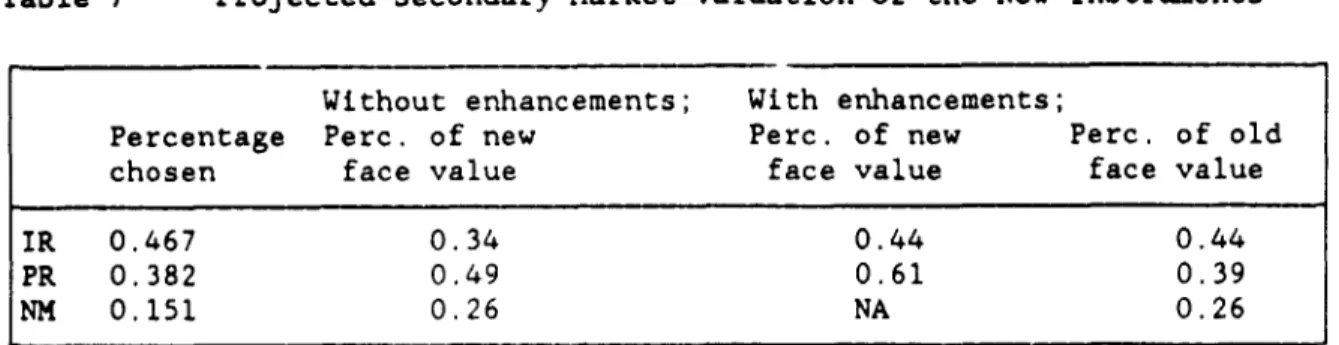
creditors choosing one of the debt relief options. The question addressed here
is, who in the end profited most from the official resources devoted to the
deal, Mexico or its commercial creditors?
This question cannot reall-y e answered by simply reading off secondary
market quotations of the various nstruments traded before and after the deal.
International events did not staud still over the six months of the
negotiations, and it is thus difficult to disentangle the impact of the deal
from other events influencing market evaluation of Mexico's credit risk. To
separate out the impact of the deal, a formal framework is used based on
financial option pricing techniques (see Claessens and van Wijnbergen (1989)
and Annex I to this paper).
Section VI looks at what is arguably the most important aspect of the
deal, its likely impact on the recovery of economic growth in Mexico. The
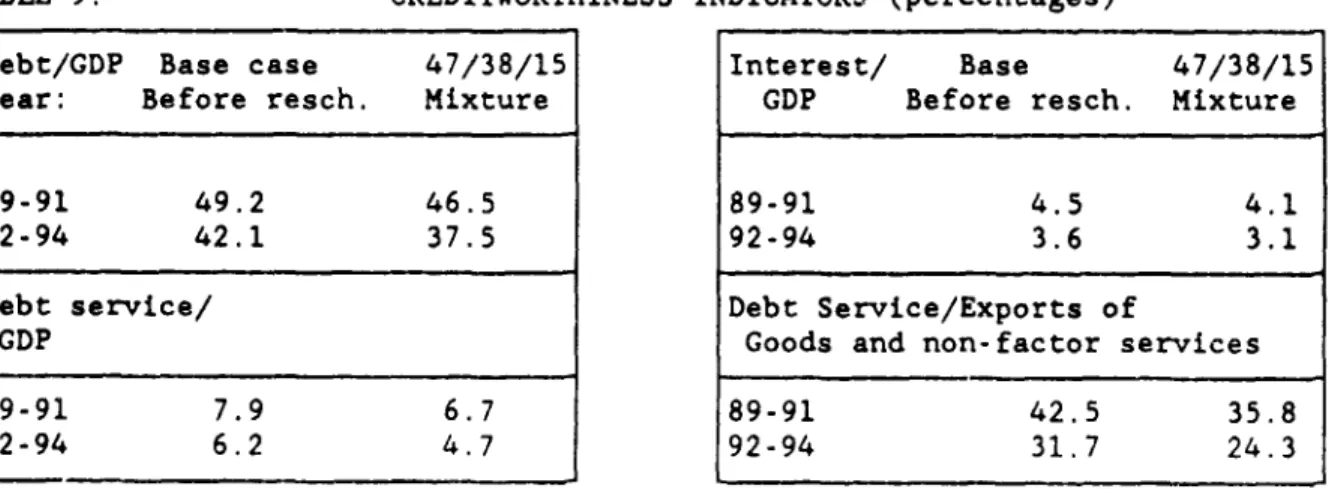
section first assesses the impact of the deal on Mexico's financing gap. It
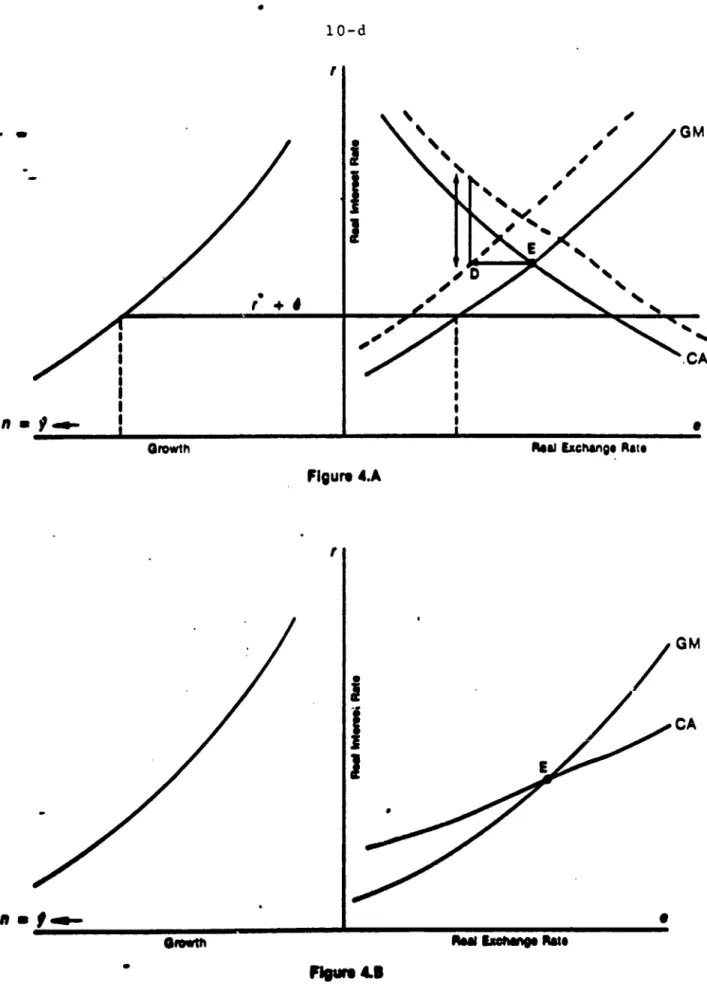
then uses a quantitative framework dev.loped for this purpose (cf van
Wijnbergen (1989, 1990b) and Annex II to this paper) to assess the likely
impact of the deal on Mexico's prospects for a recovery of economic growth.
Section VII draws all the threads together in a conclusion, making three
points. First, Mexico made very efficient uses of the official funds available
to it for debt reduction purposes. The market value of the claims before
enhancement went down by close to the full amount of the value of the
additional foreign official resources devoted to this package. On a different
measure, the rate of return on the use of the official resources far exceeds
the interest rate at which they have been extended. Second, although it
follows by implication from the first observation, the market value after
enhancement was basically the same as the market value of the outstanding
claims before the deal. Mexico's commercial creditors thus got a fair deal,
with the credit enhancement by and large making up for the debt relief
granted, but not more than that. Thus, the official creditors' money ir the
end mostly benefited Mexico rather than its commercial creditors. Therefore,
the World Bank, the IMF and the Government of Japan (who provided the official
resources contributed to this deal) achieved their objective of helping
Mexico; the additional resources did n accrue to the creditors, something
some. Third and most importantly, on the available evidence this package seems
sufficient to establish a basis for ustainable growth in Mexico.
II ECONOMIC BACKGROUND
In the years preceding the 1989/1990 debt negotiations, Mexico has gone
through a rather tumultuous series of macroeco,.omic developments, and, towards
the end, through an increasingly rapid process of structural reform. A better
understanding of what happened in the years leading up to the negotiations
explains much of the various parties negotiating positions, and of the urgency
behind the proceedings. We therefore provide a brief survey of this period.2 1
II.1 Macroeconomic Developments
A. The Period Leading Up to the Stabilization Program 88/89
Between 1950 and 1974, Mexico enjoyed a remarkable period of high
growth, low inflation and moderate external debt accumulation. Real growth
averaged 6.4%, and inflation was in single digits throughout the period, in
line with the prudent fiscal policies followed. This era of fiscal
conservatism came to an abrupt end in the early seventies. Government
involvement in the economy expanded rapidly, and increased public expenditure
pushed up aggregate demand and the rate of economic growth. However, the
higher government expenditure was not matched by rising public sector
revenues. As a result, the inflation tax and external debt became
increasingly important sources of public finance. At the same time, a decline
in private savings incentives (real interest rates turned sharply downward)
prevented a matching increase in private savings; external debt thun
increased, increased oil revenues notwithstanding. The period of single digit
inflation ended in 1973, the real exchange rate2l started to appreciate and
the accumulation of external debt accelerated above the GNP growth rate. A
serious, but comparatively brief, financial and economic crisis in 1976
terminated following major oil discoveries in 1977. The ensuing prosperity
lasted until 1982, when soaring domestic inflation, falling international oil
prices, rising world interest rates, and massive capital flight led to a
refusal bv external creditors to roll over Mexico's short-term debt and a
subsequent suspension of Mexican payments of interest on its external debt.
Over the 1982-88 period, economic growth ground to a virtual halt. This
was accompanied by charply falling living standards, a deteriorating
infrastructure, high inflation, and a loss of investor confidence. Towards
the second half of t.his period, a series of measures was taken to reverse
Mexico's declining fortunes. Among the most important goals were:
(a) macroeconomic stability; (b) a rationalized set of incentives for private
sector investment; (c) reallocation of public spending to support private
sector-led growth, improved social services and the environment; and (d) a
J/ A more detailed treatment can be found in Dornbusch (1988), Ortiz (1990)
and van Wijnbergen (1989).
2/. The real exchange rate is defined as the price of foreign goods relative
credible financing plan to renove the unsustainable uverhang of external debt.
In each of these areas, the Ltxxican Government has achieved notable progress.
B. Macroeconomic Stabilization
The onset of the financial and economic crisis of 1982 brought in its wake explosive inflationary and balance of payments difficulties. Initial strong fiscal and monetary adjustment efforts were alternately not sustained for a sufficiently long period (1983-85) or undermined by external shocks such as the collapse in international oil prices (1986). Inflation, rather than slowing down, accelerated, partially in response to the sharp real devaluation of the excharge rate necessitated by the 1986 downturn in the terms of trade. The subsequent de facto targeting of the real exchange rate, together with an increase in the frequency of wage and cost adjustments, introduced an element of inherent instability into the system, culminating in a run on the peso in the last quarter of 1987 and triple-digit inflation.
The Government responded with the "Economic Solidarity Pact" (Pacto), an agreement between business, labor, and government. This agreement called for accelerated structural reform, further tightening of fiscal and monetary policy, a freeze of minimum wages and of basic public and private sector prices, and, the cornerstone of the "Pacto", a freeze of the nominal exchange
rate against the U.S. dollar. This partial freeze was extended at three-month intervals through the end of 1988, and renewed, with some modifications, by the new Mexican Administration under the name of "PECE" (Pact fo'
Stabilization and Growth) through July 1990. The main adjustments brought about under the PECE initially were once-off catch up increases in selected public sector tariffs and in prices of key inputs, a two-stage 26% cumulative
adjustment in the minimum wage, and a daily adjustment of the exchange rate of about one peso against the U.S. dollar. More recently, it has been announced
that public sector prices will be adjusted more re 1.arly but by smaller
amounts, in line with general inflation targets. I. 1dition, there has been substantial progress towards more flexible pricing, most recently in
agriculture, The current policy stance is thus more flexible and more in line with current actual inflation than it was one year ago; arguably the PECE's
"soft landing" has almost been achieved.
The fiscal measures, backed by the temporary exchange rate freeze and an array of formal and informal wage and price controls, have had a dramatic
success in reducing the rate of inflation, from 159% in 1987 to 20% itl 1989, a
rate that will likely also obtain in 1990. At the same time, the economy has shown encouraging signs of economic recovery, led by a strong resurgence of
privatoi investment. Industrial production wds 6% higher in the first half of
1989 than in the same period a year earlier, and the economy has grown by an estimated 3% in real terms for the year as a whole. The current account balance has deteriorated from a 1988 deficit of US$3 billion to an estimated deficit of more than US$5 billion in 1989. This is largely due to the
acceleration in private sector investment and a drought-induced decline in net agricultural exports which has brought about a temporary decline in income. Manufactured export growth continues at an annual rate of about 10%, less than
in 87/88 as the real exchange rate appreciated somewhat over the pacto period, in which the Peso was kept fixed against the dollar. Interest rates, although still high by historical standards, declined by about 20 percentage points within days after the announcement in July 1989 of a debt reduction
agreement between Mexico and its-commercial bank creditors. The same factors
have also led to more than US$2 billion in returned flight capital in 1989.
II.2 The Process of Structural Reform
A. Rationalized Private Sector Incentives
Mexico has, since 1985, transformed itself into one of the most open
economies in the world through an extensive trade reform. Trade
liberalization to date has lowered the oercentage of domestic (non-oli)
tradeoDle production covered by import quotas from 100% in 1984 to less than
17% at present. Maximum import tariffs were cut by similar magnituaes, from
over 100% down to 20%. Non-oil merchandise exports, which represented less
than one-third of total exports in 1984, have doubled their share since then,
These "core" reforms have been complemented by ma.ny others. Recognizing
that the era of public sector-led growth had passed, the Government took a
number of measures to stimulate greater private investment. In May 1989,
foreign investment regulations were considerably relaxed and made more
transparent. A long-standing prohibition against majority foreign ownership
was removed, the fishing, petrochemical, and mining sectors were oper.ed to
foreign investors for the first time, the licensing of proposed investments
under US$100 million was made automatic in those sectors, and approval of
larger investments bec3me automatic following a 45-day waiting period, unless
the Government interposed formal objection within that waiting period. Since
1986, the tax system underwent a series of reforms bringing marginal tax rates
more in line with levels in major industrial countries, encouraging the
repatriation of flight capital, and increasing the sanctions for tax evasion.
Also, profits are for tax purposes now adjusted for the effects of inflation
on assets and liabilities, and the previous bias against equity finance has
been reduced substantially.
To encourage improved mobilization of domestic savings, the Government
initiated a parallel process of financial market liberalization, supporLed by
a Financial Sector Adjustmeat Loan from the Bank. Commercial banks no longer
face any ceilings on the deposit interest rates they can charge; .he system or
forced allocation of commercial credit towards favored sectors has been
abolished and credit subsidies through official deve.opment banks have been
reduced significantly. The principal development and agricultural banks in
the public sector are in the midst of significant managerial and financial
restructuring, designed to consolidate institutions, clean up balance sheets,
and reform lending practices.
To reduce the role of the public sector in production, over 750
state-owned enterprises were sold, transferred, or liquidated between 1)83 and the
present. Many large-scale enterprises underwent major financial and partial
managerial restructurings. More recently, the Government announced 'lans to
sell the country'3 largest airline and its telecommtnications company. It
also placed in receivership for eventual sale or liquidation the country's
largest mine. A radical deregulation of the transport sector has already been
implemented. Such deregulation is useful in its own right, but it also
increases the efficiency gains from the trade reforms uriertaken earlier.
Since 1982, a major retrenchment of public expenditure has taken place.
Non-interest spending declined from 35% of GDP in 1981 to around 20% in 88/89.
The composition of the cutbacks was, pethaps, not ideal from the standpoint of
growth. Real investment expenditures were cut more deeply than current
outlays, posing the risk, now that growth is underway once again, that
infrastructural bottlenecks might impose constraints on potential growth.
Also, some of the gains in reducing illiteracy, infant mortality, and
nutrition during the seventies are threatened by the sharp cutbacks in public
expenditvres for social programs. The social sector's budgetary share
declined from 20% or imore in the years preceding the 1962 to around 13%
currently. This trend is probably unsustainable, given the worsening
inter-personal and inter-regional income disparities.
In recent years, authorities have sought to soften the blow of
reductions in social expenditures. Global consumer subsidies for basic food
items are being replaced by less expensive, but more targeted, subsidies to
the poor. In 1989, a new "National Solidarity Program" has set aside US$400
million to coordinate the activities of existing agencies and provide limited
additional budgetary support for agriculture, infrastruc'ure, and social
programs in Mexico's ten poorest states. For example, title to 100,000 urben
plots is to be regularized, 150,000 hectares of semi-arid arable land
rehaoilitated, and tubewells, irrigation works, and rural infrastructure
extended. And, starting in June 1989, a program to rehabilitate 25,000
primary and secondary schools began, with an expected cost of nearly US$220
million.
Given the severe fiscal constraints, the need to rebuild crumbling
roads, bridges, and other infrastructure is at present only partially met.
Resources are found by shifting public expenditure away from activities which
could be better carried out by the private sector, such as steel, mining or
telecommunications, to areas like transport infrastructure where the state's
role is more easily justified. However, the restoration of sustainable growth
will require a gradual increase in public investment over the next few years,
for agriculture, the eTivironxment, transportation, energy, and the social
sectors,
II.3 The Case for Debt Relief
Despite the far reaching reforms implemented in Mexico, international
capital markets have not provided the resources needed to bridge the period
between the current costs and the future benefits of the reform program.
Continuing high external transfers generated uncertainty about whether the
rapidly growing transfer burden could be met. This, in turn, generated
increased uncertainty about future exchange rates, taxation, and financial
regulation. Thus, to forestall further capital flight, Mexico had to pay
unsustainable interest rates on its domestic debt. "Ex post" real interest
rates were almost 50% in the weeks before the debt accord was reached.
Real in-erest rates so far above the real growth rate of the economy are
explosive under any circumstance; however in Mexico there is an additional
complication in that the government is in the middle of a stringent economic
stabilization program in which fiscal retrenchme:ut plays an important role.
However at a 30% real interest rate (the average level for most of 1989), the
current fiscal stance is far out of line with the stated inflation target of
debt, the government needs mole than 6% of GDP in extra revenues for domestic
debt service alona. The uncertainty caused by future transfer problems,
through its impact on domestic real interest rates, war thus a direct threat
to the survival of the still highly successful stabilization program.
Therefore the beneficial domestic effects of the aebt: package will
follow as much from reduced uncertainty and improved expectations about future
policies as from the direct fiscal impact of any reduction in net transfers to
foreigners. But for such expectational factors to come into play, the deal
really needs to be of a medium term nacure. Hence the imperative not only of
a solution, but a solution that would likely forestall debt problems for the
foreseeable future.
Against the background sketched so far, Mexico initiated the debt
negotiations to seek international sur -rt for its far-reaching Ltjustment
program and recovery of economic growth. The Government has already
demonstrated its strong commitment to the program, but its continued success
depends on tne availability of external support. Because of the high domestic
costs of continuing uncertainty, the required international support can make a
substantial difference only if it is basee on an unequivocal, medium term
commitment by the creditors. Therefore, Mexico has pressed in the
negotiations for a multi-year financing package.
The need for debt relief, in the case of Mexico, needs to be seen from
this perspective. It was not so much the level of the country's debt, but the
current flow of debt service payments that is too high, and causes too much
uncertainty to allow growth and sustainability of adjustment. The need for
debt relief has to be seen in this context. Debt reli3f offers the most
certain way to reduce future net transfers for a long time to come. However
new money commitments, if credible and stretched out far enough into the
future, could have served equally well.
There are otl.er arguments, however, both political and economic, that
stress the importance of debt relief over new money commitments. Political
because Mexicans have made such enormous adjustments, accepted such a large
reduction in living standards, that any package without an extensive and
visible contribution by external creditors would not be acceptable
domestically. Economic because the new money commitments, while generous,
stretch out for three and a half years only, possibly not enough to see a
process of economic growth firmly established.
The conclusion should be clear. Mexico had the structural policies and
domestic fiscal measures in place for sustainable growth to take off. What was
missing was a sufficiently long period during which external creditors would
allow this inherently sound economic program t -et off the ground. The only
way of obtaining a credible commitment to such medium term international
accommodation is debt relief.
III THE DEBT AGREEMENT BETWEEN MEXICO AND THE COMk4ERCIAL BANKS
III.1 Structure of the Debt and Pre-Deal Financing Gap
A Structure of the Debt
At the end of 1988, Mexico's external debt was at $100.4 billion. Of this total, most is held by commercial cieditors (see Table 1), with the
holds $7.4 billion and the IMF $5 billion. Of the commercially held debt
($70.6 billion), a smtll amount ($5.1 billion) has never been rescheduled.
The bulk of this $5.1 billion consists of PEMEX liabilities ($3 billion) that traditionally have been rolled over automatically.
Table 1: MEXICO: EXTERNAL DEBT BY CREDITOR AS OF END OF 1988 (USS billion) Commercial banks: 70.6 of which to: Public Sector 65.1 of which: Rescheduled 3/.9 Now Money 14.8 non-rescheduled 5.1 Inter-Bank 7.3 PrLvate Sector 5.5 Other Creditors: 29.8 of which to: Public Sector 28.8 of which IBRD 7.4 IMF 5.0 Bilaterals 8.7 Bonds 3.7 Others 4.v Private Sector 1.0 TOTAL 100.4
The new financing package covers the sum of the $37.9 billion that was rescheduled during 1986/1987 and the $14.8 billion of new money that was
provided in the previous two rescheduling exercises (1983/1984 and 1986/1987).
This total ($52.7 ui.llion) has since been reduced to $48.9 billion because of
cross-curren..y exchange rate changes, debt-equity swaps and cancellation of
debt held by Mexican institutions. Thus the basis covered by the debt package is $48.4 billion. A certain amount of sovereign debt is held by Mexican owned
banks. Those claims will either be brought under the new nioney option
described below, or will not receive enhancements if debt or debt service reduction options are chosen.
B. Financing Requirements and Financing Plan 1989-94
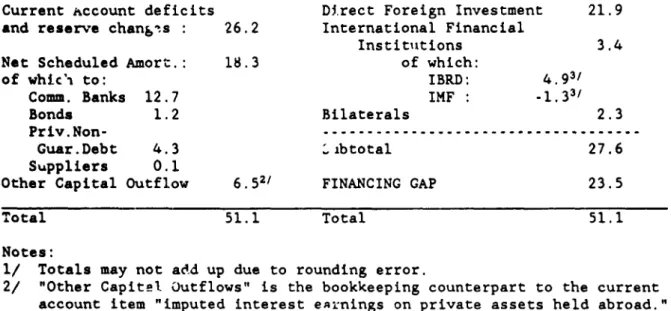
Based on simulations with the model presented in Annex I, Mexico's total gross financing needs over the 1989-1994 were estimated to amount to over $50 billion (Table 2), This level of financing would accommodate a growth target of an average 4% over the next six years, provided, however, that the non-interest current account would generate a surplus of 2.4% of GDP on average. At current interest rates and for the given structure of the country's debt, this leads to a cumulative current account deficit of around $23 billion
increase by $3.1 billion, a, tipulated under the IMF Extended Fund Facility
that came into operation May 1989, raising the total to around $26 billion.
Total finanning requirements include, in addition, the scheduled net
amortization payments to commercial banks, bondholders, suppliers and holders
of private t,on-guaranteea debt. These amortization payments were estimated at
US$18.3 billion over the same period.
Table 2: MEXICO'S FINIANCING NEEDS AND SOURCES 1989-1994 (bUSS)
Needs Sources
Current Account deficits Direct Foreign Investment 21.9
and reserve chang.s : 26.2 International Financial
Instituttions 3.4
Net Scheduled Amort.: 18.3 of which:
of whic'i to: IBRD: 4.93/
Comm. Banks 12.7 IMF :-1.33/
Bonds 1.2 Bilaterals 2.3
Priv.Non-
---Guar.Debt 4.3 .ibtotal 27.6
Suppliers 0.1
Other Capital Outflow 6.52/ FINANCING GAP 23.5
Total 51.1 Total 51.1
Notes:
1/ Totals may not add up due to rounding error.
2/ "Other Capitel Outflows" is the bookkeeping counterpart to the current
account item "imputed interest enrnings on private assets held abroad."
3/ This does not include additional disburbements of US$ 950 million and
US$ 600 million under the Interest Support Facilities of respectively the
Bank and the IMF.
To meet the above needs, funding is expected to be available from net
lending by bilaterals and the international financial institutions. In
addition, substantial direct foreign investment (DFI) is projected to take
place in response to the economic reforms described in the preceding Section,
including the recent liberalization of the foreign investment regime. However,
Table 2 indicates that funds available from these sources were short of gross
financing needs; thus a financing gap was projected of $23.5 billion
cumulatively over the period ending in 1994, or almost $4 billion per year.
This includes amortization on commercially held debt ($12.7 billion).
Therefore, the corresponding net financing required from debt service
reduction, new money and return of Mexican flight capital would have to be
$10.8 billion.
This scenario is sensitive to developments in the world environment.
Every dollar decrease in world prices for Mexican oil costs Mexico $0.5
billion in foregone export revenues per annum. Thus if oil prices are two
years.21 The financing gap would increase correspondingly. Of course
unanticipated increases in the price of oil would reduce the financing gap. Similarly, a one percentage point increase in international jnterest rates would increase the cumulative current account deficit by close to $6 billion over the period, with a matching increase in the financing gap. This
sensitivity to international interest rates highlights the potential benefits of fixed interest debt instruments.
III.2 Economic Considerations Underlving the Package Al
From the Mexican point of view, two considerations were important in judging any proposal: impact on cash flow and implied debt relief. On the one extreme, rescheduling, capitalization of interest due and new money have a one for one positive impact on cash flow but imply no debt relief. On the other extreme are reserve financed debt buy-backs in the secondary market: these imply debt relief equal to the amount of debt repurchased times the discount at which it is bought, but actually lead to negative cash flow effects in the year of purchase.
An alternative way of looking at cash flow effects is, to recognise that Mexico because of the external credit constraints, must have a higher discount rate than suggested by world interest rates. In that case, packages with equal discounted value when evaluated at world interest rates may have a different discounted value when evaluated at the Mexican, higher discount rate. In particular, packages that give the debt relief early on would be preferred on
that criterion. Thus, a reserve based debt buy back would be worse than an equal present value (evaluated at world interest rates) cut in interest rates when evaluated at Mexican discount rates because of the early negative cash
flow effect of such buy backs.
The impact of Central Bank reserve losses on the precarious exchange rate situation made reserve financed debt buy-backs ill advised. Any package
thus had to come down to a combination of cash-flow oriented
interest-capitalization/new-money schemes and debt-relief oriented debt exchanges. For similar reasons, debt reschedulings with relending provisions, like those incorporated in Brazil's package in 1988, were not advisable on a significant scale. In an economy with open capital markets like Mexico, a relending
provision is tantamount to instantaneous prepayment at face value. Such an arrangements would thus not only involve no debt relief, but would also result
in a major negative cash flow impact. The only way to avoid this is to restrict on-lending to public sector agencies.
Debt buy-backs can be distinguished by the asset being sold (or type of new debt issued) to finance the debt buy-backs. These could be publicly owned assets; examples are a reserve financed debt-buy back or debt equity swap involving a parastatal. When such schemes involve public assets, there are no fiscal problems since the public sector already owns the asset.
ii Oil export volumes are projected to remain constant for the next six
years. The oil prices mentioned refer to the average price of Mexico's oil exports. Recently, this price has stayed about $3.50 US$ below the price for West-Texas Intermediate.
The case of public debt for private assets (for example equity) is
different: to execute such a public debt for private equity scheme, the public sector needs to acquire the asset first. Therefore, the government needs to raise the resources to acquire the private asset. For the evaluation of such public-debt/private-equity swaps it matters how the government raises the resources to acquire the private sector asset. This can be done through
increasing the primary budget surplus, inflation tax, internal debt iss.:e o
external (net) debt increase (i.e., reserve losses).
The primary surplus is already strained to the limit as part of the current fiscal ietrenchment. Use of the inflation tax (through a change in exchange rate policy) goes against the grain of the current stabilization program. Use of internal debt issue is ill advised as long as internal debt carries in excess of 30 percent real interest rates. Finally, we already mentioned that the use of reserves is not possible in the current precarious exchange rate situation.
These considerations ruled out public debt for private equity swaps. Anyhow, Mexico's experience in the 1987 program suggests that such schemes reduce debt but not really foreign liabilities: the average discount was slightly over 10 percent only (Sanguines (1989)). One could conceivably use
the privatization program to engineer public debt for public equity swaps, but unless claims on future oil production are brought in, such schemes sill never be big enough to have a major impact. Thus, while debt-equity swaps might play a small positive role in the government's privatization program, they cannot and should not play a major role in any debt reduction operation.
That left as the only option exit bond schemes and cash flow oriented measures. Exit bond schemes would require guarantees of principal and interest payments to allow significant debt relief. But any package also had to involve major cash flow oriented measures, such as for example interest
capitalization.
An attractive option was reduced interest rates. Refinancing of old loans at lower 'nterest rates implies debt relief because the discounted value of all future payment obligations falls; at the same time it provides early cash flow relief because it does not involve any purchase of assets up front. Finally, since there is no need for the public sector to obtain ownership of private assets, no fiscal problems arise. Thus interest relief combines the favorable cashflow effects of new money packages with the debt relief impact of discounted exchange offers.
But to maximize the amount of debt relief, there was no doubt Mexico had to offer its creditors a menu of choices. The reason why a single option deal would have reduced the amount of debt relief lies in the differences in
regulatory and tax environment that Mexico's various commercial creditors face. For this reason, different schemes that would present equal debt relief to Mexico, could implie very different costs to its creditors. Thus,
restricting the choice to one instrument only would, for given willingness to grant relief by the creditors, unambiguously reduce the amount of relief actually received by Mexico.
Finally, for maximum impact on credibility of the stabilization effort and hence on domestic interest rates, the more years are covered by any deal, the better: year to year deals keep the possibility of impending BoP crises open. A deal for the first three years would, unless accompanied by some sort of an understanding on what will be done beyond 1991, cast a large shadow over Mexico's adjustment program.
This is in particular an issue for the revival of private investment,
because of the irreversible nature of capital accumulation. Uncertainty about
the future will bias private savers towards more liquid assets, including
foreign ones, until such uncertainty is resolved. Also, with the possibility
of BoP crises still looming at the horizon, a major reduction in domestic real
rates would seem unlikely: nominal rates would first of all reflect higher
expected depreciation, raising "ex post" real rates; second, private investors
would almost ceitainly require continued high premiums before they are willing
to bear exchange rate risk, raising "ex ante" real rates too. This suggests
that a shor.-term deal will not only preclude a recovery of private
investment, but it will also perpetuate the current fiscal problems created by
high real interest rates on domestic debt.
III.3 Negotiatinz Mexico's External Debt: a Brief Chronologv of Events
Negotiations were extraordinarily complicated straight from the
beginning. One complicating factor was the number of banks involved (more than
600). This problem was dealt with in what is by now a standard solution,
through the formation of a Bank Advisory Committee with representatives of
some 15 creditor banks. This committee conducted the actual negotiations with
representatives of the Mexican Government, which were concluded with the July
23 agreement on a "term sheet" containing the outlines of the agreement.
But there were more players in the act. Prior to any negotiations with
commercial creditors, Mexico sought to reduce net external transfers to its
official creditors, and in addition, sought their support for the principles
underlying subsequent negotiations with commercial creditors. An agreement was
reached with the Paris club covering $2.6 billion of principal and interest
payments falling due in the period 6/89-5/92. All amortization over the three
year period was rescheduled over ten years with 6 years grace. Also
rescheduled were 100% of interest payments due in the first year, 90% of
interest payments in the second, and 80% of interest due in the third. Access
to import financing of up to $2 billion per annum was also secured.
Even before this agreement, negotiatons had started with both the World
Bank and the IMF about a major package of support measures. In February 89,
Mexico and the IMF reached agreement on an Extended Fund Facility for SDR 2.9
billion (about $4.1 billion) covering three years and an optional fourth one.
At around the same time, the World Bank and Mexico successfully concluded
extensive negotiations covering three Structural Adjustment Loans for $0.5
billion each, plus a commitment by the World Bank to a lending program of
about $2 billion per year for the period 1990-1992.
Moreover, both institutions publicly supported Mexico's claim that
reduction in Mexico's debt burden was called for in one form or another if
growth was to recover in Mexico. In a historically unprecedented move, both
the IMF and the World Bank allowed a portion of the resources extended to
Mexico to be used for support of debt reduction operations ("Set Asides"). In
another first, both institutions made available to Mexico an additional,
one-time sum for debt reduction purposes (Interest Support Facilities of $0.6
billion from the IMF and $1.26 billion from the World Bank). At the same time,
the Government of Japan, through its EXIM bank, offered financial support to
Mexico to the extent of $2.05 billion, also to be utilized in the debt
Once negotiations with the IMF and the World Bank were concluded, negotiations with the Bank Advisory Committee began in New York early April. Although tha negotiations were officially behind closed doors, the various proposals and counterproposals were widely reported in the press throughout
the three months of negotiations. The initial skirmishing was about Mexico's financing needs were growth to recover, in which both the World Bank and the IMF played an advisory role, albeit an unofficial one.
When the negotiations moved on to debt relief, initial positions were far apart, with Mexico asking for 55% debt relief and the committee offering only 15%. Although various counterproposals brought the parties somewhat closer, negotiations in New York seemed to stall beginning of summer and wer. escalated towards a higher level. The final negotiations, in Washington DC, involved Secretary Brady, the chairmen of the most important banks i.&.volved, senior officials of the World Bank and the IMF and, from the Mexican side, finance minister Mr. Aspe and debt negotiator Curia. This phase was
successfully concluded with the announcement of an agreement in principle on July 23, 1989. This agreement included a debt relief option involving 35% debt relief, exactly halfway the opening proposals of both parties. The structure of this agreement, which was further refined in subsequent negotiations
between Mexico and its commercial creditors, is described in the next section. II1.4 Terms of the Agreement
On September 15, l989, the Government of Mexico and the Bank Advisory Committee representing the commercial bank creditors reached agreement on a financing package covering the period 1989-92, restructuring approximately US$48.4 billion of Mexico's external debt. The agreement consists of a menu
of financing options which includes two debt and debt service reduct'.on facilities and four new money facilities. On the same day, the Government of Mexico disseminated a term sheet to all of its commercial bank creditors and
invited them to participate in the financing operation. The following are the summary terms of the financing options offered by Mexico to its commercial bank creditors under the 1989-92 Financing Package:
A Debt and Debt Service Reduction Options
Option A: Collateralized Floating Rate Discount Bond Exchange. Creditors may exchange eligible debt for new collateralized floating rate discount bonds issued by the United Mexican States in a principal amount equal to 65% of the principal amount of the eligible debt offered
for exchange. The new bonds will be in registered form, will mature ih
a single installment on December 31, 2019 and will bear interest at a rate of 13/16% per annum over the six-r-nth LIBOR rate for the currerncy in which the bonds are issued. (Bonds will be issued in: Canadian and U.S. Dollars; Belgian, French and Swiss Francs; Deutsche Marks; Dutch Guilders; Italian Lire; Japanese Yen; and Pounds Sterling). Payment of
the full principal amount of the Discount Bonds on December 31, 2019 will be secured by a pledge by Mexico of zero-coupon U.S. Treasury
obligations (or other comparable collateral for other currencies). Payment of interest will be secured by a pledge by Mexico of cash or permitted investments in the currency of the bonds in an amount equal to
eighteen months' interest (calculated at a constant interest rate of 10%
per annum in the case of discount bonds issued in US dollars).
Option B: Collateralized Fixed Rate Par Bond Exchange.
Creditors may exchange eligible debt for Collateralized Fixed Rate Par
Bonds issued by the United Mexican States in a principal amount equal to
100% of the principal amount of eligible debt offered for exchange. The
Fixed Rate Par Bonds will also be in registered form; will be issued in
the same ten currencies as under Option A above; and will mature in one
maturity on the same day as the Floating Rate Discount Bonds. The
interest rate payable on the Fixed Rate Par Bonds will be 6.25% per
annum for those issued in U.S. dollars and corresponding rates for those
issued in other currencies. Principal and interest payments on the
Fized Rate Par Bonds will be secured in the same fashion as for the
Floating Rate Discount Bonds, except that instead of using the assumed
constant interest rate concept, the interest payments on the Fixed Rate
Par Bonds will be secured to their full contractual levels.
B New Money Options
Option C: 1989-92 New Money Credit Agreement.
Lenders may elect to commit to lend up to 100% of their New Money
Commitment (defined as 12.5% of Facilities 2 and 3 advances under the
1987 Multi-Facility Agreement and 25% of all other eligible debt) in the
New Money Credit Agreement which will provide the United Mexican States
(with an undertaking by Banco de Mexico to provide foreign exchange)
with a 15 year (7 years grace) loan at an interest rate of (a) 13/16%
over LIBOR, or (b) 13/16% over the three months Certificate of Deposit
rate or (c) a fixed rate calculated to provide a comparable yield to
maturity as the floating rate options. The loans will be made in the
same currencies as the Debt and Debt Service Reduction Bonds, except
that European Currency Units can also be lent under the New Money Credit
Agreement. Amounts under this Agreer nt will be available for
disbursement in six semi-annual tranches commencing on December 1, 1989
and concluding in July 1992. The first tranche will permit the
disbursement of 40% of the loans and each subsequent tranche will permit
the withdrawal of 12%.
Option D: New Money Bonds.
Each creditor may elect to purchase New Money bonds in an amount up to
50% of its New Money Commitment, although not more than $500 million of
New Money bonds will be issued in total. New Money Bonds will be issued
by the United Mexican States; they will be in registered form, issued in
U.S. dollars; and will bear interest at the rate of 13/16% over LIBOR.
They will be issued on the date of the borrowing of the first tranche
under the New Mcney Credit Agreement, and will be repayable in equal
semi-annual installments beginning in 1997 and ending in 2004 (15 year
Option E: Onlending Facility.
Up to a limit of 20% of its New Money Commitment, each creditor may
elect to make advances to a trust established by Mexico (with Banco de
Mexico as trustee) for the purpose of onlending funds to Mexican public
sector borrowers with the guarantee of the United Mexican States. These
advances will have the same repayment schedule as the loans made under
the New Money Credit option (15 years maturity, 7 years grace), at an
Interest rate of (a) 13/16% over LIBOR, or (b) 13/16% over the three
months Certificate of Deposit rate. Advances made under the Onlending
Facility may be in any of the currencies permitted under the New Money
Credit Agreement; and the same restriction on availability applies as
the one on loans under the New Money Credit Agreement.
Option F: Medium-Term Trade Credit Facility.
Up to a limit of 20% of its New Money Commitment, each creditor may
elect to make advances to a trust established by Mexico (with Banco de
Mexico as trustee) for the purpose of financing certain eligible trade
credits (e.g., unguaranteed portions of bilateral trade credits to
Mexican public sector borrowers, or trade credits to Mexican private
sector borrowers for transactions approved by Mexico). The Medium-Term
Trade Credit Facility will have the same primary terms and conditions as
the Onlending Facility.
Creditors holding claims in their home currency can, if that home
currency is not the US dollar, choose whether to maintain the original
currency denomination or switch into US dollars. If they choose to remain in
their non-dollar home currency, the total funds devoted to enhancement will
not exceed what would have to be provided for an equivalent dollar claim. l
Banks holding Mexican obligations contracted in the 1983-88 period will
reschedule them to 7 years grace with 15 years maturity to the extent they are
not swapped for par or discount bonds. Mexico's external creditors would
provide all the necessary w.ivers to make feasible the issue of new debt and
debt service reduction instruments with credit enhancement.
The Government would be entitled to buy back any of the newly issued
discount or par bonds if (a) it is current on interest payments, and (b) the
collateral account for interest support is either not drawn upon or
replenished. This latter restriction lapses after end-1994.
Mexico would continue to service the incerest on its existing loans on
their contractual terms until the exchange takes place. However, the terms of
the agreement would, upon signing, be implemented with retroactive effect from
July 1, 1989. For the new money commitments, this implies that at the time of
the signing, participating banks would disburse immediately all the
installments due until and at that time, subject to the satisfaction of
certain conditions precedent (which include the issuance of the discount and
par bonds). Similarly, once the discounted and par bonds are issued, Mexico
i/ There is one exception to this rule. Up to 5% of the Yen-denominated debt
held by Japanese creditors is eligible for full collateralization of principal
would deduct from the initial interest payments the amounts of interest paid on the exchanged loans in excess of the interest due on the new bonds, after July 1989. This clause was introduced to eliminate any possible perverse incentive on the part of the banks to delay the signing of the agreement.
C Debt-Equity Conversion
Banks participating in the 1989-92 financing package will have access to a debt/equity program which would be authorized up to $1 billion per year. This program would be limited to public sector companies that are being privatized and to qualified infrastructure projects. The lower limit of discount would be 35% on par bonds, new money and eligible old debt, and the conversion of discount bonds would not be higher than the face value.
D Recapture Clause
Banks that have chosen discount or par bonds are eligible to recover some of the money given up through a "recapture clause". Under this clause, beginning July 1996, 30% of the additional oil revenues Mexico gets if the price of oil rises above $14 per barrel (to be adjusted for US inflation), will accrue to the banks that have granted debt and debt service relief. The
total amount to be recaptured, however, will not exceed in any year 3% of the nominal value of the debt exchanged for debt reduction instruments at the time
of the exchange (i.e. there is no indexation of this cap) Furthermore, the
amount available under this clause will be scaled back by the percentage of the total debt brought under the two debt reduction options. These recapture clauses, once attached to new instruments, can survive early redemption of
such instruments by at most five years.
E Credit Enhancement
All discount and par bonds will be repaid in a single installment on December 31, 2019. The principal would be secured by the pledge of zero coupon US Treasury obligations (or other comparable securities for bonds in other currencies) with a maturity date matching that of the Mexican bonds. In addition, interest payments would be partly secured by a pledge of cash or
permitted investmenits in the relevant currencies for an amount equal to 18
months of interest payments due. 6/ The securities and cash pledged as
collateral will be held in special collateral accounts, to be managed by the
Federal Reserve Bank of New York, as collateral agent.Z/ Creditors' debt service would be paid out of these collateral accounts in case the Government failed to make interest payments for longer than 30 days, for as long as there are funds in the accounts. To enable establishment of the special collateral accounts, waivers of the negative pledge restrictions are necessary and have been received from Mexico's commercial bank creditors.
j/ That is, covering three semi-annual interest payments.
7/
More than one account may be needed to secure interest paymentsThe bondholders will appoint the Federal Reserve Bank of New York as collateral agent to hold the collateral for discount and par bonds for the benefit of the bondholders in the various currencies in which the debt
exchange instruments are subscribed. The collateral agent, whose appointment
would be set out in collateral pledge agreement with the Government, will open
the collateral accounts and deposit into those accounts the cash and
securities available for interest support. Interest earned on the funds held in the collaterai accounts will be released to the Government. The balance in the collateral accounts, once the bonds for which interest support was
provided have matured, will be returned to the Government.
To implement Mexico's credit enhancement scheme for the discount and par
bonds, it is necessary for the Government to obtain limited waivers of the
restrictions against giving security on other external debt -- the negative
pledge restrictions -- contained in agreements that Mexico has entered into
with the World Bank, IDB and other external creditors including the commercial
banks. As the Morgan bonds were secured and had no negative pledge restriction, those bond holders did not have to be consulted.
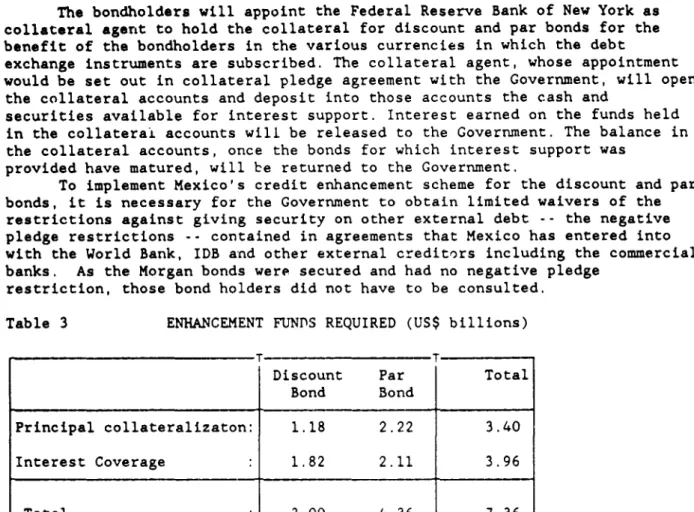
Table 3 ENHANCEMENT FUNDS REQUIRED (US$ billions)
T T
Discount Par Total
Bond Bond
Principal collateralizaton: 1.18 2.22 3.40
Interest Coverage 1.82 2.11 3.96
Total : 3.00 4.36 7.36
± 1
Note: Based on a 6 months based 30 year bond yield of 7.925%, or a cost of 9.7 cts per dollar, a debt base of $48.9 billion, and a mix of 46.7% Par Bond, 38.2% Discount Bond and 15.1% New Money plus other categories receiving no enhancement moneys. In particular debt held by Mexican banks is assumed not to receive any enhancement. Totals may not add up due to rounding errors.
According to the term sheet agreed upon July 23, 1989, a total of at least $7 billion is needed to secure the debt and debt service reduction
instruments subscribed by Me -ico's commercial creditors, and more if at the
mix chosen $7 billion is not enough for full collateralization of prirncipal and 18 months interest coverage. 49.8% of che debt not held by Mexican
agencies has been committed to the par bond, and 40.7% to the discount bond,
with the remati.dcr going towards the new money option and to other categories
rece'ving no enhancements. Placing Mexican creditors in the new money option for purposes of the calculations, results in a mix of 46.7% par bond, 38.2% discount bond and 15.1% new money. This mix would require $7.36 billion (Table 3), $0.36 billion more than has been committed sofar. The calculation is based on the long term bond yield at which the US Treasury has agreed to sell 30 year zero coupon debt instruments to the Mexican Government.
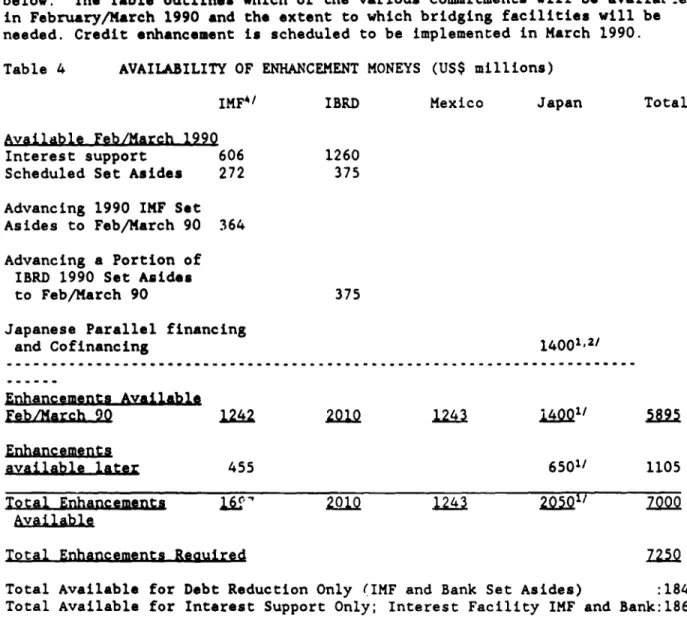
The commitments and timing of the various sources are shown in Table 4
below. The Table outlines which of the various commitments will be available
in February/March 1990 and the extent to which bridging facilities will be
needed. Credit enhancement is scheduled to be implemented in March 1990.
Table 4 AVAILABILITY OF ENHANCEMENT MONEYS (US$ millions)
IMF4/ IBRD Mexico Japan Total
Available Feb/March 1990
Interest support 606 1260
Scheduled Set Asides 272 375
Advancing 1990 IMF Set
Asides to Feb/March 90 364
Advancing a Portion of
IBRD 1990 Set Asides
to Feb/March 90 375
Japanese Parallel financing
and Cofinancing 14001,2/
Enhancements Available
Feb/March 20 122400124 L401/ 59
Enhancemen
available later 455 6501/ 1105
Total Enhancements IQ.' 2010 1243
2050Q
2 7000Available
Total Enhancements Recuired
z725
Total Available for Debt Reduction Only (IMF and Bank Set Asides) :1841
Total Available for Interest Support Only; Interest Facility IMF and Bank:1866
Notes:
1/ Japanese money includes cofinancing for $1.25 billion, whi-h is not
directly available for credit enhancement purposes, and a bridge loan of
US$150 million by Japanese counmercial banks.
2/ The dollar value of the IMF contributions has been calculated on the basis
of a SDR value of US$1.30.
For the World Bank's contribution, a total of US$750 million was set
aside from adjustment loans. The set asides could be used to provide principal
or interest collateral for the discount bonds issued by the Governnent. The
level for set asides amounts to 25% of all adjustment loans the Bank has made
or expects to make to Mexico in the three-year period FY89-91. The Bank's
contribution for interest coverage on discount and par bonds have been made
billion loan would be additional to the scheduled volume of lending. However,
US$310 million of the interest support loan will be funded from within the
scheduled lending volume for FY89-91.
IMF financial contributions to Mexico's debt reduction program have been
made under the SDR2.8 billion extended arrangement in the form of set asides
and through an augmentation of the arrangement in an amount equivalent to 40%
of quota. Set asides and interest support under the extended arrangement and
resources to be made available from the augmentation of the arrangement amount
to a total of SDR 1.3 billion, which at the exchange rate of the day W&3
roughly equivalent to US$1.7 billion.
To meet the enhancement requirements by February/March 1990, the Bank,
the Export-Import Bank of Japan 1// and the IMF have attempted to front load
their contributions to the extent possible. The table above shows the degree
to which front loading by each party was feasible. As the front loading
obtained provided only US$5.9 billion by the target date, available funds fell
short of the required US$7.25 billion. A group of commercial banks has
provided a bridge loan to provide US$1.1 billion towards filling the gap.
Furthermore, to cover the remaining US$360 million, an agreement has been
reached to provide only the discounted value of interest enhancement funds up
front, to be placed in safe securities in such a way that the full amount will
become available in line with growing interest payment obligations. This is
estimated to reduce up front requirements around US$250 million, leaving an
estimated shortfall of some $100 million. The Government will fund the
remaining shortfall from reserves.
111.5 Subscriotion by the Commercial Banks
This agreement, reached with the Bank Advisory Committee and supported
by management of the major banks involved, the official creditors, the US
Government and the Government of Japan, was in subsequent months presented to
all creditor banks. Although the agreement also included a small early
commitment fee expiring end of October, the majority of the commercial banks
only submitted their preference towards the end of the year. This was
partially due to the complexity of the deal, but partially also to lingering
uncertainty about tax and regulatory treatment of the conseuences of the
various options in the diffArent countries involved.
To become effective, banks holding at least 90% of the debt eligible for
the exchange had to sign up. In the event of a shortfall, this threshold could
be lowered to 80% if 50% of the creditor banks agreed to it. This arrangement
was designed to avoid a small minority of banks exercising an effective veto
right.
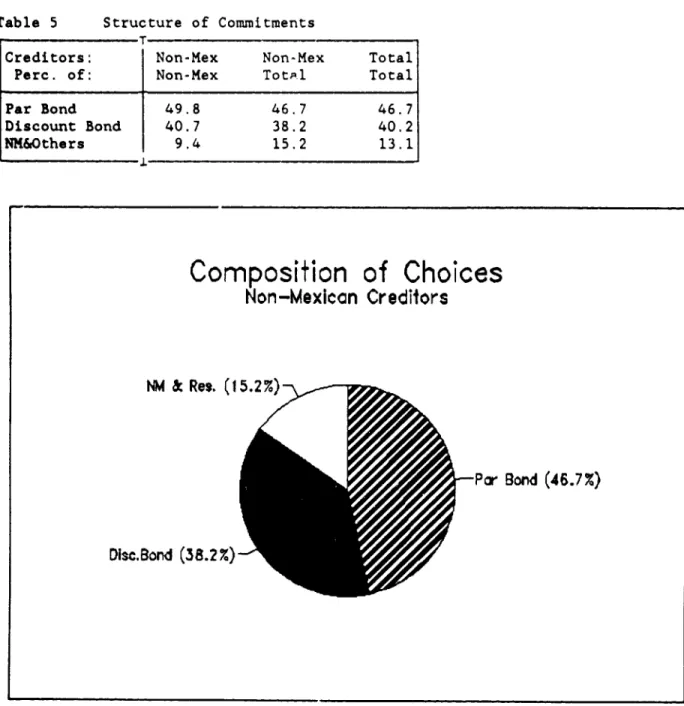
Table 5 and Figure 1 summarize the choices made (full detail is provided
in Annex III). As is clear from the Table and the diagrams, par or discount
bonds were the preferred options for most banks. Out of the non-Mexican
creditors, most opted for one of the debt reduction options, with only 9.4%
choosing new money.
Since 67% of the Mexican creditors chose new money, the overall new
money option choice was higher, at 13.1 percent. The remaining 33% of the
L'
EXIM Bank loans are for cofinancing and are not directly available forMexican creditors opted for the discount bond. Thus with all creditors
combined, the configuration of Fig. 1 comes out, with a total of $22.8 for par
bonds and $18.8 brought under the discount bond option ($1.0 of which was
brought in by Mexican creditors).
Table 5 Structure of Commitments
T
Creditors: Non-Mex Non-Mex Total
Perc. of: Non-Mex TotA.l Total
Par Bond 49.8 46.7 46.7 Discount Bond 40.7 38.2 40.2 NM&Others 9.4 15.2 13.1
Composition
of Choices
Non-Mexican
Creditors
NM
&Res. ( 15.2
%)
P ar Boind
(46.7X)
Disc.Bond (38.2%)Banks were explicitly denied the option to just hold on to their claims; in a process called "novation", all eligible debt was to be exchanged for one
of the new debt instruments created under the agreement. Mexico made it clear
it would not recognise any remaining old claims covered by the agreement after
York court (the venue where any legal proceedings would have to be settled),
although precedents involving Co3ta Rica did not really support such views.
The circumstances of that case (in particular the absence of any support by
the US in that case) were apparently sufficiently different tc warrant
optimism this time around.
Mexico's cxtensive support was reflected in the fact that Governments in
the major creditor countries publicly supported the approa:} early in the
process during a G-7 meeting in February 89. This extent of official support
very likely contributed to the virtual absence of any serious attempt to free
ride by simply holding on to existing claims. By the end of January, all banks
had made their preferences known, paving the way for the official signing of
the agreement on February 4, 1990 during a public ceremony in Mexico City.
IV EVALUATION OF THE AGREEMENT: DEBT RELIEF
This Section first assesses the amount of debt relief to which the July
23 agreement and the subsequent choices of the creditor banks have led to. One
can look at the amount of debt relief from two angles. First, is it enough
given the resources devoted to the package? In other words, have the
enhancement moneys been used efficiently? Efficiency of use can be assessed in
two different ways. In one approach, the operation is seen as a project on
which a rate of return can be calculated. This rate can then be compared with
the cost of financing of the enhancement funds. This Rate of Return approach
is pursued in this Section. An alternative approach links the amount of debt
relief obtainable to the amount of enhancement moneys available. This approach
comes down to asking whether, in the end, the enhancement moneys accrued to
the creditors or to Mexico. The answer to this question ,equires an assessment
of likely market valuation before and after the deal, and with and without
enhancement moneys. This approach is pursued in Section V.
The second angle from which to assess the extent the amount of debt
relief is not from the point of view of use of enhancement moneys, but from
Mexico's point of view. Is it enough to allow efficient growth to take place
without the fiscal and balance of payment problems that have stymied the
process of growth over the past six to seven years? This question is taken up
in Section VI.
IV.l How much Debt Relief?
Table 6 below summarizes the elemenc of debt relief embedded in each of
the three options the commercial banks can choose between. In addition, the
Table evaluates the impact of the actaal subscription, a blend of 46.7% par
bonds (IR), 38.2% discourt bonds (PR), and 15.1% new money and others (NM).
Discount bonds chosen by Mexican banks included in "others" (NM), i.e. they
Table 6: DEBT RELIEF IMPLIED BY THE THREE OPTIONS
Percentage Debt Relief:
Without Recauture With Recapture
New Money 0 0
Interest reauction 28 26
Principal reduction 35 33
46,7% IR/38.2% PR/15.1% NM 26 25
Note: Debt relief is defined as the reduction in the discounted value of debt
service as a percentage of the face value of the outstanding debt. Debt
relief granted by Mexican creditor banks is not counted in this Table.
Of course, new money implies no debt relief. The principal reduction
option involves 35% debt relief, since the mark-up of 13/16 of one percentage
point on top of LIBOR will not be changed under this scenario. Evaluated at
current interest rate projections, the low interest rate option implies 28%
debt relief. I/ This results in a debt relief percentage for the mix chosen
of 26.4 percent of the face value of US$48.9 billion, or $12.9 billion.
Furthermore, the debt and debt service relief options quialify for the
recapture clause. The value of these provisions depends both on expected
future oil prices and on the variability of these prices. Thus any evaluation
needs explicitly to incorporate the impact of uncertainty on the expected cost
of this clause; evaluating the impact of the recapture clause on debt service
obligations at some point in the future based on estimated oil prices is not
e