A Small Continuous Time
Macro-Econometric Model of
the Czech Republic
Emil Stavrev
Transition Economics Series
A Small Continuous
Time
Macro-Econometric Model of
the Czech Republic
Emil Stavrev
July 2000
Transition Economics Series
Institut für Höhere Studien (IHS), Wien
Institute for Advanced Studies, Vienna
Contact: Emil Stavrev Czech National Bank Economic Modelling Division Na Prikope 28
115 03 Prague 1, Czech Republic email: [email protected]
Founded in 1963 by two prominent Austrians living in exile – the sociologist Paul F. Lazarsfeld and the economist Oskar Morgenstern – with the financial support from the Ford Foundation, the Austrian Federal Ministry of Education and the City of Vienna, the Institute for Advanced Studies (IHS) is the first institution for postgraduate education and research in economics and the social sciences in Austria. The Transition Economics Series presents research done at the Department of Transition Economics and aims to share “work in progress” in a timely way before formal publication. As usual, authors bear full responsibility for the content of their contributions.
Das Institut für Höhere Studien (IHS) wurde im Jahr 1963 von zwei prominenten Exilösterreichern – dem Soziologen Paul F. Lazarsfeld und dem Ökonomen Oskar Morgenstern – mit Hilfe der Ford-Stiftung, des Österreichischen Bundesministeriums für Unterricht und der Stadt Wien gegründet und ist somit die erste nachuniversitäre Lehr- und Forschungsstätte für die Sozial- und Wirtschafts-wissenschaften in Österreich. Die Reihe Transformationsökonomie bietet Einblick in die Forschungsarbeit der Abteilung für Transformationsökonomie und verfolgt das Ziel, abteilungsinterne Diskussionsbeiträge einer breiteren fachinternen Öffentlichkeit zugänglich zu machen. Die inhaltliche Verantwortung für die veröffentlichten Beiträge liegt bei den Autoren und Autorinnen.
illustrate how the model can be used to determine the nominal equilibrium exchange rate of the Czech koruna in a macro-economic framework. The paper also investigates the effectiveness of monetary and fiscal policies in the presence of a fixed exchange rate regime and massive capital inflows. The search for an equilibrium point is outlined and stability and sensitivity analyses are provided, along with in-sample static and dynamic predictions with the approximate discrete analogue.
Keywords
Macro-econometric model, nominal equilibrium exchange rate, effectiveness of monetary and fiscal policies
JEL Classifications
C51, C52, C53, E17, E50Comments
This research was undertaken with support from the European Union’s Phare ACE Programme 1996. I would like to thank Prof. S. Reynolds, Assistant Prof. E. Koèenda, Prof. R. Filer, Prof. J. Kmenta, Prof. A. Wörgötter, and my colleagues at the Centre for Economic Research and Graduate Education, and the Institute for Advanced Studies in Vienna for many helpful comments. All errors, however, are mine.
1. Introduction
1
2. Theoretical Framework
2
2.1. Qualitative Analysis of the Model ... 3
2.1.1. Search for an Equilibrium Point ... 3
2.1.2. Stability of the Model ... 4
2.1.3. Sensitivity of the Model ... 5
3. Specification of the Model
5
4. Econometric Results
11
4.1. Estimated Parameters ... 144.2. Stability and Sensitivity ... 16
4.3. Results for the In-Sample Predictions... 17
4.4. Calculation of the Equilibrium Nominal Exchange Rate ... 20
4.5. Effectiveness of Monetary and Fiscal Policies ... 21
4.5.1. Scenario 1 ... 21
4.5.2. Scenario 2 ... 22
5. Conclusions
24
References
25
Appendix 1. Derivation of the Approximate Discrete Analogue 27
Appendix 2. Search for an Equilibrium Point and Linearization
Around It
31
1. Introduction
Over the past seven years the Czech Republic has undergone significant reforms in its transition toward a market economy. At the beginning of these market reforms, the Czech Republic introduced a fixed exchange rate regime which helped to stabilize the macro-economic situation in the Czech Republic. At the beginning of the transformation the country experienced a relatively high decline in real GDP (14.2% for 1991 and 6.4% for 1992) which was halted in 1993. However, the economy recovered in 1994 when growth was 2.6%. Economic growth reached 5.5% in 1995, which was the maximum growth rate for the past seven years. In 1996 and 1997 the growth rates were 4.1% and 1.7% respectively (see Nachtigal [1997] and Hajek et al. [1997a and 1997b]). Following a major price deregulation in 1991, the average yearly inflation rate reached 56.6% in 1991 and then fell to 11.1% in the following year. The main reason for the jump in the inflation rate to 20.8% in 1993 was the introduction of a VAT and a second big deregulation of prices at the beginning of the year. In the following years the average inflation rate was below 10%.
The fact that the Czech Republic’s economy recovered relatively quickly and the inflation rate dropped to below two digits in a three-year period helped to attract foreign investment, which totaled around 8.4 billion USD at the end of 1998. Since 1994 the country has registered a current account deficit, which gradually increased from 3% in 1994 to 7.6% for 1996 and to 8.7% for the first quarter of 1997, although it subsequently fell during the last three quarters of 1997 to 6.1% at the end of the year and is expected to reach 1.4% for 1998. The huge capital inflows and the current account deficit have caused problems for policy-makers. In the presence of a fixed exchange rate regime, capital inflows had an inflationary impact and the increasing current account deficit has caused devaluationary expectations for the Czech currency.
Even though the country is in transition and has a short time series, it is interesting to look at the relationship among different macro-economic variables on one hand and the possibility of influencing their evolution over time by policy-makers. To date few macro-econometric models for the Czech Republic have been published; J. L. Brillet and K. Šmidková (1997) presented a medium-sized macro model of the Czech Republic aimed at capturing the specific characteristics of a transition economy. The macroeconomic impact of the transition process and the effect of external factors on macro-economic variables are investigated in Šujan and Šujanová, (1995). A Bayesian approach and the application of a Kalman filter in the estimation of a macro-econometric model of the Czech Republic are developed in Vašièek (1997).
The aim of this work is to estimate a relatively small continuous time macro-econometric model, which can later be used for the following purposes. Firstly, to determine the impact of the policy parameters on the nominal equilibrium exchange rate of the Czech koruna in the context of a macro-dynamic framework. Secondly, to predict the values of the nominal
exchange rate. Thirdly, to investigate the effectiveness of monetary and fiscal policies as applied to the Czech Republic.1
We use continuous time models because they have several attractive properties. These types of models are small and thus easy to manipulate analytically, which represent advantages over the large macro-econometric models where the properties of the model are investigated using numerical simulations. A continuous time model may also allow a more satisfactory treatment of distributed lag processes. An additional advantage is that these models allow for a better treatment of mixed flow-stock variables usually present in macro-econometric models. They take into account the fact that a flow variable is not measured instantaneously and that what one observes is in fact its integral over a certain period. Lastly, these models in principle ought to have an equilibrium, but it is important to note that this does not mean that the model is in this kind of equilibrium or that the equilibrium is necessarily stable. Therefore, the model can be solved for the actual paths, which may or may not be the equilibrium path.2 This property seems especially attractive in modeling the economies of countries in transition.
The rest of the paper is organized as follows. In Section 2 we present the theoretical framework used to construct the model. In Section 3 the specification of the different equations of the model is given. Section 4 presents econometric results and analysis stability and sensitivity of the model. In this section we suggest a way to calculate the nominal equilibrium exchange rate and investigate the effectiveness of monetary and fiscal policies. Section 5 concludes.
2. Theoretical Framework
The theoretical base used in this work follows the principles explained in several works written by Gandolfo, Bergstrom and Wymer.3 In general the process of adjustment to excess demand can be formulated mathematically as:
Dy(t) = f (x(t) - u(t)), (1)
1 It should be mentioned that the purposes for which the model can be used are not by any means restricted to the
ones described above. After incorporating interest rates into the model it will be possible to use it to predict inflation. Hence, it can become a very useful tool for the purposes of inflation targeting, a policy adopted by the CNB at the beginning of 1998.
In its present version the model is constructed under the assumption of a fixed exchange rate regime. It is possible, however, provided that longer time series are available, to change the model in such a way so as to account for the change in the exchange rate regime in mid-1997. We believe that even in this version the model is useful for performing simulations which can be of interest not only for the Czech Republic, but also for other countries (Estonia, for example) which have fixed exchange rate regimes.
2
For the construction and estimation of a continuous time disequilibrium model of the UK financial market see Wymer (1973).
3
where D denotes the differential operator d/dt and f is a sign-preserving function, satisfying the conditions f (0) = 0 and f ’
(0) > 0. One obtains a partial adjustment equation in the strict sense when x(t) =
y t
$
( )
and u(t) = y(t). If x(t) and u(t) are functions of other variables, then variable y(t) adjusts in relation to the difference between the desired and actual values of these variables.Further, equation (1) will be linearised around the sample mean or the equilibrium point to obtain:
Dlny(t) = α(lnx(t) - lnu(t)). (2)
On the basis of the above formulations, the model can be written as a first order differential system in the normal form as follows:
DlnX(t) = F[lnX(t),Z(t),θ] + ε(t), (3)
where X(t) is a vector of endogenous variables, Z(t) a vector of exogenous variables, θ a vector of parameters, F a vector of linear or non-linear differentiable functions, and ε(t) a vector of disturbances with classic properties. The vector of parameters θ consists of the speed of adjustment parameters −α, constants or propensities −γ, elasticities −β and policy parameters − δ. For simplicity, later in this section ε(t) is omitted. The disturbances will be dealt with again in Section 4.
2.1. Qualitative Analysis of the Model
We perform a qualitative analysis of the model using methods from mathematical economics. In order to investigate the general properties of the model we: 1) search for an equilibrium point; 2) examine its stability; and 3) perform analysis of sensitivity.
2.1.1. Search for an Equilibrium Point
In order to find an equilibrium point, the method of undetermined coefficients will be applied. Exogenous variables are assumed to grow at a constant proportional rate,
Zi(t) = Z *
i e λ i t
,for all i, (4)
where Z*i are the initial levels of the exogenous variables and λi the growth rates.
The equilibrium solution is given as a particular solution of the system (3) in the following form:
Xi(t) = Xi *
where the values of Xi* and ρi must be determined. The equilibrium point levels Xi* depend on the initial levels of the exogenous variables, the growth rates and the parameters of the model. The growth rates of the equilibrium paths of the endogenous variables, ρi,, depend on the exogenous growth rates and the sub-vector of parameter vector θ. Parameter vector θ includes elasticities and the propensity to consume, but not the speed of adjustment parameters. Formally, if θ = {α,β}, where α is a sub-vector of adjustment parameters and β is a sub-vector of propensities and elasticities, then it follows that
ρ = φ1(λ,β) (6)
X* = φ2(Z*,λ,θ). (7)
We provide a detailed description of the method along with the solutions for the equilibrium point in Appendix 2.
2.1.2. Stability of the Model
We will deal with the local stability of the system (3) in this section. In order to ascertain whether the system (3) is locally stable or not, we linearise it around the equilibrium point, using Taylor series expansion and neglecting all higher order terms. The original system (3) explicitly contains functions of time and, thus, it is not an autonomous system. In this case one must define the conditions under which one may neglect the higher order terms in the Taylor series expansion. Let us consider the following system:
Dx(t) = Ax(t) + f(x,t) (8)
The null solution x(t) = 0 of the system (8), where A is a matrix of constants, is asymptotically stable if ||f(x,t)||/||x|| tends to zero uniformly in t as ||x|| tends to zero and A has characteristic roots with negative real parts. If the above condition is satisfied then the system below is called a uniformly good approximation of the original system (3):
Dx(t) = Ax(t) (8’)
The system (8’) will be asymptotically stable if, and only if, all characteristic roots of the matrix A have negative real parts.
One important feature of continuous time models is that for most of them the original system is autonomous (time is not explicitly present in them), which means that after linearization around the equilibrium point, one obtains a system that is a uniformly good approximation of the original system. It is an important characteristic because the question of uniform convergence then does not arise, and in order to investigate the stability of the model it suffices to focus on the linearised system or precisely on the characteristic roots of the
matrix A. The original system is locally stable if all the characteristic roots of the matrix A have negative real parts. The stability analysis for the estimated model is given in Section 4 below.
2.1.3. Sensitivity of the Model
In the sensitivity analysis, we compute the partial derivatives of the characteristic roots with respect to the parameters. This analysis is particularly useful for examining dynamic behavior and the policy implications of the model. This allows us to evaluate the effect of a change in any one of the parameters in the model, and especially policy parameters on the dynamic properties of the system, without having to use numerical simulations. The characteristic roots of matrix A are functions of its elements and these elements are functions of the parameters of the model. Hence, one can examine the effects of changes in the parameters of the estimated model on the characteristic roots by computing the partial derivatives of the eigenvalues with respect to the parameters. The above definition of sensitivity analysis is developed in Wymer (1976) and Bergstrom (1990). The results of the sensitivity analysis for the estimated model are presented in Section 4 below.
3. Specification of the Model
The model is an interdependent system of stochastic differential equations specified according to the theoretical base discussed in Section 2. To simplify, the disturbance terms are omitted. The symbol (^) refers to the partial equilibrium level, or the desired value of the variable, (e) to its expectation, and ln to the natural logarithm. All parameters are assumed to be positive unless otherwise specified.
Consumption function DlnC = α1ln
$
C
C
+ α2 m2 (9) where$
C
= γ1 Y where γ1 is marginal propensity to consume (9.1)C − real consumption (both private and government) m2 − proportional rate of change of money supply (M2) Y − real gross domestic product
In equation (9) real aggregate consumption4, C, adjusts to its desired level,
C
$
, which is given as the marginal propensity to consume applied to real domestic income.5 The second term in this equation must capture the impact of the monetary variables, proxied by m2, on consumption. The above specification is similar to the one specified in Hendry and Ungern-Sternberg (1981) and differs from the consumption functions discussed in Whiteley (1994) by not including inflation as a proxy for the inflation loss on liquid assets. The idea is that nominal money balances play a buffer role in the private sector asset portfolio, allowing unexpected variations in income and expenditure.Imports DlnIm = α3 ln
$
Im
Im
+ α4 ln$
V
V
(10) whereI
m
$
= γ2P
P
f
β1 (DK)β2 Cβ3 Eβ4 (10.1)$
V
= γ4Y e, (10.2) Im − real importsV − stock of inventories in real terms
DK − change of fixed capital stock in real terms E − real exports
P − domestic price level (CPI) Pf − foreign price level
Real imports defined in equation (10) are determined by two terms. First, they adjust to their desired value
Im
$
, which is a function of terms of trade, investment, consumption, and exports all in real terms. This specification connects demand for imports to total sales and takes into account the fact that some imported goods are included in exports. Second,
4
Precisely speaking, in equation (2.9) and in the following equations we define the rate of change in the left hand side variables as opposed to their real levels, but after the integration of the system (2.9) − (2.20) we will obtain the levels of the variables.
5 Because C is total consumption, private plus public, we may use the net of depreciation GDP instead of the net
imports are connected to the change in inventories. If inventories are less than their desired level, imports will increase. Hence, inventories are supposed to play a buffer role between supply and demand in the goods market.
Exports DlnE = α5 ln
$
E
E
(11) where$
E
= γ β λ 3P 5e 1 t − (11.1) t − timeEquation (11) defines the demand for real exports of goods and services. Their partial equilibrium level depends on the price level and a trend term, which accounts for the change in foreign demand for exports and foreign price level. The parameter λ1 can be considered a weighted sum of the growth rates of real income and price level in the rest of the world.6 This specification has some advantages over the usual export demand specification where terms of trade and foreign income explicitly determine the desired level of exports (for example, a variation in the exchange rate is allowed by changing the parameter γ3).
Expected output DlnY e = ξ ln
Y
Y
e
(12) Y e − expected outputEquation (12) defines expected output. Expected output evolves according to an adaptive expectation mechanism and has two functions in the model. In addition to determining real output, it connects real output to the rest of the model by the presence of the second term in equation (13) below.
6 For the estimation we use the price level in the rest of the world, which is constructed as a weighted average of US
and German price levels as follows: Pf = 0 .35*eDM$* Pus + 0.65*PGer where eDM$ is the exchange rate of the US dollar with respect to German mark. Thus, the price index for rest of the world is expressed in German marks. We obtain income for the rest of the world in the same way.
Instead of the traditional specification of the export function we use the one above because we believe that in a period of changing structure of exports and fighting for market shares in western countries the impact of the real exchange rate on exporters will not be a major factor in their exports. The specification used here is thought to better capture the process of conquering new markets, which may contradict exchange rate developments.
Output7 DlnY = α6 ln
Y
Y
e
+ α7 ln$
V
V
(13) where$
V
= γ4Y e. (13.1)Real output is defined in equation (13). It adjusts to its desired level, which in this case is represented by expected income and depends on the difference between the desired level of inventories and their actual level. It is assumed that producers have a desired ratio of inventories to expected output − γ4. Hence, they will increase output and imports when the desired inventories are bigger than the actual inventories.
Fixed capital formation
Dk = α8{
DK
K
$
- k} + α9 m2 (14) whereDK
$
= γ5Y e (14.1)Equation (14) defines the development of the fixed capital stock. The proportional change of capital stock k adjusts to its desired level
k
$
=DK
K
$
. The desired investment,DK
$
, is a function of expected income. As in the consumption function, the speed of the adjustment of k to its desired level is assumed to be an increasing function of m2. The idea is to use the percentage change in M2 as a proxy for the credit conditions in the economy. It may seem more appropriate to use the interest rate in the above equation and incorporate it into the whole model, but we have decided not to include the interest rate for several reasons. First, due to the process of transition and the lack of a developed banking system, the interest rates in the Czech Republic were not set according to the market until the beginning of 1994.
7
Instead of equation (12) for expected output and equation (13) for output it is possible to construct the model using an equation for output of the following type:
D Y
C
DK
E
Y
C
DK
E
V
Y Y V Vln
=
α
ln
γ
(
+
+
)
+
α
ln
γ
(
+
+
)
(13V)where the sum of C + DK + E equals total sales for consumption, capital formation and exports. We used the specification in the paper in order to evaluate the impact of expectations in the economy.
Second, it seems plausible to assume that, for countries in transition, the interest rate may not be the main factor affecting the investment decisions of the economic agents during the first stage of the transformation.
Domestic price level
DlnP = α10 ln
$
P
P
+ α11 lnM
M
d2
2
(15) where$
P
= γ6Pfβ6 W Pr β7 (15.1)M2d = (PY)βmd − money demand (15.2)
M2 − nominal stock of money supply
Pr − productivity
W − nominal wage
Domestic price level is defined in equation (15). In the first term domestic price level adjusts according to the difference between the desired and actual price level. The desired price level is assumed to depend on both domestic and foreign factors. The domestic cost factors are represented by the level of the nominal wage rate W and of productivity, which is exogenously given. The foreign factor is represented by the foreign price level. The second term represents the monetary factor in determining domestic price level. The fact that money supply is not included in the partial equilibrium level of P is in accordance with the monetarist approach and simply shows that the adjustment of the price level is not constant.
Wages DlnW = α12 ln
$
W
W
(16) where$
W
= γ7 Pβ8 eλ2 t (16.1)The nominal wage rate, equation (16), adjusts to a partial equilibrium level
W
$
, which depends on the domestic price level and institutional factors (trade unions, etc.). Thus, it is assumed that the target nominal wage exceeds the level determined only by the domestic price level. The institutional factors are captured by the trend term in the formula for the desired nominal wage.Influence of the Balance of Payments on Money Supply
Dm2 = α13 (
m
$
2 - m2) (17) where$
m
2 = δ1 ln E γ8Im - δ2 DlnP
P
f
, δ1 < = > 0, (17.1) Equation (17) is a policy function and describes the monetary authorities’ adjustment of the percentage change of nominal money stock to its target valuem
$
2. The first and the last terms capture the balance of payments effects. The parameter γ7can be interpreted as the ratio of exports to imports which the monetary authorities aim at in order to attain the desired structure of the balance of payments. The second term in this equation represents the anti-inflationary target of the monetary policy, which in this case focuses on relative price stability. The δ coefficients represent the different weights given to the different targets. Coefficient δ2 must be positive, while δ1 may be either positive or negative.Capital Stock DlnK = k (18) Money Supply DlnM2 = m2 (19) Inventories DV = Y + Im - E - C - DK (20)
The last three equations in the model are definitions. Equations (18) and (19) help us to express the model as a system of 12 first order differential equations. Equation (20) defines the change in the real inventories as a residual term.
In the model there are twelve equations and twelve endogenous variables. The only exogenous variables in the model are time − t, productivity8− Pr and foreign price level − Pf.
4. Econometric Results
For estimation purposes the approximate discrete analogue is used (for the complete derivation see Gandolfo, G. [1971]). After the linearization of the system (3), one obtains a system of the following type:
Dx(t) = Ax(t) + Bz(t) + ε(t) (21)
We integrate the system (21) over the interval (t - δ, t) using the following approximations:
1
0δ
δ
δDx t
(
−
s ds
)
≈
x
t∫
∆
,x t
(
δ
s ds
)
x
t δ−
≈
∫
Γ
0 , (22) where ∆ ≡ 1 δ (1 - L) and Γ ≡ 12 (1 + L), L is the lag operator, and δ is the length of the
observation interval. If one further assumes the length of the observation interval equal to the basic time unit then δ = 1. Using formulas (22) the system (21) can be written in the following form:
∆xt = AΓ xt + BΓzt + υt , (23)
where υt is a vector of disturbances that depends on ε and on errors of approximation. The new disturbances will be serially uncorrelated only if there are no mixed stock-flow variables. If the opposite is true, the system (21) must be integrated twice, once to obtain measurable variables and once to obtain the approximate discrete analogue. After the second integration one obtains ∆xt 0 = AΓ xt 0 + BΓzt 0 + ηt (24) 88
In order to endogenise productivity the following equation is estimated:
Dln Pr . ln W (DK) Pr ( . ) . . ( . ) ( . ) = 1 02 0 2 0 43 0 08 0 02 0 06 (16.V)
The idea is that the desired level of productivity depends on the nominal wage rate W and investment. Predictions of the model consisting of equations (9) − (20) plus equation (16.V) were not satisfactory and we did not include equation (16.V) in the final version. One possible reason for the less satisfactory results is that the use of aggregate data makes it difficult to distinguish between newly established and old capital, which may lead to underestimating the effect of investment on productivity.
Measurable variables are denoted by superscript (0). Let x0(t) be a flow variable. The integral
x t
ox t
s ds
( )
=
1
∫
(
−
)
0δ
δ
δ (25)is measurable and an observation of this integral over the interval (τδ - δ, τδ) is denoted by xt0. In fact, this is what one observes in reality for a flow variable. If xt0 is a stock variable, then the integral (25) is not observable. We evaluate it using the trapezoidal rule. In this case the observation of the integral of a stock variable is approximately given by
xt 0
= Γxt (26)
where Γ is defined above. Let x1(t) denote the instantaneous change of a stock variable and x1(t) = D x(t). We obtain a measurable value for this type of variable from the point observation on the stock variable x(t). After integrating x1(t), we have
x1t0 = ∆xt (27)
where ∆ is defined above and x1t0 is the observation on x1(t).
We transformed the system of differential equations (21) into a system of difference equations by integrating it twice. The process of integration leads to the introduction of autocorrelation. It is possible, however, to derive an approximation of the process of formation of disturbances ηt that is independent of the parameters of the model. This approximation is given by9
ηt≈ (1 + 0.268L)ωt (28)
where ωt is a serially uncorrelated random disturbance. Since the moving average process in (28) is independent of the parameters of the model, we may use the inverse of this process to obtain a model with serially uncorrelated disturbances. Hence, we obtain the following for the uncorrelated disturbances
ωt≈ (1 + 0.268L)-1ηt (29)
Next we expand the term in brackets in (29) in Taylor series to obtain the formulas below, which are used to transform the original variables.
xt * = xt 0 - 0.268x0t-1 + 0.072x 0 t-2 - 0.019x 0 t-3 (30) 9
zt * = zt 0 - 0.268z0t-1 + 0.072z 0 t-2 - 0.019z 0 t-3
where xt0 is a vector of observed endogenous variables and zt0 is a vector of observed exogenous variables. It is obvious from the second equation of (30) that if the vector of exogenous variables contains a constant term, it must be multiplied by 0.785 (which is exactly the sum of the coefficients of the zt0 variables).
Applying the above procedure to the model (23) gives us the final version of the approximate discrete analogue xt * - x*t-1 = A 1 2 ( xt * + x*t-1) + B 1 2( zt * + z*t-1) + ωt. (31)
For estimation purposes the following form will be used
(I - A1 2) xt * = (I + A1 2)x * t-1 + B 1 2 ( zt * + z*t-1) + ωt. (32)
Now disturbances ωt are assumed to be uncorrelated.
In order to estimate the system (9) − (20), we first linearised equations (14) and (20) around the sample mean. The linearization and derivation of the approximate discrete analogue are described in Appendix 1.
The system described in Section 3 contains 34 parameters to be estimated. The ideal method to estimate this system would be the full-information maximum likelihood (FIML) method. However, the short data sample (28 quarterly observations for the period from the first quarter 1991 to the fourth quarter of 1997) prevents us from using this or other simultaneous techniques (for example, three stage least squares) to estimate the specified model. We decided to use the two stage least squares method (2SLS) because it handles the case of nonlinearity in both variables and coefficients and, unlike OLS, it also provides consistent estimates if endogenous variables are present in the right hand side of the equations (see Fair [1984]). The relevant instruments for the estimation are as follows. First, we used all predetermined variables in the model as instruments for each structural equation and second, we used all exogenous variables included in the model as instruments. Concerning the functional form of the instruments we followed the rule that the functional form of the instrument was the same as the functional form of the variable for which this instrument was used. The 2SLS technique, although consistent, is generally not asymptotically efficient because it does not take into account the correlation of the structural disturbances across equations. We are aware of the fact that the ratio of the estimated coefficient to its estimated standard error does not have a t distribution. However, we use the t distribution as a tolerable approximation of the true distribution on the basis of the available
Monte Carlo experiments, which suggest that the distortion is usually reasonably small (see Kmenta [1986], Green [1997]).
4.1. Estimated Parameters
We present the estimated equations below. Standard errors are given in brackets. In the interest of simplicity the error terms are omitted.
DlnC = 1 39 0 17 . ( . )ln
0 72
0 022.
( . )Y
C
+ 2 200 94 . ( . )m2 (9’) DlnIm = 187 0 078 . ( . )ln1 35
0 087 1 26 0 41 0 76 0 17 0 55 0 043 0 0.
Im
( . ) . . . . ( . ) ( . ) ( .116 ) ( .12 )P
P
fDK
C
E
− +1 07 0 28 . ( . )ln 0 95 0 12 . ( . )Y V e (10’) DlnE = 1 3 0 254 . ( . )ln187 61
64 15 0 35 0 042 0 0 0155.
( . ) . . ( .12 ) ( . )P
e
E
t −
(11’) DlnY = 1 96 0 265 . ( . )ln Y Y e + 0 21 0 132 . ( . ) ln 0 95 0 12 . ( . )Y V e (13’) Dk = 1 49 0 186 . ( . ) 0 264 0 051 . ( . ) Y K k e − + 0 2430 099 . ( . )m2 (14’) DlnP = 0143 0 072 . ( . ) ln 0 63 0 77 1 0 175 0 361) . Pr ( . ) . ( . P W P f + 0168 0 082 . ( . ) ln M PY 2 1 ( ) (15’) DlnW = 1 06 0 249 . ( . )ln 5663 25 603 82 0 209 0 039 0 179 0 0048 . ( . ) . . ( . ) ( . ) P e W t (16’)Dm2 = 1 374 0 229. ( . ) {0 068( .0 079. )ln
E
0 47
0 413.
Im
( . )
- 0 79 0 992. ( . )DlnP
P
f
- m2}, (17’)The speed of adjustment parameters α may be divided into two groups. The first group consists of all α parameters without α2, α4, α7, α9 and α11, and expresses the speed of
adjustment of the corresponding variables to their desired or partial equilibrium levels. The second group includes parameters α2, α4, α7, α9 and α11 , which relate the rate of growth of
one particular variable to another variable (as is the case with consumption and capital formation) or to the discrepancy between the other variable and its desired or partial equilibrium level (as in the domestic price level equation or the imports equation). Of all the adjustment parameters, only α7, the speed of the adjustment of real output to the desired
level of inventories, is insignificant. The mean time lag, with the exception of the domestic price level, is around one quarter. The domestic price level has the lowest speed of adjustment to its desired level, which is around two years. This result for the speed of adjustment of the price sector is likely due to the fact that the Czech Republic started its transformation to market economy with a relatively high share of controlled prices, which later were gradually deregulated. At the end of 1997 the share of controlled prices in the CPI was 21% (see CNB Annual Report 1997). The effect of the rate of change in money supply on consumption is captured by α2 , which is equal to 2.2. A comparison of this estimate with
the estimates for Sweden at 1.5 (see Sjöö, B., [1993]) and Italy at 0.12 (see Gandolfo, G. [1990]) shows that money supply has a bigger impact on consumption in the Czech Republic than in other two countries. One explanation for this may be the process of voucher privatisation in the country, which was completed in 1993 and provided people with relatively liquid assets, part of which were consumed.
The estimated propensity to consume, γ1, which is 0.72, is higher than the estimates of other
macro models of the Czech economy. The estimated value of the short run marginal propensity to consume is 0.61 in Brillet and Šmidková (1997) and 0.57 in Havlièek (1996). One possible explanation for the higher estimate in this model is that we consider total consumption, including private and government consumption.
The elasticity of imports with respect to total real consumption, β3, is significant and equals
0.76. The elasticity of imports with respect to investment, β2, is significant and equals 0.41.
The elasticity of imports with respect to exports, β4, is insignificant. The elasticity of exports
with respect to the price level, β5, is lower than one and significant. The elasticities
connected with Marshal-Lerner conditions β1 and β5 are both significant and their sum is
greater than one (β1 + β5.= 1.61). This means that a depreciation in the Czech currency
should improve the trade balance deficit. The model’s prediction for the Czech current account deficit for 1997 only differs by 3% from the one announced by the Czech Statistical Office.
With regard to the price-wage sector, both elasticities β7 and β8 are insignificant at the 5%
level. The effect of prices on the wage rate β8 is significant at the 10% level. Which means
we were not able to fully capture the interaction between the price level and the wage rate.
4.2. Stability and Sensitivity
We investigate the local stability of the model, given the estimated parameters, using the linear approximation of the model around the equilibrium point. The estimated characteristic roots of the linearized model together with their asymptotic standard errors are presented in Table 1 below.
Table 1: Characteristic Roots of the Model
No.: Root Asymptotic Standard Error Damping Period (Quarters)
1 -2.81 0.29 0.36 2 -0.98 0.34 1.02 3 -1.01 0.22 0.99 4 -0.86 1.09*i 0.15 0.23 1.16 5 -0.86 -1.09*i 0.15 0.23 1.16 6 -0.21 0.12 5 7 0.014 0.015 8 -1.82 0.25 0.56 9 -1.65 0.18 0.61 10 -1.44 0.19 0.69 11 -1.08 0.25 0.93
All but one of the estimated characteristic roots of the continuous time model have negative real parts. The positive eigenvalue is insignificant and smallest in absolute value compared to the other characteristic roots, which allows us to use the model for practical purposes even though from a theoretical point of view the equilibrium path of the continuous model is not stable.
By sensitivity analysis, we mean the analysis of the effect of changes in the parameters on the characteristic roots of the model. The full size of the sensitivity matrix has a dimension of 33x11. We obtain the size of this matrix by multiplying the number of the estimated parameters (i.e. 33) by the number of the characteristic roots (i.e. 11). Table 2 below shows the partial derivatives of the characteristic roots with respect to the “policy parameters” (the parameters entering equation (17)) and some relatively large partial derivatives, since this implies that the particular parameter crucially effects the stability of the model.
Table 2: Sensitivity Analysis with Respect to Selected Parameters No.: Root ∂µ/∂α12 ∂µ/∂δ1 ∂µ/∂δ3 ∂µ/∂α1 ∂µ/∂α2 ∂µ/∂β2 1 -2.81 -0.34 -1.8 -0.0096 -0.22 -1.1 -.72 2 -0.98 0.00016 0.00001 0.00032 0 0.001 0.0027 3 -1.01 -0.028 0.017 -0.046 0.00013 -0.00027 -0.0011 4 -0.86 1.09*i -0.3 0.13*i -0.98 1.8*i -0.0068 -0.026*i -0.19 0.011*i -0.12 0.58*i 0.77 1.2*i 5 -0.86 -1.09*i -0.3 -0.13*i -0.98 -1.8*i -0.0068 0.026*i -0.19 -0.011*i -0.12 -0.58*i 0.77 -1.2*i 6 -0.21 0.041 -0.016 0.064 -0.0022 -0.026 0.077 7 0.014 -0.015 -0.056 -0.014 0 -0.16 -0.31 8 -1.82 -0.067 -0.18 0.021 0.11 -0.44 -.61 9 -1.65 0.00022 0.00041 0 0.00013 -0.004 0.0047 10 -1.44 -0.009 0.00004 -0.0018 -0.51 0.39 1.1 11 -1.08 -0.00017 0 -0.00029 0 0.00011 0.00013
Increasing the policy parameters (α12 , δ1, δ3) has a generally stabilising effect on the system.
It should be mentioned that, in terms of the magnitude of the derivatives, parameter δ1 plays
the most important role as it captures the effect of the ratio of exports to imports. This once again underlines the crucial role played by the current account deficit for a small open economy like the Czech Republic. The effect of an increase in δ3 (the weight put on inflation
by the CNB) is generally stabilizing, but of a lesser magnitude. One should also note that the speed of adjustment coefficient α12 has a slightly destabilizing effect on roots two and nine,
but for small changes in this coefficient these roots do not change their sign.
In the last three columns of Table 2, the derivatives of three other parameters are given, which are large in absolute value. These are the speed of adjustment of the consumption function (α1 ), the speed of adjustment of imports (α3 ) and the elasticity of imports with
respect to consumption (β2 ). The elasticity of imports with respect to consumption has the
biggest destabilizing effect within the whole sensitivity analysis. This may mean that a considerable part of Czech imports are consumption goods, which have a negative impact of the current account deficit. An increase in the speed of adjustment of the consumption function has a modest destabilizing effect on the system through its effect on roots three, eight and nine.
4.3. Results for the In-Sample Predictions
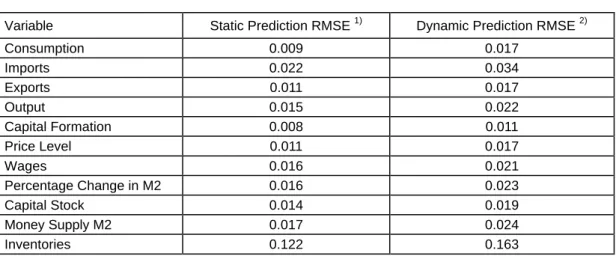
We present root mean square errors for the static and dynamic predictions obtained using the reduced form model in Table 3 below. For the static predictions actual values in period t-1 are used to predict values of the variables in period t. For the dynamic predictions we use observations of the variables in t0 to make predictions for the period t1 . Further on only the predicted values are used to make predictions for the rest of the observation period.
Since the variables are in logarithms, the root mean square error gives the average error as a percentage of the actual level of the endogenous variable.
Table 3: Root Mean Square Errors of Static and Dynamic Predictions
Variable Static Prediction RMSE 1) Dynamic Prediction RMSE 2)
Consumption 0.009 0.017 Imports 0.022 0.034 Exports 0.011 0.017 Output 0.015 0.022 Capital Formation 0.008 0.011 Price Level 0.011 0.017 Wages 0.016 0.021 Percentage Change in M2 0.016 0.023 Capital Stock 0.014 0.019 Money Supply M2 0.017 0.024 Inventories 0.122 0.163 1)
First quarter 1993 − fourth quarter 1997;
2) fourth quarter 1996 − fourth quarter 1997.
From the above table it is clear that for all but one of the eleven variables, root mean square errors for both static and dynamic forecasts are below 5%. The only variable for which the model gives a relatively bigger error is the stock of inventories. There may be both economic and statistical reasons for this, since it is very common for changes in inventories to be very volatile and, in addition, they are defined as a residual term after the main components of the national accounts have been computed. RMSE for the static predictions are very satisfactory for all the other variables in the model.
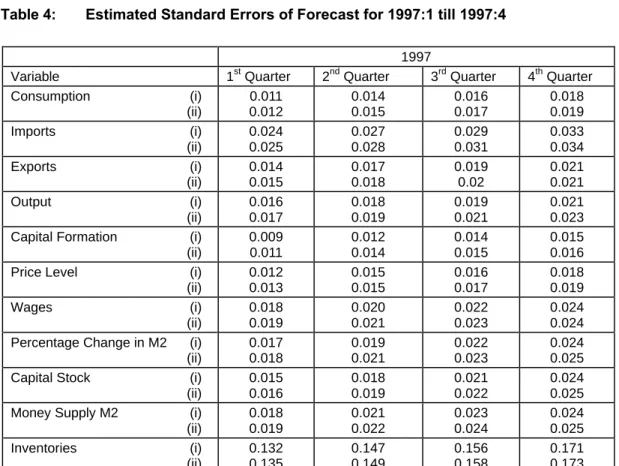
Following the methodology described in Fair (1984) Chapters 7 and 8, we provide additional statistics in order to better evaluate the model and its predictive performance. In Table 4 below we provide estimated standard errors of stochastic simulations with the model for the period from the first quarter of 1997 till fourth quarter of 1997 for both (i) uncertainty due to error terms and (ii) uncertainty due to error terms and coefficient estimates.
There are three possible ways to perform stochastic simulations. They can be done first with respect to the error terms, second with respect to the estimated coefficients and third with respect to both. Usually it is assumed that the error terms are identically and independently distributed as a multivariate N(0,
σ
$
) distribution with zero mean and variance-covariance matrixσ
$
and the estimated coefficients are distributed as N(α
$
,V
$
). Given the data, for each particular estimation technique, one can estimate the coefficient vector, its variance-covariance matrix and the variance-variance-covariance matrix of the error terms. Let εt* denote a particular draw of the vector of the error terms for period t and α*denote a particular draw of the vector of coefficients. Given this, one can solve the model for each period of simulation. Let us call this simulation a “trial”. Solving the model for another set of random draws for the
error terms and coefficients we obtain another trial. We denote by
y
$
itkj the value for the jth trial of the k period ahead prediction of variable i from a simulation beginning in period t. Hence, for J trials we can estimate the expected value of the variable −y
$
itk and the variance of the forecast error −σ
$
itk2 using the formulas:~
y
~
J
y
tk tkj i J=
=∑
1
1 (33)$
( ~
~
)
σ
tk tkj tk j JJ
y
y
2 2 11
=
−
=∑
(34)Table 4: Estimated Standard Errors of Forecast for 1997:1 till 1997:4
1997
Variable 1st Quarter 2nd Quarter 3rd Quarter 4th Quarter Consumption (i) (ii) 0.011 0.012 0.014 0.015 0.016 0.017 0.018 0.019 Imports (i) (ii) 0.024 0.025 0.027 0.028 0.029 0.031 0.033 0.034 Exports (i) (ii) 0.014 0.015 0.017 0.018 0.019 0.02 0.021 0.021 Output (i) (ii) 0.016 0.017 0.018 0.019 0.019 0.021 0.021 0.023 Capital Formation (i)
(ii) 0.009 0.011 0.012 0.014 0.014 0.015 0.015 0.016 Price Level (i)
(ii) 0.012 0.013 0.015 0.015 0.016 0.017 0.018 0.019 Wages (i) (ii) 0.018 0.019 0.020 0.021 0.022 0.023 0.024 0.024 Percentage Change in M2 (i)
(ii) 0.017 0.018 0.019 0.021 0.022 0.023 0.024 0.025 Capital Stock (i)
(ii) 0.015 0.016 0.018 0.019 0.021 0.022 0.024 0.025 Money Supply M2 (i)
(ii) 0.018 0.019 0.021 0.022 0.023 0.024 0.024 0.025 Inventories (i) (ii) 0.132 0.135 0.147 0.149 0.156 0.158 0.171 0.173
The values in Table 4 are either estimated standard errors in units of the variable or estimated standard errors in percentage points. In fact, the numbers are the ratio of the estimated standard error to estimated mean of each variable. The values of the statistics given in the above table show that the model has satisfactory forecasting properties given the short-term time series for the Czech Republic. The results for both simulations are close and the predictive performance of the model, especially for the main macro-economic variables for the first two quarters is acceptable.
In addition to the stochastic simulations, we have estimated unrestricted VAR for the following variables: CPI, real GDP, real consumption, money supply − M2 and nominal wages. Because of the short time series we used only two lags in the system, but the main idea is to compare the predictive performance of the main model presented in Section 3 with an a-theoretical reduced form VAR model. It is possible, after imposing an appropriate identifying restriction, to obtain from this reduced VAR system a restricted structural model which may fit either to Keynesian or neo-classical theories. Hence, the VAR model can be used as a benchmark for comparison purposes. The standard errors as a percentage of the mean of the variables from the VAR regression are for CPI − 0.016; for real GDP − 0.024; for real consumption − 0.028; for M2 − 0.032 and for nominal wages − 0.033. A comparison of these results with those from Table 3 and Table 4 shows that the model presented above performs relatively better than the VAR system.
4.4. Calculation of the Equilibrium Nominal Exchange Rate
In order to calculate the equilibrium exchange rate10, Pf is replaced with qPf . The exchange
rate index q is defined as follows (for an extensive discussion on the definition of the exchange rate basket see Koèenda [1998], Chapter 2):
q = aDM + bUSD (35)
where aDM and bUSD are the weights of the DM and USD in a basket. A q bigger than 1 means a devaluation of the koruna.
Next, we define the equilibrium exchange rate
q
$
such that$
q
q
o= ϕ(B), ϕ’(B) >0 and ϕ(0) = 0, (36)
where qo is the observed index and B ≡ E P
Pf
.
Im. ; a possible functional form for ϕ(B) is
ϕ(B) = E P Pf . Im. −β9 , β9 > 0. (37)
In order to simulate the model over the sample period, we include a partial adjustment equation for the index in the following form
10 For an example of using continuous-time model to calculate the exchange rate for Italy see Gandolfo et al.
Dln q qo = α14 ln
$
/
/
q q
q q
o o
α14 > 0. (38)The equilibrium exchange rate is obtained by solving the system (9) − (20) in conjunction with equation (38).
According to simulations for the nominal equilibrium exchange rate index qpred done for α14
= 1.5 and β9 = 0.9 at the end of 1997 the Czech currency should have been devalued with
respect to the basket by 18.3%. We tried different values for the parameters α14 and β9 . By
increasing the speed of adjustment (a higher value for α14) and the weight given to the
current account imbalance (coefficient β9), we obtain a higher rate of devaluation of the
currency. We obtained a devaluation of the Czech koruna in the range of 8% − 21% for a reasonably large range of variation of both parameters.
4.5. Effectiveness of Monetary and Fiscal Policies
4.5.1. Scenario 1
In this scenario the following tax rule is introduced:
D T
PY
T
Tln
=
ln
α
15γ
, (39)where T is the total tax bill, α15 is the speed of adjustment of taxes and γT is the tax rate
applied by the government. This coefficient may reflect the different speed at which the authorities collect taxes. The term PY is nominal GDP. Then we replace equation (9) with the following three equations:
D C
Y T P
C
p pln
=
ln
(
−
/
)
α
1γ
1 , (40)where Cp. is real private consumption.
D C
gY
C
g gln
=
ln
α
16 , (41)where Cg is real government consumption and g is the government’s propensity to consume taken as an exogenous variable in this scenario. Total consumption C is given by:
After that we solve the system consisting of equations (39), (40), (41), (42) and (10) − (20) for different values of the policy parameters γT and g in the range {0.15 − 0.45}and {0.18 −
0.24} and speed of adjustment of taxes to their target value −α15 about one year. When the tax rate parameter is in the upper range γT ∈{0.35 − 0.45} we obtain a significant fall in
total consumption in the short term compared with the base line scenario. Consequently, a high tax rate has a negative impact on real output and real exports. We observe a deterioration of the balance of goods and services compared to the baseline variant caused mainly by the price effect, which overcomes the quantity effect. As a result of the relatively bigger fall in the demand for money compared to money supply we have higher inflation (the second term in the price equation captures this effect). Higher inflation in turn causes higher nominal wages and starts of price-wage spiral. In the long term the main macroeconomic variables keep on diverging from the baseline solution.
For the sub-range of the tax rate parameter γT ∈{0.15 − 0.34} we initially observe slightly
lower real consumption and output with an inflation rate not substantially different from the baseline. In the long run we observe a slight improvement in inflation with the rest of the real variables reaching their long run equilibrium. Compared with the baseline scenario the real part of the characteristic roots of the system are now negative. Under a “low taxation” policy, we have higher real output and consumption, better inflation performance and improved balance of goods and services compared with the “high taxation” policy. Under “low taxation”, the evolution of the macro-economic variables in the model is close to the baseline solution, but the benefit of applying this regime is the greater stability of the economy.
4.5.2. Scenario 2
In this subsection, a more sophisticated fiscal policy feedback relation is introduced. In the model presented in Section 3 we implicitly assumed that fiscal policy was, in a sense, neutral and that monetary policy was achieved by reacting to balance of payment variations and the deviation of domestic inflation from foreign inflation. Here we assume that taxation rates and government expenditure vary in response to deviations in output from its steady-state path. The fiscal policy feedback relation can be introduced mathematically by defining T as follows: T = γ γ τ 1 1 1 g+ ( − ), (43)
where g is the partial equilibrium ratio of current government expenditure to national income and τ is the taxation rate. We replace equation (9) with the following one
DlnC = α1ln
$
C
TC
+ α2 m2. (44)A neutral fiscal policy is obtained if T = 1, in which case equation (44) reduces to the estimated equation (9).
Using equation (41) equation (42) can be rewritten as follows:
DlnC = α1ln
gY
Y T P
C
+
−
−
γ
1(
1
τ
)(
/
)
+ α2 m2. (45)As in the previous case, we introduce the fiscal policy feedback relation into the model by defining T in the following way:
DlnT = α15ln
( /
Y Y e
*)
T
yt λ β20
, (46)where Y* e λy t is the long run equilibrium growth path of output, and α15 and β20 are policy
parameters. The parameter β20 measures the strength of the feedback. Equation (46)
indicates that lnT depends with an exponentially distributed time lag on the logarithm of the ratio of real output to its long-run equilibrium level. It also implies that if g is constant, the taxation rate will converge to a level which increases as the proportional excess of real output over its long-run level increases. If τ is constant then government propensity to spend will converge to a level which is lower the greater is the proportional excess of real output over its long-run equilibrium level. To determine plausible values for this parameter we use equations (45) and (46). If β20 > 1, then from equation (48) it follows that an increase in
output will allow for an increase in T. In order to increase T the government should increase taxes and/or decrease spending. It follows from equation (45) that the partial equilibrium level of aggregate consumption will be less than it would have been if output had not increased. It is thus unrealistic to assume a value of this coefficient much greater than 1. The reciprocal of the coefficient α15 is the mean of the distributed time lag with which T responds
to changes in output from its steady-state level. For example α15 = 1 means an adjustment
speed of one quarter.
The system consisting of equations (9) − (20) plus equation (46) is linearised around the equilibrium point, and the impact on the stability of the system for different values of the policy parameters is investigated.
We tried different values for coefficients α15 and β20 in the interval 1 − 2. In the original system
without the fiscal policy feedback equation (46), we have one positive characteristic root. After introducing the fiscal policy equation, we obtain one positive characteristic root as well, which is in the interval {0.0032 − 0.0056} for different values of the above coefficients. We may conclude from this result that a fiscal policy feedback as defined in equation (45) has a slightly stabilizing effect. The fact that a feedback from output to the fiscal policy
variable is stabilizing could be explained by the greater speed with which the fiscal policy variable affects the real variables in the system.
5. Conclusions
In this paper we presented a relatively small macro-econometric model for a transition economy in the context of a disequilibrium framework. To our knowledge, this model is the most developed of all the existing models for the Czech Republic. In addition to specifying and estimating a model for a transition economy, we pursued three other objectives: first, to construct a model which can be used as a policy simulation tool; second, to obtain some insights about the role played by market forces in affecting the speed of adjustment of real and financial markets by means of the disequilibrium modeling used in the paper; and finally to investigate which of the markets play crucial role for the stability of the model.
The estimation results show that the model’s performance is satisfactorily assessed by means of the RMSE criterion and most of the estimated parameters have plausible values and correct signs. Of the estimated 32 parameters, 28 are significant at the 5% significance level and 2 are significant at the 10% significance level.
We provided two examples showing how the model can be used as a policy tool. They represent just a small number of the many possible applications of the model. (For example it could be used for antiinflationary policy simulation using different instruments).
With regard to the speed of market adjustment, the fastest adjusting markets are real markets. The most sluggish sector is the price sector, which is still under government control. Existing price regulation is around 20% of the CPI index.
The most important factor for the stability of the model appears to be the external sector (import − export markets), which seems plausible given that for the last three years the Czech Republic has had a share of imports and exports around 50% to 60% of GDP. This reflects the high degree of openness of the economy and intuitively raises the question of its vulnerability.
We see three ways in which this model could be developed further. Firstly, an enlargement of the financial sector within the model is required. In order to do this we plan to incorporate interest rates into the model because we believe their role in the economy will become very important from the point of view of both real and financial markets. Secondly, the price sector should be desegregated in order to distinguish between export prices, import prices, CPI and PPI. Thirdly, we plan to include the government sector in the model.
References
Bergstrom, A. R., 1990, Continuous Time Econometric Modelling, Oxford: Oxford University Press.
Brillet, J. L. and K. Šmidková, 1997, “Formalising the Transition Process: Scenarios for Capital Accumulation,” Série des documents de travail de la Direction des Etudes et Synthéses Économiques.
Fair, R. C., 1984, Specification, Estimation and Analysis of Macro-Econometric Models, Cambridge, MA: Harvard University Press.
Gandolfo, G., 1971, Mathematical Methods and Models in Economic Dynamics, Amsterdam: North-Holland Publishing Company.
Gandolfo, G., 1981, Quantitative Analysis and Econometric Estimation of Continuous Time Dynamic Models, Amsterdam: North-Holland Publishing Company.
Gandolfo, G. and P. Padoan, 1984, A Disequilibrium Model of Real and Financial Accumulation in an Open Economy: Theory, Evidence, and Policy Simulations, Berlin: Springer-Verlag.
Gandolfo, G., 1990, “The Italian Continuous Time Model,” Economic Modelling, April 1990. Gandolfo, G., P. Padoan, and G. de Arcangelis, 1993, “The Theory of Exchange Rate
Determination and Exchange Rate Forecasting,” in Open Economy Macroeconomics, Frisch, H. and A. Wörgötter eds., New York: St. Martin’s Press.
Greene, W. H., Econometric Analysis, 1997, New Jersey: Prentice-Hall International, Inc. Hájek et al., 1995, “A Macroeconomic Analysis of the Czech Economy 1990 − 1994,”
Working Papers of the Economics Institute of the CNB, No. 34.
Hájek et al., 1997a, “Makroekonomická analýza èeské ekonomiky 1996,” Working Papers of the Economics Institute of the CNB, No. 67.
Hájek et al., 1997b, “Makroekonomická analýza èeské ekonomiky 1997: vybrané problémy,” Working Papers of the Economics Institute of the CNB.
Hendry, D. H., and T. von Ungern-Sternberg, 1981, “Liquidity and Inflation Effects on Consumers’ Expenditure,” in Deaton, A. S. (ed.), Essays in the Theory and Measurement of Consumer Behaviour, Cambridge, MA: Cambridge University Press. Kmenta, J., 1986, Elements of Econometrics, Second Edition, New York: Macmillan
Publishing Company.
Koèenda, E., 1998, “Exchange Rate in Transition,” CERGE, Charles University.
Nachtigal, V., 1997, “Èeská ekonomika v 1. polovinì 90. let v porovnání s obdobnými evropskými ekonomikami,” Working Papers of the Economics Institute of the CNB, No. 66.
Sjöö, B., 1993, “CONTIMOS A Continuous-Time Econometric Model for Sweden Based on Monthly Data,” Continuous Time Econometrics: Theory and Applications, ed. Gandolfo, G., London: Chapman and Hall.
Šujan, I. and M. Šujanová, 1995, “The Macroeconomic Situation in the Czech Republic,” in The Czech Republic and Economic Transition in Eastern Europe, ed. Jan Švejnar, San Diego: Academic Press.
Vašièek, O., 1997, “Bayesian Identification of Non-linear Macroeconomic Model,” mimeo. Whiteley, J. D., 1994, A Course in Macroeconomic Modelling and Forecasting, Hertfordshire:
Harvester Wheatsheaf.
Wymer, C. R., 1973, “A Continuous Disequilibrium Adjustment Model of United Kingdom Financial Market,” in Powell, A. A. and Williams, R. A., eds., 1973, Econometric Studies of Macro and Monetary Relations, Amsterdam: North-Holland Publishing Company, 301−34.
Wymer, C. R., 1976, “Continuous Time Models in Macro-Economics: Specification and Estimation,” Paper presented at the SSRC-Ford Foundation Conference on Macroeconomic Policy and Adjustment in Open Economies, London, April 28 − May 1.
Appendix 1. Derivation of the Approximate Discrete
Analogue
In order to estimate the model (9) − (20), we use the approximate discrete analogue. To derive it we first rewrite the original system in log-linear form.
DlnC = α1ln(γ1) - α1ln(C) + α1lnY + α2m2 (A1.9) DlnIm = α3ln(γ2) + α4 ln(γ4) + α3β2(ln(
k
) - 1) - α3lnIm + α3β2lnK+ α3β2
k
-1 k + α3β3lnC + α3β4lnE + α3β1lnP - α3β1lnPf+ α4lnYe - α4lnV (A1.10)
DlnE = α5ln(γ3) - α5β5 lnP - α5 lnE + λ1t (A1.11)
DlnYe = ξ lnYe - ξ lnY (A1.12)
DlnY = α7 ln(γ4) + α6 lnYe - α6 lnY + α7 lnYe - α7 lnV (A1.13)
Dk = α8γ5 b1(1 - ln(b1)) + α8γ5 b1lnY e - α8γ5 b1lnK + α9 m2 - α8k (A1.14) where b1 =
e
Ye K ln −lnand
ln
Y
e,ln
K
are sample means of the logarithms of expected income and capital stock respectively.DlnP = α10 ln(γ6) + α10 β6 lnPf + α10 β7 lnW - α10 β7 lnPr - α10 lnP
+ α11 lnM2 - α11 βmd lnP - α11 βmd lnY (A1.15) DlnW = α12ln(γ7) + α12β8 lnP - α12 lnW + λ2t (A1.16) Dm2 = -α13δ1 ln(γ8) + α13δ1 lnE - α13δ1 lnIm - α13δ2 DlnP + α13δ2 lnPf (A1.17)
DlnK = k (A1.18)
DlnM2 = m2 (A1.19)
DlnV = b2(1 - lnb2) - b3(1 - lnb3) - b4(1 - lnb4) - b5
k
(1 - lnb5) + b2 lnImwhere b2 =
e
ln Im ln− V, b3 =e
C V ln −ln , b4 =e
E V ln −ln , b5 =e
K V ln −lnand
k
is the sample mean of k.We linearise the third term in equation (10.1) as follows:
ln
DK
= lnkK = lnk + lnK (1.A1)Then, lnk is linearised using Taylor’s series expansion around the sample mean of k to obtain
lnk ≅ ln
k
+k
-1(k -k
) = (lnk
- 1) +k
-1k. (A1)We linearise the term
Y
K
e
in equation (14) using the following formula:
Y
K
e
e
Y
K
Y
K
e Ye K Ye K e e≡
ln −ln≅
ln −ln+
−
−
−
(
1
ln
ln
(ln
ln
))
(3.A1)Finally, we linearise equation (20) in the following way. First we divide it by V to obtain
DV
V
Y
V
V
E
V
C
V
DK
V
= +
Im
−
− −
(4.A1)The left-hand side is equal to DlnV. The first four terms of the right-hand side are linearised using formula (3.A1). In order to linearise the last term, we rewrite it in the following way:
k
K
V
= k b5(1 - lnb5 + lnK - lnV). (5.A1)We then expand equation (5.A) in Taylor’s series and neglect all higher terms to obtain
k
K
V
≅ b5k +k
b5lnK -k
b5lnV +k
b5(1 - ln b5). (6.A1)We transform the continuous log-linear model (A1.9) − (A1.20) given above by applying equation (23) in the main text. Stock and flow variables are previously treated by the procedure given in Section 4. Taking into consideration that equation (12) is omitted, the discrete analogue of the continuous time system contains 11 equations, eight of which are stochastic.
∆lnC = .785α1ln(γ1) - α1Γ ln(C) + α1Γ lnY + α2Γ m2 + ω1 (A1.9’)
∆lnIm = .785(α3ln(γ2) + α4 ln(γ4) + α3β2(ln(
k
) - 1)) - α3Γ lnIm+ α3β2Γ lnK + α3β2
k
-1Γ k + α3β3Γ lnC + α3β4Γ lnE+ α3β1Γ lnP - α3β1Γ lnPf + α4Γ lnYe - α4Γ lnV + ω2 (A1.10’) DlnE = α5ln(γ3) - α5β5 lnP - α5 lnE + λ1t + ω3 (A1.11’) DlnY = α7 ln(γ4) + α6 lnYe - α6 lnY + α7 lnYe - α7 lnV + ω4 (A1.13’)
Dk = α8γ5 b1(1 - ln(b1)) + α8γ5 b1lnY e - α8γ5 b1lnK + α9 m2 + ω5 (A1.14’) DlnP = α10 ln(γ6) + α10 β6 lnPf + α10 β7 lnW - α10 β7 lnPr - α10 lnP + α11 lnM2 - α11 βmd lnP - α11 βmd lnY + ω6 (A1.15’) DlnW = α12ln(γ7) + α12β8 lnP - α12 lnW + λ2t + ω7 (A1.16’) Dm2 = -α13δ1 ln(γ8) + α13δ1 lnE - α13δ1 lnIm - α13δ2 DlnP + α13δ2 lnPf + ω8 (A1.17’) DlnK = k (A1.18’) DlnM2 = m2 (A1.19’) DlnV = b2(1 - lnb2) - b3(1 - lnb3) - b4(1 - lnb4) - b5
k
(1 - lnb5) + b2 lnIm - b3 lnC - b4 lnE - b5k - b5k
lnK + (-b1 - b2 + b3 + b4 + b5k
)lnV (A1.20’) The system (1.9’) − (1.20’) was used for estimation purposes.Elimination of the Expected Income
Equation (13) in the main text can be written in the following form:
DlnY = α6 ln
Y
Y
e
+ α7 lnγ
4Y Y
YV
e
(7.A1)We solve the above equation for lnYe and obtain lnYe =
D Y
ln
α
6+
α
7 +α
α
α
6 6 7ln
Y
+
+α
α
α
7 6 7ln
V
+
-α
γ
α
α
7 4 6 7ln
+
. (8.A1)Further we differentiate equation (8.A1) with respect to time and get
DlnYe =
D
Y
2 6 7 <