TECHNICAL REFERENCE DOCUMENT DATABASE SYSTEM
(TDOCS)
REQUIREMENTS DEFINITION
Prepared for
Nuclear Regulatory Commission
Contract NRC-02-88-005
Prepared by
Center for Nuclear Waste Regulatory Analyses
San Antonio, Texas
August 1993
TECHNICAL REFERENCE DOCUMENT DATABASE SYSTEM
(TDOCS)
REQUIREMENTS DEFINITION
Prepared for
Nuclear Regulatory Commission
Contract NRC-02-88-005
Prepared by
Rawley D. Johnson
Joseph H. Cooper
Christopher Moehle
Edward Harloe
Center for Nuclear Waste Regulatory Analyses
San Antonio, Texas
EXECUTIVE SUMMARY
The statutory requirement for the Division of High-Level Waste Management (DHLWM) is to make a construction authorization decision within three years, with a possible one year extension, following the U.S. Department of Energy's (DOE) required submittal of the License Application to the U.S. Nuclear Regulatory Commission (NRC). This requirement will place considerable demands on the DHLWM staff as it conducts its license application and pre-license application reviews. The NRC Overall Review Strategy for the Nuclear Regulatory Commission's High-Level Waste Repository Program (Youngblood, 1993) identifies assumptions and strategies that suggest the need for enhanced computer capabilities and tools to support the staff in performing pre-license application reviews:
* Early availability of preliminary information developed and documented by DOE during the pre-license application phase
* Ability to use the results of pre-license application reviews and supporting investigations * Ability to streamline the acceptance review process, resulting in compliance reviews that focus
less on detailed supporting information and methodologies and more on how the detailed information was used to demonstrate compliance
* Use of compliance reviews to verify the acceptability of DOE's compliance and gain confidence whether DOE's compliance demonstrations are acceptable
* Support of reviews documenting concerns as open items and tracking of these open items * Development of computer models and codes as an ongoing activity in support of iterative
performance assessment
The Advanced Computer Review System (ACRS) is being implemented in the DHLWM to address these assumptions and requirements associated with the NRC review strategy. In March, 1992, the Center for Nuclear Waste Regulatory Analyses (CNWRA) began design and implementation of the computer hardware and software system based on two primary applications: (i) technical computing and (ii) technical document referencing and database access. The technical computing application is being implemented and operation of a client/server-based network with graphics and color display is underway. A full-text management system, the Technical Reference Document Database System (TDOCS), with imaging of non-textual materials for storage and retrieval of technical reference documents, is being initiated as part of the second application for the ACRS with this report. This application is being pursued in four phases: (i) requirements study; (ii) system design; (iii) system implementation; and (iv) testing, documentation, and training. The options for access of external databases containing primarily DOE technical data are the subject of a related report (Harloe, 1993).
The purpose of this report is to identify overall requirements for TDOCS and facilitate the analysis and decision making necessary to initiate its design. The requirements provided by the DHLWM imply a number of significant needs relative to TDOCS design, maintenance, access and use as follows:
* Compatibility and synchronization with similar capability at the CNWRA
* Incorporation of three in-house technical document databases
* On-demand and routine loading by scanning paper documents and electronic document loading * Bibliographic header and full-text search
* Facilitation of user confidence in his or her retrieval of all relevant documents and only relevant documents
* Support for staff productivity through the incorporation of references in technical analyses * Adherence in system design and implementation to NRC policies and standards
The system must meet the specific needs of the DHLWM staff. However, in order to implement a system that is immediately beneficial with the desired functionality, TDOCS should support user confidence in his or her ability to find relevant documents. This concept in a document management system like TDOCS must be understood and appreciated in order to make appropriate decisions and commitments
regarding impact, cost, and tradeoffs in the system's usefulness. These decisions and commitments must then be reinforced with policies, procedures, and responsibilities clearly defined by the DHLWM for using TDOCS, so that it will not only provide immediate benefit but evolve with the needs of its users. Section 2 describes a number of related systems, such as, the Licensing Support System (LSS), DOE's INFOStreams and Improved Records Information System (IRIS), NRC's Nuclear Document System (NUDOCS) and the DHLWM's technical document databases, the ACRS, and the CNWRA's Program Architecture Support System/Program Architecture Database (PASS/PADB). NUDOCS is currently undergoing a revision to handle full-text and images (Johnson and Moehle, 1993); and a modified approach has been proposed for DOE to develop, implement, and operate the LSS as a part of INFOSstreams (Chilk, 1993). All of these systems do or will, when available, manage documents and, thus, may have beneficial aspects useful to defining requirements for TDOCS. The Appendix contains a matrix of requirements derived from a recent analysis of the needs of various NRC Offices for office-controlled document management databases, which was contracted by the Office of Information Resources Management (IRM). The table based on that study and presented in the Appendix measures NUDOCS and a tested prototype system against these requirements. Therefore, the examination of related systems is necessary to identify the unique requirements and pressing policy and compatibility issues that are driven by these systems. These requirements and issues are:
* Immediate functionality and capabilities for the DHLWM with a future interface to the LSS, when it is available, for official high-level waste (HLW) documents
* Header and full-text search capabilities
* Images of non-textual material, such as formulae, equations, tables, graphs, charts, pictures, and photographs
* On-demand scanning to meet immediate needs * Incorporation of materials and references in analyses * Connectivity with other systems and databases
The overall set of requirements for TDOCS is analyzed in Section 3 in terms of applicable functions, constraints, and policies. They include the following:
* Database loading: getting documents into the database
* Document processing: cleaning up, entering headers, and indexing full text * Search and retrieval: accessing the documents
* Document manipulation: facilitating document use
* Administration and maintenance: ensuring system functionality
Based on experience at the CNWRA, it is estimated that the DHLWM might be able to load and process as many as 20 full-text documents per day. At this rate approximately 10,000 documents could be accumulated over a two year period. By comparison, approximately 15,000 documents have been accumulated in the CNWRA library. Also discussed are two important trade-off decisions regarding cleanup after scanning and OCR and the inclusion of bibliographical headers, full-text indexing, storage, and retrieval of page images.
Section 4 concludes the report by summarizing confirmed requirements against proposed and implied requirements. It also provides directions to be taken for resolving policy matters and design issues. As stated in the CNWRA FY94-95 Operations Plan for the Division of High-Level Waste Management (CNWRA, 1993) estimates regarding scope, cost, and schedule will be updated as necessary during the design phase. Efforts to make TDOCS interfaces completely seamless, provide for easy access to identified document databases, and support imaging functions will be based on identifiable technical alternatives and cost and schedule constraints. The strategy is to provide a system capability that meets the stated requirements and is currently achievable and immediately beneficial. TDOCS will be designed as a small-scale system limited to a relatively low volume of data, and interfaced, first, to the NUDOCS revision and, later, to the LSS, when they are available.
CONTENTS
Section Page EXECUTIVE SUMMARY ... ii FIGURES. viii TABLES. ix ACKNOWLEDGMENTS. x ABBREVIATIONS .xi 1 INTRODUCTION ... ... 1-1 1.1 BACKGROUND . ... 1-1 1.2 PURPOSE AND SCOPE ... ... 1-2 1.3 DESIGN AND DEVELOPMENT REQUIREMENTS ... 1-3 1.4 USER CONFIDENCE AND PRODUCTIVITY ... 1-4 2 RELATED SYSTEM CONSIDERATIONS ... 2-1 2.1 THE LICENSING SUPPORT SYSTEM ... 2-1 2.1.1 Licensing Support System Technical Data Packages ... 2-3 2.1.2 Information Horizon and Hypertext ... 2-3 2.2 DEPARTMENT OF ENERGY AND THE INFOSTREAMS .... ... 2-5 2.2.1 INFOStreams,. ... 2-5 2.2.2 Department of Energy Records Management ... 2-6 2.3 NUCLEAR REGULATORY COMMISSION EFFORTSTO MEET DOCUMENT MANAGEMENT NEEDS .... ... 2-10 2.3.1 Nuclear Document System ... ... 2-10 2.3.2 Improvements to the Nuclear Document System ... 2-11 2.3.3 Document Management Requirements Analysis ... 2-12 2.3.4 Prototype Document Management System ... 2-13 2.3.5 Proposed Document Management System ... 2-14 2.3.6 Office of Nuclear Reactor Regulation's Text Retrieval System .... ... 2-14 2.4 DIVISION OF HIGH-LEVEL WASTE MANAGEMENT .... ... 2-16 2.4.1 The Advanced Computer Review System ... 2-16 2.4.2 Advanced Computer Review System Requirements ... 2-16 2.4.3 Advanced Computer Review System and Document Management .... ... 2-18 2.4.4 In-house Databases and Other Technical References ... 2-19 2.4.5 Document Management Concerns and Capabilities .... ... 2-19 2.5 DOCUMENT MANAGEMENT AT THE CENTER FOR
NUCLEAR WASTE REGULATORY ANALYSES ... 2-20 2.5.1 Program Architecture Support System/Program Architecture Database ... ... 2-20 2.5.2 Version 3.0 Requirements ... 2-21 2.6 SUMMARY OF RELATED SYSTEM CONSIDERATIONS .... ... 2-21 3 REQUIREMENTS ANALYSIS ... 3-1 3.1 SYSTEM FUNCTIONS ... ... 3-2 3.1.1 Database Loading . ... 3-2 3.1.1.1 Routine Loading . ... 3-2
CONTENTS (CONT'D)
3.1.1.2 3.1.1.3 3.1.2 3.1.2.1 3.1.2.2 3.1.2.3 3.1.3 3.1.3.1 3.1.3.2 3.1.3.3 3.1.3.4 3.1.3.5 3.1.3.6 3.1.3.7 3.1.3.8 3.1.4 3.1.4.1 3.1.4.2 3.1.4.3 3.1.4.4 3.1.4.5 3.1.4.6 3.1.5 3.1.5.1 3.1.5.2 3.1.5.3 3.1.5.4 3.2 3.2.1 3.2.2 3.2.3 3.2.4 3.2.5 3.2.6 3.2.7 3.2.8 3.3 3.3.1 3.3.2 3.3.3 3.3.4 3.3.5 3.3.6 3.3.7 On-Demand Loading ... Electronic Loading ... Document Processing ...Scanning, Optical Character Recognition, and Cleanup ...
Bibliographic Header Entry ...
Full-Text Indexing ...
Search and Retrieval ...
Document Access ...
Search Confidence ...
Concept Search and Building ...
Query Save, Recall, and Edit ...
Search Result Browsing ...
Concurrent, Multiple Document Viewing and Scrolling ... In-Document Match Highlighting and Browsing ...
Hyperlink Creation ...
Document Manipulation ...
Cut, Copy, and Paste ...
Document Printing ...
Report Generation ...
Document Download and Transfer ...
Public and Private Notes ...
Image Manipulation and Enhancement ...
Administration and Maintenance ...
User Passwords, Privileges, and Accounts ... Document Tracking and Configuration Control ...
Monitoring and Reporting ...
Backup and Recovery ...
SYSTEM CONSTRAINTS ...
Graphical User Interface ...
Acceptable Response Times ...
Multiple Platforms ...
Client/Server Architecture ...
Maximize Commercially Available, Off-the-Shelf Software ....
Impact on Existing/Planned Systems and Configurations ... Expandability to Meet Evolving Needs ...
Meeting NRC Policies and Standards ...
SYSTEM POLICIES ...
Specification of 'Selected' Set of Documents ... Storage and Use of Proprietary and Copyrighted Materials.
Loading Procedures ...
Retention of Images of Textual Materials ...
Use of Bibliographic Headers ...
Confidence and Quality Assurance ...
System Administration, Maintenance, and Training ...
...
...
...
...
...
...
...
...
...
...
3-3 3-3 3-4 3-4 3-5 3-6 3-7 3-7 3-8 3-9 3-10 3-10 3-10 3-10 3-10 3-11 3-11 3-11 3-11 3-11 3-11 3-12 3-12 3-12 3-13 3-13 3-13 3-13 3-13 3-13 3-13 3-14 3-14 3-14 3-15 3-15 3-15 3-15 3-16 3-16 3-17 3-18 3-19 3-20 viCONTENTS (CONT'D)
3.3.8 3.4 4 4.1 4.1.1 4.1.2 4.1.3 4.1.4 4.2 4.3 DHLWM/CNWRA Synchronization ... SUMMARY OF REQUIREMENTS ... CONCLUSIONS AND DIRECTIONS ... REQUIREMENTS CONFIRMED ...Proposed Functions ...
Proposed Considerations ...
Proposed Constraints ...
Implied Constraints ...
ISSUES FOR SYSTEM DESIGN ... MATTERS FOR POLICY DETERMINATION.
... 3-21 . . . ..3-21 4-1 4-1 4-2 4-2 4-2 4-3 4-3 4-4 5 REFERENCES ... ... .5-1 APPENDIX
FIGURES
Figure Page
1-1 Overview of TDOCS functions, policies, procedures, and responsibilities .... ... 1-5 2-1 Sources of documents for loading into TDOCS ... 2-2 2-2 HLW licensing process (Sheats, 1992) ... 2-9 2-3 ACRS and related systems and networks ... 2-17 3-1 Major TDOCS functions ... ... 3-22
0
0
TABLES
Table Page
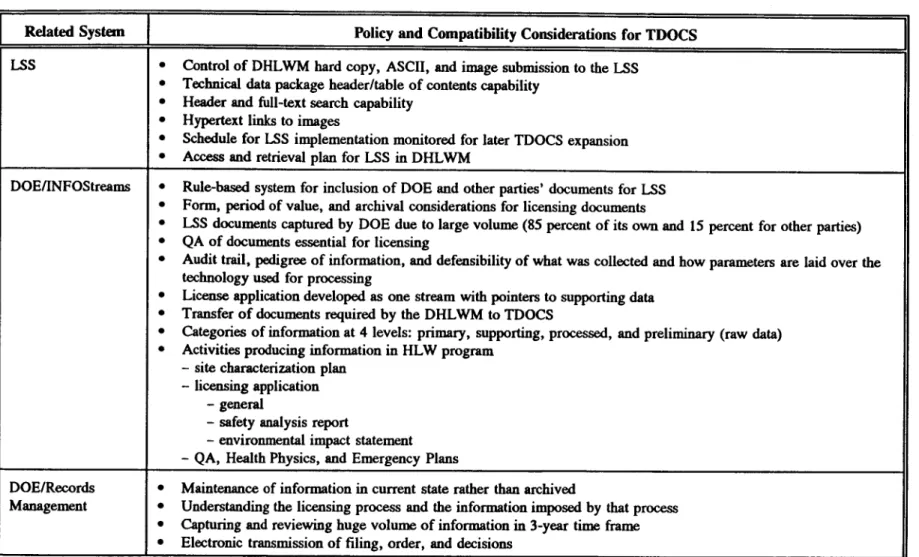
2-1 Related system policy and compatibility considerations ... ... 2-24
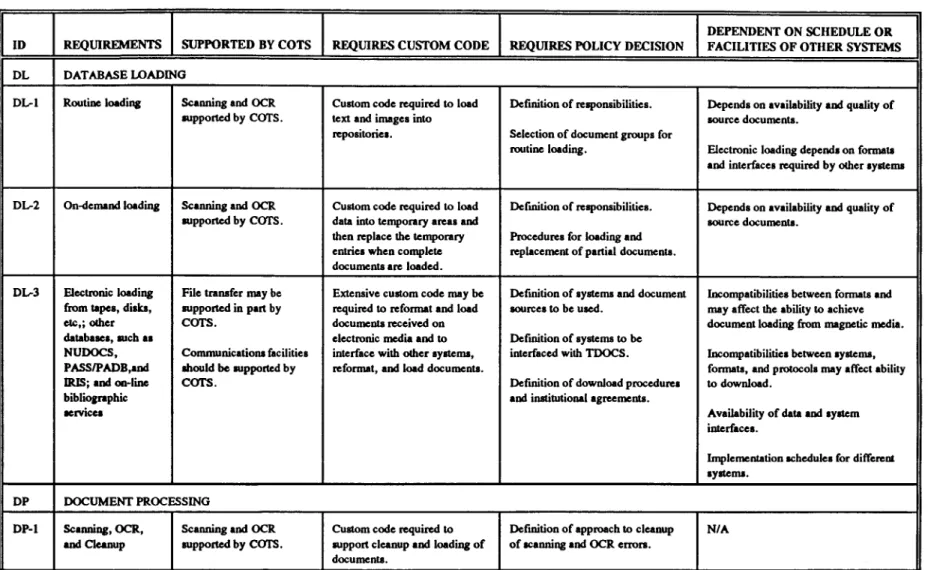
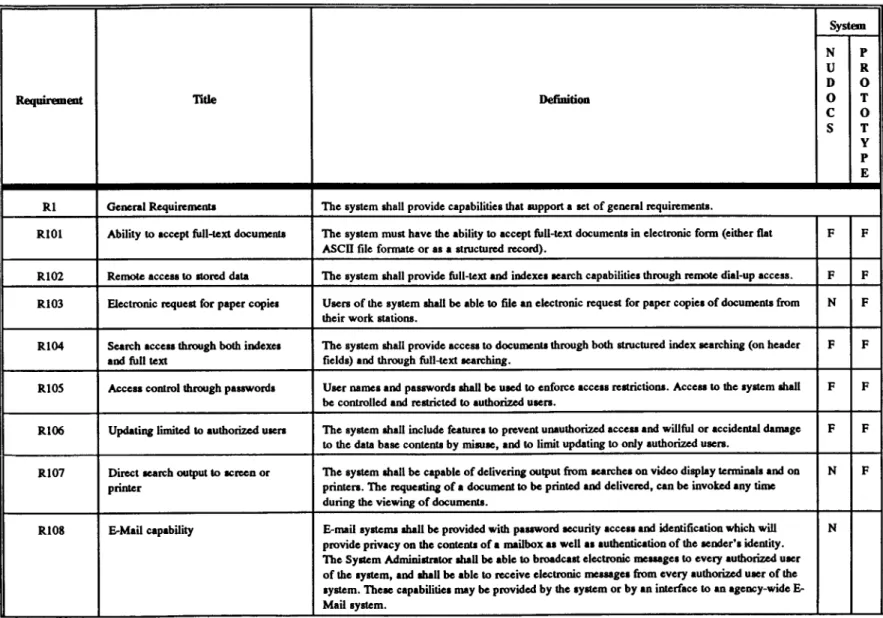
3-1 Summary of TDOCS requirements. ... 3-23 A-1 AMS prototype study requirements . ... A-1
ACKNOWLEDGMENTS
This report was prepared to document work performed by the Center for Nuclear Waste Regulatory Analyses (CNWRA) for the U.S. Nuclear Regulatory Commission (NRC) under Contract No. NRC-02-88-005. The activities reported here were performed on behalf of the NRC Office of Nuclear Material Safety and Safeguards, Division of High-Level Waste Management. The report is an independent product of the CNWRA and does not necessarily reflect the views or regulatory position of the NRC.
The authors express their appreciation to Ms. Margaret Federline, Dr. Don Chery, Dr. Chuck Interrante, Dr. William Ford, Mr. Robert Carlson, and Ms. Charlotte Abrams for their comments and discussions during the preparation of this report.
ABBREVIATIONS
ACRS AMS ANS API ASLBP AUTOS CNWRA COTS DCD DHLWM DOE EIS GUI HLW IRG IRIS IRM ISO LAN LSS LSSARP NIH NIST NRC NRR NUDOCS NWPA OCR OCRWM OGC OIG OITS PA PASS/PADB PC QA RDBMS RIDS RM SAR SECY SQL SRA SRP-UDP TCP/IPAdvanced Computer Review System Advanced Management Systems, Inc. Auto-dial Network System
Application Program Interface Atomic Safety Licensing Board Panel
Agency Upgrade of Technology for Office Systems Center for Nuclear Waste Regulatory Analyses Commercially Available, Off-the-Shelf Software Document Control Desk
Division of High-Level Waste Management Department of Energy
Environmental Impact Statement Graphical User Interface
High-Level Waste
Integrated Resources Group, Inc. Improved Records Information System Office of Information Resources Management Information System Organization
Local Area Network Licensing Support System
Licensing Support System Advisory Review Panel National Institute of Health
National Institute of Science and Technology Nuclear Regulatory Commission
Office of Nuclear Reactor Regulation Nuclear Document System
Nuclear Waste Policy Act Optical Character Recognition
Office of Civilian Radioactive Waste Management Office of the General Counsel
Office of the Inspector General Open Item Tracking System Program Architecture
Program Architecture Support System/Program Architecture Database Personal Computer
Quality Assurance
Relational Database Management System Regulatory Information Distribution System Records Management
Safety Analysis Report Office of the Secretary Structured Query Language Systematic Regulatory Analysis
Standard Review Plan - Update Project
ABBREVIATIONS (CONT'D)
TDI TDOCS 10 CFR PART 60 USGS WAN YMPO- Technical Document Index
- Technical Reference Document Database System - Title 10 of the Code of Federal Regulations Part 60 - United States Geological Survey
- Wide Area Network
- Yucca Mountain Project Office
1 INTRODUCTION
1.1 BACKGROUND
The statutory requirement for the Division of High-Level Waste Management (DHLWM) is to make a construction authorization decision within three years, with a possible one year extension, following the U.S. Department of Energy's (DOE) required submittal of the License Application to the U.S. Nuclear Regulatory Commission (NRC). This requirement will place considerable demands on the DHLWM staff as it conducts its license application and pre-license application reviews. The NRC Overall Review Strategy for the Nuclear Regulatory Commission's High-Level Waste Repository Program (Youngblood, 1993) identifies assumptions and strategies, including the following, that suggest the need for enhanced computer capabilities and tools to support the staff in performing pre-license application reviews:
* Early availability of preliminary information developed and documented by DOE during the pre-license application phase
* Ability to use the results of pre-license application reviews and supporting investigations * Ability to streamline the acceptance review process, resulting in compliance reviews that
focus less on detailed supporting information and methodologies and focus more on how the detailed information was used to demonstrate compliance
* Use of compliance reviews to verify the acceptability of DOE's compliance and gain confidence that DOE's compliance demonstrations are acceptable
* Support of reviews documenting concerns as open items and tracking of these open items * Development of computer models and codes as an ongoing activity in support of iterative
performance assessment
These assumptions and requirements associated with the NRC review strategy drive the two basic needs that the DHLWM Advanced Computer Review System (ACRS) is intended to address:
* Enhanced technical computing capabilities * Document management system capabilities
The Center for Nuclear Waste Regulatory Analysis (CNWRA) has participated directly in the analysis, design, and implementation tasks of the ACRS since March 1992. The DHLWM Advanced Computer Review System Design Summary and Proposed On-Going Support Tasks report (CNWRA, 1992) recommended ongoing activities to complement and support the ACRS design. The proposed activities were grouped into three primary development tasks and two support tasks. These tasks were discussed with the DHLWM, and, in a management meeting on October 18, 1992, the decision was made to pursue the two highest priority development tasks: design and implementation of a technical reference document database system and access to external technical databases.
The CNWRA has initiated work on both of these tasks, and this is the first report on the task to provide the DHLWM with a technical reference document database system, namely Technical Reference Document Database System (TDOCS). This is a major activity that needs to be pursued immediately to provide the necessary technical document reference and information extraction capability for the DHLWM and the CNWRA technical review staff in the high-level waste (HLW) Program (Meehan, 1993).
1.2
PURPOSE AND SCOPE
The purpose of this report is to identify overall requirements for TDOCS and facilitate analysis and decision-making necessary to initiate the design of TDOCS. This report constitutes an intermediate milestone deliverable on Subtask 6.1 conducted under Center Operations Element, Task 6 (DHLWM) Advanced Computer System for Technical License Review - Support Tasks (CNWRA, 1993). The
remaining milestones are system design; system implementation; and testing, documentation, and training. This report attempts to make explicit all the functions and constraints that need to be supported. In order to meet the needs of the DHLWM, TDOCS must support user confidence and provide value in terms of increased functionality and staff productivity. The major requirements to meet these objectives are:
* Ongoing and routine loading of and access to documents for an up-to-date office database of technical documents
* Accurate and complete document processing
* A variety of search, query, and hypertext access paths and functions to locate documents * A wide range of practical functions for day-to-day use in staff activities
* Administrative and maintenance functions for a secure and protected system
In short, the system must provide reliable access and practical use of an up-to-date technical document database.
Based on experience at the CNWRA, it is estimated that the DHLWM might be able to load and process as many as 20 full-text documents per day. At this rate approximately 10,000 documents could be accumulated over a two year period. By comparison, approximately 15,000 documents have been accumulated in the CNWRA library. Also discussed are two important trade-off decisions regarding cleanup after scanning and Optical Character Recognition (OCR) and the inclusion of bibliographical headers, full-text indexing, storage, and retrieval of page images.
As stated in the CNWRA FY94-95 Operations Plan for the Division of High-Level Waste Management (CNWRA, 1993), estimates regarding scope, cost, and schedule will be updated during the design phase. Efforts to make TDOCS interfaces completely seamless, provide for easy access to all document databases, and support imaging functions will be based on identifiable technical alternatives and cost and schedule constraints. These efforts will be fully discussed in a follow-on design document. The strategy is to provide a system capability that meets stated requirements and is currently achievable and immediately beneficial. TDOCS will be designed as a small scale system, limited to a relatively low volume of data, with immediate but limited benefits. It will interface to, and complement, both the Nuclear Document System (NUDOCS) revision and the Licensing Support System (LSS), when those systems are implemented, providing ongoing and significant support for DHLWM users. NUDOCS is
currently undergoing a revision to handle full-text and images (Johnson and Moehle, 1993); and a modified approach has been proposed for DOE to develop, implement, and operate the LSS as a part of INFOStreams (Chilk, 1993).
1.3 DESIGN AND DEVELOPMENT REQUIREMENTS
The design and development requirements provided by the DHLWM for TDOCS are driven by two major requirements and a number of other considerations. The first requirement concerns the capability for on-demand text and image scanning, OCR, indexing, storage, full-text search, and retrieval of selected documents. The second requirement concerns the capability for routine scanning and loading of a selected set of documents that are submitted to the NRC and are relevant to the HLW program for full-text search and retrieval. Other considerations include (i) implementation on the ACRS server, using as much commercially available software as possible; (ii) the consolidation of three in-house technical databases; (iii) the incorporation of text and images, including color, in technical analyses; (iv) access to documents in other databases, such as the NRC's NUDOCS and the CNWRA's Program Architecture Support System/Program Architecture Database (PASS/PADB), and transfer of individual documents and those in technical data packages from DOE's INFOStreams; and (v) dial-in to on-line library bibliographical services with access and download capabilities.
The requirements provided by the DHLWM imply a number of significant needs related to TDOCS design, maintenance, access, and use. These needs are as follows:
* Compatibility and synchronization. Because of the close relationships between the DHLWM and the CNWRA and their need to share documents and data, and because the plan is to implement TDOCS at both sites, it will be important for the design to be compatible with systems at the CNWRA in order to synchronize TDOCS at each site.
* On-demand and routine loading. On-demand and routine loading will need to include not only the scanning of paper documents but also the loading of electronic documents, including such sources as on-line, tape, optical disk, floppy disk, and others.
* Policies, procedures, and responsibilities. On-demand and routine scanning and loading of documents and the synchronization of databases at both sites will require specification of policies, procedures, and responsibilities for the proper maintenance of TDOCS.
* Structured queries and full-text search. It is likely that the DHLWM staff will need to be able to access documents through both structured query and full-text search - that is, it is
expected that they will, in some cases, need to locate documents by specific title, author, keywords, and other header fields, while in other cases, they will need to locate all documents that refer to a given concept through full-text search.
* User Confidence. TDOCS should support user confidence in his or her ability to achieve recall, the capability of finding all relevant documents, and precision, the capability of finding only relevant documents.
* User productivity. Use of the system to support technical analyses implies that there are needs for viewing, printing, and transferring documents; cutting and pasting, storing references, embedding notes, and creating hypertext links.
* Adherence to standards. System design and implementation must adhere to all relevant NRC policies and standards.
1.4 USER CONFIDENCE AND PRODUCTIVITY
The system must meet the specific needs of the DHLWM staff. However, in order to implement a system that is immediately useful, system requirements must be driven by the notion of user confidence. That is, TDOCS must support user confidence in all of its major functional areas:
* Database loading * Document processing * Search and retrieval * Document manipulation
* Administration and maintenance
These five functional areas are diagrammed in Figure 1-1, which illustrates the movement of documents through the system and suggests the key role of policies, procedures, and responsibilities of administration and maintenance. An important implication of the diagram is that TDOCS software can only support confidence. Confidence in the system will be gained only by the adoption and practice of policies, procedures, and responsibilities for it use. Confidence can be maximized at the loading stage through policies for the appropriate selection of:
* Documents from in-house databases * Incoming technical documents
* Documents from other databases and on-line services
Confidence can be maximized at the processing stage through the appropriate procedures for: * Document scanning, OCR, and accurate and complete cleanup
* Accurate and complete bibliographic headers
Confidence can be maximized at the search and retrieval stage by providing these appropriate access tools:
* Full-text search on all documents * Structured query search on headers * Hypertext access to documents
Confidence can be maximized at the document manipulation stage by providing user functionality for: * Cut and paste to enable users to incorporate portions of documents directly into analyses * Document printing, downloading from the server, and transfer via electronic mail (e-mail)
0
Database Loading:
On-demand, Routine, and Electronic
l
- 5b
Document Processing:
Scanning, OCR, Cleanup, Header Entry, and Full-text
Indexing
Administration and Maintenance:
Policies, Procedures, and Responsibilities for System Confidence and Usefulness
... ... :P., .... , 1 P 0
Search and Retrieval:
Structure Query, Full-text Search, and Hypertext Access
Document Manipulation:
Viewing, Cut and Paste, Printing, Download, Transfer, Reporting
Confidence can be maximized at the administration and maintenance responsibilities stage by: * Protecting documents with user privileges
* Setting up appropriate user accounts
* Providing standard password protection and system backup
The notion of user confidence in document management systems like TDOCS must be understood and appreciated in order to make appropriate decisions and commitments regarding its impact in terms of cost and tradeoffs in the system's usefulness. These decisions and commitments must then be reinforced with policies, procedures, and responsibilities by the DHLWM for using TDOCS so that it will not only provide immediate benefit but evolve with the needs of its users.
Immediately following are major sections that review existing and planned systems; specify, analyze, and define the scope of requirements; and draw conclusions on important requirements. The status of each of these existing and planned systems of the major organizations involved is reviewed in Section 2 to identify specific capabilities, interface requirements, schedules, and other considerations necessary for effective TDOCS implementation. Detailed requirements for the design of TDOCS, as derived from the NRC and the CNWRA systems, as well as discussions with the DHLWM, are defined in Section 3. In Section 4, conclusions are drawn concerning system requirements and design confirmed by this report. Other issues that remain to be determined during design are formulated as subsequent action items.
2 RELATED SYSTEM CONSIDERATIONS
TDOCS capabilities must be designed in a useful and beneficial way. Such a design requires an understanding of the DHLWM manual and automated operations in order for the system to conform with current and planned operations and to meet the needs of its intended users. It is also reasonable, when developing a currently achievable system, to investigate other operations and systems being used, developed, or planned to provide similar capabilities. The purpose of this section, then, is to establish a set of related requirements applicable to the design and implementation of TDOCS.
The LSS will be discussed, since there was a negotiated rulemaking for the establishment of the LSS to contain all the documentary material for all parties to the HLW licensing process. The recent decision by the NRC regarding the long-range plan for the LSS is described. The DOE's planned capabilities with INFOStreams and records management for licensing are presented as stated at the Third Annual International Conference on High-Level Radioactive Waste Management. It is estimated the DOE will produce over 85 percent of the HLW program documents, which the NRC will review in a selected manner. Potential NRC office-controlled text management systems are surveyed. This survey includes a requirements analysis conducted by Advanced Management Systems, Inc. (AMS) for the NRC whereby appropriate staff at the NRC were interviewed to document Agency plans to revise NUDOCS and meet the document management needs of some of its offices. The ACRS being designed and implemented by the CNWRA and the DHLWM is reviewed. TDOCS is planned as a major application of the ACRS. The full-text management requirements proposed by the CNWRA for PASS/PADB are surveyed. This system will be used as part of the overall relational database system for preparing, searching, and retrieving Systematic Regulatory Analysis (SRA) records.
The requirements derived from discussion of the above systems are summarized at the end of this section. Figure 2-1 illustrates the essential sources of technical documents for TDOCS. The diagram depicts a generalized system, the details of which are discussed in this and subsequent sections. It is important to point out that on-demand loading focuses on individual documents, including selected backlog technical references in-house databases, position papers, journal articles, and so on; while routine loading focuses on document types, including selected document types submitted to the NRC and passing through the Project Directorate from the DOE, CNWRA, and other participants. Some systems, particularly the NRC prototype and office-controlled systems, are discussed in this section for their relevant requirements rather than for a need to interface with them and, thus, are absent from the diagram. The presence of some other systems in the diagram does not imply a requirement for an immediate interface to them. The strategy is to provide a system capability that is currently achievable and immediately beneficial. While it is possible to plan for future expansion, it is not possible to design interfaces to systems, such as the NUDOCS revision and the LSS/INFOStreams implementation, that do not yet exist and whose database design, communications protocols, and implementation schedules are not yet formulated. TDOCS will be designed as a small-scale system limited to a relatively low volume of data, and interfaced, first, to the NUDOCS revision and, later, to LSS/INFOStreams, when they are available.
2.1
THE LICENSING SUPPORT SYSTEM
The LSS, an electronic information management system, will contain all the documentary material of all parties to the licensing process for the HLW repository. It is expected to provide access to full text and images with technical data arranged in data packages. The NRC has been examining ways to have an effective LSS, reduce its overall cost, and achieve a more workable alignment of LSS
0
TDOCS WorkStation
D00REF0 ODDIOODOD
0
0
responsibilities between the NRC and the DOE. Recently, the Commission directed the staff to pursue discussions with DOE and the Licensing Support System Advisory Review Panel (LSSARP) on a modified approach for the development and operation of the LSS. The modified approach would have DOE develop, implement, and operate the LSS as part of INFOStreams, with the NRC providing oversight of its development and operation, and compliance assessments and audits of the LSS contents. The plan is to have the LSS loaded and accessible by all parties one year prior to license submittal (Chilk, 1993).
It is currently anticipated that the LSS will not be on-line until the year 2001. Even then it will not provide access to the DHLWM documents or in-house databases. TDOCS is needed now to support control and retrieval of documents by the DHLWM staff for technical reviews in the pre-licensing stage (Youngblood, 1993). The DHLWM will need to acquire individual documents and those in data packages from the DOE, in particular, before the LSS is on-line, and download them for local access. The longer-term goal for the LSS to support the retrieval of all HLW program documents does not mean that the TDOCS will go away when the LSS is available. TDOCS will still be needed for control of DHLWM documents at a scope and level beyond that which the LSS will provide. Nevertheless, LSS/INFOStreams development must be monitored to ensure the compatibility of TDOCS with them for support of submittals to the LSS when it is available.
2.1.1
Licensing Support System Technical Data Packages
The CNWRA (Johnson et al., 1991) investigated alternative ways of making LSS packaged documentary materials available. Estimates are that up to 50 percent of the documentary material related to licensing a HLW repository is unlikely to be suitable for entry into LSS in the form of searchable text. Some of these materials (i.e., graphic and handwritten materials) can be scanned as images for viewing on LSS screens; the rest consists mainly of magnetic material, usable only by means other than electronic display. Since full-text search techniques cannot be used to find information in these documentary materials, it will be necessary to rely on the adequacy of bibliographic headers prepared to describe them. The governing LSS Rule, while providing for packaging of documentary material, does not indicate how that material should be identified aside from the submittal of a bibliographic header based on a package's table of contents. The CNWRA recommended that individual, supplementary headers be assigned for finished products and machine-dependent items. Commentary and graphic/handwritten material are adequately described in a package's table of contents. If TDOCS is to be able to handle packages, then it must accommodate headers at these levels. Furthermore, it is not clear how the LSS will actually provide for packaging of documentary material, since the NRC has recently decided to pursue an approach whereby the LSS is intended to be developed and operated as a part of the DOE's INFOStreams (Chilk, 1993). The initial focus of TDOCS will be on individual documents; but, as the packaging of documentary materials becomes more defined for the LSS, those packaging concepts may later be incorporated in TDOCS.
2.1.2
Information Horizon and Hypertext
The CNWRA (Johnson et al., 1991) discussed a number of interesting document management concepts that the LSS could employ to meet requirements for access to packages, at least two of which have direct relevance if TDOCS is to be able to handle packages. These concepts have to do with the notions of information horizon and hypertext.
0
0
The information horizon is the point beyond which information cannot be effectively found. Factors that affect the information horizon include access protocols, indexing, retrieval efficiency, relational linkages, degree of specificity of search parameters, and so on. To deal with this problem in the LSS, indexing is intended to have two major thrusts: bibliographic search and full-text search. Bibliographic headers allow users to access information through fixed fields, much like using a library card catalog. With bibliographic headers, the information horizon is limited by such factors as the content, accuracy, completeness, and quality of the headers. Policies and procedures controlling these factors are an important consideration.
Another method to dramatically expand the information horizon is full-text indexing. This method allows users to search for individual words, combinations of words, phrases, and so on. However, if the implementation of full-text search and retrieval is not fairly sophisticated, search results can overwhelm the user, obscure the desired information, and render it beyond his or her effective information horizon. In addition, full-text search can be applied only to textual documents, not images.
Therefore, a balanced approach is required, one that employs bibliographic headers for searching the information base for titles, authors, and the like; and full-text search to check for information not fully contained in bibliographic headers, namely the full text of each document.
The term, "hypertext" is used to describe a relatively new information storage and retrieval technology. This technology permits logical relationships between different text and/or graphical records to be embedded within the data. Hypertext permits users to navigate quickly and efficiently between related units of information without having to deal with conventional commands, queries, menus, and selection lists. In a hypertext application, the logical relationships, called hypertext links or "hyperlinks," are constructed such that certain words and/or phrases in the textual data are internally associated with other records, images, or processes. Typically, the textual information is presented to the user on a display screen with certain words or phrases highlighted. These highlighted words or phrases are the hypertext links. The user, using a mouse or other pointing device, identifies and selects one of the highlighted hypertext links. The system responds by activating the hypertext link and executing the procedure associated with the link so that the related textual data or image is retrieved and displayed.
A fairly straightforward application of hypertext may be illustrated by the example of the table of contents and the index of a book. In a typical table of contents, one finds a list of chapters or topics that are arranged sequentially to represent the physical organization of the book. In the index, one finds a list of key words arranged alphabetically to permit access to the book through concepts. Thus, the table of contents and the index represent alternate methods of accessing information contained in the book. Page numbers are associated with each entry in both the table of contents and the index to tell where the beginning of the desired text may be found. So when one wants to find some information in a book, the typical approach is to open it to either the table of contents or the index, find the desired entry, and then turn to the appropriate page. In other words, a logical relationship is established for each entry in the table of contents or index that points to the corresponding text for a particular chapter or concept. The page number is the vehicle used for traversing that logical relationship.
In a hypertext implementation of the table of contents or index, the same logical relationships would exist. However, the linkages between the table of contents and the chapters, or the index and the text addressing certain concepts, would be embedded in the table of contents and the index, respectively. A hypertext table of contents or index would not need to show the page numbers. By "pointing to" and selecting the desired entry in the table of contents or index, the user would be able to select and display
*
0
the desired text immediately. In effect, the hypertext application would automatically "turn the pages' so that the first page of text for a selected table of contents or index entry would appear immediately.
Hypertext is developed by applying computerized links to a document in order to establish logical relationships among the document's words, phrases, diagrams, and images. A document display application capable of interpreting these hyperlinks can then be used to highlight document links. When a user selects a link, the application follows the link to related information, retrieves, and displays it. Hypertext applications can be straightforward or complex, depending on the nature of information relationships and user requirements. It has been suggested that this technique could be applied to the table of contents of LSS packages. Each package of documentary materials includes a table of contents containing an entry for each line-item unit of information in the package. These entries should include a short description of the item, perhaps as much as would be entered in a bibliographic record. Thus, tables of contents could be captured and converted to text format. As such, full-text search could be applied to the converted tables of contents, and individual items in the table could act as hypertext "entry points" into the related documents. The same principles could be applied to any large document, for example 10 CFR Part 60.
2.2
DEPARTMENT OF ENERGY AND THE INFOSTREAMS
The following information from DOE's session on 'Information Management of the U.S. HLW Program" is excerpted from the Proceedings of the Third Annual International Conference on High-Level Radioactive Waste Management. The two articles referenced in this section do not necessarily reflect the current views of the NRC or the DOE. There will no doubt be some adjustments to these DOE plans with the forthcoming meeting of all parties with the LSSARP on the recently modified approach to the LSS discussed in the previous section (Hoyle, 1993).
2.2.1 INFOStreams
The information in this section on INFOStreams is excerpted from a paper presented at the aforementioned session, titled "Information Management for the Department of Energy Office of Civilian Radioactive Waste Management" (Cerny, 1992).
The major goal of INFOStreams is to logically organize program information into streams that can be processed, stored, accessed, and disseminated to accomplish Office of Civilian Radioactive Waste Management (OCRWM) goals and objectives. Users are linked through personal computers into local and wide area networks and into mainframe capabilities. Groupware will enable them to create, route, concur on, and track documents, while an audit trail is being automatically generated. Different forms of information are treated appropriately. Management information systems and baseline technical data systems, for example, are standardized within a program wide database structure. Specialized analytic programs and models, however, would have only network access through appropriate interfaces.
Information will be routed into streams both manually and with the assistance of a rule based expert system. The use of this expert system represents one of the solutions offered by technology. A major breakthrough results from the paradigm shift of moving from the management of information, documents, and records to the
management of information based on the value of the content of the documents to the program. As information is created or input into the system, a bit mapped image is produced as well as ASCII text, if appropriate, and the document is channeled by content into the appropriate stream. At the same time, the content will determine its ultimate disposition. Will it be put into a computerized database and in what form? For what period will it be kept up? Is it permanent information that must be generated on microfilm and sent to the National Archives? One of the reasons that the U.S. is losing its institutional memory is that disposition of official records in a paper based world are governed by broad categories. Not until rules can be applied concurrently with the generation of the information, as in INFOStreams, can this process be substantially sharpened.
The INFOStreams concept is a natural outgrowth of a major information management initiative. Several years ago, DOE and the NRC conceived of the idea of the LSS. This $200 million computer system would serve as the sole source of document discovery for all parties to the license hearing for the geologic repository. Information that is relevant to, or could lead to relevant information, would be included. All parties would enter their information in exchange for use of the system. A successful negotiated rulemaking among the potentially affected parties on the functions, use and administration of the LSS was held in 1988-1989.
As we began to develop the LSS concept, it became clear that the intake process for the LSS could not be implemented out of context of the Office of Civilian Radioactive Waste Management (OCRWM) program, as the rule envisioned. Since DOE has 85-90% of the information that will reside in the LSS, it must be captured, screened, and indexed following stringent procedures that include quality assurance. The Audit trail, the pedigree of the information, and the defensibility of what was collected, and how, are parameters that must be overlaid upon the technology used for the physical processing. While the license application is developed as one "stream," with pointers to supporting data, ultimately the totality discovery during the hearing is yet but another "stream."
2.2.2
Department of Energy Records Management
The information in this section on INFOStreams is excerpted from a paper presented at the aforementioned session, titled "Records Management in Support of the Licensing Process for the High-Level Radioactive Waste Facility" (Sheats, 1992).
At the Yucca Mountain Project Office (YMPO) the type of information that will be required to support the licensing effort will be contained in a wide variety of media. The media will range from the hard copy document to imaging (both microform and electronic). The one critical element throughout the anticipated media is that information is sufficiently recorded and can be transferred to others for consideration. The transferring or distribution of this recorded information will be the responsibilities of three separate entities. They are:
* The Originator of recorded information (Source)
*
0
* The Information System Organization (ISO) * The Records Management (RM) organization
The source will use the tools developed by the ISO [Computers, Local Area Networks (LAN), Wide Area Networks (WAN), etc.] to generate or record the required information. The ISO generally will be responsible for how the tools are integrated as a coherent distribution system. RM will provide the critical link to that system designated to function as the single source of licensing information, in this instance the LSS.
The information distribution scheme positions the RM organization in a unique role that is not performed in an archival operation. The archival operation consists of receiving recorded information after it has exhausted its useful life cycle. An example of this is the retrieval of calculations or drawings. Seldom is RM called upon to provide current information (latest revision). The source of current information is usually the domain of Document Control. The RM only receives the "current information" after it has been revised upward. It is then called on to provide information for historical or legal purposes.
In the LSS distribution scheme, RM will be called on to insure the maintenance of information in a current state. This function is not unlike that of Document Control and firmly establishes RM as a "Pro-Active" member of the information distribution team.
As the logical entry point to the LSS and in order to perform effectively, RM must understand the licensing process and the information requirements imposed by that process.
RM AND THE LSS
The Nuclear Waste Policy Act (NWPA) mandates a three (3) year license proceeding for a HLW repository. This period is a significant reduction in time from the 6-13 years to license power reactors. This reduction complicated an already delicate process. Further complicating the license process is that the NRC has never licensed a repository. Experience has shown that a good portion of time in any hearing process, either judicial or administrative, is consumed with legal document discovery and motion practice. This will be particularly true in licensing the repository. The immense volume of information that will be produced and require evaluation requires special consideration.
In order to facilitate both the time line for licensing and the anticipated volume of documentation, Title 10 of the Code of Federal Regulation (10 CFR) Subpart J sets forth the procedures that are to be followed by all interested parties. Pursuant to Subpart J all relevant information from all parties to the hearing would be computerized and made available in both full text and image form. The design and development of this computerized system called the LSS is the responsibility of the DOE.
The primary purpose of the LSS is to support an expedited licensing process. To carry out the intended purpose and withstand the rigors of legal challenge the LSS must contain all recorded information (documentation) required to support the repository licensing process. This will be accomplished by providing electronic access to documentary material and electronic transmissions of filing, order and decisions. Documentary material is that information that is relevant to the licensing of the site. To determine relevancy, Integrated Resources Group, Inc. (IRG) developed and is currently testing an inclusion/exclusions list to be used by RM. This inclusion/exclusion list will determine what records, that pass through the RM process, are to be designated as LSS records.
LICENSING DOCUMENTATION
The documentation required to support the licensing of the repository can be found in 10 CFR 60. The attached figure (Figure 2-2) shows the licensing process, the general products resulting from the various sub-processes and the 10 CFR 60 controls over each of those sub-processes. As categorized by IRG, the information that will be migrated to the LSS has four (4) levels as follows:
* Level 1: Primary Information
Technical (published) reports, procedures, correspondence, etc. * Level 2: Supporting Information
Scientific notebook, related correspondence, comments directly applicable to data. * Level 3: Processed Information
Processed data, electronic data, raw data, circulated drafts, lab notes. * Level 4: Preliminary Information
Raw data used to bound an experiment, preliminary data not directly applicable, extra computer runs not utilized, preliminary drafts.
In this hierarchy only level 4 can be considered irrelevant or non-applicable to the Licensing process.
This documentation will be produced from the following activities and may be considered "Licensing Basis Documents."
* Site Characterization Plan:
Although not specifically a licensing document, it provides the framework for those activities that will produce information required for the license application (See 10 CFR 60.18).
- - -
*License Application:
The license application is the key licensing document (See 10 CFR 60.21). It will consist of General Information, the Safety Analysis Report (SAR) and the Environmental Impact Statement (EIS).
Information required to support the SAR is comprised of that which describes, analyzes and provides information for subsequent discussions. These discussions will involve assessments of the site. This will include identification and evaluation of the geologic setting and design of both the surface and subsurface operating areas. The evaluation of operating area designs will focus on performance requirement of the structures, systems and components that are considered important to safety. This requirement also includes those structures, systems and components that require research and development. These requirements do not differ greatly from those for the licensing of a nuclear power plant (see 10 CFR 50.34).
Additional requirements are the details of the Quality Assurance Health Physics, and Emergency Plans and Programs. Again these differ only marginally from those for nuclear power plants.
2.3
NUCLEAR REGULATORY COMMISSION EFFORTS TO MEET
DOCUMENT MANAGEMENT NEEDS
This section examines the NRC NUDOCS and current efforts to meet document management needs in the various offices of the NRC. First, the system and procedures for document submission, search, and retrieval are briefly described. Next, plans to revise the system are examined. Finally, a series of efforts by the NRC to define similar requirements, to design a prototype, and to produce a distributed, customer-controlled, document management systems are surveyed.
2.3.1
Nuclear Document System
The official repository of documents at the NRC is the NUDOCS. It is the repository for over 2 million records of documents, some full text, some abstracted, that have been generated or received by the NRC since 1978. Effective license application review requires access to these references for incorporation into analyses and written reports. What follows is a brief description of procedures for document submission, search, and retrieval; it is a paraphrase of a more detailed description (Youngblood, 1992).
DHLWM staff are responsible for the placement of internally and externally generated documents into the document control system. Internally generated documents must be submitted according to procedural guidelines to the Document Control Desk (DCD) for processing, distribution, and submission to NUDOCS by secretarial staff. The DCD is principally responsible for ensuring that externally generated documents are distributed to DHLWM staff and submitted to NUDOCS; however, the DHLWM staff are responsible for returning hand-carried documents and those marked "Personal" or "Addressee Only" for processing.
NUDOCS staff are responsible for processing submitted documents. For each document, they prepare a microfilm copy and a bibliographic header with keywords for the NUDOCS database. The microfilm is distributed to all NRC NUDOCS WorkStations. Bibliographic headers are inserted into the NUDOCS database, an Oracle database running on a Data General MV/40000. Some documents, many related to HLW, have been designated for full-text processing; in fact, electronic versions are also submitted with paper copies. All documents except those containing proprietary or safeguards information are made available to the public.
Once a document has been submitted to NUDOCS, it is available for search and retrieval at a NUDOCS WorkStation. DHLWM staff can access NUDOCS over the Agency Upgrade of Technology for Office Systems (AUTOS), specifically using "SmarTerm" software over an Auto-dial Network System (ANS). On line, the interface allows users to search by menu or command, browse sets of records, or employ predefined queries. They can perform structured queries on headers or full-text search on available scanned documents to locate bibliographic references. These references provide accession numbers that staff can use to locate microfilm copies of documents or download available full-text documents. In the case of microfilm copies, staff must key in the text in order to incorporate technical references into reviews.
In discussions with them (Johnson and Moehle, 1993) DHLWM staff have expressed concern with NUDOCS as a document search and retrieval system. These concerns are based on several factors. First, turnaround time, between document submission and its on-line availability, can be as long as three weeks. Second, a limited number of documents are stored as full text, so, for the majority of documents, the only useful search criteria are author, title, date, and keyword. Moreover, there is uncertainty about what is and is not available for search. These latter two factors reduce search precision and recall, which are the basis of confidence in a system. What is required instead is on-line access, on-demand scanning, and full-text search immediately available to the technical staff.
2.3.2
Improvements to the Nuclear Document System
According to the NRC (Johnson and Moehle, 1993), other alternatives are open for accessing NUDOCS. It is possible to download these electronic documents on demand over AUTOS, but this process could easily lead to tying up communication access lines. A more reasonable approach would be to download HLW related documents loaded in NUDOCS with a batch process overnight. In order to establish this procedure, NUDOCS staff would need only to be informed of the requirements for batch downloading. While technically feasible, uploading of documents would become a possibility if legal issues related to electronic signatures were resolved. Support for this functionality would have to comply with NRC policies on electronic signatures.
In addition, there are short-term plans to make NUDOCS available on-line via Transmission Control Protocol/Internet Protocol (TCP/IP), perhaps sometime in 1994. There is also a long-term plan to revise NUDOCS. As soon as contracts are settled, AMS will begin a complete requirements analysis.
The NRC has recognized and worked toward overcoming inadequacies of current information management at the agency. IRM has contracted AMS to work with several agency offices to conduct a requirements analysis and to propose a document management system.
0
0
2.3.3
Document Management Requirements Analysis
On January 16, 1991, the Office of the Inspector General (QIG) issued a report recommending that IRM should use NUDOCS to meet the requirements of offices that maintain search and retrieval systems similar to NUDOCS. However, if those requirements could not be met, the OIG recommended that IRM propose feasible approaches to meeting them. The offices involved were the Office of the Secretary (SECY), the Atomic Safety and Licensing Board Panel (ASLBP), the Advisory Committee on Reactor Safeguards, and the Office of the General Counsel (OGC). IRM contracted AMS to initiate a requirements study to address these concerns (Chery, 1992).
The following is a summary of the work done by AMS as described in their requirements analysis report (AMS, 1991). In order to conduct the requirements analysis, AMS interviewed individual staff members in the offices noted above as well as others throughout the NRC who use NUDOCS. These users indicated the need for two types of support for their text management operations. The first area concerned specific features typical of any computer system used for this purpose. The second area concerned data structures required to adequately describe stored documents. The LSS needs analysis and conceptual design (completed by the Science Application International Corp. under contract to the U.S. Department of Energy, Office of Civilian Radioactive Waste Management, Contract DE-AC01-87RW00084) was also used as a framework. Features were divided into six categories: General, Query/Search, Retrieval, User Interface, Inputs, and Outputs.
The data structures required for document storage relate directly to the purpose of the individual systems. These purposes can be categorized into structured bibliographic record searching and full-text retrieval. The former assumes the user already knows something about the desired document, while the latter assumes the user knows very little and needs a very flexible approach. The two approaches require quite different underlying data structures. Specific features and structures are not presented here. The features and structures are, however, laid out in Table A-1 in the Appendix. The table is derived from the analysis conducted for IRM by AMS of the needs of various NRC Offices for office-controlled document management databases, and based on that study measures NUDOCS and a prototype system
against these requirements. Together they are used to indicate features and data structures implemented by NUDOCS and those requested by the NRC offices for prototype proof of concept. This section will focus on findings of the present study.
In its report on requirements, AMS found that NUDOCS would require major enhancements and that the NRC would need to make a greater effort toward full-text capture to meet the requirements of its offices. The study suggested four alternatives:
* Expanded use of the current NUDOCS system * Development of additional Oracle databases * Redesign of NUDOCS
* Introduction of customer-controlled systems
In addition to the problems with NUDOCS pointed out earlier, the AMS study found the following problems in interviews with various office staff. Of the approximately 2 million records for documents submitted to NUDOCS, only approximately 35,000 documents have been scanned full text while only approximately another 35,000 include abstracts. In addition, it requires approximately one week to add an abstract to NUDOCS, and three to four weeks to add full text. Besides problems with
0
0
timeliness, NUDOCS lacks the sophisticated capabilities of a full-text search and retrieval system. Some specific examples include its inability to route search output to the screen or a printer, perform proximity searches, rank hits and sort relevant headers, or provide a flexible and convenient user interface. It is not flexible enough to meet the needs of various users. These inadequacies are reported in full in the AMS requirements analysis report (AMS, 1991).
Examination of the four NUDOCS alternatives in terms of improvements and impacts favored the introduction of customer-controlled systems. These systems would be individually operated and controlled by each office, with data sharing among offices and NUDOCS. In order to investigate this alternative further, AMS recommended the design and development of a small prototype personal computer (PC)-based system.
In the prototype that followed, IRM elected to follow up on the fourth recommendation, combining the distributed capabilities of PCs with the minicomputer-based NUDOCS to provide customer-controlled functionality but to preserve the concept of NUDOCS as the central data repository (AMS, 1991; AMS and Pinkerton, 1992).
2.3.4
Prototype Document Management System
Following requirements analysis, under the direction of IRM, AMS designed and developed a prototype document management system (AMS and Pinkerton, 1992). A kickoff meeting reviewed the 67 features listed in the requirements study, 49 of which were rated as mandatory by at least one office; 37 of these were selected as being required for proof of concept. These requirements, along with assessments of NUDOCS and the prototype, are listed in Table A-1 in the Appendix as mentioned earlier (these tables combine a number of tables found in AMS reports). This section reviews the design, implementation, and results of the prototype system.
The prototype consisted of individual text management systems operated and controlled by the NRC Offices, which allowed sharing of relevant data. The prototype used full-text search and retrieval software for text management, installed for distributed processing on PCs connected on a LAN, and database software for data exchange with NUDOCS. The processing environment provided for the following:
* Local maintenance of bibliographic data, abstracts, and full text * Sharing of this information with users throughout the NRC * Submission of bibliographic information to NUDOCS
NUDOCS contained all records and full text of official documents, while local systems contained the documents local to each office and working copies of selected official documents.
The full-text software met many of the NRC's requirements, including an easy-to-use interface, proximity search, multiuser access, and update capabilities on the LAN. Furthermore, it allowed users to construct header records that could be passed in real time to NUDOCS and update the database, and to construct a search locally and then query and identify matching records in the database. It is important to note here that, while realtime updates to NUDOCS were shown to be technically feasible, the process required a good deal of custom code; also, nontechnical issues were avoided in this prototype by duplicating any tables that were accessed for update.
In addition to off-the-shelf software, a variety of custom software modules had to be implemented. This effort included parsers to translate queries between the full-text software and NUDOCS, Structured Query Language (SQL) generators, programs to receive query results and to download them as a file via SmarTerm, and procedures to search for documents in local databases. Approximately 400 programs contained in NUDOCS had to be examined to de