DP
RIETI Discussion Paper Series 11-E-027
Does the Structure of Multinational Enterprises'
Activity Affect Technology Spillovers?
JINJI Naoto
Kyoto University
ZHANG Xingyuan
Okayama University
HARUNA Shoji
Okayama University
RIETI Discussion Paper Series 11-E-027
March 2011
Does the Structure of Multinational Enterprises'
Activity Affect Technology Spillovers?
JINJI
Naoto
†ZHANG
Xingyuan HARUNA
Shoji
Kyoto University Okayama University Okayama University
Abstract
We examine how the structure of multinational enterprises’ (MNEs’) activity affects technology spillovers between MNEs and their host economies by using firm-level data of Japanese MNEs and patent citations data. We construct new measures of foreign direct investment (FDI) by exploiting information on sales and purchases of foreign affiliates of MNEs. Pure horizontal (vertical) FDI is defined as FDI with a high share of transactions (i.e., both purchases of inputs and sales of outputs) in the local market (with the home country). Partially horizontal and vertical FDI are also defined. We then estimate the effects of these types of FDI on technology spillovers captured by patent citations. Our findings reveal that when developed economies host Japanese MNEs, pure vertical FDI has significantly positive effects on technology spillovers in both directions. When developing economies host Japanese MNEs, by contrast, no form of FDI significantly facilitates technology spillovers in either direction.
Keywords: technology spillovers, patent citations, FDI, and multinationals.
JEL classification: F10; F23; O3; L2
The authors would like to thank Masahisa Fujita, Shuichiro Nishioka, Ryuhei Wakasugi, the members of the research project titled “International Trade and Firms” at the Research Institute of Economy, Trade and Industry (RIETI), and seminar participants at Keio University for their helpful comments and suggestions on earlier versions of the paper. The authors would also like to thank RIETI for providing an opportunity to conduct this research and the Research and Statistics Department of the Ministry of Economy, Trade and Industry (METI) for granting permission to access firm-level data of the METI's survey. Financial support from RIETI and the Murata Science Foundation is gratefully acknowledged. The authors are solely responsible for any remaining errors.
†
Corresponding author. Faculty of Economics, Kyoto University, Yoshida-honmachi, Sakyo-ku, Kyoto 606-8501, Japan. E-mail: [email protected]
RIETI Discussion Papers Series aims at widely disseminating research results in the form of professional papers, thereby stimulating lively discussion. The views expressed in the papers are solely those of the author(s), and do not present those of the Research Institute of Economy, Trade and Industry.
1
Introduction
Foreign direct investment (FDI) and international trade are two major channels of international nology spillovers (Keller, 2004, 2009). While a number of empirical studies confirm significant tech-nology spillover effects through imports, empirical findings on techtech-nology spillover effects through FDI are mixed. In particular, there is relatively little evidence of technological spillovers from inward FDI to the host country’s firms in the same industry. For example, Haskel, Pereira, and Slaughter (2007) examine the situation in the United Kingdom and find significantly positive technology spillovers from FDI. Keller and Yeaple (2009) also provide similar results for the United States. By contrast, Aitken and Harrison (1999) and Haddad and Harrison (1993) find no significant or only weak technology spillovers from FDI for developing countries hosting FDI (the former analyzes the case of Venezuela and the latter the case of Morocco).1 Todo (2006) and Todo and Miyamoto (2006) find that research and development (R&D) activities play an important role in technological spillovers from FDI to local firms in the same industry. That is, a positive, statistically significant spillover effect is observed only for R&D-performing foreign firms (in Indonesia) or foreign firms’ R&D stock (in Japan). In contrast, a number of studies find significant technological spillovers from inward FDI to the host country’s upstream firms through backward linkages. These studies include Javorcik (2004) for the case of Lithuania, Javorcik and Spatareanu (2008) for the case of Romania, and Blalock and Gertler (2008) for the case of Indonesia.2 Moreover, Branstetter (2006) and Singh (2007) find evidence of technol-ogy spillovers from outward FDI. That is, firms investing in foreign countries acquire technological knowledge from other firms in the host countries.
When a firm establishes business enterprises in two or more countries through FDI, it becomes a multinational enterprise (MNE). Although actual patterns of FDI are very complex, the types of FDI and MNE’s activities have been usually categorized into horizontal and vertical.3 Horizontal FDI replicates a subset of the production process in foreign countries to serve local markets (Markusen, 1984, 1995; Markusen and Venables, 1998, 2000; Brainard, 1993, 1997; Helpman, Melitz, and Yeaple, 2004). It is often motivated by a desire to reduce transportation costs. In contrast, vertical FDI involves geographical fragmentation of the production process and is often motivated by a desire to take advantage of factor cost differentials (Helpman, 1984, 1985; Helpman and Krugman, 1985; Venables, 1999). Recently, Yeaple (2003a) proposed a model in which horizontal, vertical, and complex (i.e., both
1Aitken and Harrison (1999) also find negative spillover effects of FDI on the productivity of domestically owned
plants in Venezuela.
2However, Keller (2009) argues that some issues such as a measurement problem in contractual payment between
the MNEs and local firms may lead to estimation bias. Barrios, Gorg, and Strobl (2009) also argue that the measures of backward linkages used in recent studies on spillovers are potentially problematic. Using the standard measures employed in the literature, they fail to find robust evidence for spillovers through backward linkages. When they use alternative measures of backward linkages, on the other hand, they find robust evidence for positive FDI backward spillover effects.
horizontal and vertical) FDI arises endogenously. Grossman, Helpman, and Szeidl (2006) also analyze MNEs’ integration strategies that may involve horizontal and vertical FDI simultaneously. A number of empirical studies give support to the predictions for horizontal FDI. For example, Brainard (1993, 1997) finds evidence of horizontal FDI but little evidence of vertical FDI. Markusen and Maskus (2002) argue that a large proportion of FDI is taken place among developed countries and is characterized by the horizontal type. Looking at the location decisions of MNEs, however, Yeaple (2003b) and Hanson, Mataloni, and Slaughter (2005) find evidence that is consistent with comparative advantage.
Alfaro and Charlton (2009) have recently shown that the share of vertical FDI is much higher than previously thought, even within developed countries. They argue that a significant amount of vertical FDI has been misclassified as horizontal in the previous studies. They find that a substantial amount of vertical FDI between developed countries emerge in high-skill sectors because parent firms own the stages of production proximate to their final production and source raw materials and inputs in low-skill production stages from outside of the firm.
Because most of the world’s technology creation occurs in only a handful of developed countries, the pattern of worldwide technology changes is determined in large part by international technology spillovers (Keller, 2009). Consequently, the structure of MNEs’ activity between developed countries may play a very important role in international technology spillovers.
Some recent studies have utilized patent citations data to investigate whether FDI plays any role in international technology spillovers.4 In these studies, the term “technology spillovers” refers to “the process by which one inventor learns from the research outcomes of others’ research projects and is able to enhance her own research productivity with this knowledge without fully compensating the other inventors for the value of this learning” (Branstetter, 2006: 327–328). Branstetter (2006) analyzes firm-level data of Japanese MNEs in the United States and patent citations at the US Patent and Trademark Office (USPTO) and finds evidence that FDI facilitates technology spillovers both from investing firms to local firms in the host country and from local firms to investing firms. Although he examine whether different types of FDI, such as acquisition, greenfield investment, and R&D facilities, have different effects on spillovers, he does not distinguish between horizontal and vertical FDI. Using patent citations data at the USPTO and the originally created parent-subsidiary database for MNEs investing in 30 countries, Singh (2007) also finds significant technology spillovers both from MNEs to the host country and from the host country to MNEs. In technologically advanced countries, knowledge outflows to foreign MNEs on average exceed knowledge inflows to the host country. Even in technologically less advanced countries, knowledge inflows from foreign MNEs to the host country are only slightly stronger than knowledge outflows. He does not distinguish among different types of
4In the literature, patent citations data are used as a proxy for spillovers of technological knowledge (Jaffe,
Trajten-berg, and Henderson, 1993). There is a growing literature on empirical study of international technological spillovers based on patent citations (Jaffe and Trajtenberg, 1999; Hu and Jaffe, 2003; MacGarvie, 2006; Mancusi, 2008; Haruna, Jinji, and Zhang, 2010; Jinji, Zhang, and Haruna, 2010).
FDI.
In this paper, we attempt to combine a comprehensive firm-level dataset for the business activities of MNEs’ foreign affiliates and information on the patent citations between MNEs and their host countries to identify how the structure of MNEs’ activity in terms of horizontal and vertical FDI affects the technology spillovers between MNEs and host countries. Following Branstetter (2006), we define “technology spillovers” as the effects on the research productivity from the outcomes of others’ research activities without full compensation for the value of research productivity enhancement.5 We use firm-level data of Japanese firms’ FDI and patent citations at the USPTO and Japanese Patent Office (JPO).6 Our dataset includes information on the sales and purchases of the foreign affiliates, classified according to the destination and source countries. We exploit this information to construct new measures of horizontal and vertical FDI based on the shares of the host and home countries in their transactions. In particular, we define a measure of “pure horizontal FDI” as the extent to which affiliates’ purchases of intermediate inputs and sales of final goods are concentrated in the local market. We also define a measure of “pure vertical FDI” as the extent to which affiliates’ purchases of intermediate inputs and sales of final goods are linked to the home country. We can also define measures of “partially horizontal” and “partially vertical” FDI. We then estimate how different types of FDI affect technology spillovers from Japanese MNEs to the host country and from the host country to Japanese MNEs. As for the empirical methodology, we follow Branstetter (2006). Since the dependent variable (i.e., patent citations) is the count data, we utilize a negative binomial model developed by Hausman et al. (1984). Moreover, to deal with a potential endogeneity problem we also employ an endogenous switching model discussed by Miranda and Rabe-Hesketh (2006).
Our main findings are as follows. We find that an increase in the degree of pure vertical FDI has significantly positive effects on technology spillovers captured by patent citations when developed economies host Japanese MNEs. Spillovers occur in both directions between the MNEs and their host countries. These positive effects of pure vertical FDI on technology spillovers are robust for different specifications. Partially vertical FDI (i.e., FDI with a higher share of purchase of intermediate inputs in the local market and a higher share of sales of outputs to the home country) also has significantly positive effects on technology spillovers from the (high-income) host countries to the MNEs.7 By contrast, an increase in the degree of pure horizontal FDI has no significant effect or significantly negative effects on technology spillovers between Japanese MNEs and their host countries. Partially
5Therefore, our definition of technology spillovers is narrower than that used in studies on the productivity change
due to FDI or trade. However, we think that our definition is useful, because it focuses on direct effects and can still capture an important part of the effects in terms of the contribution to the expansion of the world’s technology frontier.
6We acknowledge that the range of technology spillovers measured in the data may be narrowed, particularly for
developing countries, by using patent citations, because many indigenous firms in developing countries are not so active in application of patents.
7The positive effects of partially vertical FDI are not robust when we employ different specifications, although we
horizontal FDI (i.e., FDI with a higher share of purchases from the home country and a higher share of sales to the local market) has significantly positive effects on technology spillovers from the MNEs to the (high-income) host countries, but the result is not robust for different estimations. We also find that when developing economies host Japanese MNEs, no form of FDI significantly facilitates technology spillovers between the MNEs and their host countries. In some estimations, partially vertical FDI has significantly positive effects on technology spillovers in both directions between the (low-income) host countries and the MNEs. However, the positive effects disappear when the possible endogeneity problem is controlled. From these results, we conclude that pure vertical FDI plays a dominant role in technology spillovers in both directions between Japanese MNEs and the high-income host countries.
Our findings have important policy implications. We find that the type of FDI matters for technol-ogy spillovers between MNEs and local firms in host countries. Therefore, whether or not government policies to attract inward FDI or to encourage outward FDI will successfully enhance technology spillovers from foreign to domestic firms depends on how parent firms organize the activities of their affiliates. However, it is not realistic for governments to tailor policies to attract only specific types of FDI. Since our results indicate that FDI with geographical fragmentation of production processes has positive effects on technology spillovers, policies to induce a harmonization of domestic product stan-dards with international stanstan-dards, for example, may be effective in promoting technology spillovers by facilitating inward investment by foreign firms.
The rest of the paper is organized as follows. Section 2 describes the data employed in our analysis. Section 3 introduces estimation methods. Section 4 provides empirical results. Section 5 concludes the paper.
2
Data
2.1
Data of patent citations and Japanese firms’ FDI
Following Jaffe, Trajtenberg, and Henderson (1993), Jaffe and Trajtenberg (1999) and other studies, we use patent citations data as a proxy for technology spillovers. The patent citations are collected from the dataset compiled by the National Bureau of Economic Research (NBER) patent database for patents at the United States Patent and Trademark Office (USPTO). A new version of the NBER patent dataset has been extended to 2006.8 This dataset includes the information on the application date, the country name of the assignee, the main US patent class, and citations made and received for each patent. From this dataset, we extract information on the patent applications and citations by the Japanese MNEs and their host countries. We also use the dataset released by the Japanese Institute of Intellectual Property (JIIP) for the patent applications at the Japanese Patent Office (JPO) from
1964 to 2008.9 This dataset covers all information that corresponds to that of the NBER dataset for Japanese MNEs and their host countries. Because of the truncated problems of citations both in the datasets of the NBER and the JIIP, we concentrate our analysis on the period before 2003.
Our data for Japanese MNEs’ activities abroad are obtained from theKaigai Jigyo Katsudo Kihon Chosa(Survey on Overseas Business Activities, hereafter the METI survey) conducted by the Japanese Ministry of Economic, Trade and Industry (METI). This data source provides detailed data on affiliate-level FDI activities, such as the sales and purchases of affiliates of Japanese MNEs, classified by their destinations and sources, i.e., sales to (or purchases from) the local market, or exports to (or imports from) the home country and a third country.
The foreign affiliates listed in the METI survey are either foreign affiliates with at least 10% of their capital held by a Japanese parent company, or foreign affiliates with at least 50% of their capital held by a foreign subsidiary, which in turn has at least 50% of its capital held by a Japanese parent company. These affiliates exclude those that run businesses such as financial banking, insurance, or real estate in host countries. According to METI, there were approximately 15,000 foreign affiliates that responded to the survey in 2000.10 Table 1 shows the top 30 host economies for Japanese MNEs in 2000, based on the number of affiliates that had completed the METI survey.11 As shown in Table 1, the United States attracted the largest number of Japanese firms’ affiliates, followed by China. Asian economies as well as developed countries are popular host economies for Japanese MNEs.
Our sample covers the period between 1995 and 2003. All countries in which Japanese MNEs have at least one affiliate are included in our sample. Since the countries vary significantly in terms of the number of patent applications made, we divide our sample into two groups according to the number of USPTO patent applications made by the sample countries during the period between 1995 and 2003. For Group I, the number of patent applications is larger than 1,000, while it is less than that for Group II.12All countries that are categorized into each group are listed in Table A1. Since Group I consists of high income countries/economies, we call Group I countries/economies “Developed Economies.” In contrast, since the vast majority of countries/economies that are included into Group II are those in middle and low income countries, we call Group II countries/economies “Developing Economies.”
We use the Nikkei company code system to link the three data sources and collected the data for 1,445 parent companies which run at least one affiliate during the sample period. Among these parent companies, 279 made at least one citation to USPTO patent applications from 93 countries, while
9See Goto and Motohashi (2007) for the details of JIIP dataset.
10See the website of METI (http://www.meti.go.jp/english/statistics/tyo/kaigaizi/index.html) for the details of the
METI survey.
11About 10,100 affiliates reported full or partial information on their sales and purchases classified by the destinations
and the sources in 2000.
12Although the number of USPTO patent applications made by China, India, Russia, and Singapore is more than
1,000 during the period, a large jump in applications is observed after 2000, compared with a very limited number in the early years for these countries. We therefore categorize those four countries into the second group.
393 parent companies made at least one citation to JPO patents. At the same time, 301 companies received at least one USPTO patent citation and 388 parent companies received at least one JPO patent citation.
Figure 1 shows the USPTO patent citations made (and received) by Japanese parent companies to (and from) developing economies, developed economies excluding the United States, and the United States in the sample period from 1995 to 2003. We take a logarithm of the average number of USPTO citations on the vertical axis. Looking at the number of patent citations for the three groups, we observe that most are made between Japanese parent companies and developed countries, compared with relatively smaller citations with developing countries. That is quite consistent with the argument in Keller (2009). If we use JPO patents, we can observe patterns that are similar to those in Figure 1. Note that, among the patent applications for USPTO patents in 2000, about 131,000 applications (44% of total applications) come from non-US residents, compared with 35,000 (8% of total applications) from non-Japanese residents for JPO patents.13 Thus, patent citations collected from USPTO patents may provide more comprehensive information than those of the JPO patents.
2.2
Types of FDI
In the literature, FDI and MNEs’ activities are usually categorized into horizontal and vertical. In the empirical studies, there are a number of ways to measure horizontal and vertical FDI.
Hummels, Ishii, and Yi (2001) and Alfaro and Charlton (2009) use the industrial classifications to define the types of FDI. Hanson, Mataloni, and Slaughter (2001, 2005) utilize the firm-level data from the US Bureau of Economic Analysis (BEA) to characterize vertical FDI as intra-firm flows of inputs which they observed flowing from parent companies in the United States to affiliates abroad. This method enables them to measure one-way US bilateral intra-firm trade. Using the same METI dataset as in this paper, Fukao and Wei (2008) employ the local sales ratio of the affiliates, and classify a local sales ratio that is less than the average ratio into vertical FDI and that larger than the average ratio into horizontal FDI.
An advantage of the METI survey dataset is that it allows us to measure vertical and horizontal FDI by using information on the sale of outputs and the purchase of inputs by foreign affiliates.14 The local sales ratio and local purchases ratio of foreign affiliates of Japanese MNEs are denoted byShSaHF DI andShP uHF DI, respectively. Similarly, the sales and purchases ratios to and from Japan for foreign affiliates of Japanese MNEs are denoted by ShSaV F DI and ShP uV F DI, respectively. Table 2
13See the website of the World Intellectual Property Organization (http://www.wipo.int/portal/index.html.en) for
the patent statistics of patent applications by the patent offices.
14One limitation of the METI survey dataset is, however, that it does not track transactions between foreign affiliates
or between foreign affiliates and the parent companies. Thus, there may exist some biases for measuring the types of FDI by using information on sale and purchase because we cannot examine flows within the boundary of a firm from our dataset.
shows the average values of those ratios during the sample period for the subsamples of developed and developing economies. Looking at the ratios over the years, no evident trend is observed during the sample period. The table also interestingly shows that the values ofShSaV F DI, which indicates the vertical structure of sales from foreign affiliates, are around 10–12% in developed countries and around 20–22% in developing countries. If we focus onShP uV F DI (i.e., the vertical structure of purchases by foreign affiliates), on the other hand, the values are around 40–42% in developed countries and 37–40% in developing countries. Thus, in terms of the purchase of inputs, Japanese MNEs engage in vertical FDI more actively in developed host countries than in developing host countries. This evidence is consistent with Alfaro and Charlton (2009), who showed that vertical FDI emerges as far more prevalent between developed countries.
By exploiting information on the horizontal and vertical structures in sales and purchases of foreign affiliates, we construct new indexes of horizontal and vertical FDI, i.e.,HF DI,V F DI,P HF DI, and
P V F DI, in the following way:
HF DI = ShSaHF DI×ShP uHF DI
V F DI = ShSaV F DI×ShP uV F DI
P HF DI = ShSaHF DI×ShP uV F DI
P V F DI = ShSaV F DI×ShP uHF DI
As is evident from the definition of the index,HF DImeasures the extent to which affiliates’ purchases of intermediate inputs and sales of final goods are concentrated in the local market. Thus, HF DI captures the degree of “pure” horizontal FDI. If HF DI = 1, a foreign affiliate makes all purchases and sales in the local market. However, if HF DI = 0, either or both of purchases and sales of a foreign affiliate are zero in the local market. Note that HF DI = 0 does not necessarily imply that the foreign affiliate engages in vertical activities because there is a possibility of transactions with third countries. V F DI measures the extent to which affiliates’ purchases of intermediate inputs and sales of final goods are linked to the home country (i.e., Japan). Thus, V F DI captures the degree of “pure” vertical FDI. On the other hand,P HF DI andP V F DI capture “partially” horizontal and “partially” vertical FDI, respectively. The value ofP HF DI rises if an affiliate buys more intermediate goods from the home country and sells more final goods to the local market. Since the structure of sales is more important to distinguish the type of FDI than the structure of purchases, we consider thatP HF DI measures the degree of “partially” horizontal FDI due to its horizontal sales structure. Similarly, the value of P V F DI becomes large if an affiliate buys more intermediate goods from the local market and sells more final goods to the home country. Since the structure of sales is vertical in
P V F DI, we consider that it measures the degree of “partially” vertical FDI.
We then test whether there are any differences in the effects on technology spillovers among those types of FDI.
3
The Empirical Model
In this section, we explain our empirical model. Although the METI survey is conducted every year, there are many blanks in the data for a particular firm because in some years certain respondents did not report to METI. For this reason, we only use a pooled data in our estimation. Thus, we run the following specification as did in Branstetter (2006),
Ci=β1+α1LP Hosti+α2LP P arenti+β2F DIi+ui, (1)
where i refers to the affiliate i, and Ci is the number of citations made (or received) by USPTO (or JPO) patents of the Japanese parent company that owns affiliate i. Note that Ci = Ci holds
for affiliate i and affiliate i if the same parent company owns affiliatei and affiliate i. We expect that citations made by Japanese parent companies capture the technology spillovers flowing from the host countries to Japanese companies, while the citations received reflect the flows from Japanese companies to host countries. F DIi is one of the alternative measures of the FDI types, i.e.,HF DI,
V F DI,P HF DI andP V F DI for affiliatei.
As indicated in Branstetter (2006), patent citations may rise as the “citable” host inventions increase. At the same time, the higher absorptive capacity in the home country may also be associated with a higher ability to understand and exploit external knowledge, and cite more external patents (Mancusi, 2008). Thus, we use LP P arenti and LP Hosti, which refer to the logarithm of the count of the USPTO (or JPO) patent applications made by affiliatei’s Japanese parent company and the host country where the affiliateiruns its business, respectively, to proxy the home absorptive capacity and “citable” host inventions. Note thatLP P arenti is the same across affiliateifor the same parent company, andLP Hostiis the same across affiliateifor the same host country.
The focus of interest in (1) will be the coefficientβ2. That is, we examine if the types of FDI of Japanese firm in host countries have an influence on patent citations made and received by the firm. We also investigate if there is a difference in the magnitude and sign of the coefficient between the citations made and received by the home and host countries, and across the types of FDI Japanese firms implemented.
Since the observations of a dependent variable (i.e., patent citations) are the count data, we utilize a standard estimation technique, namely, a negative binomial model discussed in Cameron and Trivedi (1998), where the data are Poisson process, but more flexible modeling of the variance to account for overdispersion than the Poisson is allowed. We use this estimation technique to give our basic findings and alternative estimation results.
The other challenge of estimating the effects of the types of FDI on technology spillovers arises from the fact that patent citations may be endogenous in the sense that unobservables in determining the types of FDI may be correlated with unobservables in determining the citations. At the same time, certain geographic factors such as distance and language may influence the citations as well
as the types of FDI. Neglecting these unobserved or endogenous factors may result in biased and inconsistent estimators.15 We therefore attempt to use the endogenous switching model discussed in Miranda and Rabe-Hesketh (2006) in our empirical analysis. In that model, the citationCi follows a Poisson distribution, and the probability distribution for count data is given by
P r(Ci, μi) = μi
Ciexp(−μi)
Ci! , (2)
so that a log-linear model for the mean ofCi,μi, can be specified as
log(μi) =β1+α1LP Hosti+α2LP P arenti+α3LDisti+α4LGDPi+α5LCosti+β2Di+i, (3) where LDisti is the logarithm of the distance between Japan and the host economy of affiliate i,
LGDPi is the logarithm of GDP of affiliate i’s host economy, LCosti is the logarithm of salary per employee of affiliatei, andi is an unobserved heterogeneity term. LGDPi measures the market size of the host economy andLCosti measures the labor cost of the affiliate. Instead ofF DIi in Eq. (1), here we use a dummyDi (DHF DIi, DV F DIi,DP HF DIi, orDP V F DIi) for types of FDI, which equals one for a particular type, and zero otherwise. Following Fukao and Wei (2008), we construct the dummy for a particular type of FDI such that the dummy equals one when the value of an FDI type’s index (HF DI, V F DI, P HF DI, or P V F DI) for affiliate i is greater than the average value of the particular FDI type’s index in the full sample, and zero otherwise. We then use a probit model to examine how a parent firm determines its FDI type. The logic we use here is that the type decision of FDI depends on factors that favor a particular type of FDI or not. The probit model can be formulated as D∗ i =ziγ+λi+ui, (4) and Di= ⎧ ⎨ ⎩ 1, if D∗i >0, 0, otherwise,
wherezi is a vector of factors which may influence the particular type of FDI. As usual,ui∼N(0,1) and ui is independent ofi. In the so-called endogenous switching model, V ar(i) = σ2, and total variance is λ2σ2+ 1. If λ= 0, Di is considered to be exogenous. Although a Poisson distribution is used, the variance ofCiis not necessarily equal to the conditional mean and overdispersion is allowed in this model. Using the normality assumption fori, we have
V ar(Ci|xi, Di) =E(Ci|i, xi, Di)[1 +E(Ci|i, xi, Di)(exp(σ2)−1)],
wherexi is a vector of explanatory variables in Eq. (3) (i.e.,LP Hosti,LP P arenti,LDisti,LGDPi,
LCosti, and the constant term), which implies that ifσ= 0 the model exhibits overdispersion, as we would expect from the negative binomial model in Eq. (1). (See Miranda and Rabe-Hesketh (2006) for more detail.)
Using this approach, we expect that we could control endogenous factors that affect both technol-ogy spillovers and the structure of MNEs’ activity. In the estimation, following Fukao and Wei (2008), we includeLDisti (distance),LGDPi(market size), andLCosti (labor cost) inziin Eq. (4). Among those variables, the data for salaries and number of employees of foreign affiliates are obtained from the METI survey. The data on distance are measured as kilometers, and collected from the database of CEPII Research Center. Data on GDP in host countries are obtained from Penn World Tables.
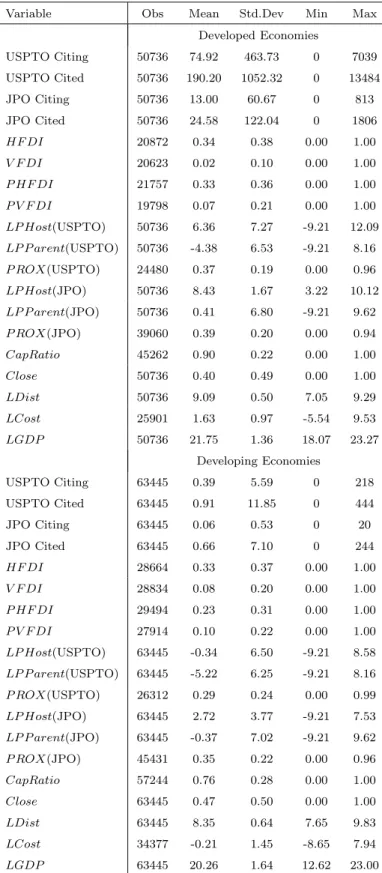
Table A2 shows the descriptive statistics of variables. Table A3 shows the correlations among variables.
4
Empirical Results
In this section, we report our estimation results. We first show the basic findings by the negative binomial model. We then report the results by the endogenous switching model and discuss whether the endogeneity issue matters in our analysis. Finally, we discuss the robustness of our findings by showing the results of alternative estimations with additional explanatory variables. We also show the results using JPO patent data, in addition to USPTO data.
4.1
Basic findings
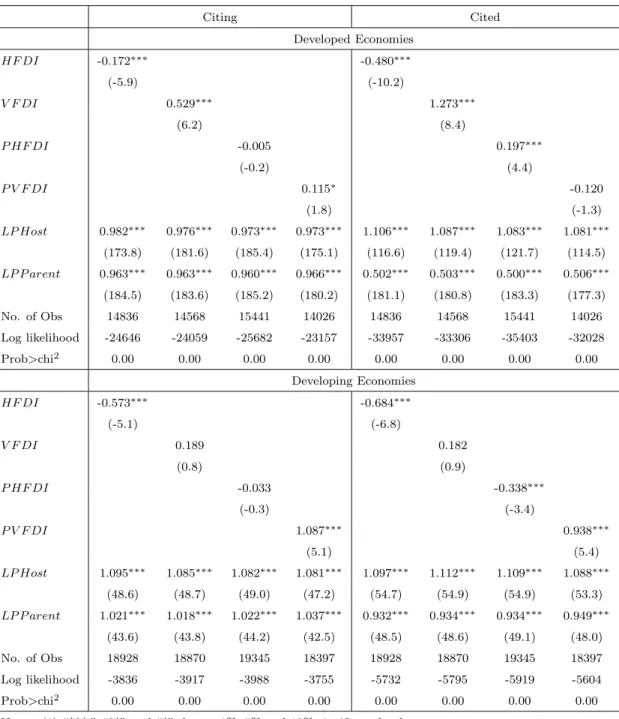
We first estimate Eq. (1) by the negative binomial model. The results are reported in Table 3. The upper panel of Table 3 shows the estimated results for the subsample of developed economies. We observe that the estimates ofHF DIare significant and negative, whereas they are significantly positive for V F DI, both for the citing and cited. As for P HF DI, the estimated coefficient is insignificant for the citing, and significantly positive for the cited. In contrast, the coefficient of P V F DI reveals significant and positive for the citing and insignificant for the cited.
The lower panel of Table 3 presents the estimated results for the subsample of developing economies. Unlike the case of the developed economies, only the coefficients for P V F DI show significantly pos-itive, whereas the coefficients of the other types of FDI reveal negative or insignificant effects on the citing as well as the cited.
These results show that an increase in the degree of the “pure” vertical FDI has a significantly positive effect on technology spillovers in both directions between Japanese parent companies and their host countries if Japanese MNEs invest in high-income countries. This implies that vertical FDI may play a dominant role in technology spillovers with mutual effects in developed economies. When middle- and low-income countries host Japanese MNEs, on the other hand, an increase in the “partially” vertical FDI has a significantly positive effect on the number of patent citations in both directions between the Japanese parent companies and the firms in their host countries.
4.2
Estimating with an endogenous switching model
To deal with potential endogeneity issues, we simultaneously estimate an endogenous switching model described by Eqs. (2) and (3) for technology spillovers and a probit model based on Eq. (4) for the decision on FDI types. The estimated results are summarized in Tables 4 and 5. Table 4 shows the results for the subsample of developed economies and Table 5 shows those for the subsample of developing economies.
Columns 9 and 11 in Table 5 show that both of LDistand LGDP positively contribute to the choice of “pure” horizontal FDI (DHF DI) and “partially” horizontal FDI (DP HF DI) for the subsample of developing economies. As shown in columns 10 and 12 in Table 5, on the other hand, the coefficients ofLDistandLCostturn out to be significantly negative for both “pure” vertical FDI (DV F DI) and “partially” vertical FDI (DP V F DI). These results are quite consistent with the findings in Fukao and Wei (2008). Thus, horizontal and vertical FDI to developing economies in our sample follow the standard theory of foreign investments and MNEs. By contrast, we observe different patterns for developed economies (Table 4). In particular, the coefficient ofLCostis significantly positive for both “pure” vertical FDI (DV F DI) and “partially” vertical FDI (DP V F DI). This implies that vertical FDI to developed economies is not motivated by wage cost saving.
In terms of the endogeneity between technology spillovers and the decision on FDI type, the estimates of ρ in the two tables imply strong significance against the null hypothesis in two cases out of eight estimations for developed economies and all cases for developing economies.16 Thus, neglecting the endogenous issues may result in biased and inconsistent estimators (Miranda and Rabe-Hesketh, 2006). The estimations in Table 4 for developed economies reveal thatDV F DI based on the endogenous switching model for both the citing and cited cases provides results that are similar to those based on the negative binomial model. For DP V F DI, the two models also provide similar results, suggesting that more local purchases and more sales in Japan may favor Japanese parents with more technology spillovers from the host economies. As observed forDHF DI andDP HF DI, the estimates turn insignificant or significantly negative for citing. Our findings imply that, for developed economies, “pure” vertical FDI is associated with significant technology spillovers, even controlling for endogenous issues. For developing economies, however, the estimated results of the switching model are insignificant or significantly negative for all types of FDI, suggesting no evidence of positive effects of FDI on technology spillovers between Japanese parent companies and developing host countries.
4.3
Alternative estimations
To check the robustness of the basic findings in Section 4.1, we conduct alternative estimations by adding explanatory variables. We includeP ROX (technological proximity),CapRatio(capital ratio), andClose(a dummy for industrial classification, which is one for the same sector and zero otherwise).
We also includeLDist(the logarithm of distance between Japan and host countries) andY earwhich captures the changes in citations.
Japanese parent companies and firms in their host countries may increase their citations of each other just because Japanese parent companies and firms in their host countries change the focus of their research activities in ways that bring them “closer” to each other in the technology space (Branstetter, 2006). To control for this issue, we include a measure of technological proximity (P ROX) in the regression. As suggested by Jaffe (1986) and Branstetter (2006),P ROX is constructed by
P ROXi= FiF
host,i
[(FiFi)(Fhost,iFhost,i )],
whereFi= (f1i,· · ·, fki) is a vector of the cumulative count of patents obtained by affiliatei’s parent firm in kth technical area17 and Fhost,i is a vector of the aggregate count of patens obtained by all firms in the host country in which affiliate iis located.
The literature on the role of affiliate ownership in technology spillovers is limited. There are a few studies focused on the correlation between productivity and the ownership of affiliates. Javorcik (2004) and Javorcik and Spatareanu (2008) found that the correlation of productivity with FDI is stronger if the affiliate is only partially, and not fully foreign owned, because joint ownership generates more technology transfer, and wholly owned affiliates employ more sophisticated technology that is out of reach of the average domestic supplier. As indicated by Keller (2009), however, the technology gap may be a key reason for differential effects for wholly versus partially owned affiliates. CapRatio, which is the share of affiliate capital owned by Japanese parent, is included to test the effects of ownership of affiliates on technology spillovers.
As for the dependent variable, we use patent citations at the USPTO, just as in Section 4.1. We also use patent citations at the JPO for comparison. The correlations among explanatory variables and the USPTO citations are presented in Table A2. As in Section 4.1, we employ the negative binomial model for our estimation.
The estimated results are presented in Tables 6 to 9.18 Table 6 (Table 7) shows the results for citations made (received) by Japanese parent firms to (from) the patents of host countries for the subsample of developed economies. In both Tables 6 and 7, the coefficients ofP ROX are significantly positive in all cases of citing and cited. These results confirm the findings in Branstetter (2006). The dummy Close reveals different effects on technology spillovers in the subsample of developed economies. The coefficients of Close are significantly positive in technology spillovers from host economies to Japanese MNEs (Table 6), which implies that Japanese parent companies cite more patents of host economies when their affiliates run a business that is the same as or close to that of the parents. However, this is not the case for technology spillovers from Japanese MNEs to host economies
17We aggregate the US patent classes into 44 fields derived by Schmoch et al.(2003).
18Here, we only report the estimated results with full sets of explanatory variables. The results with various
(Table 7), since the coefficients of Close are significantly negative in the case of patent citations at USPTO and are mostly insignificant in the case of patent citations at JPO. The ownership variable,
CapRatio, has positive coefficients that are mostly significant, which implies that a higher share of ownership of foreign affiliates by Japanese parent companies tends to facilitate technology spillovers in both directions between Japanese MNEs and their host economies.
The estimates ofHF DI,V F DI,P HF DI, andP V F DIfor USPTO give similar results to those we observed in Table 3, except forP HF DI andP V F DIin the cited. The estimates for JPO, on the other hand, indicate different results in many cases. Although we do not report the results in detail here, the significantly positive effect of P V F DI is not robust for some combinations of explanatory variables.
Table 8 (Table 9) shows the results for citations made (received) by Japanese parent firms to (from) the patents of host countries for the subsample of developing economies. As in the case of developed economies, the coefficients of P ROX are significantly positive in all cases. The coefficients of CapRatioare significantly positive for the case of USPTO, which is consistent with the result for high-income host economies. However, in the case of citations at JPO, the coefficients of CapRatio are insignificant for the citing (Table 8) and significantly negative for the cited (Table 9). Thus, a higher share of foreign ownership may not always facilitate technology spillovers in developing economies. Moreover, the coefficients of Close are either insignificant or significantly negative in Tables 8 and 9, which suggests that when the host country is a developing economy, the closeness of industrial classification between parent companies and their foreign affiliates does not necessarily facilitate technology spillovers. It may even hinder technology spillovers.
The estimates ofHF DI,V F DI,P HF DI, andP V F DI in Tables 8 and 9 are basically consistent with those in Table 3. That is, the significantly positive coefficient is only for P V F DI, though the citing at the JPO does not confirm this.
5
Conclusions
In this paper, we have investigated how the structure of MNEs’ activity affects technology spillovers between MNEs and their host countries by using detailed firm-level data of Japanese MNEs and patent citations data. We have proposed new specifications of FDI by using information on sales and purchases of foreign affiliates of MNEs. We define pure horizontal FDI as FDI with a high share of both purchase of intermediate inputs and sales of outputs in the local market. We also define pure vertical FDI as FDI with a high share of transactions (i.e., both purchases of intermediate inputs and sales of outputs) with the home country. Partially horizontal and partially vertical FDI are also defined.
pure vertical FDI has a significantly positive effect on technology spillovers as measured by patent ci-tations, in both directions between the host country and Japanese MNEs. In contrast, pure horizontal FDI has no significant effect or significantly negative effects on technology spillovers in either direction. It is clear that vertical FDI between developed countries is not based on factor price differentials. It may rather be motivated by utilizing technological advantage in the fragmented production process. If investing firms and local firms have a technological advantage at different stages of the production process, technology spillovers in both directions could occur by specializing in the production stage with technological advantages.
The results in this paper indicate that technology spillovers from FDI occur among developed economies. In particular, vertical FDI plays an important role in technology spillovers. Thus, devel-oped countries can gain knowledge flow from MNEs’ activities both as the home country and as the host country, when FDI involves the geographical fragmentation of the production process.
We also found that when the host country is a developing country, any types of FDI do not have positive effects on technology spillovers. One possible reason for this result is that we have focused on technology spillovers measured by patent citations. Since patent applications must be made to be counted as “spillovers,” indigenous firms in developing countries may not strongly benefit from technology spillovers in our definition. Another possible interpretation of the result is that it reflects the stringency of intellectual property rights (IPRs) protection in host countries. Branstetter, Fisman, and Foley (2006) and Wakasugi and Ito (2009) find that the stronger protection of IPRs in host countries has a positive effect on technology transfer from parent firms to their foreign affiliates. Nagaoka (2009) also finds a positive effect of stronger patent protection on expanding the scope of the recipients of technology transfer. Taking these empirical findings into account, the weaker protection of IPRs in developing countries in general may hinder technology spillovers from FDI in our measurement.
Since our findings are based on Japanese MNEs’ data, we suggest testing whether our findings could be applicable to other countries’ MNEs by examining detailed data of MNEs in other countries.
References
[1] Alfaro, Laura and Andrew Charlton. 2009. “Intra-industry foreign direct investment.”American Economic Review99(5): 2096–2119.
[2] Barrios, Salvador, Holger Gorg, and Eric Strobl. 2009. “Spillovers through backward linkages from multinationals: Measurement matters!” CEPR Discussion Paper No. 7491.
[3] Blalock, Garrick and Paul J. Gertler. 2008. “Welfare gains from foreign direct investment through technology transfer to local suppliers.”Journal of International Economics74(2): 402–421. [4] Bottazzi, L. and G. Peri. 2003. “Innovation and spillovers in regions: Evidence from European
patent data.”European Economic Review47(4): 687–710.
[5] Branstetter, Lee. 2006. “Is foreign direct investment a channel of knowledge spillovers? Evidence from Japan’s FDI in the United States.”Journal of International Economics68(2): 325–344. [6] Branstetter, Lee, Raymond Fisman, and C. Fritz Foley. 2006. “Do stronger intellectual property
rights increase international technology transfer? Empirical evidence from U.S. firm-level panel data.”Quarterly Journal of Economics121(1): 321–349.
[7] Cameron, A. Colin and Pravin K. Trivedi. 1998.Regression Analysis of Count Data. New York: Cambridge University Press.
[8] Fukao, Kyoji and Yuhong Wei. 2008. “How do the location determinants of vertical FDI and horizontal FDI differ?” Hi-Stat Discussion Paper Series No. 233. Institute of Economic Research, Hitotsubashi University.
[9] Goto, Akira and Kazuyuki Motohashi. 2007. “Development and innovation of a patent database.” The Web Side ofThe Institute of Intellectual Property (IIP).
[10] Grossman, Gene M., Elhanan Helpman, and Adam Szeidl. 2006. “Optimal integration strategies for the multinational firm.”Journal of International Economics70(1): 216–238.
[11] Hanson, Gordon H., Raymond J. Mataloni, Jr., and Matthew J. Slaughter. 2001. “Expansion strategies of U.S. multinational firms.” In D. Rodrik and S. Collins, eds.Brookings Trade Forum, 245–282.
[12] Hanson, Gordon H., Raymond J. Mataloni, Jr., and Matthew J. Slaughter. 2005. “Vertical pro-duction networks in multinational firms.”Review of Economics and Statistics87(4): 664–678. [13] Haruna, Shoji, Naoto Jinji, and Xingyuan Zhang. 2010. “Patent citations, technology diffusion,
and international trade: Evidence from Asian countries.” Journal of Economics and Finance 34(4): 365–390.
[14] Helpman, Elhanan. 1984. “A simple theory of international trade with multinational corpora-tions.”Journal of Political Economy92(3): 451–471.
[15] Helpman, Elhanan. 1985. “Multinational corporations and trade structure.”Review of Economic Studies52(3): 443-457.
[16] Helpman, Elhanan. 2006. “Trade, FDI, and the organization of firms.” Journal of Economic Literature44(3): 589–630.
[17] Helpman, Elhanan and Paul R. Krugman. 1985.Market Structure and Foreign Trade: Increasing Returns, Imperfect Competition, and the International Economy. Cambridge, MA: MIT Press. [18] Helpman, Elhanan, Marc J. Melitz, and Stephen R. Yeaple. 2004. “Export versus FDI with
heterogeneous firms.”American Economic Review 94(1): 300-316.
[19] Hu, Albert G.Z. and Adam B. Jaffe. 2003. “Patent citations and international knowledge flow: The cases of Korea and Taiwan.”International Journal of Industrial Organization21(6): 849–880. [20] Hummels, D. J., J. Ishii and K. M. Yi. 2001. “The nature and growth of vertical specialization
in world trade.”Journal of International Economics54(1): 75–96.
[21] Jaffe, Adam B. 1986. “Technological opportunity and spillovers of R&D: Evidence from firms’ patents, profits, and market value.”American Economic Review76(5): 984–1001.
[22] Jaffe, Adam B. and Manuel Trajtenberg. 1999. “International knowledge flows: Evidence from patent citations.”Economics of Innovation & New Technology 8(1/2): 105–136.
[23] Jaffe, Adam B., Manuel Trajtenberg, and Rebecca Henderson. 1993. “Geographic localization of knowledge spillovers as evidenced by patent citations.”Quarterly Journal of Economics 108(3): 577-598.
[24] Javorcik, Beata Smarzynska. 2004. “Does foreign direct investment increase the productivity of domestic firms? In search of spillovers through backward linkages.”American Economic Review 94(3): 605–627.
[25] Javorcik, Beata Smarzynska and M. Spatareanu. 2008. “To share or not to share: Does local participation matter for spillovers from foreign direct investment?”Journal of Development Eco-nomics85(1–2): 194–217.
[26] Jinji, Naoto, Xingyuan Zhang, and Shoji Haruna. 2010. “Trade Patterns and International Tech-nology Spillovers: Theory and Evidence from Patent Citations.” Graduate School of Economics, Kyoto University, Research Project Center Discussion Paper Series No. E-10-006.
[27] Keller, Wolfgang. 2004. “International technology diffusion.” Journal of Economic Literature 42(3): 752–782.
[28] Keller, Wolfgang. 2009. “International trade, foreign direct investment, and technology spillovers.” NBER Working Paper 15442.
[29] Keller, Wolfgang and Stephen R. Yeaple. 2009. “Multinational enterprises, international trade, and productivity growth: Firm-level evidence from the United States.”Review of Economics and Statistics91(4): 821–831.
[30] Kenkel, D. S. and J. V. Terza. 2001. “The effect of physician advice on alcohol consumption: Count regression with an endogenous treatment effect.”Journal of Applied Econometrics16(2): 165–184.
[31] MacGarvie, Megan. 2003. “International trade and knowledge diffusion: A survey of recent em-pirical evidence.” mimeo, School of management, Boston University.
[32] Mancusi, M. L. 2008. “International spillovers and absorptive capacity: A country cross-sector analysis based on patents and citations.”Journal of International Economics76(2): 155– 165.
[33] Markusen, James R. 1984. “Multinationals, multi-plant economies, and the gains from trade.” Journal of International Economics16(3–4): 205–226.
[34] Markusen, James R. 1995. “The boundaries of multinational enterprises and the theory of inter-national trade.”Journal of Economic Perspectives9(2): 169–189.
[35] Markusen, James R. 2002. Multinational Firms and the Theory of International Trade. Cam-bridge, M.A.: MIT Press.
[36] Markusen, James R. and Keith E. Maskus. 2002. “Discriminating among alternative theories of the multinational enterprise.”Review of International Economics10(4): 694–707.
[37] Markusen, James R. and Keith E. Maskus. 2003. “General-equilibrium approaches to the multina-tional enterprise: A review of theory and evidence.” In Choi, E.K. and J. Harrigan. eds.Handbook of International Trade. Oxford: Blackwell Publishing
[38] Markusen, James R. and Anthony J. Venables. 1998. “Multinational firms and the new trade theory.”Journal of International Economics46(2): 183–203.
[39] Markusen, James R. and Anthony J. Venables. 2000. “The theory of endowment, intra-industry and multi-national trade.”Journal of International Economics52(2): 209–234.
[40] Maurseth, P. B. and B. Verspagen. 2002. “Knowledge spillovers in Europe: A patent citations analysis.”Scandinavian Journal of Economics104(4): 531–545.
[41] Miranda, Alfonso and Sophia Rabe-Hesketh. 2006. “Maximum likelihood estimation of endoge-nous switching and sample selection models for binary, ordinal and count variables.” The Stata Journal6(3): 285–308.
[42] Nagaoka, Sadao. 2009. “Does strong patent protection facilitate international technology transfer? Some evidence from licensing contracts of Japanese firms.”Journal of Technology Transfer34(2): 128–144.
[43] Schmoch, Ulrich, Francoise Laville, Pari Patel, and Frietsch Rainer. 2003. “Linking technology areas to industrial sectors.” Final Report to the European Commission, DG Research.
[44] Singh, Jasjit. 2007. “Asymmetry of knowledge spillovers between MNEs and host country firms.” Journal of International Business Studies38(5): 764–786.
[45] Todo, Yasuyuki. 2006. “Knowledge spillovers from foreign direct investment in R&D: Evidence from Japanese firm-level data.”Journal of Asian Economics 17(6): 996–1013.
[46] Todo, Yasuyuki and Koji Miyamoto. 2006. “Knowledge spillovers from foreign direct investment and the role of local R&D activities: Evidence from Indonesia.” Economic Development and Cultural Change55(1): 173–200.
[47] Venables, Anthony J. 1999. “Fragmentation and multinational production.”European Economic Review43(4–6): 935–945.
[48] Wakasugi, Ryuhei and Banri Ito. 2009. “The effects of stronger intellectual property rights on technology transfer: Evidence from Japanese firm-level data.” Journal of Technology Transfer 34(2): 145–158.
[49] Wooldrige, J. M. 2002.Econometric Analysis of Cross Section and Panel Data. Cambridge, MA: MIT Press.
[50] Yeaple, Stephen Ross. 2003a. “The complex integration strategies of multinationals and cross country dependencies in the structure of foreign direct investment.” Journal of International Economics 60(2): 293–314.
[51] Yeaple, Stephen Ross. 2003b. “The role of skill endowments in the structure of U.S. outward foreign direct investment.”Review of Economics and Statistics 85(3): 726–734.
[52] Yeaple, Stephen Ross. 2009. “Firm heterogeneity and the structure of U.S. multinational activity.” Journal of International Economics78(2): 206–215.
0 1 2 3 4 5
Developing economies Developed economies excluding US US
mean of log no. of USPTO citing mean of log no. of USPTO cited
Source: The authors’ calculation from the METI survey.
Table 1: Top 30 FDI Host Countries/Economies in 2000
Economy No. of affiliates Economy No. of affiliates Economy No. of affiliates United States 2,172 Australia 342 India 99 China 1,246 Korea 257 Vietnam 97 Thailand 692 Netherlands 248 Belgium 80 Singapore 613 France 216 New Zealand 74 Hong Kong 585 Canada 196 Chile 42 United Kingdom 509 Brazil 193
Malaysia 477 Panama 138 Taiwan 460 Mexico 132 Indonesia 431 Italy 114 Germany 363 Spain 100
Table 2: Sales and Purchases Ratios of Affiliates Abroad 1995 1996 1997 1998 1999 2000 2001 2002 2003 Developed Economies ShSaHFDI 0.761 0.747 0.735 0.757 0.761 0.759 0.751 0.752 0.745 ShSaVFDI 0.128 0.125 0.126 0.127 0.126 0.122 0.124 0.106 0.107 ShPuHFDI 0.530 0.493 0.474 0.501 0.481 0.481 0.490 0.464 0.462 ShPuVFDI 0.403 0.398 0.405 0.413 0.424 0.421 0.420 0.404 0.403 Developing Economies ShSaHFDI 0.655 0.649 0.612 0.639 0.644 0.636 0.630 0.631 0.631 ShSaVFDI 0.208 0.197 0.211 0.222 0.212 0.212 0.228 0.204 0.208 ShPuHFDI 0.524 0.482 0.464 0.512 0.494 0.493 0.509 0.530 0.536 ShPuVFDI 0.392 0.395 0.401 0.405 0.407 0.402 0.403 0.370 0.369 Source: The authors’ calculation from the METI survey data from 1995 to 2003.
Table 3: Negative Binomial Estimates for USPTO Citations Citing Cited Developed Economies HF DI -0.172∗∗∗ -0.480∗∗∗ (-5.9) (-10.2) V F DI 0.529∗∗∗ 1.273∗∗∗ (6.2) (8.4) P HF DI -0.005 0.197∗∗∗ (-0.2) (4.4) P V F DI 0.115∗ -0.120 (1.8) (-1.3) LP Host 0.982∗∗∗ 0.976∗∗∗ 0.973∗∗∗ 0.973∗∗∗ 1.106∗∗∗ 1.087∗∗∗ 1.083∗∗∗ 1.081∗∗∗ (173.8) (181.6) (185.4) (175.1) (116.6) (119.4) (121.7) (114.5) LP P arent 0.963∗∗∗ 0.963∗∗∗ 0.960∗∗∗ 0.966∗∗∗ 0.502∗∗∗ 0.503∗∗∗ 0.500∗∗∗ 0.506∗∗∗ (184.5) (183.6) (185.2) (180.2) (181.1) (180.8) (183.3) (177.3) No. of Obs 14836 14568 15441 14026 14836 14568 15441 14026 Log likelihood -24646 -24059 -25682 -23157 -33957 -33306 -35403 -32028 Prob>chi2 0.00 0.00 0.00 0.00 0.00 0.00 0.00 0.00 Developing Economies HF DI -0.573∗∗∗ -0.684∗∗∗ (-5.1) (-6.8) V F DI 0.189 0.182 (0.8) (0.9) P HF DI -0.033 -0.338∗∗∗ (-0.3) (-3.4) P V F DI 1.087∗∗∗ 0.938∗∗∗ (5.1) (5.4) LP Host 1.095∗∗∗ 1.085∗∗∗ 1.082∗∗∗ 1.081∗∗∗ 1.097∗∗∗ 1.112∗∗∗ 1.109∗∗∗ 1.088∗∗∗ (48.6) (48.7) (49.0) (47.2) (54.7) (54.9) (54.9) (53.3) LP P arent 1.021∗∗∗ 1.018∗∗∗ 1.022∗∗∗ 1.037∗∗∗ 0.932∗∗∗ 0.934∗∗∗ 0.934∗∗∗ 0.949∗∗∗ (43.6) (43.8) (44.2) (42.5) (48.5) (48.6) (49.1) (48.0) No. of Obs 18928 18870 19345 18397 18928 18870 19345 18397 Log likelihood -3836 -3917 -3988 -3755 -5732 -5795 -5919 -5604 Prob>chi2 0.00 0.00 0.00 0.00 0.00 0.00 0.00 0.00 Notes: (1) “***,” “**” and “*” denote 1%, 5% and 10% significant level.
(2) The values in the parentheses are t-statistics. (3) Constant terms are included in the estimations.
T a bl e 4 : E ndogenous Swi tc hi ng E st im ates fo r U SPTO Ci tati ons for D e v e lo p e d E conom ies S w it ch in g (c it in g ) S w it ch in g (c it e d ) DHF D I DVF D I DPH FD I DPV FD I DHF D I -0. 084 -0. 107 (-1. 1) (-1. 3) DVF D I 0. 147 ∗∗∗ 0. 509 ∗∗ (8. 6 ) (2. 3 ) DPH FD I -0 .0 9 9 ∗∗∗ 0. 062 (-11. 0) (1. 3 ) DPV FD I 0. 151 ∗∗∗ 0. 197 (2. 8 ) (1. 5 ) LP H os t 1. 023 ∗∗∗ 1. 020 ∗∗∗ 1. 026 ∗∗∗ 1. 018 ∗∗∗ 1. 138 ∗∗∗ 1. 134 ∗∗∗ 1. 134 ∗∗∗ 1. 133 ∗∗∗ (147. 9) (153. 2) (175. 4) (158. 6) (116. 8) (126. 2) (129. 2) (122. 4) L PPa re nt 0. 997 ∗∗∗ 0. 999 ∗∗∗ 1. 004 ∗∗∗ 0. 999 ∗∗∗ 0. 644 ∗∗∗ 0. 647 ∗∗∗ 0. 642 ∗∗∗ 0. 649 ∗∗∗ (169. 4) (187. 5) (256. 1) (167. 2) (96. 9) (96. 9) (98. 7) (95. 5) LD is t -0 .1 8 9 ∗∗∗ -0 .4 1 1 ∗∗∗ -0 .1 8 9 ∗∗∗ -0. 411 ∗∗∗ -0 .1 9 0 ∗∗∗ -0 .4 1 6 ∗∗∗ -0. 192 ∗∗∗ -0 .4 0 9 ∗∗∗ -0. 134 ∗∗∗ -0. 397 ∗∗∗ 0. 006 -0. 382 ∗∗∗ (-8. 1) (-13. 8 ) (-8 .1 ) (-13. 8) (-8. 1) (-13. 6 ) (-8 .3 ) (-1 3. 6) (-7. 2) (-16. 0) (0. 3 ) (-1 5. 5) LGD P 0. 251 ∗∗∗ 0. 047 ∗∗∗ 0. 251 ∗∗∗ 0. 047 ∗∗∗ 0. 251 ∗∗∗ 0. 047 ∗∗∗ 0. 252 ∗∗∗ 0. 047 ∗∗∗ 0. 226 ∗∗∗ 0. 061 ∗∗∗ 0. 084 ∗∗∗ 0. 028 ∗∗ (23. 5) (2. 9) (23. 5) (2. 9) (23. 5) (2. 9) (23. 5) (2. 9) (26. 1) (4. 3) (10. 8) (2. 0) LC os t -0 .1 9 5 ∗∗∗ 0. 094 ∗∗∗ -0 .1 9 5 ∗∗∗ 0. 094 ∗∗∗ -0 .1 9 5 ∗∗∗ 0. 094 ∗∗∗ -0. 194 ∗∗∗ 0. 093 ∗∗∗ -0. 208 ∗∗∗ 0. 095 ∗∗∗ -0 .1 7 2 ∗∗∗ 0. 106 ∗∗∗ (-13. 4 ) (4. 2) (-13. 4) (4. 2 ) (-13. 3 ) (4. 2) (-13. 3 ) (4. 2) (-18. 6 ) (5. 2) (-16. 0 ) (5. 8) σ 0. 651 ∗∗∗ 0. 648 ∗∗∗ 0. 658 ∗∗∗ 0. 646 ∗∗∗ 1. 487 ∗∗∗ 1. 484 ∗∗∗ 1. 483 ∗∗∗ 1. 487 ∗∗∗ (51. 9) (52. 6) (61. 8) (50. 2) (60. 6) (60. 0) (62. 0) (58. 7) ρ -0. 013 0. 058 -0. 015 0. 078 -0. 020 -0. 101 ∗ -0. 082 ∗∗∗ 0. 018 (-0. 1) (1. 0 ) (-0 .4 ) (1. 1) (-0. 8) (-1. 8) (-5. 2) (0. 6 ) No . o f O b s 35247 35247 35247 35247 35247 35247 35247 35247 17958 17776 18803 17014 L o g lik e lih o o d -31452 -39223 -25915 -24942 -33610 -32515 -40635 -32285 -10718 -3415 -12124 -3448 Pr ob > ch i 2 0. 00 0. 00 0. 00 0. 00 0. 00 0. 00 0. 00 0. 00 0. 00 0. 00 0. 00 0. 00 N otes : (1) “***, ” “**” and “*” d enote 1% , 5% and 10% si gni fi can t le v e l. (2) T he v a lu es in the p ar en thes es ar e t-stati st ics . (3) C ons tan t ter m s ar e incl uded in the es ti m ati ons . (4) DHF D I , DVF D I , DPH FD I and DPV FD I ar e dum m y v al u e for the four typ es of FD I.
T a bl e 5 : E ndogenous Swi tc hi ng E st im ates fo r U SPTO Ci tati ons for D e v e lo pi ng Econom ie s S w it ch in g (c it in g ) S w it ch in g (c it e d ) DHF D I DVF D I DPH FD I DPV FD I DHF D I -1 .0 2 8 ∗∗∗ -0 .8 8 0 ∗∗∗ (-4. 8) (-3. 2) DVF D I -0. 825 ∗∗∗ -1 .4 7 3 ∗∗∗ (-3. 7) (-5. 3) DPH FD I -0. 258 ∗∗ -0. 352 ∗∗∗ (-2. 3) (-3. 0) DPV FD I -0. 589 ∗∗∗ -0. 180 (-3. 6) (-1. 0) LP H os t 1. 190 ∗∗∗ 1. 188 ∗∗∗ 1. 193 ∗∗∗ 1. 194 ∗∗∗ 1. 214 ∗∗∗ 1. 216 ∗∗∗ 1. 224 ∗∗∗ 1. 219 ∗∗∗ (39. 3) (41. 8) (41. 2) (40. 2) (49. 2) (50. 1) (51. 6) (49. 3) L PPa re nt 1. 161 ∗∗∗ 1. 152 ∗∗∗ 1. 164 ∗∗∗ 1. 160 ∗∗∗ 1. 023 ∗∗∗ 1. 022 ∗∗∗ 1. 030 ∗∗∗ 1. 033 ∗∗∗ (39. 2) (40. 4) (40. 7) (39. 3) (27. 8) (29. 0) (28. 6) (27. 7) LD is t 0. 101 ∗∗∗ -0. 357 ∗∗∗ 0. 097 ∗∗∗ -0. 359 ∗∗∗ 0. 101 ∗∗∗ -0 .3 3 5 ∗∗∗ 0. 097 ∗∗∗ -0. 358 ∗∗∗ 0. 127 ∗∗∗ -0 .3 8 2 ∗∗∗ 0. 245 ∗∗∗ -0 .3 5 3 ∗∗∗ (6. 2) (-17. 0) (6. 0) (-17. 0) (5. 0) (-12. 5) (4. 9) (-14. 3) (7. 7 ) (-15. 3) (15. 2) (-14. 8 ) LGD P 0. 142 ∗∗∗ -0. 015 0. 137 ∗∗∗ -0 .0 1 7 ∗ 0. 143 ∗∗∗ 0. 009 0. 135 ∗∗∗ -0. 014 0. 131 ∗∗∗ -0 .0 4 1 ∗∗∗ 0. 110 ∗∗∗ -0 .0 7 2 ∗∗∗ (16. 4) (-1. 5) (16. 2) (-1. 8) (1 2 .4 ) (0 .7 ) (1 3 .2 ) (-1 .2 ) (17. 8) (-4. 4) (15. 4) (-7. 8) LC os t 0. 047 ∗∗∗ -0. 203 ∗∗∗ 0. 048 ∗∗∗ -0. 203 ∗∗∗ 0. 047 ∗∗∗ -0 .1 9 7 ∗∗∗ 0. 049 ∗∗∗ -0. 203 ∗∗∗ 0. 035 ∗∗∗ -0 .2 1 4 ∗∗∗ 0. 031 ∗∗∗ -0 .1 8 3 ∗∗∗ (7. 2) (-26. 9) (7. 5) (-27. 1) (6. 2) (-18. 8) (6. 3) (-21. 7) (5. 2) (-27. 3) (4. 7) (-23. 8) σ 1. 400 ∗∗∗ 1. 423 ∗∗∗ 1. 373 ∗∗∗ 1. 417 ∗∗∗ 1. 506 ∗∗∗ 1. 640 ∗∗∗ 1. 488 ∗∗∗ 1. 531 ∗∗∗ (22. 4) (24. 2) (22. 9) (22. 6) (33. 5) (26. 7) (34. 7) (34. 7) ρ 0. 273 ∗∗∗ 0. 438 ∗∗∗ -0. 098 ∗∗ 0. 331 ∗∗∗ 0. 166 ∗ 0. 703 ∗∗∗ -0. 101 ∗∗∗ 0. 243 ∗∗∗ (3. 7 ) (7. 3) (-2. 3) (6. 5 ) (1 .9 ) (1 7 .3 ) (-2 .7 ) (5 .2 ) No . o f O b s 41080 41080 41080 41080 41080 41080 41080 41080 24590 24747 25390 23894 L o g lik e lih o o d -13354 -9916 -13507 -9762 -15279 -11801 -15457 -11642 -14992 -9438 -16029 -9905 Pr ob > ch i 2 0. 00 0. 00 0. 00 0. 00 0. 00 0. 00 0. 00 0. 00 0. 00 0. 00 0. 00 0. 00 N otes : (1) “***, ” “**” and “*” denote 1% , 5% and 10% si gni fican t lev el . (2) T he v a lu es in the p ar en thes es ar e t-stati st ics . (3) C ons tan t ter m s ar e incl uded in the es ti m ati ons . (4) DHF D I , DVF D I , DPH FD I and DPV FD I ar e dum m y v al u e for the four typ es of FD I.
T abl e 6: A lt er nati v e Es ti m ati ons for Ci tati ons M ade b y M N E s to D ev el op ed Econom ie s USPTO J PO USPTO J PO USPTO J PO USPTO J PO HF D I -0. 125 ∗∗∗ -0 .0 6 4 ∗ (-4. 0) (-2. 0) VF D I 0. 387 ∗∗∗ 0. 251 ∗∗ (4. 0) (2. 3) PH FD I -0. 026 0. 079 ∗∗∗ (-0. 9) (2. 6 ) PV FD I 0. 151 ∗∗ 0. 175 ∗∗∗ (2. 1) (2. 6) LP H os t 0. 937 ∗∗∗ 1. 036 ∗∗∗ 0. 935 ∗∗∗ 1. 039 ∗∗∗ 0. 930 ∗∗∗ 1. 033 ∗∗∗ 0. 933 ∗∗∗ 1. 035 ∗∗∗ (138. 9) (96. 0) (144. 5) (98. 6) (148. 2) (101. 6) (140. 1) (95. 5) L PPa re nt 0. 944 ∗∗∗ 0. 876 ∗∗∗ 0. 944 ∗∗∗ 0. 883 ∗∗∗ 0. 939 ∗∗∗ 0. 878 ∗∗∗ 0. 945 ∗∗∗ 0. 884 ∗∗∗ (153. 9) (124. 3) (153. 5) (124. 0) (154. 8) (126. 5) (150. 7) (121. 6) PR O X 0. 904 ∗∗∗ 1. 863 ∗∗∗ 0. 903 ∗∗∗ 1. 828 ∗∗∗ 0. 963 ∗∗∗ 1. 907 ∗∗∗ 0. 926 ∗∗∗ 1. 828 ∗∗∗ (13. 6) (29. 1) (13. 4) (28. 2) (14. 8) (30. 4) (13. 6) (27. 7) Ca pR at io 0. 270 ∗∗∗ 0. 245 ∗∗∗ 0. 222 ∗∗∗ 0. 230 ∗∗∗ 0. 295 ∗∗∗ 0. 226 ∗∗∗ 0. 287 ∗∗∗ 0. 257 ∗∗∗ (4. 4) (3. 7) (3. 6) (3. 5) (4. 9) (3. 5) (4. 6) (3. 8) Cl os e 0. 075 ∗∗∗ 0. 060 ∗∗ 0. 069 ∗∗∗ 0. 053 ∗∗ 0. 070 ∗∗∗ 0. 054 ∗∗ 0. 067 ∗∗∗ 0. 063 ∗∗ (3. 3) (2. 5) (3. 0) (2. 2) (3. 1) (2. 3) (2. 9) (2. 5) LD is t 0. 140 ∗∗∗ 0. 206 ∗∗∗ 0. 158 ∗∗∗ 0. 210 ∗∗∗ 0. 142 ∗∗∗ 0. 209 ∗∗∗ 0. 129 ∗∗∗ 0. 192 ∗∗∗ (5. 4) (8. 1) (5. 8) (7. 9) (5. 5) (8. 4) (4. 9) (7. 5) Ye ar 0. 000 -0. 045 ∗∗∗ 0. 003 -0. 042 ∗∗∗ -0 .0 0 1 -0 .0 4 6 ∗∗∗ 0. 001 -0. 042 ∗∗∗ (0 .0 ) (-1 0 .6 ) (0 .6 ) (-9 .8 ) (-0 .2 ) (-1 1 .2 ) (0 .3 ) (-9 .6 ) No . o f O b s. 6505 10539 6330 10297 6835 10961 6047 9914 L o g lik e lih o o d -20903 -20251 -20335 -19798 -21692 -20985 -19616 -19068 Pr ob > ch i 2 0. 00 0. 00 0. 00 0. 00 0. 00 0. 00 0. 00 0. 00 N otes : (1) “***, ” “**” and “*” denote 1% , 5% and 10% si gni fi can t le v e l. (2) T he v a lu es in the p ar en thes es ar e t-stati st ics . (3) C ons tan t ter m s ar e incl uded in the es ti m ati ons .