Global Optimum Distance Evaluated Particle
Swarm Optimization for Combinatorial
Optimization Problem
Ainizar Mustapa, Zuwairie Ibrahim, Zulkifli Md Yusof, Ismail Ibrahim
Faculty of Electrical and Electronics Engineering
Universiti Malaysia Pahang
26600 Pekan, Malaysia
Abstract—Based on the mechanism of Particle Swarm Optimization (PSO) measurement process, every particle estimates the global minimum/maximum. Particles communicate among them to update and improve the solution during the search process. However, the PSO is only capable to solve continuous numerical optimization problem. In order to solve discrete optimization problems, a new global optimum distance evaluated approach is proposed and combined with PSO. A set of traveling salesman problems (TSP) are used to evaluate the performance of the proposed global optimum distance evaluated PSO (GO-DEPSO). Based on the analysis of experimental results, we found that the proposed DEPSO is capable to solve discrete optimization problems using TSP.
Keywords—Particle Swarm Optimization; Distance Evaluated; Combinatorial; Traveling Salesman Problems
1.
I
NTRODUCTIONOver the last decades there has been a growing interest in algorithms inspired by the observation of natural phenomenon. It has been shown by many researches that these algorithms are good replacement as tools to solve complex computational problems. Various heuristic approaches have been adopted by researches including genetic algorithm, tabu search, simulated annealing, ant colony and particle swarm optimization. PSO can be classified in swarm intelligence areas, where developed by Kennedy and Eberhart in 1995. Since 1995, PSO is being researched and utilized in different subjects by researches around the world. It is reported in the literature that the PSO technique can generate high-quality solution within shorter calculation time on some optimization problems.
PSO is motivated from the simulation of social behavior. This optimization approach update the population of individuals by applying an operator according to the fitness information obtained from the environment so that the individuals of the population can be expected to move towards better solution areas [1]. The PSO technique conducts searches using a population of particles, corresponding to individuals. Each particle tries to search the best position (state) with time in a multidimensional space and adjusts its position in light of its own experience and the experiences of its neighbors, including the current velocity and position and the best previous position experienced by itself and its neighbors [1].
The origin version of the particle swarm has been operated in continuous space. But many optimization problems are set in combinatorial/discrete space. There are a lot of discrete optimization problems in literature and real-world applications. Examples of discrete optimization problems are assembly sequence planning [2-3], DNA sequence design [4-5], VLSI routing [6-7], robotics drill route problem [8], and airport gate allocation problem [9].
This paper is organized as follows. At first, PSO will be briefly reviewed followed by a detail description of the proposed global optimum distance evaluated PSO (GO-DEPSO) algorithm. Experimental set up will be explained and results will be shown and discussed. Lastly, a conclusion will be provided at the end of this paper.
2.
P
ARTICLES
WARMO
PTIMIZATIONSimilar to evolutionary algorithms, the PSO technique conducts searches using a population of particles, corresponding to individuals. Each particle represents a candidate solution to the problem at hand. In a PSO algorithm, particles change their
Bird flocking optimizes a certain objective function. Each particle (individual) knows its best value so far and its position (called as personal best or pbestifor ithparticle). The information corresponds to personal experiences of each particle. Moreover, each
particle knows the best value so far in the group among (known as global best or gbest ). Namely, each particle tries to modify its position xi) using the following information:
• the distance between the current position and pbest. • the distance between the current position and gbest.
This modification can be represented by the concept of velocity ( vi ). The velocity and the position of each particle in a d
-dimensional space, can be modified by the following equations [1]:
vi k+1 = w.vi k + c1.r1.(pbesti – si k) + c2.r2.(gbest – si k) (1)
si k+1 = si k + vi k+1 (2)
where r1 and r2 are two random functions in the range [0,1], c1 and c2 are cognitive and social coefficient accordingly and w is
the inertia weight. si (si1, si2,..., sik+1 ) represents the position of ithparticle. The rate of the position change (velocity) for
particle i is represented as vi vi1, vi2,..., vik+1). The best previous position (the position giving the best fitness value) of the ith
particle is recorded and represented as pbesti ( pbesti1, pbesti2,..., pbestid).
As a particle moves through the search space, it compares its fitness value at the current position to the best fitness value it has ever attained at any time up to the current time. There are two PSO models known as global model (or gbest) and personal model (or pbest). The equations (1) and (2) represent global model. In the global model, all the particles in the swarm interact with the gbest while in the personal model, each particle interact with the local best particle (pbestifor ithparticle).
3.
G
LOBALO
PTIMUMD
ISTANCE EVALUATEDP
ARTICLES
WARMO
PTIMIZATIONIn population-based search algorithm, generally, particles are randomly positioned in the search space. Then, the particles move in the search space to find global minimum or maximum. During the beginning of the search, exploration is preferred to make sure the search covers almost all regions in the search space. In this stage of search process, the position between articles is normally far with each other. As the search process continues, during the end of the search, exploration is no longer preferred because fine-tuning or exploitation is more preferred. During exploitation, particles becomes closer to each other and hence, the distance among them decreases.
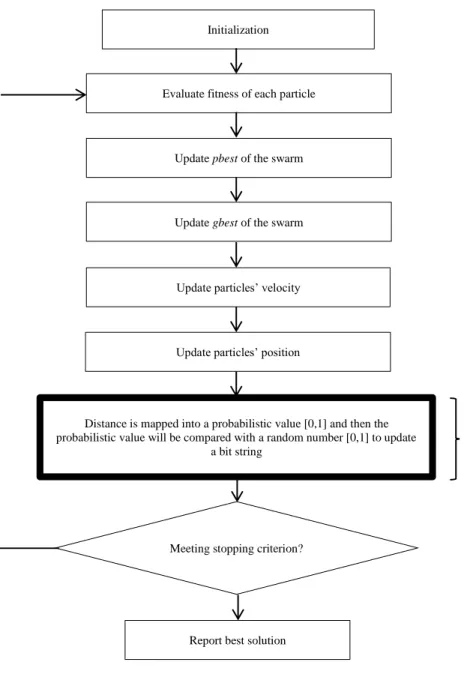
The position of particles in a search space during a typical search process is illustrated in Figure-2, Figure-3, and Figure-4. Normally, as the iteration continues, the distance between particles and the best-so-far solution decreases. This distance plays an important role in the proposed global optimum distance evaluated particle swarm optimization algorithm (GO-DEPSO). In GO-DEPSO, the distance is mapped into a probabilistic value [0,1] and then the probabilistic value will be compared with a random number [0,1] to update a bit string or solution to a combinatorial optimization problem. In detail, most of the calculations in the proposed GO-DEPSO are similar to the original PSO. Modifications are needed only during initialization and generation of solution to combinatorial optimization problem.
During the initialization of particles, in PSO, the states of each particle is given randomly. An additional initialization is introduced in GO-DEPSO. Every particle is associated with a random bit string as well. The length of the bit string is problem dependent and subjected to the size of the problem. Thus, 2 types of variables are associated with an particle in PSO. They are continuous variable, x, which is produced as estimated value of PSO (also similar to the position of particle in a search space), and a bit string, Σ, which is used to represent solution to a combinatorial optimization problem.
In GO-DEPSO, for a particular dth dimension, the distance between an ith agent to the best-so-far solution at iteration t can be
calculated as follows:
Di k (t) = xi k (t) – x kbest-so-far (t) (3)
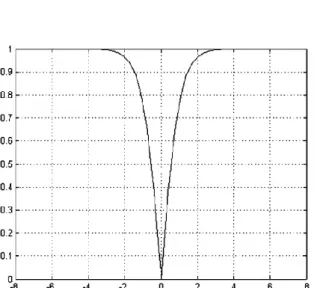
In binary gravitational search algorithm (BGSA) [12], a function, as shown in Figure-5, is used to map a velocity value into a probabilistic value within interval [0,1]. Similar function is used in GO-DEPSO. This distance value, Di k (t) , is mapped to a
probabilistic value within interval [0,1] using a probability function, S(Di k (t)), as follows:
S (Di k(t) ) = |tanh (Di k(t))| (4)
Yes No
Initialization
Evaluate fitness of each particle
Update particles’ velocity
Update particles’ position
Report best solution Meeting stopping
criterion? Update pbest of the swarm
Update gbest of the swarm
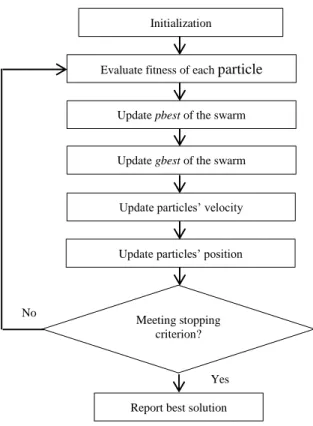
Figure 1: PSO algorithm
Particle Best-so-far solution
Figure 2: Position of particles at the beginning of the search.
Particle Best-so-far solution
Particle Best-so-far solution
Figure 4: Position of particles at the end of the search.
Figure 5: Probabilistic function used in [12]
if rand < S (Di k(t) )
then Σid (t+1) = complement Σid (t+1)
else Σid (t+1) = Σid (t+1) (5)
The GO-DEPSO algorithm is illustrated in Figure-6.
The GO-DEPSO is applied to solve a set of TSP. The objective of TSP is to find the shortest distance from a start city to an end city while visiting every city not more than once. In this paper, 10 instances of TSPs are considered, from the size of 52 cities to 2103 cities, as shown in Table-1. These problems were taken from TSPLib [10]. Experimental setting for GO-DEPSO is shown in Table-2. For benchmarking purpose, 1 additional experiment was considered, which is based on the well-established distance-evaluated simulated kalman filter (DESKF) [13]. Experimental setting for DESKF is shown in Table-3. In all experiments, the number of runs, the number of particles or agents, and the number of iterations are 50, 30, and 1000, respectively.
5.
E
XPERIMENTS,
R
ESULTS ANDD
ISCUSSIONThe proposed GO-DEPSO is compared with DESKF. The average performances of the algorithms are presented in Table-4. The numbers written in bold show the best performance. Based on these average performances, Wilcoxon signed rank test is performed. The result of the test is tabulated in Table-5.
Based on these average performances, Wilcoxon signed rank test is performed. The result of the test is tabulated in Table-5. The level of significant chosen here is 0.05. It is found that statistically no significant difference is found between the roposed GO-DEPSO and DESKF. Both of the algorithms perform as good as each other in solving TSP problems. Examples of convergence curves of GO-DEPSO are shown in Figure-7 and Figure-8.
Figure 6: GO-DEPSO algorithm
6.
C
ONCLUSIONThis paper reports a research on using a modified PSO for solving combinatorial optimization problems. Based on the proposed GO-DEPSO, the distance between a particle to the best-so-far solution is evaluated to update a binary value. Experimental result and analysis showed the potential of GO-DEPSO. The GO-DEPSO performed as good as DESKF.
7.
R
EFERENCE[1] H. Nezamabadi-pour, M. Rostami-shahrbabaki, M.M. Farsangi, "Binary Particle Swarm Optimization: challenges and New Solutions", The Journal of Computer Society of Iran (CSI) On Computer Science and Engineering (JCSE), vol. 6, no. (1-A), pp. 21-32, 2008.
[2] Mukred J.A.A, Ibrahim Z., Ibrahim I., Adam A., Wan K., Yusof Z.M., and Mokhtar N. 2012. "A Binary Particle Swarm Optimization Approach to Optimize Assembly Sequence Planning", Advance Science Letters, Vol. 13, pp. 732-738.
Initialization
Evaluate fitness of each particle
Update particles’ velocity
Update particles’ position Update pbest of the swarm
Update gbest of the swarm
Meeting stopping criterion?
Report best solution
Distance is mapped into a probabilistic value [0,1] and then the probabilistic value will be compared with a random number [0,1] to update
a bit string
Distance Evaluation
Table-1.
Property of the test problems.
Table-2.
Experimetal setting parameters GO-DEPSO.
Parameters
Value
rand
[0,1]
ɷ
0.9 - 0.4
v
-4 - 4
c
12
c
22
Table-3.
Experimetal setting parameters DESKF.
Parameters
Value
P
1000
Q
0.5
R
0.5
rand
[0,1]
x
min-100
x
max100
TSP Index
Name
Size
1
Berlin52
52
2
Bier127
127
3
Ch130
130
4
Ch150
150
5
D198
198
6
D493
493
7
D657
657
8
D1291
1291
9
D2103
2103
10
DSJ1000
1000
Table-4.
Average performance.
TSP Index
GO-DEPSO
DESKF
1 Berlin52
22903.03
22932.2
2 Bier127
545544.72
544106.72
3 Ch130
39290.75
39254.37
4 Ch150
46187.73
46270.79
5 D198
157253.68
157618.45
6 D493
412033.06
411998.9
7 D657
795856.84
796175.26
8 D1291
1643490.5
1645013.36
9 D2103
3124524.54
3123370
10 DSJ1000
523998219
524027900
Table-5.
Wilcoxon test result.
Comparison
R
+R
-GO-DEPSO vs DESKF
21
34
Figure-7. An example of convergence curve of GO-DEPSO for TSP index 1. Note that y-axis is the fitness value and x-axis is the iteration value.
Figure-8. An example of convergence curve of GO-DEPSO for TSP index 8. Note that y-axis is the fitness value and x-axis is the iteration value.
[3] Ibrahim I., Ibrahim Z., Ahmad H., Mat Jusof M.F, Yusof Z.M., Nawawi S.W., and Mubin M. 2015. "An Assembly Sequence Planning Approach with a Rule based Multi State Gravitational Search Algorithm", The International Journal of Advanced Manufacturing Technology, Vol. 79, pp. 1363-1376.
[4] Yakop F., Ibrahim Z., Zainal Abidin A.F., Yusof Z.M., Mohamad M.S., Wan K., and Watada J. 2012. "An Ant Colony System for Solving DNA Sequence Design Problem in DNA Computing", International of Innovative Computing, Information and Control, Vol. 8, No. 10, pp. 7329-7339.
[5] Ibrahim Z., Khalid N.K., Ibrahim I., Lim K.S., Bunyamin S., Yusof Z.M., and Muhammad M.S. 2011. "Function Minimization in DNA Sequence Design Based on Binary Particle Swarm Optimization". Journal Teknologi D (UTM), No. 54, pp. 331-342.
[6] Yusof Z.M., Zainal Abidin A.F., Salam M.N.A., Khalil K., Mukred J.A.A., Hani M.K., and Ibrahim Z. 2011. "A Binary Particle Swarm Optimization Approach for Buffer Insertion in VLSI Routing". International Journal of Innovative Management, Information and Production, Vol. 2, No. 3, pp. 34-39.
[7] Yusof. Z.M., Zainal Abidin A.F., Adam A., Khalil K., Mukred J.A.A., Mohamad M.S., Hani M.K., and Ibrahim Z. 2012. "A Two Step Binary Binary Particle Swarm Optimization Approach for Routing in VLSI". ICIC Express Letters, Vol. 6, No. 3, pp.771-776.
[8] Othman M.H., Zainal Abidin A.F., Adam A., Yusof Z.M., Ibrahim Z., Mustaza S.M., and Lai Y.Y. 2011. "A Binary Particle Swarm Optimization Approach for Routing in PCB Holes Drilling Process", International Conference on Robotic Automation System (ICORAS2011), pp. 201-206.
[9] Bouras A., Ghaleb M.A., Suryahatmaja U.S., and Salem A.M. 2014. "The Airport Gate Assignment Problem: A Survey". The Scientific World Journal.
[10] comopt.ifi.uni-heidelberg.de/software/TSPLIB95/
[11] Kennedy, J. and Eberhart, R. 1997. "A discrete binary version of the particle swarm algorithm". IEEE International Conference on Systems, Man, and Cybernetics. Computational Cybernetics and Simulation, vol. 5, pp. 4104–4108. [12] Rashedi, E., Nezamabadi-pour, H., and Saryazdi. S. 2010. "BGSA: binary gravitational search algorithm". Natural
Computing, vol. 9, issue 3, pp. 727-745.
[13] Yusof, ZM, Ibrahim, Z, Ibrahim, I, Azmi, KZM, Aziz, NAA, Aziz, NHA, Mohamad, MS. 2015. "Distance evaluated simulated kalman filter for combinatorial optimization problem". International Conference on Electrical Control and Computer Engineering 2015.