Volume 23 Issue 2 Spring 1983
Spring 1983
State Energy Policymaking
State Energy Policymaking
Allan Fitzsimmons
Recommended Citation Recommended Citation
Allan Fitzsimmons, State Energy Policymaking, 23 Nat. Resources J. 305 (1983). Available at: https://digitalrepository.unm.edu/nrj/vol23/iss2/3
This Article is brought to you for free and open access by the Law Journals at UNM Digital Repository. It has been accepted for inclusion in Natural Resources Journal by an authorized editor of UNM Digital Repository. For more information, please contact [email protected], [email protected], [email protected].
Allan Fitzsimmons*
State Energy Policymaking
INTRODUCTION
In the United States energy policymaking is principally the task of the federal government. Policymaking at the state level, however, is becom-ing increasbecom-ingly important to the achievement of federal policy goals. The cumulative effect of state level policies is part of a feedback process that influences the success of federal policies and contributes to their evolution. This paper examines federal influences on state energy policy-making and the effect of those influences on state planning efforts. The author then presents a model which illustrates the policy level relation-ships between state and federal governments and the role of regional variables in the formation of state energy policy. The paper then examines these regional factors in relation to energy policymaking in the ten largest energy consuming states.
FEDERAL INFLUENCES
Federal influence on state energy policymaking stems chiefly from three sources: federal. energy legislation, legislation in related policy areas that affects energy actions, and federal control of energy resources on federal lands.
Prior to the 1970s no comprehensive federal energy policy or legislation existed.' Individual energy-related actions were piecemeal, unconnected, and often undertaken to achieve non-energy goals-such as the imposition of oil import quotas in the name of national security and the use of off-again on-off-again energy price controls as part of economic policy. Drastic OPEC price increases and the oil embargo of 1973 gave impetus to comprehensive national policymaking, resulting in passage of several pieces of legislation concerned with the national energy condition, in-cluding the National Energy Act of 1978.2 The thrust of this body of *The author received a Ph.D. in geography from UCLA. He resides in Woodbridge, Virginia. 1. Nash, Energy Crisis in Historical Perspective, 21 NAT. RES. J. 341 (1981); C. GOODWIN,
ENERGY POLICY IN PERSPECTIVE: TODAY'S PROBLEMS, YESTERDAY'S SOLUTIONS (1981).
2. The National Energy Act is actually composed of five separate acts: The Natural Gas Policy Act of 1978, Pub. L. No. 95-621, 92 Stat. 3350 (1978); the Powerplant and Industrial Fuel Use Act of 1978, Pub. L. No. 95-620, 92 Stat. 3289 (1978); the National Energy Conservation Policy Act of 1978, Pub. L. No. 95-619, 92 Stat. 3206 (1978); the Energy Tax Act of 1978, Pub. L. No.
95-618, 92 Stat. 3074 (1978); and the Public Utility Regulatory Policies Act of 1978, Pub. L. No. 95-617, 92 Stat. 3117 (1978). See generally SENATE COMM. ON ENERGY AND NATURAL RESOURCES,
NATURAL RESOURCES JOURNAL
legislation was to make the nation less dependent on foreign oil, to stimulate domestic energy production, and to shift the energy base of the nation toward a greater use of renewable or domestically abundant energy resources. 3
The federal government has adopted several strategies to achieve these goals. Domestic oil prices have been decontrolled and controls on natural gas are being phased out in order to stimulate production. Federal funds have supported research and development for synfuels and other alter-native energy sources. In contrast with the Carter Administration, how-ever, the Reagan Administration has reduced federal funding for alternative energy sources in keeping with its position that energy-related federal expenditures are secondary to the government's role of ". .. ensuring that the private sector can respond to market realities."4 The current administration argues that:
Public spending is appropriate (and will continue) in long-term re-search with high risks, but potentially high payoffs. In most cases, however, using public funds to subsidize either domestic energy production or conservation provides little additional security and only diverts capital, workers, and initiative from uses that contribute more to society and the economy.'
Additional energy-related federal action includes establishment of a strategic petroleum reserve to guard against supply interruptions and the imposition of restrictions on construction of new oil and gas fired plants .6 And federal incentives have been created to encourage a switch from these fuels to alternatives, especially coal. For example, the Energy Tax Act of 1978 provides business tax credits for coal boilers while denying investment tax credits and accelerated depreciation for new oil and gas boilers.7 Finally, there has been a strong push for conservation in all sectors of the economy.
Federal conservation strategy also includes a number of laws which mandate state actions. 8 Taken together these laws require states to develop
3. ExEcuTrivE OFFICE OF THE PRESIDENT, NATIONAL ENERGY PLAN II 5-7 (1979).
4. U.S. DEP'T. OF ENERGY, SECURING AMERICA'S ENERGY FUTURE: THE NATIONAL ENERGY POLICY PLAN, DOE/s-0008, at 2 (1981).
5. Id.
6. Energy Policy and Conservation Act of 1975, Pub. L. No. 94-163, 89 Stat. 871 (1975); Powerplant and Industrial Fuel Use Act of 1978, Pub. L. No. 95-620, 92 Stat. 3289 (1978).
7. Energy Tax Act of 1978, Pub. L. No. 95-618, 92 Stat. 3074 (1978).
8. Energy Policy and Conservation Act of 1975, Pub. L. No. 94-163, 89 Stat. 871 (1975); Energy
Conservation and Production Act, Pub. L. No. 94-385, 90 Stat. 1125 (1976); National Energy Extension Service Act, Pub. L. No. 95-39, 91 Stat 180 (1977); National Energy Conservation Policy Act of 1978, Pub. L. No. 95-619, 92 Stat. 3206 (1978); Emergency Energy Conservation Conser-vation Act of 1979, Pub. L. No. 96-102, 93 Stat. 749 (1979); and Energy Security Act, Pub. L. No. 96-294, 94 Stat. 611 (1980).
STATE ENERGY POLICYMAKING
plans that meet federally set conservation targets. Federally mandated measures include the establishment of energy efficiency standards in light-ing and buildlight-ings, the development of programs to encourage carpools, the approval of right-turn-on-red, and the establishment of public con-servation education and out-reach programs. In addition, states must develop procedures for involving local governments in energy matters, and utilities are required to perform conservation related activities for their customers such as conducting residential energy audits, estimating the costs and energy savings of conservation measures, and providing loan and contract advice regarding the installation of conservation de-vices.' Responses to these laws form a programmatic core of energy policymaking that is common to all states.
Federal legislation in economic, social, and environmental areas also influences state energy policymaking. In the area of environmental pro-tection federal legislation has been especially influential, and includes the Clean Air Act of 1970 and its 1977 Amendments,' 0 the Resources Conservation and Recovery Act of 1976," the Safe Drinking Water Act of 1974 and its 1977 Amendments,'2 the Coastal Zone Management Act of 1972, " and the Federal Mine Safety and Health Act of 1977.14 These and other acts require or encourage the states to formulate plans designed to meet or exceed federal protective standards. In areas which lack com-prehensive federal regulation, such as some aspects of land use regulation, the laws call for the establishment of state regulatory criteria. In the main, the result of such legislation is to restrict energy use and development. Through this legislation the actual or potential impacts of energy-related activities on land, air, water, and biota or on human health, safety, and welfare may be judged excessive, resulting in limitation or prohibition of the offending energy projects or uses. '5 Such legislation influences the kind and amount of energy used as well as the location of energy facilities and the development of energy technologies.
Another source of federal influence is control over energy resources on federal lands. Prior to 1950 those lands contributed little to domestic energy production. By 1979, however, energy resources on federal lands
9. U.S. DEP'T OF ENERGY, ENERGY CONSERVATION VI-I-VI-6 (1980); personal communication with Larry Parker, Congressional Research Service, Washington, D.C. (1981).
10. Clean Air Act of 1970, Pub. L. No. 91-604, 84 Stat. 1676 (1970); and Clean Air Act Amendments of 1977, Pub. L. No. 95-95, 91 Stat. 685 (1977).
i1. Resources Conservation and Recovery Act of 1976, Pub. L. No. 95-580, 90 Stat. 2795
(1978).
12. Safe Drinking Water Act of 1974, Pub. L. No. 95-523, 88 Stat. 1661 (1974); and Safe Drinking Water Act Amendments, Pub. L. No. 95-190, 91 Stat. 1393 (1977).
13. Coastal Zone Management Act of 1972, Pub. L. No. 94-370, 90 Stat. 1013 (1976).
14. Federal Mine Safety and Health Act of 1977, Pub. L. No. 95-164, 91 Stat. 1290 (1977). 15. See generally U.S. DEP'T OF ENERGY, LEADING TRENDS IN ENVIRONMENTAL REGULATION THAT AFFEcr ENERGY DEVELOPMENT, DOE/EIA-01682 UC-I 1 (1980).
NATURAL RESOURCES JOURNAL
accounted for 15 percent of indigenous oil production, 33 percent of the natural gas produced, 11 percent of coal production, and 19 percent of the uranium produced.'6 In addition, the bulk of U.S. oil shale and geothermal resources are located on federal lands, as are significant re-serves of conventional fossil fuels and uranium. Thus federal lands will play an increasingly important role in the provision of energy resources. As a result, the federal government, through its development policies, will be the single most important agent in determining the amount and location of future domestic energy production.
The common thread running through these areas of federal influence on state energy policymaking is their differential regional impact. For example, federal decontrol of petroleum prices is far more critical to a state which gets 70 percent of its total energy from oil than it is to one which depends on petroleum for only 30 percent of its energy needs. The impact of conservation programs will vary owing to such regional factors as age of housing stock, climate, and population densities. Calls for increased coal production mean one thing in Appalachia, where there are few alternative uses for coal lands and where coal mining is deeply ingrained in the economic and cultural history of the area, and quite another thing in the Northern Great Plains with its different land uses, history, and lifestyles.
Until very recently, policymaking at the state level, like that at the federal level, was piecemeal and uncoordinated. State energy policy was oriented toward utility regulation and facility siting, which were often accomplished in conjunction with local authorities. 7 Those states with significant energy production often possessed a body of laws concerned with state revenues from energy production and some degree of environ-mental protection.
OPEC actions of the early 1970s made the states, no less than the federal government, aware of the need for integrated energy planning; however, states were generally slower to act than was the federal gov-ernment. As shown in Table I, many facets of energy policymaking involve federal responsibility, and state planning often had to await the establishment of national policy directions. Moreover, states generally lacked the expertise, data, institutional structures, and financial resources
16. U.S. DEP'T OF ENERGY, THE USE OF FEDERAL LANDS FOR ENERGY DEVELOPMENT, DOE/EIA-0201/8, at 3-17 (1980); U.S. DEP'T OF ENERGY, ENERGY TAXATION: AN ANALYSIS OF SELECTED
TAXES, DOE/EIA-0201/14, at 41 (1980); U.S. CONGRESS OFFICE OF TECHNOLOGY ASSESSMENT,
MANAGEMENT OF FUEL AND NONFUEL MINERALS OF FEDERAL LANDS 41-46 (1979).
17. Regens, State Policy Responses to the Energy Question: An Analysis of Innovation, 61 Soc.
SCi. Q. 45 (1980); Cortner, Formulating and Implementing Energy Policy: The Inadequacy of State Response, 7 POL'Y STUD. J. 24 (1978); Light, Federalism and the Energy Crisis: A View from the
States, 6 PUBLIUS 81 (1976).
STATE ENERGY POLICYMAKING
TABLE I
Governmental Levels Responsible for Energy Policy Activity
Fuel/Activity Governmental Level,
Coal Exploration F-S Production F-S-L Transportation F-S Consumption F-S-L Oil Exploration F-S Production F-S Importing F Refining F-S-L Transporting F-S Consumption F-S Fuel Distribution F-S Natural Gas Exploration F-S Production F-S Transportation F-S Consumption F-S Electricity Siting S-L Transmission F-S Distribution S-L Nuclear Exploration F-S Production F-S Processing F-S-L Transportation F-S-L Waste Disposal F-S-L Conservation
Closing schools, stores, factories S-L
Building Codes S-L
Land use S-L
Transportation F-S-L
Efficiency standards F-S
Renewables
Research and development F-S
Production F-S-L
Siting S-L
Consumption F-S-L
IF federal, S = state, L = local
Source: Adapted from L. Parker, The Federal-State Relationship in Energy Policy: The Debate over the Energy Management Act, Congressional Research Service (Feb. 2, 1981).
NATURAL RESOURCES JOURNAL
to quickly undertake comprehensive planning efforts. ' To date state ef-forts have been uneven, with some states doing only what has been required by federal legislation while others have taken a lead role in policy innovation.'9 As state planning capabilities mature and as suc-cessful programs are diffused among the states, the role of the states in the overall national planning effort will increase.20
THE MODEL
Energy policymaking requires the consideration of a variety of inter-woven and underlying factors associated with the natural resource po-tentials, lifestyles, and economies of the areas involved.2' National norms
for such factors give rise to federal policy directions. Substantial regional variation in these factors, however, results in widely divergent state policy responses, despite the presence of a common core of federally mandated state programs. The model developed here depicts the interplay between state and federal governments and those regionally varying factors which influence state energy policymaking.2 2 Individual components of the model shown in Figure I are discussed in turn.
The natural environment provides the backdrop for many societal ac-tivities. Over time man has appraised that environment for energy, min-eral, agricultural, forest, scenic, recreational, biotic, climatic, and other resources. The cumulative impact of decisions based on these appraisals has been an important determinant of present-day regional lifestyles and economic conditions. The natural environment is, however, evaluated by many different groups, each having its own analytic framework and point of view. Consequently, the same area may be concurrently valued for its agricultural potential, as wildlife habitat, or for the minerals which lie beneath its surface. 23
18. Light, the Governor's Push for Emergency Energy Powers, 10 PUBLIUS 57, 58 (1980); Haill, White, and Ballard, Western States and National Energy Policy, 22 AM. BEHAV. SCIENTIST 193 (1978); for another view, see Aron, Intergovernmental Politics of Energy, 5 POL'y ANALYSIS 451 (1979).
19. Regens, supra note 17, at 44; ELSTEIN, STATE ENERGY POLICY ISSUES 3 (Council of State Governments 1979).
20. On regionalism and state level policy innovation, see Foster, Regionalism and Innovation in the American States, 40 J. OF POL. 178 (1978); and Savage, Policy Innovativeness as a Trait of American States, 40 J. OF POL. 212 (1978).
21. Regens, Patterns of State Compliance with Federal Energy Conservation Guidelines, 2 CHANGING
ENERGY USE FUTURES 827 (R. Fazzolare & C. Smith eds. 1979).
22. Elazar, Harmonizing Governmental Organization with Political Tradition, 8 PUBLIUS 50 (1978). 23. The volume of literature on concurrent resource evaluations is legion. For a philosophical interpretation, see D. MENIG, THE INTERPRETATION OF ORDINARY LANDSCAPES 33 (1979); for practical examples, see SENATE COMM. ON ENERGY AND NATURAL RESOURCES, HEARING ON SURFACE
MINE CONTROL AND RECLAMATION ACT OF 1977, S. Doc. No. 32, 95th Cong., 1st Sess. 79, 637, 769 (1977); HOUSE COMM. ON INTERIOR AND INSULAR AFFAIRS, HEARINGS ON INCLUSION OF ALASKA
LANDS IN NATIONAL PARK, FOREST, WILDLIFE REFUGE, AND WILD AND SCENIC RIVERS SYSTEMS, H.R. Doc. No. 16, 95th Cong., 1st Sess. Vol. II at 113-18, Vol. XIV at 36-37 (1977).
April 1983] 0 0 tou -E . 0 C 0 o -C o oU
NATURAL RESOURCES JOURNAL
Closely interwoven with natural factors are those associated with state and regional lifestyles. Lifestyle factors are essentially intangible and involve emotional attachments to, perceptions of, and feelings about place.24 For instance, even amidst the crowds and crime many a New Yorker believes that the good life can best be achieved in that city. In contrast, the typical Wyoming resident judges life to be best in that state despite the absence of many urban cultural amenities. Such feelings about the characteristics of place and region often weigh heavily with citizens and public officials alike during the making of policy decisions--espe-cially on issues which may have a negative impact on regional attributes deemed to contribute to the good life. Thus, in spite of the obvious economic advantages associated with expanded energy production, many state officials have warned that some production will be foregone if such expansion poses an excessive threat to existing lifestyles or closely as-sociated environmental amenities .25
Economic factors comingle with natural and lifestyle considerations to further influence the process of state energy policymaking. The extent to which state economies depend on energy extractive or intensive industries can be a critical element.26 Policymakers may also be concerned with the possibility of supply interruptions, energy prices, and the sectoral structure of the state's economy.27 In a broader sense, such elements as unemployment rates, state tax revenues, and income levels can also in-fluence state officials as they make energy-related decisions.
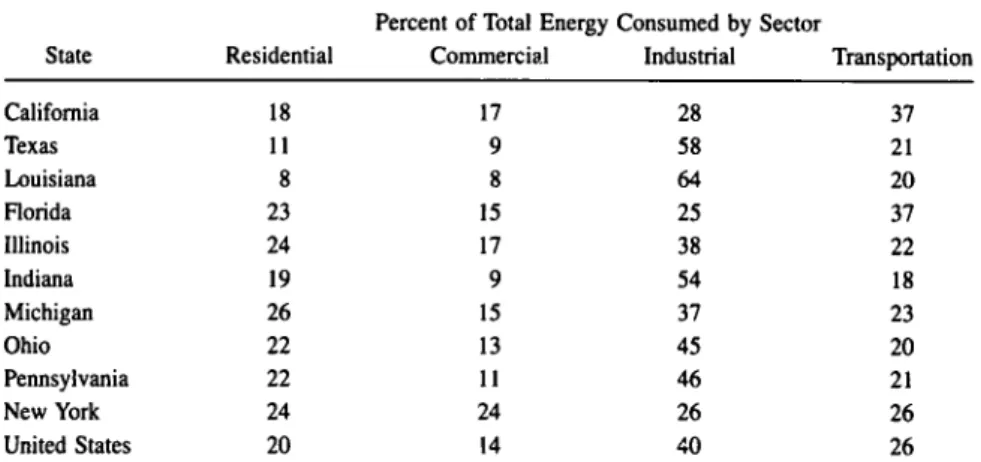
Countless combinations of individual variables within the scope of natural, lifestyle, and economic factors have influenced energy decisions. The accumulation of such decisions has resulted in the existing structure of energy use within states as measured by the energy base; that is, the percentage of total energy consumption contributed by individual fuels, and the sectoral (residential, commercial, industrial, and transportation) end use of energy. As reflections of energy decisions, differing energy structures among states provide evidence of the varying weights given to natural, lifestyle, and economic factors as those decisions were made.
24. E. RELPH, PLACE AND PLACELESSNESS 1, 10 (1976); and generally, Y. TUAN, TOPOPHILIA
(1974); Vance, California and the Search for the Ideal, 62 ANNALS OF THE A. OF AM. GEOGRAPHERS
185-210 (1972).
25. L. HAYES, ENERGY, ECONOMIC GROWTH, AND REGIONALISM IN THE WEST 2-4 (1980); Chris-tianson & Clack, A Western Perspective on Energy: A Plea for Rational Energy Planning, 194 Sci.
582 (1976).
26. TEXAS ENERGY AND NATURAL RESOURCES ADVISORY COUNCIL, RESOLUTION REGARDING
MAXIMIZING DOMESTIC ENERGY PRODUCTION (Dec. 7, 1979); STATE OF MONTANA, MONTANA ENERGY ALMANAC 36 (1979); STATE OF NEW MEXICO, NEW MEXICO STATE ENERGY PLAN 9, 42-43 (1978);
STATE OF LOUISIANA, LOUISIANA ENERGY REPORT EXECUTIVE SUMMARY 3-4 (1975).
27. STATE OF OHIO, ENERGY STATUS REPORT 1-7, 22-26 (1980); STATE OF NEW YORK, NEW YORK STATE ENERGY MASTER PLAN EXECUTIVE SUMMARY 2, 5 (1980); STATE OF NEW JERSEY, THE NEW JERSEY ENERGY MASTER PLAN 13-15 (1978).
STATE ENERGY POLICYMAKING
Such differential weighting depends in large measure upon the per-ceptions of problems, conditions, and solutions held by groups which influence policymaking. Each decision also reflects the differing percep-tions of elected state and local officials, bureaucrats, special interest groups (many of which have suprastate loyalties), and local issue interest groups. The political process blends the views of such groups into general state viewpoints that are manifested in state policies and positions. Such policies and positions are communicated to federal policymakers through congressional delegations, governor's offices, and professional lobbyists and become part of the federal decision-making process. Federal policies in turn affect state activities by prescribing particular actions, defining parameters, and setting the tone and direction of energy strategies.
THE MAJOR CONSUMING STATES
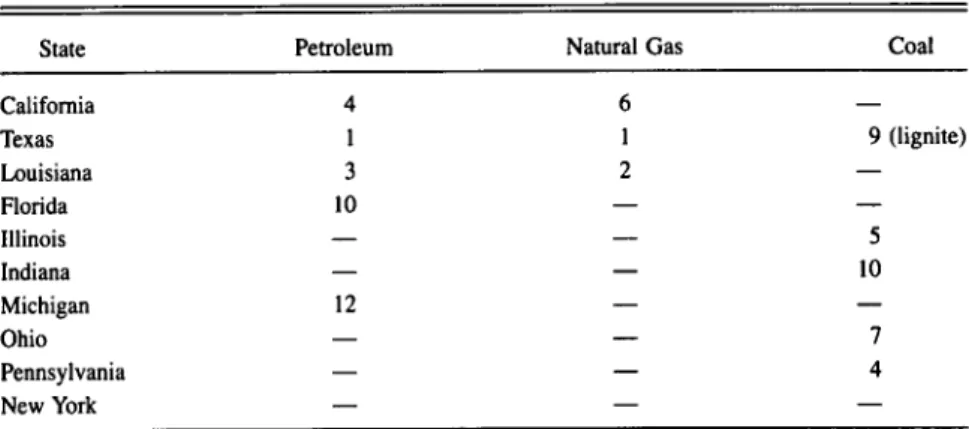
States can directly affect in-state energy production and consumption patterns through such mechanisms as taxation, environmental standards, land and water use decisions, and facility siting requirements. However, the states vary considerably in their ability to influence national patterns. Ten states accounted for 54 percent of the nation's total energy con-sumption in 1980: California, Texas, Louisiana, Florida, Illinois, Indiana, Michigan, Ohio, Pennsylvania, and New York.28 Not coincidentally, sev-eral of these states are also highly ranked producers of at least one fossil fuel (see Table II). Owing to their collective and individual importance as energy consumers and their consequent significance to the achievement of national energy goals, the remainder of this paper will focus on the policy actions of these ten major consuming states.
The energy structures (as illustrated by Tables III and IV) and policies of these states reflect the considerable variation in their natural endow-ments, lifestyles, and economic conditions. Six of the ten, those stretching from Illinois across to New York, comprise most of the nation's urban-industrial core. In these long-settled states a wide range of manufactured goods move over dense transportation networks as part of a highly de-veloped pattern of trade and commerce. In addition, this area supports a significant amount of intensive agriculture which provides the basis for a sizable food processing industry.
The remaining high energy consuming states provide a striking contrast. California, Texas, Louisiana, and Florida are coastal states well removed from the urban-industrial heartland. They have become heavily populated
28. U.S. DEP'T OF ENERGY, STATE ENERGY DATA REPORT, DOE/EIA-0214(80), at xi (1982); Hock, Role of Energy in the Regional Distribution in Economic Activity. ALTERNATIVES TO CONFRONTATION (V. Arnold ed. 1980); E. ALLEN, ENERGY AND ECONOMIC GROWTH IN THE UNITED
STATES (1977). April 1983]
NATURAL RESOURCES JOURNAL TABLE II
Energy Consuming States as Fossil Fuel Producers: Rank Among Top Twelve Producing States for 1981
State Petroleum Natural Gas Coal
California 4 6 -Texas 1 1 9 (lignite) Louisiana 3 2 -Florida 10 - -Illinois - - 5 Indiana - - 10 Michigan 12 - -Ohio - - 7 Pennsylvania - 4 New York
-Source: Department of Energy, Petroleum Supply Annual 1981, DOE/EIA-0340 (81/1), Vol. 1 at 43 (1982); Department of Energy, Energy Data Report, Natural Gas Monthly Report, DOE/EIA-0130 (81/12), at I (Dec. 1981); Department of Energy, Weekly Coal Report, DOE/EIA-0218 (82/18), at 3 (May 7, 1982).
TABLE III State Energy Base-1980
Percent of Total Energy Consumed Supplied by:
State Petroleum Natural Gas Coal Othera
California 55 29 1 14 Texas 42 50 9 0 Louisiana 40 57 0 4 Florida 69 13 9 9 Illinois 40 29 23 8 Indiana 34 21 47 0 Michigan 34 32 27 7 Ohio 32 24 40 5 Pennsylvania 38 20 41 1 New York 58 20 8 14 United States 45 27 20 8
'lncludes nuclear, hydro, geothermal, and net electricity imports.
Source: Department of Energy, State Energy Data Report, DOE/EIA-0214 (80), at xi (1982).
STATE ENERGY POLICYMAKING TABLE IV
Sectoral Consumption of Energy-1980 Percent of Total Energy Consumed by Sector
State Residential Commercial Industrial Transportation
California 18 17 28 37 Texas 11 9 58 21 Louisiana 8 8 64 20 Florida 23 15 25 37 Illinois 24 17 38 22 Indiana 19 9 54 18 Michigan 26 15 37 23 Ohio 22 13 45 20 Pennsylvania 22 11 46 21 New York 24 24 26 26 United States 20 14 40 26
Source: Department of Energy, State Energy Data Report, DOE/EIA-0214 (80), at xi (1982).
only recently, and their economic activity is more specialized. Industry is based on electronics, aerospace, petroleum refining, and petrochemicals rather than on diversified manufacturing. Agriculture focuses on climat-ically restricted crops such as citrus, cotton, and grapes in addition to the more generalized grain-livestock agriculture that typifies the other six states. Moreover, the climate and aesthetically pleasing natural landscapes of these four states have helped develop a thriving tourist industry.
All states have formulated energy policies which include a consider-ation of natural endowments. Concern for these natural endowments ap-pears to be highest in California, Texas, and Louisiana, although for different reasons. Whereas California tends to emphasize natural endow-ments in conjunction with lifestyle factors, Texas and Louisiana link their natural riches to economic factors.29 California favors a rapid shift to renewable energy sources in part because they are perceived to be more environmentally benign than either conventional fossil fuels or nuclear power.3 0 Thus, development of indigenous solar and geothermal resources is generally favored over production of in-state conventional and heavy oils, which are viewed as excessive threats to coastal environments and as causes of air quality degradation.31
29. CALIFORNIA ENERGY COMMISSION, 1979 BIENNIAL REPORT 30-33 (1979); GOVERNOR'S ENERGY
ADVISORY COUNCIL, TEXAS ENERGY OUTLOOK: THE NEXT QUARTER CENTURY 108-09 (1977); STATE
OF LOUISIANA, supra note 26, at 4.
30. CALIFORNIA ENERGY COMMISSION, 1981 BIENNIAL REPORT 201 (1981).
31. CALIFORNIA ENERGY COMMISSION, supra note 29, at 29-37; CALIFORNIA ENERGY COMMISSION,
supra note 30, at 163. April 1983]
NATURAL RESOURCES JOURNAL
California's policies also include a pronounced emphasis on conser-vation which extends beyond federal mandates and is related to the state's energy structure as well as its lifestyle.32 State authorities have concluded that a BTU conserved is a BTU produced since California's heavy de-pendence on oil coupled with a bias against coal and nuclear power are both occurring at a time when alternative energy sources are not yet capable of an immediate major contribution to the state's energy base. Furthermore, the California economy does not focus on energy intensive industries. Thus a reduction in petroleum and natural gas supplies is more in the nature of inconvenience to the populace, manifested in gasoline lines and home thermostat adjustments, than it is a threat to the state's economic well-being. The conservation emphasis is also in keeping with the perceptions of many Californians, including state decision-makers, that they are citizens of a state that is more mindful of man-nature re-lationships and the need for environmental protection than most other states. One could argue that the environmental movement got its insti-tutional start with the California-based Sierra Club. And it is no coinci-dence that the city of Davis, a university town and bedroom community for the state capital of Sacramento, was a pioneer in passing strict local ordinances for energy conservation.
Texas and Louisiana are the two largest energy-producing states in the country and energy-related industries form the backbone of their econ-omies. Thus, the production and use of energy resources is stressed in policy formulation and has been for many years. For example, the Texas Railroad Commission has operated since the 1920s to bring order to the marketing of Texas petroleum so as to enhance financial gain and minimize waste.33 Policies in these two states focus on fossil fuels rather than
renewables even though both states are well suited climatically for a solar future.34 The energy structure of the two states shows a dependence on natural gas, and the industry dominated sectoral pattern suggests energy uses (feedstocks, for example) for which renewable energy forms are not readily substitutable. Refining and petrochemicals are critically important to both the Texas and Louisiana economy. As a result, declines in the availability of natural' resources needed by those industries would have substantial economic repercussions.
Oil provides 69 percent of Florida's total energy needs. The state imports 80 percent of its petroleum even though it is the tenth ranked oil producing state. Several dry holes off the Florida coast during the last decade have dimmed hopes of greatly expanded petroleum production.
32. CALIFORNIA ENERGY COMMISSION, supra note 30, at 131. 33. DAVIS, ENERGY POLmcS 57 (2d ed. 1978).
34. GOVERNOR'S ENERGY ADVISORY COUNCIL, supra note 29, at 108-09; STATE OF LOUISIANA, supra note 26, at 22-31.
STATE ENERGY POLICYMAKING
These realities, coupled with an economy in which oil-dependent agri-culture and tourism play major roles, have caused the state to focus on economic factors in its energy policymaking while maintaining a healthy regard for natural endowments .3 5
Most of Florida's programs have been mandated by federal legislation and both legislative and gubernatorial policy efforts have concentrated on conservation.36 Through conservation measures such as energy effi-ciency standards for new buildings and sales tax exemptions for energy saving equipment like heat pumps and cogeneration systems, Florida seeks to minimize the impact of continued oil price increases and potential supply interruptions on the economy. By focusing on conservation it hopes to forestall development of small fossil fuel deposits which may pose a threat to environmental amenities. At the same time Florida is trying to develop alternative energy resources, chiefly solar, and has exempted selected equipment from property and sales taxes. However, the state is less optimistic than California about the lead times required before such sources make a significant contribution to the state's energy base.3 7
Among the six urban-industrial states New York and Pennsylvania stand out as having the most comprehensive state energy policies. Examination of New York's energy structure indicates that the state is heavily dependent on petroleum and lacks significant fossil fuel production. Thus, the state's primary policy goal is to lessen its dependence on oil (particularly in view of its rising costs) and to reduce the impact of supply cutoffs from foreign suppliers who now provide 70 percent of the state's petroleum needs.38 Policy strategies focus on conservation, renewable resources, increased use of coal, and regional cooperation in the form of linking New York's utilities with those in nearby states.3 9
Although economic factors are of considerable significance to New York, natural factors are also at issue. The state views energy conserved as energy produced, and such production is deemed to have environmental advantages over the increased use of fossil or nuclear fuels. Renewable energy sources are also favored over such fuels for environmental rea-sons.4" Lack of substantial potential in either conventional or renewable
energy resources has forced the state to embrace a wide-ranging approach to in-state energy development that includes small scale hydro, biomass, solar, wind, cogeneration, and municipal solid wastes.
35. FLA. STAT. ANN. §§ 377.601-377.608, 377.701 (West 1975); FLA. STAT. ANN. §§ 377.601-377.603, 377.606, 377.608, 377.701, 377.703 (West Supp. 1981).
36. Personal communication with Ron Cossman, Governor's Energy Office, Oct., 1980.
37. GOVERNOR'S REPORT ON ENERGY Vol. 1, at 3 (May 1980).
38. STATE OF NEW YORK, supra note 27, at 4.
39. Id. at 5. 40. Id. at 17-18.
NATURAL RESOURCES JOURNAL
Pennsylvania goes farther than does New York in emphasizing eco-nomic factors in its energy policy. This difference in emphasis results in large part from variations in natural and economic factors between the states. In contrast to the scarcity of energy resources in New York, Penn-sylvania has abundant coal resources. Coal and energy intensive industries like steel, cement, and glass have a significant effect on the state's econ-omy and lifestyles. This situation is reflected in the state's energy policy goals: greater efficiency in energy use, securing a reliable energy supply at least cost, increased in-state energy production, and fairness in energy pricing."
Pennsylvania clearly feels that the benefits of coal production and use outweigh its associated costs. Its energy policy is aimed at expanding coal's share of the state's energy base as well as increasing state coal exports.42 In pursuit of these goals the state recently redrew air quality
control region boundaries and eased emission standards on new industrial boilers to facilitate coal use. Coal usage in state owned facilities has been increased and a state bond was issued to pay for modernization of a coal loading pier in Philadelphia. And the federal government has been pe-titioned to rebuild locks on the Monongahela River to accommodate more coal traffic.43 This economic emphasis carries over into consideration of renewable resources and conservation. Although the environmental ben-efits of some renewable resources are recognized, development of such resources is advanced primarily on economic grounds such as long term availability and surety of supply, while conservation is viewed mainly from the perspective of increased economic efficiency.44
The remaining major energy consuming states-Illinois, Indiana, Michigan, and Ohio-have not yet developed state energy policies as comprehensive as those undertaken by New York and Pennsylvania. Moreover, as shown in Table V, they have lagged behind these two states as well as California and Texas in taking state level energy policy initi-atives.
Illinois, Indiana, Michigan, and Ohio have begun to gather and analyze energy data in response to federally mandated programs requiring con-servation plans and procedures to deal with supply shortfalls. And, to the extent that fossil fuel resources are present, these states have taken action to stimulate development of such resources. Coal production, for ex-ample, is a significant contributor to the economies of Illinois, Indiana, and Ohio. Efforts to stimulate fossil fuel production include substitution of coal for oil as well as measures to insulate state coal industries from
41. GOVERNOR'S ENERGY COUNCIL, PENNSYLVANIA ENERGY POLICY 3 (1981). 42. Id. at 18-40.
43. Id. at 29-30. 44. Id. at 41.
STATE ENERGY POLICYMAKING C) € C) 53 -g M -0 April 1983] 00 m 0 00 o 00 0007'91 0 00 0. 0 '0 4) 0 -e C) S '0 00 4) 0 0 0 ~ 4)0 F-S 0 0 0 0 C)>, ~ 0.4) 00 0 .~C) 4)0 -e C) U ~ 0-~-~ 4) 0 4)4)0. ~ 4)0 0 >,.0Z 4) 00~ b 00 4) ce 0 4)4) -, 0 0 4) 0 0.005 ~: ~ ~-C) 0. 0 ~ 0 W- o m CIA N m " 't W) It)
NATURAL RESOURCES JOURNAL
competition provided by out-of-state low sulphur coal.45 These and other measures emphasize economic factors. Alternative energy sources are also considered primarily from an economic standpoint. The energy po-tential of Michigan's forests are attracting attention while Illinois, Indiana, and Ohio are exploring energy crops, the use of agricultural wastes, and
solar energy.
CONCLUSION
Among the ten largest energy consuming states substantial differences exist in the extent to which individual states have gone forward with development of comprehensive energy policies. Such differences are at-tributable not only to the multifaceted nature of energy-related issues but also to the fact that some states are normally trend setters while others are more cautious in developing state policies regardless of the issue involved. In addition, priorities differ among the states as to which issues are most fundamental and deserving of immediate attention. Political factors which accelerate or impede policy development also vary among the states.
California, New York, and Pennsylvania have produced the most com-plete energy policies among the states examined in this study. Texas has several policy positions and a compendium of energy-related legislation but not a single comprehensive policy as such. The remaining states have responded to federal program requirements, sometimes innovatively, but have not yet gone beyond a piecemeal approach to solving state energy problems. This failure to develop comprehensive energy plans does not result from a specific determination that state policies are unnecessary. Rather, the situation reflects lag time and comparative slowness in es-tablishing necessary institutional mechanisms and capabilities, and in reaching the consensus needed to develop comprehensive plans. Despite such variation in policy development, the ten greatest energy consuming states as a group have made more progress toward state energy policy formation and have generally been more innovative than the remaining thirty-nine states, as illustrated in Table V.
Clearly the federally determined policy milieu is changing with the Reagan Administration's greater emphasis on domestic production, and its search for a new balance between resource development and environ-mental protection. In addition, the administration's bias in favor of the operation of market forces over federal regulation and its desire to lessen the federal role in financing new energy projects both point to a shift in federal energy policy focus and concerns. Whereas the states may object
45. STATE OF OHIO, supra note 27, at 8-15; ILLINOIS INSTITUTE OF NATURAL RESOURCES, 1980 ILLINOIS ENERGY PROGRAMS SUMMARY 9 (1980).
STATE ENERGY POLICYMAKING
to a reduction in the flow of federal dollars, the current administration's proclivity for turning a greater share of decision-making back to the states is generally welcomed. This enhanced decision-making power will in-crease the opportunities for the states to tailor policies to better suit their individual natural resource, lifestyle, and economic circumstances-an opportunity that states have actively sought.4 6
Inherent in an increased role for the states is a latent threat to federal policies. States will adopt policies based on in-state natural resource, lifestyle, and economic factors, with the intent of maximizing in-state benefits or minimizing in-state costs. To the extent these factors differ from national norms, state policies may develop which complicate the achievement of national policy goals. There is already some evidence of such policy development among the major energy producing states of the Rocky Mountain and Northern Great Plains regions which lie outside the scope of this study.
Owing to the incomplete nature of state energy policymaking at present and the changing federal milieu, it is too early to determine with precision the cumulative impact on federal goals of the policies adopted in the nation's ten largest energy consuming states. Existing state policies, how-ever, provide clues as to where such impacts are most likely to be felt and where the greatest opportunities for influence may lie.
By and large policies in the ten major consuming states will operate to forward the national goal of increasing domestic production of fossil fuels. The reluctance of California and Florida to pursue some potential petroleum production is more than offset by the pro-production stances taken by the more significant petroleum producing states of Texas and Louisiana. The major coal producers-Pennsylvania, Ohio, Indiana, and Illinois-likewise take pro-production positions at the state level.
In the realm of conservation the states could play a larger role than at present. The reluctance of many major energy consuming states to go beyond federally mandated activities, coupled with evidence provided by California that further state action in this policy area is possible, indicates that much room exists for increased conservation activity on the state level. In the light of the fact that many, if not most, areas conducive to conservation measures fall under state and local, rather than national, jurisdiction (e.g., building codes, traffic laws, utility regulation, and land use decisions), expanded state efforts in those areas would be appropriate. Finally, the states could play a major part in stimulating a shift to renewable energy resources. Solar, wind, and biomass systems are still 46. NATIONAL GOVERNOR'S ASSOCIATION COMM. ON NATURAL RESOURCES AND ENVIRONMENTAL
MANAGEMENT COMPREHENSIVE ENERGY AND NATURAL RESOURCES POLICY STATEMENT D-2 (1980); personal communication with George R. Gantz, Governor's Council on Energy, State of New Hampshire, Oct., 1980; CALIFORNIA ENERGY COMMISSION, supra note 29, at 7, 9.
NATURAL RESOURCES JOURNAL
largely non-competitive in economic terms with conventional energy sources in many applications. Furthermore, the expanded use of such systems often requires the resolution of land use and utility-oriented issues that do not lend themselves to federal solutions. Through their taxing powers states can be of substantial aid in making renewable energy resources more economically competitive. States can encourage small scale decen-tralized electricity production through utility regulations and can stimulate large scale operations by working with local governments to remove obstacles arising out of land use questions.
A danger exists that states will not move forward on energy policy issues as fast as they might, owing to complacency brought on by recent declines in oil imports and relative stability in oil prices. Energy policy questions may also be neglected as states reorder their legislative and executive agendas to focus on issues raised by Washington's reduction in the funding of social programs which affect the states. Delays in reaching difficult state level energy policy decisions would, however, be unfortunate. The overall welfare of individual states and the nation as a whole requires that we proceed expeditiously with comprehensive energy policymaking at all levels of government, for the ability to fulfill our energy needs is fundamental to the survival of the nation.