A game-theoretic analysis of preventing spam
over Internet Telephony via audio
CAPTCHA-based authentication
Yannis Soupionis
1,3, Remous-Aris Koutsiamanis
2,
Pavlos Efraimidis
2, Dimitris Gritzalis
11. Information Security and Critical Infrastructure Protection Research Laboratory Dept. of Informatics, Athens University of Economics & Business (AUEB)
76 Patission Ave., Athens, GR-10434, Greece {jsoup,dgrit}@aueb.gr
2. Dept. of Electrical and Computer Engineering, Democritus University of Thrace University Campus, Xanthi, GR-67100, Greece
{akoutsia,pefraimi}@ee.duth.gr
3. Joint Research Center, European Commission Enrico Fermi 2749, Ispra Varese, 21027, Italy
{yannis.soupionis}@jrc.ec.europa.eu
Corresponding Author: Dimitris Gritzalis, 76 Patission Ave., Athens, GR-10434 Greece, tel.: (+30) 210 8203505, e-mail: [email protected]
Abstract
Spam over Internet Telephony (SPIT) is a potential source of dis-ruption in Voice over IP (VoIP) systems. The use of anti-SPIT mech-anisms, such as filters and audio CAPTCHA (Completely Automated Public Turing Test to Tell Computer and Humans Apart) can prevent
unsolicited calls and lead to less unwanted traffic. In this paper, we present a game-theoretic model, in which the game is played between SPIT senders and internet telephony users. The game includes call fil-ters and audio CAPTCHA, so as to classify incoming calls as legitimate or malicious. We show how the resulting model can be used to decide upon the trade-offs present in this problem and help us predict the SPIT sender’s behavior. We also highlight the advantages in terms of SPIT call reduction of merely introducing CAPTCHA, and provide experimental verification of our results.
Keywords: Spam Prevention, Spam over Internet Telephony (SPIT), Game Theory, Audio CAPTCHA, Nash Equilibria.
1
Introduction
The explosive growth of the Internet has introduced a wide array of new techno-logical advances and more sophisticated end-user services. One of them is VoIP, which is a developing technology that promises a low-cost, high-quality and availability service of multimedia data transmission. Inevitably though, VoIP “inherited” not only these positive features of Internet services, but also some of their problems [8][20][21][46]. One of them is Spam over Internet Telephony (SPIT) [36][37], which is the expression of Spam in VoIP network environments. SPIT is a challenging issue that IP telephony is expected to be facing in the near future. This is the reason why a) major organizations have already started developing mechanisms to tackle SPIT [13][35], and b) the U.S. Federal Com-munications Commission has extended the Telephone Consumer Protection Act of 1991 to include automated calls, called robocalls [9]. Moreover, it should be stated that the U.S. Federal Trade Commission has created the “Do Not Call Registry” in order to allow users to reduce the number of telemarketing sales calls received (automated or not) [10]. The active registrations in the “Do Not
Call Registry” were over 217 million on October 30th, 2012 [11].
The SPIT threat for VoIP is the analogue of spam for e-mail. However, due to its characteristics, it may also give the opportunity to malicious users to not only send low- or zero-cost unsolicited instant messages but also to make low- or zero-cost unsolicited calls by using automated software (bots). The malicious user’s main purpose could be financial, like presenting advertisements, or to extract/steal a legitimate user’s personal information (phishing). A real-life ex-ample is the “Rachel” robocall enforcement case, where five companies were shut down, because they made millions of illegal pre-recorded robocalls claiming to be from “Rachel” and “Cardholder Services” while pitching credit card interest rate reduction services [12]. Although the similarity of the SPIT phenomenon to the well-established spam threat is easy to identify, this does not lead to the conclusion that the techniques handling spam are appropriate for handling SPIT as well. While applying the anti-spam techniques can be done quite easily in terms of service configuration, some characteristics of SPIT make the direct application of anti-spam techniques inefficient and ineffective. In particular, telephony and instant messaging services operate in real time while email ser-vices are based on a “store and forward” model [18][40]. Therefore, the anti-spam techniques can examine the content/body of the email in order to classify it as spam or not, but this is not possible for VoIP real-time communication services [27].
A serious obstacle when trying to prevent SPIT is identifying VoIP communi-cations which originate from software robots (“bots”) in real-time. A typical way to tackle these attacks is the use of a Reverse Turing Test, called CAPTCHA (Completely Automated Public Turing Test to Tell Computer and Humans Apart). Since visual CAPTCHA are hard to apply in VoIP systems, audio CAPTCHA appear to be appropriate for defending against SPIT calls/messages
[15][42][43].
VoIP is a useful technology with significant value for legitimate users, as it enables communication and decreases costs. On the other hand, VoIP spammers can obtain significant financial revenues as the email spam paradigm has shown. Therefore, we have a situation where independent decision makers are engaged in a strategic interaction; the actions taken by SPIT senders may influence the defensive actions taken by the VoIP users and the opposite. The outcome of such scenarios is not only a matter of effective tools like audio CAPTCHA challenges, but also of how independent selfish decision makers will act and react in the presence of such tools. Such settings, where two or more independent decision makers interact, can be studied with concepts and tools from Game Theory. The equilibrium points of the respective game-theoretic model can reveal important attributes of the state(s), in which the system is expected to operate. For example, it will reveal how often the audio CAPTCHA will be used or whether the overall rate of SPIT calls decreases in the presence of audio CAPTCHA. In the presence of selfish users, there are examples where the introduction -always with good intentions - of a tool or an extra option for the users may lead to worse overall system performance. This can happen even with the simple addition of a new tool to an existing system. For example, in [17] scenarios are identified where increasing the number of (selfish) security experts of an information network may lead to reduced overall security of the network; the Braess paradox [4] shows how adding an extra route to a traffic network may lead to worse conditions for selfish drivers.
In this paper, we assume the existence of effective audio CAPTCHA chal-lenges and discuss how the strategic interaction between SPIT senders and VoIP users can be modelled as a two-player game in the presence of such CAPTCHAs. In particular, we propose a game-theoretic model and show how the resulting
model can be used to predict the behavior that the two opponent communities will eventually adopt, how it can guide to fewer SPIT messages and how the use of CAPTCHA assists VoIP users against SPIT. As part of the legitimate user defences against SPIT we also integrated an anti-SPIT filter, which classifies each incoming call/message as legitimate, malicious or “unknown” (when it is not possible to have a confirmed answer). After the filter’s incoming call classi-fication, the user may directly accept or reject the call or request a CAPTCHA, depending on the precision and the verdict of the filter.
The rest of the paper is organized as follows: first, in Section 2, we illustrate the related work on relevant game-theoretic models and the cost calculation of spam/SPIT. In Section 3, the game theoretic model is introduced and its parameters and assumptions are presented. In Section 4 we present predictions about the SPIT calls/messages percentage of overall calls by computing the Nash equilibria of the game. In Section 5 we present the results of the experimental verification of the theoretical results. Finally, in Section 6, we end with a number of conclusions and our plans for future work.
2
Related Work
As the SPIT phenomenon is practically still in its infancy, we were not able to find relevant research work focusing on the cost of spam for both the SPIT sender and the user, or on relevant game-theoretical models. Therefore, we present research work based on a close relative of SPIT, i.e., e-mail spam.
2.1
Cost of unsolicited communication
Kim Y., et al. [22] propose a method to measure the disutility experienced by e-mail users who receive spam. Their study employs conjoint analysis of stated preference data to estimate e-mail users’ overall inconvenience cost attributable
to spam. The results show the inconvenience-originating cost of spam to be about $0.0026 per spam message.
Kanich C., et al. [19] present a methodology for measuring the conver-sion rate of spam. They produced nearly half a billion spam e-mails and they identified the number that were successfully delivered, the number that passed through popular anti-spam filters, the number that elicited user visits to the advertised sites, and the number of “sales” and “infections” produced. They managed to calculate that the total revenue of a spam campaign is about $7000 and the cost to produce it is the paycheck of three “good” programmers. There-fore the cost per message is about $0.001. Finally, a report placed the retail price of spam delivery at slightly under $80 per million [47]. This price means that each spam email costs $0.00008, but we stick to the previous paper’s cost estimates, as this kind of price is an order of magnitude less than what legitimate commercial mailers charge.
2.2
Game-theoretic models
Androutsopoulos I., et al. [1] present an interesting game-theoretic model for the interaction of spam and ordinary e-mail users and later extend their model in [45] to the case where the users are able to use Human Interaction Proofs (HIP). In the latter work, they focused on the scenario where the users can read messages, delete them without reading them or send HIP. They have provided an extensive theoretical analysis of a game-theoretic model for the problem of spam. As discussed earlier, there are important qualitative differences between SPIT and spam. We generalize the model proposed in [45] to a more complicated problem with more actions to account for additional situations that arise in VoIP, and apply it within a related, but substantially different, application context, namely VoIP. We also experimentally confirm the predictions of the
model.
Parameswaran M. [33] suggests that the spammer can strategize to maxi-mize the amount of spam sent by making inferences from the block-list rules. They introduce a theoretical modeling approach for the spammer’s behavior and present a comparison of this behavior with the data that has been collected from block-list organizations. The main issue with this work is that is based on collected data, therefore its outcomes cannot be generalized. Shahroudi A.B. et al. [38] examine how VoIP service providers attempt to control the growing phe-nomenon of SPIT by creating a game-theoretic model of competition between providers. The model is based on the notion that two different service providers, which try to maximize their profit with different business strategies, are com-peting on shared resources. Each service provider can select to either detect or prevent SPIT in order to address attacks, with consequences to the overall profit of both providers. The research outcome is that the providers are going to focus on mechanisms which detect SPIT attacks, because even though they are more expensive than preventative mechanisms, it maximizes their profit.
Moreover, a discussion of game theory approaches for detection software can be found in [6]. The proposed model is able to assist firms in the configuration process of detection software and a significant outcome is that false-positive and false-negative errors in detection could affect the value of these systems significantly.
In general, even though there is work on applying game-theoretic tools to problems of security, to the best our knowledge this is the first attempt of a game-theoretic analysis of SPIT and how to counter it with audio CAPTCHA.
3
Suggested game-theoretic model
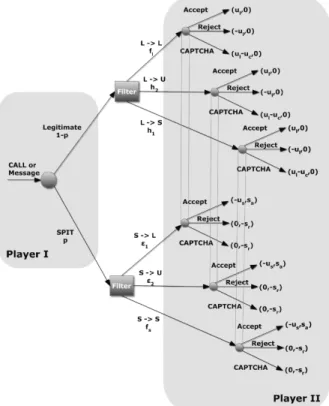
Generalizing and building upon Androutsopoulos et al. [1][45], we define the SpitGame, a game-theoretic model with two players: the SPIT sender (Player I) and the legitimate VoIP user (Player II). The game is illustrated in Fig. 1. We will describe the game in detail and at the same time give short definitions of the game-theoretic terms and concepts that we encounter. For more details on the game-theoretic terms, the reader may refer to textbooks on Game Theory [29][30][31], or to a recent volume on Algorithmic Game Theory [28].
The SpitGame, as shown in Fig. 1, is an extensive form game with imperfect information. The game is initiated whenever a new call/message is sent towards a user. The SPIT sender (Player I) moves first and is able to interfere with the stream of incoming calls and send a new SPIT call at any point. Thus, the frequency with which SPIT senders initiate a malicious call determines the average ratio of SPIT to legitimate calls in the users’ incoming streams. For example, if a SPIT sender initiates a SPIT call every four (4) legitimate calls, then the overall probability/rate of SPIT calls will bep= 0.2, which is presented as probability p in Fig. 1. Although in reality SPIT senders are not able to completely control all the incoming calls/messages, or to decide whether or not they will insert a new SPIT message/call, the assumption that the SPIT senders control the ratio between SPIT and legitimate calls is reasonable. A similar assumption has been used in the game-theoretic models for SPAM in [1][45] upon which we generalised.
The SPIT sender chooses to make the incoming call SPIT or to allow it to be a legitimate call. The VoIP user does not learn which choice the SPIT sender has made. That is, the VoIP user is imperfectly informed about the game status and for this reason we model this interaction as an extensive game with imperfect information. However, the VoIP user gets some stochastic information
about the game status from the outcome of an anti-SPIT filter. After the move of the SPIT sender, the call is processed by anti-SPIT filters, which are able to flag the calls they consider SPIT. The use of filters is a common countermeasure (in some cases of Internet service providers, this is mandatorily applied to their users). We have assumed that the filter contains a deterministic first stage and a stochastic second stage. In the first stage, an accurate black/white-list, created from past calls, can accept or discard the call. The second stage is invoked if the black/white-list does not identify the caller. In this stage, the filter attempts to guess the nature of the call from the characteristics of the call (e.g. the time/date, the caller domain, the user agent, etc.). In the model we describe, the filter refers only to the second stage, since the first stage does not have a game theoretic aspect.
In our model, the performance of these filters is fully described by six vari-ables: fl, h2, h1, 1, 2 and fs. More specifically, in the case of legitimate
calls, the filter will classify the calls accurately with a probability offl, it will
consider them unknown with a probability ofh2and it will misclassify them as SPIT calls with a probability ofh1. In the case of SPIT calls the corresponding legitimate, unknown and SPIT classification probabilities are1,2andfs. For
example, consider the case when the filter misclassifies the incoming message. In Fig. 1 the probability of misclassifying a SPIT call as legitimate is depicted as S → L and the probability of misclassifying a legitimate call as SPIT is depicted as L → S. Moreover, the filters may not be able to come to a defi-nite conclusion over the nature of the call. In this situation, the filter classifies the call as “Unknown”, which is common in VoIP communication systems. Al-though this may be uncommon in email spam filters, since the messages can be classified based on content and header, VoIP is a real time protocol that does not grant the receiver access to the call contents prior to its acceptance/session
establishment. Therefore, whenever a call arrives from an unknown number, the call may be classified as SPIT or legitimate. Since VoIP communication is synchronous, unlike email spam where email is delivered asynchronously and the marked-as-spam messages can be stored, if the call is rejected then there is no way for the user to retrieve its content/purpose. Since much less information is available than in email spam, the anti-SPIT filter should include the “Unknown” verdict, which is dominant when a SPIT call is received, since most SPIT calls are initiated from numbers unknown to the user.
In the context of SpitGame, after the move of the SPIT sender the filter classifies the incoming call. The action of the filter is modelled with an artificial third player; such a player is usually called chance in the game. Player chance has three moves, one for each of the possible outcomes of the filter.
The user is informed about the “move” of the filter but not the move of the SPIT sender. The user should decide his move based on the filter’s prior classi-fication. He is able to accept the call, reject it or request an audio CAPTCHA. The user is not aware of the true nature of the calls before he listen to them, so when he sees that his filter has classified a call as legitimate, he does not know whether it was misclassified or not. For example, when a user receives a legitimate filter-classified call it is impossible to distinguish in which node (L→LorS→L) of the game he is. In game-theoretic terms, each of the pos-sible outcomes of the filter defines an information set for the VoIP user. Each such set contains two nodes of the extensive-form game, because there are two nodes in the game which may lead to the particular filter decision. The VoIP user, however, is informed only about the information set and not about the particular node of the set in which the game really is.
Therefore, each user has to select a strategy consisting of what he will do with incoming calls depending only on information sets, i.e., the decisions of his filter;
for example,Accept calls classified asLegitimate,Rejectcalls classified asSPIT, and request audioCAPTCHAwhen calls are classified as Unknown. Similarly, we may assume that the overall community of users adopts a strategy, whose probabilities reflect the frequencies with which it adopts actionsAccept,Reject, and CAPTCHA. That means that the sum of the probabilities of these three actions is equal to 1 for each game node. For example, when a user receives a new call, which is classified as Legitimate, then P(Accept) +P(Reject) +
P(CAPTCHA) = 1, regardless of whether the message was misclassified or not.
Likewise, this happens in the other two cases: SPIT andUnknown.
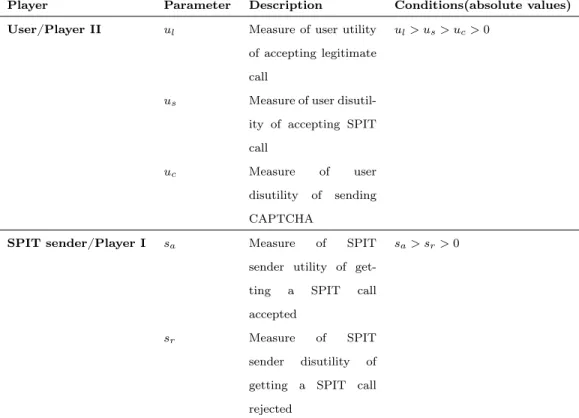
Whenever a new session is initiated, the actions which the SPIT sender and legitimate user select lead to a particular cost or utility for each player. For example, if the SPIT sender selects to initiate aSPIT call and the user selects to Accept the call, then the game ends with a utility ofsa >0 for the SPIT
sender and a cost of−us<0for user. In summary, every combination of actions
of the two players leads to an outcome of the game, and this outcome determines the amount of utility for each participant, which is shown in Fig. 1 and Table 1. Notice that the utilities for the user and SPIT sender do not depend directly on the filter classification, however, the classification does affect the ratio between legitimate and SPIT calls which the user receives.
The utilities for each player are determined by five parameters:
1. ul: This is the measure of average utility of accepting a legitimate call.
2. us: This is the measure of average disutility of receiving a SPIT call,
taking into consideration factors such as the average cost of consumed computational resources, the time needed to answer the phone, and the average time it takes to listen to it, which means a general decrease to user productivity.
puzzle, taking into consideration the annoyance of a legitimate caller, of whom it is required to solve a CAPTCHA challenge in order to reach the user. This annoyance can directly lead to profit loss if the caller is a potential customer, but also indirectly lead to social issues if the user’s acquaintances are reluctant or hesitant to call him.
4. sa: This is the measure of average utility the SPIT sender obtains from
each SPIT call that is accepted, taking into consideration factors such as the percentage of users that order products after listening to the SPIT call, and the advertisement campaigns he may be paid to be part of. 5. sr: This is the measure of average disutility to the SPIT sender of
get-ting a SPIT rejected, taking into consideration all related costs, including the computational resources to create SPIT, and the effort to create an appropriate bot to execute SPIT attacks.
The parameters express a measure (or absolute value) of utility or disutility; as suchul, us, uc, sa, sr >0 and when appearing in pay-offs their sign denotes
whether they express utility (+) or disutility (-).
We assumed that the utility from accepting a legitimate call is exactly the opposite of the cost of rejecting it. This is justified by equating the (dis)utility of the user to the information value of the call being (rejected) accepted. Moreover, the utility of accepting the call may be the information value of the call minus the cost of the consumed computational resources for session establishment, while the cost of rejecting it may be simply the information value. This cost difference is so marginal that it was not taken into consideration.
In order to facilitate the examination and analysis of the model, we have set a few restrictions on the costs:
user’s disutility for missing a legitimate message (−ul). In absolute terms,
ul> uc. This means that when a user initiates a call, the process to answer
a CAPTCHA for establishing the call is not cost-forbidden.
2. The user’s disutility for sending a CAPTCHA (−uc) is smaller than the
user’s disutility of accepting a SPIT call (−us). In absolute terms,us> uc.
Otherwise, the use of CAPTCHA would have no sense, since it would be better for the user to receive SPIT than request a CAPTCHA.
3. The user’s disutility of accepting a SPIT call (−us) is smaller than the
user’s disutility for missing a legitimate message (−ul). In absolute terms,
ul> us. This condition is based on the premise that receiving a SPIT call
may be annoying and distracting for the callee, but missing a legitimate call is more important since it may mean loss of business opportunities, damage to a business’ image and reputation or disruption of the user’s social life.
4. The utility for a SPIT sender to have a SPIT call accepted (sa) is larger
than the cost of having the call rejected (−sr). In absolute terms,sa > sr.
Given that in practice the chance of the SPIT sender making a profit from an accepted call is very low and that the cost of making SPIT calls, due to the way VoIP works, is also very low, it can reasonably be assumed that the utility of having a call accepted needs to be high, at least higher that the disutility of making the call, in order for the SPIT sender to have an incentive to make calls. In general, SPIT calls could be profitable even if
sa < sr, if the chance of making a profit from an accepted call could be
assumed to be high enough.
The above mentioned utilities for each player actions and the relevant con-ditions are described in Table 2.
4
Game-theoretic analysis and Nash equilibrium
In this section, we present a theoretical analysis of the SpitGame. The funda-mental solution concept for games is the Nash equilibrium (NE), i.e., a state of the game from which no individual player has an incentive to unilaterally deviate. The Nash equilibrium is the most popular solution concept in game theory and has been used in the analysis of a vast number of scenarios with interacting decision makers coming (the scenarios) from diverse application do-mains including economics, biology, political science, computer science and other ([26][28][29][30]). There are numerous applications of game theory, the Nash equilibrium concept and its refinements in Computer Security. See for example the recent surveys [24][44] and the references therein.Overall, the formulation of the Nash equilibrium has had a fundamental and pervasive impact in economics and the social sciences [26] and more recently in Computer Science [28][32]. Of course, from the development of the Nash equilibrium concept, there have also been some critiques of it. Some of the main critiques are that the Nash equilibrium concept makes misleading or ambiguous predictions in certain circumstances, that it may not capture correctly non-credible threats, that in many games there are many NE, and, more recently, that the computation of NE is intractable in the general case [7].
However, despite these critiques, the NE and its refinements are undoubtedly the most successful solution concept in game theory, widely used in theoretical and practical applications of game theory. Moreover, most critiques do not seem to apply to the NE of the SpitGame. Firstly, the SpitGame exhibits a unique NE (except for some boundary cases) as is shown in Theorem 2. Consequently, there is no ambiguity in the prediction of the state of the game. Moreover, the NE of the SpitGame is computable in polynomial time via a closed form equation (see Table 8) and thus, neither the critique concerning the intractability
of general NE applies in this case. As discussed later in this section, the NE of the SpitGame is also Subgame Perfect, which removes the non-credible threat issue of some NE. Finally, the NE solution of the SpitGame does not seem to belong to the cases where the NE leads to counter-intuitive solutions, like for example in the case of the Traveller’s Dilemma [3].
There are adaptations and refinements of the NE concept for different game settings and purposes. A variation of the NE for extensive-form games is the Subgame Perfect Equilibrium (SPE), which is more appropriate for games with perfect information. In the SpitGame, when Player II has to decide his action without seeing the action of Player I, that is, Player II is imperfectly informed about the game status. However, Player II has access to the outcome of the filter, which provides stochastic information about the action of Player I. The filter verdicts are shown in Table 3. Each of the filter verdicts defines an information set for Player II, who has to decide his action based on the information set. A natural approach for analysing such a model is to use the concept of behavioral strategies ([26][6], and in particular [45][1]), in which players can randomize independently at each information set. In particular, Player II of the SpitGame will have an independent mixed strategy for each of his information sets. A well known fact in game theory, Kuhn’s Theorem, states that in extensive-form games with perfect recall, behavioral and mixed strategies are equivalent. The solution concept that we will use to solve the SpitGame is the Nash equilibrium of the corresponding extensive form game, and we will base our analysis on the behavioral strategies of the players.
The interaction between legitimate VoIP users and SPIT senders is a con-tinuous challenge for both parties. Each player, call receiver or SPIT sender, will have to make his choices repeatedly. Moreover, a legitimate caller might be required to solve audio CAPTCHAs when he calls a VoIP user for the first time.
Such overheads may devalue the VoIP service in the eyes of legitimate callers. One may argue that a repeated game could be used to model this interaction. Even though one cannot (and should not) exclude such or other possible formu-lations of the SpitGame problem, we believe that the current formulation as a one-shot game is well suited for the problem. Each time there is an interaction between two entities, the interaction will be unique, or at least we are only interested in the unique interactions. The subsequent interactions between the same entities can be trivially solved by the outcome of the first game. Then, the legitimate player would know if the call is SPIT or not. The cost incurred to the legitimate callers for solving audio CAPTCHAS is assumed to be captured by the disutilityuc. Note that legitimate callers are not directly modelled in the
current SpitGame model. Alternatively, one may consider other game-theoretic formulations of the same problem, for example as a repeated game and/or a game with strategic legitimate callers being part of the model. We leave such possibilities for future work.
We will start the analysis of the SpitGame with the following straightforward observation that Player I will never use a pure strategy at any Nash equilibrium.
Theorem 1. The SpitGame has no Nash equilibrium where Player I plays a
pure strategy.
Proof. We will use a proof by contradiction. Assume that Player I chooses a pure strategy, for example SPIT. Then the optimal response for Player II would be the pure strategyReject. Then however, Player I would be motivated to change his strategy, i.e., there is no NE if Player I plays SPIT. If, on the other hand, Player I chooses the pure strategy Legitimate then Player II can respond withAccept, which makes the move of Player I suboptimal, i.e., again no NE.
the NE (Table 4) and let(pi, qi, ri)be the strategy of Player II at information
seti, fori= 1,2,3. Thus, at the NE, the strategy of Player I is to submit SPIT calls with rate p, i.e., the probability that a new incoming call will be SPIT is
p. From the proof of Theorem 1 we know that at any NE
0< p <1. (1)
Player II has three information sets, one for each of the outcomes of the filter, presented in Table 3.
Since Player II does not know which action Player I has made and the out-come of the filter is stochastic, Player II can base his decision only on conditional probabilities. Assume that a new call has arrived and that the corresponding filter verdict is SPIT. Player II is informed that the information set is SPIT
and has to choose a strategy based on this information only. Let PLS be the
conditional probability that the incoming call isLegitimate given that the filter has classified it asSPIT. Using standard probability theory gives
PLS=P rob[L/S] =
(1−p)h1
(1−p)h1 + p fs
. (2)
Similarly, we define and calculate the conditional probabilities for all possible cases. PLS= (1−p)h1 (1−p)h1 + p fs , PSS= p fs (1−p)h1 + p fs , PLU = (1−p)h2 (1−p)h2 + p 2 , PSU = p 2 (1−p)h2 + p 2 , PLL= (1−p)fl (1−p)fl + p 1 , PSL= p 1 (1−p)fl + p 1 . (3)
Using the above conditional probabilities of Equation 3 and the SpitGame model as it is depicted in Fig. 1, the average utility of Player I for each of his pure strategies can be calculated. Firstly, note that the average utility for the
pure strategy of Player ILegitimate, i.e., Player I does nothing, is
U1L= 0. (4)
When Player I submits a SPIT call, then his average utility can be calculated as follows. Given the strategypof Player I, letVL(p),VU(p), andVS(p)be the
probabilities that the filter verdict is Legitimate, Unknown, andSPIT respec-tively. Also, given the strategy of Player II, letU1SL(p1, q1), U1SU(p2, q2), and
U1SS(p3, q3) be the average utility of action SPIT of Player I in information set Legitimate, Unknown, and SPIT respectively. Then the average utility of actionSPIT of Player I is
U1S =VL(p)U1SL(p1, q1) +VU(p)U1SU(p2, q2) +VS(p)U1SS(p3, q3), (5) where VL(p) = (1−p)fl+p1, VU(p) = (1−p)h2+p2, and VS(p) = (1−p)h1+pfs. (6)
After expanding the terms in Equation 5 and doing some algebraic manipulation we obtain that
U1S =−sr+1(sa+sr)p1+2(sa+sr)p2+fs(sa+sr)p3. (7)
From Theorem 1 we know that Player I uses a mixed strategy at any NE. Thus, both actions of Player I are played with strictly positive probability at any NE; in other words, both actions of Player I belong to the support of his strategy at any NE. A well known requirement for all actions that belong to the support of a NE strategy, is that each of them must achieve the same average utility.
Otherwise, the user would exclude the strategies with lower average utility from his NE strategy. We know from Equation 4 thatU1L, i.e., the (average) utility
of action Legitimate for Player I, is zero. Thus, the average utility of action
SPIT of Player I must also be
U1S = 0. (8)
Combining the above equation with Equation 7 gives the following Lemma.
Lemma 1. At any NE of the SpitGame
1p1+2p2+fsp3=
sr
sa+sr
. (9)
We now focus on the utility of Player II. Using again the conditional prob-abilities of Equation 3 and the SpitGame model (Fig. 1), the average utility of Player II for each of his pure strategies at each of his information sets can be calculated. For example, in information set Legitimate, the average utility for Player II for actionAccept of an incoming call is
U2LA=PLLul+PSL(−us) =
fl(1−p)ul−1pus
fl(1−p) +1p
. (10)
Similarly, we can calculate the expected utilities U2LC and U2LR for actions
CAPTCHAandReject. In the same way, we calculate U2U A,U2U C, andU2U R
for the information setUnknown, andU2SA,U2SC, andU2SRfor the information
setSPIT. U2LA=fl(1f−p)ul−1pus l(1−p)+1p , U2LC= fl(1−p)(ul−uc) fl(1−p)+1p , U2LR= −fl(1−p)ul fl(1−p)+1p, U2U A=h2h(1−p)ul−2pus 2(1−p)+2p , U2U C = h2(1−p)(ul−uc) h2(1−p)+2p , U2U R= −h2(1−p)ul h2(1−p)+2p, U2SA=h1h(1−p)ul−fspus 1(1−p)+fsp , U2SC= h1(1−p)(ul−uc) h1(1−p)+fsp , U2SR= −h1(1−p)ul h1(1−p)+fsp. (11)
Now, using the notation of Tables 4 and 5 for the player strategies, and the average utility for each of the pure strategies of Player II (Equation 11) the average utility of Player II for each information set can be calculated. For example, information setLegitimate, the average utility of Player II is
U2L=p1U2LA+q1U2LC+r1U2LR. (12)
Similarly, for information setsUnknownandSPIT the average utility of Player II is
U2U =p2U2U A+q2U2U C+r2U2U R (13)
and
U2S =p3U2SA+q3U2SC+r3U2SR, (14)
respectively. Expanding Equations 12, 13, and 14, with the expressions of Equa-tion 11 gives a closed expression for the average utility of Player II at each in-formation seti= 1,2,3. After some algebraic manipulation, and exploiting the symmetry in the expressions for the three information sets, we obtain that the average utility of Player II in each information set is
Aipi+Biqi+Ci
Di
, fori= 1,2,3. (15)
where the coefficientsAi, Bi, CiandDi are as defined in Table 6. Note that the
coefficientsDi correspond to the probabilities of each information set, as they
are defined in Equation 6. The coefficientsAi, Bi, Ci andDi are functions of
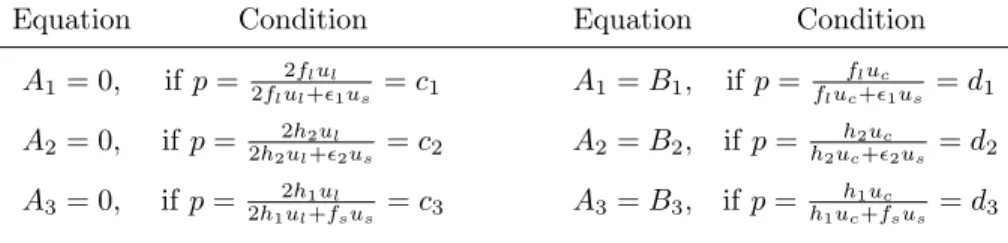
the strategypof Player I and other variables. We focus on pand identify the boundary valuesci anddi fori= 1,2,3, presented in Table 7.
4.1
The Nash Equilibrium
We are now ready to determine the NE of the SpitGame. Our analysis will be valid for a wide range of parameter values. The main assumption we make is that
1< 2. (16)
This is a reasonable assumption which also holds for the empirical parameter values we use in the experiments (Table 3). A further plausible assumption is that the probability that the filter verdict is correct is larger than the probability that the verdict is completely wrong. More precisely,
h1< fl, and (17)
1< fs. (18)
Additionally, we assume that
h2< fl. (19)
The final assumption, which is also a plausible one, states that
uc<2ul, (20)
that is, the cost for Player I to submit an audio CAPTCHA is less than twice the utility of accepting a legitimate call. Note that a costuc larger than2 ul
would make the use of audio CAPTCHAs pointless. The cost of applying an audio CAPTCHA should actually be much lower than2ul.
At any NE equilibrium, the strategy of Player II, i.e., the values of pi and
qi, must be such that the values of U2L, U2U andU2S are maximized, for the
coefficientsAi or Bi are strictly negative then the corresponding pi or qi will
have to be null at the NE.
For eachi, we will compare the coefficients of each pair ofpiandqi. We will
also compare the coefficients of allpi with each other. In Table 7 the boundary
values ofpto satisfy specific equations on the coefficientsAi andBi are given.
Forp=c1, the coefficient ofp1in Equation 15 fori= 1becomesA1= 0. Note, that if p > c1 then A1 < 0, and if p < c1, then A1 >0. Similarly, if p= d1 thenA1 =B1, if p > d1, thenA1 < B1, and ifp < d1, thenA1> B1. Similar statements hold for coefficientsA2, B2, A3 andB3.
Some observations about the relations between the boundary values ofpare in order. Using Equations 16, 17, 18, and 19 we obtain that
c1> c2andc1> c3. (21)
Similarly, we obtain
d1> d2andd1> d3. (22)
Using Equation 20 we immediately obtain that
di< ci, fori= 1,2,3. (23)
and
Bi>0, fori= 1,2,3. (24)
We can also make some observations about the strategy of Player II. An immediate consequence of Equation 9 is that
Thus, at least one of the Ai must be ≥ 0. This, in turn, implies that p ≤
min{c1, c2, c3}=c1. Moreover, from Equation 24 we know that all coefficients
Bi are strictly positive. This implies that
pi+qi = 1 fori= 1,2,3. (26)
In other words, the actionRejectis not used by Player II at any NE. A careful look at the SpitGame in Fig. 1 reveals that actionReject of Player II is weakly dominated by his action CAPTCHA. This means, that the utility of action
Reject is less than or equal and in some cases strictly less than the utility of actionCAPTCHA. However, this observation alone would not be sufficient to exclude actionReject from NE strategies. There are well known examples of games having NE where players use also weakly dominated strategies.
Finally, letσbe
σ=sr/(sa+sr). (27)
4.1.1 Case Analysis
We are now ready to obtain the NE of the SpitGame.
Case 1: 1≥σ
Let us first consider the case1 > σ. From Equation 9 we obtain thatp1<1. Thus in Equation 12 we havep1>0 andq1>0. Recall, that values of p1 and
q1 at a NE have to maximize the utilityU2L. The only way the expressionU2L
is maximized forp1 and q1 both strictly positive is if A1 = B1 ≥ 0. To have
A1 =B1, it must hold that p=d1. Moreover, the corresponding value of A1 andB1forp=d1is strictly positive from Equation 24. Thus, the SpitGame has a single NE equilibrium atp=d1. Moreover, for p=d1, we haveA2< B2 and
A3< B3. Consequently, p2 =p3 = 0, and thusq2=q3= 1. Using Equation 7 we getp1=σ
We will now obtain the same results for the case 1 = σ. First we will show that p1 = 1. Assume, p1 < 1. Then q1 > 0 ⇒ A1 = B1 and, thus
p=d1. Moreover, forp=d1, we haveA2< B2 andA3< B3. Consequently,
p2=p3= 0. At the same time, using p1<1in Equation 9 givesp2+p3>0, a contradiction with the previous result. Thus, in this casep1= 1. Fromp1= 1, we obtainp2=p3= 0,q1= 0, andq2=q3= 1.
Thus, for the case of1≥σ, the SpitGame has the following unique NE
p p1 q1 p2 q2 p3 q3
d1 σ
1 1−p1 0 1 0 1
Note that we do not show the values of the ri for the SpitGame, since their
value will always be zero, as discussed earlier. Case 2: 1< σ
We have to further distinguish three sub-cases based on the relation of the ratios
2/h2andfs/h1.
Case 2.1: 2/h2< fs/h1
The inequality2/h2< fs/h1 implies that
c2> c3andd2> d3. (28)
Case 2.1.1: 1< σ < 1+2
In this case, ifp1 would bep1<1, then (as in the case 1> σ) we would have
p2=p3= 0. However, then Equation 9 would be infeasible. Thus,
p1= 1, q1= 0. (29)
If1 =σ, then from Equations 29 and 9, we again conclude that p2 =p3= 0. If1 > σ, then for the same reason it must hold p2+p3 >0, that is, at least
one of p2 and p3 must be strictly positive (because else Equation 9 would be infeasible).
If A2 > B2 ⇒p2 = 1. This, however, makes Equation 9 on p1,p2 and p3, infeasible. The caseA2< B2 is also not feasible, because then we would have
p2= 0andq2= 1, which would again make Equation 9 infeasible. Consequently, it must holdA2=B2 and consequentlyp=d2.
Thus, the NE for Case 2.1.1 is
p p1 q1 p2 q2 p3 q3
d2 1 0 σ−1
2 1−p2 0 1
Case 2.1.2: 1+2≤σ.
Assume thatA3> B3. Then,A3> B3⇒p < d3⇒p < d2⇒A2> B2⇒p2=
p3 = 1. In this case the strategy of Player II would be always Accept, which is not a NE strategy (Player I would simply respond always withSPIT). Thus
A3 cannot be smaller thanB3. The caseA3< B3is also not possible, because it would implyp3= 0, which in turn would make Equation 9 infeasible. From the above arguments, we conclude that
A3=B3. (30)
Thus, in this case,A1> B1,A2> B2 andA3=B3 and consequently
p=d3. (31)
The overall NE is
p p1 q1 p2 q2 p3 q3
d3 1 0 1 0 σ−f1s−2 1−p3
The inequality2/h2> fs/h1 implies that
c2< c3andd2< d3. (32)
A simple adaptation of the analysis of the cases 2.1.1 and 2.1.2 gives the following results for cases 2.2.1 and 2.2.2, respectively.
Case 2.2.1: 1< σ < 1+2
In this case,p=d3 and the overall NE is
p p1 q1 p2 q2 p3 q3
d3 1 0 0 1 σ−fs1 1−p3
Case 2.2.2: 1+2≤σ.
In this case,p=d2 and the overall NE is
p p1 q1 p2 q2 p3 q3
d2 1 0 σ−12−fs 1−p2 1 0
Case 2.3: 2/h2=fs/h1. In this case,
d2=d3andc2=c3. (33)
The case p1 <1 can easily be excluded, because it would imply p2 =p3 = 0, making Equation 9 infeasible. Thus, we conclude thatp1= 1. From Equation 9 we obtain thatp2+p3>0. Any pair of valuesp2andp3satisfying2p2+fsp3=
σ−1gives a NE. In this case the SpitGame has the following continuous range of NE
p p1 q1 p2 q2 p3 q3
d2 1 0 p2 1−p2 σ−1f−s2p2 1−p3 whered2=d3 and the range of values forp2 is
max{0,σ−1−fs 2 } ≤p2≤ σ−1−fsmax{0,σ−f1s−2} 2 . (34)
From the above case analysis of the SpitGame we conclude that:
Theorem 2. The SpitGame has a unique NE equilibrium for the assumptions
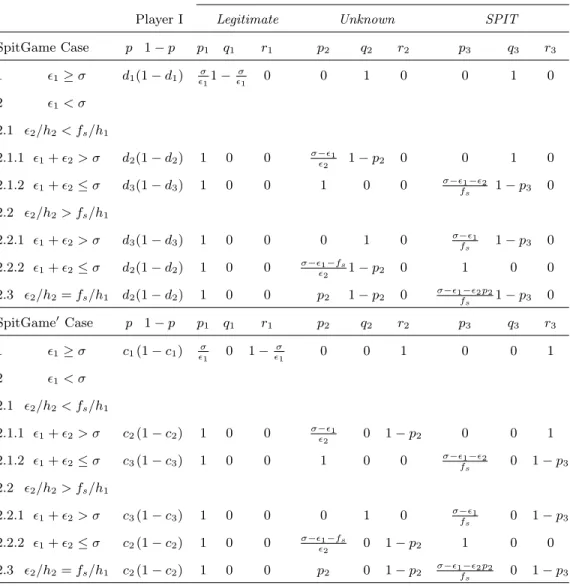
made earlier except for the Case 2.3. The closed forms of the NE for each case are summarized in Table 8.
4.2
The NE without audio CAPTCHAs
We examine now the NE of the SpitGame if users did not have the option to use audio CAPTCHAs. We can assume that the action CAPTCHA is removed from the game or equivalently thatuc>2ul. Ifuc>2ul, then all coefficients
Bi would be negative
Bi<0 fori= 1,2,3. (35)
and consequently the probability of submitting an audio CAPTCHA would be
qi= 0, for all infomation sets. We will call the model without audio CAPTCHAs
SpitGame0.
From Equations 25 and 21 we obtain that in the SpitGame0 the strategy of Player I satisfiesp≤max{c1, c2, c3}=c1.
Case 1: 1≥σ
Let us first consider the case1 > σ. From Equation 9 we obtain thatp1<1. Thus in Equation 12 we havep1>0 andq1>0. Recall, that the values of p1 and q1 at any NE have to maximize the utilityU2L. Given that B1 < 0, the only way the expressionU2Lis maximized forp1andq1both strictly positive is ifA1= 0. This requires thatp=c1.
Since p=c1 impliesA2<0 andA3 <0, we obtain thatp2=p3 = 0(and thusr2=r3= 1). Using this in Equation 9 we obtain thatp1= σ
Thus, the SpitGame0 has the following unique NE
p p1 r1 p2 r2 p3 r3
c1 σ1 1−p1 0 1 0 1
There is an evident analogy with the corresponding NE of the original SpitGame. The strategy of Player I isc1instead ofd1, while the strategy of Player II is the same if we swap the values ofqi and ri. In Section 4.3 we will show that the
probability of SPIT callsc1 is c1> d1, for uc <2ul. That is, the rate of SPIT
calls in the SpitGame0 is increased in comparison with the corresponding case of the SpitGame. We will also compare the corresponding utilities of Player II in both models.
Working in the same way it is straightforward to adapt the rest of the analysis of the original SpitGame to the SpitGame0. The results are presented below. Case 2: 1< σ Case 2.1: 2/h2< fs/h1 Case 2.1.1: 1< σ < 1+2 p p1 r1 p2 r2 p3 r3 c2 1 0 σ−1 2 1−p2 0 1 Case 2.1.2: 1+2≤σ. p p1 r1 p2 r2 p3 r3 c3 1 0 1 0 σ−f1s−2 1−p3 Case 2.2: 2/h2> fs/h1. p p1 r1 p2 r2 p3 r3 c3 1 0 0 1 σ−fs1 1−p3 Case 2.2.2: 1< σ < 1+2.
p p1 r1 p2 r2 p3 r3 c2 1 0 σ−12−fs 1−p2 1 0 Case 2.3: 2/h2=fs/h1. p p1 r1 p2 r2 p3 r3 c2 1 0 p2 1−p2 σ−1f−2p2 s 1−p3
wherec2=c3 and the range of values forp2 is
max{0,σ−1−fs 2 } ≤p2≤ σ−1−fsmax{0,σ−f1s−2} 2 . (36)
The closed forms of the NE for all cases of the SpitGame and the SpitGame0 are summarized in Table 8.
4.3
The benefit of supporting audio CAPTCHAs
We can now compare the NE of the SpitGame and the SpitGame0 in order to assess the effect of audio CAPTCHAs on the properties of the corresponding NE. We are interested in the rate of SPIT calls at the NE and the corresponding utility of Player II, the VoIP user.
Note that the strategy of Player I is always some value di, fori∈ {1,2,3}
in the SpitGame, and ci for the same index value of i in the corresponding
SpitGame0. Using Equation 20 it is straightforward to show that ci > di, for
any i∈ {1,2,3}, which implies a reduced rate of SPIT calls at the NE of the SpitGame. For example the ratioc1/d1 is
c1/d1=
2ul(fluc+1us)
uc(2flul+1us)
>1. (37)
Similarly, the ratiosc2/d2 andc3/d3 can also be shown to be larger than1.
option to submit audio CAPTCHA’s.
The utility of Player II at any NE of the SpitGame is larger than in the NE of the corresponding SpitGame. For example, the difference of the utility of Player II in Case 1 of the SpitGame minus the utility of the NE of the corresponding NE in the SpitGame0 is
U2−U20 =
1h2(2ul−uc)us(flul+1us)
(fluc+1us)(2flul+1us)
>0. (38)
Note, that we use the difference for the utilities instead of the ratio, because Player II may have a negative utility in the SpitGame0. For Case 2.1.1 the difference is
U2−U20 =
2h2(2ul−uc)us(h2ul+2us)
(h2uc+2us)(2h2ul+2us)
>0. (39)
In the same way, the difference of the utilities of Player II at NE in the SpitGame and the SpitGame0 can be shown to be positive for the remaining cases of the game.
Theorem 4. At NE, the utility of Player II is larger in the SpitGame than in
5
Experimental Study
For the experimental analysis we produce the theoretically predicted Nash Equi-libria properties independently from the theoretical analysis. We have selected realistic values for the filter’s ability to discern legitimate calls from SPIT calls based on the analysis performed in Sections 3 and 4. The experimental analysis was performed for three filter specification cases, shown in Table 9, and for each case we examined the NE of both SpitGame and SpitGame0.
The first filter specification case represents the most realistic case: the filter has significant difficulties in identifying SPIT calls resulting in a large percentage of SPIT calls being classified asUnknown, but can classify legitimate calls with relatively high accuracy. The second filter specification represents the conditions in a large organisation which receives calls from a large pool of people. As a result, it tends to classify both SPIT and legitimate calls as Unknown. The third filter specification represents a smaller organisation with a much smaller pool of frequent callers. Therefore, it tends to identify SPIT and legitimate calls much more accurately than in the previous two cases.
In order to reduce the original problem from a 5D parameter space into an equivalent 3D exploration space we take advantage of the conditions on the parameters shown in Table 2 to setul= 100 andsa = 100. In order to further
reduce the number of problem instances to solve, we take integral values for
us,uc andsr. The restrictions convert the original 5D parameter space into a
3D exploration space shown in Table 10. Additionally, we performed adaptive exploration of the games for values ofsrnear the boundary conditions for each
case.
We automatically computed the Nash equilibria of these games using the
gambit-lcp program supplied with Gambit [25] and fitted the resulting data to functions independently from the theoretical analysis.
5.1
Experimental Results & Discussion
The first result is that the Nash equilibria are unique, i.e., for each set of distinct values ofuc,usandsr, the game produces exactly one Nash equilibrium. This
has also significantly simplified our results and their analysis. It also means that there are no other equilibriums, with potentially worse outcomes for the user, for the game. As a result, the user’s selection of strategies, given the SPIT sender’s pay-offs always leads to exactly one equilibrium state. We have also verified empirically the validity of Theorem 1, by finding that all the NE, in all game instances, are mixed.
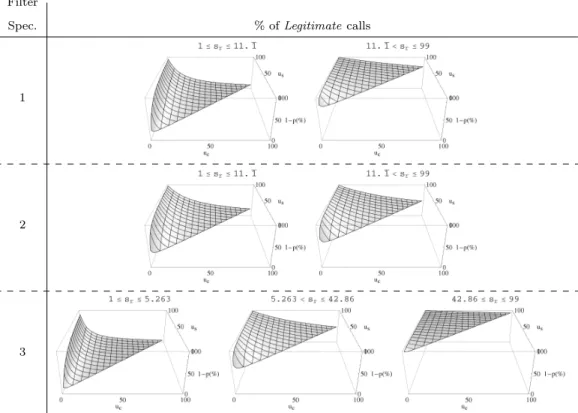
Another interesting result is the percentage of legitimate calls that the SPIT sender decides on (or conversely, the percentage of SPIT calls, as they are com-plementary) in the NE as a function of uc and us. In the filter specification
cases 1 and 2 there are twosrvalue groups (1≤sr≤11.1and11.1< sr≤99),
while filter specification case 3 has three sr value groups (1 ≤ sr ≤ 5.263,
5.263 < sr < 42.86 and 42.86 < sr ≤ 99). These results are shown in Fig.
2. These sr value groupings are correspond to the two base cases (1 and 2)
illustrated in Table 8 for both SpitGame and SpitGame0. As an example, for the first filter specification and for case 1 in Table 8:
1 ≥ σ⇔
0.1 ≥ sr/(sa+sr)⇔
0.1 ≥ sr/(100 +sr)⇔
11.1 ≥ sr
Case 2 is the complement of case 1, so11.1< sr.
In these Nash Equilibria and within each of the value groups for sr the
percentage of legitimate calls as a function of uc, us is identical. Realistically,
the actualsrvalue for SPIT senders will be relatively low and probably≤11.1
the SPIT call goes through) given the resources needed to make SPIT calls. The difference between the value groups pertains to the rate with which the percentage of the legitimate calls decreases in relation tousanduc. The figure
illustrates that as the cost of deploying the CAPTCHA mechanism increases, the number of SPIT calls also increases (legitimate percentage decreases). At the same time, as the disutility of accepting SPIT calls (us) increases for the
user, the number of legitimate calls increases, purportedly due to the increase in CAPTCHA use providing a strong disincentive to the SPIT sender.
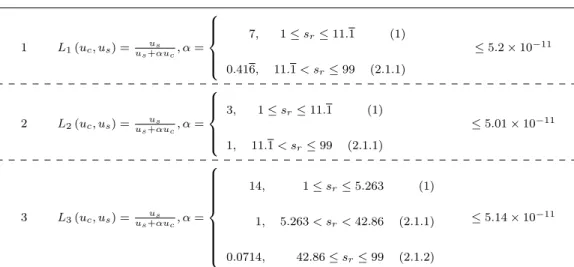
The percentage[0.0−1.0]of legitimate calls as a function ofuc and us has
been fitted to the functionsL1, L2, L3as shown in Table 11, which are identical to the ones produced in the theoretical analysis. For each of the fitted function cases, we have parenthesised its corresponding case in the NE Table 8.
5.2
Comparison of SpitGame and SpitGame
0In order to examine whether the use of the CAPTCHA challenge provides ben-efits to the users, we created a game model where all theCAPTCHAchallenge actions have been removed (SpitGame0) and only Accept and Reject actions are present. Using the same value ranges for ul, us, sr, sa and disregarding
uc (since there are no CAPTCHA challenges present) we performed the same
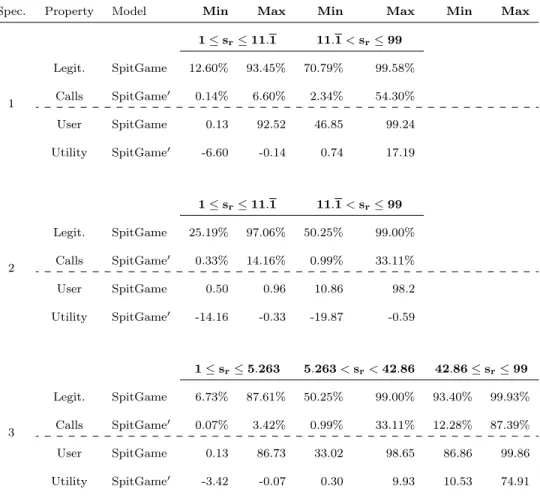
experiments at the same granularity as before. Our findings from compar-ing the model without CAPTCHA (SpitGame0) to the model with CAPTCHA (SpitGame) are summarized in Table 12.
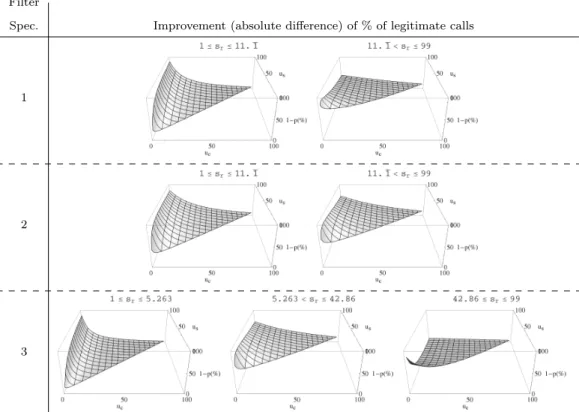
The use of CAPTCHA leads in to notable improvements to the percentage of legitimate calls since in no case does the percentage of legitimate calls drop. The improvement in percentage of legitimate calls is shown in Fig. 3. It is notable that for the filter specifications 1 and 2 when sr ≤ 11.1 and for the
badly that the measure of improvement is almost identical to the performance of the model with CAPTCHA.
Further discoveries include the fact that for the first filter specification, for all values ofsr, when the filter identifies a call asSPIT, only theCAPTCHAaction
is used (neverRejectorAccept). Also, even when the call is identified as either
LegitimateorUnknown, theRejectaction is never used. Furthermore, when the filter identifies a call asLegitimate andsr>11.1the user always selectsAccept.
Finally, when the filter identifies a call asUnknownandsr≤11.1the user never
selectsAccept. These discoveries, summarized in Table 13, mean that for the more realistic values ofsr (≤11.1) the Accept action can be removed without
impact when the filter identifies a call asUnknown orSPIT.
6
Conclusions and further research
Spam over Internet Telephony is a significant threat for VoIP communications, which may become a serious problem just like ordinary spam is for email. In this paper, we focused on the strategic interaction between SPIT senders and legitimate VoIP users. We assumed the existence of incoming call filters and effective audio CAPTCHAs and armed the VoIP users with the option to accept an incoming call, to reject it or to request an audio CAPTCHA based on a filter’s verdict.
The main contribution of our work is the derivation of game-theoretic model that captures the interaction of independent, selfish SPIT senders and VoIP users. Through theoretical arguments and a comprehensive experimental anal-ysis we studied the properties of the proposed game and identified its Nash equilibria.
The outcomes of our approach show that the use of the above mentioned de-fensive mechanisms lead to desirable Nash equilibria, where audio CAPTCHAs
contribute to the utility of the legitimate users. Moreover, if the user and SPIT sender pay-offs are known, then the game always leads to exactly one equilib-rium state with predictable characteristics.
In is noteworthy that in our model we allow for the attacker (SPIT user) to already know the performance characteristics of our filter. As a result, we are not vulnerable to attacks which would uncover the filter’s characteristics. In addition, at NE, all players, hence SPIT senders too, have full knowledge of the strategies of their opponents, but still cannot achieve a better outcome. This means that in our approach we are not attempting to secure through obscurity. The game-theoretic model of this work can be extended in several aspects to capture more properties of the real problem. An interesting topic for further research could be to refine the audio CAPTCHAs, for example, with additional parameters to model the solvability of the audio CAPTCHA. We have assumed here that the audio CAPTCHA are always solvable by a legitimate user and never solvable by a SPIT sender (automated SPIT application). New research works [5][42] have proven that about 10% of the humans are unable to solve them and that the success rate of the bots is about 5%. This new parameter would cover these edge cases.
Building upon the theoretical arguments and the experimental results pre-sented here, we plan to work on performing a complete theoretical analysis of the SpitGame [14]. As part of this analysis, we plan to investigate how dif-ferent filter parameters influence the Nash equilibria and lead the VoIP users and the SPIT sender to adjust their behavior. This will aid in further informing the decisions on trade-offs when implementing real CAPTCHA-based anti-SPIT systems.
7
Acknowledgments
This work was performed in the framework of the SPHINX (09SYN-72-419) Project, which is partly funded by the Hellenic General Secretariat for Research and Technology (http://sphinx.vtrip.net).
8
References
1. I. Androutsopoulos, E. Magirou and D. Vassilakis, A game theoretic model of spam e-mailing, in: Proc. of the 2nd Conference on Email and Anti-Spam, Stanford University, USA, 2005.
2. V. Balasubramaniyan, M. Ahamad and H. Park, Callrank: Combating spit using call duration, social networks and global reputation, in: Proc. of the 4th Conference on Email and Anti-Spam, USA, August 2007. 3. K. Basu, The traveler’s dilemma: Paradoxes of rationality in game theory,
American Economic Review, 84(2):391–95, May 1994.
4. D. Braess, Über ein Paradoxon aus der Verkehrsplanung. Unternehmens-forschung 12, pp. 258-268, 1968.
5. E. Bursztein, S. Bethard, C. Fabry, J. Mitchell and D. Jurafsky, How good are humans at solving CAPTCHA? A large scale evaluation, in: Proc. of the 2010 IEEE Symposium on Security and Privacy, pp. 399-413, USA, 2010.
6. H. Cavusoglu and S. Raghunathan, Configuration of detection software: A comparison of decision and game theory approaches,Decision Analysis, Vol. 1, No. 3, pp. 131-148, 2004.
7. C. Daskalakis, P.W. Goldberg and C.H. Papadimitriou, The complexity of computing a Nash equilibrium,Commun. ACM, 52(2):89–97, February 2009.
8. S. Dritsas, B. Tsoumas, V. Dritsou , P. Konstantopoulos and D. Gritzalis, OntoSPIT: SPIT Management through Ontologies,Computer Communi-cations, vol. 32, no. 2, pp. 203-212, 2009.
9. Federal Communications Commission, FCC Strengthens Consumer Pro-tections Against Telemarketing Robocalls, In the Matter of Rules and Reg-ulations Implementing the Telephone Consumer Protection Act of 1991, CG Docket No. 02-278, February 15, 2012.
10. Federal Trade Commission, Do-Not-Call Implementation Act of 2003, Public Law No. 108-10, June 2003.
11. Federal Trade Commission, National Do Not Call Registry Data Book for Fiscal Year 2012, October 2012.
12. Federal Trade Commission,FTC Settles “Rachel” Robocall Enforcement Case ( http://www.ftc.gov/opa/2013/07/aplus.shtm , retrieved 23 Octo-ber 2013).
13. D. Graham-Rowe, A sentinel to screen phone calls technology, MIT Re-view, 2006.
14. D. Gritzalis, P. Katsaros, S. Basagiannis and Y. Soupionis, Formal anal-ysis for robust anti-SPIT protection using model-checking, International Journal of Information Security, vol. 11, no. 2, pp. 121-135, 2012. 15. D. Gritzalis, V. Katos, P. Katsaros, Y. Soupionis, J. Psaroudakis and A.
botnet?, in: Proc. of the 4th International Conference on Information, Intelligence, Systems and Applications, IEEE Press, 2013.
16. D. Gritzalis, G. Marias, Y. Rebahi, Y. Soupionis and S. Ehlert, SPIDER: A platform for managing SIP-based spam over Internet Telephony,Journal of Computer Security, Vol. 19, No. 5, pp. 835-867, 2011.
17. B. Johnson, J. Grossklags, N. Christin and J.Chuang, Are Security Ex-perts Useful? Bayesian Nash Equilibria for Network Security Games with Limited Information, in: Proc. of the 15th European Symposium on Re-search in Computer Security, pp. 588-606, Greece, September 2010. 18. A. Johnston,SIP: Understanding the Session Initiation Protocol, 2nd
edi-tion, Artech House, 2004
19. C. Kanich, C. Kreibich, K. Levchenko, B. Enright, G. Voelker, V. Paxson and S. Savage, Spamalytics: An empirical analysis of spam marketing conversion, in: Proc. of the 15th ACM Conference on Computer and Communications Security, pp. 3-14, USA, October 2008.
20. A. Keromytis, Voice-over-IP Security: Research and Practice, IEEE Se-curity and Privacy, vol. 8, no. 2, pp. 76-78, 2010.
21. A. Keromytis, A Comprehensive Survey of Voice over IP Security Re-search, IEEE Communications Surveys & Tutorials, vol. 14, no. 2, pp. 514-537, 2012.
22. Y. Kim, Y. Park and J. Lee, Using stated-preference data to measure the inconvenience cost of spam among Korean e-mail users,Applied Economics Letters, Vol. 13, No. 12, pp. 795-800, 2006.
23. D. Lowd and C. Meek, Good word attacks on statistical spam filters, in:
2005.
24. M.H. Manshaei, Q. Zhu, T. Alpcan, T. Bacşar and J.P. Hubaux, Game theory meets network security and privacy,ACM Comput. Surv., 45(3):25:1– 25:39, July 2013.
25. J. McKelvey, D. Richard, A. McLennan and T. Turocy,Gambit: Software tools for game theory, ver. 0.2010.09.01. http://www.gambit-project.org. 26. R.B. Myerson, Game Theory: Analysis of Conflict, Harvard University
Press, Cambridge, MA, 1991.
27. S. Niccolini, S. Tartarelli, M. Stiemerling and S. Srivastava, SIP Exten-sions for SPIT Identification, Internet Draft, Network Working Group, 2007, draftniccolini-sipping-feedback-spit-03.
28. N. Nisan, T. Roughgarden, E. Tardos and V.V. Vazirani, Algorithmic Game Theory, Cambridge University Press, New York, NY, USA, 2007. 29. M. Osborne and A. Rubinstein, A Course in Game Theory, The MIT
Press, 1994.
30. M. Osborne, An Introduction to Game Theory, Oxford University Press, 2003.
31. G. Owen,Game Theory, Academic Press, 1982.
32. C.H. Papadimitriou, Algorithms, Games, and the Internet, in: Proceedings of the 33rd ACM STOC, pages 749–753, New York, NY, USA, 2001. 33. M. Parameswaran, H. Rui and S. Sayin, A game theoretic model and
empirical analysis of spammer strategies, in: Proc. of the Collaboration, Electronic Messaging, Anti-Abuse and Spam Conference, 2010.
34. P. Patankar, G. Nam, G. Kesidisand and C. Das, Exploring anti-spam models in large scale voip systems, in: Proc. of the 28th International Conference on Distributed Computing Systems, China, June 2008. 35. J. Quittek, S. Niccolini, S. Tartarelli, M. Stiemerling, M. Brunner and T.
Ewald, Detecting SPIT calls by checking human communication patterns, in: Proc. of the IEEE International Conference on Communications, pp. 1979-84, UK, 2007.
36. J. Rosenberg and C. Jennings, The Session Initiation Protocol (SIP) and Spam,Network Working Group, RFC 5039, January 2008.
37. S. Sawda and O. Urien, SIP security attacks and solutions: A state-of-the-art review, in: Proc. of the IEEE International Conference on Information and Communication Technologies, pp. 3187-3191, April 2006.
38. A.B. Shahroudi, R.H. Khosravi, H.R. Mashhadi and M. Ghorbanian, Full Survey on SPIT and prediction of how VoIP providers compete in presence of SPITTERS using Game-Theory, in: Proc. of the 2011 IEEE Interna-tional Conference on Computer Applications and Industrial Electronics (ICCAIE), pp. 402 - 406, Abu Dhabi, 2011
39. D. Shin, J. Ahn and C. Shim, Progressive multi gray-leveling: a voice spam protection algorithm, IEEE Network, Vol. 20, No. 5, pp. 18-25, 2006.
40. H. Sinnreich and B. A. Johnston, Internet Communications Using SIP: Delivering VoIP and Multimedia Services with Session, Second Edition, Wiley Publishing Inc., 2006
41. Y. Soupionis and D. Gritzalis, ASPF: An adaptive anti-SPIT policy-based framework, in: Proc. of the 6th International Conference on Availability,
Reliability and Security, pp. 153-160, Austria, August 2011.
42. Y. Soupionis and D. Gritzalis, Audio CAPTCHA: Existing solutions as-sessment and a new implementation for VoIP telephony, Computers & Security, Vol. 29, No. 5, pp. 603-618, 2010.
43. Y. Soupionis, S. Dritsas and D. Gritzalis, An adaptive policy-based ap-proach to SPIT management, in: Proc. of the 13th European Symposium on Research in Computer Security, pp. 446-460, Springer, 2008.
44. M. Tambe, M. Jain, J.A. Pita and A.X. Jiang, Game theory for security: Key algorithmic principles, deployed systems, lessons learned, in: 50th Annual Allerton Conference on Communication, Control, and Computing, pages 1822–1829, 2012.
45. D. Vassilakis, I. Androutsopoulos and E. Mageirou, A game-theoretic in-vestigation of the effect of human interactive proofs on spam e-mail, in:
Proc. of the 4th Conference on Email and Anti-Spam, USA, 2007. 46. T. Walsh and D. Kuhn, Challenges in securing voice over IP,IEEE Security
and Privacy, Vol. 3, No. 3, pp. 44-49, 2005.
47. T. Wilson,Competition may be driving surge in botnets and spam.
Tables
Table 1: Game-theoretic model utilities
User/Player II SPIT sender/Player I
Message Accept Reject CAPTCHA Accept Reject CAPTCHA
Legitimate ul −ul ul−uc 0 0 0
SPIT −us 0 0 sa −sr −sr
Table 2: Player preferences parameters
Player Parameter Description Conditions(absolute values)
User/Player II ul Measure of user utility
of accepting legitimate call
ul> us> uc>0
us Measure of user
disutil-ity of accepting SPIT call
uc Measure of user
disutility of sending CAPTCHA
SPIT sender/Player I sa Measure of SPIT
sender utility of get-ting a SPIT call accepted
sa> sr>0
sr Measure of SPIT
sender disutility of getting a SPIT call rejected
Table 3: The filter verdicts.
Filter verdict
Type of call Legitimate Unknown SPIT
SPIT call 1 2 fs
Legitimate call fl h2 h1
Table 4: The strategy of Player I at a NE
Action of Player I Probability
SPIT call p
Legitimate call 1-p
Table 5: The strategy of Player II at a NE
Action of Player II Information Set
(Filter verdict)
Accept CAPTCHA Reject
1 Legitimate call p1 q1 r1= 1−p1−q1
2 Unknown p2 q2 r2= 1−p2−q2
3 SPIT call p3 q3 r3= 1−p3−q3
Table 6: The coefficients for Equation 15
i Ai Bi Ci Di
1 2flul(1−p)−1usp fl(2ul−uc)(1−p) −flul(1−p) fl(1−p) +1p
2 2h2ul(1−p)−2usp h2(2ul−uc)(1−p) −h2ul(1−p) h2(1−p) +2p
Table 7: Boundary values ofp
Equation Condition Equation Condition
A1= 0, ifp=2f2flul lul+1us =c1 A1=B1, if p= fluc fluc+1us =d1 A2= 0, if p= 2h2h2ul 2ul+2us =c2 A2=B2, ifp= h2uc h2uc+2us =d2 A3= 0, ifp=2h2h1ul 1ul+fsus =c3 A3=B3, ifp= h1uc h1uc+fsus =d3
Table 8: The NE of SpitGame and SpitGame0 (without CAPTCHAs).
The ranges of values forp2 in case 2.3 of SpitGame and 2.3 of SpitGame0 are given in Equations 34 and 36, respectively.
Player II (Information Sets)
Player I Legitimate Unknown SPIT
SpitGame Case p 1−p p1 q1 r1 p2 q2 r2 p3 q3 r3 1 1≥σ d1(1−d1) σ 11− σ 1 0 0 1 0 0 1 0 2 1< σ 2.1 2/h2< fs/h1 2.1.1 1+2> σ d2(1−d2) 1 0 0 σ−1 2 1−p2 0 0 1 0 2.1.2 1+2≤σ d3(1−d3) 1 0 0 1 0 0 σ−f1−2 s 1−p3 0 2.2 2/h2> fs/h1 2.2.1 1+2> σ d3(1−d3) 1 0 0 0 1 0 σ−f1 s 1−p3 0 2.2.2 1+2≤σ d2(1−d2) 1 0 0 σ−12−fs1−p2 0 1 0 0 2.3 2/h2=fs/h1 d2(1−d2) 1 0 0 p2 1−p2 0 σ−1f−2p2 s 1−p3 0 SpitGame0Case p 1−p p1 q1 r1 p2 q2 r2 p3 q3 r3 1 1≥σ c1(1−c1) σ 1 0 1− σ 1 0 0 1 0 0 1 2 1< σ 2.1 2/h2< fs/h1 2.1.1 1+2> σ c2(1−c2) 1 0 0 σ−1 2 0 1−p2 0 0 1 2.1.2 1+2≤σ c3(1−c3) 1 0 0 1 0 0 σ−f1s−2 0 1−p3 2.2 2/h2> fs/h1 2.2.1 1+2> σ c3(1−c3) 1 0 0 0 1 0 σ−f1 s 0 1−p3 2.2.2 1+2≤σ c2(1−c2) 1 0 0 σ−1−fs 2 0 1−p2 1 0 0 2.3 2/h2=fs/h1 c2(1−c2) 1 0 0 p2 0 1−p2 σ−1f−2p2 s 0 1−p3
Table 9: The experimental filter verdicts.
Filter verdict
Filter Specification Type of call Legitimate Unknown SPIT
1 SPIT 0.1 0.6 0.3 Legitimate 0.7 0.25 0.05 2 SPIT 0.1 0.6 0.3 Legitimate 0.3 0.6 0.1 3 SPIT 0.05 0.25 0.7 Legitimate 0.7 0.25 0.05
Table 10: Solution exploration space
us
× uc × sr =
# Instances
2. . .99 1. . . us−1 1. . .99 ∼500000
Filter
Spec. Fitted functions for%of legitimate calls Abs. Fitting Error
1 L1(uc, us) = u us s+αuc, α= 7, 1≤sr≤11.1 (1) 0.416, 11.1< sr≤99 (2.1.1) ≤5.2×10⁻¹¹ 2 L2(uc, us) = u us s+αuc, α= 3, 1≤sr≤11.1 (1) 1, 11.1< sr≤99 (2.1.1) ≤5.01×10⁻¹¹ 3 L3(uc, us) = u us s+αuc, α= 14, 1≤sr≤5.263 (1) 1, 5.263< sr<42.86 (2.1.1) 0.0714, 42.86≤sr≤99 (2.1.2) ≤5.14×10⁻¹¹
Table 11: Fitted functions for% of legitimate calls ((1−p)∗100) (function of
Table 12: Major findings from comparison of models with (SpitGame) and without CAPTCHA (SpitGame0) in NE
Filter
Spec. Property Model Min Max Min Max Min Max
1≤sr≤11.1 11.1<sr≤99 1 Legit. SpitGame 12.60% 93.45% 70.79% 99.58% Calls SpitGame0 0.14% 6.60% 2.34% 54.30% User SpitGame 0.13 92.52 46.85 99.24 Utility SpitGame0 -6.60 -0.14 0.74 17.19 1≤sr≤11.1 11.1<sr≤99 2 Legit. SpitGame 25.19% 97.06% 50.25% 99.00% Calls SpitGame0 0.33% 14.16% 0.99% 33.11% User SpitGame 0.50 0.96 10.86 98.2 Utility SpitGame0 -14.16 -0.33 -19.87 -0.59 1≤sr≤5.263 5.263<sr<42.86 42.86≤sr≤99 3 Legit. SpitGame 6.73% 87.61% 50.25% 99.00% 93.40% 99.93% Calls SpitGame0 0.07% 3.42% 0.99% 33.11% 12.28% 87.39% User SpitGame 0.13 86.73 33.02 98.65 86.86 99.86 Utility SpitGame0 -3.42 -0.07 0.30 9.93 10.53 74.91
Table 13: Summary of actions used based on filter call identification and the valuesr in the first filter specification case
Call identified as
Actions Used
1≤sr≤11.1 11.1<sr≤99 Legitimate Accept,CAPTCHA Accept
Unknown CAPTCHA Accept,CAPTCHA
Figure Captions
Fig. 1. The game-theoretic model
Fig. 2. % of legitimate calls ((1−p)∗100) (function of uc and us for the sr
value groups)
Fig. 3. Improvement (absolute difference) of % of legitimate calls with CAPTCHA (SpitGame) vs. without CAPTCHA (SpitGame0)
Figures
Filter
Spec. %ofLegitimatecalls
1
2
3
Fig. 2: % of legitimate calls ((1−p)∗100) (function of uc and us for the sr
Filter
Spec. Improvement (absolute difference) of%of legitimate calls
1
2
3
Fig. 3: Improvement (absolute difference) of % of legitimate calls with CAPTCHA (SpitGame) vs. without CAPTCHA (SpitGame0)