This is a repository copy of Story Blocks : Reimagining narrative through the blockchain. White Rose Research Online URL for this paper:
http://eprints.whiterose.ac.uk/115257/ Version: Accepted Version
Article:
Maxwell, Deborah orcid.org/0000-0002-1896-6925, Speed, Chris and Pschetz, Larissa (2017) Story Blocks : Reimagining narrative through the blockchain. Convergence: The International Journal of Research into New Media Technologies. pp. 79-97. ISSN 1354-8565
https://doi.org/10.1177/1354856516675263
[email protected] https://eprints.whiterose.ac.uk/ Reuse
["licenses_typename_unspecified" not defined]
Takedown
If you consider content in White Rose Research Online to be in breach of UK law, please notify us by
Story Blocks: reimagining narrative through the blockchain
Deborah Maxwell, Chris Speed, Larissa Pschetz
Abstract
Digital technology is changing, and has changed the ways we create and consume narratives, from moving images and immersive storyworlds to digital longform and multi-branched story experiences. At the same time, blockchain, the technology that underpins cryptocurrencies such as Bitcoin, is revolutionising the way that transactions and exchanges occur. As a globally stored and collaboratively written list of all
transactions that have ever taken place within a given system, the blockchain
decentralises money and offers a platform for its creative use. There are already examples of blockchain technologies extending beyond the realm of currency, including the
decentralisation of domain name servers that are not subject to government takedown, and identity management and governance.
By framing key blockchain concepts with past and present storytelling practices, this paper raises questions as to how the principles and implementation of such distributed ledger technologies might be used within contemporary writing practices Ð that is, can we imagine stories as a currency or value system? We present three experiments that draw on some of the fundamental principles of blockchain and Bitcoin, as an instantiation of a blockchain implemented application, namely; 1) the Ledger, 2) the Blocks, and 3) the Mining Process. Each low-fi experiment was intentionally designed to be very accessible to take part in and understand and were conducted as discrete workshops with different sets of participants. Participants included a cohort of design students, technology industry and design professionals, and writing and interaction design academics. Each experiment raised a different set of reflections and subsequent questions on the nature of digital, the linearity (or not) of narratives, and collaborative processes.
Introduction
New technologies have the potential to profoundly change the way we experience and therefore the way we tell stories, from moving images and immersive storyworlds (e.g. Pullinger, 2007) to digital longform and multi-branched story experiences. One emerging technology that could radically change the way we communicate is the blockchain. Often associated with the Bitcoin cryptocurrency system, blockchain applications are
revolutionising the way transactions and exchanges occur, and, we argue, have the potential to change the way we think about digital technologies and storytelling more broadly.
We propose that blockchain technologies can become a new framework not only for the production (distribution and financing) of stories but also their creation. The implications of such a technology and its disruption in other sectors from finance, retail, and identity management has encouraged us to consider that if stories can be envisaged as currency, that is, holding a fluctuating value within a social system, how might they
change both creation and consumption behaviours? With this question in mind we conducted three experimental workshops drawing on a Research through Design (RtD) inspired approach (e.g. Gaver, 2012) that explored key features of blockchain
technologies, namely; 1) the Ledger, 2) the Blocks, and 3) the Mining Process. RtD focuses on knowledge gained through the practice of design where its practitioners recognise making as Òa route to discovery.Ó (Gaver, 2012, p.942) Our rationale for adopting such a creative, collaborative, interactive and ultimately engaging approach was threefold: 1) to increase access to what is essentially a highly technical topic involving complex computational concepts and jargon; 2) to create and open a fluid design space for the consideration of blockchain principles into new domains, i.e. narrative and storytelling; and 3) to engage in creative or ÔmakingÕ activities to directly stimulate creative thinking and rich conversations (Gauntlett, 2013).
Each low-fi experiment was conducted as a discrete workshop with different sets of participants, namely, a cohort of design and computer science students; technology industry and design professionals; and writing and interaction design academics. The opportunistic recruitment of participants afforded a structured tailoring for each experiment that ensured workshop activities, observations and captured data were appropriate for each case. This human-centred workshop approach to research draws on design methods employed in service design and design thinking (e.g. Brown, 2008; Chasanidou et al., 2015). Whilst organised around three technical aspects of the
blockchain, each experiment raised a set of reflections and subsequent questions on the nature of digital, linearity (or not) of narratives, and collaborative processes. Following an overview of their related blockchain principle and an account of the experiment, reflections and speculations are offered on how each workshop may help us think about contemporary writing challenges and practices. It should be noted that each experiment stands on its own, representing a progression and reflection in the authorsÕ thinking, rather than comparative instantiations of scientific experiments.
Technology and Writing
The widespread adoption of the internet introduced new ways of thinking about communication systems (e.g. Bolter & Grusin, 2000), externalising our memory and extending our Ònervous systemÓ (McLuhan, 1994). Practices of browsing, searching and accessing information online as well as communicating through new online systems have changed the we perceive and react to the world around us, adopting new information seeking strategies (e.g. Morris et al, 2010; Walton and Vukovic, 2003). We have moved from mere consumers of content towards producers, documenting not only our thoughts and activities online through social media, but also our data through purchasing habits and personal sensors and tracking devices. Open source software approaches and licensing models such as Creative Commons are opening up not just social and commercial sharing of creative media but also in academia; e.g. GitHub, an open software publishing platform, hosts some technical white papers (Swan, 2015).
Figure 1. PettittÕs Gutenberg Parenthesis
Technology and storytelling have always evolved, and indeed Pettitt's Gutenberg Parenthesis (2007) offers a framework for considering the changing attributes of creative practice in relation to technology (Figure 1). The introduction of the printing press heralded a new era for transmission of knowledge and, it can be argued, prompted a shift from a mutable oral cultural (pre-parenthetical) to literate culture with an emphasis on the fixity of the written word. As can be seen from Figure 1, connections between pre- and post- parenthetical are evident, suggesting that digital technology offers a post-literary interpretation, resulting in more fluid, democratic forms of communication. These three stages are to an extent mirrored by the three experiments described in this paper;
Experiment 1. The Ledger adopts an oral storytelling approach exploring the changing of stories across a network;
Experiment 2. The Blocks adopts a written approach, using handwritten notes sealed in envelopes to preserve their state; and
Experiment 3. The Mining Process adopts a digital approach, embracing collaboration to co-author a text.
The Ôpost-parentheticalÕ era includes the experimental technology uses employed not only by creative writing academics but also mainstream authors. Recent bestseller The Martian by Andy Weir was originally composed and published in serialised form, hosted on his blog, with versions seeking feedback and input from a technical online audience (Jaggard, 2015). Similarly Atwood (Biedenharn, 2015) and Pullman (Berridge, 2014) have used social media platform Twitter as a way of publishing, promoting, and engaging with readers; at the same time, crowdfunding ventures such as Unbound1 offer new avenues for publishing and authoring.
Blockchain and Blocks of Stories
Blockchain is most commonly discussed in relation to Bitcoin and alternative cryptocurriences. However, there are already examples of blockchain technologies extending beyond the realm of finance, including the decentralisation of domain name servers2 that are not subject to government takedown, and identity management and governance3. Furthermore, Swan (2015) outlines opportunities in education, business and
PRE-PARENTHETICAL
( )
re-creative collective contextual unstable traditional PERFORMANCE GUTENBERG PARENTHESIS original individual autonomous stable canonical COMPOSITION POST-PARENTHETICAL sampling remixing borrowing reshaping appropriating recontextualizinghealth contexts, through what she terms Blockchain 3.0, seeing blockchain as a Ònew paradigm for organizing activity with less friction and more efficiencyÓ (p.29).
The radical invention of the blockchain is notable for two key elements:
1) The blockchain introduces scarcity to digital systems. While we tend to think about digital entities as being easily replicable (e.g. copying image files), known finite assets of the value system (e.g. Bitcoins) are tracked and maintained through a networked ledger of the blockchain.
2) The creation and maintenance of the blockchain is a participatory endeavour.
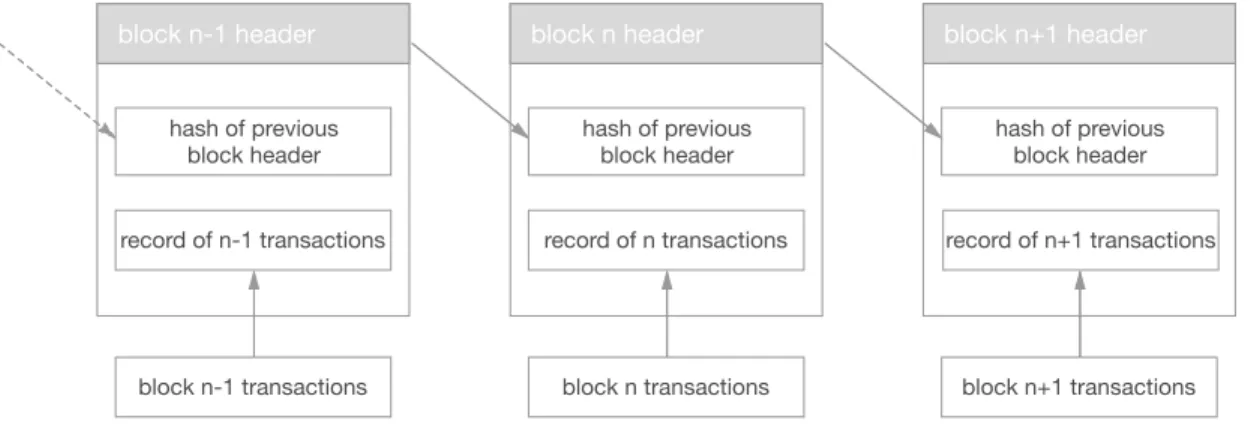
Consider the example of emailing an image file, where both the sender and receiver have a copy at the end of the transaction. To similarly prevent users printing their own money, transactions in the value system need to be validated to ensure digital scarcity. This takes place across a network through a process called ÔminingÕ, using a single ledger that stores all these transaction in blocks. This ledger is freely accessible to miners, any interested parties and users of the system with multiple copies of the same ledger held across the network, i.e. a distributed ledger. Miners compete with each other to encode each block into a sequence of bits called a hash. This hash in turn includes the previous blockÕs hash and so on, back to the Genesis Block, thus the chain metaphor in the term ÔblockchainÕ. Figure 1 illustrates this chain for a given block n in a system. The blockchain therefore is an encrypted, cumulative, distributed ledger composed of blocks of transactions that are confirmed by miners, which, for Bitcoin leads back to the first Genesis block whose instance is timed as 18:15:05 GMT on the 3rd of January 2009, signifying the start of the Bitcoin currency. The production or mining of these hashes involves mathematical rules that are highly computationally intensive and expensive. Miners are incentivised by the potential reward of currency within the system (e.g. Bitcoins).
Figure 2. Simplified diagram of chained blocks in a system.
At first glance, the idea of combining stories and cryptocurrencies might seem outlandish, however, the structural breaking down of stories into constituent parts and formulae is well established Ð from AristotleÕs analysis of tragedy in Poetics, to Georges Polti identifying thirty-six plots (1954), to CampbellÕs monomyth (1993), and BookerÕs seven
record of n-1 transactions block n-1 header hash of previous block header block n-1 transactions record of n transactions block n header hash of previous block header block n transactions record of n+1 transactions block n+1 header hash of previous block header block n+1 transactions
themes (2004). ProppÕs (1968) codification of Russian folktales into thirty-one discrete functions, describes the structural elements of a tale as assigned to its characters, and his analysis continues to have a profound influence on the computational production and theories of interactive narrative (e.g. Nakasone and Ishizuka, 2006; Cavazza et al., 2009; Gerv‡s, 2013).
This paper does not draw on these formulaic approaches to narrative creation, however there is clear potential for the application of such techniques that utilise discrete blocks of stories, and which may be helpful when conceptually reflecting on the
blockchain (and indeed for future applied research avenues). Additionally, this paper does not attempt to provide a full understanding of the complexities of distributed ledger technologies. Rather, an overview of principles are given as they are encountered and presented as simply as possible.
Experiment 1: The Ledger
In which a game of truth and lies provides a means to explore ownership, authenticity and value across a network.
Aim: To explore how a blockchain-inspired network employing stories as a form of currency might function using oral storytelling.
The Ledger Experiment: Blockchain Concept
The Ledger Experiment explored the blockchain concept of a recorded chain of
transactions, drawing on the use of pseudonyms to explore tensions between anonymity and transparency. For instance, in the case of Bitcoin, whilst all transactions are
underpinned by a blockchain, visible and transparent to anyone via interrogation of the ledger, each transaction is attached to a specific user code or pseudonym. Without knowing the real world identity of the pseudonym the transactions are essentially anonymous. This attribute of pseudonymity affords some of the criminal and fraudulent activity surrounding Bitcoin as frequently reported in mass media.
Critically however, the movement or flow of the object of value in the system (e.g. Bitcoins) can still be tracked, moving from one anonymous owner to another Ð back to the creation or ÔminingÕ of the object (e.g. the introduction of a specific Bitcoin into the system). The Ledger Experiment attempted to mirror these movements by physically tracking the ownership of stories (not Bitcoins) across a group of people in a room through a paper-based token system, with the paper token representing ÔownershipÕ of a story. Additionally, the paper token illustrated and tracked the number of transactions or movements (or previous ÔownersÕ) a specific story had. It deviated however from
blockchain principles in that the chain of transactions are, in the experiment, tied to each object (i.e. story), rather than as a single, decentralised agreed ledger that tracks all transactions in the network and is widely distributed across the network.
A set of approximately 50 first year undergraduate design students at University of Dundee, UK, took part in a half-day workshop with talks and activities around ways to write and reflect. As part of this, the final session was a blockchain inspired ledger activity based on the Two Truths and a Lie game. Each student was given three slips of paper and asked to write the name of a (preferably famous) person on one side and choose and write their own pseudonym on the other side. The three ÔfamousÕ names they selected were to include two people that they had actually met (the Truths), and one that they had not (the Lie). They were then asked to tell their stories to each other in pairs, afterwards choosing to swap one or more of their stories by trading the story cards, and adding their pseudonym to the back of each new card they acquired. The stated aim was to be the best storyteller or liar, with a card that moved around the room the furthest, with instructions to swap the best story or one that they thought had the most potential.
Importantly, students were invited to elaborate elements of the story with each swap. Once the storytelling began the room became very animated (see Figure 3), with everyone physically moving round the room to share and retell their stories. After 10 minutes a new rule was introduced to the trading system, where a single highly valued story card could be swapped for more than one less valued story card. After a further 10 minutes, time was called and some of the stories were shared out loud to the whole class. As the story transactions or ÔownershipÕ records were denoted on the back of each card it was easy to see which stories had travelled the furthest, and students were asked to share the starting point and end point of each of these cards. We also sought to establish who was the best ÔliarÕ by who had the ÔbestÕ truth or lie card.
The Ledger Experiment: Discussion and speculations
The movement and mutation of stories in the experiment is reminiscent of more
traditional forms of knowledge exchange, such as gossip, word of mouth, or oral culture more broadly. In the world of traditional Scottish storytelling there is a saying that when you tell a story those who have told it before, the story ancestors so to speak, are standing just behind your shoulder, one behind the other going back to the first tale teller (the very first, or Genesis, block in our blockchain analogy). The image of previous tellers
watching you demands a sense of gravitas and respect for both the stories and the practice and reflects the community ethos, acknowledging the both the sense of time and tradition as well as its contemporary nature. In comparison to the spoken word, written texts have an air of permanenceÑof disembodied voices transcending space, time and death. In some ways oral communication is more immediate and essentially alive; Ôsound exists only when it is going out of existenceÕ (Ong, 1986, p. 25).
Whilst the definition and even term Ôoral cultureÕ sparks debate amongst scholars, a universally accepted attribute of oral cultures is that of malleability. In pre-literate cultures the amount of information that can be stored by an individual is finite. Thus Ôcollective memoryÕ is codified in narrative using rich, descriptive language and stored by the group memory as a whole. This collective knowledge is not necessarily passed on unchanged ad infinitum, much like our stories in the Ledger Experiment. Goody and Watt (1968) describe how genealogies vary as even collective memory has limits.
Similarly, they recount how the Gonja of Northern Ghana explain the subdivision of their state into seven by relating it to their founderÕs (Ndewura Jakpa) seven sons. Due to British colonisation two of these divisions vanished and the number of Ndewura JakpaÕs sons in the narrative correspondingly reduces to five. In a similar vein, it has been noted that verbatim recitation does not necessarily warrant the same attention in oral traditions as in literate. Meaning, or sense, is the criterion against which expressions are judged, i.e. two expressions meaning the same are deemed to actually be the same without using the exact wording (Olson, 1996).
The story card ownership records (the list of pseudonyms on the reverse of the slips of paper) indicated that cards had between one and six owners, i.e. some story cards did not change hands at all, whilst others were swapped several times during the activity. The less popular cards included the Queen and local footballers as well as the names of two members of staff in the department, including the module leader who was present at the workshop. Taking into account that the participants were first year undergraduate students on the same course in a relatively small city, as might be imagined several story cards had the same name on them, for instance of well known, touring comedians. It would be easy to hypothesise that students had been to these events as a peer group. Setting aside the limitations of the participant group, the value of this activity was in its means to reflect on the movement of narrative and the spontaneous rewriting of
anecdotes across a network.
In oral storytelling, it is said that the only time a story can truly belong to or be owned by an individual is in the act of telling (Yashinsky, 2004). Yet even that statement is potentially contentious, for it is actually shaped and therefore belongs to the grouping
of listeners and teller as a whole, bound to that instant in time. In Scottish storytelling culture, once a story has been told or heard it is free to be retold by the listeners, perhaps with acknowledgement of the previous teller, but the ownership of the tale is fluid, precious in its existence but a folk tale, owned by the folk who hear and tell it, altering subtly in each rendition. In essence this is what the experiment sought to do, making the provenance of each story card explicit in each state of mutation (Figure 4).
Figure 4. Mutation of a story across its network transactions.
An often cited potential application for blockchain related technologies is the verification of ownership, e.g. proof of purchase of a car, deeds of a house, or a last testament and will (Swan, 2015). But what if the nature of the ÔthingÕ being owned changed with each transaction? If there was indeed a block chain of stories, each block containing a subtly altered or augmented version of a story, what would that look like? Could this form a new way of writing, reading or understanding of the process? Lost in Track Changes
(Groth, 2014) provides a print-based example of a chain approach to writing Ð a series of authors were commissioned to sequentially remix a vignette that Òtakes the personal and intimate craft of memoir and turns it over to the wild cut-and-paste aesthetic of remix cultureÓ. The reader is also given permission to take part in the remixing Ð by physically removing or annotating pages using the bookÕs spiral binding.
In considering what the workshop revealed in connection with the blockchain, one key observation is that the concept is dependent on the links and transmission across the network. In this instance there was a pre-existing trust relationship and common shared knowledge amongst the students. Conversation flowed easily and stories mutated, in some instances dramatically, e.g. a (real) meeting with a Swedish princess on a plane became a murder mystery style plot. The role of reputation or popularity in the experiment was not accounted for either. In an increasingly flooded and competitive publishing marketplace (Holman, 2015), authors live and die by their name Ð their name is their brand. Blockchain technologies could propagate and authenticate a
transaction/author across a network. Purse.io4, a third party means of converting Bitcoin to a government backed fiat currency (e.g. US dollars or pound sterling) via real world goods, hinges on trust and development of reputation, where the incentive is for the Bitcoin seller is to be a ÔgoodÕ seller thereby increasing reputation and commanding a better price for their selling services (i.e. the ability to command higher discount rates on real world goods). Subsequent research might consider how a similar platform could be developed for authors and readers to promote, propagate and publish work.
In which a parlour game of matryoshka doll-like nested story fragments provides a means to explore the weight of words, permanency, and cumulative, connective knowledge.
Aim: To explore how a string of related written story fragments might form using the concept of sealed blocks in distributed ledger technologies.
The Blocks Experiment: Blockchain Concept
The Blocks Experiment, not dissimilar to the Exquisite Corpse or Consequences Victorian parlour games, explored the blockchain concepts of discrete ÔblocksÕ of transactions. The aim of the Blocks experiment was to focus on the cumulative qualities of the block chain as it validates and builds up a collection of transactions before being ultimately sealed as a block (see Figure 2). This ÔsealingÕ of blocks confers a sense of permanency, i.e. events that have taken place in previous blocks cannot be changed or undone. This permanency is essentially maintained for as long as the system exists (for further information see Zohar, 2015).
In the example of Bitcoin, the construction of a new transaction block takes place approximately every 10 minutes, a timing that is calibrated by the Bitcoin network rules Ð if blocks are completed quicker, the difficulty of the mining is increased, and vice versa. Each block provides an opportunity for transactions to be verified and thus take place within a reasonable and anticipated amount of time. This process is verified by miners who compete to complete Ôproof of workÕ functions, that is, computationally intensive algorithms, which can be considered to be similar to maths puzzles. Once a miner has completed the proof of work, the block, encapsulating the set of transactions, is sealed and the latest sets of transactions are broadcast and propagated across the network, enabling the next block of transactions to begin. As illustrated in Figure 2, each new block references the previous block, creating the chain.
The Blocks experiment deviates from the blockchain in that it created a set of stories within each other, conceptually nested rather than a linear chain (Figure 5). However, the sealing of each story was significant, and suggests that the materiality of paper, books and ledgers perhaps implies a serious and earnest nature of its content. In comparison to Experiment 1. The Ledger, the Blocks experiment employed the written word, situating the experiment within the Gutenberg Parenthesis. This emphasis on permanency of the written word and exact phrasing as proof of authenticity also resonates with the use of hash functions in cryptocurrencies.
The one-way hash functions used in cryptography (e.g. SHA-256 as currently used in Bitcoin) transform blocks of data so that an input of an arbitrary length results in an output of fixed length. This is essentially a one-way mapping, i.e. it is computationally expensive and prohibitive to work out the original input given the output. A useful analogy might be that of mixing paint, where it is difficult (and costly) to work out what two exact original colours might be given a mixed third (output) colour. Additionally, in hash functions any change in the original input text produces an unpredictable hashed output. This concept is central to the mining process of Bitcoins and is explored further in Experiment 3. One of the benefits of such a one-way hash function however is that the owner or holder of the original data block can prove that they do indeed have the original data, as running the original data through the hash function will result in the same stored hashed value, i.e. exact data or wording is considered a mark of authenticity.
The Blocks Experiment: Method
The Blocks Experiment was designed as part of a larger residential workshop that took place in Edinburgh, UK, in February 2015. The overall workshop brought 24 individuals together from different backgrounds, including designers, academics, developers and technology start ups and businesses, using creative thinking as a catalyst to generate new business ideas around a central topic, in this instance alternative currencies, including cryptocurrencies such as Bitcoin. Consequently, some participants had extensive and in-depth understanding of blockchain and related technologies. Post-workshop, seed funding was available to support these new business ideas.
The Blocks Experiment was conducted at the start of the workshop as an ice-breaker activity that would propagate across the room when participants arrived at the venue. Participants were invited to take part in the parlour game, which created a chain of interactions that resulted in a fragmented set of nested stories. The game began with a small envelope in which the first participant was invited (privately) to place a piece of paper containing a sentence responding to the prompt Òthe best bargain you ever got?Ó. The sentence was placed within the envelope and handed to another participant who read the sentence, sealed the envelope, added a further sentence on a fresh piece of paper, and placed this, along with the first sealed envelope, into a marginally bigger unsealed envelope. This cycle was repeated, building up the Russian doll layering of envelopes inside each other. Each participant was able to open and read the previous authorÕs sentence only, and interpreting and responding to this only (see Figure 6). After a series of rounds, this cumulative cycle led to a bulging final envelope that encased the previous envelopes. This anonymous set of stories involved approximately ten participants. The final act involved everybody sharing in the opening of the envelopes to reveal the different responses and evolution from the initial question.
Figure 6. Participants writing their individual responses and sealing them in the envelopes.
The Blocks Experiment: Discussion and speculations
As discussed, the blockchain consists of an encrypted, cumulative ledger composed of ÔblocksÕ of transactions that are confirmed by miners to prevent double spend within the system. In our experiment, each previous Story Block was sealed within an envelope, leaving only the latest sentence unsealed for the next roundÕs participant to respond to - somewhat similar to the folding of paper in the Exquisite Corpse parlour game to hide the previous segment of the drawing. This enforced linear, processional writing down of ÔtransactionsÕ or story fragments was of particular interest to the paper authors, and in particular how this might relate to traditional creative acts that use an incremental device toward a piece of text or drawing. The written, sealed and unchangeable nature of the
written responses were created as individual activities, undertaken in a group setting (Figure 2) with participants who had not met each other before. Whilst no authorship was sought or added to the notes, each one was uniquely handwritten and could therefore be identified by the author if not by anyone else.
The context, or concatenation, provided by the previous story offered a set of design constraints for the next author to respond to. This Òrestrictive spaceÓ might, we anticipated, not only lead to an interesting thread of interpretations and linked stories, but also, as described by Sharples (1996), provide Òthe source material for creativityÓ. Unlike the parlour games that formed part of the background for this activity, the Story Blocks game did not impose any rules on the stories created for each layer (e.g. the ÒHe saidÓ, followed by ÒShe saidÓ instructions in Consequences). Each nested story was therefore a microfiction in its own right, drawing on the context of the previous layer for its
inspiration.
The experiment could have easily been conducted using mobile technology such as Twitter, and indeed social media platforms have been and are being employed to push the boundaries of contemporary storytelling (e.g. Biedenharn, 2015). However, in this case the use of handwriting was intentional. Although hidden in the case of the story Block envelopes, the instantaneity of feeling and weighing up every previous transaction in the clutch of an envelope carried with it the significance of what you are about to write, rather like the stress associated with having to write something witty in a
colleagueÕs leaving card, or the pressure of making an acute observation in the visitorsÕ book of a bed and breakfast hotel.
The broader implications and value of literacy, relating here to the written or typed word, and its associated technologies are complex and subject to debate (e.g. Street, 2003; Brandt & Clinton 2002), and the authors of this paper do not attempt to delve into them. However, the sense of permanency that the experiment and related inscribed writing activities imbue, where mistakes are not easily hidden or rectified, are a world away from the world of word processing, where misspelled words are often
autocorrected as we type. Indeed, handwriting can be considered a dying art (Hensher, 2012; Birkerts, 2006) undergoing, according to Kress (2003), ÒÉchanges in its uses and in its forms as significant as any that it has experienced in the three or four thousand years of its historyÓ.
The use of writing (and in particular sealed records as in this experiment) leads to, as ÒÉPlatoÕs Socrates complains, a written text [that] is basically unresponsive. If you ask a person to explain his or her statement, you can get at least an attempt at
explanation: if you ask a text, you get nothing except the same, often stupid words which called for your question in the first place.Ó Ong, 1986, p.27. In the case of our
experiment, interpretation of the previous story block was required, in order to create a response. This may well lead to misinterpretations, forming the basis of an unexpected creative response. It is therefore possible to read the chain of story blocks as an
ÔintertextualÕ work (Williams, 2015), showing links not necessarily between external literature, but with each (n-1) and (n+1) block (Figure 2).
Although the Blocks game was only played once, there was an interesting effect upon the writing of each author as they wrote into an envelope of increasing size, as though the legacy, and history of the ledger weighed upon them. This material weight of the envelopes appears to have an interesting cognitive effect on people that perhaps the actual blockchain does not. The distributed, immaterial nature of the blockchain is celebrated because it avoids the bottleneck of traditional centralised banking systems in which the flow of fiat currencies are controlled, and conversely offers a flexibility and freedom to pursue transactions without the oversight of a central bank. Although the Blocks experiment was also intended to explore the ledger aspects of the blockchain, of course it was never really distributed, and in the end became a very traditional,
centralised record of all transactions. This nested envelope connoted the heft of an old ledger, one whose very presence infers truth and security Ð held by a trusted third party, in this instance the authors as workshop facilitators.
The concatenation and sealing of blocks could enable an end to the saying that history is written by the victors. Distributed ledger technologies could enable the creation and recording of timestamped, network-validated documentation as historical events unfold, revealing richly complex set of histories for perpetuity (or, as long at the particular cryptographic blockchain system remains active or archived at least). This would of course be subject to human inconsistencies and bias as much as any other form of recordings but would represent the actual data created at the time of its validated block. Already journalism is changing Ð citizen journalism plays a critical role in contemporary reporting (Khamis and Vaughn, 2011), whilst artificial intelligence technologies are being harnessed to automate news reporting, for instance in sports journalism (Wright, 2015). With the advent of smart contracts, where events are triggered or enabled when some condition is met (e.g. inheritance payments to dependants on confirmation of benefactorÕs death), the Blocks experiment suggests that future research should consider the implications of revealing archival data in the aftermath of events at some predetermined time or condition. Subsequent research should consider carefully the ethical and moral implications and dilemmas of such practices.
Experiment 3. The Mining Process
In which a digital writing game reveals tensions between cooperation and competition, and sparks discussion on the nature of quality and criticism in literature.
Aim: To explore how the concept of ÔminingÕ to find a specific outcome might be translated into a collaborative creative writing activity.
The Mining Process Experiment: Blockchain Concept
The third experiment explored writing as mining. In the context of blockchain
technologies, mining is used as a metaphor for the labour intensive process of finding rare commodities such as gold. In systems such as Bitcoin, mining is equally power intensive, or more specifically, computationally intensive, and acts as a way to introduce more currency into the system at predefined and predictable rates. More than this
however, mining is the process that sustains blockchain technologies, as it verifies and adds transaction records to the blockchain ledger.
As we have seen, in the case of Bitcoin, transactions are recorded in a ledger in sequential blocks, created every 10 minutes. The list of transactions for a given block is encoded (an analogy might be that of a compressed file), added to the header of the previous block to form a chain and verified (Figure 2). The verification takes place through mining, where miners (dedicated computer hardware and software) compete to encode the block using one-way hash functions until they find the correct outputted hash string. The required output hash string has known features that signal that the correct input has been found (e.g. a sequence of 60 zeros in the first 60 bits of the output string). The finding or mining of the correct input string involves mathematical rules that are highly computationally intensive and expensive. While many number of miners work towards finding the answer only one will be successful in adding the block to the
distributed ledger. In Bitcoin mining, this winning miner receives a prize of new Bitcoins (25 Bitcoins as of time of writing) as an incentive to do the computationally expensive work of mining. Our mining experiment attempted to reproduce aspects of this process in the context of storytelling.
The Mining Process Experiment: Method
The Mining Process experiment explored the power intensive work of mining through a creative collective text competition to find a keyword and ÔsealÕ the block. Eight
participants took part in a half day workshop in Edinburgh, June 2015, and were recruited through an open call to research emailing lists. Participants were a mix of experienced writers and copy editors (undertaking doctoral studies) and postgraduate students in design. Each participant had access to a laptop with internet access, and everyone, sitting in the same room, used Google Docs to produce a text in search of a control-word in a way that mimicked the process of mining for an specific hash in the Bitcoin system. The Google document was made public, and once publicised via Twitter, a number of
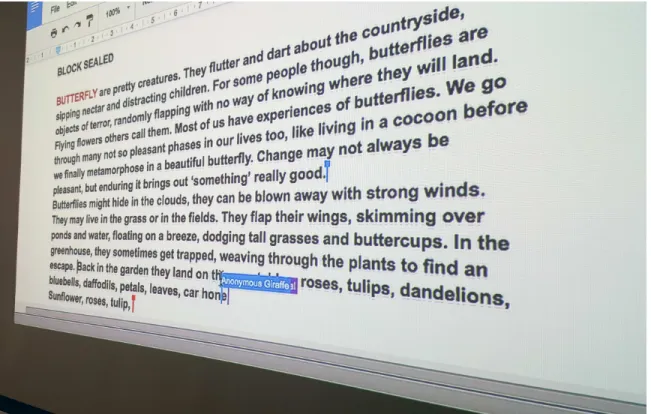
anonymous participants also joined in. Before the writing started, one participant secretly chose the initial control-word for the story as well as a loosely related word that would be the starting point of the writing activity (this was used to give some contextual guidance for participants, as finding a randomly selected word would have been an inordinately challenging and time-consuming process). The other participants were directed to start simultaneously typing their texts into the single document to construct a story and eventually find or ÔmineÕ the chosen word. There were no predetermined rules for this writing. As well as being visible on individual screens, the collaborative Google doc was also projected onto the wall in the room for everyone to see (Figure 7). When the chosen word was finally written, the story was considered ÒminedÓ, and the block of text was encoded into a hash.
Figure 7. Screenshot of the story ÔminingÕ Ð note the multiple visible and overlapping cursors, indicating where participants were working into the text.
The first word chosen in the mining exercise was ÒbutterfliesÓ, and the word defined to seal the story block was ÒgardenÓ. After nine minutes into the exercise, one participant typed ÒbutterflyÓ, and the story block was mined;
The garden was full of enormous orange carrots and green weeds that were now beginning to climb the kitchen window, like spiderÕs web. As she woke up one gray saturday morning, walked to the window to see what she had to do. To her amazement, six foxes had appear from a nearby bush. Ha! she exclaimed. It was an amazing sight. she quickly grabbed her digital camera to take a few shots before they discover they were being watched. The carrots had started to grow so large they began to up-root. Then it was the turn of the Flowers, which bloomed beside that. Two huge white rabbits jumped into the garden. Birds were flying around. One landed on the bird table, while the others start eating the butterfly.
A hash of this text was created by pasting the paragraph of text into an online website1 using SHA-256 (the one time hash protocol used in Bitcoin). This created the following: 3e737d176066e9b81f65fa6dce8d3e06a368b4c29e1eea814de7202a3873bfdb. A brief illustration and explanation of one-way hash functions was given, where any small change in the input, such as an inserted comma in the pasted text, results in an unpredictable and radical change in the outputted hash string. Similar to transactions encoded into the blockchain, the generated hash could be used to prove the authenticity of the original text.
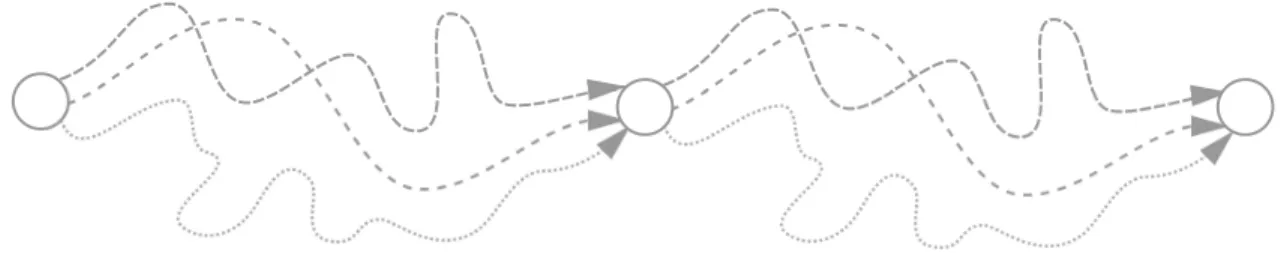
Figure 8. Overlapping and complex path to each keyword or ÔsealingÕ of a block in the Mining Process experiment.
The discovered word (ÒbutterflyÓ in this case) was used to start a new story block, providing a means of linking, or chaining, to the previous block. The Mining Process experiment differs from blockchain mining in that the solution or keyword to the writing activity is unknown, requiring a third-party to confirm that the keyword has been found. For the purpose of continuing the game, the participant who mined the keyword won the right to choose the next keyword, which was again ÒminedÓ by other participants through the production of text, creating a new story block, and so on (see Figure 8). ÒButterfliesÓ was then used to start the next block of the story, and another participant secretly chose ÒdaisyÓ as the second control-word. This word was mentioned in 13 minutes, through the production of the following text:
Butterflies are pretty creatures. They flutter and dart about the countryside, sipping nectar and distracting children. For some people though, butterflies are objects of terror, randomly flapping with no way of knowing where they will land. Flying flowers others call them. Most of us have experiences of butterflies. We go through many not so pleasant phases in our lives too, like living in a cocoon before we finally metamorphose in a beautiful butterfly. Change may not always be pleasant, but enduring it brings out ÔsomethingÕ really good.
Butterflies might hide in the clouds, they can be blown away with strong winds. They may live in the grass or in the fields. They flap their wings, skimming over ponds and water, floating on a breeze, dodging tall grasses and buttercups. In the greenhouse, they sometimes get trapped, weaving through the plants to find an escape. Back in the garden they land on the vegetables, roses, tulips, dandelions, bluebells, daffodils, petals, leaves, carnivorous flowers, nettles, honeysuckle, daisy.
The workshop concluded with a group discussion.
The Mining Process Experiment: Discussion and speculations
The Mining Process Experiment attempted to reproduce the network approach of finding solutions to problems, playing with words and narrative construction. The experiment revealed a subtle difference between competing and collaborating in online
computational power in the network and are easily defined as a competitive task. In text production, however, the boundaries are less clear. Human relations expressed in collective practices of writing and the drive to collaborate challenges the metaphor Ð participants found the writing process challenging and were uneasy with the speed of text production;
ÒI write slowly. It is quite unnatural to be forced to write competitively Ð quickly.Ó (P1).
This fast pace was perceived as compromising their flow of thoughts; Òas we all were writing together it is easy to lose your train of thoughtsÓ (P4) and some strategies to circumvent this problem started to emerge; ÒI could see it moving and I was getting distracted so I just wrote my bit on a text editor and pasted into the shared fileÓ (P2). The speed of collaboration also resulted in a sense of lack of control over the produced text as, Òyou canÕt change what you wrote because somebody else already picked that upÓ (P1). This complexity and overwriting was observed on screen too, with one participant even suggesting that they should each take turns to write three words each. This was quickly discounted as other participants realised this approach would detract from the competitive element, limiting the chance of each individual winning.
The enforced linearity of the writing process that the experiment created disparities between participantsÕ conventional writing patterns;
Òthis way of writing is linear, there are not multiple versions. That is not my way of writing at all. I might write the ending first. Here itÕs like a flow, I donÕt know what the end will beÓ (P1).
One further complexity with Bitcoin and the blockchain mining process is how it handles the possibility of more than one miner discovering the solution at the same time. In these cases, once the winning, conflicting blocks have been sealed, the chain is in essence forked (Zohar, 2015), with two (or more) competing chains in operation. As each sealed block and chain is propagated across the network however, the protocol always adopts the longer chain, i.e. if network nodes learn about conflicting blocks that make up a longer consistent chain, they reject the blocks in their own shorter chain in favour of the longer chain. This metaphor could be adopted as an experimental way of directing and creating branched narratives using longest chain metaphor to create a final ÔsingleÕ linear narrative. That is, once the authoring process is completed, the reader would see a single narrative. The authoring process however could be collaborative or directed by readers, ÔvalidatingÕ the story blocks by adopting the longest chain. This type of approach could potentially also help to address another finding from the experiment, that of assessing quality;
ÒIf we had it running with thousands of miners and they all get to that ÒdaisyÓ word we could think of some rules to judge the quality of the textÓ (P2).
The experiment and resultant discussion revealed the difficulty in differentiating between competition (as the experiment was organised) and a generally collaborative writing exercise, which is one of the main applications of online systems such as Google docs. As one participant observed, ÒMining is fundamentally a competition. Blockchain is
based on a proof of work, you have to prove that you invested computation so you need to prove that you participated in the game. Producing the text is a way to prove that that happened in the gameÓ (P1). While some participants tried to simply find the words, even gaming the system by stringing together a list of potential keywords, others naturally tried to build bridges between sentences, and improve the representation of the text in general. This was challenging given the format of the experiment; Òit is difficult to
communicate what you are thinking, all you can see is the outputÓ (P5), Òthe exercise was difficult because it was hard to understand what others were thinking, so if there were a way to agree on what you were writingÓ (P4). Whilst there was some verbal discussion that took place during the activity, the majority of writing was completed in silence. According to Wilkins (2014), the need for authorÕs ÒvisibilityÓ to their audience, through constructing an engaging online persona via blog posts and social media, challenges the writerÕs ability to produce their core writing output. These marketing pressures can, she argues, act as distractions, in much the same way, we posit, as the disruption of our collaboration mining experiment challenges conventional writing patterns.
The Mining Process experiment was obviously a gross simplification of Bitcoin mining, however, had the blockchain mining principles been followed more closely perhaps some of the participantsÕ challenges may not have arisen. For instance, each ÔminerÕ could have worked on individual Google documents, and as soon as any one miner found the solution, the hash and keyword of the completed ÔblockÕ would be published and propagated to the rest of the miners.
Conclusions: Can blockchain offer new opportunities for
Story?
This paper has explored some of the underlying principles of blockchain as a conceptual technology. Adopting a hands-on designerly approach using creative, participatory activities, which drastically simplify the technical complexities, we have worked through three core concepts with a range of creative practitioners and technologists, ranging from those who have no prior knowledge of Bitcoin or blockchain to highly competent
designers and developers of cryptocurrencies. Our underpinning premise for these experiments was the notion that stories can be considered as currency Ð they have value
in and of themselves that fluctuates at any given time according to their level of
penetration or distribution across a system and its social mores. These ÔexperimentsÕ can be understood as inspired by blockchain, opening up possibilities more than providing a set of findings or validation of hypotheses. The implementation of Bitcoin, itself an evolving experiment, and NakamotoÕs (2013) mining and blockchain protocols provides a breakthrough for digital, providing a way to limit production of digital assets through a network. Replicability of digital is taken as a given, particularly in this age of ever increasing cheap file storage. Bitcoin and blockchain therefore open up new possibilities, not just for financial transactions but ways to consider the very notion of what digital means. The story of stories has always been influenced by the media transmitting it, whether it be by the physicality of an audience, illuminated manuscripts, printed word, or instant global distribution via the internet.
The three workshops and experiments presented in this paper provide a glimpse into how blockchain technologies can open unique opportunities to explore how
storytelling might adapt as distributed ledger technologies become part of how we read, write and share stories. The process of drawing analogies between contemporary writing activities and cryptocurrencies offers a new way to think about value and our assessment of it. It is evident that the blockchain could significantly transform the distribution, promotion and propagation of stories. The unequivocal time stamping principles of the blockchain will undoubtedly present interesting implications for how archival data can be revealed, and whilst this offers interesting creative opportunities, it could have serious ethical and moral consequences. Finally it is evident that the distributed nature of the blockchain fosters a different form of collaborative practice. One that holds a competitive dimension but, one that could offer interesting potentials for managing collaboration, contribution and attribution. On a broader level, we see the studies as extending research into the practice of story writing, telling and reading, and offer the community an insight in to how a further digital technology may impact upon such a vital part of our culture.
Acknowledgements
The authors would like to thank all of the participants who took part in the experiments described in this paper. The research in this paper was part of the Design in Action research project. Photograph credit for Figure 6 by Lindsay Perth.
Funding Statement
This work was supported by the Arts and Humanities Research Council [grant number AH/J005126/1].
Notes
1. Unbound: https://unbound.co.uk
2. Namecoin: Òa decentralized open source information registration and transfer system based on the Bitcoin cryptocurrencyÓ http://namecoin.info
3. Bitnation: Òa distributed organisation incorporated on the Bitcoin BlockchainÓ http://www.bitnation.co
4. Purse: https://purse.io/
5. Online SHA-256: http://hash.online-convert.com/sha256-generator
References
Berridge G (2014) Philip Pullman's latest literary endeavour: the Twitter tale of Jeffrey the housefly. In: The Telegraph. Available at:
http://www.telegraph.co.uk/culture/books/10646921/Philip-Pullmans-latest-literary-endeavour-the-Twitter-tale-of-Jeffrey-the-housefly.html (accessed 5 May 2016).
Biedenharn I (2015) Margaret Atwood talks Twitter Fiction and near-genius hashtags. In: Entertainment Weekly. Available at:
http://www.ew.com/article/2015/05/20/margaret-atwood-twitter-fiction (accessed 5 May 2016).
Birkerts S (2006) The Gutenberg elegies: The fate of reading in an electronic age.
Macmillan.
Bolter JD and Grusin RA (2000) Remediation: Understanding new media. Mit Press.
Booker C (2004) The seven basic plots: Why we tell stories. A&C Black.
Brandt D and Clinton K (2002) Limits of the local: Expanding perspectives on literacy as a social practice. Journal of literacy research 34(3): 337-356.
Brown T (2008) Design thinking. Harvard business review, 86(6): 84. Campbell J (1993) The Hero with a Thousand Faces. Fontana Press.
Cavazza M, Champagnat R and Leonardi R (2009). The iris network of excellence: Future directions in interactive storytelling. In: Interactive Storytelling (pp. 8-13). Springer Berlin Heidelberg.
Chasanidou D, Gasparini AA and Lee E (2015). Design Thinking Methods and Tools for Innovation. In Design, User Experience, and Usability: Design Discourse (pp. 12-23). Springer International Publishing.
Gauntlett D (2013) Making is connecting. John Wiley & Sons.
Gaver W (2012). What should we expect from research through design? In Proceedings of the SIGCHI conference on human factors in computing systems. ACM Press, New York (pp. 937-946).
Gerv‡s P (2013) Propp's Morphology of the Folk Tale as a Grammar for Generation. In
OASIcs-OpenAccess Series in Informatics (Vol. 32). Schloss Dagstuhl-Leibniz-Zentrum fuer Informatik.
Goody J and Watt I (1963) The consequences of literacy. Comparative studies in society and history, 5(03): 304-345.
Groth S (2014) Lost in Track Changes. if:book Australia.
Hensher P (2012) The missing ink: The lost art of handwriting. Macmillan. Holman T (2015) Digital Census 2015: five key findings. The Bookseller [online]
Available at: http://www.thebookseller.com/insight/digital-census-2015-five-key-findings-315594 (accessed 4 January 2016).
Jaggard V (2015) The Secret of "The Martian" Success? Scientific Peer Review. In: Smithsonian.com. Available at: http://www.smithsonianmag.com/science-nature/secret-martian-success-scientific-peer-review-180956745/?no-ist (accessed 5 May 2016). Khamis S and Vaughn K (2011) Cyberactivism in the Egyptian revolution: How civic
engagement and citizen journalism tilted the balance. Arab Media and Society, 14(3): 1-25.
Kress G (2003). Literacy in the new media age. Psychology Press.
McLuhan M (1994). Understanding media: The extensions of man. MIT press. Morris MR, Teevan J and Panovich K (2010). A Comparison of Information Seeking
Using Search Engines and Social Networks. ICWSM, 10: 23-26. Nakamoto S (2013). Bitcoin: A peer-to peer electronic payment system.
Nakasone A and Ishizuka M (2006) SRST: A storytelling model using rhetorical
relations. In: Technologies for Interactive Digital Storytelling and Entertainment (pp. 127-138). Springer Berlin Heidelberg.
Olson DR and Torrance N (1996). Modes of thought: Explorations in culture and cognition. Cambridge University Press.
Ong WJ (1986). Writing is a technology that restructures thought. The written word: Literacy in transition, pp.23-50.
Polti G (1954) The thirty-six dramatic situations. Boston.
Propp V (1968) Morphology of the Folktale. Austin, University of Texas Press. Pullinger K and Joseph C (2007). Inanimate Alice.
Sharples M (1996) An account of writing as creative design. In The Science of writing. Hillsdale, NJ: Lawrence Erlbaum.
Street B (2003) WhatÕs ÒnewÓ in New Literacy Studies? Critical approaches to literacy in theory and practice. Current issues in comparative education, 5(2): 77-91.
Swan M (2015). Blockchain: Blueprint for a New Economy. OÕReilly Media, Inc. Walton M and Vukovic V (2003). Cultures, literacy, and the web: dimensions of
information scent. interactions, 10(2): 64-71.
Wilkins K (2014) Writing resilience in the digital age. New Writing, 11(1): 67-76. Williams P (2015) Plagiarism, Palimpsest and Intertextuality. New Writing, 12(2):
169-180.
Wright A (2015). Algorithmic authors. Communications of the ACM, 58(11): 12-14. Yashinsky D (2004) Suddenly they heard footsteps: Storytelling for the Twenty-first
Century. University Press of Mississippi.