Estimating surface soil moisture from SMAP
observations using a Neural Network technique
J. Kolassaa,b,∗, R.H. Reichleb, Q. Liuc,b, S.H. Alemohammadd, P. Gentined, K.Aidae, J. Asanumae, S. Bircherl, T. Caldwellm, A. Collianderf, M. Coshg, C. Holifield Collinsn, T.J. Jacksong, J. Mart´ınez-Fern´andezh, H. McNairni, A.
Pachecoi, M. Thibeaultj, J.P. Walkerk
aUniversities Space Research Association/NPP, Columbia, MD, USA
bGlobal Modelling and Assimilation Office, NASA Goddard Spaceflight Center, Greenbelt,
MD, USA
cScience Systems and Applications Inc., Lanham, MD, USA dColumbia University, New York, NY, USA
eUniversity of Tsukuba, Tsukuba, Japan
fJet Propulsion Laboratory, California Institute of Technology, Pasadena, CA, USA gUSDA ARS Hydrology and Remote Sensing Laboratory, Beltsville, MD, USA hInstituto Hispano Luso de Investigaciones Agrarias (CIALE), Universidad de Salamanca,
Salamanca, Spain
iAgriculture and Agri-food Canada, Ottawa, Ontario, Canada
jComisi`on Nacional de Actividades Espaciales (CONAE), Buenos Aires, Argentina kDepartment of Civil Engineering, Monash University, Clayton, Victoria, Australia lCentre d’Etudes Spatiales de la BIOsph`ere (CESBIO-CNES, CNRS, IRD, Universit´e
Toulouse III), Toulouse, France
mUniversity of Texas at Austin, TX, USA
nUSDA ARS Southwest Watershed Research Center, Tucson, AZ, USA
Abstract
A Neural Network (NN) algorithm was developed to estimate global surface soil moisture for April 2015 to March 2017 with a 2-3 day repeat frequency using passive microwave observations from the Soil Moisture Active Passive (SMAP) satellite, surface soil temperatures from the NASA Goddard Earth Observing System Model version 5 (GEOS-5) land modeling system, and Moderate Res-olution Imaging Spectroradiometer-based vegetation water content. The NN was trained on GEOS-5 soil moisture target data, making the NN estimates consistent with the GEOS-5 climatology, such that they may ultimately be as-similated into this model without further bias correction. Evaluated against in
∗Corresponding author
Email address: [email protected](J. Kolassa)
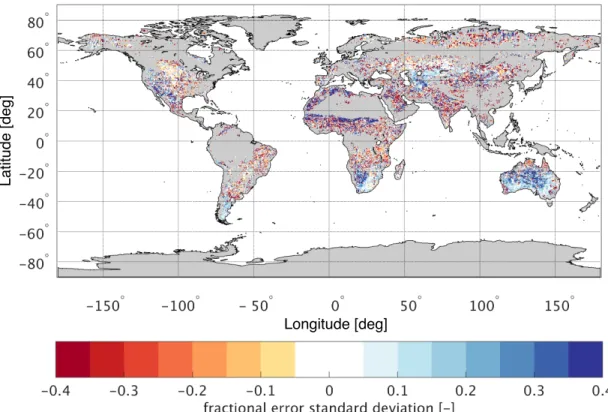
situ soil moisture measurements, the average unbiased root mean square error (ubRMSE), correlation and anomaly correlation of the NN retrievals were 0.037 m3m−3, 0.70 and 0.66, respectively, against SMAP core validation site measure-ments and 0.026 m3m−3, 0.58 and 0.48, respectively, against International Soil Moisture Network (ISMN) measurements. At the core validation sites, the NN retrievals have a significantly higher skill than the GEOS-5 model estimates and a slightly lower correlation skill than the SMAP Level-2 Passive (L2P) product. The feasibility of the NN method was reflected by a lower ubRMSE compared to the L2P retrievals as well as a higher skill when ancillary parameters in physically-based retrievals were uncertain. Against ISMN measurements, the skill of the two retrieval products was more comparable. A triple collocation analysis against Advanced Microwave Scanning Radiometer 2 (AMSR2) and Advanced Scatterometer (ASCAT) soil moisture retrievals showed that the NN and L2P retrieval errors have a similar spatial distribution, but the NN retrieval errors are generally lower in densely vegetated regions and transition zones.
Keywords: soil moisture remote sensing, SMAP, data assimilation, microwave
radiometer
1. Introduction 1
Soil moisture is a key variable for many surface and boundary layer
pro-2
cesses, such as the coupling of the water and energy cycles (Seneviratne et al.,
3
2006;Gentine et al., 2011;Bateni and Entekhabi, 2012) or the partitioning of
4
precipitation into runoff and infiltration (Philip, 1957; Corradini et al., 1998;
5
Assouline, 2013). Soil moisture is also a key determinant of the carbon cycle
6
(McDowell, 2011; Sevanto et al., 2014; Jung et al., 2017). The importance of
7
soil moisture has been recognized by the World Meteorological Organization by
naming it an Essential Climate Variable (GCOS, 2009) and thus encouraging
9
efforts to obtain better soil moisture observations, which is challenging because
10
of its high variability both in space and time.
11
One avenue to obtain observations of soil moisture is through satellite
instru-12
ments that provide global observations with a relatively short revisit period of
13
2-3 days. In particular, L-band (1.4 GHz) microwave instruments exhibit a high
14
sensitivity to soil moisture in the top∼5 centimeters of the soil in sparsely to
15
moderately vegetated areas. This has led to the launch of two L-band satellite
16
missions to observe soil moisture, the European Soil Moisture and Ocean
Salin-17
ity (SMOS) mission in 2009 (Kerr et al., 2010) and the NASA Soil Moisture
18
Active Passive (SMAP) mission (Entekhabi et al., 2010) in 2015.
19
Traditionally, satellite soil moisture retrievals from L-band (and other)
sen-20
sors are implemented through the inversion of Radiative Transfer Models (RTMs)
21
(e.g. Owe et al.(2001);Kerr et al.(2012);O’Neill et al.(2015)), which
explic-22
itly formulate the physical relationships linking surface soil moisture to satellite
23
brightness temperature observations. The RTM inversion technique is used to
24
produce the official SMOS and SMAP retrieval products, and is able to provide
25
high quality soil moisture estimates (Al Bitar et al., 2012;Chan et al., 2016b;
26
Colliander et al., 2017) with a typical latency of 12 to 24 hours. However, this
27
approach requires accurate knowledge of the physical relationships between the
28
surface state and the satellite observations as well as their associated
parame-29
ters, which are often empirically estimated and thus uncertain. Moreover, RTM
30
inversions also require explicit information on other surface states, including
surface soil temperature and vegetation, and are thus typically ill-posed
prob-32
lems. Additionally, for time critical applications, such as near real time flood
33
prediction or soil moisture assimilation into weather prediction models, retrieval
34
products with a shorter latency are required.
35
Data assimilation provides another option to generate improved soil moisture
36
estimates through the merging of satellite and model information, and can yield
37
soil moisture estimates that are of higher quality than estimates from satellite
38
observations or models alone (e.g. Entekhabi et al.(1994);Walker and Houser 39
(2001); Liu et al. (2011); Lahoz and De Lannoy (2014)). For soil moisture
40
assimilation, the observations and model estimates have to be unbiased with
41
respect to each other, which is typically achieved by locally matching the mean
42
and variability of the satellite observations to those of the model (Reichle and 43
Koster, 2004). While this satisfies the requirements of the assimilation system,
44
it has the side effect of removing some independent information in the satellite
45
observations. Given the high quality of soil moisture observations from SMOS
46
and SMAP this is undesirable.
47
As an alternative to RTM inversions, statistical Neural Network (NN)
re-48
trieval algorithms have been successfully implemented for a number of sensors
49
in recent years (Aires et al., 2005;Chai et al., 2009;Kolassa et al., 2013, 2016;
50
Rodriguez-Fern´andez et al., 2015;Santi et al., 2016). Instead of explicitly
for-51
mulating physical relationships, NNs are calibrated on a sample of satellite
ob-52
servations and corresponding soil moisture estimates (the target data) to model
53
the global statistical relationship between the satellite observations and surface
soil moisture. As a result, NN retrievals can offer several general advantages
55
over traditional RTM inversions. First, they do not require an explicit
param-56
eterization of physical relationships and are thus not affected by errors in our
57
knowledge of these relationships or their parameters. Second, after a one-time
58
calibration, NNs are computationally extremely efficient and can provide soil
59
moisture estimates almost immediately after arrival of the instrument data,
60
thereby shortening the latency. Third, training a NN non-locally on target data
61
from a model, yields NN retrievals that are globally unbiased with respect to
62
the model, with spatial and temporal patterns that are driven by the satellite
63
observations (e.g. Jimenez et al.(2013);Kolassa et al.(2016);Alemohammad et 64
al.(2017)). This may reduce the need for bias correction prior to an assimilation
65
and at the same time retain more of the independent information contained in
66
the spatial and temporal patterns of the satellite observations.
67
In this study, we develop the first NN algorithm to retrieve global surface
68
soil moisture from SMAP observations. The motivation for this work is
two-69
fold. First, we investigate statistical retrieval techniques as a possible
alterna-70
tive or supplement to the existing physically-based SMAP retrieval algorithms.
71
Since statistical techniques require less ancillary data and are subject to
differ-72
ent algorithm-related errors than physically-based retrievals, NN retrievals may
73
provide useful information where and when RTMs are known to be uncertain.
74
For SMOS, the NN technique has been successfully implemented ( Rodriguez-75
Fern´andez et al., 2015). However, it is not obvious that a NN for SMAP will
76
work equally well, given the differences between SMOS and SMAP in the
serving geometry (multiple vs. single incidence angle) and instrument error
78
characteristics (De Lannoy et al., 2015). Second, we aim to investigate the
79
potential of statistical techniques to generate a soil moisture product with
char-80
acteristics beneficial to SMAP soil moisture assimilation. The NN algorithm
81
retrieves soil moisture in the climatology of the target model and thus may
82
reduce the need for bias correction prior to data assimilation. In a follow-on
83
study, we will investigate whether this results in a more efficient use of SMAP
84
observations during data assimilation.
85
The NN retrieval algorithm is trained with SMAP brightness temperatures
86
and two ancillary datasets as inputs, and with target data from the NASA
God-87
dard Earth Observing System version 5 (GEOS-5) model (section 2). Using the
88
trained NN, we compute global estimates of volumetric surface soil moisture
89
for the period April 2015 to March 2017 and evaluate them using a number of
90
different metrics and techniques (section 3). We compare the SMAP NN soil
91
moisture estimates to the target GEOS-5 model soil moisture to identify the
in-92
dependent information provided by the SMAP observations that can potentially
93
inform the model during data assimilation (section 4.1). Next, we assess the
94
SMAP NN retrievals against independent in situ measurements and compare
95
their skill to that of the SMAP Level-2 passive (L2P) retrieval product and the
96
GEOS-5 model soil moisture (section 4.2). Finally, we assess the global error
97
distributions of the SMAP NN, GEOS-5 and SMAP L2P products using a triple
98
collocation (TC) analysis in conjunction with soil moisture retrievals based on
99
observations from the Advanced Microwave Scanning Radiometer 2 (AMSR2)
and the Advanced Scatterometer (ASCAT), which have independent errors with
101
respect to the SMAP and GEOS-5 products (section 4.3).
102
2. Datasets 103
2.1. Neural Network Inputs and Target Datasets 104
2.1.1. SMAP Observations 105
The main input to the NN soil moisture retrieval algorithm are the SMAP
106
brightness temperatures. SMAP was launched in January 2015 and is equipped
107
with an L-band (1.4 GHz) radiometer observing on four different channels,
hor-108
izontal and vertical polarization as well as the 3rd and 4th Stokes’ parameter.
109
SMAP is in a sun-synchronous, near-circular orbit with equator crossings at 6
110
AM and 6 PM local time and a revisit time of 2-3 days (Entekhabi et al., 2010).
111
Brightness temperature data have been collected since 31 March 2015.
112
For our NN retrieval product we use SMAP Level-1C brightness
temper-113
atures (Chan et al., 2016a) for the April 2015 to March 2017 period. The
114
data are provided on the 36-km resolution Equal-Area Scalable Earth version
115
2 (EASEv2) grid (Brodzik et al., 2012) as daily half-orbit files. We only use
116
observations from the 6 AM overpass, in order to minimize observation errors
117
due to Faraday rotation and the difference between the soil and canopy
tem-118
peratures (Entekhabi et al., 2010;O’Neill et al., 2015). A test of different input
119
combinations indicated that using data from all four SMAP channels as
in-120
puts to the retrieval algorithm yielded the best NN retrieval performance (not
121
shown). While the 3rd and 4th Stokes’ parameters are not directly sensitive to
soil moisture, including them as inputs helps the NN algorithm to distinguish
123
between different observing conditions and thus determine the weight for a given
124
brightness temperature observation.
125
2.1.2. GEOS-5 Model Surface Soil Moisture and Temperature 126
The model soil moisture estimates used here are generated using the
GEOS-127
5 Catchment land surface model (Koster et al., 2000; Ducharne et al., 2000).
128
The Catchment model version used in this study is very similar to that of the
129
SMAP Level-4 Soil Moisture (L4 SM) version 2 system (Reichle et al., 2015,
130
2016, 2017b(in press), but SMAP brightness temperature observations are not
131
assimilated. The surface meteorological forcing data were provided at 0.25◦ 132
resolution by the GEOS-5 Forward Processing atmospheric data assimilation
133
system (Lucchesi, 2013). The GEOS-5 precipitation forcing data were
cor-134
rected using global, daily, 0.5◦ resolution, gauge-based observations from the
135
Climate Prediction Center Unified (CPCU) product, which have been scaled to
136
the Global Precipitation Climatology Project (GPCP) v2.2 pentad
precipita-137
tion product climatology (Reichle and Liu, 2014; Reichle et al., 2017a,b). The
138
GEOS-5 background precipitation was also scaled to the GPCP v2.2
climatol-139
ogy. Output fields were produced as 3-hourly time averages and provided on
140
the 9-km EASEv2 grid.
141
In this study, we use two model output fields: (1) the surface soil moisture
142
(0-5 cm soil layer) and (2) the surface soil temperature (0-10 cm soil layer). The
143
GEOS-5 soil moisture fields served as target data in the NN training (section
retrieval compared to that of the target model. The surface soil temperature
146
data were used as an input to the retrieval algorithm to account for the surface
147
soil temperature contribution to the observed brightness temperatures (section
148
3.1). Using surface soil temperature estimates from the target model potentially
149
introduces some of the GEOS-5 spatial patterns into the NN estimates and could
150
lead to model dependency issues during a later assimilation of the NN estimates
151
into the GEOS-5 model. The same would be true, however, for the assimilation
152
of the SMAP L2P product, which also uses GEOS-5 ancillary soil temperatures
153
(section 2.2.1). We assume here that the canopy temperature and surface soil
154
temperature are in equilibrium for the 6 AM (local time) SMAP observations
155
used here, so only a single temperature estimate is required. The surface soil
156
temperature data were also used in the data quality control to identify frozen
157
soil conditions (section 2.3).
158
2.2. Validation Datasets 159
2.2.1. SMAP Level-2 Passive Retrievals 160
The SMAP L2P soil moisture retrieval product uses SMAP radiometer
Level-161
1C brightness temperatures to provide soil moisture estimates on the 36-km
EA-162
SEv2 grid as daily half-orbit files. The retrieval algorithm is based on a physical
163
tau-omega model (Wigneron et al., 1995;O’Neill et al., 2015) to isolate the soil
164
emission from the total observed surface emission (soil and vegetation) and to
165
subsequently convert it into a soil moisture estimate through the use of soil
166
emission and mixing models. The surface soil temperature data required by
167
the tau-omega model are provided by the quasi-operational GEOS-5 Forward
Processing system (Lucchesi, 2013) with a 0.25◦ resolution. The tau-omega
169
model also requires information on the vegetation water content (VWC), which
170
is estimated from a climatology of the Normalized Difference Vegetation Index
171
based on Moderate Resolution Imaging Spectroradiometer (MODIS)
observa-172
tions using an empirical relationship established from prior investigations. No
173
retrieval is performed for frozen soil conditions based on GEOS-5 surface soil
174
temperature. Soil moisture retrievals are flagged as ‘not recommended’ when
175
the VWC within the satellite footprint exceeds 5 kg m−2 (O’Neill et al., 2015).
176
In this study, we use version 4 of the L2P ‘baseline’ soil moisture estimates
177
derived from the SMAP morning (6 AM) overpass vertical polarization
bright-178
ness temperatures (O’Neill et al., 2016). Only data points flagged as having the
179
‘recommended’ retrieval quality were used.
180
2.2.2. AMSR2 and ASCAT Soil Moisture Retrievals 181
The Advanced Multichannel Scanning Radiometer 2 (AMSR2) is a
multi-182
channel passive microwave satellite instrument that has been collecting data
183
since July 2012. AMSR2 measures brightness temperatures at frequencies
rang-184
ing from 6.9 GHz to 89 GHz with a revisit time of approximately 2 days and
185
equator crossings at 1.30 AM and 1.30 PM local time (Kasahara et al., 2012).
186
Here we use the Japan Aerospace Exploration Agency AMSR2 soil moisture
187
product computed from the 10.7 GHz and 36.5 GHz vertical and horizontal
188
polarization brightness temperatures (Maeda and Taniguchi, 2013). The data
189
are provided as daily estimates of volumetric surface soil moisture on a grid
The Advanced Scatterometer (ASCAT) (Figa-Salda˜na et al., 2002) is an
192
active microwave satellite instrument aboard the MetOp satellites, which have
193
been collecting data since 2006. ASCAT measures surface backscatter at
C-194
band (5.3 GHz) with a revisit time of 1-2 days and equator crossings at 9.30
195
AM and 9.30 PM.
196
Here we use the ASCAT surface soil moisture product developed byWagner 197
et al. (2013). The data are provided in units of surface degree of saturation
198
with a sampling distance of 12.5 x 12.5 km and were converted into estimates
199
of volumetric surface soil moisture using the soil porosity data ofReynolds et 200
al.(2000).
201
Despite being posted on finer resolution grids, the spatial resolution of the
202
AMSR2 and ASCAT observations is very similar to the SMAP 36-km resolution.
203
2.2.3. In Situ Measurements 204
SMAP Core Validation Sites. The SMAP core validation sites (referred to here
205
as ‘core sites’) represent locally dense networks of in situ soil moisture
measure-206
ments that are specifically designed for the calibration and validation of SMAP
207
soil moisture products (Colliander et al., 2017). Each site features an array of
208
soil moisture sensors to represent the different spatial scales of the SMAP
prod-209
ucts (3 km, 9 km and 36 km). The measurements from each site’s sensors are
210
combined into and area-weighted average to yield one soil moisture time series
211
per site that is representative of a 36-km satellite grid cell.
1: Ov erview of the SMAP Cal/V al cor e sites. Sho wn are (from left to ri g h t) the site name, reference pixel ID (RPID ), lo cation, climate, la nd v er an d the a v era ge n um b e r of senso rs that co n tribute to the reference pixel a v erage. Soil moisture is measured at 5 cm depth or o v er the top 5 ( Col liander et al. , 2017) Site (abbreviation) RPID lo cation climate land co v er n um b er of sen- sors REMEDHUS (RM) 03013602 Spain temp erate cro plands 14 Reynolds Creek (R C) 04013601 USA (Idaho) arid grasslands 5 Y anco (YC) 07013601 Australia arid croplands 26 Carman (CM) 09013601 Canada cold croplands 19 Tw en te (TW) 12043602 Holland temp erate croplands / natural mosaic 9 W aln ut Gulc h (W G) 16013603 USA (Arizona) arid shrub op en 20 Little W ashita (L W) 16023602 USA (Oklahoma) temp erate grasslands 16 F ort Cobb (F C) 16033602 USA (Oklahoma) temp erate grasslands 12 Little Riv er (LR) 16043602 USA (Georgia) temp erate croplands / natural mosaic 19 South F ork (SF) 16073602 USA (Io w a ) cold croplands 18 Mon te Buey (MB) 19023601 Argen tin a temp erate croplands 10 Kenaston (KN) 27013601 Canada cold croplands 26 TxSON (TX) 48013601 USA (T exas) temp erate grasslands 32 Mahasri (MH) 53013601 Mongolia cold g rasslands 5
YC MH TW RM LR SF CM KN RC FC LW WG TX MB Figure 1: Lo ca tion of the SMAP core v alidation sites (blue circles) and ISMN stations (red crosses). The bac kground sho ws the dominan t In ternational Geosphere-Biosphere Program (IGBP , ( Belwar d et al. , 1999)) land co v er class for eac h lo cation.
Table 1 summarizes the main characteristics of the 36-km core sites used
213
here. Out of the 14 locations, nine are in North America, two in Europe, and
214
one each in Asia, Australia and South America. The sites represent a range
215
of different climatic conditions and land cover types, and the average number
216
of sensors that contribute to the 36-km reference pixel data ranges between
217
5 and 32. Figure 1 shows the distribution of the SMAP core sites and their
218
corresponding dominant land cover.
219
International Soil Moisture Network (ISMN). 220
T able 2: Ov erview of the ISMN ( Dorigo et al. , 2011). Sho wn are the lo cation, n um b er of stations p er net w ork and the net w ork-sp ecific reference. Net w ork lo catio n # stations reference Dahra Senegal 1 ( T agesson et al. , 2015) FMI Finland 27 ( Dorigo et al. , 2011) iR ON USA 6 ( T aylor e t al. , 2015) PBO H2O USA 161 ( L arson et al. , 2008) REMEDHUS Spain 24 ( Sanchez et al. , 2012) RSMN Romania 20 ( Dorigo et al. , 2011) SCAN USA 181 ( Schaefer et al. , 2007) SMOSMANIA F rance 21 ( Calvet et al. , 2007) SNOTEL USA 441 ( L eavesley et al. , 2008) SOILSCAPE USA 171 ( Mo ghaddam et al. , 2016) USCRN USA 115 ( Diamond et al. , 2013 )
We further evaluate the NN retrieval product against independent in situ soil
221
moisture measurements from the International Soil Moisture Network (ISMN),
222
a database of soil moisture networks hosted at the Technical University (TU)
223
of Vienna (Dorigo et al., 2011) and referred to here as the ‘sparse networks’.
224
We used only ISMN networks that are not part of the SMAP core sites (Table
225
2). The REMEDHUS network comprises a different set of sensors for the core
226
site and as a sparse network and thus appears for both in situ data types. The
227
measurement depth, repeat frequency, coverage, station density and
measure-228
ment method depend on the contributing network. The number of stations in
229
each network ranges between 1 and 441 (Table 2), but - unlike for the core sites
230
- there is typically only one sensor per 36-km grid cell. That is, the ISMN
mea-231
surements are not necessarily representative of the spatial scale of the satellite
232
observations. Figure 1 shows the spatial distribution of the ISMN stations and
233
the dominant land cover at each location.
234
For two of the ISMN networks, SCAN (Schaefer et al., 2007) and USCRN
235
(Diamond et al., 2013), the data were already available in-house and had been
236
subjected to additional quality control as described inDe Lannoy et al. (2014)
237
and (Reichle et al., 2015b) (their Appendix C). Hence, the in-house data were
238
used for SCAN and USCRN instead of the data provided through the ISMN. As
239
a result, more reliable metrics could be estimated for these two sparse networks.
2.3. Data Preprocessing 241
2.3.1. Satellite Observations and Model 242
We co-located all datasets spatially and temporally, using the 36-km EASEv2
243
grid and the SMAP morning (6 AM) overpass times as a reference. The GEOS-5,
244
AMSR2 and ASCAT data were aggregated from their higher-resolution native
245
grids to the 36-km EASEv2 grid using simple averaging. The temporal
co-246
location was implemented by using the GEOS-5 3-hourly average that includes
247
the SMAP morning overpass for a given location and day. For the AMSR2 and
248
ASCAT retrieval products, only data from their night-time/morning overpasses
249
for the same day - at 1.30 AM and 9.30 AM, respectively - were used since
250
these are closest in time to the SMAP overpass at 6 AM. Likewise, for the L2P
251
retrievals we used only the morning overpass estimates, and no regridding was
252
required because the SMAP-based NN and L2P products are provided on the
253
same 36-km EASEv2 grid.
254
We additionally applied several quality control steps to the satellite and
255
model data sets to identify and exclude conditions in which a soil moisture
re-256
trieval was not feasible. Using the GEOS-5 surface soil temperature, we excluded
257
times and locations with a surface soil temperature below 1◦C. The MODIS-258
based VWC estimates provided with the L2P data were used to exclude times
259
and locations with a VWC higher than 5 kg m−2, where the SMAP radiometer
260
is not expected to provide reliable retrievals. Finally, we excluded all pixels
261
within 72 km of a water body - defined as a grid cell with a water fraction in
262
excess of 5% according to the GEOS-5 land mask - to mitigate the impact of
water bodies, as their low brightness temperatures cause erroneously high soil
264
moisture retrievals (O’Neill et al., 2015).
265
2.3.2. In Situ Data 266
The core site measurements are representative of the 36-km spatial resolution
267
of the retrievals and the aggregated model, however, the geographical center of
268
the in situ sensors for a given reference pixel does not generally coincide with
269
the EASEv2 grid cell center of the satellite and model products. Similarly,
270
the location of a (single point) ISMN measurement is typically offset from the
271
center of a EASEv2 grid cell. To account for this, the retrieval and (aggregated)
272
model soil moisture were linearly interpolated to the in situ location using data
273
from the nearest EASEv2 grid cell and its 8 surrounding neighbors, requiring a
274
minimum of 4 data points. Where applicable, ISMN measurements located in
275
the same EASEv2 grid cell were averaged and their average location was used
276
for the interpolation. For each day, the in situ measurement closest in time and
277
within a 3 hour window of the SMAP overpass was used.
278
Using the GEOS-5 surface temperature for the ISMN measurements and the
279
in situ surface soil temperature observations for the core site measurements, the
280
in situ data were screened for (nearly) frozen soil conditions by applying the
281
same 1◦C threshold that was used for the satellite and model data.
3. Methodology 283
3.1. Neural Network Retrieval Algorithm 284
In this study we use a NN approach to retrieve global surface soil
mois-285
ture with a 2-3 day repeat using SMAP brightness temperatures, GEOS-5 soil
286
temperatures and the MODIS-based VWC climatology that is used in the
gener-287
ation of the SMAP L2P product. The NN retrieval algorithm is first calibrated
288
(trained) using a subset of the available SMAP and model data to determine the
289
statistical relationship between the satellite observations and surface soil
mois-290
ture. Once calibrated, the trained NN is used to retrieve surface soil moisture
291
from the entire set of satellite observations.
292
3.1.1. Neural Network Architecture 293
A neural network is a group of computational nodes arranged in a layered
294
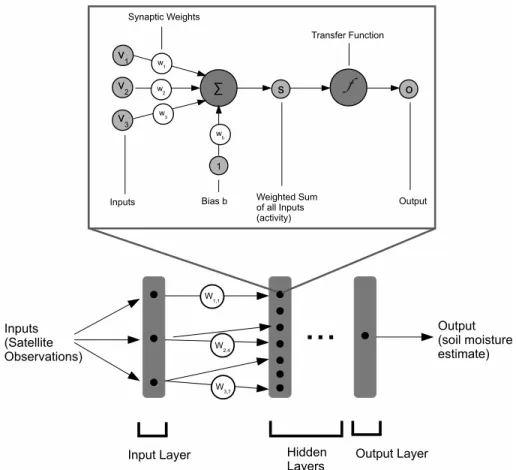
and inter-connected architecture. Figure 2 shows a schematic of a basic NN for
295
soil moisture retrievals. The NN used here consists of 3 layers: (1) an input layer
296
that receives the satellite observations and ancillary inputs, (2) one hidden layer,
297
and (3) an output layer that produces the soil moisture estimates. This
archi-298
tecture is sufficient to approximate any continuous function (Cybenko, 1989).
299
The inputs for the SMAP NN retrieval algorithm are the observations from the
300
four SMAP channels, the GEOS-5 surface soil temperature and the
MODIS-301
based VWC estimates. The output from the NN algorithm is an estimate of the
302
volumetric surface soil moisture.
303
While the number of neurons in the input and output layers is determined by
Inputs (Satellite Observations) Output (soil moisture estimate)
...
Input Layer Hidden
Layers Output Layer
W1,1 W3,7 W2,4 ∑ v 1 v2 v 3 s
f
o w1 w2 w3Inputs Weighted Sum of all Inputs (activity) Output 1 wb Bias b Synaptic Weights Transfer Function
Figure 2:Schematic of a neural network with close-up of a single neuron (adapted from
the number of input and output variables (here, 6 for the input layer and 1 for
305
the output layer), the optimal number of neurons in the hidden layer depends on
306
the problem complexity. We found that for this study 15 hidden layer neurons
307
constituted the lowest number of neurons that was able to converge to a solution
308
during the NN training. We use a fully connected feed-forward network, in which
309
all neurons from one layer are connected to all neurons in the next layer. These
310
connections are assigned weights - the synaptic weights - used by each neuron
311
to compute a weighted sum of all its input plus a bias before applying a transfer
312
function. Neurons in the input and output layers use a linear transfer function,
313
while hidden layer neurons use the typical tangent-sigmoid transfer function.
314
3.1.2. Neural Network Training 315
In order to determine the statistical function that relates the NN input
316
data, including the satellite brightness temperature observations, to surface soil
317
moisture, the NN is calibrated on a sample set of NN inputs and coincident soil
318
moisture estimates (the target data), together referred to as the training data.
319
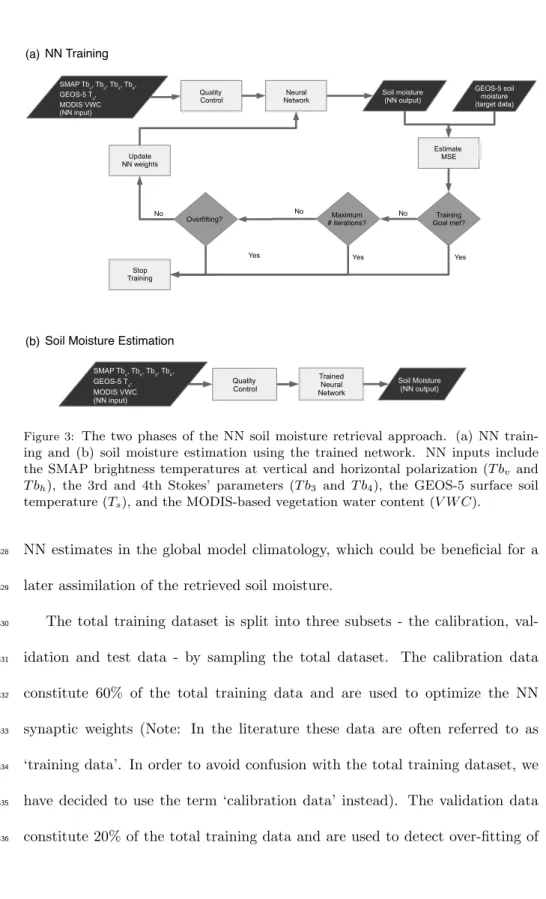
This process is referred to as the NN training and is schematically illustrated
320
in Figure 3 (a). To generate a training dataset representative of all expected
321
conditions, we used the first year (April 2015 - March 2016) of our study period
322
for NN training. The second year (April 2016 - March 2017) of the study
323
period was used for the evaluation presented in sections 4.1 and 4.2. Model
324
soil moisture estimates from GEOS-5 are used as the target data, because (1)
325
the model estimates have a similar resolution as the satellite observations while
326
providing complete spatio-temporal coverage and (2) training on a model yields
(a) NN Training
(b) Soil Moisture Estimation SMAP Tbv, Tbh, Tb3, Tb4, GEOS-5 Ts, MODIS VWC (NN input) Soil moisture (NN output) GEOS-5 soil moisture (target data) Neural Network Estimate MSE Training Goal met? Maximum # iterations? Overfitting? Update NN weights Stop Training Yes Yes Yes No No No Quality Control Retrieval
(NN) inputs Soil Moisture(NN output)
Trained Neural Network SMAP Tbv, Tbh, Tb3, Tb4, GEOS-5 Ts, MODIS VWC (NN input) Quality Control
Figure 3: The two phases of the NN soil moisture retrieval approach. (a) NN
train-ing and (b) soil moisture estimation ustrain-ing the trained network. NN inputs include
the SMAP brightness temperatures at vertical and horizontal polarization (T bv and
T bh), the 3rd and 4th Stokes’ parameters (T b3 and T b4), the GEOS-5 surface soil
temperature (Ts), and the MODIS-based vegetation water content (V W C).
NN estimates in the global model climatology, which could be beneficial for a
328
later assimilation of the retrieved soil moisture.
329
The total training dataset is split into three subsets - the calibration,
val-330
idation and test data - by sampling the total dataset. The calibration data
331
constitute 60% of the total training data and are used to optimize the NN
332
synaptic weights (Note: In the literature these data are often referred to as
333
‘training data’. In order to avoid confusion with the total training dataset, we
334
have decided to use the term ‘calibration data’ instead). The validation data
335
constitute 20% of the total training data and are used to detect over-fitting of
the NN weights (see below). These are part of the training data and should not
337
be confused with the independent evaluation data used in sections 4.1 and 4.2 to
338
assess the SMAP NN retrieval quality. The test data constitute the remaining
339
20% of the training data and are used to assess the NN fit.
340
The NN training is non-localized, meaning that one NN is fitted to a global
341
training dataset that contains data from the entire training period (April 2015
342
- March 2016). Furthermore, no information regarding the location and
acqui-343
sition time of the training points is provided to the NN. The NN training thus
344
essentially involves an association of the same sets of input values (that is, the
345
same brightness temperatures, Stokes’ parameters, and ancillary data) with the
346
mean value of the corresponding target soil moisture data. If, for example, the
347
target data in a specific region overestimate the soil moisture, they will appear
348
as outliers in the NN training, and the NN will thus not inherit such regional
349
errors (e.g., (Jimenez et al., 2013)). As a result, the spatial and temporal
pat-350
terns of the NN estimates are mostly driven by the input satellite observations.
351
Moreover, the NN estimates match the global (single-value) mean and
variabil-352
ity of the target data, but mean differences in the spatial patterns between the
353
satellite observations and the model estimates are retained. These remaining
354
local biases could represent an issue during an assimilation of the NN product.
355
Further investigation will be needed to determine whether the disadvantage of
356
local biases in the assimilation is outweighed by the benefit of retaining more of
357
the independent information in the assimilated SMAP observations.
358
The training itself consists of an iterative optimization of the NN synaptic
weights to minimize the error between the NN output and the target data
(Fig-360
ure 3 (a)). Three different scenarios cause the NN training to stop. First, the
361
training is stopped when the mean squared error between the NN outputs and
362
the target data is less than 0.001 m3m−3and the training goal is met. Second,
363
the training is stopped when the NN training does not converge to a solution
364
after a maximum number of iterations - set here at 1000. Third, training is
365
stopped when over-fitting of the NN weights to the calibration data is detected.
366
For this, the error between NN estimates computed from the validation input
367
data and the validation model soil moistures is estimated upon each iteration. A
368
divergence of the validation estimates from the corresponding validation model
369
soil moisture indicates an over-fitting of the NN weights to the calibration data
370
and a loss of the NN’s generalization ability. When such a divergence is
de-371
tected for six subsequent iterations, the training is stopped and the weights
372
from the last iteration before the occurrence of the divergence are used as the
373
final solution.
374
Here we use a Levenberg-Marquardt training algorithm (Levenberg, 1944;
375
Marquardt, 1963) and apply an error back-propagation approach (Rumelhart
376
and Chauvin, 1995) to update the weights. The Levenberg-Marquardt algorithm
377
stops when a local minimum is found and thus does not permit a full exploration
378
of the error surface. To account for this, the NN training is repeated four
379
times, using a different random initialization for the NN weights (and thus a
380
different starting point on the error surface) each time. This corresponds to four
381
repetitions of the training process illustrated in Figure 3 (a). After the training
is stopped, we compute the root mean square error (RMSE) between the NN
383
estimates computed from the test data and the corresponding test model soil
384
moistures to assess the NN fit. The NN with the lowest RMSE error out of the
385
four repetitions is then retained as the optimal NN and used to generate the
386
soil moisture retrieval product.
387
The trained NN is used to compute global estimates of volumetric soil
mois-388
ture from the complete set of satellite observations and ancillary data (Figure
389
3 (b)). The soil moisture estimates are computed for the period April 2015 to
390
March 2017 and include both the training data (first year) and the evaluation
391
data (second year) that was not used in the training phase.
392
3.2. Evaluation Metrics 393
As part of the NN retrieval development, we evaluate our retrieval product
394
against in situ soil moisture measurements and assess its fit with respect to the
395
target model. To quantify different aspects of the retrieval product and model
396
skill, we use the correlationR, anomaly correlation Ranom and unbiased root
397
mean square error ubRM SE. These metrics have been chosen, because they
398
evaluate different aspects of the retrieval products and provide complementary
399
information on the product skill. Additionally, they are well-established for
400
the evaluation of soil moisture retrievals (Al Bitar et al., 2012; Albergel et al.,
401
2013;Chan et al., 2016b; Colliander et al., 2017). The evaluation metrics are
402
computed with respect to the model soil moisture estimates (section 4.1) and
403
in situ measurements (section 4.2).
404
The correlation (R) estimates the ability to capture soil moisture variations
at all time scales and is computed as the Pearson correlation coefficient between
406
the raw soil moisture and reference data time series in each location. The
407
anomaly correlation (Ranom) estimates the ability to capture individual drying
408
and wetting events and is computed similarly to the correlation, but using the
409
anomaly time series, with the anomalies defined with respect to the 30-day
410
moving average centered on the current day. TheubRM SEmeasures the RMSE
411
excluding the bias and is computed after removing the long-term mean from the
412
soil moisture and reference data time series in each location. When assessing
413
the fit between the NN retrieval product and its target model (section 4.1),
414
we use the term unbiased root mean squaredifference (ubRM SD) to indicate
415
that the target model is not considered the truth in this case. Rather, the
416
ubRM SDsimply aims to identify differences between the observed and modeled
417
soil moistures.
418
When evaluating the skill of the retrieval and model products against in situ
419
measurements, only data points common to all four datasets (i.e., the NN and
420
L2P retrievals, GEOS-5 model estimates, and in situ measurements) contributed
421
to the metric calculations, with a minimum of 30 data points required. For the
422
evaluation against ISMN data, we report the average metrics across all stations
423
in a network. Following the approach used byDe Lannoy and Reichle (2016),
424
we employ a k-means clustering to avoid a dominance of areas with a high
425
station density and to obtain realistic confidence intervals. The spatial extent
426
of each cluster is limited to 1◦around its center. Additionally, we report average
427
metrics computed across all sites for the evaluation against core site data and
across all networks for the evaluation against the ISMN data, applying the same
429
clustering approach.
430
3.3. Triple Collocation Analysis 431
The evaluation of the NN retrieval product against in situ observations is
432
limited by the availability of the in situ measurements and thus only covers
433
a limited range of climate regions and land cover types. However, for most
434
applications, and in particular for data assimilation, retrieval error estimates
435
are required for every location. Here, we implement a triple collocation (TC)
436
analysis (Stoffelen, 1998;McColl et al., 2014) in order to compute a global map
437
of error estimates for the NN soil moisture product.
438
Triple collocation resolves the linear relationships between three independent
439
datasets of the same variable (here, soil moisture) in order to estimate the
440
errors in each dataset independent of a reference. It is a localized technique
441
that estimates the errors for all three datasets in each location independently,
442
yielding a map of error estimates. Several studies have successfully applied TC
443
to estimate soil moisture retrieval errors (e.g., Scipal et al. (2008); Draper et 444
al.(2013); Su et al.(2014); Chen et al. (2016)). Here, we use TC to estimate
445
the NN retrieval product errors and, for comparison, the errors of the GEOS-5
446
model and L2P soil moisture. However, one of the main assumptions of the TC
447
analysis is an independence of the errors in the three datasets that constitute
448
the triplet. In the case of the NN, GEOS-5 and L2P products this assumption
449
cannot be made, since the NN uses information from the GEOS-5 model while
450
the NN and L2P retrievals rely on the same satellite input data. We therefore
use the independent soil moisture retrieval products from AMSR2 and ASCAT
452
(section 2.2.2) to create three suitable triplets: [SMAP NN, AMSR2, ASCAT],
453
[GEOS-5, AMSR2, ASCAT] and [SMAP L2P, AMSR2, ASCAT]. This allows us
454
to derive error estimates for SMAP NN, GEOS-5 and SMAP L2P.
455
Following McColl et al. (2014) andDraper et al. (2013), we apply the
ex-456
tended TC to the anomaly soil moisture time series (section 3.2) and compute
457
an error estimate in each location with at least 10 common data points in the
458
three contributing datasets. A bootstrapping approach with 100 samples is
ap-459
plied to ensure a robust error estimation. To mitigate the error dependence
460
on the (product- and location-specific) soil moisture variability, we estimate the
461
fractional error standard deviation (Draper et al., 2013;Gruber et al., 2016),
de-462
fined here as the error standard deviation divided by the soil moisture standard
463
deviation of the corresponding product in each location. The fractional error
464
standard deviation is an approximation of the noise-to-signal ratio, with values
465
below 1 indicating that the noise is smaller than the signal and values greater
466
than 1 indicating that the noise exceeds the signal.
467
4. Results and Discussion 468
4.1. Neural Network Fit 469
As a first assessment, we compare the NN soil moisture estimates to the
470
GEOS-5 modeled soil moisture used as the target data. The purpose of this is
471
to (1) assess the NN fit with respect to the target data over the training period,
472
identify areas of disagreement between the SMAP driven NN estimates and the
474
model soil moisture. In such areas, an assimilation of the NN retrievals should
475
result in the largest changes to the model.
476
Over the training period, the domain average ubRMSD, correlation and
477
anomaly correlation between the NN and GEOS-5 soil moistures are 0.037
478
m3m−3, 0.60 and 0.53, respectively. These fit values are typical for daily NN
479
soil moisture retrievals (for example (Kolassa et al., 2016)). For the NN
train-480
ing it is not desirable to obtain a perfect fit with respect to the target data,
481
since the non-localized calibration results in spatial and temporal patterns that
482
are driven by the satellite input observations and are thus expected to differ
483
from patterns in the target data (Jimenez et al., 2013). Nevertheless, the fairly
484
high correlation and low ubRMSD values indicate that the SMAP based NN
485
soil moisture corresponds with the estimates generated by the model in most
486
regions.
487
To assess the NN’s ability to generalize beyond the training dataset and to
488
investigate the spatial distribution of the differences between the NN estimates
489
and the GEOS-5 soil moisture, we also compared both datasets over the
evalua-490
tion period, i.e., using only data points that were not part of the training dataset.
491
Figure 4 shows maps of the ubRMSD, correlation, anomaly correlation and bias
492
between the NN estimates and the model soil moisture. Averaging across these
493
maps yields a ubRMSD, correlation and anomaly correlation of 0.037 m3m−3,
494
0.61 and 0.55, respectively, which are similar to the average metrics obtained
495
for the training period and indicate that the NN is able to generalize beyond
the training dataset.
-150 -100 -50 0 50 100 150 Longitude [deg] -40 -20 0 20 40 60 80 Latitude [deg] 0 0.1 0.2 0.3 0.4 0.5 0.6 0.7 0.8 0.9 1 correlation [-] -150 -100 -50 0 50 100 150 Longitude [deg] -40 -20 0 20 40 60 80 Latitude [deg] 0 0.1 0.2 0.3 0.4 0.5 0.6 0.7 0.8 0.9 1 anomaly correlation [-] -150 -100 -50 0 50 100 150 Longitude [deg] -40 -20 0 20 40 60 80 Latitude [deg] 0 1 2 3 4 5 6 7 8 ubRMSD [m3 m-3] × 10 -3 (a ) (b ) (c) -150 -100 -50 0 50 100 150 Longitude [deg] -40 -20 0 20 40 60 80 Latitude [deg] -0.02 -0.015 -0.01 -0.005 0 0.005 0.01 0.015 0.02 bias [m3 m-3] (d ) Figure 4: (a) Correlation, (b) anomaly correlation, (c ) ubRMSD and (d) bias b et w een the SMAP NN soil moisture re triev als and the GEOS-5 mo del soil moisture for data p oin ts from the ev aluation p erio d (April 2016 -Marc h 2017). White spaces indicate areas wit h le ss than 30 data p oin ts, for whic h no robust metric could b e computed.
The correlations (Figure 4 (a)) and anomaly correlations (Figure 4 (b))
ex-498
hibit similar spatial patterns, with high values in the transition zones between
499
wet and dry climates and in regions with strong soil moisture variability, such as
500
the Sahel, Eastern Brazil and India. However, strong correlations and anomaly
501
correlations are also observed in semi-arid, sparsely to moderately vegetated
502
regions, such as the Western US, the Arabian Peninsula and large parts of
Aus-503
tralia. The (anomaly) correlations are lowest in arid regions (e.g., the Sahara
504
and Central Australia), where the soil moisture signal tends to be small and
505
noisy, as well as in extensive cropland regions (e.g., the US corn belt or the
506
croplands of Argentina, Uruguay and Paraguay), where irrigation and other
507
agricultural practices are likely to cause differences between the satellite
re-508
trieval product and the model.
509
The spatial patterns of the ubRMSD between the SMAP NN estimates and
510
the GEOS-5 soil moisture (Figure 4 (c)) are different from those observed for
511
the (anomaly) correlations, with large portions of the globe showing a ubRMSD
512
of less than 0.001 m3m−3, including Africa, Australia and large parts of South
513
America (excluding the Andes). Larger differences occur near mountainous
514
regions, such as the Rocky Mountains or the Southern Andes, likely caused
515
by higher uncertainty in the SMAP retrieval product. High-latitude boreal
516
regions, where the data availability is low and the model precipitation forcing
517
is less reliable (Reichle and Liu, 2014), also exhibit larger differences between
518
the NN retrieval product and the model. Finally, the ubRMSD between the NN
519
retrievals and the model estimates is large in the croplands of the US as well
as Southern Russia and Kazakhstan, which is possibly a result of the missing
521
representation of irrigation and other agricultural practices in the model that is
522
being corrected by the NN.
523
The bias between the NN estimates and the GEOS-5 model over the training
524
period (Figure 4 (d)) ranges between -0.02 m3 m−3 and 0.02 m3 m−3 and, by
525
design, has a global average close to zero. In arid regions such as the Arabian
526
Peninsula, Central Australia or the Kalahari, the NN retrievals tend to indicate
527
wetter conditions than the GEOS-5 model. An exception is the Western Sahara,
528
where the NN retrievals show a dry bias with respect to the GEOS-5 estimates,
529
which might be an artifact of increased surface roughness in this region that
530
lowers the observed soil emissivity.
531
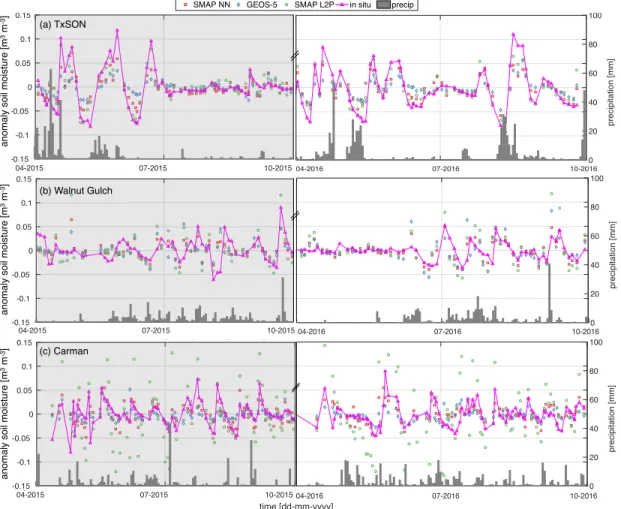
In order to illustrate the behavior of the NN retrievals relative to the
GEOS-532
5 model soil moisture in the training and evaluation periods, Figure 5 shows
533
the anomaly time series with respect to a 30-day moving average of the NN soil
534
moisture estimates (red squares) and the GEOS-5 model soil moisture (blue
dia-535
monds) for three SMAP core site stations - TxSON, Walnut Gulch and Carman.
536
(The figure also shows the in situ and L2P data, which will be discussed in
sec-537
tion 4.2.1). For better readability and to reduce the effect of seasonal differences,
538
we only plot the months April - September for 2015 and 2016 to represent the
539
training and evaluation periods, respectively, with the former indicated through
540
gray background shading. There is no obvious difference between the behavior
541
of the NN retrieval product in both periods, underlining once more the ability
542
of the trained NN to generalize beyond the training dataset. For the TxSON
(Figure 5 (a)) and Walnut Gulch (Figure 5 (b)) sites, the time series average
544
and dynamic range of the NN retrieval product and the GEOS-5 soil moisture
545
are comparable, but there are differences in the response to individual events,
546
illustrated for instance during the stronger drying in the NN soil moisture at
547
the TxSON station in June 2015. At the Carman site (Figure 5 (c)), the NN
548
soil moisture has a stronger variability compared to the model. This illustrates
549
that while the NN estimates globally match the bias and variability of the target
550
data, local biases and differences in variability between the NN estimates and
551
the target data occur.
552
4.2. Evaluation against In Situ Observations 553
In this section, we evaluate the skill of the NN retrieval product against
554
independent in situ soil moisture measurements from the SMAP core sites and
555
the ISMN (section 2.2.3). The skill of the NN retrievals is compared against
556
that of the GEOS-5 model soil moisture and the L2P retrievals. Only data from
557
the period April 2016 - March 2017 are used in the evaluation, since these data
558
did not contribute to the NN training.
559
4.2.1. Core Site Data 560
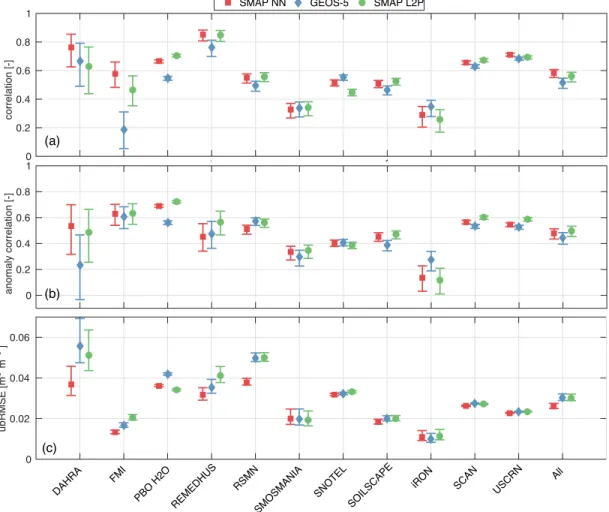
First, we assess the skill of the soil moisture products against core site in
561
situ measurements. The NN retrieval product has a higher correlation than the
562
GEOS-5 soil moisture for most core sites (Figure 6(a)), which is reflected in
563
the higher average correlation of 0.70 for the NN retrievals compared to 0.64
564
02-2016 04-2016 07-2016 10-2016 time [dd-mm-yyyy] -0.15 -0.1 -0.05 0 0.05 0.1 0.15 soil moisture [m 3 m -3 ]
0901Carmancolocated20150401 20170331.mat
0 20 40 60 80 100 precipitation [mm]
SMAP NN GEOS-5 SMAP L2P in situ precip
04-2015 07-2015 10-2015 12-2015 time [dd-mm-yyyy] -0.15 -0.1 -0.05 0 0.05 0.1 0.15 soil moisture [m 3 m -3] 0901
Carmancolocated20150401 20170331.mat
0 20 40 60 80 100 precipitation [mm]
SMAP NN GEOS-5 SMAP L2P in situ precip
04-2015 07-2015 10-2015 12-2015 time [dd-mm-yyyy] -0.15 -0.1 -0.05 0 0.05 0.1 0.15 soil moisture [m 3 m -3 ]
1601WalnutGulchcolocated20150401 20170331.mat
0 20 40 60 80 100 precipitation [mm]
SMAP NN GEOS-5 SMAP L2P in situ precip
04-2015 07-2015 10-2015 12-2015 time [dd-mm-yyyy] -0.15 -0.1 -0.05 0 0.05 0.1 0.15 soil moisture [m 3 m -3] 4801
TxSONcolocated2015040120170331.mat
0 20 40 60 80 100 precipitation [mm]
SMAP NN GEOS-5 SMAP L2P in situ precip
a n o ma ly so il mo ist u re [ m 3 m -3] a n o ma ly so il mo ist u re [ m 3 m -3] 10-2015 01-2016 04-2016 07-2016 10-2016 time [dd-mm-yyyy] -0.15 -0.1 -0.05 0 0.05 0.1 0.15 soil moisture [m 3 m -3 ]
1601WalnutGulchcolocated20150401 20170331.mat
0 20 40 60 80 100 precipitation [mm]
SMAP NN GEOS-5 SMAP L2P in situ precip
(b) Walnut Gulch (a) TxSON 02-2016 04-2016 07-2016 10-2016 time [dd-mm-yyyy] -0.15 -0.1 -0.05 0 0.05 0.1 0.15 soil moisture [m 3 m -3 ] 4801
TxSONcolocated20150401 20170331.mat
0 20 40 60 80 100 precipitation [mm]
SMAP NN GEOS-5 SMAP L2P in situ precip
02-2016 04-2016 07-2016 10-2016 time [dd-mm-yyyy] -0.15 -0.1 -0.05 0 0.05 0.1 0.15 soil moisture [m 3 m -3]
4801TxSONcolocated2015040120170331.mat
0 20 40 60 80 100 precipitation [mm]
SMAP NN GEOS-5 SMAP L2P in situ precip
04-2015 07-2015 10-2015 12-2015 time [dd-mm-yyyy] -0.15 -0.1 -0.05 0 0.05 0.1 0.15 soil moisture [m 3 m -3 ]
4801TxSONcolocated2015040120170331.mat
0 20 40 60 80 100 precipitation [mm]
SMAP NN GEOS-5 SMAP L2P in situ precip
02-2016 04-2016 07-2016 10-2016 time [dd-mm-yyyy] -0.15 -0.1 -0.05 0 0.05 0.1 0.15 soil moisture [m 3 m -3]
1601WalnutGulchcolocated20150401 20170331.mat
0 20 40 60 80 100 precipitation [mm]
SMAP NN GEOS-5 SMAP L2P in situ precip
02-2016 04-2016 07-2016 10-2016 time [dd-mm-yyyy] -0.15 -0.1 -0.05 0 0.05 0.1 0.15 soil moisture [m 3 m -3 ]
4801TxSONcolocated2015040120170331.mat
0 20 40 60 80 100 precipitation [mm]
SMAP NN GEOS-5 SMAP L2P in situ precip
04-2015 07-2015 10-2015 12-2015 time [dd-mm-yyyy] -0.15 -0.1 -0.05 0 0.05 0.1 0.15 soil moisture [m 3 m -3 ]
4801TxSONcolocated2015040120170331.mat
0 20 40 60 80 100 precipitation [mm]
SMAP NN GEOS-5 SMAP L2P in situ precip
(c) Carman 02-2016 04-2016 07-2016 10-2016 time [dd-mm-yyyy] -0.15 -0.1 -0.05 0 0.05 0.1 0.15 soil moisture [m 3 m -3 ]
4801TxSONcolocated2015040120170331.mat
0 20 40 60 80 100 precipitation [mm]
SMAP NN GEOS-5 SMAP L2P in situ precip
04-2015 07-2015 10-2015 12-2015 time [dd-mm-yyyy] -0.15 -0.1 -0.05 0 0.05 0.1 0.15 soil moisture [m 3 m -3 ]
4801TxSONcolocated2015040120170331.mat
0 20 40 60 80 100 precipitation [mm]
SMAP NN GEOS-5 SMAP L2P in situ precip
02-2016 04-2016 07-2016 10-2016 time [dd-mm-yyyy] -0.15 -0.1 -0.05 0 0.05 0.1 0.15 soil moisture [m 3 m -3 ] 1601
WalnutGulchcolocated20150401 20170331.mat
0 20 40 60 80 100 precipitation [mm]
SMAP NN GEOS-5 SMAP L2P in situ precip
a n o ma ly so il mo ist u re [ m 3 m -3]
Figure 5: Soil moisture anomalies with respect to a 30-day moving average at the (a)
TxSON, (b) Walnut Gulch and (c) Carman core sites for April - September of 2015 and 2016. Shown are the SMAP NN retrievals (red squares), the GEOS-5 model soil moisture (blue diamonds), the SMAP L2P retrievals (green circles) and the core site in situ soil moisture measurements (magenta triangles). Gray bars indicate the corrected GEOS-5 precipitation (section 2.1.2) interpolated to the ground station site. The gray background shading indicates data belonging to the training period.
at Reynolds Creek and a higher correlation than the NN retrievals at Carman
566
and Kenaston. The Carman and Kenaston watersheds are both located at
567
high latitudes where an incomplete seasonal cycle due to frozen soil filtering
568
could prevent the NN from accurately learning the SM-Tb relationship for such
569
conditions in the training phase. The NN retrievals tend to have a notably
570
higher skill than the model in moderately vegetated regions, such as the
shrub-571
and grassland sites of Little Washita or TxSON, as well as at most of the sites
572
characterized by an arid climate (see Table 1). However, while the results appear
573
to connect the relative performances of the NN product and model with climate
574
and land cover characteristics, more sites would be required to draw a firm
575
conclusion. The poor performance of the model at the South Fork site is partly
576
due to agricultural tile drainage, which is not accounted for in the model.
577
The L2P retrieval product has a higher correlation skill than both of the
578
other soil moisture products for the majority of core sites and consequently
579
has the highest average correlation of 0.78 (Figure 6(a)). The magnitude of
580
the skill difference between the two retrieval products is not obviously related
581
to the climate or land cover of the in situ sites. In regions with a moderate to
582
strong seasonal cycle, the correlation (R) primarily reflects the skill of capturing
583
seasonal soil moisture variations. Hence, the above results indicate a better
584
representation of the soil moisture seasonal cycle in the two retrieval products
585
compared to the model.
586
In terms of the anomaly correlations (Figure 6(b)), the NN retrieval product
587
has higher skill than the model estimates for most core sites and an average
0 0.02 0.04 0.06 0.08 ubRMSE [m 3 m -3 ] RM RC YC CM TW WG LW FC LR SF MB KN TX MH All Core Site 0 0.2 0.4 0.6 0.8 1 correlation [-] RM RC YC CM TW WG LW FC LR SF MB KN TX MH All Core Site 0 0.2 0.4 0.6 0.8 1 anomaly correlation [-] RM RC YC CM TW WG LW FC LR SF MB KN TX MH All Core Site 0 0.2 0.4 0.6 0.8 1 anomaly correlation [-] Ranom REMEDHUS Reynolds Creek Yanco
Kyeamba Carman Twente
Walnut GulchLittle WashitaFort Cobb Little RiverSouth ForkMonte Buey
TxSon Mahasri
All
C Si
SMAP NN GEOS-5 SMAP L2P
0 0.2 0.4 0.6 0.8 1 correlation [-] RM RC YC CM TW WG LW FC LR SF MB KN TX MH All Core Site (a) (b) (c)
Figure 6: (a) Correlation, (b) anomaly correlation and (c) ubRMSE between the core
site in situ measurements and the SMAP NN retrievals (red squares), the SMAP L2P retrievals (green circles) and the GEOS-5 model soil moisture (blue diamonds). Shown are the metrics for each site as well as the average across all sites. The error bars represent the 95% confidence interval.
skill of 0.66 compared to 0.57 for the model. The L2P retrieval product has the
589
highest average skill overall (0.71) as well as for a majority of the core sites.
590
In terms of the ubRMSE (Figure 6(c)), the skill of all three products is more
591
similar. The NN product has a somewhat lower error than the L2P product at
592
a majority of the stations and an overall lower average error of 0.037 m3m−3
593
compared to 0.041 m3m−3 for the L2P and GEOS-5 model estimates.
594
Our findings for the L2P skill are consistent (within error bars) with those
595
ofColliander et al. (2017) (not shown). The only significant difference occurs
596
at the Twente site, whereColliander et al.(2017) used a different set of sensors.
597
Compared toChan et al.(2016b), we obtain higher correlations and a slightly
598
larger ubRMSE for the L2P product. This is in part a result of the more
599
refined validation approach used byChan et al.(2016b), who generated special
600
L2P retrievals on custom grid cells that better match the locations of the in
601
situ measurements and thus did not perform the spatial interpolation that was
602
required for the published L2P retrievals used here (section 3.2). Other factors
603
contributing to the differences in the L2P metrics are the different validation
604
periods and L2P product versions used here and byChan et al.(2016b).
605
To further investigate the cause for the skill differences between the retrieval
606
products and the model at select sites, we now revisit Figure 5. At the TxSON
607
and Walnut Gulch sites the anomalies for both retrieval products follow the
608
in situ measurements very closely. The different average anomaly correlations
609
obtained for these sites are mostly due to different responses to isolated events.
610
An example is the dry down in June 2015 at the TxSON site, which is better
captured by the L2P retrievals than by the NN retrievals.
612
At the Carman site, both retrieval products are very noisy compared to the
613
model and in situ measurements (Figure 5(c)). The L2P product is noisier than
614
the NN product, which is also reflected in its higher ubRMSE at this site (see
615
Figure 6(c) ). The higher ubRMSE might be caused by ancillary soil texture
616
data in the L2P retrieval algorithm that poorly describes the highly variable
617
conditions in the Carman watershed. This suggests that the NN retrieval
ap-618
proach has the potential to supplement the physically-based SMAP retrievals
619
in regions where the ancillary data used in the RTM are uncertain.
Addition-620
ally, both retrieval products suffer from using a VWC climatology that does not
621
accurately describe the rapidly changing vegetation dynamics at Carman.
622
The above results show that both SMAP retrieval products have higher
cor-623
relations than the model soil moisture with respect to the in situ measurements
624
(Figure 6). This is encouraging, given that most of the core sites are located in
625
North America, where models typically have been well tested and already have a
626
high skill (e.g. Albergel et al.(2013)). Additionally, the retrievals are at a slight
627
disadvantage in the comparison, since for most locations the SMAP emission
628
depth will be less than the 5 cm depth represented by the in situ measurements
629
and the model estimates. The better correlations of the retrieval products thus
630
illustrate the high quality of the SMAP observations and their potential to
pro-631
vide independent information that is not captured in the models, likely related
632
to agricultural practices, land use differences or phenology. This is corroborated
633
by the benefit of the SMAP brightness temperature assimilation performed in
the Level-4 soil moisture algorithm (Reichle et al., 2017b(in press).
635
Against the core site data, the L2P retrievals generally have a higher skill
636
than the NN retrievals in terms of the correlations and anomaly correlations,
637
while the NN retrievals have a better average ubRMSE (Figure 6). This
behav-638
ior could indicate the existence of a conditional bias in the SMAP NN retrievals,
639
as a result of dynamic range reduction that is typical for statistical techniques
640
(e.g. (Kolassa et al., 2013)). The global average of the anomaly soil moisture
641
temporal standard deviations for the SMAP NN retrievals, the SMAP L2P
re-642
trievals and the GEOS-5 estimates are 0.020 m3 m−3, 0.036 m3m−3 and 0.015
643
m3m−3, respectively, suggesting that the lower dynamic range of the NN
re-644
trievals compared to the L2P retrievals is driven by the lower dynamic range
645
of the model. At the core sites in Figure 5, the NN estimates appear to better
646
match to dynamic range of the in situ measurements than the L2P retrievals,
647
however, the limited number of core validation sites does not permit conclusions
648
regarding the general suitability of the retrieval products’ dynamic range.
649
A notable exception from the typical relative skill ranking is the Reynolds
650
Creek site, where the NN retrievals have a significantly higher skill than the
651
L2P retrievals in terms of the correlations and ubRMSE. Since the retrieval
652
inputs are very similar for both products, the skill difference is likely caused by
653
uncertainties in the ancillary data used by the L2P algorithm (for example the
654
soil texture or roughness).
655
From the NN retrieval perspective, differences in the core site correlation skill
656
between the NN and L2P retrievals can be caused by (1) errors in the target