Improving Communications Effectiveness and Reducing Costs
with Internet Routing in Space: A DoD Joint Technology
Capabilities Demonstration
Executive SummaryToday’s national governments require ever-expanding communications capabilities to enable successful military operations, support public safety and law enforcement, and connect remote areas and educational institutions. Geographically dispersed personnel operate in environments ranging from mountainous terrain to urban areas, on missions to combat terrorism, assist on multinational projects, or provide disaster relief. Accordingly, this workforce requires real-time, high-bandwidth applications to support a wide variety of critical missions.
In response to this need, government organizations are increasingly turning to the benefits of satellite
communications such as those based on the Internet Protocol (IP) to help cost-effectively achieve collaboration goals and build a more resilient infrastructure for public services.
In 2007 the U.S. Department of Defense (DoD) approved a Joint Capabilities Technology Demonstration (JCTD) to test the viability of IP-based communications networking in space. The Cisco® 18400 Space Router was used to evaluate the concept of Internet Routing in Space (IRIS). IRIS is designed to use today’s technological advances to best advantage in commercial satellite communications to meet critical operational needs of joint, interagency, intergovernmental, and multinational (JIIM) users.
Developed and built in 22 months, IRIS was successfully launched in November 2009 on Intelsat’s IS-14 satellite. The DoD conducted a series of tests from February to April 2010 to evaluate the technical and operational merits of the technology compared to currently deployed communications systems. The testing ground included a NATO ship with the mission of monitoring drug trafficking in the Caribbean Sea.
The results of the following DoD evaluation are covered in the Mission Utility Assessment (MUA). In summary, the JCTD found that IRIS provided significant space-to-ground communications benefits. By using the capabilities of the IP-based networking, IRIS was shown to provide:
● A dramatically shorter, less-expensive development cycle for space-borne mission capabilities, decreasing from up to 7 years to less than 24 months
● 50% faster transmission times enabled by a “single-hop” integrated mesh configuration
● Onboard regeneration (OBR) for a power reduction of 3 dB or more, reducing the size of antennas on the ground and providing additional IP throughput
● Flexible bandwidth on demand with higher throughput than traditional systems, designed to support larger transmissions such as real-time video from unmanned aerial vehicles (UAVs) or access for underserved users
● Support for the same commercial software as terrestrial IP service platforms, including converged voice over IP (VoIP), security, policy and bandwidth management, and mobility
● Ability to interface with legacy systems to support connectivity across joint groups or forces, and use an encrypted IP connection to protect classified information
Based on the measures of operational performance (MOP) evaluated during the JCTD, Cisco IRIS achieved the following measures of effectiveness (MOE) during testing:
● 100% of respondents noted improvements in accurate classification of targets, boarding, and evidence processing based on video and chat capabilities. Respondents noted call clarity, a high success rate for data transmission, and consistent persistence of signal while in motion, while the operations officer noted an improvement in classification confidence.
● 80% of respondents observed that Cisco IRIS enhanced mission agility. Crew members and commanders
found that they could use the system in a variety of ways to take advantage of dynamic changes, including multicast and unicast messaging, collaboration, and video teleconferencing.
● 75% of respondents saw significant improvements in timeliness and their ability to meet their deadlines for performance and mission completion. Message transmission times were greatly improved from point to point to achieve near real-time capabilities, with high availability.
● Overall, 75 to 80%of respondents found that IRIS provided better reliability, capability, capacity, and
robustness in overall communications networking and service compared to traditional systems. The Move to IP-Based Networking
The JCTD was a collaborative effort by the DoD and industry to take advantage of the latest communications advances to meet critical operational needs of joint operations. In response to the DoD’s request, industry partners Cisco and Intelsat developed the IP-based Cisco IRIS hosted payload. The goals of the demonstration were to determine whether:
● Industry could put a payload based on COTS technologies into orbit in less than 24 months, as opposed to
today’s multiyear program timelines
● IP-based satellite networking provides a viable alternative to traditional “bent-pipe” networks for more agile, resilient, and cost-effective communications
● Procurement of capabilities-based managed services (via a hosted payload) serves as a viable alternative for government and military use
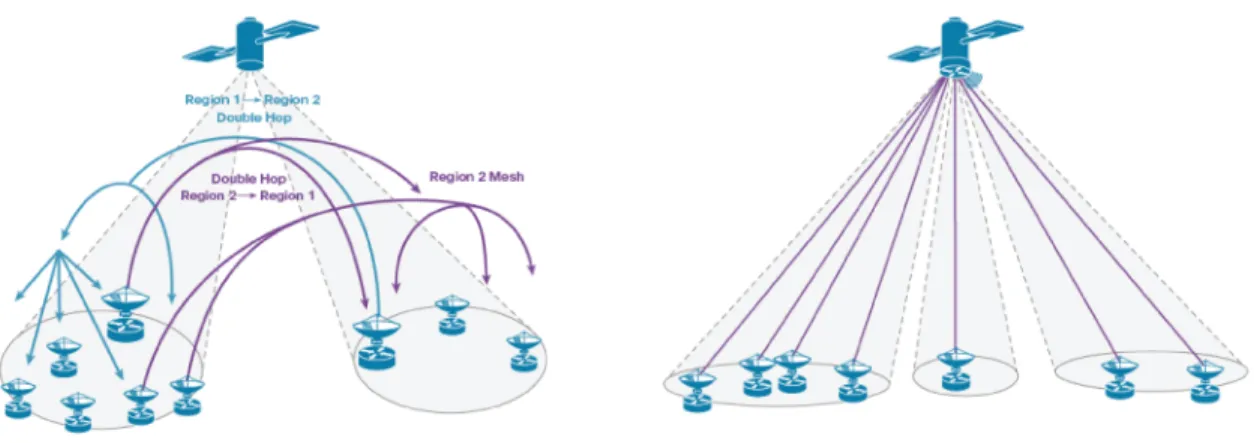
The JCTD tested how IP-based networking using IRIS can mitigate the traditional star configuration “double hop” of the signal by providing full-mesh terminal-to-terminal communications, especially across beams of different bands and coverage areas. Data traffic is managed by an intelligent router on the satellite through onboard processing (OBP), instead of on the ground. The signal travels between users in just one hop, cutting transmission times by 50% over current designs (see Figure 1), eliminating the need to multi-hop or cross-strap in order to provide beam-to-beam communications.
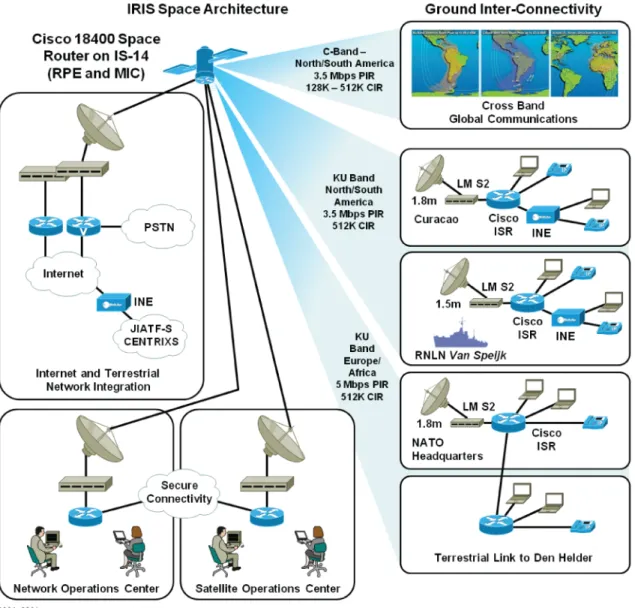
For the demonstration, the Cisco IRIS capability (Figure 2) included the space-based payload, ground-based terminals with network gateways, and a network operations center (NOC) developed by the industry management team (IMT) led by Cisco. The payload consists of the Cisco 18400 Space Router with integrated software-defined radio and associated uplink and downlink converters. The modem interface chassis (MIC) and route processing engine (RPE) support all the functions of the routed payload, including encapsulation and segmentation of Layer 3 IP packets, modulation, coding, and bandwidth on demand. The Cisco IOS® Software Operating System provides a common management and feature base for both the space and ground networks.
Each 36-MHz IRIS-enabled transponder aboard the satellite supports a set of channels with symbol rates of 1.25, 2.5, and 5 Msps, providing peak information rates of up to 5 Mbps. This capability allows direct connectivity between authorized users located within the footprint of any of these beams for seamless intrabeam, interbeam, and cross-band communications.
Figure 2. The Space-Ground Architecture Enabled by Cisco IRIS
Each ground terminal user node consists of typical very-small-aperture-terminal (VSAT) satellite earth station equipment (antenna, amplifiers, block upconverter [BUC], low noise block converter [LNB], etc.), plus a linkway
The first hosted payload was launched on the IS-14 satellite on November 23, 2009, with an orbital location of 45º West covering Europe, Africa, and the Americas (Figure 3).
Figure 3. The Cisco IRIS Hosted Payload: Global Cross-Beam, Cross-Band Communications (Source: Intelsat General, 2009)
The Scope of the Demonstration
The IRIS JCTD performed its initial evaluation of both the technical and operational merits of the Cisco IRIS network for 90 days, from February to April 2010. The U.S. Joint Interagency Task Force South (JIATF-S) and the Royal Netherlands Navy (RNLN) were the primary testers. JIATF-S is headquartered in Key West in the State of Florida, and is responsible for conducting counter-drug operations in the Eastern Pacific, Caribbean Sea, and Gulf of Mexico. Its primary mission is directed at the detection and monitoring of suspect air and maritime operations within its area of responsibility (AOR) in conjunction with partnering nations.
The demonstration facilitated the DoD evaluation by supporting JIATF-S counter-drug operations and extending a NATO military encryption system to a maritime node. The RNLN, with a U.S. Coast Guard contingent on board, participated in the demonstration using terminals set up at Curaçao, Netherlands Antilles; on the RNLN Frigate Van Speijk; and at NATO Headquarters in The Hague in the Netherlands, which provided a terrestrial link to RNLN headquarters at its home port of Den Helder.
Assessing Measures of Performance and Effectiveness
The MUA measured performance by performing benchmarking tests (see Table 1) and asking mission commanders and crew to participate in a series of surveys focused on their area of expertise. The measures of effectiveness included:
1. Agility: The ability to rapidly and efficiently adapt to change in support of the mission 2. Timeliness: The ability to execute tasks per the mission timeline
3. Classification accuracy: The ability to accurately identify and classify targets of interest
4. Communications service: The ability of the communications network to provide reliable, flexible communications services in support of the mission
Real-Time Collaboration for Operations
Real-time chat, voice, and web portal services were used extensively during counter-narcotics operations by both the RNLN and onboard U.S. Coast Guard contingent. This simultaneous joint connectivity to NATO and the secured network enhanced operations provided real-time situational awareness protected by an encryption-enabled capability for the first time on a ship belonging to the Dutch nation.
Support for Conferencing
The Cisco 18400 Space Router was also used to support the ship’s administrative communications. For the first time, officers participated in video conference calls with headquarters in Den Helder while at sea.
Support for General Planning and Administration
The ship’s commanding officer reported that he was able to communicate more easily with superiors via the converged network with quality of service (QoS)-enabled clarity of voice and video. He used this capability once or twice per week while at sea to contact Den Helder or Curaçao, reducing time and increasing effectiveness in receiving mission information, as opposed to the hour or more previously spent reading and interpreting daily memorandums.
Wide Bandwidth and Ease of Use
On ships at sea, sailors and officers are traditionally limited as to how and when they may gain Internet access. However, IP-based broadband provided stable access at sea for both operations and an Internet café, as opposed to previous stove-piped communications. Even in times of bandwidth congestion, applications maintained a high quality of performance, positively affecting morale. As well, the ready-to-use design of the router required only minimal training for communications crew members, lessening distraction from mission operations.
Upon conclusion of the demonstration period, the ship’s officers requested an extension of Cisco IRIS coverage to support the remainder of their mission in the region. The commander’s report reflected his satisfaction with the system overall, stating, “The moment [IP-based service] was gone, I really missed it.”
Table 1. Measures of System Performance
Measure Results
High availability: Ensured system uptime when needed
● Cisco IRIS achieved 99.95-percent router availability, providing the foundation for mission-critical operations.
● The system offers on-demand access to applications such as video conferencing without dedicated bandwidth.
Seamless, high-performance global IP communications: Across three IS-14 Cisco IRIS-enabled transponders, including cross-band (C to KU) communications
● Terminals were deployed and redeployed within all three beams without re-addressing and maintaining VPN membership.
● Applications such as VoIP, video, and file transfer performed equally well, regardless of terminal location.
Secure, flexible IP VPNs: Facilitated by standards-based routing protocols, VPNs reduced operating expenses (OpEx) in support of missions and connectivity requirements that change in real time.
● Two VPNs were configured and cross-VPN traffic was successfully prevented.
● The VPNs were combined toward the end of the demonstration period into a single VPN with no user interaction required, demonstrating the reduced OpEx provided by managed services as facilitated by the router.
Multiple service levels: Committed information rates (CIRs) of 128,000 to 512,000 and maximum information rates of 1 to 5 Mbps demonstrated the ability to mesh interconnect terminals at various access speeds.
● Meshed, single-hop IP communications between terminals of differing service levels cut transmission times in half.
● Reduced terminal size reduced complexity and power requirements of satellite mesh networks that are typically engineered to worst-case link budgets.
Converged networking: Real-time applications (such as VoIP) were supported.
● Differentiated Services (DiffServ)-based per-terminal QoS maintained consistent latency during terminal bandwidth congestion for real-time traffic, providing quality voice and video.
● Overall latency was reduced by 50 percent compared to traditional systems. Reduced field engineering expertise: Terminal
deployment is rapid and easy.
● A simple, web-based deployment process incorporating modem and ground routing reduced engineering expertise required in the field to deploy each terminal.
● The router and modem were operational within 8 minutes of antenna setup. Integrated performance-enhancing proxy: Cisco
IRIS improved the end-user experience over long-delay satellite networks by providing quicker transfer of critical information in support of mission operations and using available bandwidth more efficiently.
● Cisco IRIS was combined with Cisco Wide Area Application Services (WAAS) to provide (TCP Performance Enhancing Proxy, compression, and data redundancy elimination):
◦ Large FTP files experienced a significant decrease in file transfer times and more efficient use of available bandwidth.
Cross-Band Communications
Traditionally, ships operating at sea have limited connectivity that is broken down into circuits for each service. This does not provide the ability to access joint databases or networks; vessels have different beams and coverage maps even under the same satellite. IRIS enabled a new level of connectivity at sea by rerouting the RNLN ship’s Ku-band signals, cross-connecting them via a different transponder, on a different beam, directly to headquarters via a terrestrial link from the NATO NC3A terminal.
As a result, the ship gained immediate, real-time access to on-shore databases and enforcement resources while still at sea. This scenario provided new levels of real-time collaboration for the NATO ship, while the U.S. Coast Guard contingent took advantage of greatly increased bandwidth in order to process passport information, query criminal databases, and check ship registries.
Conclusion
Today’s governments demand ever-increasing access to information shared by geographically dispersed military forces and first responders. The U.S. DoD JCTD demonstrates that IP-based Cisco IRIS in space can provide:
● Ease of cross-beam, cross-band transmission in a single hop to provide real-time transoceanic
communications with flexible bandwidth on demand
● Enhanced communications based on improved QoS and satellite link performance, with reduced latency and less degradation
● Operational benefits in terms of mission agility, accuracy, and timeliness, including information sharing across
distributed operations, improved situational awareness, better collaboration and synchronization, and long-haul reach-back to information and operations centers
● Ability to deliver encrypted communications via a hosted payload, enhancing the managed services option for government acquisition with a faster development cycle based on COTS technologies
The Cisco 18400 Space Router has continued to serve as a test bed as additional technologies are uploaded to the satellite—most recently, the addition of the Cisco Unified Communications Manager Express for telephony services when terrestrial infrastructure is missing or has been compromised.
With this demonstration, the Cisco IRIS JCTD has proven the validity of IP-based networking in space for government use, showing how satellite assets can be launched quickly and cost-effectively in less than two years, while being integrated seamlessly into a converged space-based network and helping to reduce costs while enabling government goals. Enabling a new level of network flexibility and resiliency, IRIS continues to lay the groundwork for the future of space-ground communications.
FORWARD-LOOKING STATEMENTS
This paper contains projections and other forward-looking statements regarding future events or the future financial performance of Cisco, including future operating results. These projections and statements are only predictions. Actual events or results may differ materially from those in the projections or other forward-looking statements. Please see Cisco’s filings with the SEC, including its most recent filing on Form 10-K, for a discussion of important risk factors that could cause actual events or results to differ materially from those in the projections or other forward-looking statements.
Printed in USA C11-617326-00 08/10