Executive compensation
RAGHAVENDRA RAU
Sir Evelyn de Rothschild Professor of Finance University of Cambridge
ABSTRACT
The optimal design of executive compensation is one of the primary issues in the area of corporate governance and has been investigated in considerable detail in the academic literature over the past three decades. The underlying assumption behind the design of optimal compensation schemes is that the executives of the firm have more information on the firm’s projects and cash flows than the shareholders. In the presence of symmetric information, since the shareholders can completely distinguish the executive’s effort from bad luck or other extraneous factors, there is little need to motivate the executive beyond a flat salary. In the presence of asymmetric information, the shareholder faces two problems: One, to select the right type of agent (the adverse selection problem) and two, to motivate the agent to work hard once selected (the moral hazard problem). All executive compensation schemes represent trade-offs between these two agency problems.
In this survey, in the first section, I start by discussing the theory of executive compensation. Why do firms pay executives? I distinguish two major approaches. The first arises from the theory of optimal compensation contracting and focuses on the composition of pay. It argues that the composition of pay is set to attract good executives (to solve the adverse selection problem) and motivate them to work hard (the moral hazard problem). The second approach focuses on the level of pay. It argues that managers have a considerable degree of power in setting their own wages, and in particular, use their power to extract excessive pay or rents from the shareholders. In the second section, I discuss the evidence on both the composition and level of pay and how it has changed over time, treating each component pay separately. I also discuss the composition of pay in countries around the world and in specific industries. In the third section, I describe who decides pay composition and levels. Finally, in the fourth section, I conclude by examining how the structure of pay has real consequences for firms.
Contents
Introduction ... 1
I. The theory of executive compensation ... 7
The resolution of information uncertainty ... 8
The inducement of effort in general: the role of delta ... 13
The provision of specific incentives ... 19
Incentivizing managers to increase risk: the role of vega ... 19
Incentivizing managers to undertake corporate events ... 21
Ex post effort measurement ... 23
Executive perceptions of compensation schemes ... 25
Rent extraction ... 27
II. The structure of executive compensation ... 34
The overall structure of compensation ... 34
Incentive plans: options and restricted stock ... 37
Severance pay ... 42
Pensions ... 46
Perks ... 47
Non-monetary benefits: quality of life ... 49
Negative compensation: clawback provisions ... 49
Pay for other executives ... 50
Compensation across firm types and industries ... 52
Family firms ... 52
Private firms ... 54
Pay in specific industries ... 55
International structure of compensation ... 61
Pay in the United Kingdom... 64
Pay in Europe ... 66
Pay in Canada ... 67
Pay in China ... 67
Cross-country pay comparisons ... 73
III. Who sets pay? ... 75
The compensation committee and compensation consultants ... 80
The shareholders ... 83
Regulation ... 88
Regulatory changes that affected all industries ... 91
Regulatory changes that affected specific industries ... 94
Social and executive factors ... 96
Peer groups... 96
Social capital ... 100
Networks ... 102
Individual executive characteristics: reputation, age, and gender ... 102
Firm environments ... 106
IV. Consequences of pay... 111
Firm performance... 112 Turnover ... 118 Firm policy ... 120 Earnings manipulation ... 125 Conclusions ... 129 References ... 133
INTRODUCTION
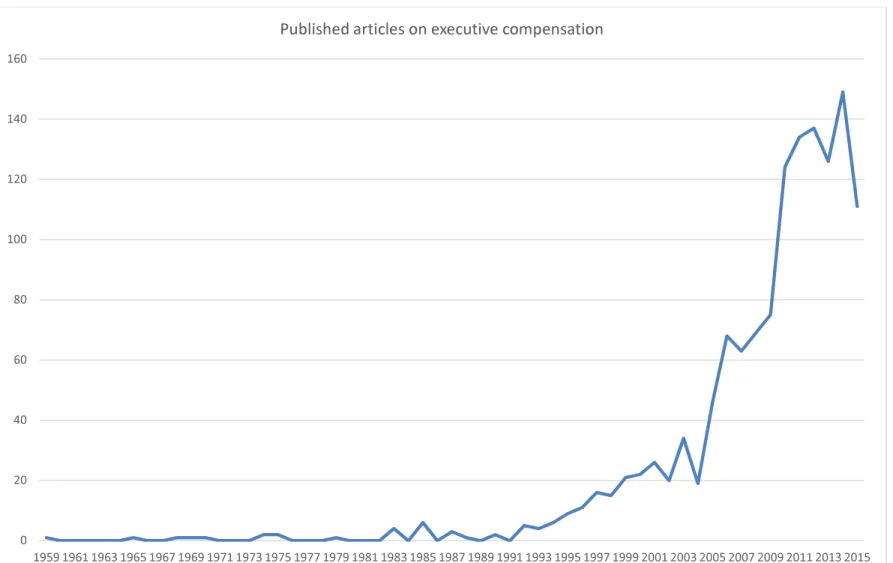
Over the last half century, the subject of executive compensation has received extensive academic attention. This attention has dramatically increased over the past two decades. From 1959 to 2015, a search on Scopus reveals the existence of over 1,300 published articles on executive compensation. From 1959 to 1991, there was relatively little attention paid to this topic, with just over 25 articles listed as published on Scopus over this period. In striking contrast, the growth has been nearly exponential since 1991 with 109, 544, and 657 articles on executive compensation published over the periods from 1992-2000, 2001-2010 and 2011-2015 respectively. This trend is illustrated in figure 1.
Though the magnitude of research on executive compensation appears daunting, the broad pattern is relatively easy to discern. Academic research on executive compensation can roughly be classified into two streams that examine either the composition of pay or the level of pay respectively. Specifically, they either examine how a particular component of pay is able to solve economic issues of selection or motivation of executives, or examine why the level of pay is different from the optimal level suggested by economic models respectively.
The overall trend in academic research also shows a second pattern. It appears closely related to the evolution of top executive pay documented in Frydman and Saks (2010, Figure 1). Frydman and Saks (2010) document that executive compensation was relatively flat from the end of World War II to the mid-1970s, even though firms grew considerably during that time. In addition, the magnitude and determinants of the correlation between wealth of executives and the performance of the firms they managed (pay-to performance sensitivity) did not change much over the fifty-year period from 1930-1980. In contrast, both pay and the pay-to-performance sensitivity of top executive pay expanded dramatically over the subsequent couple of decades, accompanied by a simultaneous increase in academic articles on this topic. The explosion in pay in the 1990s was almost entirely driven by the payment of stock options and the growth rate over the past fifteen years has been much lower, with pay only now approaching the levels of 2000 and with a changed composition to pay in prior decades.
What accounts for this striking coincidence between the increase in executive pay, Chief Executive Officer (CEO) pay in particular, and the simultaneous increase in academic research? While it is difficult to narrow down the explanation for executive compensation growth to any single factor, we can note that the explosion of academic interest occurred concurrently with two
factors: the growth of economic models to analyze incentive mechanisms and the easy availability of data, specifically, the availability of the COMPUSTAT Executive Compensation Database (Execucomp) that provided information on executive compensation for all the S&P500, Mid-Cap 400 and the Small-Cap 600 companies. These firms (comprising the S&P1500) constitute more than 80% of market capitalization of US public firms. Prior to these two events, articles published on executive compensation were largely practitioner articles, published in journals such as
Business Research with almost no influence on subsequent research. In the 1980s, the evolution of information economics and the development of screening and signaling models led to the first modern papers on executive compensation. albeit still with relatively small samples. The essence of these papers lay in the development of principal-agent models in the mid-1970s.
The principal-agent issue is of importance for all firms where the ownership of the firm is separated from corporate control, an issue documented by Berle and Means (1932) in firms going back as far as the beginning of the twentieth century. If managers are self-interested and if shareholders cannot perfectly monitor them (or cannot even hire the right type of manager), executives are likely to pursue their own well-being at the expense of shareholder value. In particular, there are two types of principal-agent problems, adverse selection and moral hazard. The adverse selection problem arises because shareholders are seeking the perfect executive to manage the firm and attempt to choose the manager with the ideal blend of different attributes – risk-aversion, effort aversion, and innate skill. However, managers know significantly more than shareholders whether they possess these attributes in the proportions desired by the shareholders. Hence the adverse selection problem lies in attracting the right type of candidate. Assuming that this is possible, the shareholders then face the moral hazard problem. Even though ex ante the manager may be the correct type of manager, ex post after being hired, the manager may choose to shirk, invest in undesired projects, or extract excess perquisites from the firm.
It is also important to realize that adverse selection can also arise in the presence of symmetric information where neither the manager nor the shareholder has the information on the potential quality of the firm-manager match. For example, while the manager may indeed work hard, the effectiveness of the effort may be linked to firm characteristics – some types of firms will not match well with the manager though the manager will not necessarily know this before she joins. Alternatively, changes in macroeconomic or industry conditions unanticipated by both parties may mean that any degree of managerial effort will not result in shareholder value. The
optimal contract should therefore be able to distinguish an ex post moral hazard problem from an ex ante symmetric uncertain information problem.
As noted above, the literature on executive compensation largely takes one of two approaches. The first and earlier stream examines the composition of pay. For example, an optimal compensation package for a CEO might consist of a combination of a cash salary and bonus, an option package (perhaps becoming exercisable over a number of years), a stock grant package (perhaps restricted in some manner), a severance package, a golden parachute package that comes into play if the firm is acquired, and a pension plan. Why should the optimal plan be so complicated? The optimal contracting approach draws on principal-agent theory to argue that pay should address both moral hazard and adverse selection. In the example above, the cash salary and bonus have no incentive effects once paid (since they are in the form of cash, which is time invariant). Hence, to motivate the manager to continue to work hard for the shareholders, she is paid in options. The options become exercisable at some point in the future at an exercise price that is fixed today. If she shirks, her options drop in value. However, if the options are deep out of the money, they become largely useless for motivational purposes, so stock grants are used to provide motivation in these circumstances. If the manager takes risks, she is likely to be fired, so she takes less risk than the shareholders (who have limited liability) would wish. Hence, an optimal package would also have severance pay to incentivize the manager to take more risks. However, taking too much risk would create wealth transfers from the bondholders to the shareholders. If the bondholders anticipate this transfer, the cost of debt of the firm would increase. Therefore, the manager is also compensated with a pension plan that acts like inside debt, persuading the manager to reduce the incidence of potential shareholder-bondholder conflicts. Finally, to persuade the manager not to resist (too hard) if the firm receives an acquisition offer, the package might also contain a golden parachute that is triggered if the firm is acquired.
The first category of theoretical models examines the role of pay in resolving information uncertainty on the level of unobserved effort, specifically how pay evolves over time. Shareholders, boards, and managers do not know the ability of the managers to manage a particular firm because managerial ability depends both on the manager’s intrinsic nature and on her match with the firm and extrinsic factors (such as macroeconomic factors). They learn about this ability by observing the manager over time and their changing beliefs affect the optimal structure of pay.
A second category of models in this stream examine the ability of compensation plans to either elicit managerial effort in general, or exert effort to achieve a particular outcome (increase risk or undertake a specific corporate event such as an acquisition). These models typically pick a particular component (such as the levels of incentive compensation, severance pay, or pensions) and test how the component addresses the moral hazard and the adverse selection problems, with significantly more attention being paid to the former than the latter.
The reason for this asymmetric degree of attention is straightforward. In either case, the counterfactual needs to be determined (who would have been hired and how much she would have been paid in the absence of moral hazard or adverse selection). The counterfactual for moral hazard involves identifying a group of firms that differed in the degree to which moral hazard played a potential role - firms that are different in the cross-section on one or two characteristics that are believed to affect pay. Examples include firms with differing levels of corporate governance, firms that were affected differently by regulation, and so on. This is reasonably straightforward to do under a set of justifiable assumptions. Identifying the counterfactual for adverse selection is considerably more difficult since the econometrician has to construct a set of alternative executives who might have been hired in the place of the actually hired executive had circumstances been different. This is considerably harder.
The cross-sectional evidence is reasonably clear however. While the overall structure of pay (described above) has remained roughly constant over time, the importance of each type of component has waxed and waned over time – but in a manner consistent with economic theory. For example, while the decision to reward and the actual composition of the package each executive is ultimately made by the board, there is significant variation in stock option grant vesting periods and patterns. This suggests that boards actively choose vesting terms depending on firm and executive characteristics, rather than adopting boilerplate terms. Vesting schedules are longer in growth firms where lengthening the executive’s investment horizon is more important. Similarly, severance pay is positively related to the distress risk of the firm and the risk aversion of the executive. Younger executives with little human capital of their own are more likely to receive explicit contracts and better terms. Firms with high distress risk, high takeover probability, and high return volatility are significantly more likely to revise their severance contracts. Importantly, there also appears to be a consistent increase in uniformity about how executives are paid that transcends national, political, and cultural differences. The cross-country evidence is
consistent with executives being paid in the UK, Europe, China, Canada and other countries for much the same economic rationales as studies on US executives.
The second stream of research, developed in the early 2000s, in contrast, focuses on the
level of pay. The idea is that once in post, managers enjoy a considerable degree of autonomy and power and hence extract excess rents from shareholders beyond levels that compensate them for the degree of risk they are exposed to and the effort they put in (Bebchuk, Fried, and Walker, 2002, Bebchuk and Fried, 2004). If the managers face losses, they extract rents ex post – by manipulating information, hiding losses or manipulating contracts. These papers implicitly argue that the explosion of pay in the 1990s was largely due to an increase in the payment of option pay. Option pay has an attractive feature – it is difficult to understand for the average shareholder. Cash in contrast, is easy to value. Hence, the explosion of pay in difficult-to-value options not only had the (desirable) effect of incentivizing the manager to work hard on behalf of the shareholders (as the first stream of literature argues) but also (undesirably) increased the ability of the managers to award themselves high levels of pay, higher than that justified by their effort or ability.
The problem with this latter stream, is that while plausible, it is difficult to determine what the optimum level of pay should be if we do not measure what managers should be paid for particular tasks and how important the tasks are. A common approach is to compute pay relative to a benchmark, either a peer group of firms, a peer group of executives, or a model based on firm-characteristics. However, if a manager is paid well above her benchmark, does that mean that she is excessively paid? It is unclear. Computing the optimal level of pay involves evaluating the manager’s responsibilities and what pay is appropriate for those responsibilities, a very difficult task. For example, a number of papers in the second half of the 2000s, argued that, if firms compete for scarce managerial talent, since larger firms are able to pay more, the rapid increase in compensation is correlated with the rapid increase in the size of the typical firm in the market, even though the dispersion in talent may not be very large (Gabaix and Landier, 2008). Similarly, another group of papers argue that the market for executives has changed over time with different types of skill sets in demand (network connections or social factors, for example) and this has influenced executive pay (Murphy and Zabojnik, 2004). Simply put, papers in the rent extraction stream of literature suffer from a joint-hypothesis problem akin to papers examining market efficiency.
This does not mean that all is lost for this stream, however. The papers in this stream also document significant managerial misbehavior around compensation awards. For example, managers facing a shortfall in pay have been shown to manipulate earnings, misstate financial statements, or back-date their pay awards. You do not need a benchmark model to argue that pay incentives may also cause these managers to behave opportunistically.
Finally, there is also a complex interplay between the composition and the level of pay that is, to a large extent, affected by regulation. While a number of these regulations were aimed at the levels of pay, they affected the composition of pay. For example, stock options were almost never used until the 1950s when restricted stock options were introduced following a reform of tax legislation. Since income tax rates were extremely high at the time, this had an immediate impact on compensation structure. After 1992, the Clinton administration taxed fixed compensation in excess of $1 million that was not performance related. The cash salary component of CEO pay packages were largely restricted to this amount following this rule but the amount paid in the form of performance related option pay increased strikingly. However, since plain vanilla call options on the firm’s stock with the strike price set equal to the stock price on the grant date did not have to be expensed, options granted to the CEOs were largely vanilla options. The Statement of Financial Accounting Standards SFAS 123(R), changed the rules on the vesting terms of stock option grants, requiring firms to expense the fair value of option grants over their vesting periods, and causing a decline in stock options in favor of (first) restricted shares and (then) performance shares (restricted shares vesting on the achievement of performance hurdles and not simply the passage of time). In all these cases, the managers have significantly higher incentives to keep the level of their pay constant by changing the structure of pay, than the shareholders for whom the firm may form a small fraction of their portfolios.
As in numerous surveys on executive compensation over the past two decades, including Gomez-Mejia and Wiseman (1997), Murphy (1999), Abowd and Kaplan (1999), and Murphy (2013), I start with discussing the theoretical approaches on pay. As noted above, I distinguish between research that analyzes the composition of pay and research that analyzes the level of pay. In the later sections, I will place a larger emphasis on what the recent literature has shown on the determinants of executive pay. In particular, since the largest part of the research on executive compensation is devoted to CEO pay, in this survey, I will also tend to emphasize research on
CEO pay. However, I will draw parallels between compensation paid to CEOs and those to other top executives in the firm.
I. THE THEORY OF EXECUTIVE COMPENSATION
In this survey, I will use the word theory in a broad sense – both describing formal mathematical models and less formal qualitative hypotheses that nevertheless fit into a wider framework. As noted above, that framework largely consists of two parts – an optimal contracting approach and a rent extraction approach. The optimal contracting approach largely focuses on the composition of pay. According to this approach, executive compensation is designed by shareholders (either directly or indirectly through boards, as I will discuss in the third section) to increase shareholder value. Much of this literature draws on standard principal-agent theory (for example, Hölmstrom, 1979) to determine the optimal structure of compensation. In these papers, the principal may be unaware of the agent’s type, the agent may be unaware of the match between principal and agent, or the principal may be unaware of the agent’s effort, given the type. I will first discuss models that use the structure of compensation to resolve uncertainty as to the agent’s type. As discussed below, these models are related to the adverse selection problem but are not exactly the same. The second and third set of papers focus on mechanisms to induce the agent to induce effort in general (solve the moral hazard problem) or induce effort for specific purposes. The fourth set of papers focus on mechanisms that measure whether the manager has indeed expended the effort and renegotiate contract terms accordingly. The fifth set focuses on managerial perceptions of compensation mechanisms and the final set focuses on the level of pay, arguing that managers seek excessive levels of pay (rents) and hence earn compensation which is unrelated to (or even negatively related to) shareholder value.
In particular, the final, rent-extraction approach, typically draws on the Jensen and Meckling (1976) framework to argue that compensation schemes are designed to address the principal-agent problem, in particular, the moral hazard problem. According to Jensen and Meckling, managers are prone to agency costs, pursuing their own objectives instead of maximizing shareholder value. The major difference between the optimal contracting approaches and the rent extraction approach is that the latter does not deny that managers are paid for effort or for certain activities. Instead, it argues either that the level of compensation is too high for the
activities that managers perform or that managers manipulate compensation mechanisms away from the optimal levels.
THE RESOLUTION OF INFORMATION UNCERTAINTY
The first major problem firms face is to determine the ability of the executive. Standard principal–agent theory, beginning with Hölmstrom (1979), predicts that the ability of the principal (board or shareholders) to observe the agent’s (manager) efforts influences the type of compensation paid. If the manager’s efforts are easily observed and verifiable, the optimal contract pays a manager a fixed salary and charges her for sub-optimal behavior. In contrast, if the manager’s actions are unobservable, then the principal needs to link the manager’s wealth to productive outcomes such as the value of the firm. Contracts should be based on any signal that has incremental information on the level of (unobserved) effort the CEO is exerting.
Therefore, the role of pay in resolving information uncertainty on the level of unobserved effort forms the first category of theoretical models I discuss. These models focus on explaining the evolution of pay for the same executive. This strand of theoretical papers shares the core idea that shareholders and boards may not know the ability of the executives ex ante. They learn about this ability by observing the manager over time and their changing beliefs affect the optimal structure of pay. In this class of models, the information is asymmetric – the manager knows her own abilities and effort levels better than the shareholders do.
However, the ability of the manager is a function that is dependent on two factors – her intrinsic ability (her risk-aversion and her propensity to exert effort) and the degree to which her ability matches the firm’s needs. Hence, while a manager may be aware of her intrinsic ability, she herself may not be aware of how well her ability will translate into effective shareholder value creation since the latter is dependent on firm-specific information that the manger may not have. Similarly, macroeconomic conditions may prevent a manager from performing regardless of how much effort she puts in. So it is important to remember that designing a compensation contract is not solely a question of the firm designing a compensation contract that induces the manager to tell the truth about her intrinsic ability. In other words, some of the information may be uncertain but not asymmetric.
To understand the differences between the two types of models, consider two of the earliest theoretical papers on executive compensation. In Eaton and Rosen (1983), shareholders are unable to obtain information on the current level of effort of their executives. They may receive ex post information on executive performance, but that information may be noisy. There is no matching problem in this paper in that the executives expend effort but the effectiveness of managerial effort is not related to firm characteristics. The executive is interested solely in maximizing her utility of consumption while minimizing effort. Shareholders will therefore attempt to tie compensation characteristics to the informativeness of the signals available on managerial effort because tying compensation to a “noisy” indicator exposes the executive to greater income variability. Given the risk aversion of the executive, this implies that the expected level of compensation must then be higher to attract a given executive. When future indicators of executive performance are more informative than indicators presently available, firms will prefer to delay compensation.
In contrast, the model in Harris and Hölmstrom (1982) is driven by symmetric information. While there is uncertainty on managerial abilities, managers and firms are both imperfectly informed on ability and learn gradually by observing the manager’s output over time. However, since output and ability are not perfectly correlated, this learning process results in random fluctuations of perceived ability over time. Long-term implicit contracts protect risk averse managers from wage changes induced by fluctuations in perceived productivity. If firms are risk neutral, the contract will entail a downward rigid wage, under which the managers’ wages will never fall. The wage is not fully rigid however, since managers can quit to accept higher offers from the market. The threat of quitting will force the wage to be bid up whenever the market wage is higher than the current wage. Hence wage contracts can simply be interpreted as a minimum wage guarantee which is equal to the market value of the manager at the time of contracting. Under this model, managers cannot commit to staying with the firm when the value of their outside options exceed the value of their current compensation contract.
In an extension of the Harris and Hölmstrom model, Ai and Li (2015) note that there is another type of limited commitment involved in the optimal compensation design - shareholders cannot commit to undertaking negative net present value (NPV) projects. Under these types of optimal contracts with limited commitment, CEO compensation is history-dependent. The type of limited commitment influences the relation between historic performance and compensation. In particular, limited commitment on the manager side implies that CEO compensation is an
increasing function of the historical highest level of firm size even after controlling for the current size of the firm. In contrast, limited commitment on the shareholder side implies that CEO compensation is an increasing function of the historical lowest level of firm size. The intuition is that if a firm’s value is driven toward zero by a sequence of negative productivity shocks, shareholders optimally reduce CEO compensation to keep the firm value nonnegative (because they cannot commit to negative NPV projects). Simultaneously, optimal risk sharing requires that CEO pay stays constant unless the limited commitment constraint binds. As a result, subsequent positive shocks do not affect CEO compensation. In this case, CEO compensation is determined by the historical worst performance of the firm where the current level of compensation is set.
Banker, Darrough, Huang and Plehn-Dujowich (2012) argue that past performance provides signals of the CEO’s ability. They differentiate between two components of cash compensation: fixed salary (based on signals already observed) and contingent bonus (based on signals of current performance observed after contract agreement) and posit that salary and bonus, although jointly determined, play two different roles in solving agency problems in the presence of both adverse selection and moral hazard. Intuitively, by making compensation contingent on performance, the bonus induces effort and rewards better ability types. To screen on ability, the sensitivity of bonus to performance needs to differ across types so that agents of higher ability command higher information rents. Salary and bonus together provide the agent with his reservation utility and information rent. Thus, an optimum compensation structure trades off productive efficiency with information rent extraction. They find that salary (bonus) is positively (negatively) associated with past performance for both continuing and newly hired CEOs.
Taylor (2013) also models how learning about a CEO’s ability over time affects the wage dynamics, specifically why the level of CEO pay responds asymmetrically to good and bad news about the CEO’s ability. Suppose that after a year of high profits, shareholders update their beliefs about their CEO’s ability. As a result, the CEO’s perceived contribution to next year's profits increases by $20 million. If the CEO obtains a $10 million raise the following year, then the CEO captures half of the $10 million surplus and shareholders the remaining half. Taylor measures these surpluses from learning, and how CEOs and shareholders split them. In his model, both CEO and shareholders gradually learn the CEO’s ability, defined as the CEO’s contribution to firm profitability, by observing the firm’s noisy profits and an additional latent signal. Stock prices, return volatility, and changes in the level of CEO pay respond endogenously to news about CEO
ability. Taylor estimates the CEO’s share of positive surpluses (from good news) and negative surpluses (from bad news) from a structural estimation approach. The average CEO captures approximately half of the surpluses from good news, implying CEOs and shareholders have roughly equal bargaining power. In contrast, the average CEO bears none of the negative surplus from bad news, implying CEOs have downward rigid pay.
The downward rigid pay is consistent with Harris and Hölmstrom (1982). Risk-averse CEOs accept significantly lower compensation in return for the insurance provided by downward rigid pay. However, Harris and Hölmstrom predict that workers capture 100% of the surplus from good news, because their workers can always threaten to take their skills to another firm at no cost. Taylor’s structural model estimates suggest that the average CEO’s actual outside employment options are not as strong as Harris and Hölmstrom assume. CEOs’ share of positive surpluses is significantly higher in the subsample with more institutional ownership, implying that strong CEO bargaining power is not inconsistent with strong governance. The CEOs’ share of positive surpluses is also higher in subsamples with insider CEOs and heterogeneous industries, potentially because their firms have fewer potential replacement CEOs and hence less bargaining power. Finally, the CEOs’ share of positive surpluses is positively related to the number of similarly sized firms in the industry, which Taylor uses as a proxy for CEOs’ outside employment options.
Finally, Laux (2012) relates the issue of revelation of CEO ability to the type of investment undertaken by the firm and to the vesting policies for the options granted to CEOs. Investment in short-term projects has beneficial effects in that it provides early feedback about CEO talent, which leads to more efficient replacement decisions. Granting stock options with long vesting periods implies that if the CEO is fired at an interim date, she will forfeit her options because they have not yet vested. Consequently, a long vesting horizon biases the CEO in favor of remaining with the firm. This is beneficial for the firm from an effort incentive perspective because the threat of losing her position and forfeiting unvested options provides the CEO with strong incentives to work hard. But at the same time, the threat of option forfeiture distorts the CEO’s investment decision toward short-term projects. The CEO knows that the board will rely on short-term results to update beliefs about managerial talent when making the replacement decision. To reduce the probability of being fired and forfeiting unvested options, the CEO has to impress the board and boost its perception about her ability. The CEO can achieve this by allocating excessive resources
to short-term projects. Thus, in the presence of potential CEO turnover, long vesting terms link CEO pay not only to long-term but short-term performance, encouraging short-termism.
There is some empirical evidence that is consistent with the information resolution hypotheses. Henderson and Frederickson (1996) measure the level of CEO compensation in four industries (chemicals, high-tech equipment, natural resources and conglomerates) where shareholders are likely to find it especially difficult to measure CEO effort. They find that CEO compensation is indeed higher in firms whose diversification strategy, approach to technology, and top management team structure places particularly high information-processing demands on their CEOs and hence are likely to be difficult for shareholders to evaluate.
Consistent with Harris and Hölmstrom (1982), Harris and Helfat (1997) argue that differences in pay are driven by lack of information executives have on the matching process. When they switch firms, executives forego the future value of their firm-specific skills in their old firms, and also bear risk connected to the lack of firm-specific skills in their new jobs. To induce an executive to switch firms, therefore, the firm may have to pay a premium up front to an external successor. They also argue that outside-of-industry external successors will earn greater initial compensation than within-industry external successors, as compensation for the return that outside-of- industry successors forego to their old industry- specific skills and for risk arising from lack of industry-specific skills in their new jobs.
Contrasting with these two papers, in a more recent paper, Riachi and Schwienbacher (2013) examine the effect of corporate asset-backed securitization (ABS) on managerial compensation. ABS helps improve the effectiveness of executive compensation by securitizing those assets whose performance does not correlate with CEO effort. Hence, corporate performance becomes a better signal of managerial effort after the securitization of non-correlated assets. Riachi and Schwienbacher find that CEO compensation indeed increases after securitization of corporate assets in particular, by increasing short-term accounting components (bonuses). This is somewhat consistent with Eaton and Rosen (1983). If equity based signals of managerial effort become relatively less informative after securitization, firms should increase the relative level of short-term signals and reduce the level of performance based compensation. However, firms do not appear to do the latter. Securitization does not appear to affect equity-based components of the CEO’s performance-based compensation.
THE INDUCEMENT OF EFFORT IN GENERAL: THE ROLE OF DELTA
How should the firm induce effort? Cash salary and bonus have no incentive effects once paid (since they are in the form of cash, which is time invariant). Hence, to motivate the manager to exert effort, she needs to be paid in some form of equity-dependent compensation. Therefore, the second category of theoretical models examines the composition of executive compensation – the proportion in the form of cash, stock, or options. Varying these proportions of cash, stock, and options in the pay contract changes the sensitivity of the CEO’s compensation to firm performance, the pay-performance sensitivity (PPS) of the CEO’s contract. This is usually also termed the delta of the compensation contract.
The earliest empirical papers appeared to provide evidence that managers have relatively low PPS. In an enormously influential article, Jensen and Murphy (1990a) collected data on 2,500 CEOs in 1400 publicly held companies from 1974-1988, and argued that top executives in that period were not receiving record salaries and bonuses. While cash compensation had increased over the prior fifteen years, CEO levels were approximately the same as they were 50 years ago. Much more important, annual changes in executive compensation did not appear to reflect changes in corporate performance. Specifically, for the median CEO in the 250 largest public companies, they argued that a $1,000 change in shareholder value corresponded to a change of just 6.7 cents in salary and bonus over a two-year period. They also argued that CEO compensation appeared to show little relationship with firm performance. In particular, CEO stock incentives (stock ownership) were significantly greater in the 1930s than in the 1980s. Hall and Liebman (1998) estimated larger pay-performance sensitivities and document that the pay-performance sensitivity has grown since 1980 because of increasing ownership of stock and stock options. However, the puzzle at the time was why CEO pay did not seem very sensitive to the performance of the firm.
Going back to Hölmstrom (1979), one possibility is that the relative informativeness of the stock-performance signal is lower for riskier firms. In such firms, managers should therefore not be compensated with contracts with high PPS. Aggarwal and Samwick (1999a) use the variation in stock return volatility across firms to test whether executives at riskier firms indeed have lower pay-performance sensitivities. They find that the PPS of a manager’s compensation decreases in the overall variance of the firm’s returns. The pay-performance sensitivity for executives at firms with the least volatile stock prices is significantly greater than the pay-performance sensitivity for
executives at firms with the most volatile stock prices. However, firms do not appear to take advantage of other measures that can improve informativeness. For example, evaluating the performance of executives against those in other firms (relative performance evaluation (RPE) measures) would appear to incorporate the benefits of risk sharing while being more informative on CEO effort. However, Aggarwal and Samwick find little evidence that firms use RPE in executive compensation, suggesting that executive compensation contracts are not always set to resolve information asymmetry.
Cao and Wang (2013) and Jin (2002) also measure the sensitivity of CEO pay to the variability of firm performance, but go on to separate firm risk into idiosyncratic and systematic risks. Cao and Wang focus on the idiosyncratic risk component while Jin focuses on systematic risk. Cao and Wang note that, in a market where there is competition for CEOs, the CEO can privately observe the idiosyncratic shock ahead of the shareholders and choose to quit the firm. Each firm has an incentive to design contracts to increase the probability of retention. Thus, changes in market conditions can affect PPS by affecting the severity of competition for CEOs. By switching from one firm to another, a CEO can change the amount of idiosyncratic risk to which he is exposed, but not aggregate systematic risk since all firms face the same systematic risk. PPS should therefore depend on these two types of risks differently.
Specifically, the firm offers an incentive contract that can be contingent on its output and the aggregate shock (which is publicly observable), but not directly on the idiosyncratic shock and the CEO’s effort. The CEO decides whether to accept the offer after observing the idiosyncratic shock. If he quits, he can search for a new job. Due to competition among firms, a CEO’s outside option depends on the probability of getting a new job and the compensation at the new job. Because the idiosyncratic shock is the CEO’s private information, the base wage cannot be made contingent on such a shock. The CEO will choose to stay to obtain the high payoff when the idiosyncratic shock is high, and will quit to insulate himself from the low payoff when the shock is low. In this setting, it is optimal for the firm to set PPS below one to get part of the high surplus when the idiosyncratic shock is high and compensate for the low payoff when the CEO quits. However, the PPS can also be affected by aggregate and idiosyncratic risk. An increase in the risk (either aggregate risk or idiosyncratic risk) increases the firm’s expected profit conditional on retention, which increases the firm’s incentive to retain the CEO. However, when the value of the CEO’s outside option is high, the probability of retaining the CEO is low. Therefore, it is optimal
for the firm to increase retention probability by increasing the base wage and reducing PPS. The opposite holds when the risk decreases. Thus, overall, PPS is negatively related to aggregate and idiosyncratic risks if the value of the CEO’s outside option is positive.
In contrast, Jin (2002) focuses on systematic risk, arguing that CEOs might not be able to hedge firm-specific price movements (which may also be illegal), but can adjust their exposure to market risk through trading of the market portfolio. He shows theoretically that when CEOs can trade the market portfolio, the optimal incentive level again decreases with idiosyncratic risk but is unaffected by systematic risk. Armstrong and Vashishtha (2012) note, however, that if the CEO can trade the market portfolio, she has an incentive to increase systematic risk in place of idiosyncratic risk. They find that the sensitivity of the CEO’s compensation to the volatility of its stock, its vega, gives CEOs incentives to increase their firms’ total risk by increasing systematic risk but not idiosyncratic risk. They argue that stock options might not always encourage managers to pursue projects that are primarily characterized by idiosyncratic risk when projects with systematic risk are available as an alternative. Similarly, Akron and Benninga (2013) connect executive compensation with hedging. In their paper, instead of quitting the firm (as in Cao and Wang, 2013), CEOs can hedge idiosyncratic price movements in the stock by hedging on the product market, specifically through the use of commodity futures contracts. When the hedging instrument’s pricing includes a risk premium, hedging is costly to shareholders, while being costless to the manager. In this scenario, increased equity-linked compensation might result in excessive managerial corporate hedging, which diverts corporate value from the shareholders to the manager. They argue that shareholders can reduce the value diversion to managers by reducing the PPS or by putting restrictions on the extent of hedging activities of executives. This is somewhat consistent with Riachi and Schwienbacher (2013) (who find that asset-backed securitization increases short-term bonuses but not the level of incentive pay) though the two perspectives are different.
Empirically, Sloan (1993) examines the role of accounting earnings in top executive compensation contracts and shows that earnings-based incentives help shield executives from market-wide factors in stock prices. Earnings reflect firm-specific changes in value, but are less sensitive to market-wide movements in equity values. As a result, the inclusion of earnings-based performance measures in executive compensation contracts helps shield executives from fluctuations in firm value that are beyond their control. Baber, Kang, and Kumar (1998) present
empirical evidence that compensation committees consider not only current period earnings surprises but also their persistence into the future when rewarding managers based on earnings. They argue that compensation committees take persistence into account to solve the horizon problem that managers typically have much shorter horizons than shareholders. Persistence based measures encourage managers to look beyond the current-period earnings and thus extend managers’ decision horizons, without sacrificing the use of earnings as a contracting vehicle. Consistent with their hypothesis, they also find that relative weights assigned to persistence are greater for CEOs who are approaching retirement - individuals who are likely to face relatively short decision horizons.
Milbourn (2003) and Jayaraman and Milbourn (2012) take a different approach. They also examine how the pay sensitivity of the CEO is affected by the informativeness of stock prices. In Milbourn (2003), prices are informative as to the CEO’s ability or reputation. In Jayaraman and Milbourn (2012), the stock’s liquidity affects the informativeness of prices. The interesting feature of these models is that the informativeness of the price signal depends on an ex ante assessment of the CEO’s ability. As in Harris and Hölmstrom, Milbourn develops a theory of stock-based compensation contracts for CEOs of firms where shareholders do not have perfect information on the CEO’s ex ante ability. In the model, the effectiveness of stock-based pay depends directly on how much shareholders can infer about the value of the CEO’s efforts, which is affected in equilibrium by her perceived ability. However, since the CEO’s true underlying ability is unobservable, market participants form beliefs over CEO ability and update them according to Bayes’ rule as new information is observed. Milbourn defines reputation as this Bayesian assessment of ability.
Shareholders initially have a CEO of unknown ability managing their firm. The firm generates a single, noisy, terminal cash flow that depends on who is the CEO in place at the end of the game. The model characterizes the optimal (second-best) compensation contract offered to the incumbent CEO. Critical to the model is the feature that the firm has an opportunity to replace the incumbent CEO before the end of the game, but this has direct implications for the optimal contract. In the model, the stock price is realized after the contract is offered to the CEO, but before the date at which the firm will make its retention/dismissal decision. Given the fact that the stock price represents the expected cash flow that will be earned in the future, the possibility that the CEO will be fired and replaced with a randomly drawn CEO from the labor pool affects the stock
price. The reason is that the firm’s terminal cash flow depends on the ability of the firm’s CEO in place at the end of the game. Therefore, the stock price naturally reflects the probability that the incumbent CEO will be fired and replaced in the future.
This is where perceptions of CEO ability (ex ante reputation) play an important role. The likelihood that the CEO will be retained in the future is increasing in the assessment of his ability at the time the compensation contract is offered. If the shareholders believe that the CEO has high ability, the CEO is more likely to be retained until the end of the game. This is reflected in the stock price which thereby offers a more informative contracting mechanism. In contrast, if the initial assessment of the incumbent CEO’s ability is quite low, the likelihood of ultimately being retained in the future is also low. The stock price again reflects this fact and consequently puts more weight on the expected contribution to be made by the replacement CEO, as opposed to the incumbent CEO. This reduces the relative informativeness of the stock price as a measure of the incumbent’s contribution.
Hence, according to the Milbourn model, the optimal stock-based pay sensitivity is increasing in the a priori reputational assessment of the CEO. If shareholders think that the incumbent has high ability, the stock price is more reflective of the incumbent CEO’s contribution increases and the optimal contract can be made more sensitive to the firm's stock price. Analogously, as the incumbent CEO’s reputation falls, the stock price more heavily weights the value of a potential replacement, thereby minimizing its sensitivity to the incumbent CEO’s effort choices. Given this lack of responsiveness, the reliance on stock-based compensation is optimally smaller for CEOs with lower reputations.
Jayaraman and Milbourn (2012) build on the same idea – that the informativeness of stock prices affects the compensation composition but instead of reputation influencing the informativeness of the price, Jayaraman and Milbourn argue that stock liquidity plays the same role. They find that as stock liquidity goes up, the proportion of equity-based compensation in total compensation increases while the proportion of cash-based compensation declines. They attribute this relation to two effects. First, because executives value liquidity, greater stock liquidity increases their preference for stock-based compensation relative to cash-based compensation. Second, as stock liquidity increases, the reduced trading costs encourage informed traders to impound more information about the manager’s actions in the stock price. These increases in stock price informativeness result in greater reliance being placed on stock prices in PPS relative to other
performance metrics such as earnings. Hence, the CEO’s PPS is increasing in the liquidity of the stock.
While stock-based compensation induces managers to exert productive effort, on the negative side, it also gives them incentives to divert valuable firm resources to misrepresent performance. When misrepresentation is possible, Goldman and Slezak (2006) show that the equilibrium PPS is lower than it would be in the absence of the possibility of manipulation. PPS increases in the detection probability (i.e., the likelihood that manipulation will be detected ex-post). For example, firms with more complex business operations, and therefore lower detection probabilities, will have lower PPS. Policy reforms such as the Sarbanes-Oxley Act of 2002 that increase the penalty and detection probabilities of misrepresentation reduces the need within the firm for the incentive contract to control manipulation. As a result, the principal, now focusing more on effort, increases the PPS, which increases the manager’s incentive to misrepresent performance.
Similarly, Peng and Röell (2014) model optimal executive compensation in a setting where managers are in a position to manipulate short-term stock prices but where the manager’s manipulation propensity is uncertain. In particular, the strength of incentives is determined by the product of the elasticity of pay to the stock price and the elasticity of the stock price to reported firm performance. Thus, even if pay is very sensitive to the stock price, incentives for effort may be weak if the stock price is unresponsive to reported performance—which would be the case if investors suspect that performance yardsticks are inflated to an uncertain degree and therefore unreliable. Hence, an increase in manipulation uncertainty usually calls for pay to be more
sensitive to the short-term stock price. Thus, for firms, industries, or CEO traits for which the degree of manipulation is more uncertain, higher powered incentive contracts are likely to emerge. For example, startup firms and high-tech, high-growth, intangible asset–intensive industries typically feature extremely stock price-sensitive pay with generous use of options. Similarly, younger managers, who do not have a track record regarding the degree to which their reports are inflated, similarly receive more option-based pay (in contrast, ex ante uncertainty about their skills generate less use of options). The key difference between the two models is the uncertainty of manipulation costs. In Goldman and Slezak (2006), managers have the same propensity to exaggerate reported performance. Since the investors are fully aware of the true state of the company, manipulation does not affect the accuracy of stock market price discovery. In Peng and
Röell (2014), uncertainty about the degree to which reports are inflated imposes an additional source of risk on investors, resulting in less informative stock prices and less effective contracting, even in settings where the direct costs of manipulation are modest.
THE PROVISION OF SPECIFIC INCENTIVES
Incentive provision models examine the incentives of managers to carry out explicit tasks (as opposed to expending effort in general). One of the most popular strands in this area of research investigates the incentives provided for the managers to undertake risky projects. Central to this strand is the idea is that shareholders are neutral and hence need to provide incentives for risk-averse managers to take on risk. The entire previous section was devoted to the idea that compensation policy can be used to manage the slope of the relation between managerial wealth and stock price (PPS, or the delta of the executive’s incentives), which means that shareholders can induce managers to take actions that increase equity value.
Managing this slope is, however, insufficient to control the shareholder-manager agency conflict. A higher delta can mean that managers will work harder or more effectively because managers share gains and losses with shareholders. But another effect of increased delta is to expose managers to more risk. To the extent that managers are undiversified with respect to firm-specific wealth, they are exposed to more risk than diversified shareholders. Accordingly, it is possible that managers will forgo some positive net present value (NPV) projects if those projects are very risky.
INCENTIVIZING MANAGERS TO INCREASE RISK: THE ROLE OF VEGA
Hence, beyond the slope of the relation, shareholders also need to manage the convexity of the relation between stock price and managers' wealth. The convexity, or curvature, of the wealth-performance relation is the sensitivity of managers’ wealth to the volatility of equity value (the manager’s compensation vega). One of the earliest and most heavily cited papers in this area is Guay (1999). Using compensation data for 278 corporate CEOs, Guay finds that stock options, but not common stockholdings, significantly increase the convexity of the relation between managerial wealth and the stock price. Guay measures convexity as the change in the value of managers’ stock options and stockholdings for a given change in stock-return volatility. Cross-sectionally, this
sensitivity is positively related to firms' investment opportunities. This result is consistent with managers receiving incentives to invest in risky projects when the potential loss from underinvestment in valuable risk-increasing projects is greatest.
Rajgopal and Shevlin (2002) build on Guay by examining whether ESOs provide managers with incentives to invest in risky projects in a sample of oil and gas producers between 1992-1997. Specifically, Rajgopal and Shevlin show that the coefficient of variation of future cash flows from exploration activity (a proxy for exploration risk) increases with the sensitivity of the value of the CEO’s options to stock return volatility (ESO risk incentives). ESO risk incentives also exhibit a negative relation with oil price hedging in a system of equations, where ESO risk incentives and hedging are allowed to be endogenously determined.
Guay (1999) shows that when vega is the dependent variable, there is a positive association between vega and firm size, investment opportunities, and R&D intensity. Coles, Daniel, and Naveen (2006) investigate the opposite side of the coin. They examine if vega (controlling for delta) influences the investment and financial policies and hence determines the riskiness of the firm. The issue is that causality works both ways. Hence, Coles, Daniel, and Naveen use a set of simultaneous equations to examine the effect of investment policy on the choice of delta and vega in the managerial compensation scheme, and the effect of delta and vega on investment policy. They document a strong relation between managerial compensation and investment policy, debt policy, and firm risk. Controlling for CEO delta and the feedback effects of firm policy and risk on the managerial compensation scheme, higher sensitivity of CEO wealth to stock volatility (vega) means that the CEO implements riskier policy choices, including relatively more investment in R&D, less investment in PPE, more focus, and higher leverage. Riskier policy choices generally lead to compensation structures with higher vega and lower delta. Stock-return volatility has a positive effect on both vega and delta.
Low (2009) takes a different approach to the same question. Instead of using simultaneous equations, she uses an exogenous shock. Specifically, she uses the mid-1990s changes in the Delaware takeover regime that increased anti-takeover protection for Delaware-incorporated firms. She finds that managers of these firms, on average, decrease firm risk by 6%. She also shows that the risk reduction destroys shareholder value. The increased sensitivity of CEO portfolio value to stock return volatility helps align managerial risk-taking behavior with shareholders’ interests,
as most of the risk reduction occurs among firms with low CEO vega values. Finally, firms appear to take active steps in countering the adverse effects of the regime shift by increasing CEO vega.
Researchers have also gone deeper into specific industries. For example, Chen, Steiner, and Whyte (2006) examine the relation between option-based executive compensation and market measures of risk for a sample of commercial banks during the period 1992-2000. This period is interesting because it coincides with a number of regulatory changes. For example, the Federal Reserve Board first permitted a bank to sell stocks through a subsidiary in 1990. While the stock market operations were initially limited to 10% of the company’s total revenue, this ceiling was lifted to 25% in 1996. In 1994, the Riegle-Neal Act permitted bank holding companies (BHCs) to operate in multiple states. Finally, the passage of the Gramm-Leach-Bliley Act in 1999 allowed banks to fully expand into the securities and insurance businesses. Chen, Steiner, and Whyte argue that these changes altered the level and structure of executive compensation in the banking industry. Following deregulation, they show that banks have increasingly employed stock option-based compensation. As a result, the structure of executive compensation induces risk-taking, and the stock of option-based wealth also induces risk-taking.
In a variant on incentives to take risk discussed in this section, Bolton, Scheinkman, and Xiong (2006) introduce another motivation for optimal compensation contracts to emphasize short-term stock performance at the expense of long-run fundamental value. In their multi-period agency model, investors have heterogeneous beliefs. Stock prices may deviate from underlying fundamentals and include a speculative option component. This speculative component arises from an option to sell the stock in the future to potentially overoptimistic investors. As a result, an optimal compensation contract may emphasize short-term performance incentives to induce managers to pursue actions that increase the speculative component in the stock price. Egger and Radulescu (2014) empirically test the Bolton et al. model in a sample of over 8,500 directors and up to 1,677 companies between 2004-2008. Using vesting time as a measure of the short-term performance weighting in CEO compensation and various alternative measures of the extent of speculation, they find that vesting time decreases with more intensive speculation.
INCENTIVIZING MANAGERS TO UNDERTAKE CORPORATE EVENTS
Another popular strand of research investigates if compensation is used to affect the CEO’s incentives to undertake particular corporate events. Compensation that is tied to the general
performance of the firm may not be optimal for a firm that is making a takeover bid or facing one. In these circumstances, a CEO has enormous influence over the outcome. Moreover, for a target firm in particular, acquisitions are also linked with executive turnover, while bidders may be driven by agency issues.
Beginning with acquiring firm CEOs, Zhao (2013) examines how providing an acquiring firm CEO with an explicit employment contract affects acquisition outcomes. He finds that among large acquisitions made by S&P 500 CEOs between 1993 and 2005, over half of the acquirer CEOs have explicit contracts. An explicit CEO contract is more likely to be granted when the firm is more susceptible to takeovers or has recently underperformed, when the CEO has less power, less experience, and larger uncertainty about her capability, and when board monitoring is more effective, suggesting that contracts provide insurance for managerial human capital or protection against opportunistic behavior of the board. Zhao also finds that definite term rather than at-will contracts, longer contract duration, long-term equity incentives in annual compensation, and accelerated stock and option vesting provisions in severance package are associated with larger acquirer value creation. He argues that fixed term and longer duration contracts provide greater protection to managers, thereby motivating long-term, risky, value-creating investments.
Similarly, Fich, Starks, and Yore (2014) also find that chief executive officers (CEOs) are rewarded for their deal-making activities, not just in acquisitions but also in joint ventures, strategic alliances, seasoned equity offerings (SEOs), and spin-offs. Using compensation committee reports from 400 randomly selected deal-making firms and 400 randomly selected non-deal-making firms, they document that performance-based justifications are mentioned significantly less often in the reports of deal-making firms. Instead, the boards of these companies cite their CEOs’ deal-making activities or leadership skills to explain their compensation decisions, implying that CEOs are rewarded, at least in part, on the basis of entering deals. In a sample of acquiring U.S. banks, Hagendoff and Vallascas (2011) show that CEOs with higher pay-risk sensitivity engage in risk-inducing mergers (as measured by the Merton distance to default measure). Their findings are driven by acquisitions completed during the last decade (after bank deregulation had expanded banks’ risk-taking opportunities) and acquisitions completed by the largest banks (where shareholders benefit from ‘too big to fail’ support by regulators and gain most from shifting risk to other stakeholders).
Finally, Yim (2012) demonstrates that acquisitions are accompanied by large, permanent increases in CEO compensation, creating strong financial incentives for CEOs to pursue acquisitions earlier in their career. Yim argues that young CEOs will be particularly motivated to pursue acquisitions when the anticipated financial benefits are large. She finds that the age effect on acquisition activity is stronger among firms where the CEO can expect a large compensation response to acquisitions, and where the CEO has the power to favorably influence post-acquisition compensation.
Turning to target firm CEOs, Heitzman (2011) investigates the determinants and consequences of granting equity to the target’s CEO during deal negotiations in a sample of completed deals. These negotiation grants likely reflect information about the acquisition, benefit from the deal premium, and provide more timely bargaining incentives. Heitzman finds that CEOs are more likely to receive equity during negotiations to persuade them to negotiate effectively for the target, particularly when the target has more bargaining power. This suggests that boards use equity to enhance bargaining incentives for CEOs with the most influence over deal price. He finds no evidence that they have material adverse effects on shareholders.
EX POST EFFORT MEASUREMENT
Ex ante compensation design models are incomplete without examining how shareholders actually measure output ex post and revise executive compensation based on the level of effort they believe the manager has expended. Examining how the level and structure of compensation changes following performance is a larger topic, so I will only briefly touch on these papers here, discussing this stream of research further in the last section. With a few exceptions, most of them are purely empirical.
As an example of these papers, Matsunaga and Park (2001) examinethe effects of missing quarterly earnings benchmarks on the CEO’s annual bonus. They find that CEO annual cash bonuses significantly decline when the firm’s quarterly earnings fall short of the consensus analyst forecast or the earnings for the same quarter of the prior year, for at least two quarters during the year, suggesting that the firms punish managers who do not expend effort. However, firms can also adjust compensation upwards if the executive has expended effort but the firm has not performed well for reasons beyond the executives’ control. As an example, Chidambaram and Prabhala (2003) examine firms that reprice their executive stock options.
Firms typically offer two major explanations for repricing. One is that deep-out-of-the-money options no longer provide any meaningful incentives to executives (Hall and Murphy, 2000), so it is necessary to revise the strike price downward. A second argument, especially cited by high-technology companies, is that repricing is needed to retain key executives. Executives will leave if options are so underwater that they are no longer a material part of the compensation contract. Chidambaram and Prabhala find that repricing firms tend to be smaller, younger, rapidly growing firms that experience a sudden deep shock to growth and profitability. They are also more concentrated in the technology, trade, and service sectors and have smaller boards of directors, appearing to suggest that the principals also do not punish managers who perform poorly for reasons outside their control. Interestingly, repricers have abnormally high CEO turnover rates, implying that despite the repricing, they do not appear to be able to retain executives.
From a theoretical perspective, Acharya, John, and Sundaram (2000) show that repricing does not always weaken managerial incentives ex ante. In their model, interim information becomes available on the state of the world after the initial compensation contract is set. Will it be optimal for the principal to agree to amend the original contract to reflect the new information? The tradeoff is that the ability of the principal to renegotiate ex post can have a negative impact on the initial effort of the manager. However, it allows the principal a greater ability to influence continuation outcomes. Acharya, John and Sundaram find that allowing some resetting is almost always optimal. The relative advantages of resetting diminish with greater ability of managers to influence the resetting process, greater relative importance of external factors on stock performance, and lower costs of replacing incumbent managers.
Another interesting question that has been investigated is who does the actual monitoring of managerial effort. Mobbs (2013) examines board monitoring when a credible CEO replacement is on the board. Inside directors whose talents are in greater demand externally, as reflected by their holding outside directorships, are more likely to become CEOs, and their presence is associated with greater forced CEO turnover sensitivity to accounting performance and CEO compensation sensitivity to stock performance. Mobbs argues that certain insiders strengthen board monitoring by serving as readily available CEO replacements and contradicts the presumption that all insiders are under CEO control. Andres, Fernau, and Theissen (2014) investigate the opposite issue – whether former CEOs serve as monitors. In the German two-tiered system of corporate governance, it is not uncommon for CEOs to become the chairman of the