Abstract—The students in the rural region can not have enough learning resource because of the limitation of time, space and the unequal allocation of educational resources. The situation is changing due to the development of information technology and the easy access of computers. In this advanced change, more and more tools can overcome the geographic limitation, be utilized in learning and teaching environment, and then provide more educational opportunities for the students in rural areas. In this study, the research team linked the pre-service teachers and countryside students within the X-learn system. The program used the X-learn system as a platform to make the synchronous distance learning work. Via the technical support of the X-learn system from Chung Hwa Telecom, the rural students obtained more opportunities and tools to learn. Through a questionnaire, it was found that the rural students are satisfied with this synchronous learning and will most likely accept online tutoring. From the results proved that the e-tutor may be an alternative remedial instruction for the countryside students.
Keywords—Online-tutoring, Rural district education, Synchronous learning, Student Satisfaction.
I. INTRODUCTION
ITH the matured program design development of e-Learning, more and more people consider the Internet as a new type of study alternative. The Ministry of Education in Taiwan also strongly encouraged the educators to aggressively adopt information technologies in their regular teaching. This makes teachers and students take the Internet as an alternative study resource [1-2]. Additionally, the ease of access and the usefulness of these studying systems enhance the students’ willingness to apply them in their learning [3]. In
Manuscript received June 1, 2007: Revised version received September 30, 2007. The author would like to thank the National Science Council of the Republic of China for financially supporting this research under Contract Nos. NSC 94-2520-S-008-007, NSC 96-2520-S-008-003, and NSC
96-2524-S-008-002.
Shan Shan Cheng is with the Ming Hsin University of Science and Technology, No. 1, Hsin Hsin Road, Hsin Feng, Hsincu, Taiwan 30444 (e-mail: [email protected]).
Eric Zhi Feng Liu is with the Graduate Institute of Learning & Instruction, National Central University, No.300 Jung-da Road, Chung-Li City, Taoyuan, Taiwan 320 (corresponding author to provide phone: 886-3-4227151 ex33861;e-mail: [email protected]).
Hwa Wei Ko is with the Graduate Institute of Learning & Instruction, National Central University, No.300 Jung-da Road, Chung-Li City, Taoyuan,
Taiwan 320 (e-mail: [email protected]).
Chun Hung Lin is with the Graduate Institute of Learning & Instruction, National Central University, No.300 Jung-da Road, Chung-Li City, Taoyuan,
Taiwan 320 (e-mail: [email protected]). .
according with the encouragement of the Taiwan government and the increasing educational use of the Internet, researchers acknowledge that applying existing distance learning systems in supporting contemporary teaching and studying patterns is very important.
Students in many rural districts have natural and environmental limitations which make them have less education resources then urban students The pre-service teacher in Center for Teacher Education will be a good supplementary resource. They can gain teaching experiences in cram schools or in one-by-one tutoring jobs before they have their internship via this system. The idea of using distance learning system for pre-service teachers’ instruction and rural students’ learning tried to provide a new approach to solve the difficulties that per-service teachers and suburban students have encountered. It is assumed that the X-Learn system of Chung Hwa Telecom could provide a perfect linkage between pre-service teachers and rural students and a wonderful solution to existed unequal allocation of educational resources. Furthermore, the pre-service teachers will not only gain valuable real-time teaching experience when they offer their service for rural students, but also confirm if they want to go further to dedicate themselves in education in the future. Participants in this study are eighteen students from rural areas. For the students, they have already joined tutoring programs for one or two semesters and are familiar with the operation of learning assistant system. However, the research team had never surveyed the extent of the students’ satisfaction. In order to know the students’ opinions about learning by e-tutoring, questionnaires and interviews were used. Researchers try to find out the level of satisfaction of these rustic students, and, besides, their comments for future improvement of X-Learn systems. Therefore, four research questions are stated below:
What is the students’ perception of satisfaction with e-tutoring class atmosphere?
What is the students’ perception of satisfaction with e-tutoring teacher-student relationship?
What is the students’ perception of satisfaction with e-tutoring learning effectiveness?
Will the students be willing to join the e-tutoring program in the future? Why or why not?
Learning with online tutoring: Rural area
students’ perception of satisfaction with
synchronous learning
Shan Shan Cheng, Eric Zhi Feng Liu, Hwa Wei Ko, and Chun Hung Lin
W
INTERNATIONAL JOURNAL OF COMPUTERS AND COMMUNICATIONS Issue 2, Volume 1, 2007
II. LITERATURE REVIEW
A. The Status Quo of Rural Area Education
Japanese economist Kenichi Ohmae [4] had observed Japan’s social and economic tendency since 1990.He concluded that the structure of Japanese society has emerged into an M-shape distribution. Ohmae, in according with his observation, acclaimed that in the M-Shape Society the middle class will gradually vanish, the rich will be richer, and the poor will be poorer; even more, the people in the lower class will have fewer and fewer opportunities and fair competition not only in economic but also in educational field. To prevent the miserable consequence caused by M-Shape Society, Ohmae mentioned the importance of education reform and equal opportunities provision. As Ohmae's book was translated into Chinese version, this notion was also hotly discussed in Taiwan. With the wildly spread of the idea of M-Shape Society, the scholars noticed problems resulted from the inequality of educational opportunities and resources allocation in rural areas [5]. For example, the rural area students can not have some more extra instruction after school because their teachers are usually overwhelmed by teaching and extra school administrative works and there is no remedial institution there.
The difficulties that most remote district schools have encountered are classified as the following categories: the shortage of qualified and willing teachers [6], the shortage of finance support, and the lack of communities support. Several common and significant features of rural schools are that they are small, have a few teachers, and always can not be reached easily.
In rural schools, the teachers are always in charge of not only their teaching job but also many annoying administrative works when comparing their counterparts in urban schools. It is next to impossible for the rural teachers to unload those side jobs because there must be someone taking care those school’s affairs and the teachers are the ones who have no choice but to burden the responsibility. Moreover, being that these schools are not easily be accessed, most teachers are not willing to come to these countryside schools when the teachers consider how many opportunities of on-the-job training they will have and how long they will spend on commuting between home and school. Because of the small student population, these countryside schools usually have little budget. Therefore, they cannot afford the expense of instructional equipment maintenance, extra teaching material, and the remedial education for low academic performance students. In the urban areas, the schools usually get additional support from their communities; however, the habitants in rural areas most likely have a lower income and are busy about earning a living. They usually don’t participate and support activities and care less about students’ learning [5, 7-9].
According to the concept of equality of educational opportunities, the government association must ensure that the students will receive equal educational resources regardless of the existence of social, racial, economic, and geographic barriers [8- 9]. It is not easy to provide really equal educational opportunities for every student; yet by means of X-learn system, the research team members expect that the gap will be
narrowed under the premise of not increasing the teachers’ burden and the students’ financial loading.
B. Types of Distance Learning
Regarding to the mode of the interaction, distance learning can be classified as synchronous and asynchronous learning [10].
1) Asynchronous Learning
The teacher posts the softcopy or pre-recorded video-audio teaching materials on the webpage for students to download or to read. Meanwhile, the teacher can host a BBS or a blog for students to have an asynchronous discussion. This model totally breaks the time and spatial limitation. The learner can have individual learning at “different times and different locations”. Both the teacher and students can teach and learn in their own time and record their interaction activities at the same time. Those recordings, additionally, will be useful references for other students in the same course or condition [10-11].
In the asynchronous mode, BBS is the most common used learning platform. Under asynchronous teaching-learning model, the teacher’s leading tactics impact students’ discussion intention. The timely awards, the immediate response to students’ questions and the transformation of students’ role into teacher’s are critical strategies which will influence the result of the distance learning when a discussion bulletin board is used in asynchronous distance learning [3]. Other factors that influence asynchronous e-learning are variation of the media selection, system reliability, interaction, flexible materials designation, and the students’ and the teacher’s capacity of information technology [11].
2) Synchronous Learning
In synchronous learning, the teacher and the student are the main subjects in the interaction. They can communicate and interact with each other under the mainframe of high speed Internet networking system, computerized video-audio setups, and packaged software. This environment will enable them to have bilateral real-time teaching-learning process in different locations. The teacher can express their materials by video-audio and multimedia to all students and receive real-time optic or sonic responses from students. This will be similar to real class room face-to-face interaction scenarios. [10-11]
Huang and Huang[12] believe that under the broadband internet networking, the video-audio transmission model will break through the old text-based communication model and get both sides interacting. This will increase the learning effects. In the old instant messenger pattern, both sides communicated with each other by typing words, and it is time consuming and hard to express themselves well. Therefore, without an effective interaction mechanism, the participants will give up their intention in on-line learning.
3) The Features of Asynchronous and Synchronous
Educational Technologies
Simonson, Smaldino, Albright, and Zvacek [13] developed a system for classifying synchronous learning based on Dale’s Cone of Experience. In Dale’s opinion [14], the mediated INTERNATIONAL JOURNAL OF COMPUTERS AND COMMUNICATIONS Issue 2, Volume 1, 2007
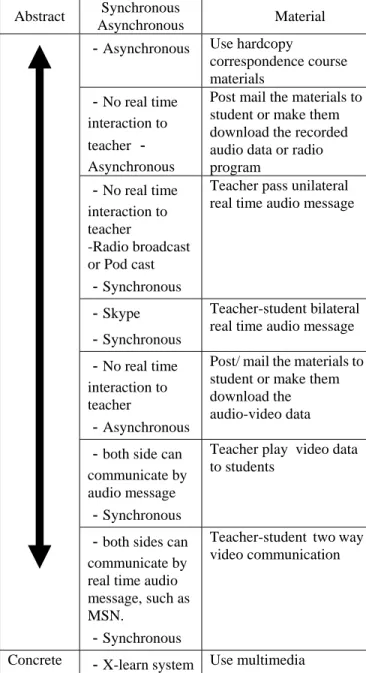
learning experiences can be categorized into concrete and abstractive ones. The concrete learning experience includes field trips and multi-perceptional experiences etc. On the other hand, the usage of linguistic symbols and text description are viewed as abstractive learning experiences. Therefore, before being able to comprehend the abstract concepts, the younger students or the students without adequate practical experiences have to obtain the concrete and multi-perception experiences so that they can have fundamental understanding on which advance learning of abstract concepts can be built. For this purpose, when providing online instruction for students, it is important for the educators to consider the levels of concreteness of a distance learning system and then choose an appropriate one for delivering their teaching. According to the levels of concreteness of distance learning systems, they can be classified as Table1 shows:
Table 1. The classification of educational technology’s concreteness
Abstract Synchronous
Asynchronous Material
-Asynchronous Use hardcopy
correspondence course materials -No real time interaction to teacher - Asynchronous
Post mail the materials to student or make them download the recorded audio data or radio program -No real time interaction to teacher -Radio broadcast or Pod cast -Synchronous
Teacher pass unilateral real time audio message
-Skype
-Synchronous
Teacher-student bilateral real time audio message
-No real time interaction to teacher
-Asynchronous
Post/ mail the materials to student or make them download the audio-video data
-both side can communicate by audio message
-Synchronous
Teacher play video data to students
-both sides can communicate by real time audio message, such as MSN.
-Synchronous
Teacher-student two way video communication
Concrete -X-learn system Use multimedia
in this study
-Synchronous
PowerPoint files to assist two way audio-video communication
III. RESEARCH METHODOLOGY
In this study, we first process existing literature and reference analysis to cross check the positive and reliable supportive statements from popular journals, publications, Ph.D. and Master unpublished dissertations and international conference papers. After that, adapting survey research methods in this study, a questionnaire developed by the research group are provided to the students. With the aim of understanding the levels of satisfaction, the On-line Learning Satisfaction Survey Questionnaire was given to them at the end of the course. Finally, the content analysis was capitalized on analyzing the open-end questions for collecting qualitative data which are used to make up the deficiency part of qualitative analysis.
A. X-Learn System
X-learn system is developed by Chung Hwa Telecom as an online synchronous teaching platform. This system allows both teacher and students process teach-and-learn interaction online shown as fig. 1.
Fig. 1 Student in Class
The whole system is divided into four sections (fig. 2): Function tab, video window, content window, and chat room. The operation functions are video recording, teaching materials presentation, writing board, desktop sharing, teaching materials management, video window, chat room, practice, tests, audio interaction, and system management. To be more like a face-to face tutoring, the web camera will capture both tutor’s and student’s images and show them on their own video window. INTERNATIONAL JOURNAL OF COMPUTERS AND COMMUNICATIONS Issue 2, Volume 1, 2007
Fig. 2 The desktop of student’s computer in class
Besides, the system provides a hand-writing recognized board for both teachers and students. They can communicate directly by using the mouse and pad in writing, drawing, and typing patterns with no boundary. The information they input will be shown on the White Board area. This function is found to be very useful for mathematics problem solving. Moreover, either the teacher or the student can tape record the whole in-class process in video and audio formats and the recorded data will be stored in a system database. If the students would like to review it after class, they can use those recorded videos or audio anytime.
B. On-Line Class Satisfaction Survey Questionnaire
Three dimensions are set in this survey questionnaire: class atmosphere, teacher-student relationship, and learning effectiveness. This survey adopted a five-point Likert scale: strongly disagree (1), disagree (2), normal (3), agree (4), and strongly agree (5). In addition to these three dimensions, the questionnaire also included some open-ended questions such as user’s background information and future intension for keeping on with the program.
In the reliability analysis, it shows 0.96 in class atmosphere parameter, 0.81 in teacher-student relationship, and 0.82 in learning effectiveness. This was to say the questionnaire was reliable.
C. Participants
In the X-learn system, participants are students from a mountain school. The researchers selected a rural junior high school located in Nantou, Taiwan. After surveying their intention, there are eighteen students, nine boys and nine girls, would like to join the program. Nine students were in the target English course and another nine students were in Mathematics course. One tutor from Teacher Education Center of a national university was assigned to each student. After they completed the program, a questionnaire was issued to each of them. Among eighteen participants, the research team recovered fifteen filled out and valid questionnaires from eight boys and seven girls, eight from Mathematics course and seven from English course, one 7th grader, ten 8th graders, and four 9th graders.
D. Procedure
The main purpose of X-learn system is for after school tutoring, and two hours per week. The total program takes fourteen weeks. In the first three weeks, the students learned how to use and control some fundamental computer hardware and software such as graphic design software, word processing software package. The concepts and examples of integrating IT into education were also included in the courses. After that, the orientation about X-learn system used in the program was given in the fourth week. System engineers and training specialists from Chung Hwa Telecom were in charge of explaining the system and the program in the orientation. The content delivered in the orientation included the registration and operation of the X-learn system and the solutions of frequently encountered problems. From week five to week twelve, primarily, they spent more than two hours per week accepting tutoring online. In the final week, they accomplished the tutoring classes, completed the online learning satisfaction survey questionnaire, and were interviewed.
IV. DATA ANALYSIS
A. Satisfaction Level for Class Atmosphere
Fig. 3. The histogram of mean and SD of class atmosphere survey questions.
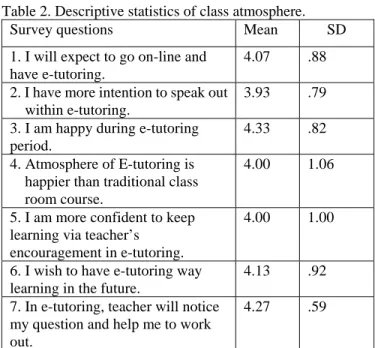
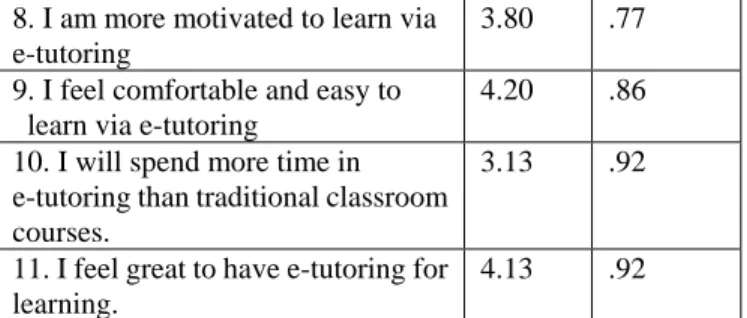
Table 2. Descriptive statistics of class atmosphere.
Survey questions Mean SD
1. I will expect to go on-line and have e-tutoring.
4.07 .88 2. I have more intention to speak out
within e-tutoring.
3.93 .79 3. I am happy during e-tutoring
period.
4.33 .82 4. Atmosphere of E-tutoring is
happier than traditional class room course.
4.00 1.06
5. I am more confident to keep learning via teacher’s
encouragement in e-tutoring.
4.00 1.00
6. I wish to have e-tutoring way learning in the future.
4.13 .92 7. In e-tutoring, teacher will notice
my question and help me to work out.
4.27 .59 INTERNATIONAL JOURNAL OF COMPUTERS AND COMMUNICATIONS Issue 2, Volume 1, 2007
8. I am more motivated to learn via e-tutoring
3.80 .77 9. I feel comfortable and easy to
learn via e-tutoring
4.20 .86 10. I will spend more time in
e-tutoring than traditional classroom courses.
3.13 .92
11. I feel great to have e-tutoring for learning.
4.13 .92
The results of descriptive statistics (fig. 3 & table 2) showed that participated students are satisfied with the class atmosphere of e-tutoring course. It refers that the distant learning program has the effect of companionship when higher value is marked in questions as I feel comfortable and easy to learn via e-tutoring, In e-tutoring, the teacher will notice my question and help me to work out, and I feel great to have e-tutoring for learning.
B. Satisfaction Level for Teacher-Student Relationship
Fig. 4 The histogram of mean and SD of teacher-student relationship survey questions.
Table 3. Descriptive statistics of teacher-student relationship.
Survey questions Mean SD
1. I will make the e-tutor as my
learning role model. 4.33 .72
2. My e-tutor and I are friends. 4.00 1.00 3. I will share everything in school
and life with my e-tutor. 3.87 1.30
4. I know better about university life
via my e-tutor. 4.00 1.19
5. I have more expectation to be a
university student. 3.87 .99
The results of the descriptive statistics (fig. 4 & table 3) showed that participating students are satisfied with the teacher-student relationship of e-tutoring course when we have a higher value in I will make the e-tutor as my learning role model, my e-tutor and I are friends, and I know better about
university life via my e-tutor, The participating teachers can be the role models for the students and are willing to show positive sides of university life to them.
Worth mentioning, that even after the program was finished, the students still keep in touch with their tutor. Although during the program, they did not see each other face to face, they really built up the sense of their own community and developed their friendship. In the cards that the students mailed to their tutors, not only their appreciation but truly friendship were shown (figure 5). Some students who were given English remedial instruction even tried to write to their tutor in English (figure 6).
Fig. 5 Card from a student (Content is translated as following: Dear Miss Shu Long, I am Mong-Shu. I am very happy to have you to be my tutor and really thank your teaching me prudentially. Even though I have not been like a small boat that luckily has someone to push forward to the ocean, I want to let you know that I continuously try hard to row to my goal. Any way, I want to give my appreciation to you and thank you very much. Merry graduation to you! From your student, Mong-Shu.)
Fig. 6 Card from student (Content is as following: Dear teacher, hi. I am Max Li. I’ll become a 9th grade student in junior high school. And I don’t have much time to play games or watch TV. INTERNATIONAL JOURNAL OF COMPUTERS AND COMMUNICATIONS Issue 2, Volume 1, 2007
But I still try to find some time to play Mo-Jay, the name of an online game, for relaxation. I won’t forget you. P.S. Remember to reply me. Sincerely, Max Li.)
The biggest problem that the online program will encounter is the high dropout rate. The factors that will influence students not to complete their study online included issue of isolation, poor course design, technological problems, and program related problems etc. [14-15]. However, the problem did not take place in this research. The assumption for explaining the significant difference is that the friendship between the tutor and the student helps and motivates the students to keep participating in the program.
C. Satisfaction Level for Learning Effectiveness
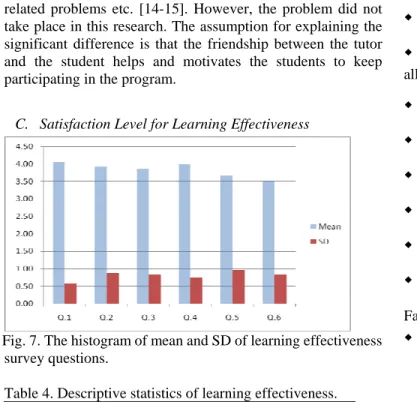
Fig. 7. The histogram of mean and SD of learning effectiveness survey questions.
Table 4. Descriptive statistics of learning effectiveness.
Survey questions Mean SD
1. The e-tutoring helps me to
understand more in course content. 4.07 .59 2. I usually forget to take a break in
e-tutoring class period. 3.93 .88
3. I pay lots attention in teacher’s
instruction in e-tutoring. 3.87 .83
4. I learn a lot via e-tutoring. 4.00 .75 5. E-tutoring helps me to focus and
concentrate in class. 3.67 .97
6. I get used to ask question in class. 3.53 .83 The results of descriptive statistics (fig. 7 & table 4) showed that participated students are satisfied with the learning effectiveness of e-tutoring courses. We had lower value in questions I got used to ask question in class, and e-tutoring helps me to focus and concentrate in class. This suggests that we shall encourage the students to ask more questions, more attention getting activities, and a test-review right after the class section.
D. The Reasons and Intention for Keeping Joining the
Program
Only fifteen students replied their intention on future participation. Twelve will keep joining the program, and three will not join.
The answers from open-ended questions show the factors leading to their intention of future participation are:
◆ Helpful for learning.
◆ The teacher is patient and will explain until we understand all.
◆ We can ask teacher to repeat the explanation for the question.
◆ We have an obvious progress in scores.
◆ We can ask question any time.
◆ No pressure in class.
◆ We can have extra knowledge beyond school.
◆ It is fun.
Factors of no participation:
◆ Already join the regular cram school course. V. CONCLUSION
In this study, we worked out several interesting findings. First of all, the students are much satisfied with class atmosphere in e-tutoring, and a ranked high satisfaction during e-tutoring period. The high remarks are in “I feel comfortable and easy to learn via e-tutoring, and in the e-tutoring, the teacher will notice my question and help me to work out.” This finding tells us that distance learning taking place in the X-learn system will not make students feel distant, and the teacher is still capable of helping them solve problems. The instructional approach used in this study solves the problem of the isolation, which will result in student attrition, mentioned in Willging and Johnson’s research [15]. Second, students are satisfied with the teacher-student relationship of e-tutoring course, when we have a higher value in friendship between the tutor and the student, and I know better about university life via my e-tutor. This tells us that the e-tutor will become students’ role model not only in academy performance and in future life style. When they aspire to be future university students, the teacher can easily help them to improve in learning and academy performance. Third, students had a middle ranking to the learning effectiveness of e-tutoring course. They had relative low value in e-tutoring helps me to focus and concentrate in class, and I get used to ask question in class. These results echo Morgan and Tam’s indication that some students’ unwillingness to online learning result from the poor course design [16]. Therefore, it is suggested that the teachers shall have more activities to gain students’ attention and questioning. The teachers also can have a pop quiz and answer review right after the course section to INTERNATIONAL JOURNAL OF COMPUTERS AND COMMUNICATIONS Issue 2, Volume 1, 2007
know the effective results. The class section shall be shorter as traditional class sections to avoid over-fatigue and distraction after long time watching the computer monitor. Finally, most participated students are willing to keep joining the program in the future but three of them were not. These three students are from wealthy families and will have expensive face-to-face tutoring. This shows and matches Durden [17] findings that lower income families can only afford cheap or free distant learning programs.
For both the rural students and pre-service teachers, a quite different learning and teaching experiences are provided by X-learn system. These rustic students have really learned some academic and life-related knowledge from online tutoring. Similarly, the pre-service teachers have learned some practical teaching methods via serving in this program. This is just a beginning and it is a hope of all the members in this research that the future researchers and online tutoring system designers can get some information about implementation online tutoring program, that location and environment will not be a limitation to learning, and that finally created an alternative remedial instruction for the students in need.
ACKNOWLEDGMENT
The authors would like to thank the National Science Council of the Republic of China for financially supporting this research under Contract No. 96-2520-S-008-003. Thanks also for the Chung Hwa Telecom’s supporting in X-learn system.
REFERENCES
[1] [1]J. Sandholtz, C. Ringstaff, and D. Dwyer, Teaching with technology: Creating student –centered classrooms, New York: Teachers College Press, 1997
[2] [2]E. Z. F. Liu, Using on-line forum to assist teacher’s instruction and student’s learning, Conference on Computer and Network Technology in Education (CNTE2002), Hsinchu, 2002. (in Chinese)
[3] [3]E. Z. F. Liu, A survey study of learning via online-forum, The 14th International Conference on Information Management (ICIM 2003), Chayi, 2003. (in Chinese)
[4] [4]K. Ohmae, M-Shape Society (Y. C. Chiang, Translate), Business Weekly Publications, 2006.
[5] [5]S. B. Chen, Strategies for the problems of educational resources allocation of remote districts, NPF Commentary, National Policies Foundation, NPF(C) No. 096-018, Retrieved October 10, 2007, from World Wide Web: http://www.npf.org.tw/particle-2458-1.html (in Chinese)
[6] [6]T. Collins, Attracting and Retaining Teachers in Rural Areas ERIC Digest, ERIC Clearinghouse on Rural Education and Small School, ERIC No. ED438152, 1999.
[7] [7]H. C. Tsai, An Overview of Rural Situation and Rural Community Development in Taiwan, APO-ICD papers (Asian Productivity Organization-Integrated Community Development), 2000, Retrived Octorber 12, 2007, from World Wide Web: http://www.apo-tokyo.org/icd/papers/E-Publications/02.IntegLocComm Dev/02-04.pdf
[8] [8]W. S. Tsai, Consider the Taiwan aborigine students' education: Current and future situation from the education opportunity equality, Formosan Education and Society, Vol. 6, 2004, pp.109-144. (in Chinese)
[9] [9]R. Nash, Equality of educational opportunities: In defense of traditional concept, Educational Philosophy and Theory, Vol.36, No.4, 2004, pp.361-377.
[10] [10]K. S. Soo and C. J. Bonk, Interaction: What Does It Mean in Online Distance Education?, ERIC Document Reproduction Service No. ED 428724, 1998.
[11] [11]M. L. Williams, K. Paprock, and B. Covington, Distance learning: The essential guide, Thousand Oaks, Calif.: Sage, 1999.
[12] [12]Y. W. Huang and Y. F. Huang, Study of interaction within multi-user and multimedia, Conference on Computer and Network Technology in Education (CNTE2002), Hsin Chu, 2002. (in Chinese)
[13] [13]M. Simonson, S. Smaldino, M. Albright, and S. Zvacek, Teaching and learning at a distance: Foundations of distance education, New Jersey: Prentice Hall, 2000
[14] [14]E. Dale, Audio-visual methods in teaching. Henry Holt & Co, 1954. [15] [15]P. A. Willging and S. D. Johnson, Factors that influence student’s
decision to dropout of online courses, Journal Asynchronous Learning Networks, Vol. 8, No., 4, pp. 105-118, 2004
[16] [16]C. K. Morgan and M. Tam, Unraveling the complexities of distance education student attrition, Distance Education, Vol. 20, No. 1, pp. 96-108, 1999.
[17] [17]W. Durden, Liberal arts for all, not just the rich, Chronicle of Higher Education, 2001, Retrieved October 10, 2007 from World Wide Web: http://www.lexisnexis.com/us/lnacademic/results/docview/docview.do?r isb=21_T2258670933&format=GNBFI&sort=BOOLEAN&startDocNo =1&resultsUrlKey=29_T2258670940&cisb=22_T2258670939&treeMa x=true&treeWidth=0&csi=171267&docNo=2
Shan Shan Cheng is a doctorate student at National Central University who also a lecturer in Ming Hsin University of Science and Technology. Her active research interests include network assisted learning, multimedia instructional design, and alternative assessments.
Eric Zhi Feng Liu received the M.S. degree in computer and information science from the National Chiao Tung University, Taiwan, in 1999 and the Ph.D. degree in computer science from the National Chiao Tung University, Taiwan, in 2002.
He is an Associate Professor in the Graduate Institute of Learning & Instruction at National Central University in Taiwan, where he teaches courses in introduction to instructional media, web 2.0 and education, robot and education, and simulation and gaming in education. His active research interests include learning technology, design of distance learning systems, and evaluation of learning technology systems.
Hwa Wei Ko is a Professor in the Graduate Institute of Learning & Instruction at National Central University in Taiwan. Her research interests and specialty include Developmental Psychology, Instructional Psychology, Psychology of Reading, and Learning Disabilities.
Chun Hung Lin is a graduate student at National Central University in Taiwan. His research interests included evaluation of digital instructional games, service learning, and e-portfolio.
INTERNATIONAL JOURNAL OF COMPUTERS AND COMMUNICATIONS Issue 2, Volume 1, 2007