CHIS Studies
A Special Report Series by the Center for Health Informatics and Statistics 1908 Mail Service Center, Raleigh, N.C. 27699-1908
www.schs.state.nc.us/SCHS/ North Carolina Public Health
No. 124 February 2001
Using HEDIS Measures to Evaluate
Medicaid Managed Care Organization Performance:
The Treatment of Persistent Asthma in the
Pediatric Medicaid Population
by
Kathleen A. Jones-Vessey
ABSTRACT
Objectives: This study employs managed care industry standards to examine the prevalence and treat-ment of persistent pediatric asthma across four systems of North Carolina Medicaid health care deliv-ery: Carolina Access, Access II/III, Health Maintenance Organizations (HMOs), and fee-for-service.
Methods: 1998 and 1999 North Carolina Medicaid claims and enrollment records are examined. Only individuals continuously enrolled in Medicaid for the entire two year period were included. Persis-tent asthmatics are identified in accordance with the Health Employer Data and Information Set (HEDIS) specifications developed by the National Committee for Quality Assurance (NCQA).1 Pre-scription drug claims paid by Medicaid in 1999 are examined to determine if appropriate asthma medications were received by the 1998 pediatric asthma population.
Results: Of those individuals ages 5 through 20 continuously enrolled in Medicaid in 1998 and 1999, 4.7 percent were identified as persistent or chronic asthmatics in 1998. Approximately 60 percent of those with persistent asthma in 1998 were receiving the appropriate medications for long-term asthma management during the following year (1999). There were significant differences across the four sys-tem of care groups, with HMOs and fee-for-service recipients having the lowest rates of appropriate medication use and the Carolina Access and Access II/III groups having the highest rates.
Conclusions: There are significant variations in compliance with prescription drug standards of care for the treatment of persistent asthma across the four systems of health care delivery in North Caro-lina Medicaid. HEDIS standards are a useful tool for comparing both the prevalence of chronic health problems, such as asthma, and the performance of health care delivery systems in responding to such problems.
Introduction
Over the past decade, the Division of Medical As-sistance (DMA) has begun offering North Carolina’s Medicaid recipients several different managed health care options in addition to standard fee-for-service care. In traditional fee-for-service Medicaid coverage, a health care service provider is paid directly for specific services rendered to Medicaid clients. The provider does not commit to manage the care of the patient for any longer than the duration of the visit.
In contrast, with Medicaid managed care, partici-pating health care providers agree to treat and man-age the care of a certain number of North Carolina’s Medicaid clients on a more long-term basis. Cur-rently, there are three major types of managed care organizations (MCOs) available to Medicaid recipi-ents in the state: Carolina Access, Access II/III, and health maintenance organizations (HMOs).
Carolina Access: Introduced in April of 1991, Carolina Access was the first state-run managed health care program. Carolina Access connects Medicaid recipients with primary care providers (PCPs) who agree to coordinate the health care needs of their Medicaid clientele. The PCP is in-tended to act as a gatekeeper in assuring that appro-priate preventive care and referred services are rendered to their Medicaid recipients. They are re-imbursed a management fee for their services. Ini-tially available in only a few counties, the program was opened to 99 North Carolina counties (exclud-ing only Mecklenburg) in late 1998. Currently, al-most two-thirds of all Medicaid recipients are enrolled in the Carolina Access program.2
Access II & III: An extension of the Carolina Access program, the Access II and III managed care programs were established in July 1998. Adminis-tered by the North Carolina Office of Research, Demonstrations, and Rural Health Development, the Access II program links Medicaid providers with health care networks which focus on community-based initiatives aimed at improving the quality and
reducing the costs of Medicaid managed care. 2 Ac-cess III is a community-based model functioning in Pitt and Cabarrus counties. The main objectives of Access III are initiating case management, improv-ing data accessibility through web-based technolo-gies, decreasing unnecessary medical utilization, and patient education.3
HMO: Known as “Healthcare Connection,” HMOs began delivering Medicaid services in North Caro-lina in July of 1996. HMOs are available primarily to Medicaid recipients who are residents of Mecklenburg county where HMO enrollment is mandatory. There are a number of health plan op-tions available to Medicaid recipients of Mecklenburg county including: The Wellness Plan, United Healthcare, South Care, and Metrolina. HMOs also operate in a more limited capacity in other counties in the state including Gaston, Davidson, Forsyth, Guilford, and Rockingham counties.2 However, therewere few participants in HMOs outside of Mecklenburg county.
The common factor among all of the state’s MCOs is the effort to link North Carolina Medicaid recipi-ents with a primary care provider to coordinate their core health care needs. The intent behind these ef-forts is to improve members’ access to preventive care and to help maintain continuity of care for the state’s Medicaid recipients.4 However, to date, there has been little research examining the quality of care for the different groups of North Carolina’s MCO recipients and for the standard, fee-for-ser-vice Medicaid clientele. In an effort to bridge this gap, this study will evaluate Medicaid’s managed care and fee-for-service programs with regard to a major chronic pediatric health problem: asthma.
Methods
In defining the persistent asthmatic population, this study employs standards developed by the Na-tional Committee for Quality Assurance (NCQA). A private, non-profit organization, NCQA creates specifications that are designed to facilitate com-parisons between different types of MCOs. These
standardized measures focus on assessing the prevalence of chronic health problems, as well as quality of and access to health care.
Based on NCQA standards, there are four admin-istrative (claims) data components that identify a member as a “persistent asthmatic”:
1. Four or more prescription medications used in the treatment of asthma in one year.
2. One or more visits to the emergency room with a principal diagnosis of asthma in the year. 3. One or more inpatient hospital visits with a
principal diagnosis of asthma in the year. 4. Four or more outpatient visits with any
diagno-sis of asthma and two or more claims for a pre-scription drug used in the treatment of asthma within the year.
If an individual meets any one of the four criteria, then they are identified as a “persistent asthmatic”.1 The criteria are not mutually exclusive. Conse-quently, an individual may be picked up through any one or more of the four HEDIS criteria. Table 1 displays a chart outlining the HEDIS criteria for identifying persistent asthmatics.
Continuity of care is an important consideration when comparing the appropriateness of asthma treatments over time. A managed care organization cannot be held accountable for initiating an appro-priate asthma drug treatment plan for an individual who has been enrolled in the program for only a few months.5 Therefore, for this study, in order to be eligible for inclusion in the population, clients had to be continuously enrolled in Medicaid for a two year period: 1998 and 1999. In keeping with NCQA criteria, continuous enrollment is defined as enroll-ment of a full year with no more than a one month gap in enrollment. Therefore, only individuals with 11 or more months of Medicaid enrollment in both years are included in the eligible population.
For the purposes of this analysis, a Medicaid recipi-ents health plan option (fee-for-service, Carolina Access, Access II/III, or HMO) will be defined as their “system of care”. In this study, Medicaid en-rollees had to be continuously enrolled in their sys-tem of care during calendar year 1999 in order to be considered a continuous member of that system of care. Only individuals enrolled eleven months or more in their health plan in 1999 were included in the data system of care. Enrollment in systems of
Utilization of Health Services* (Asthma Visits)
NONE LOW HIGH TYPE I HIGH TYPE II
(0 Visits) (1-3 OP) (4+ OP) (1 ER or 1 INP1)
Asthma Medication Use2
0-1 A B C D
Low (2-3) E F G H
High (4+) I J K L
* Shaded cells identify the population with persistent asthma.
OP=Outpatient visit with asthma (ICD-9CM 493) as any diagnosis ER=Emergency room visit with asthma as a primary diagnosis INP=Inpatient hospital stay with asthma as a primary diagnosis
1 Member with any ER/INP event is in this column regardless of the number of OP visits. 2 Pharmacy units are in number of dispensing events of any asthma medication.
Source: National Committee for Quality Assurance (NCQA)
care was determined by examining paid claims for administrative/management fees and premium pay-ment claims for HMOs, Carolina Access, and Ac-cess II/III. Medicaid recipients who were continuously enrolled in Medicaid during 1999 but did not have administrative fees or premiums paid during the period were considered fee-for-service members.
For the assessment of appropriate medication use, HEDIS standards for identifying medications for people with persistent asthma were used. If an in-dividual received any of the drugs identified by NCQA as a primary therapy for the long-term treat-ment and control of asthma, then they were determined to have had appropriate prescription drug treatment. The drugs classified as asthma con-trollers or maintenance therapy include prescrip-tions for inhaled corticosteroids, nedocromil, cromolyn sodium, leukotriene modifiers, and methylxanthines. These treatments are considered primary therapy for the long-term control of persis-tent asthma as outlined by the National Heart, Lung, and Blood Institute (NHLBI).1,6
Results
Eligible population
There were a total of 283,135 individuals ages 5 through 20 continuously enrolled in Medicaid in 1999 and 264,395 in 1998. In both years, the num-ber continuously enrolled represented approxi-mately 60 percent of all enrollees during the same time period.
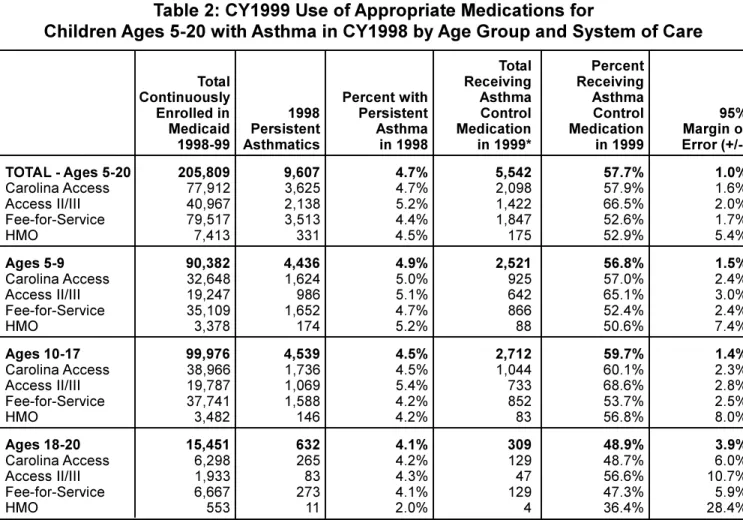
In order to be included in the eligible population for this study, an individual had to be continuously enrolled in Medicaid for the full two year period and continuously enrolled in their system of care in 1999. Table 2 presents the number of individuals who were continuously enrolled in Medicaid dur-ing 1998-99 and their specific system of care en-rollment in 1999 by age group. The enen-rollment figures by system of care represent the system of
care in which they were continuously enrolled in during 1999 (the year the long-term asthma medi-cations should have been administered). Based on analysis of Medicaid enrollment files, 205,809 in-dividuals ages 5-20 were continuously enrolled during both years 1998 and 1999.
Persistent asthma
Of the Medicaid clients who were continuously enrolled during 1998 and 1999, 4.7 percent (N=9,607) met the HEDIS criteria for persistent asthma. Table 3 presents the number of individu-als identified by each of the four HEDIS criteria for persistent asthma. As stated previously, the criteria were not mutually exclusive, therefore an individual could have been identified through multiple crite-ria. Results show that approximately four-fifths of the persistent asthmatic children (n=7,804) would have been selected through the asthma prescription drug criterion alone. While many persistent asth-matics were identified by more than one of the HEDIS criteria, only about one percent (n=141) of those who were continuously eligible met all four of the HEDIS criteria for persistent asthma.
As shown in Table 2, the proportion of persistent asthmatics varied by system of care. The percent of 1999 Access II/III members who had persistent asthma in 1998 (5.2%) was higher than all the other systems of care. The proportion of members with persistent asthma also varied by age group, with children in the youngest age group – ages 5 through 9 – having the highest persistent asthma rate (4.9%). However, taking into account both age and system of care, the highest asthma prevalence rate occurs among those ages 10-17 who were enrolled in Caro-lina Access II/III in 1999.
Appropriate long-term asthma control drug therapy
Of the 9,607 persistent asthmatics ages 5-20 iden-tified in 1998, almost 60 percent were receiving appropriate long-term drug therapy for the control of their asthma in 1999 (N=5,542). Table 2 displays
Table 2: CY1999 Use of Appropriate Medications for
Children Ages 5-20 with Asthma in CY1998 by Age Group and System of Care
Total Percent
Total Receiving Receiving
Continuously Percent with Asthma Asthma
Enrolled in 1998 Persistent Control Control 95%
Medicaid Persistent Asthma Medication Medication Margin of
1998-99 Asthmatics in 1998 in 1999* in 1999 Error (+/-) TOTAL - Ages 5-20 205,809 9,607 4.7% 5,542 57.7% 1.0% Carolina Access 77,912 3,625 4.7% 2,098 57.9% 1.6% Access II/III 40,967 2,138 5.2% 1,422 66.5% 2.0% Fee-for-Service 79,517 3,513 4.4% 1,847 52.6% 1.7% HMO 7,413 331 4.5% 175 52.9% 5.4% Ages 5-9 90,382 4,436 4.9% 2,521 56.8% 1.5% Carolina Access 32,648 1,624 5.0% 925 57.0% 2.4% Access II/III 19,247 986 5.1% 642 65.1% 3.0% Fee-for-Service 35,109 1,652 4.7% 866 52.4% 2.4% HMO 3,378 174 5.2% 88 50.6% 7.4% Ages 10-17 99,976 4,539 4.5% 2,712 59.7% 1.4% Carolina Access 38,966 1,736 4.5% 1,044 60.1% 2.3% Access II/III 19,787 1,069 5.4% 733 68.6% 2.8% Fee-for-Service 37,741 1,588 4.2% 852 53.7% 2.5% HMO 3,482 146 4.2% 83 56.8% 8.0% Ages 18-20 15,451 632 4.1% 309 48.9% 3.9% Carolina Access 6,298 265 4.2% 129 48.7% 6.0% Access II/III 1,933 83 4.3% 47 56.6% 10.7% Fee-for-Service 6,667 273 4.1% 129 47.3% 5.9% HMO 553 11 2.0% 4 36.4% 28.4%
* Based on HEDIS 2000 Technical Specifications. Indicates the number of CY1998 chronic/persistent asthmatics who were receiving appropriate asthma control medications in CY1999.
Note: Persons included in this table had continuous enrollment in Medicaid in CY1998 & CY1999 and continuous enroll-ment with the system of care in CY1999.
TABLE 3: 1998-99 Continuous Medicaid Enrollees Ages 5-20 Identified as Persistent Asthmatics by Criterion Type and System of Care
Identified by Identified by Identified by Identified by TOTAL Identified Emergency Inpatient Prescription Outpatient/ by Any of the
Room Hospital Drug Drug Four HEDIS
Criterion Criterion Criterion Criterion Criteria*
n % n % n % n % n TOTAL 3,089 32.2% 877 9.1% 7,804 81.2% 1,524 15.9% 9,607 Carolina Access 1,197 33.0% 309 8.5% 2,947 81.3% 529 14.6% 3,625 Access II/III 564 26.4% 186 8.7% 1,827 85.5% 441 20.6% 2,138 Fee-for-Service 1,185 33.7% 362 10.3% 2,792 79.5% 529 15.1% 3,513 HMO 143 43.2% 20 6.0% 238 71.9% 25 7.6% 331
* Represents an unduplicated count of all Medicaid recipients identified by any of the four HEDIS criteria for persistent asthma.
data for appropriate asthma medication treatment by system of care and age group.
Results show that appropriate asthma medication use varied significantly by system of care. Chart 1
illustrates the percentage of 1998 asthmatics receiv-ing long-term control medications in 1999 by sys-tem of care. Despite having a greater proportion of persistent asthmatics, Access II/III had the high-est overall asthma medication use rate; with ap-proximately 67 percent of their 1998 persistent asthmatics receiving appropriate long-term control asthma medication in 1999. Children in the Caro-lina Access program had somewhat lower rates of medication use with approximately 58 percent of their 1998 persistent asthmatics receiving long-term control drug treatment the following year. Medica-tion rates were lowest among fee-for-service and HMO clientele, with a little over half of these cli-ents having appropriate asthma medications in 1999. However, given the relatively small numbers
of HMO clients in the persistent asthma population, the confidence intervals around the HMO asthma medication percentages are relatively large (rang-ing across the age groups from 5 percent to +/-28 percent). Therefore, the rates for HMO clients may be unstable – especially for the 18-20 age group where only 11 persistent asthmatics were identified in 1998.
Appropriate asthma medication use also varied by age, with the post-adolescent age group (ages 18 through 20) experiencing the lowest rates of asthma control medication use. Chart 2 shows that slightly less than half (48.9 percent) of all 1998 persistent asthmatics ages 18-20 were receiving appropriate asthma drug therapy in 1999. For all other age groups, the proportion receiving appropriate drug treatment was closer to 60 percent. However, again the confidence intervals surrounding the 18-20 age group are rather large (+/- 3.9 percent). As a result, rates for this age group should be interpreted with caution.
Discussion
The results of this HEDIS-based study reveal that persistent asthma is a chronic health problem for North Carolina’s pediatric Medicaid population. In 1998, 4.7 percent of all Medicaid clients ages 5-20 were identified as persistent asthmatics. Compa-rable national statistics are not yet available
The prevalence of persistent asthma varied by age, with older age groups showing the lowest rates in this study. The relationship found here between persistent asthma and age is consistent with a vari-ety of research which suggests that asthma symp-toms decline with maturation.7,8 However, this does not necessarily indicate that these children have “aged out” of asthma. Studies have found that in-dividuals who were believed to have outgrown
asthma based on self-perceived indicators of asthma severity (symptoms), were in fact still asthmatic as measured by peak-flow-meter readings and pulmo-nary function tests.9,10 These studies further support the use of long-term asthma control medications in the treatment of pediatric asthmatics despite appar-ent reductions in the overt severity of symptoms.
Persistent asthma rates also differed considerably by system of care. The Access II and III managed care programs showed a higher proportion of asthmat-ics enrolled in their programs than the Carolina Ac-cess, fee-for-service, and HMO groups. This may reflect the fact that the Access II and III programs have initiated an asthma disease management pro-gram which has as one of its core elements: “iden-tifying and recruiting asthma patients”.11
With regard to asthma drug treatment, this analy-sis also reveals substantial variation in appropriate asthma medication by age and system of care. The use of appropriate long-term asthma control drugs was higher for the managed care plans run by the state – Carolina Access and Access II/III, even though Access II and III have the highest propor-tion of persistent asthmatics among the system of care groups. Again, the higher rates of appropriate medication use for the Access II/III programs are likely a reflection of their quality improvement and disease management activities related to asthma.11
While the rates for appropriate asthma medication use were found to be relatively high in this study, they still do not approach 100 percent. Between one-third to one-half of all 1998 persistent asthmat-ics were not receiving prescription drug treatment to control their asthma in 1999. Clearly, across the board, efforts should be made to educate health plans, physicians, and patients on the importance of continuing drug therapy for asthma. In addition, while appropriate asthma drug treatment is impor-tant, it is not the only strategy that managed care programs can implement. Other factors such as in-creasing patient and physician education regarding appropriate asthma treatment and the creation of asthma staging plans should also be addressed.12,13,14
As with any study which examines administrative data, there are limitations to this analysis due to problems inherent with paid claims data. Claims may be subject to data entry or diagnostic coding errors.15,16 Further, NIH guidelines recommend clinical indicators for identifying persistent asth-matics.6 No chart review was done for this study, therefore the accuracy of this claim-based informa-tion has not been verified. Another potential con-cern with using administrative data for the medication use portion of this analysis is that from
examining claims information alone, we only know about asthma drug acquisition. We do not know the number of prescriptions that were written by phy-sicians, but not filled by the patient. Further, even with a filled prescription, we cannot be certain that the patient actually took the drug or that the drug was administered properly. Asthma drug regimens can be difficult for children and adolescents to fol-low, increasing the likelihood that drugs will not be administered in a timely and appropriate fashion. To examine whether the medication was adminis-tered correctly would require the supervision of trained medical personnel.
It should also be noted that the HMO data presented here may be suspect. Data from participating HMOs is gathered and stored within the participat-ing plans and there are sometimes significant de-lays between the dates of service and when the claims are actually delivered to the North Carolina Medicaid management information system (MMIS). Given the small number of HMO patients in the data for this study, it appears that the HMO data may be incomplete. With such small figures for HMOs, their rates are difficult to interpret. HMOs should be encouraged to provide timely and com-plete data to the North Carolina Medicaid program. Without complete data, it is difficult to assess the magnitude of chronic health problems in their popu-lation and compute accurate measures that are com-parable to other systems of care.
Despite the constraints of using administrative data, this study demonstrates that NCQA’s HEDIS stan-dards are a useful tool for comparing performance across different systems of managed health care. As demonstrated here with asthma, these specifications provide a consistent and rigorous method with which to identify the persistent asthma population and assess adequacy of prescription drug care.
References
1. National Committee for Quality Assurance. Use of appropriate medications for people with asthma. HEDIS 2000 technical specifications, Volume 2 ;1999: 98-100.
2. Medicaid in North Carolina Annual Report for 1999: Managed Care. North Carolina Division of Medical Assistance, 2000, http:// www.dhhs.state.nc.us/dma/ [July 25,2000]. 3. AccessCare, Inc: Mission and Company
His-tory. AccessCare Inc, 2000, http:// www.ncaccesscare.org/ [July 26, 2000]. 4. Piehl MD, Clemens CJ, Joines JD. Narrowing
the gap: decreasing emergency department use by children enrolled in the Medicaid program by improving access to primary care. Archives of Pediatric Adolescent Medicine 2000; 154(8): 791-795.
5. Carrasquillo O, Himmelstein DU, Woolhandler S, Bor DH. Can Medicaid managed care pro-vide continuity of care to new Medicaid enroll-ees? An analysis of tenure on Medicaid. Ameri-can Journal of Public Health 1998; 88(3): 454-456.
6.Expert Panel Report 2: Guidelines for the di-agnosis and management of asthma. National Asthma Education and Prevention Program (NAEPP) of the National Heart, Lung, and Blood Institute; NIH Publication No. 97-4051, 1997: 32-36.
7. Zannolli R, Morgese G. Does puberty interfere with asthma? Medical Hypotheses 1997; 48(1): 27-32.
8. Panhuysen CI et al. Adult patients may outgrow their asthma: a 25-year follow-up study. Ameri-can Journal of Respiratory and Critical Care Medicine 1997; 155(4): 1267-72.
9. Roorda, RJ. Prognostic factors for the outcome of childhood asthma in adolescence. Thorax
1996; 51(1): S7-12.
Acknowledgments
The author would like to thank Anne Rogers and Vickie Dean of the Managed Care Section of the NC Division of Medical Assistance, Kim Farrior and Torlen Wade of the NC Office of Research, Demonstrations, and Ru-ral Health Development and Paul Buescher, Gustavo Fernandez, Katrina Baggett, and Eleanor Howell of the State Center for Health Informatics and Statistics for their helpful sug-gestions and review of this paper.
10. Boulet, LP Turcotte H, Brochu A. Persistence of airway obstruction and hyperresponsiveness in subjects with asthma remission. Chest 1994; 105(4): 1024-1031.
11.Access II/III update: Access II/III plans asthma disease management program. NC Office of Research, Demonstrations, and Rural Health Development. July 2000: No. 2.
12. Mainous AG, Talbert J. Assessing quality of care via HEDIS 3.0. Is there a better way? Ar-chives of Family Medicine 1998;7(5): 410-413. 13. Warman KL, Silver EJ, McCourt MP, Stein RE. How does home management of asthma exac-erbations by parents of inner-city children dif-fer from NHLBI guideline recommendations?
Pediatrics 1999; 103(2):422-427.
14. Page P, Lengacher C, Holsonback C, et al. Qual-ity of care-risk outcomes model: testing the ef-fects of a community-based educational self-management program for children with asthma.
Nursing Connections 1999; 12(3): 47-58. 15. Iezzoni LI. Assessing quality using
administra-tive data. Annals of Internal Medicine 1997; 127: 666-674.
16. Newton KM et al. The use of automated data to identify complications and comorbidities of diabetes: a validation study. Journal of Clini-cal Epidemiology 1999; 52(3): 199-207.
Department of Health and Human Services Center for Health Informatics and Statistics 1908 Mail Service Center
Raleigh, NC 27699-1908 919/733-4728
State of North Carolina
Department of Health and Human Services Division of Public Health
Center for Health Informatics and Statistics John M. Booker, Ph.D., Director
www.schs.state.nc.us/SCHS/
The NC Department of Health and Human Services does not discriminate on the basis of race, color, national origin, sex, religion, age or disability in employment or the provision of services.
500 copies of this public document were printed at a total cost of $112.00 or 22¢ per copy. 02/01
PRESORTED STANDARD US POSTAGE
PAID RALEIGH NC PERMIT #1862