Holy Trinity Roman Catholic Separate
School Division # 22
Annual Report 2013-14
Table
of
Contents
Letter of Transmittal ... 1
Highlights/Accomplishments ... 2
Introduction ... 3
School Division Profile ... 4
Program Overview ………..6
School Division Planning ... 11
The School Division in the Community ... 12
Governance ... 15
Our Students and Staff ... 17
Indicators ... 20
Facilities and Transportation ... 24 Financial Overview ... 26 Appendix A: Management Report and Audited Financial Statements ... 28 Appendix B: Organizational Chart, August 31, 2014 ... 61
Appendix C: School List ... 62
Appendix D: Payee List ... 63
Appendix E: Infrastructure Projects ... 67
Holy
Trinity
Catholic
School
Division
#
22
“Christ Centered Life Long Learning”
502 6th Avenue NE, Moose Jaw, SK S6H 6B8 Phone:(306) 694‐5333
Fax:(306) 692‐2238 E‐mail: [email protected] Website: www.htcsd.ca
Letter of Transmittal
Honourable Don Morgan, Q.C. Minister of Education
Dear Minister Morgan:
The Board of Education of Holy Trinity Roman Catholic Separate School Division # 22 is pleased to provide you and the residents of the school division with the 2013-2014 annual report. This report outlines activities and accomplishments of the school division and provides audited financial statements for the fiscal year September 1, 2013 to August 31, 2014.
Respectfully submitted
Joann Blazieko Chairperson
Highlights/Accomplishments
Inter-professional Collaboration
Holy Trinity Catholic School Division recognizes the value of inter-professional collaboration (IPC) as a key component of the service delivery model used for providing supports for student learning and achievement. The expectation in 2013-14 was to embed IPC in the school support personnel protocols to positively impact student learning. Holy Trinity Catholic School Division, under the guidance of an external facilitator, worked on developing an inter-professional collaboration process. This process included self-assessment, elaboration of roles, sharing of vision, and
development of an integrated framework to response to student and classroom needs. Holy Trinity Catholic School division personnel look forward to implementing the integrated in 2014-15.
Reading
Research indicates that literacy is connected to future success. If children at the age of nine are able to read they will be able to use this critical skill for future learning success. Holy Trinity Catholic School Division had a comprehensive responsive reading intervention process which supported every reader from prekindergarten to grade eight. The Division’s Reading Response Plan for Grades 1 to 3 included early collection of students’ reading levels, quality core classroom literacy
experiences, Leveled Literacy Intervention for those needing short term extra reading support, and more intensive reading intervention for those requiring individual and targeted reading support. The June 2014 reading results surpassed the goal of 80% proficiency for grades 1-3 students.
Safe, Caring and Respectful Schools
Many initiatives took place in the 2013-2014 school year to enrich our culture of safety and respect. At the early learning level, Roots of Empathy, an evidence-based program that raises social/
emotional competence, increases empathy and reduces aggression was implemented in a kindergarten classroom with great success. All teachers and educational assistants received in-service in responsive school practices. Also, more than fifty staff members were trained in non-violent crisis intervention and all administrators now have non-violent risk assessment training. As well, in the area of respectful schools, all staff and parents were provided workshops in anti-bullying strategies and a high school student team (Students 4 Action) was trained in Respect Ed.
This team worked in all schools to raise awareness and promote acceptance of diversity. Four key support documents were updated/created: Administrative Procedures to address bullying; a common Parent-Student Handbook; a current Emergency Response Guide; and a Crisis Response Guide for schools. All support documents can be found on the division website.
Introduction
This annual report presents an overview of Holy Trinity Catholic School Division’s activities and results for the fiscal year September 1, 2013 to August 31, 2014
It provides a snapshot of Holy Trinity Catholic School Division’s governance structures, students, staff, programs and facilities. It also includes results and analysis of a number of indicators that contribute to student success.
In addition to detailing the School Division’s activities and performance, this report outlines how Holy Trinity is implementing its strategic plan, provides a financial overview and audited financial statements, and includes appendices such as an organizational chart, school list, and payee list. Financial statements included in this report have been audited by an independent auditor following the Canadian Generally Accepted Auditing Standards.
School Division Profile
About Us
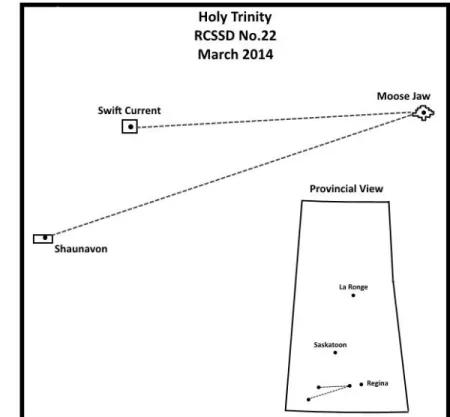
Holy Trinity Catholic School Division is proud to include ten schools in the three
southwestern communities of Moose Jaw, Swift Current and Shaunavon, with an enrolment of just under 2200 students from Prekindergarten through Grade 12.
Holy Trinity Catholic School Division is governed by eight board members: one from Shaunavon, two from Swift Current and five from Moose Jaw.
Holy Trinity Schools provide a wide variety of educational, co-curricular and extra-co-curricular programs within a faith based Catholic environment.
Partnerships with local communities and parishes strengthen and enhance the learning outcomes for Holy Trinity students and provide a vehicle for students to participate in service projects and community volunteerism.
Division Philosophical Foundation
Division Mission Statement
Our Mission is to Create Hopeby Fostering Learning and Honouring Diversity in a Catholic Environment.
Division Vision Statement
Christ Centred Life Long Learning.
Board Guiding Principles
Catholicity
We value our Catholic identity and faith as expressed in word, sacrament, individual behaviour and interpersonal relationships.
Learning
We value holistic teaching and learning environments that are spiritual, emotionally, academically and physically safe, secure, and positive - where all students can achieve their full academic potential.
Stewardship
We value Christian stewardship as a pillar of our Catholic faith which guides us as servant leaders to be accountable for all persons and things that have been entrusted to us.
Inclusiveness
We value inclusiveness as a Gospel mandate to accept and embrace all people. We value cultural diversity and the rich array of people in our communities and the contributions they can make.
Empowerment
We value the Christian principle of empowering others to utilize their gifts in creating environments where all are enabled to contribute and learn to the fullest extent.
Communication
We value open, reasoned and honest communication between the Board and all Stakeholders.
Celebration
We value celebrating our successes as a welcoming, hope-filled Christian community committed to lifelong learning, evangelization and respect for the dignity of each individual.
Program Overview
Holy Trinity Catholic School Division included 2023 students from Kindergarten to Grade 12, plus 166 Prekindergarten learners. Students came to our ten schools from a variety of homes and with a variety of backgrounds. We took their choice to attend our schools seriously and strove to respond to their academic needs in a proactive and relevant fashion.
All classrooms in Holy Trinity Catholic School Division provided, in a transparent and dynamic way, the provincially-mandated curricula. Teachers have been encouraged and supported through ongoing professional development to provide engaging classroom instruction delivered through effective strategies and differentiation.
In addition, each school in the Division offered specialized programming that responds to the needs of its students. The following list identifies programs that were in operation at one or more of the Division’s schools:
Alternate high school programming for “at risk” students
Core French instruction
Embedded technology
English as an Additional Language programming
French Immersion programming
InMotion programming
Leveled Literacy Intervention programming
Music/band programming
Nutrition programs
Prekindergarten programs
Technology-enhanced learning
Additional services and support were offered to students and teachers by specialized School Division staff including:
Counsellors
Curriculum assessment technology consultant
Curriculum, instruction and assessment consultants
Psychologist
Registered nurses
Speech and language pathologists
Social worker
Programming highlights for 2013-2014 included:
Grade 3 Reading
Holy Trinity Catholic School Division has a Reading Response to Intervention Plan which include students reading levels being assessed three times a year. Results are then used to determine plans for reading supports.
The Division Reading Response to Intervention Plan has been evaluated as successful in supporting emergent readers.
Division reading goals for June 2014 were as follows:
80% of grade 1 students will be reading at grade level
80% of grade 2 students will be reading at grade level
June 2014 reading scores were:
85% of grade 1 students scored at or above grade level
81% of grade 2 students scored at or above grade level
84% of grade 3 students scored at or above grade level
June 2014 reading scores provide evidence that early, targeted and responsive reading interventions, both in the classroom and as augmentation, provide the opportunity for young readers to be successful.
Professional Growth Plans
Teachers’ professional development was important to understand curricular outcomes and the criteria for proficient student work. Teachers who know and apply the effective strategies that improve student engagement and motivation have fostered improved student achievement. Holy Trinity Catholic School Division has developed a multi-leveled professional development plan to support teachers on their continued professional journey which included individual Professional Growth Plans comprised of:
a focus on assessment with options for teachers to work individually or with colleagues on their unit plans.
two meetings with In-school administrators to review and support Professional Growth Plans.
Treaty and First Nations and Métis Education
The highlights of Holy Trinity Catholic School Division’s First Nations and Métis Education Plan appear below.
Goal #1: Equitable Outcomes -The achievement rates of self-identified First Nations, Métis and Inuit (FNMI) students will improve year over year in reading, writing, oral language, and
numeracy.
Strategies to achieve this goal included instructional programs that focused on targeted academic skills, individual and group interventions, systematic measurement of students’ progress, and support for teachers.
Holy Trinity Catholic School Division has a .2 FTE FNMI support teacher who collects FNMI data in reading, writing, math, attendance and graduation rates.
Goal #2: All learners to have knowledge and appreciation of the unique contributions of First Nations and Métis peoples - Holy Trinity Catholic School Division has had a FNMI Education Higher Literacy and Achievement plan for the past five years. Within this plan, a concerted effort has been made to assist educators in treaty teachings. Strategies to support this goal include incorporation of First Nations and Métis content, perspectives and ways of knowing in all units and lesson plans, and increasing the number of library resources with FNMI themes.
Board Chair, Joann Blazieko, listens to a student demonstrate improved reading skill
Goal #3: Data collection and reporting - The School Division will develop and implementation plans to disaggregate student achievement data in order to measure the growth of self-identified FNMI students. Strategies to achieve this goal include collection of data within the Pearson Inform database. Holy Trinity Catholic School Division believes in the value of early intervention and implemented Help Me Tell My Story, a culturally based early learning assessment at Sacred Heart School.
Digital Fluency and Improved Student Outcomes
Technology is a motivator for students, increasing their engagement and, subsequently, their achievement. Holy Trinity Catholic School Division continued to show its progressive mandate to provide 21st Century learning opportunities for 21st Century students:
Professional Development was aligned to teacher expertise in both hardware and digital resources.
The use of a variety of digital Mathematics supports such as Khan Academy Mathematics video, Mathletics and Reflex Math was expanded.
A technology catalyst group prepared a multi-year HTCSD Technology Plan which provided targets for the use of technology to achieve improved student outcomes.
8 teachers have been registered as Discovery Education Network Stars. Their roles are ones of leadership in the incorporation of Discovery Education digital resources to promote engagement and improve learning outcomes.
Early Learning
Holy Trinity Catholic School Division believes in the importance of quality early learning experiences and the positive impact these experiences have on future
opportunities to learn. Holy Trinity Catholic School Division had a Prekindergarten program in every Moose Jaw and Swift Current elementary school with a total number of 166 children being provided a developmentally appropriate early learning experience. Five of Holy Trinity Catholic School Division’s Prekindergarten programs are funded by the Ministry while six are funded by the Division. The support for early learning extended to include:
Prekindergarten teachers, instructional assistants and Kindergarten teachers engaged in collaborative continuous professional development. This included book studies in areas of social and emotional development.
Administrators provided Play and Exploration professional development.
Every Prekindergarten and Kindergarten classroom took part in the Early Years Evaluation
(EYE) Assessment in April, 2014. The results were shared with parents and then used to support children’s developmental needs.
The Help Me Tell My Story assessment was added to Prekindergarten and Kindergarten classrooms at Sacred Heart Community School.
The Roots of Empathy program to raise social/emotional competence, increases empathy and reduce aggression was implemented in a kindergarten classroom with great success.
Programming for Medically Fragile Students
The Raphael Centre, a program for medically fragile students, is situated within the St. Michael Elementary School facility. Its purpose is to promote independence in children with significant physical and/or cognitive disabilities. The centre is equipped to address the complex needs of children with disabilities in a caring competent setting. Holy Trinity has a contractual arrangement with Prairie South School Division (PSS210) whereby PSS210 students who are medically fragile are able to attend the Raphael Centre.
The Raphael Centre wing includes a multi-purpose gathering room and an eat-in kitchen for meals and domestic arts. A large physiotherapy room is equipped with two plinths, a Hoyer lift and student-specific therapy equipment including bikes and standing frames. Adjacent rooms include two sensory spaces and a small classroom with touch-screen computers. The bathrooms are outfitted with regular toilets, wheelchair accessible toilets, training toilets, change tables and a wheelchair accessible bathing facility. Students are able to play safely and independently in a fully-enclosed, partially sheltered courtyard in an alcove of St. Michael’s School. In the 2013-2014 school year eighteen students (12 from Holy Trinity and 6 from PSS210) are registered in the program. In the 2013-2014 school year, the Raphael Centre went through a process to identify critical steps to provide quality programming for students with intensive developmental needs. Assessment, resources and learning templates were identified as essential to ensure students receive high quality service.
By June 2014, the Assessment of Basic Language and Learning Skills (ABLLS-R) was successfully implemented with 13 students at the Raphael Center and 5 students currently in regular classroom settings. ABLLS-R is a resource that provides assessment, curriculum guide, and a skills tracking system for children with delays. It gives both parents and professionals information regarding a child’s current skills in academic, self-help and motor skills. Teaching resources and lesson outlines were aligned to meet the Raphael team’s goal for providing high quality programming to students with developmental disabilities.
Inter-professional Collaboration
Curriculum and Student Services Consultants and Specialists spent the year engaging in an Inter-professional Collaboration initiative with the goal of improving integration of services to schools and students.
The targeted outcomes for the year long process included:
a) Coordination of support to positively impact student learning and achievement b) Development of a Student Support School Team Process
There were two midyear monitoring reports that provided essential feedback that helped to frame the ongoing work of the Inter-professional Collaboration group.
A final integrated framework to respond more effectively to student and classroom needs is now complete and ready for implementation.
High School Special Programs/Achievements
Vanier Collegiate provides a quality Catholic high school program for grades 9 to 12 students in Moose Jaw. There are many highlights but two will be noted here: the Pre-Health Professions Club and the Vanier Collegiate Chamber Choir achievement.
Vanier is the only high school in Moose Jaw to offer the Pre-Health Professions Club which provides students unique opportunities to network, mentor and explore health care professions in medicine, nursing, pharmacy and nutrition. The club is a partnership between Saskatchewan school divisions, post-secondary institutions and regional health authorities. Since 2008, students at Vanier
Collegiate have greatly benefited from this unique, exciting and informative program.
Also the Vanier Collegiate Chamber Choir and conductor Valerie McWilliams have been invited to perform at the Heritage Carnegie Hall Festival in New York City next spring. The group earned a Gold rating for its performance at the Heritage New York Festival in April 2014, and that Gold rating resulted in an invitation for the Chamber Choir to perform at Carnegie Hall as part of a National Youth Choir.
School Division Planning
Holy Trinity Catholic School Division has a well-established planning, implementation and monitoring process. School Division priorities align with Provincial targets.
Strategic Plan
In 2013 the Board of Education of Holy Trinity Catholic School Division developed a strategic plan which provides overall direction for everything the division does and serves as an anchor to ensure that all division planning processes are in alignment with each other.
The strategic plan defines Holy Trinity Catholic School Division’s mission, vision, and guiding principles – provided earlier in this annual report. In addition to these foundational elements, the strategic plan includes strategic directions, board priorities, and key strategies to achieve board priorities.
The Holy Trinity Catholic School Division’s strategic directions include: Direction #1: Faith Development
Direction #2: Early Learning Direction #3: Reading Direction #4: Infrastructure
A copy of the 2013-14 strategic plan is available at
http://www.htcsd.ca/public/pdf/board/BoardPriorities2014.pdf
Throughout 2013-14, Holy Trinity Catholic School Division collaborated with all other school divisions and the Ministry of Education to develop, for the first time, an Education Sector Strategic Plan (ESSP) for 2014-2020. This plan will align the work of all school divisions and the Ministry in working toward improving education outcomes of Saskatchewan students. The ESSP includes strategies, outcomes and measures to ensure that the targets identified in the Saskatchewan Plan for Growth are achieved. This plan will be deployed in 2014-15.
The School Division in the Community
Community and Parent Involvement
All schools in Holy Trinity School Division recognize the significant impact parent engagement has on increased student learning. There are many ways that Holy Trinity schools involved their
communities in the life of learning. Schools regularly communicated with parents through
newsletters, email, twitter, HTCSD App and PowerSchool. At the beginning of the school year, each school held an open house for parents and the community that was coupled with a snack, breakfast or BBQ supper. Events regularly occurred at the school to draw the community into the building. Many schools celebrated Shrove Tuesday with a breakfast and all elementary schools have literacy, science and/or math evenings. All schools held a Mission Fair to raise money for charities—a tradition which parents, grandparents and extended family regularly attend. In 2013-1014, student-led conferences were implemented, with great success, in all schools and parents had the
opportunity to listen as students demonstrated their achievement. Local media highlighted many of the special events that happened in Holy Trinity Schools. Of note was the Moose Jaw elementary schools promotion and celebration of reading that occurred during Reading Town Week 2014.
Community Partnerships
Holy Trinity Catholic School Division has established a wide range of formal and informal community partnerships in order to provide a variety of student learning opportunities that will be positive and successful for students.
Integrated Services Model:
Holy Trinity Catholic School Division is dedicated to responsive education. To this end, all schools in the Division have adopted an integrated services model in which they partner with agencies and local community-based organizations in order to address the needs of students. The School Division psychologist partners with the Autism Spectrum Disorder (ASD) Program psychologist and together they assess, create common reports and programs for students who are designated with ASD. The School Support Consultant worked with numerous agencies, such as mental health, Family
Outreach, Cognitive Disability, YMCA and Community Living and other social services agencies in order to ensure that students’ physical, social, and psychological needs are met.
Family Outreach, Mentors, and Adolescent School-based Team:
The School Division has partnered with the Ministry of Social Services in funding a Family Outreach Program to support families who require assistance to access services in areas such as mental health care, parenting, recreation, or grief counselling.
Holy Trinity has also partnered with Five Hills Health Region (FHHR), Mental Health and Addiction Services, Ministry of Social Services, and Prairie South School Division to form the Adolescent School-based Team which provides individual and group intervention services in the high schools for children and high risk youth.
Regional Intersectoral Committees:
Holy Trinity is an active supporting member of the Moose Jaw South Central and the South West Regional Intersectoral Committees whose purpose is to promote collaboration, integration and partnerships among government, non-government and community agencies. We worked together to improve the well-being of children, youth, families and communities. Through shared processes and resources we better supported and facilitated the combined work of our departments, agencies
A community Mobilization HUB model has been running successfully in Moose Jaw since January, 2013. As of January, 2014, The HUB model is now established in Swift Current and Shaunavon. The HUB was established to bring government, human service agencies, police and community
organizations together to focus on community safety and wellness and on long-term community goals. Holy Trinity has referred a number of situations involving its students to the HUB for intervention, and most of these students are now back in school.
Newcomers’ Protocol:
In recent years, the schools in Swift Current and Moose Jaw have welcomed many students who are newcomers to Canada. Holy Trinity School Division works closely with the Multicultural Office in Moose Jaw and the Welcome Centre in Swift Current to connect with and get to know these families. All of our newcomer students were assessed with the Common Framework of Reference (CFR) and received appropriate programming within two weeks of arrival. In 2013-2014, fifteen teachers and consultants received two days of specialized training in order to become more knowledgeable in planning and delivering lessons to help develop English language proficiency. In the 2013-2014, Holy Trinity welcomed 15 newcomer families to our school communities.
YMCA Mentorship Program:
The Shared Services Mentor Program is a Mentorship Program derived from a partnership between Holy Trinity Catholic School Division, FHHR Mental Health and Addiction Services, Prairie South School Division, and the Ministry of Social Services. Mentors are trained adults who are partnered with youths (mentees) in need of extra support from an adult and/or opportunities for more participation in the community and in activities. A mentor spends at least 10 hours per month with a school-aged youth doing one-on-one or small group activities. Activities are designed to meet the needs and interests of the mentee, and to help develop self-confidence, community connectedness, and life skills in the mentee. In 2013-2014 ten Holy Trinity elementary students received mentorship support through this program.
Parishes:
Holy Trinity schools partner with four parishes: Christ the King in Shaunavon, Christ the Redeemer in Swift Current, and Church of Our Lady and St. Joseph in Moose Jaw. All parishes generously supported literacy and nutrition programs in our schools. The Moose Jaw parishes have also financially supported some of the material needs of our most vulnerable students. All parishes have participated in our programs to provide a safe and caring environment for our students.
Archbishop Bohan with students from Vanier Collegiate
Hunger in Moose Jaw:
The Hunger in Moose Jaw program provides free lunches for students in our schools in Moose Jaw who live in poverty. In addition, Parish organizations and committees and several businesses in Moose Jaw, Swift Current and Shaunavon offer financial support to our breakfast programs for students.
High School Partners:
Phoenix Academy has had an effective partnership with the YMCA. The students have use of the YMCA facilities four days a week for eight months. The YMCA also provides an alternative to suspension program for students who do not choose to comply with expectations. Parishes as well as businesses donate money for gifts and acknowledgement of students who do well in completing their courses or giving back to the community in some way. Students are also connected thorough volunteer work at Riverside Mission.
A group of businesses and the YMCA have informally partnered with Vanier Collegiate in Moose Jaw to renovate and provide equipment for the school’s fitness room. Strictly Fences, a local business, has supported physical fitness by donating time, resources, expertise to the Vanier gym and weight equipment room. Businesses in Moose Jaw have been very generous in supporting both Vanier Collegiate and Phoenix Academy students in Career Work Experience opportunities. As well, the Ministry of Health (Mental Health and Addictions) provides on-site counselling for students at both Vanier Collegiate and Phoenix Academy.
Governance
The Board of Education
Holy Trinity Catholic School Division # 22 is governed by an eight-person elected Board of Education.
The Education Act, 1995 gives the Board of Education the authority to “administer and manage the educational affairs of the school division” and to “exercise general supervision and control over the schools in the school division”.
The current Board was elected on October 24, 2012 to serve a four-year term. Board of Education members at August 31, 2014 are:
Moose Jaw ... Joann Blazieko (Board Chair) Moose Jaw ... Hélène Chenard Moose Jaw ... Patricia Gottselig Moose Jaw ... Gisele Perrault Moose Jaw ... Joan Schwinghamer Shaunavon ... Debbie Olesen Swift Current ... Mary Jane Benesh (Vice Chair) Swift Current ... Lucy Gehl
A List of remuneration paid to all board members in 2013-2014 is provided in Appendix D.
Patricia Gottselig Debbie Olesen Gisele Perrault Joan Schwinghamer Joann Blazieko Mary Jane Benesh Hélène Chenard Lucy Gehl
School Community Councils
The Board of Education has established School Community Councils (SCC) to support our schools. All nine School Community Councils in Holy Trinity School Division are made up of the required number of elected and appointed members, as outlined in The Education Regulations, 1986. One School Community Council served both St. Patrick Elementary and St. Joseph Middle School in Swift Current. The actual number of School Community Council members varies from school to school. St. Michael School has representation from parents who have children with disabilities; Vanier Collegiate and Phoenix Academy have student representatives on their Councils.
School Community Councils (SCCs) continue to play a key role in all schools. All School Community Councils were a part of creating and supporting the goals of their schools. School Community Councils were involved in the math, science and literacy nights. They supported the schools with such things as book exchanges, bike rodeos, InMotion activity days, dances and play days. They also supported financially to supply the schools with items such as playground equipment, sports uniforms, SMART boards and Chromebooks. They have been strong advocates with all parents and with the community.
Holy Trinity Board of Education met with all School Community Councils at least once each year in each of our three communities. This meeting was used as an opportunity for the community to participate in shared planning, provide advice to the Board and share highlights of the past year. Some highlights included the promotion of citizenship and community building through such events as caroling, community clean-up, volunteering at Riverside Mission, adopting third world children and families, donating to Habitat for Humanity and connecting with families who are part of this program and donating to the food bank. Other highlights included the supporting of literacy, science and math through activity evenings, book exchanges, contests, dress up days and the purchase of technological devices and programs such as Chromebooks and Mathletics. Physical activity has also been strongly supported by our SCCs through the InMotion events and activities, playground
improvements, purchasing of sports and fitness equipment, score clocks and school sports uniforms.
Phoenix students and a member of their SCC learning about the life of settlers and First Nation people during a school camping trip.
Our Students and Staff
Students
In 2013-2014, 2023 Kindergarten to Grade 12 students were enrolled with Holy Trinity Catholic School Division, reflecting a relatively stable trend. In addition to the Kindergarten to Grade 12 programming, Holy Trinity operates 11 Prekindergarten programs throughout the Division, 5 funded by the Ministry and 6 funded by the Board.
The total number of Prekindergarten students was 166 (91 Division funded and 75 Ministry funded) in 2013-2014; 185 (108 Division funded and 77 Ministry funded) in 2012-2013; and 188 (101 Division funded and 87 Ministry funded) in 2011-2012.
Total head count of all Prekindergarten to Grade 12 students was: 2,189 in 2013-2014, 2,252 in 2012-2013, and 2,305 in 2011-2012.
Figure 2: Enrolment by Grade
–
September 30
thKindergarten - Grade 12
Note: The table above identifies the actual number of students enrolled in each grade as of
September 30 of each year. Source: Ministry of Education, 2014
The subpopulation enrolments in Holy Trinity Catholic School Division over the past three years show some interesting trends. There has been an increase in the number of self-declared FNMI students since 2011-2012 and relatively similar results between 2012-2013 and 2013-2014 self-identified numbers. French Immersion numbers remain relatively stable. English as an Additional Language (EAL) students make up 8% of Holy Trinity’s grade 1-9 student population.
2011-12 2012-13 2013-14 Kindergarten 165 178 186 1 182 157 173 2 177 180 168 3 172 172 169 4 190 175 174 5 189 190 168 6 161 171 188 7 189 153 173 8 153 174 142 9 120 108 84 10 100 128 118 11 134 107 137 12 185 174 143 Total 2117 2067 2023 PreK 188 185 166
Note: The table above identifies the actual number of students enrolled in grade-level groupings as of
September 30 of each year. Source: Ministry of Education, 2014
Students at École St. Margaret show their support for World Suicide Prevention Day
Staff
Holy Trinity Catholic School Division covers a very large geographical area and makes significant contributions to the regional economy. The Division employed the full-time equivalent of 264.95 people in the 2013-2014 school year. Approximately 60.28% of these employees were teachers; the other 39.72% represented a wide range of occupations. The School Division employs educational assistants, clerical staff, information technology (IT) people, caretakers, bus drivers, accountants and other staff in order to provide a quality education for students of the Division.
2011-12 2012-13 2013-14 K to 6 24 51 50 7 to 9 14 29 22 10 to 12 27 43 45 Total 65 123 117 K to 3 120 120 126 4 to 6 70 74 72 7 to 9 61 50 40 10 to 12 25 28 31 Total 276 272 269 1 to 3 − 30 44 4 to 6 − 29 45 7 to 9 − 23 19 10 to 12 − 0 3 Total − 82 111 School Year Self-Identified FNMI Subpopulation Enrolments Grades French Immersion English as an Additional Language
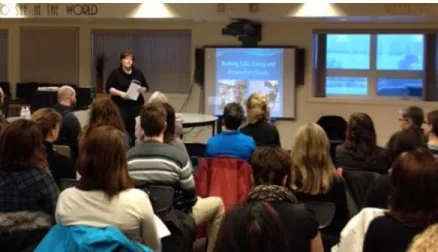
Psychologist Debbie MacDonald Presents to Teachers
Figure 3: School Division Staff – 2013-2014
Job Category FTEs
Classroom teachers 137.69
Principals, vice-principals 12.1
Other educational staff –e.g., psychologists, educational assistants, school community coordinators, speech language pathologists, counsellors
63.92
Administrative and financial staff –e.g., clerks, accountants, IT staff, administrative assistants
19.79
Plant operations and maintenance – e.g., caretakers, handypersons, carpenters, plumbers, electricians, gardeners, supervisors
18.45
Transportation –e.g., bus drivers, van drivers, mechanics, parts persons, supervisors
9.0
Senior management team –e.g., chief financial officer, director of education, superintendents
4.0
Total Full-Time Equivalents (FTE) Staff 264.95
Notes:
The number of employees listed above represents full-time equivalents (FTEs). The actual number of employees is greater because some people work part-time or seasonally.
Some individuals are counted in more than one category. For example a teaching principal might be counted 0.4 as a classroom teacher and 0.6 as a principal.
Information for all staff is at August 31, 2014.
Source: Superintendent of Human Resources and Operations, Holy Trinity Catholic School Division
Senior Management Team –The Acting Director of Education, Geri Hall, reports directly to the Board of Education. Two Superintendents are responsible for supporting all schools within the division:
Dave DePape - Human Resources and Operations Ward Strueby - Learning
Each team member below works with the school-based administrators as well as coordinators and consultants.
Gerry Gieni - Chief Financial Officer
Doug Sears - Supervisor of Facilities and Transportation Ryan Stinn - Supervisor of Technology
Indicators
Holy Trinity Catholic School Division’s objective is to support priorities that align with those of the province in areas designated as having significant impact on academic achievement and future success. The following four indicators are relevant to this objective.
Grade 12 Graduation
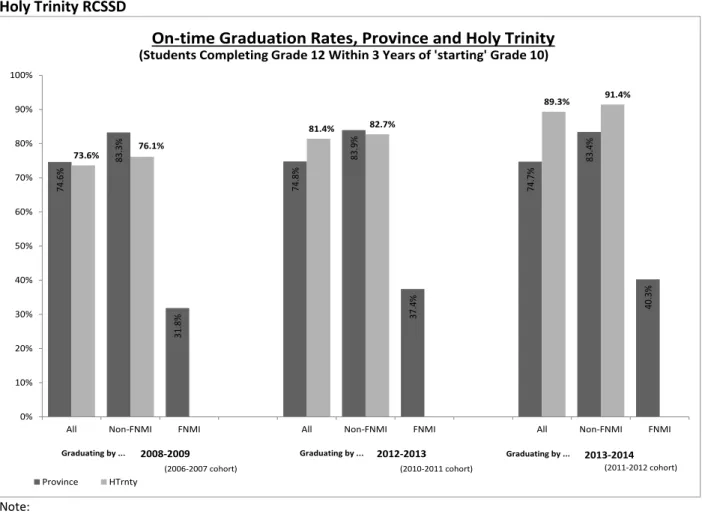
Three-Year Graduation Rates – In June 2014, 89.3% of all Holy Trinity Catholic School Division students graduated within three years of entering Grade 10, an 8% increase from 2013. Data for self-identified FNMI students has been suppressed as there were fewer than 10 students in these cohorts. Holy Trinity Catholic School Division’s overall graduation rate is higher than provincial results for the past two years.
Figure 4: Grade 12 Graduation – Students Completing Grade 12 Within Three Years: Baseline Year with Two Most Recent Years
Holy Trinity RCSSD
Note:
On-time graduation rates are calculated as the percentage of students who complete Grade 12 within 3 years of ‘starting’ Grade 10.
Results for populations of 10 or fewer have not been reported to avoid identifying individuals or very small groups of students.
FNMI students are those who choose to self-identify as First Nations (Registered/Treaty/Status Indian, Non-Status Indian), Métis, or Inuit/Inuk. Non-FNMI students are those who do not identify themselves to be FNMI, and may include FNMI students who choose not to self-identify.
Source: Ministry of Education, 2014
74.6% 83.3% 31.8% 74.8% 83.9% 37.4% 74.7% 83.4% 40.3% 73.6% 76.1% 81.4% 82.7% 89.3% 91.4% 0% 10% 20% 30% 40% 50% 60% 70% 80% 90% 100%
All Non-FNMI FNMI All Non-FNMI FNMI All Non-FNMI FNMI
Province HTrnty
(Students Completing Grade 12 Within 3 Years of 'starting' Grade 10) On-time Graduation Rates, Province and Holy Trinity
Graduating by ... Graduating by ... Graduating by ...
(2006-2007 cohort) (2010-2011 cohort) (2011-2012 cohort)
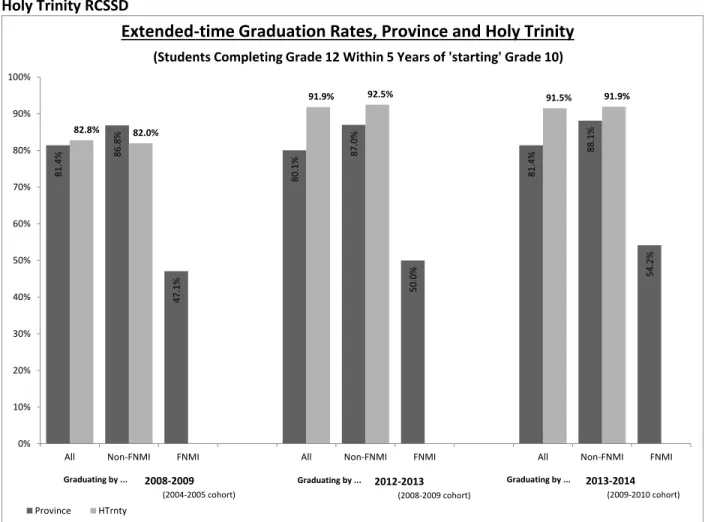
Five-Year Graduation Rates – Some students need more time to complete all the courses necessary to graduate, and so they continue in school longer than three years after beginning Grade 10. The graduation rate increases when these extra years of schooling are considered. By June 2014, 91.5% of all Holy Trinity Catholic School Division students who had entered grade 10 five years previously had graduated. Holy Trinity Catholic School Division’s five-year graduation rate for all students shows a 10% improvement from June 2012 and a similar percentage when compared to 2013. These results indicate perseverance and commitment to achieve graduation even with
impediments.
Figure 5: Grade 12 Graduation – Students Completing Grade 12 Within Five Years: Baseline Year with Two Most Recent Years
Holy Trinity RCSSD
Note:
Extended-time graduation rates are calculated as the percentage of students who complete Grade 12 within 5 years of ‘starting’ Grade 10 (and include those who graduate on-time).
Results for populations of 10 or fewer have not been reported to avoid identifying individuals or very small groups of students.
FNMI students are those who choose to self-identify as First Nations (Registered/Treaty/Status Indian, Non-Status Indian), Métis, or Inuit/Inuk. Non-FNMI students are those who do not identify themselves to be FNMI, and may include FNMI students who choose not to self-identify.
Source: Ministry of Education, 2014
81.4% 86.8% 47.1% 80.1% 87.0% 50.0% 81 .4% 88.1% 54.2% 82.8% 82.0% 91.9% 92.5% 91.5% 91.9% 0% 10% 20% 30% 40% 50% 60% 70% 80% 90% 100%
All Non-FNMI FNMI All Non-FNMI FNMI All Non-FNMI FNMI
Province HTrnty
(Students Completing Grade 12 Within 5 Years of 'starting' Grade 10)
Extended-time Graduation Rates, Province and Holy Trinity
Graduating by ...
(2004-2005 cohort)
Graduating by ... Graduating by ...
(2008-2009 cohort) (2009-2010 cohort)
Average Final Marks
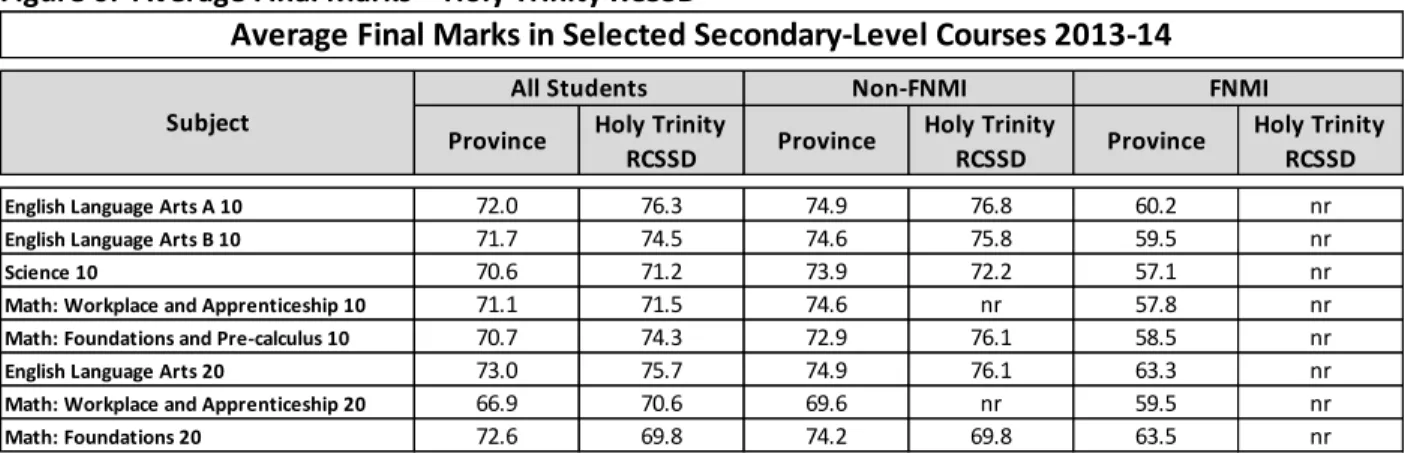
Holy Trinity RCSSD students’ average final marks in grade 10 and 11 2013-14 courses are higher than the provincial average in all courses selected for comparison with the exception of Math
Foundations 20. Division First Nations and Métis and Inuit self-declared students are fewer than 10 and therefore not reported.
Figure 6: Average Final Marks – Holy Trinity RCSSD
Note:
Results for populations of 10 or fewer have not been reported to avoid identifying individuals or very small groups of students (nr).
FNMI students are those who choose to self-identify as First Nations (Registered/Treaty/Status Indian, Non-Status Indian), Métis, or Inuit/Inuk. Non-FNMI students are those who do not identify themselves to be FNMI, and may include FNMI students who choose not to self-identify.
Source: Ministry of Education, 2014
Grade 7 to 10 Transitions
There are several critical transition points as students move through the Prekindergarten to Grade 12 education system. The transition from middle to secondary grades is particularly important. Figure 6 below shows that while the great majority of Holy Trinity Catholic School Division students who begin Grade 7 are still in Grade 10 three years later, all FNMI students are either in Grade 10 or are still in school continuing previous grades.
Figure 7: Grade 7 to 10 Transitions – Holy Trinity RCSSD
Note:
Students who have not progressed to Grade 10 “on-time” may have remained in a previous grade or were not re-enrolled in subsequent years. “Still in School” is the proportion of students either in Grade 10 or continuing a previous grade. Results for populations of 10 or fewer have not been reported to avoid identifying individuals or very small groups of students (nr). Categories where results are not available at this time are recorded as (na).
Province Holy Trinity
RCSSD Province
Holy Trinity
RCSSD Province
Holy Trinity RCSSD
English Language Arts A 10 72.0 76.3 74.9 76.8 60.2 nr
English Language Arts B 10 71.7 74.5 74.6 75.8 59.5 nr
Science 10 70.6 71.2 73.9 72.2 57.1 nr
Math: Workplace and Apprenticeship 10 71.1 71.5 74.6 nr 57.8 nr
Math: Foundations and Pre-calculus 10 70.7 74.3 72.9 76.1 58.5 nr
English Language Arts 20 73.0 75.7 74.9 76.1 63.3 nr
Math: Workplace and Apprenticeship 20 66.9 70.6 69.6 nr 59.5 nr
Math: Foundations 20 72.6 69.8 74.2 69.8 63.5 nr
Average Final Marks in Selected Secondary-Level Courses 2013-14 Subject
All Students Non-FNMI FNMI
Grade 7 Cohort Progressing from Grade 7 to 10
On-Time Still In School 2007-08 Baseline 2009-10 2010-11 2007-08 Cohort 2009-10 Cohort 2010-11 Cohort 2010-11 Cohort All students 167 165 153 98.2% 97.6% 96.7% 97.4% Non-FNMI students na 152 144 na 97.4% 96.5% 97.2% FNMI students nr 13 9 nr 100.0% 100.0% 100.0%
FNMI students are those who choose to self-identify as First Nations (Registered/Treaty/Status Indian, Non-Status Indian), Métis, or Inuit/Inuk. Non-FNMI students are those who do not identify themselves to be FNMI, and may include FNMI students who choose not to self-identify.
Source: Ministry of Education, 2014
Credit Attainment
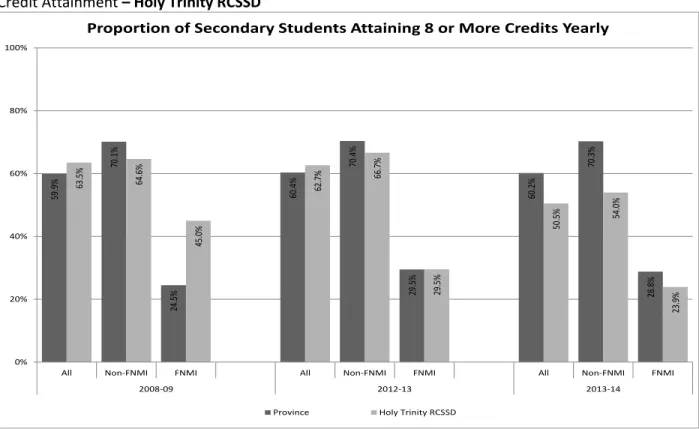
Credit attainment in high school is one way to determine students’ progress in meeting graduation requirements of 24 credits. In Holy Trinity Catholic School Division, there are a number of students who take more than eight credits in their grade 10 and 11 school years so that they do not need to take eight credits in grade 12. Secondly, the graph below includes data from the alternate high school program which includes a number of students who wish to continue their education while working full time or providing child care. Their other commitments do not allow them time to take eight credits per year. Holy Trinity Catholic School Division intends to analyze this data in greater detail so as to respond when needed.
Figure 8: Proportion of Secondary Students Attaining 8 or More Credits per Year: Baseline Year with Two Most Recent Years
Credit Attainment – Holy Trinity RCSSD
Note:
Proportions are calculated as the percentage of students enrolled at the secondary level on September 30 attaining eight of more credits yearly.
Results for populations of 10 or fewer have not been reported to avoid identifying individuals or very small groups of students.
FNMI students are those who choose to self-identify as First Nations (Registered/Treaty/Status Indian, Non-Status Indian), Métis, or Inuit/Inuk. Non-FNMI students are those who do not identify themselves to be FNMI, and may include FNMI students who choose not to self-identify.
Source: Ministry of Education, 2014
59.9% 70.1% 24.5% 60.4% 70.4% 29.5% 60.2% 70.3% 28.8% 63.5% 64.6% 45.0% 62.7% 66 .7% 29.5% 50.5% 54.0% 23.9% 0% 20% 40% 60% 80% 100%
All Non-FNMI FNMI All Non-FNMI FNMI All Non-FNMI FNMI
2008-09 2012-13 2013-14
Proportion of Secondary Students Attaining 8 or More Credits Yearly
Facilities and Transportation
Facilities
Holy Trinity Catholic School Division’s facilities include:
ten schools located in 3 communities. See Appendix C for a list of schools. The average age of these schools is 48 years. The oldest school is 58 years old; the newest school All Saints Catholic School opened in September 2014 which replaced two schools in Swift Current;
the school division head office located in Moose Jaw. The central core of this building is 56 years old. The head office building is adequate in size for present needs;
one satellite office is located in Swift Current; and,
one fenced bus compound with workshop and storage is located in Moose Jaw.
All Saints Catholic School, Swift Current: under construction
All Saints Catholic School, Swift Current: completed
Figure 9: Utilization Rate
Source: Supervisor of Facilities and Transportation, Holy Trinity Catholic School Division, 2014 and Baragar
School Sept. 30, 2013 Enrolment Prek-12 Gross Utilization Rate Sept. 29, 2014 Enrolment Prek-12 2019 Projected Enrolment*
All Saints Catholic 435 100% 438 431
Christ the King 47 57% 58 100
Phoenix Academy 95 100% 98 71 Sacred Heart 224 148% 238 274 St. Agnes 254 138% 254 321 St. Margaret 260 98% 260 254 St. Mary 154 172% 153 169 St. Michael 333 121% 333 377 Vanier Collegiate 387 82% 367 416 Totals 2,189 113% 2199 2413
Student Transportation
In 2013-14 Holy Trinity Catholic School Division used two primary methods of student
transportation. Contracted services were used in the communities of Swift Current and Shaunavon, and a fleet of Division-owned and operated buses and 15-passenger vans provided service in Moose Jaw. The fleet of seven route buses and two spare buses were housed at a fenced compound in Moose Jaw. The School Division does not have garage facilities or mechanics. All service and maintenance were contracted to a third party.
In addition to the seven route buses there were three 15-passenger vans that were utilized solely for transporting prekindergarten children in full child restraint seats within the city of Moose Jaw. An additional 15-passenger van was used to transport children residing on streets that cannot accommodate a traditional bus as well as providing service in special situations as approved.
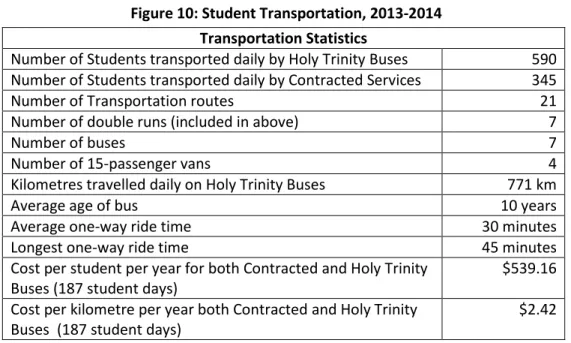
In Swift Current and Moose Jaw transportation for students with special circumstances are provided in a variety of ways. Figure 10 below refers only to transportation services provided by Holy Trinity buses or 15-passenger vans to and from school:
Figure 10: Student Transportation, 2013-2014
Source: Supervisor of Facilities and Transportation, Holy Trinity Catholic School Division, 2014
The First Bus at All Saints Catholic School, Swift Current
Transportation Statistics
Number of Students transported daily by Holy Trinity Buses 590 Number of Students transported daily by Contracted Services 345
Number of Transportation routes 21
Number of double runs (included in above) 7
Number of buses 7
Number of 15-passenger vans 4
Kilometres travelled daily on Holy Trinity Buses 771 km
Average age of bus 10 years
Average one-way ride time 30 minutes
Longest one-way ride time 45 minutes
Cost per student per year for both Contracted and Holy Trinity Buses (187 student days)
$539.16 Cost per kilometre per year both Contracted and Holy Trinity
Buses (187 student days)
Financial Overview
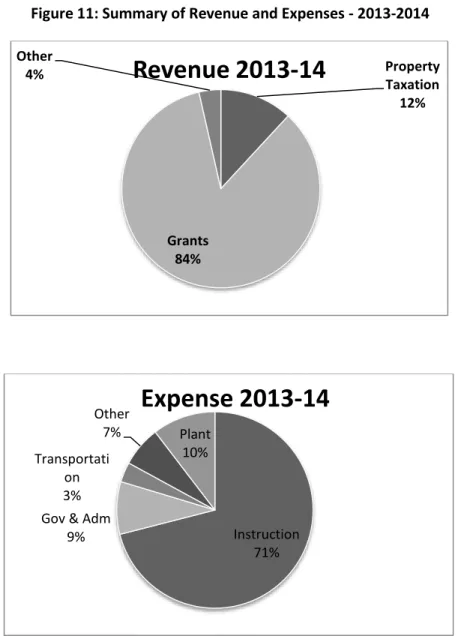
In the 2013-2014 fiscal year we completed the construction of a new school in Swift Current. As a result of this project our revenues in the last two years have been inflated by approximately $7 million each year. The grants for this capital construction are included in the 84% in the graph below.
As demonstrated in the graph below our biggest source of revenue comes from Provincial Grants. If the amount of $7 million for capital construction is removed in order to focus on Operations, then the percent changes slightly to about 81% from Ministry and 15% from Property Tax.
Expenditures in the various categories continue to be consistent with previous years. Our biggest component lies in the Instructional area. Almost 75% of our spending is going directly to support students in the classroom. As you see from the graph below, maintaining our school facilities is the next biggest category coming in at just over 10% of our expenditures.
Figure 11: Summary of Revenue and Expenses - 2013-2014
Property Taxation 12% Grants 84% Other 4%
Revenue 2013-14
Instruction 71% Gov & Adm9% Transportati on 3% Other 7% Plant 10%
Expense 2013-14
Budget to Budget to 2014 2014 2013 Actual Actual % Variance Over / (Under) Property Taxation 3,862,724 3,782,629 3,926,531 (80,095) -2% Grants 18,413,574 26,924,274 26,929,033 8,510,700 46% 1
Tuition and Related Fees - 107,869 69,814 107,869 100% 2
School Generated Funds 800,000 506,706 716,630 (293,294) -37% 3
Complementary Services 350,000 342,594 342,173 (7,406) -2% External Services - - - - Other 121,657 177,080 156,777 55,423 46% 4 23,547,955 31,841,152 32,140,958 8,293,197 35% Governance 232,464 282,244 228,286 49,780 21% 5 Administration 1,595,991 1,823,310 1,369,047 227,319 14% 6 Instruction 17,273,104 17,273,983 17,424,922 879 0% Plant 2,201,060 2,529,647 2,500,653 328,587 15% 7 Transportation 816,847 796,457 741,068 (20,390) -2%
Tuition and Related Fees 24,000 6,750 3,000 (17,250) -72% 8
School Generated Funds 800,000 422,147 525,387 (377,853) -47% 9
Complementary Services 644,855 825,943 659,642 181,088 28% 10 External Services - - - - Other Expenses 352,409 365,724 99,254 13,315 4% 23,940,730 24,326,205 23,551,259 385,475 2% (392,775) 7,514,947 8,589,699 Note 1 2 3 4 5 6 7 8 9 10
Surplus (Deficit) for the Year
Budget Actual Note
REVENUES
Total Revenues EXPENSES
Total Expenses
Actual Variance
Explanation for Variances (All variances that are greater than positive or negative 5% must be explained) Explanation
The major difference between budget and actual grants from the Ministry is comprised of $7,193,720 in revenues from the Ministry for construction of a new school in Swift Current which was not included in the budgeted revenues. When adding grant and complementary services revenue received from the Ministry and removing the capital grants for the new school, the difference between budget and actual ministry revenue is $121,847 or just over .5 percent in varience.
Holy Trinity school division has only one source of tuition revenue which comes to us from Prairie South school division for students enrolled at Raphael Centre (St. Michael School). The Raphael Centre addresses the complex needss of students with significant cognitive and/or physical disabilities. At the time the budget was approved tuition revenue was not included.
School generated revenues are those funds collected at school level. All revenues are maintained and accounted for by the division office, with no bank accounts held at the school level. All school generated funds must be spent for the purpose which ther were collected. Any unspent revenue are placed into a reserve account and made available in the next school year. The budget established for this line item may vary depending on how active fund raising initiative at the school level are in any given year.
Our school division amalgamated in 2003 and at that time established brand new Board Policies & Procedures. The Board did a review and update of those policies and procedures this fiscal year which resulted in more expenditures than were budgeted for in the area of 'Governance'.
The varience in the area of 'Administration' relates to unexpected expenditures for the division office building HVAC system as well as some salary expenditures which were not budgeted for.
In the area of 'Plant' this fiscal period there were a number of emergent issues which arose that were unbudgeted for. Our school facilities are very aged and at a point where issues come up which must be addressed. An example of this would be structural issues at St. Margaret School that required attention for safety reasons. This alone cost $30,000. The difference between budget and actual in the 'other revenue' category was an under-estimate of interest revenue partly due to the fact that funds were advanced for capital projects and not expended immediately - resulting in additional interest revenue.
School Generated Expenditures likewise are recorded and accouncted for throught the division office. Because expenditures must not exceed total revenue plus any carry over from the previous year, the budget in this category is always set at the same amount as is budgeted for in the revenue category. The net effect of 'School Generated Funds' on the financial bottom line for the entire division is always zero because these funds cannot be used for school division operations since the funds belong to individual schools. In the category of 'Tuition and Related Fees' the under spending relates to a budget for monies paid directly to parents in lieu of providing transportation. Our expenditures in this area came in less that expected when the budget was established.
Appendix A: Management Report and Audited Financial
Statements
Audited Financial Statements
Of the
School Division No. 2226000
For the Period Ending: August 31, 2014
Gerry Gieni
Chief Financial Officer
Virtus Group Chartered Accountants & Business Advisors LLP Auditor
Note - Copy to be sent to Ministry of Education, Regina
VIRTUS
GROUP
INDEPENDENT AUDITORS’REPORT
To the Board of Directors,
Holy Trinity Roman Catholic Separate School Division No. 22
We have audited the accompanying financia~ statements of Holy Tdnity Roman Catholic Separate School Division No.22 which comprise the statement of financial position as at August 31, 2014 and the statements of operations and accumulated surplus (deficit) from operations, statements of changes in net financial assets (net debt) and cash flows for the year then ended, with related schedules and a summary of significant accounting policies and other explanatory
information.
Management’s Responsibility for the Financial Statements
Management is responsible for the preparation and fair presentation of these financial statements in accordance with Canadian public sector accounting standards and for such internal control as management determines is necessary to enable the preparation of financial statements that are free from material misstatement, whether due to fraud or error.
Auditors’ Responsibility
Our responsibility is to express an opinion on these financial statements based on our audit. We conducted our audit in accordance with Canadian generally accepted auditing standards. Those standards require that we comply with ethical
requirements and plan and perform the audit to obtain reasonable assurance about whether the financial statements are free of material misstatement.
An audit involves performing procedures to obtain audit evidence about the amounts and disclosures in the financial statements. The procedures selected depend on the auditor’s judgment, including the assessment of the risks of material misstatement of the financial statements, whether due to fraud or error. In making those risk assessments, the auditor considers internal control relevant to the school division’s preparation and fair presentation of the financial statements in order to design audit procedures that are appropriate in the circumstances, but not for the purpose of expressing an opinion on the effectiveness of the school division’s internal control. An audit also includes evaluating the appropriateness of accounting policies used and the reasonableness of accounting estimates made by management, as well as evaluating the overall presentation of the financial statements.
We believe that the audit evidence we have obtained is sufficient and appropriate to provide a basis for our audit opinion.
Opinion
In our opinion, these financial statements present fairly, in all material respects, the financial position of the school division as at August 31, 2014 and the results of its operations, changes in its net financial assets, and its cash flows for the year then ended in accordance with Canadian public sector accounting standards.
Other Matter
The financial statements of Holy Trinity Roman Catholic Separate School Division No. 22 for the year ended August 31, 2013 were audited by another auditor who expressed an unmodified opinion on those statements on November 25, 2013.
November 20, 2014
Regina, Saskatchewan Chartered Accountants
The King George, Suite 200, 157 - 2rid Avenue North
… page 2
2014 2014 2013
Budget Actual Actual
REVENUES (Note 16)
Property Taxation 3,862,724 3,782,629 3,926,531
Grants 18,413,574 26,924,274 26,929,033
Tuition and Related Fees - 107,869 69,814
School Generated Funds 800,000 506,706 716,630
Complementary Services (Note 13) 350,000 342,594 342,173
Other 121,657 177,080 156,777
Total Revenues (Schedule A) 23,547,955 31,841,152 32,140,958
EXPENSES Governance 232,464 282,244 228,286 Administration 1,595,991 1,823,310 1,369,047 Instruction 17,273,104 17,273,983 17,424,922 Plant 2,201,060 2,529,647 2,500,653 Transportation 816,847 796,457 741,068
Tuition and Related Fees 24,000 6,750 3,000
School Generated Funds 800,000 422,147 525,387
Complementary Services (Note 13) 644,855 825,943 659,642
Other Expenses 352,409 365,724 99,254
Total Expenses (Schedule B) 23,940,730 24,326,205 23,551,259
Operating Surplus (Deficit) for the Year (392,775) 7,514,947 8,589,699
Accumulated Surplus from Operations, Beginning of Year 25,665,682 25,665,682 17,075,983
Accumulated Surplus from Operations, End of Year 25,272,907 33,180,628 25,665,682
The accompanying notes and schedules are an integral part of these statements
Holy Trinity Roman Catholic Separate School Division No. 22
Statement of Operations and Accumulated Surplus from Operations… page 3
2014 2014 2013
Budget Actual Actual
(Note 16)
Net Financial Assets, Beginning of Year 2,499,244 2,499,244 4,077,610
Changes During the Year:
Operating Surplus (Deficit) for the Year (392,775) 7,514,947 8,589,699 Acquisition of Tangible Capital Assets (Schedule C) (1,127,000) (14,796,884) (10,789,636) Amortization of Tangible Capital Assets (Schedule C) 752,879 903,240 752,878 Net Change in Other Non-Financial Assets - (107,359) (131,307)
Change in Net Financial Assets / Net Debt (766,896) (6,486,056) (1,578,366)
Net Financial Assets (Net Debt), End of Year 1,732,348 (3,986,812) 2,499,244
The accompanying notes and schedules are an integral part of these statements
Holy Trinity Roman Catholic Separate School Division No. 22
Statement of Changes in Net Financial Assets (Net Debt)… page 4
2014 2013
OPERATING ACTIVITIES
Operating Surplus for the Year 7,514,947 8,589,699
Add Non-Cash Items Included in Surplus / Deficit (Schedule D) 903,240 752,878 Net Change in Non-Cash Operating Activities (Schedule E) 902,680 (213,595)
Cash Provided by Operating Activities 9,320,867 9,128,982
CAPITAL ACTIVITIES
Cash Used to Acquire Tangible Capital Assets (14,796,884) (10,789,636)
Cash (Used) by Capital Activities (14,796,884) (10,789,636)
INVESTING ACTIVITIES
Cash Used to Acquire Portfolio Investments - (6,133,155)
Proceeds on Disposal of Portfolio Investments 5,654,513 -
Cash Provided (Used) by Investing Activities 5,654,513 (6,133,155)
FINANCING ACTIVITIES
Proceeds from Issuance of Long Term Debt 334,176 9,663,797
Repayment of Long Term Debt (553,041) (269,837)
Cash Provided (Used) by Financing Activities (218,865) 9,393,960
INCREASE (DECREASE) IN CASH AND CASH EQUIVALENTS (40,369) 1,600,151
CASH AND CASH EQUIVALENTS, BEGINNING OF YEAR 7,639,313 6,039,162
CASH AND CASH EQUIVALENTS, END OF YEAR 7,598,943 7,639,313
The accompanying notes and schedules are an integral part of these statements
Holy Trinity Roman Catholic Separate School Division No. 22
Statement of Cash FlowsA-1
2014 2014 2013
Budget Actual Actual
Property Taxation Revenue Tax Levy Revenue:
Property Tax Levy Revenue 3,630,687 3,555,776 3,687,320
Total Property Tax Revenue 3,630,687 3,555,776 3,687,320
Grants in Lieu of Taxes:
Federal Government 90,582 88,770 111,251
Provincial Government 50,262 47,755 47,315
Railways 21,944 17,714 23,331
Other 64,470 67,339 67,570
Total Grants in Lieu of Taxes 227,258 221,578 249,467
Other Tax Revenues:
House Trailer Fees 15,343 14,144 19,700
Total Other Tax Revenues 15,343 14,144 19,700
Additions to Levy:
Penalties 24,810 25,904 25,751
Total Additions to Levy 24,810 25,904 25,751
Deletions from Levy:
Cancellations (35,374) (34,773) (50,315)
Other Deletions - - (5,392)
Total Deletions from Levy (35,374) (34,773) (55,707)
Total Property Taxation Revenue 3,862,724 3,782,629 3,926,531
Grants:
Operating Grants
Ministry of Education Grants:
Operating Grant 17,660,804 18,527,743 18,025,538
Other Ministry Grants - 78,770 65,638
Total Ministry Grants 17,660,804 18,606,513 18,091,176
Other Provincial Grants 50,000 - 29,700
Grants from Others - - 17,660
Total Operating Grants 17,710,804 18,606,513 18,138,536
Capital Grants
Ministry of Education Capital Grants 702,770 8,317,761 8,790,497
Total Capital Grants 702,770 8,317,761 8,790,497
Total Grants 18,413,574 26,924,274 26,929,033
Holy Trinity Roman Catholic Separate School Division No. 22
Schedule A: Supplementary Details of Revenue for the year ended August 31, 2014
A-2
2014 2014 2013
Budget Actual Actual
Tuition and Related Fees Revenue Operating Fees:
Tuition Fees:
School Boards - 107,869 69,814
Total Tuition Fees - 107,869 69,814
Total Tuition and Related Fees Revenue - 107,869 69,814
School Generated Funds Revenue Curricular:
Student Fees 120,000 61,995 83,654
Total Curricular Fees 120,000 61,995 83,654
Non-Curricular Fees:
Commercial Sales - Non-GST 248,000 141,802 215,790
Fundraising 174,000 101,079 142,925
Grants and Partnerships 32,000 11,525 12,711
Students Fees 104,000 104,219 129,288
Other 122,000 86,086 132,262
Total Non-Curricular Fees 680,000 444,711 632,976
Total School Generated Funds Revenue 800,000 506,706 716,630
Complementary Services Operating Grants:
Ministry of Education Grants:
Operating Grant 350,000 320,184 319,043
Other Ministry Grants - 22,410 22,410
Total Operating Grants 350,000 342,594 341,453
Fees and Other Revenue
Other Revenue - - 720
Total Fees and Other Revenue - - 720
Total Complementary Services Revenue 350,000 342,594 342,173
Other Revenue
Miscellaneous Revenue 71,657 55,814 66,956
Sales & Rentals - 2,599 4,629
Investments 50,000 118,667 85,192
Total Other Revenue 121,657 177,080 156,777
TOTAL REVENUE FOR THE YEAR 23,547,955 31,841,152 32,140,958
Schedule A: Supplementary Details of Revenue for the year ended August 31, 2014
B-1
2014 2014 2013
Budget Actual Actual
Governance Expense
Board Members Expense 44,020 85,220 68,913 Professional Development - Board Members 69,584 66,968 52,371
Advisory Committees - 674 2,878
Elections - - 7,874
Other Governance Expenses 118,860 129,382 96,250
Total Governance Expense 232,464 282,244 228,286
Administration Expense
Salaries 1,126,342 1,382,576 1,039,884
Benefits 117,209 118,069 131,445
Supplies & Services 159,603 101,799 98,415 Non-Capital Furniture & Equipment 17,187 11,312 8,574 Building Operating Expenses 43,250 102,839 41,741
Communications 41,500 35,174 17,516
Travel 38,400 31,382 8,148
Professional Development 52,500 32,572 12,412
Amortization of Tangible Capital Assets - 7,587 10,912
Total Administration Expense 1,595,991 1,823,310 1,369,047
Instruction Expense
Instructional (Teacher Contract) Salaries 11,827,354 12,168,066 12,301,306 Instructional (Teacher Contract) Benefits 568,899 617,533 635,591 Program Support (Non-Teacher Contract) Salaries 2,566,811 2,497,368 2,644,653 Program Support (Non-Teacher Contract) Benefits 509,536 454,220 417,361
Instructional Aids 770,203 289,461 275,481
Supplies & Services 78,110 238,629 250,703
Non-Capital Furniture & Equipment 137,512 231,918 136,611
Communications 33,729 51,917 55,851
Travel 83,232 32,682 62,220
Professional Development 282,074 138,474 222,116
Student Related Expense 124,495 94,423 86,548
Amortization of Tangible Capital Assets 291,149 459,292 336,481