How to communicate environmental
efforts for value creation
- A case study from a Swedish waste contractor in a B2B
setting
Fanny Skoglund
Master’s thesis · 30 hec · Advanced level Degree thesis No 941 · ISSN 1401-4084 Uppsala 2015
How to communicate environmental efforts for value creating – A case study from a Swedish waste contractor in a B2B setting
Fanny Skoglund
Supervisor: Suvi Kokko
Swedish University of Agricultural Sciences, Department of Economics
Examiner: Karin Hakelius
Swedish University of Agricultural and Sciences, Department of Economics
Credits: 30 hec Level: A2E
Course title: Degree Project in Business Administration Course code: EX0782
Faculty: Faculty of Natural Resources and Agricultural Sciences Place of publication: Uppsala
Year of publication: 2015
Name of Series: Degree project/SLU, Department of Economics No: 941
ISSN 1401-4084
Online publication: http://stud.epsilon.slu.se
Key words: Corporate identity, CSR, Environmental communication, image differentiation
Acknowledgements
This is my Master Thesis in Environmental Economics and Management at the Swedish University of Agricultural Sciences (SLU).
First and foremost, I would like to express my deepest thanks to the persons who have taking their time to participate in this study. Without your unique experiences and knowledge, this study would not have been possible. A special thanks goes to Nina Neuman at the case company, Wiklunds, for her support and engagement during the thesis process.
Further, I would like to thank the single most important person for this study, my supervisor Suvi Kokko at SLU, for sharing her valuable insights and knowledge, comments and
improvement suggestions.
Summary
Stakeholders’ pressure and expectations regarding environmental responsibility have forced companies’ to work with Corporate Social Responsibility (CSR) as an integrated part of their business strategy. Environmental responsibility is therefore valued higher than ever before and must be effectively communicated towards stakeholders’. Much research investigates in business-to-consumer (B2C) effects of CSR while there is limited research in how the
business-to-business (B2B) market should implement and apply CSR. However, the pressure on companies operating in the B2B market is increasing as they are also expected to take responsibility for their actions.
The objective of this study is to conduct a case study of Wiklunds, a service- and logistics company (waste contractor) focusing on waste disposal from the construction sector. This is done in order to investigate how environmental communication can fulfill clients’ needs and adding value. Moreover, the objective with this study is to offer an academic perspective of a phenomenon that is currently challenging companies in their efforts to address environmental aspects of corporate conduct. However, the audience for this thesis is not only academic persons but also industrial representatives since responsible waste management favors construction companies and the society at large.
This study is delaminated to evaluate the effectiveness of environmental communication and not the effectiveness of the environmental performances as such. The empirical data consist of interviews with five of Wiklunds main clients from the construction- and property industry, and two key employees from Wiklunds.
The theoretical framework consists of research in corporate values and identity, in order to evaluate how aligned a waste contractor’s environmental image and identity is with its
clients’ expectations. Thereafter, is Heikkurinen (2010) framework in strategic CSR presented with the aim to create a situation were both the people, planet, and profit prospers. The final theory is mainly based on Morsning and Schultz (2006), strategic CSR communication. The empirical study shows that Wiklunds has a positive environmental image; long-term relationships indicate that the clients are satisfied. However, the awareness of Wiklunds environmental work is limited, meaning that Wiklunds environmental image and identity is not completely aligned with its clients’ perception. Up to present, Wiklunds environmental work has not been communicated fully, meaning nor its identity and what they represent, although it would benefit Wiklunds corporate reputation. The results indicate that Wiklunds image might be threatened if the company does not start to communicate its environmental work. Wiklunds clients want to collaborate with active waste contractors that help them reaching environmental goals, and therefore would Wiklunds benefit from an environmental image differentiation. Wiklunds should use a two-way symmetric communication strategy in order to improve its external environmental communication, as the interaction between Wiklunds and its clients is a key factor for successful waste management.
Sammanfattning
Intressenters ökade krav och förväntningar på företag att ta miljömässigt ansvar har lett till att företag arbetar med Corporate Social Responsibility (CSR) som en integrerad del av sin verksamhet. Företags miljöarbete värderas högre än någonsin och måste på ett effektivt sätt kommuniceras till intressenterna för att visa företagets etiska ståndpunkt. Mycket forskning undersöker business-to-consumer (B2C) effekter av CSR och begränsad forskning tittar på hur business-to-business (B2B) marknaden bör genomföra och tillämpa CSR. Dock ökar trycket på företag som är verksamma inom B2B-marknaden och de förväntas i allt större utsträckning ta ansvar för sina handlingar.
Syftet med denna studie är att göra en fallstudie av Wiklunds, ett service- och logistikföretag (avfallsentreprenör) med fokus på avfallshantering från byggsektorn. Studien syftar till att undersöka hur miljökommunikation kan uppfylla kundernas förväntningar och skapa mervärde. Utöver ämnar studien att ge ett akademiskt perspektiv på ett fenomen som för närvarande utmanar företag i deras ansträngningar att adressera miljöaspekter av
företagsansvar. Dock riktar sig denna studie inte bara till akademiska representanter utan också till industrirepresentanter då ansvarsfull avfallshantering gynnar såväl byggföretag som samhället i stort.
Denna studie avgränsas till att utvärdera effektiviteten av miljökommunikationen och inte miljöprestandan som sådan. Det empiriska materialet består av intervjuer med fem av Wiklunds största kunder från bygg- och fastighetsbranschen, samt två nyckelpersoner från Wiklunds.
Den teoretiska ramen utgörs av forskning i värdegrund och identitet, i syfte att utvärdera hur väl i linje en avfallsentreprenörs miljöimage och identitet stämmer med kundernas
förväntningar. Därefter presenteras Heikkurinen (2010) ramverk inom strategisk CSR med målet att skapa en situation där både människor, natur och ekonomi gynnas. Slutligen presenteras Morsning och Schultz (2006) teori, strategiskt CSR kommunikation.
Den empiriska studien visar att Wiklunds har en positiv miljöimage; långsiktiga relationer påvisar god kundnöjdhet och trovärdighet. Dock är kundens kännedom om Wiklunds
miljöarbete begränsad, vilket innebär att Wiklunds miljöimage och identitet inte är helt i linje med kundernas uppfattning. Wiklunds förmedlar i nuläget inte sitt miljöarbete fullt ut, och därmed inte heller sin identitet och vad de representerar, vilket skulle gynna företagets anseende. Resultaten av intervjustudierna tyder på att Wiklunds miljöimage kan hotas om företaget inte börjar kommunicera sitt miljöarbete mer effektivt. Kunderna vill samarbeta med en aktiv avfallsentreprenör som hjälper dem att nå sina miljömål och därmed skulle Wiklunds gynnas av en tydlig miljöimage. Vidare är en tvåvägskommunikation en strategi Wiklunds bör använda för att förbättra sin miljökommunikation, då interaktionen mellan Wiklunds och kunderna är den viktigaste faktorn för en framgångsrik avfallshantering.
Abbreviations
B2B Business to Business B2C Business to Consumer CR Corporate Responsibility CS Corporate Sustainability
CSR Corporate Social Responsibility
ISO International Organization for Standardization SD Sustainable Development
WBCSD World Business Council for Sustainable Development WCED World Commission on Environment and Development
Table of Contents
1 INTRODUCTION ... 1 1.1PROBLEM BACKGROUND ... 1 1.2 PROBLEM ... 2 1.3 AIM ... 3 1.4 OBJECTIVES ... 3 1.5DELIMITATIONS ... 4 1.5.1 Empirical delimitations ... 4 1.5.2 Theoretical delimitations... 5 1.6 OUTLINE ... 52 LITERATURE REVIEW AND THEORETICAL PERSPECTIVE ... 6
2.1 LITERATURE REVIEW ... 6
2.1.1 Corporate Social Responsibility ... 6
2.1.2 Value creation ... 6
2.1.3 Image differentiation with CSR ... 7
2.1.4 Environmental communication ... 8
2.2 THEORETICAL FRAMEWORK ... 8
2.2.1 Corporate values and identity ... 8
2.2.2 Image Differentiation with strategic CSR ... 10
2.2.3 Strategic CSR communication ... 12
3 METHOD ... 15
3.1 LITERATURE REVIEW ... 15
3.2 IDENTIFICATION OF THEORETICAL FRAMEWORK ... 16
3.3 QUALITATIVE APPROACH ... 16
3.4 CASE STUDY ... 17
3.4.1 Choice of sector and company ... 18
3.4.2 Selection of respondents ... 18
3.5 COLLECTION OF DATA ... 20
3.6 DATA ANALYSIS ... 20
3.7 ENSURING QUALITY ... 21
3.8ETHICS ... 22
4 BACKGROUND FOR THE EMPIRICAL STUDY ... 23
4.1 WIKLUNDS ... 23
4.2 CLIENTS ... 24
4.3 WASTE HIERARCHY ... 25
5 THE EMPIRICAL STUDY ... 26
5.1 WIKLUNDS ... 26
5.1.1 Value ground ... 26
5.1.2 Environmental image ... 26
5.1.3 Environmental responsibility and strategy ... 27
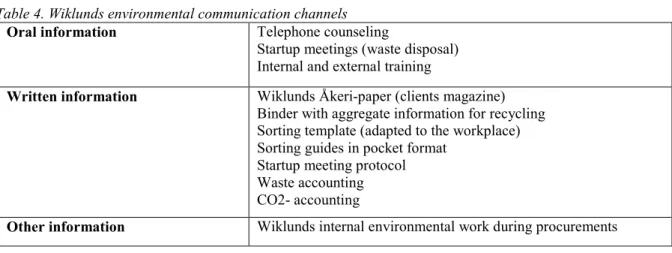
5.1.4 Environmental communication ... 28
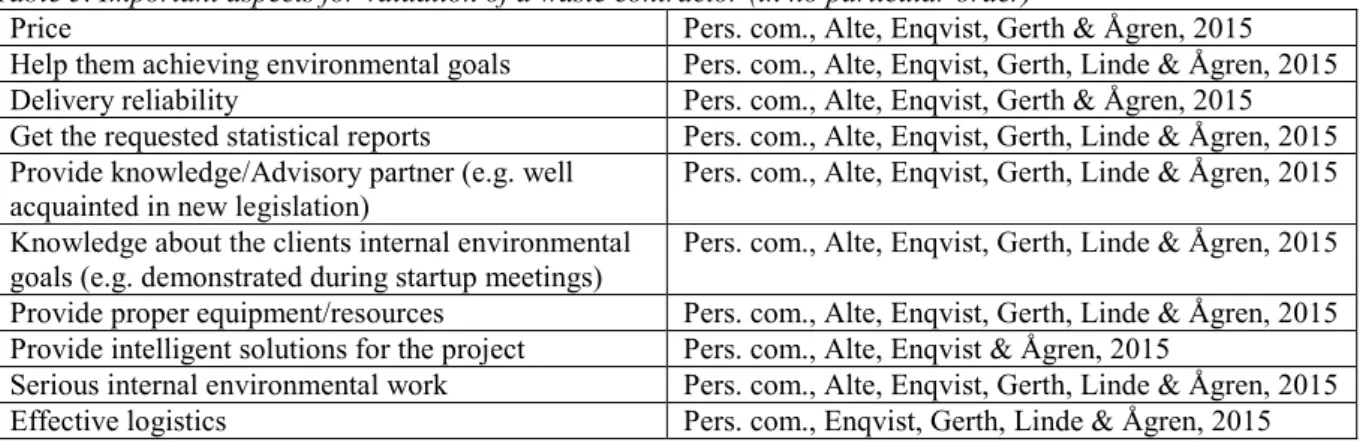
5.1.5 Value of environmental efforts ... 30
5.2VEIDEKKE,JM,NCC,VASAKRONAN AND SKANSKA ... 32
5.2.1 Environmental image ... 32
5.2.2 Stakeholder pressure ... 33
5.2.3 Environmentally responsible transportation ... 33
5.2.4 Environmentally responsible construction waste ... 34
5.2.5 Clients’ relationship with Wiklunds ... 34
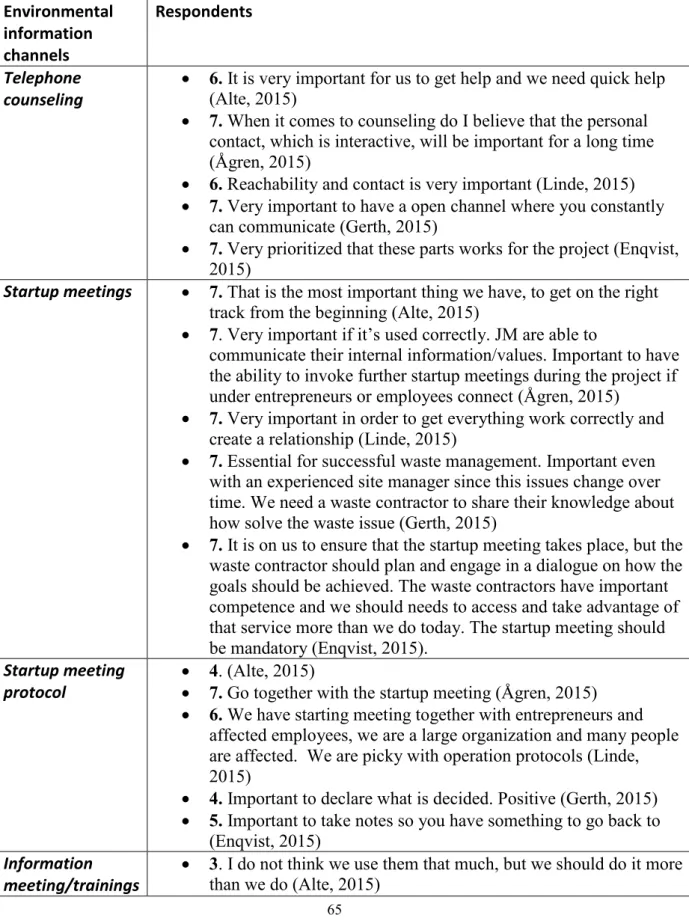
5.2.6 Clients’ communication with Wiklunds ... 35
5.2.7 Value Creating ... 36
5.2.8 Waste management in the future ... 38
6 ANALYSIS AND DISCUSSION ... 39
6.1 IDENTITY, IMAGE AND VALUES ... 39
6.2 ENVIRONMENTAL IMAGE DIFFERENTIATION ... 43
6.3 STRATEGIC COMMUNICATION OF ENVIRONMENTAL EFFORTS ... 44
7 CONCLUSIONS ... 48
7.1 DATA QUALITY AND RECOMMENDATIONS FOR FUTURE RESEARCH ... 49
BIBLIOGRAPHY ... 51
Literature and publications ... 51
Internet ... 56
Personal messages ... 57
APPENDICES ... 58
APPENDIX 1: THE INTERVIEW GUIDE (WIKLUNDS) ... 58
APPENDIX 2: THE INTERVIEW GUIDE (CLIENTS) ... 61
APPENDIX 3: EVALUATION OF ENVIRONMENTAL INFORMATION CHANNELS (WIKLUNDS) ... 63
APPENDIX 4: EVALUATION OF ENVIRONMENTAL INFORMATION CHANNELS (CLIENTS) ... 65
List of figures
Figure 1: Micro/Meso/Macro/Global-level drivers for CR (Heikkurinen, 2010) Figure 2: Five levels of CR aggressiveness and competitive aim (Ansoff & McDonnell, 1990; Ketola,1992:2005)
Figure 3: Waste Management Hierarchy (European Commission, 2015)
List of tables
Table 1: The stakeholder involvement strategy (Morsning & Schultz, 2006) Table 2: Search terms
Table 3: The participant and their position at each company Table 4: Wiklunds environmental communication channels Table 5: Important aspects for valuation of a waste contractor
1 Introduction
The introduction chapter gives a background to the problem and to the rationalization behind the creation of this study. Thereafter is the aim and the research questions presented followed by the objectives, delimitations, and the outline of the study.
1.1 Problem background
Global warming and the human footprints on earth have increased the awareness of
sustainable development (SD) and made it an important alternative to neoliberal economics that mostly focus on short-term profitability and little on the long-term effects of business (Reid, 1995). The interest for SD received widespread attention after the Brundtland Report, 1987, “Our common future” (World Commission on Environment and Development, WCED) that first addressed the concept of business role in society. SD is defined as “a development that meets the needs of the present without compromising the ability of future generations to meet their own needs” (WCED, 1987). Accounting for not only financial performance, but also social and environmental concerns equally, is referred to as “the triple bottom line” framework and was first coined by John Elkington in 1994. SD can therefore be seen as an ethical concept on a macro level that offers ideas concerning sustainable orientation (Ebner & Baumgartner, 2008). Creating value for stakeholders has therefore a more extensive role than the traditional “business as usual” approach. The globe faces major environmental challenges including climate change, biodiversity loss, land use change, air pollution, freshwater
consumption, ocean acidification and deforestation (Rockström et al., 2009). The social challenges that businesses should take into consideration include health and safety problems, inequality, air pollution, lack of education, social disorganization, and other types of
discrimination (Visser & Tolhurst, 2010). Corporate Social Responsibility (CSR) can be seen as a social strand of the SD-framework and focus on corporate engagement and its
responsibility as a member of society and meeting stakeholders’ expectations (Ebner & Baumgartner, 2008). While SD is on macro-level, CSR is on a micro-level and a part of Corporate Sustainability (CS) three pillars: economic, ecological and social.
Stakeholders’ pressure and expectations on companies have made companies to work with CSR as an integrated part of the business strategy (Porter & Kramer, 2011; Carroll & Shabana, 2010; Hooghiemstra & van Manen, 2002). Companies that are committed to their ethical practices have seen improvements in the company’s overall performance; resulting in economic benefits (Orlitzky et al., 2003; Vershoor, 1998), brand equity and differentiation (Chen & Bouvain, 2005). Stakeholders’ role cannot be underestimated since they ask companies for accountability and transparency and expect them to “walk the talk”, i.e., do what they communicate. However, there is no clear definition of what CSR comprises (Grafström et al, 2008; Dunne, 2007, p. 372, Porter & Kramer, 2006). This is problematic, meaning that companies interpret active social responsibility differently, resulting in that they do not know how to meet stakeholders’ expectations (ibid.). As a result, companies might not be seen as legitimate players on the market, since they do not communicate what is expected (Morsing et al., 2011). Since CSR is not regulated by law and is a relatively new field there is gap in the literature about how to integrate CSR in the business strategy (Durdan, 2007). The strategic role companies undertake in their work with CSR look different among companies as they face different social and environmental challenges (Heikkurinen, 2010), which in turn leads to different opportunities, threats and costs. While some see CSR as a
business opportunity, others have a more proactive approach and rather perceive CSR as a threat to current business practices and inconsistent with maximizing profits (Chin et al, 2009; Carroll & Shabana, 2010). However, the majority of large companies work with CSR through the entire value chain, from supplier to end-user, with the purpose to adopt a sustainable business idea (Crane & Matten, 2010). How companies meet stakeholders’ expectation depend on costs to adapt, impact on the brand, and competitive position (Spar & La Mure, 2003). Smith (2003) points out that business-to-consumer (B2C) face more pressure
compared to business-to-business (B2B) companies that do not have a direct contact with the end user since consumers today want to access information regarding what is behind the product or service to make sure that they do not contribute to unethical behavior. However, supplier with a bad reputation implies an indirect risk for the principal company since the end user values a sustainable supply chain (ibid.).
Subhabrata (2008) discusses how companies with a high impact on the environment, for example the transportation sector and the construction sector, can be environmentally
conscious. The transportation sector is subjected to a lot of criticism regarding environmental issues and is growing in complexity, size, and the externalization of its environmental impacts (Schiller et al. 2012). Together with volume growth, has the distance between the goods and raw materials that are transported increased, meaning a higher amount of energy used and pollution generated (ibid.). The construction sector’s environmental impact occurs from the extraction of raw materials to waste management (Naturvårdsverket, 2013). The waste arises in new constructions, redevelopment, and demolition. The Swedish construction industry generated in 6,8 million tons non-hazardous construction- and demolition waste in 2012 and 900 000 tons of hazardous waste for commercial activities (ibid.). The hazardous waste must be sorted at an early stage in order to not pollute other waste. According to Sweden’s waste plan, must the inventory during demolition, and the identification of materials that can be reused and recycled, improve. It is generally easier to sort construction waste than demolition waste since the fractions are not connected the same way (ibid.). A waste contractor that manages the construction waste in an ethical manner is therefore fundamental for a sustainable value chain.
1.2 Problem
Not taking responsibility for environmental and social issues might result in major negative effects such as bad reputation and poor legitimacy (Ammenberg, 2012). Companies must therefore understand how stakeholder’s expectations change over time and how they interpret CSR differently (Grafström et al., 2008). Much research is looking at the B2C effects of CSR and limited research is looking at how the B2B market should implement and work with CSR (Esty & Winson, 2006). However, the pressure on companies operating in the b2b market is increasing and they are also expected to take responsibility for their actions (ibid.). If a
company should work with CSR is no longer a question but rather how they should work with these issues (Borglund et al, 2009). The competitive climate has indirectly forced companies to offer something in addition to its products and services in order to demonstrate the positive effects of its business (Löhman & Steinholtz, 2003). Companies must therefore, to a greater extent, take different stakeholders values and demands into consideration to survive on the market (Grolin, 1998). What CSR approach the company chooses is based on the core business, the financial capacity and the knowledge and expertise in the company (ibid.). However, the benefits from CSR activities will only affect clients purchase intentions and
attitudes if they are aware of the initiatives, meaning, if the CSR activities are effectively communicated (Pomering & Dolnicar, 2009).
Several sectors need to reduce their environmental impact in favor of a long-term
sustainability in Sweden. The domestic transport sector alone, in 2014, accounts for around 33 percent of Sweden’s total carbon emissions (www, Trafikverket, 2014). Another sector that is subjected to critique regarding unethical corporate behavior is the construction sector (Mark-Herbert & von Schantz, 2007). Annual investments in the construction sector were estimated to 329,6 billions in 2013 where the investments will rise throughout the forecast period 2014-2015 (Byggvärlden, 2014-2015). Around half of the costs come from the material used during the construction process, which indicate that the sector use large material resources (Asplund et al., 1994). The construction sector is sometimes referred to as the “40 percent sector” since 40 percent of the total waste in Sweden comes from the sector, and 40 percent of all hazard substances is found in construction waste (Naturvårdsverket, 2015). The negative environmental effects from the construction sector could be an encouragement for
construction companies to work with serious waste contractors within their supply chain, both regarding waste management, as well as making sure the waste is transported in a responsible and sustainable manner. The competitive climate requires waste contractors to communicate their sustainability work effectively so that the construction companies comprehend value-adding activities such as a serious environmental work. While considering ones‘ suppliers, contractors and business partner, companies have to ensure there are no environmental violations (Brown, 2005). Competitive procurements are hence strongly affected by the ways a company addresses sustainability issues. Consequently, many companies require suppliers and contractors to adhere to sustainability agendas and codes of conducts as a condition for partnership (ibid.). The communication process is a key tool for affecting stakeholders within the supply chain (Grafström et al. 2008). However, many companies work with a “top-down-approach” which means that the principal company set the guidelines without listening to the rest of the supply chain. A supplier that has good reputation and is perceived as trusty will more likely be seen as a legitimate player on the market (ibid.).
1.3 Aim
The aim of this study is to investigate the conditions for effective environmental
communication for a waste contractor’s effort to create more value for its clients, in the construction sector.
In order to reach the aim the following research questions will be in focus:
• How aligned are a waste contractor’s environmental image and identity with its clients expectations?
• How can a waste contractor benefit from an environmental image differentiation? • How can a waste contractor communicate its environmental work to create value for
its clients?
1.4 Objectives
The objective of this study is to conduct a case study of Wiklunds Åkeri AB (hereafter referred to as Wiklunds), which is a service- and logistics company (hereafter referred to as a
waste contractor) focusing on waste disposal from the construction sector. This is done in order to investigate how environmental communication can fulfill clients’ needs and adding value. Moreover, the objective with this study is to offer an academic perspective of a
phenomenon that is currently challenging the transportation and waste management sector in their efforts to address environmental aspects of corporate conduct. However, the audience for this thesis is not only academic persons but also industrial representatives since a reduction in construction waste favors construction companies and the society at large, both
environmentally and economically speaking.
1.5 Delimitations
The empirical and theoretical delimitations are those characteristics that limit the scope and define the boundaries of this study.
1.5.1 Empirical delimitations
The study is delaminated to five of Wiklunds’ largest clients in Stockholm since they represent the majority of sales and are fundamental for Wiklunds continued survival. These clients are all construction- or property companies where Wiklunds manages their waste disposal. Focusing on Wiklunds’ clients operating within the same sector is a conscious choice to concentrate the study. Swaen (2003) supports the idea of studying companies that operate in the same sector and business since CSR can differ in both definition and execution in different contexts. The study focuses on the relationship between Wiklunds and their clients, giving the study a corporate perspective (B2B). Other relevant stakeholders, such as end consumers and politicians, are not included in the study, which could have been
interesting to give a more holistic view to the study. The external pressure from relevant stakeholders, most likely affects the construction companies’ and the property company’s approach to environmental responsibility, and this in turn affects the pressure and
expectations on Wiklunds environmental work. The study is not indented to evaluate the different clients environmental work.
The methodological approach of this study is grounded in many choices and was therefore subjected to delimitations. The method for the chosen country, sectors, companies etc. is further explained in Chapter 3. An important delimitation is the qualitative design of the study. Only one environmental representative from each construction- and property company has been interviewed due to time limitations, which can have made the case study rather superficial. Extending the amount of respondents from each company could have given a more holistic picture of studied phenomena. However, this approach was considered more appropriate over an in-depth-study since the purpose was to get an overall view of how
Wiklunds environmental work is perceived and communicated. Two key personnel at the case company were interviewed; the quality and environmental manager and the marketing and sales manager. These persons are most involved in the environmental work and have a close contact with the large clients, which is the reason why these empirical delimitations were made.
Important to note is that the concept CSR will be used in this study, but only include
environmental responsibility. Social issues within the transportation and waste management are left out and the study. This delimitation was made since Wiklunds considering their environmental work most valuable for their clients (pers. com., Neuman & Blomberg, 2015). The environmental pillar is focusing on construction waste (resource use) and transportations.
The study is further delaminated to focus on how the case company communicates CSR and is not evaluating how they practice CSR.
1.5.2 Theoretical delimitations
The theories that are chosen in this study are carefully balanced since they highly affect the analysis and in return the outcome of the study. The selected theories were based on the aim to enable a strong analysis of how environmental communication works within the case setting. Therefore, this study includes theories to identify corporate identity and strategies for effective external environmental communication in order to create value for Wiklunds clients. The study is therefor delimited to the type and combination of theories chosen (see more in 4.2 Identification of theoretical framework). The study is delimitated to evaluate how the environmental efforts are valued and communicated. Additional theories about green
marketing, shared value, and stakeholder theory could have been interesting to include in the study to provide additional perspectives.
1.6 Outline
Chapter 1 gives the reader an overview and background to the studied phenomena. It starts with the problem background, followed by the problem, aim and research questions. Further, chapter 1 will establish some important delimitation for the study. The following Chapter 2 provides an in-depth literature review. Thereafter the chosen theories for this study are presented (Chapter 3), that is theories about corporate identity, differentiation with CSR, and CSR communication strategies. Chapter 4 gives a detailed explanation about the
methodological approach that has been used in order to produce a valid and reliable study. This is a qualitative case study with many courses of actions to take into consideration, as well as ethical aspects. Chapter 5 presents the empirical background, starting off with a background of the case company, and then presenting the construction companies and the property company. Chapter 6 presents the core of the study, the empirical results from the interviews with case company, followed by the results from construction companies and the property company. Chapter 7 analyzes and discusses the results of the empirical study in relation to the theoretical framework. It is provided in order to get a deeper understanding of how a waste contractor should communicate its environmental efforts in order to satisfy their clients needs. The final chapter (chapter 8) presents the conclusions from the study as well identifies further research areas.
2 Literature review and theoretical perspective
The chapter starts with a literature review with the purpose to give the reader a background to the chosen theories in corporate values and identity, image differentiation with strategic CSR, and strategic CSR communication.
2.1 Literature review
2.1.1 Corporate Social Responsibility
Corporate Social Responsibility (CSR) is considered a voluntary task, meaning doing more than what laws and regulation requires (Caroll, 1979). A common definition of CSR is “the continuing commitment by business to behave ethically and contribute to economic
development while improving the quality of life of the workforce and their families as well as of the local community and society at large”, stated in the World Business Council for Sustainable Development (WBCSD, 1999, p. 3).
However, there is no clear definition of CSR among academics and in the corporate world and different views remain of what should be included in the concept (Dahlsrud, 2008). In this study is CSR defined after Grankvist (2009) interpretation. Grankvist (2009) argues that organizations can volunteer in three different responsibilities: environmental responsibility, social responsibility and economic responsibility. An economic responsibility means maximizing profits in order to secure the companies’ finances, as well as dividends to shareholders. Environmental and social responsibilities on the other hand are more extended responsibilities. Social responsibility means that the company shows respect and care for society and people in the environment, no matter if they are employees, suppliers, clients, or any other stakeholders. Taking responsibility for the environment means operating the business in a sustainable manner, without long-term negative effects on the environment. Companies are often accountable for more people and organizations then they may realize. Savitz and Weber (2006), and Elkington (2004) points out that even profitable companies are threaten if they fail to take stakeholder’s values into consideration. The interest for
environmental issues has resulted in that consumers becoming aware of the entire value chain, meaning that if companies’ business practices and products do not meet acceptable
sustainability standards, consumers and stakeholders might penalize these companies
(Francés-Gómez, 2008). Companies can no longer be seen as isolated organisms that only are held responsible for their own actions; instead companies must take responsible for the entire value chain (Savitz & Weber, 2006). Therefore, B2C pass down customers’ demands and expectations to B2B companies further back in the supply chain (Hojemose et al., 2013). The Triple Bottom Line framework transfers backwards in the supply chain, where companies need to act in accordance with accepted sustainability standards (Hoejmoste et al., 2013, Francés-Gómez, 2008).
2.1.2 Value creation
Value creation is a central notion in todays service research (Edvardsson, et al., 2005;
Normann, 2001; Ravald & Grönroos, 1996) and is a new important way of depicting service. The service-oriented research on value creation emphasizes interaction between the company and its clients as central for value creating (Grönroos, 2011); “It is through interactions that values is created, seeing that information is exchanged, consumed (i,e. existing information
utilized) and produced (i,e. new information created) as well as knowledge is generated, and services are co-designed and co-created” (Salomonsson et al., 2011, p. 145). This interactive perspective differs form the non-interactive perspective where values are seen as being embedded in the products and services provided by the selling company. According to the service-centered perspective is value derived and determined in customers’ use (value-in-use) (Vargo et al., 2008). Customers create value independently, but are supported by its
customers (Payne et al., 2007). There are limited empirical studies on how value creation is accomplished in practice, and especially on how communicative interaction support value creation (Salomonsson et al., 2011). Several researchers stress the need for more closely observations of between the supplier and its customers. That would enable a deeper understanding of how the supplier can engage itself with the customers value-generating processes and thus becoming a co-creator of value with its customers (Grönroos, 2008). A service company has the opportunity to, with customer interaction, to actively influence the outcome of its customer’s consumption process (value creating). The customer has the same opportunity, to influence the service company’s activities (Grönroos, 2008). Frontline staff is often involved in the contact with customers before, during, and after the purchase and play therefore a strategic role in value creating. They also create customer trust (Darian et al.,) and increasing the customers’ service encounter satisfaction (Bitner et al., 2015). Meaning, the human interaction is essential for evaluating whether the service delivery was deemed satisfactory or not.
2.1.3 Image differentiation with CSR
CSR, values and ethics are linked to the culture and management of the firm (Joyner & Payne, 2002). Napoles (1988) discusses the importance of customers’ attention in a competitive environment. “Corporate Identity Design” offers a practical tool in order to design and implement a comprehensive and successful corporate identity program. Napoles (1988) distinguishes between corporate identity – what the company is– and corporate image – how the company is perceived by the pubic. The intention is to close the gap between corporate image and corporate identity in order to refine the corporate identity. Steps in designing identity design includes; “recognizing the need for corporate identity adjustment”, “Selecting a basic symbol category from which to choose”, “Deciding on and refining a chosen symbol”, and “Implementing a careful, intelligent program for phasing in the new corporate identity and ensuring its acceptance by the public.
More recent studies in the field define corporate image as a mix of attributes that make an organization distinct such as corporate mission, values, activities, markets covered etc. (Balmer & Greyser, 2002). The connections between corporate image, ethics and CSR have received widespread attention among public media and academics (Fukukawa et al., 2007). McDonald’s for example, was in the longest court case in English history during the 1990s and received a lot of media attention (Crane & Matten, 2004). The company was blamed for not acting ethical such as paying low wages, exploited children in their campaigns, and treated some animals in the value chains poorly. There was a gap between the company’s communicated ethical stance and the corporate identity. However, there are also examples where corporate identity matches with ethical stands (Croft, 2005). These “authentic businesses” are characterized by a business purpose that goes beyond profits such as an environmental and/or social purpose. These ethical companies challenge their customers to change their mindset and take actions for a better world (Fukukawa et al., 2007).
2.1.4 Environmental communication
Up to the present, there has not been much empirical research on the questions why, how, and to with what effect companies engage in environmental communication (Signitzer & Prexl, 2008). However, the literature review supports that the motives for practicing environmental communication can be grouped into three categories; business case, marketing case, and public case. Research has pointed to the potential business benefits of the internal and external communication of CSR (Maignan et al., 1999). Even though research suggests companies to communicate their environmental and social ambitions, in order to attract critical stakeholders, the numbers of companies that communicate their CSR initiatives are low (Warner, 2004; Vallentin, 2001). Glazebrook (1999) found out in a comprehensive study of company publication, CEO statements, and annual reports in Australia that only 37 out of 500 companies considered CSR as central for the strategic direction of their business. A similar study in UK indicated that 35 percent out of 180 companies were not publishing their CSR efforts. The majority (53 percent) of the companies claimed that they did not have a philanthropy policy, while the additional 48 percent connected their CSR efforts to the core business and target customers with the intension to create goodwill or boosting corporate image. Regardless of customer support for particular CSR domains and perceived trade-offs with functional attributes (such as price and quality), prior work suggests that the lack of customer response to firms’ CSR initiatives has two primary sources; companies have not strongly communicated their CSR initiatives (Carrigan, 1997; Dawkins, 2004; Work
Foundation, 2004). Or companies have communicated their CSR initiatives, yet customers are unaware of them, which could be due to a multitude of reasons including bad communication campaigns, lack of attention by customers, inability of customers to place CSR information into relevant context, etc. In that sense, CSR engagement today needs more ongoing and sophisticated stakeholders awareness and requires more solid CSR communication strategies than previously (Morsing & Schultz, 2006).
Vague statements such as “environmental friendly”, “sustainable”, and “green” are received with skepticism and environmental communication faces several obstacles that other
corporate communication lack. Environmental communication is perceived as misleading and incomplete among individuals, meaning that environmental actions might therefore be hard to evaluate for a purchaser (Kangun et., 1990).
2.2 Theoretical framework
2.2.1 Corporate values and identityA company’s willingness to practice CSR is based on corporate values (Löhman & Steinholtz, 2003). Meaning, not only external pressure motivates CSR practices, the company’s internal values also play a significant role. Bravo et al (2012) investigated in if CSR is a concept that shows corporate culture and values. The results indicated that 93,4 percent of the 82
companies included in the study presented CSR practices on their homepage. Around 52 percent of the case companies presented CSR practices in their annual report. The study shows that CSR activities were implemented in corporate values but is not a determining factor for how a company operates its business. Bravo et al (2012) study further indicates that corporate values affect what kind of responsibilities the company chooses to engage in. As the company conveys its responsibilities, it also demonstrates its identity and what it represents (ibid.).
According to Löhman and Steinholtz (2003) corporate values are based on traditions, culture, and individual and personal norms. Corporate values affect how the company acts and
operates its business (ibid.). These values are often associated with corporate mission, which demonstrates the fundamental purpose and existence of the company. Corporate values can help the company to keep focus during tough times (Löhman & Steinholtz, 2003). Research indicates that corporations that formulate their CSR strategy after their values increase their chances to get stakeholders to participate in the company’s CSR activities (Chong, 2009). Over time, the interaction between CSR activities and company values will enhance the corporation’s identity on the market. A company that adapt their CSR strategies after corporate identity and values are more likely to get committed and engaged employees. A company should therefor, develop their CSR strategies after corporate values and identity (ibid.).
Traditionally, corporate identity has been narrowly conceived in terms of graphic design in image creation (Napoles 1988). Contemporary corporate identity scholarship, however, defines corporate identity in terms of the mix of attributes that make any organizational entity distinct such as corporate values, mission, activities, markets covered and so on (Balmer & Greyser, 2002).Having a favorable image will over time create a favorable corporate
reputation, which is an intangible way to differentiate products and services from competitors (Siltaoja, 2006). Since corporate identity is “what we are” and corporate image is what the company is perceived to be, might it be legitimate to argue that it is less complicated to internalize a CSR identity if the company has a responsible behavior. Cramer (2005) also supports the idea of integrating CSR into the corporate culture, which facilitates the
communication of values and norm underlying the concept. Therefore, a positive (created i.e., reflected) corporate image results in a stronger corporate position. Lack of CSR might ruin the corporate image while positive effects of CSR enhance corporate reputation (Marconi, 1996). Siltaoja (2006) connects CSR with value theory, and highlights the importance of corresponding the new corporate image with its key stakeholders values. However, in order for a company to benefit from an environmental image differentiation, stakeholders must be aware of the environmental action.
Fukukawa et al (2007) map ethical identity into four distinct strands: (1) foundations, trigger and motives (2) management: (3) action and communication and (4) image and stakeholder perception. They call this encapsulation of CSR, ethics and corporate identity for
“Ethicalization”. Foundations, Trigger and Motives relate to ethical ethos that leads to a company’s social responsiveness. The integration and emergency of ethical identity are originated from the following three forces: the altruistic beliefs of a leader, strategic alternatives as gaining competitive advantages, and external forces such as changes in legislation/societal norms. The other aspect of ethicalization focuses on the management of ethical identity. While the company has decided to become more ethical and take more social and environmental responsiveness they must set goals, policies and procedures; have a clear division of labor and finally review and monitoring methods. The third aspect of
ethicalization focuses on the relationship between what is demonstrated in terms of CSR, ethics and corporate identity in relation to communication, in other worlds the relationship between Action and Communication. The key to success is the notion what the company really is (corporate identity) and what the company say it is (communication) should be congruent. A false image can be seen as a company, which, communicate responsibility that is de-coupled from the identity, where a true identity is seen as a close connection between what is communicated, and the corporate identity. Image and stakeholder perceptionis the
fourth aspect in the ethicalization process. Since perception has the ability to guide behavior is it an important aspect for ethical organizations. Creating and maintain the corporate identity, as well as avoiding a negative image are all important concerns (ibid.). What is clear are a range of motives for pursuing CSR activities, some of which are external to a firm (e.g., global competition, standardization, legal obligation), while others are internal (e.g., initiatives from management and/or employees, founder’s philosophy, corporate mission).
2.2.2 Image Differentiation with strategic CSR
The environmental trend has clearly changed the competitive climate resulting in new
opportunities and threats for business (Heikkurinen, 2010). Companies, which are long-term, oriented and realize the opportunities of having a serious environmental approach are more likely to succeed and benefit from competitive advantage (Friedman & Friedman, 2009). The purpose with strategic CSR is to create a situation were both the people, planet, and profit prospers (Heikkurinen, 2010). Also, CSR becomes strategic when it generate in business-related benefits for the company, especially when it supports core business activities, and therefore, contribute to the company’s effectiveness in achieving its mission. There exist strategic implication of CSR and a company can differentiate while having an environmental responsible image. Treating all stakeholders the same is not a successfull strategy since they all have different interest and values. CSR can be both internally and externally driven. A company can hasten lack of external demand for CSR by supplying CSR (ibid.) An
environmentally responsible image enhances the company’s strategic position both internally and externally. The internal benefits are a preferred employer, increased employee motivation and cost savings. The external advantages of an environmentally responsible image include better reputation, a preferred partner and supplier, which create greater loyalty and trust. It is important to build the image upon the actual CSR action to get reflected image, which is more likely to create desired results compared to a pragmatic image (ibid.). However, the CSR activities can vary among stakeholders since they operate in different contexts. The
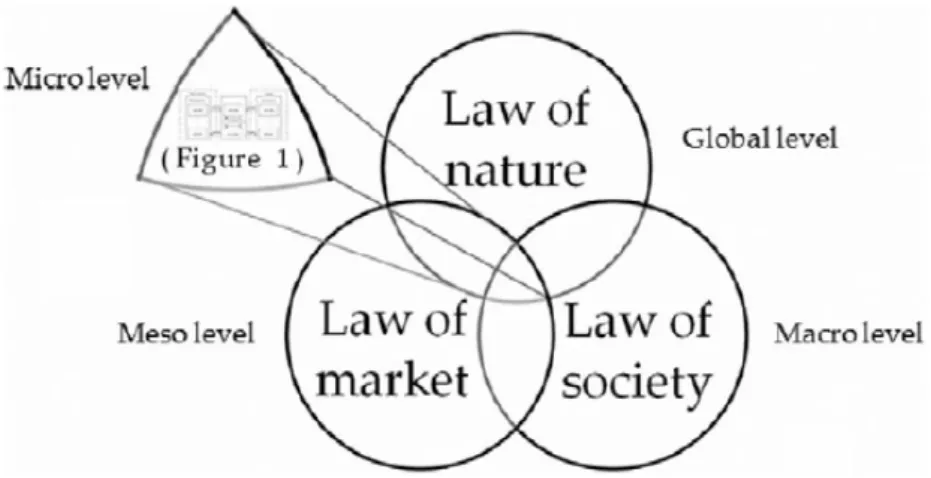
company’s responsible identity is reflected in the CSR actions but the identity does not have to be affected in line with changes in corporate values (ibid). The responsible identity appears throughout the whole value chain and is it a result of internalized CSR values in the entire chain. These changing values is often a result transfigured values from the key stakeholders’ since a key stakeholders oriented company changes its values in accordance with the values from the key stakeholders. A company’s aggressiveness towards CSR (see Figure 1) is driven on micro level (expectation of stakeholders and individuals), meso level (pushed towards CSR by competitors and partners), macro level (supply CSR in accordance with laws and regulations) and finally global level (working with CSR because the world has limited resources and the ecosystem is fragile) (ibid.). Even though Heikkurinen (2010) study is focusing on image differentiation as a strategy, it should be noted that this strategy can lead to cost efficiency. CSR management is about surviving in the long run and incorporate CSR values throughout the value chain.
Figure 1. Micro/Meso/Macro/Global-level drivers for CR (Heikkurinen, 2010)
The competitive aim affects the amount of CSR actions and what level is sought. In Figure 2 are five levels of CR approached identified; passive CSR, reactive CSR and proactive CSR all dependent on the competitive environment, entrepreneurial and creative CSR on the other hand, are less dependent.
Figure 2. Five levels of CR aggressiveness and competitive aim (Ansoff & McDonnell, 1990; Ketola, 1992:2005)
Heikkurinen’s study (2010) claims that there are five levels of CSR aggressiveness and competitive aims, where the corporate management needs to determine what competitive aim is sought. It is important that the aim correspond to the company’s CSR actions for the employees to act upon. As the company increases its CSR aggressiveness, and focuses on a higher level of CSR (Proactive CSR, Entrepreneurial CSR, and Creative CSR) greater
emphasis should be on stakeholder communication (worlds), which is the last step in the holy trinity od CSR (value-action-worlds) by Ketola (2006b).
2.2.3 Strategic CSR communication
Communication is a crucial tool for companies to reach consumers and therefore benefit from its CSR initiatives. This is a result of higher pressure from stakeholders who requires
companies to “walk the talk” and present their actions (Grafström et al., 2008). Morsing & Schultz (2006) argue that finding the most suitable communication strategy help companies to strengthen its position among critical stakeholders. The company needs to identify what specific message to send to different stakeholders and develop a communication strategy based on that information (Borglund et al, 2012). Communicating ones action is in most cases a crucial tool in order be seen as a legitimate player on the market. Long-term relationships to stakeholders play a fundamental role for the company’s overall success, and there is
impossible to maintain and create new relationships without communication. However, when a company is starting to communicate its CSR strategy increases the risk of being subjected to critique externally (Snyder et al, 2005).). Therefor, some companies avoid communicating their CSR actions despite the importance of informing stakeholder about ones responsibility (ibid.). Morsing & Schults (2006) have identified three types of CSR communication strategies that companies use while communicating with their stakeholders: information strategy, response strategy and involvement strategy. They perceive these strategies as a spectrum that goes from a monologue from the company to a dialogue with their stakeholders.
The stakeholder information strategy
The purpose with the stakeholder information strategy is to demonstrate information through unidirectional communication such as webpages and sustainability reports (Morsing & Schults, 2006). Grafström (2008) explains unidirectional communication as communication that takes an informative form with the intention to inform the stakeholders. The information does not necessary have to be convincing, but rather inform stakeholders about the business. Stakeholders have the ability to influence by either accept and support, or reject and boycott of corporate actions (Morsing & Schults, 2006). The reason why companies demonstrate their sustainability work is to minimize negative reactions, but there might also be an intention to do the right thing and take more responsibility. The starting point is only a corporate initiative and they do not consider what external stakeholders think about the sustainability initiative. They believe that trusty communication comes from the company itself (ibid.). However, Van Riel (1995) highlights the importance of communication of what the stakeholders consider important. Beckmann and Morsing (2006) claim that unidirectional communication is necessary, but cannot be the only information channel while communicating CSR.
The stakeholder response strategy
This response strategy is based on an asymmetric two-way communication model with the intention to interpret and understand the external environment and thereafter influence stakeholders with informative communication (Morsing & Schults, 2006). The interpretation of the environment can be done with debates, surveys, or communication with the stakeholder to get a better understanding of how the company can improve their CSR initiatives. This strategy is the opposite to a symmetric two-way communication, meaning that there is an uneven balance that benefits the company. The company rather wants to change their
stakeholder’s mindset about the company, rather than listen to stakeholder’s opinion and the change themselves. It does not exist an open dialogue between the company and the
stakeholders about the CSR initiatives. Beckmann & Morsing (2006) argue that this strategy tries to convince stakeholders chose their products and is on a risk since the stakeholders does not have the chance express their opinions.
The stakeholder involvement strategy
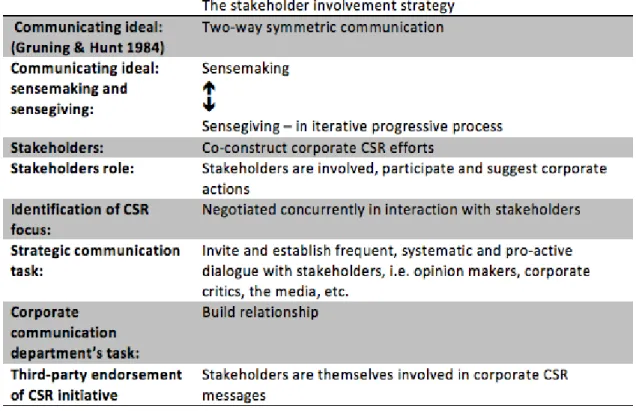
The stakeholder involvement strategy (summarized in Table 1.), in contrast to the previous strategies, takes off in a symmetric communication between the company and its stakeholders and is advocated by Morsing & Schultz (2006). The dialogue is iterative and progressive where stakeholders are encouraged to suggest activities that the company should take action in. Rather than being informed the stakeholders are involved and the company asks for their opinions in order to improve its CSR efforts. In other worlds, the stakeholders are proactively involved and are not just receiving information. Consequently, the company can adapt to stakeholders’ expectations and needs, where the stakeholders support their actions. Having a regular dialogue with stakeholders ideally leads to a situation where the company and its stakeholders both influence and get influenced by each other, a process Morsing and Schultz (2006) refer to as sensemaking and sensegiving. Thus, both parties must be willing to change in order for the strategy to be functional. Having a dialogue with stakeholders also creates trust and conditions for a better relationship between the company and the stakeholders (ibid.).
Third party endorsement is one approach for stakeholder involvement (Morsing & Schultz, 2006). The company benefits from positive CSR statements and opinions that come from external stakeholders and not from the company itself since this brings credibility to the CSR efforts. Hence, third party endorsement is a result of a dialogue between the company and the stakeholders. Even though internal stakeholders can be seen as less detached and do not directly increase the credibility of the CSR efforts, the company can benefit from internal endorsement as well. Employees are more likely to identify themselves with internal values and this will in return attract current and future employees.
Table 1. The stakeholder involvement strategy (Morsing & Schultz, 2006)
Engaging in a dialogue with stakeholders’ increases the understanding for stakeholders concerns, interest and needs as well as realize and identify potential risks. Having a dialogue with stakeholders give the company a chance to identify unmet needs, which allows them to turn it to an opportunity of creating value (Freeman & Velamuri, 2006; Morsning and Schults, 2006).
Summary of theoretical framework
Corporate values, identity, and reputation are closely linked and the corporate identity affects the company’s engagement in CSR. When CSR is integrated into the corporate culture, will that facilitate the communication of values and norm underlying the concept. Having a favorable image will over time create a favorable corporate reputation, which is an intangible way to differentiate products and services from competitors. Lack of CSR might ruin the corporate image while positive effects of CSR enhance corporate reputation.
The purpose with strategic CSR is to create a situation were both the people, planet, and profit prospers (Heikkurinen, 2010). There exist strategic implication of CSR and a company can differentiate while having an environmental responsible image. Heikkurinen’s study (2010) claims that there are five levels of CSR aggressiveness and competitive aims, where the corporate management needs to determine what competitive aim is sought. As the company increases its CSR aggressiveness, and focuses on a higher level of CSR (Proactive CSR, Entrepreneurial CSR, and Creative CSR) greater emphasis should be on stakeholder communication.
Morsing & Schultz (2006) argue that finding the most suitable communication strategy help companies to strengthen its position among critical stakeholders. They have identified three types of CSR communication strategies that companies use while communicating with their stakeholders: information strategy, response strategy and involvement strategy. The purpose with the stakeholder information strategy is to demonstrate information through unidirectional communication such as webpages and sustainability reports. This response strategy is based on an asymmetric two-way communication model with the intention to interpret and
understand the external environment and thereafter influence stakeholders with informative communication. The stakeholder involvement strategy in contrast to the previous strategies takes off in a symmetric communication between the company and its stakeholders and is advocated by Morsing & Schultz (2006).
3 Method
The purpose of this chapter is to describe the methodological approaches that serve as a basis for this study. The chapter consists of the approaches that the researcher has used in order to reach the aim and answer the research questions. Why and how the methodological
approaches are used is also described. In the end, a discussion about the study’s
methodological approaches in relation to reliability and validity is presented. Total objectivity cannot be reached since the researcher always will influence the study with former ideas, views and experiences (Alvesson & Sköldberg, 1994).
3.1 Literature review
Robson (2011) claims that a literature review is necessary in order to develop a suitable research question in a specific field. The theory chapter starts with background facts and a presentation about corporate identity and CSR communication. The literature review was conducted in order to give the reader an overview of the studied phenomena and summarize the claims and findings in a concisely way from previous research in the subject (Knopf, 2006). Further, the literature review should evaluate the existing research critically and draw conclusions about how complete and accurate the knowledge is. However, it is also important to explain how the study will alter or add to the existing body of knowledge (ibid.).
First phase:
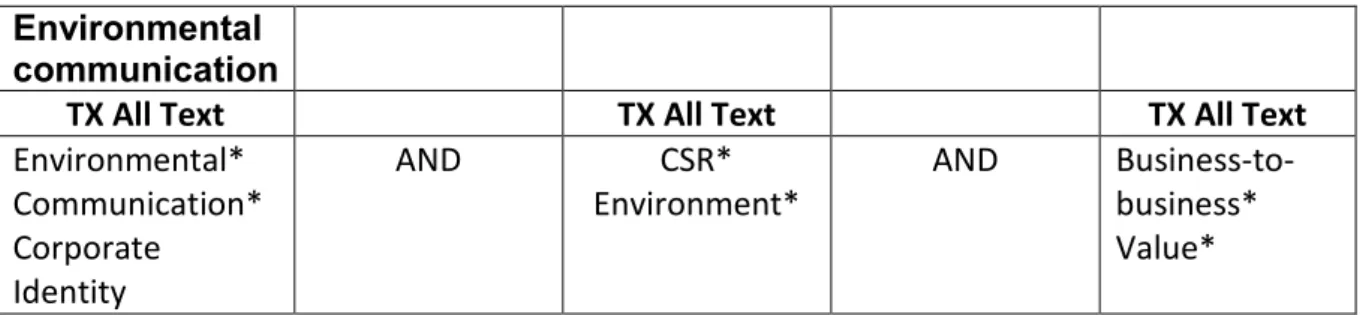
The literature review was starting point for the study, and in order to find suitable articles in the field. The most cited journals in these articles give a good base for the sources that should be focused. The search terms have also a solid basis after this first revive. Table 3 shows the search terms that have been used.
Table 2. Search terms
Environmental communication
TX All Text TX All Text TX All Text
Environmental* Communication* Corporate
Identity
AND CSR*
Environment* AND Business-to-business* Value* Second phase:
Peer-reviewed articles mainly from the databases Google scholar, Primo and Jstor were searched for in order to access the literature. Further, information from Wiklunds homepage, intern documents and other Internet based sources were used. Finally, literature from the SLU library and Kungliga Biblioteket (the Royal Library) has served as basis for this study. 400 articles were found while searching environmental* communication* and corporate identity. 255 articles were found while searching environmental communication* customer* value* corpora*. 71 articles were found while searching CSR b2b and communication. 8 articles were found when searching “waste contractor” value and construction.
3.2 Identification of theoretical framework
The purpose with the theoretical framework used within this study is to tie the empirical data with existing models and therefore fulfill the aim and research questions. However, the selection of the theoretical framework has extensive consequences for the outcome of the study and should be done under careful consideration.
Corporate values, identity, and reputation are closely linked and the corporate identity affects the company’s engagement in CSR. When CSR is integrated into the corporate culture, will that facilitate the communication of values and norm underlying the concept (Cramer, 2005). Having a favorable image will over time create a favorable corporate reputation, which is an intangible way to differentiate products and services from competitors (Siltaoja, 2006). Wiklunds wants an environmental image, and their values, as well as perceived image of their clients, play an important role and motivate the choice of theory. Corporate identity should match ethical stands (Croft, 2005), while Fukukawa et al (2007) study about ethicalization has been used. Heikkurinen (2010) framework “Image Differentiation with Corporate Environmental Responsibility”, analyzes the strategic implication of CSR. An
environmentally responsibility image, can enhance the company’s strategic position, which Wiklunds seek with its environmental work, since they want to be one step ahead from its competitors. The long term benefits with CSR, as a strategy for differentiation is
trustworthiness among critical stakeholders. Wiklunds, are interested in how its clients perceive its environmental efforts, and how they can develop its environmental work to maintain a long-term relationship. Wiklunds goal is to develop its external environmental communication towards clients. The company has a restricted marketing budget, which limit the options of communication channels. Accordingly, a suitable theory about strategic communication, written by Morsing and Schultz (2006) has been in focus in the study, in other worlds the stakeholder information strategy, the stakeholder response strategy, and the stakeholder involvement strategy. By using Morsing and Schultz (2006) CSR communication strategies has Wiklunds different communication channels been analyzed and what
communication strategies that might be suitable in the development of Wiklunds environmental communication
3.3 Qualitative approach
This study uses a qualitative approach; it is a case study of Wiklunds, which is a waste contractor, located in Stockholm and Uppsala. The study is based on both primary data and secondary data in order to reach the aim and answer the research questions. The primary data is mainly based on qualitative semi-structured interviews, informal conversations and email correspondence with the case company. Interviews with Wiklunds clients were done in order to collect descriptive, rich data about the clients’ attitudes and perceptions to Wiklunds environmental work and communication. In-depth interviews are the right method when the researcher is interested in evaluating and collecting specific and precise answers about individual experiences, opinions and motives (Webb, 1992). Another advantage with the in-depth interview is that the respondent has time to further develop and motivate his or hers individual standpoints without being influenced by other respondents opinions (ibid.) The secondary data consists of corporate documents and information from webpages such as Wiklunds webpage and newspapers. Both methods are used in order to give a methodological width to the study.
The qualitative approach is characterized by proximity between the researcher and the study objects, which creates favorable preconditions for a deeper understanding of the studied phenomena (Holme & Solvang, 1991). It is used in order to answer “how”, “why”, and “what”. The qualitative method gives an overview of a complex situation and is used to understand a social system (Holme & Solvang, 1997). The qualitative approach is
characterized by flexibility, which enables the researcher to change the intended study during the process, which contributes to a more complex holistic picture (Repstad, 2007).
This enhances the perspectives and gives the researcher better insights. The method enables investigation of social interactions (ibid.), which this study aims to explore. The qualitative approach enables the researcher to investigate a phenomenon that might be hard to quantify or measure (Kumar et al., 1991)
Seven people in total have been interviewed for this study, which does not make the study representative for a great population, meaning that the results cannot be statistical verified. However, the main purpose with the qualitative approach is to find specific factors,
phenomena, and attributes that differ from other (Stenbacka, 2001). Christensen et al., (2001) argue that is possible to generalize based on the results from the qualitative method even though you cannot quantify or draw any direct conclusions. The qualitative method has been subjected to critique because the method entails a risk that the research will be affected by language, interpretations, and selectivity (Alvesson & Sköldberg, 2010). The researcher had the shortcomings from the qualitative method in mind and a self-critical attitude throughout the study; this is further explained under “reliability and validity”.
3.4 Case study
“ Case study is a strategy for doing research which involves an empirical investigation of a particular contemporary phenomenon within its real life context using multiply sources of evidence” (Yin, 2007, p. 177). In order to reach the aim and answer the research question a case study method has been used. Qualitative research goes into depth and tries to investigate how, what, and why something occurs. Interpretation of the data is based on the aim and research questions. A case study is suitable when the researcher wants to find out underlying reasons why something occurs and understand a social system (Merriam, 1994). A case study explores and studies a case in a more detailed manner. The benefits with a case study is that the researcher can focus on a specific case and contribute to the understanding what
underlying factors that affected the course (Bryman, 2011). The researcher describes an event, consisting several components, with an example, and do not have the purpose to explain the entirety. A case study has been used in this study since it is focusing on a specific case, and the specific context Wiklunds operates within. The company has unique conditions that serve as a basis for the study’s problem.
Case study as a research method has been criticized for not being able to generalize the results from one single case (Yin, 2007). Merriam (1994) is concerned that the reader will be
mislead, and thinks that the case study shows the entirety of a situation, when is rather
represent a small part of a larger whole. Yin (2007) further states that research is not based on one single case, rather the results from many different experiments and studies. Ejvegård (1999) also highlights the importance of showing great caution when drawing a conclusion about a phenomenon that shows a small part of reality. Conclusions should be treated as hints until they can be applied on similar cases. The case study has also been criticized for being
too long and containing to detailed information, making it hard for stressed decisions-makers to apply the results (Merriam, 1994). However, these problems could be managed with a clear structure of the case study.
3.4.1 Choice of sector and company
The transportation and logistic sector is fundamental for globalization and economic growth (Schiller et al. 2012). At the same time, transportation emissions are a major threat to global warming. The environmental impact from the transportation industry, as well as the
importance of transportation for civilization, made the sector and company particularly interesting to study. In order to reach the aim and answer the research question, one criterion was that the case company had an established environmental work. However, smaller
companies tend to not have as developed environmental strategies as larger companies (Russo & Tencati, 2008). I am very pleased that Wiklunds gave me the opportunity to conduct this study.
The case company, Wiklunds largest clients are construction- and real estate companies. In addition to transportation Wiklunds manages its clients’ construction waste. The construction sector is a business with significant environmental impact (Mark-Herbert & Von Schantz, 2007). Due to the fact that Wiklunds takes care of the construction waste, the company is an important actor within the construction companies’ supply chain. It is currently the leading company in transporting construction waste in Stockholm. At the same time, Wiklunds is well aware about future threats, and wants to be at the forefront to meet future demands (Blomberg & Neuman, 2015). The company was one of the first transportation companies to implement the standard ISO 14000 and ISO 9000 and wants to be a step before their clients in their environmental work and offerings. Wiklunds has a limited marketing budget. The financial capacity and workforce is limited in contrast to some of Wiklunds large competitors.
Companies’ environmental approach differs due to company size where large companies have more capacity to develop an environmental strategy. How Wiklunds, which is a
small/medium company views it’s environmental work, differs from its clients, which are large companies, motivates the choice of sector and company. Other small- to middle size companies might also learn how to meet clients’ expectation from this study. However, despite Wiklunds limited marketing budget they have very satisfied clients. A survey from 2014 indicated that the average clients satisfaction is 4.5 out of 5. Studying a small actor, which is currently in good terms with its clients, made the choice of company particularly interesting.
This connection between the transportation and the construction sector, both fundamental for growth in Sweden, but with significant environmental impact, made the area of study
interesting in double sense. Stakeholders’ pressure on these sectors motivates Wiklunds, both regarding their internal impact regarding transport, as well as creating value for its clients by helping them to limit their construction waste. Accessibility was another factor that motivates the choice of company. The case company was very cooperative which facilitates the study as they could provide information and material. Wiklunds clients are four of Sweden’s leading construction companies; Veidekke, JM, NCC, and Skanska. And Sweden’s leading property company Vasakronan. Wiklunds clients are further presented in section 5.2.
3.4.2 Selection of respondents
Wiklunds quality and environmental manager, Nina Neuman, and the marketing and sales manager, Niklas Blomberg was interviewed for this study (see Appendix 1 for interview
guide). Neuman (pers. com., 2015) coordinates quality, environment, and work environment and has an advisory role. She has worked for the company for 15 years. Niklas Blomberg has been at Wiklunds for 1 year and is responsible for their clients. Further, he is making sure Wiklunds are following the budget and company goals when it comes to increased revenues and doing profitable business. Blomberg & Neuman in their role possess unique information regarding the company’s environmental work and communication channels. Neuman has worked for the company for over 15 years. It is fundamental to collect enough data in the most suitable way in order to ensure the studies quality and to in order to avoid bias (Robson, 2011). One way to collect suitable data is to choose “good respondents”, meaning respondents that have experienced the phenomena and possess necessary information (ibid.). The
information should also be comprehensive and vary. The clients and respondents included in this study work with environmental issues and are well versed in waste management (see Appendix 2 for interview guide). Their unique experiences, interest, and engagement in environmental issues made them particularly relevant for this study. Alvesson (2011) support the idea of picking the most relevant respondents. Wiklunds helped finding the companies and representatives from each company. Five interviews with one representative from each
company were conducted. The interviews where conducted with several persons with different perspectives on the studied phenomena in order to avoid one-sided and biased answers (Eisenhardt & Geaebner, 2007). Due to the fact that respondents have similar positions at each company, enables comparison of the answers, in other worlds, to find out if they interpret Wiklunds environmental work and communication differently.
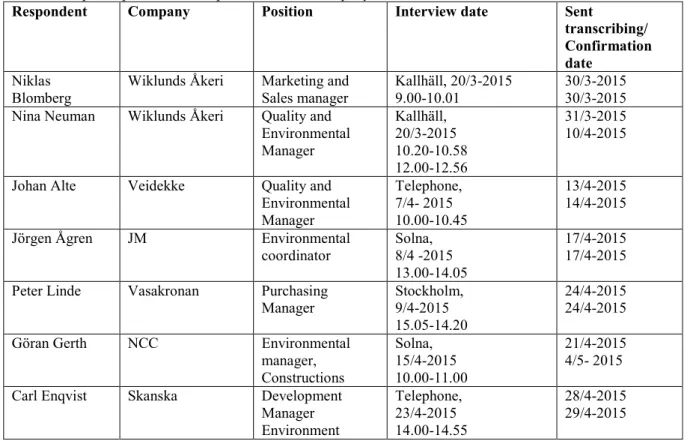
Table 3: The participants and their position at each company
Respondent Company Position Interview date Sent
transcribing/ Confirmation date
Niklas
Blomberg Wiklunds Åkeri Marketing and Sales manager Kallhäll, 20/3-2015 9.00-10.01 30/3-2015 30/3-2015 Nina Neuman Wiklunds Åkeri Quality and
Environmental Manager Kallhäll, 20/3-2015 10.20-10.58 12.00-12.56 31/3-2015 10/4-2015
Johan Alte Veidekke Quality and Environmental Manager Telephone, 7/4- 2015 10.00-10.45 13/4-2015 14/4-2015 Jörgen Ågren JM Environmental
coordinator Solna, 8/4 -2015 13.00-14.05
17/4-2015 17/4-2015 Peter Lin