August 2019 167 Accredited by Directorate General of Strengthening for Research
and Development No: 30/E/KPT/2018
DOI: https://doi.org/10.5398/tasj.2019.42.2.167 Available online at http://journal.ipb.ac.id/index.php/tasj
INTRODUCTION
Broiler farming is increasing in West Sumatera, because it has some advantages compared to the other farms. The advantages of broiler farming include rapid capital turnover, chickens can grow quickly and be harvested in a short time, and have a genetic advan
-tage that is capable of displaying optimal production performance. Broiler meat is much sought after by the consumers compared to other meat such as beef and lamb, because chicken price is relatively cheaper. These advantages are become the attractiveness to the farmers to do the business of broiler farming.
In 1981 the government issued a Presidential Decree number 50 which stipulated that broiler farming was a small-scale business. This regulation was consid
-ered as a failure to encourage the growth of the broiler industry in Indonesia, so the government replaced it with the Presidential Decree number 22 of 1990 which allows large-scale companies to enter the broiler indus
-try with the condition that 65 percent of its production is for export and companies are required to partner with small-scale farmers. After the 1997 financial crisis and
The Impact of Vertical Integration Intensity on Broiler Farms Technical Efficiency:
The Case of Contract Farming in West Sumatera
Hariantoa, N. Kusnadia,*, & D.A. ParamitabaDepartment of Agribusiness, Faculty of Economics and Management, IPB University (Bogor Agricultural University) bDepartment of Resources and Environmental Economics, Faculty of Economics and Management,
IPB University (Bogor Agricultural University) Kampus IPB Darmaga, Bogor 16680, Indonesia *Corresponding author: [email protected]
(Received 03-08-2018; Revised 22-02-2018; Accepted 07-02-2019)
ABSTRACT
Contractual arrangements of different types have increasingly found in West Sumatera not only in subsistence and commercial crops but particularly also in livestock sector. Contract farming in livestock agribusiness is generally defined as broiler farms under an agreement between farmers and a livestock inputs supplier. Within this broad definition, there are different variants of contracts depend
-ing on the formality and intensity of contractual arrangement. This study objective was to prove that the design of a contract, as representation of vertical integration intensity in broiler agribusiness, has different efficiency effects on production. The stochastic frontier production function was used in this study, and employed a regression method to estimate the level of technical efficiency. Data were col
-lected from 87 broiler fattening farms consisted of 50 broiler fattening farms under formal contractual system and 37 broiler fattening farms under informal contractual system. The results showed that farm experience and improvement of the contract system would reduce the level of technical inefficiency of
broiler farms. The study concluded that broiler farms under formal and detail contract farming had
greater technical efficiencies compared to broiler farms under informal unwritten contract arrange
-ment. However, the broiler farms under informal contract obtained higher net returns compared to the
broiler farms under formal contract arrangement.
Keywords: broiler farming; contract-farming; technical efficiency; vertical-integration
broiler farms performances declined, the Presidential Decree of 1990 was revoked and replaced by the Presidential Decree of 2000 which indicated that the government did not interfere with the structure of the livestock industry, but would act as a regulator. Based on data from the Central Bureau of Statistics (BPS), companies that produce parent stock grew from 19 companies in 2000 to 80 companies in 2017 in Indonesia. Conversely, large scale companies showed a tendency to decline from 834 companies in 2000 to only 97 in 2017. In the same period, broiler production in West Sumatera continued to grow from 10.4 million heads to 18.3 mil
-lion heads. This information indicates that large scale companies are increasingly collaborating with small scale farmers to cultivate broilers until they are ready to be harvested and sold to the market.
The development of broiler farms in West Sumatera is more directed to contract farming and become fewer broiler farms with independent status. Contract farm
-ing that exist leads to vertical integration between the companies that provide production inputs and the farmers who use the inputs for broiler. Many studies have been conducted to assess the performance of
168 August 2019
independent broiler farms (for example, Ali & Hossain, 2010; Mendes et al., 2014; Emokaro & Emokpae, 2014;
Carvalho et al., 2015) or contract farming model farms (for example, Begum et al, 2012; Yunus, 2012; Tuan, 2012; Ajao & Oyedele, 2013), or to compare the performance of independent farms and contract farming farms (for example, Todsadee et al., 2012; Mahjoor, 2013; Wainaina
et al., 2014; Gondalia et al., 2017). An in-depth study of 23 research articles conducted by Nguyen et al. (2015) concluded that contract farming has a positive influence on farm productivity and income.
The study objective is to prove that the different designs of contract, that is formal contract farming
compare to informal contract farming as representation
of vertical integration intensity in broiler industry, has different efficiency effects on production. The novelty of this study come out ahead not in the form of compar -ing the performance of independent farms and contract
farming farms, but the novelty lies in how contract farming can have different vertical integrative proper
-ties and these differences have a real effect on broiler farm performance.
METHODS
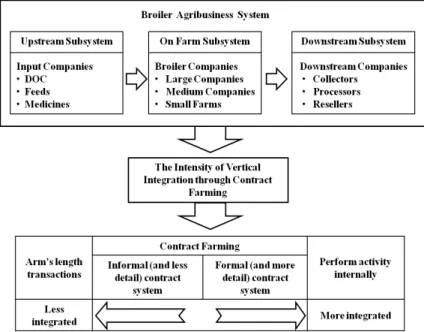
Broiler agribusiness system in Indonesia can be categorized into the subsystem of agribusiness inputs or upstream subsystem, subsystem of broiler farms or on farm subsystem, and subsystem of marketing and pro
-cessing of broiler products or downstream subsystem. Subsystem of agribusiness inputs provides inputs to the broiler farms subsystem.
If the company carries out all activities from down
-stream to up-stream, it means that the company fully performs vertical integration perfectly. Conversely, if the company only runs a business on one subsystem and carries out buying and selling activities with other companies outside the subsystem, the company can
be categorized as carrying out an arm’s length market transaction. However, companies can act in between, namely by employing contract with companies in other subsystems.
Transaction activities that are fully through the market are the lowest intensity of integration. Conversely, companies that carry out their own ac
-tivities from upstream to downstream are the highest intensity of integration. Formal contracts are more directed to the highest intensity of integration, while informal contracts are more towards the lowest intensity of integration. In summary, the conceptual framework employed in this research can be seen in Figure 1.
Broiler agribusiness in West Sumatera gener
-ally engaged in contract farming or otherwise chose to stand as independent farms. The contract was made in accordance with the agreement between the parties to the contract. The scope and content contained in the contract varied depending on the intent and purpose of the cooperation (Oya, 2012). The contract also evolved in the degree of formality (Chaddad & Cook, 2004). In an early of contract farming existed in Indonesia, coop
-eration was carried out without a written contract. Now days, cooperation between the two parties is based on a detail written contract.
In research area there were two categories of con
-tract farming between the livestock inputs companies and broiler farms. The first category was contract farm
-ing with a formal contractual system. The formal con
-tract was formulated in detailed and signed by two con
-tracting parties. The livestock inputs company would provide day old chicken (DOC), chicken feed, vaccine, vitamins, and medicines to broiler farms. In the con
-tract, each item of inputs broken down clearly according to its type and its price. The broiler farm would receive regular guidance and supervision from the company during the fattening period until harvesting. All broiler produced shall be sold to the company provider of pro
-Figure 1. The conceptual framework of the intensity of vertical integration in contract farming of broiler agribusiness (Adaptation from Besanko et al., 2013).
TASJ-1847
533534
Figure 1. The conceptual framework of the intensity of vertical integration in contract 535
farming of broiler agribusiness. 536
(Adaptation from Besanko et al, 2013) 537
538 539
August 2019 169 duction inputs at the price specified in the contract. The
proceeds of the sale were subtracted by all the costs of production inputs provided by the company to come up with broiler farm income.
The second category of contract farming was an informal contract system and without any written docu
-ments to be signed by two contracting parties. The com
-pany would provide all inputs (i.e. DOC, chickens feed, vaccines, vitamins, and medicines) needed by broiler farm through credit scheme. The company supply of inputs to broiler farm at market price was available at the time of transaction take place. The broiler farm must sell the broiler chicken it produced to the company. The selling price of the product corresponded to the market price at the time of sale. The values of proceeds were then deducted by the company according to the amount of loans made by broiler farm.
Hypothesis
Based on the conceptual framework stated above, the hypothesis of this study was that the production technical efficiency of broiler farm under formal contract farming system was greater compared to technical ef
-ficiency under informal contract farming system. Data
The research was conducted in Limapuluh Kota Regency in West Sumatera Province. Site selection was done purposively with the consideration that Limapuluh Kota was the area that has the largest popu
-lation of broiler farms and was the center of broiler pro
-duction in West Sumatera. The data used in this study were the primary data obtained from the questionnaire guided interviews with selected farmers. Primary data collected included data relating to broiler farming busi -ness activities and socio-economic data of respondent
farmers. Data relating to broiler farming activities in
-cluded the quantity and price of inputs used in the pro
-duction (DOC, chicken feed, labor, vaccines, medicines, vitamins, and litter) and the quantity and price of out
-put produced. While the socio-economic data of farm
-ers included age, years of education, broiler farming experience, the number of family members, experience of obtaining guidance, status of broiler farming activi
-ties). This study only recorded the business activities of broiler farms in one production period. The production period data taken was one production period before the interview was conducted, so that the production data provided by broiler farmers were expected to be in the same time period.
The broiler farming respondents were obtained through two step process of sampling method. The first step was to select the livestock inputs companies or in
-puts suppliers purposively based on their willingness to
provide the information regarding the identity of broiler
farm they invited to cooperate with. Two categories of livestock inputs companies or inputs suppliers included in this research. First category was the companies that drew up formal and detailed written agreement in contract farming, that were PT. Jaya Sakti, PT. Multi
Sentosa, and PT. Menara Pratama. The second category was the poultry shop Torang, poultry shop Garuda, and poultry shop without name, that carried out informal and without written contract in contract farming.
The list of identity of broiler farms provided by the
companies and poultry shops became sampling frame for the second step of sampling process. The second step of sampling process was to choose randomly the broiler farms from sampling frame. The study selected 87 broiler farms from sampling frame which composed of 50 broiler farms under formal and written detail contractual system and 37 broiler farms under informal and unwritten contractual system. The number of sam
-pling of 87 broiler farms were expected to represent the population in the sampling frame and sufficient for data analysis of research model.
Research Model and Methods of Analysis The analysis of broiler production function in this study employed stochastic frontier production function. It employed a Cobb-Douglas production function to simultaneously estimate the random disturbance term (vi) which was outside the control of the production unit and the inefficiency effects (ui) as was proposed by Battese et al. (1996). The Cobb-Douglas form is widely used in the analysis of input-output data in the field of agriculture. This is because the function has some well-known properties that justify its wide application in ag
-riculture. It is a homogeneous function that provides a scale factor enabling one to measure the returns to scale and interprets the elasticity coefficients with relative ease. The Cobb-Douglas production function for this study is shown in the following equation:
lnQ= β0 + β1lnX1 + β2lnX2 + β3lnX3 + β4lnX4 + β5lnX5 + β6lnX6 + (vi – ui)
where ln represents the natural logarithm (i.e. to the base e), Q is the weight of broiler chicken produced in one period (kg), X1 is the number of chicken fledgling (DOC) in one period (head), X2 is the amount of feed in
one period (kg), X3 is the value of vaccines in one period (IDR), X4 is the amount of medicines in one period (g),
X5 is the amount of vitamins in one period (g), X6 is
labor employed (person), β0 is intercept or constants, βi is production factor regression coefficient / parameter estimator, where (i = 1,2, ..., 6), and vi - ui is error term (vi
is noise effect, uiis the technical inefficiency effect of the model).
All variables in the model were converted into lo
-gistic forms.
Expected coefficient value β1, β2, β3, β4, β5, β6 > 0, meaning that the result of stochastic frontier produc
-tion func-tion estima-tion gave positive value of all parameters. The positive value of parameter meant that by increasing the amount of day-old chicken (DOC), chicken feed, labor used, vaccines, medicines, vitamins, and vaccines, it would increase the production of broiler chickens.
The stochastic frontier approach produced two con
-ditions simultaneously, that wer the level of technical efficiency and the factors that affected the technical inef
-ficiency of a production process. The level of technical efficiency for each broiler farm was measured through the observation output compared to the stochastic frontier output. The level of technical efficiency for each broiler farm was calculated employing the following formula:
TEi= Qi/ [exp (xi,β)] = exp (-ui)
where TE is technical efficiency of farmer i, Qi is output observed (i = 1, 2, ..., 87), and exp (xi, β) is output esti
-mated (i = 1, 2, ..., 87).
The technical efficiency value was between 0 ≤ TE ≤ 1. The technical efficiency value was inversely related to the technical inefficiency effect value and was only used for functions that had a certain number of outputs and inputs. The farmers’ technical efficiency value was categorized as efficient enough if it was ≥ 0.7 and catego
-rized as inefficient if it was <0.7 (Coelli et al., 2005).
The ui variable was a random variable that de
-scribed technical inefficiency in production and was related to internal factors, the greater the value of ui,
the greater the farming inefficiency of farmers. The inefficiency term u was assumed to follow a half-normal distribution with mean zero and a heteroskedastic variance N (0, σ2
u). The variance of inefficiency was
expected to vary with farm characteristics. Variables farm characteristics included in the model followed previous researches, especially those related to farm production efficiency (Begum et al., 2012; Ali & Hossain, 2010; Akhter, 2008). To determine the distribution of the technical inefficiency effect (ui) of broiler farms and the
factors that influenced it, the model employed in this research was follows:
ui= δ0 + δ1Z1 + δ2Z2 + δ3Z3 + δ4Z4+ δ5D1+ δ6D2 + δ7D3 + ε Where ui is effect of technical efficiency, δ0is constant, Z1
is age (year), Z2 is education (year), Z3 is broiler farming
experience (year), Z4 is number of family members (per
-son), D1 is dummy supervision (D1= 1 there was guid -ance and D1= 0 for no guidance), D2 is dummy broiler farm status (D2= 1 as a main job and D2= 0 as a side job),
D3 is dummy contract system (D3= 1 formal and D3= 0
informal), and ε is residual element (error).
The expected parameters were δ1> 0, whereas δ2,
δ3, δ4, δ5, δ6, δ7 <0. If the predicted parameter was posi
-tive then increasing the value of variable could lead to the increase in technical inefficiency of broiler farms. On the contrary, if the sign of predicted parameter was negative then the increase in the value of variable would decrease the technical inefficiency of the broiler farms. The maximum likelihood estimate (MLE) for all the parameters of the stochastic frontier production func
-tion and the inefficiency model defined above and the technical efficiency was obtained using the Frontier 4.1 computer program (Coelli, 1994) at a confidence level until 20%.
RESULTS
The independent variables employed in the
pro-duction function model included the number day old chicken (DOC), feed, vaccines, medicines, vitamins,
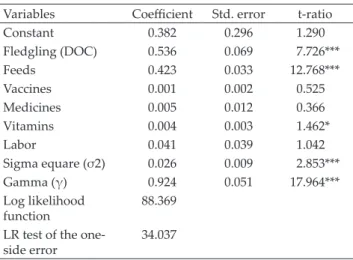
and labor. The dependent variable in the model was the amount of broiler produced in one period of production. The results of maximum likelihood estimates for Cobb Douglas production function of broiler farm are pre
-sented in Table 1. All the coefficients in the production function model were interpreted as elasticity of output produced with respect to inputs (i.e. DOC, feed, vac
-cines, medi-cines, vitamins, and labor), because all vari
-ables in the model were changed into logarithm forms. Table 1 showed that the number of DOC and quantity of feed had positive input elasticity of production 0.536 and 0.423 respectively, and were highly significant. The coefficients on vaccines, medicines, and labor were sta
-tistically insignificant.
Table 1 also provided the results of the maximum likelihood estimator in which the parameters γ and σ2 were parameters in the stochastic frontier analysis
used for hypothesis testing. The value of sigma square (σ2) was 0.0263 and highly significant different from 0.
This indicated a good fit and correctness of the specified distribution assumption of the composite error term. If σ2 = 0 it indicated there was no difference between actual
production (Q) and maximum production possibility (Qfrontier). Thus, from estimated value of σ2 it indicated
that the broiler farms in West Sumatera had not yet 100 percent technically efficient.
The variance ratio of gamma (γ) which was associ
-ated with the variance of technical inefficiency was esti
-mated to be 0.924 with a significance level of 1 percent. This showed that the term error was largely derived from inefficiency (ui) and only a small amount came
from noise (vi). This indicated that 92.4% of the total variation in the production of broiler farms was due to differences in technical efficiency. If the value of γ was near zero, then most of the error term was as a result of noise (vi) such as weather, climate, pests and diseases, etc. not the result of inefficiency. Table 1 also shows the value of the generalized likelihood ratio (LR), that is 34,037. This calculated value of LR value was greater than the value of Kodde & Palm (1986) at a significance level of 1% of 19,384, meaning that the amount of broiler Table 1. The estimated results of stochastic frontier production
function of broiler fattening farms in West Sumatra
Variables Coefficient Std. error t-ratio
Constant 0.382 0.296 1.290 Fledgling (DOC) 0.536 0.069 7.726*** Feeds 0.423 0.033 12.768*** Vaccines 0.001 0.002 0.525 Medicines 0.005 0.012 0.366 Vitamins 0.004 0.003 1.462* Labor 0.041 0.039 1.042 Sigma equare (σ2) 0.026 0.009 2.853*** Gamma (γ) 0.924 0.051 17.964*** Log likelihood function 88.369
LR test of the
one-side error 34.037
August 2019 171 farms production in West Sumatera was influenced by
the technical efficiency as well as technical inefficiency factors.
Table 2 presents the descriptive statistics (mean, minimum, and maximum) of the estimated broiler farms technical efficiency according to contractual sys
-tem categories in West Sumatera. The estimated sample mean of technical efficiency of broiler farms under formal contract system was 0.953, while the mean for broiler farms under informal contract system was 0.790. This finding confirmed the hypotheses of the study that the production technical efficiency of broiler farm under formal contract farming system was higher compared to technical efficiency under informal contract farming system.
The technical inefficiency of broiler farms in West Sumatera was predicted to be influenced by internal fac
-tors of farmers and fac-tors other than inputs production. Table 3 provides the estimated results of the source of technical inefficiency of broiler farms. Results indicated that older farmers were more likely to be less efficient than the younger farmers in managing broiler farms. This finding was similar to the results found by Bahari
et al. (2012) that the increase in age made the technical inefficiency of broiler farms worsen. Older farmer households generally engaged in more than one farm activities or also pursuing more profitable non-farm ac
-tivities. Msuya et al. 2005 showed that younger farmers
in sugarcane production could produce more efficiently than aged farmers. Young and healthy farmers have greater physical ability and longer working time than older ones.
Variable of education or schooling years did not significantly affect the broiler farms efficiency. The lack of different use of improved inputs and tools across the broiler farms might explain why there were no discern
-ible differences among farmers with different levels of education. However, the study indicated, with 20% significant level, that the inefficiency of production decreased as the years of broiler farming experience increased. This result was in line with the study expecta
-tion that learning by doing would increase the efficiency of production. These results implicitly reinforce the results of Burhanuddin’s study (2013) which found that production efficiency was an important indicator that reflected entrepreneurship.
The success of contract farming is certainly not only to be evaluated solely base on the improvement of pro
-duction technical efficiency, but more importantly has to be judged base on its ability to increase farms profitabil
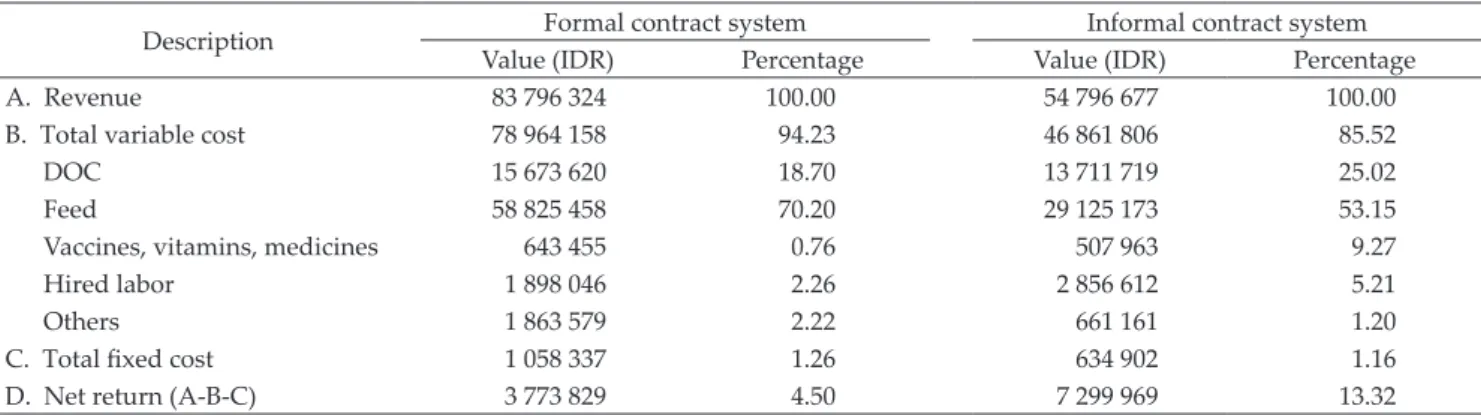
-ity. Table 4 shows that in terms of revenue the broiler farms under formal contract system have higher average revenue than broiler farms under informal contract sys
-tem. Broiler farms in formal contract farming obtained higher revenue because the price incentive given by the company if the farmer was able to produce chickens Table 2. Distribution of technical efficiency level of broiler fat
-tening farms based on contract system category in West Sumatra
Level of technical efficiency
Formal contract
system Informal contract system Frequency Percentage Frequency Percentage
TE < 0.70 0 0 6 16.22 0.70 ≤ TE < 0.80 0 0 13 35.14 0.80 ≤ TE < 0.90 3 6 12 32.43 0.90 ≤ TE ≤ 1.00 47 94 6 16.22 Total 50 100 37 100 Mean TE 0.953 0.790 Maximum TE 0.986 0.975 Minimum TE 0.812 0.608
Table 3. The estimated results of sources of production technical inefficiency of broiler fattening farms in West Sumatra
Variables Coefficient Std. Error t-ratio
Constant 0.380 0.296 1.290 Age 0.096 0.030 3.247*** Education -0.037 0.084 -0.441 Broiler farming experience -0.057 0.042 -1.366* Number of family members 0.006 0.077 0.082 Farming supervision -0.052 0.124 -0.418 Farming status -0.055 0.062 -0.879 Contract system -0.603 0.239 -2.528**
Note: *** significant at 1% level; ** significant at 5% level; ***significant at 20%.
Table 4. Broiler fattening farms profitability under formal and informal contract system base on average scale size of 3000 chickens in West Sumatra
Description Formal contract system Informal contract system
Value (IDR) Percentage Value (IDR) Percentage
A. Revenue 83 796 324 100.00 54 796 677 100.00
B. Total variable cost 78 964 158 94.23 46 861 806 85.52
DOC 15 673 620 18.70 13 711 719 25.02
Feed 58 825 458 70.20 29 125 173 53.15
Vaccines, vitamins, medicines 643 455 0.76 507 963 9.27
Hired labor 1 898 046 2.26 2 856 612 5.21
Others 1 863 579 2.22 661 161 1.20
C. Total fixed cost 1 058 337 1.26 634 902 1.16
with the standard feed conversion ratio (FCR) as speci
-fied in the contract. If the farmer was able to produce chicken better than the standard, the company would give a higher purchase price than that was agreed in the contract.
However, the broiler farms under informal contract system obtained higher net return compared to the broiler farms under formal contract system. Farmers with informal contracting system had a higher flexibility in determining the source of DOC, the type of chicken cage and equipments, feed, vitamins, and medicines. Table 4 shows that the broiler farms under formal con
-tract bear much higher total variable cost compared to the broiler farms under informal contract. The variable cost consists of cost allocated for DOC, feed, vaccines, vitamins, and medicines, hired labor, and litter, and cage heater electricity.
The biggest difference source of total variable cost came from chicken feed. Feed for broilers was divided into three types of feed, namely feed starter, feed grow
-er, and feed finish-er, in accordance with the stage of chicken growth until ready to be harvested. The value of feed used in broiler farms under formal contract was more than twice the feed value used in the broiler farms under informal contract. The higher feed costs in
broiler farms incorporated in formal contract farming
were caused by higher prices of feed. The price of feed in contract farming included the costs for supervision and technical guidance that was periodically provided by the provider input companies at broiler farms loca
-tion. Intensive guidance provided by inputs company or input supplier to broiler farmers not only produced a higher level of efficiency, but also reduced the risk of production. In the formal contract farming, input prices and output prices were also set and agreed before the production process began, so broiler farm also carried a lower price risk than informal contract farming whose inputs and output prices depended on the prices pre
-vailing in the market. The price of feed paid by broiler farmers under formal contract which was relatively higher than broiler farmers under informal contract also reflected the lower risk of production and the lower risk of inputs and outputs prices.
DISCUSSION
The results presented in Table 1 indicate that DOC and feed become the major driver of broiler farms production. The results of this study are consistent with several studies such as Akhter & Rashid (2008); Ohajianya et al. (2013), and Ezeh et al. (2012) where DOC and feed are an influential factor in production. The re
-sults also in line with the research conducted by Pakage
et al. (2014) that revealed the number of DOC was the most influential factor of production of broiler farms with closed house cage system.
Feed was the second most influential variable after DOC in broiler farms in West Sumatera. The results of this study are in accordance with the results reported by Umboh et al. (2014) which state a decrease in feed use because of the increased price of corn causes a decrease in chicken meat production. Livestock growth is deter
-mined by the quantity and quality of feed. Growth or weight gain is also an interaction between feed, genetic potential, and environmental factors. If everything inter
-acts well, then the growth of livestock will be optimal. Variable that also significantly affect the production of broiler farms is vitamins. Although it has a relatively small effect compared to DOC and feed, vitamins are needed in the prevention of disease and to support optimal growth of broiler. The effect of vitamin on the amount of broiler production in this study is relatively lower than the results of the other studies. Udoh & Etim (2009) found that vitamin significantly affected broiler production in Nigeria, with elasticity of 0.34. While Pakage et al. (2014) discovered that medicines and vitamins had positive and significant effects on the production with elasticity value of 0.02, which meant an increase in the use of medicines and vitamins by 10% would increase the amount of broiler production by 0.2%.
Table 2 shows that all the broiler farms under for -mal contract system can be categorized as technically
ef-ficient farms because the level of their efficiency already above 0.70. Meanwhile, in informal contract system category, 16.2% of broiler farms can be categorized as technically inefficient. The range of maximum and mini
-mum technical efficiency level in the broiler farms under informal contract were also larger than in the broiler farms under formal contract system. This indicates that the broiler farms under informal contract system face a greater production risk compare to the broiler farms under formal contract system.
Table 3 also shows clearly that the broiler farms un
-der formal written contract are associated with a higher farm efficiency as are indicated by the negative and significant coefficient. This result confirms the results of analysis of technical efficiency based on production function that the broiler farms under formal contract are more efficient than those under informal contract. The broiler farms under formal contract receive technical assistance from company provider inputs of produc
-tion as well as better access to inputs timely. Poultry companies that have legal entity status and provide formal contracts to farmers can improve farm efficiency compared to poultry shops that do not have legal status. This result is in line with research findings of Resti et al. (2017) in dairy cooperatives in West Bandung Regency, where cooperative institutions that are active and large-scale are able to improve the quality of milk produced
by the farmers compared to less active and small-sized
cooperative institutions.
In formal contract farming systems, broilers farm
-ers receive more intensive technical guidance and the opportunity to have better access to production inputs on timely basis. Begum et al. (2012) and Issa & Chrysostome (2015) explain that contract will provide several benefits for farmers, namely input supply, market access, risks sharing, managerial access, techni
-cal assistance, and production credit. The results of the present study also support the results found by Roopa
et al. (2013) that contract farming contributes to improve productivity of agricultural production. Through formal and detail contract agreement and frequent supervision
August 2019 173 by inputs company or inputs supplier, the broiler farm
-ers may learn more skills and methods of employing input efficiently, record keeping, and the significance of product quality and characteristics.
Table 4 shows the high cost of feed is a major cause of the much smaller profits gain on formal contract farming compared to informal contract farming, al
-though in terms of revenue the formal contract system has higher revenue than the informal contracting sys
-tem. Formal contract farming systems are technically more efficient, but do not guarantee higher returns than informal contract farming systems. Ragasa et al. (2018) found the similar results when examining contract farm
-ing in corn agribusiness in West Ghana. They showed that these schemes led to yield increases. However, on average, the impact of the contract farming schemes on profitability is negative, even when the input diversion is accounted for. Yield increases are not high enough to compensate for higher input requirements. Despite the higher yields, the costs to produce one metric ton of maize under contract farming schemes are higher than on maize farms without contract farming schemes. In West Ghana, the implicit cost of guidance and technical supervision in contract farming apparently also imputed in the cost of feed. Wang et al. (2014) showed that the
contract system had a positive impact on income of
veg-etable farming in Vietnam, but provided a lower level of profit compared to direct selling.
CONCLUSION
The broiler farms under formal contract farming system have greater technical efficiencies compared to broiler farms under informal contract. The average value of technical efficiency of broiler farms under
formal contract is 16 percent higher than broiler farms
under informal contracts. However, net return of the informal contract broiler farms is 48 percent higher compared to net return of broiler farms under formal contract. The higher price of output for formal contract broiler farms is not enough to offset higher price of feed used during the production process compared to feed price paid by broiler farms under informal contract.
CONFLICT OF INTEREST
The authors confirm that there are no conflicts of interest associated with this paper and there has been no financial support for this research that could have influ
-ence its outcome.
REFERENCES
Ajao, A. O. & G. A. Oyedele. 2013. Economic efficiency of contract farming in Oyo state: Experience from British American Tobacco Company. Intl. J. AgriScience 3: 699-707.
Akhter, S. & M. H. A. Rashid. 2008. Comparative efficiency analysis of broiler farming under Aftab Bahumukhti farm limited supervision and farmers’ own manage -ment. Progress. Agric. 19:195-204. https://doi.org/10.3329/ pa.v19i2.16962
Ali, M. S. & M. M. Hossain. 2010. Factors influencing the
performance of farmers in broiler production of Faridpur District in Bangladesh. J. World’s. Poul. Sci. 66: 123-131. https://doi.org/10.1017/S0043933910000127
Todsadee, A., K. Hiroshi, N. Kamol, & Y. Koh-En. 2012. Contract Broiler Farming. American J. Econ. Bus. Adm. 4: 166-171. https://doi.org/10.3844/ajebasp.2012.166.171 Bahari, F. N., M. M. Mustadjab, N. Hanani, & B. A. Nugroho.
2012. Analisis contract farming usaha ayam broiler. Agro. Eco. 30: 109-127. https://doi.org/10.21082/jae. v30n2.2012.109-127
Battese, G.E., S. J. Malik, & M. A. Gill. 1996. An investigation of technical inefficiencies of production of wheat farmers in four districts of Pakistan. J. Agri. Econ. 47:37-49. https:// doi.org/10.1111/j.1477-9552.1996.tb00670.x
Begum, I. A., M. J. Alam, J. Buysee, A. Frija, & G. H.
Huylenbroeck. 2012. Contract farmer and poultry farm ef -ficiency in Bangladesh: A data envelopment analysis. App. Econ. 44: 3737-3747. https://doi.org/10.1080/00036846.2011 .581216
Bellemare, M. F., & L. Novak. 2017. Contract farming and food security. American J. Agri. Econ. 99:357–378.
Besanko, D., D. Dranove, M. Shanley, & S. Schaefer. 2013. Economics of Strategy. 6th ed. John Wiley & Sons, Singapore.
Burhanuddin, Harianto, R. Nurmalina, & R. Pambudy. 2013. The determining factors of entrepreneurial activity in broiler farms. Med. Pet. 36: 230-236. https://doi.org/10.5398/ medpet.2013.36.3.230
Carvalho, E. H., J. B. Zilli, A. S. Mendes, G. M. Morello, & D. V. Bonamigo. 2015. Main factors that affect the economic efficiency of broiler breeder production. Brazilian J. Poul. Sci. 17: 11-16. https://doi.org/10.1590/1516-635x170111-16 Chaddad, F. R. & M. L. Cook. 2004. The economics of organiza
-tion structure changes: A US perspective on demutualiza -tion. Annals of Public and Cooperative Economics75: 575-594. https://doi.org/10.1111/j.1467-8292.2004.00263.x Coelli, T. J. 1994. A Guide to FRONTIER Version 4.1: A
Computer Program for Stochastic Frontier Production and Cost Function Estimation. Department of Econometrics. University of New England (Armidale), England.
Coelli, T. J., D. S. P. Rao, C. J. O’Donnell, & G. E. Battese. 2005. An Introduction to Efficiency and Productivity Analysis. 2nd ed. Springer. New York, NY, United States.
Emokaro, C. O. & O. P. Emokpae. 2014. Technical efficiency and production elasticity of broiler producers in Edo State, Nigeria. App. Trop. Agri. 19: 59–65.
Ezeh, C. I., C. O. Anyiro, & J. A. Chukwu. 2012. Technical ef -ficiency in poultry broiler production in Umuahia Capital Territory of Abia State, Nigeria. Greener J. Agri. Sci. 2:001-007. https://doi.org/10.15580/GJAS.2013.3.1206
Gondalia, V.K., Y.C. Zala, & R.K. Bansal. 2017. Comparative economics of contract and non-contract farming of potato in Gujarat. Econ. Aff. 64: 683-690. https://doi. org/10.5958/0976-4666.2017.00083.3
Issa, N. & N.J. Chrysostome. 2015. Determinants of farmer par -ticipation in the vertical integration of the Rwandan coffee value chain: results from Huye District. J. Agric. Science. 7:197-211. https://doi.org/10.5539/jas.v7n9p197
Kodde, D. A., & F. C. Palm. 1986. Wald criteria for jointly testing equality and inequality restriction. J. Econ. 54:1243-1248. https://doi.org/10.2307/1912331
Mahjoor, A. A. 2013. Technical, allocative and economic ef -ficiencies of broiler farms in Fars Province, Iran: A Data Envelopment Analysis (DEA) approach. World. J. App. Sci. 21: 1427-1435.
Mendes, A. S., D. C. Gudoski, A. F. Cargnelutti, E. J. Silva, E. H. Carvalho, & G. M. Morello. 2014. Factors that impact the financial performance of broiler production in Southern States of Paraná, Brazil. Brazilian. J. Poul. Sci. 16:113-120.
https://doi.org/10.1590/S1516-635X2014000100016
Mwambi, M. M, J. Oduol, P. Mshenga, & M. Saidi. 2016. Does contract farming improve smallholder income? the case of avocado farmers in Kenya. J. Agri. Dev. Emer. Econ. 6: 12-20. https://doi.org/10.1108/JADEE-05-2013-0019 Narayanan, S. 2014. Profits from participation in high value ag
-riculture: evidence of heterogeneous benefits in contract farming schemes in Southern India. Food Policy. 44: 142– 157. https://doi.org/10.1016/j.foodpol.2013.10.010
Nguyen, A.T, J. Dzator, & A. Nadolny. 2015. Does contract farming improve productivity and income of farmers? a review of theory and evidence. J. Dev. Areas. 49: 531-538. https://doi.org/10.1353/jda.2015.0094
Ohajianya, D. O., J. U. Mgbada, P. N. Onu, C. O. Enyia, A.
H. Henri-Ukoha, Ben-N. G. Chendo, & C. C.
Godson-Ibeji. 2013. Technical and economic efficiencies in poul -try production in Imo State, Nigeria. American J. Expe. Agri. 3: 927-938. https://doi.org/10.9734/AJEA/2013/4089 Oya, C. 2012. Contract farming in Sub-Saharan Africa: a survey
of approaches, debates and issues. J. Agra. Change. 12: 1–33. https://doi.org/10.1111/j.1471-0366.2011.00337.x
Pakage S., B. Hartono, Z. Fanani, & B. A. Nugroho. 2014. Analysis of technical efficiency of poultry broiler business with pattern closed house system in Malang-East Java, Indonesia. J. Econ. Sust. Dev. 5: 16-22.
Porter, G. & K. Philips-Howard. 1997. Comparing con -tracts: an evaluation of contract farming schemes in Africa. World. Dev. 25: 227-238. https://doi.org/10.1016/ S0305-750X(96)00101-5
Ragasa, C., I. Lambrecht, & D. S. Kufoalor. 2018. Limitations of contract farming as a pro-poor strategy: the case of maize outgrower schemes in Upper West Ghana. World. Dev. 102: 30-56. https://doi.org/10.1016/j.worlddev.2017.09.008
Resti, Y., R. Baars, M. Verschuur, & G. Duteurtre. 2017. The role of cooperative in the milk value chain in west Bandung Regency, West Java Province. Med. Pet. 40: 210-217. https:// doi.org/10.5398/medpet.2017.40.3.210
Roopa, H.S., N. Nagaraj, & M.G. Chandrakanth. 2013. Comparative economic analysis of baby corn under con -tract and noncon-tract farming in Karnataka. Agri. Econ. Research Rev. 26: 40-50
Tuan, N.P. 2012. Contract farming and its impact on income and livelihood for small-scale farmers: case study in Vietnam’, J. Agribusiness and Rural Dev. 4: 147-166.
Udoh, E. J. & N. A. Etim. 2009. Measurement of farm level ef -ficiency of broiler production in Uyo, Akwa Ibom State, Nigeria. World J. Agri. Sci. 5:832-836.
Umboh, S.J.K., D. B. Hakim, B. M. Sinaga, & I K. Kariyasa. 2014. Impacts of domestic maize price changes on the performance of small-scale broiler farming in Indonesia. Med. Pet. 37:198-205. https://doi.org/10.5398/ medpet.2014.37.3.198
Wainaina, P. W., J. J. Okello, & J. M. Nzuma. 2014. Blessing or evil? contract farming, smallholder poultry production and household welfare in Kenya. J. Inter. Agri. 53: 319-340. Wang, H., P. Moustier & N. T. T. Loc. 2014. Economic impact of
direct marketing and contracts: the case of safe vegetable chains in Northern Vietnam. Food Policy 47: 13-23. https:// doi.org/10.1016/j.foodpol.2014.04.001
Wang, H. H., Y. Wang, & M. S. Delgado. 2014. The transition to modern agriculture: contract farming in developing econ -omies. American J. Agri. Econ. 96: 1257–1271. https://doi. org/10.1093/ajae/aau036
Yunus, I. 2012. Estimation of technical efficiency of broiler pro -duction in Peninsular Malaysia: A stochastic frontier anal -ysis. Journal of Business Management and Accounting 2: 77-96.