Citation: Khan, Faraz (2017) Text Independent Offline Hand Writer Recognition Using Machine Learning. Doctoral thesis, Northumbria University.
This version was downloaded from Northumbria Research Link: http://nrl.northumbria.ac.uk/39471/
Northumbria University has developed Northumbria Research Link (NRL) to enable users to access the University’s research output. Copyright © and moral rights for items on NRL are retained by the individual author(s) and/or other copyright owners. Single copies of full items can be reproduced, displayed or performed, and given to third parties in any format or medium for personal research or study, educational, or not-for-profit purposes without prior permission or charge, provided the authors, title and full bibliographic details are given, as well as a hyperlink and/or URL to the original metadata page. The content must not be changed in any way. Full items must not be sold commercially in any format or medium without formal permission of the copyright holder. The full policy is available online: http://nrl.northumbria.ac.uk/policies.html
Text Independent Offline Hand Writer
Recognition Using Machine Learning
Faraz Ahmad Khan
Department of Computer and Information Sciences
University of Northumbria at Newcastle
This dissertation is submitted for the degree of
Doctor of Philosophy
I would like to dedicate this thesis to my loving family: Masood Ahmed Khan, Dr. Salma Masood Khan, Shireen Fawad, Nayab Faraz, Faizan Ahmad Khan and Zaurayz Ahmad Khan. But my special gratitude goes towards my dear mother and sister, who have always
supported me throughout my hardships. You have always lifted me up with your love and moral support whenever I was feeling down and lost. I am forever indebted to you and no
Declaration
I hereby declare that except where specific reference is made to the work of others, the contents of this dissertation are original and have not been submitted in whole or in part for consider-ation for any other degree or qualificconsider-ation in this, or any other University. This dissertconsider-ation is the result of my own work and includes nothing which is the outcome of work done in collaboration, except where specifically indicated in the text.
Faraz Ahmad Khan 2017
Acknowledgements
If the completion of my doctoral research and thesis is a forest, I am only a tree and, as the popular proverb goes, a tree does not make a forest. I want to use this opportunity to acknowledge the numerous trees that contributed to the growth of this doctoral forest.
First and foremost, my deepest gratitude and thanks go to Allah for enabling me to reach this stage and for helping me throughout the many hardships I faced during my stay in UK. Without His generosity and mercy none of this would have been possible and I would not be the man I am today.
I would also like to extend my gratitude to my supervisors: Dr. Ahmed Bouridane, Dr. Fouad Khelifi and Dr. Muhammad Atif Tahir, who have provided me with valuable support, guidance and encouragement. Through their guidance I was able to achieve many things which I would not have been capable of doing alone. I would also like to thank all my colleagues in Lab F7 with whom I have shared countless memories, which I will always cherish.
I would also like to sincerely acknowledge the scholarship and financial support provided by Northumbria University which allowed me to complete this research.
Abstract
Handwriting is a behavioural biometric that an individual learns and develops over time and automated writer identification systems can be developed by identifying these behavioural as-pects of an individual’s writing style. These writer recognition systems greatly assist forensic experts by facilitating them with semi-automated tools that segment the text, narrow down the search, help with visualization and finally assist in the final identification of an unknown handwritten sample.
Handwriting, as a behavioural characteristic, has been a subject of interest for researchers for many decades and intensive research performed in this field has resulted in the develop-ment of multiple methods and algorithms. However, automated writer identification is still a challenging problem. Difficulties in segmenting text and the deviation of an individual from his or her unique writing style is the reason for ongoing research in this field.
This thesis aims to investigate the problems faced in automated writer identification and propose novel techniques of segmentation and classification that would contribute to the field of writer identification. This has led to four different contributions.
First a novel segmentation algorithm is proposed for segmenting sub-words within hand written Arabic words, the proposed method outperforms the previously used projection profile method. The second proposed method offers a segmentation free multi-scale Local Ternary Pattern Histogram for text independent writer identification. Local ternary patterns are ap-plied at various scales to produce a predictor model for its respective scale while the high dimensionality problem of a multi-scale approach has been tackled with dimensionality re-duction using SR-KDA. The third contribution tackles the problem of writer identification in noisy conditions. A robust offline text independent writer identification system is proposed using Bagged Discrete Cosine Transforms. The proposed system effectively utilizes discrete cosine transform for writer identification while avoiding problems of high dimensionality and memory limitations. Finally, in the fourth contribution a dissimilarity Gaussian mixture model is proposed for describing the contrast between different writers of a dataset. Furthermore, a weighted histogram approach is also proposed that penalizes bad prediction scores with a cost function to significantly enhance the identification rate.
x
List of Publications
Journal Papers
• Faraz Ahmad Khan, Muhammad Atif Tahir, Fouad Khelifi, Ahmed Bouridane, Resheed Almotaeryi - "Robust Off-line Text Independent Writer Identification Using Bagged Discrete Cosine Transform Features", Expert Systems with Applications, 2016.
• Faraz Ahmad Khan, Fouad Khelifi, Muhammad Atif Tahir, Ahmed Bouridane - "Dis-similarity Gaussian Mixture Models for Efficient Offline Handwritten Text-Independent Identification using SIFT and RootSIFT Descriptors", IEEE Transactions on Informa-tion Forensics & Security, 2018.
Conference Papers
• Faraz Ahmad Khan, Ahmed Bouridane, Fouad Khelifi, Resheed Almotaeryi, Sumaya Almaadeed - "Efficient segmentation of sub-words within handwritten Arabic words", Control, Decision and Information Technologies (CoDIT), 2014.
• Faraz Ahmad Khan, Muhammad Atif Tahir, Fouad Khelifi, Ahmed Bouridane - "Offline Text Independent Writer Identification using Ensemble of Multi-Scale Local Ternary Pattern Histograms", European Workshop on Visual Information Processing (EUVIP), 2016.
Contents
Contents xi
List of Figures xv
List of Tables xix
1 Introduction 1
1.1 Background . . . 1
1.2 Biometric Characteristics . . . 2
1.3 Modes of Biometric Recognition . . . 4
1.4 Handwriting as a Biometric Trait . . . 5
1.4.1 Text-dependent vs Text-independent Identification . . . 6
1.4.2 Online vs Offline Writer Identification . . . 6
1.5 Hand Writer Identification Process . . . 7
1.6 Problem Statement . . . 9
1.7 Research Aims and Objectives . . . 10
1.8 Thesis Organization . . . 11
2 Literature Review 15 2.1 Background . . . 15
2.1.1 Identification based on Graphemes . . . 15
2.1.2 Identification based on Characters/Words . . . 19
2.1.3 Identification based on Lines . . . 22
2.1.4 Identification based on Paragraphs/Full Text . . . 23
2.2 Datasets Used . . . 26
2.2.1 IAM Dataset . . . 28
2.2.2 IFN/ENIT Dataset . . . 28
xii Contents
2.2.4 CVL Dataset characters . . . 30
2.2.5 Firemaker Dataset . . . 30
2.2.6 ICDAR2011 Dataset . . . 32
2.3 Conclusion . . . 32
3 Efficient Segmentation of sub-words within Handwritten Arabic Words 35 3.1 Introduction . . . 35
3.2 Proposed System . . . 37
3.3 Experimental Results . . . 42
3.4 Conclusion . . . 45
4 Writer Identification using Ensemble of Multi-Scale Local Ternary Pattern His-tograms 49 4.1 Introduction . . . 49
4.2 Proposed System . . . 51
4.2.1 Multi-Scale Local Ternary Pattern Histograms . . . 51
4.2.2 Spectral Regression Kernel Discriminant Analysis (SR-KDA) . . . . 52
4.2.3 Ensemble of Classifiers using Majority Voting Rule . . . 54
4.3 Experiments and Results . . . 55
4.4 Conclusion . . . 57
5 Robust Off-line Text Independent Writer Identification Using Bagged Discrete Cosine Transform Features 59 5.1 Introduction . . . 59
5.2 Proposed System . . . 61
5.2.1 Kernel Discriminant Analysis with Spectral Regression (SR-KDA) for Dimensionality Reduction . . . 65
5.3 Experiments and Results . . . 68
5.3.1 Extraction of DCT features . . . 68
5.3.2 Comparison of our proposed system with existing work . . . 70
5.3.3 Robustness of the proposed system . . . 73
5.4 Discussion . . . 81
5.5 Conclusion . . . 81
6 New Gaussian Mixture Models for Efficient Offline Handwritten Text-Independent
Contents xiii
6.1 Introduction . . . 83
6.2 Proposed System . . . 84
6.2.1 Word Segmentation . . . 84
6.2.2 Feature Extraction . . . 86
6.2.3 Similarity and Dissimilarity Gaussian Mixture Models . . . 88
6.2.4 Intermediate Prediction Score with the Weighted Histogram . . . 93
6.2.5 Score Fusion . . . 94
6.3 Experimental Results and Analysis . . . 95
6.3.1 Sensitivity to Model Parameters . . . 95
6.3.2 Evaluation of the Score Fusion Method . . . 96
6.3.3 Evaluation of the Weighted Histogram . . . 101
6.3.4 Comparison with Existing Works . . . 101
6.3.5 Discussion . . . 102 6.4 Conclusion . . . 107 7 Conclusion 109 7.1 Summary of Contributions . . . 109 7.2 Future Work . . . 111 References 113
List of Figures
1.1 Verification mode of biometric systems. . . 4
1.2 Identification mode of biometric systems. . . 5
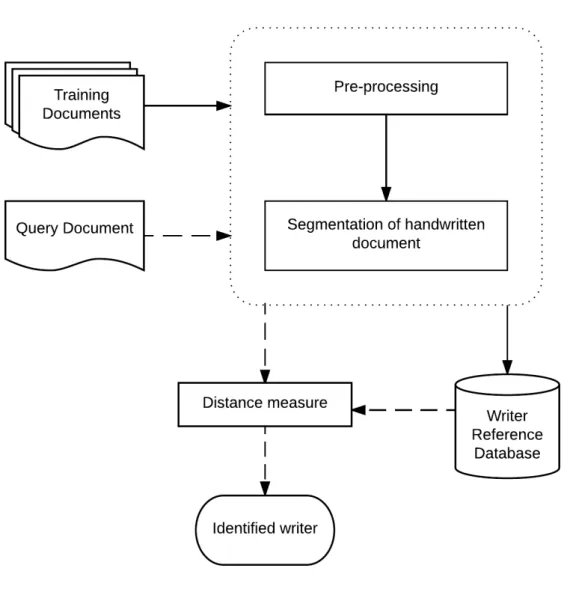
1.3 Training and testing phases of a typical writer identification process. . . 8
1.4 Sample from the CVL database showing effect of pen change on writing style. 10
1.5 Sample from CVL database showing effect of writing conditions on writing style. . . 10
1.6 Thesis Organization. . . 12
2.1 (a) A33 x 33 self-organizing map of CO3 graphemes (Schomaker & Bulacu,
2004). (b) A 15 x 15 self-organizing map of FCO3 graphemes (Schomaker
et al.,2007). . . 16
2.2 Graphemes clustered into writer invariant codebook (Bensefiaet al.,2005a,b). 17
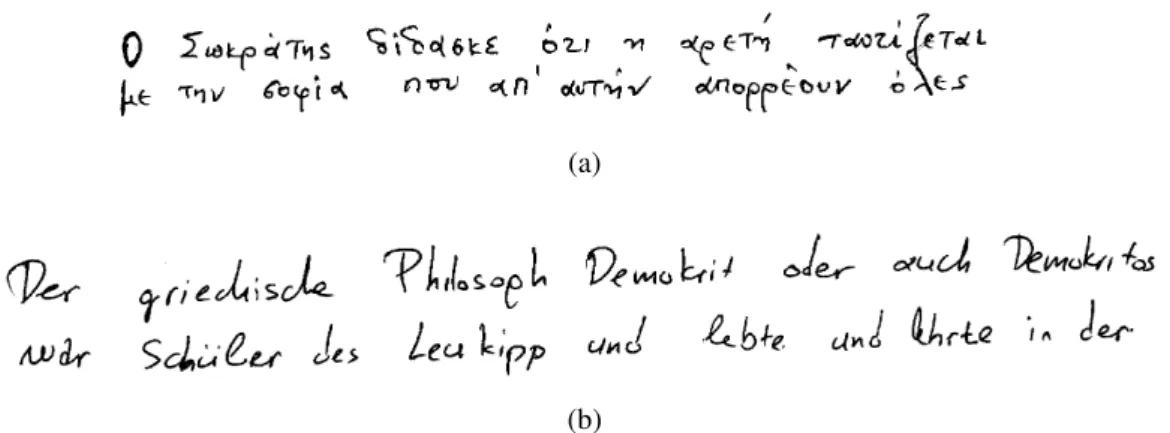
2.3 Samples of handwritten text from IAM dataset written by different writers. . 29
2.4 Samples of handwritten text from IFN/ENIT dataset written by different writers.
29
2.5 Samples of handwritten text from AHTID/MW dataset written by different writers. . . 30
2.6 Samples of handwritten text from the CVL dataset written by different writers. 31
2.7 Samples of handwritten text from the Firemaker dataset written by different writers. . . 31
2.8 Samples of handwritten text from the ICDAR2011 dataset written by different writers. . . 32
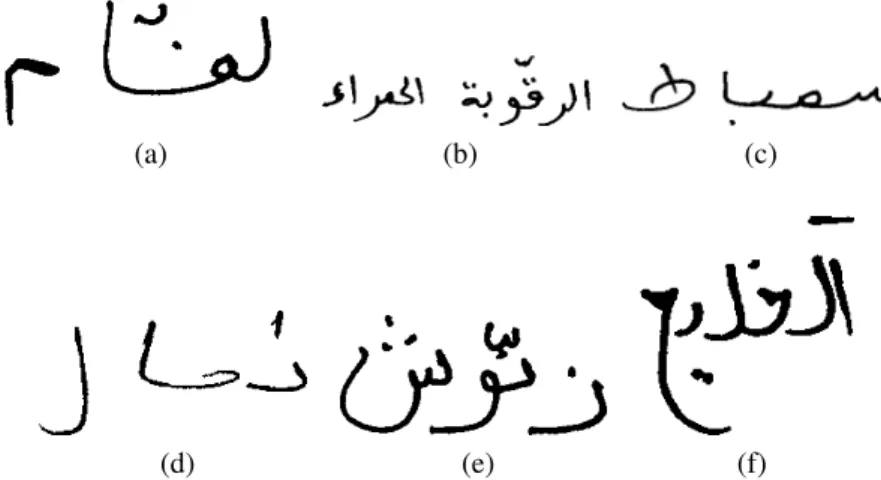
3.1 An Arabic letter written differently based on its position within the word (Mezghaniet al.,2012). . . 35
3.2 Overlapping of characters in Arabic words . . . 37
xvi List of Figures
3.4 Connected components at a single threshold . . . 39
3.5 Clusters representing sub-words . . . 40
3.6 Overlapping of clusters in the same area region . . . 40
3.7 Clusters merged together. Lowest clusters represent diacritics, higher clusters represent sub-words . . . 41
3.8 Normal distribution curve representing a cluster. The filled area represents the 95% confidence interval, whose limits are calculated using equation3.5 . . . 42
3.9 Successful segmentation of the sub-words using proposed method. All hidden and occluded sub-words are detected . . . 43
3.10 Sub-words considered as diacritics. Detected subwords are labeled with red circles . . . 44
3.11 Segmentation of sub-words based on projection profile method. The hidden or occluded sub-words are not detected here . . . 45
3.12 Accuracy of the proposed method compared with the projection profile method used previously . . . 46
3.13 Successful segmentation in the presence of noise. (a) and (b) represent the original image, (c) and (d) represent the noisy segmented images . . . 46
4.1 (a) Original image. (b) LTP atR=3. (c) LTP atR=6. (d) LTP atR=9. . . 50
4.2 An example of the LTP encoding procedure for a 3×3 block. . . 52
4.3 Classification of a query document via majority voting. . . 54
4.4 Comparison of the Top 1 accuracy achieved on the IAM dataset with different values ofR. . . 56
5.1 Reconstructed blocks with fewer DCT coefficients. (a) original block. (b) reconstruction of (a) with 2500 DCT coefficients. (c) original block. (d) re-construction of (c) with 2500 coefficients. . . 60
5.2 Multiple codebook generation with random feature selection. L=number of images,M=number of models,(L>>M) . . . 63
5.3 Training phase - SR-KDA predictor modeliis generated for codebooki. . . 64
5.4 Testing phase of the proposed system. . . 66
5.5 Comparison of Top 1 accuracy based on block size. . . 68
5.6 Zig-zag extraction of the DCT coefficients. . . 69
5.7 (a)An image sample from the IAM dataset (b) One of the words extracted from the line (c) The word divided into overlapping blocks of size 32 x 32. . . 70
List of Figures xvii
5.9 Comparison of the Top 1 accuracy of the IAM dataset based on number of predictor models. . . 71
5.10 Comparison of the Top 1 accuracy of the CVL dataset based on number of predictor models. . . 72
5.11 Comparison of the Top 1 accuracy of the AHTID/MW dataset based on num-ber of predictor models. . . 72
5.12 Comparison of the Top 1 accuracy of the IFN/ENIT dataset based on number of predictor models. . . 73
5.13 Gaussian blurring applied to a sample of text from the IAM dataset. (a) Ori-ginal image. (b) Gaussian filter with standard deviation of 2. (c) Gaussian filter with standard deviation of 3. (d) Gaussian filter with standard deviation of 4. (e) Gaussian filter with standard deviation of 5. . . 75
5.14 Salt & pepper noise applied to a sample of text from the IAM dataset. (a) Original image. (b) Salt & pepper with a noise density of 0.1. (c) Salt & pepper with a noise density of 0.2. (d) Salt & pepper with a noise density of 0.25. (e) Salt & pepper with a noise density of 0.3. . . 76
5.15 Comparison of the drop in accuracy observed for the IAM dataset subjected to Gaussian blurring with incrementally increasing standard deviation. . . 79
5.16 Comparison of the drop in accuracy observed for the IAM dataset subjected to salt & pepper noise with incrementally increasing noise density. . . 80
5.17 Comparison of the drop in accuracy observed for the AHTID/MW dataset sub-jected to Gaussian blurring with incrementally increasing standard deviation. 80
5.18 Comparison of the drop in accuracy observed for the AHTID/MW dataset subjected to salt & pepper noise with incrementally increasing noise density. 80
6.1 SGMM and DGMM generation for writerj. . . 84
6.2 (a) SIFT feature extraction on an unsegmented document from the Firemaker dataset showing invalid keypoints. (b) (c) (d) (e) Only valid SIFT keypoints extracted after word segmentation. . . 85
6.3 Segmentation and word extraction procedure. (a) An image from the IAM dataset in it’s original form. (b) The same image after being subjected to binarization and morphological closing. (c) (d) (e) The extracted words. . . . 86
6.4 Divergence between the writers of the AHTID/MW dataset in RootSIFT . . 90
6.5 Divergence between the writers of the AHTID/MW dataset in SIFT . . . 91
List of Tables
2.1 An overview of the different datasets available for hand writer recognition. . 27
4.1 Comparison of the proposed system with the state of the art systems for the IAM dataset. . . 56
4.2 Comparison of the proposed system with the state of the art systems for the AHTID/MW dataset. . . 56
5.1 Accuracy comparison of the proposed system with the state of the art systems in writer identification for the IAM dataset. . . 74
5.2 Accuracy comparison of the proposed system with the state of the art systems in writer identification for the CVL dataset. . . 74
5.3 Accuracy comparison of the proposed system with the state of the art systems in writer identification for the AHTID/MW dataset. . . 74
5.4 Accuracy comparison of the proposed system with the state of the art systems in writer identification for the IFN/ENIT dataset. . . 75
5.5 Comparison of reported accuracy of published works against our implement-ation of the same. . . 77
5.6 Drop in Top 1 accuracy observed for the IAM dataset subjected to Gaussian blurring when compared to the results achieved with the noiseless version of the dataset. . . 78
5.7 Drop in Top 1 accuracy observed for the IAM dataset subjected to salt & pepper noise when compared to the results achieved with the noiseless version of the dataset. . . 78
5.8 Drop in Top 1 accuracy observed for the AHTID/MW dataset subjected to Gaussian blurring when compared to the results achieved with the noiseless version of the dataset. . . 79
xx List of Tables
5.9 Drop in Top 1 accuracy observed for the AHTID/MW dataset subjected to salt & pepper noise when compared to the results achieved with the noiseless version of the dataset. . . 79
6.1 Comparison of Top 1 accuracy achieved (in percentage) on the IAM dataset using all models at varying Gaussians. . . 96
6.2 Comparison of Top 1 accuracy achieved (in percentage) on the IFN/ENIT dataset using all models at varying Gaussians. . . 96
6.3 Comparison of Top 1 accuracy achieved (in percentage) on the AHTID/MW dataset using all models at varying Gaussians. . . 97
6.4 Comparison of Top 1 accuracy achieved (in percentage) on the CVL dataset using all models at varying Gaussians. . . 97
6.5 Comparison of Top 1 accuracy achieved (in percentage) on the Firemaker data-set using all models at varying Gaussians. . . 97
6.6 Comparison of Top 1 accuracy achieved (in percentage) on the ICDAR2011 dataset using all models at varying Gaussians. . . 98
6.7 Top 1 accuracy achieved (in percentage) on the IAM dataset with varying number of Gaussians for the SIFT and RootSIFT features. . . 98
6.8 Top 1 accuracy achieved (in percentage) on the IFN/ENIT dataset with varying number of Gaussians for the SIFT and RootSIFT features. . . 98
6.9 Top 1 accuracy achieved (in percentage) on the AHTID/MW dataset with varying number of Gaussians for the SIFT and RootSIFT features. . . 99
6.10 Top 1 accuracy achieved (in percentage) on the CVL dataset with varying number of Gaussians for the SIFT and RootSIFT features. . . 99
6.11 Top 1 accuracy achieved (in percentage) on the Firemaker dataset with varying number of Gaussians for the SIFT and RootSIFT features. . . 99
6.12 Top 1 accuracy achieved (in percentage) on the ICDAR2011 dataset with vary-ing number of Gaussians for the SIFT and RootSIFT features. . . 100
6.13 Comparison of Top 1 accuracy achieved (in percentage) using SGMM/DGMM models and the proposed score fusion approach. . . 100
6.14 Top 1 accuracy achieved (in percentage) on all datasets using proposed weighted histogram-based approach versus the averaging of scores approach. . . 101
6.15 Accuracy comparison of the proposed system with the state of the art systems in writer identification for the IAM dataset. . . 103
List of Tables xxi
6.16 Accuracy comparison of the proposed system with the state of the art systems in writer identification for the IFN/ENIT dataset. . . 104
6.17 Accuracy comparison of the proposed system with the state of the art systems in writer identification for the AHTID/MW dataset. . . 104
6.18 Accuracy comparison of the proposed system with the state of the art systems in writer identification for the CVL dataset. . . 105
6.19 Accuracy comparison of the proposed system with the state of the art systems in writer identification for the Firemaker dataset. . . 105
6.20 Accuracy comparison of the proposed system with the state of the art systems in writer identification for the ICDAR2011 dataset. . . 106
Nomenclature
Acronyms / Abbreviations
BDCT Bagged Discrete Cosine Transform
CC Connected Component
DCT Discrete Cosine Transform
DGMM Dissimilarity Gaussian Mixture Model
DoG Difference of Gaussians
FRG Feature Relation Graph
GMM Gaussian Mixture Model
HMM Hidden Markov Model
HoG Histogram of Oriented Gradients
KDA Kernerl Discriminant Analysis
LBP Local Binary Pattern
LCS Longest Common Subsequence
LDA Linear Discriminant Analysis
LPQ Local Phase Quantization
LTP Local Ternary Pattern
MLTPH Multi-scale Local Ternary Pattern Histogram
xxiv Nomenclature
SGMM Similarity Gaussian Mixture Model
SIFT Scale Invariant Feature Transform
SOM Self Organizing Map
SR-KDA Kernel Discriminant Analysis using Spectral Regression
Chapter 1
Introduction
1.1
Background
The term ’biometrics’ originates from the Greek words; ’bios’ and ’metron’ meaning life and measurement respectively. Therefore, in a broad sense biometrics can be seen as a measure-ment of a human’s body characteristics (Rieraet al.,2009). According to this basic definition, biometrics has been applied in many fields such as pharmacy, biology, engineering, agriculture and medicine to study biological behaviours with the help of statistical methods. However, by the second half of the 20th century and with the development of advanced technological meth-ods, biometrics was given a new meaning. In today’s research, the term biometrics refers to a method that automatically analyses behavioural and physiological characteristics of a human in order to recognize that person or distinguish that person from another (Gracia,2006).
Over the last few decades, biometrics has also acquired a new meaning where rather than focusing on the technique of measurement, the characteristic to be measured is focused on. Hence, biometrics is also defined as a unique and measurable characteristic of a human being that would help to automatically identify an individual.
The main task of any identity management system is to determine or verify an individual’s claimed identity. Such a system is necessary to prevent imposters from accessing resources that are not intended for them and thereby rightfully protected. Traditional methods of estab-lishing or verifying an individuals identity involves knowledge based systems such as pass-words or token based systems such as ID cards, however the problem with such traditional forms of ID is that they can be easily manipulated, lost or stolen. Such risks of compromising an identity management system do not exist with biometric authentication systems. Biometric recognition systems can actually establish the identity of an individual based on who he or she is rather than what he or she remembers or possesses. Biometric systems also offer the
addi-2 Introduction
tional advantage of negative recognition, something that is not offered by password and token systems. Negative recognition is the process of establishing whether an individual is already enrolled in the system even though the individual might deny this. Negative recognition is of great importance in welfare or benefits disbursement systems where an individual might try to claim multiple benefits under different identities.
Biometric systems rely on a variety of behavioural and physiological characteristics or traits to establish the identity of an individual. Some systems supplement behavioural traits with physiological traits to produce an extra level of security. Both of these traits are defined briefly below.
Physiological Characteristics
These refer to the physical traits of an individual defined as the measurements of the physical parameters of a specific part of a human body. Physiological characteristics can be captured from finger prints, palm prints, knuckle prints, retina scanning, facial features etc.
Behavioural Characteristics
Behavioural characteristics are related to the behaviour of a human being or in other words how an individual uses his or her body. Behavioural characteristics, although not as strong as physiological characteristics, do provide some advantages. They are non obtrusive and can therefore be collected without the knowledge or consent of the subject. Furthermore, they usually do not require any special equipment of hardware and are therefore comparatively more cost effective (Yampolskiy & Govindaraju,2008).
1.2
Biometric Characteristics
A characteristic can be physical or behavioural, something that is measurable, and through which the identity of a person can be known or verified. It is essential that these characteristics are intrinsic in nature and may involve what a person does or is. Jain et al. Jainet al.(2006), recommended seven factors by which the suitability of a biometric trait can be established.
Measurability
It should be possible to collect and digitize a biometric trait and it’s collection should not cause any undue inconvenience to the individual. Furthermore, the data acquired should be processable such that features can be extracted from it.
1.2 Biometric Characteristics 3
Permanence
For the characteristic being measured to be reliable, it must be quantifiable and relatively static. Traits being measured must be stable enough so that passage of time, environmental conditions and age do not bring about significant changes in them.
Universality
Every member of the relevant population must be able to provide the biometric being measured and it should also be in a form that can be conveniently collected.
Uniqueness
In biometrics recognition, it is essential that when a characteristic is selected through which an individual may be identified, it must be completely unique. It must have no equal and therefore be the only one in existence. Selection of such a characteristic is key to successfully determine and/or verify the identity of an individual (Jainet al.,2004).
Performance
The resources required to achieve the target recognition accuracy must be within the con-straints set by the system. Furthermore, the system should be capable of responding to queries promptly with acceptable accuracy (Ashbourn,2014).
Acceptability
The population that will utilize the biometric system must accept the system and be willing to present their biometric traits to that system. If the users are not comfortable with the device or sensor being used, they will avoid using it.
Circumvention
It should not be fairly easy to find a “way around” the system. The biometric traits collected should not be easily imitated or mimicked.
All of the above mentioned criteria constitute the characteristics of a very strong biometric. However, it is accepted that no single biometric modality will meet every single one of the criteria mentioned above, but for a biometric system to be acceptable and practical, it should at least be appropriate for its intended application (Impedovo & Pirlo,2008;Jainet al.,2006).
4 Introduction
Figure 1.1: Verification mode of biometric systems.
1.3
Modes of Biometric Recognition
A biometric recognition system works in the same way as a pattern recognition counterpart i.e. an individual’s biometric data is first collected, features are extracted from the acquired data finally these features are compared against a known database. Depending on the application, biometric systems may operate in verification/authentication or identification mode.
Verification or Authentication mode
Authentication comes from the Greek word ’authentes’ which means author. Biometric veri-fication systems aim to prove the identity claimed by an individual. In this mode, the system compares the captured biometric data of a person with his or her own given biometric tem-plate already available on the system. Verification comparisons are carried out on a one-to-one basis, where the system compares the given biometric data to a specific template on the system in order to verify the claimed identity. In this case, the system answers the question, “Does the provided biometric data match that of subject X”? This mode is mostly used in positive recognition systems where the objective is to prevent people from using the same identity. A diagram of a verification process is shown in Figure1.1.
Identification mode
Identification comes from the Latin words ’idem-facere’ which means ’to make the same’. In this mode, the system tries to determine the identity of an individual without any previous claim about their identity. This mode performs a one-to-many comparison as the captured biometric data is compared with that of all the available subjects in the database. Therefore, identification biometric systems try to answer the question, “To whom does the provided bio-metric data belong to”? The identification mode of biobio-metric systems is crucial in negative
1.4 Handwriting as a Biometric Trait 5
Figure 1.2: Identification mode of biometric systems.
recognition systems, where the aim is to prevent a single individual from using multiple iden-tities. The identification process is shown in Figure1.2.
1.4
Handwriting as a Biometric Trait
Handwriting is a behavioural biometric that a human learns and develops over time. It involves coordination between the hands (motor effectors controlled by the brain) and the eyes (feed-back receptors to the brain). This coordination allows humans to generate complex ink shapes and sequences. Handwriting biometrics is the science of identifying this behavioural aspect of an individual’s writing style and using it to develop writer recognition systems. Handwriting, as a behavioural characteristic, has been a subject of interest for researchers for many decades. This interest is spread over a variety of fields that have a collected interest in the handwriting of an individual. Examples include forensic experts, psychologists, palaeographers as some of the few. Writer identification has also been used in domains such as forensic analysis ( Tapi-adoret al.,2004), analysis of historical documents (Fornéset al., 2008;Forneset al.,2009) and security (Ballardet al.,2006). Furthermore hand writer identification is also used in fields such as verifying the authenticity of financial documents, wills including in criminal investig-ations where a piece of handwriting is the only piece of evidence available to the police, such as in case of ransom notes. Hand writer recognition algorithms aim to make the task of the forensic experts much easier by facilitating them with semi-automated tools that segment the text, narrow down the search, help with visualization and finally assist in the final identifica-tion of an unknown handwritten sample. These techniques are expected to produce a list of predicted authors of the unknown text sample, ranked in terms of confidence measure from which the forensic expert will make the final decision (Fiel & Sablatnig,2012). This supports
6 Introduction
the forensic experts as they are no longer required to manually go through every image in huge databases but rather they can make their decision from a small list of writers that are predicted by the algorithm.
The process of identifying an individual based on his or her handwriting may be as old as handwriting itself. Handwriting can be used as a reliable identification tool is of great value to the law and justice enforcement agencies. Along with other forms of evidence, such as DNA, fingerprints and material analysis, handwriting is also recognized as a valid and admissible form of evidence in the court of law for Questioned Document Examiners (QDE) or Forensic Document Examiners (FDE) (Davis,2007;Jainet al.,2002;Srihariet al.,2002).
Handwriting is considered to be a useful and valid biometric as it has shown to meet the criteria outlined in Section1.2. It is universal, as in terms of practicality it is considered that a population is capable of handwriting and have also previously produced written documents. It is unique to every individual as demonstrated by (Srihariet al.,2002) and (Aroraet al.,2002). Furthermore, it is also stable throughout the life of an individual. (Walton,1997) observed that although ageing and the physical conditions associated with ageing do have some impact on the handwriting process, they are not enough to prevent or affect the process of identification.
1.4.1
Text-dependent vs Text-independent Identification
The challenge of automatic hand writer identification can be divided into either a text depend-ent or a text independdepend-ent approach (Namboodiri & Gupta,2006). In text dependent approaches the identity of the writer is determined using a specific transcript and usually the writer is asked to reproduce a sample of text. In such systems the availability of the writer is assumed. One example of text dependent systems is that of signature identification systems (Jainet al.,
2002).
Text independent systems, on the other hand, aim to identify a writer regardless of the written text. Generally, text dependent systems are more accurate but since they assume the exact same text to be reproduced for accurate identification along with the availability of the writer, they are not always practical. Text independent systems, on the other hand, are more practical as they do not depend on the exact same content but on the other hand do require a large amount of data from every writer in order to properly train the system.
1.4.2
Online vs Offline Writer Identification
Online writer identification involves automatic processing of the text while it is being written using a stylus and tablet or a digitizer pen. This allows the system to have access to a set of
1.5 Hand Writer Identification Process 7
additional dynamic features such as the slant of the pen, it’s speed and acceleration, pressure on the tip etc. (Li & Tan,2009;Yanget al.,2016).
On the other hand, offline writer identification does not have the luxury of working with such an abundance of information but only relies on the scanned static images available to it. Consequently, a lot of research in offline writer identification has been focused around identification and extraction of new features from the scanned ink traces available. Online writer identification has a very high accuracy rate due to the additional information available to it and is generally considered much superior to it’s offline counterpart systems.
1.5
Hand Writer Identification Process
A writer identification process can be divided into four stages: image acquisition, pre-processing, feature extraction and classification as shown in Figure1.3.
Image Acquisition
The main goal of this step is to digitize the handwritten documents. For the identification to be effective, it is important that the images acquired at this stage are of an acceptable quality as pre-processing and feature extraction do not work well or even at times fail to work on low quality and noisy images. The tools usually used for this step are either a digital camera or a scanner. The images are usually scanned in at more than 300 dpi as images lower than 300 dpi are considered to be of low quality.
Pre-processing
The majority of handwritten identification algorithms require an effective pre-processing of the acquired documents. The pre-processing stage performs many corrections (if needed) to the acquired images, such as skew correction, space normalization, smoothing, thinning, binarization, padding, region of interest selection, words or connected component extraction and so on. These pre-processing tasks help to improve the final result of the identification system.
Feature Extraction
In its raw image format, there is usually far too much information available for the purpose of writer identification and most of that information is not even relevant and therefore useless for
8 Introduction
1.6 Problem Statement 9
the task at hand. This stage therefore, involves determining and then extracting features from the images which serve as useful identifiers for the classification stage. These identifiers are known as features and effective features are those that are able to identify the class to which it belongs with a high degree of confidence.
Classification
In the classification stage, the extracted set of features are analysed in order to determine which class they belong to. In the case of writer identification, each class is an individual writer hav-ing its own unique handwrithav-ing with a unique pattern of features. This process of attributhav-ing an unknown set of features to a class is known as classification. In terms of classification, the features that are extracted to represent a sample are known as it’s feature space, and the measurement of these features with respect to other samples are known as feature vectors. Therefore, the distance between feature vectors represent their similarity. Feature vectors be-longing to the same class would be close together with small distance, whereas different class feature vectors would be far apart with large distance.
1.6
Problem Statement
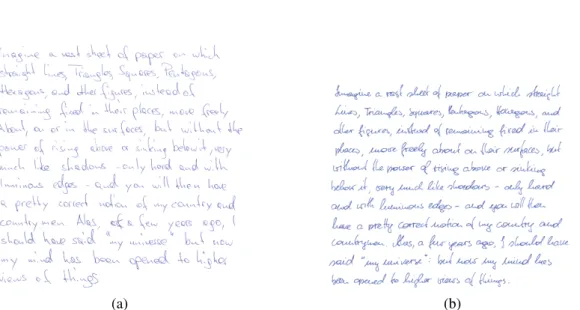
Writer identification research is based on the hypothesis that every individual has a unique writing style that is consistent throughout their life and also that their unique writing style is distinguishable from the writing style of another individual. This hypothesis was verified by (Aroraet al.,2002) where the authors obtained handwriting samples from 1500 individuals of varying gender, race and age. Global feature extraction was used along with machine learning to verify this hypothesis. However, it has also been known that at times a person will write in a style that deviates from his or her unique writing style. This is attributed to a number of reasons such as the type of pen used to write the text and also the condition in which the writer is writing. Figure1.4, which is a sample from the CVL database (Kleberet al.,2013) shows the effect of change of pen on an individuals writing style. It can be seen that the writer changed their pen mid-document and with it the writing style also got affected. Similarly, Figure1.5 (another writer from the CVL database) shows the effect of change of condition during writing such as text written in a hurry or if the writer seated or standing. It can clearly be seen in Figure 1.5 that the writing style of the writer changed mid-document, it appears that the changed text was written in a rushed condition. These problems are the reason for continued research in this field and also the main challenges faced by researchers (Fiel &
10 Introduction
Figure 1.4: Sample from the CVL database showing effect of pen change on writing style.
Figure 1.5: Sample from CVL database showing effect of writing conditions on writing style.
Sablatnig,2013).
1.7
Research Aims and Objectives
This thesis aims to investigate novel techniques of feature extraction and classification in the field of writer identification. The main objective of this thesis is to investigate and further develop techniques of segmentation and classification that would contribute to the field of writer identification. The aims and objectives of this research can be summarized as as follows: • To develop a new segmentation algorithm that would help to effectively segment
sub-1.8 Thesis Organization 11
words in hand written Arabic text.
• To investigate the concept of multi-scale feature extraction at a textural/global level for use in writer identification.
• To develop a robust writer identification system that can be used by forensic analysts to analyse noisy and distorted documents.
• To propose a writer identification system that effectively combines different features for improved identification performance.
• To investigate a dissimilarity model framework for writer identification. The dissim-ilarity framework should further improve identification results by producing a strong contrast between correct and incorrect classifications.
1.8
Thesis Organization
This thesis consists of 7 chapters in total, the organization of which is shown in Figure1.6. The contents of every chapter are summarized below:
Chapter2 discusses previously published systems in writer identification. An emphasis on offline systems has been made although some notable online identification systems have also been reviewed. The works are organized based on the level of feature extraction performed for their respective systems.
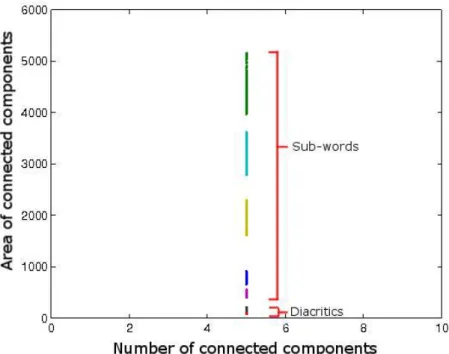
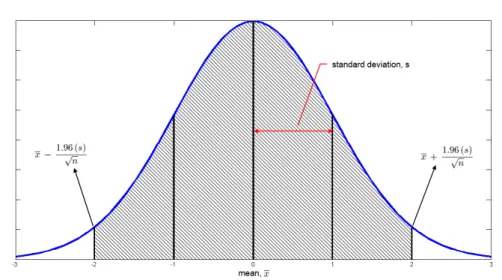
Chapter 3 identifies the problem of segmentation of characters within Arabic words and proposes a novel method of segmenting sub-words in hand written Arabic text. The pre-processing step of binarization is exploited to generate clusters for every character within a word. These clusters are then automatically extracted using the central limit theorem.
Chapter4. reports a segmentation free multi-scale local ternary pattern histogram (MLTPH) for offline text independent writer identification. Local Ternary Patterns (LTP) have been ap-plied at various scales to produce a predictor model for its respective scale whereas, high dimensionality due to the multi-scale approach has been tackled by using SR-KDA for dimen-sionality reduction.
12 Introduction
1.8 Thesis Organization 13
Chapter5 proposes a robust offline text independent writer identification system that can be used by forensic analysts in noisy conditions. A Bagged Discrete Cosine Transform (BDCT) approach has been proposed so that DCT can be utilized effectively for the purpose of writer identification without having to face problems such as memory limitations and dimensionality problems.
Chapter6 presents an efficient handwriting identification system that combines SIFT and RootSIFT descriptors in a set of Gaussian mixture models (GMM). In particular, a new concept of similarity and dissimilarity Gaussian mixture models (SGMM and DGMM) is in-troduced. While a SGMM is constructed for every writer to describe the intra-class similarity that is exhibited between the handwritten texts of the same writer, the DGMM represents the contrast that exists between the writer’s style on one hand and other different handwriting styles on the other hand. Furthermore, a new weighted histogram method is proposed to derive an intermediate prediction score for each writer’s GMM.
Chapter7 summarizes the main contributions made and also details the conclusions drawn from the work done in this thesis. Recommendations for possible future work are also presen-ted.
Chapter 2
Literature Review
2.1
Background
The identification of subjects based on their handwriting is an active area of research. The challenges posed by the difficult problems encountered in this field have lead to many the advancements in pattern recognition and computer vision. Over the last two decades, con-siderable advancements have been made in the field of writer identification in a variety of languages. Along with multi-script systems, a lot of work has gone into developing language specific writer identification as well, since each language brings with it its own unique chal-lenges depending on the characteristics of its writing style.
A detailed survey in the field of writer identification can be found in the works done by (Chen, 2012) and (Sreeraj & Idicula, 2011). In the following sections, we perform a brief survey focusing mainly on offline hand writer identification approaches. The survey is or-ganized based on the text component used for extracting writer discriminatory features i.e. characters/graphemes, words, lines or paragraph/page level identification.
2.1.1
Identification based on Graphemes
Rather than focusing on an entire script containing alpha-numeric characters, (Leedham & Chachra,2003) proposed a writer identification algorithm by considering only on the ten hand-written digits. Features such as height, width, area, centre of gravity, junctions, endpoints and degree of roundness were extracted from the handwritten digits. Hamming distance was used as the distance measure to identify the writers. They achieved an accuracy of 95% on a data-base of 15 writers who contributed random strings of digits from 0 to 9.
16 Literature Review
(a) (b)
Figure 2.1: (a) A 33 x 33 self-organizing map of CO3 graphemes (Schomaker & Bulacu,
2004). (b) A15 x 15self-organizing map of FCO3 graphemes (Schomakeret al.,2007). (Schomaker & Bulacu, 2004) proposed a new feature in upper-case western handwriting called Connected-Component Contours (CO3). This feature was used to construct a universal codebook using the Kohonen self-organizing map (SOM). By using the codebook, a descriptor can be computed for each text image based on the occurrence histogram of its corresponding CO3. In order to enhance the identification performance, the authors also combined CO3 with another edge-based feature describing the angle of edges in a histogram. A variant of CO3, called Fragmented Connected Component Contours (FCO3) was also proposed by Schomaker et al. in (Schomaker et al., 2004) and (Schomaker et al., 2007). Investigating codebook generation for writer identification, (Bulacu & Schomaker, 2005) have shown that the K-means clustering technique can also be used for generating the code-book as the performance offered was very close to the one obtained with the Kohonen self-organising map. Recently, FCO3 have also been adopted by (Khalifaet al., 2015) with a multiple codebook approach where the codebook for every writer was divided into 12 sub-codebooks. These multiple codebooks were then used to represent every writer. It was demonstrated that using multiple codebooks to represent every writer produced better results than by using a single codebook approach.
(Van Der Maaten & Postma, 2005) utilized a statistical approach and a model based proach for improving automatic hand writer identification. They argued that statistical ap-proaches have the limitation of only relying on single scale features whereas the model based approach require an extended amount of time to generate writer models. The authors proposed
2.1 Background 17
Figure 2.2: Graphemes clustered into writer invariant codebook (Bensefiaet al.,2005a,b). to remove both these limitations. In the case of statistical approach multi scale features were evaluated and from them, the best performing single scale feature was selected. For model based approaches the authors showed that the generation of Kohonen maps was unnecessary and that randomly generated codebooks tend to give better results. They applied their pro-posed system on the Firemaker database using 100 writers for the codebook generation and 150 writers for testing. They achieved a Top 1 accuracy of 97% by combining their improved statistical and model based approach.
Bensefia et al. (Bensefiaet al., 2005a,b) proposed a writer identification and verification system based on extracting strokes of characters of the Latin script and generating a writer in-variant codebook. These strokes of connected components were called graphemes. A univer-sal feature environment was generated by clustering the extracted graphemes using k-means clustering. The authors applied their proposed system on three text independent databases, covering 39 historical documents and 88 books and the evaluation considered both writer identification and verification modes. In writer verification, the evaluations were made by comparing the distributions of graphemes and making decisions based on the mutual inform-ation between the two distributions, while writer identificinform-ation was done in an informinform-ation retrieval capacity. Their proposed method showed an accuracy of 86% when tested on the IAM database using 150 writers. This method of grapheme feature extraction and clustering was also employed by (Schlapbachet al.,2005).
(Gazzah & Essoukri Ben Amara, 2006) performed writer identification by extracting the features at two levels: spacial and frequency domain. Wavelet transforms and entropy were extracted at the frequency domain and features such as height of text, intra and inter word
dis-18 Literature Review
tance, ascender slant etc. were extracted at the spatial domain. Classification was performed by using a Multi Layer Perceptions (MLP) classifier. Their proposed system was tested on a database of 180 text samples achieving an accuracy of 94.73%. Gazzah et al. further improved this result in (Gazzah & Amara,2007) by using a 2D discrete wavelet transform lifting scheme for feature extraction. An MLP classifier was used achieving an accuracy of 95.68% using the same database of 180 text samples. They also compared their result with a Support Vector Machine (SVM) classifier and concluded that MLP outperforms an SVM classifier.
Writer identification at the character level in Persian script was performed by Baghshah et al. (Baghshahet al.,2006). The handwritten text, was pre-processed and then segmented into strokes where each stroke was further described by a set of features; direction, horizontal and vertical slant and measurement ratio. Fuzzy Learning Vector Quantization (FLVQ) was used for classification. Their proposed system achieved an accuracy of 95% when applied on an online database of 128 writers.
(Bulacu & Schomaker,2007) identified the writers based on two sets of features. The first set of features were extracted at the texture level and a probability distribution function (PDF) was used to represent the features such as the slant, roundness of the writing style and the curvature. The second set of features operated at the character level and focused on extracting the information at the allograph level where the writers were characterized by a stochastic pattern generator of graphemes. The graphemes extracted from each writer are his/her charac-teristics. The PDF’s of these graphemes were computed using a codebook obtained by graph-eme clustering. A combination of these features achieved attractive results as their proposed system showed an accuracy of 89% using the full IAM database of 650 writers. (Siddiqi & Vincent, 2007) also used the codebook concept and improved it by extracting the graphemes at a much smaller scale i.e. at a sub-grapheme level. The authors achieved this result by us-ing a modified form of component by component extraction for the purpose of the codebook generation. A fixed window of sizen×n (13×13 achieved best results) was moved over the text from left to right while keeping the vertical origin fixed. Due to the small scale of the grapheme extraction the authors mentioned that to get an effective accuracy rate each writer would require a large amount of training data to familiarize the identifier. Their proposed system achieved an identification rate of 94% using 50 writers from the IAM database.
Balacu et al. further applied their proposed method mentioned above on the Arabic script as well in (Bulacuet al., 2007). Here allograph level features were also extracted after menting the Arabic text into characters. The minima of the lower contour was used for seg-mentation purposes. They applied their proposed system on the IFN/ENIT Arabic database using 350 writers and achieved a Top 1 accuracy of 88%. They observed and concluded that
2.1 Background 19
the identification of text in Arabic script is more difficult than that of Latin scripts.
(Abdiet al.,2010) proposed a writer identification algorithm for the Arabic script. Six dif-ferent features were extracted from the Arabic character strokes. These strokes were extracted after a number of pprocessing steps, i.e., binarization, morphological dilation, diacritics re-moval and extraction of connected components. Identification was performed using K-Nearest Neighbours (KNN) and by using multiple distance measures within KNN such as Euclidean, Chi-squared, Manhattan, Hamming, Mahalanobis, standardized Euclidean and Minkowski. They tested their proposed system on 82 writers selected from the IFN/ENIT database and achieved a Top 1 accuracy of 90.2%.
(Ghiasi & Safabakhsh, 2013) also utilized a codebook approach for the writer identific-ation problem. The authors realized that using connected components to identify cursive handwriting produces long and complex patters, to overcome this they proposed two novel methods of curve and line fragment extraction methods. The proposed extraction methods utilized pixel co-ordinates and angles and lengths of segments for piece wise approximation. An occurrence histogram was then utilized to generate feature vectors of each manuscript. Their proposed method was evaluated using the IAM and Firemaker datasets and achieved accuracies of 94.8% and 94.2%, respectively.
(Jain & Doermann,2014) suggested to combine three descriptors that capture the curvature and shape of the handwritten words. They proposed to combine K-Adjacent Segments (KAS), Sped Up Robust Features (SURF) and Contour Gradient Descriptors (C). Equal weights were given to each of the descriptors and they denoted this combination as K&S&C. Fisher vectors were used for the pooling of features which were fused together using linear combination of distances. They evaluated their proposed system on the IAM, ICDAR2013 and CVL datasets and achieved an Top-1 accuracies of 94.7%, 97.4% and 99.4%, respectively.
2.1.2
Identification based on Characters/Words
Word level approaches for writer identification have also been extensively researched for many languages. Previously, these approaches would only focus on a small set of selected words for the identification and thus would only be used in a text-dependent identification mode. However, they have recently been utilized in conjunction with more advanced methods for text-independent writer identification as well.
(Zois & Anastassopoulos,2000) focused on the single word, “characteristic” written in two languages; English and Greek. The words were first binarized and then thinned morphologic-ally to generate horizontal projection profiles of the thinned images. Morphological operators
20 Literature Review
were applied on two scales to obtain the feature vectors. Neural networks and Bayesian clas-sifiers were used for identification purposes. Their proposed system was applied on a text dependent database of 50 writers who were asked to copy the word ’characteristic’ 45 times each. An identification rate of 95% was achieved for both languages.
Similarly, (Srihari, 2003) developed a writer identification and verification system by fo-cusing on four Latin words only; “Medical”, “Cohen”, “been” and “referred”. Gradient, con-cavity and structural features were extracted from these words. The classification was per-formed using a KNN classifier and an accuracy rate of 83% was achieved for identification while 90.9% was achieved for verification. The database used was composed of 1027 writers, who were asked to copy the above mentioned words three times each. The authors concluded that relying on full words instead of characters produce better results for identification and verification.
(Tomaiet al.,2004) also presented a writer identification system using a selected group of English words. 1000 writers participated in their tests, who were asked to copy the following words three times: {“To”, “Dr”, “Bob”, “Grant”, “602”, “Queensberry”, “From”, “Nov”, “300”, “Allentown”, “New”, “York”, “14707”, “Parkway”, “10”, “1999”, “Jim”, “Elder”, “829”, “Loop”, “Street”, “Apt”, “Omar”, “West”, “Virginia”}. Along with gradient, concavity and structural features, the authors also relied on the curvature shape, a word model recognizer and contour shape context as distinguishing features. KNN classifier was used achieving an accumulated performance of all words of 62% for identification and 82% for verification. The authors concluded that, longer words seem to perform better than shorter words.
Using a selected subset of words for writer identification was also applied for the Chinese script by (Zuoet al.,2002). The authors used a subset of 40 Chinese words written ten times by 40 writers. Half the words were used for training while the other half was used for testing. The extracted feature vectors underwent a dimensionality reduction using Principal Component Analysis (PCA). Their proposed algorithm achieved an accuracy of 86.5% for a single word and 97.5% for a combination of ten words (sentence).
Writer identification using a selection of words in the Arabic script was performed by ( Al-Ma’adeedet al., 2008). Structural features such as height, length, area, distance of baseline from upper and lower limits of words were used along with features such as edge directions at multiple angles and moment invariants. They tested their proposed system on a database of 100 writers who wrote twelve common Arabic words and four common Arabic phrases, copied twenty times. 75% of the database was used for training while the remaining 25% was used for testing. Only the Top 10 results were reported where an accuracy of 90% was achieved using a KNN classifier.
2.1 Background 21
(Fiel & Sablatnig, 2012) proposed a writer identification and retrieval system based on the codebook approach. Rather than generating the codebook using graphemes or textural based identifiers, the authors proposed to extract the Scale Invariant Feature Transform (SIFT) features from all writers after extracting words as connected components from the handwritten text. These features were clustered and a codebook was generated. By using SIFT, the authors avoided the binarization step hence eliminating the associated problems of poor binarization of faded text or low contrast documents which can lead to a loss of important identifying features. Their proposed system achieved an accuracy of 91% using 650 writers of the IAM database. Later (Fiel & Sablatnig, 2013) used local SIFT approach for identification where SIFT features were used to create a visual vocabulary by a clustering process using Gaussian Mixture Models (GMM). This enabled the authors to calculate the Fisher vector for each image. Classification was performed using the least distance rule. Their proposed system was applied on the CVL and ICDAR2011 databases in which they showed top 1 results of 97.8% and 91.3% respectively.
The bag of features approach was utilized by (Huet al.,2014) for writer identification in Chinese. The authors realized that codebook generation with the help of graphemes was not ideal for a language with such complicated structures. They instead proposed to utilize SIFT descriptors in place of graphemes for training the codebook. Two recent coding methods: Locally Constrained Linear Coding (LLC) and Improved Fisher Kernels (IFK), were used for encoding each SIFT descriptor. They evaluated their proposed method on the CASIA offline dataset (240 writers) and achieved Top 1 accuracies of 96.25% and 95.42% using the IFK and LLC methods, respectively.
(Jain & Doermann,2013) proposed a method that replicates the approach taken by forensic experts for writer identification. The authors proposed a novel contour gradient feature that captures the shape and curvature of the characters and paired it with character segmentation. These two features were clustered to achieve a pseudo-alphabet of each writing style. A distance measure between two pseudo-alphabets was used for classification. They evaluated their proposed method on the IAM (301 writers) and Arabic-MADCAT (316 writers) datasets to achieved Top 1 accuracies of 96.5% and 87.5%, respectively.
Wu et al. (Wuet al., 2014) proposed to perform writer identification using two features; SIFT descriptors (SD) and their corresponding scales and orientations (SO). These two fea-tures, extracted from the segmented words of the writers, were used in different ways during the identification process. The extracted SDs from the writers were clustered in order to gen-erate a training codebook. This was followed by an enrolment stage where the SDs of the training images were converted, with the help of the SD codebook, into an SD Signature
22 Literature Review
(SDS). At the enrolment stage a scale and orientation histogram (SOH) was also generated from the extracted SOs. Identification was performed by extracting and comparing SDS and SOH of the query images with the enrolled ones. Thus resulting in two matching distances, which were fused to get the final identification result. Their presented system achieved a Top 1 accuracy of 98.50% on the IAM dataset (650 writers), 92.40% on the Firemaker dataset and 95.20% on the cropped version of the ICDAR2011 dataset.
In the same year, (Tang et al., 2014) proposed a modification of two structural features: The SD was modified to include orientation information and called modified SIFT descriptor (MSD) and a Triangular descriptor (TD) that was a relationship between three selected fixed points. A codebook was generated using the extracted MSDs and the bag of words approach was utilized to generate MSD Histograms (MSDH). Similarly, a TD Histogram was generated by tracking contour points of the handwritten words. Classification was performed by consid-ering the distance between the MSDHs and the TDHs. Their proposed system was evaluated on the IAM and ICDAR2013 datasets and achieved an accuracy of 97.1% (657 writers) and 95.2% (250 writers), respectively.
2.1.3
Identification based on Lines
From the perspective of human thinking, line level identification seems more effective than character or grapheme counterparts. Using lines, one apparently extracts more information to work with, which should improve the identification. This section focuses on works where line level identification has been explored.
(Martiet al.,2001) proposed a writer identification system by extracting twelve local fea-tures from text lines. These twelve local feafea-tures were derived from the width, the slant and the zones of the handwritten text. They applied their proposed system on the IAM database using only twenty writers. Two different classifiers were used: KNN and Artificial Neural Networks (ANN). An accuracy of 87.8% and 90.7% was achieved using KNN and ANN, respectively.
(Hertel & Bunke,2003) also proposed a line level writer identification system where fea-tures were extracted from individual text lines. The feafea-tures were based on the blobs inside the ink loops, the distances between the upper and lower contours and the distance between the connected components. Fractal features were also utilized which observed the growth in area (pixels) of handwritten text after applying a thinning operation. The KNN classifier was used for identification purposes. They applied their proposed system on 50 writers from the IAM database and achieved an accuracy of 90.7% for a single line and 99.6% for a combination of lines.
2.1 Background 23
Line based writer identification for Persian script was carried out by (Rafiee & Motavalli,
2007). Eight features, which were based on the width and height of the words within each text line, were extracted. They applied their proposed system on a database of twenty writers, where each writer was asked to copy a line of text twice followed by three to five arbitrary lines of text. An accuracy of 86.5% was achieved using Neural Networks (NN).
(Kırlı & Gülmezo˘glu, 2012) presented an offline text independent writer identification system by extracting global and local features from segmented lines of handwritten text. For local feature extraction, each text line was divided into three writing zones and a dynamic window was used to extract six local features. Along with these, global features such as slant, thickness, width, surface area, density and size were also extracted. KNN, GMM and Normal Density Discriminant Function (NDDF) Bayes classifiers were used to test individual feature performance along with the performance of combination of different features. They applied their proposed system on the IAM dataset using 93 writers and a performance of 98.76% was reported. They also concluded that for their feature set the NDDF Bayes classifier outperformed KNN and GMM.
2.1.4
Identification based on Paragraphs/Full Text
Along with character level and text line level writer identification, researchers have also ex-plored extracting features from paragraphs or full page text for writer identification. Such methods consider the handwriting as a texture and thus identification as a textural problem.
(Schlapbach & Bunke, 2004) used an HMM (Hidden Markov Model) to identify the un-known images. For each writer, the authors built a single HMM recognizer using the features extracted from a shifting pixel-wide window, the sliding window which extracts 9 features in total with three global and six local. The global features included the number of black pixels in the window, the second order moment and the centre of gravity. While the local features ex-tracted were the positions of the top most and lowest pixel, the fraction of black pixels between these two limits and the number of black to white transitions. Using this 9-dimensional fea-ture vector the corresponding HMM is trained for every writer and the authors were able to achieve a 96.5% accuracy using 100 writers from the IAM database. The identification was achieved using a log-likelihood score to rank the writers. The same authors proposed a further improvement to their previous work in (Schlapbach & Bunke,2006) where they replaced the HMM with a GMM. At the time GMM was used mainly in the speech recognition community but by applying the same concept to writer identification, the authors were able to achieve an improved performance. When compared against their previous result of 96.5%, an
identi-24 Literature Review
fication rate of 98.4% was achieved using 100 writers from the IAM database. Furthermore, GMM was conceptually simpler and faster to train than the HMM models. A drawback of both these systems was that they were highly dependent on perfect line segmentation to achieve the desired results as poor segmentation would greatly affect the performance of the system.
(Shahabi & Rahmati,2006) proposed a text independent writer identification system using a full A4 page. Each page was divided into four sections, three sections were used for train-ing while the last section was used for testtrain-ing. The documents were pre-processed through a binarization process, normalization of space between words and smoothing of the text. This was followed by feature extraction using multi-channel Gabor filters. Euclidean distance and chi-square distance were used for classification. Their system was tested on a text independent database of 25 writers and the system achieved a Top 1 accuracy of 88% and a Top 3 accuracy of 92%. The same authors further proposed a text dependent writer identification and veri-fication system in (Nejad & Rahmati,2007). They used a text dependent database containing 40 writers to test their system. They performed identification at word level as well as para-graph level. For word level identification they achieved an accuracy of 45% whereas for full text level identification they achieved an accuracy of 82.5%. Helli and Maghoddam (Helli & Moghaddam, 2008) also utilized Gabor filters for the purpose of feature extraction and ex-tended the concept by using a Longest Common Subsequence (LCS) based classifier for the purpose of identification. They applied their system on the PD100 database using 100 writers and achieved an accuracy of 95%. The same authors extended their previous work by using a Feature Relation Graph (FRG) to represent the Gabor features (Helli & Moghaddam, 2010). The FRG was constructed for each writer using a fuzzy method. Identification was performed using a graph similarity approach which achieved an identification accuracy of 100% when tested on the PD100 database using only 80 writers.
(Al-Dmour & Abu Zitar, 2007) proposed a page level writer identification system by se-lecting an ideal subset of features from multi-channel Gabor filters, spectral statistical meas-ures and grey level co-occurrence matrices. They used a database of 20 writers, where each writer was asked to copy an A4 document of text twice. One document per writer was used for training while the other was used for testing. The authors used a number of classifiers to test their system, including Linear Combined Distance (LDC), KNN, SVM and Weighted Eu-clidean Distance (WED). Identification accuracy of 90%, 47%, 57% and 69% were achieved for LDC, WED, KNN and SVM respectively.
Siddiqi and Vincent (Siddiqi & Vincent, 2008) proposed a system which utilized both the global and local features of handwriting. They proposed a two-step approach: (i) first global features were extracted by localizing the oriented segments using Gabor filters and
2.1 Background 25
by using a direction criteria the handwriting class was determined, (ii) the query document was identified using local features by searching only in the specific class that was determined before. This was made possible by clustering the frequent patterns of handwriting from every writer. Classification was made possible by comparing the patterns using a Bayesian classifier. They tested their proposed system on the IAM database using 100 writers and reported an accuracy of 92%. The same authors later proposed extracting identifying information from the contours of handwriting at local and global levels (Siddiqi & Vincent,2009). Their proposed system reported an accuracy of 86% when applied on the full IAM database composed of 650 writers. The same authors further improved their previous work in (Siddiqi & Vincent,
2009) by extracting information from the orientation and curvature of the chain code sequence of handwriting. This system improved their previous result when applied on the full IAM database of 650 writers by producing an accuracy of 89%.
Brink et al. (Brink et al.,2012) demonstrated the importance of width patterns in writer identification by proposing the QuillHinge feature to extract identifying characteristics from the direction of ink traces as well as the width of ink strokes. Their proposed system showed an accuracy of 86% when applied on the Firemaker database (lower case) and 97% when applied on the full IAM database of 650 writers.
(Bertoliniet al.,2013) considered the handwriting text as a texture and used Local Binary Patterns (LBP) and Local Phase Quantization (LPQ) to extract textural features for writer veri-fication and identiveri-fication. They built upon a previously reported work using the dissimilarity framework approach by (Hanusiaket al.,2012) and extended the idea to writer identification. The concept underlying the dissimilarity framework is based on the mapping of texture vec-tors into dissimilarity vecvec-tors where two classes only can be constructed: positive population and negative population. The samples from both classes are then used to train a binary SVM classifier. Given a reference text image and a query text image, the system calculates the corresponding dissimilarity vector and uses the trained SVM to classify it (this is to verify whether the query image is from the same class as the reference image). In writer identifica-tion, the query image is compared with all images in the database to extract the corresponding dissimilarity vectors. Each di