Normak, P., Pata, K., & Kaipainen, M. (2012). An Ecological Approach to Learning Dynamics. Educational Technology & Society, 15 (3), 262–274.
262 ISSN 1436-4522 (online) and 1176-3647 (print). © International Forum of Educational Technology & Society (IFETS). The authors and the forum jointly retain the
An Ecological Approach to Learning Dynamics
Peeter Normak, Kai Pata and Mauri Kaipainen
1Tallinn University, Institute of Informatics, Narva mnt 25, 10120 Tallinn, Estonia // 1Södertörn University, Department of Communication, Media and IT, 14189 Huddinge, Sweden // [email protected] // [email protected]
(Submitted November 3, 2010; Revised June 8, 2011; Accepted August 9, 2011) ABSTRACT
New approaches to emergent learner-directed learning design can be strengthened with a theoretical framework that considers learning as a dynamic process. We propose an approach that models a learning process using a set of spatial concepts: learning space, position of a learner, niche, perspective, step, path, direction of a step and step gradient. A learning process is presented as a path within a niche (or between niches) in a learning space, which consists of a certain number of steps leading the learner from the initial position to a target position in the dynamically changing learning space. When deciding on steps, the learner can take guidance from learning paths that are effective from a viewpoint of the learning community.
Keywords
Ecological approach, Learning space, Affordance, Learning modeling
Introduction
Both the means as well as the requirements of an educational process, have tremendously changed during the last few decades due to the explosion of educational software. There is a shift from the teacher-controlled approach towards a learner-directed approach in planning learning goals, learning environments composition, and learning resources (Attwell, 2007; Brown & Adler, 2008; Anderson, 2009). Due to the increased availability on the Web of teaching and learning applications, traditional learning design models have been criticized (Underwood & Banyard, 2008; Fiedler & Pata, 2009; Väljataga & Laanpere, 2010). Even the nature of education itself is changing; the prioritization of informal learning experiences, besides formal education, expands the range of learning options. Contemporary learning designs need, therefore, to focus on selective combinations of technologies (Bower, 2008). A variety of flexible, self-combinable web-based learning/teaching tools and social software has appeared that may be applied as personal learning environments (PLE) as well as collaborative knowledge building environments. Furthermore, in such environments learning communities are dynamically formed that actively shape their members’ teaching and learning potentials. The conditions of learning have changed also. Instead of it being mainly an individual effort in a clear-cut and teacher-defined learning space along the same path shared by all students, learning has moved towards being simultaneously autonomous and collaborative, taking place in a dynamically changing environment. Whether in formal or informal settings, learners can follow their personal learning paths while being simultaneously guided by the community of learners who collectively shape and change the learning settings. However, a universal theoretical framework for the adequate analysis and modelling of such learning processes in dynamically evolving environments is still missing.
In this paper we propose an ecological approach to learning processes. According to this, learning takes place in a dynamically evolving learning space that is formed not only by the individual learner, but also to a great extent by the wider community of learners and teachers. In order to explain the ecological approach in the learning process, we present its underlying principles and analyse them in relation to existing learning design frameworks. To formalize our approach, we define the basic concepts and propose a general framework for constructing learning paths. The framework is illustrated by two examples: firstly, a simple one for explaining the basic concepts (learning addition of natural numbers) and secondly, a case study for demonstrating the application of the dynamical ontospace model, to guide the learning process. Finally, we outline the basic preconditions of applying the ecological approach for learning design, but only on a formal level at this stage. In order to apply it in practice for analyzing and designing learning processes, more research and development is needed.
Underlying Principles
Classically, it has been assumed that learning is sequential, and the decisions with respect to learning objectives, activities and environments are largely teacher-determined. However, the classical system approach to learning does
not meet the requirements of self-directed learning in a learning community (Pata, 2009a). The new learning approach that considers self-directed learning in learning communities has at least three major implications for the learning design:
1) Study groups should be viewed as more or less temporary, heterogenuous and less strictly defined in terms of an individual learners’ learning goals, competences, selection of learning paths, and activation of learning resources and tools;
2) In order to satisfy individual learning needs, more autonomy in decision-making and self-direction should be given to the learners while participating in study groups;
3) Learning and collaboration in study groups of self-directed individuals assumes the dynamic emergence and availability of certain well-estalished rules of behavior in the shared learning space that are defined by the learners themselves, and that can be used for personal or group navigation within the learning space.
To apply the requirements of learner-directed learning design one needs to consider the learning process as an emergent phenomenon. Our approach is influenced by the post-positivist understanding of cognition and human behaviour developed by James Gibson in ecological psychology (Gibson, 1979) and also by the activity theory (Leontjev, 1978; Engeström, 1987; Jonassen, 2000; Conole, 2008). We assume that conceiving the learning process as emergent and dynamic has certain analogies to ecology in the nature, namely, how an individual specimen of any species adapts itself to the niche(s) of its species in the natural ecosystems. In our framework, an individual learner or a group of learners represents an individual specimen, while the community of learners represents one species. Inspired by this analogism, we will apply in this paper the concepts of ecology for describing and designing the learning process.
Gibson’s ecological explanation of the actor’s interaction with the surrounding environment is based on the concept of affordance, defined as a possibility of action dynamically emerging in the environment. This concept has had a significant impact on the approaches to learning design. For example, Kirschner, Strijbos, Kreijns & Beers (2004) suggest an affordance-based and learner-centred sequential interaction design model of learning. Using affordances makes the selection of appropriate tools for certain learning design ecological, since affordances depend on the learners’ perception and action, as well as on the existing possibilities in the learning environment. However, Kirschner et al. (2004) do not particularly emphasize learners’ self-monitoring and self-evaluating activities while performing learning actions. Instead they rather leave the task of monitoring affordances to the teachers. Thus, this design model only partially supports self-directed learning.
Furthermore, Fiedler and Pata (2009) have suggested that the learners should take part in identifying and negotiating the affordances of their individual and joint learning space. Pata (2009a, 2009b) outlined the principles of an ecological learning design framework for supporting self-directed learning in the new social Web. According to this framework, learners and facilitators participate jointly in the construction of a learning environment, modifying it and contributing to the evolution of learning. They can simultaneously use hints acquired from the learning environment and follow the actions of each other.
However, these general aspects of an ecological learning design model do not describe in detail how individual learners would determine their learning paths and navigate in the learning space. As a method of exploration in the learning space and design of learning processes for self-directed learning, the spatio-dynamic ontology approach is proposed in this paper. We adopt a set of spatially defined and ecologically inspired concepts to describe the learning process in such a way that it would enable development of appropriate design models for self-directed learning in dynamic learning environments.
Basic Concepts
This section is devoted to the definitions of concepts used in our approach. In order to allow application of the ecological learning approach in different educational settings, the definitions are given in a fairly general terms. These concepts are used in subsequent sections for the formal description of the ecological approach to learning as well as in case studies.
Learner and learning community
The concept of learner denotes an individual or a group of individuals who share a common goal in a learning process – in performing systematic actions for gaining knowledge or improving comprehension or skills. A community of learners (or, equivalently, a learning community) denotes a set of learners who share some common identity. Common identity in turn means that the learners: 1) are engaged in common learning activities, 2) share certain imaginations and 3) align, control and coordinate their actions within the community (Wenger, 1998). The community may have a fixed membership or it may change in time; alignment to such communities is perceived and may be recognized by learners themselves. The learner may simultaneously belong to several communities.
Learning (onto)-space
A learning space is determined by a collection of descriptive dimensions describing perceived qualities of persons, competences, tools, methods, services, and artifacts involved in the learning process. Dimensions that define a learning space depend on the area of the learners’ interest, previous experiences and the intended learning outcomes. For example, a learning space for learning addition of natural numbers (positive integers) can have three dimensions – “number of summands” (having values 2 for two summands and 3 for more than two summands), “number of digits” (1 for one digit, 2 for two digits and 3 for more than two digits), and “method of calculation” (1 for using a calculator, 2 for written and 3 for mental calculation).
In a more formal framework, a learning space can be conceived of as a dynamic spatial ontology defined by ontological dimensions, in accordance with Kaipainen, Normak, Niglas, Kippar & Laanpere (2008). This is why we may call the learning space learning onto-space and refer to its dimensions as onto-dimensions. Accordingly, the coordinates of an element in learning space are called onto-coordinates. Learning space A is described by an
open-ended coordinate system O = [x1, x2, …, xm]. Each element of A is represented by an m-tuple Ai = (ai1, ai2, … , aim) of numerical coordinates where aij stands for the salience of jth quality with respect to the element. Semantically, meaning of aij depends on the nature of dimension xj, e.g., presence, proximity, probability, strength-of-relation. Niche
We define a (learning) niche as a subspace of a learning onto-space defined by a subset of onto-dimensions and ranges (areas of values) within them, such that a community of learners and teachers with similar motives select in the learning process depending on a chosen goal. For example, if the goal is to learn summation of two natural numbers, the niche is determined by the value 2 of the second coordinate (the number of summands).
Formally, a niche N in a learning space A can be presented as a subset of A. A niche is both action- and meaning
based, and can also be determined, for example, by certain aspects of identity of a learning community. Therefore, a niche can be a loose subset and it may lack a formal determination. The utilization of the concept of a niche is adopted from biology where it is extensively used to describe a region in an abstract space of environmental factors, in which a species has optimal living conditions for performing actions related to their life. Although Gibson (1979) previously considered niches in ecological psychology, the term has been used in the context of ecological learning systems only recently (Pata, 2009a, b).
Perspective
A learning space has, by default, too many dimensions to be made sense of directly. The learner can consciously perceive or pay attention to only a very limited number of dimensions at a time. A perspective is defined as a vector of weights of the learning space, one for each dimension with the extreme values of 0 standing for ignorance of the dimension and 1 for its full taking into account. Fixing a proper perspective the observer applies only a subspace of the whole learning space. Choosing certain weights for dimensions, a perspective produces a prioritization. When taking certain goal-directed actions, this allows focusing on one or on few dimensions of the learning space only. If, for example, the method of calculation is not important, the corresponding perspective is defined by vector (1, 1, 0).
Formally, a perspective W of an m-dimensional learning space A is a vector W = (w1, w2 , …, wm), where 0 ≤ wj ≤ 1 for each j {1, 2, …, m}.
When shared by more than one individual, a perspective becomes community-defining, facilitates some community actions more than the others, and contributes to the determination of an abstract community-specific learning niche.
Position
An element of a learning space is called position; a position is represented by a vector of its onto-coordinates. For each learner, we attribute a specific position in the learning space (or in the niche) that determines to what extent the data items corresponding to the coordinates are currently relevant to the learner. The position attributed to a learner is referred to as the position of a learner. In the case of a “learner” consisting of a group of individuals, if a dimension describes the availability of a certain affordance (e.g., sharing artifacts, for the definition of affordance see below), the coordinate value 1 corresponds to the case in which this affordance is perceived by all members of the group and the value 0 to the one in which nobody from the community perceives it. A learner who is able to find a sum of only two natural numbers both having only one digit and only by using a calculator, has the position (2,1,1).
Although the learners are not considered as elements of a learning space we may project learners into it by identifying every learner with their position in the learning space: the fact that the position of learner equals P can be written as L() = P; L(k) = P
k means that after performing kth step in their learning path, the learner reached position Pk.
Learning objective and outcome
A learning objective is defined as an intended learning outcome; it can be, for example, a material object, plan, idea or a competence. Learning objectives motivate learners to perform learning actions. The learning outcome is the result of these actions – increase of competences, a knowledge artifact or, for example, a completed project.
An ecological approach considers that an individual learner is influenced by the niche, which is determined by a learning community. The set of possible positions H achieved by realization of a learning objective O may consist of
only one position or can cover a whole subspace of the learning space A. In our example of addition, the element (2,
2, 2) and the subspace (2, 2, x) with x ranging over all possible values, would present examples of learning objectives. Therefore, we can define the outcome function F, setting F(O) = H where HA.
Note that the terminology used in the literature depends on what level the learning is considered. For example, according to activity theory (Kuutti, 1995), three levels of abstraction can be distinguished: activities, actions and operations. Activities are governed mainly by motives that are described in rather general terms, while on an action and operation level the objectives are usually expressed in terms of concrete goals.
Step
A step is defined as any event causing a change of a position of a learner in the learning space. Each step leads from the current position Pi-1 to the next one Pi. A step Si can be considered as an operator having the position Pi-1 as its argument and the next one Pi as the result: Si(Pi-1) = Pi. Here we may consider the activity theory notion of mediators of action including learning software, learning content, other people involved in the learning situation and rules and regulations in this community (Engeström, 1987). The mediators used while performing a step can be indicated by attributes of the corresponding step operator. In the example of addition, a teacher, a textbook, an internet site, a friend or a software based recommender can serve as mediators during a step that leads from the position (2, 2, 1) to the position (2, 2, 2).
Path
A path (or learning path) is defined as a chain of subsequent steps. Having fixed an initial position P0 and a learning path (S1, S2, …, Sn) the learner achieves the final position Pn (=Sn(Pn-1)) through intermediate positions
P1 (=S1(P0)), P2 (=S2(P1)), …, Pn-1 (=Sn-1(Pn-2)).
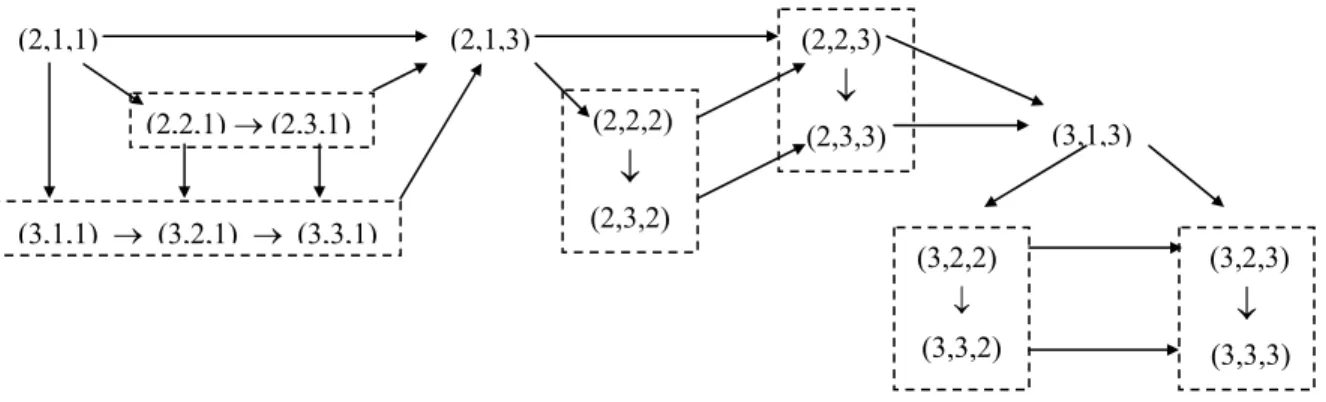
In the example of addition, steps leading consecutively through the positions (2, 1, 1), (2, 1, 3), (2, 2, 1), (2, 2, 2) form a path; for example, a calculator, mother, or teacher respectively, can serve as mediators used while performing the steps.
For deciding what path should be chosen, different criteria can be used, for example:
time for completing the path (total time for performing the steps)
length of a path (number of steps)
costs for actualizing necessary mediators (for example, buying a textbook)
a weighted criterion.
A formal model for describing learning paths is presented in (Janssen et al, 2008). Learning pattern
A learning pattern is a formal model for describing the general structure of a learning process by means of steps and positions in which learning objectives and various human and material resources in the learning space are interrelated and influencing each other for achieving a certain learning outcome. The approach builds on the concept of pattern language (Alexander, Ishikawa & Silverstein, 1977). It assumes that a pattern is a proven solution to a problem in a context, and that it is based on problems of fixed format and their solutions. Representation of a learning pattern depends on the modelling or descriptive tool used.
It is important to note that learning pattern and learning path are fundamentally different concepts. A learning pattern Q is formed due to the continuous generalization of a set Q of many learning paths having similar objectives
and can be achieved through factorization of the set of learning paths Q by a certain similarity relation ; formally, Q
= Q/. Therefore, a learning pattern allows a variation of different paths that the community members have
frequently used for achieving certain learning objectives, whereas a learning path describes meaningful ways for a concrete learner to achieve the outcome in given conditions. The actual learning process forms a learning path; the latter can be considered as a realization of some learning pattern. Therefore, learning patterns serve a learner as general guides for deciding on next steps.
Let Figure 1 represent the graph of all steps that appeared in a hypothetical learning addition of natural numbers. The positions of a learner that are considered similar are surrounded by dashed boxes:
Figure 1. The graph of steps in addition of natural numbers
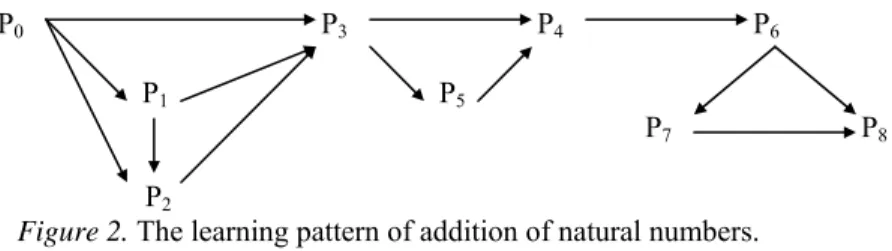
Identifying similar positions (that is, considering the set of mutually similar positions as one position), we can identify the learning pattern. Therefore, the learning pattern of addition of natural numbers can be represented by the following directed graph (using corresponding notations for vertices of the graph):
(2,2,1) (2,3,1) (3,1,1) (3,2,1) (3,3,1) (2,1,3) (2,1,1) (2,2,2)
(2,3,2) (2,2,3)
(2,3,3) (3,1,3) (3,2,3)
(3,3,3) (3,2,2) (3,3,2)P0 P3 P4 P6
P1 P5
P7 P8
P2
Figure 2. The learning pattern of addition of natural numbers.
Both the graph of steps and the learning pattern can be applied for different niches as well. For example, if only a calculator and mental calculation are possible (meaning that the third coordinate can not have the value 2), we obtain a corresponding learning pattern by leaving out vertices P5 and P7 together with the adjacent edges.
Should the learner, for example, neglect the method of calculation – this is determined by the perspective (1,1,0) meaning that the two positions will be identified exactly if their first two coordinate coincide – the positions in subsets {P0,P3}, {P1,P4,P5} and {P2,P6,P7,P8} would be considered as equivalent and the learning pattern would reduce to
P0 P1
P2
Figure 3. The learning pattern for the addition of natural numbers in the case of neglecting the method of calculation Here P0 denotes the position "adding two one-digit natural numbers," P1 denotes "adding two natural numbers (of arbitrary length)" and P3 denotes "adding more than two natural numbers (of arbitrary length)."
Direction of a step
Direction of a step is defined as a relative position of the next position with respect to the current position without considering the distance between the positions. Formally, if a step leads from position Pi-1 = (ai-1,1, ai-1,2, … , ai-1,m) to position Pi = (ai1, ai2, … , aim) then its direction equals to the vector Pi-1Pi = (ai1 - ai-1,1, ai2 - ai-1,2, … , aim - ai-1,m). Therefore, an arbitrary set of features causing a change of the position determines a certain direction. In learning, choosing the direction of a step is represented by perception and actualization of a set of dimensions of the learning space related to achieving a certain goal and corresponding mediators of learning. For each step, there normally exist a number of possible directions, which lead to different outcomes (to different next positions of a learner in the learning space) depending on the attributes of the step. Here again, the direction of a step is determined only if the position of which the step is applied to is fixed. Figure 4 below, illustrates the relationship between the concepts of position, step, path, learning pattern and direction of a step.
The step leading from position (3,1,3) to position (3,2,2) has (0,1,-1) as its direction. This means that the length of the summands has increased and the complexity of calculation has decreased by one level while performing the step. Step gradient
Gradient (or step gradient) is defined as the most preferred direction of the learner toward the next position in a learning path, as seen from the currently selected perspective. Following the gradient offers the learner an opportunity to make the biggest advancement toward learning objective.
Gradients are dependent not only on varying perspective but also on other actors taking actions in a particular learning space. We can put it even more strongly: the gradient is not only a function of learning objectives but also – and possibly to a greater extent – of the current position of the learner and learning opportunities offered by the learning space.
For example, after having learned how to use a calculator for adding two one-digit numbers (that is, having the position (2,1,1)), the most preferred direction would be (2,1,3) - (2,1,1) = (0,0,2) if a calculator is not available in later stages of learning addition. On the other hand, should a calculator be the main tool for checking the accuracy of the calculation, the most preferred direction would be either (2,2,1) - (2,1,1) = (0,1,0) or (3,1,1) - (2,1,1) = (1,0,0), depending on the learning objective.
Affordance
We define an affordance as a perceived action-promoting property or relation between particular aspects of the situation and the subject who plans or undertakes actions in a certain environment.
More specifically, we see learning affordances as something that learners with certain learning goals belonging to a community culture, perceive when they interact with the components of the learning situation (e.g., human and material resources, tools) in certain particular learning environments. The accumulated set of affordances perceived by the majority of the community members can characterize the learning affordances of this community culture (Pata, 2009a, 2009b). Individual members of the community can use such a set of community’s learning affordances as a guidance to interact with their learning environment in order to achieve their learning objectives or pursue their learning motives in accordance with those of the community. Affordances provide the cognitive basis for our approach because they convey the idea of cognition that enables an individualized approach in goal-directed action.
Moving towards the learning objective
After we have defined the basic notions we are now able to describe the ecological approach to learning that enables a learner to be influenced by the dynamic learning space and simultaneously contribute to the formation of this space. The key question for a (self-directed) learner is to find a path that leads them from the current position in a learning space to the target position or to a region determined by the learning objective. Depending on the learner’s preferences and imposed restrictions it should be possible to choose between different learning paths.
As an example of a learning path to follow, the learner may: 1. Determine the learning objective.
2. Decide on the sub-goals and their order.
3. Select the first sub-goal and determine the niche within the learning space suitable for achieving the sub-goal. 4. Decide on a step toward the selected sub-goal in the gradient direction (for example, by selecting an appropriate
mediator of the learning event). 5. Perform the step.
6. Assess whether the sub-goal is reached; if not, return to 4 (decide on a new step).
7. Assess whether the learning objective has been reached; if not select the next sub-goal, determine the niche and return to 4.
As mentioned before, the most preferred direction of a step (the step gradient) is influenced by both the initial and target positions as well as learning opportunities. There are several possibilities for determining the direction of the step, for example, following suggestions of a tutor or analysing an appropriate existing learning pattern.
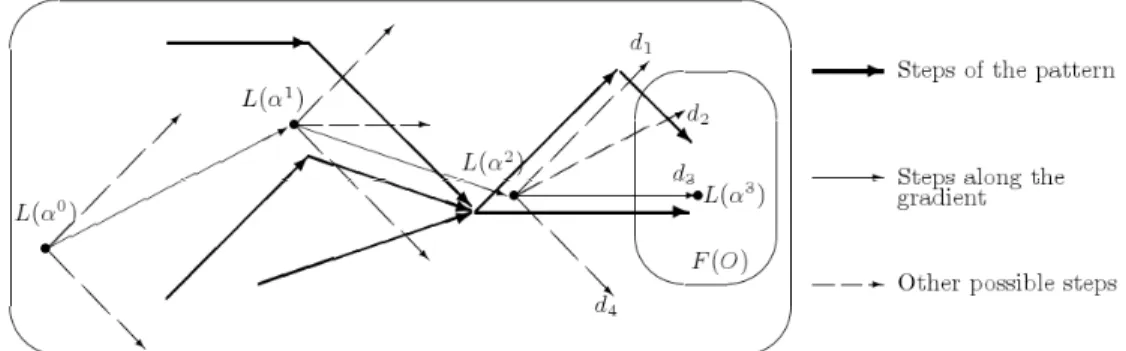
Figure 4 illustrates the navigation of a learner in the learning space that has accumulated a certain learning pattern. Each arrow represents a step – the thick arrows represent a learning pattern, thin continuous arrows represent the steps along the gradients and dashed arrows represent the other possible directions of steps for a learner. A possible strategy of using learning patterns for determining a learning path can be the following: initially (during the first steps) the learner aims to get close to a node of the learning pattern, while subsequent steps will be made according to the learning pattern.
In Figure 4, the first step brings the learner from initial position L(0) close to a node of the learning pattern; the second and third steps (from position L(1) to L(2) and to L(3)) already follow the learning pattern. Although direction d2 would lead into the outcome area F(O) as well, the learning pattern does not suggest it. Whether to
choose another possible direction d1 suggested by the learning pattern or not depends on additional circumstances (see the case study below).
Figure 4. Using the learning pattern to find a learning path
Case study
As an example we take the empirical data from Pata (2009a). A group of 53 master students at Tallinn University participated in the course “Self-directed learning with social media.” We demonstrate how the learning space and niches for individual and collaborative activities were determined with the purpose of guiding a learner.
We first determine the learning objectives. Then we determine the set of dimensions of a learning space and describe the mediators (possible learning tools) by means of these dimensions. Then the standard multidimensional scaling algorithm, e.g., Kruskal & Wish (1978) is applied in order to calculate a cluster map on which the similarity of mediators is expressed by means of their proximity of their images on the map. Using this map, one can identify the mediator that is most suitable to apply for performing the step.
Determining the learning objectives
The main learning aim of the course was to develop self-directed learning competences through individual and collaborative assignments with social software tools. As an individual assignment each learner composed a personal learning environment (PLE) for supporting their learning activities, and described its affordances. Learners were permitted to use various social media tools of their own choice; blog was the only mandatory tool to centrally monitor the progress of learners. As a collaborative assignment, the learners connected their PLEs with some associated social software tools, composing a distributed learning environment for conducting collaborative assignments. Again, they had to perform some activities in this environment and describe the affordances of the learning environment. These two learning objectives – to compose a PLE and to connect them – were determined by the teacher; however, the students had the freedom to choose the tools, methods of assembling the tools together, and situating the assignments into their particular work or learning context.
Determining the dimensions of the learning space and identifying the mediators of learning
Each learner described a set of affordances that they perceived when doing individual or collaborative assignments with certain tools. After the course these affordances were collected into a dataset that was used as an example of an authentic learning space for self-directed learners using social software. The affordances were grouped into categories to minimize the system complexity. Initially the following 19 affordance categories were formed: assembling, managing, creating, reading, presenting, changing, collaborating, sharing, exchanging, searching, filtering/mashing, collecting, storing, tagging, reflecting, monitoring, supporting, asking/feedback, and evaluating. Each category of affordances was taken to represent an onto-dimension and collectively they would constitute the learning onto-space.
Altogether 12 types of software were considered as tools in PLEs and collaborative learning environments: blog, wiki, chat, social bookmarking, aggregator, email, search engine, co-writing, forum, co-drawing, Flickr, and YouTube.
Each tool was assigned a 19-dimensional vector with coordinates within range 0…1 estimating to what degree the particular tool offered corresponding affordances in case of individual assignments compared with other available tools. For determining the coordinates, the frequency of how often each affordance/dimension was perceived while using a particular tool type in the sample group was calculated: the total number of tools used per dimension constituted 100%, from which the actual frequency of perceiving the usefulness of the tool was calculated. For example, the affordance assembling was mentioned by 49 students, while only 20 students perceived this as a blog affordance – therefore the assembling coordinate for blog was given a value equal to 20/49 = 0.41.
Setting sub-goals
As already mentioned, the following sub-goals were set: 1) composing a PLE and using it for an individual assignment and 2) connecting the PLE with the PLEs of other learners for managing a collaborative assignment. According to these goals, two niches were considered, one for performing the individual task (composing a PLE) and one for performing the collaborative task (connecting the PLEs).
For illustration purposes we will now describe a simplified learning path for one hypothetical learner consisting of two steps where the goals will consecutively be reached by one step only.
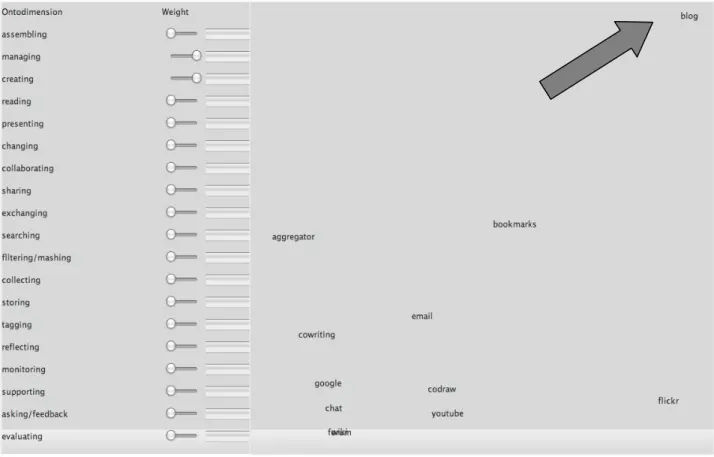
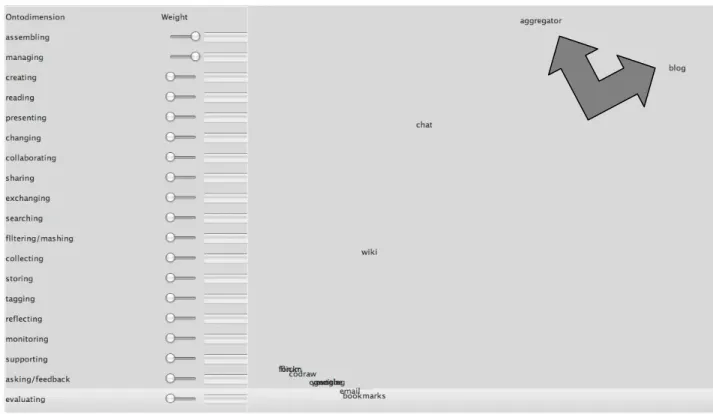
For the representation of individual and collaborative learning niches, as well as finding the most appropriate learning tools, we used the Onto-space Explorer tool (OSE tool; Kaipainen et al., 2008). This tool applies multidimensional scaling to compute a cluster map, allowing users to control the weight given to each coordinate by means of a slider (Figures 5 and 6 below).
Determining the first step
First, the learner should identify the affordance requirements for achieving the first goal. Let us assume the affordances managing and creating were chosen. Thus, a perspective {managing = 1; creating = 1, and for all other dimensions the weight = 0} was fixed. Fixing the perspective the learner prioritizes the affordances managing and creating for managing personal tools and using the PLE for an individual creative assignment (composing the PLE and analyzing it).
In our case, the learner determines a perspective by shifting the sliders for the dimensions managing and creating to 1 (see Figure 5). On the graphical map generated by the OSE tool, suitability of the learning tool is measured by the distance of its image from the upper right corner of the map; we find that blog – indicated by the block arrow – is the most suitable one to use for performing the first step S1 (note that forum and wiki are so equally unimportant that their images almost coincide on the map).
Now two possible cases may hypothetically appear:
Case A: If a learner already is a blog user, no correction is needed in their first learning step for doing individual assignments.
Case B: If a learner had previously used, for example, wiki for creative tasks, they might appear distant from the community’s activity niche for doing individual assignments.
In both cases, the learner must choose the most preferred tool, that is, in terms of the model to find the gradient of the step. In Case A, the most preferred tool is most likely the blog. In Case B they can keep using wiki only if it will be possible to get into the community niche during the second step (that is, if a tool exists that allows them to connect their PLE with the PLEs of other learners for managing a collaborative assignment). Otherwise they should acquire the skills for using blog as well and start using it.
Figure 6. The results of selecting the perspective {assembling =1, managing = 1, all other weights = 0} Determining the second step
In performing the second step S2 for managing a collaborative activity the learners selected assembling and managing as the most important expected affordances using the collaborative assignment niche. During this step the
group members’ PLEs should be assembled into a distributed learning environment, and afterwards managed. Consequently, the perspective {assembling=1, managing=1, all other weights=0} was chosen. The results computed by the OSE tool are presented in Figure 6. The indication is that blog and aggregator are suggested as the most preferred tools (note also that only chat and wiki are of some importance for completing collaborative assignments; all other tools are equally unused).
The learning pattern
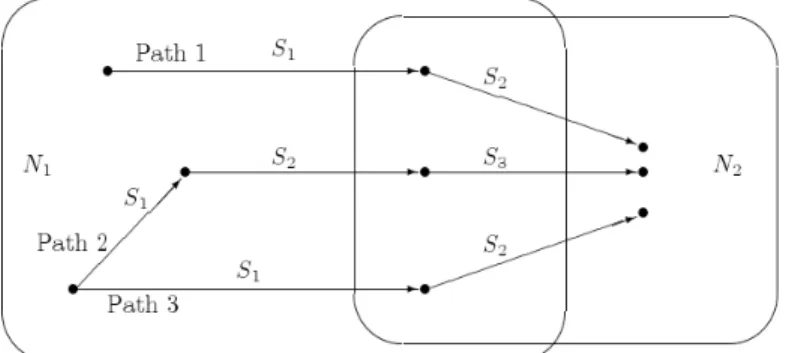
The composition of the learning pattern that is based on the empirical data in the example is presented in Figure 7 below. This pattern suggests three possible learning paths for moving from the initial position (situated in a niche N1 for performing an individual task) to a second position (situated in a niche N2 for performing a collaborative task). The selection of a path depends on learner’s preferences and imposed restrictions. A blog user can continue using blog, adding RSS feeds from other blogs, or they can additionally start using an aggregator for pulling RSS feeds from other learners’ blogs for monitoring their reflections (Path 1). A wiki user can either begin by acquiring skills for using blog, build a PLE using blog and then start using an aggregator (Path 2), or keep using wiki and then start using an aggregator (Path 3). However, Path 3 may be less effective if all the other learners are using aggregated blogs for monitoring purposes.
Figure 7. Learning paths for individual and collaborative assignments
Discussion
Previous approaches to learning design have typically focused on the developers’ or instructors’ view to learning systems and did not consider the possibility of learners to change dynamically its actions depending on perception of the system and behaviour of the learning community. Although that some authors have proposed affordance frameworks and classifications for solving particular tasks, for example, the 24 features identified by Palmer, Sire, Bogdanov, Gillet and Wild (2009) for mapping the functionality of web PLEs, no holistic computational model of describing learning affordances and dynamics has been suggested until today.
It is our experience that, where learners are provided with the freedom to choose their own tools and are encouraged towards self-directed learning, the teaching process requires appropriate decision support instruments (Fiedler & Pata, 2009). Such instruments (for example, a learning pattern or the OSE tool) enable the dynamic formation of learning spaces that are defined by the learners themselves, such that they can be used for personal or group navigation within the learning space.
Our approach is based to a great extent on the concept of the niche as a subspace of a learning space that can be dynamically determined. The fact that a niche can be action or meaning-based and may lack a formal determination can sometimes be truly challenging. Moreover, behaviour of a learner in a niche depends on a chosen perspective. Consequently, the intermediate positions of different learners for achieving the same learning objective can be different. On the other hand, this offers an opportunity to plan the learning activities and learning steps in a situation where the abilities and conditions for individual learners are different.
The proposed approach offers each individual learner two major instruments for planning and conducting their learning: (1) a possibility to contribute to the learning space as it was demonstrated in the case study (dimensions of
the learning space – affordances – were determined by participating students) and (2) a possibility to follow personal priorities (by selecting the appropriate perspective) and to adapt learning to different types of activities (by selecting an appropriate niche) as it was demonstrated by the example of addition with natural numbers.
Furthermore, we believe that application of OSE tool type of navigational decision tools that collect information about learning activities from social software systems would allow novel learning design approaches (such as for example swarming phenomena that are based on self-organization and self-regulation of PLE users).
Notice that the definition of learning space offers a possibility for considering different types of learning spaces: the coordinates of a learning space can describe the learning object (the example of summation of naturals), the qualities of learning tools (the case study above), or the qualities of a learner. Therefore, for example a component of a PLE can be represented by a single coordinate (a calculator in summation), by a set of coordinates (the case study), or it can be considered as a mediator of action and represented as an attribute of a step. Consequently the approach can be applied in different contexts and for solving different types of problems.
Conclusion
This paper presents a formal model of learning, based on a spatial metaphor. As the fundamental element of this model, an ontological space of affordances is proposed. It assumes a collaborative annotation practice, similar to many applications in social media. It constitutes the coordinate system for describing emergent community learning space, and at the same time, the framework for creating and applying personal learning paths and finding learning patterns. Beyond merely hypothetical modelling, we believe this model has potential for contributing to the methodology of learning design. This approach allows planning and analyzing learning designs from different perspectives as a result of different weightings associated with each dimension of the learning space. The software applications that implement the ideas of this model also allow for new designs for learning in PLEs. As this approach is not bound to any particular level of abstraction, in principle it can be applied equally in the analysis of general educational processes, as well as for guiding concrete learning activities.
Acknowledgements
The authors thank Viive-Riina Ruus for interest in the study and stimulating discussions as well as the anonymous referees for the many suggestions that contributed to improvements in the exposition of this paper. This study was partly funded by Estonian Science Foundation grant 7663 and by Estonian Ministry of Education and Research grant 0130159s08.
References
Alexander, C., Ishikawa, S., & Silverstein, M. (1977). A pattern language: Towns, buildings, constructions. New York, NY: Oxford University Press.
Anderson, T. (2009). Towards a theory of online learning. In T. Anderson (Ed.), The theory and practice of online learning (2nd, pp. 45–74). Edmonton, AB: Athabasca University Press.
Attwell, G. (2007). Personal learning environments - future of elearning? Retrieved June 16, 2010, from http://www.elearningeuropa.info/files/media/media11561.pdf
Bower, M. (2008). Affordance analysis – matching learning tasks with learning technologies. Educational Media International, 45(1), 3–15.
Brown, J. S., & Adler, R. P. (2008). Minds on fire: Open education, the long tail, and Learning 2.0. EDUCAUSE Review, 43(1), 16–32.
Conole, G. (2008). The Role of Mediating Artefacts in LearningDesign. In L. Lockyer, S. Bennet, S. Agostinho & B. Harper (Eds.), Handbook of Research on Learning Design and Learning Objects: Issues, Applications, and Technologies (pp.187-207). doi:10.4018/978-1-59904-861-1
Fiedler, S., & Pata, K. (2009). Distributed learning environments and social software: In search for a framework of design. In S. Hatzipanagos & S. Warburton (Eds.), Handbook of Research on Social Software and Developing Community Ontologies (pp. 151–164). Hershey, PA: IGI Global.
Gibson, J. J. (1979). The ecological approach to visual perception. Boston, MA: Houghton Mifflin.
Janssen, J., Hermans, H., Berlanga, A., & Koper, R. (2008). Learning path specification. Retrieved October 22, 2010, from http://dspace.ou.nl/handle/1820/1620
Jonassen, D. H. (2000). Revisiting activity theory as a framework for designing student-centered learning environments. In D. H. Jonassen & S. M. Land (Eds.), Theoretical Foundations of Learning Environments (pp. 89–121). Mahwah, NJ: Lawrence Erlbaum.
Kaipainen, M., Normak, P., Niglas, K., Kippar, J., & Laanpere, M. (2008). Soft ontologies, spatial representations and multiperspective explorability. Expert Systems,25(5), 474–483.
Kirschner, P., Strijbos, J. W., Kreijns, K., & Beers, P. J. (2004). Designing electronic collaborative learning environments. Educational Technology Research and Development, 52(3), 47–66.
Kruskal, J. B., & Wish, M. (1978). Multidimensional scaling. Beverly Hills, CA: Sage Publications.
Kuutti, K. (1995). Activity theory as a potential framework for human computer interaction research. In B. Nardi (Ed.), Context and consciousness: Activity theory and human computer interaction (pp. 17–44). Cambridge, MIT Press.
Leontjev, A. N. (1978). Activity, consciousness, and personality. Englewood Cliffs, NJ: Prentice-Hall.
Palmer, M., Sire, S., Bogdanov, E., Gillet, D., & Wild, F. (2009). Mapping web personal learning environments. In F. Wild, M. Kalz, M. Palmer, & D. Mueller, Proceedings of the Second International Workshop on Mashup Personal Learning Environments, 506, 31-46. Retrieved from CEUR Workshop Proceedings website: http://ceur-ws.org/Vol-506/palmer.pdf
Pata, K. (2009a). Modeling spaces for self-directed learning at university courses. Journal of Educational Technology & Society, 12(3), 23-43.
Pata, K. (2009b). Revising the framework of knowledge ecologies: How activity patterns define learning spaces? In N. Lambropoulos & M. Romero (Eds.), Educational Social Software for Context-Aware Learning: Collaborative Methods & Human Interaction (pp. 1 - 23). Hershley, PA: IGI Global.
Underwood, J., & Banyard, P. E. (2008). Understanding the learning space. Retrieved June 16, 2010, from http://www.elearningpapers.eu/index.php?page=doc&doc_id=11937&doclng=6
Väljataga T., & Laanpere, M. (2010). Learner control and personal learning environment: A challenge for instructional design. Interactive Learning Environments,18(3), 277-291.