Calhoun: The NPS Institutional Archive
Theses and Dissertations Thesis Collection
2014-12
Using automatic identification system technology to
improve maritime border security
Lindstrom, Tedric R.
Monterey, California: Naval Postgraduate School http://hdl.handle.net/10945/44607
NAVAL
POSTGRADUATE
SCHOOL
MONTEREY, CALIFORNIA
THESIS
Approved for public release; distribution is unlimited USING AUTOMATIC IDENTIFICATION SYSTEM TECHNOLOGY TO IMPROVE MARITIME BORDER
SECURITY
by
Tedric R. Lindstrom December 2014
Thesis Advisor: Robert Simeral
REPORT DOCUMENTATION PAGE Form Approved OMB No. 0704–0188 Public reporting burden for this collection of information is estimated to average 1 hour per response, including the time for reviewing instruction, searching existing data sources, gathering and maintaining the data needed, and completing and reviewing the collection of information. Send comments regarding this burden estimate or any other aspect of this collection of information, including suggestions for reducing this burden, to Washington headquarters Services, Directorate for Information Operations and Reports, 1215 Jefferson Davis Highway, Suite 1204, Arlington, VA 22202-4302, and to the Office of Management and Budget, Paperwork Reduction Project (0704-0188) Washington, DC 20503.
1. AGENCY USE ONLY (Leave blank) 2. REPORT DATE December 2014
3. REPORT TYPE AND DATES COVERED Master’s Thesis
4. TITLE AND SUBTITLE
USING AUTOMATIC IDENTIFICATION SYSTEM TECHNOLOGY TO IMPROVE MARITIME BORDER SECURITY
5. FUNDING NUMBERS
6. AUTHOR(S) Tedric R. Lindstrom
7. PERFORMING ORGANIZATION NAME(S) AND ADDRESS(ES) Naval Postgraduate School
Monterey, CA 93943-5000
8. PERFORMING ORGANIZATION REPORT NUMBER
9. SPONSORING /MONITORING AGENCY NAME(S) AND ADDRESS(ES) N/A
10. SPONSORING/MONITORING AGENCY REPORT NUMBER
11. SUPPLEMENTARY NOTES The views expressed in this thesis are those of the author and do not reflect the official policy or position of the Department of Defense or the U.S. Government. IRB protocol number ____N/A____.
12a. DISTRIBUTION / AVAILABILITY STATEMENT Approved for public release; distribution is unlimited
12b. DISTRIBUTION CODE A
13. ABSTRACT (maximum 200 words)
Our coastal waters are the United States’ most open and vulnerable borders. This vast maritime domain harbors critical threats from terrorism, criminal activities, and natural disasters. Maritime borders pose significant security challenges, as nefarious entities have used small boats to conduct illegal activities for years, and they continue to do so today. Illegal drugs, money, weapons, and migrants flow both directions across our maritime borders, as vessels can quickly complete these transits without detection. To what extent could Automatic Identification System (AIS) technology improve border security against the small vessel threat?
This thesis provides an overview of existing AIS systems and reviews the maritime border security effectiveness and cost benefit impacts of potential AIS equipment carriage requirements. We compared and analyzed policy options and reviewed implementation issues and concerns. Our conclusions are that the Department of Homeland Security should implement a regulation for all vessels, regardless of size, to install and broadcast Class A or Class B AIS when conducting international voyages. The proposed regulation would expand the existing Small Vessel Reporting System to a mandatory program wherein mariners are required to preregister and file float plans prior to conducting an international voyage. This proposed action provides direct support to three of the five basic homeland security missions: prevent terrorism and enhance security, secure and manage our borders, and enforce and administer our immigration laws.
14. SUBJECT TERMS Automatic Identification System, AIS, Coast Guard, maritime security, small boats, maritime domain awareness, Department of Homeland Security, Small Vessel Reporting System, terrorist, Customs and Border Protection, border security
15. NUMBER OF PAGES 85 16. PRICE CODE 17. SECURITY CLASSIFICATION OF REPORT Unclassified 18. SECURITY CLASSIFICATION OF THIS PAGE Unclassified 19. SECURITY CLASSIFICATION OF ABSTRACT Unclassified 20. LIMITATION OF ABSTRACT UU
NSN 7540–01-280-5500 Standard Form 298 (Rev. 2–89)
THIS PAGE INTENTIONALLY LEFT BLANK
Approved for public release; distribution is unlimited
USING AUTOMATIC IDENTIFICATION SYSTEM TECHNOLOGY TO IMPROVE MARITIME BORDER SECURITY
Tedric R. Lindstrom
Port Security Specialist, Thirteenth Coast Guard District, Seattle, WA B.S., U.S. Coast Guard Academy, 1978
M.S., Naval Postgraduate School, 1989
Submitted in partial fulfillment of the requirements for the degree of
MASTER OF ARTS IN SECURITY STUDIES (HOMELAND SECURITY AND DEFENSE)
from the
NAVAL POSTGRADUATE SCHOOL December 2014
Author: Tedric R. Lindstrom
Approved by: Robert Simeral Thesis Advisor
Erik Dahl Second Reader
Mohammed Hafez
THIS PAGE INTENTIONALLY LEFT BLANK
ABSTRACT
Our coastal waters are the United States’ most open and vulnerable borders. This vast maritime domain harbors critical threats from terrorism, criminal activities, and natural disasters. Maritime borders pose significant security challenges, as nefarious entities have used small boats to conduct illegal activities for years, and they continue to do so today. Illegal drugs, money, weapons, and migrants flow both directions across our maritime borders, as vessels can quickly complete these transits without detection. To what extent could Automatic Identification System (AIS) technology improve border security against the small vessel threat?
This thesis provides an overview of existing AIS systems and reviews the maritime border security effectiveness and cost benefit impacts of potential AIS equipment carriage requirements. We compared and analyzed policy options and reviewed implementation issues and concerns. Our conclusions are that the Department of Homeland Security should implement a regulation for all vessels, regardless of size, to install and broadcast Class A or Class B AIS when conducting international voyages. The proposed regulation would expand the existing Small Vessel Reporting System to a mandatory program wherein mariners are required to preregister and file float plans prior to conducting an international voyage. This proposed action provides direct support to three of the five basic homeland security missions: prevent terrorism and enhance security, secure and manage our borders, and enforce and administer our immigration laws.
THIS PAGE INTENTIONALLY LEFT BLANK
TABLE OF CONTENTS
I. INTRODUCTION...1
A. SMALL VESSEL THREAT ...1
1. SVSS ...2
2. DHS Small Vessel Security Implementation Plan ...2
B. LITERATURE REVIEW OF SMALL VESSEL DETECTION ...4
C. STATUS QUO ...7
D. POTENTIAL SOLUTION ...8
II. AUTOMATIC IDENTIFICATION SYSTEM...11
A. AIS OVERVIEW ...11
B. CLASS A AIS ...13
C. CLASS B AIS ...14
D. SATELLITE AIS ...14
E. CLASS E AIS ...15
F. AIS REGULATIONS WITHIN THE UNITED STATES ...16
G. INTERNATIONAL USE OF AIS ...17
H. SUMMARY ...20
III. POLICY OPTIONS ANALYSIS ...21
A. STATUS QUO ...21
1. Overview ...21
a. NEXUS ...22
b. Canadian Border Boat Landing Permit (I-68) ...22
c. Outlying Area Reporting System ...23
d. Small Vessel Reporting System...23
2. Maritime Border Security Effectiveness ...25
3. Cost Benefit Considerations ...26
a. Risk Reduction ...27
b. Cost Impacts ...29
B. AIS CLASS A/B REQUIREMENT POLICY OPTION ...31
1. Overview ...31
2. Maritime Border Security Effectiveness ...32
3. Cost Benefit Considerations ...33
C. AIS CLASS E REQUIREMENT POLICY OPTION ...35
1. Overview ...36
2. Maritime Border Security Effectiveness ...36
3. Cost Benefit Considerations ...37
IV. ANALYSIS AND COMPARISON ...39
A. SECURITY BENEFITS AND COST IMPACTS ...39
B. AVIATION COMPARISON—A RIGOROUS AND VETTED SYSTEM ...40
1. Current Requirements...40
C. IMPLEMENTATION ISSUES AND CONCERNS ...45
1. Impact to Mariners ...45
2. General Public Stakeholders ...46
3. Review of Pending AIS Regulation Changes ...46
4. National Small Vessel Security Summit Concerns ...47
5. Improved Maritime Domain Awareness ...48
6. Estimated Public Costs ...49
7. Marketing ...50
8. Incentive to Participate...50
V. CONCLUSION AND RECOMMENDATIONS ...53
A. CONCLUSION ...53
B. RECOMMENDATIONS. ...55
1. Implement AIS Requirement ...55
2. Engage Stakeholders ...55
3. 2015 Small Vessel Security Summit ...56
4. Incentive Program ...56
C. EPILOGUE ...56
LIST OF REFERENCES ...59
INITIAL DISTRIBUTION LIST ...63
LIST OF FIGURES
Figure 1. VHF-Based AIS Coverage ...12 Figure 2. AIS Identifier and Satellite-Based AIS Coverage ...13 Figure 3. ADS-B Coverage fromFlightAware ...43
THIS PAGE INTENTIONALLY LEFT BLANK
LIST OF TABLES
Table 1. Hourly Standard Rates for Coast Guard Services ...30 Table 2. Estimated Government Costs for Specific Actions ...35 Table 3. Vessels Impacted by the Pending AIS Regulations ...46
THIS PAGE INTENTIONALLY LEFT BLANK
LIST OF ACRONYMS AND ABBREVIATIONS
ADIZ air defense identification zone
ADS-B Automatic Dependent Surveillance-Broadcast
AIS Automatic Identification System
AMOC Air and Marine Operations Center
ANOA advance notice of arrival
CBP U. S. Customs and Border Protection
CBSA Canadian Border Security Agency
CSS Coastal Surveillance System
CSTDMA Carrier Sense Time Division Multiple Access
DHS U. S. Department of Homeland Security
DSC digital selective calling
EPIRB Emergency Position Indicting Radio Beacon
EU European Union
FAA Federal Aviation Administration
GAO U. S. Government Accountability Office
GPS Global Positioning System
GS General Schedule
IBIS Interagency Border Inspection System
ICMLEO Integrated Cross-Border Maritime Law Enforcement Operations
MANPADS Man-Portable Air-Defense System
MDA maritime domain awareness
MMSI Maritime Mobile Service Identity
MSIS Merchant Ship Information System
NAIS National Automatic Identification System
NATO North Atlantic Treaty Organization
NEXUS Alternative CBP Inspection Program
NPS Naval Postgraduate School
NSVSS National Small Vessel Security Summit
OAM Office of Air and Marine
POE port of entry
QHSR Quadrennial Homeland Security Review
RCMP Royal Canadian Mounted Police
RFID radio frequency identification
SARSAT synthetic aperture radar satellite
SOLAS safety of life at sea
SOTDMA self organizing time division multiple access
SVRS Small Vessel Reporting System
SVSS Small Vessel Security Strategy
TSA Transportation Security Agency
US United States
USCG United States Coast Guard
VHF very high frequency
VTS vessel traffic service
WBIED water born improvised explosive device
WMD weapons of mass destruction
EXECUTIVE SUMMARY
Our coastal waters are the United States’ most open and vulnerable borders. This vast maritime domain harbors critical threats from terrorism, criminal activities, and natural disasters. The maritime border security mission is complex and challenging; the maritime domain is an expansive pathway to the world without fences that connects to more than 95,000 miles of U.S. shoreline.1 This presents unique challenges and enforcing the law is
difficult, especially when nefarious individuals intend to ignore it. Illegal drugs, money, weapons, and migrants flow both directions across our maritime borders as vessels can quickly complete these transits without detection. A recent Government Accountability Office (GAO) report indicates, “Law enforcement agencies face the challenge of distinguishing between legitimate small vessel operators and the relatively few individuals estimated to be engaged in illicit activities.”2 This thesis looks at the extent
Automatic Identification System (AIS) technology could improve border security and reduce the small vessel threat.
An overview of Class A, Class B, and Class E AIS technology provides a baseline of current capabilities and use. The development of less expensive Class B AIS transceivers has increased the use of AIS beyond the Class A carriage requirements established by the International Maritime Organization. Recently deployed commercial satellite systems now provide almost worldwide coverage for tracking vessel AIS signals. Many countries have expanded AIS carriage requirements to improve maritime safety and security and small self-contained AIS identifiers now provide worldwide tracking of vessels of any size.
1Written Testimony of CBP Office of Air and Marine Assistant Commissioner Randolph Alles for a
House Committee on Homeland Security, Subcommittee on Border and Maritime Security Hearing Titled What Does a Secure Maritime Border Look Like? 113th Cong. (2013) (testimony of Randolf Alles, U.S. Customs and Border Patrol Office of Air and Marine Assistant Commissioner), accessed October 7, 2014 http://www.dhs.gov/news/2013/11/19/written-testimony-cbp-house-homeland-security-subcommittee-border-and-maritime
2 Stephen Caldwell, Maritime Security DHS Could Benefit from Tracking Progress in Implementing
the Small Vessel Security Strategy (GAO 14-32) (Washington, DC: Government Accountability Office, 2013), 1.
In this thesis, three policy options for AIS equipment carriage requirements are developed and analyzed: status quo, Class A/B requirement policy option, and Class E requirement policy option. Maritime border security effectiveness and cost benefit impacts of each policy option is developed. Policy options are compared and analyzed and implementation issues and concerns are reviewed. As a cellular phone based system, Class E AIS was not considered an effective option for improving maritime security in the border region and excluded from further consideration.
Conclusions are that Department of Homeland Security (DHS) should implement a regulation for all vessels, regardless of size, to install and broadcast Class A or Class B AIS when conducting international voyages. The proposed regulation would expand the existing Small Vessel Reporting System (SVRS) to a mandatory program in which mariners are required to pre-register and file float plans prior to conducting an international voyage. Analysis indicates implementation costs for both the government and public are low and the program has the potential to make maritime border security operations more efficient and effective. If the government attempted to detect, identify, interdict, and board each vessel crossing our maritime border as is done now with aircraft and vessels, it would expend between $5,000 and $10,000 per maritime boarding event. AIS allows law enforcement agencies to monitor the border without having to detect, identify, and interdict on the water. Agencies can decide the need, time, and location of conducting a boarding to ensure compliance with federal law providing a more streamlined border crossing for the mariner. A comparison to private aviation requirements for border crossings supports the implementation of an AIS requirement.
To facilitate the drafting of appropriate AIS rules and regulations as well as an effective implementation strategy, DHS should engage the various stakeholders via a second National Small Vessel Security Summit. This summit should review the changes in technology and threat and advise DHS on a specific AIS policy design that balances competing issues and concerns yet fulfills maritime security needs. As an incentive to participate with the program the federal government should consider offering a financial rebate to those that purchase an AIS and register with the Small Vessel Reporting System. This proposed action provides direct support to three of the five basic homeland
security missions: prevent terrorism and enhance security, secure and manage our borders, and enforce and administer our immigration laws.
THIS PAGE INTENTIONALLY LEFT BLANK
ACKNOWLEDGMENTS
I wish to thank the staff at the U. S. Coast Guard District Thirteen Office of Law Enforcement for covering my responsibilities during my absence while completing this thesis and master’s program. I also wish to thank the faculty and staff of the Naval Postgraduate School’s Center for Homeland Defense and Security for their dedication to and support of the students. In combination with the exceptional members of my cohort, this academic experience has been extremely memorable, highly challenging, and most enjoyable. Finally, I offer great appreciation and love to my wife, Lyn, and children for their support, patience, devotion, and understanding while I “checked-out” to complete this academic experience and mid-life crisis.
THIS PAGE INTENTIONALLY LEFT BLANK
I.
INTRODUCTION
Our country’s ports and waterways are physically, economically, and culturally significant to our way of life. We use our maritime venues for recreation and transportation of people and products to our economic benefit and expect this to be a safe and secure environment. Our coastal waters are also the United States’ most open and vulnerable borders. This vast maritime domain generates critical threats from terrorism, criminal activities, and natural disasters.1 The United States (U.S.) maritime borders pose
significant security challenges (e.g., nefarious entities have used small boats to conduct illegal activities for years and they continue today). Illegal drugs, money, weapons, and migrants flow both directions across our maritime borders as vessels can quickly complete these transits without detection. To what extent could Automatic Identification System (AIS) technology improve border security against the small vessel threat?
A. SMALL VESSEL THREAT
The Department of Homeland Security (DHS) published the Small Vessel Security Strategy (SVSS) in 2008 to harmonize related strategies into a multi-layered, unified approach to improve security across all levels of government that work within the maritime domain.2 Three years later, DHS published the Small Vessel Security Strategy Implementation Plan to provide a roadmap for realizing the goals and objectives of the DHS National Small Vessel Security Strategy.3 DHS Small Vessel Security Strategy Implementation Plan Goal 2 is “to enhance maritime security and safety based on a coherent plan with a layered, state-of-the-art approach.”4 Goal 3 of this strategy is to
1 U.S. Department of Homeland Security, Small Vessel Security Implementation Plan Report to the
Public (Washington, DC: U.S. Department of Homeland Security, 2011), 1.
2 U.S. Department of Homeland Security, DHS Small Vessel Security Strategy (Washington, DC: Department of Homeland Security, 2008), 16.
3 U.S. Department of Homeland Security, Small Vessel Security Implementation Plan, 1. 4 Ibid., 6.
“leverage technology to enhance the ability to detect, determine intent, and, when necessary interdict suspicious small vessels.”5
1. SVSS
DHS crafted the Small Vessel Security Strategy (SVSS) to “reduce potential security and safety risks from small vesselsthrough the adoption and implementation of a coherent system of regimes, awareness, and security operations that strike the proper balance between fundamental freedoms, adequate security, and continued economic stability.”6 The four scenarios that cause the greatest concern for the use of small vessels
in terrorist-related attacks are identified in the SVSS as:
a) Domestic use of waterborne improvised explosive devices (WBIEDs); b) Conveyance for smuggling weapons (including WMDs) into the United
States;
c) Conveyance for smuggling terrorists into the United States; and
d) Waterborne platform for conducting a stand-off attack (e.g., Man-Portable Air-Defense System (MANPADS) attacks).7
Two of these four high consequence scenarios involve vessels smuggling people and/or weapons into the U. S. across the maritime border.
2. DHS Small Vessel Security Implementation Plan
To move closer to the goal of small vessel security, the DHS Small Vessel Security Implementation Plan was forged in 2011 to improve overall management of maritime risks. The plan “builds upon a strong, successful partnership and dialogue among federal and local authorities, small vessel stakeholders, the private sector, and the general public.”8 The plan identifies potential and existing methods for managing and
controlling maritime risks associated with the use of small vessels for terrorism. The
Implementation Plan has four stated goals:
5 Ibid., 8.
6 U.S. Department of Homeland Security, DHS Small Vessel Security Strategy, 1. 7 Ibid., 11.
8 U.S. Department of Homeland Security, Small Vessel Security Implementation Plan, 1.
2
1 Develop and leverage a strong partnership with the small vessel
community and public and private sectors in order to enhance maritime domain awareness;
2 Strengthen maritime security and safety based on a coherent plan with a layered, innovative approach;
3 Exploit technology to enhance our ability to detect, determine the intent of, and, where necessary, interdict small vessels; and,
4 Enhance coordination, cooperation, and communications between Federal, state, local, tribal, and territorial agencies, the private sector, and non-governmental organizations as well as international partners.9
The Implementation Plan is not a resourcing document and all government activities are required to follow the standard federal appropriations process and regulatory review procedures for funding support and execution. The plan “lays out ongoing and contemplated activities to meet the objectives of the Strategy and promotes active linkages of DHS components, state, tribal, local, and other national authorities.”10
Although the U.S. has a strong vision for small vessel security, there is very weak budget support to implement the various plans and intended actions. Funding requests have been made by DHS, but there have been no funds authorized to specifically support small vessel security issues in recent DHS budgets.11
The vastness of the maritime domain provides great opportunities for exploitation by terrorists. The use of smaller commercial and recreational vessels closer to shore and areas of interest to transport WMD is of significant concern. Terrorists have demonstrated that they have the capability to use explosive-laden suicide boats as weapons as demonstrated by the attack on the USS Cole. The Mumbai attacks in India were carried out using a hijacked fishing vessel. In a world where small watercraft can be turned into weapons against navy destroyers and pirates can hold ships for ransom, surveillance of the sea is of increasing importance.12
9 Ibid., 2. 10 Ibid., 12.
11 William Painter, and Jennifer Lake, Homeland Security Department: FY2012 Appropriations, (R41982), (Washington DC: Congressional Research Service, 2011).
12 “Maritime Security—Maritime Situational Awareness (MSA),” NATO Science and Technology Organization, accessed July 11, 2014, http://www.cmre.nato.int/research/maritime-situational-awareness
In addition to potential terrorist use of small vessels, our nation must strengthen the means to detect and deter illegal or harmful activity designed to take advantage of inherent vulnerabilities within the maritime domain. To protect, prevent, mitigate, and enhance recovery from all threats, including human and drug smuggling, the United States must achieve a more comprehensive and effective understanding of the maritime domain. Table 1 of the National Maritime Domain Awareness Plan, published in December 2013, lists the top challenge to U.S. maritime domain awareness as the collection of non-emitting and uncooperative vessels.13 These small dark non-emitting
and uncooperative vessels intentionally conduct undetected maritime operations while they transport people, weapons, money, and drugs in support of criminal or terrorist activities. Requiring all vessels that conduct international voyages to or from the United States to carry and broadcast AIS would improve the visibility of legitimate small vessel traffic.
B. LITERATURE REVIEW OF SMALL VESSEL DETECTION
Key to improving small vessel security is increasing the ability to detect small vessels and determine intent of these small dark contacts. In his 2007 Naval Postgraduate School (NPS) thesis, John Crofts proposes to use radio frequency identification (RFID) tags to monitor small vessels. Crofts finds, “an RFID-based monitoring system could work effectively as one layer in a multi-faceted small vessel monitoring program.”14
Although this technology could support small vessel security in accordance with Goal 3 of the Small Vessel Security Implementation Plan, mentioned above, there has been no action toward the use of RFID to track and monitor small boats. The limited range of detection and privacy concerns are the most likely drawbacks to employing RFID in the maritime arena. As Crofts concludes that RFIDs would only be one layer of a complete system; an effective small vessel monitoring system must alert to vessels that are not carrying RFID tags.
13 National Maritime Domain Awareness Plan for the National Strategy for Maritime Security, 2013, White House, accessed July 17, 2014, http://www.whitehouse.gov/sites/default/files/docs
/national_maritime_domain_awareness_plan.pdf, C-1.
14 John A. Crofts, “Radio Frequency Identification Potential to Monitor Small Vessels” (master’s thesis, Naval Postgraduate School, 2007), 52.
4
In his 2010 NPS thesis, Jeffrey Westling proposes a Great Lakes Maritime Operations Center with the installation of radar surveillance equipment coupled with Automatic Identification System (AIS) transceivers to monitor and track vessel movements in the Great Lakes region.15 This system would improve maritime domain
awareness (MDA) and security by automatically notifying Command Center watchstanders when a vessel violates border crossing regulations or security zones.16 In
his thesis, Westling calls for increasing infrastructure and coordination to improve the common operating picture, but he does not expand the AIS carriage requirements. Legislation or the establishment of new rules would be necessary to require all vessels to purchase AIS equipment and transmit identification signals. Thus, far there has been no action to put in place such a requirement. Furthermore, a recent 2011 Congressional research report states, “It appears the Coast Guard has no immediate plans to require smaller vessels be outfitted with transponders.”17
In 2010, Dr. Stephen Harris at the Savannah River National Laboratory led a team that looked into computer-based simulation modeling to determine “the probability of encountering an adversary based on allocated resources including response boats, patrol boats and helicopters over various environmental conditions including day, night, rough seas and various traffic flow rates.”18 The U. S. Coast Guard (USCG) has used
probability and detection theory for years to optimize search and rescue, law enforcement and security operations.19 Harris’s paper produced no new concepts or unique resource
allocations to improve the probability of detection of a small vessel. In addition, the Coast Guard does not have sufficient helicopters and small boats to use as primary
15 Jeffrey C. Westling, “Securing the Northern Maritime Border through Maritime Domain Awareness” (master’s thesis, Naval Postgraduate School, 2010), 72.
16 Ibid.
17 William Painter, Issues in Homeland Security Policy for the 112th Congress (R42025), (Washington DC: Congressional Research Service, 2011), 31.
18 Dave Dixon et al., Security Modeling for Maritime Port Defense Resource Allocation (Aiken, SC: Savannah River National Laboratory, 2010), 3.
19 U. S. Coast Guard, The U.S. Coast Guard Addendum to the United States National Search and
Rescue Supplement (NSS) to the International Aeronautical and Maritime Search and Rescue Manual (IAMSART) (Commandant Instruction M16130.2F), (Washington, DC: U. S. Department of Homeland Security, 2013), accessed October 7, 2014 http://www.uscg.mil/hq/cg5/cg534/manuals/
COMDTINST%20M16130.2F.pdf, H-81.
detection assets due to the immense size of the maritime domain and high operating expenses. In concert with Goal 3 of the Implementation Plan, agencies should seek technology to enhance the ability to detect, to determine the intention of, and to interdict small vessels.20
In his NPS thesis from 2009, Brian Hill proposes a nationwide effort to identify areas where a small boat attack could be staged or originated, and then provide a focused and coordinated presence in these areas. The Coast Guard has adopted Hill’s Operation Focused Lens as a best practice since the program’s goal is to detect an attack before it begins.21 The effort has Coast Guard personnel visiting high-risk marinas on a frequent
basis and training local mariners on America’s Waterway Watch program.22 During the
2010 Winter Olympics in Vancouver British Columbia, the Coast Guard utilized over 400 local Coast Guard Auxiliary and watch group members in and around the Puget Sound region to increase vigilance and communication using the Focused Lens approach. Focused Lens was identified by DHS in 2013 during a Government Accountability Office (GAO) audit on progress in implementing the SVSS as a key initiative that enhances small vessel security.23 This effort improves internal security but does not reduce the
threat from external small vessels that begin voyages outside of the United States.
To counter the threat posed by small vessels exploiting the porous maritime border with Canada, the Integrated Cross-Border Maritime Law Enforcement Operations agreement (ICMLEO-Shiprider) framework was signed in 2009 by former Public Safety Minister Peter Van Loan and Janet Napolitano, U.S. Secretary of Homeland Security.24
This program uses law enforcement personnel from the Royal Canadian Mounted Police (RCMP) and USCG to conduct joint patrols on small boats in the border region. This
20 U.S. Department of Homeland Security, Small Vessel Security Implementation Plan, 8. 21 Brian P. Hill, “Maritime Terrorism and the Small Boat Attack Threat to the United States: A Proposed Response” (master’s thesis, Naval Postgraduate School, 2009), 12.
22 Ibid., 69.
23 Stephen Caldwell, Maritime Security DHS Could Benefit from Tracking Progress in Implementing
the Small Vessel Security Strategy (GAO 14-32), (Washington, DC: Government Accountability Office, 2013), 22.
24 “Canada-U.S. Shiprider,” Royal Canadian Mounted Police, last modified June 17, 2013, http://www.rcmp-grc.gc.ca/ibet-eipf/shiprider-eng.htm
6
effort effectively removes the international maritime border as a weakness to be exploited by criminals as the patrol vessel crewed with both USCG and RCMP can enforce laws on both sides of the border.25 This program aligns with the Implementation Plan
requirement of building innovative partnerships and improving cooperation, but it brings no additional resources to the Coast Guard. Existing crews and small boat hours have been redirected to support this worthwhile effort.
C. STATUS QUO
Operators of small pleasure craft on international voyages arriving in the United States are required to report their entrance immediately to U. S. Customs and Border Protection (CBP) as per Reports of Arrival of Vessels in the 19 CFR 4.2.26 In addition,
the U.S. Customs and Border Protection establishes specific reporting locations for recreational boaters to moor and be inspected. There are several programs in place to facilitate these requirements and streamline the processing of recreational boaters return to the U.S. In July 2011, “CBP developed the Small Vessel Reporting System (SVRS) to better track small boats arriving from foreign locations and deployed this system to eight field locations.”27 Unfortunately this option, as well as all arrival reporting programs, is
based on a self-reporting system where mariners phone in their arrivals to CBP to comply with Report of Arrival of Vessels, Vehicles, and Aircraft, 19 USC 1433.28 Law abiding
citizens are likely to comply with these requirements, but criminals and terrorists would simply forgo checking in with CBP and enter the country illegally. Amitai Etzioni highlights this gap in security and the likelihood that many small vessels arriving into the United States go unchecked by failing to comply with the reporting process.29 His article
highlights the lax enforcement of entry by mariners as compared to the tight security
25 U.S. Department of Homeland Security, DHS Northern Border Strategy (Washington, DC: U.S. Department of Homeland Security, 2012), 5.
26 Reports of Arrival of Vessels, 19 C.F.R. 4.2, 1993. 27 Caldwell, Maritime Security DHS Could Benefit, 11.
28 U. S. Customs and Border Protection, “Pleasure Boat Reporting Requirements,” U. S. Customs and Border Protection, accessed July 22, 2014, http://www.cbp.gov/xp/cgov/travel/pleasure_boats/boats/ pleasure_boat_overview.xml
29 Amitai Etzioni, “The Joke is on Air Travelers,” Huffington Post, April 7, 2011.
imposed on air travelers. The current system also allows an unlawful mariner to make landfall, moor, offload contraband or personnel, and then contact CBP for inspection after completing illegal activity. A system to detect, determine intent, and interdict small vessels crossing our maritime borders as proscribed by Goal 3 is needed.
President Reagan’s famous Russian saying regarding nuclear arms-control was
doveryai, no proveryai, “trust, but verify.” We could use some of his wisdom along our maritime borders today. We are trusting that all mariners aboard small boats entering the country are law-abiding citizens; however, the nation would benefit from a system to verify the movements of these small vessels.
D. POTENTIAL SOLUTION
As Westling postulates in his thesis, AIS is a critical element to maritime domain awareness and improving the security of our borders.30 AIS alone is not the solution and
sensors to detect vessels not transmitting AIS are needed. This thesis will analyze to what extent maritime border security could be improved through the use of AIS policy changes coupled with recent improvements in technology.
Government agencies would be significantly more effective and efficient in securing our maritime borders if all vessels crossing the maritime border were broadcasting AIS. In concert with Goal 3, requiring all vessels, regardless of size, that conduct international voyages to install and broadcast AIS would leverage existing technology to monitor, detect, and determine intent of small vessels in the maritime arena. This requirement, the mandatory broadcast of AIS, would increase the security of our nation and the effectiveness of law enforcement efforts by directing limited resources to intercept and board small vessels transiting our maritime borders that are not broadcasting AIS.
Following this introduction, an overview of existing AIS systems is provided in Chapter II, and in Chapter III the maritime border security effectiveness and cost benefit impacts of potential AIS requirements are discussed. In Chapter IV, the policy options
30 Westling, “Securing the Northern Maritime Border,” 71.
8
are compared and analyzed and implementation issues and concerns are considered. Within Chapter IV, the current and future aviation border security laws and procedures to support potential changes in maritime border security requirements are also reviewed. Finally, in Chapter V conclusions and recommendations are proposed.
THIS PAGE INTENTIONALLY LEFT BLANK
II.
AUTOMATIC IDENTIFICATION SYSTEM
A. AIS OVERVIEW
Automatic Identification System (AIS) is an automatic tracking system used on ships and by vessel traffic services (VTS) for identifying and tracking vessels by electronically exchanging data with other nearby ships and AIS base stations. A ship borne AIS combines a very high frequency (VHF) transceiver with a positioning system, most often a Global Positioning System (GPS) receiver, with other electronic navigation sensors, such as a gyrocompass or rate of turn indicator. An AIS-equipped system on board a ship displays information on other vessels in the vicinity via a variety of information display systems: standalone AIS transceivers, radar, or integrated charting systems. AIS information supplements marine radar, which continues to be the primary method of collision avoidance in the maritime arena.31
There are several versions of AIS equipment: Class A, Class B, Class B receive only, and identifiers that are fully self-contained battery powered AIS units with internal GPS and antenna. AIS was originally configured to transmit data via VHF radio frequencies and therefore limited to line-of-sight distances based on the height of VHF radio antennas on a ship’s mast. Information provided by AIS equipment includes vessel identification, position, course, speed as well as other parameters like destination, estimated time of arrival, and rate of turn.32 Vessels fitted with AIS transceivers and
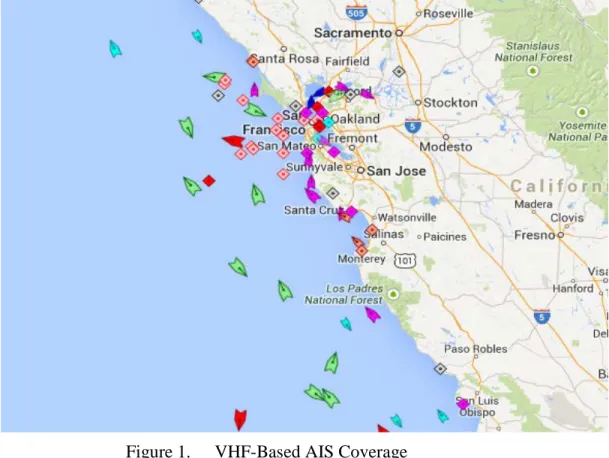
transponders can be tracked by AIS base stations located along the coast. Numerous websites provide real-time data on maritime traffic in the area by collecting and displaying the AIS information received. Commercial AIS systems using VHF-FM radio coverage can provide data well offshore depending on the height of the vessel’s mast, locations of shore-based antennas, and transmit power33 as shown in Figure 1 taken from
31 U.S. Coast Guard Navigation Center, “Automatic Identification System Overview,” accessed July 11, 2014, http://www.navcen.uscg.gov/?pageName=AISmain
32 Evans Starzinger, “Collision Avoidance 2.0,” Boat US Magazine, October/November, 2013, accessed August 10, 2014, http://www.boatus.com/magazine/2013/October/collision-avoidance.asp
33 Ibid.
MarineTraffic.com. AIS signals are displayed in Figure 1 by vessel type (color), size, and direction of travel; squares represent vessels drifting or moored. Hovering the mouse over contacts will bring up the vessel name, course, and speed. Clicking on the contact will bring up complete AIS data including track history, pictures, and destination. As demonstrated by Figure 1, in a VHF-FM “line-of-sight” based system, shore based towers generally receive and display AIS information when the vessels are within 80 nautical miles of the mainland.
Figure 1. VHF-Based AIS Coverage
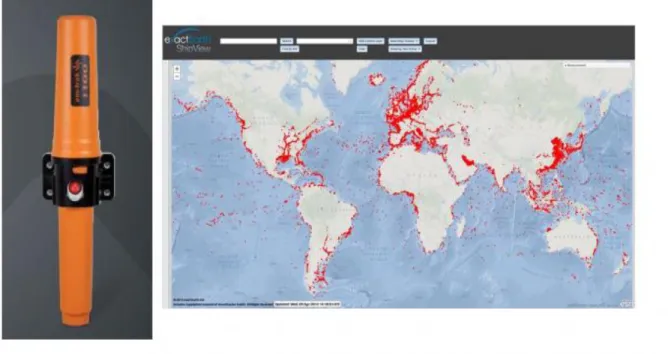
Recently, satellites have been fitted with special AIS receivers that are capable of managing a large number of signals.34 The AIS identifier shown in Figure 2 is the
advanced Class B satellite enabled AIS (ABSEA) along with typical satellite AIS coverage. Details on the product and recent technology advances that allow worldwide
34 London Research and Development Corporation, “Automatic Identification of Ships (AIS),” accessed July 11, 2014, http://www.london-research-and-development.com/AIS.html
12
AIS coverage can be found at the exactEarth website. Deployment of satellite communications-enabled and linked AIS receivers have enabled vast improvements in maritime coverage providing essentially worldwide vessel tracking capabilities and services as shown in Figure 2.
Figure 2. AIS Identifier and Satellite-Based AIS Coverage35
B. CLASS A AIS
Class A AIS equipment standards were established to comply with safety of life at sea (SOLAS) requirements, including integration of bridge equipment and displays; transmit power of 12.5 watts, and use of self-organizing time division multiple access (SOTDMA) VHF-FM transmissions. When a Class A AIS starts up, SOTDMA “pre-determines its data transmission slots by ‘listening’ to the existing traffic. This establishes which slots are free, helped by stations already ‘on-air,’ which broadcast their future slot selection as part of their transmitted messages.”36 SOTDMA helps to manage and
35 exactEarth, “ABSEA,” accessed February 17, 2014, http://www.exactearth.com/technology/absea 36 Andy Norris, “Automatic Identification Systems: The Effects of Class B on the Use of Class A Systems,” The Journal of Navigation 59, no. 2 (2006): 335–347.
maximize the flow of data over the VHF-FM band by eliminating units from broadcasting simultaneously. In a congested area with limited time slots, the AIS unit will select a timeslot being used by the most distant transmitter. This feature gives preference to the closer targets that are of greater concern and drops out the targets farther away. Class A units refresh their position and movement information every two to 10 seconds while underway, depending on vessel speed and every three minutes while anchored or moored. Static data including vessel name, type, call sign, International Maritime Organization (IMO) number, destination, and estimated time of arrival is reported every six minutes.37
C. CLASS B AIS
The key differences between Class A and B AIS are lower transmitting power, slower refresh rates, and data transmission method. Class B units use 2 or 5 watts as their maximum transmit power and refresh rates between five and 30 seconds depending on vessel speed and transmission method. Some Class B units use SOTDMA, identical to Class A, while others use carrier sense time division multiple access (CSTDMA) transmissions that are designed not to compete with Class A broadcasts. Class B units operating CSTDMA monitor the time slots to sense the presence of a Class A transmission. The unit waits about two microseconds and when it senses an unused time slot it will broadcast its data. The combination of lower power and CSTDMA protocols “ensure that Class B stations do not significantly affect the channel capacity of Class A traffic.”38
D. SATELLITE AIS
Since 2008, commercial companies have been launching low-earth orbiting satellites with AIS receivers and offering worldwide vessel tracking services using data received from AIS transponders aboard vessels. These satellites currently use two methods for collecting and retransmitting AIS data. In low-density locations, they use an
37 U.S. Coast Guard Navigation Center, “Automatic Identification System Types of AIS,” accessed July 11, 2014, http://www.navcen.uscg.gov/?pageName=typesAIS
38 Ibid.
14
onboard processor and relay AIS data like an Earth-based VHF tower. In areas of higher vessel density, the chance of time slot collisions increase generating a higher probability of data loss. In these areas, satellites use spectrum de-collision processing where all of the AIS signals are collected and then re-transmitted back to Earth where computers are used to process the data and de-collide any messages that were received simultaneously from vessels.39 Commercial satellite companies have established worldwide networks resulting
in satellite-based collection of AIS as the primary means of tracking vessels at sea.40
E. CLASS E AIS
Technology Systems, Inc. has developed a new free smartphone application (app) called Smart Chart AIS. Smart Chart AIS’s development has been supported by the DHS Science and Technology Directorate under the Small Business Innovation Research Program, Contract #D12PC00364. The app provides visibility of AIS Class A and B traffic and “introduces a new cellular-based AIS capability, called AIS Class E, which is tailored for smaller, recreational craft.”41 The app includes many additional features that
improve mariner safety, including an augmented reality feature allowing boaters to “see” in fog, darkness, and other low-visibility situations, the locations of buoys and channel markers are displayed, and live weather overlays are available. Users can transmit their location immediately in the event of an emergency and use the social networking to chat boat-to-boat with friends, send photos, share waypoints, arrange where to rendezvous, and find friends in a large or crowded harbor.42 As boaters elect to use this technology to
improve their safety and social networking, they “get lots of valuable resources free of charge, in exchange for participating in this new form of AIS.”43 The app is available on
phones with either android or apple operating systems. As of October 2014, the
android-39 Heather Ball, Satellite AIS for Dummies, Special edition (Mississauga, Ontario:John Wiley and Sons, 2013), 21.
40 Edward Lundquist, “Connecting the Dots,” Proceedings, 140, no. 10 (2014): 22.
41 “Need Maritime Security? There’s an App for That,” Maritime Security Outlook, accessed December 28, 2013, http://www.maritimesecurityoutlook.com/
index.php?option=com_content&view=article&id=110:aisapp&catid=2:products&Itemid=5 42 “Smart Chart AIS,” accessed December 27, 2013, http://www.smartchartais.com./ ( 43 “Need Maritime Security? There’s an App for That.”
based Smart Chart app reported 10,000 to 50,000 users providing more than 300 reviews with an average rating of 3.6 out of 5.44 A primary difference between Class E and Class
A/B is that Class E AIS operates over the cellular phone network and not VHF-FM or satellite. As a smart phone app, the device is mobile and not mounted to a specific vessel but it can be associated with a vessel for identification purposes.
F. AIS REGULATIONS WITHIN THE UNITED STATES
The International Maritime Organization Safety of Life at Sea (SOLAS) AIS carriage requirements can be found in Regulation 19, Chapter V. As of 2005 the requirements are, “all ships of 300 gross tonnage and upwards engaged on international voyages and cargo ships of 500 gross tonnage and upwards not engaged on international voyages and passenger ships irrespective of size”45 shall be fitted with AIS.
Current AIS carriage requirements for U.S. vessels are contained in 33 CFR 164.64 and are summarized as applying to:
• Self-propelled vessels of 65 feet or more in length, other than passenger and fishing vessels, in commercial service and on an international voyage; • Passenger vessels of 150 gross tonnage or more or certificated to carry
more than 150 passengers-for-hire; • Tankers, regardless of tonnage;
• Vessels, other than passenger vessels or tankers, of 300 gross tonnage or more;
• Towing vessels of 26 feet or more in length and more than 600 horsepower in commercial service within a Vessel Traffic System.46
The Coast Guard has proposed new AIS regulations to expand the required carriage to additional vessels. The proposed regulations have been published in the Federal Register, are pending implementation, and are summarized as:
• All commercial self-propelled vessels 65 ft in length or greater—no exclusions.
44 “Smart Chart AIS Android,” accessed December 27, 2013, https://play.google.com/store/apps/ details?id=com.tsinc.smartchart&hl=en
45 “IMO Automatic Identification Systems,” accessed February 2, 2014, http://www.imo.org/ OurWork/Safety/Navigation/Pages/AIS.aspx
46 Navigation and Navigable Waters, 33 C.F.R. 164.64.
16
• Towing vessels of 26 feet or more in length and more than 600 horsepower, in commercial service (expands current requirement to all locations).
• Vessels with 50 or more passengers for hire;
• High-speed passenger vessels with 12 or more passengers for hire; • Certain dredges and floating plants;
• Vessels moving certain dangerous cargos47
These new proposed regulations do not alter the international SOLAS requirements for carriage of Class A AIS, although Class B devices will be authorized to meet the new requirements on some commercial vessels. As Class A devices transmit data more frequently, they are a better option for “commercial vessels that are highly maneuverable, travel at high speed, or routinely transit congested waters or in close-quarter situations with other AIS equipped vessels.”48 The current and proposed U.S.
regulations do not require small private vessels to install and transmit AIS although some U.S. mariners could be required to install and transmit AIS when conducting international voyages to other countries. A review of international use of AIS supports the safety and security benefits of this technology.
G. INTERNATIONAL USE OF AIS
The primary requirement for the use of AIS in the international community is contained in the international convention for SOLAS. AIS carriage requirements from Regulation 19 of SOLAS, Chapter 5, are summarized as: “all ships of 300 gross tonnage and upwards engaged on international voyages and cargo ships of 500 gross tonnage and upwards not engaged on international voyages and passenger ships irrespective of size.”49 This IMO requirement went into effect in December of 2004.
The versatility of new and modern variants of AIS has resulted in additional regulations by various countries to improve maritime domain awareness, safety, and
47 U. S. Coast Guard, “Notice of Proposed Rulemaking: Vessel Requirements for Notices of Arrival and Departure, and Automatic Identification System,” Federal Register 73, no. 242 (2008): 76317–76318.
48 U.S. Coast Guard Navigation Center, “Automatic Identification System Overview.”
49 International Maritime Organization, “IMO SOLAS Regulations for AIS Carriage,” accessed July 16, 2014, http://www.imo.org/OurWork/Safety/Navigation/Pages/AIS.aspx
security. As of January 2012, Singapore has extended the requirement that all power driven vessels entering Singapore waters have on board and operating a class A or class B AIS transponder.50 Previously, the AIS requirement did not apply to private visiting
vessels.51
The Mexican government has also taken steps to improve identification requirements of vessels in its waters. Mexico has received $4.9M in funding from the U.S. Department of State for the purchase of Class B AIS I-100 identifiers to be installed on all vessels greater than seven meters in length operating in its waters.52 The I-100
identifiers are transmitting only devices that allow the government of Mexico to “locate and identify (in real time) any small vessels cruising Mexican National waters.”53 As of
June 2014, the Mexican government has installed over 7,000 of the planned 19,000 AIS identifiers on commercial, tourist, and fishing vessels.54 In addition to Mexican flagged
vessels, the regulation technically encompasses all vessels greater than seven meters in length visiting Mexico. How soon Mexico begins to enforce this new AIS regulation on visiting U.S. vessels is unknown.
In 2009, after the Mumbai attacks, India announced a new requirement for the installation and use of AIS equipment on all vessels other than fishing vessels that are less than 20 meters in length. This requirement is intended to improve safety and security and during the regulation “roll-out” India explained, “That the uniform registration practice and installation of AIS transponders would go a long way in tracking lost or hijacked vessels like MV Kuber, which was hijacked by the terrorists involved in the
50 Victor Han, Carriage of Transponders—Port Entry Requirement (Port Marine Circular #10 of 2010), Maritime and Port Authority of Singapore, accessed July 17, 2014, http://www.mpa.gov.sg/sites/ circulars_and_notices/pdfs/port_marine_circulars/pc10-10.pdf
51 Val Ellis, “New—AIS Requirement for Yachts Entering Singapore,” Noonsite, accessed January 16, 2014, http://www.noonsite.com/Members/val/R2012-04-02-1
52 Bruce Striegler, “Vancouver’s Xanatos Marine Makes AIS Sale to Mexican Merchant Marine,”
Canadian Sailings, September 16, 2012, accessed July5, 2014, http://www.canadiansailings.ca/?p=4699 53 Monica Niiranen, 2014 AIS Installation Progress (Washington, DC: Department of State/ International Narcotics and Law Enforcement Bureau, 2014).
54 Ibid.
18
Mumbai attacks.”55 An Indian committee is currently studying equipment and
requirements that could provide MDA over vessels less than 20 meters but no regulations have been enacted. To support this effort, India contracted Saab, in collaboration with Elcome Marine Services, to install a National Automatic Identification System (NAIS) network. The 74 lighthouses outfitted with the Saab system provides AIS coverage to the entire Indian Coast and is monitored at six regional control and two coastal control centers, besides one national data center. In July 2013, India, Maldives, and Sri Lanka agreed to share AIS information via the Merchant Ship Information System (MSIS) to bring about maritime domain awareness in the region. India has also recently added 200 patrol vessels between five and 12 tons to perform intercepts of suspected dark contacts. A study recommended setting up of an additional 131 coastal police stations along the Indian coastline and upgrading 20 existing police stations in the Andaman and Nicobar islands.56
In 2009, the European Union (EU) updated the AIS carriage requirement to include more fishing vessels operating within EU waters. The phased implementation ending 31 May 2014 is now complete with all fishing vessels of 15 meters in length or more required to carry AIS equipment.57 The United Kingdom completed an analysis of
the regulation to include cost impacts and elected to follow the EU requirement.58
Other countries have also taken steps toward mandatory identification systems. For example, Turkey is mandating 25,000 commercial vessels to carry Class B AIS and many other nations are enacting sweeping AIS coverage and requirements. In addition, China has built a complete coastal listening network similar to India with the plan of monitoring some 220,000 fishing vessels and integrated VTS-AIS, which includes small
55 Vishwa Mohan, “AIS Transponders Now Made Must for all Fishing Vessels,” The Times of India, sec. India, July 12, 2009.
56 “India’s Coastal Security Profile: The Official View.” Security-Risks, accessed January 17, 2014, http://www.security-risks.com/security-trends-south-asia/india-defence/india%E2%80%99s-coastal-security-profile:-the-official-view-510.html
57 “The EU System for Fisheries Controls,” European Commission, last modified October 28, 2014, accessed August 15, 2014 http://ec.europa.eu/fisheries/cfp/control/technologies/index_en.htm
58 “Automatic Identification System (AIS) for Fishing Vessels,” August 12, 2014, accessed August 15, 2014 https://www.gov.uk/government/publications/automatic-identification-system-ais-for-fishing-vessels
commercial vessels is already in place in South Korea.59 Countries around the world are
finding that AIS technology provides a cost effective approach to improving maritime domain awareness, safety, and security.
H. SUMMARY
To summarize this chapter, the various AIS systems together provide extensive worldwide coverage; however, small private boats are outside U.S. carriage requirements for AIS equipment. The international community is embracing AIS technology for the improved safety and security it offers at a reasonable price and implementing regulations for use by the small vessel community. In the proposed rulemaking process for expanding AIS, the Federal Register describes AIS as a major contributor of information needed for maritime domain awareness. In 2008, the Coast Guard stated, “ultimately we believe all vessels should avail themselves of AIS,”60 and this is the direction being taken by many
countries. The reason the requirement has not been expanded to all vessels is the Coast Guard only mandates AIS on vessels as directed by Congress via the Maritime Transportation Safety Act,61 and this law is the basis for the expanded AIS regulations
that are pending implementation. Currently, there are no requirements for small vessels to carry and broadcast AIS in the U.S. and that is the issue. A policy analysis of requirements for all vessels, regardless of size, to install Automatic Identification System (AIS) equipment and transmit vessel specific information via AIS when on international voyages that cross U.S. maritime borders will be conducted in Chapter III.
59 Ben Ellison, “AIS on Fire Worldwide, & Hello AIS MOB Tech,” Panbo, May 3, 2010, accessed March 24, 2014, http://www.panbo.com/archives/2010/05/
ais_on_fire_worldwide_hello_ais_mob_tech.html
60 U. S. Coast Guard, “Notice of Proposed Rulemaking,” 76301. 61 Ibid.
20
III.
POLICY OPTIONS ANALYSIS
This chapter lays out policy options for improving maritime border security using AIS. The three options investigated are: status quo, Class A or B AIS, and Class E AIS. After an overview of the policy is presented, the maritime security benefits and estimated costs of these policy options are developed to assist in cost benefit analysis.
A. STATUS QUO
To establish a baseline for the existing process and conditions for conducting international voyages to and from the U.S. the current laws, rules, and regulations are reviewed in this status quo section. The maritime security effectiveness of our current regulations are reviewed and both financial and security impacts are estimated.
1. Overview
Operators of all small pleasure craft, regardless of size, on international voyages arriving in the United States are required to report their entrance immediately to U. S. Customs and Border Protection (CBP) as per Reports of Arrival of Vessels (19 CFR 4.2).62 A voyage is considered international when arriving in the United States from a
foreign port or place, including any vessel that has visited a hovering vessel or received merchandise outside the territorial sea. A hovering vessel is defined as a vessel loitering offshore often with the intent to introduce merchandise into the United States illegally. Departing the United States and transiting international or foreign waters without a call at a foreign port is not considered an international voyage. Therefore, “fishing vessels, cruises to nowhere, or any vessel that leaves from a United States port and returns without calling a foreign port or place, has not departed the United States.”63 Pursuant to
the Scope of Examination (8 CFR 235.1), an application to lawfully enter the United States must be made in person to a CBP officer at a U.S. port-of-entry.64 The vessel
62Reports of Arrival of Vessels, 19 C.F.R. 4.2, 1993.
63 U. S. Customs and Border Protection, “Pleasure Boat Reporting Requirements.” 64 Ibid.
master must contact CBP telephonically and be “directed to the nearest Port of Entry to satisfy the face-to-face requirement, or report to the nearest designated reporting location along with the boat’s passengers for inspection.”65 Customs and Border Protection
establishes specific reporting locations for recreational boaters to report their arrival and be inspected.
CBP continues to work to reduce barriers to fast, efficient, and secure travel to and from the U.S. and implemented several programs, including Alternate Inspection Systems, to facilitate entry requirements and streamline the processing of recreational boaters return to the U.S. All of these arrival-reporting programs are based on a self-reporting system where mariners phone in their arrivals to CBP to comply with Report of Arrival of Vessels, Vehicles, and Aircraft (19 USC 1433).66 In each of these programs,
CBP retains the right to direct mariners to report for a physical inspection. These programs are summarized below:
a. NEXUS
NEXUS is a joint venture between Canada Border Services Agency (CBSA) and U.S. Customs and Border Protection (CBP) that offers facilitated customs and immigration clearance for low-risk recreational boaters entering either country through registration into the program. NEXUS registration is valid for five years and satisfies the boat operator’s legal requirement to report to a port-of-entry for face-to-face inspection, but boaters must still phone in their arrival. Approved applicants are issued a photo-identification and proximity radio frequency photo-identification (RFID) card that allows them to cross the border with a minimum of customs and immigration questioning.67
b. Canadian Border Boat Landing Permit (I-68)
Another alternative inspection system is the Canadian Border Boat Landing Permit (I-68) that allows recreational boaters to enter the U. S. from Canada. Applicants
65 Ibid. 66 Ibid.
67 U. S. Customs and Border Protection, “NEXUS Program Description,” accessed July 17, 2014, http://www.cbp.gov/travel/trusted-traveler-programs/nexus/nexus-overview
22
are inspected and issued an I-68 permit valid for the entire boating season. The I-68 permits boaters to report their arrival telephonically without having to appear at a port-of-entry for an in person inspection. The process to obtain an I-68 permit “involves an interview, checking the individual in the Interagency Border Inspection System (IBIS) and possibly other law enforcement databases, completion of the form I-68, and payment of the fee.”68 Each person aboard the vessel older than 14 years of age must obtain his or
her own I-68 permit and “the names and dates of birth of children less than 14 years of age must be listed on one or both of their parents’ Form I-68.”69 The Form I-68 is valid
for one year and will bear the photograph and fingerprint of the applicant for identification purposes.
c. Outlying Area Reporting System
Outlying Area Reporting System (OARS) is another northern border method for boaters to report entry to satisfy reporting requirements into the United States from Canada. The OARS program uses videophones, located at public marinas, which boaters use to report their arrival. The system is “comprised of an AutoDial telephone, a video transceiver, a monitor, a facial camera and a document camera”70 that allows both the
traveler and the officer to view one another as the inspection is taking place. Typically, “OARS reporting satisfies the in-person inspection requirement, but a CBP Officer may direct a boater to report to a port-of-entry or designated location for an in-person inspection.”71
d. Small Vessel Reporting System
The Small Vessel Reporting System (SVRS) is the latest program that facilitates customs and immigration clearance for low risk recreational boaters; it is an outgrowth of the CBP’s Local Boater Option. The SVRS was initially piloted in Florida starting in
68 U. S. Customs and Border Protection, “Canadian Border Boat Landing (I-68) Program,” accessed October 7, 2014, http://www.cbp.gov/travel/pleasure-boats-private-flyers/cbbl
69 Ibid.
70 Blue Seas, “U. S. Customs and Border Protection,” Blue Seas, accessed October 7, 2014, http://www.offshoreblue.com/cruising/us-customs.php
71 U. S. Customs and Border Protection, “Pleasure Boat Reporting Requirements.”
2010 and fielded to all offices by the end of 2011. Enrollment in SVRS is voluntary, but boaters benefit by the expedited arrival reporting process. The program satisfies the vessel operator’s legal requirement to report for a face-to-face interview at a port-of-entry, but boaters must still phone in their arrival.72 The SVRS is a web-based automated
on-line reporting system created to streamline the small boat international arrival process. Mariners complete an application to participate on line that includes the scheduling of an appointment for a face-to-face interview with a CBP officer to complete the registration process.73 Program participants are required to provide digital fingerprints and a
photograph for identification purposes. Upon returning to the U. S., the master must contact CBP immediately upon arrival; provide her or his specific SVRS number, identifying biographical information, and information as directed by the acceptance letter to the SVRS program:
The master of a pleasure boat arriving from foreign is required to contact CBP via telephone immediately upon arrival (pursuant to 19 CFR 4.2 and 8 CFR 235.1) and make an oral declaration for themselves and all passengers on the boat concerning any goods purchased or acquired while abroad (19 CFR 148.11 and 148.12). The master is also required to report in-person at the nearest port-of-entry (POE) within 24 hours to submit the necessary documentation to verify identity and lawful immigration status (pursuant to 8 USC 1321 and 1323). For more detailed information about the CBP requirements for pleasure boaters, please visit our website at http://www.cbp.gov/xp/cgov/travel/pleasure_boats/boats/svrs.xml.74
The requirement to report within 24 hours may be waived by CBP as the letter also states; “CBP will verify that the master and occupants of the vessel are SVRS participants and determine whether the master’s telephonic arrival notification satisfies the inspection requirements or whether further inspection is necessary.”75 CBP retains
the authority to board and inspect any vessel and its occupants arriving from any foreign port and conducts random inspections of SVRS participants.
72 U. S. Customs and Border Protection, “Small Vessel Reporting System (SVRS),” accessed October 6, 2014, http://www.cbp.gov/travel/pleasure-boats-private-flyers/svrs
73 Ibid.
74 U. S. Customs and Border Protection, “Sample CBP SVRS Acceptance Letter,” accessed October 6, 2014, https://svrs.cbp.dhs.gov/Documents/SampleAcceptanceForm.pdf
75 Ibid.
24