Proceedings of IRIS 23. Laboratorium for Interaction Technology, University of Trollhättan Uddevalla, 2000. L. Svensson, U. Snis, C. Sørensen, H. Fägerlind, T. Lindroth, M. Magnusson, C. Östlund (eds.)
Local Area Network Management
Practices
- A Comparative approach
Seppo SirkemaaPori School of Technology and Economics P.O. Box 300, FIN-28101 Pori, Finland
Reima Suomi
Turku School of Economics and Business Administration P.O. Box 110, FIN-20520 Turku, Finland
Abstract
Local area network (LAN) is a key component of company’s internal
communication infrastructure. Therefore keeping up and running the LAN is one of the main responsibilities of the Information Technology (IT) function. As opposed to the maintenance of telecommunication facilities utilizing public networks, the company is often left alone with this haunting task, with only marginal support from the hardware and software vendors. In such an environment, different practices can emerge, and companies can have very different aspiration, efficiency, effectiveness and cost and benefit levels. This article draws attention to the importance of LAN management, and introduces the reader to our benchmarking project in the area. Our research question in the benchmarking project is as follows: How are information systems and networks managed in a small company? The management includes both development and daily routines that keep the system functioning and supporting the company’s business. We study network management from several viewpoints and look how things are organized in different companies. The goal is to find and distribute best practices in local area network
management. Our article contains still more questions than answers, and discusses our project more from the methodological and project management point of view, than delivers ready answers of statistics.
1.
Introduction
“Welcome to one of the most cut-throat areas in networking: the process of negotiating a corporation’s wide area telecommunications expenses for a year or more.” (Strauss 1995)
As crystallized above, telecommunications management is currently a major challenge for managers. Mistakes in this management area can contribute to excess costs and lost business opportunities.
This paper discusses the importance of using multiple viewpoints in evaluating LAN development and management. The use of balanced scorecard approach will be studied as a candidate for a LAN evaluation framework. We use also benchmarking approach to study network management practices in different companies. Finally, the importance of core
competences is taken up: is local area network management a core competence for companies or not. The frameworks are used in an ongoing research project.
The theoretical background is rooted in balanced scorecard approach and
benchmarking methods. We use the different viewpoints of balanced scorecard as they give interesting starting point for the study of company's information systems. We also compare the network management practices found in different companies. Comparing is not a part of balanced scorecard; it has been borrowed from benchmarking research methods. The results are therefore based on firstly studying the information systems from different viewpoints, and secondly on comparison of practices in different companies.
In their article, Computer Sciences Corporation (1997) provide a list of the critical issues for IT management in the next five years. We can see that issues that are directly connected to LAN management are of utmost importance (boldface added to our list):
• Internet and the World Wide Web • Electronic Commerce
• Computer-Supported collaborative work • Knowledge management
• Network security
• Broadband networks
• Object-oriented technologies • New user interface technologies • Wireless communications • Modeling and simulation
Other issues like wireless communications and Internet-related systems are also connected to LAN management. At least IT management has to develop LAN to support these technologies and business opportunities that for example electronic commerce makes possible.
When telecommunication technologies are being used or acquired, the users learn to do these tasks more effectively. “Learning by doing” is too true in the case of telecommunications usage and acquisition. So the usage and acquisition processes too always become learning processes. When telecommunication technologies are being used, learning about them occurs. Usage is a stabile process, whereas learning as a dynamic process always tries to invent new
forms of usage. Within the primary level usage the learning has to do primarily with efficiency, whereas within the secondary level usage the learning is focused on the effectiveness of telecommunications services usage. Our task in our project is to facilitate learning about LAN management across organizational boundaries.
LAN management, as any management practice, is about eliminating risks, real or those connected with opportunity costs. We try to help the companies in our project to eliminate LAN management risks. We devote our attention between three risk types as discussed below.
The first type of quality failure is the risk related to prices. Company can have a perfectly working LAN; but it may cost too much. As it comes to the transaction costs, it can for example turn out that the purchase and initiation process for a LAN is more complicated and costly than expected. During usage, it can turn out that a service or technology was much more expensive than originally expected and calculated, for example because of hidden costs such as education of staff or integration of the system to other telecommunication services. One form of price risk is that of investment risk: investments turn out to be too large or too small. This is especially problematic in the case of investments with long lead times - LAN investments are usually of this type.
The second type of quality failure is the risk related to the working of the technology. It might turn out that the acquired technology is not working properly in its intended usage. Usually such risks are small in the case of mass-marketed telecommunication services and products such as LAN components, but might well materialize in complicated technical settings.
The third type of quality failure is the risk of application. Even when the technology is working perfectly, and it's acquirement process ran without major problems, it might be that the user organization is not able to implement the technology properly to support organizational goals. Say, for example, that the organization might implement a complicated and in a technological sense perfect e-commerce platform that fails to attract users and customers.
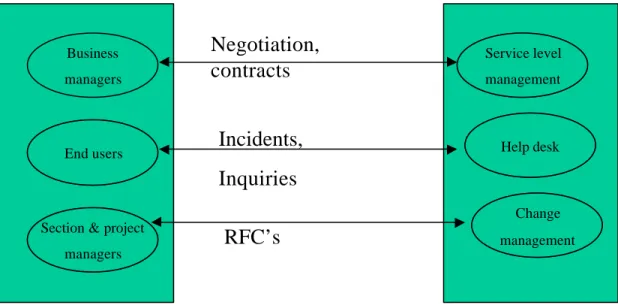
A further guide to our work is, that LAN management triggers several transactions within a company. At the business management level, a contract dictating the demanded service levels is needed. The ramifications set here are put into practice by LAN section and project managers, that are responsible for the daily running of the LAN and its change management practices. Finally, for the end users the LAN is a daily working tool. They might have practical problems with the LAN, and are usually directed to a help desk. The different levels of actions in LAN management are presented in Figure 1.
Figure 1: Study levels in IT service provision (adapted from Niessen – Oldenburg (1998))
2.
LAN’s as a research object
Local area network is here defined as a system that connects workstations, printers and servers together and enables the user to access applications and databases over the network. Usually there exist routes to other networks like Internet. The network is the basic infrastructure that makes it possible to run business applications in the company. Without a smoothly functioning network business applications and ultimately the company cannot operate – at least not very long.
In addition to the technical definition of a LAN, we need a preliminary list of the management and organizational issues that have to be taken up when discussing LAN’s. These are provided by Niessen - Oldenburg (1998):
• Availability management • Capacity management
• Incident and problem management • Change management • Contingency planning • Security management • Configuration management • Cost management • Customer liaison
• Applications development and software maintenance • Supplier management
• Service level management • IT services management.
We approach LAN’s with these ideas in mind. Firstly, we should define the boundaries of the LAN in each researched company. Secondly, there are several issues that need to be studied in
Business managers
End users
Section & project managers Service level management Help desk Change management
Negotiation,
contracts
Incidents,
Inquiries
RFC’s
LAN management. As a result of this some companies may have good working practices in some issues and other companies can have better solutions in other areas.
3.
Our approach – methodology and approaches
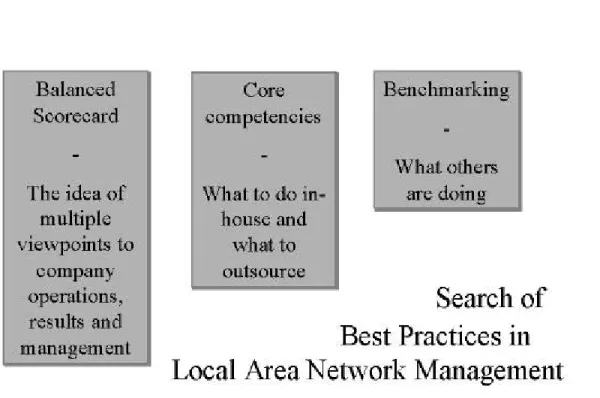
Our analysis of the LAN management practices rest on three conceptual approaches.
First, LAN management is a multifaceted task with several target functions. Demands from different stakeholders have to be balanced. For that purpose, each organization has to decide carefully, what they expect and want from their LAN’s. The balanced scorecard – approach should give us tools to handle this problem.
According to established knowledge, companies should in-source strategic tasks on core competences and leave tasks that do not necessitate and develop core competences to the playfield of market forces (Quinn – Hilmer 1994, Takac 1994). To find out how to manage LAN’s, the companies should decide whether LAN management is a core competence for them or not. For some companies this is certainly true, for some maybe not. We so turn to the core competence approach.
Last, in our search for cross-organizational learning, we find that different benchmarking practices might guide us in our work. Our goal is to find data usable for benchmarking LAN management, and even more importantly, to trigger actions in the studied companies based on this benchmarking information.
Our research project looks at network management mainly from the manager’s point of view. The idea is to bring up important issues in local area network management and discuss how they are organized. Issues range from information systems costs to IS-personnel, from network reliability to security and from information systems education to IS-planning practices. These issues have been selected based on earlier research (Nadig – Hard 1993, Niessen -Oldenburg 1998, Sirkemaa 1999a) and discussions with IS-professionals.
Figure 2: Our research setting
3.1.
The Balanced Scorecard -approach
Kaplan and Norton (1992, 1993, 1997) argue that evaluation of company’s processes and success should be based on both financial and nonfinancial measures. In recent years focus has shifted more to internal process quality, which has prompted some companies to measure satisfaction, complaints and problems in different processes and functions. Here we look at these issues in IT function and LAN management.
The idea of using multiple methods and indicators seems promising, as combining financial and nonfinancial measures should give a rich and comprehensive picture of company’s operations. Multiple measures should balance the view of company’s success, hence this approach is called balanced scorecard.
Kaplan and Norton (1997) notice that balanced scorecard is more than a collection of critical indicators or key success factors. Measures should form a linked series of objectives and measures that are both consistent and reinforce each other. The measurement system should reveal the relationships among measures and objectives explicit so that they can be managed. Consequently balanced scorecard can be a powerful tool in creating shared vision in the company. The strengths of the approach are (Kaplan - Norton 1993):
• Measures are grounded in a company’s strategic objectives and competitive demands which help to focus on critical areas
• Scorecard addresses both past and future success of the company
• Information provides a balance between external and internal properties and efficiencies • Balanced scorecard can integrate people in different departments and projects to see the
goals of the company and help understand how they can contribute to business success The balanced scorecard approach is frequently understood as a tool for strategy implementation and evaluating the company on corporate level (Olve 1999). Actually balanced scorecard approach was first developed for companies that operate within a single industry, in a particular niche like Advanced Micro Devices (AMD) or in a segment like Apple Computer in the computer industry. The idea of balanced scorecard can well be used in strategic business units. The most important issues are whether a department or function has a mission, a strategy, external or internal customers, and internal processes that enable it to accomplish its mission and implement its strategy.
Company’s IS-department has a mission, a strategy, customers and internal processes. This prompts us to use balanced scorecard approach in information systems department and apply it to LAN management.
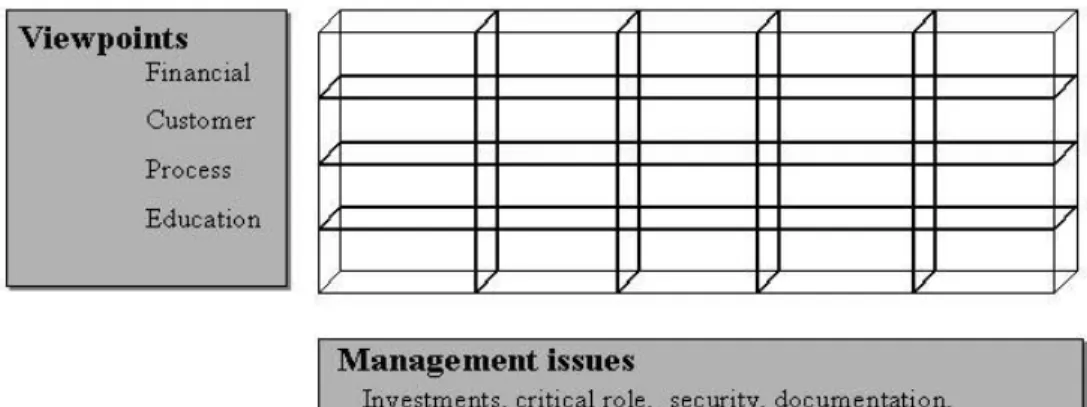
The balanced scorecard studies the researched area using four main perspectives, financial (how much money is invested in network related issues), customer (here network user), process (functionality, critical role, security) and education (both users and IT-staff). We believe this will give a in-depth understanding of the management of information systems and network resources in the company. The approach could help in (Kaplan - Norton 1992): • Focusing on really important issues in IT, the critical functions and core competencies • Bringing together a well-understood report of the company’s IT-function current and past
performance and help to evaluate future development possibilities
• Understanding the importance of teamwork, quality, shortening response time, understanding IT-customer needs and reducing launch times
• Scorecard approach also helps in seeing the importance of long-term development. Short term optimization can be harmful if for example costs are to be minimized which may lead to ill-manageable systems in the long run
To summarize, the balanced scorecard approach could be a tool for clarifying the
IT-departments management practices. It could benefit the IT-department by focusing on important issues and creating shared vision of the IT-strategy and mission. It could also help to improve both short term and long-term performance. Here we concentrate on issues and indicators that are important specifically in LAN management.
Figure 3. Viewpoints and management issues combined
3.2.
Benchmarking - approach
Benchmarking-methods could support the balanced scorecard approach. Benchmarking strengthens operations by focusing on processes and practices. It indicates gaps in performance and helps to identify the areas where development should be made (Zairi 1992). Benchmarking forces testing of internal actions against external standards of industry practices (Camp 1989). Benchmarking is here defined as comparing current practices to other company’s practices.
Benchmarking company’s operations with other companies, preferably with the best ones in the field should give ideas on what could be done better. The benchmarking process is important as it reveals the practices that are needed to reach goals (Camp 1989, p.28). When several companies are compared with each other, not only with one company, the results give guidance to all participating companies and furthermore can give a detailed and comprehensive view of the studied issue.
The benchmarking of information systems management practices can give valuable information about IS-department - strengths and weaknesses, possibilities and threads. The objectives of benchmarking are (Zairi 1992, Camp 1989)
• Becoming more competitive
• Defining customer requirements and finding out how to meet them • Becoming aware of the industry best practices
• Establishing effective goals and objectives • Developing true measures of productivity
The idea of measuring processes against other companies enables to set targets and focus on clear objectives. Benchmarking exposes organization by revealing practices that could be more effective. It is a planning method and can be used as a tool to identify areas that need further development. Benchmarking is also a way to educate, involve and empower all the people that are participating in the benchmarking process (Zairi 1992).
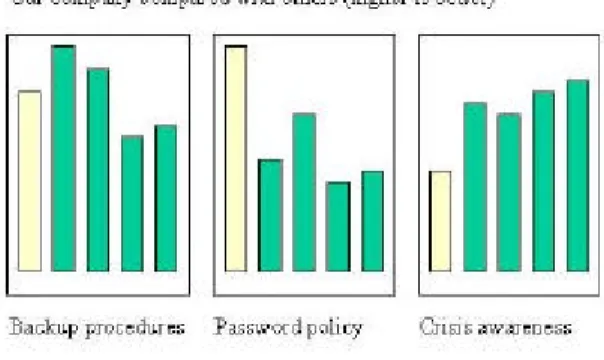
Comparing company’s performance with other companies can be valuable as it shows what areas are in good condition and what issues should be developed further. This is why we believe that looking at management issues from several perspectives gives added value to the case companies. The following figure (Figure 4) should give an idea of how we will present results in our research: they should reveal gaps in current information systems and LAN management procedures. The results will be based on comparisons of each company’s LAN management issues with others, and the current state of the issue in question will be evaluated numerically (numbers 1 to 5, where 1 is poor and 5 is excellent). These comparisons will be presented in lists, tables and figures. By displaying results so that it is easy to see how “good” each company is compared with others we hope to raise discussion which leads to development in LAN management issues in the companies.
Figure 4: Example of benchmarked results
3.3.
Core competences –approach
Core competences are those basic skills of an organization that contribute to its success and survival on the markets (Markides - Williamson 1994, Prahalad - Hamel 1990). Outsourcing information systems has become important management issue as companies change their business strategy, abandon diversification and focus on core competencies (Prahalad - Hamel 1990). With scarce resources focusing on core business processes is understandable.
The main objectives of outsourcing are usually cost cutting, need to focus on the business and not on information systems, or getting rid of maintaining and operating legacy systems (Earl 1996). As there are risks involved (Earl 1996, Lacity et al. 1996), the
outsourcing question is in which areas and how can the company take advantage of external partners. It is argued that selective or smart outsourcing can be the key to successful
management of IS capabilities (Earl 1996, Lacity - Hirschheim 1993, Lacity et al. 1996). Outsourcing is not considered as a framework, instead it should be seen as a solution to manage information systems and LAN with scarce resources. In this research we look at in what extent companies use outside business partners to help in LAN management.
4.
Current state of research
Our current research is looking at the basic network infrastructure in a company. We do not look very deeply into various software, databases and business applications, although this can not be avoided as in most cases there is very little difference between the business applications and the network infrastructure. At least from users point of view there is little difference what causes a problem if there is a customer to be served and the system is down.
We look issues in local area network management through the viewpoints and ideas of balanced scorecard approach. This approach was selected as it underlines the fact that a system, like company or its network should be studied from several viewpoints. We hope that these viewpoints can help in developing the management practices as they might not all be considered in IS-department. A pilot study has been completed during 1999 where seven organizations were studied using this methodology and theoretical background. We studied the use of accounting information systems in company's decision making. The results show that multiple viewpoints can be fruitful and give ideas to further development (Sirkemaa 1999b).
In this research we look at information systems and LAN management practices in different companies. We use benchmarking techniques to compare management practices in companies that operate in different fields. By combining these issues and viewpoints we describe how local area networks are managed and developed. The goal is to find best practices and solutions in the many tasks that have to be organized when a network is run in a company.
4.1.
Case companies in the research
We have gathered 10 case companies in our research project. The case companies operate in different fields, only one in computer business. In other companies or organizations information systems are in a supportive role, as the main business or core is somewhere else. The company that is in computer business can be seen as a reference organization, and it is interesting to study whether things are better organized there than in other companies. A more detailed description of case companies can be found at the project web-site sirkemaa.com
The case companies are small or medium-sized and usually there are only few IT-professionals in the organization. The challenge of running the information systems with limited personnel resources was in fact one of the driving forces behind this research setting. With small IT-staff and scarce resources one has to consider what can be done in-house and what should be organized through outside business partnerships. Outsourcing is seen as a solution to manage information systems or local area network related issues.
4.2.
Data gathering methods
This research uses multiple data gathering techniques. We use several, mainly qualitative methods in data gathering (Yin 1984, Patton 1988). The methods used are:
• Interviews of key persons (line managers, IT-managers and key users) • Data sheets (for technical and financial data)
• Questionnaire for the users
Interviews are used as main method of gathering data. As Huber - Power (1985, p.174) argue if a single key informant or informants is used it should be a person that is most knowledgeable about the issues of interest. Based on this argument the persons that are interviewed are IT-managers and business IT-managers who have a key role in IT-management and development issues. The selection of interviewees was partly made to ensure that both information systems and business perspectives are included in the research. The interviews were semi-structured as the questions were prepared before interviews but they were used as themes or a backbone in the interviews. They were not necessarily asked in same order in all interviews; some questions may even be skipped in case the interviewed person did not know about the issue.
4.3.
Preliminary results
Interviews and data gathering with questionnaires and other data sheets are in progress. When this paper has been written about 60 key persons have been interviewed.
Interviews indicate that in smaller companies there is firstly a need for IT-professionals that manage IT related issues on a full-time basis. Secondly, in small companies general IT management and LAN management should be better organized. In larger companies
procedures are more established and users are rather satisfied with IT-departments. In smaller companies everything depends too much on one IT-person, which makes the whole system very fragile. For example in some companies IT-staff holiday is a serious threat to LAN-operations.
IT-related education was considered very important in all companies. Still even the biggest companies used “ad hoc” –style education planning.
Backup and security related procedures were usually unsatisfactory. Only in large companies where there were hundreds of employees were security-related procedures more planned. In health care is security and privacy better understood at all levels of the organization than in other fields.
There are still many things to do: for example statistics of IT investments is currently not available. Also user questionnaires have not been computed yet. More results will be available in September this year.
5.
Conclusions
Local area network management is a difficult and critical task for all organizations, for some it is even a core competence. Because of the internal nature of the task by definition, different management practices in the field are bound to emerge. There is clearly a need for cross-organizational learning and benchmarking.
Comparison of the management practices is however not a straightforward task. Different organizations have different aspiration levels and goals for their LAN management. One of the first tasks in evaluating is to take a critical look at the goals. The balanced scorecard -approach is to give help for this.
Our task is of course not just to build a snapshot on the current situation, but to help companies to manage their LAN’s even in the future. It is worthwhile to try to understand which are the critical management activities with LAN’s, and which kinds of resources and
us guidance.
Our project on benchmarking 10 companies in their LAN management is currently at the data collection phase. In the next year, we will be able to provide detailed data on the best LAN management practices.
6.
References
Camp, R.C. Benchmarking: The Search for Industry Best Practices That Lead to Superior Performance. Milwaukee, Wisconsin, ASQC Quality Press, 1989.
Computer Sciences Corporation (1997) Critical Issues of Information Systems Management. El Segundo, CA. Referred to in Senn, Jim. The Challenge of Relating IS Research to Practice, Information Resources Management Journal, Vol.11, No.1, 1998, pp. 23-29.
Earl, Michael J. The Risks of Outsourcing IT. Sloan Management Review, Spring 1996, pp. 26-32.
Kaplan, Robert S. - Norton, David P. The Balanced Scorecard - Measures That Drive performance. Harvard Business Review, January-February, 1992, pp. 71-79.
Kaplan, Robert S. - Norton, David P. Putting the Balanced Scorecard to Work. Harvard Business Review, September-October, 1993, pp. 134-147.
Kaplan, Robert S. - Norton, David P. Why Does Business Need a Balanced Scorecard? Journal of Cost Management, May/June, 1997, pp. 5-10.
Lacity, Mary C. - Hirschheim, R. Information Systems Outsourcing: Myths, Metaphors, and Realities. Chichester, England: Wiley 1993.
Lacity, Mary C. - Willcocks, Leslie P. - Feeny, David F. The Value of Selective IT Sourcing. Sloan Management Review, Spring 1996, pp. 13-25.
Nadig, D.V. - Hard, N.J. A Proposed Model for Managing Local Area Networks and Measuring Their Effectiveness. In Proceedings of the 26. Annual Hawaii International Conference on System Sciences, 1993, pp. 538-547.
Markides, C. - Williamson P. J. Related Diversification, Core Competences and Corporate Performance, Strategic Management Journal, Vol. 15, Special Issue (Summer), 1994, pp. 149-165.
Niessen, Jan – Oldenburg, Paul. Service Level Management – Customer Focused. Central Computer and Communications Acengy, Norwich, England 1998.
Olve, Nils-Göran. Performance drivers: a practical guide to using the balanced scorecard. Chichester Wiley 1999.
Patton, Michael Q. How to Use Qualitative Methods in Evaluation. Sage Publications, Newbury Park, California, USA 1988.
Prahalad, C.K. - Hamel, Gary. The Core Competence of the Corporation. Harvard Business Review, Volume 63, May-June 1990, pp. 79-91.
Quinn, James Brian – Hilmer, Frederick G. Strategic Outsourcing. Sloan Management Review, Summer 1994, pp. 43-55.
Sirkemaa, Seppo. Network Management: Issues in Local Area Network Management. In Proceedings of the 22nd Information Systems Research Seminar in Scandinavia (IRIS 22): ”Enterprise Architectures for Virtual Organizations” Computer Science and Information Systems Reports, University of Jyväskylä 1999a.
Sirkemaa, Seppo. Laskentatoimen informaatiojärjestelmät: Käyttö päätöksenteon tukena. Julkaisusarja A – Porin korkeakouluyksikkö. Nro A24, Pori 1999b.
Strauss, Paul. The get tough guide to telecom contracts. Datamation March 15, 1995, pp. 38-44. Takac, Paul F. Outsourcing: a key to controlling escalating IT costs ? Int. Journal of Technology
Management, Vol. 9, No. 2, 1994, pp. 139-155.
(Publishing) Ltd. England 1992.
Yin, R.K. Case Study Research - Design and Methods. Beverly Hills, Sage Publications, California 1984.