Abstract—Electronic commerce has developed a lot in the last few years. Product recommendation helps to satisfy customers as one of useful applications of electronic commerce. Recommending right products to right customers enhances the customer’s utility and firm profitability. Different types of customers have different interests, so firms should firstly segment customers in to groups and recommend right product to them. A very useful method for grouping customers is customer lifetime value model, which identifies the value of each customer by various parameters. The main purpose of this paper is to clustering customers based on customer lifetime value and then recommending product to different groups of customers with using association rule mining technique. We use one electronic retailing in our study. One useful result of this survey indicates that the rules which are generated for the most loyal customers have more confidence.
Index Terms—Roduct recommendation; customer Lifetime Value; electronic commerce;data mining; customer loyalty.
I. INTRODUCTION
With growing electronic commerce in all over the world, considering to customers and their needs and desires is so important. Customers attract to electronic retailing with high compliance with their desires [1]. So considering the voice of customers and providing right product for them is important. In electronic commerce because of not face to face relation with customers this subject is more important.
Customers with different interests in electronic shopping can’t relate to the salesman, so there is not direct way to persuade customers to buy some special goods. Automated product recommendation system can help to provide appropriate product to right customers.
Different groups of customers prefer some special products. Customer’s type recognition is one of the main aims of each business and firms know who want what. [2] So firms should try finding customer groups according to customer’s behavior.
Recommender systems are so useful in one-to-one marketing [3]. As Reference [4] “Recommender systems rely on customer purchase history to determine customer preferences and to identify products that customers may purchase”. So we should investigate all past customer purchases and provide the transaction record for each customer. With exposing these records and using association rule mining we can suggest suitable product to every customer and customers may buy the suggested products
Manuscript received October 9, 2011; revised February 13, 2012. Z. Tabaei and M. Fathian are with Department of Industrial Engineering, Iran University of Science and Technology (email: Zahra_Tabaei@ind. iust.ac.ir; [email protected]).
with high probability. As result both customers and retailers obtain profitability. [5]
Finding customer’s behavior similarities is a useful method for product recommendation. Grouping customers with this method can help us to reduce the dimensions of issues and concentrate more to profitable group of customers and as result allocate them the proper portion of marketing resources.
Customer loyalty is a suitable feature for segmenting customers. Customers’ past purchasing behavior can show their loyalty [6]. The customer is loyal, if he/she purchases more products in his/her lifetime, buys products recently and spending more money during the lifetime. But if a customer doesn’t purchase recently, total number of his/her purchases is low and usually spends a little money in the lifetime, so he/she is disloyal customer.
Customer loyalty in different industries is so different. In some cases with expensive and valuable products, customers may refer few. But in some industries such as grocery customers refer several times in a week to provide the daily needs. So the importance of frequency and recency values are different in varied industries [7].
RFM model is one of customer lifetime value models that have been used for customer loyalty in a lot of studies ([4], [6], [8]-[12]). This model is easy. The parameters required for constructing this model almost are available. RFM is behavioral model and consider all past customer purchases to prospect the future customer behaviors. Considering this model in a lot of studies in varied issues can prove the usefulness of this model.
Some studies have developed the RFM model with adding some parameters to it. Reference [13] has added the Count item to this model and has constructed the RFMC model. Results showed that this parameter is not so useful and the result of RFM model was better than RFMC model. Cheng in 2009 added two parameters to RFM model: Time since first purchase, and churn probability, then developed RFMTC model [9].
Using CLV models for customer loyalty value and data mining techniques for customer segmentation according to CLV, we can recommend right products to right customers and provide individual marketing decision for each customer. So customers receive products according to their requirements, will been satisfied and purchase more at time and finally they will be loyal customers. On other words, firms spend lower cost for customer retention and can reach more profitability.
The organization of this study is as follows. In Section II, we review the related works in customer lifetime value models and recommendation systems. In section III, we propose our methodology for product recommendation which is based on CLV in conjunction with findings in our
Using Customer lifetime Value Model for Product
Recommendation: An Electronic Retailing Case Study
case study. Finally, a discussion on the study results is described in section IV.
II. LITERATURE REVIEWE A. Customer Lifetime Value
Customer Lifetime Value models are used widely to identify customer loyalty and determinate marketing strategies for different groups of customers [14]. There are several models for CLV. Some of them are based on past behavioral models and some of are based on future customer revenue.
One of useful behavioral models for customer value is RFM model. RFM was constructed based on 3 variables [15]:
• Recency: refers to the duration time between last customer purchasing and present time.
• Frequency: refers to the total number of customer purchases during life time.
• Monetary: refers to the average money which is spent during past customer purchases.
In weighted RFM, each normalized variables multiply to their estimated weights which defined by experts. Experts define the weights according to their experiences [16]. Equation 1 shows the weighted RFM.
M w F w R w RFM = R× + F × + M × (1)
where R, F and M refer to recency frequency and monetary value, and wR , wf and wm refer to weight of R, F and M.
Khajvand et al. in 2011 added Count Item to RFM model and developed the RFMCI model. They compared the result of their proposed model with RFM model and emphasized that RFM model is better than RFMCI model. Figure 1 shows the framework of their model [8]. The modeling phase shows that they use weighted RFM model with AHP analysis and selected the more valuable model. They used this model in a health and beauty company and obtained useful results.
Some studies such as [9], after customer segmentation, have estimated customer value with distance between the center of each cluster and zero.
2 2 2 ( 0) ( 0) ) 0 ( − + − + − = ir if im i C C C CV (2)
where Cir, Cif and Cim are respectively the average of R, F and M value for segment i.
Past customer value (PCV) is another CLV model which is based on the past monetary value of customers. PCV extrapolate the past monetary spent by customers in past purchases into present time. This model doesn’t consider the future expected customer value [17]. This model emphasizes that the previous monetary value of customers is a good scale for predicting the future value. Equation 3 shows one type of this model [18].
∑
= + × = T t t t d PR PCV 0 ) 1 ( (3)where T is the total time period, RPt is the customer profit in time period t and d is discount rate. Discount rate is the very important parameter of this model and depends on economical situation of each country.
Fig. 1. Framework of Customer Segmentation Based on RFM model [8]. Some CLV models prospect the future monetary value of customers. These models extrapolate the future prospected monetary will spend by customer into present time [16]. In contrast of PCV, this model is prospective. There is a lot of formula for this model in literature for special industries and situations. Equation 4 shows the general form of LTV model [19].
∑
= + × = T o t t t d pp LTV ) 1 ( 1 (4)where ppt is the predicted customer profit in time period t. d is the discount rate.
Some studies such as [20], [21] have prospected future customer acquisition profits and active time for each customer, then they have sued them to estimate the LTV.
Retention rate is an important factor in LTV estimation. If the firm identifies the right retention rate, it can estimate the valid LTV. Some studies such as [22], [23] have constructed the LTV according to the retention rate. Equation 5 shows the LTV with considering the retention rate and acquisition price [16]. AC d CM R LTV T t t t t t r r ⎟⎟ − ⎠ ⎞ ⎜⎜ ⎝ ⎛ + × ⎟⎟ ⎠ ⎞ ⎜⎜ ⎝ ⎛ =
∑
∏
=1 =1 (1 ) 1 (5)where Rr is the retention rate, and AC is the acquisition cost. Acquisition cost is very important in marketing and almost is so high. So every business should try to retain former customers with providing some value for customers. Research shows that the cost of customer acquisition is so higher than retention cost.
Determining Business objectives
Assessing Situation Determine Data Miner Goals
Data Collection Data Description Data Reduction Feature Selection Data Transformation Normalization Clustering with K-means (R, F, M) Clustering with K-means (R, F, M, CI) Compare result Business Understanding Data preparing Modeling Evaluatio n Data understanding
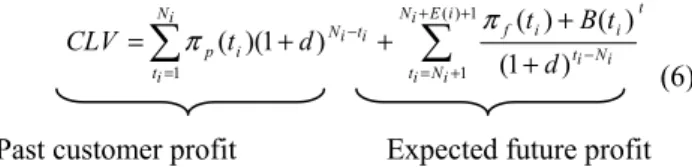
Combining PCV and LTV model leads to complete model. This model considers both past and future behavior of customer for calculating customer value. Hwang in 2004 has applied CLV model to estimate customer loyalty value for a service provider industry. Equation 5 shows the proposed CLV model [24].
∑
∑
= + + + = − − + + + + = i N i t t i E i N i N i t ti Ni i i f i t i N i p d t B t d t CLV 1 1 ) ( 1 (1 ) ) ( ) ( ) 1 )( ( π π (6) Past customer profit Expected future profitwhere ti is the time period the customer i has received the service, Ni is the total times the customer i has received the service, E(i) is the expected time periods the customer i will be active in future, πp(ti) is the past profit by customer i in time ti, πf(ti) is the expected future profit by customer i in time ti and B(ti) is the potential profit by customer i in time ti. As Equation 6 shows, both PCV and LTV have been considered.
Buyer and seller’s commitment is an effective factor has been considered in [25]. In fact, customer commitment builds the loyalty and seller’s commitment leads to customer trust and as result CLV models can been constructed based on these commitments.
According to literature review about customer value we can understand that although CLV model is the best one, but prospect the acquired future revenue from customers and their lifetime are so difficult. But RFM model is a behavioral flexible model and can adapt itself to every business. The usefulness of RFM model in marketing and customer relationship management has confirmed in a lot of studies in different industries: service provider ([9], [12], [13], [24], [26], [27]) and retailing ([4], [28]-[30]). So we use weighted RFM model to estimate the loyalty value of each group of customers.
B. Recommendation Systems and Association Rule
According to reference [4] “Recommender systems are technologies that assist businesses to implement one-to-one marketing strategies”. Recommender systems review the history of past customers purchasing and identify the customer desired products. Using recommendation systems leads to both customer and firm profitability [31].
For product recommendation first stage is to gather information about past customer’s purchases. This information contains all data about any combination of products have been purchased by each customer group. With this information, recommendation system extracts the useful rules and can propose the right products to customers [32].
One of the useful data mining techniques which has been used in recommendation systems is association rule mining. This technique extracts useful patterns according to customer transaction records [33], [34].
Association rule mining is a very useful method to find the effective rules in every field of marketing. At first stage all data transaction of all customers in the past purchases should be gathered. After that all frequent itemsets (a set of some items) are generated and finally useful rules are accepted according to some metrics. There are some algorithms to
create frequent itemset. In Brute-Force algorithm each itemset is a choice for frequent itemset. Using “support” metric can help to select actual frequent itemset. Support count refers to frequency of occurrence of an itemset. “An itemset whose support is greater than or equal to a min-support threshold is a frequent itemset”[35] the time complexity of this algorithm is exponential . So this method is so expensive. Another algorithm which is named Apriori algorithm uses anti-monotone property of support and reduces the candidate itemsets [36].
Another rule evaluation metric is ‘confidence’. For every rule, confidence measures how often items (products) in appear in transactions that contain [36]. So if the confidence value of the rule is equal or more than min-confidence threshold, it is selected as useful rule.
After rules extraction, recommendation system works according to the following method:
If is the set of all product types have been purchased by customer at past, for each rules in , if then all product types were proposed to candidate customer. is the set of rules related to customer group [4],[37].
III. METHODOLOGY WITH FINDINGS
In our survey we have used weighted RFM model for customer loyalty estimation.
Fig. 2. Research design.
In the first stage after data preparing we used RFM model for customer value estimation. In the second stage customers have been segmented according weighted RFM and have been assigned ranking score to each groups. Finally we use association rule mining to extract useful rules for product recommendation. The brief stages of our methodology have been shown in Fig. 2.
Preparing data
Ranking segment according to RFM weighted average Extraction the R, F and M
variables
Evaluating the weight of each R, F and M variables by experts
Making decision for number of clusters
Using K-means algorithm for customer segmentation
Using association rule mining for product recommendation Phase 1
Phase 2
A. Data Preparing
We use a data set from one electronic retailing in our study. This electronic retailing sells different types of CD (software, educational, film, game and music) as total 218 CDs to customers. Data set contains 65535 transaction records with 22086 customers. Each record contains customer ID, last purchase time, price of purchased product and product ID. The R, F and M value for each customer were extracted. In our survey the customers who purchase recently has higher R value.
B. Clustering Customers with Similar RFM Value
After evaluating the weight of each variable with AHP analysis, K-means algorithm has been used in order to customer segmentation. We set the number of clusters at 8, because each variable R, F and M is higher ( ) or lower ( ) than its average (2*2*2=8) [38]. TABLE I shows the result of customer segmentation according to normalized weighted R, F and M value.
TABLEI:8CLUSTER RANKING BY WEIGHTED SUM OF NORMALIZED RFM VALUE
cluster customers No. of Recency Weighted Frequency Weighted Monetar Weighted
y Pattern T ype WRFM Rank 1 13374 0.06 0.000 0.000 0.060 8 2 3 0.728 0.164 0.058 0.950 1 3 2127 0.586 0.004 0.001 0.591 4 4 1 0.134 0.048 0.038 0.220 7 5 1979 0.254 0.002 0.001 0.257 6 6 71 0.708 0.037 0.012 0.757 2 7 2462 0.692 0.006 0.002 0.700 3 8 2069 0.438 0.003 0.001 0.442 5 Overall average 0.236 0.0021 0.0011 WR=0.68, WF=0.21, WM=0.11
TABLEII:4CLUSTER RANKING BY WEIGHTED SUM OF NORMALIZED RFM VALUE
cluster customers No. of Recency Weighted Frequency Weighted Monetar Weighted
y Pattern T ype WRFM Rank 1 13937 0.065 0.000 0.000 0.065 4 2 4856 0.638 0.005 0.002 0.645 2 3 3284 0.336 0.002 0.001 0.369 3 4 9 0.713 0.116 0.034 0.863 1 Overall Average 0.236 0.0021 0.0011 WR=0.68, WF=0.21, WM=0.11
TABLEIII:CLUSTER RANKING BY WEIGHTED SUM OF NORMALIZED RFM VALUE
cluster cus No. of
tomer
s
Weighted
Recency Frequency Weighted Monetar Weighted
y T ype WRFM Rank 1 13937 0.065 0.000 0.000 0.065 3 2 4863 0.648 0.006 0.002 0.645 1 3 3286 0.338 0.002 0.001 0.369 2 Overall Average 0.236 0.0021 0.0011 WR=0.68, WF=0.21, WM=0.11
As TABLE I shows clusters 2 and 4 have few customers, they may be outliers. So with putting aside them only 4
cluster patterns ( , , , and
) have been identified. So it seems that we should decrease the number of clusters. We set number of clusters at 4 and perform K-means algorithm again. The results with 4 clusters have been shown in TABLE II.
Results show that with 4 clusters, 3 pattern types have been identified and cluster 4 with 9 members is outlier. So we repeat last stage again with 3 clusters. There is no outlier customers. The results with 3 clusters have been shown in TABLE III. Results show that with 3 clusters, 3 pattern types have been identified and there is no outlier customers. So the results are valid.
C. Product Recommendation
The association rule mining is used for extracting useful rules in each separate segment of customers and then propose desired products to customers.
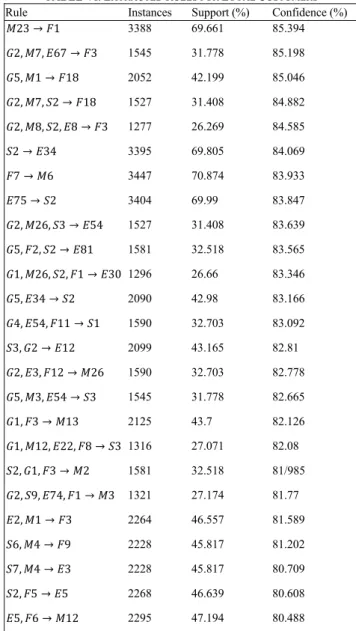
TABLEVI:EXTRACTED RULES FOR LOYAL CUSTOMERS
Rule Instances Support (%) Confidence (%)
23 1 3388 69.661 85.394 2, 7, 67 3 1545 31.778 85.198 5, 1 18 2052 42.199 85.046 2, 7, 2 18 1527 31.408 84.882 2, 8, 2, 8 3 1277 26.269 84.585 2 34 3395 69.805 84.069 7 6 3447 70.874 83.933 75 2 3404 69.99 83.847 2, 26, 3 54 1527 31.408 83.639 5, 2, 2 81 1581 32.518 83.565 1, 26, 2, 1 30 1296 26.66 83.346 5, 34 2 2090 42.98 83.166 4, 54, 11 1 1590 32.703 83.092 3, 2 12 2099 43.165 82.81 2, 3, 12 26 1590 32.703 82.778 5, 3, 54 3 1545 31.778 82.665 1, 3 13 2125 43.7 82.126 1, 12, 22, 8 3 1316 27.071 82.08 2, 1, 3 2 1581 32.518 81/985 2, 9, 74, 1 3 1321 27.174 81.77 2, 1 3 2264 46.557 81.589 6, 4 9 2228 45.817 81.202 7, 4 3 2228 45.817 80.709 2, 5 5 2268 46.639 80.608 5, 6 12 2295 47.194 80.488
Note: G=Game, E=Educational, F=Film, S=software, M=music
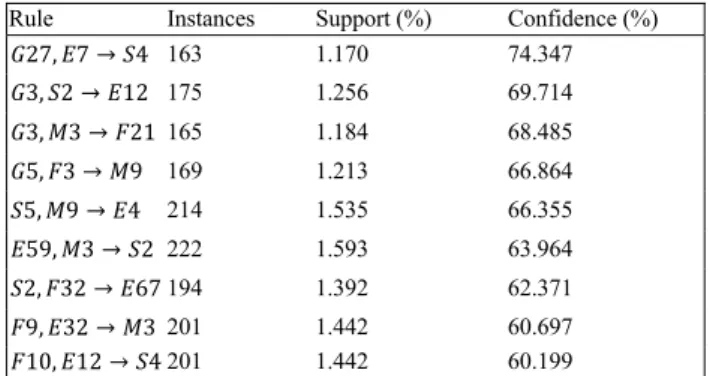
Some extracted rules from loyal customers and all rules from disloyal and new customers segments have been shown in TABLE IV, V and VI. We used Apriori algorithm from SPSS Clementine 12 for rule extraction.
As have been shown, the rules have been extracted from disloyal segment have low support (1%) and the maximum confidence is 74%. Reference [4] has proposed that for disloyal customers preference-based CF Collaborative Filtering (CF) method is useful and can improve the recommendation quality. But for loyal and new customers the minimum support and confidence are high so the results are reliable.
TABLEV:EXTRACTED RULES FOR DISLOYAL CUSTOMERS
Rule Instances Support (%) Confidence (%)
27, 7 4 163 1.170 74.347 3, 2 12 175 1.256 69.714 3, 3 21 165 1.184 68.485 5, 3 9 169 1.213 66.864 5, 9 4 214 1.535 66.355 59, 3 2 222 1.593 63.964 2, 32 67 194 1.392 62.371 9, 32 3 201 1.442 60.697 10, 12 4 201 1.442 60.199 Note: G=Game, E=Educational, F=Film, S=software, M=music
TABLEVI:EXTRACTED RULES FOR NEW CUSTOMERS
Rule Instances Support (%) Confidence (%)
75 2 1837 55.907 84.586
2 28 1854 56.425 83.81
7 6 1793 54.568 83.594
23 1 1793 54.568 83.595
Note: G=Game, E=Educational, F=Film, S=software, M=music
IV. CONCLUSION
In this survey product recommendation was studied. At first customers were segmented with CLV model. Three types of customers were identified: loyal, disloyal and new customers. Then association rule mining was used for extracting rules from each segment. Results show that the rule support and confidence for loyal and new customers is relatively high, so this method is useful and reliable for these groups. But because of low support for disloyal customers this method is not so useful and CF method may be applicable for the disloyal segment, as proposed in [38].
REFERENCES
[1] L. -S. Chen, F. -H. Hsu, M. -C. Chen, and Y.-C. Hsu, “Developing recommender systems with the consideration of product profitability for sellers,” Information Sciences, Vol. 178, No. 4 , February 2008. pp. 1032-1048 , doi:10.1016/j.ins.2007.09.027.
[2] D. -R. Liu and C. -H. Liou, “Mobile commerce product recommendations based on hybrid multiple channels,” Electronic Commerce Research and Applications, Vol. 10. No.1, January-February 2011, pp. 94-104, doi:10.1016/j.elerap.2010.08.004. [3] D. -R. Liu and Y. -Y Shih, “Product recommendation approaches:
Collaborative filtering via customer lifetime value and customer demands,” Journal of Systems and Software, Vol. 35, pp. 350–360, August 2008
[4] D. -R. Liu and Y. -Y Shih, “Hybrid approaches to product recommendation based on customer lifetime value and purchase preferences,” Journal of Systems and Software, Vol. 77, pp. 181–191, August 2005
[5] S. Senecal and J. Nantel, “The influence of online product recommendations on consumers’ online choices,” Journal of Retailing, Vol. 80, No. 2, pp. 159-169, June 2004.
[6] H. –C Chang, H. -P and Tsai, “Group RFM analysis as a novel framework to discover better customer consumption behavior,”
Expert Systems with Applications,Vol. 38, No. 12, November-December 2011, doi:10.1016/j.eswa.2011.05.034.
[7] Y. -L. Chen, M. -H. Kuo, S. -Y. Wu, and K. Tang, “Discovering recency, frequency, and monetary (RFM) sequential patterns from customers’ purchasing data,” Electronic Commerce Research and Applications, Vol. 8, No. 5, pp. 241-251,October 2009.
[8] M. Khajvand and M. J. Tarokh, “Estimating customer future value of different customer segments based on adapted RFM model in retail banking context,” Procedia Computer Science,Vol. 3,pp.1327-1332, February 2011.
[9] C.-H. Cheng and Y. -S. Chen, “Classifying the segmentation of customer value via RFM model and RS theory,” Expert Systems with Applications, Vol. 36, pp.4176-4184, April 2009.
[10] C. -H. Cheng and H. -P. Tsai “Group RFM analysis as a novel framework to discover better customer consumption behavior,”
Expert Systems with Applications, in press.
[11] S. M. S. Hosseini, A. Maleki, and M.R. Gholamian, “Cluster analysis using data mining approach to develop CRM methodology to assess the customer loyalty,” Expert Systems with Applications, Vol. 37, pp.5259-5264, July 2010.
[12] L. -C. Cheng and L. -M. Sun, “Exploring consumer adoption of new services by analyzing the behavior of 3G subscribers: An empirical case study,” Electronic Commerce Research and Applications, In press, June 2011
[13] M. Khajvand, K. Zolfaghar, S. Ashoori, and S. Alizadeh, “Estimating customer lifetime value based on RFM analysis of customer purchase behavior: Case study,” Procedia Computer Science,Vol. 3,pp.57-63, February 2011.
[14] J. Miglautsch “Thoughts on RFM Scoring,” Journal of Database Marketing, Vol. 8, No.1, 2000, pp. 67-72.
[15] B. Stone, Successful direct marketing methods, Lincolnwood, IL: NTC Business Books, 1995, pp. 37-57.
[16] V. Kumar and W. J. Reinartz, Customer Relationship Management: A Data based Approach, First ed., Wiley & Sons, 2006, pp.108-128. [17] V. Kumar and R. Venkatesan, “Who are the multichannel shoppers
and how do they perform?: Correlates of multichannel shopping behavior,” Journal of Interactive Marketing, Vol. 19, No. 2, March 2005, pp. 44-6.
[18] V. Kumar and B. Rajan, “Profitable Customer Management: Measuring and Maximizing Customer Lifetime Value,” Management Accounting Quarterly, Vol. 10, pp. 1-18, spring 2009.
[19] C. S. Y. Sublaban and F. Aranha, “Estimating cellphone providers' customer equity,” Journal of Business Research, Vol. 62, No. 9, September 2009, 891-898, doi:10.1016/j.jbusres.2008.10.006. [20] A. P. Sant’Anna and R. O. Ribeiro, “Statistical modeling and
probabilistic composition in the prediction of the customer lifetime,”
Benchmarking: An International Journal, Vol. 16, pp.335 – 350, 2009. [21] N. Glady, B. Baesens, and C. Croux, “A modified Pareto/NBD approach for predicting customer lifetime value,” Expert Systems with Applications, 36:2, 2062-2071, March 2009.
[22] E. Malthouse and F. Mulhern, “Understanding and using customer loyalty and customer value,” Journal of Relationship Marketing, Vol. 6, pp.59 - 86,September 2008.
[23] P. Hidalgo, E. Manzur, S. Olavarrieta, and P. Farias, “Customer retention and price matching: The AFPs case,” Journal of Business Research, Vol. 6, pp.691-696, June 2008.
[24] H. Hwang, T. Jung, and E. Suh, “An LTV model and customer segmentation based on customer value: a case study on the wireless telecommunication industry”, Expert Systems with Applications, Vol. 26,No. 2, pp. 181-188, June 2004.
[25] G. E. Fruchter and S. P. Sigué, “Social relationship and transactional marketing policies—Maximizing customer lifetime value,” Journal of Optimization Theory and Applications, Vol. 142, pp.469–492, 2009. [26] S. -T. Li, L.-Y. Shue, and S.-F. Lee, “Business intelligence approach
to supporting strategy-making of ISP service management,” Expert Systems with Applications, Vol. No. 3, pp. 739-754, October 2008. [27] Y. -Shyang Chen, C. –H. Cheng, C. –J. Lai, C. –Y. Hsu, and H. -J.
two-stage clustering-classification approach: A hospital-based assessment,”
Computers in Biology and Medicine, In press,December 2011. [28] W. Buckinx, and D. V. D. Poel, “Customer base analysis: partial
defection of behaviourally loyal clients in a non-contractual FMCG retail setting ,” European Journal of Operational Research, Vol. 164, No. 1, pp. 252-268, July 2005.
[29] C. -Y. Tsai and C.-C. Chiu, “A purchase-based market segmentation methodology ,” Expert Systems with Applications, Vol. 27, No. 2, pp. 265-276, August 2004.
[30] D. -C. Li, W.-L. Dai, and W. -T. Tseng, “A two-stage clustering method to analyze customer characteristics to build discriminative customer management: A case of textile manufacturing business,”
Expert Systems with Applications, Vol. 38, No. 6, pp. 7186-7191, 2011.
[31] Y. H. Cho and J. K. Kim, “Application of Web usage mining and product taxonomy to collaborative recommendations in e-commerce,”
Expert Systems with Applications, Vol. 26, No. 2, February 2004, pp. 233-246, doi:10.1016/S0957-4174(03)00138-6.
[32] H. Yun, D. Ha, B. Hwang, and K. Ho Ryu, “ Mining association rules on significant rare data using relative support,” The Journal of Systems and Software,Vol. 67, No. 3, September 2003, pp. 181– 191,doi:10.1016/S0164-1212(02)00128-0.
[33] S. W. Changchien and T. -C Lu, “Mining association rules procedure to support on-line recommendation by customers and products fragmentation,” Expert Systems with Applications, Vol. 20, No. 4, , May 2001, pp. 325-335, doi:10.1016/S0957-4174(01)00017-3. [34] D. -Ren Liu, C. –H. Lai, and W. -J. Lee, “A hybrid of sequential rules
and collaborative filtering for product recommendation,” Information Sciences, Vol. 179, No. 29, September 2009, pp. 3505-3519, doi:10.1016/j.ins.2009.06.004.
[35] P. -N. Tan, Introduction to data mining, Published by addition wesley, 2006, pp. 176-193.
[36] J. Han and M. Kamber, Data Mining: Concepts and Techniques, 3rd ed ,Morgan Kaufmann, 2000, pp. 186-220, Jiawei Han and Micheline Kamber.
[37] B. Sarwar, G. Karypis, J. JKonstan, and J. Riedl, “Analysis of recommendation algorithms for e-commerce,” In: Proceedings of the ACM Conference (Electronic Commerce), pp. 158–167, 2000, doi:10.1145/352871.352887.
[38] D. –R. and Y. –Y shih “Integrating AHP and data mining for product recommendation based on customer lifetime value,“ Information & Management, Vol. 42, No. 3, pp. 387-400, March 2005.
Zahra Tabaei is from Iran. She was born in 9 June 1985. She received BS degree in the field of software engineering from Alzahra University in 2007. She received MS degree in the field of Information Technology (Electronic Commerce) from Industrial Engineering department of Iran University of Science and Technology in 2011. She has some research papers in the field of electronic commerce.
Mohammad Fathian is associate professor of Iran University of Science and Technology (IUST). He was born in 1967. He received BS degree in the field of electronic engineering from KNToosi University of Technology in 1991. He received MS and PHD degree in the field of Industrial Engineering from Iran University of Science and Technology in 1997 and 2002 respectively. He was head of the department of electronic commerce of IUST from 2006 to 2011. He has published 5 books and more than 20 journal papers.
![Fig. 1. Framework of Customer Segmentation Based on RFM model [8].](https://thumb-us.123doks.com/thumbv2/123dok_us/1051347.2639433/2.892.465.830.161.538/fig-framework-customer-segmentation-based-rfm-model.webp)