© 2013, American Alliance for Health, Physical Education, Recreation and Dance, www.aahperd.org 1900 Association Drive • Reston, VA 20191, U.S. (703) 476-3410 • Fax (703) 476-8316
Position
The American Alliance for Health, Physical Education, Recreation and Dance (AAHPERD) recommends that all schools implement a comprehensive school physical activity program (CSPAP).
The Need for Physical Activity
Physical activity is important to the overall health and well-being of everyone, including all school-age children. The benefits of physical activity are well-documented and include the mitigation of many health risks, including those for developing Type 2 diabetes, high blood pressure and high blood cholesterol. Physical activity also contributes to the building and maintenance of healthy bones and muscles, improved health-related fitness, and positive social and mental health (United States Department of Health and Human Services, 2008). While childhood obesity continues to be a top public health concern throughout the United States, physical activity is a proven critical tool for preventing and treating obesity and its related risk factors (Glickman, Parker, Sim, Cook & Miller, 2012; U.S. White House Task Force on Childhood Obesity, 2010).
Also, an increasing body of scientific evidence suggests that healthier students are better learners and that physical activity can improve student academic achievement (e.g., grades, standardized test scores), as well as other factors that influence academic success in school (e.g., attention span, classroom behavior, attendance) (Basch, 2010; USDHHS, 2010; Hillman, et al., 2009; Trudeau & Shephard, 2008; Active Living Research, 2007).
In 2008, the U.S. Department of Health and Human Services released the first comprehensive guidelines on physical activity for all Americans, and included key recommendations for
children and adolescents. In concert with recommendations from AAHPERD and other leading public health, medical and education organizations and researchers, HHS recommended that children and adolescents should be physically active at least 60 minutes daily, and should participate in activities that are mostly moderate to vigorous in intensity and that are muscle- and bone-strengthening (USDHHS, 2008; NASPE, 2004; Strong, et al., 2005; Glickman, et al., 2012; AAP, 2006). Examples include brisk walking, jogging, jumping rope and many other activities through which students increase their
Comprehensive School Physical Activity Programs:
© 2013, American Alliance for Health, Physical Education, Recreation and Dance, www.aahperd.org 1900 Association Drive • Reston, VA 20191, U.S. (703) 476-3410 • Fax (703) 476-8316 2
Comprehensive School Physical Activity Programs (Cont.)
respiration rate or heart rate, or would become fatigued after engaging in the activity for several minutes. AAHPERD also recommends activities that provide skill-development opportunities.
Physical activity programs in schools should help all children — regardless of ability or developmental level — meet these national recommendations, and schools must make accommodations, when possible, to ensure the safety of and appropriate environment for all students. Schools should provide students with opportunities to:
Learn the skills that they need to become competent movers; View physical activity as important and enjoyable;
Become confident in participating in physical activity; and
Discover physical activities that cultivate the habits that lead to being active for a lifetime (USDHHS, 2010).
The Role of Schools in Providing Physical Activity
Schools are in an ideal position to influence children’s health through improved physical activity participation, because school is where most children spend the majority of their time outside the home. Consistent messages and opportunities for physical activity across the school environment that encourage and reinforce similar actions in the community and home settings are critical to meeting the recommended 60 minutes of physical activity each day and to influencing health-related behaviors (Kaplan, Liverman & Kraak, 2005; Glickman, et al., 2012, Pate, et al., 2006).
HHS’s Healthy People 2020 national objectives call for schools to increase the proportion of students who meet these physical activity guidelines, and who participate in daily physical education and other physical activity opportunities such as recess, after-school activities and active transport (USDHHS, 2010). The National Physical Activity Plan©, released in 2010 by a consortium of major health-related organizations, calls for schools to do the same, and to stand accountable for the quality and quantity of the physical activity programs that they provide (National Physical Activity Plan, 2010).
In recent years, leading national public health, medical and government organizations and agencies also have called on schools to adopt more strategies to help children participate in high-quality physical education and other physical activity opportunities before, during and after school, and to serve as the cornerstone in collaborative partnerships with communities to promote physical activity (USDHHS, 1996; Strong, et al., 2005; Pate, et al., 2006; U.S. White House Task Force on Obesity, 2010; Glickman, et al., 2012 NASBE, 2009; NSBA, 2012; NEA 2010; NASPE, 2009; ASCD, 2011). The Institute of Medicine’s 2012 report on obesity
prevention calls for schools to become the national focal point for obesity prevention, and for all local education agencies and schools to adopt requirements for high-quality physical education — which includes a focus on skill development — and opportunities for daily physical activity outside of physical education (Glickman, et al., 2012). All of those recommendations call for schools to assume strong leadership roles in the education and
© 2013, American Alliance for Health, Physical Education, Recreation and Dance, www.aahperd.org 1900 Association Drive • Reston, VA 20191, U.S. (703) 476-3410 • Fax (703) 476-8316 3
Comprehensive School Physical Activity Programs (Cont.)
promotion of physical activity among children, both during the school day and outside of school.
What Is a Comprehensive School Physical Activity Program?
A comprehensive school physical activity program (CSPAP) is a systemic approach by which schools use all opportunities for school-based physical activity to develop physically educated students who participate in the nationally recommended 60-plus minutes of physical activity each day and who develop the knowledge, skills and confidence to be physically active for a lifetime.
The five components of a CSPAP are: 1. High-quality physical education. 2. Physical activity during school.
3. Physical activity before and after school. 4. Staff involvement.
5. Family and community engagement. The goals of a CSPAP are to:
Provide a variety of physical activity opportunities throughout the school day, with a high-quality physical education program as the foundation.
Provide physical activity opportunities both before and after school, so that all students can participate in at least 60 minutes of physical activity daily.
Incorporate physical activity opportunities for faculty and staff members, as well as for families.
Encourage and reinforce physical activity opportunities in the community.
Coordinate among the CSPAP components to maximize understanding, application and practice of the knowledge and skills learned in physical education, so that all students are physically educated and motivated to pursue a lifetime of physical activity.
Exploring the 5 Components of a CSPAP
1. Physical Education
A high-quality physical education program is the cornerstone of a comprehensive school effort to increase the physical activity levels of students (Rink, Hall & Williams, 2010). Physical education teachers are responsible for providing students with the knowledge, skills and confidence needed to lead physically active lifestyles.
High-quality physical education is characterized by standards-based instruction and includes moderate-to-vigorous physical activity for at least 50 percent of the class time, but not at the expense of skill development or high-quality instruction; follows appropriate instruction
practices; and is developmentally appropriate to students’ physical, cognitive and social needs of children (NASPE, 2003). Teachers and administrators must not neglect skill-development opportunities, as they provide a major avenue for promoting physical activity over a lifetime.
© 2013, American Alliance for Health, Physical Education, Recreation and Dance, www.aahperd.org 1900 Association Drive • Reston, VA 20191, U.S. (703) 476-3410 • Fax (703) 476-8316 4
Comprehensive School Physical Activity Programs (Cont.)
The success of a high-quality physical education program depends upon district and school administrative support in hiring highly qualified physical education teachers (NASPE, 2007), holding teachers accountable for high-quality instruction and allocating funds for adequate equipment, facilities and personnel.
Increasing physical education time in schools is an ideal way to increase physical activity, but it might require funded state-level legislation. Establishing physical activity programs in schools, however, requires little funding, and the CSPAP effort to build community and parent support has the potential to garner impetus for legislation to increase physical education time (Rink, et al., 2010).
2. Physical Activity During the School Day
Along with high-quality physical education classes, students need additional opportunities for physical activity throughout the school day to help meet the recommended 60 minutes or more of daily physical activity. Physical activity breaks interspersed throughout the day also can contribute to improved cognitive skills and enhanced concentration, as well as improved classroom behavior (USDHHS, 2010). Such activity breaks are not intended to take the place of high-quality physical education, but rather to supplement physical activity time accumulated during physical education class, and to help students use the skills and knowledge that they have acquired in physical education to participate in and enjoy physical activity.
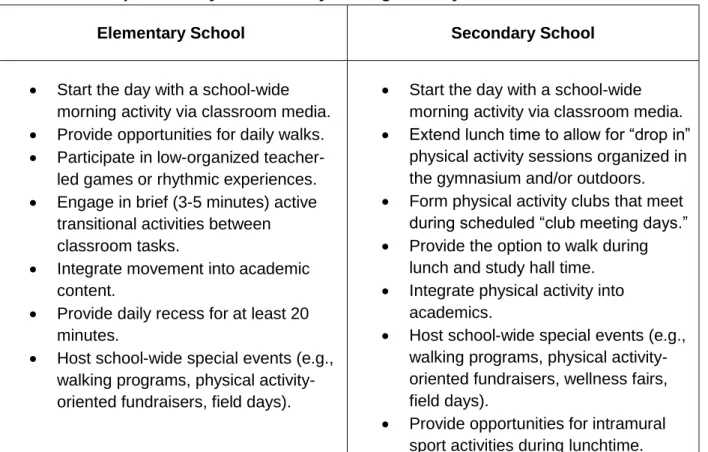
Table 1. Examples of Physical Activity During the Day
Elementary School Secondary School
Start the day with a school-wide morning activity via classroom media. Provide opportunities for daily walks. Participate in low-organized
teacher-led games or rhythmic experiences. Engage in brief (3-5 minutes) active
transitional activities between classroom tasks.
Integrate movement into academic content.
Provide daily recess for at least 20 minutes.
Host school-wide special events (e.g., walking programs, physical activity-oriented fundraisers, field days).
Start the day with a school-wide morning activity via classroom media. Extend lunch time to allow for “drop in”
physical activity sessions organized in the gymnasium and/or outdoors. Form physical activity clubs that meet
during scheduled “club meeting days.” Provide the option to walk during
lunch and study hall time. Integrate physical activity into
academics.
Host school-wide special events (e.g., walking programs, physical activity-oriented fundraisers, wellness fairs, field days).
Provide opportunities for intramural sport activities during lunchtime.
© 2013, American Alliance for Health, Physical Education, Recreation and Dance, www.aahperd.org 1900 Association Drive • Reston, VA 20191, U.S. (703) 476-3410 • Fax (703) 476-8316 5
Comprehensive School Physical Activity Programs (Cont.)
3. Physical Activity Before and After School
Before- and after-school physical activity opportunities are promising venues for increasing students’ overall physical activity levels (Beets, Beighle, Erwin & White, 2009; Kaplan, et al., 2005; NASPE, 2002a, 2002b; Powers, Conway, McKenzie, Sallis & Marshall, 2002; Yin, Gutin, Johnson, Hanes, Moore, Cavnar & Barbeau, 2005). A number of options — including intramural activities, interscholastic sports, active transport to school, activity clubs, youth sports and traditional daycare/after-school programs — exist to promote physical activity for students during the hours before and after school (Beighle & Moore, 2012).
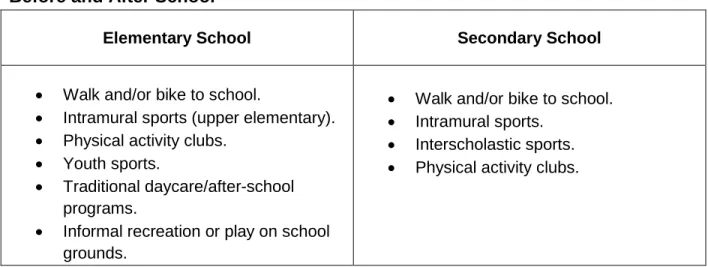
It’s important that school personnel focus on providing opportunities for the greatest number of students; thus, providing a wide variety of activities that stimulate student interest should be the goal. Each opportunity is described in more detail below, and a non-exhaustive list of options for elementary schools and secondary schools is presented in Table 2.
Intramural activities encompass a myriad of physical activity choices, including sports (e.g., volleyball, tennis), individual lifetime activities (e.g., walking, jogging) and classes or lessons (e.g., karate, dance). They can be offered before or after school in a competitive or
non-competitive environment. Also, intramural options can involve traditional sports or innovative
activities to pique the interest of those who are not normally physically active.
Physical activity clubs are similar to intramurals, but typically, they start off smaller in an effort to gauge and/or increase student interest. They also are mostly recreational. with a non-competitive atmosphere. Examples can include orienteering, yoga or other forms of specialized activities initiated by a staff member or parent who has a particular interest and/or skill set.
Interscholastic sports, typically, are offered at the secondary school level. They are an important part of American culture; yet, with regard to improving physical activity for all students, they are highly exclusionary and tend to favor highly skilled students. Research suggests that students’ gender and age, and the type of sport (e.g., soccer, softball), influence the amount of physical activity accrued through interscholastic sports (Leek, Carlson, Cain, Henrichon, Rosenberg, Patrick & Sallis, 2011).
Youth sports are community-based programs in which youths play organized sports in both competitive and non-competitive environments, depending on the nature of the program. Generally, youth sports are offered by organizations within the community, such as a local YMCA, parks and recreation departments, and Boys’ and Girls’ Clubs, although they sometimes are school-based. Typically, youth sports are open to all children, regardless of skill level.
Before- and after-school programs typically take place immediately before or after school and are run by various community organizations, as referenced above. They provide adult-supervised, organized activities in which students can participate beyond the traditional school day. Thereare no clear-cut mandates for offering physical activity during these programs; however, both structured and non-structured forms of physical activity are suggested.
© 2013, American Alliance for Health, Physical Education, Recreation and Dance, www.aahperd.org 1900 Association Drive • Reston, VA 20191, U.S. (703) 476-3410 • Fax (703) 476-8316 6
Comprehensive School Physical Activity Programs (Cont.)
Recommendations related to the amount of physical activity offered during these hours (e.g., number of minutes of physical activity offered, percentage of time during the program
dedicated to providing physical activity) are being implemented in a number of states (Beets, Wallner & Beighle, 2010). The most recent suggestion is for after-school programs to help children accumulate up to 30 minutes of moderate to vigorous physical activity per day (Beets, Huberty & Beighle, 2012).
Active transport to and from school — including National Walk to School Week, bike-to-school days, walking bike-to-school buses and other programs — is an effective way to more physical activity before and after school, as students who walk or bike to school tend to expend more energy on a daily basis (Cooper, Page, Foster & Qahwaji, 2003; Tudor-Locke, Ainsworth, Adair & Popkin, 2003; Tudor-Locke, Neff, Ainsworth, Addy & Popkin, 2002).
Table 2. Examples of Elementary & Secondary Physical Activity Opportunities
Before and After School
Elementary School Secondary School
Walk and/or bike to school.
Intramural sports (upper elementary). Physical activity clubs.
Youth sports.
Traditional daycare/after-school programs.
Informal recreation or play on school grounds.
Walk and/or bike to school. Intramural sports.
Interscholastic sports. Physical activity clubs.
4. Staff Involvement
Staff involvement in a comprehensive school physical activity program includes both programs incorporated by school staff to increase the physical activity levels of students and programs incorporated to increase the physical activity levels of school staff members. School
employee wellness programs, which have existed for years, are designed to improve the health of staff and can address a number of health aspects, including physical activity, nutrition, stress and mental health. A CSPAP can offer walking programs, personal training sessions, group fitness classes, yoga/Pilates and other types of physical activities. Ideally, school staff members can use school facilities to participate in group physical activity opportunities.
Staff involvement also can include having staff members provide opportunities for staff and students to be active. For example, staff might assist supervisors or sponsors of
activity-© 2013, American Alliance for Health, Physical Education, Recreation and Dance, www.aahperd.org 1900 Association Drive • Reston, VA 20191, U.S. (703) 476-3410 • Fax (703) 476-8316 7
Comprehensive School Physical Activity Programs (Cont.)
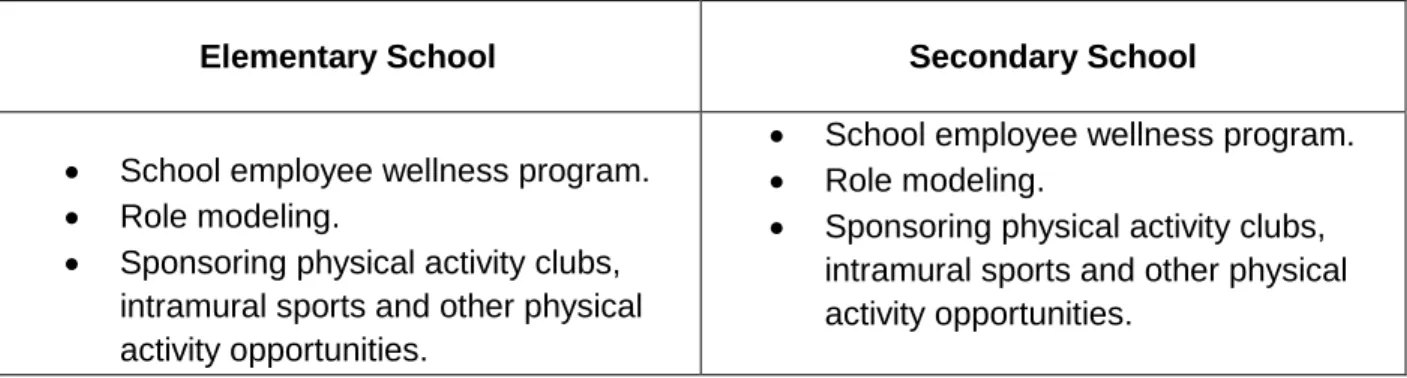
based events and programs (e.g., intramurals, physical activity clubs). They also might show support by serving as physically active role models for students, as listed in Table 3.
Table 3. Examples of Elementary & Secondary School Staff Involvement
Elementary School Secondary School
School employee wellness program. Role modeling.
Sponsoring physical activity clubs, intramural sports and other physical activity opportunities.
School employee wellness program. Role modeling.
Sponsoring physical activity clubs, intramural sports and other physical activity opportunities.
5.
Family and Community Engagement
This fifth and final component of a comprehensive school physical activity program — family and community engagement — can exert the most significant impact on lifetime physical activity, since the physical activity opportunities for all students after their k-12 education is complete occur within the community. As students progress through a P-12 school
curriculum, they have several different physical activity opportunities (e.g., physical education, physical activity during the school day, physical activity before and after school). The link that’s often missing for many students, however, is the connection with the local community. A truly successful comprehensive school physical activity program works with students, faculty, staff, parents and others to engage in physical activity offerings in settings both within the school and in the community (NASPE, 2008) and, thereby, fosters the development of a lifetime of physical activity. Therefore, schools should take an active part in informing students of ways in which they can involve themselves in physical activity within their communities (e.g., walking trails, recreation leagues, fitness-based classes).
In addition, school administrators and each school’s CSPAP champions — those who most significantly promote and affect physical activity levels within the school — should provide opportunities for physical activity within the school environment, or provide regularly scheduled school and community physical activity events (e.g., health fairs, annual road races, recreation nights). School administrators must play a strong role within any CSPAP, contributing to the overall vision and plan.
Perhaps the most meaningful way to encourage students to participate in physical activity is to provide strategies for them to be physically active with their own family members. Research suggests that children of physically active parents are more likely to be active than children of sedentary parents (Freedson & Evenson, 1991; Moore, Lombardi, White, Campbell, Oliveria & Ellison, 1991; Nader, Sellers, Johnson, Perry, Stone, Cook, et al., 1996; Ornelas, Perreira & Ayala, 2007; Welk, Wood & Morss, 2003). Also, children who are active with their parents are
© 2013, American Alliance for Health, Physical Education, Recreation and Dance, www.aahperd.org 1900 Association Drive • Reston, VA 20191, U.S. (703) 476-3410 • Fax (703) 476-8316 8
Comprehensive School Physical Activity Programs (Cont.)
likely to be more active than children who are not active with their parents (Sallis, 1998a; Sallis 1998b). The same also might be true when students see significant others in their lives (e.g., close friends, teachers, leaders in the community) model physically active behaviors, as research demonstrates the effectiveness of modeling as an important factor in altering human behaviors (Bandura, 1997).
As students move through their P-12 education and turn into young adults, how, when and where they engage in physical activity likely will change. To aid this transition, it’s imperative that students are equipped with the knowledge and understanding of how to navigate physical activity options within their community. Ideally, by the time that students graduate from high school, they are familiar with community options that interest them and have begun to develop lifestyle habits that will keep them physically active in places near their homes and/or work. While one can recognize that being physically active with family members and/or within the community is important, other facets of family and community involvement must be
considered. Schools have a tremendous opportunity to develop partnerships with local entities, creating a connection between school- and community-based physical activity options. This can include “promoting programs and facilities where people work, learn, live, play and worship (i.e., workplace, public, private and non-profit recreation sites) to provide easy access to safe and affordable physical activity opportunities; developing partnerships with other sectors for the purpose of linking youth[s] with physical activity opportunities in schools and communities; and providing access to and opportunities for physical activity before and after school” (National Physical Activity Plan, 2010). Examples might include sharing facilities, summer camp opportunities and specific community-outreach endeavors or other special initiatives.
In addition to students’ being physically active with family members, in the local community and through different partnership occasions, another option for family and community involvement is for schools to organize and implement physical activity with family and
community members on the school grounds. This might include family game nights (evening or weekend special events), nutrition and physical activity seminars, inviting guest speakers to participate in school functions and physical activity fundraisers that include community
member participation.
Further, school personnel can encourage physical activity at home and among community members by creating newsletters and other printed materials, or by providing information through a variety of technology-based outlets (e.g., e-mail, Web site, Facebook), so that parents are continually aware of the importance of physical activity and of strategies to promote safe physical activity for their children (NASPE, 2008).
Strategies for Implementing a Comprehensive School Physical Activity Program
Some schools and/or districts have many programs that focus on the promotion of physical activity, and they are well on their way toward establishing a comprehensive school physical activity program. Establishing a comprehensive school physical activity program provides significant benefits for schools and communities, and often requires repurposing people and
© 2013, American Alliance for Health, Physical Education, Recreation and Dance, www.aahperd.org 1900 Association Drive • Reston, VA 20191, U.S. (703) 476-3410 • Fax (703) 476-8316 9
Comprehensive School Physical Activity Programs (Cont.)
time within the school, without taking away from high-quality physical education. In addition, while many strategies to increase physical activity in all schools require no funding, additional funds are available from a variety of sources. (For more information, see
www.LetsMoveSchools.org). Successful schools have identified four questions to help
determine a starting point for establishing a comprehensive school physical activity program: 1. Is the district supportive of increasing high-quality physical education and physical
activity?
2. Is the mission shared with colleagues, the superintendent, governing board and community members?
3. Is the recommended amount of time for high-quality physical education and physical activity supported by the administration?
4. Is a wellness leadership team in place?
While no “one size fits all” strategy exists, successful schools have identified the following list of key factors that contributed to their success:
Take ownership. Develop a sense of belonging, because what we do is valuable. Get organized to ensure positive results.
Conduct a needs assessment. Develop goals for students, faculty/staff and the community.
Use a calendar. Give notice of events early, highlighting certain events/weeks. Make use of available programs and resources. Consider all options, including
indoor/outdoor space, pre-existing programs and community resources.
Show enthusiasm. Be energetic and flexible, and avoid simple frustrations stemming from lack of progress.
Provide professional development. Make plans for growth and improvement, share ideas and communicate with others.
Evaluate the program annually. Identify areas in which the school is doing well. Target areas in which the school needs improvement.
American Alliance for Health, Physical Education,
Recreation and Dance
1900 Association Drive, Reston, VA 20191
(p) 703-476-3410
(f) 703-476-8316
www.aahperd.org
© 2013, American Alliance for Health, Physical Education, Recreation and Dance, www.aahperd.org 1900 Association Drive • Reston, VA 20191, U.S. (703) 476-3410 • Fax (703) 476-8316 10
Comprehensive School Physical Activity Programs (Cont.)
Suggested Citation
American Alliance for Health, Physical Education, Recreation and Dance. (2013).
Comprehensive school physical activity programs: Helping students achieve 60 minutes of
physical activity each day [Position statement]. Reston, VA: Author.
Resources
For more information, see the following AAHPERD resources:
Overview of a Comprehensive School Physical Activity Program, www.letsmoveschools.org.
101 Tips for Implementing a Comprehensive School Physical Activity Program (2010),
www.aahperd.org.
Quality Coaches, Quality Sports: National Standards for Sport Coaches, 2nd Edition,
www.aahperd.org/naspe/standards/nationalStandards/sportCoaches.cfm.
Contributing Authors
Eloise Elliot, West Virginia University Heather Erwin, University of Kentucky Tina Hall, Middle Tennessee State UniversityBrent Heidorn, University of West Georgia
References
Active Living Research (2007). Active education: Physical activity, physical education, and academic performance. Research brief. Retrieved on June 10, 2012, from
http://www.activelivingresearch.org/files/Active_Ed.pdf.
American Academy of Pediatrics (2006). Active healthy living: Prevention of childhood obesity
through increased physical activity. Pediatrics,117(5), pp. 1834 -1842.
ASCD (2011). Making the case for educating the whole child. Alexandria, VA: Author. Bandura, A. (1997). Self-efficacy: The exercise of control. New York: W.H. Freeman & Co. Basch, C.E. (2010). Healthier students are better learners: A missing link in efforts to close the
achievement gap. Equity Matters, 6. New York: The Campaign for Educational Equity. Beets, M.W., Beighle, A., Erwin, H. E. & White, J. (2009). Review of after-school programs to
increase physical activity – A meta-analysis. American Journal of Preventive Medicine, 36, 527-537.
© 2013, American Alliance for Health, Physical Education, Recreation and Dance, www.aahperd.org 1900 Association Drive • Reston, VA 20191, U.S. (703) 476-3410 • Fax (703) 476-8316 11
Comprehensive School Physical Activity Programs (Cont.)
Beets, M.W., Wallner, M. & Beighle, A. (2010). Defining standards and policies for promoting physical activity in afterschool programs. Journal of School Health, 80, 411-417. Beets, M. W., Huberty, J., & Beighle, A. (2012). Physical activity of children attending
afterschool programs: Research- and practice-based implications. American Journal
of Preventive Medicine, 42(2), 180-184.
Beighle, A. & Moore, M. (2012). Physical activity before and after school. Journal of Physical
Education Recreation and Dance. 83(6). 25-28.
Cooper, A.R., Page, A.S., Foster, L.J. & Qahwaji, D. (2003). Commuting to school: Are children who walk more physically active? American Journal of Preventive Medicine, 25,
273-276.
Freedson, P.S. & Evenson, S. (1991). Familial aggregation in physical activity. Research
Quarterly for Exercise and Sport, 63, 384-389.
Glickman, D., Parker, L., Sim, L.J., Cook, H. & Miller, E.A., (Eds.) (2012) Accelerating progress in obesity prevention: Solving the weight of the nation. Committee on Accelerating Progress in Obesity Prevention. Food and Nutrition Board. Institute of Medicine.
Hillman, C., Pontifex, M., Raine, L., Castelli, D. Hall, E. & Kramer, A. (2009). The effect of acute treadmill walking on cognitive control and academic achievement in
preadolescent children. Neuroscience, 159: 1044-1054.
Kaplan, J.P., Liverman, C.T. & Kraak,V.A. (Eds.) (2005). Preventing childhood obesity: Health in the balance. Institute of Medicine. Washington, DC: The National Academies Press. Leek, D., Carlson, J.A., Cain, K.L., Henrichon, S., Rosenberg, D., Patrick, K. & Sallis, J.F.
(2011). Physical activity during youth sports practices. Archives of Pediatrics & Adolescent Medicine, 165, 294-299.
Moore, L.L., Lombardi, D.A., White, M.J., Campbell, J.L., Oliveria, S.A. & Ellison, R.C. (1991). Influence of parents’ physical activity levels of young children. Journal of Pediatrics, 118, 215-219.
Nader, P.R., Sellers, D.E., Johnson, C.C., Perry, C.L., Stone, E.J., Cook, K.C., et al. (1996). The effect of adult participation in a school-based family intervention to improve children’s diet and physical activity: The child and adolescent trial for cardiovascular health. Preventive Medicine, 25, 455-464.
National Association for Sport and Physical Education. (2002a). Co-curricular physical activity and sports programs for middle school students [Position statement].Reston, VA: Author.
National Association for Sport and Physical Education. (2002b). Guidelines for after-school physical activity and intramural sport programs. [Positionstatement] Reston, VA: Author.
National Association for Sport and Physical Education. (2003). What constitutes a quality physical education program?[Position statement] Reston, VA: Author.
National Association for Sport and Physical Education. (2004). Physical activity for children: A
© 2013, American Alliance for Health, Physical Education, Recreation and Dance, www.aahperd.org 1900 Association Drive • Reston, VA 20191, U.S. (703) 476-3410 • Fax (703) 476-8316 12
Comprehensive School Physical Activity Programs (Cont.)
National Association for Sport and Physical Education. (2007). What constitutes a highly qualified physical education teacher?[Position statement] Reston, VA: Author.
National Association for Sport and Physical Education (2008). Comprehensive school physical activity programs [Position statement]. Reston, VA: Author.
National Association of State Boards of Education (2009). Public policy positions of the National State Boards of Education. Alexandria, VA: National School Boards Association.
National Education Association (2010). Position statement on physical activity. Retrieved June 10, 2012, from
http://www.educationvotes.nea.org/wp-content/uploads/2010/05/StudentHealth-PhysEdOnepager.pdf. National Physical Activity Plan (2010). Retrieved June 24, 2012, from
www.physicalactivityplan.org.
National School Boards Association (2012). Beliefs and policies of the National School Boards
Association. Alexandria, VA: National School Boards Association.
Ornelas, I.J., Perreira, K.M. & Ayala, G.X. (2007). Parental influences on adolescent physical activity: A longitudinal study. International Journal of Behavioral Nutrition and Physical Activity, 4:3.
Pate, R.R., Davis, M.G., Robins, T.N., Stone, E.J., McKenzie, T.L. & Young, J.C. (2006). Promoting physical activity in children and youth: A leadership role for schools.
Circulation: Journal of the American Heart Association. 114, 1214-1224.
Powers, H.S., Conway, T.L., McKenzie, T.L., Sallis, J.F. & Marshall, S.J. (2002). Participation in extracurricular physical activity programs at middle schools. Research Quarterly for
Exercise and Sport, 73, 187-192.
Rink, J.E., Hall, T.J. & Williams, L.H. (2010). Schoolwide physical activity: A comprehensive
guide to designing and conducting programs. Champaign, IL: Human Kinetics.
Sallis, J. (1988a). Family variables and physical activity in preschool children. Journal of
Development and Behavioral Pediatrics, 9, 57-61.
Sallis, J. (1988b). Aggregation of physical activity habits in Mexican-American and Anglo families. Journal of Educational Psychology, 11, 30-41.
Strong, W.B., Malina, R.M., Blimkie, C.J.R., Daniels, S.R., Dishman, R.K., Gutin, B., et al. (2005). Evidence-based physical activity for school-age youth. The Journal of
Pediatrics, 146(6), 732-737.
Trudeau, F. & Shephard, R. (2008). Physical education, school physical activity, school sports and academic performance. International Journal of Behavioral Nutrition and Physical Activity, 5:10.
Tudor-Locke, C., Ainsworth, B.E., Adair, L.S. & Popkin, B.M. (2003). Objective physical activity of Filipino youth stratified for commuting mode to school. Medicine & Science
© 2013, American Alliance for Health, Physical Education, Recreation and Dance, www.aahperd.org 1900 Association Drive • Reston, VA 20191, U.S. (703) 476-3410 • Fax (703) 476-8316 13
Comprehensive School Physical Activity Programs (Cont.)
Tudor-Locke, C., Neff, L.J., Ainsworth, B.E., Addy, C.L. & Popkin, B. M. (2002). Omission of active commuting to school and the prevalence of children’s health-related physical activity levels: The Russian longitudinal monitoring study. Child: Care, Health &
Development, 28, 507-512.
United States Department of Health and Human Services. (1996). Physical Activity and
Health: A Report of the Surgeon General. Atlanta: Centers for Disease Control and
Prevention.
United States Department of Health and Human Services (2008). Physical activity guidelines for Americans. Retrieved June 24, 2012, from www.health.gov/paguidelines.
United States Department of Health and Human Services (2010). Healthy People 2020. Retrieved June 10, 2012, from www.healthypeople.gov.
United States Department of Health and Human Services (2010). The association between school-based physical activity, including physical education, and academic
performance. Atlanta: Centers for Disease Control and Prevention. Retrieved June 10,
2012, from
http://www.cdc.gov/healthyyouth/health_and_academics/pdf/pa-pe_paper.pdf.
United States White House Task Force on Childhood Obesity (2010). Solving the problem of childhood obesity within a generation. White House Task Force on Childhood Obesity Report to the President. Washington, DC: Executive Office of the President of the United States.
Welk, G.J., Wood, K. & Morss, G. (2003). Parental influences on physical activity in children: An exploration of potential mechanisms. Pediatric Exercise Science, 15, 19-33. Yin, Z., Gutin, B., Johnson, M.H., Hanes, J., Moore, J.B., Cavnar, M., Barbeau, P. (2005). An
environmental approach to obesity prevention in children: Medical College of Georgia FitKid Project Year 1 results. Obesity Research, 13, 2153-2161.