Procedia - Social and Behavioral Sciences 67 ( 2012 ) 454 – 463
1877-0428 © 2012 The Authors. Published by Elsevier Ltd.
Selection and peer-review under responsibility of i-Learn Centre, Universiti Teknologi MARA, Malaysia doi: 10.1016/j.sbspro.2012.11.350
The 3
rdInternational Conference on e-Learning
ICEL2011, 23-24 November 2011, Bandung
Intelligent Tutoring System Using Rule-Based And
Case-Based: A Comparison
Norzaidah Md Noh
a*, Azlin Ahmad
a, Shamimi Ab. Halim
aand Azliza Mohd Ali
aaFaculty of Computer and Mathematical Sciences, Universiti Teknologi MARA, Shah Alam, Malaysia
Abstract
Intelligent Tutoring System (ITS) is one of the solutions due to the need for on-demand tutoring among students nowadays. ITS may provide the students unlimited access to effective and affordable personal tutoring anytime, anywhere. It is developed specially to give a one-to-one tutoring to students while simulating the student-teacher learning environment. The tutoring process includes giving notes, examples, exercises, hints and corrections, similar to in-class tutoring process. The main objective of this study is provide a systematic view of implementing two different artificial intelligence techniques which are rule based and case based reasoning in an ITS for primary school children in the subject of Mathematics. It was built on cognitive models, which represent the knowledge a student might posses about specific subject. The scope of this research covers only for standard six students in the subject of Mathematics, especially in fraction. The objective of this research is to compare the implementation of rule-based and case-based in ITS, based on five features; knowledge representation, learning, search strategy effectiveness, user feedback, incomplete input and knowledge base expansion.
© 2012 The Authors. Published by Elsevier Ltd. Selection and/or peer-review under responsibility of i-Learn Centre, Universiti Teknologi MARA, Malaysia.
Keyword: Intelligent Tutoring System; Artificial Intelligence; Cognitive Models
* Corresponding author. E-mail address: [email protected]
© 2012 The Authors. Published by Elsevier Ltd.
Selection and peer-review under responsibility of i-Learn Centre, Universiti Teknologi MARA, Malaysia Open access under CC BY-NC-ND license.
1.Introduction
Students’ understanding and perception on a certain subject at school depends on how much they are
tutored directly by the teachers. Students especially from the primary school, needs special attention from the teachers where they need the one-to-one direct tutorial to make them learn faster and understand better. The more they are given direct tutorial, the better they will understand and the faster they learn new topics. Involving students in tutorial is an important process. Students need to participate in the
tutorial to understand what they are learning. Tutoring students without students’ participation will lead to
shorter term of memory. In order to store something in their long term memory, students need to participate actively in the tutorial.
One of the problems with the current educational method is lack of one-to-one tutorial during school hours. Maybe several students may afford to get personal teacher to come to their house after school to revise what they have learned in school. It is quite impossible for teachers in school to satisfy all the students need because of the limited time and work congestion. As a result some students are still stuck at some chapter and miss the boat to proceed to the next chapter.
In search for the alternative solution for this problem, several tutoring approaches were developed including the Computer Based Training (CBT) and courseware. This computer software was designed to provide students with the alternative way of one-to-one tutorial and at the same time improving their understanding and perception. This solution at first was seen as success as more of this software was developed to provide education tutorial to the students. Students also accept this method easily as they prefer to interact with computer which they find it interesting and fun. However the problem for this
method is that the system’s tutoring approach is prefix and static. Therefore, this tutoring approach is not
the optimal solution and does not reflect the real tutoring between students and teachers at school. The
approach does not adapt to students’ capability and that it assumes all students are the same. There are
needs for a system that can really simulate the one-to-one tutoring between students and teachers and adapts to the students’ capability.
An ITS is a system that not only provide tutoring materials to students, it also adapts to the students capability. Every student has different capabilities and has different type of understanding. Advance students, are less dependent to tutoring materials and able to learn new things faster than the weaker ones.
This various type of students’ capability allow the needs of ITS to be initialized.
Rule-based expert system is one of artificial Intelligent (AI) approach that is use in expert system. Rule is defined as a statement that expressed in the IF (antecedent) and THEN (consequent) form. If the antecedent is true, then the consequent is also true. While, rule base is the knowledge system whose knowledge base contains a set of production rules. Meanwhile, rule-based expert system is an expert system whose knowledge base contains a set of production rules (Negnevistky, 2002).
Case-based reasoning (CBR) is a family of artificial intelligence techniques, based on human problem solving, in which new problems are solved by recalling and adapting the solutions of similar past problems (Kolodner,1993). According to Aamodt and Plaza (2000), Case-based reasoning is a problem solving paradigm that in many respects is fundamentally different from other major AI approaches. Instead of relying solely on general knowledge of a problem domain, or making associations along generalized relationships between problem descriptors and conclusions, CBR is able to utilize the specific knowledge of previously experienced, concrete problem situations (cases).
The aim of this paper to provide a systematic view of implementing two different artificial intelligence techniques which are rule based and case based reasoning in an ITS for primary school children in the subject of Mathematics. We also aim to differentiate both techniques capabilities in this scope.
2.Intelligent Tutoring System
Intelligent Tutoring Systems (ITS) are computer-based instructional systems with models of instructional content that specify what to teach, and teaching strategies that specify how to teach (Murray, 1999). It seeks to mimic the methods and dialog of natural human tutors, to generate instructional
interactions in real time and on demand, as required by the individual student. They can “learn by doing”
in realistic and meaningful contexts where student can ask questions and have more control over their
learning. ITS will tracks the student’s work, by answering student questions, giving feedback and
providing individualized guidance.
In particular, ITS are computer based learning system which attempt to adapt to the need of learners and are therefore the only such system which attempt to care about learner in that sense. (Samuelis, 2007). The goal of ITS is to provide the benefits of one-on-one instruction automatically and cost effectively. Besides, it enables participant to practice their skills by carry out tasks within highly
interactive learning environment. ITS asses each learner’s action within these interactive environment and
develop a model of their knowledge, skills and expertise. Based on the learner model, ITS tailor instructional strategies, in term of both the content and style, and provide explanation, hints, examples, demonstrations, and practice problems as needed (Ong & Ramachanran, 2003).
Basically the function of the system is to provide students with one-to-one tutoring approach with
tutoring materials that match with the students’ capabilities. The system is equipped with tutoring
materials like notes, examples and exercises. This materials is use to tutor the students but the students will not get to see all the materials as they will be shown materials that are only necessary to them. This means that advance students who are good in the subject and have better understanding will not be shown materials for the beginners. For example, if a student who uses the system is already good in the subject and considered to be advance student, the student will be given more difficult exercise rather than basic exercise for the beginners. Beginner student meanwhile will be given basic exercise, notes and examples and will be train until the student reaches the level for advance students.
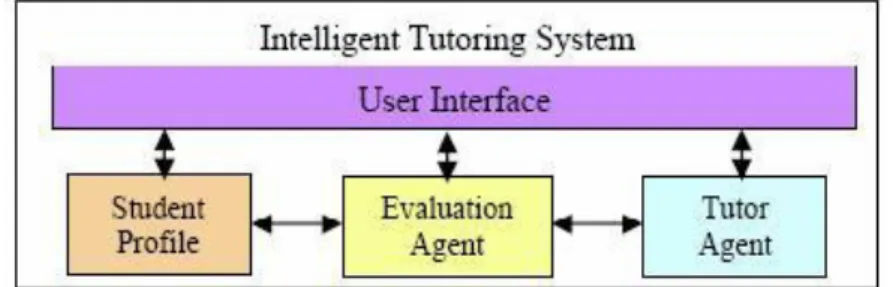
ITS is a multi-agents system where there are 3 different agent working in the background interacting each. The agents have their specific roles and they provide information for each other. All user activities with the system will be capture by the agents via the user interface. User interacts with the system by giving inputs and these inputs are process by the agents to provide feedback to the user. The agents working in the system are student profile, tutor agent and evaluate agent. The agents in the background are separated to the user via the user interface. Both user and agents can control what appears on the user interface and this means that the system and the user are actually communicating each other.
The system is a multi-agents system where the agents interacts each other as a whole unit. All agents are important and they receive inputs and provide outputs to each other. Each agent has their specific role and their task is to provide output for the other agents to process. The intelligent agents were constructed to process information received from user’s interactivity with the system interface.
2.1.Student Profile
Student agent is an agent for the user. It will capture the information relating to the user from the first time the user registers until the user finish the using the system. First time user who use the system will have to register their personal detail into the system. The agent will then use the data and pass the information to the other agents. During registration, the user need to key in their full name, date of birth, school, username and password into the system. The agent will pre-determine the new user as a level 1 student which means beginner. This level is however is not fixed as the user levels may varied depending on their progress. There three levels of students identified in the system which are level 1 (beginner), level 2 (intermediate) and level 3 (advance). The user may be in any level and their level depends on their progress in the system.
2.2.Tutor Agent
Tutor agent is the agent that determines the tutoring approach for the user. As discussed earlier, two techniques to be implemented are rule-based and case based ES. The tutor agent is the best place to differentiate both techniques.
2.3.Evaluator Agent
Evaluator agent job is to evaluate the user progress throughout the tutoring process. Every time the
user answers the questions, the evaluating agent captures the data and evaluates the user’s performance. The agent will look into student’s weakness and strength and provide information for the tutor agent to
determine the set of questions to give to the user. Evaluating agent tasks also are to correct the user’s
mistakes and make sure that the user knows where their mistakes are. The agent makes sure that the user answers their questions correctly before proceeding to the next question. Besides that the agent also record the time taken for the user to answer each question and sum up all the time taken to complete all the questions.
The agent will provide information like total time taken and user’s strength and weakness to the tutor
agent for further process. User who failed to answer a question correctly will have to do correction and the agent will provide them with hints or notes for the user reference. All user activities in answering the questions will be recorded by the agent to provide useful information to the tutor agent.
Expert system is the system which simulates the human expert. In the case of this project, school teachers have been identified by the researcher as the expert domain. The expert system consists of knowledge from the school teachers in tutoring students and evaluating their capabilities. The knowledge gained from the system are then stored in knowledge bank and rules were made to support the knowledge. The expert systems were used in the agent to help the agent to process the data gathered from the user activities.
In order to provide hints, guidance, and instructional feedback to learners, ITS system typically relies on 4 types of knowledge. The “domain model” represents subject matter expertise and provides the ITS with knowledge of what its teaching. The “student model” represents what the users know and does not
know. This knowledge gives the ITS more knowledge about the student using it. The “pedagogical module” provides a model of teaching process. For example, information about when to review, when to
present a new topics, and which topic to present are controlled by pedagogical module. The student model is used as input to this component, so pedagogical decisions reproduce the differing need of each student.
Finally, the “interface model” controls the interaction with the learners, including the dialog and screen
layout.
3.Implementation
The processes involved in the ITS are shown in the following figure. One obvious difference shown in the figure below is the evaluation part which are the main function of the evaluator agent. The following subchapter will discuss the implementation of each technique in ITS.
3.1.Rule-base Intelligent Tutoring System
The rule-based expert system supports the agent in terms of what approach to use in tutoring different type of user level. It diagnoses the student’s progress and determines the level of the user. It will then
provide information to the tutor agent to construct the questions to be given to the user for further tutoring.
Knowledge for expert system were obtained from two primary school teachers that have experience in teaching mathematics to standard six students. Using rule-based, the tutor agent’s task is to come out with sets of questions which are suitable for the user based on the user’s level. The agent will use information
captured from the student agent to determine the approach to use to tutor the user. The questions in the
question set are not fixed for the whole process as they will change depending on the user’s progress.
For new user who has registered, they will get fifteen randomly selected questions suitable for level 1 user. The question however are pre-determined questions and does not reflects the user’s exact level.
Once the user starts to answer the questions, the agent will study the user level. After first five questions
answered by the user, the agent will be able to have glimpse view on the user’s level. The agent will then change the balance ten questions to set of questions that are suitable for the user’s level based on the first
evaluation. This will continue for the next five questions until the user finish all fifteen questions. After the user complete the first fifteen questions, the agent then can predict thoroughly the exact level for the user. The user will then again receive another set of fifteen questions that matching the level determined by the agent.
The next round for the user tutoring process will follow the user level and the agent will provide the user with more challenging sets of questions in order to increase the user level and capability. The agent will stop training the user when the user successfully complete all course of questions and reaches the highest level in the system.
3.2.Case-based Intelligent Tutoring System
In a case-based intelligent tutoring system, the process is slightly different. Instead of translating expert knowledge into rules, we have to collect data and information which represent domain knowledge. Cases were chosen to be the knowledge representation because cases manage to express relations, recommendation or solution, directive, and strategies. All the information has been structured in cases in order to come out with result that been process by the system.
The process of constructing the cases involves collecting data from a number of students. All information is verified by the expert. All the information has been structured in standard form of cases and stored in the database for further use in the system. These are some example of cases that being constructed.
Case 1
- From the first five questions, student can answer 3
questions correctly
- she/he takes 5 minutes to complete Then solutions:
- Student level will set to level 1
- Set the remaining five questions to level 1
Case 2
- From the first five questions, student can answer
4 questions correctly
-she/he takes 2.5 minute to complete Then solutions:
- Student level will set to level 3
- Set the remaining five questions to level 3
Case 3
- From the first five questions, student can answer 5
questions correctly
- she/he takes 2 minute to complete Then solutions:
- Student level will set to level 3
- Set the remaining five questions to level 3
Fig. 3.
Examples cases for studentCase based reasoning (CBR) involves four main steps; retrieve, reuse, revise and retain. A case is retrieved on the basis of a partial match, facilitated by knowledge about its features. It also can be viewed as approximation to an entire solution, although it is possible to draw analogies to different cases iteratively to solve different parts of a problem. For the basic structure, CBR contain four main characters or known as 4R cycle to apply the techniques:
i. Retrieve – Find similar problem or new case ii. Reuse – Propose solutions from retrieved cases iii. Revise – Adapt and repair proposed solution iv. Retain – Integrate in case-base
In this study, K- nearest neighbor matching algorithm had been chosen for matching one case against another case which has similar features values is conceptually ‘closer’ than those do not. The purpose of
this algorithm is to classify a new object based on attributes and training samples.
4.Results And Discussions
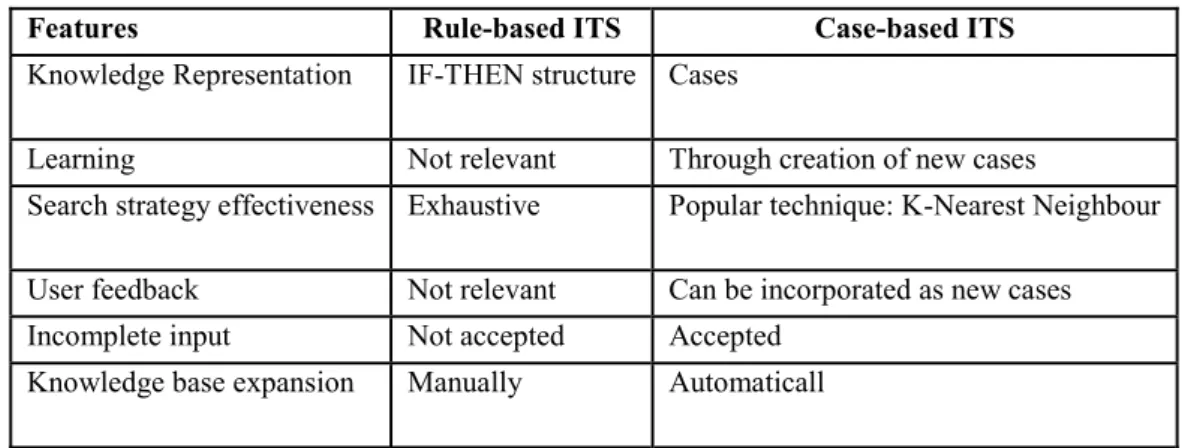
The ITS was developed to provide a system that can help student to study the topic that cover whole number in mathematic subject at their own pace. The two techniques that have been applied have several advantages and disadvantages, as shown in Table 1. For the rule based expert system, the rule can easily construct with the natural knowledge representation where the expert usually explain the problem solving
procedure with such expression as this “in such-and-such situation, I do so-and-so”. These expressions
can be represented quite naturally as IF-THEN production rules. The production rules have the uniform IF-THEN structure. Each rule is an independent piece of knowledge. The very syntax of production rules enables them to be self-documented.
Table 1. Comparison of Rule-based and Case-based ITS
Features Rule-based ITS Case-based ITS
Knowledge Representation IF-THEN structure Cases
Learning Not relevant Through creation of new cases
Search strategy effectiveness Exhaustive Popular technique: K-Nearest Neighbour User feedback Not relevant Can be incorporated as new cases
Incomplete input Not accepted Accepted
Knowledge base expansion Manually Automaticall
Besides, there are some disadvantages of the rule based expert system. The first disadvantage is opaque relations between rules. Although the individual production rules are relatively simple and self-documented, their logical interactions within the large set of rules may be opaque. Rule-based systems make it difficult to observe how individual rules serve the overall strategy. Second disadvantage is rule based expert system have ineffective search strategy which the inference engine applies an exhaustive search through all the production rules during each cycle. Rule based expert systems with a large set of rules (over 100 rules) can be slow, and thus large rule-based systems can be unsuitable for real-time applications. In general, rule-based expert systems do not have an ability to learn from the experience.
Unlike a human expert, who knows when to “break the rules”, a rule based system cannot automatically
modify its knowledge base, or adjust existing rules or add new ones. The knowledge engineer is still responsible for revising and maintaining the system.
Similar to the above, the cased based reasoning technique also has their advantages and disadvantages. In this case based ITS, the system can be creative where the case solutions can be combined into new ones and cases can also be used in a different level of abstraction providing innovative solutions. The systemcan works as a tutoring in which it provides some notes to the students according to the chapter based on the cases. Case based ITS also have a learning features where learning can be done without human interference. ITS can learn the student performance from the quizzes taken by the student. From the performance the system can determine, which technique are suitable to teach the student for the
next chapters. CBR systems can become robust and provide better solutions. User’s feedback is easily
incorporated in the revise phase. Case based ITS also can recognize when no answer exists to a problem by simply defining a threshold from which a solution is no longer acceptable. In decomposable problem domains, a solution can be created from the combination of partial solutions.
However there are some limitation in this case based ITS. Currently, the system only has 20 cases that already stored into the database. This is the limitation of the case based ITS. By adding more cases, the system can easily provide solution to the new case. Due to the opinion from the domain experts themselves that evaluating a student is a subjective and there are still no exact way how to measures
student’s level. The case given from the experts are based on their experience in teaching students, so it may be different from other.
5. Conclusions
Intelligent tutoring systems have provided a fertile ground for artificial intelligence research over the past twenty-five years. Some of these systems have been demonstrated to have a very large impact on educational outcomes in field tests, including effective learning rate, asymptotic learning levels and motivation (Corbett, Koedinger & Anderson, 1997). From the two techniques that we have discussed before, based on the prototype, we can say that each technique have their strength and limitation. Rule based expert system makes the student study every chapter and master it before go to the next chapter. It is good because the student can strengthen their understanding what they have learnt. Meanwhile using case based reasoning technique, the student will learn faster about the subject because the ITS will skip certain chapter based on the case. These techniques also are more economic and not wasting time.
For future works, we recommend doing a hybrid system which combine rule based and case based reasoning. Rule-based reasoning uses induction rules to determine whether a new chapter should be learn further or not. Case-based reasoning performs similarity-based matching to find the most similar case in case base (Lee, 2007). Besides, ITS also can use neural network techniques to predict the student performance for every chapter they have learnt and provide a better tutoring for the next level.
References
Aamodt,A. & Plaza,E.(2000). Case-Based Reasoning: Foundation Issues, Methodology Variations and
System Approach, AICOM, Vol.7,No.1.
Corbett, A. T., Koedinger, K.R & R. Anderson, J.R. (1997). Intelligent Tutoring Systems . http://act-r.psy.cmu.edu/papers/173/Chapter_37_Intelligent_Tutoring_Systems.pdf
Kolodner, J. L. (1992). An introduction to case-based reasoning. Artificial Intelligence3-34. Lee, G.H. (2007). Rule-based and case-based reasoning approach for internal audit of bank .
Murray, T. ( 1999). Authoring Intelligent Tutoring Systems: An analysis of the state of the art. Retrieved March, 24 2008 from http://aied.inf.ed.ac.uk/members99/archive/vol_10/murray/full.html Negnevitsky, M. (2002). Artificial Intelligence:A Guide to Intelligent System. Pearson Education. Ong, J. & Ramachandran, S.(2008). Intelligent Tutoring Systems: The What and the How. Retrieved from
http://www.learningcircuits.org/2000/feb2000/ong.htm
Samuelis, L. (2007). Notes on the Components for Intelligent Tutoring Systems. Acta Polytechnica Hungarica. Vol. 4, No. 2.