www.ssoar.info
A conversational model of causal explanation
Hilton, Denis J.
Veröffentlichungsversion / Published Version Forschungsbericht / research report
Zur Verfügung gestellt in Kooperation mit / provided in cooperation with: GESIS - Leibniz-Institut für Sozialwissenschaften
Empfohlene Zitierung / Suggested Citation:
Hilton, D. J. (1991). A conversational model of causal explanation. (ZUMA-Arbeitsbericht, 1991/02). Mannheim: Zentrum für Umfragen, Methoden und Analysen -ZUMA-. https://nbn-resolving.org/urn:nbn:de:0168-ssoar-68857
Nutzungsbedingungen:
Dieser Text wird unter einer Deposit-Lizenz (Keine Weiterverbreitung - keine Bearbeitung) zur Verfügung gestellt. Gewährt wird ein nicht exklusives, nicht übertragbares, persönliches und beschränktes Recht auf Nutzung dieses Dokuments. Dieses Dokument ist ausschließlich für den persönlichen, nicht-kommerziellen Gebrauch bestimmt. Auf sämtlichen Kopien dieses Dokuments müssen alle Urheberrechtshinweise und sonstigen Hinweise auf gesetzlichen Schutz beibehalten werden. Sie dürfen dieses Dokument nicht in irgendeiner Weise abändern, noch dürfen Sie dieses Dokument für öffentliche oder kommerzielle Zwecke vervielfältigen, öffentlich ausstellen, aufführen, vertreiben oder anderweitig nutzen.
Mit der Verwendung dieses Dokuments erkennen Sie die Nutzungsbedingungen an.
Terms of use:
This document is made available under Deposit Licence (No Redistribution - no modifications). We grant a exclusive, non-transferable, individual and limited right to using this document. This document is solely intended for your personal, non-commercial use. All of the copies of this documents must retain all copyright information and other information regarding legal protection. You are not allowed to alter this document in any way, to copy it for public or commercial purposes, to exhibit the document in public, to perform, distribute or otherwise use the document in public.
By using this particular document, you accept the above-stated conditions of use.
A C o n v e r s a tio n a l Model o f C a u s a l E x p la n a tio n D e n is J. H ilt o n Z U M A - A r b e i t s b e r i c h t N r . 9 1 / 0 2 Z e n t r u m f ü r U m f r a g e n , M e t h o d e n u nd A n a l y s e n e . V . ( Z U M A ) P o s t f a c h 12 21 55 6 8 0 0 M a n n h e i m 1
Seit Juli 1 983 sind die ZUMA-Arbei tsberichte
in zwei Reihen aufgeteilt:
Die ZUMA-Arbeitsberichte (neue Folge) haben
eine hausinterne Begutachtung durchlaufen und
werden vom Geschäfts führenden Direktor zusam
m en mit den übrigen Wissenschaftlichen Lei
tern herausgegeben. Die Berichte dieser Reihe
sind zur allgemeinen Weitergabe nach außen
bestimmt.
D i e Z O M A - T e c h n i s c h e n Berichte dienen zur
hausinternen Kommunikation bzw. zur U n t e r
richtung externer Kooperationspartner. Sie
sind nicht zur allgemeinen W e i t e r g a b e b e
stimmt.
A C O N V E R S A T I O N A L MODEL OF C A USAL EXPLANATION
Summary
A conversational model of causal explanation is outlined,
w h i c h emphasises the role of counterfactual reasoning, contrast
cases and conversational constraints in causal explanation. It is
us e d to organise existing models of causal attribution, to
integrate a ttribution research w i t h other models of causal
reasoning, and to study explanations in ordinary language.
Denis J. H i l t o n
Zentrum fuer Umfragen, M e t h o d e n u n d Analysen, Mannh e i m and
Universitaet M a n n h e i m
Draft of chapter to appear in W. Stroebe and M. Hewstone
( E d s . ) European R e v i e w of Social Psychology. 2
This chapter w a s prepared while I was supported by the
Al e x a n d e r von H u m b o l d t Foundation. I thank Friedrich Forsterling, A n n McGill, John Medcof, and Norbert Schwarz for helpful comments on an earlier draft of this paper.
In this review I p r e sent a conversational model of causal
explanation, which emphasises the role of counterfactual
reasoning, contrast cases, and conversational constraints in
explanation. I show how this model can be applied to analysis of
information in Kelley's (1967) cube and provides an organising
framework for various attribution theories. I then show how it
can be e xtended to analyse explanations given on the basis of
natu r a l i s t i c causal scenarios expressed in ordin a r y language. The
conversational model of causal explanation thus provides a
simple, parsimonious and u n i f y i n g framework for understanding
causal explanation.
A CONVERSATIONAL MODEL OF CAUSAL EXPLANATION
Hi l t o n (1988; 1990) elab o r a t e d on the proposals of H e s s l o w
(1983; 1984; 1988) that causal explanation proceeds by comparing
a target case w i t h a counterfactual contrast case. Every
why-question thus has an implicit rather than built into it.
In counterfactual reasoning, we compare the case in w h ich
the target event happened to a counterfactual case in w hich the target event did not happen. The factor that is not shared by the
target case and the contrast case is focused as "the"
explanation, whereas the factors shared by b o t h cases are treated
as b a c k g r o u n d e d presuppositions. For example, w e are sometimes
able to e x p lain an event by contrasting it to the counterfactual
case w h i c h never happened. One example w o u l d be the explanation
given for the U.S. decis i o n to drop an atomic b o m b on Japan in
1945 by. recourse to what might have happened if they had not done so. The quest i o n "Why did the U.S. drop the a tom bomb" is thus,
implicitly, "Why did the U.S. d rop the atom bomb when they could
J ustified this decision is that hundreds of thousands of lives
w e r e saved because the Allies did not have to engage in the
costly process of defeating Japan b y taking successive P a cific
islands at enormous h u m a n sacrifice. This consideration is thus
not o n l y a n e c e ssary one for the decision, but also is
"sufficient in t h e circumstances" for it, and is thus dignified
as its cause (cf. Mackie, 1974).
Clearly, another "necessary condition" for dropping the bomb is t h a t the U.S. and Japan w e r e at w a r w i t h e a c h other, but since
this condition was true of both the target scenario and the
counterfactual scenario, it has no e x p l a n a t o r y value and is
t r e a t e d as part of the "causal field" of backgrounded n e c e s s a r y but not sufficient conditions for the event (Mackie, 1974).
Thus, to u n d e r s t a n d a causal question, we must u nderstand
the implicit contrast it p r esupposes (Hesslow, 1986).
Consequently, the proper unit of analysis in causal explanation
is the question-answer pair (Turnbull and Slugoski, 1988). The
same surface causal q u e stion can be g i v e n different m e a nings if
the implicit contrast is changed. Suppose the implicit q u e stion
is "why did the U.S. drop the atom b o m b o n Japan (in 1945, rather
than on North Korea in 1951)?". Here the answer might refer to
the fact that the U.S. was not afraid of n u c l e a r retaliation from Japan's allies in 1945, as it w o u l d h a v e been if it h a d dropped an atom bomb on N o r t h K o r e a in 1951.
In addition, causal explanations are constrained b y maxims
of conver s a t i o n (Hilton, 1990). Thus they should be p r o b a b l y
true, informative, relevant and clear (Grice, 1975). As w e shall
see later, observance of these maxims has important implications
for the study of processes of causal explanation. Immediately
below, however, I address the question of how traditional models
model of causal explanation, a n d brought into a single unifying
framework based on counterfactual reasoning. 1 then show how the
conversational model opens u p n e w questions in the study of
causal explanation processes.
THE "MAN-THE-SCIENTIST A N A L O G Y OF CAUSAL ATTRIBUTION:
DEVELOPMENTS A N D REFORMULATIONS
Research in attribution t h e o r y has b e e n dominated by
Heider's (1958) " m a n - t h e - s c i e n t i s t " analogy. H e i d e r proposed that the layperson m a k e s causal attributions in m u c h the same w a y that
a scientist does, n a m e l y through use of M i l l ' s method of
difference. Heider's ideas w e r e taken over and given their most
influential formulation by K elley (1967) in the so-called ANOVA
model, and it is this formulation that will prove the foundation
for m u c h of the research described in this article.
Kelley, following Mill, defined a cause as "that condition
w h i c h is present when the effect is present and w h i c h is absent
w h e n the effect is absent" (1967, p. 154). Given an event such as
John 1auqhed at the c o m e d i a n . this logic implies that certain
"control" conditions should be e x a mined to determine the cause of
the event. Thus if w e w i s h to determine whether the person (i.e.
John) is the cause, we should examine consensus information to
determine w h e t h e r other people laugh at the comedian or not. If
w e wish to d e t e rmine w h e t h e r the stimulus (i.e. the comedian) is
the cause, then w e should examine distinctiveness information to
determine w h ether John laughs at other comedians or not. Finally,
if we w i s h to determine w h e t h e r the present circumstances
(sometimes c alled occasion or time) is the cause, then we should
examine c o nsistency information to see if John laughs at this
comedian on other occasions.
specific example of counterfactual reasoning. T h e target case, or set of cases, (where t h e effect occurs) is c o m p a r e d to a contrast
case (where the effect does or does not occur). Paradoxically,
though K elley (1967) stated this logic of "controlled
experimentation" clearly, he and others did n o t elaborate and
test this logic in subsequent e x periments on attribution
proce s s e s (McArthur, 1972; 1976; Orvis, C u n n i n g h a m and Kelley,
1975). For example, K e l l e y (1967) only m a d e predictions for three of the eight possible cells m a d e by crossing h i g h and low levels of consensus, distinctiveness and consistency information.
T h e formalisation of how Mill's m e t h o d of d ifference should
b e a p p l i e d to the analysis of consensus, distinctiveness and
c o n s i s t e n c y information had to await the development of the
inductive logic model of causal attribution (Jaspars, Hewstone
and Fincham, 1963). Jaspars et al. (1963) n o t e d that it was
i m p o s s i b l e to conduct an analysis of v a r i a n c e or its formal
e q u i v a l e n t o n the information pattern provided to subjects by
M c A r t h u r (1972). A little reflection will suffice to reveal that
in any e xperiment designed to test the operation of three factors
(person, stimulus, occasion) in a f u l l y-crossed 2x2x2 design,
eight cells of information are necessary. In McArthur's (1972)
ex p e r i m e n t subjects w e r e p r o vided w i t h only four, n a m e l y the
target event in c ombination w i t h consensus, distinctiveness and
co n s i s t e n c y information. Consequently, four cells of information
are missing, rendering the "experimental design" equivalent t o a
fract i o n a t e d block d e s i g n in w h i c h analysis of interactions is impossible.
A l t h o u g h an A N O V A - l i k e analysis is impossible on the
i n f o r m a t i o n given in M c A r t h u r ' s experiment, it is still possible t o apply M ill's m e t h o d of difference to the information provided.
c o m e d i a n . Jaspars proposed that low consensus (i.e. n o - o n e else
laughs at the comedian) indicates the target person as a cause
because the effect is present w h e n t h e target p erson is present,
but not when other target persons are present. Likewise, high
distinctiveness (i.e. John laughs at no other comedians)
indicates the target stimulus as cause because the effect occurs w h e n the target stimulus is p r esent but not w h e n other stimuli
are present. Finally, low c o n s i s t e n c y (i.e. John has never
laughed at the comedian before) indicates that the present
o ccasion is the cause, because t h e target event occurs o n this
occasion but not on others.
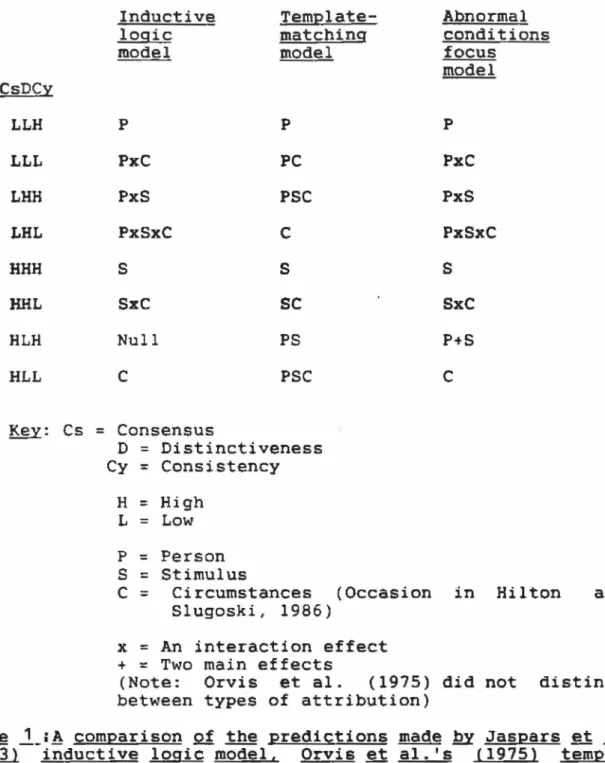
The inductive logic model also predicts interactional
attributions, t h rough joint coding of factors. Thus the LHH (low
consensus, h i g h distinctiveness and h i g h consistency
configuration) indicates the c o m b i n a t i o n of the person and the
stimulus as cause. This is b e c a u s e the effect occurs only when
the joint c o n d i t i o n of p erson and the stimulus together is
present (target event, high consistency) and does not occur when
the joint c o n d i t i o n of the p e r s o n and stimulus together is absent (low consensus, h i g h distinctiveness).
This last set of interactional predictions led Jaspars to an
important procedural innovation. Jaspars (1983) explicitly
speci f i e d all t h e possible response combinations created by
combinations of the person, stimulus and circumstances; i.e.
person, stimulus, circumstances, p e r s o n x stimulus, person x
circumstances, stimulus x circumstances, and p e r s o n x stimulus x
circumstances. M c A r t h u r (1972) on the other hand, only e xplicitly
specified "main effect" attributions (person, stimulus,
circumstances) in her response format, and asked subjects to
response formats seems to have had a strong effect on the
pr o clivity to produce interactional attributions. Those studies
w h i c h u s e d full response formats produced 61% (Jaspars, 1983) and
48% (Hilton and Jaspars, 1987) interactional attributions,
whereas those that did not only produced 35% (McArthur, 1972) and 37% (Hewstone and Jaspars, 1983). Consequently, the earlier study by M c A r t h u r (1972) m a y h a v e seriously under e s t i m a t e d subjects' ability to produce a ppropriate interactional attributions.
Follo w i n g the inductive logic model, the predictions
detailed in the left-hand column of Table 1 can be derived.
INSERT TABLE 1 ABOUT HERE
Further details of the inductive logic model are detailed in
Hewst o n e and Jaspars (1987), Jaspars (1988) and Jaspars, Hewstone
and F i n c h a m (1983). Studies designed to test the inductive logic
model p r o v i d e d an impressive degree of conf i r m a t i o n for the model
(Hilton and Jaspars, 1987; Jaspars, 1983). Moreover, re-analyses
of the data of Hewstone and Jaspars (1983) and McArthur (1972)
also provi d e d strong support for the inductive logic model
(Hewstone and Jaspars, 1987).
As Hilton, Smith and Alic k e (1988) noted, the inductive
logic model proposes that low consensus information leads to
p e rson a ttribution and h i g h distinctiveness information leads to
stimulus attribution, wher e a s most other models of causal
attri b u t i o n propose that high consensus information leads to
stimulus attribution and low distinctiveness information leads to
pe rson attribution (Alicke and Insko, 1984; Anderson, 1978;
Bassili and Regan, 1977; DiVitto and McArthur, 1978; Garland,
Hardy and Stephenson, 1975; Hansen, 1980; Hortacsu, 1987; Kassin,
1979; Major, 1980; McArthur, 1972; 1976; Orvis et a l ., 1975).
that or Orvis et al. (1975), posit that high consistency leads to circumstance attributions (see T a b l e 2).
INSERT TABLE 2 A B O U T HERE
Although the consensus-stimulus and distinctiveness-stimulus
links proposed b y the latter m o d e l s deviate from the
counterfactual logic implicit in Kelley's (1967) definition of
causality, they clearly have w o n w idespread acceptance.
Intuitively, there does seem to be sense in the claim that
consensus information is somehow "about" t h e stimulus and
distinctiveness information is intuitively "about" the person
(Higgins and Bargh, 1987 ). Below, w e shall review a proposal
w h i c h integrates the position of the inductive logic model
(Jaspars et a l ., 1983) w i t h that of Orvis et al.'s (1975)
t e m p l a t e - m a t c h i n g model (Hilton, 1989b). Specifically, it is
a r g u e d that causal e xplanation m u s t be d i s tinguished from
dispositional attribution. When this is done it is possible to
see that causal explanation is achieved through the application
of M i l l ' s m e t h o d of difference (i.e. counterfactual reasoning)
a nd dispositional attribution t h rough application of Mill's
m e t h o d of agreement.
Causal e xplanation and dispositional attribution
Causal e x p l a n a t i o n and dispositional attribution are not the
s a m e thing. In causal e xplanation w e explain w h y a particular
e vent happened, w h ereas in dispositional attribution w e attribute a general pattern of behaviour to an u nderlying characteristic of o n e or more of the entities involved.
Certain c o variation configurations identify the same entity
as the cause of the event to be explained, and as having an
u n d e r l y i n g d i sposition to produce the kind of behaviour in
high c o n sistency (LLH) and h i g h consensus, h i g h distinctiveness
and h i g h consistency (HHH) configurations. For example, in the
LLH confi g u r a t i o n below, w e w o u l d say that Paul is a g e nerally
helpful p e r s o n (dispositional attribution), and that this is the
cause of his helping Linda (causal e x p l a n a t i o n ) . Paul helps Linda
H a r d l y anyone else who k n ows her helps Linda Paul helps almost everyone else he knows
In the past, Paul has almost always h e lped Linda
T here has been perhaps a tendency to assume that covariation
configurations always imply dispositional attributions to those
entities that they identify as causes. This tendency w ould have
been e x a c e r b a t e d by the fact that Kelley (1967) only made
predictions for the LLH and H H H cells, and that McArthur (1972)
focused o n !,main effect" attributions to the person, stimulus or
circumstances at the expense of interactional attributions.
A n interesting contrast emerges w h e n we compare the causal
inferences that can be m a d e from the h i g h consensus, low
distinctiveness and low cons i s t e n c y (HLL) configuration below: Paul helps Linda
Almo s t everyone else who knows her helps Linda Paul helps almost everyone else he knows
In the past, Paul has h a r d l y ever h e lped Linda
In p r o p e r l y designed attri b u t i o n experiments w i t h full response formats (see above), the cause is p r edominantly attributed to the
c i r cumstances (Hilton and Jaspars, 1987; Jaspars, 1983), the
present occas i o n (Hilton and Slugoski, 1986) or time
o
(Forsterling, 1989), depending on the specific phrasing used.
However, alth o u g h Paul does not usually help Linda, he would
still s e e m to be a generally helpful person because he helps most
people. A l t h o u g h we w o u l d attribute the cause of his helping
explanation), w e w o u l d probably still m a k e the inference that he is a helpful p e rson in general (dispositional attribution).
The methods of difference and agreement
Hilton (1989b) presented a functional model of social
inference w h i c h argues that causal explanations are produced by
M i l l ' s method of difference, whereas dispositional attributions
are produced by M ill's m e t h o d of agreement. The model is
functional because different methods of induction are depending o n the goal of the inference process.
Mill's m e t h o d of difference is u s e d to explain w h y a
partic u l a r event occurred. It involves comparing a target event
to a comparison event (or, as instantiated by the inductive logic
model of Jaspars et al., 1983, a set of events). Consequently,
the "control condition" for assessing the causal role of the
p e r s o n would be to determine w h ether the effect occurs in the
p r e s e n c e of other persons or not (consensus information). If the
target event occurs w h e n the target p e r s o n is present but does
not occur when the target person is absent (low distinctiveness), t h e n the case in w h i c h the target event occurs differs from the o t h e r s in which it does not occur in that Paul is present whereas
he is absent in the other cases. Consequently, something about
t h e target p e r s o n is designated as the cause that "makes the
d ifference" (see Table 3).
INSERT TABLE 3 A B O U T HERE
However, w h e n w e learn that Paul helps most people (low
distinctiveness), we m a k e the dispositional attribution that Paul
is a helpful guy. This dispositional attribution is accomplished
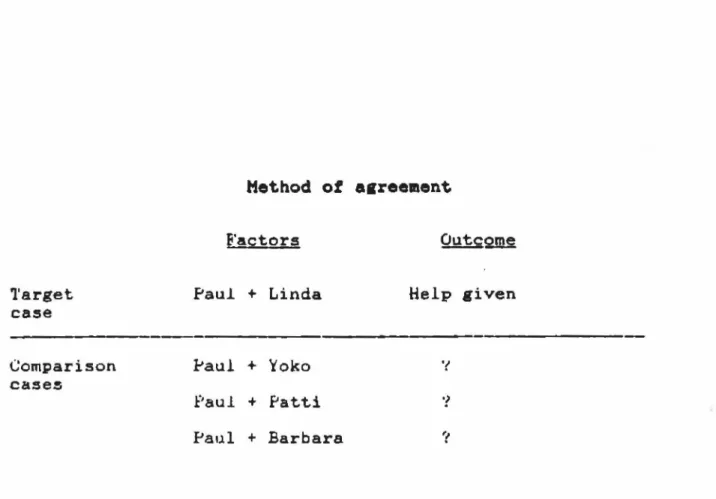
by a process analogous to Mill's (1872/1973) m e t h o d of agreement.
H e r e all the cases in w h i c h the effect occurs agree in having
INSERT T A B L E 4 ABOUT HERE
predict dispositional a t t r i b u t i o n to the stimulus because all
examples agree in having t h e target stimulus p r esent w h e n the
effect occurs, and low d istinctiveness will lead to stimulus
dispositional attributions b e c a u s e all examples agree in having
the target person p r e sent w h e n the effect occurs. H i g h
consistency should also lead to dispositional attribution to the person and the stimulus b e c a u s e all cases agree in having the
person and the stimulus present w h e n the effect occurs. However,
the the amount of dispositional a ttribution under high
consistency m a y be e x p e c t e d to be smaller than under high
consensus and low c o n s i s t e n c y because a) the behavior is
attributed to two sources (the p erson and the stimulus) rather
than one (the person or the stimulus), and b) the generalization
of the target event over other times alone does not imply the
same amount of g e n e r a l i z a t i o n as the consensus and
distinctiveness dimensions, w h i c h imply g e n e ralization of the
effect over other persons and times, and other stimuli and times, respectively.
W h e n the subject is r e q uired to explain w h y the target event
happened in experiments u s i n g the p a r adigm of McArthur (1972),
the results are consistent w i t h the application of the m e t h o d of
difference, w i t h the e x c e p t i o n of the h i g h consensus, low
distinctiveness, high consi s t e n c y (HLH) cell (Hewstone and
Jaspars, 1987; Hilton and Jaspars, 1987; Jaspars, 1983). None
of these experiments asked subjects to m a k e dispositional
attributions, however. H i l t o n (1989b) did n o t ask subjects to
produce causal explanations as in the other studies, but to m a k e
f o u n d the judgments p r e d i c t e d by application of the m e t h o d of
a greement specified above. H i g h consensus led to stimulus
dispositional attributions and low distinctiveness to p erson
dispositional attributions, and h i g h consistency to m o d e r a t e
dispositional attributions to the p erson and the stimulus. In
contrast to the v e r y strong effects obtained in support of the
o p e r a t i o n of the m e t h o d of agreement, there was little support for the operation of the application of the m e t h o d of difference. Thus there no effect of consensus o n p e r s o n attributions and only
a r e l a t i v e l y small effect of h i g h distinctiveness on stimulus
a t t r i b u t i o n s .
The functional model of social inference thus appears to fit
the data well. It also helps explain some previous
inconsistencies. For example, Iacobucci and McGill (in press) re
a n a lysed the data of several a t tribution experiments (Hewstone
and Jaspars, 1987; H i l t o n and Jaspars, 1987; Jaspars, 1983;
McArthur, 1972) u s i n g log-linear techniques. They found that
a l t hough the inductive logic model of Jaspars et al. (1983) fit
these data better than the t e m plate-matching model of Orvis et
al. (1975), "residual variance" still n e e d e d to be accounted for b y the consensus-stimulus and d i s t i n c t iveness-person inferential links p o sited b y the t e m plate m a t ching model. This p a ttern would
b e predicted if subjects tended to treat the causal explan a t i o n
task as a dispositional a ttribution task. Finally, the functional
model predicts the information a c quisition results obtained by
Hilton, Smith and A licke (1988), w h o found in some conditions
that subjects were more likely to prefer consensus information
w h e n asked to explain a sporting perfor m a n c e than when t h e y were
asked to evaluate h o w good the p e r s o n performing the event was,
The functional model of social inference thus clarifies
aspects of the attribution process. A full treatment of this
model is not possi b l e here (but see H i lton and Smith, 1990). For
present purposes, its m a i n advantage is to show that
counterfactual reasoning, in the form of Mill ' s method of
difference, is used to prov i d e causal explanations of an event.
Below, we address the question of h o w real-world knowledge is
combined w i t h explicitly given information in the causal
attribution process.
WORLD KNOWL E D G E AND THE PROCESS OF CAUSAL ATTR I B U T I O N The abnormal conditions focus model
Hilton and Slugoski (1986) n o t e d that p e ople bring
real-world expectancies w i t h them to the attribution task. They based
their analysis on the criticisms made of the M i l lian definition
of causality g i ven by the legal theorists, Hart and Honoré
(1985). Specifically, Hart and Honoré (1985) argued that the
meth o d of diffe r e n c e could reveal an innumerable number of
neces s a r y conditions but for w h i c h a target event w ould not have
happened. For example, if a t rain crashes, w e m a y be able to
reason c o u n t erfactually that the train w ould not have crashed if
the train had not b een travelling so fast, or if it had not been
so heavily laden, or if there had not b een a bent rail in the
track, and so on. Thus the c r ash could be attributed to any one
of a pleth o r a of neces s a r y conditions. However, in normal
conversation, w e typically tend to m e n tion o nly one factor as
"the" cause in causal explanation. This raises the prob l e m of
how to select causes from conditions. Hart and H o n o r é (1985)
proposed that w e norma l l y compare the target event to the normal case to see what is abnormal about the target event. Thus, if the
without crashing, then the bent rail is identified as the
abnormal condition as that "makes the difference" to the train
crashing or not crashing. It is thus dignified as "the" cause
whereas t h e speed and w e i g h t of the train are relegated to the
status of mere conditions w h i c h serve as b a c k g r o u n d information (cf. M a c kie's (1974) n o t i o n of a "causal field").
As will be shown later, t h e abnormal conditions focus model
c a n be applied to a w i d e range of causal e xplanation tasks.
However, H i l t o n and Slugoski (1986) began b y applying it to the
analysis of causal a t tribution in the McArthur (1972) paradigm.
Specifically, they proposed that low consensus throws the p e r s o n
into focus as abnormal, h i g h distinctiveness throws the stimulus
into p erson as abnormal, and low consistency throws the present
o c c asion into focus as abnormal. In their first experiment they
ve r i f i e d these predictions b y showing that subjects judged these items to be informative about the predicted targets.
A l t h o u g h all the details cannot be given here, H ilton and
Slugoski (1986) then a p p l i e d their model to the analysis of the
p r o b l e m a t i c high consensus, low distinctiveness and h i g h
c onsistency (HLH) config u r a t i o n discussed above. According to the
inductive logic model of Jaspars et al. (1983), no attribution
should b e p o s s i b l e here b e c a u s e the occurr e n c e of the target e v e n t g e n e r a l i s e s over o ther persons, stimuli and times. However,
experimental results show that subjects reliably attribute the
target event to either the person, the stimulus or a combination
of the p e r s o n and the stimulus in this condition (see Table 2).
This result seems intuitively quite reasonable if we consider the config u r a t i o n below:
R a l p h trips u p over Linda dancing
Almost everyone else trips u p over Linda dancing L inda trips up over almost everyone else dancing
dancing
The logical c o n c l u s i o n w o u l d s e e m to be that Ralph is a clod and Linda is a clod (cf. M c A rthur (1972). Indeed, Hilton and Slugoski
(1986) found that subjects attribute this event to m u l t i p l e
sufficient causes, i.e. "Something special about Ralph and Linda
(even w h e n they are not together)". In effect, Ralph and Linda
are being identified as abnormal (i.e. clumsier than the average
dancer). Consistent w i t h this reasoning, H ilton and Slugoski
(1986, Expt 1) showed that subjects p e r c e i v e d high consensus to
be informative about the stimulus and low distinctiveness to be
informative about the person.
However, the perceived normality of the target event appears t o affect the a t tribition process (cf. Hart and Honoré, 1985). If
the target event to be explained is h i g h l y normal (e.g. buying
s o m e thing in a supermarket), then the conclusions suggested by
the same HLH c o n f i g u r a t i o n appear to be quite different: Sally buys something on her visit to the supermarket
Almost everyone else buys s o m e thing on their visit to this supermarket
Sally buys something on her visit to almost every other
supermarket
In the past Sally has almost always bought something on her visit to this supermarket
Here, subjects attribute the event to the null option "Nothing
special about Sally, t h e supermarket, t h e present occasion or any
combi n a t i o n of the t h r e e ” (Hilton and Slugoski, 1986), as
p r e d i c t e d by the inductive logic model of Jaspars et al. (1983).
Ne i t h e r the p e r s o n nor the stimulus are identified as the cause
in this condition, since neither is identified b y the covariation
in formation as an abnormal condition. Consistent w i t h this,
n e i t h e r low distinctiveness or high consensus w e r e judged to be
informative about the person or the stimulus when the target
Norms and the missing dimensions of covar i a t i o n information
Most experiments on attribution proc e s s e s (Hewstone and
Jaspars, 1983; Hilton and Jaspars, 1987; Jaspars, 1983; McArthur,
1972; 1976; Orvis et a l ., 1975) only p r e s e n t e d subjects w i t h
information from four of the eight cells required to test for the
causal effect of the person, stimulus and occa s i o n using an
analysis of variance or its formal equivalent. The one early
exception was the experiment of Pruitt and Insko (1980), w h i c h
prese n t e d subjects w i t h a f i fth dimension, n a m e l y
comparison-object consensus information about the b ehaviour of other persons
to other stimuli, e.g. about what other peop l e do on visits to
other r e s t a u r a n t s .
H ilt o n (1988; 1990) elaborated the theoretical position of
Hilt o n and Slugoski (1986) and proposed that subjects' real-world
knowledge served the function of filling out the "missing
d i m e n s i o n s ” of Kelley's (1967) cube in experiments using the
p a r a d i g m of McArthur (1972). This can m ost easily be seen by
considering Figure 1, where the above target events are
INSERT FIGURE 1 ABOUT H E R E
r epresented in 2x2 matrices. The consistency dimension has been
omitted for reasons of clarity of exposition. The occurrence of
an event in a given cell is signified b y a "1", and its n o n oc c urrence b y a "0", and its occasional o c c urrence by "1/2". In
b oth matrices, a "1" is u s e d to signify the occurrence of the
target event w h e n the target p e r s o n and stimulus are both present (the target event itself), w h e n the target p e rson is present w i t h
other stimuli (low distinctiveness), and w h e n other persons are
present w i t h the target stimulus (high consensus). The difference between the two matrices comes in how the b o t t o m right-hand cell
Thus, subjects appear to have knowledge of what norma l l y h a ppens when people go dancing or shopping in supermarkets. These
m a y be expressed as n o r m s . i.e. generalizations of the form Some
p eople trip u p over other people dancing sometimes or Most people
b u y things on most v i s i t s to most s u p e r m a r k e t s . These norms m a y
p e rhaps be thought of as being the lay equivalent of "covering
l a w s ” (cf. Hempel, 1965). This implicit world knowledge is then
u s e d to fill in information in the "missing cell" about what
o ther persons do w i t h other stimuli. Thus w e w o u l d fill the
m i s s i n g cell w i t h a "1" in the case of the supermarket example
b e cause normally most people b u y something on their visit to
most supermarkets, w h ereas we w o u l d only fill the missing cell
w i t h a "1/2" in the dancing example to indicate that n o r m a l l y some people trip up over some people dancing.
If we then p e r f o r m informal equivalents of the analysis of
v a r i a n c e on the two matrices, w e obtain results that correspond
to the responses that subjects give in these experiments. Thus,
in the supermarket example, w e o b tain no effects at all
(corresponding to the null option) and in the dancing example we o btain two m a i n effects (corresponding to two sufficient causes).
Thus subjects appear to supplant the experimenter-provided
i n formation w i t h their own w o r l d - k n o w l e d g e to "complete the
d e s i g n ” of the Kelley cube. W h e n they have done this, they
p r o d u c e responses that w o u l d be p r e d i c t e d b y a normative analysis of variance. This result stands against the w i d e l y held v i e w that subje c t s "underuse" b a s e - r a t e u n f o r m a t i o n (e.g. Nisbett and Ross,
1980). Rather, in this case, it seems to have been the
experi m e n t e r s w h o have generally o verlooked the importance of
base rate information b y omitting to supply information in the
made good this lack by supplying this information from their own w o rld knowledge.
It w o u l d seem that subjects are considerably more rational
in using covariation information to make causal inferences than
has been previ o u s l y supposed. This supposition is confirmed by
recent r e s e a r c h in w h i c h subjects have been e x p licitly given
information in all eight cells of Kelley's (1967) cube. W h e n this is done, subjects produce inferences that c o r respond very closely to those that w ould be p r e d i c t e d by a n o r m a t i v e analysis of
variance (Cheng and Novick, 1990; Forsterling, 1989; 1990).
Comparable results were obtained by Pruitt and Insko (1980), who
explicitly supplied a fifth dimension of comparison-object
consensus information to their subjects. One striking feature of
all these experiments is the extent to w h i c h they support the
hypothesis that the m e thod of difference is used to produce
causal explanations. Thus consensus information affects person
explanations, distinctiveness information affects stimulus
explanations and consistency information affects circumstance/
occasion/time explanations. P articularly n o t e w o r t h y is the
finding that consensus information, far from being u n derused
(McArthur, 1972; 1976; Nisbett and Borgida, 1975), has a
consistently strong and predi c t a b l e effect on person
e x p l a n a t i o n s .
One consequence of these findings w o u l d be to conclude that Kelley's (1967) A N O V A analogy actua l l y describes subjects' causal
inference p r o c e s s e s v e r y well. The failure to recognize this
earlier is due to four m a i n reasons. First, early theorists
(McArthur, 1972; Orvis et al. 1975) did not take K e l l e y ’s (1967)
suggestions to their logical conclusion. They therefore did not
recognize that models (e.g. the template-matching model) that
inferential links d e v iated from the canons of Mill's m e t h o d of
difference. Second, b y u s i n g response formats that were
incomplete and ambiguous, their experimental procedures appear to
have b iased the results o b t ained (cf. Cheng and Novick, 1990;
Forsterling, 1969; H e w s t o n e and Jaspars, 1967; Hilton and
Jaspars, 1987; H i l t o n and Knibbs, 1988). A n d third, by either
omitting complete information from the cube, or overlooking the
role of subjects' p r e s u ppositions in "filling out" missing cells, theorists u n d e restimated subjects' ability to reason according to
the canons of an intuitive analysis of variance. In fact,
subjects do indeed use consensus and base-rate information in the form of norms appropriately and normatively.
Counterfactual reasoning as a model of causal explanation
A s n o t e d above, the conversational model causal explanation
proposes that every w h y - q u e s t i o n thus has an implicit rather than
built into it, and that in order to u n d e r s t a n d a request for a
causal e xplanation for an event, one must u n d e r s t a n d the implicit
contrast drawn in the w h y question. Using this simple logic, one
is able to see that the v a r i e g a t e d attribution theories appear to
share the same counterfactual logic, but to address questions
w h i c h presu p p o s e different contrasts (See T a b l e 5; also Lipe, in press, for a similar proposal).
INSERT T A B L E 5 ABOUT H E R E
Thus the inductive logic model of Jaspars et al. (1983),
w h i c h instantiates Kelley's (1967 p . 194) definition of a cause as
"that condition w h i c h is present when the effect is present and
w h i c h is absent when the effect is absent" addresses the question
"Why did this event occur rather than not occur?" (Why x rather
than not x?). The abnormal conditions focus model of H ilton and
Slugoski (1966) addresses the q u e stion "Why did this event occur rather than the normal case?" (Why x rather than the default
va l u e for x?). Jones and Davis's (1965) theory of correspondent
inference addresses the question "Why did the actor m a k e this
choice rather t h a n that choice?" (Why x rather than y?). F i ncham
a n d J a s p a r s 1 (1980) entailment model of the a ttribution of
responsibility addresses the q u e stion "Why did the actor do what he did rather than what he should have done?" (Why x rather than
the moral or legal ideal? " . Schank and Abelson's (1977; see also
Carbonell, 1981; Wilensky, 1981; 1983) model answers questions
like "Why did this plan fail rather than succeed?" (Why x rather
than the projected a i m ) and "Why did the actor v a l u e this goal
rather than that goal?" (Why x rather than y?).
Counterfactual reasoning and ordinary 1anguage
Al t h o u g h considerable p r o gress has been made in modelling
causal inference in specific and artificial experimental
paradigms, such as that of M c A r t h u r (1972), the question still
a rises as to what extent these inference processes occur in
other, more natural settings.
Thus, consistent with the abnormal conditions focus model
(Hilton and Slugoski, 1986), unanti c i p a t e d events appear to
attract atten t i o n and to initiate attributional processing
(Weiner, 1985). Events m a y be u n a nticipated b e cause they are
unusual (Hastie, 1984), o r represent failure (Bohner, Bless,
Schwarz and Strack, 1988), or are cognitively imbalanced in
H e i d e r ’s (1958) sense (Brown and v a n Kleeck, 1989).
There is also c o n siderable evidence that p e o p l e ’s
representations of stories are best represented by an adaptation of Mackie's (1974) counterfactual test. If, by the counterfactual
another to occur, then a link is e s tablished between the two. The
network of interconnections built up by this test (Trabasso and
Sperry, 1985; Trabasso, S perry and v a n den Broek, 1985; v a n den
Broek and Trabasso, 1986) predicts story event importance and
recall b etter than formalisms derived f r o m Schank and A b e l s o n ' s
(1977) model of text c o m prehension (Graesser et al., 1980;
Graesser et a l ., 1981). Thus richly c o n n e c t e d events are m o r e
likely to judged as important and be r e c alled than p o o r l y
connected events.
W h i l e people's representations of story-lines m a y be
c onstituted of complex n e t w o r k s of interlocking conditions the
p r o b l e m of causal selection once again presents itself. How do w e decide w h i c h member of a complex set of conditions to m e n t i o n as "the" cause? Mill (1872/1973) himself n o t i c e d that people often
omitted n e c e s s a r y conditions from causal explanations, instead
focusing on the one that "completes the tale", and regarded this
as "capricious" iSystem of L o g i c . Book III, Chapter v, S e ction
iii). In fact, selection of causes f r o m conditions in o r d inary
language seems to be quite orderly, and g o v e r n e d by general rules
of d i s c o u r s e (Grice, 1975; Hilton, 1990; H ilton and Slugoski,
1986).
G e n e r a l l y speaking, causa t i o n tends be attributed to the
factor t h a t "could have b e e n o t h e r w i s e " , i.e. that factor for
w h i c h it is possible to imagine a counterfactual alternative.
Abnormal conditions are e a s i l y mutable w h e r e a s normal conditions
are not, and thus get focussed as causes (cf. Kahneman and
Miller, 1986). This can be seen from research on people's
p e rceptions of accidents. Accidents are typically caused by
unfor t u n a t e combinations of factors. However, when asked
s pontaneously focus on abnormal rather than normal conditions
(Kahneman and Miller, 1986; Kahneman and Tversky, 1982). People
are more likely to say "If only he had gone home by his normal route" (thus u n d o i n g the fact that the v i c t i m went home by an
abnormal route) t han "If only he had gone home by a different
route" (thus u n d o i n g the fact that the v i c t i m went home by his
normal route). Consistent w i t h the v i e w that abnormal conditions
become focused as causes, Wells and Gavanski (1969) report
further evidence that those conditions that peop l e are most
likely to "undo" are those that are m ost likely to be judged as
c a u s e s .
In a provocative study, Brown and Fish (1983) suggest that
peop l e vary m ore in their disposition to p e r form actions than in
their disposition be acted upon, wher e a s the reverse holds true
for emotions. For example, people seem to v a r y more in their
d i s p osition or a b i l i t y to help than to be helped, whereas they
v a r y m ore in their ability to elicit liking than to like (but see
Au, 1986; H o f f m a n and Tchir, in press, for exceptions).
Consistent w i t h this, the trait adjectives derived from action
verbs tend to descr i b e a characteristic of the person performing
t he action (h e l p f u l , c h a r m i n g , etc.) whereas trait adjectives
d e r i v e d from state verbs tend to descr i b e a characteristic of the person elic i t i n g the state or e m o t i o n (l i k e a b l e , h a t e f u l ,
etc.). In the sample of verbs studied by B r own and Fish (1983),
this rule is o b s e r v e d in over 90% of cases. This tendency
suggests that language affords us trait adjectives that are most likely to help desc r i b e the abnormal characteristic w h e r e i n a
pe r s o n differs f r o m most other people, and w h i c h makes a
difference to the occurrence of the event in question. The
v o c a b u l a r y of language itself thus tends to focus on abnormal
In default of explicit focus, implicit focus appears to be
on abnormal conditions. However, explicit focus can override
this. For example, w h e n asked to explain normal states, Gavanski
and Wells (1990) show that p e o p l e focus on normal conditions.
Al t h o u g h o r d inary people sponta n e o u s l y focus o n the unusual, the s
unwanted and the imbalanced (see above), as Hart and H o noré
(1985) point out, scientists t e n d to ask w h y t h i n g s happen the w a y they n o r m a l l y do, and to explain t h e m in terms of stable underlying c h a r a c t e r i s t i c s .
Sometimes causal expla n a t i o n will be influenced b y subtle
linguistic focus cues (Moxey and Sanford, 1987). For example, the quantifiers "A few" and "Few" denote the same proportion, but
focus on different aspects of the set that they partition. Thus
”A few" focuses attention on the minority who did p e rform the
behaviour in question, w h e r e a s "Few" focuses attention on the
m a j ority w h o did not p e r f o r m the behaviour in question.
Consequently sentences such as "A few of the M . P . ' s went to the
party because..." should be completed b y reasons for going (e.g.
"they were still in town"), w h e r e a s sentences such as "Few of the
M.P.'s went to the party" should be completed b y reasons for not
going (e.g. "it was boring"). M o x e y and Sanford (1987) obtained
data consistent w i t h these predictions, and e x t e n d e d them to
frequency quantifiers. Thus events quantified w i t h "occasionally" were c o m p l e t e d w i t h reasons for doing the action, w h ereas events quantified w i t h "seldom" w e r e quantified w i t h reasons for not doing the action.
Finally, various "biases" may be attributable to the
implicit focus of causal questions, w h i c h can be overidden by
specifying q u e stion focus explicitly. Thus McGill (1989) presents
m a y be attributable to implicit q u e stion focus. Normally, observers asked q u e s t i o n such as " W h y did your roommate choose
chemistry?" tend to attribute others' actions to the actor,
w h e r e a s actors asked questions such as "Why did y o u choose
chemistry?" tend to attribute their actions to stimuli. However,
w h e n the actor or object is explicitly focused b y focus adjuncts
such as "in particular" (Quirk, Svartvik, Greenbaum a n d Leech,
1972), as in questions such as "Why did y o u in particular choose
chemistry?", the bias is greatly attenuated. McGill (1989)
pr e sents and tests a similar rationale for explaining the
te n d e n c y to explain success in terms of personal factors and
failure in terms of external factors.
In sum, causal explanation seems to proceed t h rough a
process of counterfactual reasoning. Counterfactual reasoning
appears to u n d e r l y causal reasoning in comprehension of
n a t u r a l i s t i c stories and scenarios as well as in Kelley's (1967)
A N O V A analogy. In o r d inary language we appear to have natural
t endencies to focus on the abnormal and to explain it by
comparing it to the normal. However, this tendency, like
actor-o b s e r v e r differences in causal explanation, can be reversed by
u s e of linguistic focus devices. Causal selection thus appears to
b e determ i n e d by linguistic focus rules, w h i c h may either be
implicit (e.g. determ i n e d by knowledge about what is normal and
m a y be p r e s u p p o s e d and what is abnormal and should be focused),
or explicit (e.g. determined by explicit linguistic focus
d e v i c e s ) .
CO N V E RSATIONAL CONSTRAINTS ON CAUSAL EXPLANATION
A l t h o u g h the r e s e a r c h reported above provides strong support
for the conversational model of causal explanation, it is based
h i g h internal validity due to strict control of variables, it
runs the risk of low external v a l i d i t y t h rough presenting the
subject w i t h inference taks that are unrep r e s e n t a t i v e of those
encountered in real life. A c c o r d i n g l y it is important to seek
support for the model w i t h d a t a from natural sources, such as
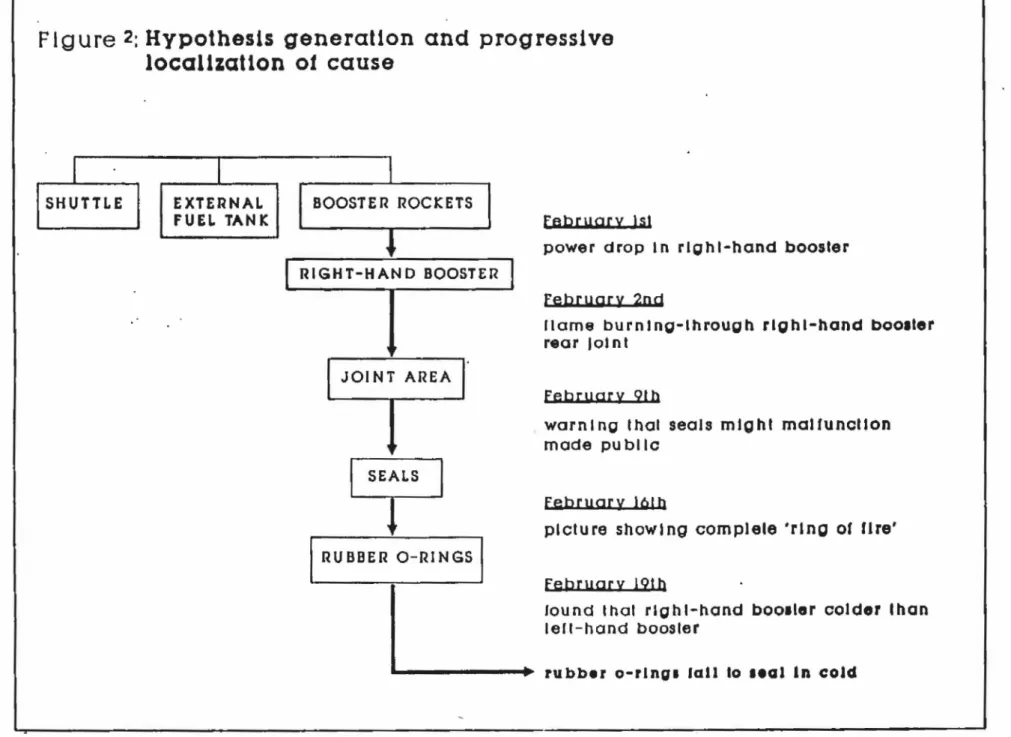
newspaper reports. Below, 1 explore the intimate interplay
b e t w e e n the logic of causal explanation and the rules of
conversation in N e w York Times reports on the causes of the
Challenger s p a c e-shuttle disaster. I show how analysis of how a
real-life e x p l a n a t i o n is built u p reveals processes of causal
explanation that had not p r e v i o u s l y been studied in experimental
research. I then report a series of experimental studies w h i c h
investigate what makes a good explanation.
Maxims of causal e xplanation
With some exceptions (Einhorn and Hogarth, 1986; Leddo,
A b e l s o n and Gross, 1984; Read, 1987) researchers on causal
e xplan a t i o n have on the w h o l e p a i d little attention to the
fundamental q u e stion of what makes a good explanation, in
contrast to the effort expended on investigating the internality. stability, g l o b a l i t y and c o n t r o llability of explanations. In this
section I d e velop the argument that a good explan a t i o n is one
that satisfies Grice's (1975) m a x i m s of conversation.
Grice (1975) proposed that utterances m a d e in normal c o
o perative c o n v e r s a t i o n should follow four maxims. The m a x i m of
gualitv states that an u t t e r a n c e should be true, or reasonably
likely to be true. The m a x i m of quant i t y states that an utterance
should be informative. The m a x i m of relation states that an
u t t e r a n c e should be relevant and to the point. Finally the m a x i m
of m a n n e r states that the u t t e r a n c e should be clear. Good