Facultad de Formación del profesorado y Educación.
Máster en enseñanza Integrada de Lengua Inglesa y Contenidos: Educación Infantil y Primaria.
TRABAJO FIN DE MASTER.
THE ACQUISITION PROCESS OF A SECOND
LANGUAGE.
ADVANTAGES ON COMPREHENSION AND SUBJECT
KNOWLEDGE.
Tutor: Written by:
INDEX
1. ABSTRACT 3
2. INTRODUCTION 4
3. FIRST LANGUAGE ACQUISITION 9
3.1 STUDIES ALONG HISTORY 10
4. SECOND LANGUAGE ACQUISITION 12
4.1 WHY IS IT IMPORTANT TO START TO LEARN A LANGUAGE DURING CHILDHOOD? 16
4.2 STAGES OF LANGUAGE ACQUISITION. 18
4.3 SECOND LANGUAGE ACQUISITION PERSPECTIVES. 21
5. RESEARCH 33
5.1 PARTICIPANTS. 34
5.2 TASK 36
5.3 RESULTS AND ANALYSIS. 37
5.3.1 READING AND COMPREHENSION. 38
5.3.2 SCIENCE QUESTIONNAIRE 40
6. CONCLUSIONS 43
7. REFERENCES 45
1. ABSTRACT
The focus of this research was to try to clear answers about the advantages of acquiring a second language. Along this research we run a study about possible benefits of studying/acquiring a second language. To reach this goal, we chose two groups of study. Group number 1(Bilingual/CLIL group) was a group 6 grade students who had been exposed to bilingual education since Kindergarten. Group number 2 (monolingual group) was a group of 6 grade students who had not been exposed to a bilingual education and their only contact with English language was through the English subject since Kindergarten. We tried to identify possible advantages in reading comprehension in L2 and better understanding and knowledge of the subject matter Science. We concluded that group 1 performed better at the reading comprehension task while group 2 performed better at the subject matter task.
2. INTRODUCTION
The aim of this study is to analyze the possible advantages among children who are exposed to a bilingual language education and children who are exposed to a monolingual one.
What is special about language? There are many answers to this question. Some people think that what is special about it is that it is one of the most effective ways to communicate and satisfy our needs, whereas others would think that it is what best describes human beings, that it is our most important feature, what makes us human and rational animals. But, why did human beings develop such complex system of sound and meaning?. Why did our species evolve among others as the only one with the most complex communication system?
Some experts like Darwin (1859) refer to an adaptation process as it there was something in the environment that made human beings feel the need to get adapted to new conditions; this is what Darwin called “natural selection”.
From this starting point, there have been many hypotheses trying to answer this question. Hauser, Chomsky and Fitch (2002) discuss this in an article called “The Faculty of language: what is it, who has it and what is special about it?”. They divide the language faculty in two: FLB (Faculty of language in the broad sense) and FLN (Faculty of language in the narrow sense). They describe how FLB is shared with other animals whilst FLN can only be found in human beings.
According to these definitions they consider three hypotheses to explain how the faculty of language evolved.
1. FLB and FLN exist in animal communication. It can be more or less developed but it exists in all cases.
2. FLB is seen as an adaptation for language. In this case, FLB including FLN, is the result of a biological mechanism called natural selection. Although some animals may have some homologous mechanisms they do not have the same properties human beings have.
3. FLN is uniquely human. This last hypothesis establishes a difference between FLB and FLN. In the first case, FLB is shared among other nonhuman species whist FLN is specifically human. (Hauser, Chomsky, Fitch. 2002)
From this starting point, we cannot deny the fact that every living thing, even the simplest ones, have the need to communicate. Maybe their purposes are not varied or not so complex as ours but in any case, the need exists.
It is now when we should ask ourselves if this is something we should attribute to natural selection or something else.
Did our ancestors communication system grow in complexity only because our species found certain needs that should be covered? or was it because we already had a predisposition that was already present in our system waiting for the right moment to come out?.
Chomsky (2006) would affirm that this “ability” is something inherent to our species. There is something in human nature that makes humans able to communicate; we are genetically programmed to develop our potential (linguistically speaking) in relation with the environment.
There are certain triggers in the environment that help that potential to come out, certain inner grammatical structures will come out from our mind without us knowing how they really appeared there.
As Chomsky (2006) would say, metaphorically speaking, we could be referring to the growth of a language rather than the learning of it. As in his case, this growth could be compared with the process of lung cell formation.
This ability is closely related to the fact that among other living things, humans are considered social beings. We must not forget that human beings are the only ones characterized as social animals, as animals “who” need to communicate if they want to fit in a society and as animals “who” want to survive.
It is here that we can ask ourselves, what was first: the fact that we were pre-programmed to be social animals or the need of socializing? Was this need what made us social animals?
There have been cases of “savage children” who were exposed to an environment without any human language stimulus and the consequences were terrible, obviously.
These children were never able to fit in their societies; they never learnt the language as perfectly as their age fellows.
If is true what Chomsky (2006) claims and we are pre-programmed to talk, why were those children never able to communicate?.
Lane (1979) shows us a detailed account about Dr. Jean-Marc Itard's work in 1980. His work is focused on a 12 year old boy called Victor of Aveyron (a savage child) who was found when he was twelve. Until that moment, he had lived in the woods without any other company than the creatures that lived there. He could not say a word and his behavior was close to an animal's. After being exposed to “education” and having taken part in different studies by Jean Marc Gaspard Itard, he was not able to say more than a couple of sentences. Itard affirmed that Victor’s ears were not organs which could appreciate sounds, he was not deaf, but his ears only recognized sounds that could warn him that something dangerous was going to happen.
This leads us to think is it true, as Lenneberg (1976) would affirm, that there is a critical period after which we cannot acquire a language with the same proficiency as we acquire ours when we were young?
Is it really true that there is a specific period of time, to be exact, the first years of our existence where language can be developed more easily? Is this a certainty for us to reach a level of proficiency in the adulthood?
Cases as Victor's situation are not very common but it can lead us to ask ourselves: how is it possible that he could not speak if he was pre-programmed to do so? If he was not deaf, maybe his ears were just not ready to discriminate language sounds.
Maybe it was not him, but his ears that were not ready to discriminate a specific type of sounds. Depends on the environment we grow up in, our organs will get used to certain conditions and depending on those conditions we will learn a specific system of sounds and meaning.
Although, what we are really interested in is: how do we learn a language?, is it something we are born with?, is it something we learn?, is it something we
acquire?, is there a critical period to learn a language?, how does this critical period influences or not in the learning/ acquisition of a second language?
From this starting point we will try to give answer to these two questions: are there any advantages between children who only speak one language and those who can speak more than one? and are there any advantages in what subject knowledge may concern?
As nowadays, bilingual programs and immersion programs seem to be the key to future success, we will try to see the benefits these approaches may have in the development of each individual and taking part in these programs can help children to develop not only their linguistic abilities but acquire more easily concepts in different areas/subjects.
Thorough this study we will try to give answers to these questions. We will analyze how we acquire our first language and how that differs from the process of second language acquisition. Finally, we will try to see if it is really true that there are differences between what we call “bilingual children” and “monolingual children”.
3. FIRST LANGUAGE ACQUISITION
How we acquire a language is a question that has been asked for many years. There is still uncertainty about it; many experts seem to have different theories about it. One of the most significant is Chomsky, but still there are no golden rules that tell us how this process works.
If we think about a baby, a very unskilled animal, the process of language acquisition seems to be a mystery. How is it possible that the most immature animal can acquire such amount of complex structures?
Language is not only words, it is more than that. It is a complex organization that must be arranged around certain grammatical rules, some of them are learnt and some others are born with us. Cook and Newson (2007) claim that Chomsky is known for having proposed what he called the principles of grammar. Each human being is born with a predisposition to learn a language. We could compare it with a biological mechanism that help us to understand everything around us. Same way our lungs work without our being conscious of it, our intelligible system makes language a “game” for human beings.
At the beginning, children may not understand a word, but soon they learn how to name all they need and how to express what is in their heads, being one of the characteristics that makes us humans. We are social animals who look for socialization and this is only possible thanks to our ability to communicate with others.
As we said earlier, Chomsky claims that every human being is born with a natural predisposition to talk. No matter what type of language he/she will learn. All languages seem to have a deep common structure that babies are born with,
then, we deduce how to organise all those structures to make it work in every language.
Three year old children can tell you that “an orange” is right but not “an oranges” They cannot provide a grammatical explanation about articles or the number of each noun, but they can tell you “because it is not right”. They do not know why but they know it is not right.
This is because they have something in their experience that tells them “that does not sound good, so it cannot be possible”. This argument was hold under the name of “the poverty of stimulus”. As Cook, V (2007) would say in her paper Chomsky’s Universal Grammar and Second Language Learning:
“The language properties inherent in the human mind make up “Universal Grammar” which consists, not of particular rules or a particular grammar, but of a set of general principles that apply to all grammars and that leave certain parameters open; Universal Grammar sets the limits within which human language can vary”.
This means we are born with something that makes our nature works differently from that of a chimpanzee. But do we really believe this?
3.1 Studies along history
Along the history there have been different tendencies. Obviously, as researchers were finding more data, the techniques to learn more about language acquisition grew in complexity.
Ingram (1989) organises this process of language acquisition along three different period trying to give explanation to this process and proposing a concrete and successful method to understand it step by step.
• The period of diary studies (1876-1926)
• The period of large sample studies (1926-1957) • The period of longitudinal studies (1957-present)
Ingram (1989) explains how unprecised the information kept in the diary studies was, evolving into more detailed studies like the ones given by Stern or Nice. Relevant researchers as Chomsky appeared later on. Chomsky was one the first in highlighting the importance of grammatical structures as the key to learn a language. This was a big step in what acquisition process may concern as it reinforced the idea that a language is not a chain of words as it was thought for a period of time.
Children need to experience how language works, how there is something or someone that is the doer and something or someone that receive the action. As part of a developmental process, the acquisition of these structures is gradual and they go from the easiest to the most complicated ones.
Teachers and parents see how there is something that helps children to understand what is around them and something that triggers and internal mechanism that aims them not only to understand but to produce their own input.
4. SECOND LANGUAGE ACQUISITION
Saville-Troike (2006) would call second language acquisition to the study of children who are learning a language subsequent to learning their first language as young children, and to the process of learning that language.
This process normally happens during their childhood as it is expected to be the best period as children can integrate both grammars without effort.
We use the term acquisition because it is a process characterised by “picking up” a language. Children take part in different communicative situations in which they babble or talk to different people in a meaningful context. This process can be the result of interacting with a native speaker or a co-worker who speaks the target language as a second language.
Saville- Troike (2006) claims that along the history there have been two types of classification in terms of “learning” a second language. There was a formal education and what was called informal education.
• Formal education was characterised by people who attended to specific classes to learn a language in a classroom environment
• Informal education was characterised by “picking up” the language in a natural environment. Upper classes, cultivated language skills sending their sons or daughters abroad or just bringing a native speaker to the household; this way, children have the chance to learn a new language in a natural environment, in the same way they did with their mother tongue.
Nowadays, when we consider second language learning we can see it as a mixture of both tendencies. However, there are a few questions we should ask ourselves first:
• How does the learner acquire this knowledge?
• Why are some learners more successful than others?
When we try to give answers to these questions we must specify the point of view we are adopting. Depending on the field we are coming from we would adopt some ideas or others. For example, linguistics emphasizes the differences between one language and others considering this a key to help the student to learn another language. They talk about different stages of acquisition whilst psychologists and psycholinguistics are focused on cognitive processes involved in acquisition. However, sociolinguistics consider the pragmatic use of the language and the use of the language one of the most important keys to be successful in this acquisition process. Finally, social psycholinguistics emphasize the importance of motivation and contexts of learning.
This lead us to think that there is no agreement on how we really acquire a language and the truth is that there is there is no guide that tell us what comes next, how changes are developed, why they happen or how they can be improved or accelerated in those cases when children seem not to be able to say a word.
Some linguistics take one or more perspectives to this problem but we cannot name any field that gives answer to all our questions covering all the fields of studying language as an acquisition process.
Firstly, we would like to make clear the difference between a second language, a foreign language, a library language and an auxiliary language. Saville- Troike (2006) defined these four terms in her book "Introduction Second Language Acquisition" (2006):
• "A second language is an official dominant language needed for education,
employment or other basic purposes.
• A foreign language is one not widely used in the learner immediate social
context which may be used for future travel or other cross-cultural communication situations.
• A library language: is a tool for further learning through reading, especially
when books or journals in a desired field of study are not commonly published in the learner’s native tongue.
• An auxiliary language is one in which learners need to know official functions”.
(2006:4)
As we can see, what comes after naming a different language as a second language, foreign language or library language is only based on the circumstances. The use we want to give to that language is what is going to lead us to name it one way or another.
A second language would globalise all of the previous definitions. It helps you to communicate if you travel, if you study abroad if you need to check certain information that you need for your job or studies and at the same time it can help you to go further in your career.
Obviously, if we want to achieve all these goals, the second language that we would be talking about must be a “dominant” one or as we informally say an
“important” one. We would not even think about the possibility of learning Latin or Classical Greek if we intend to use this language for all these purposes.
We are using the adjective important as a way to define a language that is needed by the society being this necessity the product of our circumstances and life style. When Romans conquered Spain another language apart from Latin would be useless.
Nowadays, English has been established as a necessity in our lives and Latin is only a goal for those ones who are interested in a specific field of linguistics or classical cultures.
When children are sent to a specific school, parents look for a bilingual one. But, it is not only important that the school is bilingual, the language of instruction must be one that fits in their profile, in that profile that is organised according to “the most important languages I should know to be successful in my life”. This language normally follows this pattern:
• A language that helps us to communicate abroad.
• A language that helps us to acquire or learn new knowledge or ideas. • A language that helps us to communicate.
• A language that helps us in our professional career.
All of these items that were explained before according to four different concepts are what parents look for when they want their children to be bilingual. They want them to be competent communicators in a formal and an informal situation.
4.1 Why is it important to start to learn a language during childhood?
Many experts have talked about the importance of being in touch with a second language as early in life as possible. Nowadays, many schools claim to have a bilingual programme that starts not in Primary but in the Early Years period, but why do people seem to be so concerned about the importance of starting to learn a second language so early in life?. The answer is simple; by the age of six months a baby has produced all of the vowels sounds and most of the consonants in their mother tongue, but if the baby is in touch with a second language this development is produced at the same time.
If children are in contact with two languages, they learn to discriminate between those sounds. They learn how to make meaning of certain words and how to disregard others.
Children have mastered most of the distinctive sounds of their first language before they reach the age of three years old. They are even aware of basic discourse patterns like turn-taking. This process can be developed at the same time not only with their mother tongue but with a second language. This process is called simultaneous multilingualism.
The question here is “how is this possible?”. Humans are born with a natural predisposition and an innate capacity to learn a language. This is a fact as children learn their L1 at the same age in every country. They master their basic phonological and grammatical operations in their L1 by the age of six or five, they cannot only understand but create new utterances they have not heard before etc.
We are claiming that human beings are born with a natural ability to acquire a language, this is something genetic to our nature that is why children’s ability to create new utterances should be highlighted, they can even know when a chain of words constitute a grammatical sentence or not. This fact is not a consequence of children learning about grammar, children are not told about right sentence collocations but somehow they know. If they would have to be explained about all these abstract concepts not even the smartest children would learn a language.
Facing this problem, Chomsky developed a theory claiming that many of these abstract principles are common to all languages. Those principles are universal and they are programmed in all children. This explains why children developed the same grammatical structures all over the world.
Children language development is a complex process in which children acquire a set of rules. Some rules are more complex than others that is why some children may need more time than others to reach this point.
Jean Piaget (1959) observed that every child needs his/her own time to master a language being this only a cognitive matter but not a need of more stimuli.
Every child has his/ her own world and depending on the age and the cognitive developmental stage they will acquire a language easily or more complexly. We cannot force a child to go faster in this process because it is not a question of capacity or need of stimuli. It is a question of natural development and we should wait until every child is ready to take the next step.
However, not all the L2 acquisition can be attributed to innate ability as Chomsky claimed. Children need to be exposed to the language in a meaningful context, they will never learn a language if that language is not used around them. If they do not see people around them speaking in the target language, they will never see the meaning or the use of the language and consequently they will not acquire the whole idea of language. Language is a mean of communication, knowledge and development.
Social experiences and interaction are crucial for children to develop this capacity.
4.2 Stages of language acquisition.
When children acquire two languages at the same time they follow some common steps. Maybe the process is exactly the same, but, they share some steps. Saville- Troike (2006) divides this process in three phases: initial state, intermediate states and final state.
Initial state:
As we said before, children are born with an innate capacity to learn languages. Some linguistics believe that this natural predisposition remains with human beings during all their lives. However, others think that this ability is lost with time although there are left remains.
If we think of an adult who is starting to learn a language we will probably see that the steps he/she takes are quicker than the ones taken by a child. This is only due to the fact that an adult has a higher cognitive level and a child
needs more time according to his/her capacities. In a child, language is growing in complexity at the same time that the child matures.
Somehow, from a theoretical assumption older learners could never reach the same level of proficiency that a child who has been exposed during all his/her life to a second language; a language he/she has grown with.
If a second language is learnt at the same time than the first one, children have the advantage that the understanding of grammar follows the same steps in one language as in the other. In this case, L2 learners possess real world knowledge; this knowledge was not part of them when they started to learn the L1. They count on different resources they were not aware when they started to learn their mother tongue, resources of L1 competence that will help them to understand L2 and established skills for interaction.
Intermediate states:
During these intermediate states, the development of L1 and L2 is very systematic:
• There is a predictable sequence of phenomena between both languages. • Similarities between the two languages.
The processes that are developed during these stages are spontaneous and unconscious for the speakers of the language. Some of the more characteristic ones are transfers between one language and the other.
! Positive transfer: when we use an L1 structure in L2 and the use of this structure is appropriate.
! Negative transfer/ interference: when an L1 structure is used in an L2 utterance and it is inappropriate.
This phenomenon of transferring from one language to another one is called cross-linguistic influence. This influence is positive in the sense that it facilitates the process of language learning.
Interaction is crucial and the vital importance. We cannot achieve a comprehension in a language if we have not been exposed to that language previously.
But considering all these facts, it looks like everybody should reach the same level in a language after being exposed to the same input and context. But the truth is they do not reach the same level. It is at this point where we should ask ourselves how can this be possible? if this could be due to the feedback they receive (correcting errors and mistakes), their aptitude, their memory capacity, their analytic ability or motivation etc.
As we can see there are many factors we should consider before trying helping children to acquire a second language. There are no golden rules that tell us which factor is more important or can cause more trouble when we are referring to language acquisition; that is why we should consider them all if our aim is to help children to achieve a good command a different language.
Final state:
At the end of this stage, the speaker of both languages should have reached a native linguistic competence in both languages. However some experts disagree in this sense. Some of the most common ideas are:
• “The final stage of L2 development can never be totally native linguistic competence".
• “The level of proficiency which learners reach is highly variable”.
• “Some learners reach a “native-like” competence or a “near native” competence along L2”
At this final stage children should have reached a proficiency level in both languages. Depending on their preferences they would speak in one language more often than in the other, which should be a key fact which would contribute to name native language to one language or the other.
However, the phonological and grammatical system is established by the age of 5-6 years old, which would mean that the phonological and grammatical system in both languages would have been established and they would be as capable of speaking in one language as in the other.
But it is the use we give to one language or another which would contribute to name one language native and the other one “native-like language”.
4.3 Second language acquisition perspectives.
When we try to give answer to the question: “how do we acquire L2?” we should take into consideration three different perspectives depending on the
fields we consider more important. According to Saville- Troike (2006) these are:
• The linguistic perspective. • The psychological perspective. • The social perspective.
Here we are only going to talk about the linguistic and physiological perspective.
Linguistic perspective:
Linguistics organise languages around five different levels: lexicon (vocabulary), phonology (sound system), morphology (word structure), syntax (grammar) and discourse (the way sentences and information convey).
Linguistics affirm that in the case of second language acquisition, the process is developed automatically because children use the information they firstly gathered when they learnt their mother tongue. They organise this process along three different approaches: contrastive analysis, error analysis and interlanguage.
Contrastive analysis (CA) is an approach that predicts and explains learner problems comparing L1 and L2. It determines similarities and differences.
Its pedagogical goal is to increase the efficiency in L2 through teaching and testing. This way, they try to predict and describe patterns that will cause difficulty in learning.
They highlight two problems during the processing of mastering a language: the phonological system and the structure of language.
Believing in some notions of the behaviourist psychology, some CA followers have the behaviourist psychology as a base. They assume that we learn a language through stimulus –response –reinforcement. According to them imitation and repetition is what helps children to improve. “Practice makes perfect”.
Robert Lado (1957) suggested that the easiest structures are those acquired from the L1 with the same form, level and distribution. These structures would be transmitted by positive transfer.
The problem appears when there is an overlap but not an equivalent of structures in form, meaning and distribution because this can cause interference.
For example, when we find a similar form in English but with different meaning, what we commonly name as: “false friends”, or words with the same meaning but different form and distribution. For example, water in English can work as a noun, or as a verb or even as a modifier.
This type of interference can cause problems when we are trying to acquire a language. This is what contrastive analysis tries to identify possible problems that cause difficulty acquiring or learning a language and describe those problems through different patterns.
However, this contrastive analysis approach is not adequate for the study of SLA. It cannot explain how learners know more than when they have been taught once they first gets in contact with a language.
Error analysis is an approach characterised by being the first one that includes an internal focus on learner’s creativity to construct the language.
This change was due to the fact that linguistic theory changed. Linguistics were not so concerned about surface forms and they started to give more importance to underlying rules.
A changed from a behaviourist perspective to a mentalist one took place. Mentalism emphasises the importance of internal capacity/ predisposition rather than other factors.
We could highlight here the importance of Chomsky, as one the most relevant researchers. In his introduction to transformational generative grammar, he proposed that languages have only a small number of basic rules. These basic rules are the ones that help us to produce and infinite number of possible grammatical utterances. Being able to speak in a language is not only a matter of memorizing structures; otherwise, people would not be able to produce sentences they have never heard before. That is why Chomsky believed that there are inner forces which turn the child into an active participant in the communication process.
This process is closely related to the environment. We could say it is a team work between inner forces and environmental forces that help children to have a meaningful context and real life situations where they can use the language.
S.PitCorder (1967) is the most influential figure in the Error Analysis field; in his article "the significance of learner's errors" he described errors not as bad habits but as sources of insight into the learning processes. He claimed that errors are a sign that the learner is discovering the language.
Interlanguage:
This term was introduced by Larry Selinker (1972)to refer to the intermediate stages that a learner goes thru before commanding L2.
Interlanguage is a process that is driven by inner forces that every person who is trying to learn language posses but it is not only related to individual's characteristics as it influenced by environmental factors too.
Slinker(1972) highlights the difference between the interlanguage development in the process of acquisition in L1 and the development in the process of acquisition of L2 by children.
Saville- Troike (2006) claims that according to Slinker, when a learner is trying to acquire L2 they experience different cognitive processes:
! Language transfer from L1 to L2. ! Transfer of learning, how L2 is taught.
! Strategies of second language learning, how learners approach to the L2 materials and the task of L2 learning.
! Strategies of second language communication, ways learners try to communicate with others in the L2.
! Overgeneralization of the target language linguistic material, in which L2 rules that are learnt are applied broadly.
As we can see, how we acquire a second language is hardly influenced by L1. There is a transfer of structures from L1 conditioned by the materials, the way the language is taught, and the communicative situation. There are many factors that are not under control that is why the question “why some learners are more successful than others at learning languages?” is still unanswered.Is it a question of motivation or only environmental factors in relation with a natural predisposition?.
The idea is that the beginning of the interlanguage process is established when we can appreciate changes in grammar but the end of this process cannot be defined.
The psychological perspective.
This trend is characterised by its focus on the brain and the different connections and distributions of the brain itself according to the language and its functions. Saville- Troike (2006) refers to Broca as in his research he observed that an area in the left frontal lobe seemed to be the responsible for the ability to speak and noted that an injury to the left side of the brain was more likely to result in a language loss than an injury on the right one.
Later studies have proved that there are more brain areas involved in the language activity, although the core of the linguistic processes is localized in the left hemisphere.
Johnson and Newport (1989) in their article about the effect of critical period on second language acquisition referred to Lennebergas he hypothesized that language could only be acquired during a critical period that starts during the childhood and comes to an end during the puberty. If children suffered any kind of damage in their brain during that period of time, another area of the brain would take the language function. But beyond a certain age, this would not be possible. This is called critical period hypothesis.
Learning processes from a psychological perspective:
Saville- Troike (2006) refers to two frameworks that are focused on the learning process: information processing and connectionism.
Information processing:
This is an approach developed by John Anderson. It claims that a language is learnt in the same way we learn another type of knowledge.
“Learning is learning”.
Connectionism:
This framework agrees that learning is learning but it also claims that learning is a matter of establishing associations between different facts. It is not only about the abstraction of rules and principles.
Both frameworks are right but depending on the person, the age, the context and the situation one of the approaches would fit better than the other.
For example, if we were referring to a three year old kid, the way this child would learn the language would be through a meaningful context and in the same way he/she would learn another fact about his/her natural environment. In this case, there would be no difference between learning a new language and learning maths. “Learning is learning”. We could reinforce this theory based on the fact that at this age, children are not able to abstract things at very deep level. This child would not understand a thing about grammatical rules or principles, the only way for him/her to learn a language would be through the right context, the right motivation and the right strategies. This same structure would apply to any other field of knowledge.
On the other hand, a grown up or an older kid could count with other type of strategies. If we consider that the level abstraction of an older person is quite deeper than a child we could see that the understanding of rules or principles is way too easy. They have an “advantage”. They can understand that a three person of the present simple must end up with –s. They assimilate this rule and they apply it in every situation or context. A three year old kid cannot do this, he /she must deduce things from the context without even realising of what they are doing.
Adults tend to classify and organise every piece of information about a language in a try for them to make it easier to learn. They do not leave so much room for spontaneity, a key in the process of learning during childhood.
Both frameworks are useful but it depends on the abilities and skills that learners posses.
Differences among learners:
Psychologically speaking, there are some factors we should take into account when we are trying to give answer to the question “why some learners are more successful than others?”. There are no right answer to this question as different researchers have different opinions about possible factors that may have an impact on the easier acquisition of a different language. In this case, we have chosen Saville- Troike (2006) perspective although this research remains quite speculative.
• Age: it is thought that as soon as we start to learn a language we will achieve a better level or even a proficiency level.
As we mentioned before there is a critical period. After this period our brain loses its plasticity to learn languages. Instead of using our left hemisphere, it is our right hemisphere the one in charge of
assuming these functions.
Lenneberg claimed that critical period applies to SLA as it does for L1.
• Sex: most research in relation with this factor is concerned with cognitive strategies and learning strategies.
There seem to be differences between men and women in verbal fluency, mental representations and hormonal variables.
According to some tests women’s brains seem to be less asymmetrically organised than men’s for speech. As women seem to be better at memorising complex forms while men seem to be better at computing compositional rules. Other differences seem to be related to hormonal variables such as the level of androgen or estrogen. Higher level of androgen could help to get better automatized skills and higher estrogen level could help us to get better semantic/interpretive skills.
• Aptitude: it has been believed that aptitude was specific to learn a language. Findings establish a difference between L2 learning success depending on the naturalistic context and formal classroom instruction.
• Motivation: it determines the level of effort which learners experience when they are learning L2.
There are two types of motivation:
o Integrated motivation is based on an interest in learning.
o Instrumental motivation involves practical value in learning a language for business opportunities or occupational purposes.
As we can see both types of motivation are important. That is why we could conclude that the level of success in one or the other depends on the external or personal circumstances and the value that those circumstances have.
• Cognitive style: refers to the way everyone organises the information. Depending on our personality we tend to use one way or another to convey all the information. That is why there are many different types of cognitive styles.
• Personality: personality influences on the type of cognitive style everyone uses to organise the information.
• Learning strategies: each learner chooses the best strategies to face their learning depending on their motivation, cognitive style and personality. Although not all strategies are equals, some of them are more effective than others.
Along these chapters about first language acquisition and second language acquisition what we have been trying to do is to give a brief idea about the complex processes and connections that our students are experiencing when they are exposed to a second language since an early stage in life.
As we could appreciate before, this process is very complex and still uncertain about its stages or the different factors that could be involved in the success or not of our students.
This should help us to have a better idea of the different results we could be dealing with in a group students who have been exposed to a bilingual education very early in life. All of them have been exposed to the same amount of hours, same teachers and same topics but their results will not be the same, being this more obvious in comparison with a group of students who has not been exposed to L2 more than the amount of time established for the study of that language.
There are many factors involved in learning, some factors are more important for some people and other factors are more important for others. This means we cannot say sex is a crucial factor to be successful in acquiring a second language as we cannot say so about feedback or motivation. Here we have been trying to include as many factors as possible because every human being is a unique individual and as unique individuals we work in a different way and every possible detail should be taken into consideration for the possible influence in the final goal.
The answer to the question why some learners are more successful than others at learning/acquiring a second language is still unanswered. From my point of view, it is related to those characteristics that make us different and
special that is why some learners will command a language more easily or better than others.
The same could be applied to our study; we are going to show general conclusions that will helps us to have a general idea about the advantages or disadvantages of being exposed to a bilingual education in relation to comprehension in L2 texts and understanding of knowledge in a specific area of study.
Although we must not forget that among both groups of study there will be many factors that may be influential in children not being so motivated or so interested in this type of learning and their results will be different in comparison to the rest of students. Maybe the effect that this type of methodology may have on these children is the complete opposite, being translated in a lack of motivation because they do not see themselves being able to deal with the contents.
There are no definitive or "applied to -every-case" results. This study will show us a simple global idea of the effect that being exposed to a second language may have in other areas or as a way to improve some abilities as comprehension among the learners. However, there are still individuals that due to different factors may not obtain same results or same attitudes from the same stimulus or input.
Concluding this, we are going to explain the research we are going to conduct and the hypothesis we would like to prove.
5. RESEARCH
The focus of this research is to try to analyze possible differences in comprehension and knowledge between two groups of 6 grade students. Group A has been exposed to a bilingual education and group B has been exposed to a monolingual education.
There have been other studies which have had the same focus. Stohler (2002) in her publication "The acquisition of knowledge in bilingual learning: an empirical study on the role of language in content learning" tried to identify possible deficiencies in subject matter learning when the teaching took place in an L2 and how avoid possible disadvantages for the respective pupils. The aim of this study was to examine the pupils' knowledge when they were taught in L1 and compare the findings with those resulting from an L2 teaching arrangement.
In this case, there were no significant differences in the acquisition of knowledge when pupils were taught in an L1 and when they were taught in an L2.
Ruiz de Zarobe (2007) in her study "CLIL in a bilingual community: similarities and differences with the learning of English as a foreign language" wanted to analyze the effect of content-based instruction on the acquisition of oral competence in English as a foreign language. The basic assumption behind this study was that through successful language use the students would not only learn new concepts but develop their language proficiency more effectively. Students would learn the academic content specified in the curriculum and at the same time develop their second language proficiency.
The participants in this study were students in a Basque school. The language of instruction was Basque and Spanish and English were taught as subjects. Some of these students spoke Basque at home but others spoke Spanish and for this group the school could be considered as part of an immersion program.
In this case, although the CLIL group performed better in most of the categories, there were no significant differences between both groups. The possible explanation for these results is that a difference in the amount of hours may not be sufficient to obtain significantly better results.
Rafael Bisquerra Alzina in his study "Bilingualism in Aragón: consequences on reading and writing" analyzed the impact on learning to read and write in Spanish when the group of students do not have Spanish as their mother tongue.
In this case, he claimed that children who have an L1 not used as a mean of instruction at school and which is not an official language, obtained a lower level in reading and writing. These results related to the use of the language rather than the geographical situation. He found significant differences in 3 grade but not in 5 grade which means there is an evolution and there is progress.
5.1 Participants.
The subjects of the research are two groups of 20 students in two Asturian schools. All of the children who took part in the study have Spanish as their mother tongue.
Group A (Bilingual group) is formed by 6 grade students who study in a school located in the outskirts of Oviedo. Most of the children who attend this school belong to working class families or immigrants.
This school is well-known because it has a bilingual program that was created through an alliance between British Council and MEC in the 90's. This was due to the fact that at that time, some schools of specific areas started to have fewer children who would like to study there.
Group B (monolingual group) is formed by 6 grade students who study in a school located in the outskirts of Oviedo. This area of the city is growing and new buildings are changing the landscape. Most of the children who attend this school belong to working class families.
This school has a traditional program in which all the subjects are taught in Spanish except the subject matter English.
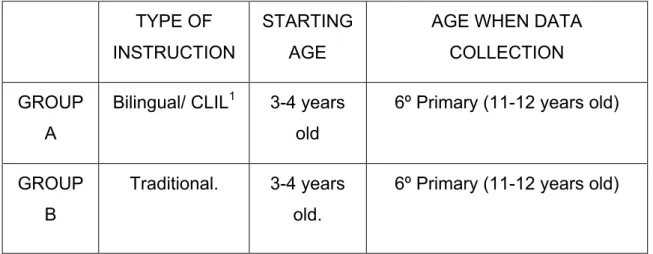
The first group has been exposed to a bilingual education since they started Kindergarten. They have been taught Science, Literacy and Art in L2 and English as a subject during their Primary education while the second group has been exposed to a monolingual education, being only taught English as a subject.
Both groups have learnt English since they started Kindergarten, but their hours of exposure were different.
TYPE OF INSTRUCTION
STARTING AGE
AGE WHEN DATA COLLECTION GROUP
A
Bilingual/ CLIL1 3-4 years old
6º Primary (11-12 years old)
GROUP B
Traditional. 3-4 years old.
6º Primary (11-12 years old)
Table 1: participants
5.2 Task
Both groups of students were asked to complete two tests which were validated by three experts. The first test is a reading and comprehension in L2 (English). The aim of this test is to see if there are significant differences in comprehension in English between a group of students who has been exposed to a bilingual education and those who has been exposed to a monolingual education.
The second test is a questionnaire about different Science topics that students will have been studying all along Primary. The questionnaire is formed by 20 questions and they should choose the right answer (a, b or c) demonstrating their knowledge about the field. The aim of this test is to see if there is a better understanding of the subject when that subject was explained and taught in L2.
The questions in the questionnaire were taken from the curriculum for Primary Education. These questions are related to the different topics they have previously studied in Primary.
The first group completed the questionnaire in L2 (English) as it was the language of instruction of that subject while the second group completed the questionnaire in L1 (Spanish).The aim of this questionnaire is to analyze the data and try to detect significant differences in the acquisition of knowledge when the teaching took place in L1 or in L2.
Both groups were given 20 minutes to complete the first part of the test (reading and comprehension) and 15 minutes to complete the Science questionnaire.
5.3 Results and analysis.
The data obtained was analyzed by Microsoft Excel (2007) and the results are presented with graphics and tables.
5.3.1 Reading and comprehension.
This part of the test was formed by an adapted text from "The witches" by Roald Dahl. Children had to read the text and answer five questions.
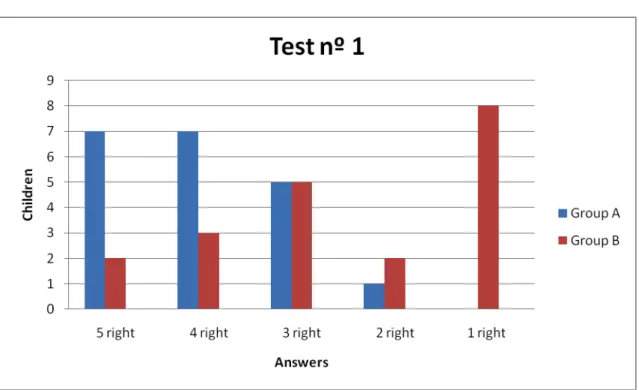
Answers. 5/5 4/5 3/5 2/5 1/5
GROUP A 7 children 7 children 5 children 1 children 0 GROUP B 2 children 3 children 5 children 2 children 8 children
Table 2: Results from the test nº1
Figure 1: Test nº1
As we can appreciate in the graphic (figure 1), the results in this part of the test show that group A, who was exposed to a bilingual education, performed better at this part of the test than group B, whose only contact with L2 was through the English subject.
In group A, 70% of the students got between 5/5 and 4/5 answers right being only 5% of the students the group of pupils who only got 2/5 answers right.
In group B, the situation is different as only 25% of the students got between 5/5 and 4/5 answers right and 40% of the students got only 1/5 questions right.
While group A seems to be more homogenous in their results, group B is more diverse. Group A is expected to get better results in L2 comprehension as the amount of hours of exposure to L2 is higher; this means they have spent more time in contact with L2 and dealing with difficulties in meaning and understanding. This could be translated in a better command of the language in what understanding concerns.
Group B has been exposed to L2 less amount of time which could be translated in a lack of L2 input that makes them find problems of meaning and understanding when they have to face tasks in L2.
These results seem to be what would be expected as the first group was exposed to more hours of instruction in English, which explains why their command of the language should be better. They have been exposed to plenty of contextualized tasks and explanations where their only mean of communication was L2. They learnt to deduce things from the context and take L2 grammatical structure along with their L1.These results could show that CLIL could be beneficial for children in what understanding of the language concerns.
5.3.2 Science questionnaire
This part of the test was a Science questionnaire that was formed by 20 questions. Both groups of students had to choose the right answer between a, b or c. The difference between group A questionnaire and group B questionnaire was the language.
Group A was given a questionnaire in L2 as this was the language of instruction in which the subject was taught since they started Primary. Group B was given the same questionnaire but in L1 as this was the language of instruction in which the subject was taught.
Answers 20/20-19/20 18/20-17/20 16/20-15/20 14/20-13/20 12/20-11/20 10/20-9/20 GROUP A 5 3 7 3 1 1 GROUP B 8 10 2 0 0 0 Table 3: Test 2
Figure 2: test nº2
As we can appreciate in the graphic (figure nº2) in this part of the test, group B performed better than group A in what concerns knowledge of the subject.
In group B, 90% of the children got grades between 20/20-19/20 and only 10% of the children got grades between 18/20-17/20 which were the lowest results. In group A we can appreciate a wider difference as only 25% of the students got grades between 20/20-19/20, 15% of the students got grades between 18/20-17/20, 35% of the students got grades between 16/20-15/20, 15% of the students got grades between 14/20-13/20, 5% of the students got grades between 12/20-11/20 and the last 5% of students got 10/20-9/20.
Group A is more diverse in their results. There are children who performed very well in the task but others who did not so well. Maybe the fact of having an L2 as a mean of instruction is what influences children in having more difficulties to deal with the subject or understand the subject.
Group B seems to get significantly better and more homogeneous results. This could be due to the fact that they did not have to deal with secondary difficulties as understanding the language when they were taught that subject.
6. CONCLUSIONS
The results in this study indicate that although CLIL seems to have an impact in comprehension and understanding of L2 it does not have the same results in what knowledge acquisition concerns. Their better command of the language could be due to fact that children in this type of programs are exposed to significantly more hours of instruction in L2 and as we saw in previous chapters, contextualized situations and exposure to constant input is what helps learners to acquire/learn an L2.
Many experts like Krashen and Terrel (1983) agree that the ideal age is in their early childhood when the process of acquisition of a second language plays a role around the process of acquisition of the first one. Children who took part in this research were exposed to bilingual education since they started Kindergarten which could explain why they have better understanding of L2.
After being exposed to this amount of hours their L2 plays a similar role along their L1 and they do not seem to differ from one or another in what understanding of the language may concern.
However, we cannot claim the same about subject matter knowledge as group B performed better at this task. Group B was taught this subject in L1 which makes this task "easier" to face as they do not have to deal with problems of meaning than group A had to deal with. Although this is not a closed statement as CLIL is characterized by a hands on methodology which helps children to experience the knowledge through their senses and make bearable the language difficulty.
This is just a little piece of data about possible advantages and disadvantages that being exposed to a bilingual education may have. However,
further research would enable us to show different or more vary conclusions on the effects of content-based instruction.
7. REFERENCES
Bisquerra Alzina, R. (1989). El bilingüismo en Aragón: estudio de sus repercusiones sobre el aprendizaje lecto-escritor. (Tesis doctoral inédita). Departamento de métodos de investigación y diagnóstico en la educación. Universidad de Barcelona
Chomsky, N. (2006). Language and mind. Cambridge: Cambridge University Press.
Cook,V and Newson, M. (2007). Chomsky's Universal Grammar. Oxford: third edition, Blackwell Publishing Ltd.
Corder, S. (1967).The significance of Learner's errors. International review applied linguistics in language teaching, VOL 5, 161-170.
Darwin, C. (1859). On the origin of spieces by natural selection. London: Jonn Murray.
Hauser, M; Chomsky, N and Fitch, W. (2002). The faculty of language: what is it, who has it and how did it evolve?.Science's compass, VOL 298, 1569-1579.
Ingram, D. (1989). First language acquisition. Cambridge: Cambridge University Press.
Johnson, J and Newport, E. (1989). Critical period effects in second language learning: the influence of maturational state on the acquisition of English as a second language. Cognitive psychology, VOL 21, 60-69.
Krashen, S and Terrel, T. (1983).Language acquisition in the classroom.Oxford: PergamonPress Ltd.
Lado, R. (1957). Linguistics across cultures. Michigan: University of Michigan.
Lane, H. (1979). The wild boy of Averyon. Cambridge; MA: Harvard University Press.
Lenneberg, E. (1967). Biological Fundations of language. New York: Wiley.
Piaget, J. (1959). The language and thought of the child. Great Britain: Biddles Ltd, Guildford and King's Lynn.
Ruiz de Zarobe, V. (2006).CLIL in a bilingual community.Similarities and differences with the learning of English as a foreign language.Viewz, VOL 15, 47-52.
Saville-Troike, M. (2006).Introducing second language acquisition. Cambridge: Cambridge University Press.
Slinker, L. (1972).Interlanguage.International review of applied linguistics in language teaching. VOL 10, 209-230.
Stohler, U. (2006). The acquisition of knowledge in bilingual learning: an empirical study on the role of language in content learning. Viewz, VOL 15, 41-46.
Van de Craen, P; Mondt, K; Allain, L and Gao, Y. (2007). Why CLIL works. An outline for a CLIL theory.Viewz, special issue 2, 71-80.
TEST Nº 1:
READING AND COMPREHENSION
A NOTE ABOUT WITCHES
In fairy-tales, witches always wear black hats and black cloaks, and they ride on broomsticks. But this is not a fairy-tale. This is about real witches.
A witch is always a woman.
I do not wish to speak badly about women. Most women are lovely. But the fact remains that all witches are women. There is no such thing as a male witch. On the other hand, a ghoul is always a male. But it is half as dangerous as a real witch.
As far as children are concerned, a real witch is easily the most dangerous of all the living creatures on earth. What makes her doubly dangerous is the fact that she doesn't look dangerous. Even when you know all the secrets, you can still never be quite sure if it is a real witch. If a tiger looked like a large dog with a waggy tail, you would probably go up and pat him on the head. And that would be the end of you. It is the same with witches. They all look like nice ladies. Examine the picture opposite. Which lady is the witch? That is a difficult question, but children could answer.
Oh, if there was a way of telling if a woman is a witch or not, we could easily guess. Unhappily, there is no such way. But there are little signals you can look for, little quirky habits that all witches have.
QUESTIONS:
1. What is this text about?
It is about real witches.
2. Can a male be a witch? why? or why not?
No, (he cannot/can't) because there is no such thing as a male witch/ because a male cannot be a witch.
3. What is the fact that makes a witch more dangerous?
A witch does not look dangerous (you can never be sure if it is a witch or a kind lady).
4. In the text, the writer compares a witch with other animal that is also dangerous. What is that animal?
A tiger.
5. Is there a way for us to know if someone could be a witch?
No, although there are little signals (like quirky habits) that all witches have in common
TEST Nº 2
SCIENCE QUESTIONNAIRE
1. The earth is: a) A star.
b) A planet.
c) A satellite.
2. The moon is: a) A star. b) A planet.
c) A satellite.
3. Water is important for living things:
a) Because living things need water to survive.
b) Because we need water to fill the swimming pool in Summer. c) Water is not important for living things.
4. What do plants get thru their roots? a) Nutrients and water.
b) Food. c) Only water.
5. Why do some animals like the chameleon camouflage themselves? a) Because they like changing their appearance.
b) Because they want to protect themselves from predators.
c) Because of the weather.
6. Choose the right food chain:
a) Grass> cow> human being.
b) Flower> dog> bacterium. c) Grass> cow> elephant.
7. What is the difference between domestic animals and wild animals?
a) Domestic animals are only cats and dogs and wild animals are the rest of the animals.
b) Domestic animals are capable of living in a home environment and wild animals not.
c) Domestic animals are animals we find only in a pet shop and wild animals not.
8.What are the different parts of the digestive system:
a) Mouth>Pharynx>liver>Gallbladder> pancreas>large intestine> small intestine> rectus> anus.
b) Nose>Tongue>Traquea>liver>stomach>Gallbladder> pancreas>large intestine> small intestine> rectus> anus.
c) Mouth>Pharynx>esophagus>liver>stomach>Gallbladder> pancreas>large intestine> small intestine> rectus> anus.
9. Why is the respiratory system important?
a) Because the respiratory system is what helps our body to breath.
b) Because the respiratory system helps us to get carbon dioxide in our body.
c) Because the respiratory system helps us to get nutrients into our body.
10. What is the goal of breathing?
a) The goal of breathing is to deliver carbon dioxide to the body and to take away oxygen.
b) The goal of breathing is to deliver oxygen to the body and to take away carbon dioxide.
c) The goal of breathing is to deliver carbon dioxide to the body and get nutrients.
11. What is a healthy diet?
a) A healthy diet is a diet that only includes vegetables and fruits.
b) A healthy diet is a balanced diet that provides our body with all the nutrients we need.
c) A healthy diet is a diet that includes lots of sugar and carbohydrates.
12. How is the sound produced?
a) Due to vibrations of an object.
b) We have no answer yet. c) Due to human beings.
13. How do we represent the distance on a map with its actual distance? a) With a ruler.
b) In kilometers (km)
c) With a scale.
14. what are the names of the different meteorological variables?
a) Temperature, humidity, wind and precipitations.
b) Temperature, humidity and wind. c) Humidity, wind and precipitations.
15. What are the different parts of the water cycle? a) Condensation and precipitation. b) Rain, condensation and precipitation.
c) Evaporation, condensation and precipitation.
16. What are the vital roles of animals?
a) Nutrition, relation and reproduction.
b) Nutrition, learning and reproduction. c) Relation, learning and reproduction.
17.How do we name the process used by plants to get energy from sun?
a) Photosynthesis.
b) Reproduction. c) Nutrition.
18. Dark surfaces like black paper:
a) Absorb more light and heat than white paper.
b) Absorb less light and heat than white paper. c)Absorb more light and less heat than white paper.
19. When the light is blocked by an object: a) It changes its path.
b)It makes a shadow.
c) It passes into another material.
20. What is a volcano?
a) A sudden release of energy that creates seismic waves. b) A column of air that is in contact with the surface of the Earth.
c) An opening on the Earth surface which allows lava, volcanic ashes and gases to come out.
TEST Nº2
CUESTIONARIO "CONOCIMIENTO DEL MEDIO"
1. La tierra es: a) Una estrella. b) Un planeta. c) Un satelite. 2. La luna es: a) Una estrella. b) Un planeta. c) Un satélite.
3. El agua es importante para los seres vivos:
a) Porque los seres vivos necesitan agua para sobrevivir.
b) Porque necesitamos agua para llenar la piscina en verano. c) El agua no es importante para los seres vivos.
4. ¿Qué consiguen las plantas a través de las raíces?
a) Nutrientes y agua.
b) Comida. c) Sólo agua.
5. ¿ Por qué algunos animales como el camaleón se camuflan? a) Porque les gusta cambiar la apariencia.
b) Porque quieren protegerse de los depredadores. c) Por el tiempo.