Towards a Curriculum for Electronic Textiles
in the High School Classroom
Leah Buechley, Mike Eisenb erg and Nwanua Elumeze
Department of Computer Science
University of Colorado at Boulder
Boulder, CO 80309
+1-303-735-6042
b uechley, duck, elumeze @colorado.edu
ABSTRACT
This paper proposes a curriculum for a high school e-textile course–a curriculum rooted in our experiences in developing an e-textile construction kit and in holding several courses and workshops with these materials. The paper briefly describes the e-textile kit and reports on our teaching experiences, reflecting on the relationship between the evolving tools and curriculum and our user experiences.
Categories and Subject Descriptors
K.3.0 [Computers and Education]: General; H.5.2 [Information Interfaces and Presentation]: User Interfaces; C.3 [Special Purpose and Application-Based Systems]– microprocessor/ microcomputer applications, real-time and embedded systems.
General Terms
Design, Experimentation, Human Factors.
Keywords
E-textiles, electronic textiles, computational crafts, wearable computing.
1.
INTRODUCTION
Programming and electronics are fundamentally design disciplines; and as such, it hardly makes sense to limit education in these disciplines to textbook readings and "cookbook" laboratory exercises. Indeed, there is a strong and (in our view) productive tradition of teaching these subjects through design activities. Computer programming might be introduced through the creation of video games, for example; or electronics through the construction of a radio. Even within this tradition of education-through-design, however, there are strong cultural limitations. That is, most projects implicitly fit within existing student subcultures–of gaming, or automotive design, for example–that include some students while implicitly excluding others. There is nothing at all wrong in our view with the support and encouragement of such subcultures; but at the same time, educators should be alert t o technological innovations that might spur the growth of new types of student subcultures of programming, engineering, and design.
As a representative of an already-existing subculture of programming and electronics, consider the area of robotics. For at least the past decade, robotics classes and clubs have been popular ways to introduce electronics, programming, engineering and other topics in a hands-on fashion. There are robotics kits, competitions, textbooks, and organizations and so forth aimed at pre-college students. And yet, while robotics is a wonderful introduction to electronics and programming for kids, it is limited in the way that any one particular educational subculture is limited–namely, in the types of projects undertaken, and the population attracted. By the same token, there are a plethora of fascinating ideas in the wider realm of physical or embedded computation that could be introduced to youngsters through alternative activities. The purpose of this paper is to explore the use of electronic textiles (e-textiles) as a means of introducing electronics and programming to students. Briefly, our argument is that the advent of new and accessible materials and programming platforms permits the growth of a new educational subculture (or perhaps collection of subcultures) rich in content and creative potential, and (eventually) potentially comparable i n interest to the cultures surrounding such activities as robotics and gaming.
We are not the first to express an interest in expanding the range of introductory activities in computing and engineering. Indeed, some recent research [9] and commercial products [8] are aiming to address the limited range of kid-centered embedded computation tools and activities. Still, there i s room for a great deal more exploration of the potential of physical computing in k-12 educational settings. For example, it is clear from the pattern of undergraduate enrollments i n engineering and computing disciplines that the population of students gravitating toward these fields is overwhelmingly male [7]; as a consequence, any effort toward creating new alternative activities that might attract female students and thus address this demographic imbalance should be welcomed. Our aim has been to produce a set of tools analogous to the Lego Mindstorms educational robotics kit [5] and a parallel curriculum to facilitate the construction of e-textiles by young people and other novices. Pursuing this goal has required innovation in several areas. We have developed or are in the process of developing: user-friendly e-textile hardware (somewhat of a misnomer in this context), electronic components that can be sewn to fabric substrates; complementary software systems that allow users to control and interact with the hardware; and, finally, the curriculum for a high school e-textile course. As these materials are developed, they need to be tested with users in the appropriate setting. We have been exploring each of these aspects of the problem in parallel and this paper will briefly describe the
hardware and software tools we have developed—the e-textile construction kit—and then describe our user study experiences and lay out our curriculum.
2.
THE E-TEXTILE CONSTRUCTION KIT
2.1
Hardware
The e-textile construction kit hardware consists of a set of fabric-mounted electronic modules that can be stitched together with conductive thread to build interactive clothing and accessories [2]. The core components are a microcontroller module—the “brain” of a construction—, sensor modules and output modules. Figure 1 shows an example kit that includes light sensors, temperature sensors, switches, an infrared transceiver, and a red, green, blue (RGB) light emitting diode (LED). A complete kit also contains a stitchable battery, an on-off switch and several alligator clips to facilitate prototyping.
Figure 1. The e-textile construction kit.
As can be seen in the figure, a module consists of electronic hardware mounted on a fabric substrate. To build a design a student sews components together with conductive thread. Tabs of conductive fabric—the labeled grey tabs visible in the image—provide points of electrical contact for the stitching.
2.2
Software
The Arduino system is a combined software/hardware platform designed to introduce novices to physical computing [1]. (It should be noted that this system was not built by the authors.) It includes an integrated development environment (IDE) that allows users to program in C or Processing, an Arduino microcontroller board, and hardware that connects the Arduino board to the computer. Figure 2 shows the Arduino IDE and a sample e-textile kit program. In a traditional use of the system, a user would employ the Arduino IDE to program an Arduino board.
Figure 2. The Arduino IDE.
Users of the e-textile kit employ the IDE to program our fabric-based microcontroller. To make this possible, we modeled our microcontroller module on the Arduino board and augmented
the Arduino’s software libraries with e-textile kit specific functionality. To program the microcontroller module, a user clips the module to a USB device that facilitates computer-module communication.
3.
EXPERIENCES
3.1
The First Class
Our first e-textile course took place in the spring of 2006 over the course of 8 weeks. The class met for two hours each week during this time. The class, titled “Learn to Make Your Own Electronic Fashion”, was offered as an elective through a local high school. We had 6 students, ages 14-16, five female and one male.
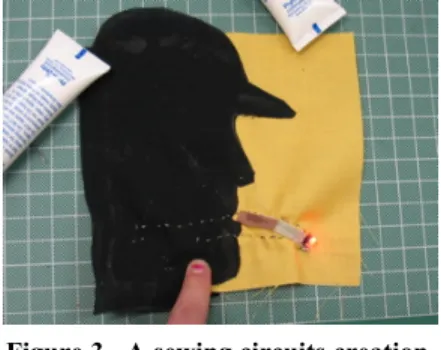
We began the course with an exercise called sewing circuits [3] that introduced the students simultaneously to the e-textile medium and to basic circuits. Students used conductive thread, a fabric switch and an LED to stitch out simple circuits. They were also given the opportunity to decorate their designs with fabric markers and pieces of decorative cloth. Each of the students constructed a working fabric circuit; Figure 3 shows an image of one of these.
Figure 3. A sewing circuits creation.
We then introduced the students to programming. The software the students used in this class was not the Arduino software described above. Rather, they used a text editor to write programs in C, and a command-line interface to compile the programs and load them onto their microcontrollers.
As a first exercise in programming, we attached microcontrollers to programming boards that contained eight LEDs and eight switches. Students were shown example code that produced patterns of blinking in the LEDs and then given the opportunity to create their own patterns, incorporating the LEDs and switches. All of the students quickly became engaged in the activity and produced original patterns. After these introductory exercises, we presented example e-textiles including a hat that contained a temperature sensor and an RGB LED; the hat displayed temperature by changing the color of the RGB LED, mounted at the crest of the hat. After discussing the examples, we gave the students e-textile construction kits and allowed them to design their own garments and accessories. Though the students were excited t o begin their projects, most expressed some confusion over the materials we presented and required assistance in mapping out a design. The rest of the class meetings were devoted t o construction.
We were delighted by the fact that five out of the six students completed successful projects. Figure 4 shows an image of one of these, a sweatshirt that contains electroluminescent wire spelling out the word “smile” and an LED dotting the smile’s i.
The wearer can control when the text and LED flash through a switch in her pocket.
Figure 4. A girl modeling the e-textile she built. This first class provided valuable feedback about the materials we used and the appropriate framework for such a class. First of all, the programming interface needed improvement. Loading a program onto the microcontroller fabric module necessitated removing the chip from the module, plugging i t into a programmer to install the program, and then removing i t from the programmer and plugging it back into the fabric module. The students, understandably, expressed frustration and confusion about this process. Only one student, who had taken a previous programming course, was able to navigate the system without assistance.
Furthermore, most designs incorporated switches, single color LEDs and electro-luminescent wire, but only one student (the girl with previous programming experience) utilized a sensor. Also, the programs students wrote were unsophisticated. We believe these issues were caused in large part by the awkward programming interface, but also because we did not provide any time or facilities for students to experiment with the e-textile materials before embarking on their projects.
We also found that students had difficulty allocating their time in reasonable ways. Students spent a disproportionate amount of time constructing their physical devices and neglected programming. For example, a student would elect t o stitch a fourth LED onto her design before programming the behavior of the three she had already attached. This resulted i n a rushed round of programming and troubleshooting in the final days of the class.
The results of pre- and post- tests of basic electronics and programming knowledge indicated that students learned basic circuit design in the course of the class, but did not learn basic programming concepts. Students’ average scores on a test of basic circuit knowledge increased by 55% as a result of the course. However, scores on a test of basic programming skills actually decreased slightly from the beginning to the end of the course; in a demonstration of how de-motivating a frustrating experience can be, students seemed to lose faith i n their ability to hypothesize about correct answers.
3.2
The Second Class
The second class took place in the fall of 2006 at another high school and was also offered as an elective titled “Learn t o Make Your Own Electronic Fashion”. The class met three days a week, in 50 minute sessions, over the course of four weeks. We had fifteen students, ages 14-17, 11 female and four male. Students in this class also had very little prior experience with programming or electronics. Because the class was larger, we assigned the students to five groups of three students each;
students completed all but the sewing circuits assignment i n these groups.
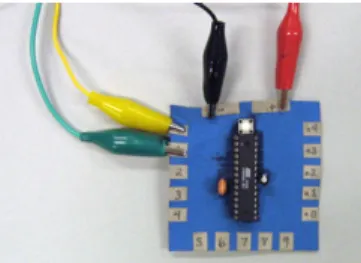
As in the class described above, we began with the sewing circuits of activity, and all but 1 of the students completed working circuits. We then began a basic introduction t o programming. In this case, we did employ the Arduino IDE and developed a system where students could experiment with the e-textile microcontroller module right away. Students used alligator clips to connect LEDs and switches to their patch and completed exercises similar to the ones conducted in the first class. Figure 5 shows how alligator clips were used to attach devices to the construction kit modules.
Figure 5. Alligator clips are used to connect microcontroller modules to other devices.
After this introduction, each group of students was given the opportunity to design a wearable artifact. The designs were presented in class, and then the remainder of the meetings were spent building these designs.
Certain aspects of this class were better than the first. The use of an IDE and the early use of the construction kit i n programming exercises improved the programming experience considerably, and the students’ designs reflected a better understanding of the materials, utilizing sensors and RGB LEDs.
Our evaluations also showed that students learned programming skills as well as circuit fundamentals in this second class. The average scores on the circuits test increased by 27%, and the average scores on a test of basic programming knowledge increased by 140% from the beginning to the end of the class. Comments on a class evaluation survey also indicated that the programming experience was positive for many students. One girl remarked that, as a result of the e-textile class, she would consider taking more computer science classes because “I thought programming would be a lot harder than it really is.”
However, only two groups were able to finish working pieces by the end of the class. The principal problem we faced was that the format of the class—the short meeting times—was terribly mismatched to the tasks students needed to complete. A significant percentage of each class was spent packing and unpacking supplies, threading needles, booting computers and so on. We also faced some technical problems with the interface that connected the microcontroller modules to the computers and addressing these took up more valuable class time.
3.3
Workshops with Adults
After these courses, we taught two e-textile workshops t o groups of adults. Each workshop took place over the course of a day. The four participants in the first workshop–art and engineering graduate students–included people with a range of experiences. The five participants in the second workshop
were a group of educators, all of whom had some limited prior programming and engineering experience.
In each workshop, we began with a brief discussion of circuits. We did not do the sewing circuit activity, but moved immediately into a series of exercises designed to teach the participants about programming and the facilities of the kit. As in the second class, we used the Arduino environment and attached the microcontroller modules directly to the computer for programming. We walked students through exercises using single color LEDs, switches, sensors, and RGB LEDs. These devices were attached to the microcontroller module with alligator clips for each exercise. After these exploratory activities, participants were given the opportunity to design and build their own e-textiles.
These workshops were more successful than the classes; all participants completed working designs that were much more sophisticated than those attempted in the classes. We believe this happened for a few reasons. Certainly, it was significantly easier to work with adults, but we also used our prior class experiences to develop better activities and support materials. Furthermore, the day-long structure provided an excellent framework for these hands-on projects.
An example of one of the remarkable projects that was developed in the second workshop was the fortune telling tank top. When asked a yes or no question, its wearer presses a hidden button that causes LEDs—each paired to an answer like “Most Definitely” or “Highly Unlikely”—to flash repeatedly for several seconds before revealing an answer t o the question by randomly lighting up one of the LEDs.
4.
REFLECTIONS
Our classes have been motivated by the same educational goals as a Lego robotics course: that is, we want to teach participants basic electronics and programming, and, more importantly, get them excited about computing. However, as is highlighted by the experience described above, there are important differences between the two media that necessitate addressing these goals in very different ways. While Lego robots are temporary prototypes that are dismantled after the class, a completed e-textile project is a permanent artifact that can be taken home and incorporated into a student’s daily life. This difference presents powerful advantages, challenges and curricular implications.
One of the primary reasons we are excited about e-textiles as an educational medium is that they allow students to build things that they can incorporate into their lives in a very unusual and visible way. Clothing and other fabric artifacts (e.g., fabric book covers, curtains, wall hangings) are pervasive in young people's lives; and it is hardly a surprise that adolescents, in particular, are tremendously concerned with what they wear. [Cf. Milner's [6] description of the role of costume in high school culture for an interesting discussion of this issue.] E-textile design and programming thus represent an unusual combination of sophisticated content and (where young people are concerned) cultural poignancy. This last point is, in fact, worth some elaboration. There is a recurring tendency among those interested in mathematics and science education to focus their attention exclusively on the classroom as a pedagogical setting. A discussion, then, of electrical engineering education is likely to devolve into a conversation about improving textbooks, teaching
techniques, and classroom activities (such as competitions). All of this is worthwhile, but it fails to exploit the remarkable degree of energy and passion that young people devote t o their own cultural milieu. That milieu–of hobbies, friendships and cliques, outdoor and indoor pastimes–is traditionally thought of as "extra-curricular", existing outside the sphere of educators' attention. Arguably, much of that culture has been shaped in recent years by an excessive focus on acquisition and consumption; but this is all the more reason for it to be re-examined as a setting for creativity, personal growth, and idiosyncratic educational achievement. E-textiles represent an area of engineering education that can spur this re-examination, and a broader study of bringing sophisticated, meaningful design activities into the hands of children. We hope that the permanence of e-textiles, combined with the ubiquity of fabric artifacts, will prove to be empowering and motivating affordances. However, there are challenges associated with this permanence. In building e-textiles, students encounter all of the problems professional engineers do. Artifacts are labor intensive to build, requiring significant amounts of time spent sewing, and mistakes are not easy t o correct, necessitating the removal and reapplication of stitching. Because of these issues, drawing up a thoughtful design before embarking on a construction is essential. This experience is in stark contrast to the typical Lego robotics activity in which designs can be quickly and easily built, tested, modified and disassembled.
These issues have profoundly impacted our curriculum and the support tools we have developed. In particular, through teaching our classes, we found that it is essential to provide means for students to experiment with the e-textile construction kit before building their designs and that this facility is central to their learning and understanding of programming concepts. As any programmer knows, it i s crucial to be able to see the results of code as one develops and debugs it. Embedded computation can be a particularly challenging medium for learning programming because i t introduces an extra layer of abstraction between the computer and the “real” world. The relationship between the virtual world, where programs are written, and the physical world, where programs are executed, can be a challenging one t o understand. A platform for rapid prototyping and experimentation is vital for students as they develop basic programming skills and learn embedded computation fundamentals.
Furthermore, students need to have concrete experiences with the materials before they are capable of designing their own artifacts. Students who were given a chance to experiment with the kit before designing an e-textile developed more sophisticated designs and displayed a much greater understanding of the kit.
In Lego robotics courses, students have a fairly consistent experience, learning important concepts as they iteratively refine their designs. An e-textile class requires two distinct phases of development: one in which students learn about programming and electronics by constructing prototypes and one in which students design and then build their final project.
5.
THE CURRICULUM
The curriculum we will now present is modeled on a Lego robotics curriculum (see for example [4]) modified to take our teaching experiences into account.
The structure of the course should allow for meeting times of at least 1.5 hours each and should provide at least 20 hours of total class time though the amount of total time could be decreased as individual meeting times were increased. The class should consist of the modules outlined below.
5.1.1
Introduction to Electronic Textiles
The class begins with an introduction to the e-textile medium. A presentation describes the applications of e-textiles in the areas of medicine, military engineering and fashion. This unit might also include a discussion of the importance and meaning of fashion in students’ lives. The purpose of this unit is to get students excited about the e-textile medium.
5.1.2
Introduction to Sewing and Electronics
The second unit introduces basic sewing skills and circuits concepts through the sewing circuits activity. Students should learn basic sewing skills—how to thread a needle, how to properly knot thread and sew stitches—and acquire an understanding of series and parallel circuits, electrical shorts, batteries, switches and LEDs. Additional curricular material could include lessons on schematic diagrams and Ohms law.5.1.3
Introduction to Programming
This unit begins by teaching students how programs are executed, compiled and loaded onto hardware platforms. The basic syntax of C is explained. Using an e-textile kit attached to the computer, users are given the opportunity to experiment with writing their own programs to control an LED. Programming constructs that are introduced include integer arithmetic, conditionals, loops and variables. Students should learn how to write and debug programs that involve these components.
5.1.4
Introduction to Hardware
This unit introduces basic concepts in embedded systems programming. The input/output (I/O) functionality of the tabs on the microcontroller module is introduced. Examples i n which pins are initialized as inputs and outputs are presented. Student use alligator clips to attach a switch and an LED to the tabs on their microcontroller module. Students should understand the relationship between different physical layouts and the code they write. Students should be able to write code to control switches and LEDs attached to any tabs.
5.1.5
Introduction to Output Devices
This unit introduces different output devices including RGB LEDs, beepers and vibrator motors. Students write programs t o control each of these devices. Again, devices are attached t o the microcontroller module with alligator clips for the investigations. Students should acquire a familiarity with a range of output devices.
5.1.6
Introduction to Sensors
Analogue sensors are introduced in the same manner. Students are allowed to experiment with different sensors including light, temperature and tilt sensors. They are taught how to read
sensor data and use it to control an RGB LED. Students should acquire a familiarity with a range of sensors and learn the difference between (digital) switches and (analogue) sensors.
5.1.7
Design
Students are presented with the design task of drafting their own e-textile. They are encouraged to think about how sensors might be mounted on the body to respond to physical activities or environmental affects. Students are required t o draw their design, including an electrical layout. (The electrical layout could be presented as a schematic diagram.) If time allows, students present their designs to the class for a peer critiquing session. Students should learn design, planning and presentation skills.
5.1.8
Prototyping
Students are required to prototype their designs using alligator clips. These prototypes include initial drafts of their control programs. Students should learn project management and prototyping skills.
5.1.9
Construction
At least half of the class time should be allotted for the final unit in which students build their designs. The class culminates in a class presentation or fashion show. Students should acquire engineering, problem solving and presentation skills.
6.
ACKNOWLEDGMENTS
We would like to thank New Vista High School, the Denver School of Science and Technology as well as Doug Prime, Fred Martin, Heidi Schelhowe, Milena Reichel, Mark Gross, Clayton Lewis and all of our class participants. This work was funded in part by the National Science Foundation award no. 0326054.
7.
REFERENCES
[1] Arduino. www.arduino.cc
[2] Buechley, L. A Construction Kit for Electronic Textiles In Proc. of IEEE International Symposium of Wearable Computers (ISWC), Montreux, Switzerland, 2006. [3] Buechley, L., Elumeze, N., and Eisenberg, M.
Electronic/Computational Textiles and Children’s Craft. In Proc. of Interaction Design and Children (IDC), Tampere, Finland, 2006.
[4] Carnegie Mellon University’s Lego Robotics curriculum. www.education.rec.ri.cmu.edu/roboticscurriculum/ [5] Lego Mindstorms. mindstorms.lego.com
[6] Milner, M (2004) Freaks, Geeks, and Cool Kids. Routledge, NY, NY.
[7] National Science Foundation. Statistics, Science and Engineering Degrees 1966-2001.
www.nsf.gov/statistics/nsf04311/sectb.htm [8] Pico Cricket. www.picocricket.com
[9] Resnick, M. Computer as Paintbrush: Technology, Play, and the Creative Society. In Singer, D. et al. (eds.), Play = Learning. Oxford University Press, 2006.