(IJSBAR)
ISSN 2307-4531 (Print & Online)
http://gssrr.org/index.php?journal=JournalOfBasicAndApplied
---
Success Factors as Critical That Shape Agile Software
Development Project Success
Dan Schilling Nguyen, Ph.D.*
Mt Washington College National Online Program, 1015 Windward Ridge Parkway, Alpharetta, GA 30005, USA
Email: [email protected]
Abstract
Information technology (IT) project success depends on having a project manager with effective decision-making, leadership, and project management skills. Project success also depends on completing the project in a given budget, time, and scope. However, there is a limited understanding of the lived experiences of agile managers and the following success factors: engineering, management, organization, and stakeholders. The purpose of this phenomenological study was to understand these lived experiences of 10 agile software development team project managers or leaders at global workplaces based in the United States. The research questions were focused on the effect of these success factors on agile software development project success. In accordance with nonrandom purposeful sampling strategies, a snowball technique was used to find more participants. An open-ended, e-mail questionnaire was created and sent to participants to collect data. The data were coded to discern themes or patterns. According to study results, agile software development team employs automate builds, continuous integration, and design patterns help reduce technical debt; good collaboration and communication skills are core to project success; product owner helps maximize business value delivered by team and priority and engage stakeholders; and sponsors help fund the project and other resources.
--- * Corresponding author.
This study has implications for positive social change because organizations that understand the critical factors may be able to improve project management strategies and cost benefits leading to higher efficiency, profitability, and productivity thus benefiting management, employees, and customers.
Keywords: Agile Software Development Teams; Success Factors.
1. Introduction to the Study
Many public and private sector organizations compete in the global marketplace. Some organizations are using agile software development (ASD) teams (ASDTs) as a way of developing software solutions for customers more efficiently and effectively [167]. Such ASDTs are employing state-of-the-agile software development methodologies (ASDMs), technologies, and processes [167]. However, information technology (IT) projects fail and cancellation rates continue to remain high. For instance, within the last decade, researchers have indicated that many IT / Information Systems (IT / IS) projects fail [40,169,181,206]. Weiling and Ping [220] noted that for an IT project to reach a desired goal or objective, the project manager must possess effective decision-making and leadership, and project management (PM) skills.
1.1. Background of the Study
Software development projects fail and cancellation rates remain high. One study, published in 2012 by Dr.Dobbs indicated that Agile had a 72% success rate, compared to a 64% success employing traditional methodologies. While better, an 8% betterment is barely a revolution. In today’s competitive business environment, we need to do improve in terms of success rate [84]. Another study, carried out by McKinsey, indicated that half of IT projects with budgets of over $15 million dollars run 45% over budget and deliver 56% less functionality than anticipated. Put plainly, Agile is not a silver bullet. Projects still fail at approximately the same rate today as in 2001. It appears little has altered or evolved in this respect [84]. Additionally, Kropp’s [120] agile study outcomes and argued that with respect to ASD methodologies what works for one team will not work on other.
Shenhar and Dvir [188] stated that more than 60% of IT projects are delivered late or over budget. Additionally, the Standish Group [206] found that 32% of the IT projects examined were successful and 68% of the IT projects were not successful. Emam and Koru [65] studied global IT projects in 2005 and 2007 and found that the overall failure and cancellation rates were high. Ke and Wei [110] noted that the success rate of enterprise resource planning (ERP) designs was approximately 20%. The 20% success rate consisted of ERP projects for all types of IT projects. There were several reasons for these software development projects failures and cancellations rates. For instance, IT managers may not identify and control software risks, which can contribute to project failures [181]. Researchers have demonstrated that many software development project failures also result from unidentified and uncontrolled risks [40,169,181,206]. Additionally, Kerzner [111] argued that some IT software development projects fail because project managers are not adequately monitoring schedule, cost, and scope variables. Organizational leaders can take proactive measures to help prevent the failure and cancellation of these software development projects. For instance, project managers must be cognizant of organizational issues and
additional efforts must be created in order to coordinate IT with organizational business strategies. Team cultural cognizance, motivation, cohesiveness and synergy, and job satisfaction of the team members are needed in order to accomplish project success. The management team must also ensure that any dilemmas in communication, expectation, and interaction process are addressed and rectified before venturing on the project. Carte, Chidambaram, and Becker [34] posited that when firms become more complex, global, and dynamic, IT-linked projects are needed to streamline the business process to accomplish competitive advantage, and require innovative business solutions to design IT projects. Additionally, IT projects should be managed to produce economic value and competitive advantage. For a project to be successful, process and tools should be understood beforehand. To evaluate IT project success, project managers have to manage project efficiency, the effect on customer, business success, and long-term sustainable development [67].
1.2. Research Questions
The research questions were (a) what are the lived experiences of managers or leaders regarding the effects of the success factors of engineering, management, organization, and stakeholders on agile software development team project success? These research questions are as follows:
1. What is your lived experience with agile software development team engineering factor (e.g. clean code, code and template reuse, continuous integration, and testing) that could effect agile project success. Please explain in two to three sentences.
2. What is your lived experience with agile software development team management factor (e.g., collaboration and communication, agile champion) that could effect agile project success? Please explain in two to three sentences.
3.What is your lived experience with agile software development team organization factor (e.g. product owner, scrum master, and scrum team selection) that could effect agile project success? Please explain in two to three sentences.
4. What is your lived experience with agile software development team stakeholder factor (e.g. sponsor, customer, and user) that could effect agile project success? Please explain in two to three sentences. In accordance with the nonrandom, purposeful sampling strategies, I employed a snowball technique to find more participants. A pilot test of the interview was done as well with three participants. The study contained open-ended questions to collect data. I distributed these interview questions to participants via e-mail to collect data. I then coded and analyzed the data for themes and patterns.
2. Literature Review
Researchers indicated that IT projects continue to fail at a high rate. One study, published in 2012 by Dr.Dobbs indicated that Agile had a 72% success rate, compared to a 64% success employing traditional methodologies. While better, an 8% betterment is barely a revolution. In today’s competitive business environment, we need to
do improve in terms of success rate [84]. Put plainly, Agile is not a silver bullet. Projects still fail at approximately the same rate today as in 2001. It appears little has altered or evolved in this respect [84]. Additionally, Kropp’s [120] agile study outcomes and argued that with respect to ASD methodologies what works for one team will not work on other.
Kerzner [111] argued that some IT projects fail because project managers are not monitoring the variables of schedule, cost, and scope. Shenhar and Dvir [188] illustrated that more than 60% of IT projects are not completed on time and within budget. The Standish Group (2010) wrote that 32% of the IT projects examined were successful and 68% of the IT projects were not successful; the failures were due failed and deserted projects. IT project success depends on various factors: having an IT project manager with effective leadership and decision-making. Traditionally, project success also depends on achieving the project in a given time, budget, and scope. However, there is a limited understanding of the lived experiences of those who experience the following workplace factors: cultural, functional, and organizational differences [67,157,169].
The purpose of this qualitative, phenomenological research study was to understand the lived experiences of IT managers with the workplace factors of cultural, functional, and organizational differences at global workplaces based in the United States. Up-to-date, real world communities are alike in many ways. These communities have internal factors comprised of communication, project management, accessibility of resources, project preparation, budget allotment, requirement and release management, and modification control process [36,65,67,157,169]. However, limited information is available regarding workplace factors that have an effect on IT projects [36,65,67, 157,169]. The scope of the study was within the United States and included virtual team professionals. The participants were drawn from members of managers from an international project management association. This study has implications for positive social change because organizations that understand workplace factors that effect the success of IT may develop strategies to improve project management and cost benefits leading to higher efficiency, profitability, and productivity.
The literature review in this chapter includes success factors of success factors of engineering, management, organization, and stakeholders that shape agile software development team project success and a research method review.
2.1. Literature Review 2.1.1. Engineering Factors
The success of an ASD project is often linked to engineering practices or factors. Engineering practices are significant to ASDT project success. The engineering practices are seen as very significant and as a kind of base, which ascertains that software can be developed in short sprint iterations with the required quality [120]. Kropp’s study indicated that automated tests, continuous integration and deployment refactoring, pair programming, test-driven development are the tools of the trade [120]. Continuous integration, clean coding and testing was mentioned as core engineering practices in most organizations [120]. Clean code, code and template reuse, and continuous integration will be further addressed.
2.1.1.1. Clean Code
Endlessly paying close attention to developing good code from the very starting is thought more and more significant. Some of the organizations began applying the clean code practices with the goal of building an invariably high code quality [120]. ASDTs also apply further engineering practices such as continuous quality control, regular pair programming, and regular or even institutionalized code reviews. These engineering practices help deliver quality software as well as fewer bugs versus traditional coding approach.
2.1.1.2. Code and Template Reuse
Code and template reuse practices are also very significant factor in helping ASDT to leverage exciting code and template. Code and template reuse help ASDT members to speed up the coding and development process in order help extradite a new developed software solution to customer quickly. For example, ASDT with a very well defined and organized SharePoint template could be later also reuse for different customers. With these a very well defined template reuse, a new SharePoint solution can be extradite to another customer within 1-2 months at most.
2.1.1.3. Continuous Integration
Continuous integration is also very significant engineering practices for organizations that embrace ASDT practices.Kropp [120] argued that continuous integration is seen as “an absolute must for being able to deliver software with high frequency”. Thusall organizations have built an automated build and test environment which furnishes prompt feedback to the ASDT developers about the quality of the system being established.
2.1.1.4. Testing
In most organizations automated testing on unit level is well built and is seen as an absolute must for furnishing a good software quality [120]. Kropp [120] indicated that more mature ASD organizations also apply automated testing on acceptance testing level employing new practices like Behavior Driven Development (BDD) and Automated Acceptance Testing (ATDD). These engineering practices also deliver a more quality code.
2.1.2. Management Factors
Management factors or practices are also very significant factors in order for an organization that employ ASDT project in order to be successful in delivering a new software solution to customer. Kropp [120] indicated that all ASD teams in his study earlier began with Scrum [10]. However, most teams have carefully changed Scrum over time and altered it to the specific demands of their organizations and projects. The ability to change the process is significant for the team for various causes: First of all it grants the ASDT members the feeling that they are the controls of the process, not vice versa. It objectively grants the elimination of deterrents that impediments the ASDT of being efficient. Secondly, it exhibits that Scrum appears to be a good option to begin with, but that it is not enough for all situations and thus should be adapted to the serval needs [120]. Agile champion and collaboration and communication are significant management practices will be further addressed.
2.1.2.1. Agile Champion
Leaders on all levels of ASD organizations necessitate to adopt a Catalyst Leadership style [120]. These leaders flourish by instigating ASDT members without losing the cohesiveness within the entire system. Clearly they can trust the organization and its ASDT members. Most significantly they know, at least by own experience, that ASD assume place in various domains at the same time.
2.1.2.2. Collaboration and Communication
One of the factors that is potentially to positively shape the success of an ASD project is the centralized establishment of the ASDTs. Ken Schwaber [10] asserted that collocated teams are one of the substantial vehicles for successful communication, which is, in turn, distinguished by Scott Ambler [10] as one of the significant success factors of ASD. Organization engaged in distributed offshore projects will be impacted by the cultural, and political places in those regions. Furthermore, intensive and open communication among all stakeholders is seen to be one of the key components for successful ASDT projects [120].
2.1.3. Organization Factors
Organization factor are also very significant factor in order to help organization that espouse ASDT practices in quickly deliver a new software solution to customer.
2.1.3.1. Product Owner
The Product Owner (PO) advocates the interests of the stakeholder community to the Scrum Team. The Product Owner role is to ensure clear communication of product or service functionality requirements to the Scrum team, such as defining Acceptance Criteria, and ascertaining those criteria are met [1]. The Product Owner must always keep a dual perspective. The PO must support and understand the needs and interests of all stakeholders, while understanding the needs and functioning of the Scrum Team. Because the PO must understand the needs and priorities of the stakeholders (e.g., customers and users) role is generally referred to as the customer advocate.
2.1.3.2. Scrum Master
The Scrum Master (SM) is referred as the "servant leader" of the Scrum Team who facilitates ASDT interactions as team motivator and coach [1]. The SM is responsible for ascertaining that the ASDT has the productive work atmosphere by guarding the ASDT from external obstacles and influences, and enforcing Scrum principles, processes and aspects.
2.1.3.3. Scrum Team
The Scrum Team (ST) is also known as the ASDT since they are responsible for developing the service, product, or other outcomes [1]. The ST comprises of a group of people who work on the User Stories in the
Sprint Backlog to make the Deliverables for the project. The ST also work with customers to turn requirements into user stories before these items can be discussed and assigned to ASDT members to work on.
2.1.4. Stakeholder Factors
Stakeholder involvement and support at during very early stages of the ASDT project is very important in order for the ASDT to be able to deliver a new quality software solution quickly. The stakeholder consisted of customer, sponsor, and user.
2.1.4.1. Customer
The Agile Manifesto advocates customer collaboration as one of the important requirements for successful ASD [11]. One of the principles of ASD is bestowing highest priority to gaining customer satisfaction through continuous and early deliver of valuable software [11]. This needs that the customers are not only available on site with the ASDT, but also highly motivated and active, and view themselves responsible components in the ASD project. Customer commitment is, thus, a signification success factor.
2.1.4.2. Sponsor
One core stakeholder is the sponsor who provides the project funding and other resources. Sponsors want to empathize the financial bottom line linked to a service or product and are more concerned with final results instead of with individual tasks [1]. Thus, an ASDT project to incept without this key stakeholder might not work well.
3. Research Method
The purpose of this qualitative, phenomenological research study was to understand workplace factors of cultural, functional, and organizational differences that effect the success of ASDT projects. I explored which arbitrating task process variables heighten the likelihood of success, given the presence of these workplace factors. A qualitative research approach is appropriate for the study because qualitative inquirers depict and explicate research and interpret or establish theories [45]. The critical factors included in the study are those factors leading to ASDT project success, such people, process, technical, and technologies and development tools on agile software development team project success. The study included 10 IT agile software development managers based in the United States who had successful ASDT experiences. The 10 ASDT managers were sent a set of interview questions containing open-ended questions. Researchers employ a qualitative phenomenological research design to reveal the characteristics of a phenomenon [45]. A qualitative phenomenological research design is also used when inquirers want to establish theories, best practices, and offer insights on assembled data [26].
3.1. Research Design and Rationale
3.1.1 Research Method
Researcher noted that mixed method research demand more time during data collection and data analysis process. Plano Clark [164] noted that the mixed methods form of research requires an inquirer to do extensive data collection, and the process of analyzing numerical data and text is time intensive. Mixed method designs also include a deficiency of balance in terms of how the quantitative and qualitative strategies and research are designed [30]. The deficiency of balance can lead to a study intemperately aimed on one of the research designs and can lead to the supporting facet of the research being deserted, which causes limited illumination [30]. In addition, mixed methods research is not appropriate for this study because it combines quantitative and qualitative research approaches and uses them in tandem to improve the study [71].
Quantitative research is generalized and includes numbers to test hypotheses. Quantitative research is deductive as inquirers employ the method to test theories [195]. Quantitative research includes postpositivist worldviews that focus on empirical observation and evidence [161] and comes to definitive conclusions using statistical evidence [195]. Quantitative researchers do not engage subjective facets of phenomena because they test theoretical conclusions. In addition, Borrego et al. noted that a quantitative research approach requires a bigger population independent of circumstance, which means that the study should have random sampling [172]. A quantitative research approach was not appropriate for the study because researchers who employ quantitative research approaches use particular and narrow questions, collect numerical information from participants, and analyze the numbers employing statistics [161].
A qualitative research approach was a more appropriate choice than a quantitative research approach because of the subjective nature of the research study. The study consisted of interviews employing a questionnaire consisting of open-ended questions to collect information from the participants. The study included Moustakas’ [143] modified van Kaam method and the Nvivo Qualitative Research Software Package (NQRSP) to analyze the data. A quantitative method was not applicable for this study because quantitative researchers do not collect information to distinguish emerging themes and patterns [172].
A qualitative method was appropriate for this study. Borrego et al. noted that a qualitative researcher looks to explain the phenomenon of a particular event, permitting a reader to create links between the study and his or her own circumstance [172]. Schilling [185] noted that qualitative approaches are optimal for assembling a more in- depth understanding of individuals’ purviews, lived experiences, and perceptions. Qualitative approaches are inductive because inquirers assemble data from participants to depict and explicate research and interpret or establish theories [45]. Adams et al. [1] and Creswell noted that qualitative inquiry is effective in explaining ideas about a particular phenomenon [172]. Additionally, Sherrod (2006) noted that qualitative inquiry approaches are effective for demonstrating study participants’ perceptions to understand a phenomenon. A qualitative research method is also proper when researchers need to know more about the particular construction of occurrences versus the general persona and overall distribution of the occurrences [201].
A qualitative research approach was appropriate for this study because I wished to analyze the life experiences and perceptions of a sample of ASDT managers in global workplaces based in the United States who experienced an ASDT project success. The chosen sample size, which was 10 participants, was also conducive to a qualitative research approach. Sherrod [190] noted that qualitative inquiry methods normally have smaller
sample sizes (e.g., 100 participants or less) than other research approaches. A qualitative research approach helped me achieve the goal of the study, which was to understand and depict the ASDT success factors that lead to IT project success.
3.1.2. Research Questions
The purpose of this study was to understand the critical factors that effect the success of ASDT projects. The three research questions were as follows. What are the lived experiences of managers regarding the effects of the critical factors of people, process, technical, and technologies and development tools on ASDT project success? The research question was then functionally expanded into the five subquestions (see Appendix C & D).
3.2. Methodology 3.2.1. Population
The population for the study included ASDT managers based in the United States with direct involvement in ASDT. The inclusion criteria for selecting participants included the volunteers’ willingness to participate in the study, participants’ prior and current cognition of ASDT processes, and the participants’ willingness to share lived experiences and perceptions about critical factors. Knapik (2006) noted that participants included in qualitative inquiry studies generally have comprehensive experience and cognition about their work environment. In addition, participants normally want to offer high-quality and accurate data based on experience [118]. The eligible study participants received an e-mail letter of invitation letter requesting to participation (see Appendix A) briefly explaining the research study and providing criteria for inclusion.
3.2.2. Data Collection
Researcher indicated that qualitative researchers use more than one steps when assembling research data. Patton [161] claimed that there are five steps involved in the process of gathering qualitative data. Qualitative studies require obtaining participants, attaining access, deciding on the types of information to collect, using data collection forms, and administrating the study in an ethical fashion [161]. In other words, the data collection process is comprised of collecting data using forms with questions to evoke responses from participants, gathering text, and collecting data from a small number of participants.
An e-mail questionnaire was used to collect the research questionnaire data. The participants were required to answer the same questions. The questionnaire was used to gather demographic information (e.g., age, gender, number of year experience with collocated and virtual team project, and current industry), details about project success, cultural, functional, and organizational differences.
3.2.2.1. Interviews
Interviews with open-ended questions were used to evoke responses from participants, exploring the workplace
factors leading to ASDT project success. The workplace factors the participants believe are most highly valued at ensuring ASDT project success are documented. Therefore, the participants’ responses helped me in answering the research questions of the study.
3.2.3. Instrumentation and Material
An e-mail questionnaire interview format was the vehicle employed to collect information from the study participants. An e-mail questionnaire interview enables an inquirer to implement the content and analyze the outcomes objectively. The study questions (see Appendix C & D) were based on what researchers advised as workplace factors that could effect ASDT project success.
3.2.4. Pilot Study
Singleton and Straits [197] noted that during research, there is a possibility of participants misinterpreting interview questions. Pilot testing both the interview questions and the instructions minimizes this problem. Three individuals were be asked to participate in the pilot test that meet the same criteria as the primary study participants and these participants would not be included in the primary study. I followed up with the pilot participants after the pilot study to obtain feedback on the questions and instructions to obtain any recommendations for further development and enhancement. I also asked if the questions are clear and easy to understand. Feedback and recommendations from the pilot study participants were not essential and were not implemented in the primary study.
4. Results
The purpose of this qualitative, phenomenological research study was to understand the lived experiences of ASDT managers with the success factors of engineering, management, organization, and stakeholder at global workplaces based in the United States. The lived experiences and perceptions of 10 ASDT managers who experienced an ASDT processes were explored to analyze the success factors leading to project success (e.g., resulting in improved PM, higher productivity, improved cost benefits, greater efficiency, and profitability) to assist in the improvement of future ASDT projects. I used the data assembled from the interviews to answer the following three research questions: What are the lived experiences of managers regarding the effects of the success factors of engineering, management, organization, and stakeholder on ASDT project success?
4.1. Pilot Study
One out of three managers were included in the pilot test (see Appendix E), which consisted of open-ended questions supporting the research questions on January 15, 2016. The managers chosen for the pilot test were knowledgeable of ASDT processes and were current or had prior experience in managing or leading a ASDT. The results of the pilot test required no modifications to either the instructions or the interview questions. The participants responded to all nine questions appropriately with no indications of ambiguity.
4.2. Demographics
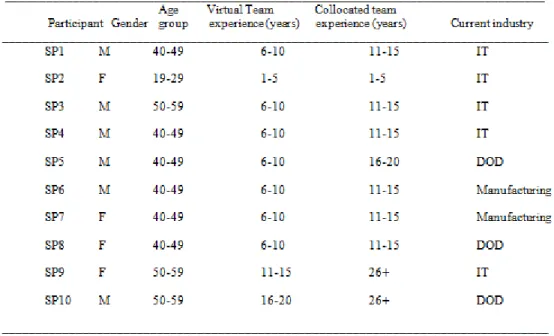
The intent of the study was to obtain a better understanding of the following organizational workplace factors: cultural, functional, and organizational differences. The participants came from diverse backgrounds and were all either members of an International PM association or group. Five (see Table 1) out of 10 (50%) study participants work in the IT industry. Two out of 10 (20%) participants worked in manufacturing. Three out of 10 (30%) participants worked in the department of defense. By looking at these participant pools, I was able to seize the views of tenured ASDT managers from a variety of backgrounds. Table 1 presents the demographic information offered by each participant.
Table 1: Participant Demographic Information
4.3. Data Collection
4.3.1. Participants
Participant selection using purposeful sampling began on Jan 11, 2016 and ended on Feb 11, 2016. Letter of invitations (see Appendix A), a participant informed consent form (see Appendix B), and the interview questions (see Appendix E) were e-mailed to 40+ participants employed at global workplaces based in the United States. After the 25-day period, a total of 10 project managers and / or leaders at global workplaces based in the United States took part in an interview using e-mail as part of my interviewing protocol. They answered a series of four interview questions, as noted in my data collection instrument (see Appendix E). Table 1 shows a demographical overview of the study participants.
The data collection process used in the study to gather in-depth responses from participants had no variations from what I discussed in Section 3 to the actual implementation. I obtained the participants’ e-mail addresses during the initial contact via Linked In discussion postings and LinkedIn International PM association and group discussion postings. I did not face any unusual circumstances during the data collection process, such as any technical difficulties with using e-mail. All participants were knowledgeable of e-mail functionalities. The
interview protocol and methodology used to assemble the data from participants was effective and I did not face any issues that changed or hindered the data collection process in any manner.
4.4. Study Results
4.4.1. Responses
The completed interview questionnaires (see Appendix D) were the collected data. The synopses of responses were the result of Moustakas’ [143] modified version of van Kaam’s method of phenomenological data analysis. Additionally, the NQRSP was used to distinguish common themes and patterns among the study participants’ responses.
The open-ended questions containing the questionnaire (see Appendix E) were the result of the cognition gained from the literature review. Research articles on workplace factors leading to ASDT project success [67,146,169], PMI [199], and ASDT [167] were important in developing the nine open-ended questions in the questionnaire.
4.4.2. Agile Software Development Teams
More and more organizations are turning into agile software development team to leverage information and communications technologies (ICTs), development methodologies, and team members’ diverse expertise skills around the world. Thus, project leaders and team members with effective decision-making and project management skills have an effect on project outcomes. Additionally, project leaders and team members need to be culturally sensitive as well as be trained on different cultures in order to work effectively with their team members locally and remotely. This in turn helps minimize miscommunication among team members as well as optimized team overall performance, especially during team meetings and teleconferences meetings. Furthermore, leadership with effective decision-making and project management skills as well as appropriate leadership styles usage also effect project outcomes [117]. The following nine interview questions and findings are as follows.
Question 1
Question 1 was “What is your lived experience with agile software development team engineering factor (e.g. clean code, code and template reuse, continuous integration, and testing) that could effect agile project success?”
As shown in Table 2, 9 out of the 10 (90%) study participants believe agile software development team members employ automate builds, continuous integration, and design patterns help reduce technical debt. Participants 1, 2, 4, 5, 6, 7 and 8 showed similar thoughts based on the responses. For example, Participant 3 stated, “Our agile team employs and embraces automate builds, continuous integration, and design patterns this in turn help our organization reduce technical debts.” Eight out of 8 (80%) study participants think agile software development team employ code and template reuse: speed up development time and quicker solution to
customer. Participants 1, 2, 4, 5, 6, 7 and 8 showed similar thoughts based on the responses. For example, Participant 3 stated, “Code and template reuse help our agile team to speed up the process in delivering a new solution to customer. For instance, by reusing a very well defined code, we just need to do a few modifications for another customer. Our team can deliver a new solution to another customer within 2-3 months.” Seven out of 7 (70%) study participants believe that agile software development team employs clean Code: eliminate bug, save maintenance cost, and provide better quality software. For example, Participant 3 stated, “I believe that clean the will help eliminate bug and provide better quality software solution to customer. Clean code will in the long run will save maintenance cost.”
Table 2: Responses to Question 1 (N = 10)
Question 2
Question 2 was “What is your lived experience with agile software development team management factor (e.g., collaboration and communication, agile champion) that could effect agile project success?”
Table 3: Responses to Question 2 (N = 10)
As shown in Table 3, 9 out of the 10 (90%) study participants believe agile software development team members with good collaboration and communication skills are core to project success. Participants 1, 2, 4, 5, 6, 7 and 8 showed similar thoughts based on the responses. For example, Participant 3 stated, “Agile team members required to have good collaboration and communication skills are core to agile development project success.” Eight out of 8 (80%) study participants think agile software development team members employ organization centralize training resources team can improve technical, collaboration, and communication skill. Participants 1, 2, 4, 5, 6, 7 and 8 showed similar thoughts based on the responses. For example, Participant 3 stated, “Our company has a centralized learning resources location where all employee could use this portal learning resources at any time to aid them in order to help better their improve their technical, collaboration, and communication skills. As a results, team members can be more productive during their daily collaboration and
stand up meetings.” Seven out of 7 (70%) study participants believe that agile software development team Agile Champion is the driver, motivator and help maintain team cohesiveness. For example, Participant 3 stated, “Agile champion leaders boom by instigating ASDT members without losing the cohesiveness within the entire agile project team. They are the driver and motivator for agile team project success.” Six out of 6 (60%) study participants believe that agile software development team Lack of communication and collaboration impediment team goal, performance, and project success.
Question 3
Question 3 was “What is your lived experience with agile software development team organization factor (e.g. product owner, scrum master, and scrum team) that could effect agile project success?”
Table 4: Responses to Question 3 (N = 10)
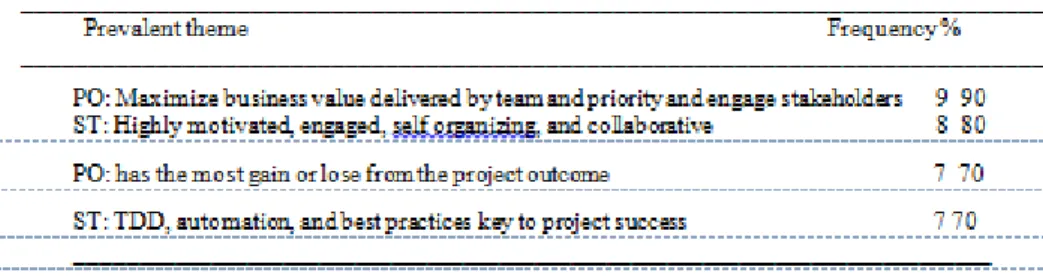
As shown in Table 4, 9 out of the 10 (90%) study participants believe agile software development team product owner help maximize business value delivered by team and priority and engage stakeholders. Participants 1, 2, 4, 5, 6, 7,8, and 9 showed similar thoughts based on the responses. For example, Participant 3 stated, “I believe that product owner help maximize business value delivered by team and priority and engage stakeholders.” Eight out of 10 (80%) study participants think agile software development team members need to be highly motivated, engaged, self-organizing, and collaborative. Participants 1, 2, 4, 5, 6, 7 and 8 showed similar thoughts based on the responses. For example, Participant 3 stated, “Team members need to be highly motivated, engaged, self-organizing, and collaborative is key for project success.” Seven out of 10 (70%) study participants think agile software development team employs TDD, automation, and best practices key to project success. For example, Participant 3 stated, “Scrum team employs TDD, automation, and best practices key to project success within our organization.” Seven out of 10 (70%) study participants think agile software development team product owner has the most gain or lose from the project outcome. Participants 1, 2, 4, 5, 6, and 7 showed similar thoughts based on the responses. Participant 3 stated, “I also believe that the product owner has the most gain or lose from the project outcome.” .
Question 4
Question 4 was “What is your lived experience with agile software development team stakeholder factor (e.g. sponsor, customer, and user) that could effect agile project success?”
Table 5: Responses to Question 4 (N = 10)
As shown in Table 4, 9 out of the 10 (90%) study participants believe agile software development team sponsors fund the project and other resources. Participants 1, 2, 4, 5, 6, 7,8, and 9 showed similar thoughts based on the responses. For example, Participant 3 stated, “The sponsor help fund the project and other resources, within our agile team lack of sponsor support, the agile project will not be possible.” Eight out of 10 (80%) study participants think agile software development team customers need to be highly active, motivated, and onsite availability. Participants 1, 2, 4, 5, 6, 7, and 8 showed similar thoughts based on the responses. For example, Participant 3 stated, “The customers always be available onsite with the agile team project and must be very highly active and highly motivated, and see themselves responsible components in the project.” Seven out of 10 (70%) study participants think agile software development team is the most important stakeholder. Participants 1, 2, 4, 5, 6, and 7 showed similar thoughts based on the responses. For example, Participant 3 stated, “Customer is the most important stakeholder of all since they pay for the project.”
Emergent themes. The emergent themes are those with the highest frequency (e.g., number of study
participants who stated the theme in the interview questionnaire) for each question shown in the synapses of responses. As shown in Table 6, the emergent theme for question 1 is employ automate builds, continuous integration, and design patterns help reduce technical debt with a frequency of nine. The emergent theme for question 2, is ASDT members with good collaboration and communication skills are core to project success. The emergent theme for question 3 is ASDT product owner helps maximize business value delivered by team and priority and engage stakeholders. The emergent theme for question 4 is to sponsors help fund the project and other resources with a frequency of nine.
Table 6: Emergent Themes Identified from Responses (N = 10)
5. Discussion, Conclusions, and Recommendations
The purpose of this phenomenological research study was to understand the lived experiences of IT managers who experienced the workplace factors of cultural, functional, and organizational differences at global workplaces in the United States. The lived experiences and perceptions of 10 IT managers who experienced an
ASDT success were explored to understand the success factors they believed to be of value. A qualitative research approach was appropriate for the study because qualitative inquirers depict and explicate research and interpret or establish theories [45].
The primary themes found in the analysis are as follows. The themes associated with Interview Question 1 (see Table 2) were automate builds, continuous integration, and design patterns help reduce technical debt. The themes connected with Interview Question 2 (see Table 3) were concerned with good collaboration and communication skills are core to project success. The themes connected with Question 3 (see Table 4) were product owner helps maximize business value delivered by team and priority and engage stakeholders. The themes connected with Question 4 (see Table 5) were sponsors help fund the project and other resources.
5.1. Interpretation of the Findings
The problem was the limited understanding of the lived experiences of persons who have experienced the following success factors: engineering, management, organization, and stakeholder [67, 157, 169,187]. An open-ended questionnaire and follow up e-mails were sent to ensure that the study participants (managers or leaders) completed all of the questions accurately about their lived experiences on virtual teams. Oza and Hall [157], Espinosa et al. [67], Sharma et al. [187], and Reed and Knight (2009) argued that workplace factors such as cultural, functional, and organizational differences effect IT project success; however, limited studies are available to confirm the statement. As noted by Espinosa et al. [67], Nair [146], and Reed and Knight [169], most researchers have studied specified variables of cost, scope, and schedule. Therefore, the findings of the study was to understand the success factors IT project managers believed to be of value, which is beneficial in reducing the gap and extending the existing literature. Emam and Koru [65]) found that software development projects’ failure and cancellation rates are high. Ke and Wei [110] posited that the success rate of enterprise resource planning (ERP) designs is approximately 20. More study is needed to understand why IT projects continue to fail at a high rate [41,40,204, 78, 167,227].
The main focus of the findings was on the specific and most prevalent themes among the study participants’ responses to answer the three research study questions. The most common theme in Question 1, based on 9 out of the 10 (90%) participants, was that automate builds, continuous integration, and design patterns help reduce technical debt. The most common theme linked with Question 2, based on nine out of the 10 (90%) participants, was that good collaboration and communication skills are core to project success. The most common theme linked with Question 3, based on 9 out of the 10 (90%) participants, was that product owner helps maximize business value delivered by team and priority and engage stakeholders. The most common theme linked with Question 4, based on 9 out of the 10 (90%) participants, was to sponsors help fund the project and other resources. The most common themes among the study participants’ responses were used to address the research questions to build a more comprehensive and in-depth understanding of how IT company managers or leaders perceive the effects of success factors to be of value.
5.2. Limitations of the Study
The findings of the study facilitated one limitation indicated in Section 1, which were email interviews. I was able to reach my study target sample size without having to include a monetary incentive (e.g., $15) to address possible issues with voluntary participation. I also did not face any issues with response rates from using an e-mail questionnaire, as all participants were familiar with the capabilities of ee-mail; therefore, I did not have to exercise the monetary incentive (e.g., $15).
However, a few limitations still existed. For instance, the transferability of the findings led to a limitation because of the inquiry method and design of the study, the imminent sample size used, and the aim on ASDT project for the IT industry [161]. Lincoln and Guba noted that transferring findings into positions outside of the study setting might be challenging for inquirers because of minimal resemblance between the two settings [172]. The introduced descriptive data (e.g., population and sample) in the research study might not be adequate for other inquirers to apply the findings to other settings. Transferring the study findings to other industries might be difficult because of the specific focus on ASDT project for the IT industry and the sample used in the study.
Another limitation was the creation of participant biases, which might have shaped the study results. The bias was that the participants seemed to believe that the success factors he or she stated were the most effective and no other factors were as effective in assuring project success. Therefore, the participants did not appear to conceive a wide spectrum of other success factors that might be more effective than what he or she had experienced. Finally, the study sample size (e.g., 10) used was small as well the study participants workplaces based in the United States.
5.3. Implications and Recommendations
IT projects continue to fail at an unacceptable rate despite the steps taken by organizational managers to streamline the processes [171,225]. The implications of the research study may be significant to IT project managers, management teams, and resources working from global workplaces. Business managers in the IT industry, and managers from other industries, can use the data gathered in the research study to develop strategies to improve project management and benefits to reduce IT project failures and cancellation rates. The links between success factors and IT project success reconfirm the significance to the outcome of projects. Researchers may use the current study to explore additional success factors and different contexts. The findings from the research study include some productive considerations for managers who wish to succeed in IT project endeavors. Success factors such engineering, management, organization, and stakeholder play a role in the ASDT project success. Organizational managers should be aware that ignoring success factors could threat the success of ASDT projects [171].
IT organizational leaders are seeking for the root causes of project failure. The findings from the research study offer the ground for future studies to explore the effect of success factors on ASDT project success. The following factors, if included, may gain accomplish a positive and generalized result. Failure to conceive and leverage the findings may lead to project failure. The factors to be conceived are (a) employ a larger sample size, (b) employ quantitative methodologies to corroborate the outcomes obtained from the current study, (c) encompass IT professionals from various firms and global workplaces, and (d) carry out a mixed research study
on the effect of success factors on ASDT project success.
There are several recommendations for future studies. The first recommendation is with the same sample size and method; future researchers should encompass (a) participants’ work location based in China or other countries, (b) participants consist of agile team leaders instead of managers, (c) participants consist of agile team members instead of managers, and (d) participants consist of agile team members who work for the IT industry. The second recommendation is for a larger sample size and same method; scholars should include participants as mentioned in (a) to (d) above. The third recommendation is for future researchers to use a large sample size and a quantitative study.
I trusted in the data offered by the participants that was rooted on a survey questionnaire. By interviewing the IT professionals or managers, greater details about project success or failure could be obtained. Moreover, the triangulation technique could be used to corroborate the findings. By encompassing IT professionals from distinct firms around the globe, a representative sample could be obtained that could be employed to generalize the findings.
The final recommendation is to carry out a mixed-methodology research study on the effect of success factors on IT projects. I found significant links between success factors and IT project success. A mixed-methodology research study could be employed to reconfirm and generalize the findings.
5.3.1. Recommendations for Actions
In order for IT organizations to remain competitive, software quality, employee satisfaction, and safer and healthier organization should be used to help reduce the current project cancellation and failure rates; project managers need to proactively implement new ASDT practices. To help accomplish this, the following recommendations or strategies for organizational managers and HR personnel work together to build an effective virtual project team: (a) establish cultural awareness and training programs to help train new team members, (b) select new candidates with good communication skills as well as prior or current experience ASDT practices, (c) institute continuous training programs to encourage team members to improve their technical skills as well as communication skills; (d) routinely conduct risk assessment on current project and its team members technical skills; (e) Establish strong trust with other team members at the beginning of a new project inception; (f) Encourage team members to work with Sr. engineers and learn from their expertise; (g) Promote team members to do cross-functional training or learning; (h) Invite key stakeholders to attend meetings right at the beginning of project inception; (i) Encourage team members to utilize communication tools; (j) Sr. managers need to provide realistic expectations for all team members to achieve; and (k) Select product owner or scrum Master had prior experience with ASDT project.
Without designing formal reporting structures, there is a risk that the distant team members may not report properly, due to misunderstandings and cultural differences. The threat here is that ASDT members may accept tasks that they are badly equipped to perform; risk management should be integrated into well-planned ASDT software projects. ASDT projects bring additional exposure to risks, which are linked with dealing a culturally
diverse global team.
5.3.2. Implications for Positive Social Change
This study has implications for positive social change. The literature review depicted that the body of knowledge available covers several internal factors such as project planning, project and resource management, leadership styles, and time allocated, and how they effect ASDT project success. If the linkage between success factors and project success can be documented and researched, firms will be able to extradite services to customers, heightening efficiency with fewer defects or errors, resulting in a safer and healthier organization.
Because IT is a critical element in public and private sectors, this research study has important implications for IT project management. This research study suggests an approach that can enhance IT agile software development team project success. This study contributes to IT by understanding the success factors of engineering, management, organization, and stakeholder that could have an effect on ASDT project success. This research study offers a better understanding of the effect of success factors when resources work from distinct workplaces.
5.3.3. Implication for Practice
Managing IT agile software development teamwork in the global workplace is challenging. Numerous managers have an ongoing struggle to establish commitment to common goals, align and enforce performance expectations, build trust, motivate members to collaborate and share knowledge and navigate personality issues. ASDT members must be able to adapt to distinct cultures and work styles, leverage harmonious team processes, and use appropriate ICTs to produce efficiencies in the global workplace. The findings from this research study are significant step in this guidance. Managers and leaders who are involved in the operating of ASDTs need to understand diversity and its diverse forms. Managers should understand the possible presence of deep degree attributes in team members and as such, training should be offered to aid in the process of relationship establishing among ASDT members. Furthermore, managers themselves should be trained and advised on the development and improvement of ASDT processes in order to harvest greater effectiveness and effective team performance returns from their teams. Managers or leaders also need to understand the interaction between team diversity and task programming requirements; the study outcomes indicate that more diverse ASDTs can be confined with interdependent tasks that demand higher degrees of motivation from team members.
ASDTs usually rely on ICTs, such as email, IM, teleconferences, videoconferences and group decision support systems. The study findings indicate that decision makers should aim on the collaborative facets of the technology. For instance, managers should select an ICT that encourages parallelism, transparency, and sociality. Designers of ICT should integrate such features when developing new technology. Once the ICTs have been selected, managers need to offer training to promote the utilization of these new features. Implementation of language policies and training is a path worth pursuing for the ASDT manager as outcomes from F2F teams indicate that common language proficiency has a firm impact on communication effectiveness. Cultural training and facilitation aiming on cultural differences in media utilization and communication could
also evidence beneficial for ASDT functioning. Ultimately, the physical presence of an individual who can work as inter-unit mediator could countermeasure the negative effects of intercultural ICT communication.
5.4. Conclusion
The purpose of this phenomenological study was to understand the lived experiences of 10 IT agile software development team managers with the success factors of engineering, management, organization, and stakeholder at global workplaces based in the United States. By comparing the outcomes of the opened interview questionnaires to the literature in this research study, it is clear that success factors such as engineering, management, organization, and stakeholder could effect ASDT project success. The current literature emphasizes the significance of success factors such as engineering, management, organization, and stakeholder. Software developers or engineers who spend time operating together with resources from distinct countries have a better opportunity of shrinking risks linked with misunderstandings caused by cultural differences. Information technology organizations ASDT, managers, and leaders could use this study findings to put engineering, management, and best practices in place to help build a more sustainable ASDT in order to remain competitive.
The on budget, time, and accurate extradite of a software development project depends on the amount of time of experience during which a software engineer had utilized the same language in a work climate as his or her counterpart working from other workplaces. IT managers identified success factors such as engineering, management, organization, and stakeholder as the most significant ASDT to project success. The study findings indicate that effective teams were able to overcome these barriers to accomplish success, but this success was accomplished through the implementation of special alignment, collaboration and communication, engineering and management best practices and cognitive processes oriented to aid teams to work through barriers but with considerable additional cost and effort.
Author Biography
Dr. Dan S. Nguyen, obtained his Bachelor of Science in Electrical Engineering, a Master of Science in Computer Science, and a PhD in Management with specialization in Information Systems Management from the Illinois Institute of Technology, Northeastern Illinois University, and Walden University respectively. Currently Dr. Nguyen is a project technical lead at DFAS I&T. Dr. Nguyen’s research interest includes Global Virtual Teams, Computer Security, Information Assurance, Software Engineering, and Artificial Intelligent. Dr. Dan can be reached via email:[email protected]
Dedication
First, the researcher would like to dedicate this research study to God who saved me three times from drowning at sea; and another time while he was on a kayak fishing at lake in Texas. Secondly, the researcher would also like to dedicate this research study to my blood parents Do Nguyen and Tai Thi Dang; and my American parents Raymond L. Schilling and Lucille M. Schilling who raised and influenced me since seventh grade and throughout high school and my sponsors (Ms. Alinda, Ms. Hildegarde, and Ms. Renata Weiss). Third, the
researcher would like to dedicate this research to my wife, Hồng Nhung Trương, and my sons (Bill Lê and Jacob Schilling). Finally, this research study would not have been possible and successful without those American soldiers (58,226) and South Vietnamese soldiers (1,250,000) who fought and died for the war.
Acknowledgements
The researcher would like to thank the International Journal of Sciences Basic and Applied Research (IJSBAR) review board as well as internal and external reviewers who reviewed and accepted this research study.
References
[1] A Guide to the SCRUM BODY OF KNOWLEDGE (SBOKTM GUIDE)- 2013 Edition. @2013 SCRUMstudyTM, a brand of VMEdu, Inc.
[2] Ahuja, J. (2010). A study of virtuality impact on team performance. The IUP Journal of Management
Research, 9(5), 27-56. Retrieved from http://www.iupindia.in/710/IJMR_Study_Virtuality_Impact_27.html
[3] Ambler, S. W. (2007). Defining success: There are lessons to be learned when defining IT project success. Dr. Dobbs Journal, 32(12), 60–62. Retrieved from http://www.Drdobbs.com/architecture-and-design/defining-success/20280777
[4] Addison, T., & Vallabh, S. (2002). Controlling software project risks – an empirical study of methods used by experienced project managers. Proceedings of SAICSIT, (2002), 128-140. Retrieved from http://www.itu.dk/~katten/speciale/Controlling_Software_Project_Risks_an_Empirical_Study_of_Met hods.pdf
[5] Alnuaimi, O. A., Robert, L. P., & Maruping, L. M. (2010). Team size, dispersion, and social in technology-supported teams: A perspective on the theory of moral disengagement. Journal of Management Information Systems, 27, 203-230. doi:10.2753/MIS0742-1222270109
[6] Aloini, D., Dulmin, R., & Mininno, V. (2011). Risk management in ERP project. Information Systems, 37(2012), 183–199. doi:10.1016/j.is.2011.10.001
[7] Agarwal, N., & Rathod, U. (2006). Defining ‘success’ for software projects: An exploratory revelation. International Journal of Project Management, 24(4), 358–370. doi:10.1016/j.ijproman.2005.11.009
[8] Ambler, S. W. (2007). Defining success: There are lessons to be learned when defining IT project success. Dr. Dobbs Journal, 32(12), 60–62. Retrieved from http://www.drdobbs.com/architecture-and-design/defining-success/202800777
[9] Amurgis, W. (2007). Paving the way for an intranet revolution at AEP. Strategic Communication Management, 11(3), 8-102. Retrieved from http://www.melcrum.com/products/journals/scm.shtml
[10] Anantatmula, V. S. (2010). Impact of cultural differences on knowledge management in global projects. The Journal of Information and Knowledge Management Systems, 40(3/4), 239-253. doi:10.1108/03055721011071377
[11] Ang, S., & Inkpen, A. (2008). Cultural intelligence and offshore outsourcing success: A framework of firm-level intercultural capability. Decision Sciences, 39(3), 337-358. doi:10.1111/j.1540-5915.2008.00195.x
[12] Baglione, S. L. (2008). The influence of internal ethics and values and external
perceptions of values and needs on profitability: An empirical study of U.S.
executives. Review of Business Research, 8(5), 89-95. Retrieved from http://www.questia.com/library/1G1-190699924/the-influence-of-internal-ethics-and-values-and-external
[13] Bannerman, P. L. (2008). Risk and risk management in software projects: A reassessment. The Journal of Systems and Software, 81(2008), 2118–2133. doi:10.1016/j.jss.2008.03.059
[14] Barclay, D. W., & Smith, J. B. (1997). The effects of organizational differences and trust on the effectiveness of selling partner relationship. Journal of Marketing, 61(1997), 3-21. Retrieved from http://business.highbeam.com/138375/article-1G1-19213908/effects-organizational-differences-and-trust-effectiveness
[15] Bass, B., & Avolio, B. (1993). Transformational leadership and organizational culture. Public Administration Quarterly, 17, 112-121. doi:10.1080/01900699408524907
[16] Beers, P. J., Boshuizen, H. P. A., Kirschner, P. A., & Gijselaers, W. H. (2005). Computer support for knowledge construction in collaborative learning environments. Computers in Human Behavior, 21, 623-643. doi:10.1016/j.chb.2004.10.036
[17] Benbya, H., & McKelvey, B. (2006). Toward a complexity theory of information systems development. Information Technology & People, 19, 12-34. doi:10.1108/09593840610649952
[18] Berg, B. L. (2006). Qualitative research methods for the social sciences (6th ed.). Boston, MA: Allyn and Bacon.
[19] Berry, G. R. (2011). Enhancing effectiveness on virtual teams. Journal of Business Communication, 48(2) 186-206. doi:10.1177/0021943610397270
[20] Bielski, L. (2005). What makes a good leader? American Bankers Association, 97(12), 21-24. Retrieved from http://www.aba.com/
[21] Boehm, B. W. (1989). Software risk management tutorial. Washington, DC: IEEE Computer Society.
[22] Boban, M., Pozgaj, Z., & Sertic, H. (2007). Effective information systems development as a key to successful enterprise. Management, 12, 65-86. Retrieved from http://www.efst.hr/management/
[23] Bolin, A. U. (2012). Salvaging value from project failure. Performance Improvement, 51(5), 12. doi:10.1002/pfi.21262
[24] Brandt, V., England, W., & Ward, S. (2011). Virtual teams. Research-Technology Management, 54(6) 62-63. Retrieved from http://www.questia.com/library/1P3-2521947141/virtual-teams
[25] Branson, L., Bin, F. S., Sung, C. H., & He, F. (2011). The influence of team functional processes on investment team performance. International Journal of Business, Marketing, and Decision Sciences, 4(1), 56-65. doi:10.1207/S15327043HUP1701_2
[26] Breslin, M., & Buchanan, R. (2008). On the case study method of research and teaching in design.
Design Issues, 24(1), 36-40. Retrieved from http://www.mitpressjournals.org/doi/abs/10.1162/desi.2008.24.1.36
[27] Bretherton, P., & Chaston, I. (2005). Resource dependency and SME strategy: An empirical study. Journal of Small Business and Enterprise Development, 12(2), 274–289. doi:10.1108/14626000510594656
[28] Brett, J., Behfar, K., & Melymuka, K. (2006). Managing multicultural teams. Computerworld, 40(47), 36. Retrieved from http://www.computerworld.com/s/news
[29] Brown, F. W., & Moshavi, D. (2005). Transformational leadership and emotional intelligence: A potential pathway for an increased understanding of interpersonal influence. Journal of Organizational Behavior, 26, 867-871. doi:10.1002/job.334
[30] Bryman, A. (2007). Barriers to integrating quantitative and qualitative research. Journal of Methods Research, 1, 8-22. doi:10.1177/2345678906290531
[31] Buyl, T., Boone, C., Hendriks, W., & Matthyssens, P. (2011). Top management team functional diversity and firm performance: The moderating role of CEO characteristics. Journal of Management Studies, 48(1), 151-176. doi:10.1111/j.1467-6486.2010.00932.x
[32] Callen, D. (2008). How intercultural competence drives success in global virtual teams: Leveraging global virtual teams through intercultural curiosity, sensitivity, and respect. Retrieved from http://gbr.pepperdine.edu/2010/08/how-intercultural-competence-drives-success-in-global-virtual-teams/
[33] Calloway, J., & Awadzi, W. (2008). Trust, communication, and leadership challenges in virtual teams. Consortium Journal of Hospitality & Tourism, 12(2), 25-32. doi:10.1008/s10726-006-9055-8
[34] Carte, T. A., Chidambaram, L., & Becker, A. (2006). Emergent leadership in selfmanaged virtual teams. Group Decision and Negotiation, 15(4), 323. doi:10.1007/s10726-006-9045-7
[35] Casey, V. (2010). Developing trust in virtual software development teams. Journal of Theoretical and Applied Electronic Commerce Research, 5(2), 41-58. doi:10.4067/S0718-18762010000200004
[36] Cerpa, N., & Verner, J. (2009). Why did your project fail?. Communications of the ACM, 52(12), 130– 134. doi:10.1145/1610252.1610286
[37] Chang, H. H., Chuang, S. S., & Chao, S. H. (2011). Determinants of cultural adaptation, communication quality, and trust in virtual teams’ performance. Total Quality Management, 22(3), 305–329. doi:10.1080/14783363.2010.532319
[38] Charette, R. N. (1989). Software engineering risk analysis and management. New York, NY: McGraw-Hill.
[39] Charette, R. N., 1996. The mechanics of managing IT risk. Journal of Information Technology, 11(4), 373–378.doi:10.1057/jit.1996.10
[40] Chen, C. C., Wu, J., Ma, M., & Knight, M. B. (2011). Enhancing virtual learning team performance: A leadership perspective. Human Systems Management, 30(4), 215. doi:10.4018/978-1-60566-958-8
[41] Chen, H. L. (2011). Predictors of project performance and the likelihood of project success. Journal of International Management Studies, 6(2), 1-10. Retrieved from http://www.jimsjournal.org/11%20Hong%20Long%20Chen.pdf
[42] Chew, J., & Chan, C. (2008). Human resource practices, organizational commitment and intention to stay. International Journal of Manpower, 29(6), 503–522. doi:10.1108/01437720810904194
[43] Chulkov, D. (2009). De-escalation of commitment in MIS projects: The implications of three economic theories. Review of Business Research, 9(1), 48–55. Retrieved from http://www.freepatentsonline.com/article/Review-Business-Research/208534997.html
[44] Clark, D., & Gibb, J. (2006). Virtual team learning: An introductory study team exercise. Journal of Management Education, 30(6), 765-787. doi:10.1177/1052562906287969
[45] Coast, J., & Horrocks, S. (2007). Developing attributes and levels for discrete choice experiments using qualitative methods. Journal of Health Services Research and Policy, 12(1), 25-30. Retrieved from http://jhsrp.rsmjournals.com/content/12/1/25.abstract
[46] Colfax, R. S., Santos, A. T., & Diego, J. (2009). Virtual leadership: A green possibility in critical times but can it work? Journal of International Business Research, 8, 133-139. Retrieved from
http://www.jibs.net/
[47] Colquitt, J., & Piccolo, R. (2006). Transformational leadership and job behaviors: The mediating role of core job characteristics. Academy of Management Journal, 49, 327-340. doi:10.5465/AMJ.2006.20786079
[48] Conger, J. (1999). Charismatic and transformational leadership in organizations: An insider’s perspective on these developing streams of research. Leadership Quarterly, 10(2), 145-69. doi:10.1016/S1048-9843(99)00012-0
[49] Cooper, D. R., & Schindler, P. S. (2003). Business research methods (8th ed.). Boston: McGraw-Hill Irwin.
[50] Copeland, M. (2006). The mighty micro-multinational. Business, 7(6), 106-114. Retrieved from http://money.cnn.com/magazines/business2/
[51] Coughlan, J., Lycett, M., & Macredie, R.D. (2003). Communication issues in requirements elicitation: A content analysis of stakeholder experiences. Information and Software Technology, 45(2003), 525– 537. Retrieved from http://www.sciencedirect.com/science/article/pii/S0950584903000326
[52] Cramton, C. D. (2001). The mutual knowledge problem and its consequences for dispersed collaboration. Organization Science, 12, 346-371. doi:10.1287/orsc.12.3.346.10098
[53] Crow, G., Wiles, R., Heath, S., & Charles, V. (2006). Research ethics and data quality: The implications of informed consent. International Journal of Social Research Methodology, 9(2), 83-95. Retrieved from http://www.tandfonline.com/doi/abs/10.1080/13645570600595231#preview
[54] Dani, S., Burns, N., Backhouse, C., & Kochhar, A. (2006). The implications of organizational culture and trust in the working of virtual teams. International Journal of Networking and Virtual Organizations, 220, 951-960. doi:10.1243/09544054JEM415
[55] Davidson, J., & Jacobs, C. (2012). The implications of qualitative research software for doctoral work. Qualitative Research Journal, 15(3), 72- 80. doi:10.2835794579434
[56] Davis, D. (2005). New projects: Beware of false economies. Boston, MA: Harvard Business School Press.de Oliveira, S.B, Valle, R., & Mahler, C.F. (2010).A comparative analysis of CMMI software project management by Brazilian, Indian and Chinese companies. Software Quality Journal, 18(2), 177–194. doi:10.1007/s11219-009-9087-6.
[57] DeRosa D, & Lepsinger R (2010). Virtual team success. San Francisco, CA: Jossey-Bass. Dibbern, J., Winkler, J., & Heinzl, A. (2008). Explaining variations in client extra costs between software projects offshored to India. MIS Quarterly, 32(2), 333–366. Retrieved from
mannheim.de/1815/1/Working_Paper_8_2007_aktualisiert.pdf
[58] Dionne, S. D., Yammarino, F. J., Atwater, L. E., & Spangler, W. D. (2004). Transformational leadership and team performance. Journal of Organizational Change Management, 17, 177-193. doi:10.1108/09534810410530601
[59] Doh, J. (2005). Offshore outsourcing: Implications for international business and strategic management theory and practice. Journal of Management Studies, 42(3), 695–704. doi:10.1111/j.1467-6486.2005.00515.x
[60] Drouault, S. C. (2006). Participatory budgeting: A developing country process? A comparative analysis of the experiences of PB in Brazil, France, and Spain. Retrieved from http://tel.archives-ouvertes.fr/tel-00283658/en
[61] Eberly, M. B., Holley, E. C., Johnson, M. D., & Mitchell, T. B. (2011). Beyond internal and external: A dyadic theory of relational attributions. Academy of Management Review, 36(4), 731–753. http://dx.doi.org/10.5465/amr.2009.0371
[62] Ebrahim, N., Ahmed, S., & Taha, Z. (2009). Virtual teams: A literature review. Australian Journal of Basic & Applied Sciences, 3(3), 2653-2669. Retrieved from http://papers.ssrn.com/sol3/papers.cfm?abstract_id=1501443
[63] Eissa, G., Fox, C., Webster, B. D., & Kim, J. (2012). A framework for leader effectiveness in virtual teams. Journal of Leadership, Accountability and Ethics, 9(2), 12-21. Retrieved from http://www.nabusinesspress.com/JLAE/FoxC_Web9_2_.pdf
[64] Elloy, D. F. (2008). The relationship between self-leadership behaviors and organization variables in a self-managed work team environment. Management Research News, 31, 801-809. doi:10.1108/01409170810913015
[65] Emam, K., & Koru, A. (2008). A replicated survey of IT software project failures. IEEE Software, 25(5), 84–90. doi:10.1109/MS.2008.107
[66] Eom, M. (2009). Cross-cultural virtual team and its key antecedents to success. The Journal of Applied Business and Economics, 10(1), 1-14. Retrieved from http://www.na-businesspress.com/JABE/EomWeb.pdf
[67] Espinosa, J. A., DeLone, W., & Lee, G. (2006). Global boundaries, task processes and IS project success: A field study. Information Technology & People, 19(4), 345-370. doi:10.1108/09593840610718036
[68] Fink, R. C., James, W. L., & Hatten, K. J. (2010). Customer perceptions of dependencies in customer–