BABCOCK INSTITUTE DISCUSSION PAPER
No. 2004-4
PARMALAT
W.D. Dobson
The Babcock Institute for International Dairy Research and Development University of Wisconsin, College of Agricultural and Life Sciences
240 Agriculture Hall, 1450 Linden Drive Madison, Wisconsin 53706-1562
University of Wisconsin-Madison College of Agricultural and Life Sciences University of Wisconsin-Madison School of Veterinary Medicine University of Wisconsin Extension Cooperative Extension Division
Funding for this study was provided by CSRS USDA Special Grant 02-34266-12789 The views expressed in Babcock Institute
Discussion Papers are those of the authors; they do not necessarily represent those of the
Institute, nor of the University.
ISBN 1-59215-093-4
The Babcock Institute
College of Agricultural and Life Sciences 240 Agriculture Hall, 1450 Linden Drive
Madison, Wisconsin 53706 Phone: 608-265-4169; Fax: 608-262-8852
Email: [email protected] Internet: http://babcock.cals.wisc.edu
Table of Contents
Executive Summary...1
I. The Origins, Growth, and Strategies of Parmalat ...4
II. The Downfall of Parmalat ...7
Parmalat’s Deceptions...7
Where Did All the Money Go?...8
III. Strategies and Practices that Exposed Parmalat to Major Risks...9
Parmalat’s Rapid-Fire Acquisition Strategy...9
Parmalat Overestimated Payoffs from Consolidating Fragmented Businesses ...9
The Size and Complexity of the Firm Made it Difficult to Administer...10
Proliferation of Brands ...11
IV. How Parmalat will be Restructured...12
Main Elements of Restructuring Plan ...12
Parmalat Canada Ltd...12
Parmalat Australia...13
The Partial Dismemberment of Parmalat...13
V. How Parmalat’s Experiences Will Shape Strategies in International Dairy Markets ...14
VI. Broader Lessons for International Businesses ...15
List of Tables
Table 1. Parmalat’s number of plants and employees by geographic area, June 30, 2003 ...4Table 2. Parmalat’s group sales by geographical area and product division, June 30, 2003...5
Table 3. Partial accounting for expenditures that produced 14.2 billion euros of debt for Parmalat...8
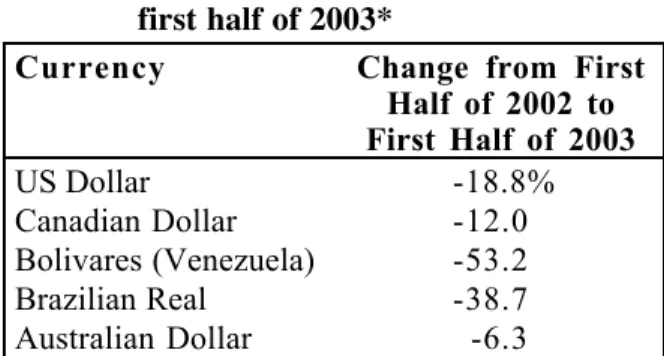
Table 4. Decline in average value of currencies of selected countries relative to the euro from first half of 2002 to first half of 2003...11
PARMALAT
W.D. Dobson* Executive Summary Introduction
• Parmalat of Italy, once one of the world’s leading dairy-food firms, filed for bankruptcy protection in December 2003. After the bankruptcy, it was discovered that fraud on a massive scale had occurred at Parmalat, putting the firm in the infamous category occupied by Enron, Tyco International, and WorldCom.
• This Discussion Paper analyzes the origins, growth, strategies, downfall, and restructuring of Parmalat, and identifies implications for the U.S. and world dairy industries and international businesses that flow from the firm’s experiences.
The Origins, Growth, and Strategies of Parmalat
• Currently headquartered in Collecchio, Italy, Parmalat grew from a small cold cuts and preserves firm founded by Calisto Tanzi in 1962 into one of the world’s largest dairy-food firms in the late 1990s and early 2000s.
• The publicly-held Parmalat had about 36,000 employees and 135 plants in its worldwide operations in mid-2003. Parmalat’s sales totaled about 7.6 billion euros (U.S.$8.0 billion) in 2002.
• Parmalat’s key strategies included the following practices during the 1980s, 1990s, and early 2000s:
— Employ debt as a major source of funding for acquisitions.
— Invest in countries with more growth potential than Western Europe. — Emphasize sales of differentiated (value-added) dairy-food products.
— In developing countries, use commodity dairy products to generate cash and provide a distribution channel. As incomes increase in these countries, push higher-valued products through the same channels.
The Downfall of Parmalat
• Complicated developments preceded Parmalat’s implosion. A shortage of short-term liquidity precipitated the firm’s collapse. It turned out that about four billion euros that were supposed to exist in a Cayman Islands’ account controlled by Parmalat did not exist. Without the cash, Parmalat’s business empire crumbled.
• Shoddy auditing practices failed to uncover Parmalat’s fraudulent behavior.
• With hindsight, it is difficult to fathom why so many bankers and investors continued to lend to, or invest in, Parmalat until shortly before its implosion.
• While Parmalat’s shares had a market value of about 2.0 billion euros (U.S.$2.5 billion) before the firm’s collapse, its actual assets totaled less than one billion euros (U.S.$1.23 billion) at the end of 2003.
*W.D. Dobson is Professor Emeritus, Department of Agricultural and Applied Economics and Agribusiness Economist for the Babcock Institute, UW-Madison.
Strategies and Practices that Exposed Parmalat to Major Risks
• Parmalat’s rapid-fire acquisition strategy made it difficult to practice suitable due diligence. • Parmalat overestimated payoffs from consolidating fragmented fluid milk industries. • The size and complexity of Parmalat made it difficult to administer.
• Parmalat engaged in brand proliferation. How Parmalat Will Be Restructured
• The restructuring plan calls for the sale of the dairy group’s non-core assets, slashing the number of Parmalat’s brands, and concentration on milk, milk-related products and fruit juice. • Operations will be narrowed to about 10 countries, including Italy, Canada, Australia, South
Africa, Spain, Portugal, Russia, and Romania.
• A new company will be set up that would convert debts owed creditors into equity shares (debt-for-equity swap). Creditors will lose more than 85% of the U.S.$17.3 billion they loaned to Parmalat over the years.
• Under an agreement entered into in the U.S., Parmalat agreed to have its board of directors elected by shareholders and for a majority of the directors to be independent of company management.
How Parmalat’s Experiences Will Shape Strategies in International Dairy Markets • Parmalat’s downfall confirms the notion that size and profitability don’t necessarily go
together.
• The company’s experience indicates that fluid milk industries in many developed countries no longer fit the classical description of fragmented industries. Thus, consolidating fragmented fluid milk industries in developed countries is not likely to represent the significant strategic opportunity that it once did.
• Parmalat’s attempts to operate diverse businesses (dairy-foods, tourism, and football) successfully underscore the difficulty of doing so.
• The firm’s success in becoming a world leader in sales of UHT milk should be recognized. Parmalat did many things correctly to expand worldwide sales of this product.
Broader Lessons for International Businesses • Parmalat’s strategies represent a useful “don’t list.”
• Shoddy auditing failed to identify Parmalat’s fraudulent behavior in a timely fashion. Changes in auditing practices are needed.
• Special Administrator for Parmalat, Enrico Bondi, has filed suit against multinational auditing firms and banks, alleging questionable practices on the part of these firms. These suits are likely to have a salutary effect on auditing and lending practices in international markets.
PARMALAT
W.D. Dobson
Parmalat of Italy, once one of the world’s leading dairy-food firms, filed for bankruptcy protection in December 2003. After the bankruptcy, it was discovered that fraud on a massive scale had occurred at Parmalat, putting the firm in the infamous category occupied by Enron, Tyco International, and WorldCom. The presence of fraud limits the strategic lessons that can be drawn from Parmalat’s experience. However, Parmalat’s experience is not devoid of strategic implications. Indeed, Parmalat did a number of things that, on the surface, at least, appeared orthodox and potentially profitable —e.g., became a world leader in production of UHT milk, engaged in orthodox product differentiation, and consolidated parts of the fragmented international fluid milk business. But Parmalat pursued practices that exposed the firm to big risks and strong competition. It is no stretch to conclude that these practices contributed to Parmalat’s bankruptcy.
This Discussion Paper analyzes the origins, growth, strategies, downfall, and restructuring of Parmalat and identifies implications for the U.S. and world dairy industries that flow from the firm’s experiences. Part of the analysis focuses on how the restructuring of Parmalat will reshape strategic thinking in the dairy industry. Finally, a few broader lessons for
international businesses that are underscored by Parmalat’s experiences are noted.
A Caveat: Certain figures reported by Parmalat in the firm’s H1 2003 Results and Strategies report are employed in the paper. These figures should be interpreted with caution. However, the figures supplied by Parmalat on the firm’s plant numbers and closely related information for various countries probably are accurate since other, non-company, sources provide documentation for these figures. Data on the identity of products sold and certain brand information supplied by Parmalat are also usable since the identity of the firm’s products could be transparently determined and there was little apparent incentive for Parmalat to falsify such information. Figures reported by Parmalat on gross sales are cited in the paper. It is questionable whether these figures are fully accurate since Parmalat could have inflated them to pump up profits and assets reported by the firm. However, the sales figures probably are useful for providing general approximations of the firm’s sales. No figures for the period prior to December 2003 taken from Parmalat’s balance sheet and profit and loss statement are included in the study since these are the subject of fraud investigations.
Currently headquartered in Collecchio, Italy, Parmalat grew from a small cold cuts and preserves firm founded by Calisto Tanzi in 1962 into one of the world’s largest dairy-food firms in the late 1990s and early 2000s. The publicly-held firm had about 36,000 employees and about 135 plants in its worldwide operations in mid-2003. Parmalat’s sales totaled about 7.6 billion euros (U.S.$8.0 billion) in 2002 [28]. Products produced by the firm included items from 25 product categories sold through the firm’s milk, fresh products, vegetable, and bakery and other products divisions.
Parmalat became a world leader in UHT milk sales. UHT milk was Parmalat’s strongest branded product and accounted for about 90% of the firm’s milk sales in the late 1990s and early 2000s [9]. This product, which has a shelf life of about six months in an unopened container, represented the bulk of the firm’s sales in South America and half the company’s sales in Europe. Parmalat’s sales of UHT milk in developing countries were fostered in part by the following developments:
• Governments in developing countries promoted consumption of UHT milk as a safe alternative to poor quality tap water. • Government programs to combat
malnutrition included UHT milk.
• The longer shelf life and no refrigeration costs led retailers to prefer to carry shelf-stable UHT milk rather than regular pasteurized milk.
Reflecting an aggressive acquisition strategy, Parmalat expanded its presence from six countries to 31 countries during the 1990s. According to Parmalat’s Results and Strategies Report, the company recorded about an 11-fold increase in sales from 1990 to 2002—mainly through acquisitions [28]. Primarily through those acquisitions, the company established a major presence in Brazil and also acquired plants in a host of countries around the world. Countries in which Parmalat operated plants in mid-2003 appear in Table 1. Parmalat’s employment figures reveal the importance of the firm as an employer in South America. Over 40% of the firm’s employees worked at Parmalat’s 32 South American plants (Table 1).
The firm’s Brazilian plants accounted for a substantial share of the South American employees. Prior to the implosion, Parmalat-Brazil employed about 6,000 people in the firm’s nine plants [21]. The nine plants purchased milk from 10,000 farmers, recorded sales of U.S.$600 million per year, and were second only to Nestle-Brazil in sales.
I . The Origins, Growth, and Strategies of Parmalat
Table 1. Parmalat’s number of plants and employees by geographic area, June 30, 2003*
Geographic Area Number of
Plants % Number ofEmployees %
Europe: France, Germany, Italy, Portugal, United Kingdom, Romania, Russia, Spain and Hungary
43 32.0 7,907 22.0
North and Central America: Canada, Cuba, Mexico, Nicaragua, Dominican Republic, and U.S.
38 28.0 7,315 21.0
South America: Argentina, Brazil, Chile, Colombia, Ecuador, Paraguay, Uruguay and Venezuela
32 24.0 15,434 43.0
Rest of World: Australia, Botswana, China, Mozambique, South Africa, Swaziland, Zambia, and Thailand
22 16.0 4,957 14.0
Total 135 100.0% 35,613 100.0%
Parmalat
Parmalat’s acquisitions were expected to decline in the early 2000s while the firm focused on integrating new businesses into the company and paring operating costs. There was a lull in acquisitions for the first three quarters of 2000 but Parmalat closed the year with five acquisitions in the final quarter [40]. Parmalat’s Chairman renewed speculation that the acquisitions were largely over with the following comment that appeared in the firm’s H1 2003 Results and Strategies Report [28]:
Parmalat considers that the phase of rapid expansion is substantially completed. The focus is now on consolidation, maximizing value of the expansion.
It is uncertain whether an era of consolidation was actually underway at Parmalat in mid-2003 since the firm imploded before it could be determined whether this was a new direction for the company.
The percentage of Parmalat’s sales by geographic area and product division for the first half of 2003 appear in Table 2. The figures in Table 2 are, for the most part, not surprising. However, it is perhaps surprising that a third of Parmalat’s sales were made in North and Central America. While this figure needs to be interpreted with caution for reasons noted earlier, it undoubtedly reflects, among other things, the importance of Parmalat as a player in Canada.
Parmalat’s key strategies for its dairy and other food businesses included the following practices during the 1980s, 1990s, and early 2000s [9]:
• Employ debt as a major source of funding for acquisitions. Among other things, this allowed the Tanzi family to retain 51% or more of the control of the company. • Invest in countries with more growth
potential than Western Europe.
• Transform the firm from a commodity food company into a nutrition company, offering functional foods that have specific health benefits.
• Expand the firm’s R&D capability to support the increased sales of functional foods and other differentiated products. • In developing countries, use commodity
dairy products to generate cash and provide a distribution channel. As incomes increase in these countries, push higher-valued products through the same channels, build brand awareness for the firm’s products, and ultimately introduce a range of value-added products.
With notable exceptions, Parmalat’s strategies relating to dairy products and their pattern of evolution are familiar. For example, Parmalat’s efforts to expand sales of differentiated products and develop the R&D capacity to support product differentiation are familiar strategies employed by big U.S., European, and Australasian firms. The final strategy in the list is broadly similar to a generic (and successful) strategy used by Nestle for expanding developing country food product sales in response to changes in incomes in developing countries.
Table 2. Parmalat’s group sales by geographical area and product division, June 30, 2003*
Geographic Area % Product Division %
Europe 38.5 Milk 57.1
North and Central America 33.2 Fresh Products 23.0
South America 18.4 Vegetable 9.5
Rest of World 9.9 Bakery and Other 10.4
Total 100.0% 100.0%
*Source: Parmalat’s H1 Results and Strategies Report [28]. Percentage figures represent percentages of total sales of 3.426 billion Euros (U.S.$3.9 billion) for the half year ending June 30, 2003. The Fresh Products Division in Table 2 markets yogurt, desserts, cheeses, margarine, and butter.
As discussed later, the notable exceptions relate to Parmalat’s use of debt and product differentiation. These exceptions might be regarded as orthodox practices. Heavy use of debt as a major source of funding for acquisitions is not an unusual strategy. For example, the successful Kerry Group of Ireland has made extensive use of debt for its
many successful acquisitions during recent decades. It also was not unusual for Parmalat to pursue expanded sales of differentiated products—especially branded products. However, the manner in which these strategies were pursued by Parmalat produced risk and generated problems for the firm.
Parmalat
Parmalat’s Deceptions
As was the case at Enron, Tyco International, WorldCom and other firms involved in corporate corruption in recent years, the implosion of Parmalat turned out to be a complicated matter. The full range of developments that led to Parmalat’s bankruptcy has yet to be uncovered. An article appearing in the Economist in early January 2004 described the complex financial problems that were unearthed at Parmalat immediately before the firm’s bankruptcy in December 2003, as follows[13]:
When Enrico Bondi, a turnaround expert, arrived at Parmalat in mid-December, 2003, he thought his job was merely to help restructure the finances of Italy’s biggest dairy group. Within days, however, events moved faster than even the shrewd Mr. Bondi can have predicted. First, Calisto Tanzi, Parmalat’s founder and boss…was ousted in a brutal show of strength by the company’s main banks. Then Mr. Bondi began to uncover the truth behind Parmalat’s strange balance sheet, and a bad story got much worse.
The immediate problem at the company had been one of short-term liquidity. As a regular user of bond markets, Parmalat had been criticized as being inefficient for its habit of carrying large debts that were supposedly offset by big cash holdings. Suddenly in December 2003, it struggled to redeem a 150 million eurobond (U.S.$180 million), despite apparently having already bought back much of the issue. Financial markets wondered why the redemption was a problem for the group with more than 4 billion euros of reported cash and short-term assets. Investors then panicked when Parmalat admitted that it had been unable to release almost 500 million euros trapped in a mutual fund in the Cayman Islands.
It turned out that the four billion euros that were supposed to exist in the Cayman Islands account were fabricated through an elaborate hoax. At the heart of the scandal was a letter, supposedly written by a Bank of America official, in which the official confirmed that Bonlat, a Parmalat subsidiary based in the Cayman Islands, had deposits of
about 4.4 billion euros (U.S.$5.5 billion) with the bank. In mid-December 2003 the Bank of America said that the document had been forged. The cash simply did not exist. Without the cash, Parmalat’s business empire crumbled.
How could the forged letter escape the notice of auditors since standard practice is for auditors to write independently to banks for confirmation of cash balances? Grant Thornton, one of Parmalat’s auditors, relied on Parmalat’s internal mail to deliver the letter confirming the amount of money in the Cayman Island fund. This was a lapse in procedure that allowed Parmalat to perpetuate the fraud.
The Economist reports that Parmalat used additional documents to support the fraudulent claims of funds in the Bonlat account in the Cayman Islands, as follows [13]:
…Investigation magistrates claim that four times a year Parmalat was using a crude, but effective, system for forging documents that purported to show big cash balances within Bonlat. The balance sheets of the subsidiaries were simply adjusted to make sense of the group’s overall financial position, and then reported to the center as audited numbers.
This was not the full extent of Parmalat’s deceptions. In July 2004, prosecutors in Milan, Italy were seeking to indict Calisto Tanzi and other Parmalat officials for manipulating the Milan stock market. In brief, it was charged that the manipulation occurred as follows [25]:
Shares of the Italian food company surged 17 percent on December 20, 1999, after Parmalat issued a press release valuing its main Brazilian unit at about U.S.$1.35 billion, or more than two-thirds of Parmalat’s total market worth at the time. What investors did not know was that the appraisal came from a report by accountant Deloitte Touche Tohmatsu dated July 23, 1998—17 months earlier and six months before Brazil devalued the real, letting it drop 40 percent against the U.S. dollar.
Why was it so difficult for lenders and other financial institutions to discover the fraudulent behavior that was taking place at Parmalat? Parmalat used elaborate bond and derivatives deals, often using complex offshore structures that involved some of its many subsidiaries. This made it difficult for bankers and investors alike to understand the firm’s complex balance sheet or to gauge the true extent of Parmalat’s liabilities [12]. However, more than a year before the meltdown at Parmalat one financial firm, Merrill Lynch, did report that it could not understand the need for Parmalat’s opaque finances and advised investors to sell shares in the firm. Equipped with hindsight, it is difficult to fathom why so many bankers and investors continued to lend to, or invest in, Parmalat until shortly before the firm’s meltdown.
Enrico Bondi was appointed by the Italian government to the position of special administrator to run and restructure the insolvent Parmalat. Bondi’s investigations— not surprisingly—have shown that Parmalat’s liabilities were much greater than shown on the company’s balance sheet at the time it imploded.
Where Did All the Money Go?
Bondi’s investigations have provided a partial answer to the question that bankers
and investors have asked, namely, “Where did all the money go?”
The so-called money trail identified by Bondi that appears in Table 3 contains items that are not surprising and elements that only a detailed investigation could reveal. The big item (3.8 billion euros) for acquisitions is perhaps not surprising given the acquisition spree that Parmalat pursued in recent decades. Large outlays for interest payments and fees related to bank debts and interest payments for fees related to bonds also might be expected given the heavy use that Parmalat made of debt. Moreover, borrowing to service debts incurred in the past increased these figures.
The amount of money siphoned off from the company represents a relatively large figure. A Wall Street Journal report indicates that Enrico Bondi and Italian prosecutors believe that nearly 500 million euros were diverted to Parmatour, a travel company run by Calisto Tanzi’s daughter, Francesca [18]. Other smaller expenditures were channeled to other companies with linkages to the Tanzi family.
Bondi’s report shows that, while Parmalat’s shares had a market value of more than two billion euros (U.S.$2.5 billion) before the company’s collapse, its actual assets totaled less than one billion euros (U.S.$1.23 billion) at the end of 2003 [18].
Table 3. Partial accounting for expenditures that produced 14.2 billion euros of debt for Parmalat*
Item Expenditure
(Billion Euros) Percent of Total
Acquisitions 3.8 26.8%
Interest Payments and Fees Related to Bank Debt 2.8 19.7
Interest Payments and Fees Related to Bonds 2.5 17.6
Siphoned Off from the Company 2.3 16.2
Losses at Operating Units 1.6 11.3
Taxes 0.9 6.3
Dividends 0.3 2.1
Totals 14.2 100.0%
Parmalat
There is no way to identify precisely the strategies and practices in Parmalat’s far-flung businesses that created losses at operating units and produced incentives for fraudulent behavior by the firm. However, as noted below certain strategies pursued by the firm carry inherent risk and created difficult financial problems for the firm.
Parmalat’s Rapid-Fire Acquisition Strategy
The speed with which Parmalat made acquisitions—e.g., recall that five dairy firms were acquired in the last quarter of 2000 alone--probably precluded the firm from carrying out suitable due diligence. Business analysts, Cullinan, Le Roux, and Weddigen, indicate that successful acquirers address the following questions as part of the due diligence process [8]:
• What is the firm really buying? Successful acquirers test a deal’s strategic logic. They typically organize their investigations around the four C’s of competition: Customers, competitors, costs, and capabilities.
• What is the target’s stand-alone value? There are many accounting tricks that a target firm can pull. Often the only way to uncover the tricks is to send a due diligence team into the field to see what is really happening with costs and sales. Tricks and hidden treasures can be uncovered by such investigations.
Successful acquirers frequently will walk away from a target whose management is uncooperative in due diligence.
• What are the synergies and skeletons associated with the target firm?
• What is the walk away price? The walk away price should never include the full value of the synergies.
While Parmalat may have conducted detailed due diligence of the type required to address these questions, it is doubtful that the firm did. Such a due diligence procedure would have been particularly time-consuming and difficult in the many foreign markets
where Parmalat acquired dairy and other food firms. The rapid acquisitions burdened the firm with a heavy debt load and the associated interest costs noted in Table 3.
Parmalat Overestimated Payoffs from Consolidating Fragmented Businesses
Parmalat has prided itself on making important strides toward consolidating the fragmented international fluid milk business but the firm may have encountered nasty surprises in recent years. Why might negative surprises have arisen for the company?
Parmalat might have accepted standard arguments about benefits from consolidating a fragmented industry of the type advanced by Michael Porter of Harvard’s Business School. Porter defines a fragmented industry as one where no firm has a significant market share and no firm has the market power to shape industry events [31]. He adds that fragmented industries are commonly found in agriculture in many countries.
Porter elaborates, noting that the following characteristics tend to make an industry fragmented [31, p.196]:
• Low entry barriers.
• Absence of economies of scale or experience curve.
• High transportation costs.
• High inventory costs or erratic sales fluctuations.
• No advantage of size in dealing with buyers or suppliers.
• Diseconomies of scale in some important respect.
• Diverse market needs. • Exit barriers.
Porter points out that an important payoff from consolidating a fragmented industry is as follows [31, p.200]:
Overcoming fragmentation can be a very significant strategic opportunity. The payoff to consolidating a fragmented
industry can be high because the costs of entry into it are by definition low, and there tend to be small and relatively weak competitors who offer little threat of retaliation.
The points and quote from Porter represent generally accepted ideas about fragmented industries. However, several of the points and the quote fail to describe the fluid milk businesses of many countries.
Competition for the fluid milk business —particularly the most desirable business —in many countries is rigorous. Thus, Parmalat faced competition from multi-nationals such as Nestle, Unilever, Kraft, Fonterra, and other financially-strong firms in both developing and industrialized countries.
Entry barriers may not be particularly low in the international fluid milk business since entry frequently must be secured by purchasing existing firms. This method of entry—which was pursued with vigor by Parmalat—reduces the need for a firm to cut prices to gain market share but it is also a capital intensive way to acquire business. This contributed to placing a heavy financial burden on Parmalat.
Economies of scale and transportation costs will vary by country. In countries such as the U.S., Canada, Australia, and Western Europe, economies of scale in fluid milk processing are substantial since it has become feasible to ship fluid milk processed at large plants long distances efficiently on modern highways. In developing countries, lack of scale economies and high transportation costs may still contribute to industry fragmentation.
In developed countries, there are significant advantages of size in dealing with suppliers and buyers. In the U.S., for example, milk cooperatives and buyers such as Wal-Mart have become large and powerful. Large processors are better able to negotiate successfully with such suppliers and customers.
Parmalat noted in the firm’s Results and Strategies Report for mid-2003 that the “U.S. is the largest milk market in the world and still fragmented [28].” This comment
could be interpreted to mean that Parmalat thought that the U.S. market was still an inviting target for acquisitions and consolidation. If so, Parmalat appears to have overstated the advantages of further reducing fragmentation in the U.S. market. For one thing, many of the most attractive, available fluid milk businesses already have been acquired by Dean Foods.
Parmalat’s experience suggests that capitalizing on fragmentation—particularly if it involves acquiring fluid milk plants with borrowed capital—can be risky. Indeed, reducing fragmentation in fluid milk businesses may no longer represent “a very significant strategic opportunity” in many countries.
The Size and Complexity of the Firm Made it Difficult to Administer
A business with about 135 plants and 36,000 workers in 31 countries obviously is complex to administer. Moreover, there is little evidence in the management literature that Parmalat developed business systems for administering its far-flung business empire that were as sophisticated and effective as those used by competitors such as Nestle, Unilever, and Fonterra.
Problems experienced by Parmalat were accentuated by the fact that a sizable number of its plants were located in countries where economic instability is common. For example, Brazil and Argentina experienced severe economic recessions in the early 2000s, which reduced Parmalat’s earnings in those countries. Moreover, devaluation of the currencies of the two countries made the earnings that were recorded there less valuable when converted to euros.
Problems with exchange rates were not confined to Brazil and Argentina. Parmalat reported the changes noted in Table 4 in average exchange rates for the euro vs. other major currencies of the countries where the firm did business. It claimed that exchange rate factors accounted for about a 15% decline in the value of the firm’s total sales (expressed in euros) for the first half of 2003 compared to the comparable period a year
Parmalat
earlier [28]. The reported decline in the value of the currencies relative to the euro appears to be correct. However, because of the fraudulent reporting of the firm’s financial results it is unclear whether the 15% figure can be relied upon. However, exchange rate developments undoubtedly depressed the firm’s sales reported in euros for 2003. Table 4. Decline in average value of
curren-cies of selected countries relative to the euro from first half of 2002 to first half of 2003*
Currency Change from First Half of 2002 to First Half of 2003 US Dollar -18.8% Canadian Dollar -12.0 Bolivares (Venezuela) -53.2 Brazilian Real -38.7 Australian Dollar -6.3
*Source: Parmalat’s H1 2003 Results & Strategies [28]. Parmalat was also involved in other enterprises unrelated to the dairy-food business, including tourism (Parmatour), professional soccer (Parma Football Club), and Odeon TV. There was some siphoning off of funds and cross-subsidization of these other businesses with funds earned in the dairy-food business.
As noted earlier, the complexity of Parmalat’s operations carried the dubious advantage of allowing the firm to fraudulently conceal weaknesses in the firm’s financial statements. However, this ability tempted the firm to pursue practices that led to its implosion.
Proliferation of Brands
While proliferation of brands was not one of Parmalat’s greatest weaknesses, brand proliferation probably created problems for the firm. Prior to the implosion, Parmalat had some 120 brands for its milk, fresh products, vegetables and bakery products. Familiar international brands included Parmalat (UHT milk), Santal (fruit juice products), Mr. Day (muffins), and GriSbi (cookies). In the U.S. and Canada, the firm’s brands included Parmalat milk, Astro yogurt, Esker water, and Archway cookies.
International marketing authority, Nirmalya Kumar, contends that many companies engage in brand proliferation and accumulate many losing or marginally profitable brands [20]. His research shows that businesses earn almost all their profits from a small number of brands—fewer than the 80/20 rule suggests. He supports his argument with the following findings regarding the brand portfolios of food companies, Nestle and Unilever [20, p.2]:
Nestle marketed more than 8,000 brands in 190 countries in 1996. Around 55 of them were global brands, 140-odd were regional brands, and the remaining 7,800 or so were local brands. The bulk of the company’s profits came from around 200 brands, or 2.5% of the portfolio…
Unilever had 1,600 brands in its portfolio in 1999, when it did business in some 150 countries. More than 90% of its profits came from 400 brands. Most of the other 1,200 brands made losses or, at best, marginal profits.
It is noteworthy that Unilever has recently pared its brands to about 400 in an effort to bolster the company’s profitability.
While Parmalat did not develop the massive brand portfolio of a Nestle or Unilever, it did accumulate some 120 brands for a much smaller product line than possessed by these huge multinationals. Some of Parmalat’s brands—especially the UHT milk brands—provided useful product differentiation. However, Enrico Bondi’s restructuring plan for Parmalat suggests that brand proliferation was a problem. Bondi plans to slash the number of the group’s brands from 120 to 30 and concentrate on fruit juice, milk, and milk-related products [17].
What is one to make of the risky strategies undertaken by Parmalat? Clearly there is no proof that any one of these strategies pushed Parmalat into bankruptcy. However, as a package, the strategies probably contributed significantly to the financial problems, and ultimate bankruptcy, of Parmalat.
Main Elements of Restructuring Plan Special Administrator, Enrico Bondi, unveiled a plan for restructuring Parmalat in July 2004. Bondi’s plan has the approval of the Italian government. Under the restruct-uring plan, Parmalat’s creditors will submit claims for reimbursement (or partial reim-bursement) from the insolvent firm. Initially, hearings will be held to determine the validity of the claims. In certain cases where disagree-ments arise about the eligibility of creditors for reimbursement, the validity of the claims will be settled by the courts.
Main elements of the restructuring plan are as follows:
• The plan calls for the sale of the dairy group’s non-core assets, slashing the number of brands to the extent noted earlier, and concentration on fruit juice, milk, and milk-related products [17]. • Early in the restructuring process
Parmalat indicated that it would narrow its key operations to about 10 countries as it tried to repair its balance sheet. Countries where Parmalat apparently would try to maintain operations include Italy, Canada, Australia, South Africa, Spain, Portugal, Russia, and Romania [2].
• A new company would be set up that would convert debts owed to creditors into equity shares (debt-for-equity swap). Selected creditors would be paid in full, including suppliers and investors who loaned the company money after it went into bankruptcy [24].
• Creditors will lose more than 85% of the U.S.$17.3 billion they loaned to Parmalat over the years. They will receive shares and up to 500 warrants that may be exchanged for future shares in the restructured company that will have a value equal to about 11% of their original investment [11].
• Under the reimbursement plan, Parmalat creditors will hold a 47.9% stake in the new company, which initially will be controlled by a foundation. By agreeing to renounce their debt, subordinated
creditors—those who have little chance of securing full reimbursement—will receive shares in the new company in proportion to their exposure to Parmalat [4].
• The company that emerges from the restructuring of the bankrupt food group will distribute 50% of its profits in dividends over a 15-year period [4]. • Under an agreement entered into in the
U.S., Parmalat agreed to have its board of directors elected by shareholders and for a majority of directors to be independent of company management. The positions of chairman and chief executive officer also will be split as part of the agreement. These concessions were agreed to in order to avoid fines sought by the U.S. Securi-ties and Exchange Commission. The agreement is subject to approval by the federal court in Manhattan, New York [7]. Parmalat Canada Ltd.
A development that will help with the Canadian aspect of the restructuring is the financial contribution made by Ontario Teachers Pension Plan Board. Ontario Teachers have injected CA$610 million into the Canadian arm of Parmalat Finanziaria SpA to refinance 100% of the dairy company’s debts. Toronto-based Parmalat Canada Ltd—which is fully owned by its Italian parent but independently operated and financed—said that the money will be used to repay debts [2].
The actions by Ontario Teachers are not surprising given the organization’s interest in acquiring Parmalat Canada. Ontario Teachers began talks to purchase the Canadian unit of Parmalat in September 2003 but the talks fell apart when the accounting scandal emerged [2].
Mr. J. Leach, a Senior Vice President of Ontario Teachers, defended the financial infusion, saying that Parmalat Canada is a profitable company with strong prospects. With respect to the CA$610 capital infusion, Leach claimed that, “There is a ringed fence around it, there is no money (from this IV. How Parmalat will be Restructured
Parmalat
refinancing) leaked out to Italy (emphasis supplied) [2].” It may be that there is a fence around the money, but in the messy business of restructuring after a corporate bankruptcy, few things are fully certain.
Parmalat Australia
Parmalat Australia represents a part of Parmalat that is likely to be a viable part of the slimmed down, restructured organization. A June 2004 report indicated that Parmalat’s Australia Group generated positive cash flows from operating activities (after interest and taxes) of AU$23 million [29]. Parmalat Australia’s Managing Director, David Lord, said that Parmalat Australia is already structured to drive the strategy of the restructured group, since the Australian unit focuses on milk, milk-related products, and fruit juices. Moreover, the sale or shutdown of the Thai, Vietnamese, and Indonesian components of Parmalat is likely to mean that the firm’s Australian component will be a platform for exports of dairy products to customers in these three countries.
The Partial Dismemberment of Parmalat
As noted earlier, Parmalat will sell off a number of operations in hopes of becoming a slimmer, profitable company. A partial listing of plant operations that have been sold, put up for sale, or wound down by Parmalat appears below. (Companies put up for sale or wound down are identified in the list. Other companies listed have been sold.)
• Milk Products of Alabama, U.S.A. (Part of Parmalat’s Farmland Dairies) [38]. • Kinnet Dairy, U.S.A. (Parmalat’s
southern U.S. ice cream distributor) [2]. • Parmalat, Thailand [16].
• Parmalat, Vietnam [16].
• Parmalat, Indonesia (Being wound down) [16].
• Parmalat UK [22].
• Parmalat’s Inbal, Brazil Tomato Processing Plant (Reversed the acquisition of this small tomato processing plant from Unilever) [30]. • Parmalat (Tianjin) Dairy Co. Ltd and
Parmalat (Nanjing) Dairy Co. Ltd, China (Operations suspended) [5].
• Parmalat, Mexico [19].
• Streglio, Parmalat’s chocolate maker (Put up for sale) [17].
• Parmatour (A portion of this tourism firm has been put up for sale) [17].
This list of firms, compiled in August 2004, is certain to be an incomplete list. Enrico Bondi has indicated that the firm will dispose of portions of its South American, U.S. and Asian holdings in order to develop a smaller, more profitable company. Parmalat’s Brazilian operations, in particular, represent a potentially large group of firms that likely will be placed on the market. Thus, the financial news can be expected to show many additional sales announcements as suitable buyers are found.
It is too early to fully assess how Parmalat’s experiences will shape strategies in international dairy markets. However, the firm’s experiences provide a few insights on strategies that are likely to be successful and strategies that may no longer work effectively. Competitors probably envied Parmalat’s meteoric growth during the 1990s and early 2000s. The fact that Parmalat’s growth was obtained fraudulently will cause businesses to remember the old addage that, “If it looks too good to be true, it probably is.” Parmalat’s performance probably should have been recognized earlier as being too good to be true given the risky strategies that the firm pursued.
Parmalat’s downfall confirms the notion that size and profitability don’t necessarily go together. Parmalat was undoubtedly a complex firm to manage, especially given the large number of countries in which the firm operated. Moreover, there is little evidence in the management literature that Parmalat had a suitable system for managing its sprawling operations. Multinationals such as Parmalat probably need sophisticated management systems of the type developed by Nestle and Unilever over the decades to operate successfully in risky international dairy markets.
The difficulties that Parmalat experienced in consolidating fragmented fluid milk businesses throughout the world should be carefully noted. Fluid milk industries in many developed countries no longer fit the classical description of fragmented industries, and consolidating these industries is not likely to represent a significant strategic opportunity. In the U.S., for example, many of the desirable acquisitions have already been made by Dean Foods. Secondly, conditions have developed favoring economies of scale in processing and
distribution in fluid milk businesses. Finally, market share and the ability to shape developments in the industry have become valued attributes possessed by many processors. The lack of fragmentation in its classic form in many developed countries means that acquisitions must be made using formulas suitable for industries where market power prevails.
Fragmentation undoubtedly still exists in fluid milk industries in many developing countries. Firms seeking to gain from elimination of fragmentation may still find profitable opportunities in these countries. However, a premium will be placed on doing careful due diligence before acquiring dairy plants in these countries. For reasons noted earlier, conducting suitable due diligence is not an easy task in such countries.
Parmalat’s attempt to operate diverse businesses (dairy-foods, tourism, football) successfully underscores the difficulty of doing so. In particular, the skills needed to run a dairy-food business successfully are not the same as those needed to run a tourism business profitably. This, of course, is not a revelation. Many firms learned this lesson the hard way in the 1960s and 1970s. But in Parmalat’s case it led to siphoning off of funds from the dairy-food business, cross subsidization, and fraud.
Parmalat’s success in becoming a world leader in sales of UHT milk should be recognized. The company did many things correctly in expanding worldwide sales of this product. While Parmalat probably engaged in excessive proliferation of brands, its efforts to develop differentiated products appear to be much like those of other leading international dairy firms. The firm’s efforts toward product differentiation—in a business where commodities are common—appeared satisfactory.
V . How Parmalat’s Experiences Will Shape Strategies in International Dairy Markets
Parmalat
A key lesson from Parmalat’s experiences, one supposes, is that owners and managers should avoid putting themselves in positions that create incentives for fraudulent behavior. Thus, certain business practices and strategies pursued by Parmalat represent a useful “don’t list.” Legal actions taken by Enrico Bondi also identify broader lessons.
Mr. Eugene Flegm, the former auditor of General Motors Corporation, said that a number of factors, including those noted below, created conditions for a “perfect storm” in which the scandals of the past three years—one of which involved Parmalat— were nearly inevitable [1]:
A lack of business ethics, a congressional misunderstanding of the role of the Securities and Exchange Commission (in the U.S.), pressure from company boards of directors and poor internal controls all contributed to a bad environment.
While some of these factors were involved in Parmalat’s bankruptcy and associated fraud, a more important factor is probably the poor quality of auditing for the firm. Auditing is frequently regarded as “grunt work” that is assigned to junior members of an auditing firm. Whether this was the case at Parmalat is unclear. However, the quality of the audits appears unquestionably poor. Indeed, Mr. Enrico Bondi has brought suit against one the auditing firms that allegedly allowed fraudulent behavior to continue at Parmalat.
Bondi’s lawsuits seek damages from firms that allegedly engaged in unlawful or
negligent behavior for auditing or financing of Parmalat (Table 5). Bondi’s charges against Parmalat’s auditors are noteworthy [35].
Parmalat argues that firms in the global networks of Deloitte Touche Tohmatsu, whose Italian affiliate was Parmalat’s primary auditor from 1999 until its collapse in December 2003, and Grant Thornton International, whose Italian arm audited select Parmalat businesses during the same period failed to perform proper audits, and in some cases actively took part in ‘looting’ of the company. The suit also claims that that Deloitte ‘ignored repeated clear warnings from member firms around the world of wholly unsubstantiated transactions [at Parmalat] that bore the hallmarks of fraud.’
Deloitte Touche Tomatsu said that Parmalat’s action is unjustified and that the firm will defend itself against the charge. The auditor said it is being sued on the theory that it failed to catch Parmalat for its own fraudulent actions. Parmalat could possibly claim that it was given defective service. But that may be a hard sell since Parmalat’s former managers are alleged to have masterminded the fraud [35].
An important side issue is involved in this case. Parmalat’s suit alleges that responsibility for audit-related problems at the company should rest with the global accounting organization, not just the Italian affiliates. The Wall Street Journal describes why international auditing firms currently are organized to prevent the sort of responsibility that Parmalat desires, as follows [35]:
VI. Broader Lessons for International Businesses
Table 5. Lawsuits filed against firms that had dealings with Parmalat*
Target Country Where Suit
was Filed Amount Sought
Bank of America US US$10 Billion
Citigroup US US$10 Billion
UBS Italy 290 Million Euros
Deutsche Bank Italy 17 Million Euros
Credit Suisse First Boston Italy 248 Million Euros
Various Arms of Deloitte Touche Tohmatsu
and Grant Thornton Int’l. US US$10 Billion
Accounting firms such as Deloitte and Grant Thornton are typically structured so that each country operation within their global network is an individual business, usually a limited-liability partnership, that doesn’t share legal ties with other businesses within the group. Such structures are designed in part to prevent auditors, usually seen as deep-pocket defendants in corporate collapses, from collectively sharing the financial burden of lawsuits related to audit work done by other firms within the group.
If Bondi (Parmalat) should be victorious in this suit, it presumably would have important implications for multinational accounting firms. The deep pockets of the parent accounting and auditing firms could become more readily accessible to plaintiffs in corporate bankruptcy cases.
The lawsuits brought by Bondi against banks are complex and beyond the scope of this paper. Thus, only brief summary points regarding the charges made against the banks appear below [32,33,34, 35]:
• Bank of America: Bondi’s suit, filed in a North Carolina court, seeks up to $10 billion from Bank of America. The suit charges that Bank of America continually induced Parmalat to incur more debt in order to fuel Bank of America’s demand for fees and additional interest payments, and to hide Parmalat’s true financial condition.
• Citigroup: Bondi’s suit, filed in a New Jersey state court, seeks $10 billion from from Citigroup. He claims a series of
transactions the bank arranged for Parmalat were designed to help its managers disguise the firm’s perilous financial condition.
• UBS: Bondi is seeking to recoup 290 million euros he claims UBS received when Parmalat in December 2003 defaulted on its debt. Bondi alleges that the bank’s actions essentially put it ahead of other creditors by improperly ensuring that it would get money back from the transaction if Parmalat defaulted. • Credit Suisse First Boston: The suit
alleges that CSFB, a unit of Switzerland’s Credit Suisse Group, in 2002 arranged a complex transaction for a Parmalat subsidiary in Brazil that effectively allowed the parent firm to disguise the true level of its debts.
• Deutsche Bank: Bondi is expected to claim that by arranging debt issues during the second half of 2003, Deutsche Bank helped worsen the condition that led to Parmalat’s insolvency.
Bank of America, Citigroup, UBS, Deutsche Bank and Credit Suisse First Boston will vigorously defend themselves against the claims raised by Bondi for Parmalat. It is not useful to speculate about the outcome of these lawsuits. However, even if not fully successful, the suits might have a beneficial effect on lending practices of banks to multinationals. The lawsuits should make the banks more cautious about lending to firms with opaque financial statements.
Parmalat
REFERENCES
1. Accounting.smartpros.com, “Accountants strive to learn lessons from recent business scandals,” August 6, 2004.
2. Bloom, R., “Teachers gives Parmalat Canada $610-million cash,” theglobeandmail.com, July 13, 2004 and quote.bloomberg.com,“Parmalat Gets CA$610 million from Canadian Pension Plan (Update 3),” August 7, 2004.
3. Caymannetnews.com, “Parmalat administrator says Bank of America was fully aware of financial distress,” April 5, 2004.
4. Channelnewsasia.com, “Parmalat takes first step to paying off its debts,” July 27, 2004. 5. Chinadaily.com, “Parmalat’s Chinese plants stop production,” August 7, 2004.
6. CNN.com/2003/BUSINESS, “NatFoods eyes Parmalat’s Australia firm,” December 11, 2003.
7. CNN.com.international, “Reformed Parmalat spared U.S. fine,” July 29, 2004. 8. Cullinan, G., J.-M. LeRoux and R.-M. Weddigen, “When to walk away from a deal,”
Harvard Business Review, April 2004, pp. 96-104.
9. Dobson, W., J. Wagner, and R. Hintz, “When will U.S. firms become major dairy exporters and bigger direct investors in foreign dairy-food businesses,” Babcock Institute Discussion Paper No. 2001-3, 29 pages.
10. Dobson, W. and A. Wilcox, “How international dairy companies adjusted to changes in world dairy markets,” Babcock Institute Discussion Paper No. 2002-4, 26 pages. 11. Duprey, R., “Parmalat is Worth a Lot,”fool.com, July 19, 2004.
12. The Economist, “Corporate scandals—Déjà vu all over again?” December 20, 2003, pp. 95-96.
13. The Economist, “The crisis at Parmalat—Milking lessons,” Jan.3, 2004, pp. 45-46. 14. The Economist, “Parmalat—Beware of Bondi,”August 7, 2004, p. 62.
15. The Economist, “Parma splat,” January 17, 2004, pp. 59-61. 16. Finance.news.com.au, “Parmalat gets milk contract,”July 27, 2004. 17. Forbes.com, “Italian gov’t to approve Parmalat plan,” July 5, 2004.
18. Galloni, A. and D. Reilly, “How Parmalat spent and spent,”Wall Street Journal, July 23, 2004, pp. C1 and C4.
19. Just-food.com, “MEXICO: Parmalat Mexico to sell assets to Grupo Lala, July 19, 2004. 20. Kumar, N., “Kill a brand, keep a customer,” Harvard Business Review, December 2003,
pp. 1-10.
21. Marquez, H., “LATIN AMERICA: Embattled Parmalat still supplying milk, jobs,” ipsnews.net, January 12, 2004.
22. Moher, B., “Parmalat UK sold,”accountancyage.com, February 18, 2004. 23. Money.cnn.com, “Parmalat promises payout,” July 26, 2004.
24. News.bbc.co.uk, “Parmalat outlines turnaround plan,” June 21, 2004. 25. News.com.au, “Parmalat ‘manipulated market,’” July 9, 2004. 26. The Observer, “Parmalat dream goes sour,” January 4, 2004. 27. Oligopolywatch.com,“Oligopoly brief: Parmalat,”January 12, 2004. 28. Parmalat Group—H1 2003 results and strategies, 2003.
29. Pauls.com.au, “Parmalat Australia reports strong 2003 operating performance,” Media Release, June 7, 2004.
30. Perso.wanadoo.fr, “Parmalat’s Brazil unit to return plant to Unilever,” January 12, 2004. 31. Porter, M.E., Competitive Strategy—Techniques for Analyzing Industries and Competitors,
The Free Press, New York, 1980.
32. Reilly, D., “Parmalat’s overseer plans to sue Deutsche Bank over bond issues,” Wall Street Journal, August 9, 2004, P. A3.
33. Reilly, D. and A. Galloni, “Parmalat socks CSFB in latest suit,” Wall Street Journal, August 20, 2004, P. A6.
34. Reilly, D., A. Galloni, and C. Mollenkamp, “Parmalat sues Bank of America Corp.,” Wall Street Journal, October 8, 2004, P. A3.
35. Reilly, D. and A. Galloni, “Parmalat sues Deloitte and Grant for $10 billion,” Wall Street Journal, August 19, 2004, pp. A3 & A6.
36. Schlesinger, L., “Kroll to hunt for Parmalat assets,” accountancyage.com, February 3, 2004. 37. Schlesinger, L., “Parmalat hemorrhaging 300 million pounds a year,” accountancyage.com,
February 23, 2004.
38. TSC Staff, “Parmalat unit selling Alabama assets,”thestreet.com, July 15, 2004.
39. Wall Street Journal, “Parmalat unveils plan to reimburse its debt holders,” July 15, 2004, P. C6.
40. Zwanenberg, A., “Consolidation in the dairy industry—A new merger, acquisition or alliance every 2.5 days,” Rabobank International Industry Note: Food & Agribusiness Research Issue 017-2001, June 2001, pp. 1-4.