2020
Techniques for utilizing classification towards securing
Techniques for utilizing classification towards securing
automotive controller area network and machine learning towards
automotive controller area network and machine learning towards
the reverse engineering of CAN messages
the reverse engineering of CAN messages
Clinton YoungIowa State University
Follow this and additional works at: https://lib.dr.iastate.edu/etd
Recommended Citation Recommended Citation
Young, Clinton, "Techniques for utilizing classification towards securing automotive controller area network and machine learning towards the reverse engineering of CAN messages" (2020). Graduate Theses and Dissertations. 17927.
https://lib.dr.iastate.edu/etd/17927
This Thesis is brought to you for free and open access by the Iowa State University Capstones, Theses and Dissertations at Iowa State University Digital Repository. It has been accepted for inclusion in Graduate Theses and Dissertations by an authorized administrator of Iowa State University Digital Repository. For more information, please contact [email protected].
network and machine learning towards the reverse engineering of CAN messages
by
Clinton Young
A dissertation submitted to the graduate faculty in partial fulfillment of the requirements for the degree of
DOCTOR OF PHILOSOPHY
Major: Computer Engineering (Secure and Reliable Computing)
Program of Study Committee: Joseph Zambreno, Major Professor
Phillip Jones Yong Guan Liang Dong Gary Tuttle
The student author, whose presentation of the scholarship herein was approved by the program of study committee, is solely responsible for the content of this dissertation. The Graduate College will ensure this dissertation is globally accessible and will not permit alterations after a degree is
conferred.
Iowa State University Ames, Iowa
2020
DEDICATION
To my loving parents, Shih-Yih Ryan Young and Chih-Ming Liau. You provided your loving guidance and support during my work.
TABLE OF CONTENTS
Page
LIST OF TABLES . . . vi
LIST OF FIGURES . . . vii
ACKNOWLEDGMENTS . . . ix ABSTRACT . . . x CHAPTER 1. INTRODUCTION . . . 1 1.1 Objectives . . . 3 1.2 Contributions . . . 4 CHAPTER 2. BACKGROUND . . . 6
2.1 Controller Area Network . . . 6
2.2 CAN Messages . . . 8
2.3 Vulnerabilities of CAN . . . 9
2.3.1 Lack of Message Authentication . . . 9
2.3.2 Unsegmented Network . . . 9
2.3.3 Unencrypted Messages . . . 9
2.4 Threats and Attacks . . . 10
2.4.1 Attackers and Motivations . . . 10
CHAPTER 3. RELATED WORK . . . 14
3.1 Intrusion Detection Systems . . . 14
3.1.1 Host-based . . . 14
3.1.2 Network-based . . . 14
3.2 Intrusion Detection Methods . . . 15
3.2.1 Signature-Based . . . 15
3.2.2 Anomaly-Based . . . 15
3.3 Intrusion Detection Systems for Automotive Security . . . 16
3.3.1 Message Timing . . . 16
3.3.2 Signature-Based . . . 19
3.3.3 Anomaly-Based . . . 20
3.3.4 Other Works . . . 24
CHAPTER 4. OUR APPROACH TOWARDS AUTOMOTIVE INTRUSION DETECTION 27 4.1 Introduction . . . 27
4.3 Message Interval Evaluation . . . 29
4.4 Message Frequency Detection . . . 33
4.4.1 Vehicle Modes of Operation . . . 33
4.4.2 Message Injection Attack . . . 34
4.4.3 Frequency Analysis with Fourier Transform . . . 36
4.5 Summary . . . 39
CHAPTER 5. HYBRID AUTOMOTIVE INTRUSION DETECTION SYSTEM . . . 41
5.1 Anomaly Detector . . . 41
5.2 Signature Detector . . . 42
5.2.1 Event-based Observers . . . 42
5.2.2 Context-based Observers . . . 43
5.3 Multiple Detection Approach . . . 43
5.4 Evaluation . . . 44
5.4.1 Evaluation Setup . . . 45
5.4.2 Signature Anomaly Detection . . . 45
5.4.3 Hybrid Anomaly Detection . . . 46
5.4.4 Implementation . . . 47
5.4.5 Summary . . . 47
CHAPTER 6. MACHINE LEARNING TOWARDS REVERSE ENGINEERING CAN MES-SAGES . . . 48
6.1 Background . . . 48
6.1.1 Reverse Engineering . . . 48
6.1.2 Machine Learning . . . 49
6.2 Related Work . . . 50
6.2.1 Ground Truth Data . . . 52
6.3 Proposed Work . . . 53
6.4 Classifying Controller Area Network Messages . . . 54
6.4.1 Feature Extraction . . . 54
6.4.2 Clustering . . . 56
6.5 Reverse Engineering using Machine Learning . . . 58
6.6 Evaluation and Analysis . . . 62
6.6.1 Data . . . 62
6.6.2 Simulation . . . 63
6.6.3 Oak Ridge Real CAN Data . . . 64
6.6.4 J1939 Data . . . 67
6.7 Summary . . . 70
CHAPTER 7. MACHINE LEARNING TOWARDS AUTOMOTIVE SECURITY . . . 72
7.1 Related Work . . . 73
7.1.1 Modeling Driver Behavior . . . 73
7.1.2 Machine Learning for Automotive Intrusion Detection . . . 74
7.2 Threat Model . . . 75
7.3 Feature Engineering . . . 76
7.5 Future Work . . . 78
7.5.1 Intrusion Detection . . . 79
CHAPTER 8. CONCLUSION . . . 81
LIST OF TABLES
Page
Table 3.1 Comparison of Proposed IDSs for In-Vehicle Networks . . . 26
Table 4.1 Detection Accuracy for Single and Multiple CAN ID Injection Attacks 31
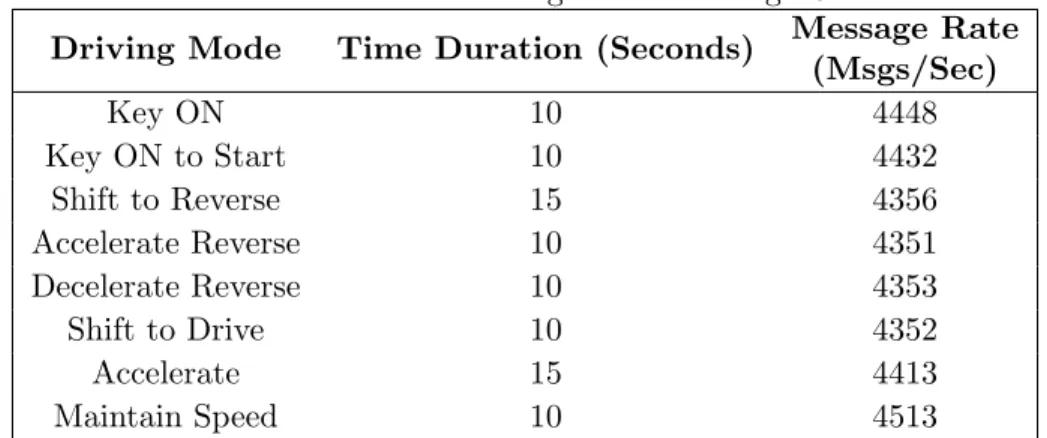
Table 4.2 Different Driving Modes Message Count . . . 34
Table 4.3 Frequency Analysis of Message Injection Attack . . . 36
Table 5.1 HAIDS . . . 47
Table 6.1 Reverse engineered CAN IDs and their corresponding vehicular function 65
Table 6.2 Reverse engineered J1939 CAN IDs and their corresponding vehicular function . . . 67
Table 6.3 Reverse engineered J1939 CAN IDs and their corresponding vehicular function, with k = 8 . . . 70
LIST OF FIGURES
Page
Figure 1.1 Automotive attack surfaces. . . 2
Figure 2.1 Standard CAN frame format. . . 8
Figure 3.1 Diagram about transmitted messages on CAN bus on (a) normal status and (b) under message injection attack. The time interval of message CAN ID 0x02 is shortened by the injection of attack messages. . . 17
Figure 4.1 Every CAN message is read and its ID captured. The time interval from current to previous message with the same ID is calculated and com-pared to the normal model timing interval for that message. If the interval time is less than normal, the IDS will indicate an anomaly and the IDS sends an alert. . . 29
Figure 4.2 Demonstrating message injection attacks affecting the timings of mes-sages. The simulated attack messages have fluctuating message timings and are shorter than normal depending on rate of injection. . . 30
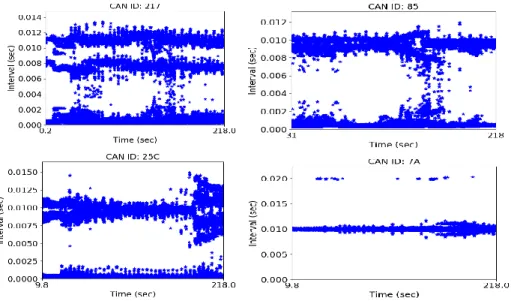
Figure 4.3 These plots depict the varying message intervals seen by multiple CAN messages. Some CAN messages show multiple distinct intervals while some vary due to changes in vehicle operations. . . 32
Figure 4.4 A comparison of the effect message injection attack has on the interval and frequency of CAN ID: 0x202. Blue is normal operation and Red is attack traffic. Left: Injection attack alters the interval of messages by shortening them. Right: It is clear when the message injection attack is occurring. The frequency doubles in rate during attacks. . . 35
Figure 4.5 Left plot depicts an ideal square wave, which is representative our converted CAN message data. The messages get transmitted at a fixed interval and have a certain transmission time represented by the duty cycle of the wave. The right plot shows the Fourier transform of the square wave. 38
Figure 4.6 On the left side there are two example plots of CAN messages with irregular timing intervals. The right side shows their respective FFT outputs 39
Figure 4.7 These plots show the change in the input signal and FFT output dur-ing a message injection attack. It can be seen as the message rate doubles, the magnitudes of the frequency peaks increase. The increase in magnitude is caused by the doubling of singles with the same frequency. . . 40
Figure 4.8 Spectrogram Plots. Left side plots normal message signal, and the right side plots a 2x message rate injection attack. . . 40
Figure 5.1 Automotive Intrusion Detection System . . . 44
Figure 6.1 Simulated distance matrix representing all distances between each CAN ID. . . 64
Figure 6.2 Dendrogram for simulated data. This figure shows how each CAN ID clustered with the other IDs. It also shows the two major groupings for the CAN IDs. . . 64
Figure 6.3 Captured raw data dendrogram, clustered the CAN IDs into 4 major groupings. . . 65
Figure 6.4 Cluster labels from Oak Ridge . . . 66
Figure 6.5 CANoe plots with 3 different yet related signals. Showing the rela-tionship between accelerator pedal and engine rpm and fuel rate. . . 69
ACKNOWLEDGMENTS
I would like to take the opportunity to thank my advisor, Dr. Joseph Zambreno, for providing the great opportunity to pursue my Ph.D. I would like to thank him for giving me the freedom to explore my ideas while providing his guidance, patience, and constructive feedback throughout this research.
I would like to thank my committee members Dr. Phillip Jones, Dr. Yong Guan, Dr. Neil Gong, Dr. Gary Tuttle, and Dr. Liang Dong for their guidance and feedback during the years of my Ph.D. I would also like to thank all the members of the Reconfigurable Computing Lab for their support and good times in the lab.
Lastly, I want to thank my parents and brother for all their support and encouragement. With-out them, all of this would not have been possible.
ABSTRACT
The vehicle industry is quickly becoming more connected and growing. This growth is due to advancements in cyber physical systems (CPSs) that enhance the safety and automation in vehicle. The modern automobile consists of more than 70 electronic control units (ECUs) that communi-cate and interact with each other over automotive bus systems. Passenger comforts, infotainment features, and connectivity continue to progress through the growth and integration of Internet-of-Things (IoT) technologies. Common networks include the Controller Area Network (CAN), Local Interconnect Network (LIN), and FlexRay. However, the benefits of increased connectivity and features comes with the penalty of increased vulnerabilities. Security is lacking in preventing at-tacks on safety-critical control systems. I will explore the state of the art methods and approaches researchers have taken to identify threats and how to address them with intrusion detection. I discuss the development of a hybrid based intrusion detection approach that combines anomaly and signature based detection methods.
Machine learning is a hot topic in security as it is a method of learning and classifying system behavior and can detect intrusions that alter normal behavior. In this paper, we discuss utilizing machine learning algorithms to assist in classifying CAN messages. I present work that focuses on the reverse engineering and classification of CAN messages. The problem is that even though CAN is standardized, the implementation may vary for different manufacturers and vehicle models. These implementations are kept secret, therefore CAN messages for every vehicle needs to be analyzed and reverse engineered in order to get information. Due to the lack of publicly available CAN specifications, attackers and researchers need to reverse engineer messages to pinpoint which messages will have the desired impact. The reverse engineering process is needed by researchers and hackers for all manufacturers and their respective vehicles to understand what the vehicle is
doing and what each CAN message means. The knowledge of the specifications of CAN messages can improve the effectiveness of security mechanisms applied to CAN.
CHAPTER 1. INTRODUCTION
The vehicle industry is quickly becoming more connected and growing. This growth is due to advancements in cyber physical systems (CPSs) that enhance the safety and automation in vehicle. The modern automobile consists of more than 70 electronic control units (ECUs) that communicate and interact with each other over automotive bus systems [8]. Passenger comforts, infotainment features, and connectivity continue to progress through the growth and integration of Internet-of-Things (IoT) technologies. Common networks include the Controller Area Network (CAN), Local Interconnect Network (LIN), and FlexRay. I focus specifically on CAN, which is the most commonly used bus system.
However, the benefits of increased connectivity and features comes with the penalty of increased vulnerabilities [99, 96], as demonstrated in Figure 1.1. Security is lacking in preventing attacks against comfort and infotainment features from compromising safety-critical control systems [9]. Cyber attacks on automotive in-vehicle networks have risen [9, 7, 97] and this has driven a need for security in vehicles. Koscher et al. [38] demonstrated the ability of malicious agents to control several vehicle operations from unlocking the doors to stopping the engine. Miller and Valasek demonstrated their ability to control a Jeep Cherokee remotely through a cellular network, leading to the recall of over a million vehicles [52].
As an communication network develop in 1983 without cybersecurity in mind, the CAN bus has become an enticing target for hackers. The CAN protocol does not have origin and destination for messages. Instead, each node in network can send and receive messages based on the pre-defined ECU configuration. As the standard in modern vehicles, CAN has become an enticing target for hackers. An adversary may physically access the On-Board Diagnostic (OBD) port standard in all modern vehicles. Or they may remotely access the vehicle through a variety of wireless or cellular
Airbag ECU
Remote Link Type App
Wi-Fi Bluetooth USB Cellular Passive Keyless Entry
TPMS RemoteKey ADAS System ECU OBD II
Lighting System ECU Steering and Braking ECU Engine and Transmission ECU Vehicle Access System ECU
Figure 1.1 Automotive attack surfaces.
connections. Thus, a major security concern is in protecting the CAN bus that facilitates the communication and interactions of ECUs.
One option to enhance the security of in-vehicle networks is to adopt intrusion detection and pre-vention techniques. Intrusion detection systems (IDS) are used to mitigate intrusions in computer network systems. However, many traditional techniques in network security cannot be directly applied to vehicular networks. The limited computational, memory, and power resources in ECUs hinder the implementation of complex security mechanisms. Thus, an effective and efficient IDS that can work for in-vehicle networks is an important need.
I will explore the state of the art methods and approaches researchers have taken to identify threats against vehicles and how to address them with IDS approaches. I discuss the development of a hybrid based intrusion detection approach that combines anomaly and signature based detection methods. I will detail the individual components of each approach and how they were developed and evaluated.
Machine learning is a hot topic in security as it is a method of learning and classifying system behavior and can detect intrusions that alter normal behavior. In this paper, I discuss utilizing machine learning algorithms to assist in classifying CAN messages. The proposed approach employs the k-means and agglomerative clustering to categorize CAN messages. The distance between CAN message IDs are used to cluster the CAN messages by relevance to each other. The machine learning algorithm, combined with previously labeled CAN IDs, classifies CAN messages. The goal is to
determine the function of unknown CAN messages using machine learning and labels. To the best of our knowledge, this is the first paper toward utilizing machine learning in reverse engineering CAN messages without access to a physical vehicle nor having a DBC file.
I present work that focuses on the reverse engineering and classification of CAN messages. The problem is that even though CAN is standardized, the implementation may vary for different manufacturers and vehicle models. These implementations are kept secret, therefore CAN messages for every vehicle needs to be analyzed and reverse engineered in order to get information. Due to the lack of publicly available CAN specifications, attackers and researchers need to reverse engineer messages to pinpoint which messages will have the desired impact. The reverse engineering process is needed by researchers and hackers for all manufacturers and their respective vehicles to understand what the vehicle is doing and what each CAN message means. The knowledge of the specifications of CAN messages can improve the effectiveness of security mechanisms applied to CAN.
1.1 Objectives
This paper aims to identify the constraints and requirements of developing intrusion detection systems for modern vehicles. Presented are findings to contribute to a deeper understanding of the challenges of implementing IDS for in-vehicle networks. The research questions that drive this research are:
• What are the considerations that need to be made in designing an IDS? • What vulnerabilities exist in vehicles and what can be done to secure them? • How can an attack be detected and how does the automotive system respond? • Can machine learning be utilized towards reverse engineer CAN messages? • What features exist in raw CAN messages and what features can be extracted?
• What metrics should be used to evaluate the success and shortcomings of our detection and classification approaches?
1.2 Contributions
There is numerous research that highlight the importance of integrating security into in-vehicle networks. However, due to the complex nature of these approaches, they cannot be easily imple-mented. To further advance vehicle security, a greater understanding is required of the vehicle traffic. Provided are the following contributions to address these issues.
• Frequency-based anomaly detector. The design and implementation of a frequency-based IDS that can identify message injection attacks using the frequencies of CAN messages to capture normal behavior and then detect violations of the normal as signs of an attack.
• HAIDS:Hybrid Automotive Intrusion Detection System. The design and implementation of an IDS that combines anomaly and signature-based detection methods for a more comprehensive detection system.
• Machine learning messages classifier. An approach towards classifying unknown controller area network messages utilizing hierarchical clustering.
This dissertation is organized as follows. Chapter 2 gives background information on the con-troller are network and its vulnerabilities. I discuss the security challenges and attacker motivations. Chapter 3 provides a comprehensive survey on intrusion detection and related work on automotive intrusion detection systems. Chapter 4 outlines the details of our approach towards automotive intrusion detection. I break down the different message timing features I examined and utilized. Chapter 5 details the hybrid automotive intrusion detection system, called HAIDS. I outline the details of the anomaly and signature based detectors for intrusion detection. Additionally, the evaluation and analysis of HAIDS is discussed. Chapter 6 delves into the CAN reverse engineering process using machine learning. This chapter provides background on reverse engineering and ma-chine learning, to help get the reader up to speed. Also, related work on novel approaches of reverse
engineering CAN and utilizing machine learning towards CAN are investigated. This chapter also details the reverse engineering process using hierarchical clustering and reports the evaluation and analysis of our message classification. Chapter 7 outlines the future work of using machine learning towards automotive security. Finally, Chapter 8 concludes the dissertation.
CHAPTER 2. BACKGROUND
In this chapter, provided are details into in-vehicle networks, their vulnerabilities, and how attackers are exploiting these openings.
A network is a system of interconnected devices where information is shared. While a standard local area network consists of a group of computers, printers, and other devices,communicating and sharing resources with each other, an in-vehicle network consists of several control units. These control units include engine control systems, transmission control systems, electronic control systems. These units communicate via the data bus in real-time to manage vehicle operation. Electronic systems in vehicles are connected to each other. The demand for enhanced safety, comfort, and infotainment have increased the number of electronic systems in vehicles.
An in-vehicle network consists of nodes, gateways, and buses. A node is an ECU, which is connected to the bus. Together these buses and nodes form a network. Gateways connect different in-vehicle networks together. There are many different types of network bus domains in an vehicle, with the most common one being the controller area network.
2.1 Controller Area Network
The controller area network (CAN) was created to reduce the network complexity and wiring costs by simplifying current mechanical wiring in vehicles with a two-wire bus. CAN is an asyn-chronous, serial, multi-master communication network protocol that connects ECUs [14]. Vehicles, airplanes, and industrial machinery utilize CAN as a serial communication protocol. CAN supports bit rates in the range of 1Kbps to 1Mbps. Low speed CAN normally has data rates up to 125Kbps while the high speed CAN has data rates up to 1Mbps.
CAN is a message-based protocol that uses a lossless bitwise arbitration to transmit binary signal data. It uses the term dominant bits to represent the logical 0 and recessive bits for the
logical 1 signals. When the voltage difference between the two wires is large, the state is dominant. The state is recessive when the voltage difference is small between the two wires. Dominant state overwrites the recessive state when two or more ECUs send messages at the same time.
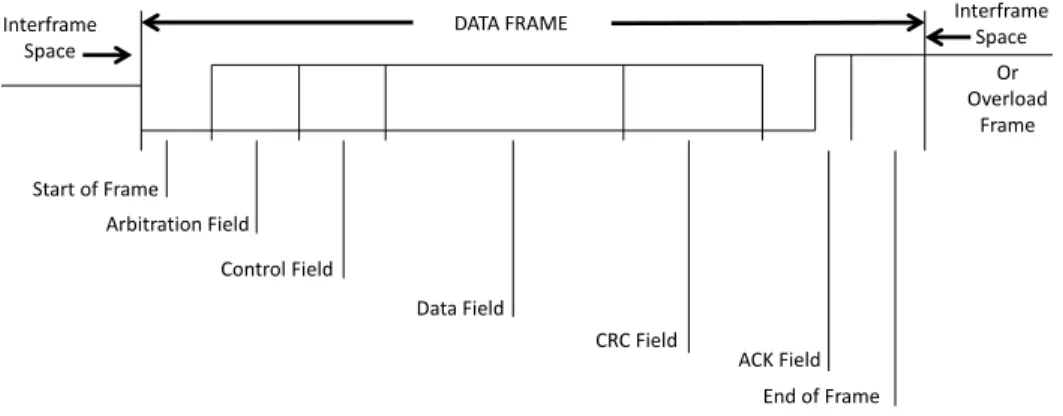
The CAN bus communication follows the Open Systems Interconnection (OSI) model for dif-ferent layers: application, object, transfer, and physical. The broadcast nature of the CAN bus means that transmitted data are received by all ECUs on the bus. Data is transmitted between ECUs in the data frame of CAN packets, which consists of an ID field, data field, cyclic redundancy check (CRC), and other fields seen in Figure 2.1. CAN efficiently implements static fixed priority non-preemptive scheduling of messages through bus arbitration. CAN messages may be periodic, sporadic, or aperiodic. Periodic messages arrive at regular intervals with fixed lengths called pe-riods. Sporadic messages recur with a minimum inter-arrival time between successive messages, while aperiodic messages occur at arbitrary times. The period of a messages is the fixed time in-terval after which a message releases another message. Each transmitted message goes through the arbitration process to determine which wins the bus. When a message wins arbitration and starts transmitting, it becomes non-preemptable. Messages win arbitration according to their priority, which is determined by the messages identifier (ID). A message with a lower ID has higher priority. An important feature of CAN is the MAC protocol Carrier Sense Multiple Access with Collision Avoidance (CSMA/CA). It manages and avoids communication collisions, in the case of several nodes trying to access and send frames on the bus at the same time. When two or more ECUs start transmitting messages simultaneously, arbitration is done and the messages with the lowest message ID wins. The ECU which is attempting to transmit a recessive bit cancels its transmission, because it recognizes the other ECU’s attempt to transmit a message with higher priority.
The CAN bus does not implement security mechanism such as encryption, authorization or authentication. The CAN architecture was envisioned to be lightweight and robust and designed to be unsegmented, unencrypted, and lacking authentication so that CAN messages could flow freely to and from each ECU. However, these properties directly lead to CAN’s security vulnerabilities.
Interframe Space DATA FRAME Start of Frame Arbitration Field Control Field Data Field CRC Field ACK Field End of Frame Or Overload Frame Interframe Space
Figure 2.1 Standard CAN frame format.
2.2 CAN Messages
Message transfer is established and controlled by four different frame types: data, remote, error, and overload frame. The data frame transfers data between the nodes on the bus. A unit on the bus transmits the remote frame to request the transmission of the data frame with the same identifier. On bus error detection, an error frame is transmitted by any unit in the bus. The overload frame is used to provide an extra delay between the leading and succeeding data or remote frames.
Controller area messages can be sniffed and logged from the CAN bus. It is standard for recorded CAN data to consist of a time stamp for the message, the message ID of each message, and the individual 8 bytes of data that make up the Data field. CAN ID and data fields are presented in hexadecimal form. Below is an example of a single CAN message. The first field is the time stamp of when the message was captured on the bus. The 2nd field is the CAN message ID. The last 8 fields are the 8 bytes that make up the data field for the CAN message.
0.000248134, 202, 0C, EE, 72, 6D, 60, 00, 00, 00
It can be seen that not every field is recorded by some CAN snooping software. Depending on how the CAN messages are captured, more or less information may be available. What I present are the standard fields that useful software will present.
2.3 Vulnerabilities of CAN
There have been several publicized attacks on the vehicular network by researchers [4, 7, 27]. Securing automotive in-vehicle networks is challenging because of the resource constraints and the need to maintain predictable performance of the ECUs. Due to their low-cost nature and low data rates, most ECUs have limited computing power and memory to implement security mechanisms. Automotive networks have significantly lower transmission capability compared to network systems. CAN is susceptible to eavesdropping, denial-of-service, message injection, and impersonation attacks because of its broadcast nature, lack of authentication, and encryption.
2.3.1 Lack of Message Authentication
Each ECU broadcasts and receives all data on the CAN bus then decides whether messages are meant for them. CAN by design is unable to prevent unauthorized devices from joining the bus and broadcasting malicious messages to all the ECUs. By accessing the bus, hackers can send spoofed messages to any ECU on the network. Security in this context is provided only through a lack of open documentation. A hacker needs to dedicate time and resources to reverse engineer the CAN protocol before being able to launch malicious attacks on a particular vehicle.
2.3.2 Unsegmented Network
All ECUs are connected to a common network. This is a major reason CAN was adopted in automotive networks, to reduce the need of point-to-point connections between automotive systems. However, this reduction means a system component dealing with infotainment can communicate to safety critical vehicle systems. While some manufacturers utilize different networks for safety-critical systems, there is still cross-communication between safety safety-critical and non-safety-critical systems.
2.3.3 Unencrypted Messages
CAN was designed to be lightweight and robust back in the 1980s, when car hacking was not a reality. Addition of encryption would only slow down CAN messages and clog the network.
However, because CAN traffic is unencrypted, it can be easily sniffed, spoofed, modified, and replayed. There is a large area of research in applying encryption to automotive networks [5, 58, 44, 3, 64, 75].
Knowing these vulnerabilities, I examine how attackers could take advantage of them and to determine how to secure these vulnerabilities.
2.4 Threats and Attacks
To address the security concerns of modern vehicles, security analysis is needed in the devel-opment process. Threat modeling is a technique for security analysis using a structured approach that identifies security threats. A good threat model captures the possible attacks, motivations of attackers, and their capabilities to achieve their goals. With a threat model, a system designer can evaluate threats to the system and identify the vulnerabilities and attack-able vectors.
Threat modeling is a whole sub-field in automotive security. Beyond identifying vulnerabilities that can be exploited, a good understanding of potential attackers, their capabilities, and their objectives is needed. In this section I give an examination of attackers and attack vectors in vehicles.
2.4.1 Attackers and Motivations
Past attacker taxonomies [66] are based at least partially on the intentions of the attacker. Beginner attackers are amateurs or script kiddies that have limited security knowledge but know just enough to exploit security flaws with tools made by more knowledgeable hackers. These knowledgeable hackers can be known as crackers and vandals. These hackers have the security knowledge to seek out specific data utilizing security vulnerabilities. Lastly, the category of career criminals are individuals with the knowledge, skill set, and focused objective for monetary gain.
Modern vehicles contain multiple interfaces that expose the vehicle’s systems to cyber attacks through physical and wireless access.
• Physical access: The attacker has direct connection to the OBD port in the vehicle that is connected to the CAN bus and all ECUs. This port can be accessed with the right tools and opportunity. An attacker can plug a small dongle to the OBD port to gather information or inject messages. An attacker can also plug a wireless device to the port and access it remotely [9].
• Wireless access: The more critical of the two attack surfaces. An attacker does not need phys-ical access to the vehicle. These attack surfaces include Bluetooth and the telematics common in modern vehicles for wireless and cellular connectivity. Miller and Valasek demonstrated unauthorized CAN bus access to a Jeep Cherokee through its WiFi network that exploited a weakness in its password generation protocol [52].
Further research needs to be done in determining the objectives of different attackers and what methods they can use to accomplish their goals. Understanding the motivations, goals and methods of attackers helps with developing methods to prevent their attacks.
Some primary motivations for attacking vehicles include:
• Research: Attacks can be performed by security experts; this process is known as penetration testing.
• Illegal Profit: Attacker aims to profit by stealing a vehicle, stealing information on the vehicle, or other illegal activities.
• Illegal Falsification: Attacker aims to alter actual vehicle information such as odometer read-ings to increase the vehicle’s value.
• Remote Hijacking: Attacker aims to take control and operate a vehicle while it is in use. The attacks demonstrated by these works [38, 9, 52, 1, 18, 96, 90] can be broken down into the following categories:
• Sniffing: Because CAN does not support confidentiality and every CAN message is broadcast to every node on the network, an attacker can sniff and eavesdrop all CAN messages.
• Unauthorized Data Injection: An attacker can execute a replay attack easily because they can sniff all messages transmitted on the CAN. An attacker can also impersonate an ECU and transmit arbitrary messages on the network through message injection.
• Denial of Service: It is trivial for an attacker to continuously send high-priority messages over the OBD-II port, thereby keeping the network busy and unavailable to the rest of the ECUs on the network.
Each of these attack vectors tie into one another. Typically attackers start by sniffing CAN messages on the network and then reverse engineer them. After understanding specific CAN messages, they can then inject specific messages onto the network to make the vehicle misbehave. Through message injection, an attacker can launch a Denial of Service (DoS) attack and disable the network and the vehicle [78]. A core component in most modern attacks is unauthorized data injection.
Unauthorized data injection can be broken down into several categories:
• Injecting a single CAN message ID: Inject a single CAN packet repeatedly. The goal is to make the vehicle do what the message is commanding.
• Injecting multiple messages: Similar to single CAN message injection but injecting multiple CAN IDs onto the network to make the vehicle misbehave.
• Massive message injection to perform a DoS attack: This is also known as message flooding, where there is an influx of messages on the network.
• Bus-off attack: By iteratively injecting attack messages, the adversary coerces the transmit error counter (TEC) of an un-compromised victim ECU to continuously increase, deceiving it to think it is defective, which triggers the CAN fault confinement to force the victim or even the entire network to shutdown [11, 29].
A defining characteristic of injection attacks is how they affect the timing intervals of CAN mes-sages. The interval between messages decreases because the original ECU continues to transmit its
messages as attackers are injecting their own malicious messages. I will focus on different attack scenarios, all with an adversary whose goal is to control the vehicle.
CHAPTER 3. RELATED WORK
3.1 Intrusion Detection Systems
Intrusion Detection Systems (IDS) are software or hardware systems that automate the attack detection process, usually through use of sensors and reporting systems. Most modern IDS monitor either the host computers or networks to capture intrusion related data [70, 79, 94, 101, 68, 73, 69, 64]. The sensors are monitoring agents on the network. They collect real time network or host data to detect malicious activities. I examine approaches and implementations of traditional IDS and how these principles can be applied to automotive security.
3.1.1 Host-based
A Host-based Intrusion Detection System (HIDS) resides in and monitors the host system. The IDS monitors activity such as process events and system calls. In automobiles, a host-based IDS would reside in individual ECUs, where it monitors the traffic packets entering and leaving, and check to ensure packets are not malicious. HIDS also monitors the ECU itself to detect behavior indicative of an intrusion. The issue with host-based IDS is that some ECUs lack the processing power required to support a HIDS. Implementing a HIDS in automobiles would require re-work on the part of manufacturers on their ECUs.
3.1.2 Network-based
A Network-based Intrusion Detection System (NIDS) is part of the communication system and monitors all traffic traversing the network. Information monitored include header and content of each message or packet. An automotive NIDS monitors all traffic on the network with the NIDS acting as an ECU, so that it can receive and monitor all messages broadcast.
3.2 Intrusion Detection Methods
Intrusion detection methods can be classified under two main categories: signature and anomaly-based. IDSs can only detect an intrusion, they are not able to offer protections for networks or information systems. Preventative and reactive measures against intrusions have to be implemented in order to secure a network.
3.2.1 Signature-Based
Signature-based approaches detect attacks using a pre-defined knowledge base of attack signa-tures that is captured and created, and current network traffic is monitored for these signasigna-tures. This detection mechanism is effective in detecting known attacks with high accuracy and low error rates. However, signature-based IDSs cannot detect any attack not defined in the database, and therefore are unable to detect new attacks, nor any deviation from known attacks. It is critical to maintain the knowledge base and update it frequently for accurate detection.
3.2.2 Anomaly-Based
Anomaly-based intrusion detection typically starts with a training or normal model of the system’s activity. To obtain best accuracy in detection, the normal model must be thorough. The IDS then compares current system’s activity to past captured normal model to detect variations in behavior and label those deviations as anomalies. Any deviation not captured in the normal profile could be correctly or mistakenly identified as an intrusion. It is important to have the most complete normal profile, so the system does not suffer from high rates of false positives. The main advantage of anomaly detection is its ability to identify new and previously unknown attacks.
Although anomaly detection can be effective in detecting previously unknown attacks, the use of anomalies to infer intrusions suffers from a few key challenges:
• Defining a normal model that encompasses all possible expected behavior is extremely diffi-cult. The boundary between normal and anomalous behavior is often blurred.
• Normal continues to evolve, and what is normal currently may not be so in the future. • Anomalies may not be a result of malicious actions. Data often contains noise which may
produce anomalies that can be difficult to distinguish from attacks.
• Attackers try to mask their actions to appear normal, therefore making the task of defining a tight boundary around normal more important, and also more difficult.
To address these challenges, researchers have used different types of intrusion detection systems and methods, and will detail these.
IDSs vary in data sources and the specific techniques used to analyze this data. Signature-based detect attacks are effective in detecting known attacks with low error rates, but they cannot detect any attack not in the database of signatures, and therefore are unable to detect newly created attacks nor any deviation of known attacks. Anomaly-based detection can infer an attack is occurring if network traffic deviates from the normal model, which enables detecting new attacks, but can incur high false-positive rates. As attacks are always evolving, so must detection, and this requires updates to detection methods to detect new attacks.
3.3 Intrusion Detection Systems for Automotive Security
I investigate how researchers are applying traditional intrusion detection approaches to securing automotive networks in this related works section. I summarize some of the cutting edge work on automotive intrusion detection in Table3.1 and discuss their advantages and drawbacks.
3.3.1 Message Timing
In normal vehicle operation, each message ID generated by an ECU has a regular frequency. When attackers inject messages to execute a command to an ECU, this frequency will unexpectedly change. Even when an attacker is injecting messages, the ECUs still send their messages period-ically. Eventually, rate of messages on the network will be increased by a factor of more than 2 to 100 times, depending on the attacker’s injection speed. Miller and Valasek reported that they
needed to inject at a rate of at least 20 times faster than normal for their attack to be successful [52]. Because the original ECU is still transmitting its message, an attacker needs to send in messages at a fast enough rate to overwrite the normal message with the same ID.
Detection is based on the following principles.
1. When a new message is transmitted on the CAN bus, the IDS will check the ID and compute the time interval from the arrival time of the latest message.
2. If the time interval of the new message is shorter than the normal model, the IDS indicates message as an anomalous message due to this message is arriving sooner than expected. A conceptual diagram on the effects of message injection attacks on normal traffic is given in Figure
3.1. Injected messages shorten the inter-arrival times of those specific messages.
Time (ms) (b) Message Injection 0x02 (a) Normal 0x01 0x02 10 20 30 40 50 60 70 80 90 30 ms Intervals 10 ms Interval 0x01 0x01 0x02 0x01 0x01 0x01 0x02 0x01 0x01 0x02 0x01 0x02 0x01 10 ms Interval
Figure 3.1 Diagram about transmitted messages on CAN bus on (a) normal status and (b) under message injection attack. The time interval of message CAN ID 0x02 is shortened by the injection of attack messages.
Miller and Valasek [51] introduced a concept of analyzing the rate of messages for in-vehicle network intrusion detection. The number of messages on CAN bus is the sum of the number of normal messages and attack messages. By analyzing the distribution rate of messages, it should be possible to detect anomalous messages.
Researchers have explored utilizing message timing features for intrusion detection. These works have shown good results in using message intervals for detecting a significant threat to automotive security, message injection.
Gmiden et al. [21] proposed a simple intrusion detection method for CAN bus. Their proposed algorithm does not require any modification to the CAN bus, which would mitigate changes to the native system and computational overhead, and is based on the analysis of time intervals of CAN messages. Their future work involves implementing and evaluating their proposed detection method.
Moore et al. [57] proposed an anomaly detector based on the regularity of CAN message fre-quency. Similar to the detection method proposed by Gmiden [21], Moore’s detector relies on the time intervals of CAN messages. They observed regularity in the signal frequencies, and hy-pothesize that a simple anomaly detection system monitoring the inter-signal wait times of CAN bus traffic will provide accurate detection of a regular-frequency signal injection attacks. To test their detector, they defined and executed three signal injection attacks. In their investigations they identified that many signal injection attacks require repeated injections to be effective and the regularity of normal signals has an exceptionally accurate anomaly detection capability. They conclude that their approach is a promising avenue for accurate detection of an important class of CAN bus attacks.
Song et al. [76] also proposed a lightweight intrusion detection algorithm that examines the time interval of CAN messages. They evaluated how three different types of message injection attacks affect the unique time interval of each CAN ID. They combined 100 one-second sample of normal and attack data logs and then applied their IDS to determine which logs were of attacks. They determined that the time interval is a feature capable in detecting message injection attacks in CAN bus traffic by showing there was a clear difference between time intervals of messages in normal status and attack status. The strength of their proposed detection algorithm is that it is simple and efficient to use.
Taylor et al. [80] proposed an algorithm that measures inter-packet timing over a sliding window. Adapted from industrial control systems, the authors applied a flow based method to the CAN bus to measure changes in the data content and their frequencies then compare them to historical values for anomaly detection. Communications between the endpoints of the CAN networks are contained in the flow statistics which are trained using the One Class Support Vector Machines for flow classification. The result of this approach was evaluated using time test statistics of the flow detector and consistent detection improvement is observed with OCSVM as the number of packet insertions increased with time.
Tomlinson et al. [82] presents an analysis of CAN broadcasts and consequent testing of statistical methods to detect timing changes in the CAN traffic indicative of some predicted attacks. The detection is implemented in time-defined windows. The generation of simulated attack data, and the determination of positive detections, are also considered.
Utilizing the CAN message timing intervals show good detection capabilities with minimal change to the vehicle’s native network. This approach using CAN message timing features has shown the most success in detecting known attacks. However, the methods are very simple and is currently limited to detecting attacks that inject numerous messages onto the CAN bus. While the majority of demonstrated attacks have been message injection, it is conceivable that other methods of attacks exist. I examine alternative detection methods in the following sections.
3.3.2 Signature-Based
A signature-based detection method relies on signatures that describe the behavior of the system and attacks. These behaviors of the system are described by it functionality. The monitoring of the system involves detecting these signatures or deviations from the signature. Larson et al. [41] proposed a specification-based attack detection approach that has a detector placed in each ECU. The incoming and outgoing network traffic can be analyzed based on information from the protocol stack and object directory of the CAN-protocol at the expected ECU. They show that potential attacks can be detected from the trace of extracted information through theoretical simulation.
The authors inferred that a likely target for attackers is the gateway ECU because a variety of attacks can be accomplished when it is compromised.
Mitchell and Chen [53, 54, 55] proposed a behavior-rule signature based IDS for medical CPS and unmanned aircraft systems. In their approach, they used a binary failure threshold to classify a node as normal or malicious based on the node’s compliance threshold. Esquivel-Vargas et al. [16] proposed an approach to automatically deploy a signature-based IDS to monitor automation systems. They developed an approach to generate rules that represent valid device behavior in BACnet networks that are used by the IDS to detect violations in the network traffic. This approach was implemented in a passive way and with network- wide coverage. Fauri et al. [19] proposed an approach to combine formal specification with anomaly-based monitoring to overcome the semantic gap between network anomalies and actionable alerts by leveraging the lightweight logical system specification.
3.3.3 Anomaly-Based
Researchers also explored other avenues applying intrusion detection to automotive networks beyond the simple examination of message timing features. However, a limiting factor of imple-menting complex intrusion detection systems is the computing power of ECUs. ECUs come in varying complexity and sophistication from a simple seat control unit that adjusts seat height and angle to complex engine control units that control a variety of engine functions. Some of the fol-lowing techniques are computationally heavy and implementing them onto automotive networks may require major rework of the automotive system.
3.3.3.1 Cyber-Physical
The following works define different ECU characteristics to authenticate individual vehicle ECUs. Each IDS proposes using a specific characteristic that is unique to every ECU on the vehicle. Similar to message timing anomaly detection, when these properties vary from the
cap-tured normal, an anomaly is detected. The works here describe alternative features to message timing that can be captured and examined to detect certain attacks.
Cho and Shin [12] introduced a clock-based IDS that uses clock skew (timing error) to authen-ticate ECUs. The IDS records communications on the CAN bus and creates fingerprints of every ECU on the network. Each ECU is assigned a fingerprint based on their specific clock skew and this is used to distinguish them. The authors proposed that by analyzing the CPU clocks behaviors, spoofing attacks can be detected in the network.
Ji et al. [30] investigates a detection method based on clock drift. Their approach considers that every ECU has a fixed clock skew and it is possible to establish a normal model of ECU’s clock behaviors to detect abnormal measurements. They evaluate the effectiveness of the method against injection and suspension attacks. The analysis results demonstrated that the proposed detection method can detect small-scale change of packets transmitted in CAN networks.
Choi et al. [13] proposed a novel automotive intrusion detection system, VoltageIDS. This system leverages the electrical CAN signal characteristics as a fingerprint of the ECUs. The VoltageIDS does not require any modification of the vehicular system and can distinguish between errors and bus-off attacks. They evaluated their IDS on moving as well as idling vehicles. The method is shown to be capable of detecting the recently introduced bus-off attack.
Lee et al. [42] proposed an IDS called OTIDS that measures the response performance of network nodes based on the offset ratio and the time interval between request and response. The authors claimed that each node has a fixed response offset ratio and time interval in a normal operation mode which varies significantly during attack. This difference in the offset ratio and time intervals is used to detect attacks in the network.
3.3.3.2 Entropy
Entropy-based intrusion detection has been applied to traditional network-based systems, but typically has a high rate of false positives [59] due to typical traffic variance. As automotive network traffic tends to be more periodic, entropy-based detection has been shown it can detect anomalies
with a low rate of false-positives. M¨uter et al. [59], using data recorded from the in-vehicle network communication during normal operation, calculated the Shannon entropy value. Deviations from that entropy are identified as potential intrusions. Marchetti et al. [47] proposed an entropy-based algorithm for detecting anomalies in CAN messages in an unmodified vehicle. They conducted extensive evaluations based on several hours of CAN traffic captured during driving sessions on public motorways. Their experimental evaluations show that entropy-based anomaly detectors are a viable approach for identifying CAN bus anomalies caused by attackers injecting messages.
3.3.3.3 Message Rate
Very similar to the message timing detection, Hoppe et al. [27] proposed an anomaly-based IDS that is placed on the CAN bus so that it can listen to network traffic. Their IDS examines the rate of transmission of specific messages and compares it to what is normal to detect additional or missing messages. This approach differs from the previously examined works as it counts rate of transmission of packets as opposed to the timing intervals of the packets. Deviations from the expected normal number of messages transmitted are identified as anomalies. Their future work involves implementing and evaluating their proposed detection method.
3.3.3.4 CAN-Fields
Several works utilize the makeup and data fields of CAN messages for anomaly detection. Matsumoto et al. [50] proposed a method of preventing unauthorized data transmission in CAN. Each ECU monitors all the data on the bus, and broadcasts an error message if it recognizes spoofed messages with its own ID, before the unauthorized message is completely transmitted. Boudguiga et al. [89] proposed an intrusion detection method that makes each legitimate ECU monitor the data frames on the CAN bus to detect whether another ECU is sending frame on its behalf. The authors used a hardware security module, a security processor dedicated to cryptographic computation and secure key storage, in the ECU to enforce security in the CAN bus.
Van Herrewege et al. [84] suggested adding message authentication protocol to the CAN mes-sages. They showed that the standard authentication protocols are not suitable to the CAN bus, and presented CANAuth. This is a new backward compatible and lightweight message authenti-cation protocol for the CAN bus. However, this required all ECUs to know a pre-shared key to be able to verify messages.
Taylor et al. [81] proposed an anomaly detector using Long Short-Term Memory recurrent neural network for CAN bus anomaly detection. This approach trained the neural network to predict the payload of the next message. The prediction errors are then used as signals for identifying anomalies in the messages sequence.
Martinelli et al. [49] proposed a detection method to identify attacks on CAN packets using fuzzy classification algorithms. The authors developed a fuzzy rough nearest neighbor classification technique to classify legitimate CAN messages generated by the human driver and the injected ones. Kuwahara et al. [39] proposed a statistical anomaly detection approach based on supervised and unsupervised learning of message patterns. The authors assume that there is likely a malicious message in a sequence if the number of messages is higher than normal.
Markovitz et al. [48] proposed a novel domain-aware anomaly detection system for CAN bus traffic. They discovered semantically meaningful fields through the inspection of real CAN traffic. They developed a greedy algorithm to split CAN messages into fields and classify these fields into specific types they observed. Their anomaly detection system uses classifiers to characterize the fields and build a model for the messages, based on their field types in the learning phase. In the enforcement phase, the system detects deviations from the model. They evaluated their system on simulated and real CAN traffic and achieved near zero false positives. These methods require a deeper understanding of CAN messages and reverse engineering of the messages and their data fields.
Tyree et al. [83] present a transformational approach to CAN IDS that exploits the geometric properties of CAN data to inform two novel detectors, one based on distance from a learned, lower dimensional manifold and the other on discontinuities of the manifold over time. Proof-of-concept
tests are presented by implementing a potential attack approach on a driving vehicle. The initial results suggest that (1) the first detector requires additional refinement but does hold promise; (2) the second detector gives a clear, strong indicator of the attack; and (3) the algorithms keep pace with high-speed CAN messages. As their approach is data-driven it provides a vehicle-agnostic IDS that eliminates the need to reverse engineer CAN messages and can be ported to an after-market plugin.
3.3.4 Other Works
M¨uter et al. [60] introduced an approach for anomaly detection using sensors to recognize attacks on in-vehicle networks during normal vehicle operation. The authors discussed the design and the application criteria for attack detection in the network, especially the CAN bus, without causing false positives. This detection scheme consists of eight sensors for detecting an attack. The sensors serve as a criteria for recognizing a threat to the automobile by monitoring different aspects of the network. In their proposed approach, the applicability of these sensors is based on different criteria such as the type and number of messages, the number of buses they need to access, and if the payload of the message needs inspection. The authors showed sensor data results can be evaluated and how to integrate the approach into an holistic IDS concept.
Kang and Kang [32] proposed a machine learning based IDS approach using deep neural network structure to monitor CAN packets. Their IDS consists of two modules. A monitoring module that decides a type of CAN packet based on trained features of known attacks. Once the monitoring module identifies a new attack, a profiling module records the attack model and updates the system for an upcoming packet. These two modules would be embedded in each ECU to analyze CAN packets. They used an unsupervised Deep Belief Net to capture underlying statistical features of CAN data and used them to classify messages as benign or anomalous. They reported a 99 percent detection ratio while keeping false positives under 1 to 2 percent through the use of software simulation. However, the authors did not discuss the overhead to implement their machine learning approach on modern vehicles.
Studnia et al. [77] proposed a language based IDS that uses language theory to define a set of attack signatures from an ECU behavioral model. This idea involves automatic generation of forbidden sequences from patterns characterizing the expected behavior of ECU based on language theory. Formal language is used here to describe a set of attacks which vehicles may be subjected to. This approach describes an algorithm that can be used to overcome the excessive use of memory which may be necessitated by an increase in states caused by the language.
These works show that there are multiple CAN and vehicle ECU characteristics that can be leveraged for intrusion detection in vehicles. Some works [12, 30, 13] capture specific characteristics without requiring changes to the native vehicular system to detect attacks. There are works [50, 48, 3, 23] that require reverse engineering of the CAN system and its messages to implement an intrusion detection system. While it is difficult to determine whether which approach is better, as some have not been evaluated, the best approach to detect the most comprehensive range of attacks may be a combination of some of these works.
The prior research in automotive security lacks a unified notion of anomalies and baselines. I have attempted to clarify and unify the concepts of anomalies and intrusion detection regarding automotive security. This begins with identifying threat models and threats that effect all vehicles and not just one specific model. From a technical perspective, IDSs can work well for detecting intrusions on the CAN bus. Different implementations of anomaly detection methods can detect different types of anomalies. Current approaches have a focus on message injection attack detection because it is the main attack vector for hackers trying to manipulate a vehicle to misbehave. The link to the next step after detection is to enable prevention; an effective IDS for cyber-physical systems should have an active response to cyberattacks.
As research in this field continues to progress, so will the attackers and their attacks. This progression requires continual updates to threat models to identify new vulnerabilities and attacks, and subsequent adjustments to IDS to counter them. The fundamental issue remains that CAN, while inherently insecure is a modern day vehicle standard, exemplifying the need for security should be addressed throughout the design process.
Table 3.1 Comparison of Proposed IDSs for In-Vehicle Networks
Detection Feature Proposed System Intrusions Detected Evaluation Message Frequency Miller and Valasek (2016) [51] Message Injection Live Road Tests
Hoppe (2008) [27] Message Injection and Deletion Testbench Simulation Message Interval Gmiden (2016) [21] N/A No Evaluation
Song (2016) [76] Message Injection Live Road Tests Moore (2017) [57] Message Injection Real Vehicle Simulation Signatures Larson (2008) [41] Known Attacks with Defined Signatures Theoretical Simulation Cyber-Physical Cho and Shin (2016) [12] Spoofing Real Vehicle Simulation
Ji (2018) [30] Injection and Suspension Attacks Testbench Simulation Choi (2018) [13] Bus-Off Attack Real Vehicle Simulation Entropy Marchetti (2016) [47] Message Injection Real Vehicle Simulation M¨uter (2011) [59] Various Attacks that Effect System Entropy Real Vehicle Simulation CAN Fields Matsumoto (2012) [50] Message Spoofing No Evaluation
Markovitz (2017) [48] N/A Real and Simulated CAN Traffic Sensor Data M¨uter (2010) [60] Message Injection No Evaluation Deep Neural Network Kang and Kang (2016) [32] Attacks Based off Statistical Features SW Simulation with OCTANE
CHAPTER 4. OUR APPROACH TOWARDS AUTOMOTIVE INTRUSION DETECTION
I showed that numerous works utilize CAN message timing intervals for intrusion detection [76, 57]. In this section of the paper, I present my adaptation of current methods, their limitations, and how I improved upon current methods while developing a new anomaly detection method.
4.1 Introduction
This chapter investigates the performance of an anomaly detector based on message timing features. The key idea of this detection approach is to model CAN message timings for every message ID to describe normal vehicle behavior. The goal is to design a detector that detects changes in message timing from normal as an indicator of an anomaly.
This chapter examines the performance of different message timing based anomaly detectors. I evaluate the effectiveness of my approach using real-world CAN data. The main contributions of this chapter are:
1. I investigate multiple message timing features and model normal CAN message timings using message interval and frequency.
2. I develop an intrusion detector based on message frequencies across different driving modes. The model characterizes message timings for detecting message injection attacks.
3. I prototype and evaluate the performance of the detection system using simulated CAN logs and logs generated from a real vehicle.
4.2 Message Timing Detection
I investigate the most common type of attack, message injection, in this paper. The attack can take control of a vehicle’s driving operations. The basic idea is that an attacker transmits a packet with the same ID as a legitimate packet as soon as the legitimate packet is transmitted. This will cause the other ECUs on the CAN bus to use the data from the attacker instead of the legitimate one. Even when an attacker is injecting messages, the ECUs still send their messages periodically. Eventually, the rate of messages on the network will be increased by a factor of more than 2 to 100 times, depending on the attacker’s injection speed. Miller and Valasek reported that they needed to inject at a rate of at least 20 times faster than normal for their attack to be successful [52]. Because the original ECU is still transmitting its message, an attacker needs to send messages at a fast enough to overwrite the normal message with the same ID.
Detection is based on the following two principles.
1. When a new message is transmitted on the CAN bus, the IDS will check the CAN ID and compute the time interval from the arrival time of the latest message with the same CAN ID. 2. If the time interval of the new message is shorter than the normal model, the IDS indicates new message as an anomalous message since this message is arriving sooner than expected. These detection principles are possible due to the predictable periodic nature of CAN. A conceptual diagram on the effects of message injection attacks on normal traffic is given in Figure3.1.
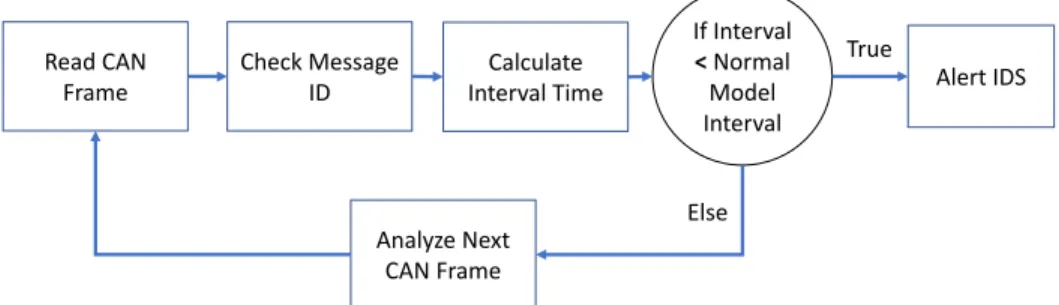
The detection process is detailed in Figure4.1. Every CAN message is read and its ID captured. The time interval from current to previous message with the same ID is calculated and compared to the normal model timing interval for that message. If the interval time is less than normal, the IDS will indicate an anomaly and the IDS sends an alert. The anomaly detector usually has two modes - one mode to capture the normal timing intervals for every CAN message and another intrusion detection mode that observes current CAN traffic and compares its message timings to the normal model to detect anomalies. To train the normal model, a few seconds of normal, no anomalies CAN traffic, is used to train the IDS. For each CAN ID, the IDS will calculate the interval time that is
defined as the difference from the previous message time to the current message time, as shown in Equation (4.1). The average interval time is determined in Equation (4.2).
∆1 =t1−t0, ..,∆n=tn−tn−1 (4.1) µ= ( n X i=1 ∆i)/n (4.2)
My normal model consists of the average message interval times for every CAN ID. Anomalous messages are detected when the interval time is less than the normal time. Shorter interval times indicate additional messages on the bus.
4.3 Message Interval Evaluation
To demonstrate the utilization of message intervals as the detection feature, the traffic capture of normal operation of two test vehicles was analyzed and the normal message interval timings for all CAN messages were calculated. The data set for our first test vehicle is the live vehicle capture data published by Miller and Valasek [51]. This data set contained the CAN traffic of their test vehicle during normal operations. The message injection attacks are simulated by injecting specific messages to create data sets of malicious CAN traffic. During simulations, I can control the rate of injection to allow multi-rate injection attacks and evaluation of the various injection rates.
Read CAN Frame Check Message ID Calculate Interval Time Analyze Next CAN Frame Alert IDS If Interval <Normal Model Interval Else True
Figure 4.1 Every CAN message is read and its ID captured. The time interval from current to previous message with the same ID is calculated and compared to the normal model timing interval for that message. If the interval time is less than normal, the IDS will indicate an anomaly and the IDS sends an alert.
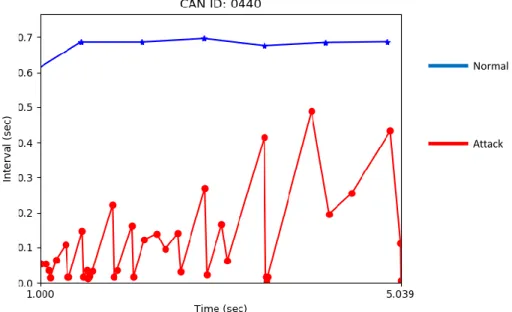
Additionally, I simulate single CAN ID injection along with multiple CAN message ID injection at multiple rates. Figure4.2 illustrates the message injection on the message time interval.
Normal
Attack
Figure 4.2 Demonstrating message injection attacks affecting the timings of messages. The simulated attack messages have fluctuating message timings and are shorter than normal depending on rate of injection.
To evaluate the IDS based on constant interval timings, the IDS is trained with normal operation CAN traffic to build a normal model for all CAN message interval timings. Each of our vehicle data sets had over 100 different CAN IDs. Then I applied this IDS against the simulated data sets of message injection attacks. It was tested against multiple rates of injection: 2, 5, and 20 times faster than normal values. It was reported that at least 20 faster rate was required for successful attack, but I tested for slower rates because it had been demonstrated it is possible to have a successful attack if rate of injection was 2 times faster, depending on vehicle and type of attack.
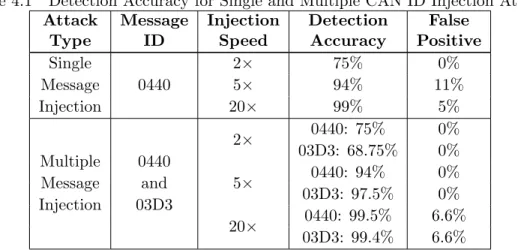
Table 4.1 reports the detection accuracy and false positive rates across the variety of message injection speeds and attacks. Detection accuracy is defined as the number of CAN messages that were correctly identified as having anomalous timings and the false positive rate is the number of incorrectly identified CAN ID messages out of the total messages. The results show that the faster the rate of injection, the higher the detection rate of anomalies. The false positive rate varies
Table 4.1 Detection Accuracy for Single and Multiple CAN ID Injection Attacks Attack Type Message ID Injection Speed Detection Accuracy False Positive Single Message Injection 0440 2× 75% 0% 5× 94% 11% 20× 99% 5% Multiple Message Injection 0440 and 03D3 2× 0440: 75% 0% 03D3: 68.75% 0% 5× 0440: 94% 0% 03D3: 97.5% 0% 20× 0440: 99.5% 6.6% 03D3: 99.4% 6.6%
depending on the rate of message injection and which messages get overwritten by the injected messages. There is an increase of false positives in both 5 and 20 times injection speeds, however it is seen that the false positives is higher in 5 times faster injection. This can be explained by how false positives is defined, when a message has anomalous timings but was not being injected, this is a false positive message. However, when an attacker is injecting messages, depending on which messages are being over written, this can increase or decrease the false positive rate because different messages have different sensitivity in timings. A message that is transmitted often has timing that is not as affected by message injection, however if a message that is rarely transmitted and misses a transmission, then this greatly alters the timing of said message.
The data set for the second test vehicle was obtained from a vehicle at Oak Ridge National Laboratory. The data set was constructed by logging CAN traffic through the ODB-II port of a real sedan while driving on a dynamometer system. The dynamometer system simulates real road operation. Attacks were performed by injection malicious messages at high rate to override normal vehicle operations. The malicious messages were constructed by sniffing and spoofing legitimate messages transmitted on the bus. I discovered there were two major issues in the message timing intervals for this second test vehicle.
1. There were several messages that demonstrated multiple timing intervals. It was assumed that CAN messages have a singular consistent message interval. Numerous previous works stated that all CAN messages have consistent timing intervals [9, 57, 52, 7].
2. A few CAN messages had message timing intervals vary depending on the vehicle’s behavior. I expected some variation in the interval but the change that was seen was at times greater than twice the normal rate.
When the IDS was applied to the data set from vehicle 2, it generated 30 percent false positives, with 41 other message IDs detected as anomalous. These poor results were caused by the inconsistencies in the message timing intervals.
Figure 4.3 These plots depict the varying message intervals seen by multiple CAN mes-sages. Some CAN messages show multiple distinct intervals while some vary due to changes in vehicle operations.
For example, in the CAN data set for the second test vehicle, several CAN messages showed non-periodic and multiple timing intervals. Figure 4.3 illustrates that multiple CAN IDs have varying message intervals. The data set for vehicle 2 had 137 different CAN messages, and about 30 of these messages showed the inconsistencies in the message timing intervals. The differences in CAN message timing behavior and required injection attack rates between the test vehicles may
indicated that CAN may differ depending on manufacturer and vehicle. This inconsistent behavior is problematic for anomaly detection algorithms based on the assumption of constant message timing intervals.
4.4 Message Frequency Detection
To address the aforementioned problem, it had been observed that the frequency of the messages remained relatively consistent, even while the CAN message intervals varied. Additionally, I noticed that the number of messages stays consistent even as the vehicle changes modes of operation. Thus, it was hypothesized the rate of messages is a better indicator for anomaly detection compared to message interval.
I proposed an anomaly detection method based on the message frequency - frequency (f) is equal to the rate of messages (m) transmitted in a set time interval (t) - as shown in Equation (f=m/t). When the frequency of messages increases by a factor of more than twice the normal value, an anomaly is indicated. As reported earlier, for an attack to be successful, the rate of injection must be at least twice the normal value. I implemented the frequency-based algorithm in our IDS. The IDS obtains a normal model for every CAN ID with the use of a few seconds of training data. The IDS then scans current CAN traffic and calculates the frequency of messages for every CAN ID. If the frequency of messages deviates at a rate of greater than 2 times normal, the IDS will indicate an anomaly for said CAN ID.
It should be noted that this approach is relatively simple in complexity as to be implemented in a simple ODB-II dongle. The dongle is likely to connect to the vehicle’s OBD port and acts as an additional ECU on the bus. In addition, this proposed method is cost-effective since it does not require any modification to the native CAN bus.
4.4.1 Vehicle Modes of Operation
I examined the two causes of false positives and message timing irregularities: 1) Vehicle mode of operation and 2) CAN message behavior. CAN message timing intervals were affected by normal