Giovanni Armano
School of Science
Thesis submitted for examination for the degree of Master of Science in Technology. Espoo 10.08.2016 Thesis supervisor: Prof. N. Asokan Thesis advisor: Dr. Samuel Marchal
Author: Giovanni Armano
Title: Real-Time Client-Side Phishing Prevention
Date: 10.08.2016 Language: English Number of pages: 8+98
Department of Computer Science Professorship: Secure Systems Supervisor: Prof. N. Asokan Advisor: Dr. Samuel Marchal
In the last decades researchers and companies have been working to deploy effective solutions to steer users away from phishing websites. These solutions are typically based on servers or blacklisting systems. Such approaches have several drawbacks: they compromise user privacy, rely on off-line analysis, are not robust against adaptive attacks and do not provide much guidance to the users in their warnings. To address these limitations, we developed a fast real-time client-side phishing pre-vention software that implements a phishing detection technique recently developed by Marchal et al. [MSSA16]. It extracts information from the visited webpage and detects if it is a phish to warn the user. It is also able to detect the website that the phish is trying to mimic and propose a redirection to the legitimate domain. Furthermore, to attest the validity of our solution we performed two user studies to evaluate the usability of the interface and the program’s impact on user experience.
Preface
This thesis is made as a completion of the master education in Computer Engineering and it has been developed during my exchange period at Aalto university.
Several people have contributed to this work. I would therefore thank my supervisor N. Asokan and my advisor Samuel Marchal for their time, valuable input and support. Furthermore, I would like to thank Tommi Gröndahl from University of Helsinki for his help in the management of the user studies.
Finally, I would like to thank my friends for their constructive comments to the thesis.
Otaniemi, 10.8.2016
Contents
Abstract ii Preface iii Contents iv 1 General Introduction 1 1.1 Motivations . . . 1 1.2 Contributions . . . 2 1.3 Structure . . . 2 2 Background 4 2.1 What is Phishing . . . 4 2.1.1 Phishing Vectors . . . 52.1.2 State of phishing threat . . . 6
2.2 Machine learning . . . 8 2.2.1 Supervised learning . . . 8 2.2.2 Tree classifier . . . 8 2.2.3 Ensemble Classifiers . . . 9 2.2.4 Gradient boosting. . . 10 2.2.5 Evaluation metrics . . . 10
2.3 A phishing detection technique . . . 12
2.3.1 URL structure. . . 13
2.3.2 Data sources. . . 13
2.3.3 Phisher limitations . . . 14
2.3.4 Feature selection . . . 14
2.3.5 Phishing detection system . . . 17
2.3.6 Target identification . . . 17 2.3.7 Evaluation . . . 18 2.4 Technical background . . . 21 2.4.1 Javascript . . . 21 2.4.2 Add-on. . . 21 2.4.3 Crossrider . . . 22 2.4.4 Python. . . 22 2.4.5 WebSocket. . . 23 2.4.6 Windows Installer. . . 23 3 Related Work 24 3.1 Phishing Prevention Techniques . . . 24
3.1.1 Security Toolbars . . . 24
3.1.2 Blacklist . . . 25
3.2 Phishing Detection Techniques. . . 26
3.2.1 Content-based Analysis. . . 26
3.3 Phishing warnings. . . 27 4 Problem Statement 29 4.1 Deployability . . . 29 4.2 Performances . . . 30 4.3 Reliability of decision . . . 30 4.4 Ease of usage . . . 30 4.5 Usefulness of functionalities . . . 30
5 Off the Hook - A phishing prevention software 32 5.1 Design . . . 32 5.2 Implementation . . . 32 5.2.1 Background script . . . 33 5.2.2 Content script . . . 34 5.2.3 Dispatcher . . . 37 5.2.4 Phishing detector . . . 38 5.2.5 Target identifier . . . 38 5.3 Deployment . . . 39 5.3.1 Cross OS . . . 39 5.3.2 Cross browser . . . 40 5.4 Performance optimization . . . 40 5.4.1 Execution time . . . 42 5.4.2 Memory consumption. . . 44 5.4.3 Features vector . . . 45 5.5 User Interface . . . 46
5.5.1 Design of the interface . . . 46
5.5.2 Cognitive walkhrough. . . 48
5.5.3 Final design . . . 50
5.5.4 Comparison to leading phishing warnings . . . 52
6 Evaluation 56 6.1 Deployability . . . 56 6.2 Performances . . . 56 6.2.1 Execution time . . . 56 6.2.2 Memory consumption. . . 58 6.3 Reliability of decision . . . 59 6.4 Add-on usability . . . 62 6.4.1 Pilot study . . . 63 6.4.2 Test description . . . 63 6.4.3 Warning message . . . 65
6.4.4 Comparison to the Firefox banner . . . 67
6.4.5 Safe banner . . . 68
6.5 Impact on user experience . . . 69
6.5.1 Test description . . . 69
6.5.3 Final questionnaire . . . 72 7 Conclusion 75 7.1 Summary of contributions . . . 75 7.2 Limitations . . . 75 7.3 Future work . . . 76 References 77 Appendices 84 A Questionnaires 85 A.1 Background questionnaire . . . 85
A.2 Add-on usability questionnaire . . . 87
A.3 Two weeks study general questionnaire . . . 91
List of Tables
1 Error matrix. . . 11 2 Feature sets . . . 15 3 URL reatures . . . 15 4 Term distribution . . . 16 5 Dataset descriptions . . . 196 Detailed accuracy evaluation for different languages . . . 19
7 Target identification results . . . 20
8 Comparison of features sets . . . 46
9 Browser usage from w3schools data (May 2016) [W3s] . . . 56
10 Processing time (milliseconds) . . . 57
11 Similarity of the extracted data . . . 60
12 Similarity of confidence values . . . 61
13 Detailed accuracy evaluation for the new model . . . 61
14 Initial interpretation of the warning message . . . 66
15 Evaluation of the warning message . . . 67
16 Evaluation of the continuation alternatives in the warning message. . 67
List of Figures
1 Unique phishing sites detected October 2015 - March 2016 (source: APWG) . . . 72 Most targeted industry sectors in the 4th quarter of 2015 . . . 7
3 ROC evaluation results from 6 languages . . . 20
4 Application architecture . . . 33
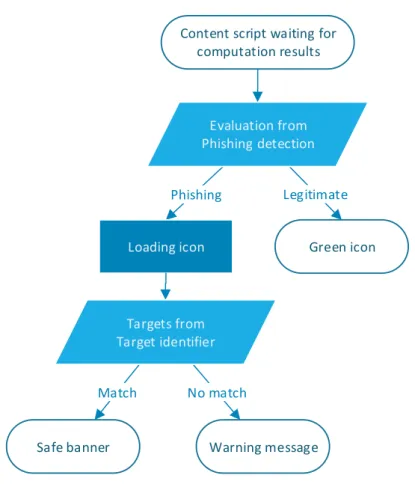
5 Add-on behaviour in case the first result is received from thephishing detector. . . 36
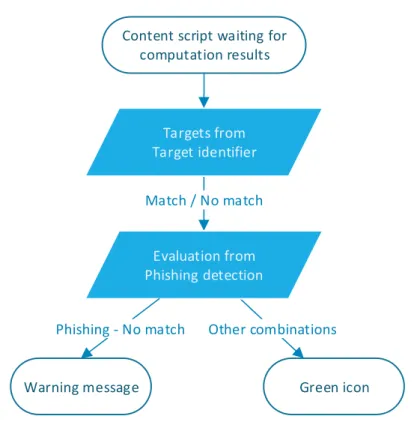
6 Add-on behaviour in case the first result is received from the target identifier. . . 37
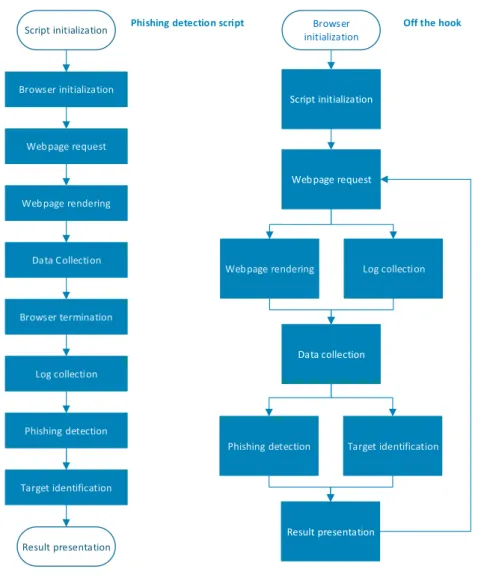
7 Comparative workflow . . . 41
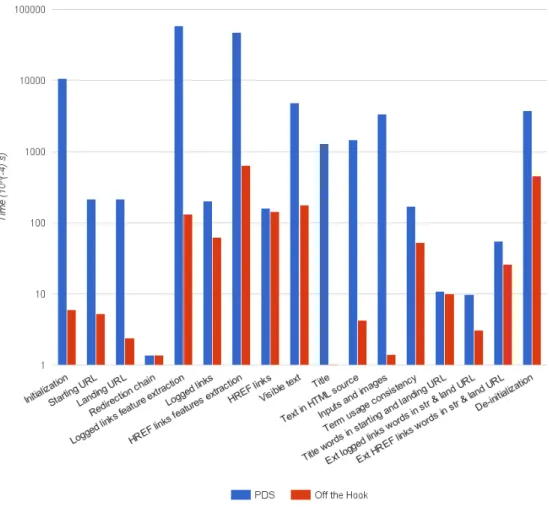
8 Delays before and after the optimization on amazon.com . . . 43
9 Warning message . . . 47
10 Warning message after the cognitive walkthrough. . . 50
11 Safe banner evaluated in the cognitive walkthrough . . . 50
12 Safe banner after the cognitive walkthrough . . . 51
13 Loading icon evaluated in the cognitive walkthrough . . . 51
14 Loading icon after the cognitive walkthrough . . . 52
15 Final version of thewarning message . . . 52
16 Final version of thesafe banner . . . 53
17 Final version of theloading icon . . . 53
18 Firefox’ phishing warning. . . 54
19 Google Chrome’s phishing warning . . . 54
21 St. Petersline phishing email used in the study. . . 63
List of Acronyms
API Application programming interface APT Advanced Packaging Tool
CSS Cascading Style Sheets CSV Comma-separated values
DOM Document Object Model
FN False Negative
FNR False Negative Rate
FP False Positive
FPR False Positive Rate
FQDN Fully Qualified Domain Name HREF Hypertext REFerence
HTML Hyper Text Markup Language HTTP Hypertext Transfer Protocol
HTTPS Hypertext Transfer Protocol Secure IT Information technology
JSON JavaScript Object Notation mld main level domain
MSI Microsoft installation package NCD Normalized Compression Distance OCR Optical Character Recognition
OS Operating System
OSM Online Social Media PDS Phishing Detection Script
RAM Random-access memory
RDN Registered Domain Name
ROC Receiver Operating Characteristic SSL Secure Sockets Layer
TCP Transmission Control Protocol
TF-IDF Term Frequency–Inverse Document Frequency TLS Transport Layer Security
TN True Negative
TNR True Negative Rate
TP True Positive
TPR True Positive Rate
URL Uniform Resource Locator XML Extensible Markup Language
1
General Introduction
1.1
Motivations
The origin of the practice of tricking users to steal personal or credit card information could be placed in the first days of computer networking. However, the wordphishing was used for the first time 20 years ago to indicate the automation of the scam process that was used to steal passwords on America Online (AOL) customers [Rek11]. This phenomenon has since only increased in scale, sophistication and profit. Techniques have been developed to target multiple brands and entities and reach millions of users at the same time. Furthermore, common people do not think they can be the target of credential, credit card or identity stealing. Phishers manipulate users using social engineering tricks to convince them to disclose their personal information. They exploit the lack of technical knowledge of users and the lack of authentication methods between server and client. Phishing usually relies on a large set of websites having a short lifetime and being able to make a high profit in the first hours after their deployment. For these reasons counteracting this threat is complex and important. Current phishing prevention techniques are implemented as browser toolbars [CLTM04, Net] or through the use of blacklisting systems [goo, mic]. The former can be installed to provide information about the legitimacy of a webpage. The result is based on information extracted from the webpage, gathered from the browsing history or collected from a centralized database. Databases are used to aggregate data such as users’ feedback or to rank websites according to the traffic they generate. This approach may raise privacy concerns, because the browsing history can be used for profiling users. Security toolbars, while providing a clear visual assessment of the legitimacy of a webpage, have a high rate of false positives and identification performances lower than 90% [ZECH06]. Furthermore, in case of phishing, they provide passive warnings that users are likely to ignore. Systems based on blacklists, such as Google Safe Browsing, are directly integrated into browsers. Together with a low false positive rate, they provide good performances and active warnings to prevent users’ interaction with phishing webpages. However, systems based on blacklist present a flaw related to the time needed for their update. Crawlers are used to reduce this delay, as they are built to scan the web and look for malicious websites. Unfortunately this approach is subject to adaptive attacks that serve different content depending on the browser user agent, location and time in which the request is performed.
To address these drawbacks we introduce a new tool in the battle against phishing. This work is based on a new phishing detection technique developed by Marchal et al. [MSSA16] that is able to identify phishing websites and the target they are trying to mimic. It is developed to perform a client-side analysis that relies only on the information contained in the page. This allows us to avoid adaptive attacks and remove the delay for blacklist updates. It performs the computation in real-time and, in case of phishing, prevents users’ interaction by an active warning. It does not rely on browsing history or centralized information and does not share information of any kind with centralized databases and, is thus, privacy friendly. Moreover, it has a
remarkably high accuracy (>99%) and a low false positive rate (<0,1%).
1.2
Contributions
This work has as main purpose the implementation of the phishing detection technique described by Marchal et al. [MSSA16] that has been published in the 2016 IEEE International Conference on Distributed Computing Systems (ICDCS). Part of the work presented in this thesis has been published in the same conference [AMA16]. The design and the evaluations of the user interface have been performed with the collaboration of Tommi Gröndahl from the University of Helsinki. He provided advice on the design of the cognitive walkthrough and the user studies, and summarized the collected data.
We claim the following contributions in the development of a client-side phishing prevention software:
• providing real-time protection and protects the privacy on the user since it is implemented completely client-side (Section 5).
• providing a user interface, built on the recommendation of several works that includes intelligible information (Section 5.5.1).
• presenting a warning message that includes the redirection to the target of the phish. This is a functionality that has never been included before in a warning message (Section 5.5.1).
• deployable in multiple operating systems and in the major web browsers (Section 6.1).
• performing data extraction and websites classification in a median time lower than 200 milliseconds (Section 6.2.1).
• using a smaller amount resources compared to the technique it is based on (Section 6.2.2).
1.3
Structure
We now present the organization of this work and the information contained in each section. Section 2 gives a description of what phishing is, the origins of such attacks and the common vectors used to perform it. It then gives an overview of machine learning principles and presents the phishing detection techniques used in this work. A technical background introduces the reader to the technologies used. Section 3 gives an overview of the state-of-the-art in phishing prevention and phishing detection together with a summary of recent studies related to phishing warning design. Section 4 reviews the drawbacks of previous techniques and introduces the problems we address in this work. Section 5 presents the core of this work, a real-time client-side phishing detection system that addresses several limitations of previous solutions. It also presents the phishing warning and the
different messages that are displayed. It illustrates the evolution of the interface design thanks to a cognitive walkthrough and compares the final version of the messages with other warning messages. Section 6evaluates the solution taking into consideration the requirements it must meet. Presents the two user studies that were conducted to evaluate the effectiveness of the user interface and the impact on the user experience. We conclude the document in Section 7.
2
Background
Section2.1 introduces the definition, origins and evolution of phishing. We explain how the attackers adapt their techniques to the defences that have been adopted during the years and the different vectors that can be used to fool users. Section 2.2 is focused on presenting some basic principles of machine learning. We describe the classification techniques that are used in this work and some metrics to evaluate them. Section2.3 presents the phishing detection technique that is the basis of this work, together with an evaluation of its performance. Section2.4 gives the necessary technical background about the technologies used to fully understand the remaining part of this work.
2.1
What is Phishing
Together with the increase of Internet usage for everyday tasks, the amount of sensitive and personal data stored on-line has increased. The large number of services nowadays available on-line helps the users in various aspects:
• Internet banking:Having access every day at any time to the information regarding the personal bank account may help to monitor payments and the balance in real-time. The opportunity to make money transfers from the laptop saves the time needed to go to the bank office in person.
• On-line shopping:Through e-commerce portals, being able to choose between a large variety of products that can be bought providing credit card credentials and an address.
• Working from home:Getting access to sensible data and documents directly from home using repositories protected by user name and password.
The possibility to use these services through webpages helps people to save time, get access to a larger set of goods and be more productive at work. These approaches imply trust between the two parties: user and server. Proving the legitimacy of the former is a trivial problem, while this is not the case for the latter.
Crooks may take advantage of naive users to create phishing webpages, which mimic other websites to gather information and personal data from users. The purpose of this practice varies from selling the data to a third party, impersonating users and using credit card credentials to buy goods.
The term phishing appears the first time back in 1996 to indicate the attack in which scammers pretended to be America Online employees to send messages to ask customers for confidential information. Phishing perpetrated via email can target millions of people at the same time or can be directed against a single company or person. We refer to the last scenario with the term spear phishing. This kind of attack is more sophisticated and less generic compared to a normal phishing email. Phishing emails usually contain indicators such as logos, signatures or an addresses that are used to make users feel confident about the legitimacy of the message. Spear
phish go beyond that and insert specific and personal information regarding the user such as transaction that they have performed recently or other references that are strictly related to the target that can be gathered using social engineering. These attacks are usually performed against employees with high clearance or CEO. Due to the high profile of their target and the amount of money that can be gained from a single person, the term whaling is used to refer to these attacks.
One reason why people keep falling for phishing is that naive users do not recog-nize which information is important to attest the legitimacy of a website [DTH06]. Even if users read URLs pointing to a webpage, they might not be able to understand the information contained in it. URLs likefacebook.com/login, login.facebook.com, facebooklogin.com or login-facebook.com might all be interpreted as legitimate Face-book login pages. While the first two are under the control offacebook.com, and only the first is the actual address of the login page, the third and the fourth have different domains that belong to different entities. Users are attracted to the look-and-feel of the page without knowing that they can be easily copied. Even expert users can be tricked by more sophisticated swindles. To mitigate this problem, browsers provide security indicators such a green lock in case of valid SSL certificate. The connection established using a certificate allows an encrypted end-to-end communication and has a double function: it prevents everyone except the server to read the data sent by the client and attests to the ownership of the domain. Though, not every legitimate website has a certificate, because it costs, and some malicious websites may have it, because it can be seen as an indication of trust.
While understanding if a website is legitimate is not an easy task, tutorials and tools that allow the creation a phishing websites are not hard to find, it is sufficient to search on a search engine such as Google to find several of them [cre]. After a phishing webpage is built, phishers may place it under some free web hosting service or on a compromised third party machine. Whatever the location is, moving the phishing website to another location is easy for the phisher and this frustrates attempts to stop their activity. Taking down a phishing website may not be an easy task, depending on several factors [bra]. Furthermore, the lifetime of phishing websites is in the order of hours or days [APW14, bra]. It is therefore imperative to operate fast and not allow the phisher to have a time window in which he can operate undisturbed.
2.1.1 Phishing Vectors
Several techniques can be used to perform phishing attacks. They rely on combina-tions of social engineering strategies and technical knowledge to make these kinds of swindles effective. Different vectors are used to spread URLs that point to phishing websites or to steal personal information and money. We now review some widely used techniques that phisher might apply.
• Emails:This is probably the first vector used to perpetrate phishing attacks. It consists of sending an email from an address that pretends to belong to a bank or a company in which the user is asked to update an account, confirm a payment or do other tasks that involve the disclosure of personal information.
During the years, companies and brand have instructed their users not to send personal information via email to reduce this phenomenon. Phishers responded by changing the structure of the emails and by including links that redirect to phishing websites that mimic the targeted brand. The excuses are similar: some privacy issue is detected or the limitation of the functionalities of a certain account is reached if the provided information is not updated in a small amount of time. Other approaches consist of the attachment of files that have to be downloaded and contain malware used to collect personal data.
• Online Social Media (OSM):Phishers’ strategies have a continuous evolu-tion. With the advent of social media they started to use Facebook and Twitter to distribute links to phishing websites. This is very effective due to the speed at which content can be spread in the network and it is hard to detect due to the obfuscating techniques used. In Twitter, in particular the URLs, both malicious and legitimate, are usually processed with a shortener service because of the maximum length (140 characters) of a single message. For the same reason, discriminating between legitimate and phishing URLs is not an easy task.
• Fake websites: This category contains websites that are crafted to recreate the look and feel of legitimate websites while their only purpose is to steal information. Typical targets are banks, social networks, payment websites, retail and other known brand in general. The URLs that point to these websites may rely on typosquatting [AJPN15], that is the intentional registration of main level domains (mlds) that are the misspelled version of popular websites. Or it can be totally different, and contain the target mld in a free part of the URL. Links to these kinds of webpages can be spread using vectors such as email or OSM. When users insert their credential (username and password), they are usually redirected to the legitimate websites, and therefore do not realize that they have been hijacked.
• Content injection: This consists of the change of a part of a legitimate website due to the injection of malicious code. This loaded content can be used to display additional forms in which personal information is requested. When the user inserts the data, the script sends it to the phisher using email or other methods. This approach is also used to perform cross-site scripting, an attack in which server side vulnerabilities are exploited to execute javascript code on the victim’s webpage.
2.1.2 State of phishing threat
In the first quarter of 2016, reports of phishing attacks show that it is a threat that continues to grow [AS]. The trimestral report of the Anti-Phishing Working Group (APWG) shows how the number of unique phishing websites is increasing from Deceber 2015 (Fig. 1). These numbers are composed of the sum of the unique base URLs of phishing websites. However, every phishing website might advertise thousand of URLs.
Figure 1: Unique phishing sites detected October 2015 - March 2016 (source: APWG) Figure1depicts that the number of phishing websites has increased by 250% from the last quarter of last year, while the number of target brands fluctuate between 431 ad 418. The number is even more alarming if compared to the state of phishing attacks back 10 years ago [APW06], where the number of unique phishing attacks was less than 30,000 and the number of targeted brands was 130. The sectors that are most targeted by this kind of attack are Retail/Services, that alone consist of 42,71% of the recorded attacks as shown in Figure 2. Another big portion (33,41%) is occupied by the Financial and Payment service sector. However, as we can see, the sectors that are targeted by phishing are several and diverse, from Financial and Government to Social networks and Education.
The cost related to phishing is not limited to the direct money loss. It also impacts the reputation of the organization, productivity loss and cost to the maintenance and recovery of IT structure. The loss related to phishing and identity theft has been estimated between 453 million dollars [Tea15] and 54 billion dollars [Str12].
2.2
Machine learning
Machine learning is the study and modelling of learning processes implemented on computers [CMM83]. To disclose patterns, it uses statistical models in combination with optimization methods and traditional algorithms from computer science.
There are several types of learning problems, and we can discriminate between two major types of learning depending on the availability of labeled data. In case labels are available, the problem is called supervised learning. Supervised learning makes use of a classifier taking as input a vector of discrete, continuous, or mixed feature values and outputting a single discrete value, the class. Its potential resides in the building of a model and finding a pattern from a training set taken as an input in order to make predictions of new instances without strictly following static instructions. If labeled data is not available, we talk about unsupervised learning. This approach addresses a class of problems in which the goal is to determine how the data is organized. The output is based on similarities within a subset of the analyzed data. These two categories are not exhaustive: there are other methods, i.e. on-line learning [FRGBMR+13], in which the model is updated every time new data becomes available. In the context of this thesis, we used a supervised learning approach that we present in this section together with machine learning algorithms and evaluation methods.
2.2.1 Supervised learning
In supervised learning the starting point is a set of raw data extracted from a certain source. In our particular case we have used data that has been collected using a web crawler and subsequently labeled into two classes. The classes of interest for us are phishing websites and legitimate websites. Based on the data source, we perform the feature extraction. This process is in charge of collecting a measurement (numerical values) from the sources that the machine learning method is able to process. Performing a good feature extraction, combined with the choice of good classification method, is the key aspect to obtaining good performance in prediction [Hal99]. When the feature set is ready, the model can be trained.
Once the model is trained, a second different set, called the test set, can be used as input to the classifier to predict the label of the instances.
2.2.2 Tree classifier
Decision tree classifiers process data based on a certain number of input variables, exploiting a decision tree. They navigate in the tree until they reach one leaf that contains the decision class [BFOS84]. Depending on what kind of a result is returned as output, we can divide them in two classes:
• Classification trees: a tree that has a finite set of target values, such as classes.
• Regression trees: a tree that can outputs a continuous set of values, such as real numbers.
In machine learning, each classifier can be described by a set of parameters and hyperparameters. In case of a tree classifier,parameters indicate the variables and their values are used in each node to determine the navigation to the leaf. The hyperparameter is the maximum depth of the tree, identified as how many nodes the process should go through before reaching a leaf containing the target value. On one hand, the deeper the tree is, the more accurate the prediction of the training set results are. On the other hand, a too fine-grained division can lead to overfitting the training set and the classifier will lose generalizability (i.e. the capability to be applied to a larger data set).
Overfitting is a common mistake in supervised learning, due to excessive tuning of a particular set of features that leads the classifier to take into account too many peculiarities of the training set, losing the ability to perform well on a different set. Tree classifiers are usually adopted as weak learners in more complex classifiers, called ensemble classifiers, such as Random Forest [Bre01] or Gradient boosting [Fri02], in which a large number of them with relatively small depths (3 is a common parameter) is used in parallel to extract a more accurate result.
2.2.3 Ensemble Classifiers
Ensemble Classifiers are based on the idea that we should train different weak classifiers and combine their solutions, i.e. by majority vote, to discriminate between the classes of interest [RT14]. A weak classifier is a classifier that has a lowaccuracy.
To understand how to establish when a classifier is weak we can consider the following example. We suppose a two class discrimination problem where we have the same number of instances in both classes (balanced dataset). Even if we assign a class to the data that we get by flipping a (unbiased) coin, we can expect to guess correctly half of the time for a large enough sample size. This means that for a problem like this we can consider as weak a classifier that performs slightly better than a random choice.
The results of the different classifiers are evaluated by a majority vote in order to extract the right decision. To do so, m classifiers are chosen, with m being odd to avoid equality. Then, if we decide to assign the result of a single classifier to +1 or -1 depending on which label is chosen by each classifier, the problem is reduced to
finding the result of the combination of the votes f1, ..., fm using: majority vote decision=sign
m X j=1 fj(x)
Two assumptions are required:
• Each classifier is stochastically independent from others, meaning that the occurrence of a certain result in a classifier does not affect the results of the others.
The compound probability of a positive outcome is the product of the probabilities of each weak classifier. Depending on the number of classifiers that we integrate into our solution we can increase the probability of success.
However, these considerations are valid only if we consider stochastically indepen-dent classifiers. Unfortunately, due to the use of a single training set, dependencies between classifiers are introduced. To overcome this problem, there are various strategies to simulate independence by modifying the training data in certain ways such as deterministic strategies, weighing data or data randomization [Fri02]. 2.2.4 Gradient boosting
Gradient boosting is an ensemble classifier method used for regression and classifica-tion problems. Boosting [Sch99] is a fitting procedure that improves the predicclassifica-tion of binary outcomes from weak models using weighted ensembles of base-learners.
Gradient Boosting consists of an iterative process where the starting point is an initial estimation of a prediction function. During each iteration, the function is improved by fitting a new base-learner (decision tree) to the negative gradient of a pre-specified loss function. Gradient boosting improves model accuracy by selecting variables and weak models at each iteration. At the end of the iterative process, the final prediction function combines the best weak learners and variables as parts of the model.
Gradient Boosting predicts the class of an unknown instance by computing values between [0, 1] that give the confidence value of the instance belonging to a given class. A discrimination threshold is used to discriminate between the two classes. It has the default parameter of 0,5, in the middle of the possible confidence values, but can be tuned to obtain better classification performance.
In order to reduce the statistical dependency that is generated by the training process of the different weak learners over the same training set, a variation called stochastical gradient boosting was introduced by Frieman [Fri02]. This approach has the main advantage of choosing a random subset of the training data for the creation of the tree in different classifiers, reducing tree correlation.
2.2.5 Evaluation metrics
In describing an algorithm for pattern recognition, it is important to introduce some metrics to be able to quantify the value of the results. The three concepts ofprecision, recall and accuracy are based on two different types of error that can be made when classifying a data set. In the presence of labeled test data (i.e. the test set) we can determine the division of the data based on the correctness of the classifier prediction as shown in Table1.
Actual class Legitimate Phishing Prediction Legitimate True negative False negative
Phishing False positive True positive Table 1: Error matrix
• True positive (TP):indicates a phishing website identified correctly
• False negative (FN):indicates a phishing website identified as legitimate
• False positive (FP): indicates a legitimate website identified as phishing
• True negative (TN):indicates a legitimate website identified correctly These metrics can also be represented as the following rate:
• True positive rate (TPR):TP/(TP+FN)
• False negative rate (FNR):FN/(TP+FN)
• False positive rate (FPR):FP/(FP+TN)
• True negative rate (TNR): TN/(FP+TN) Based on these values we can estimate the metrics as:
• Precision:TP / (TP+FP) is the number of phish correctly identified as phish by the classifier divided by the total number of websites labeled as phish by the classifier
• Recall:TP / (TP+FN) is the number of phish correctly identified as phish by the classifier divided by the total number of phishing websites
• Accuracy: (TP + TN) / (TP + TN + FP + FN) is the proportion of true results (both TP and TN) among the total set of tested data.
Additionally, we use another indicator for our data presentation:
• F1-score: is a measure for test accuracy calculated as the harmonic mean of Recall and Precision [GG05]
F1 = 2×
precision×recall precision+recall
In machine learning, in order to present data derived from binary decision, receiver operator characteristic (ROC) curves are commonly used. They show how the true positives rate (TPR) and the false negative rate (FNR) change in relation to the variation of the discrimination threshold of the classifier. The TPR describes how
many phishs were correctly identified over the phishing websites present in the test set and the FNR describes how many legitimate websites were detected as phish over all the legitimate websites present in the test set. ROC analyses are used to detect optimal values of the discrimination threshold independently of the distribution of the class.
2.3
A phishing detection technique
Some phishing detection techniques [WRN10, MSSV09] are able to identify phishing webpages with an accuracy higher than 90% and at the same time have a very low rate of misclassified legitimate webpages, i.e. less than 0,1%. These techniques are machine learning based. The algorithms used to classify phishing websites, so far, rely on millions of static features, most of them using the bag-of-words approach [MSSV09]. The bag-of-words approach is a way to represent a text as a multiset (bag) of the words that it contains. It can be used to summarize a website as an unordered collection of words extracted from different sources such as text and URLs. This led to two major weakness:
• A huge amount of labeled data is required to train the model. This data is difficult to find because the uptime of phishing websites is small [APW14], they need to be manually checked to be correctly labeled, and even in this case it can be complicated to understand the real nature of the websites (poorly known brands or services).
• It is language and brand dependent and is not effective in detecting phishing attacks against new targets.
The technique that we are going to describe in this section has been presented at the IEEE International Conference on Distributed Computing Systems (ICDCS) 2016 and forms the basis of this work [MSSA16]. The text contained in this section refers to one presented in that work and it is reported here to underline its functioning and the differences introduced by this new work. The technique described in Marchal et al. paper is built of two components. The first one is a phishing classification system that, relying on a small sets of data all collected from the webpage, is able to estimate whether a websites is legitimate or a phish. The second one is able to performtarget identification based on the information extracted from the webpage and return the websites that the phish is trying to mimic. This phishing detection system is based on two observations: (a) although phishers try to make a phishing webpage look similar to its target, they do not have unlimited freedom in structuring the phishing webpage; and (b) a webpage can be characterized by a small set of key terms; how these key terms are used in different parts of a webpage is different between legitimate and phishing webpages.
Based on these observations, this approach has several notable properties: it requires very little training data, scales well to much larger test data, is language-independent, fast, resilient to adaptive attacks and implemented entirely on client-side.
2.3.1 URL structure
To be able to identify a particular webpage, a Uniform Resource Locator (URL) is used. In its structure, several parts can be identified, and separated, based on their functions and characteristics.
protocol://[subdomains.]mainleveldomain.ps[/path][?query]
The Fully Qualified Domain Name (FQDN) is used to identify the server that hosts the page and is composed of the subdomains and the registered domain name (RDN). While the former is freely editable by the website owner (or the phisher), the latter is fixed and registered to a domain name registrar. The RDN can further be divided into the main level domain (mld) and the public suffix (ps). The part of the URL that follows the RDN is composed of the path, which is used to locate the resource in the server, and the query, which provides additional parameters. These two are not constrained and can be edited. We are going to refer to the set composed of subdmains, path and query as free URL to underline that phishers are able to freely modify them to obfuscate a URL.
2.3.2 Data sources
To extract the features needed for the classification and target identification, the useful data sources that are available on the web browser have been identified as the following:
• Staring URL: the URL given to the client to reach the webpage. It can be distributed in an email, instant messages, texts, websites, etc.
• Landing URL: the last URL indicating which content the user is actually displaying in the web browser. This is the URL present in the address bar when the webpage is completely loaded.
• Redirection chain:a list that contains all the URLs through which the user has been redirected between thestarting and thelanding URL
• Logged links:the list of all the URLs that have been requested from the page in order to be loaded, including stylesheets, HTML and PHP pages, images and any other kind of content logged by the browser.
• HTML:the source code of the page combined with these contained in IFrames and Framesets.
– Text: the text extracted displayed to the user, located between the <body> HTML tags.
– Title: the title displayed on the tab of the browser, located between the <title> HTML tags.
– HREF links: the list of the links that <a> HTML tags refer to. – Copyright: the copyright, if present, of the page.
2.3.3 Phisher limitations
Look and feel are key aspects in fooling users in phishing attacks [DTH06]. In order to create webpages that are similar to the original [XH09], phishers load content such as images and HTML code directly from the target webpage and integrate it with their portion of code [PD06]. The content loaded from external sources can include outgoing links to the legitimate webpage, together with the URL from which these resources have been downloaded. Furthermore, keywords referring to the target can be identified in several data sources, such as title, text and linksl [LMF10]. However, if the phisher wants to embed this kind of content to his webpage, there are limitations that he can not overcome.
Marchal et al. divided the data sources described in Section 2.3.2 based on the level of control and contraints that the phisher must comply to.
Control:Creating a page that embeds content from another website leads to the download of sources from other registered domain names (RDNs), that are collected as logged links. Furthermore, the incorporated part of the code will probably have HREF links pointing to the target of the phish. These data sources are divided to internal and external according to their RDNs. For this discrimination we can assume that RDNs contained in the starting URL, landing URL and redirection chain are under the control of the page owner and so are marked as internal. The remaining URLs, with other RDNs, are considered outside the control of the page owner and, because of that, marked as external.
Contraints: As described in Section 2.3.1, some parts of a URL can be freely modified. Phishers can use them in order to insert text that might fool the user. However, these subterfuges can not be used to modify the RDN that is registered. Based on this assumption they identify the RDN as a constrained part that can be casted in a set of features to model the phisher’s limitations.
2.3.4 Feature selection
We now describe how the feature set was selected and why.
To be able to introduce a new phishing detection technique comparable to the state-of-the-art, the requirements of an effective approach were analyzed. These fall into three main concepts: generalizability and adaptability.
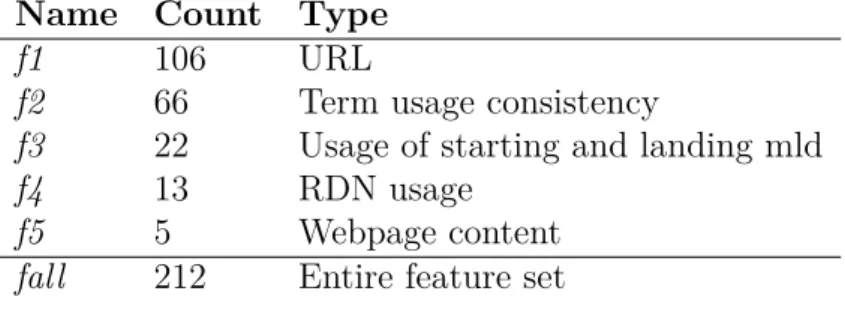
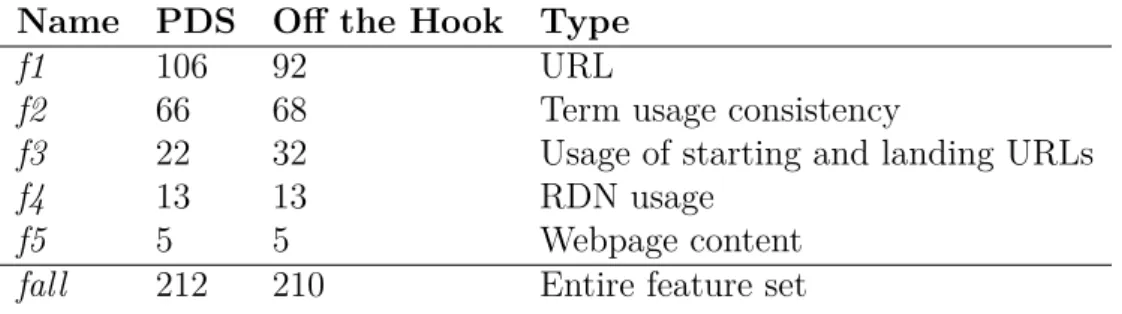
Taking these considerations into account, Marchal et al. selected 212 features that cover the constraints and the degree of control present in the phishing webpage creation process. These features can be divided into 5 categories as shown in Table 2.
URL: these features are based on nine different statistical features related to the URL composition (Table 3).
While feature 2 is meant to analyse whether the strings contained in the path or query look like a domain name, features 3 to 8 try to detect if any obfuscating techniques, such as long URLs built on several terms, have been used. Feature 9 is related to the Alexa list, a rank of the most visited domains.
Alexa Internet, Inc. [Inc] is a company that provides commercial web traffic data and analyses. It is possible to download from their website a list of the top one million websites ranked by Alexa based on a 1 month time window in which the
Name Count Type
f1 106 URL
f2 66 Term usage consistency
f3 22 Usage of starting and landing mld
f4 13 RDN usage
f5 5 Webpage content
fall 212 Entire feature set Table 2: Feature sets # Description
1 protocol used (http/https) 2 count of dots ’.’ in FreeURL 3 count of level domains 4 length of the URL 5 length of the FQDN 6 length of the mld
7 count of terms in the URL 8 count of terms in the mld 9 Alexa ranking of the RDN
Table 3: URL reatures
traffic data is collected. The list used in this scenario is a pre-downloaded copy containing domain names.
The 106 features of the first set are a combination of:
• The 9 features computed on starting and landing URL
• The mean, median and standard deviation computed on features from 3 to 9 onlogged links anHREF links (both internal and external)
• Feature 1 computed on the 4 sets previously described
Term usage consistency: as pointed out before, in order to make the victim believe that the phishing webpage is the target, phishers incorporate a part of its original content. This set of features is based on the assumption that a page crafted with information extracted from another source leads to a distinctive distribution of the terms in different locations of the page.
Taking into account only the words with a length greater than or equal to 3, supposing T to be the set of all the terms; Ts = {ti(1;m) T} is extracted from a source S with ti occurring with pi probability. They define the term distributionDs ofS as the set of m pairs (ti, pi) T ×]0,1], i {1;m}. The sources from which the different distributions are extracted are listed in Table4.
To find some inconsistency, the different constrained, unconstrained, controlled and uncontrolled parts are compared. Without taking into account Dcopyright and
Distribution Data source
Dtext Text
Dtitle Title
Dcopyright Copyright notice Dimage Webpage screenshot Dstart Starting URL - FreeURL Dland Landing URL - FreeURL
Dintlog Internal logged links - FreeURL Dintlink Internal HREF links - FreeURL Dstartrdn Starting URL - RDN
Dlandrdn Landing URL - RDN
Dintrdn Internal links (HREF and logged) - RDN Dextrdn External logged links - RDN
Dextlog External logged links - FreeURL Dextlink External HREF links - FreeURL
Table 4: Term distribution
Dimage, 66 features (12 * 11 / 2) are extracted to represent the similarity of pairs of sources by pairwise computation of the Hellinger Distance [CY00] between their distribution. This metric allows an estimation of the similarity of two probabilistic distributions, returning a value between 0, if the distributions are the same, and 1 for complete dissimilarity.
Usage of starting and landing mld: while legitimate websites are likely to register a domain name that reflects the brand or the service that they offer (i.e. the mld for Bank of America isbankofamerica.com), phishers often use a domain that has no relation with the target [XH09]. For this reason, webpages built over content extracted from other sources will have less links that point to their starting and landing mld compared to the legitimate ones. The 22 features defined to shape these characteristics are the following:
• 12 binary features are set to 1 if the starting/landing mld appear in Dtext, Dtitle, Dintlog, Dextlog, Dintlink orDextlink.
• 10 features are the sum of probabilities from terms of Dtitle, Dintlog, Dextlog, Dintlinkand and Dextlink that are substrings of starting/landing mld.
RDN usage: These features are based on the expectation that, on a legitimate website, internal registered domain names are more used than external ones. The 13 features of this set are related to the similarity of RDN in starting and landing URL, redirection chain, logged links and HREF links.
Webpage content:the last set consists of 5 features corresponding to the count of input fields, terms in title, terms in text, images and IFrames.
These has been selected because phishers include a small amount of text in order to avoid text-based detection techniques [RW13]. Input fields are used to collect
as much information as possible from the user and IFrame in order to incorporate content from other sources.
Marchal et al. also underline that all these features that are extracted from the different text sources are not related to any particular language, but only on their relative use in the different locations. The only features that are not extracted directly from the page are the ones related to the Alexa list, which once downloaded is stored as a local copy. The sum of all these sets creates 212 features that, considering their small amount, should not overfit the training data.
2.3.5 Phishing detection system
To compute the collected features and discriminate between legitimate and phishing websites, Marchal et al. used a supervised machine learning approach. A collection of data marked with their own classes (labeled data), is used as a training set for the classifier. The produced model is later used to discriminate between the classes of unlabeled data sets.
The selected algorithm used to build the classification model was Gradient boosting developed by Friedman [Fri02].
2.3.6 Target identification
The target identification component identifies the target website that a phishing webpage is attempting to mimic. The target detection component can help minimize false positives of the phishing detection system. Its analysis is based on the identifi-cation of terms that appear in several data sources of the page, called keyterms. The sources that are taken into account are five of the fourteen described in Section2.3.4.
• Starting and landing URL: Tstart∪Tstartmld∪Tland∪Tlandmld
• Title: Ttitle
• Text: Ttext
• Copyright: Tcopyright
• HREF links: Tintlink∪Tintlink
Three different procedures are used to extract the same amount of keyterm sets:
• Boosted prominent terms: are calculated from the intersection of each pair of sources. Every time a word is contained in both of the sources compared, it is inserted in a list with its relative frequency. The final set, with the overall frequency, is sorted and the top 5 terms are extracted.
• Prominent terms: are calculated using the same technique as the boosted prominent terms, but the intersection between text and HREF links is removed. This is done to avoid websites that contain the same terms in an <a> HTML tag and its HREF link, as many news websites do, from interfering with the target identification with irrelevant words. A maximum of 5 terms are extracted.
• OCR prominent terms:are the terms extracted from the optical character recognition process applied to the screenshot of the page (Timage). The set extracted is intersected with the five data sources to produce another list of the 5 most common terms.
The extracted sets of keyterms are used to identify the target. Each of the following steps is based on the assumption that when a search engine is queried for certain keywords, it will not return a phishing website as result. This is supported by two observations: (i) phishing websites that are new did not have time to improve their rank and appear as first results (before the target), (ii) old ones would have already been detected and added to a blacklist or taken down. The target is inferred using the extracted keyterms through the following steps:
1. Starting from the boosted prominent terms (bpt), the process tries to determine the possible target Fully Qualified Domain Names (FQDNs). Legitimate companies and services try to register domain names that contain their name (i.e. the domain registered for Bank of America is www.bankofamerica.com). To do that the main level domains (mlds) are extracted from sources such as: starting and landing URL, logged and HREF links. Successively, all the possible combinations of the bpt (including variants with dots or dashes) are compared with the collected mlds to find matches. If a match is found in the starting or landing URL, the websites is considered legitimate, otherwise step two will follow. 2. The set of prominent terms is used to query the search engine. The
returned mlds are compared to the starting and landing mlds. In case of a match, the webpage is marked as legitimate, otherwise the process proceeds and the mlds returned are stored and will be used for step 5. 3. The same analysis as in step 2 is performed, but with theboosted prominent
terms instead of the prominent terms.
4. The same analysis as in step 2 is performed, but using theOCR prominent terms.
5. In case the page has not been validated at any step of the process, the possible targets are returned. These are computed as the top 3 mld, based on a descending ranking of the frequency, of each mlds that has been returned from the different steps.
2.3.7 Evaluation
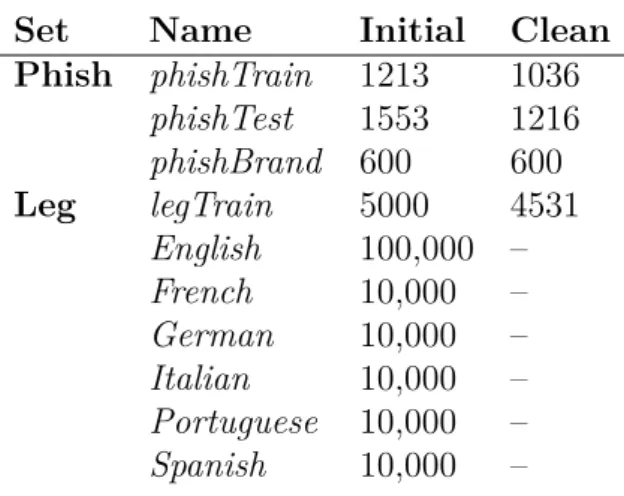
This method was evaluated using ground truth gathered from a set of phishing and legitimate websites (Table 5).
The legitimate URLs were supplied by Intel Security. The scraped websites were divided in 6 different categories depending on their language.
Set Name Initial Clean Phish phishTrain 1213 1036 phishTest 1553 1216 phishBrand 600 600 Leg legTrain 5000 4531 English 100,000 – French 10,000 – German 10,000 – Italian 10,000 – Portuguese 10,000 – Spanish 10,000 – Table 5: Dataset descriptions
The collected data takes into account websites with different notoriety and traffic. This is shown by the fact that the 65,302 of the 150,000 test URLs had RDNs ranked in Alexa’s top 1 million websites.
The phishing URLs were obtained through the website PhishTank [Phi], which provides legitimacy evaluation of websites through user’s feedbacks. The amount of data that can be collected is strongly dependent on the uptime of the phish. For this reason the scraping was performed in three different sessions that produced as many data sets.
The evaluation was conducted using a learning stage on legTrain andphishTrain and a prediction on all the other datasets.
The focus of the evaluation was on three different aspects of the performances of the Phishing detection system and an evaluation of the Target identification.
• Accuracy, recall and false positive rate:The results shown in Table6were calculated over 6 different languages. We can see that the precision reached for all the languages is remarkably high, 0.95 or 0.98, and the recall, with a value of 0.958, as well. Even the harmonic mean between precision and recall (F1−score) is significantly high for every language. Hence, the FP Rate is very low: from 0.0005 to 0.004.
Language Precision Recall F1-score FP Rate AUC
English 0.956 0.958 0.957 0.0005 0.999 French 0.970 0.958 0.964 0.0036 0.997 German 0.981 0.958 0.970 0.0022 0.998 Portuguese 0.967 0.958 0.962 0.004 0.997 Italian 0.982 0.958 0.970 0.0021 0.998 Spanish 0.982 0.958 0.970 0.0021 0.998
Table 6: Detailed accuracy evaluation for different languages
Considering that in real-word large-scale use cases, machine learning mod-els are applied only if the precision is higher than 90/95% and recall above
50/60% [SSM+12], this method is ready to be applied in multi-lingual business scenarios.
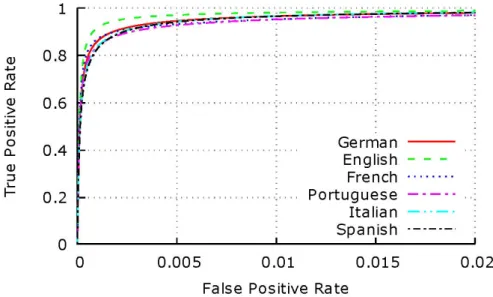
• Receiver operating characteristic (ROC):ROC curves are used to show how the false positive rate and true positive rate vary in relation to modification of the discriminating threshold. The results, relative to 6 different languages, are depicted in Fig. 3.
Figure 3: ROC evaluation results from 6 languages
We can see that for an already high value, around 0.9, for the true positive rate (TPR), the rate of false positive (FPR) is below 0.005, which is considered low. As we move the threshold and increase the value of true positive, the false positive rate remains very low. At the remarkably high TPR of 0.98, even if the value of false positive increases, 0,02 of FPR is considered as quite low.
• Target identification evaluation:To test the efficacy of the target identi-fication, Marchal et al., used the phishing websites of phishBrand. For each website a manual evaluation of the target was performed to gather ground truth. 17 out of 600 pages have an unknown target. For these pages the information present did not provide any hints about the target. Maybe it was mentioned in the email or post that was used to attract the victims.
Targets Identified Unknown Missed Success rate
top-1 526 17 57 90.5%
top-2 558 17 25 95.8%
top-3 567 17 16 97.3%
Table 7: Target identification results
The evaluation took into account the likelihood of the target being in the top-1, top-2 or top-3 results given as output of the identification process. We identify
as a success the presence of the RDN of the target in the top-N RDNs identified. Table 7 shows how the success rate of the top-1 results is above 90%. If the scheme is configured to return 3 results, then the percentage rises to 97,3%.
2.4
Technical background
This section is intended to give a general overview of the technologies and the framework used. It also puts the focus on the aspects that are strongly related to their usage in this work.
2.4.1 Javascript
JavaScript [Fla06] is a high-level, untyped and interpreted programming language that is well-suited to object-oriented and functional programming styles and finds its main usage in Web programming. Nowadays every website makes use of it to specify several page behaviors such as rendering page content, communicating with the server after a webpage is loaded, playing games and more. It is part of the triad of technologies, with HTML and CSS, that are used by every Web developer.
It should not be confused with Java, with which it has only a superficial syntactic resemblance. From its birth as a scripting language, it has now become an efficient general purpose language.
The core of Javascript includes the support for working with text, arrays, dates and regular expressions while the functionality for the input and output are supplied by the interpreter that is used to run it. Every modern web browser works as a Javascript interpreter and through the supplied console, programmers can interact directly with the content displayed in the page.
2.4.2 Add-on
Add-ons, or browser extensions, are software components that add specific features to a web browser. All the popular browsers are able to integrate them to provide more functionalities over the default ones. These kinds of plug-ins are developed in JavaScript and executed concurrently with the browser. Add-ons are collections of files that are packaged with every resource that is needed for their installation and execution. Besides resources such as images, icons and videos, they contain the script that constitutes the core of the application and other files regarding configuration and permissions.
The script can be divided into two main categories, the content script and the background script, depending on their task, lifetime and privilege.
The content scripts are executed each time a webpage is loaded when the pro-grammer triggers it, before, during or after the page rendering. They are able to interact with the webpage to read, write and modify its content and behavior.
The communication between the content and background script is possible through the use of a messaging system. In this way the content script can indirectly get access to the browser APIs.
The background scripts are meant to maintain a long-term state of the application or perform long-term tasks that run independently from the lifetime of a single tab of the browser. They are loaded and executed when the application is installed and they stop their execution when the add-on is disabled or uninstalled. They have access to the API provided by the browser as long as they have the required permission declared in the manifest file.
The information contained and required in the manifest file depends on the specification of each web browser, but they usually contain: the path to the content and background scripts, the resource folders, the permission that has to be granted to the add-on, and the information about the developer together with the support and compatibility of different browser’s versions.
2.4.3 Crossrider
Crossrider [Cro] is a framework that can be exploited to build add-ons that can be executed on different web browsers. It allows cross-browser deployability and through APIs provides an abstraction layer that uniforms the different function calls.
So far it supports Internet Explorer, Google Chrome, Mozilla Firefox and Safari. It is in continuous development but currently not all the functionalities are available for every browser.
It allows the programmers to write a single version of the code that is easier to maintain in comparison to a different ones for each web browser.
2.4.4 Python
Python [VRD03] is an object-oriented programming language. It is used in numeric programming, artificial intelligence, image processing, biology modeling and other fields. It makes use of indentation as a syntactical structure.
Python is distributed together with its interpreters and is available for the most used operating systems (i.e. OS X, Windows and Linux distributions). Several third-party tools have been developed to increase its functionalities. Some of these, such as Py2exe or Pyinstaller, can be used to package Python code into stand-alone executable programs for several OSs. This allows the software to be distributed and used without the need to install a Python interpreter.
Extensions such as Numpy, Scipy and Pandas allow the use of Python for scientific computing and execution of machine learning algorithms. These modules provide the support for large, multi-dimensional arrays and matrices, data structures to store data, together with the mathematical functions to operate on them.
Another important extension is Selenium Python, which provides a set of APIs to access web browser functionalities from a Python script. It is implemented through a browser-specific driver. It is capable of launching, sending commands to a browser and retrieving the results.
2.4.5 WebSocket
The WebSocket protocol (RFC 6455) [MF15] provides full-duplex communication over a TCP connection between clients and servers. The goal of this protocol is to avoid long polling and multiple HTTP connections and allow a two-way communication channel with the server from different clients.
The protocol specifies that to open a connection, a preliminary phase is needed in which a handshake is performed. Once the opening handshake is completed successfully, clients and servers can transfer data. The data is sent through messages. The messages that can be exchanged are of three types: text data (UTF-8), binary data and control frames. The last one is used for protocol level signaling.
WebSockets are implemented both in Javascript and Python. The support for the Javascript is provided by HTML5 WebSockets. It consist of a set of APIs that enables web pages to use the WebSockets protocol. The support of HTML5 WebSockets is supplied since Firefox 6, Safari 6, and Google Chrome 14. The implementation of WebSockets in Python is provided by several modules, such as Autobahn.
2.4.6 Windows Installer
Windows Installer [Wil04] provides a standard way to install, maintain and uninstall software. They have a transactional behavior that allows the applications to be either fully installed on the machine or not installed at all to avoid some indeterminate state in between. The extension for this kind of file is MSI and these files are managed by Windows Installer Service. Once executed, it conventionally copies the files needed for its execution in a folder under Program Files associated with the company name and product name.
To handle the installation setup and the creation of MSI files, third-party vendors offer proprietary and open-source solutions. The one used in this work is Wix-Toolset [Fou]. It is able to take the source code, compile and link it to create an executable file. It is based on a declarative XML authoring model to provide an intuitive way to build MSI installer packages.
3
Related Work
During the last ten years, several techniques have been developed and deployed to fight phishing attacks. As expeted, together with the development of prevention techniques, phishers’ strategies have also evolved to perform large scale and more sophisticated attacks. The proposed solutions to counteract phishing attacks can be divided into two main categories: phishing prevention and phishing detection techniques.
3.1
Phishing Prevention Techniques
Phishing prevention techniques have been developed to prevent users’ interaction with phishing webpages. They work at different levels: while security toolbars give information about the page that the user is visiting, blacklists prevent access by blocking the request that is performed to a certain URL.
3.1.1 Security Toolbars
These security indicators have been developed to provide intelligible information to attest the legitimacy of a website. However, nowadays browsers already provide indicators that can be used to accomplish the same task:
• URL: The Uniform Resource Identifier displayed in the address bar can easily be spotted to understand whether the website in which the user landed is the one she was looking for.
• HTTPS connection: The protocol used for the communication with the server can be used to infer if the connection is secure (encrypted).
• TLS certificate:The Transport Layer Security certificate is used to authen-ticate the web server that we are communicating with. In browsers such as Google Chrome, by clicking on the green locker displayed in the address bar information about the certificate is available.
These indicators require some technical competence to be fully understood and efficiently used to detect phishing websites. Security toolbars overcome this limitation by providing clear visual information about the website.
The Netcraft toolbar [Net] provides a color code referring to the risk associated with a visited webpage. It also provides additional information such as the data in which the website was encountered for the first time, the country and the name of the host and the rank of the websites based on the number of visits.
Another example is SpoofGuard security toolbar [CLTM04]. Its evaluation is based on a stateless analysis of the displayed webpage. This approach implies the computation of features extracted from part of the page such as URLs, images, links and password requests. The computed result is shown with a color code, similarly to the Netcraft toolbar.
A different approach is proposed by Wu et al. with Web Wallet [WML06]. It consists of a browser sidebar that should be used every time a webpage requires sensitive information such as username and password. The user inserts her information into the sidebar and then Web Wallet checks the legitimacy of the website. If it is considered safe, the data is automatically submitted, and otherwise a warning is raised and no information is sent. With this approach Wu et al. were able to reduce the spoof rate from 63% to 7%.
Another approach is proposed by PhishAri [ARK12]. It is specifically developed for addressing the OSM phishing attacks perpetrated using Twitted. It relies on features extracted from the URL, WHOIS query, text and tags extracted from the posted messages and the contact network of a certain account. Their results shows that this technique is able to detect phish more efficiently (92% accuracy) than the actual Twitter defense system (84%).
Even though these approaches can be useful to reduce the risks of phishing attacks, studies [WMG06] show that the efficiency of toolbars is low since they provide too simple information that does not evoke a sense of danger in users. Web Wallet, as underlined in the user study, is sensitive to attacks in which phishers mimic the sidebar together with the target websites [WML06]. Moreover, Egelman et al. [ECH08] underline how passive warnings are not effective prevention techniques because users tend to ignore them. It is further worth underlining that, as shown in Zang et al. [ZECH06], approaches based on toolbars reach low performance in phishing identification (90%) together with an high false positive rate (42%).
Solutions like Netcraft toolbar introduces a delay in the evaluation of a phish-ing webpage due to the rankphish-ing process used to estimate the webpage legitimacy. Furthermore, they are not effective solution for adaptive attacks that might serve legitimate content to certain uses while phishing content for other. Another aspect to take into account is the lack of guidance that these systems provide. Users might proceed to the malicious webpage just because they want to achieve to their primary task, i.e. login in their on-line banking system or other services.
3.1.2 Blacklist
Blacklists are a popular and widely-deployed technique implemented natively in all of the most used web browser [W3s]. Google Chrome and Mozilla Firefox rely on Google Safe Browsing [goo] while Internet Explorer exploits Microsoft Smart Screen [mic]. Blacklists can be used for either blocking connections to phishing websites or as filters for phishing emails. These approaches rely on lists that are composed of URLs or domain names that have been attested to point to phishing websites. Usually these lists are manually composed after the attestation of a URLs illegitimacy. Thanks to this approach the number of false positives should be almost zero. On the other hand, the time needed for the verification of the websites increases the risk of new phishing attacks. In fact, only 20% of newly created phishing websites are detected [SWW+09]. This detection rate increases to 80% after the first 12 hours.
To overcome this limitation, Liu et al. proposed an approach that is able to increase the human verification of URLs [LXP+11]. Another approach is to build a