Gonçalo Carrascal Tavares
Licenciado em Engenharia InformáticaLearning Facial-Expression Models with
Crowdsourcing
Dissertação para obtenção do Grau de Mestre em Engenharia Informática
Orientador :
Prof. Doutor João Miguel da Costa Magalhães, Prof.
Auxiliar, Universidade Nova de Lisboa
Júri:
Presidente: Prof. Doutor Pedro Manuel Corrêa Calvente Barahona Arguente: Prof. Doutor Mário J. Gaspar da Silva
iii
Learning Facial-Expression Models with Crowdsourcing
Copyright cGonçalo Carrascal Tavares, Faculdade de Ciências e Tecnologia, Universi-dade Nova de Lisboa
A Faculdade de Ciências e Tecnologia e a Universidade Nova de Lisboa têm o direito, perpétuo e sem limites geográficos, de arquivar e publicar esta dissertação através de ex-emplares impressos reproduzidos em papel ou de forma digital, ou por qualquer outro meio conhecido ou que venha a ser inventado, e de a divulgar através de repositórios científicos e de admitir a sua cópia e distribuição com objectivos educacionais ou de in-vestigação, não comerciais, desde que seja dado crédito ao autor e editor.
Acknowledgements
First and foremost, I would like to express my genuine gratitude to my advisor Professor João Magalhães, not only for all the support, patience, guidance and knowledge, but also for developing my engineering skills, which will be helpful in my professional and personal life. Additionally, I want to acknowledge my lab colleagues, André Mourão, Flávio Martins and Filipa Peleja for all the advises and knowledge.
Second, I would like to thank Faculdade de Ciências e Tecnologia da Universidade Nova de Lisboa to provide all the resources needed to accomplish my professional goals, with a special thanks to my department, Departamento de Informática. Moreover, I would like to thank the Fundação para a Ciência e a Tecnologia for providing my schol-arship.
Third, I want to give a huge thanks to all my warrior friends: André Grossinho, Cata-rina Gralha, Diogo Cordeiro, Gabriel Marcondes, Hélder Gregório, Hélder Marques, João Claro, João Espada, João Ferreira, who also fought their own battles. Writing a thesis be-comes much easier when we are all together. In special, I want to thank allThe Mumbling
community for all the hours of fun spent together, which helped in relieving stress. It redefined the concept ofall night long.
To all my family who is always there when I need the most. To my mother and father who made me in the man that I am today and for all the emotional and financial sup-port. The most deepest thanks to my beloved girlfriend, Rita Belo, for these wonderful eight years where I not only learned the meaning of the wordlove but also, and most importantly, the meaning of friendship, support and encouragement.
I would like to send a special thanks to Goku, my best childhood friend, with whom I shared great moments defeating powerful enemies, while saving the planet Earth. More-over, he taught me how to perform a Universal Spirit Bomb to absorb all my friends strength and use it to finish this thesis.
Abstract
The computational power is increasing day by day. Despite that, there are some tasks that are still difficult or even impossible for a computer to perform. For example, while identifying a facial expression is easy for a human, for a computer it is an area in de-velopment. To tackle this and similar issues, crowdsourcing has grown as a way to use human computation in a large scale.
Crowdsourcing is a novel approach to collect labels in a fast and cheap manner, by
sourcingthe labels from the crowds. However, these labels lack reliability since annota-tors are not guaranteed to have any expertise in the field. This fact has led to a new research area where we must create or adapt annotation models to handle these weakly-labeled data. Current techniques explore the annotators’ expertise and the task difficulty as variables that influences labels’ correction. Other specific aspects are also considered by noisy-labels analysis techniques.
The main contribution of this thesis is the process to collect reliable crowdsourcing labels for a facial expressions dataset. This process consists in two steps: first, we design our crowdsourcing tasks to collect annotators labels; next, we infer thetruelabel from the collected labels by applying state-of-art crowdsourcing algorithms. At the same time, a facial expression dataset is created, containing 40.000 images and respective labels. At the end, we publish the resulting dataset.
Resumo
O poder computacional tem crescido de dia para dia. Apesar disso, continuam a exis-tir tarefas que são bastante difíceis ou mesmo impossíveis para um computador realizar. Uma destas tarefas é identificar uma expressão facial. Esta tarefa é facil para um humano, mas para um computador é uma área em desenvolvimento. Para atacar problemas deste tipo,crowdsourcingcresceu como uma forma de usarhuman computationem larga escala.
Crowdsourcingé uma nova abordagem para recolher anotações de uma maneira fácil e económica. No entanto, estas anotações carecem de credibilidade. Isto possibilita uma nova área de pesquisa onde teremos de criar ou adaptar modelos de anotação para supor-tarem estas anotações fracas. As técnicas actuais, exploram a especialização de cada um dos anotadores e a dificuldade de cada tarefa como variáveis que controlam a correcção de uma anotação. Outros aspectos específicos são também considerados pelas técnicas de análise de anotações com ruído.
A principal contribuição desta tese é o processo de recolher anotações fiáveis através de crowdsourcing para um conjunto de dados de expressões faciais. Este processo é com-posto por duas fases: Primeiro é necessário recolher as anotações por crowdsourcing, que passa por definir quais os parâmetros da nossa tarefa. Após recolhidas várias anotações por imagem, é necessário inferir a verdadeira anotação entre estas. Para isso serão es-tudados os modelos de crowdsourcing mais conhecidos. Ao longo deste processo será criado um conjunto de dados com mais de 40.000 expressões faciais.
Contents
1 Introduction 1
1.1 Human-based Computation . . . 1
1.2 Motivation . . . 3
1.3 Affective-interaction Data . . . 3
1.3.1 Data Acquisition Setting . . . 4
1.4 Organization . . . 5
1.5 Problem Formalization . . . 5
2 Background and Related Work 7 2.1 Human Computation . . . 7
2.2 Crowdsourcing Research Fields . . . 8
2.2.1 Interaction Strategies . . . 9
2.2.2 Performance . . . 11
2.2.3 Human in the Loop . . . 11
2.2.4 Dataset . . . 12
2.2.5 Types of Judgements . . . 13
2.3 Annotation Models for Weakly-labeled Data . . . 14
2.4 Facial Expressions Datasets . . . 16
2.5 Summary . . . 18
3 Crowdsourcing Facial Expressions Labels 19 3.1 Building a Real-World Facial Expressions Dataset . . . 19
3.2 Optimizing Intra-Worker Agreement . . . 20
3.3 Crowdsourcing Task Design . . . 21
3.3.1 Answers domain . . . 21
3.3.2 Selecting a Pool of Workers . . . 22
3.3.3 Job Attributes . . . 23
xiv CONTENTS
3.4.1 Setup . . . 24
3.4.2 Number of Judgements per Image . . . 24
3.4.3 Number of Judgements per Worker . . . 26
3.4.4 Worker’s Payment vs Geographic Location . . . 27
3.5 Full Jobs: Results and Discussion . . . 28
3.6 Summary . . . 32
4 Benchmarking Weak-labels Combination Strategies 35 4.1 Crowdsourcing Methods . . . 35
4.1.1 Majority (MV) and ZenCrowd (ZC) . . . 35
4.1.2 Dawid and Skene (DS) . . . 36
4.1.3 GLAD . . . 37
4.1.4 CUBAM . . . 37
4.1.5 Raykar (RY) . . . 38
4.2 Experimental Setup . . . 38
4.3 Synthetic Experiment: Modelling Workers Expertise . . . 40
4.3.1 Gaussian . . . 41
4.3.2 Inverse Gaussian . . . 42
4.3.3 Logistic . . . 43
4.3.4 Gaussian Translated . . . 43
4.3.5 Discussion . . . 44
4.4 Real Data Experiment . . . 45
4.4.1 Dataset . . . 45 4.4.2 Results . . . 46 4.5 Hybrid Experiment . . . 46 4.5.1 Random Workers . . . 47 4.5.2 Adversarial Workers . . . 49 4.6 Summary . . . 50
5 Learning Classifiers with Weak-labels 53 5.1 Methodology . . . 53
5.1.1 k-Nearest Neighbors . . . 54
5.1.2 Kernel density estimation . . . 54
5.2 Datasets . . . 55
5.2.1 Cohn-Kanade . . . 56
5.2.2 Novaemotions . . . 56
5.2.3 Crowdsourcing labels . . . 56
5.3 Classifying Facial Expressions with Weak Labels . . . 57
5.3.1 Training and Test Data . . . 57
5.3.2 Results . . . 58
CONTENTS xv
6 Conclusion 61
List of Figures
1.1 The game interface. . . 4
1.2 Example of Novaemotions dataset. . . 4
1.3 Example of CK dataset. . . 5
2.1 A diagram of crowdsourcing research fields. . . 9
2.2 An example of drawing from The Sheep Market. . . 11
2.3 A subtree of ImageNet database. . . 12
3.1 Example faces from the dataset. . . 20
3.2 The gamification and crowdsourcing processes to generate the facial ex-pressions dataset. . . 21
3.3 Worker interface. . . 22
3.4 Average of image’s agreement over number of judgements. The blue line is a random sequence of judgements per image, the red line is the worst sequence, and lastly, the green is the best sequence. . . 25
3.5 The blue line is the average of agreement for the nthjudgement of each worker. Each red dot is the agreement of one worker for thenthjudgement. The area around the blue line is standard deviation. On the left side, is presented the analysis of the first job where workers. On the right side. . . 26
3.6 Worker’s location . . . 27
3.7 Example of two images whose the label isNot a face. . . 28
3.8 Workers agreement with the selected label, sorted by agreement . . . 31
4.1 The graphical representation of GLAD model. . . 37
4.2 A simplified version of the graphical representation of CUBAM model. . . 37
4.3 Accuracy of crowdsourcing methods using a constant distribution of worker’s expertise . . . 41
4.4 Accuracy of crowdsourcing methods using a normal distribution of worker’s expertise . . . 42
xviii LIST OF FIGURES 4.5 Accuracy of crowdsourcing methods using a inverse Gaussian distribution
of worker’s expertise . . . 43 4.6 Accuracy of crowdsourcing methods using a logistic distribution of worker’s
expertise . . . 43 4.7 Accuracy of crowdsourcing methods using a Gaussian distribution
trans-lated of worker’s expertise . . . 44 4.8 Species that each annotator has to identify . . . 45 4.9 Accuracy of running crowdsourcing methods using bluebirds dataset. . . 47 4.10 Accuracy of running crowdsourcing methods using bluebirds dataset with
random workers. . . 48 4.11 Accuracy of running crowdsourcing methods using bluebirds dataset with
adversarial workers. . . 50 5.1 Example of CK+ dataset. . . 56 5.2 Example of Novaemotions dataset. . . 56
List of Tables
2.1 A comparison between the most popular facial expressions datasets [59]. . 17 3.1 Job’s parameters. . . 23 3.2 Number of votes of each facial expression for each job. . . 29 3.3 Confusion matrix for each facial expression . . . 29 3.4 Workers’ votes for facial expressions wiht lowest and highest agreement. . 30 4.1 Average of relative accuracies when comparing against the majority voting. 45 5.1 Precision of each model labels against known groundtruth . . . 57 5.2 Accuracies of training various classfiers (k-NN, weightedk-NN and KDE)
1
Introduction
The scientific interest in computer vision methods has increased over the past years. However, the intrinsic human capabilities at performing semantic analysis are far more advanced than computers. For this reason, researchers have developed ways to inte-grate humans as a source of computation. This gave way for crowdsourcing to emerge. Crowdsourcing provides a fast and reliable way to request workers. One such task could be identifying the facial expression present in a given image. While this is a trivial mat-ter for a human, the same is not true for compumat-ters. Crowdsourcing was the answer to replace computers in this kind of tasks. It can be used within the research community to build entire or partial datasets. However, to take full advantage of crowdsourcing is not a trivial task, since it involves working with anonymous people from around the world. This means there is no access to a given person’s work environment nor any assessment concerning their competence. Thus, several methods have been proposed in recent years to improve the quality of crowdsourcing data.
The main focus of this thesis is to figure the best approach to build a facial expression dataset entirely through crowdsourcing. First, we will study the best way to collect the crowdsourcing data. Second, we will study the crowdsourcing methods to maximize the data quality. Finally, we will test how such data can be used to train a classifier as an alternative to the ground truth given by experts.
1.1
Human-based Computation
Despite the remarkable advancements in computing capabilities and efficiency, comput-ers are still outperformed by humans at certain tasks. The power of perception and in-terpretation are functions that us, humans, perform naturally with less or non effort in
1. INTRODUCTION 1.1. Human-based Computation
our day-to-day lives. While computers are capable of executing millions of instructions per millisecond, they cannot yet perform certain tasks at the same level as a human, e.g. interpreting an image’s content, since computer do not have this innate ability. Human based computation, the act of taking advantage of these intrinsic human abilities as a computation source, is a science dedicated to addressing this issue y A human-based computation (HBC) algorithm divides a given problem in small parts – micro tasks – and then assigns it to someone – the worker – who’s responsible for solving it. The answer from each worker is then used. The use of HBC has become commonplace in research environments where researchers appeal to volunteers or hire people to work as a source of computation. Despite the success of HBC in research environment, the ease of some tasks associated with the emergence of internet in our homes made possible to expand the concept of HBC to a larger scale. This was the origin of crowdsourcing.
Crowdsourcing is the process of collecting data from a network of people where an unknown person around the world can volunteer or be hired in place of a traditional worker: a natural expansion of HBC. Since some problems rely more on human in-terpretation, this means that most people are skilled enough to become workers and this outlines the utility of crowdsourcing. The advantages of crowdsourcing go beyond worker’s skill. Another advantage is that it is less expensive to hire a worker than an expert worker: a qualified person to perform a certain task. This is crucial when work-ing with problems involvwork-ing high amounts of data, which will ideally requires contract-ing several expert workers that will become quickly unaffordable. Another aspect is the time required to process the data: by hiring a virtually unlimited number of workers, researchers can reduce the waiting time of a job.
Crowdsourcing give us enormous advantages. However, there are some aspects that must be considered when using crowdsourcing: given that a worker is anonymous, there are no guarantees that she is qualified to perform a specific task. However, there are some aspects that must be considered when using crowdsourcing: first, it is strongly depen-dent of the nature of the task; second, given that a worker is anonymous, there are no guarantees that she is qualified to perform a specific task and, even when the task is per-formed by a qualified worker there are no guarantees that it will be execute correctly once some aspects, such as distraction, fatigue or boredom, are not being accounted. Some of these effects cannot be controlled, and Chapter 3 will present a study on how to best attenuate this issue. One simple solution is to hire more than one worker for the same task. However, we must handle the case where not all workers answer the same. A naive approach to infer the trueanswer of a task is to choose by a majority voting approach where the answer with more votes is set as thetrueanswer. However, we will study an-other approaches that outperform the majority voting. These approaches consider an-other factors such as task difficulty and worker expertise, which allows to predict with more precision thetruelabel.
1. INTRODUCTION 1.2. Motivation
1.2
Motivation
The emergence of crowdsourcing opens the doors to develop many research fields. One of these fields is machine learning. It allows to build larger and richer datasets that were impossible until now and to have more and diverse training sets to improve computer vision algorithms. In facial expression recognition problems, we usually resort to actors or psychologists to perform a given facial expression. These expressions are not entirely genuine, since the emotions behind them are being forced. Moreover, they are taken in an environment where the pose, lighting and other aspects are controlled. Does it make sense toteach computers with samples that do not reflect what happens in the outside world? In order to create a more realistic dataset, a game has been developed [1] to capture the players’ facial expressions while interacting with it. Although not entirely genuine, they were captured in a realistic scenario in which players were aware their facial expression were in full control of the gameplay. Throughout several game sessions, a large set of unlabelled interaction images was collected. Ideally, we must hire a expert to label this dataset. However, this process quickly becomes unaffordable for a large number of images. We believe that crowdsourcing can help us collect this type of labels in a faster, cheapest and reliable manner. Therefore, the main goal of this thesis is:
research the viability of crowdsourcing to create facial expressions ground truth.
1.3
Affective-interaction Data
The process of collecting the affective interaction data consists in a two-player game where the aim is to perform a number of facial expressions to match several emotions displayed, within a certain time limit, in a series of rounds. Players play simultaneously and each player’s facial expression is scored based on proximity to the emotion asked for. The player who achieves the highest score wins that round, and the player with the highest number of won rounds wins the game. This game is described in greater detail in [1].
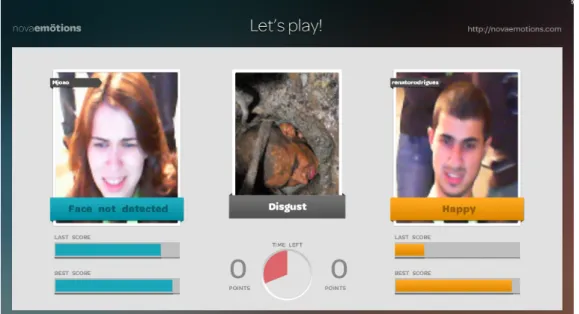
Figure 1.1 shows the game’s main interface. The colored bars represent the scores (top: previous image score, bottom: best score of the round); the numbers in the center represent the global scores; the half circle is the round timer; the image label in the mid-dle is the emotion the players are being asked to mimic and the image attempts to help evoking that emotion; the faces on both sides are the players and the label represents the last expression recognized. Refer to [2] for details on the facial expressions analysis algorithm.
1. INTRODUCTION 1.3. Affective-interaction Data
Figure 1.1: The game interface.
Figure 1.2: Example of Novaemotions dataset.
1.3.1 Data Acquisition Setting
A total of 42,911 facial expressions were captured during the game sessions. These ex-pressions were captured in a novel and realistic setting: humans competing in a game where their facial expressions have an impact on the outcome. Some examples are visi-ble in Figure 1.2. These images offer a novel view of facial expression datasets: players were competing using their own facial expressions as an interaction mechanism, instead of performing a well predefined prototype expression.
This dataset is also unique in the following senses: users faces are not in fixed posi-tions (about 50% of the face images are not front facing and they are at different heights). Existing facial expressions datasets like CK+ [3] or the BU-4DFE [4] datasets were tured in controlled environments. Moreover, facial expressions of CK+ dataset were cap-tured by people trained to perform a prototype expression. Some examples are displayed in Figure 1.3.
Our approach was different: first, the volunteers were asked to perform an expression in a social gaming environment with varying lighting, background and position; second,
1. INTRODUCTION 1.4. Organization
Figure 1.3: Example of CK dataset.
a pure affective-interaction setting where the computer is controlled by the players fa-cial expression; and lastly, each captured image contains the information regarding the expected expression and the one detected by the game algorithm.
1.4
Organization
This thesis is organized as:
• Chapter 3: Crowdsourcing Facial expressions Labels: A crowdsourcing process
must be used to label each image with a facial expression [5]. Given the large num-ber of images collected, it was not possible to have them labelled by an expert. Thus, for that purpose, a crowdsourcing service must be used. This subject will be explored in Chapter 3.
• Chapter 4: Benchmarking Weak-labels Combination Strategies: Once the labels
from the different workers are obtained, the labels concerning the same image need to be merged. Different strategies exist to achieve this goal. Therefore, several popular techniques will be compared and analysed in Chapter 4.
• Chapter 5: Learning Classifiers with Weak-labels: The final purpose of this re-search is to infer if labelling through crowdsourcing is a good and less expensive alternative to the ground truth provided by experts. Chapter 5 details the training of three classifiers with the label set obtained through crowdsourcing and compare it against a ground truth of the same set.
1.5
Problem Formalization
In this thesis the following notation will be used: A set of N images indexed by I =
{1, ..., N} where each imageihas one true label: the ground truth. This is denoted by zi ∈ Z = {z1, ..., zN} that belong to a set of possible labels or classes C. A set of M
workers indexed byJ = {1, ..., M}will label a subset of images Lj = {l
ij}i∈Ij, where Ij ⊆ Iis the set of all labels produced by the annotatorj. Similarly, all labels of an image
iare denoted asLi = {lij}j∈Li, whereLi ⊆ L. Also, the visual features of an imageiis
given byxi.
An annotation model for weakly-labeled data or crowdsourcing method, produces a set of estimated labelsY = {y0, ..., yN} whereyi ∈ Y is the estimated label of image i.
1. INTRODUCTION 1.5. Problem Formalization
The objective of this thesis is to figure the best approach to collect a set of reliable labels Land estimate a set of labelsYto maximize the likelihood between these andZ.
2
Background and Related Work
2.1
Human Computation
As previously mentioned, despite the advances in the computer processing, certain tasks, such as understanding human languages, or semantically analysing an image, are still better performed by humans. Therefore, researchers have been looking for ways to use humans as a computation source: this is known as human computation [6]. Yuen et al. [7] phased human computation systems as follows:
Alternative to machines In the beginning, human computation was used as an
alterna-tive for tasks that are difficult to perform by computers, such as reasoning tasks. Moreover, the majority of these tasks are naturally performed by humans, for ex-ample, distinguishing an image’s components.
Crowdsourcing A second generation of human computation was expanded to use
mul-tiple internet users to solve larger and/or harder problems. For instance, Wikipedia is a distributed human computation system where users around the world con-tribute with their knowledge to build an online encyclopedia.
Gamification The need to give more incentives to make users take part of a human com-putation task allied to the large amount of online gamers. Games are seen as a good way to entertain users while they are producing human computation data.
2. BACKGROUND ANDRELATEDWORK 2.2. Crowdsourcing Research Fields
2.2
Crowdsourcing Research Fields
The expansion of internet has opened the doors for crowdsourcing to emerge. The term crowdsourcing was coined in 2006 by Jeff Howe [8]. In his website [9], Howe defines crowdsourcing as follows:
"Crowdsourcing is the act of taking a job traditionally performed by a designated agent (usually an employee) and outsourcing it to an undefined, generally large group of people in the form of an open call."
Crowdsourcing can be seen as a distributed human computation model in a profes-sional environment, where employees are unknown users around the world. Quinn and Bederson distinguishes human computation from crowdsourcing: "Whereas human com-putation replaces computers with humans, crowdsourcing replaces traditional human workers with members of the public." [10]. There are many advantages in using crowdsourcing. It has been shown [11] that crowdsourcing’s results are reliable and a good alternative to experts’ results, such as natural language annotation, since only a small number of crowdsourcing workers are needed to equal the performance of an expert annotator [12]. Therefore, producing crowdsourcing data is much cheaper than hiring experts. However, crowdsourcing workers are not machines nor experts. Thus, incentives are needed to en-sure their commitment to produce reliable results. The main incentive in crowdsourcing is money: a worker receives a small payment for each completed task. However, money is not the only incentive because workers can be motivated by the idea of contributing to a “greater good" [13]. This "greater good" can be astronomy research [14], or contributing to create synthetic RNA designs [15]. Another type of approach is designing the crowd-sourcing application as a game. These games, where the final goal is to collect some crowdsourcing data, are known in literature as Games With a Purpose (GWAPs) [16]. One of the most known GWAP is the ESP game [17], where the final goal is to collect an image’s labels.
In the literature, crowdsourcing is usually confused with crowdsourcing sites. Crowd-sourcing sites, such as Amazon’s Mechanical Turk (MTurk) [18] and Crowdflower [19], are sites with the purpose of collecting crowdsourcing data. These sites have two groups of people, namely the requesters and the workers, where requesters hire workers to per-form a given set of tasks. However, there are other crowdsourcing approaches, such as Wikipedia, where users share information between themselves without involvement of payment.
Crowdsourcing research fields go beyond collecting crowdsourcing data. Yuen, King, and Leung [20] categorized these in four types: application, algorithm, performance and dataset. However, the expansion of crowdsourcing in later years reshaped some research fields and created new ones. Figure 2.1 outlines a more up-to-date categorization of crowdsourcing research fields. Therefore, we will present an overview of the most rele-vant ones.
2. BACKGROUND ANDRELATEDWORK 2.2. Crowdsourcing Research Fields
Figure 2.1: A diagram of crowdsourcing research fields.
2.2.1 Interaction Strategies
Crowdsourcing is an approach to collect knowledge. However, there are many methods to extract this human knowledge. We need to choose carefully the type of application that we need to build. The most common method is to use a crowdsourcing site to sub-mit a job (set of tasks). Then, the crowdsourcing workers undertake one or more tasks and, after completing each task, they receive a reward. Other methods to collect human knowledge include building a web-based game or a web-platform to share information. In the second case, the reward is not monetary.
2.2.1.1 Crowdsourcing Sites
One of the uses of crowdsourcing is the possibility of collecting annotations. Crowd-sourcing sites like Amazon mTurk and Crowdflower made this process automatic in many ways. For instance, crowdsourcing sites give us a platform to create our tasks and automatically spread these tasks to crowdworkers. The way of collecting crowdsourcing data in these sites is similar to a questionnaire. The template for each task is a voting system (single or multiple choice), a text box (single or multiple lines), or a rating sys-tem. The voting system is the most used template in crowdsourcing sites, mainly to ease the posterior analysis of data and to limit the answer domain per task. In this system, a crowdsourcing worker must choose an answer from a set of possible choices. Despite collecting annotations, there are other purposes for crowdsourcing sites, such as: extract-ing opinions, collectextract-ing common-sense information, collectextract-ing relevance judgements, or even sentiment analysis. However, there are other ways to collect annotations through crowdsourcing. Julia Moehrmann [21] proposed an annotation tool to label large datasets by using a self-organized map (SOM) to cluster image data. With this approach, the user can label many similar images at once. Another approach tool is presented in [22] where users have to select a person’s silhouette using four different protocols: two different coarse object segmentation protocols, polygonal labeling, and 14-point human landmark labelling.
2. BACKGROUND ANDRELATEDWORK 2.2. Crowdsourcing Research Fields
2.2.1.2 Information Sharing Systems
There are some cases where the user has a more complex role in the crowdsourcing task. One of these cases are the information sharing systems, where information is shared be-tween different users. Thus, there is no associated payment. An user can be seen as a worker and a requester: he shares information voluntarily and uses the available in-formation freely. Application such as Wikipedia and Yahoo!Answers are real examples where crowdsourcing is used to share information between internet users. A novel ap-proach in this area is the smartphone application StreetBump [23]. The concept behind this app is to collect road conditions such as holes or bumps. This information is not only useful for helping improving road conditions but also for other users who want to avoid roads that are in bad conditions.
2.2.1.3 Gamification
Gamification is the process of collecting data from a group of users through a game [24, 25]. The main purpose of using a game as a crowdsourcing application is the inherent enjoyment of games, which works as an extra incentive to users. Some data or knowl-edge are hard to collect due to different reasons, such as the natural repetitiveness or the long durations of some tasks, which causes the users to lose interest. Games are the ap-plication type that keeps the users engaged and motivated. The benefits of gamification have been explored in recent years by the community to collect data: unlike laboratory tasks, games provide a fun and engaging environment for the user and, consequently, the produced results are more reliable and genuine. The ESP game [17] is an example of a human computation game. The game consists in providing images for two differ-ent players to label. Once both players write the same label, not necessary at the same time, that label becomes that image’s label. Other good examples of human computa-tion games are ZoneTag [26] and reCAPTCHA [27]. The EteRNA [28] [15] is a browser game, where the goal is to create sequences of ribonucleic acid (RNA), which is an es-sential molecule for controlling several cellular processes. Thus, in this game there are some rules to create these RNA sequences which mimic the chemical interactions that exist in nature. Therefore, the ultimate aim of this game is to create a large-scale database of synthetic three-dimensional RNA sequences.
2.2.1.4 Crowd Creativeness
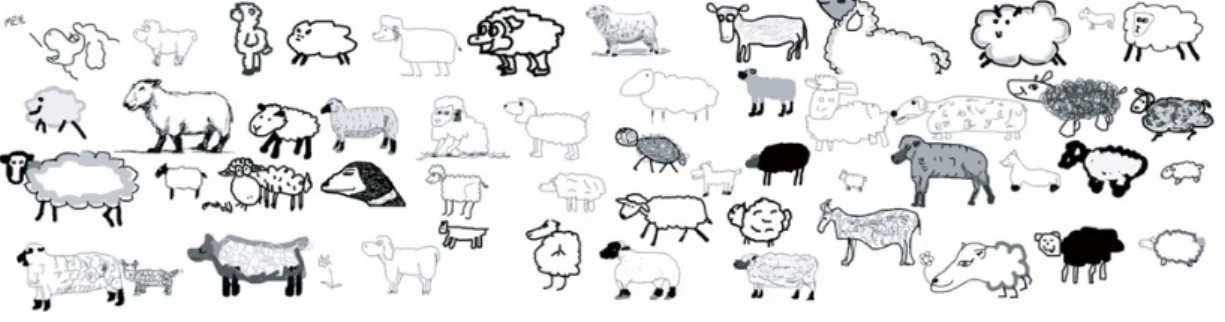
Lastly, we have the tasks that need more than human knowledge. Tasks like drawing or writing a book requires creativity which is perhaps the hardest human skill to simulate. The sheep market [29] is an interesting experience to test the crowdsourcing user’s cre-ativity. This experiment consisted in paying 0.02$ to a crowdsourcing worker to draw a sheep facing left. This resulted in a database with 10.000 drawings, and some of these drawings are presented in Figure 2.2.
2. BACKGROUND ANDRELATEDWORK 2.2. Crowdsourcing Research Fields
Figure 2.2: An example of drawing from The Sheep Market.
2.2.2 Performance
The performance aspect of crowdsourcing systems is very important, since it defines how reliable the crowdsourcing output will be. We are used to associate performance to a computer. In this case, we are interested in optimize human performance. Therefore, the attributes that we must be aware of are different from computers’ attributes, such as the worker eligibility. For example, in the context of this thesis, one must be aware that facial expressions are not universal: different cultures have different ways of expressing emotions [30]. Another important attribute is the price to pay for each task. Mason and Watts [31] presented a study where they compared the relationship between financial incentives and performance. They concluded that increasing the payments increased the quantity of work performed by each user, but not its quality. The time to complete a crowdsourcing task has also been researched. Bernstein et al. [32] showed that is possible to recruit a worker in two seconds and complete all the crowdsourcing process in ten.
2.2.3 Human in the Loop
Sometimes crowdsourcing is a mean to an end, not an end in itself. In other words, crowdsourcing can be part of some system and not be the system itself. Crowdsourcing is widely used in computer algorithms as a way to perform or validate some computer tasks. The systems that use crowdsourcing workers are usually called human-in-the-loop systems. The CrowdDB system [33] aims at extending the SQL language by using crowd-sourcing to solve some problems in the database, such as (1) unknown or incomplete data and (2) subjective comparisons. When the system detects such faults, it automati-cally generates an user interface in Mechanical Turk and the task to request a worker to solve the problem. After the crowdsourcing process finishes, the collected information is inserted in the database.
Crowdsourcing can also be useful to improve results in the field of image search. Human skills are not just a good alternative to computers algorithms but they are also a good way to validate them. One example of this concept is the image search system CrowdSearch, where it combines automated image search, by taking a picture with a
2. BACKGROUND ANDRELATEDWORK 2.2. Crowdsourcing Research Fields
Figure 2.3: A subtree of ImageNet database.
smartphone, with real-time human validation where Then, image features are extracted and uploaded to a back-end server where an automated image search engine is executed to find a set of similar images (candidate images). The resulting set of images is given to crowdsourcing workers to validate them: workers specify if the candidate images contain the same object as the picture or not.
2.2.4 Dataset
As shown in the previous section, a lot of research has been made to improve crowdsourc-ing algorithms, we need datasets to validate these algorithms. In fact, several crowd-sourcing datasets have been published, which also enable the improvement of the state-of-the-art algorithms. Dataset ground-truth can be divided in three categories: (1) binary; (2) multiple-level; (3) ranked. These categories are determined by the type of the judge-ments collected (see Section 2.2.5).
There are many crowdsourcing datasets available for research. One of the most pop-ular is the dataset collected with the ESP Game [17] which consists of 100,000 images with the respective labels. This proved the advantages of using crowdsourcing as a way to create a large dataset at a low cost. Other good example is the Galaxy Zoo [14], and their later extended version - the Galaxy Zoo 2 [34], which is a web-based project where everyone can participate by helping to catalogue a large number of galaxies. This project resulted in a dataset [35] [36] with nearly one million galaxies annotated by 100,000 par-ticipants, corresponding to a total total of 40 million judgements, which represents an enourms advance in the astronomical field. On the other hand, crowdsourcing can be also used to validate computer results. This idea was used by Deng et al. [37] to create the ImageNet database. In fact, they build an image database based on the WordNets hierarchical dataset [38] structure. This process consisted on collecting 500-1000 candi-date images from search engines for each node of WordNets, which are called synsets Deng et al. All synsets are hierarchical connected through a hyponymy relation (i.e. the node "dog" is a child of the "canine"). In Figure 2.3. we also represent one example of a subtree of this database. Nowadays, this database includes 21,841 synsets with an over-all of 14,197,122 images (an average of 650 images per synset). Finover-ally, to validate the images, the authors resorted to a crowdsourcing task in the Amazon Mturk, where they presented to each worker a candidate image and its respective synset. Thus, workers had
2. BACKGROUND ANDRELATEDWORK 2.2. Crowdsourcing Research Fields
to specify if the presented image contained one possible object of the presented synset. 2.2.5 Types of Judgements
Depending on the information domain, different definitions of relevance are more ade-quate than others. Three types of relevance judgments are easily identified in the litera-ture:
• Binary relevance: under this model a document is either relevant or not. It makes the simple assumption thatallrelevant items contain the same amount of informa-tion value.
• Multi-level relevance: one knows that documents contain information with
dif-ferent importance for the same query, thus, a discrete model of relevance (e.g., rel-evant, highly-relrel-evant, not-relevant) enables systems to rank documents by their relative importance.
• Ranked relevance: when documents are ordered according to a particular notion
of similarity.
The binary relevance model is the most common practice in HCI and AI systems. These systems are tuned with a set of judgements that reflect the majority of experts’ judgements. The multi-level relevance provides the annotator with more expressive power than with binary relevance - e.g. workers feel more comfortable with three or four levels of relevance-intensity instead of only true/false. The relevance judgements of the ranked relevance model are actually a rank of documents that exemplify the human perception of a particular type of similarity, e.g., texture, colour. In practice, for the task at hand, only the binary or the multi-level judgements are viable.
2.2.5.1 Assessors Agreement
The judgements quality of crowdsourcing jobs has been the matter of much research, [11]. Traditionally, expert annotations are obtained through processes that eliminate problems of inconsistency and bias. Volkmer, Thom, and Tahaghoghi [39] followed the following rules to improve judgements’ quality: (1) assessors annotated a sub-set of the documents with a sub-set of the labels (this avoids the bias caused by having the same person anno-tating all data with the same concept); (2) all documents must receive a relevance ment from all annotators (this eliminates the problem of incomplete relevance judge-ments but increases inconsistency); (3) docujudge-ments and labels were assigned to annota-tors so that some documents received more than one relevance judgement for the same label, thereby eliminating the inconsistency problem if a voting scheme is used to decide between relevant and non-relevant. This annotation study was a quite formal and expen-sive process. Nowak and Rüger [11] compared the judgements quality of expert to that
2. BACKGROUND ANDRELATEDWORK 2.3. Annotation Models for Weakly-labeled Data
of individual workers. They confirmed through several statistical measures that the ag-gregated results of the non-experts (crowdsourcing workers) are comparable to the ones created by experts.
2.3
Annotation Models for Weakly-labeled Data
Labels produced by non-expert annotators lack credibility. To tackle this problem, many methods have been proposed to infer true labels from weakly-labels. The most common method is the "majority vote", where the estimated label is the label with more votes. This approach works well in our society when we have to elect someone: for example, a president, since every citizen’s opinion have the same weight in this process. However, the annotation process where many annotators contribute with their own labels does not need to function in the same manner, since every worker has his own area of expertise and his interpretation may be different from the others. For this reason, many models that outperform the majority vote have been proposed. In this section we will briefly describe some annotation models. However, in Chapter 4 we will present a more detailed explanation of the most known annotation models: Dawid and Skene (DS) [40], GLAD [41], CUBAM [42], Raykar [43], Zen [44] and Majority vote.
The majority of these models are based on the Expectation Maximization (EM) algo-rithm [45]. Dawid and Skene [40] were the first to use the EM to infer the experts’ bias and also the unknown label. However, more models were researched after the expansion of crowdsourcing.
Later in 1995, Smyth et al. [46] proposed a model based on EM algorithm to infer the true label from a set of expert annotators. They produced an experiment using 4 expert annotators which had to label a ROI’s (Region of Interest) for satellite images of Venus. Annotators had to choose if the ROI contained a vulcano or not. To do so, annotators could choose between 5 confidence levels. Later, due to the simplicity of collecting labels from non-expert annotators, the necessity to clean noisy labels from datasets started to grow.
In 2009, many models emerged to tackle the problem of weakly-label data. Donmez, Carbonell, and Schneider [47] were the first to propose a method to infer each annotator’s expertise and choose the best ones for active learning. This model is based on a Interval Estimation (IE) learning algorithm, which estimates a confidence interval of an expected response, given an action, and then returns the highest confidence interval. With this approach, the authors use the IE assuming that the action is: choose an annotator from an oracle to label a dataset unit. This strategy allows us to estimate the most competent annotators to label a given dataset unit.
Later, Whitehill et al. presented GLAD, a probabilistic model to infer the probability of an attribute being present in an image. Unlike majority vote, GLAD estimates not only the true label but also the annotators accuracy and the image difficulty. To estimate these parameters, GLAD uses Expectation-Maximization approach (EM). This model is
2. BACKGROUND ANDRELATEDWORK 2.3. Annotation Models for Weakly-labeled Data
frequently used in literature.
Peter Welinder et al. proposed the CUBAM model [42] which is a generalization of the GLAD model. In this model, the image difficulty is represented by a high-dimensional concept. Instead of being parametrized by a value representing the image difficulty, an image is parametrized by a vector of task-specific measurementsxi that are available to
the visual system of an ideal annotator. A way of thinking about it is to consider the vector to be a representation of visual features. Different annotators have different inter-pretations of the same image, therefore, each annotator will perceive a corrupted version ofxi, due to the noisenij caused by his interpretationyi = xi+nij. Each annotator is
parametrized with a vectorwj representing the annotator’s expertise among all
compo-nents of the image. With this approach, each annotator is not classified as being good or bad. Instead, this model finds the "areas of strength" of each annotator.
Simultaneously, the same author proposed an online crowdsourcing algorithm [48] based on EM algorithm for requesting only labels for instances whose true label is un-certain. Additionally, they infer who are the best annotators, prioritize these, and block the possibly noisy annotators. They formalize the expertise of each annotator for binary, multi-valued and continuous annotations.
Another model based on EM algorithm was proposed by Raykar et al. [43], where they estimate the true label while modelling a classifier. This model assumes that each annotator has two attributes: sensitivity and specificity. If we consider a binary model where labels can assume values 0 or 1, these attributes can be interpreted as the expertise of the annotator in identifying the label 1 and label 0, respectively. Then they use the EM algorithm to iteratively compute the maximum-likelihood and the optimal values for the sensitivity and specificity that maximizes this likelihood. Chittaranjan, Aran, and Gatica-Perez [49] proposed a similar solution in the context of detecting psychological traits. However, these models assume that the expertise of an annotator is not dependent of the instance to label.
Tang and Lease [50] proposed a semi-supervised naive bayes approach. This model assumes that the input data has both unlabeled data and data labeled by experts. Initialy, the unlabeled data is labeled by the majority vote of all worker’s votes. Then, they use a EM approach to iteratively find two parameters: the set of class priors and the probability of a given worker classifying an example of a specific class given the true label. Based on this parameters, they re-estimate the labels for the initial set of unlabeled data. This process is repeated until convergence.
Kamar, Hacker, and Horvitz [51] proposed a system called CrowdSynth, which uses machine vision, machine learning and decision-make to predict both the correct label and the necessity to hire more workers to achieve a good agreement. They created a model using a Naive Bayes approach to predict the correct label of a given task. At the end of each iteration, the system runs a second model that predicts the state of the system that would come with the hiring of an addition worker and decides if is needed to hire more workers or if the execution can be terminated. This system was modelled with a Markov
2. BACKGROUND ANDRELATEDWORK 2.4. Facial Expressions Datasets
Decision Process (MDP) approach.
Mcduff et al. [52] collected and analysed crowdsourcing data of dynamic, natural and spontaneous facial responses while viewers were watching online media. The authors believe that facial responses are a good way to measure user’s engagement with content. Such information is ultimately for content creators, marketeers and advertisers.
2.4
Facial Expressions Datasets
Humans are able to recognize different facial expressions and infer what emotion that expression conveys. Ekman [53] defined a total of six basic universal emotion expres-sions: Happiness,Sadness,Surprise,Fear,AngerandDisgust. Neutral, a state of no visible expression, andContempt, a mixture ofAngerandDisgust, are also part of Ekman’s suit of facial expressions of emotions. These are the expressions we have chosen in our work. However, changes in facial expression can be more subtle, like moving the outer section of the brows or depressing the corners of the lips. The expressions described above can be defined as a set of Action Units (AUs). An AU is an action performed by one or more muscles of the face that humans are able to distinguish. A full description is available at Tian, Kanade, and Cohn [54]. Even using AUs, some expressions are similar: Fearis composed by the same AUs assurpriseplus other 3 AUs [55].
Due to the difficulty of labeling facial expressions by a computer algorithm, crowd-sourcing is a reliable way of determining labels for facial expressions since workers are accostumed to analyse facial expressions in their everyday lives. Barry Borsboom [56] created a crowdsourcing game that consists of a similar version of the board game "Guess who?", where players have some animated faces and have to pick one. The goal of the game is to be the first to determine which face the opponent has selected, while resort-ing to askresort-ing "yes or no" questions to his opponent. Based on the questions it’s possible to collect the attributes of each facial expression in the database. The facial expression database used in this game was ADFES [57], which is filled with actor’s facial expres-sions, meaning that these facial expressions are not genuine, i.e the actors were forced to perform those facial expressions.
Chen, Hsu, and Liao [58] proposed a method to leverage photos in social groups like Flickr and removing noisy photos through crowdsourcing, in order to acquire effective training photos for facial attribute detection. The collected results were very similar to those of manual annotations.
There are many other datasets with facial expressions. Table 2.1 (adapted from [59]) shows a comparison between the most popular facial expressions datasets. As presented in the table, the majority of the datasets are collected in laboratory, where emotions are induced through different methods, with videos being the most used tool. Unlike these datasets, our dataset was captured in a realistic scenario, where players were aware that their facial expressions can control the game.
2. BACKGROUND ANDRELATEDWORK 2.4. Facial Expressions Datasets
References Elicitation method Size Emotion description
Label-ing Accessibility Kanade, Cohn, and Tian [60] Posed 210 adults, 3 races; Category: 6 basic
emotions, and FACS Y
Sebe et al. [61] Natural: Subjects watched emotion-inducing videos
28 adults Category: Neutral, happy, surprise
Self-report N
Pantic et al. [62], [63]
Posed: static images, videos recorded simultaneously in frontal and profile view; Natural: Children interacted with a comedian. Adults watched emotion-inducing videos Posed: 61 adults Natural: 11 children and 18 adults. Overall: 3 races Available: 1250 videos, 600 static images Category: 6 basic emotions, single AU and multiple AUs activations FACS, Ob-server’s judg-ment Y O’Toole et al. [64] Natural: Subjects watched emotion-inducing videos 229 adults Category: 6 basic emotions, pizzle, laughter, boredom, disbelief Ob-server’ judg-ment Y Yin et al. [65]
Posed: 3D range data by using 3DMD digitizer.
100 adults
Mixed races Category: 6 basic emotions.Four levels of intensity Ob-servers’ judg-ment Y Gunes and Piccardi [66]
Posed: two cameras to record facial
expressions and body gestures respectively 23 adults Mixed Races Available: 210 videos Category: 6 basic emotions, neutral, uncertainty, anxiety,boredom N/A Y Chen [67] Posed 100 adults, 9900 visual and AV expressions Category: 6 basic emotions, and 4 cognitive states (interest, puzzle, bore, frustration)
N/A N
Roisman, Tsai, and Chiang [68]
Natural: subjects were interviewed to describe the childhood experience 60 adults Each interview last 30-60min Category: 6 basic emotions, embarrassment, contempt, shame, general positive and negative
FACS N
Bartlett et al. [69]
Natural: subjects were tried to convince the interviewers the were telling the truth
100 adults Category: 33 AUs FACS N
SAL [70]
Induced: subjects interacted with artificial listener with different personalities 24 adults 10h Dimensional labeling/categorical labeling FEEL-TRACE Y Douglas-Cowie et al. [71]
Natural clips taken from television and realistic interviews with research team 125 subjects, 209 sequences from TV, 30 from interview Dimensional labeling/categorical labeling FEEL-TRACE Y
2. BACKGROUND ANDRELATEDWORK 2.5. Summary
2.5
Summary
In this chapter we presented an overview of the most relevant crowdsourcing research fields. The works described show us that crowdsourcing is a good source for collecting reliable and large amounts of data, although we believe that crowdsourcing is only on its early stages and a lot of work is needed in some of its research fields. One of these fields is the crowdsourcing models, where only few models are capable to handle with multi-level judgements. In addition, we believe that for problems where the aim is to infer the true label of an image, visual features can be useful. However, only Raykar uses it.
3
Crowdsourcing
Facial Expressions Labels
3.1
Building a Real-World Facial Expressions Dataset
We resorted to CrowdFlower site to collect labels for a facial expressions dataset – the NovaEmotions dataset [1]. Figure 3.1 presents some examples of these facial expressions which were collected through a gamification process where players affectively interact with a game. The objective of this game is to perform the facial expression challenged by the game. While players try to perform the facial expression a score of the current facial expression is represented to the player. The player who better performs this chal-lengedfacial expression wins the round. In total, more than 40,000 facial expressions were collected through the NovaEmotions game.
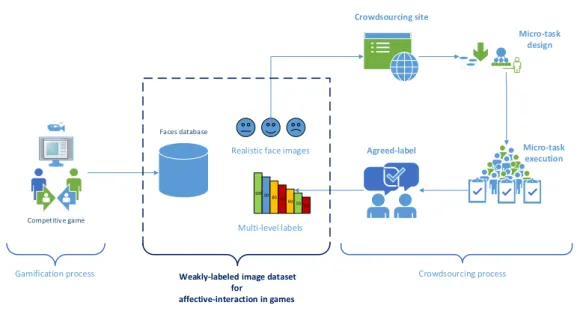
Figure 3.2 depicts the entire process used to collect the dataset. In the left side, is represented the gamification process to collect the facial expressions and described in [1]. This chapter describes how these real-world facial expressions were annotated via a crowdsourcing process. The design of the crowdsourcing process included the worker’s interface and the attributes that directly influenced the results quality. The correct values of the crowdsourcing process attributes were also estimated through experimentation. After collecting the labels, we analysed the worker’s agreement to understand how reli-able are these crowdsourcing labels.
In this chapter, we will present the process to collect crowdsourcing labels for this dataset, the NovaEmotions. The design of the crowdsourcing job was carefully planned:
3. CROWDSOURCING
FACIALEXPRESSIONSLABELS 3.2. Optimizing Intra-Worker Agreement
Figure 3.1: Example faces from the dataset.
we obtained several judgements per image, each facial expression was linked to an in-tensity, and different worker selection criteria and batch jobs were inplace to reduce bias. This effort is also particularly relevant because, the annotations of a facial expression im-age will not be a binary label, but a distribution across the different expression labels. This is extremely useful for creating better affective-interaction models.
3.2
Optimizing Intra-Worker Agreement
The main objective of a crowdsourcing task is to obtain a set of label that all annotators agree with. An estimated label that is consensual among all annotators has more prob-ability of being correct than a non-consensual one. The agreement for the imageiis the number of votes for the winner label over the total of votes for the imagei, as presented in 3.1. Thus, we will choose the labellij that maximizes the agreement for each imagei
Agreement(i) = 1
|Li| X
j∈Li
1yi(lij). (3.1)
This corresponds to a majority voting approach, where the estimated label of an im-ageiis the most voted label. In this chapter, we will use the majority voting technique to estimate the true labels of an image and in chapter 4 other models that try to improve the overall judgements quality will be examined.
3. CROWDSOURCING
FACIALEXPRESSIONSLABELS 3.3. Crowdsourcing Task Design
Crowdsourcing site
Faces database
100 9080 70 60 5040 Realistic face images
Multi-level labels Micro-task execution Agreed-label Micro-task design Competitive game
Weakly-labeled image dataset for
affective-interaction in games
Crowdsourcing process Gamification process
Figure 3.2: The gamification and crowdsourcing processes to generate the facial expres-sions dataset.
3.3
Crowdsourcing Task Design
In this section we identify the key factors that affect crowdsourcing results, and also present the experiments that led to the most reliable values. These factors can be divided into two groups, worker qualification and job attributes.
The worker interface is presented in Figure 3.3. In this interface the worker must (1) explicitly select the player’s facial expression, and (2) select theintensity of the facial expression. This second action is intended to disambiguate and quantify the certainty of a worker’s annotation. It is important do limit the set of choices and when possible not include text fields because this leads to open responses problems when matching labels. When building the interface we followed closely two important design principles:
1. The interface must be as simple as possible, a cluttered interface will lead to work-ers’ fatigue.
2. The workers’ interface should not require much interaction. This not only helps preventing workers’ fatigue, but also allows to save time and consequently money. As we shall see, the crowdsourcing task design goes much beyond the visual aspect of the workers interface.
3.3.1 Answers domain
The answers domain needs to be as short as possible for two reasons: (1) A high number of answers will demand more attention from the worker which contributes to her bore-dom. (2) The posterior data analysis will be easier. The answers must be clear and can not be ambiguous. For example, one can not have the answerHappyand the answer Smil-ing. Our answers domain will be the following facial expressions labels:Angry,Contempt,
3. CROWDSOURCING
FACIALEXPRESSIONSLABELS 3.3. Crowdsourcing Task Design
Figure 3.3: Worker interface.
Disgust,Fear,Happy,Neutral,Sad,Surprise. To this list we addedAmbiguous expressionfor images in which the facial expression is not entirely clear and alsoNot a face.
3.3.2 Selecting a Pool of Workers
To be accepted in a job, a worker must pass some qualification criteria. Due to the dif-ference in skill between workers, we need to find the group of workers that best suits a given micro-task. In our crowdsourcing job we would like to rely on common knowl-edge to interpret facial expressions. Therefore, our worker qualification process is based on the following attributes:
Cultural background As shown in [30], facial expressions are not culturally universal. Each country has its own culture, customs and non-verbal communication traits. Therefore we needed to use a group of workers that were culturally close to the players of the game. To ensure this, it is possible to include or exclude countries from a list of allowed countries.
Limiting the number of judgements per worker The maximum number of judgements
a worker is allowed to complete can be limited. A small number can significantly increase the duration of a job because more workers will be required, while a large number will require less workers, but it may be too tiresome and/or distracting for each worker after several micro-tasks.
3. CROWDSOURCING
FACIALEXPRESSIONSLABELS 3.4. Tuning Jobs
Job Micro-task/Page Judgements Workers Cost/Micro-task Agreement
#1 20 10 102 0.004 $ 70.69 %
#2 115 5 32 0.004 $ 70.79 %
#3 20 5 93 0.009 $ 72.81 %
Total - 20 227 0.017 $ 69.18 %
Table 3.1: Job’s parameters. 3.3.3 Job Attributes
Besides the worker’s cultural background and maximum amount of allowed judgements, there are other finer-grain job attributes that must be parametrized. The attributes that mostly influence the job’s quality and cost are:
Gold questions The quality of a worker can actually be determined during a micro-task. For that, one must provide gold questions where the worker is tested with pre-labelled images. The worker must answer correctly to at least four gold questions, before performing further micro-tasks.
Price per micro-task The price per micro-task is the most difficult attribute to estimate. This is correlated with other factors such as: worker’s country or task difficulty. Since the price per each micro-task can make the job cost increase significantly, one must define the price-quality ratio wanted.
Minimum number of judgments A job is divided into several pages and each page has
a predefined number of micro-tasks. Usually a worker completes at least one page, making this parameter also work as the minimum number of judgements a worker must complete.
Judgements per image In this case, a micro-task is an image that must receive a given number of judgements. The larger the number of judgements, the greater the confi-dence of our task design. At least five judgements per image were collected in each job.
3.4
Tuning Jobs
In this section we present the results collected through crowdsourcing with a subset of our dataset. By running these experiments, we were able to estimate the best parameters that should be used for the full dataset. We ran three jobs, in a non-parallel way, to find the best parameters. Each job contributed to understand how one parameter should be set. The submitted jobs can be seen in Table 3.1. In total we run 3 tuning jobs. In the way CrowdFlower works, workers involved in a job were not the same as in other jobs. For that reason, one job may have better workers than the other job and consequently achieve better results.
3. CROWDSOURCING
FACIALEXPRESSIONSLABELS 3.4. Tuning Jobs
3.4.1 Setup
We collected a sample of 500 images from our dataset and used this subset in all tun-ing jobs. The considered images had an equal distribution of labels, and an automatic algorithm was capable of detecting them correctly.
As explained above, cultural differences were considered by selecting only English speakers in Europe, US and Australia. The first parameter to tune is the number the judgements because this works as a multiplier in the final price to pay. Therefore, find-ing this parameter in the first job allows us not to spend more than necessary in the following jobs. Moreover, this value can be easily tune by requesting a large number of judgements and posteriorly analyse how many judgements were needed to converge to a label. This trick can also be used to find the best maximum of judgements per worker: we did not limit the number of micro-tasks per worker and posteriorly we analysed how many judgements an average worker can perform without decrease his performance. For the other parameters, we used values of reference based on literature. Thus, we choose to have 20 micro-tasks per page which allows workers to quit every 20 micro-tasks per-formed and pay 0.004$ for each completed micro-task.
3.4.2 Number of Judgements per Image
In the first job, we wish to find how many judgements an image needs to achieve a con-sensual result. By collecting 10 judgements per image we guarantee that we have a larger than the optimal number of judgments.
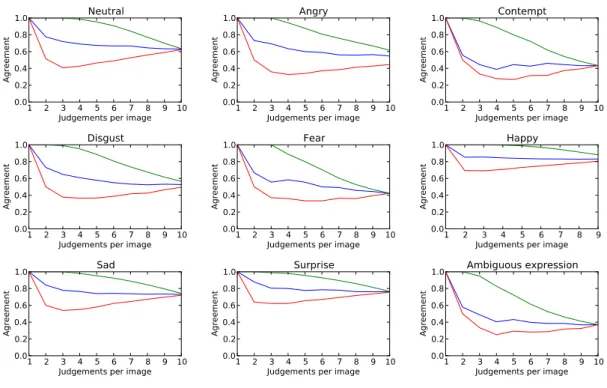
Figure 3.4 shows the evolution of annotations agreement as votes arrive for each facial expression. In these charts we plot the average agreement for all images of each facial expression. The green line shows the best sequence of votes to keep a high agreement (the first incoming votes are consensual). The red line shows the worst sequence of votes, in other words, the sequence of votes that keep the agreement at a low value. The blue line is a random sequence of votes and is the line that is most likely in a realistic scenario. Letyi be the estimated label for the imageiandqthe facial expression that we want to
analyse. Considering the setSq ={i∈ I :yi =q}. We can model the annotating process
as a sequence of votes as follows:
fq(x) = 1 |S| X i∈S 1 x x X j=1 1yi(lij) (3.2)
3. CROWDSOURCING
FACIALEXPRESSIONSLABELS 3.4. Tuning Jobs
Figure 3.4: Average of image’s agreement over number of judgements. The blue line is a random sequence of judgements per image, the red line is the worst sequence, and lastly, the green is the best sequence.
The mainly objective of this tuning job is to infer the optimal value of judgements per image. The results shows us that the agreement converges almost for every facial expression when the number of judgements is 5. Therefore, we do not need to pay for 10 judgements and consequently duplicate the costs. The Figure 3.4 also shows us the dif-ference of judgements between all facial expression. The area between the green line and the red line, shows the discrepancy of judgements between workers, so the area increases with the number of different labels voted. For example, the facial expressionhappyhas the smallest area, which means,happyis confused with few labels (neutralmostly). It is interesting to note that the facial expressionshappyandsurpriseonly need, approximately, 3 votes to stabilize at an agreement’s value. If we could set a constraint at CrowdFlower to stop collecting judgements from an image that already has 3 judgements and ishappy
orsurprisewe could decrease the job cost without decreasing the results quality.
In summary, Figure 3.4 shows that we do not need a large number of judgements per image to infer the best estimated agreement. In the majority of facial expressions, the agreement stabilizes with only 5 judgements.
3. CROWDSOURCING
FACIALEXPRESSIONSLABELS 3.4. Tuning Jobs
50 100 150 200 250 Micro-task number 0.0 0.2 0.4 0.6 0.8 1.0 Agreement 50 100 150 200 Micro-task number 0.0 0.2 0.4 0.6 0.8 1.0 Agreement
Figure 3.5: The blue line is the average of agreement for thenthjudgement of each worker. Each red dot is the agreement of one worker for thenthjudgement. The area around the blue line is standard deviation. On the left side, is presented the analysis of the first job where workers. On the right side.
3.4.3 Number of Judgements per Worker
For this experiment we changed the number of micro-tasks per page. As we can see in Table 3.1 we increased this value from 20 to 115. Each worker will complete several sets of 115 micro-tasks per set, being 115 the minimum number of judgments a worker must complete. To assess workers endurance over a large number of micro-tasks per page, we plot the mean of workers’ agreement over time on Figure 3.5. On the left side is presented the first job where workers had to perform 20 micro-tasks per page, whereas on the right side is presented the second job where workers had to perform 115 micro-tasks per page. As we can observe, for the highest value of micro-task per page (right picture), the line on the chart decays for workers who perform more micro-tasks. In contrast, small values of micro-tasks per page (left picture), show us that workers with more micro-tasks are those who perform more reliable results.
As expected, there is a significant number of workers who perform fewer micro-tasks. Therefore, the standard deviation increased over time in both jobs. Comparing the stan-dard deviation in both jobs, the second job had less workers than the first one, so, the standard deviation has increased in global. This decay in agreement in the second job is not a coincidence, because we can notice that this decay starts around the 116th micro-tasks which is the start of a new set of micro-micro-tasks. So, we can conclude that a minimum judgements per image achieve better results and workers whose performs more judge-ments are better. Therefore, we will not limit the worker’s judgejudge-ments and we will use the value of 20 micro-task, mainly because this allow the workers to quit the job as soon as they want because each page has few micro-tasks and with this ensure the focus and commitment of each worker. This will avoid situations like the second job where workers starts a new set of micro-tasks but got bored in the middle of it.
3. CROWDSOURCING
FACIALEXPRESSIONSLABELS 3.4. Tuning Jobs
Figure 3.6: Worker’s location 3.4.4 Worker’s Payment vs Geographic Location
The worker’s payment is an important parameter since it is related to the worker’s mo-tivation. It is important to highlight that the amount paid to each worker is strongly related to the complexity of the micro-task and the time required to complete it. Another factor that is important to consider is the worker’s location. We must be aware that users from different countries have reward expectations. Therefore, if we hire workers from developed countries we have to pay more than to a workers from developing countries. In our case, we only hire workers from countries which have English as the native lan-guage and were in Europe, Australia or in the US.
In our case, our task presented a very low difficulty - the worker only had to identify a person’s facial expression in an image. This is almost an instantaneous task and requires only a few seconds to complete. Therefore, we set up the price to 0.004 $ in the first two jobs. The third tuning job had the objective to infer the optimal value to pay for each completed micro-task. We increased the price for more than 100 % and as expected, we achieved better results than the initial two jobs as show in Table 3.1, approximately2%. We believe it is not worthy to have the double of the costs for an improvement of 2% in accuracy. Thus, to secure a final agreement above 70% we increased the initial values by 50%, paying each worker 0.006 dollars per judgement.