Carolyn Jeziorski
Cairo American College
[email protected]
NESA Spring Educators’ Conference 2014
Bangkok, Thailand
“Using Blogger to Encourage Independent Student
Writing”
Link to presentation:
https://docs.google.com/presentation/d/1wvMCdx3cS
69WGRMzh2_InGoN6_B1jDP6Z8m75qjwTqg/edit?usp=
sharing
650 The Reading Teacher, 62(8), pp. 650–661 DOI:10.1598/RT.62.8.3 © 2009 International Reading AssociationISSN: 0034-0561 print / 1936-2714 online
Stephanie was worried about this development. She decided to go to her students, to find out what they could do together to use the blog in more thoughtful ways. Stephanie started an online discus-sion on the class blog, and her students shared these comments:
“Can I put one of my poems up there?”
“I want to be able to post questions to the blog and have my classmates answer them.”
“I really want to write about the book I am reading at home...not just what I think will happen next in
Spiderwick.”
These comments opened up important issues for Stephanie, issues that are essential for all of us to consider as the Internet enters our reading and lan-guage arts classrooms.
The purpose of this article is to explore ways in which blogs can support literacy programs, espe-cially to develop higher order thinking (HOT) while reading and writing. First, I will provide an introduc-tion to and a theoretical raintroduc-tionale for blogging. Next, resources and ideas will be shared to help spark pos-sibilities for blogging in an intermediate-grade class-room. Four common types of educational blogs will be presented. Finally, HOT blogging, an instructional framework that uses a blog to develop higher order thinking, will be described.
What Is a Blog?
A blog, short for weblog, is an easily editable webpage with posts or entries organized in reverse chronologi-cal order. Many different formats for blogs are emerg-ing (Mortensen, 2008), and the features that are used depend on both the blogger and the tools provided by the blog host.
I
t is Sunday evening. With a steaming cup of English Breakfast tea by her keyboard, Stephanie LeClair (pseudonym) navigates to the blog she recently set up for her classroom. She is curious to see what her fifth-grade students have posted over the weekend.Stephanie, a dedicated literacy educator, had recently incorporated a response blog into her cur-riculum. She felt doing so would integrate writing in a way that supported reading. Stephanie posted open-ended prompts to her blog about The Spiderwick Chronicles by Holly Black and Tony DiTerlizzi (2003). The prompts invited students to share their respons-es. In addition to integrating writing to support read-ing, classroom blogging prepared students for the new literacies of the Internet (Lankshear & Knobel, 2003, 2006; Leu et al., 2007).
Not having previously blogged herself, Stephanie began her journey by spending an hour with the school’s technology teacher, Ms. Lowe (pseudonym). Ms. Lowe introduced her to Edublogs, at edublogs. org, one of the many free blogging sites for educators. By the end of the day, Stephanie had not only started her classroom blog but also started to connect in-school and out-of-in-school new literacies (Alvermann 2002; Hinchman, Alvermann, Boyd, Brozo, & Vacca, 2003; Hull & Schultz, 2002).
The weeks progressed smoothly. Stephanie was posting regularly and her students were commenting on the prompts she posted. Quickly, however, she be-gan to sense student interest waning. Comments were becoming more brief, superficial, and formulaic.
Blogging is an easy way to begin
preparing elementary students for
the new literacies of the Internet.
HOT Blogging: A Framework for
Blogging to Promote Higher Order
Thinking
teacher may assign a specific page of the blog to a single student. A parent searching for that student’s writing would easily locate the writing on that stu-dent’s page through a list of names in a side column of the blog. Similarly, a category for “artwork” might be created allowing readers to find all student posts across the blog related to artwork. Some additional features that blogs may include are language transla-tors, calendars, and photo viewers. The blog’s author, or blogger, determines which features are used.
Why Bother Blogging:
A Theoretical Rationale
The Internet is this generation’s defining technology for literacy (Coiro & Dobler, 2007; Leu, Kinzer, Coiro, & Cammack, 2004; Leu et al., 2007). It is home to a continuously emerging set of new technologies for literacy such as search engines, e-mail, blogs, wi-kis, instant messenger, social networking tools, and many others yet to emerge. Each requires new skills and strategies. Schools need to prepare students for Typically, a blog consists of a header and two to
three columns. Figure 1 depicts a simple three-col-umn blog. The center colthree-col-umn is often home to the most recent post (text entry) by the author. Reader comments (replies or responses to the author’s post) on this blog can be found in the right-hand column. Blog comments can often be found immediately un-der the post to which the comments refer. The new-est posts appear first, and all posts include both a title and date. The archive houses older posts and comments. This archive usually appears in the left- or right-hand column. The left-hand column in Figure 1 also includes a blogroll (i.e., links to other blogs or frequently visited websites) organized in list fashion and often by category. In this way, the author and in-terested readers can visit related blogs from one cen-tral location with ease.
Blogs can have multiple pages. Pages and catego-ries are two additional ways to organize posts and comments on a blog. These areas are similar to file drawers full of folders. Each page/category can hold links or posts related to a specific topic or student. A
Figure 1
Simple Blog With Common Features
Older blog posts
Links to other blogs or websites of interest
Most recent post by blog author Header based on theme chosen. Remains consistent across pages
652 The Reading Teacher Vol. 62, No. 8 May 2009
and learning to communicate safely—all can be de-veloped within the context of blogs.
Perhaps, however, the most cogent reason for classroom blogging comes from Mary Kreul, a teach-er widely known for hteach-er online classroom work, from Richards School in Whitefish Bay, Wisconsin (Leu, Leu, & Coiro, 2004). When asked, “Why should edu-cators take the time to blog?” Ms. Kreul replied,
I think the biggest advantage to blogs is that they pro-vide an authentic audience for student writing and work in general. In the past the teacher was usually the only person who read student work. With a blog, student work can be read by classmates, parents, extended family members, school community mem-bers, project partners, classroom teachers, pre-service teachers, and anyone around the world who locates the class blog. (Personal correspondence, December 2008)
Four Common Types
of Blogs Found
in Elementary Classrooms
Some of the most common types of blogs being used in schools today are Classroom News Blogs, Mirror Blogs, Showcase Blogs, and Literature Response Blogs. Blogs often incorporate more than one of these primary functions and, given the creative minds of effective teachers and the rapidly changing nature of literacy on the Internet, many more types will emerge.
Classroom News Blog
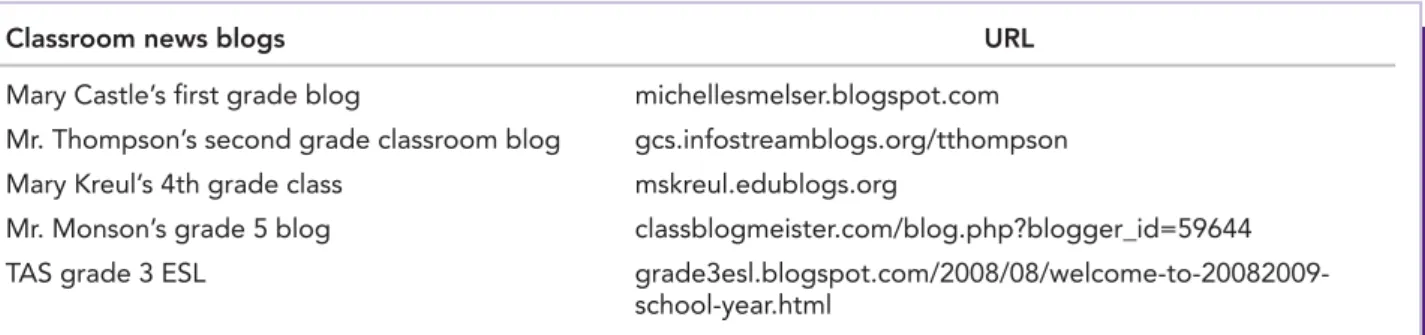
Many classroom blogs are used to share news and information with parents and students. Often, this is the first type of blog a teacher will use (Richardson, 2006). Teachers update classroom news blogs on a regular basis, posting homework assignments, providing updates on curriculum for parents, and sharing any other information that could benefit the home–school connection. Examples of a classroom news blog can be found in Table 1.
Mirror Blogs
Mirror blogs allow bloggers to reflect on their think-ing—hence the mirror metaphor. A teacher may post a response about a workshop recently attended, shar-ing insights gleaned. While readshar-ing a new profession-al book on literacy, a blogger might post quotes or these new literacies by integrating them into the
cur-riculum, and blogs are an easy way to begin. Some believe that we simply need to place com-puters in the hands of our students, and they will learn what they need (Negroponte, 2006). Yes, many of our students can develop basic tool use without instruction. We see them on the Internet at home, communicating through instant messenger (Lewis & Fabos, 2005), blogs (Mortensen, 2008), and other online tools (Lenhart & Madden, 2005). One survey has reported that some 12 million adolescents aged 12–17 maintain their own blogs in the United States (Lenhart & Madden, 2005). However, simply using these tools does not predicate effective and efficient use. Howard Reingold (2006) summed it up well by describing our students in this way:
This population is both self-guided and in need of guid-ance, and although a willingness to learn new media by point-and-click exploration might come naturally to today’s student cohort, there’s nothing innate about knowing how to apply their skills.... (n.p.)
Furthermore, a blog does not simply develop com-munication skills. Instead, online comcom-munication has become an essential aspect of online reading comprehension (Castek et al., 2007). On the Internet, writing is intrinsically integrated with the reading comprehension process (Castek et al., 2007; Leu et al., 2007). As online readers gather information to solve a problem, they frequently analyze information, critically evaluate, synthesize across multiple texts and communicate with others using instant messag-ing, e-mail, blogs, wikis, or other communication vehicles (Leu, Kinzer, et al., 2004; Leu et al., 2007). These essential new literacies of online reading com-prehension emphasize higher order thinking skills like analysis, synthesis and evaluation (Anderson, 2005; Bloom, 1956; Coiro & Dobler, 2007) and can be practiced through blogging.
Classroom blogs bridge the ever-widening gap between out-of-school literacies and in-school lit-eracies (Alvermann, Huddleston, & Hagood, 2004; Hinchman et al., 2003). Most literacy educators work hard to provide authentic opportunities that attempt to break down those barriers. Broadening the audi-ence for student writing and thinking, providing a space for collaborating outside of the typical class-room discussion, problem solving on the Internet,
students from Portugal practice their English. The blog is a combination of student and teacher writing, artwork, and even audio messages from students. Many of the blog posts are student podcasts describ-ing their day with the written text just underneath. Table 3 provides additional examples.
Literature Response Blogs
Literature response journals are common in elemen-tary classrooms. A literature response blog simply moves this idea online where the teacher may some-times post a prompt and invite student responses to a text. Using blogs to bridge a familiar “in school” activity with this “out of school” tool provides stu-dents with a different medium for literature response compelling new ideas found in the book to a mirror
blog. Many teachers are not only posting their own reflective thinking but also include student reflec-tions as well. Student comments of this type might include thoughts about lessons or content learned. Mirror blog examples may be found in Table 2.
Showcase Blogs
Many teachers use blogs to post student art projects, podcasts (audio clips), and writing in showcase blogs. Of particular interest are the ways in which second language learners can use these spaces to write and respond in their second language in more authentic ways and for more authentic audiences. Have Fun with English! 2 is an Edublogs award winner where
Table 1
Classroom News Blog Examples
Note. These blog URLs were correct at the time of publication but could change due to the dynamic nature of the Internet.
Classroom news blogs URL
Mary Castle’s first grade blog michellesmelser.blogspot.com Mr. Thompson’s second grade classroom blog gcs.infostreamblogs.org/tthompson Mary Kreul’s 4th grade class mskreul.edublogs.org
Mr. Monson’s grade 5 blog classblogmeister.com/blog.php?blogger_id=59644 TAS grade 3 ESL
grade3esl.blogspot.com/2008/08/welcome-to-20082009-school-year.html
Table 2
Mirror Blog Examples
Note. These blog URLs were correct at the time of publication but could change due to the dynamic nature of the Internet.
Mirror blogs: teachers URL
Edublogs Insights anne.teachesme.com
The Miss Rumphius Effect missrumphiuseffect.blogspot.com
Cal Teacher Blog calteacherblog.blogspot.com
Mirror blogs: students
Carol Marits’ grade four class classblogmeister.com/blog.php?blogger_id=119124 Brian Crosby’s 6th grade class classblogmeister.com/blog.php?blogger_id=65078
654 The Reading Teacher Vol. 62, No. 8 May 2009
Blogmeister (classblogmeister.com) or The Edublogs Awards (edublogawards.com) are good choices. At the former site, hundreds of different teachers have set up their own classroom blogs. At the Edublogs site, blogs that have been voted “the best of” in a variety of categories over the past few years can be explored.
Step 2: Locate Additional Classroom
Blogs With a Search Engine
Use a search engine to locate and study frequently visited classroom blogs on the Internet. With Google or Yahoo type the following terms: blog, classroom, fifth OR 5th grade. This combination of search terms will locate many fifth-grade blogs. The most fre-quently visited and linked-to sites will appear on the first few pages of results; these are blogs that other teachers often visit to get new ideas for their own classrooms.
Step 3: Select a Blog Provider
There are a number of different providers to choose from. Most are free. Creating one class blog for all (Boling, Castek, Zawilinski, Barton, & Nierlich, 2008;
Williams, 2005).
An extension of an individual literature response post is a collaborative post. Collaborative blog posts may be especially useful. They require students to negotiate among multiple perspectives about what is most important to share. This type of teamwork is necessary in our global economy (Friedman, 2005; New London Group, 1996) and may serve to in-crease each student’s awareness of effective writing strategies. Examples of literature response blogs are listed in Table 4, and an example of a collaborative response blog entry—from Ms. Kreul’s class blog— appears in Figure 2.
Beginning to Blog
Here is a simple four-step process for beginning the blogging journey:
Step 1: Explore Examples
at a Central Site
Visit two central sites with examples of educational blogs to gather ideas for a classroom blog: Class
Table 3
Showcase Blog Examples
Note. These blog URLs were correct at the time of publication but could change due to the dynamic nature of the Internet.
Showcase blogs URL
Have Fun with English! 2 fwe2.motime.com
Ms. Cassidy’s grade one classroom blog classblogmeister.com/blog.php?blogger_id=1337
Table 4
Literature Response Blog Examples
Note. These blog URLs were correct at the time of publication but could change due to the dynamic nature of the Internet.
Literature response blogs URL
Mary Kreul’s Class Blog mskreul.edublogs.org/tag/lit-circles/ Bearup’s Bloggers
(fourth grade) classblogmeister.com/blog.php?blogger_id=128294&l =1225156782 English Corner (sixth grade) classblogmeister.com/blog.php?blogger_id=17192
While the steps to starting a blog are basic, please keep in mind that exploring options for classroom blogging and initial blog set-up will take time. With any new tool or curriculum, an initial time invest-ment is typical. However, as familiarity and comfort grow, time demands diminish. Additionally, the extra time is well spent given the new opportunities to de-velop higher order thinking skills afforded through blogging.
HOT Blogging: A Framework
for
H
igher
O
rder
T
hinking
HOT blogging develops higher order thinking around the new literacies of online reading comprehension (Castek et al., 2007; Coiro, 2003; Henry, 2006; Leu et al., 2007). The approach consists of the following four recursive steps:
1. Bolster background 2. Prime the pump
3. Continue the conversation 4. Make multiplicity explicit
Each step integrates both traditional reading comprehension skills and the new, higher order students to post to may be the most efficient way to
begin. Once students develop confidence and exper-tise using the classroom blog, some blog providers offer an option to add individual student blogs, which can also be moderated. Table 5 lists some of the most common providers for classroom blogs. Technology support personnel can help determine if the blog will be accessible in school and whether blogging is consistent with the school’s policies. Additionally, check to see that blogging or communicating via the Internet is listed within the school’s Acceptable Use Policy. If not, secure parental permission for student blogging.
Step 4: Set Up the Blog
Visit the website for the blog provider chosen and follow the steps to sign up. Blog owners have many choices. With some blogs, the owner has complete control over viewing, posting, and commenting. A teacher may wish to allow only students with a teacher-assigned password to read and post to the blog. An option to moderate and approve comments before the comments appear may also be of interest. These options and others are clearly explained in video tutorials found at edublogs.org/videos.
Figure 2
Literature Response Blog Post
Note. Post retrieved from mskreul.edublogs.org/2007/10/23/pinkie-gladys-gutzman/
OCTOBER 23, 2007 02:23 PM Pinkie Gladys Gutzman
By Katie, Susan, Charlie, and Brooks
Do you know a kid named pinkie Gladys Gutzman? We do! We read June B. Jones is a Beauty Shop Guy by Barbara Park Illustrated by Denis Brunkus.
In the first chapter, Junie B. decides to change her name. She gets really excited and runs into the kitchen to tell her mom and dad her new name, which is Pinkie Gladys Gutzman. Her first name is from her favorite color. Her second and third name is from her snack lady at school.
You should really read this book because it has a lot of suspense and humor. Barbara Parks writes this book from a perspective of a kindergartner, which makes it a fantastic book to read! This book will give you nothing but laughs out loud. You should really read this book!
We recommend this book to kids K5 with a parent or first through fourth grade without a parent. We really think that you will love this book. Will Junie B. listen to her father and not cut her hair or will she? Pinkie Gladys Gutzman says good-bye~
656 The Reading Teacher Vol. 62, No. 8 May 2009
Bolster the Background
During this first stage, teachers post activities and questions on the blog designed to build background knowledge about the selection that students are read-ing. Then, students read online to locate, critically evaluate, synthesize information, and communicate their ideas by posting what they have found to the blog, inviting others to comment.
For example, before reading Number the Stars by Lois Lowry (1990), blog comments can invite students to locate three sites or other resources that could help their classmates prepare for reading and understanding the book. These resources help all students to build background knowledge and pre-pare them for reading the text.
Building background knowledge is important be-cause students with greater prior knowledge about a text are in a better position to understand it more deeply (Duke & Pearson, 2002; Pressley & Afflerbach, 1995). All readers use their existing knowledge and a range of cues from the text and the situational context to construct a mental model of meaning from the text (Pressley, 2000; RAND Reading Study Group, 2002). Research also suggests that students with greater thinking skills often required during online reading
comprehension.
As students read online and off, HOT blogging allows them to share diverse perspectives and ex-change information with one another on the Internet. This supports the development of online comprehen-sion and communication skills and creates a col-laborative learning community that builds a deeper and broader understanding across the curriculum. HOT blogging provides opportunities for questioning texts, thinking critically about an author’s message, and synthesizing across diverse perspectives—all higher order thinking skills.
Traditionally, dialogue journals have proved a use-ful tool for capturing exchanges that serve to deepen comprehension of text (Atwell, 1998). Moving this in-structional practice onto a blog allows us to widen our audience for students, minimize the demands on the classroom teacher, and maximize the com-prehension of texts. The four, recursive steps in the HOT blogging framework adapt dialogue journal ap-proaches to the Internet to help students develop rich conversations through both talk and written text.
Table 5
Classroom Blog Service Providers
Note. These blog URLs were correct at the time of publication but could change due to the dynamic nature of the Internet.
Blog provider Features
Edublogs for teachers
edublogs.org Provides free, ad-free blogs for teachers at no cost.Students may comment if the teacher allows this. Especially helpful video tutorials for initial set up. Edublogs for students
edublogs.org Provides free, ad-free student blogs at no cost.Each has an independent blog.
Recommended for intermediate grade levels and higher. 21 Classes Cooperative Learning
www.21classes.com Provides free, ad-free blogs for teachers and students.Each student blog accessible from main portal.
Communicate with all students simultaneously through main portal. Recommended for intermediate grade levels and higher.
ePals SchoolBlog
www.epals.com/products/esb Free to educators.Searchable archives allow past postings to be easily accessed. Design templates include calendars, surveys and classroom-only, parents-only, and public areas.
Landmark’s Class Blogmeister
classblogmeister.com Free to educators.Connects teachers to a variety of blogs at different grade levels. Easy to search for blogs by grade bands.
Partially completed outlines or guides can help. The guide in Figure 3, for example, provides a scaffold for students as they begin to synthesize across many pieces of text to craft a new response.
Students should work in pairs while crafting syn-thesis comments since this can prove especially sup-portive. With this and during earlier stages in this framework, good models and teacher think-alouds will support the development of better student work.
The synthesis process can occur at any point in the text and can be used multiple times in the course of reading a novel or reading online. Reading through student blog posts with a critical eye will help teach-ers determine the amount of practice students need with synthesis. The following are questions on which to focus assessments of student blog posts:
n Do the posts include a summary of other
stu-dents’ blog posts or discussion comments?
n Do the posts include any new thinking? n Are the posts well organized and focused? n Do the posts reflect inferential thinking that
moves beyond simple recall?
Make Multiplicity Explicit
Multiplicity is made explicit by inviting students to read, think, and comment on the classroom blog. Students regularly encounter how differently their classmates think from one another. When differ-ent ideas are expressed, studdiffer-ents are supported in thinking deeply about diverse beliefs and positions (McLaughlin & DeVoogd, 2004). This too, is a type of evaluation or higher order thinking skill, which re-quires more than simple summaries or retells. Often, this phase may be initiated by a prompt provided by the teacher or by using a comment a student posted previously and asking all students to address that is-sue. This will draw out the many interpretations that may exist. As students encounter multiple perspec-tives, they will also see how important it is to support one’s perspective. To convince someone with a dif-fering point of view, evidence and clear explanations become necessary.
Crafting a response that includes evidence is not often easy. As with earlier stages in the framework, a teacher think-aloud while constructing a well- supported comment will increase the likelihood of students learning how to support their comments with evidence. Figure 4 shows how a teacher modeled the prior knowledge remember more, are better able to
determine what is important in the text, and use that knowledge to draw inferences from and elaborate on the text to achieve higher levels of comprehension (Afflerbach, 1990; Duke & Pearson, 2002; Pressley & Afflerbach, 1995). Once background has been built, students are ready to prime the pump.
Prime the Pump
During prime the pump, blogging can help students think deeply about the background they have built and what they have read in the beginning chapter(s) of the text to share an initial interpretation (Langer & Close, 2001). One approach is to post an invita-tion to students to share any of the following types of thinking:
n Confusions that may need to be clarified n First impressions of the characters or story line n A summary of what has been learned so far n Connections to themselves, other texts, or the
world
A final aspect of prime the pump is to require stu-dents to read what others in the class have posted to prepare for a conversation. Instead of having stu-dents tell their own thoughts in a small group or class discussion, they should share other students’ com-ments from the blog. This approach to starting the conversation holds students accountable for reading and considering their classmates’ perspectives right from the start. During the discussion, students should jot notes from the conversation to help them in the next stage of the HOT blogging framework: continue the conversation.
Continue the Conversation
In this stage, students begin to summarize and syn-thesize understanding across multiple textual units. While thinking about the novel they are reading, the blog posts by other students, and the group/class conversation, students are asked to synthesize what has been shared and learned. Synthesizing is more than simply summarizing though; it involves original thinking (Harvey & Goudvis, 2000) and requires the use of higher order thinking skills (Anderson, 2005; Bloom, 1956). Synthesis can be challenging for both the teacher to teach and the students to practice.
658 The Reading Teacher Vol. 62, No. 8 May 2009
Literacy Teaching and Learning
Captured Through the HOT
Blogging Framework
The skills and strategies required within the HOT blogging framework support a number of IRA/NCTE (1996) Standards for English Language Arts. Indeed, HOT blogging is an effective way to integrate the stan-dards within a curriculum. When students read web-pages and posts on blogs in addition to classroom texts, they “read a wide range of print and non-print texts to build an understanding of texts, of them-selves, and of the cultures of the United States and the world” (p. 19). As students synthesize across web-sites and blog posts, they “gather, evaluate, and syn-thesize data from a variety of sources (e.g., print and use of evidence, from both personal experience and
from the text, to support the point of view expressed in a blog comment. Students were posting about the book, How to Eat Fried Worms by Thomas Rockwell (1973).
Once students post their interpretations with evi-dence, the cycle of reading begins again.
Students read their classmates’ responses, not-ing which are similar and different and in what ways, and these responses show students how diverse per-spectives can further deepen and enrich one’s own thinking. Teachers may need to demonstrate how this is possible by thinking aloud. Alternatively, stu-dents can return to the synthesis scaffold in Figure 3. The scaffold can focus their thinking on the different opinions classmates have about the issue or event.
Figure 3
Starting to Synthesize—Synthesis Scaffold
My thoughts Comments from_______ Comments from_______ Comments from_______
Copy and paste your
blog comment here Copy and paste a classmate’s comment here
Copy and paste another classmate’s comment here
Jot some notes from your group/class discussion
Ask yourself this, How are my classmates’ comments the same or different from mine? In the chart above, circle ideas that are the same as yours. Box the ideas that are new or different. When reading fiction, categorize these similarities and differences by Characters, Setting, Plot, Problem/solution or Themes:
Now, take a few minutes to THINK about any NEW ideas you have about the text. You might choose to think about your classmates’ comments, and share your thinking about their ideas below:
Finally, combine your writing from the two boxes & paste it below. Voila! You’ve synthesized across multiple texts!
a place where students could publish their writing and artwork: a showcase for student work. She knew her students would benefit from a broad audience for their work, so she made this area of the blog avail-able to anyone. She was somewhat apprehensive about doing so, but she set the blog’s permissions to require her approval before any comments appeared on the blog. She invited students to share the blog address with family and friends, so they could see their “published” pieces and receive comments. She was amazed at how many people provided thought-ful comments. Parents and grandparents, especially, posted many wonderful comments about work that appeared here. The demand from her students to publish their work at Our Best made the creative juic-es flow in their classroom.
Asking Their Own Questions
“I want to be able to post questions to the blog and have my classmates answer them.” This idea remind-ed Stephanie of a basic principle from reciprocal teaching (Palincsar & Brown, 1984, 1989)—that turn-ing over the questionturn-ing process to students helped them to question the author better during reading and increased comprehension. Stephanie began set-ting up individual blogs, within her account. Next, she invited small groups of students, each week, to develop the best higher level question they could for the class from the book the class was reading and post it at one of their individual blogs. The class then non-print texts, artifacts, people) to communicate
their discoveries in ways that suit their purpose and audience, and [they] use a variety of technological and information resources” (pp. 27–28). While writ-ing for themselves and others they “employ a wide range of strategies as they write and use different writ-ing process elements appropriately to communicate with different audiences for a variety of purposes” (p. 25). When discussing the posts and the variety of per-spectives found within, they “apply a wide range of strategies to comprehend, interpret, evaluate, and ap-preciate texts” (p. 22). These standards and the HOT Blogging framework require the higher order think-ing in which we want all our students to engage.
Stephanie’s Story
One final week remained in the school year. It had gone quickly, as all good years do. Stephanie no-ticed that only a few loose tea leaves remained in her cup during another reflective Sunday at home. The tealeaves reminded her, somehow, of her students’ comments from earlier in the year. Their ideas had prompted many new discoveries about the possibili-ties blogs hold for literacy learning.
Showcasing Student Work
“Can I put one of my poems up there?” In response to this student request, Stephanie set up a new page within her classroom blog, called Our Best. This was
Figure 4
A Teacher Demonstrating a Critical Point of View Along With the Use of Evidence During A Blog Post
Initiating prompt, posted on blog:
“If you were Billy, would you have eaten the fifteen worms? Why or why not?” 1. Restate the question and indicate who posted it.
Ms. L asked if I would have eaten the 15 worms if I was in Billy’s shoes. 2. State your opinion.
There is no way I would have eaten 15 worms. 3. Provide multiple reasons to support your opinion.
It is sickening. Also, it might make me throw up. Finally, my real friends would never ask me to do that. 4. Use evidence from the reading selection and include page numbers so that others can refer to you evidence.
I wonder why Joe didn’t stop Billy from doing this (see p. 59). None of my friends would ask me or bet me about something so gross. Your true friends don’t make you do things like that.
660 The Reading Teacher Vol. 62, No. 8 May 2009
commented at the individual blog, just as they had at Stephanie’s blog earlier. This prompted much deeper thinking about the story than even Stephanie might have accomplished.
Posting About Outside Reading
“I really want to write about the book I am reading at home…Not just what I think will happen next in Spiderwick.” Stephanie smiled as she remembered this comment. On their individual blogs, students were encouraged to post about their interests and outside reading. A number of students quickly start-ed sharing their outside reading experiences at their blogs. Others would visit these posts to gather ideas for new books to read and new online resources that provided extensive information about the book and the author. This, as much as anything, convinced Stephanie that blogging was changing the social practices around literacy in her classroom.
HOT Blogging Reflections
Stephanie thought, too, about her use of HOT blog-ging this year. Her use of this framework provided an important structure to increase higher order thinking in the books her students read. It was clearly visible. She thought this might have come from the increased use of online resources that students were reading as she frequently used the bolster the background and prime the pump steps at repeated points during the reading of a selection. As students gathered and shared online information about the topic, they had to synthesize across sources including classmates’ posts. This seemed to make them think more deeply about the story selection they were reading. This was especially evident when she compared her students’ initial blog posts to the ones at the end of the year.
Yes, it had been a very good year. Stephanie put on another pot of tea.
References
Afflerbach, P.P. (1990). The influence of prior knowledge on expert readers’ main idea construction strategies. Reading Research Quarterly, 25(1), 31–46. doi:10.2307/747986
Alvermann, D.E. (2002). Effective literacy instruction for adoles-cents. Journal of Literacy Research, 34(2), 189–208.
Alvermann, D.E., Huddleston, A., & Hagood, M.C. (2004). What could professional wrestling and school literacy practices possibly have in common? Journal of Adolescent & Adult Literacy, 47(7), 532–540.
Anderson, L.W. (2005). Objectives, evaluation, and the improve-ment of education. Studies in Educational Evaluation, 31(1–2), 102–113. doi:10.1016/j.stueduc.2005.05.004
Atwell, N. (1998). In the middle: New understandings about writ-ing, readwrit-ing, and learning. Portsmouth, NH: Boynton/Cook. Bloom, B. (1956). Taxonomy of educational objectives: The
clas-sification of educational goals. New York: Longman.
Boling, E., Castek, J., Zawilinski, L., Barton, K., & Nierlich, T. (2008). Collaborative literacy: Blogs and Internet projects. The Reading Teacher, 61(6), 504–506. doi:10.1598/RT.61.6.10 Castek, J., Leu, D.J., Jr., Coiro, J., Gort, M., Henry, L.A., & Lima, C.
(2007). Developing new literacies among multilingual learn-ers in the elementary grades. In L.L. Parker (Ed.), Technology-mediated learning environments for young English learners: In and out of school connections. (pp. 111-153). Mahwah, NJ: Erlbaum.
Coiro, J. (2003). Reading comprehension on the Internet: Expanding our understanding of reading comprehension to encompass new literacies. The Reading Teacher, 56(6). Retrieved February 13, 2009, from www.readingonline.org/ electronic/elec_index.asp?HREF=/electronic/RT/2-03_column/ index.html
Coiro, J., & Dobler, E. (2007). Exploring the online reading com-prehension strategies used by sixth-grade skilled readers to search for and locate information on the Internet. Reading Research Quarterly, 42(2), 214–257. doi:10.1598/RRQ.42.2.2 Duke, N.K., & Pearson, P.D. (2002). Effective practices for
devel-oping reading comprehension. In A.E. Farstrup & S.J. Samuels (Eds.), What research has to say about reading instruction
(3rd ed., pp. 205–242). Newark, DE: International Reading Association.
Friedman, T.L. (2005). The world is flat: A brief history of the twenty-first century. New York: Farrar, Straus and Giroux. Harvey, S., & Goudvis, A. (2000). A study guide: Strategies that
work: Teaching comprehension to enhance understanding. Retrieved February 23, 2009, from www.stenhouse.com/ pdfs/0310guid.pdf
Henry, L.A. (2006). SEARCHing for an answer: The critical role of new literacies while reading on the Internet. The Reading Teacher, 59(7), 614–627. doi:10.1598/RT.59.7.1
Hinchman, K.A., Alvermann, D.E., Boyd, F.B., Brozo, W.G., & Vacca, R.T. (2003). Supporting older students’ in- and out-of-school literacies. Journal of Adolescent & Adult Literacy, 47(4), 304–310.
Hull, G.A., & Schultz, K. (Eds.). (2002). Schools out! Bridging out-of-school literacies with classroom practice. New York: Teachers College Press.
International Reading Association & National Council of Teachers of English. (1996). Standards for the English language arts. Newark, DE; Urbana, IL: Authors.
Langer, J., & Close, E. (2001). Improving literary understanding through classroom conversation. Retrieved February 13, 2009, from www.albany.edu/cela/publication/ilu.htm
Lankshear, C., & Knobel, M. (2003, April). Do-it-yourself broad-casting: Writing weblogs in a knowledge society. Paper pre-sented at the AERA conference, Chicago, IL.
Lankshear, C., & Knobel, M. (2006). New literacies: Changing knowledge and classroom learning (2nd ed.). Maidenhead: Open University Press.
Lenhart, A.M., & Madden, M. (2005). Teen content creators and consumers. Washington, DC: Pew Internet & American Life Project.
Leu, D.J., Jr., Kinzer, C.K., Coiro, J.L., & Cammack, D.W. (2004). Toward a theory of new literacies emerging from the Internet and other information and communication technologies. In R.B. Ruddell & N. Unrau (Eds.), Theoretical models and processes of reading (5th ed., pp. 1570–1613). Newark, DE: International Reading Association. Retrieved February 13, 2009, from www.readingonline.org/newliteracies/lit_index .asp?HREF=leu/
Pressley, M. (2000). What should comprehension instruction be the instruction of? In M.L. Kamil, P.B. Mosenthal, P.D. Pearson, & R. Barr (Eds.), Handbook of reading research (Vol. 3, pp. 545–562). Mahwah, NJ: Erlbaum.
Pressley, M., & Afflerbach, P. (1995). Verbal protocols of reading: The nature of constructively responsive reading. Hillsdale, NJ: Erlbaum.
RAND Reading Study Group. (2002). Reading for understanding: Toward an R&D program in reading comprehension. Santa Monica, CA: RAND.
Reingold, H. (2006). Howard Reingold, Second life: Symposium on impact of digital learning. [Podcast] Retrieved February 13, 2009, from www.nmc.org/podcast/pedagogy-civic-participation
Richardson, W. (2006). Blogs, wikis, podcasts, and other powerful web tools for classrooms. Thousand Oaks, CA: Corwin. Williams, B.T. (2005). Leading double lives: Literacy and
tech-nology in and out of school. Journal of Adolescent & Adult Literacy, 48(8), 702–706. doi: 10.1598/JAAL.48.8.7
Literature Cited
Black, H., & DiTerlizzi, T. (2003). The Spiderwick Chronicles: The field guide, Book 1. New York: Scholastic.
Lowry, L. (1990). Number the stars. New York: Yearling.
Rockwell, T. (1973). How to eat fried worms. New York: Random House.
Zawilinski is a doctoral student at the University of Connecticut, Storrs, USA; e-mail lisa.zawilinski@ uconn.edu.
Leu, D.J., Leu, D.D., & Coiro, J. (2004). Teaching with the Internet K–12: New literacies for new times. Norwood, MA: Christopher-Gordon Publishers.
Leu, D.J., Zawilinski, L., Castek, J., Banerjee, M., Housand, B., Liu, Y., et al. (2007). What is new about the new literacies of on-line reading comprehension? In A. Berger, L. Rush, & J. Eakle (Eds.), Secondary school reading and writing: What research reveals for classroom practices. (pp. 37–68). Chicago: NCTE/ NCRL.
Lewis, C., & Fabos, B. (2005). Instant messaging, literacies, and social identities. Reading Research Quarterly, 40(4), 470–501. doi:10.1598/RRQ.40.4.5
McLaughlin, M., & DeVoogd, G. (2004). Critical literacy as compre-hension: Expanding reader response. Journal of Adolescent & Adult Literacy, 48(1), 52–62. doi:10.1598/JAAL.48.1.5
Mortensen, T.E. (2008). Of a divided mind: Weblog literacy. In J. Coiro, M. Knobel, C. Lankshear, & D.J. Leu (Eds.), Handbook of research in new literacies (pp. 449–466). Mahwah, NJ: Erlbaum.
Negroponte, N. (2006). Nicholas Negroponte: The vision behind one laptop per child. Technology, Entertainment, Design (TED). Retrieved February 13, 2009, from www.ted.com/ index.php/talks/nicholas_negroponte_on_one_laptop_per _child.html
New London Group. (1996). A pedagogy of multiliteracies: Designing social futures. Harvard Educational Review, 66(1), 60–92.
Palincsar, A.S., & Brown, A.L. (1984). Reciprocal teaching of comprehension-fostering and comprehension-monitoring activities. Cognition and Instruction, 1(2), 117–175. doi:10.1207/ s1532690xci0102_1
Palincsar, A.S., & Brown, A.L. (1989). Classroom dialogues to promote self-regulated comprehension. In J.E. Brophy (Ed.),
Advances in research on teaching: A research manual (Vol. 1, pp. 35–71). Greenwich, CT: JAI Press.
This article was downloaded by: [196.216.240.70] On: 12 March 2014, At: 00:58
Publisher: Routledge
Informa Ltd Registered in England and Wales Registered Number: 1072954 Registered office: Mortimer House, 37-41 Mortimer Street, London W1T 3JH, UK
Journal of Research in Childhood
Education
Publication details, including instructions for authors and subscription information:
http://www.tandfonline.com/loi/ujrc20
The Influence of Classroom Blogging on
Elementary Student Writing
Ewa McGrail a & Anne Davis a
a
Georgia State University , Atlanta, Georgia, USA Published online: 27 Sep 2011.
To cite this article: Ewa McGrail & Anne Davis (2011) The Influence of Classroom Blogging on
Elementary Student Writing, Journal of Research in Childhood Education, 25:4, 415-437, DOI: 10.1080/02568543.2011.605205
To link to this article: http://dx.doi.org/10.1080/02568543.2011.605205
PLEASE SCROLL DOWN FOR ARTICLE
Taylor & Francis makes every effort to ensure the accuracy of all the information (the “Content”) contained in the publications on our platform. However, Taylor & Francis, our agents, and our licensors make no representations or warranties whatsoever as to the accuracy, completeness, or suitability for any purpose of the Content. Any opinions and views expressed in this publication are the opinions and views of the authors, and are not the views of or endorsed by Taylor & Francis. The accuracy of the Content should not be relied upon and should be independently verified with primary sources of information. Taylor and Francis shall not be liable for any losses, actions, claims, proceedings, demands, costs, expenses, damages, and other liabilities whatsoever or howsoever caused arising directly or indirectly in connection with, in relation to or arising out of the use of the Content.
This article may be used for research, teaching, and private study purposes. Any substantial or systematic reproduction, redistribution, reselling, loan, sub-licensing, systematic supply, or distribution in any form to anyone is expressly forbidden. Terms & Conditions of access and use can be found at http://www.tandfonline.com/page/terms-and-conditions
Journal of Research in Childhood Education, 25: 415–437, 2011 Copyright © Association for Childhood Education International ISSN: 0256-8543 print / 2150-2641 online
DOI: 10.1080/02568543.2011.605205
The Influence of Classroom Blogging on Elementary
Student Writing
Ewa McGrail and Anne Davis
Georgia State University, Atlanta, GeorgiaBlogs in classrooms represent a new approach to teaching writing that is developing and changing daily. Although some scholarly literature explores the use of blogs in educational settings, the blogs are primarily being used at the secondary and college levels. The purpose of this qualitative case study research was to explore how blogging influenced student writing development at the elementary level. Fifth-graders’ pre- and post-blogging project writing samples, as well as other student blog posts, were the primary data. A qualitative data analysis process was applied to explore the following areas of interest in student writing: attitude, content, voice, connections and relationships, thinking, and craft. The findings indicate that student bloggers became mindful of and connected to the audience, exercised agency in a community of bloggers, and learned to take ownership of the writing process and the writer’s craft. Refraining from putting a heavy focus on corrected writing conventions during this formative time of writing development enabled students to concentrate on writing, which they filled with opinions, humor, expression, and playfulness as they learned to rethink their concepts of writing and its meaning in their lives.
Keywords: writing, technology, literacy, education, blogging
The use of blogs in classrooms represents a new approach to teaching writing that is developing and changing daily. When they are focused on student writing growth, blogs can bring different dynamics into the classroom as writing becomes public, participatory, and continually develop-ing (Boldevelop-ing, 2008; Knobel & Lankshear, 2007; Penrod, 2007). The scholarly literature explordevelop-ing the use of blogs in educational settings is primarily directed at their use in secondary school and college (Boling, 2008; Williams & Jacobs, 2004). Studies have supported the value of blogs for reflection (Ray & Hocutt, 2006), classroom dialogue (Khourey-Brown, 2005), and social net-working (Efimova & de Moor, 2005). However, there is less research on the efficacy of blogs in writing development at the elementary school level (Glewa & Bogan, 2007), even though studies have been published recognizing their effectiveness for writing in other disciplines (Dieu, 2004; Hogg, Lomicky, & Hossain, 2008). The purpose of this research was to explore how blogging influenced student writing development at the elementary school level. This article describes the findings from this exploration and includes recommendations for writing pedagogy.
Submitted August 30, 2010; accepted December 29, 2010.
Address correspondence to Ewa McGrail, Associate Professor of Language and Literacy, College of Education, Georgia State University, 30 Pryor Street, Atlanta, GA 30303. E-mail: [email protected]
416 MCGRAIL AND DAVIS
BLOGGING AS WRITING LITERACY FOR SCHOOLS
Blogging brings outside school literacy practices into the classroom (Pahl & Rowsell, 2005) and has the potential to become a literacy, not a technology, issue in schools (Leu, 2005). This is true because such technology “capitalize[s] on the strengths of authentic writing, the power of the writing process, and the engagement of collaborative writing” (Boling, Castek, Zawilinski, Barton, & Nierlich, 2008, p. 504).
Blogs also can facilitate literacy development through storytelling and dialogue, because their format encourages self-expression and recounting of personal events to the blogger community in nonverbal formats (Huffaker, 2005). Viewed in this way, blogging is about communication and interaction. Because much of this conversation in the school context is grounded in the curriculum and about critical thinking in student learning, it also needs to be seen as an academic practice, which is different from blogging for merely personal purposes (Boling, 2008).
Much of personal blogging is about sharing items of interest, news, and personal informa-tion (Williams & Jacobs, 2004). Although sharing news and personal insight are important to academic blogging, like Williams and Jacobs (2004), we believe that there is much more to it when adopted for classroom practice. Academic blogging provides a space for modeling and developing the literacy processes, critical thinking, reflection, questioning, and social practices engendered by this communicative technology (Merchant, 2005).
Most importantly, it offers a place for writers to develop and refine their ideas. Davies and Merchant (2007) described this process as the “discussion of ideas in embryo” (p. 170). Viewed in this way, blog writing is also a place to develop and nourish a community of writers who keep their readers in mind (Davis & McGrail, 2009). This is fostered by the unique collaborations and relationships that academic blogging enables (Miller & Shepherd, 2004).
WRITING AND WRITING INSTRUCTION IN THE ELEMENTARY CLASSROOM Process-oriented writing researchers and educators, such as Donald Graves (1983), Lucy Calkins (1994), and Ralph Fletcher (2000), suggest that young writers learn to write by writing, that young writers need to understand their writing processes to develop strategies for monitoring and improving their own writing, and that writing development occurs over time.
Research also suggests that young writers need to learn to comprehend and use, to their ben-efit, the reader-writer relationship and audience expectations as they make meaning for their readers (Bereiter & Scardamalia, 1987). An awareness of the audience can correlate to the qual-ity of writing (Corden, 2007). Barritt and Kroll (1978) argued that good writers have a very clear picture of the audience and write for it, whereas poor writers lack such awareness, which leads them to focus on the self, losing other peoples’ points of view. We know that writing is as much an individualistic process as a social one (Vygotsky, 1978). The latter process is an artifact of collaborative knowledge creation (Bruffee, 1984). Writers write for others, and they need their readers’ feedback to continue to refine their ideas and craft.
Although conceived in reaction to traditional product-oriented rhetoric (Crowley, 1996), the process-oriented epistemologies of writing and writing development (Dorn & Soffos, 2001) do not negate the importance of the product: the outcome of the writing itself. Rather, they bring a balance to the product-centered pedagogies that tend to overemphasize the teaching of grammar
INFLUENCE OF CLASSROOM BLOGGING 417
and style at the cost of content and idea development. Effective writing instruction gives attention to idea development and content (Graves, 1983) and creates opportunities for authentic writing tasks and interaction with a real audience (MacArthur, Graham, & Fitzgerald, 2005).
Although educators and classroom teachers endorse many of the findings from this research, they often struggle to implement them in their elementary classrooms. The obstacles are many and diverse. Standardized testing associated with the No Child Left Behind Act and its emphasis on reading, rather than writing or literacy, pushes teachers into a culture of formulaic writing (Kixmiller, 2004). It also deemphasizes process-oriented authentic writing activities, including brainstorming, conferencing with others, and multiple revisions (Applebee & Langer, 2009). In a recent study of writing instruction in the elementary classroom, the trend of “nonprocess writing activities” leading to “one-draft products created with limited teacher assistance and no expectation for revising, editing, or publishing” (Billen, 2010, p. 2) was still evident among the teachers who favored product-oriented pedagogy in eight school districts.
Additionally, in a national survey on teaching writing, Grades 4, 5, and 6, elementary teach-ers reported lack of preparation for teaching writing in teacher education programs (Gilbert & Graham, 2010). Teachers in this survey also worried about being able to teach writing for only 15 minutes a day and that their students have only 25 minutes a day for composing paragraph-long texts. Understandably, under such time constraints, there is not really much room left for teaching metacognitive thinking about writing and idea development (Kixmiller, 2004).
Looking at it from yet another perspective, acquiring audience awareness, especially the ability to anticipate the readers’ interpretation of the writer’s text, is a particularly challenging cognitive process to developing writers (Beal, 1996; Kellogg, 2008). Writers at this early stage in writing development tend to focus on their own thoughts rather than on how their writing reads, or more importantly, how it would appear to their readers (Bereiter & Scardamalia, 1987; Kellogg, 2008).
Interventions that prompt young writers to imagine the reader’s point of view can help young writers to learn to revise their writing with their readers in mind (Holliway & McCutchen, 2004). Such interventions are necessary, but often difficult to execute with the teacher serving as the primary audience/reader in the typical classroom environment. The blogging platform can aid elementary teachers in securing access to the larger audience for their young writers. If carefully planned, it also can provide young writers with the opportunity to write for an extended period about ideas of interest to them and to their readers. The readers, in turn, might serve as an external intervention that indicates to the developing writers the areas that need improvement, and teaches them the ways the readers make sense of their writing (Torrance, 2007).
METHOD Purpose
The current qualitative research (Bogdan & Biklen, 1992) was developed to address the fol-lowing broad research question: What happens when 5th-graders blog and converse about literacies in class and beyond? In particular, the researchers sought to examine the influence of blogging in supporting writing and literacy development. Participants also were asked to reflect
418 MCGRAIL AND DAVIS
on themselves as writers, publishers, readers, and learners, and on how blogging helped them to advance these literacies.
Because the study examined an activity of blogging among 5th-graders and was bounded by a single classroom context and a time frame of one academic year (Creswell, 2007; Stake, 2000), the authors selected a case study approach as the research design. The purpose was not theory advancement but rather an interest in blogging as an instructional intervention and its influence on writing and literacy development at the elementary school level.
Another reason for using the case study method was the exploratory nature of this research, as reflected in the above-mentioned question: What happens when 5th-graders blog and converse about literacies in class and beyond? Researchers find case studies appropriate for an initial investigation such as ours (Yin, 1994).
Case study methodologists, such as Cohen, Manion, and Morrison (2007), Creswell (2007), or Yin (2009), also recommended multiple data sources for the triangulation of the findings in case studies. Student and teacher interviews, as well as classroom observations, served this purpose in the current work. Student interviews engaged student bloggers in individualized talk about the expectations, purposes, and audiences they were honing through participation in the blogging research. Observation, on the other hand, afforded opportunities to watch the blogging experience unfold and examine the ways it shaped students’ writing and literacy development.
Teacher interviews helped to situate student blogger experiences, and the learning processes accompanying them, in the context of the curriculum coverage in our research classroom, stu-dents’ existing prior knowledge on writing and literacy processes, classroom dynamics, and future goals for literacy development for this group of children. Yin (2009) regarded these data collection techniques as strengths of the case study method: “the case study’s unique strength is its ability to deal with a full variety of evidence—documents, artifacts, inter-views, and observations” (p. 11). As such, we used interviews and observations as member checks (Creswell, 2003) to corroborate the themes that emerged in student writing in the study.
Participants and Setting
The students who participated in this study were 5th-grade elementary students, including nine girls and seven boys. The ethnic breakout was six Hispanic students, nine White students, and one Black student. One was a special education student, one was an English language learner (ELL), and two were in the gifted program. Almost one-half had previously attended an ELL class but were no longer being pulled out of class for the intensive help.
According to the classroom teacher, students were, for the most part, on grade level. They interacted well with each other and were receptive to trying new things. The teacher found them strong in the language arts area, with writing requiring closer attention. She also noted that the students’ critical thinking skills were very low and attributed this to the culture of testing and assessments that required low-level types of knowledge. Table 1 is a summary of the individual student bloggers’ ethnic backgrounds.
The study took place in a Title I elementary school located in the far northern portion of a southern state. At the time of the study, the school housed 680, students with 81% considered
INFLUENCE OF CLASSROOM BLOGGING 419
TABLE 1
Student Bloggers’ Ethnic Background
Pseudonym Ethnicity
Anni Hispanic
Dulce Maria Hispanic
Eddie Black Johnny White Leslie White Lindsey White Mary White Mia Hispanic Michael White MV Hispanic TK White Victoria White Emmy White Cena Hispanic Tina White Rosalina Hispanic
economically disadvantaged. Four hundred of the 680 (58.8%) students were Hispanic, who accounted for 36% of the student population identified and served in the ELL program. The rest of the student population was 16.5% African American, 21.3% White, and 3.1% multiracial. In 2008, the school received recognition for academic achievement in reading, math, and English language arts.
The Blogging Project, Researchers’ Roles, and Other Participants
Two researchers—a university professor and a university information systems training specialist—designed this blogging project. The training specialist was a former elementary school teacher who had created various blogging projects in the research site where she had previ-ously taught before coming to the university. The goal at the school was to introduce elementary teachers to blogging and how it could be used to improve writing.
Her job at the university was to assist professors and university students in using technology across the curriculum. At the university, the two researchers made a connection via blogging on the web. The university professor noted the excitement and learning that was occurring on the ele-mentary student blogs and wanted to share this purposeful use of technology and pedagogy with her classes of teachers. The previous year, the elementary teachers in the training specialist’s for-mer school had expressed interest in blogging with a whole class. Prior to this time, the blogging had been done with a select group of students pulled from various 4th- or 5th-grade classrooms. In particular, one 5th-grade teacher had expressed interest in using some of her language arts class time to explore blogging with her entire class while learning from the training specialist’s previous blogging experiences with small groups of children. The university researcher and a uni-versity information systems training specialist, who assumed the researcher roles as well, began
420 MCGRAIL AND DAVIS
the planning of a yearlong study in which one member of the research team provided instruction that involved the use of blogging for literacy development purposes. The researcher, who was the training specialist and former teacher, is referenced asthe blogging teacher throughout this article. The blogging teacher led the instruction on how to use blogging for literacy development purposes to help students think, write, and converse about their class curriculum and learning. She also was mentoring the classroom teacher and the school’s instructional technology special-ist about blogging. The blogging sessions for the class of 5th-graders in the current study were collaboratively planned with the regular classroom teacher; this step was taken to ensure that the blogging experience was integrated seamlessly into the existing curriculum, with writing being the priority.
The university professor provided informal feedback to student blogger writers and inter-viewed them on their blogging experiences. Two formal student interviews were administered, one in the beginning of the school year and one at the end of the school year. This researcher also observed classroom blogging sessions and interviewed the teachers a total of three times: the beginning, middle, and end of the year. Both researchers conducted informal conversations with individual or small groups that were recorded during the actual blogging sessions. In addi-tion, the blogging teacher met with different students in groups of five or six at other times during the last few months for a total of seven times. Discussions centered on what they were experiencing and learning from blogging. Graduate students from the professor’s courses served as commenters and mentors to student bloggers throughout the blogging project. They offered advice, asked questions, and shared writing tips and resources with student bloggers. Other com-menters were retired teachers, one from Ohio and one from Scotland, who had participated in previous blogging projects conducted by the blogging teacher; a middle-school class of student bloggers from Canada, who communicated through commenting and making posts on their own blogs; and a math class of high school students from Canada who communicated through a video session on Gizmo (an online repository of math and science simulations). Other comments emerged from the larger blogging community, including even Harley, a dog with a kid-friendly personality, who also “blogged.” This “dog blogger” was created by the participating retired teacher from Ohio.
Prior to this project, the class curriculum focused on the review of the 4th-grade basics in sentence structure, nouns, and verbs, as well as fictional story writing. For the duration of the blogging project, the class met in a language arts block period once a week for 4 hours in a computer lab, with a total of 32 blogging class sessions conducted in one academic year.
Typepad software was used for this project for two reasons: (1) access to unlimited accounts for educational use at the researchers’ university and (2) the ability to monitor student activity on their blogs and to invite students to engage in conversations about safe and responsible blogging in cases of inappropriate comments or behaviors observed in blog posts/comments. Students designed and personalized their individual blogs. They also had access to the class blog, which was maintained by the blogging teacher.
THE BLOGGING TEACHER’S WRITING PEDAGOGY
At the very beginning of the project, the blogging teacher introduced student bloggers to blogging through a webquest activity that familiarized them with the following aspects of blogging:
INFLUENCE OF CLASSROOM BLOGGING 421
questioning, thinking, writing, collaborating, reflecting, commenting, linking, and proofreading. The blogging teacher provided safety tips and guidelines using a class wiki. The wiki intro-duced the students to the sociocultural practices of a blogger community (Lankshear & Knobel, 2006; Penrod, 2007) and to the concept of responsible blogging. Central to this learning were the following roles and traits of responsible blogging, which student bloggers in this project were expected to meet:
• Accepting the challenge of blogging and striving to do their best • Understanding the conventions of public writing
• Giving credit to others’ words by linking and quoting
• Respecting others by developing the ability to write responsibly • Understanding the power of communication with a larger audience • Developing their own unique voice and not being afraid to take risks • Celebrating their own and their peers’ successes
• Recognizing the contributions of their readers.
In addition to these initial activities, the blogging teacher created a class blog to scaffold student blogger writing development (Dorn & Soffos, 2001; Vygotsky, 1978) and to model communicating with a larger audience. Typically, the blogging class started with a discussion around the posts on the class blog. These posts centered on the activity for the day, and they provided reinforcement of certain aspects of writing/blogging from previous sessions. Examples of writing foci in class blog posts included using descriptive words to make writing come alive and/or using linking words to make writing sequential, developing vocabulary, or offering tips on sustaining dialogue with the audience.
Strong pieces of blogger writing were discussed and celebrated. There were many conver-sations about what student bloggers had learned, how they could improve, and what could be done to bring their voices to the forefront. This helped student bloggers to brainstorm ideas and content for their new posts and responses to earlier posts. Each class ended with goal setting for the next session, and homework was assigned to support these goals.
Other interactive web-based components were incorporated into the blogging sessions. Examples would be podcasts with peers and readers, Skype and Gizmo conversations with classes in Canada, and a Google Maps display of places where respondents resided, includ-ing student blogger annotations about these places. Connections were made locally and globally, with student bloggers actively participating in forging these connections.
Data Collection and Analysis
The primary sources of the data for the current work were the pre- and post-blogging project writing samples as well as blog posts throughout the project that centered around the process of blogging. As previously mentioned, additional data included two interviews with students: one at the beginning and one at the end of the project. We conducted three teacher interviews with each teacher: one at the beginning, one at the midpoint, and one at the end of the project. We also videotaped all class blogging sessions, for a total of 30 meetings, which served as obser-vation documentation. The video documentation of class sessions helped us to describe in the
422 MCGRAIL AND DAVIS
current work the project, the activities in which the students participated, and the pedagogy the blogging teacher practiced throughout the project. Student and teacher interviews served as member checks (Creswell, 2003).
To describe the attributes of student writing, a general qualitative approach to data analysis (Creswell, 2003) was applied. Merriam (1998) recommended such a method to qualitative case studies in the field of education. This analysis was iterative and began with developing a coding scheme with major codes (domains) and their descriptors that emerged across student bloggers’ writing. It was a focused analysis,for it zeroed in on specific aspects of student writing, which included the following domains: attitude, content, voice, connections and relationships, thinking, and craft. Although the major domains were grounded in the traditional literature on writing and writing development (Calkins, 1994; Elbow, 1997; Graves, 1983), some supporting categories with specific domains were heavily informed by the emerging literature on blogging (Davies & Merchant, 2007; Penrod, 2007; Williams & Jacobs, 2004) and newer literacies studies (Boling et al., 2008; Knobel & Lankshear, 2007; Leu, 2005). The latter body of literature allowed adding the categories that were emerging as new or important to blog writing specifically. Examples of such categories were social networking or hyperlinking. Table 2 provides an overview of the coding scheme for this study that consists of the main domains, supportive categories, and their descriptors. Although this coding scheme served as an analytical framework for the data analysis in this work, the blogging and newer literacies studies provided theoretical grounding for this framework.
The two researchers for the blogging project coded student pre- and post-blogging writ-ing samples first, individually, uswrit-ing the above-mentioned analytical framework (see Table 3 for an example of coding). The researchers analyzed the teachers’ and students’ interviews to member check the emerging themes in student writing. They also reviewed videotaped class ses-sions to provide them with the information about the project implementation in the classroom, describe the specific activities used in the project, and capture the blogging teacher’s pedagogy. The researchers used NVivo software (Ozkan, 2004) for coding and storing data throughout the research project.
To establish intercoder reliability (Creswell, 2003), the researchers compared their individ-ual coding and discussed points of difference and similarity in their coding. Some adjustments were made to the original coding framework that helped to refine the domains and their descriptors. The revised coding framework then guided the researchers’ recoding of the student writing data. Concurrent with the second round of coding by individual researchers, analy-sis memos were developed. These memos included summative statements about the specific domains present in each sample of student blogger writing (see appendix for a sample of such analysis).
Finally, individual researcher memos and writing samples were reanalyzed using the revised coding framework to determine the themes in this work. We chose these themes as the format for reporting the results from this analysis, a practice associated with reporting the results from a single program case study, which is a blogging activity in this work (Creswell, 2007). The themes included (1) becoming mindful of and connected to the audience, (2) exercising agency in a community of bloggers, and (3) taking ownership of the writing process and the writer’s craft. Although we discuss them separately in the current work, the themes inform and complement each other.