original research The
Plant Genome
Development of a New A
m
–Genome-Specific Single
Nucleotide Polymorphism Marker Set for the Molecular
Characterization of Wheat–
Triticum monococcum
Introgression Lines
Andras Cseh, Maria Megyeri, Caiyun Yang, Stella Hubbart-Edwards, Duncan Scholefield,
Stephen S. Ashling, Ian P. King, Julie King, and Surbhi Grewal*
ABSTRACT Cultivated einkorn wheat (Triticum monococcum L. subsp. monococcum, 2n = 2x = 14, AmAm) and its wild relative T. monococcum subsp. aegilopoides are important sources of economically useful genes that can be exploited for wheat (Triticum aestivum L.) breeding. Einkorn has excellent resistance to fungal diseases and gene transfer is relatively simple via standard breeding methods. To fulfill the growing demand by modern prebreeding programs for a cost-effective high-throughput procedure for accurately detecting introgressed chromosomes or chromosome segments from T. monococcum into wheat, we used the Axiom Wheat-Relative Genotyping Array and developed a set of Am genome-specific exome-based single nucleotide
polymorphism (SNP) markers suitable for rapid identification of T. monococcum chromatin in a wheat background. We identified 1247 polymorphic SNPs between T. monococcum and wheat. We identified 191 markers across all seven chromosomes of T. monococcum that are also present on an existing Triticum urartu
Thum. ex Gandil. genetic map and potentially ordered them on the basis of the high macrocollinearity and conservation of marker order between T. monococcum and T. urartu. The marker set has been tested on leaf-rust-resistant BC3F4 progenies of wheat–T. monococcum hybrids. Two markers (AX-94492165, AX-95073542) placed on the distal end of the chromosome arm 7AL detected a T. monococcum introgression into wheat. The SNP marker set thus proved highly effective in the identification of T. monococcum chromatin in a wheat background, offering a reliable method for screening and selecting wheat–T. monococcum introgression lines, a procedure that could significantly speed up prebreeding programs.
W
heat (AABBDD, 2n = 6x = 42) is the most exten-sively cultivated cereal crop worldwide, supplying the most important food grain source for human nutri-tion and animal feed. Current wheat producnutri-tion is 752 Tg, with a requirement to reach 858 Tg in 2050 because of the predicted growth of the world’s population from 7.6 billion to 9.6 billion (Gupta and Vasistha, 2018).The tribe Triticeae consists of more than 350 annual and perennial species (Ceoloni et al., 2015; Löve, 1984), most of which are important sources of agronomically useful traits that could be exploited for wheat breeding. Triticum monococcum L. subsp. monococcum (2n = 2x =
Citation: Cseh, A., M. Megyeri, C. Yang, S. Hubbart-Edwards, D. Scholefield, S.S. Ashling, I.P. King, J. King, and S. Grewal. 2019. Development of a new Am–genome-specific single nucleotide polymorphism marker set for the molecular characterization of wheat–
Triticum monococcum introgression lines. Plant Genome 12:180098. doi: 10.3835/plantgenome2018.12.0098
Received 13 Dec. 2018. Accepted 24 Apr. 2019. *Corresponding author ([email protected]).
© 2019 The Author(s). This is an open access article distributed under the CC BY license (https://creativecommons.org/licenses/by/4.0/). A. Cseh, M. Megyeri, Agricultural Institute, Centre for Agricultural Research, Hungarian Academy of Sciences, PO Box 19, 2462 Martonvasar, Hungary; C. Yang, S. Hubbart-Edwards, D. Scholefield, S.S. Ashling, I.P. King, J. King, S. Grewal, Nottingham BBSRC Wheat Research Centre, Division of Plant and Crop Sciences, School of Biosciences, Univ. of Nottingham, Sutton Bonington Campus, Loughborough, LE12 5RD, UK.
coreideas
• We identified 1247 polymorphic single nucleotide polymorphisms between Triticum monococcum and wheat.
• We identified 191 markers validated across all seven chromosomes of T. monococcum.
• Detected a T. monococcum introgression in leaf-rust-resistant lines.
Abbreviations: FISH, fluorescent in situ hybridization; SNP, single nucleotide polymorphism.
14, AmAm), commonly known as einkorn, was domesti-cated from its wild form (T. monococcum subsp. aegilo-poides) about 12,000 yr ago (Heun et al., 1997). Triticum monococcum is closely related to T. urartu (AuAu; John-son and Dhaliwal, 1976), which is the A genome progeni-tor of durum and bread wheat (Dvořák et al., 1993), with the Au and Am genomes diverging 0.5 to 1 million years ago (Huang et al., 2002). It has been reported that the Am and Au genomes have a high level of gene collinear-ity (Devos et al., 1995); however, molecular differences have also been found (Wicker et al., 2003). Chromosomal distribution of the sequence identity and comparative analysis of genes between the A subgenome of wheat and those of A genome lineages (T. urartu and T. monococ-cum) showed that high sequence similarity and struc-tural conservation are retained, with limited gene loss and chromosomal rearrangement (International Wheat Genome Sequencing Consortium, 2014; Marcussen et al., 2014). High sequence similarity between T. monococcum and T. urartu also allowed Fox et al. (2014) to map 95% of the 120,911 exome transcripts of T. monococcum to the T. urartu genome (Ling et al., 2013) successfully.
Today, einkorn is cultivated only marginally to pro-duce traditional or organic products but it harbors many important genes that can be used in wheat breeding (Munns et al., 2012). Triticum monococcum, belonging to the primary gene pool of wheat, has excellent resistance to diseases such as leaf rust (Puccinia triticina), stem rust, yellow rust, and powdery mildew and several resistance genes [Lr 10, (leaf rust resistance); Sr21, Sr22, and Sr35 (stem rust resistance); and Pm25 and Pm26 (powdery mildew resistance)] have been mapped and transferred to bread wheat (Zaharieva and Monneveux, 2014). Gene transfer from the primary gene pool is relatively simple and is based on standard breeding methods such as homologous recombination, hybridization, and back-crossing (Mujeeb-Kazi and Rajaram, 2002).
The identification of introgressed chromatin in wheat–ancestral hybrids and backcrossed progenies is a crucial step in the prebreeding process. Fluorescent in situ hybridization (FISH) with repetitive DNA probes made it possible to discriminate between the chro-mosomes of the T. monococcum Am genome and the chromosomes of the A genome of wheat (Badaeva et al., 2015; Megyeri et al., 2017). Nevertheless, this method is limited for identifying small segments of T. monococcum chromatin in a wheat background. Therefore, the devel-opment of high-throughput molecular markers covering the entire Am genome is essential for uncovering and detecting new wheat–T. monococcum introgression lines.
Genetic maps of einkorn involving restriction frag-ment length polymorphism markers, isozymes, seed storage proteins, rRNA, and morphological loci have been reported before (Dubcovsky et al., 1996; Taenzler et al., 2002). Simple sequence repeat markers developed in hexaploid wheat have also been mapped on to T. mono-coccum chromosomes, resulting in the construction of an integrated molecular linkage map of the Am genome of T.
monococcum (Fricano et al., 2014; Hammer et al., 2000; Singh et al., 2007). Genetic linkage maps using Diversity Arrays Technology markers have also been reported for T. monococcum (Jing et al., 2009; Marino et al., 2018). Some of these linkage mapping studies in T. monococ-cum compared their genetic maps to the physical map of the T. urartu genome and reported that there was a high degree of marker order conservation between Au and Am chromosomes (Fricano et al., 2014; Marino et al., 2018). However, these markers are low-throughput or have limited success in the wheat background and thus are not suitable for the characterization and identification of wheat–T. monococcum recombinant chromosomes in large-scale pre-breeding programs.
Here, we present a set of exome-based SNP markers specific to the T. monococcum genome that have proven to be effective in the precise identification of new wheat–T. monococcum introgression lines. We used the Axiom Wheat-Relative Genotyping Array (Affymetrix, Santa Clara, CA) and the allele calling procedure described by King et al. (2017) to identify 1247 polymorphic SNPs between wheat and T. monococcum. From among these markers, we selected 191 high-quality SNP markers that have been validated on wheat– T. urartu backcrossed progenies. These could be used as diag-nostic markers for detection of T. monococcum introgressions in a wheat background.
MATERIALS AND METHODS
Plant Materials
One leaf-rust-resistant accession of diploid T. monococ-cum subsp. monococmonococ-cum (MVGB1306, obtained from Gene Bank of Martonvasar) was used to produce a wheat–T. monococcum interspecific F1 hybrid. The hybrid was backcrossed with the wheat parent (cultivar Mv9kr1) to generate BC1, BC2, and BC3 populations (Molnár-Láng et al., 1996). The BC3 plants were self-fertilized to produce the BC3F1 generation used for the leaf rust resistance tests. Resistant plants were self-fertilized three times and the BC3F4 generation was genotyped by the Axiom Wheat-Relative Genotyping SNP array. A T. urartu genetic map developed previously (Grewal et al., 2018) was used in the present study to select and validate T. monococcum chromosome-specific SNP markers.
Evaluation of Leaf Rust Resistance
Artificial leaf rust inoculation was performed in a green-house with a uredospore suspension on 65 T. aestivum × T. monococcum BC3F1 plants during the 2012–2013 growth season. The plants were inoculated at the two-leaf stage and infection types were recorded on the 10th day after inoculation as described by Stakman et al. (1962).
Genotyping via an Axiom SNP Array and Selection of T. monococcum Genome-Specific Markers
DNA samples were genotyped by the Axiom Wheat-Relative Genotyping Array as described by King et al. (2017). The procedure is documented by Affymetrix
(https://assets.thermofisher.com/TFS-Assets/LSG/manu-als/axiom_genotyping_solution_analysis_guide.pdf, accessed 12 June 2019). Eight BC3F4 wheat–T. monococ-cum plants originating from the two leaf-rust-resistant BC3F1 plants (four progeny randomly selected from each parent) and the parental lines (wheat cultivar Mv9kr1 and T. monococcum) were genotyped together with the wheat cultivar Paragon, the T. urartu parent and 258 samples of the wheat–T. urartu backcrossed populations developed by Grewal et al. (2018).
After genotyping with the array, the SNPs were clas-sified into categories as follows: (i) ‘Poly High Resolu-tion’, with at least two examples of the minor allele; (ii) ‘No Minor Homozygote’, with two clusters observed; (iii) ‘Off-Target Variant’, which had four clusters, one representing a null allele; (iv) ‘Mono High Resolution’, which were monomorphic; (v) ‘Call Rate Below Thresh-old’, where the SNP call rate was below the threshold but other cluster properties were above the threshold; and (vi) ‘Other’, where one or more cluster properties were below the threshold (Hussain et al., 2017). To select the chromo-some-specific SNPs, the highest quality Poly High Resolu-tion SNPs were used, as they provided three well-resolved genotype clusters. Flapjack (Milne et al., 2010) was used to remove any SNP markers where (i) either or both parents were clustered as heterozygous calls, (ii) both the wheat and the wild relative parents (T. monococcum, T. urartu) were clustered together in the same genotype (i.e., no poly-morphism) and/or (iii) the parental lines had an undeter-mined genotype. The polymorphic markers were assigned to T. monococcum chromosomes according to information from the genetic map of T. urartu (Grewal et al., 2018).
Comparative Analysis
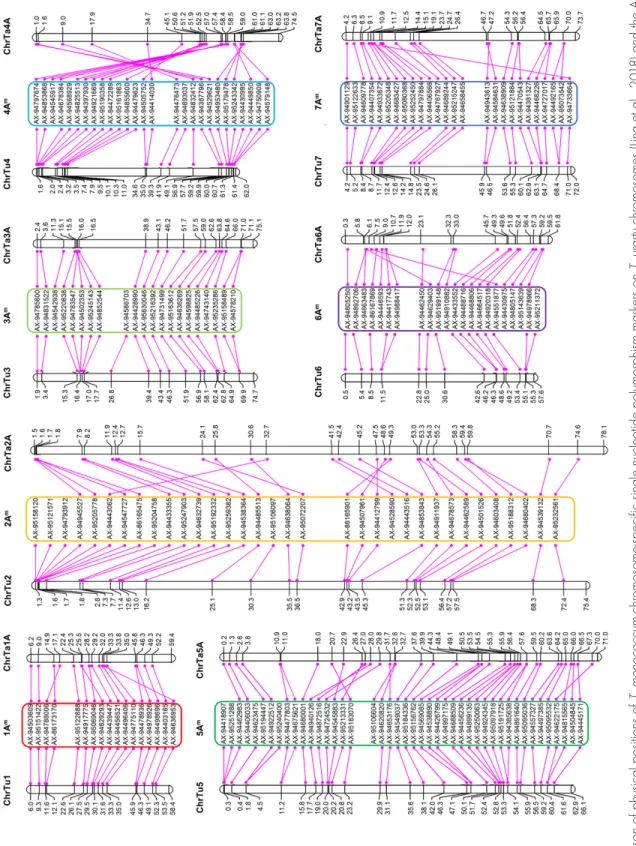
T. monococcum genome-specific markers, also present on the T. urartu map, were used in BLASTN (E-value: 10-5) analysis against the wheat genome reference assembly Ref-seq version 1 (International Wheat Genome Sequencing Consortium et al., 2018) and the T. urartu genome refer-ence assembly (Ling et al., 2018). The results were visual-ized (Fig. 1) with MapChart version 2.32 (Voorrips, 2002).
RESULTS
Response of T. aestivum × T. monococcum BC3F1 Seedlings to Leaf Rust Disease
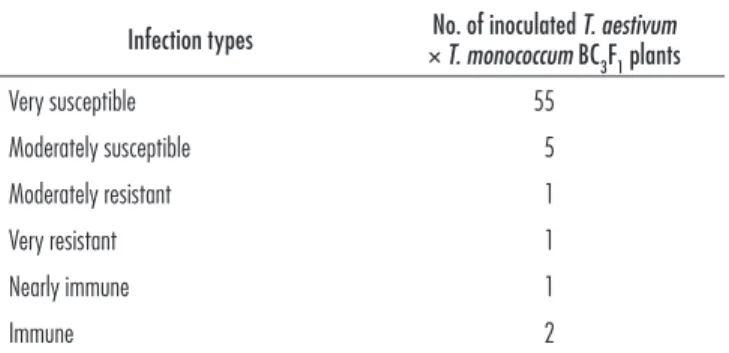
Sixty-five BC3F1 wheat–T. monococcum seedlings were randomly selected and their response to leaf rust infec-tion was recorded on the 10th day after inoculainfec-tion (Table 1). Two of the 65 seedlings showed the same immunity as the T. monococcum parent, whereas most of the remaining plants (n = 55) were very susceptible, simi-lar to the wheat parental line.
Selection and Validation of T. monococcum Chromosome-Specific SNP Markers
In total, 18,287 SNPs that were polymorphic between T. urartu and wheat and distributed across all seven
chromosome groups in wheat were included on the Axiom Wheat-Relative Genotyping Array (Winfield et al., 2016). In the present work, we screened DNA from T. monococcum, T. urartu, Mv9kr1 and Paragon wheat, eight BC3F4 lines originating from the wheat–T. monococ-cum leaf-rust-resistant hybrid, and 258 lines obtained from the wheat–T. urartu backcrossed population (Grewal et al., 2018). The Axiom ‘SNPolisher’ R pack-age allocated the scores for each of the markers into six cluster patterns (Hussain et al., 2017); however, only the calls classified as Poly High Resolution SNPs (3168 SNPs) represented good quality cluster resolution and were thus included in the genotyping. Of these, 1247 high-quality SNPs were selected as polymorphic between wheat and T. monococcum by Flapjack and were physically mapped to the A genome of wheat via a BLASTN search (Supplemental Table S1; International Wheat Genome Sequencing Consortium et al., 2018). From these 1247 T. monococcum SNP markers, 191 were identified as being in common with the T. urartu genetic map (Grewal et al., 2018) and were thus selected as a set of validated high-quality T. monococcum chromosome-specific SNP mark-ers (Table 2). The lowest numbmark-ers of SNPs with wheat were detected on homeologous Group 1 (8.9%); homeolo-gous Group 5 (23%) showed the highest number of SNPs.
The physical position of the 191 marker sequences was found on the wheat A genome (International Wheat Genome Sequencing Consortium et al., 2018) and on the T. urartu genome (Ling et al., 2018) via a BLASTN search (Supplemental Table S2). On the basis of previous work that suggested high synteny and collinearity between T. monococcum and T. urartu (Fricano et al., 2014; Marino et al., 2018), the 191 SNP markers were tentatively ordered on the T. monococcum chromosomes according to their physical position on the T. urartu genome (Fig. 1). Triticum monococcum-specific markers also showed macrosynteny with the A genome of wheat (Fig. 1), except in the case of chromosome 4A, which has a peri-centric inversion in polyploid wheat that is not found in its diploid progenitor, T. urartu (Devos et al., 1995).
From the BC3F4 progenies of the two leaf-rust-resistant plants, eight individuals were randomly selected (four from each parent) and screened with the Axiom Wheat-Relative Genotyping array, which resulted in the detection of a single T. monococcum introgression. Two T. monococcum-specific markers (AX-94492165 and AX-95073542), located within 200 bp of each other on the telomeric region of chromosome arm 7AL (Fig. 1), were detected in each of the analyzed plants. The sequences of these two markers were used in a BLASTX search against the wheat genome (International Wheat Genome Sequencing Consortium et al., 2018; http:// plants.ensembl.org/Triticum_aestivum/Info/Index, accessed 7 June 2019) to determine any potential candi-date genes. However, the immediate flanking regions of the markers did not show any annotated genes.
Fi g. 1 . C om pa ris on o f p hys ic al p os iti on s o f T. mo no co cc um c hr om os om e-sp ec ifi c s in gl e n ucl eo tid e p ol ym or ph ism m ar ke rs o n T. u rar tu c hr om os om es ( Lin g et a l., 2 01 8) a nd t he A g en om e o f w he at (IW G SC et a l., 2 01 8) a cr os s t he s ev en h om eo lo go us g ro up s. A ll p os iti on s a re i nd ic at ed a s 1 × 1 0 7 b p.
DISCUSSION
The genetic diversity of einkorn wheat provides a prom-ising opportunity to improve the resistance of bread wheat against a wide spectrum of fungal pathogens (Zaharieva and Monneveux, 2014). To speed up the gene-transfer from an alien species into wheat, it is essential to precisely trace the transferred chromosome segments in the progenies. The development of array-based chro-mosome-specific marker sets represent a cost-effective, high-throughput solution to accurately identify the introgressed chromosome segments within modern pre-breeding programs.
The A genome of wheat and those of its diploid rela-tives (the Au and Am genomes) share a remarkably similar chromosomal gene content, whereby gene sequences are highly conserved, reaching 98% identity (International Wheat Genome Sequencing Consortium, 2014; Marcussen et al., 2014). A previous study by Marino et al. (2018) com-pared the genetic map of T. monococcum and the shotgun assemblies of the T. urartu genome (Fox et al., 2014) and the bread wheat genome (Clavijo et al., 2017) and reported a high degree of conservation of marker order between them, since most markers found in the same position or in close proximity in T. monococcum were aligned to the same contig in T. urartu and bread wheat. The main exception was chromosome 4A, which carries the well-known pericentric inversion (Devos et al., 1995; Dvorak et al., 2018; Mickelson-Young et al., 1995), which is con-sistent with the BLAST results from this study (Fig. 1). In the comparison of T. monococcum and the bread wheat genome assembly (Marino et al., 2018), only a few mark-ers for each linkage group (average: 7.2%) were mapped in different bread wheat chromosomes. Grewal et al. (2018) genetically mapped 368 exome-based SNP markers into seven linkage groups in T. urartu and compared them, via BLAST, to the bread wheat genome, reporting that only six markers (1.6%) were located on different A genome chro-mosomes in wheat.
In the present study, we developed a polymorphic SNP marker set between T. monococcum and wheat. By using the recently published wheat reference assembly (International Wheat Genome Sequencing Consortium
et al., 2018) and the T. urartu genome assembly (Ling et al., 2018) and exploiting the possible macrocollinearity (Fricano et al., 2014; Marino et al., 2018) among T. ura-rtu (AuAu), T. monococcum (AmAm), and the A genome of wheat, we were able to potentially hypothesize the order of the markers within the T. monococcum chro-mosomes (Fig. 1). However, a more accurate approach to identify the order of gene-specific SNP markers along chromosomes is single-gene FISH, which can be applied on mitotic metaphase chromosomes. Single-gene FISH, together with FISH using repetitive sequences, is useful in chromosome identification and allows investigation of chromosome rearrangements and comparative stud-ies on chromosome structure between specstud-ies with the A genome lineage (Danilova et al., 2014; Said et al., 2018).
Anker and Niks (2001) identified a large number of einkorn accessions that were resistant to leaf rust. Leaf-rust-resistant accessions originated in a higher propor-tion from T. monococcum subsp. monococcum than from T. urartu and T. monococcum subsp. aegilopoides. Genes from leaf rust resistance have been transferred into wheat from T. monococcum subsp. monococcum and are located on chromosomes 2A, 3A, and 5A (Dyck and Bartoš, 1994; Kaur et al., 2008; Singh et al., 2007). In this study, we identified two leaf-rust-resistant individuals in the progenies of a wheat–T. monococcum F1 hybrid and indi-cated that the resistance could potentially be associated with the presence of two T. monococcum-specific SNP markers located on the telomeric region of chromosome
Table 1. Response to leaf rust in 65 T. aestivum × T. monococcum
BC3F1 plants at the seedling stage.
Infection types × No. of inoculated T. monococcum BCT. aestivum
3F1 plants Very susceptible 55 Moderately susceptible 5 Moderately resistant 1 Very resistant 1 Nearly immune 1 Immune 2
Table 2. Summary of the number of single nucleotide polymorphisms (SNPs) anchored to T. monococcum and T. urartu genome on the Axiom Wheat-Relative Genotyping Array.
Number of SNP markers Percentage of total SNP markers Validated SNPs on the genetic mapT. urartu Percentage of total SNPs on the T. urartu genetic map
Homeologous Group 1 118 9.5 17 8.9 Homeologous Goup 2 208 16.7 34 17.8 Homeologous Group 3 211 16.9 21 11.0 Homeologous Group 4 155 12.4 27 14.1 Homeologous Group 5 234 18.8 44 23.0 Homeologous Group 6 121 9.7 22 11.5 Homeologous Group 7 200 16.0 26 13.6 Total 1247 100 191 100
arm 7AmL. The Lr20–Sr15–Pm1 resistance locus identi-fied historically in hexaploid wheat that confers resis-tance to three different fungal wheat pathogens has also been mapped to the distal part of wheat chromosome 7AL (Neu et al., 2002; Sears and Briggle, 1969). Jayatilake et al. (2013) developed expressed sequence tag mark-ers (wri1, wri2, wri3, wri4, and wri5) between the Lr20/ Sr15 locus and the phytoene synthase gene (Psy-A1) and all markers colocated with the Lr20 gene. These mark-ers are placed on the distal region of chromosome arm 7AL from 724,135,301 bp (wri1) to 726,482,191 bp (wri5) (International Wheat Genome Sequencing Consortium Refseq version 1.0). The T. monococcum genome-specific markers presented in this study are positioned between 700,275,508 bp 94492165) to 700,275,682 bp (AX-95073542) on chromosome arm 7AL (International Wheat Genome Sequencing Consortium RefSeq version 1.0). Neu et al. (2002) and Jayatilake et al. (2013) have suggested that Lr20 is in a region where recombination is suppressed. They proposed that this could be caused by an alien introgression or a genetic rearrangement. Our results indicate that a recombination event has taken place on the telomeric region of 7AL chromosome arm, resulting in the introgression of a short T. monococcum chromosome segment into the wheat background, car-rying an effective leaf rust resistance gene acting in the seedling stage.
The wheat–T. monococcum SNP marker set devel-oped and validated in the present study offers accurate, cost-effective, and high-throughput detection of T. mono-coccum chromatin in a wheat background and thus signif-icantly speeds up the transfer of valuable traits from a wild relative into bread wheat in modern breeding programs.
Supplemental Information
Supplemental Table S1. The sequence information of 1247 polymorphic SNPs between T. monococcum and wheat.
Supplemental Table S2. BLASTN results detailing the physical positions of the T. monococcum specific marker set on the A genome of wheat (RefSeq version 1; Inter-national Wheat Genome Sequencing Consortium et al., 2018) and the T. urartu psuedomolecules (Ling et al., 2018).
Conflict of Interest Disclosure
The authors declare that there is no conflict of interest.
Acknowledgments
This work was supported by the Marie Skłodowska-Curie Fellowship Grant (H2020-MSCA-IF-2016-752453-LANDRACES) from the Euro-pean Union; the Biotechnology and Biological Sciences Research Council [grant number BB/P016855/1], as part of the Designing Future Wheat Programme; and the Hungarian National Research, Development and Innovation Office (K129221). The funding body played no role in the design of the study and collection, analysis, and interpretation of data or in writing the manuscript. We also thank Dr. Amanda Burridge and Mr. Paul Wilkinson from University of Bristol for their invaluable help in genotyping and bioinformatics.
REFERENCES
Anker, C.C., and R.E. Niks. 2001. Prehaustorial resistance to the wheat leaf rust fungus, Puccinia triticina, in Triticum monococcum (s.s.). Euphytica 117:209–215. doi:10.1023/A:1026577307163
Badaeva, E.D., A.V. Amosova, N.P. Goncharov, J. Macas, A.S. Ruban, I.V. Grechishnikova, et al. 2015. A set of cytogenetic markers allows the precise identification of all A-genome chromosomes in diploid and polyploid wheat. Cytogenet. Genome Res. 146:71–79. doi:10.1159/000433458
Ceoloni, C., L. Kuzmanovic, P. Forte, M.E. Virili, and A. Bitti. 2015. Wheat–perennial triticeae introgressions: Major achievements and prospects. In: M. Molnár-Láng, C. Ceoloni, and J. Doležel, editors, Alien introgression in wheat. Springer International Publishing, Cham. p. 273–313.
Clavijo, B.J., L. Venturini, C. Schudoma, G.G. Accinelli, G. Kaithakot-til, J. Wright, et al. 2017. An improved assembly and annotation of the allohexaploid wheat genome identifies complete families of agronomic genes and provides genomic evidence for chromosomal translocations. Genome Res. 27:885–896. doi:10.1101/gr.217117.116 Danilova, T.V., B. Friebe, and B.S. Gill. 2014. Development of a wheat
single gene FISH map for analyzing homoeologous relationship and chromosomal rearrangements within the Triticeae. Theor. Appl. Genet. 127:715–730. doi:10.1007/s00122-013-2253-z
Devos, K.M., J. Dubcovsky, J. Dvorak, C.N. Chinoy, and M.D. Gale. 1995. Structural evolution of wheat chromosomes 4A, 5A, and 7B and its impact on recombination. Theor. Appl. Genet. 91:282–288. Dubcovsky, J., M.C. Luo, G.Y. Zhong, R. Bransteitter, A. Desai, A. Kilian,
et al. 1996. Genetic map of diploid wheat, Triticum monococcum
L., and its comparison with maps of Hordeum vulgare L. Genetics 143:983–999.
Dvořák, J., P. di Terlizzi, H.-B. Zhang, and P. Resta. 1993. The evolution of polyploid wheats: Identification of the A genome donor species. Genome 36:21–31. doi:10.1139/g93-004
Dvorak, J., L. Wang, T. Zhu, C.M. Jorgensen, M.C. Luo, K.R. Deal, et al. 2018. Reassessment of the evolution of wheat chromosomes 4A, 5A, and 7B. Theor. Appl. Genet. 131:2451–2462.
Dyck, P.L., and P. Bartoš. 1994. Attempted transfer of leaf rust resistance from Triticum monococcum and durum wheat to hexaploid wheat. Can. J. Plant Sci. 74:733–736. doi:10.4141/cjps94-131
Fox, S.E., M. Geniza, M. Hanumappa, S. Naithani, C. Sullivan, J. Pre-ece, et al. 2014. De novo transcriptome assembly and analyses of gene expression during photomorphogenesis in diploid wheat Triticum monococcum. PLoS One 9:e96855. doi:10.1371/journal. pone.0096855
Fricano, A., A. Brandolini, L. Rossini, P. Sourdille, J. Wunder, S. Effgen, et al. 2014. Crossability of Triticum urartu and Triticum monococ-cum wheats, homoeologous recombination, and description of a panel of interspecific introgression lines. G3 (Bethesda) 4:1931–1941. doi:10.1534/g3.114.013623
Grewal, S., S. Hubbart-Edwards, C. Yang, D. Scholefield, S. Ashling, A. Burridge, et al. 2018. Detection of T. urartu introgressions in wheat and development of a panel of interspecific introgression lines. Front. Plant Sci. 9:1565.
Gupta, P.K., and N.K. Vasistha. 2018. Wheat cytogenetics and cytoge-nomics: The present status. Nucleus 61:195–212. doi:10.1007/s13237-018-0243-x
Hammer, K., A.A. Filatenko, and V. Korzun. 2000. Microsatellite mark-ers—A new tool for distinguishing diploid wheat species. Genet. Resour. Crop Evol. 47:497–505. doi:10.1023/A:1008761928959 Heun, M., R. Schäfer-Pregl, D. Klawan, R. Castagna, M. Accerbi, B.
Borghi, and F. Salamini. 1997. Site of einkorn wheat domestica-tion identified by DNA fingerprinting. Science 278:1312–1314. doi:10.1126/science.278.5341.1312
Huang, S., A. Sirikhachornkit, X. Su, J. Faris, B. Gill, R. Haselkorn, and P. Gornicki. 2002. Genes encoding plastid acetyl-CoA carboxylase and 3-phosphoglycerate kinase of the Triticum/Aegilops complex and the evolutionary history of polyploid wheat. Proc. Natl. Acad. Sci. USA 99:8133–8138. doi:10.1073/pnas.072223799
Hussain, B., S.J. Lucas, L. Ozturk, and H. Budak. 2017. Mapping QTLs con-ferring salt tolerance and micronutrient concentrations at seedling stagein wheat. Sci. Rep. 7:15662. doi:10.1038/s41598-017-15726-6 International Wheat Genome Sequencing Consortium. 2014. A
chromo-some-based draft sequence of the hexaploid bread wheat (Triticum aestivum) genome. Science 345:1251788. doi:10.1126/science.1251788 International Wheat Genome Sequencing Consortium, R. Appels, K.
Eversole, C. Feuillet, B. Keller, J. Rogers, et al. 2018. Shifting the lim-its in wheat research and breeding using a fully annotated reference genome. Science 361: eaar7191. doi:10.1126/science.aar7191 Jayatilake, D.V., E.J. Tucker, H. Bariana, H. Kuchel, J. Edwards, A.C.
McKay, et al. 2013. Genetic mapping and marker development for resistance of wheat against the root lesion nematode Pratylenchus neglectus. BMC Plant Biol. 13:230. doi:10.1186/1471-2229-13-230 Jing, H.C., C. Bayon, K. Kanyuka, S. Berry, P. Wenzl, E. Huttner, et al.
2009. DArT markers: Diversity analyses, genomes comparison, map-ping and integration with SSR markers in Triticum monococcum. BMC Genomics 10:458. doi:10.1186/1471-2164-10-458
Johnson, B.L., and H.S. Dhaliwal. 1976. Reproductive isolation of Triticum boeoticum and Triticum urartu and the origin of the tetraploid wheats. Am. J. Bot. 63:1088–1094. doi:10.1002/j.1537-2197.1976.tb13193.x Kaur, S., P. Chhuneja., H.S. Dhaliwal, and K. Singh. 2008. Transfer of a
new leaf rust resistance genes from diploid T. monococcum and T. boeoticum to T. aestivum. In: R. Appels, R. Eastwood, E. Lagudah, P. Langridge, M. Mackay, L. McIntyre, et al., editors, 11th Interna-tional Wheat Genetics Symposium, Brisbane, Qld., Australia. 24–29 Aug. 2008. Sydney: Sydney Univ. Press.
King, J., S. Grewal, C.Y. Yang, S. Hubbart, D. Scholefield, S. Ashling, et al. 2017. A step change in the transfer of interspecific variation into wheat from Ambylopyrum muticum. Plant Biotechnol. J. 15:217–226. doi:10.1111/pbi.12606
Ling, H.-Q., S. Zhao, D. Liu, J. Wang, H. Sun, C. Zhang, et al. 2013. Draft genome of the wheat A-genome progenitor Triticum urartu. Nature 496:87–90. doi:10.1038/nature11997
Ling, H.Q., B. Ma, X. Shi, H. Liu, L. Dong, H. Sun, et al. 2018. Genome sequence of the progenitor of wheat A subgenome Triticum urartu. Nature 557:424–428. doi:10.1038/s41586-018-0108-0
Löve, Á. 1984. Conspectus of the Triticeae. Feddes Repert. 95:425–521. Marcussen, T., S.R. Sandve, L. Heier, M. Spannagl, M. Pfeifer, K.S.
Jakobsen, et al. 2014. Ancient hybridizations among the ancestral genomes of bread wheat. Science 345:1250092. doi:10.1126/sci-ence.1250092
Marino, R., A. Volante, A. Brandolini, and M. Heun. 2018. A high-resolu-tion einkorn (Triticum monococcum L.) linkage map involving wild, domesticated and feral einkorn genotypes. Plant Breed. 137:682– 690. doi:10.1111/pbr.12637
Megyeri, M., P. Miko, A. Farkas, M. Molnar-Lang, and I. Molnar. 2017. Cytomolecular discrimination of the Am chromosomes of Triticum
monococcum and the A chromosomes of Triticum aestivum using microsatellite DNA repeats. J. Appl. Genet. 58:67–70. doi:10.1007/ s13353-016-0361-6
Mickelson-Young, L., T.R. Endo, and B.S. Gill. 1995. A cytogenetic ladder-map of the wheat homoeologous group-4 chromosomes. Theor. Appl. Genet. 90:1007–1011.
Milne, I., P. Shaw, G. Stephen, M. Bayer, L. Cardle, W.T. Thomas, et al. 2010. Flapjack—Graphical genotype visualization. Bioinformatics 26:3133–3134. doi:10.1093/bioinformatics/btq580
Molnár-Láng, M., G. Linc, and J. Sutka. 1996. Transfer of the reces-sive crossability allele kr1 from Chinese Spring into the winter wheat variety Martonvásári 9. Euphytica 90:301–305. doi:10.1007/ BF00027480
Mujeeb-Kazi, A., and S. Rajaram. 2002. Transferring alien genes from related species and genera for wheat improvement. In: B.C. Curtis, S. Rajaram, and H. Gómez Macpherson, editors,Bread wheat— Improvement and production. Plant Production and Protection Series.Food and Agriculture Organization of the United Nations, Rome. p. 199–215.
Munns, R., R.A. James, B. Xu, A. Athman, S.J. Conn, C. Jordans, et al. 2012. Wheat grain yield on saline soils is improved by an ancestral Na+ transporter gene. Nat. Biotechnol. 30:360–364. doi:10.1038/ nbt.2120
Neu, C., N. Stein, and B. Keller. 2002. Genetic mapping of the Lr20–Pm1
resistance locus reveals suppressed recombination on chromosome arm 7AL in hexaploid wheat. Genome 45:737–744. doi:10.1139/g02-040 Said, M., E. Hribova, T.V. Danilova, M. Karafiatova, J. Cizkova, B. Friebe,
et al. 2018. The Agropyron cristatum karyotype, chromosome struc-ture and cross-genome homoeology as revealed by fluorescence in situ hybridization with tandem repeats and wheat single-gene probes. Theor. Appl. Genet. 131:2213–2227.
Sears, E.R., and L.W. Briggle. 1969. Mapping the gene Pm1 for resistance to Erysiphe graminis f.sp. tritici on chromosome 7A of wheat. Crop Sci. 9:96–97. doi:10.2135/cropsci1969.0011183X000900010033x Singh, K., Ghai, M., Garg, M., Chhuneja, P., Kaur, P., Schnurbusch, T.
et al. 2007. An integrated molecular linkage map of diploid wheat based on a Triticum boeoticum × T. monococcum RIL population. Theor. Appl. Genet. 115:301–312.
Stakman, E.C., D.M. Stewart, and W.Q. Loegering. 1962. Identification of physiologic races of Puccinia graminis var. tritici. USDA-ARS. https://naldc.nal.usda.gov/download/CAT10243018/PDF (accessed 11 June 2019).
Taenzler, B., R.F. Esposti, P. Vaccino, A. Brandolini, S. Effgen, M. Heun, et al. 2002. Molecular linkage map of einkorn wheat: Mapping of stor-age-protein and soft-glume genes and bread-making quality QTLs. Genet. Res. 80:131–143. doi:10.1017/S001667230200575X
Voorrips, R.E. 2002. MapChart: Software for the graphical presenta-tion of linkage maps and QTLs. J. Hered. 93:77–78. doi:10.1093/ jhered/93.1.77
Wicker, T., N. Yahiaoui, R. Guyot, E. Schlagenhauf, Z.-D. Liu, J. Dub-covsky, and B. Keller. 2003. Rapid genome divergence at orthologous low molecular weight glutenin loci of the A and Am genomes of wheat. Plant Cell 15:1186–1197. doi:10.1105/tpc.011023
Winfield, M.O., A.M. Allen, A.J. Burridge, G.L. Barker, H.R. Benbow, P.A. Wilkinson, et al. 2016. High-density SNP genotyping array for hexa-ploid wheat and its secondary and tertiary gene pool. Plant Biotech. J. 14:1195–1206. doi:10.1111/pbi.12485
Zaharieva, M., and P. Monneveux. 2014. Cultivated einkorn wheat (Triticum monococcum L. subsp. monococcum): The long life of a founder crop of agriculture. Genet. Resour. Crop Evol. 61:677–706. doi:10.1007/s10722-014-0084-7