Analyzing and Modeling a Multiparty
Outsourcing Environment
S. David Peter. K. Poulose Jacob Sreela Sasi Department of Computer Science Department of CIS
Cochin University of Science and Technology Gannon University Cochin - 682 022, India Erie, PA 16541, USA
Abstract: This paper discusses the complexities involved in managing and monitoring the delivery of IT services in a multiparty outsourcing environment. The complexities identified are grouped into four categories and are tabulated. A discussion on an attempt to model a multiparty outsourcing scenario using UML is also presented and explained using an illustration. Such a model when supplemented by a performance evaluation tool can enable an organization to manage the provision of IT services in a multiparty outsourcing environment more effectively.
I. INTRODUCTION
Information Technology (IT) outsourcing has by far outlived the five-year period which is typical of a management fad [1]. From an initial main focus on cost reduction, IT outsourcing has been moving fast to become a complementary or alternative mode of managing IT. The main segments of IT out-sourcing include onsite facilities management, data centre operations, systems support, systems development, network management, telecommunications, etc. [2]. In the present context IT outsourcing can be defined as the process of entrusting the responsibility of providing a defined set of IT goods and services to the enterprise.
A related significant development was that, in many cases organizations made outsourcing contracts with multiple service providers. A survey conducted by Lacity and Willcocks [1] revealed that more than eighty percent of such organizations made contracts with multiple service providers. This phenomenon is referred to as multiparty outsourcing.
The purpose of this paper is two fold. The complexities associated with a multiparty outsourcing environment are discussed briefly, and these are categorized and tabulated. This is followed by a discussion on modeling the complex relationships in a multiparty outsourcing environment using Unified Modeling Language [3].
II. ANALYZING THE COMPLEXITIES IN A MULTIPARTY OUTSOURCING ENVIRONMENT
In a multiparty outsourcing environment, the delivery of some or many of the IT services are provided by multiple external service providers. In such a situation it is necessary to ensure that everyone in the business organization gets the information/IT services needed to perform his or her tasks. Usually the IT organisation is responsible to ensure that the
quality of the IT service is appropriate. This quality level is usually referred to as the minimum performance level. However in more federal or decentralised IT governance structures it can be difficult to pinpoint a single responsibility to ensure such a minimum performance level. Federal structures, for example, are based upon shared responsibilities. To ensure this minimum performance level for the products and services, many authorities within the organization “make” service level agreements with the service providers. In order to define, achieve and maintain the provision of the agreed quality of service, service level management processes are set-up within the organization.
The complexities associated with Service Level Agreements (SLAs), Service Level Management (SLM) processes and the service level management organization are analyzed initially. Then other complexities that are intrinsic to the IT sector are analyzed.
A. Complexities associated with Contracts and Service Level Agreements
A Service Level Agreement (SLA) is a written agreement between a customer and a service provider that documents the agreed service levels for a service [4]. Most often, the important targets set in a SLA will relate to the service availability which require incident resolution within agreed periods. In addition, it may also contain performance requirements such as response time, throughput etc. as well as other requirements such as security, reliability, contingency, change control, service level monitoring and reporting, etc [5]. Mostly, SLAs are part of a contract in which all aspects of the agreement have been agreed, such as financial terms and conditions as well as penalty clauses. In practice, there is no strict borderline between what to include in the contract and what to include in the SLAs.
SLAs can be defined at different levels of granularity. It can be a comprehensive overall one, made at top level covering all the services to be provided by a particular service provider, or it can be many separate ones by making one for each service. This implies that there can be multiple SLAs made by the same organization with the same service provider. Different SLAs with the same service provider by different business units/departments/user groups are also not uncommon in practice. They are often caused by the existing IT governance
structure. This also implies that different people from the same organization are responsible for making and monitoring SLAs.
In a typical multiparty outsourcing environment, the details of the outsourcing contracts can vary in each case; i.e., for each contract the terms and conditions of service, availability requirements, performance levels, etc. can be different depending upon the criticality of the service. For example, the availability of mainframe services may be 98 percent and the maximum down time can be two hours, whereas for desktops, it can be ninety percent and twenty four hours, respectively. Keeping track of each and every clause of all these SLA’s will become cumbersome in such a situation. This will add to the complexity in managing the multiparty outsourcing environment.
It is not uncommon in larger organizations to have many SLAs and contracts made by the organization with multiple service providers. Different people might have established these contracts, at different times. Proper management and monitoring of these contracts therefore has become cumbersome. Quite often it is seen that these contracts are automatically renewed, without even knowing the need or usefulness of such contracts.
B. Complexities associated with Service Level Management process
Service Level Management (SLM) is the process that controls the quality of the provision of IT services. According to Information Technology Infrastructure Library (ITIL) terminology, it is the process of defining, agreeing, documenting and managing the levels of certain IT services that are required and cost justified [4]. It means that the responsibility of SLM does not end with the creation of the SLA, but, it should also ensure that the services are provided as per the contract [6]. It is also responsible for continuously improving service levels in line with business processes, reviewing SLA’s, resolving major service issues, creating and maintaining the Service Catalogue, etc.
To achieve and maintain the agreed quality of service, the management of the relationships with the service provider is very important. For the smooth sail of each relationship, there should be a well-defined governance structure [7]. As mentioned in the previous sub-section, there can be multiple relationships with the same service provider. Also, in a multiparty outsourcing environment, there could be a number of such service providers. Such a scenario presents the issue of a complex relationship management.
The fact that the different stakeholders have conflicting interests, adds another dimension to the complexity of relationships. The management of a business organization is interested in getting the service at a minimal cost and the service provider tries to maximize the profit by diminishing the operational costs. Finally, the user expects the best quality service. As a result all the parties are forced to accept the minimum performance level as the basis, which may not be realized, unless it is monitored carefully.
Another issue related to management of relationships is the mistrust or misunderstanding caused by the cultural differences of the people belonging to the client and service providers.
People on both sides need to know each other’s goals and objectives; especially the service provider. But often they have differing objectives. For a successful relationship, the people on the supplier side should have a high level of understanding of the client’s business and should work towards achieving their goals and objectives [7]. In practice, this is not an easy task and with a large number of such service providers/suppliers, the issue becomes more acute.
When different services are outsourced to different service providers, which is quite common in selective sourcing, the coordination of the activities of various service providers is also very important. The coordination of the activities of the different service providers and the maintenance of good relationships among them is another complexity associated with the SLM process.
In IT, it is difficult to clearly demarcate the boundary of its services. This adds another dimension to the complexity in the SLM process. In a multiparty outsourcing environment, measuring the performance of the individual service provider objectively is another difficult task. This is because of the fact that the different services supported by different service providers are interdependent.
C. Complexities associated with service level management organization
Earlier, the SLM process was confined within the IT organization. But currently, there are situations in which, it is spread over the entire organization. For example, outsourcing decisions are not always taken by the IT managers. In a survey conducted by Lacity and Willcocks [8], thirty percent of the outsourcing decisions were taken by the senior executives, without even consulting the IT organization. Similarly, the beneficiary also, in certain cases, handles the monitoring of the service provision. Hence, the role of IT organization may be limited only to the maintenance of the service catalog. In such a situation, it becomes difficult to assess the overall performance of the IT in that enterprise. Different service providers providing different services submit their performance report to different monitoring authorities. To make an assessment of the overall performance, the data is to be collected from various monitoring authorities and compiled. This again raises a number of practical issues like how to gather the performance data, how to check the reliability of the data so collected, who will do the compilation, etc. Hence it becomes difficult to have an overall assessment of the performance in a multiparty outsourcing environment.
The distribution/decentralization of the monitoring and relationship management activities may cause difficulties in the maintenance of the service catalogue also. The service catalogue is to be reviewed and updated regularly on the basis of the changing user requirements and the assessment of the performance level of the services provided. So it becomes difficult to update the service catalogue, if the true performance data is not available.
The process of sub-contacting the tasks by the service provider with or without the knowledge of the client is also common. This causes additional burden to the relationship
management, in terms of complicated communication structure and accountability issues.
D. Complexities due to intrinsic characteristics of IT
There are certain characteristics, which are intrinsic of IT that makes Information Technology outsourcing different from other outsourcing activities. The fact that IT pervades, affects and even shapes most organizational processes in some way makes it very critical and important part of the organization [9]. Also, when different service providers provide different IT services or when different service providers provide services for different segments, the services of all the service providers become equally important for the smooth functioning of the business organization. So each service provider needs to understand the implications that IT has for the business organization. If any of them fail to do so, then the whole business is affected.
The speed at which the IT capabilities continue to evolve makes it difficult to estimate the future IT needs [7]. The adoption of a new technology in one sector may necessitate changes in other sectors/services. For example, a change in the software platform can necessitate changes in the hardware platform and/or changes in the application software. So, when different service providers are responsible for providing services in different sectors, all of them have to agree and cooperate for adopting a new technology, which may be outside the contract. Above all, the dynamism in the business scenario, due to various reasons like diversification of products and services, mergers, acquisitions, downsizing, etc. will necessitate corresponding changes in the IT that supports the business. Accommodating these changes ‘on the fly’, in a multiparty outsourcing environment, is another complex reality, which is to be dealt with.
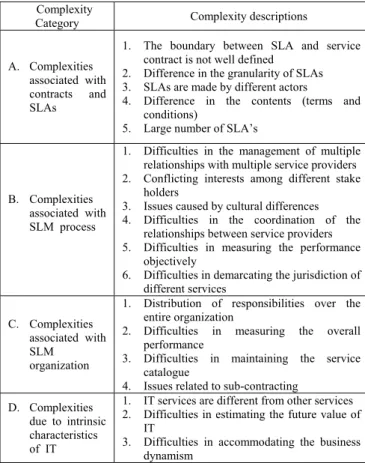
The various complexities, discussed above can be summarised as shown in Table 1. A discussion on an attempt for modeling the complex relationships in a multiparty outsourcing environment using UML [3] is presented in the next section. This will give us a better understanding of the multiparty outsourcing scenario and in turn will lead to better management of the environment.
III. GRAPHICAL MODELLING OF A MULTIPARTY OUTSOURCING SCENARIO
A visual representation of the multiparty outsourcing scenario showing the organizational structure, relationships, interactions, etc. is demonstrated using UML.
A. Modelling concepts
The following concepts were chosen for modeling the multiparty outsourcing environment:
1. The establishment of a contractual relationship with a service provider by means of contractual documents (also referred to as supporting documents), such as Service Level Agreements, Service Contracts, Service Catalogue, etc.
TABLE 1. COMPLEXITIES IN A MULTIPARTY OUTSOURCING ENVIRONMENT
Complexity
Category Complexity descriptions
A. Complexities associated with contracts and SLAs
1. The boundary between SLA and service contract is not well defined
2. Difference in the granularity of SLAs 3. SLAs are made by different actors
4. Difference in the contents (terms and conditions)
5. Large number of SLA’s
B. Complexities associated with SLM process
1. Difficulties in the management of multiple relationships with multiple service providers 2. Conflicting interests among different stake
holders
3. Issues caused by cultural differences 4. Difficulties in the coordination of the
relationships between service providers 5. Difficulties in measuring the performance
objectively
6. Difficulties in demarcating the jurisdiction of different services
C. Complexities associated with SLM
organization
1. Distribution of responsibilities over the entire organization
2. Difficulties in measuring the overall performance
3. Difficulties in maintaining the service catalogue
4. Issues related to sub-contracting D. Complexities
due to intrinsic characteristics of IT
1. IT services are different from other services 2. Difficulties in estimating the future value of
IT
3. Difficulties in accommodating the business dynamism
2. The monitoring of the performance of the services provided by the service provider. i.e., the monitoring relationship
3. The supporting document which forms the basis for the establishment of the relationship
4. The events/interactions associated with the critical tasks
B Organization of the diagrams
For the proper representation and understanding of the complex multiparty outsourcing environment with all the different types of Service Level Agreements, three sets of diagrams are envisaged. The first set contains organizational diagrams. The hierarchical organizational structure of the business organization as well as the organization which provides the service are represented using these diagrams. In UML it can be depicted using an object diagram with aggregation relationships.
The second set consists of sourcing/contractual relationship diagrams using ‘context diagrams’ and ‘detailed diagrams’. The context diagram, which basically shows the overview of the relationships maintained by the business organization with the service providers. The detailed diagram is used to show the actual contractual and monitoring relationships. Both the contractual relationships as well as monitoring relationships are shown separately. When represented in UML using instance diagrams, ordinary links are used to denote contractual
relationships and links with navigational symbols are used to show monitoring relationships. As seen in the previous discussion, the monitoring need not be done by the entity which has established the contract. For systematically drawing all the detailed diagrams, it is suggested that, initially one has to traverse the hierarchical organizational structure diagram in a breadth-first manner to identify all the entities which are responsible for the establishment of the SLAs or contracts.
The third set consists of a number of interaction diagrams which shows the sequence of activities that takes place in executing a task. It also shows the various entities involved in the accomplishment of the task. This can be very well depicted by means of collaboration diagrams in UML.
IV. AN ILLUSTRATIVE EXAMPLE
Consider the case of an IT Organization that supports a decentralized business organization with three independent Business Units. The Business Units are having their own IT Departments. However the major policy decisions with regard to IT are taken by the Central IT Organization. The organizational diagram is shown in Fig. 1.
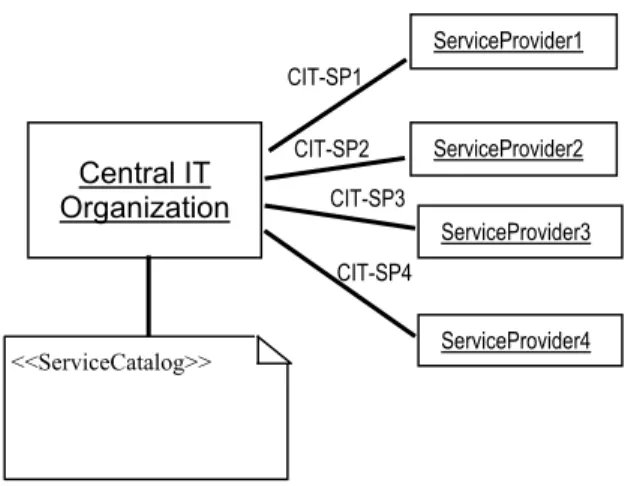
Suppose the central IT Organization has made contracts with four different service providers regarding the terms and conditions of service and the rates at which the various services they offer. The Central IT Organization maintains a Service Catalogue for this purpose. Based on these contracts, the business units can enter into specific SLAs for the services they need with any of the above four service providers. The context diagram for this scenario is shown in Fig. 2a and the detailed diagram of the Central IT Organization is given in Fig. 2b. CIT-SP1, CIT-SP2, CIT-SP3 AND CIT-SP4 are the Contractual Relationships between the Central IT Organization with ServiceProvider1, ServiceProvider2, ServicProvider3 and ServiceProvider4 respectively.
More than one service provider, at the same or a different rate, may offer the same service. The Business unit has got the freedom to choose any of the above four service providers, for each of the service it needs. Say, for example, the Business Director of the Business Unit BU1 in Fig. 3, makes SLAs in the following manner: For hardware support (PCs and servers) they have identified Service provider1. Service provider2 has been identified for networking and communications support and Service provider4 for applications development. The monitoring of the performance of the IT services delivered by Service provider2 and Service provider4 are carried out by the IT Department (ITD1) of BU1. The monitoring of services offered by ServiceProvider1 is taken care of by the respective departments, namely Finance, Marketing and Personnel.
Fig.3 shows the detailed diagram of the contractual/sourcing relationships as well as the monitoring relationships maintained by the Business Unit BU1. BU1-SP1, BU1-SP2, BU1-SP4 are the contractual relationships of BU1 with ServiceProvider1, ServiceProvider2 and ServiceProvider4 respectively. Fin-SP1, Mar-SP1 and Per-SP1 are the monitoring relationships of Finance Department, Marketing Department and Personnel Department respectively, with the Service provider SP1. ITD1-SP2 and ITD1-SP4 are the monitoring relationships of the ITD1 with ServiceProvider2 and ServiceProvider4 respectively.
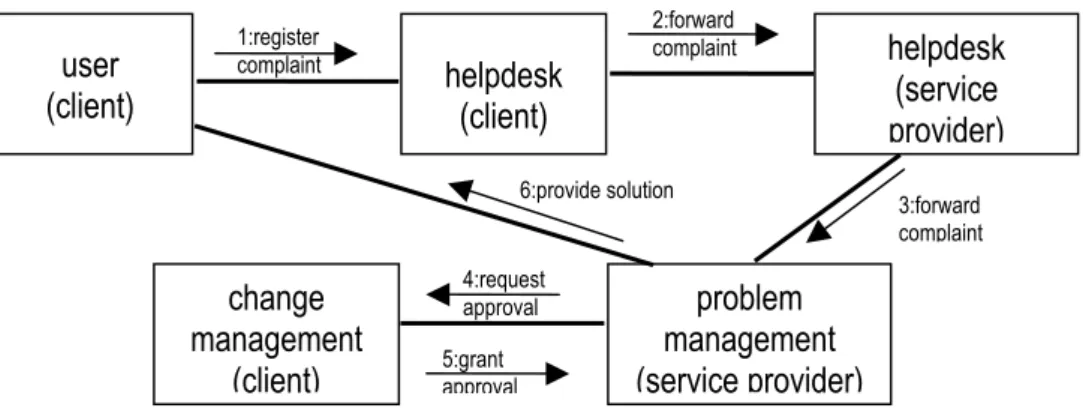
Now, assume that in this selective sourcing environment, the helpdesk and change management are retained by the respective IT department of the business units. The incident resolution process in BU1 is represented by the collaboration diagram shown in Fig. 4. The diagram shows the entities involved in the process and the corresponding actions along with the sequence number. The diagram is quite simple and self explanatory.
Fig. 1 Hierarchical Organizational Structure Diagram
BU1 BU3 BUn - Business Unit n ITDn - IT Department n BU2 Fina- nce
Mark-eting Personnel
Central IT Organization
ITD1 ITD2 ITD3
Business Organization
Fig. 2a. Context Diagram Fig. 2b. Detailed Diagram of Central IT Organization
Fig. 3. Detailed relationship diagram showing the various contractual/monitoring relationships maintained by the Business Unit-1
ServiceProvider2 ServiceProvider3 ServiceProvider4 ServiceProvider1 Business Organization CIT-SP4 CIT-SP3 CIT-SP2 ServiceProvider1 CIT-SP1 ServiceProvider2 ServiceProvider3 Central IT Organization ServiceProvider4 <<ServiceCatalog>> <<Service Contract>>
CIT-SP1 CIT-SP2 CIT-SP4
Fin-SP1 Mar-SP1 Per-SP1 ITD1-SP4 ITD1-SP2 BU1-SP4 BU1-SP2 BU1-SP1 ServiceProvider1 ServiceProvider4 ServiceProvider2
Fina-nce
Mark-eting
Pers-onnel
ITD1
BU1
<<Service Contract>> <<Service Contract>>2:forward complaint
Fig. 4. Incident resolution process in BU1 V. DISCUSSION
The graphical model described in this paper identifies all the entities and actions involved in managing a multiparty outsourcing environment. For each contract/SLA it clearly shows the entity which has established it as well as the entity which monitors it. It also gives the details of the interactions for all major tasks. Some of the complexities that often come across in a multiparty outsourcing environment are analyzed using this model. For example, the complexities due to large number of SLAs, involvement of different entities in each SLA/contract, distribution of the SLM process over the entire organization, etc. are demonstrated using this modelling technique. But there are still a few more complexities which are not yet addressed. Difficulties in measuring the overall performance is the most important among them. If the performance of the individual SLAs/contracts are measured automatically using automated tools like Contract Verification Framework developed by Bhoj, et al. [10], then the above model can assist in compiling and consolidating them to find the overall performance of the IT Organization.
VI. CONCLUSION
In this paper, an attempt was made to analyse a multiparty outsourcing scenerio to bring out its complexities. Eighteen different complexities were identified and grouped into four categories as presented in Table 1. An attempt was made to model the multiparty outsourcing scenario using UML and the same was explained using a simple illustration. This model can assist in alleviating the complexities involved in monitoring as well as measuring the performance of an IT Organization in a multiparty outsourcing environment.
ACKNOWLEDGEMENT
The authors thank Dr. Gerard M. Wijers, Faculty of Technology, Policy & Management, Delft University of Technology, The Netherlands for his valuable suggestions and comments.
REFERENCES
[1] Willcocks, L. and Lacity, M., “Information Technology Outsourcing – Practices, Lessons and Prospects” Templeton Research Paper, Templeton College, Oxford, UK, 2000, available at the site:http://www.templeton.ox.ac.uk
[2] Lee J. N., Huynh, M. Q., Kwok, R.C.W. and Pi, S. M., “IT Outsourcing Evolution – Past, Present and Future”, Communications of the ACM, Vol. 46, No. 5, May 2003, pp 84-89.
[3] Booch, G., Rumbaugh, J., Jacobson, I., “The Unified Modelling Language User Guide”, Addison Wesley Longman (Singapore) Pte. Ltd..
[4] OGC (Office of the government commerce , UK), Best Practice for Service Delivery – ITIL The key to managing IT services, The stationary office, UK, 2002
[5] Hiles, A. N., “Service Level Agreements: Panacea or Pain?”, The TQM Magazine Vol. 6, No.2, 1994, pp 14-16.
[6] Hendrix, L., and Carr, M., “ITIL : Best practice in IT service management”, in Bon, J.V. (ed.) The guide to IT Service Management Vol. I, Pearson Education Ltd., London 2002, pp 131–150,
[7] Kern, T. and Willcocks, L., “Exploring Information Technology outsourcing relationships: theory and practice” Journal of Strategic Information Systems 9 (2000) pp 321-350
[8] Lacity, M. C. and Willcocks L. P., “Best Practices in Information Technology Outsourcing”, The Oxford Executive Research Briefings, , Templeton College, University of Oxford, Oxford, England, 1996, Available at the site http://www.templeton.ox.ac.uk
[9] Kern, T., Kreijger,J. and Willcocks, L., “Exploring relationships in information technology outsourcing: the interaction approach”, European Journal of Information Systems 11 (2002) pp 3-19
[10] Bhoj, P., Singhal, S. and Chutani, S., “SLA management in federated environments” Computer Networks 35 (2001) pp 5-24.
6:provide solution 3:forward complaint 1:register complaint