Annual Plan
Program Year 2015
June 10, 2015
Hawaii Energy is the ratepayer-funded energy conservation and efficiency program
administered by Leidos Engineering, LLC under contract with the Hawaii Public Utilities Commission serving the islands of Hawaii, Lanai, Maui, Molokai and Oahu.
TABLE OF CONTENTS
1.0
INTRODUCTION 4
1.1 Annual Plan 4
1.2 Key Factors Impacting and Actions Basis for Annual Plan 5
2.0
OUTREACH & MARKETING COMMUNICATIONS
10
2.1 Overview 10
2.2 Key Objectives 11
2.3 PY14 Market Research 11
2.4 Overview of Integrated Marketing Plan 12
2.5 Overview of Marketing Strategies and Tactics 14
3.0
TRANSFORMATIONAL ACTIONS
21
3.1 Overview 21 3.2 Key Objectives 21 3.3 Behavior Modification 22 3.4 Professional Development 24 3.5 Technical Training 253.6 Energy in Decision Making 26
4.0
RESIDENTIAL PROGRAM STRATEGY & DETAILS
27
4.1 Overview 27
4.2 Residential Energy Efficiency Measures (REEM) 35
4.3 Custom Energy Solutions for the Home (CESH) 47
4.4 Residential Energy Services & Maintenance (RESM) 49
4.5 Residential Hard-to-Reach (RHTR) 51
5.0
BUSINESS PROGRAM STRATEGY & DETAILS
53
5.1 Overview 53
5.2 Business Energy Efficiency Measures (BEEM) 60
5.3 Custom Business Efficiency Measures (CBEEM) 94
5.4 Business Service and Maintenance (BESM) 98
5.5 Business Hard-to-Reach (BHTR) 108
TABLES & FIGURES
TABLES
Table 1: PY15 Program Performance Targets and Impacts 5
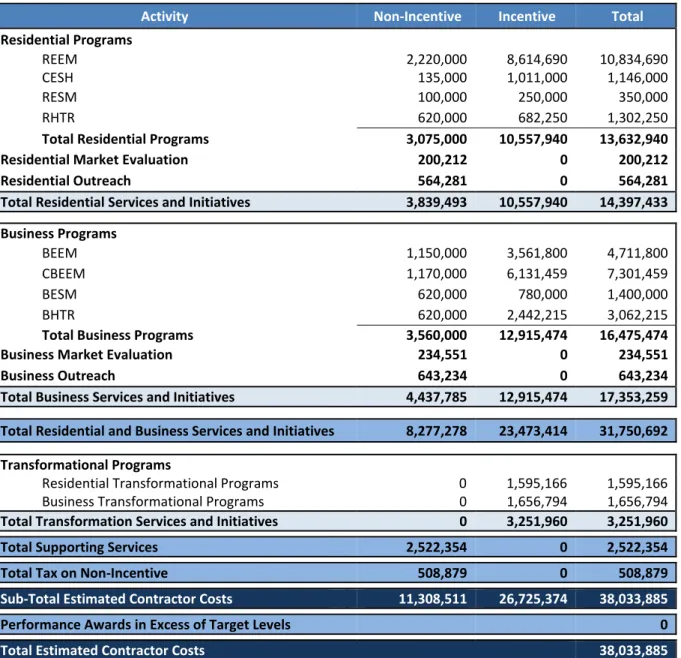
Table 2: Annual Plan Budget 116
Table 3: Performance Goals and Performance Incentives 117
FIGURES
Figure 1: Data Integration Process 7
Figure 2: Smart Meter Data Visualization 8
Figure 3: Use of GIS Tools 9
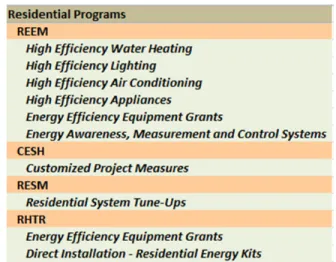
Figure 4: List of Residential Programs 27
1.0
INTRODUCTION
On behalf of Leidos Engineering, LLC (“Leidos”) and the Hawaii Energy Efficiency Program, operating as the Hawaii Public Benefits Fee Administrator (PBFA) under contract with the Hawaii Public Utilities Commission (PUC), we are pleased to present the PBFA Annual Plan for Program Year 2015 [July 1, 2015 through June 30, 2016] (PY15).
1.1
Annual Plan
This PY15 Annual Plan is based on our PY15 Program Renewal Proposal submitted May 21, 2015 and provides the detailed strategies, budget, goals and a roadmap for administration and delivery of the Hawaii Energy Program based on enhanced PBFA statutory authority, our experience to date, PUC directives and the State’s clean energy goals.
Key features of this PY15 Annual Plan include:
a. Utilizing a $38M budget to provide program-level impacts of 122,243,721 kWh first year savings with $0.034 (LBNL Cost of Saved Energy (CSE)) per kWh average lifetime Program acquisition cost, a fraction of the current utility avoided cost of $0.161/kWh;
b. Achieving a TRB of $159M and a measure life energy cost savings of $509M to utility customers;
c. The development of a new custom lighting program to address energy saving potential in existing specialty interior and linear fluorescent lamps in the residential sector;
d. A specially designed custom residential hard-to-reach program targeting previous Transformational program participants;
e. Removing the Residential and Commercial Energy Auctions from the Program making $196,000 available to be used on more cost-effective and realistic measures; f. Proactively addressing a market transition of CFLs to LEDs by reducing CFLs to 13%
of the planned energy savings, as compared to 38% in PY13;
g. Increasing the Peer Group Comparison program to reach 240,000 households while improving customer experience through the use of web-based services and
enhanced tools; and
h. Establishing a Strategic Energy Management (SEM) teaming process to assist large businesses and institutions to plan and execute effective energy management as a critical part of business operations.
1.2
Key Factors Impacting and Actions Basis for Annual Plan
The following are some of the key factors and actions that have impacted the Annual Plan developed for PY15:
Increased Program Aggressiveness – The PUC guidance has been to push the 1.2.1
Program to:
• Deeper energy savings achievement with expanded offerings and services for the Public
• Longer life measures
• Integrated Demand Response capability into energy efficiency projects
• Further opportunity and awareness for all to participate,
Building a Cost-Effective Program – The benchmark measurements of the 1.2.2
Energy Efficiency program is the “Program Cost Test” that takes into account all program-related costs as compared to the energy reductions achieved. For PY15 the “all-in” cost per kWh is $0.03.
The PY15 program energy figures are provided in the table below:
• Customer Level First Year Energy Impact of 139M kWh • 1,536,899,706 kWh savings over the life of the measures • $38,033,885 Overall Program Budget “Program Cost” • Lifetime Cost of Saved Energy (CSE) of $0.034 /kWh • Annual Cost Savings to Participants of $46 Million • Lifetime project cost savings of $509 Million
• Economic generation of $184 Million in facility improvements Table 1
PY15 Program Performance Targets and Impacts Proposed PY15 First Year
($/kWh)
Lifetime ($/kWh)
Average
Life (Yrs.) Incentives
First Year Energy (kWh) Lifetime Energy (kWh) Business $ 0.209 $ 0.019 9.1 $ 12,915,474 61,753,307 549,238,079 Residential $ 0.175 $ 0.016 13.0 $ 10,557,940 60,490,414 801,601,096 Direct Incentives Only $ 0.192 $ 0.017 11.1 $ 23,473,414 122,243,721 1,334,111,790 Transformational Programs $ 3,251,960
Program Cost/Savings $ 0.219 $ 0.020 $ 26,725,374 122,243,721 1,334,111,790
Customer Level Bill Savings 139,081,204 1,536,899,706
Economic Benefits Cost per kWh Annual Lifetime
Potential Participant Cost Savings $ 0.33 $ 46,103,169 $ 509,457,390
Average Project Simple Payback 4.0 years
Potential Participant Capital Investment $ 184,412,677
Direct Incentives $ 23,473,414
“How & What to Buy” Participant Advocacy – Hawaii Energy has sustained a 1.2.3
focused review of the inclusion of new measures and equipment into the program over the past five years and this has proven to have protected participants from “bleeding edge” and “here today, gone tomorrow”
offerings. The program has always offered customized incentives that would encompass any energy savings action and perform reviews of post energy usage to confirm claimed energy savings. The Program has also stayed contractor/vendor neutral to the extent that no promotions of available companies were done in order to avoid the appearance of endorsement. In PY15 Hawaii Energy will utilize the Clean Energy Ally program to create awareness of all the companies that are providing energy efficiency goods and services and provide “how-to-buy” discussions to address common hurdles of indecision to starting energy projects.
Increased Benchmarking and Web Tools to Drive Engagement and
1.2.4
Awareness – Hawaii Energy will build on the experience gained in PY14 with benchmarking and utility data analysis to drive behavior in both the
business and residential sectors.
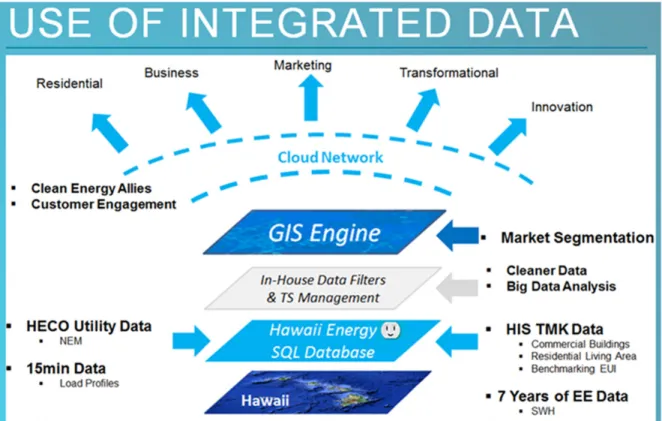
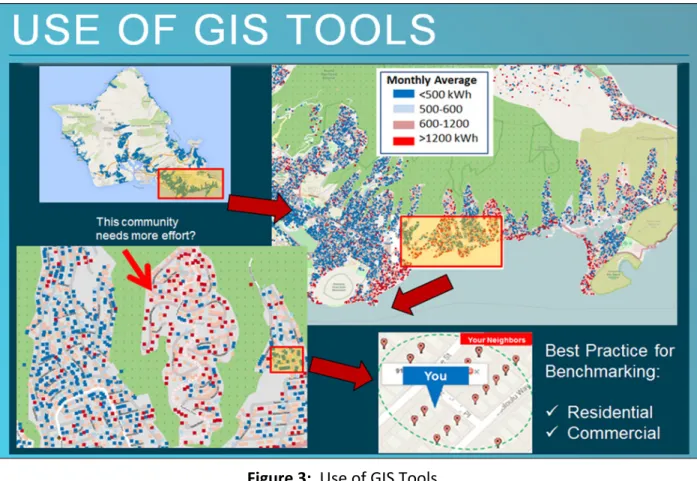
Data visualization and customized views of information on the website shown on the following pages (Figures 1, 2, & 3) will drive engagement by showing participants where their energy consumption compares with others in the community in new ways.
The Program will also provide our Clean Energy Allies with segmented and Hawaii specific data so they can make informed decisions on what products and services they can offer to assist customers in improving their operations as they lower energy usage and costs.
Figure 1: Data Integration Process
Hawaii Energy’s new data engine will integrate the utility data with geographic information system (GIS) to capture, analyze, and present the valuable information to both the business and residential sectors.
Figure 2: Smart Meter Data Visualization
This chart illustrates the concept of using energy in Time-of-Use (TOU) with the smart meter and how the Program can analyze and visualize the 15-min interval AMI data effectively in an innovative
Figure 3: Use of GIS Tools
2.0
OUTREACH & MARKETING COMMUNICATIONS
2.1
Overview
For PY15, the primary objective of the Program’s Marketing Communications (“Marcom”) is to more aggressively increase customer awareness of and participation in Hawaii Energy offerings (i.e., residential rebates, business incentives and transformational
educational/training opportunities) through development and execution of a strategic and integrated marketing plan utilizing effective strategies and tactics.
Most notably, the Program will continue to leverage lessons learned and replicate successes to break through awareness and participation barriers across electric utility customer segments by speaking in each segment’s “language” (including metrics that matter to them) and tone to motivate each to participate in Hawaii Energy’s offerings and save energy.
Breaking Through Awareness and Participation Barriers
The Program understands the PUC’s desire to ensure that all eligible utility customers are aware of the offerings and the benefits of participating. The nature of the messaging is critical and the Program will work to utilize language that has broad appeal, reaching electric customers across rate schedules and demographics. In PY15, the Program will continue to increase awareness of and participation in program offerings by leveraging marketing successes and lessons learned from prior program years through a cost-effective and metrics-based marketing plan, which will utilize a strategic mix of traditional and non-traditional strategies and tactics.
The Program will more aggressively develop and execute results-based marketing plan to increase electric customers’ awareness and participation to levels needed to sustain Hawaii Energy as a brand and a successful energy conservation and efficiency program.
Opportunities for PY15
For PY15, Hawaii Energy has identified significant opportunities to leverage the successes and lessons learned to enhance strategies and tactics already proven effective, as well as explore additional innovative, cost-effective and wide-reaching opportunities. Comprised of a mix of results-based strategies and tactics, Hawaii Energy will reach customers across Hawaii, Honolulu and Maui counties and maximize reach and effectiveness with continuous analysis and refinement.
2.2
Key Objectives
For Marcom, the key objective continues to be to increase awareness and participation in Hawaii Energy’s offerings. The primary call-to-action for customers is to go to our Hawaii Energy’s website or contact our call center. Where the offerings and/or applications are available only at retailers or other distribution points by design, the call-to-action is adjusted accordingly.
Specific new segments to be targeted are:
• Residential – Multi-family direct install candidates and homes with T12 and MR16 lamps for participation in Customized Energy Solutions for the Home (CESH) • Business – Warehouse high bay lighting, High Intensity Discharge (HID) lighting
replaced with new Light Emitting Diode (LED) lighting fixtures coupled with lighting controls.
Additionally, PY15 is the opportune time to revisit and use a more aggressive, yet local and relatable, approach to market the Program. This approach will leverage market research results from PY14, as well as selling and communication approaches such as those utilized and promoted by one of the Program’s Transformational subcontractors, Mark Jewell of EEFG Inc. Such an approach is critical to the continued and increased success of the Program.
A brief summary of the market research, as well as high-level key considerations of an aggressive integrated marketing plan in PY15, are outlined below.
2.3
PY14 Market Research
Market research conducted in PY14 indicates that although there is low awareness of Hawaii Energy, many had heard of and had participated in some of our offerings.
Specifically from the telephone phone and online surveys (the quantitative component of the market research):
• Out of a base of 624 surveyed, 10% reported having contact with Hawaii Energy. • Of those who had heard of Hawaii Energy, 43% could describe – unaided – an
offering from Hawaii Energy.
• As for aided awareness of 5 specific offerings (i.e., solar water heating, Home Energy Reports, ENERGY STAR® appliances, efficient light bulb low prices & old refrigerator rebates), it ranged from 35% to 78%.
• As for participation in those same offerings, it ranged from 15 to 34%.
The market research also included two qualitative components (i.e., focus groups and one-on-one interviews). A summary of the key findings of the market research was presented to key Hawaii Energy and PUC staff by the independent market research subcontractor, and a written detailed summary provided for further analysis. Highlights of the research will be outlined in the PY14 Annual Report.
In short, the research indicates a strong need to increase Hawaii Energy’s brand (i.e., name) awareness to increase participation. In addition, of note, those surveyed online were asked how they get most of their information. They were allowed to check off a list and indicate all that applied. A majority indicated the Star-Advertiser, Hawaii News Now, KHON-2, word-of-mouth, websites, direct mail and radio, among other responses. Key feedback such as the above will be analyzed and considered for the PY15 marketing plan.
Considering the above, where appropriate, the Program will continue to integrate cost-effective and relatable branding into offer-specific marketing communications strategies and tactics.
2.4
Overview of Integrated Marketing Plan
The cornerstone of Hawaii Energy’s PY15 integrated marketing plan is continuing to refine and use clear messaging that Hawaii Energy is the energy conservation and efficiency program funded by electric customers to serve electric customers in a way that excites and engages the different segments of the electric customers – with the goal of their
participation in Hawaii Energy offers.
As always, critical to the marketing plan – and all Marcom strategies and tactics – is the development of the exact messaging that will resonate with electric customers, yet still be simple and memorable for customers to carry out the call-to-action.
Integrating All Components of Marketing
2.4.1
As an integrated marketing plan and to add credibility and relatability to the Program, the Program will continue to increase the reach of and
participation in the Program’s offerings through robust strategies and tactics, including but not limited to public relations, outreach, promotions, web and social media to maximize success. An overview of the strategies and tactics are outlined in the sections below.
Specifically, public relations includes media relations with the goal of securing “earned media” in mainstream, community and trade publications such as bylined articles and feature stories to keep the Program top-of-mind for and to increase participation from various segments of the electric customer population.
To maximize reach while maintaining cost-effectiveness, the Program will also continue to develop and utilize a mix of strategic advertising which will be integrated with the messaging of all other marketing communications strategies outlined herein. The timeframe, total reach and mix of advertising among these media will be determined to maximize effectiveness and the budget available. PY14 advertising highlights and metrics will be included in the PY14 Annual Report.
PY15’s advertising may include but is not limited to print, radio, TV and online medium. Where feasible, built-in metrics for the Program to gauge not only interest from the target markets – but action or participation will be worked on, tracked and analyzed. This will expand on PY14’s successes, including PY14’s one-month online advertising buy to promote Residential energy-saving kits, which provided metrics ranging from interest (e.g., click-throughs) to “conversion” (i.e., opt-in/purchase of the kits). Results and metrics from PY14’s advertising buys will be highlighted in the PY14 Annual Report.
Details and components of the media buy, including but not limited to frequency, estimated impressions or reach and audience demographics, are to be determined based on budget availability, as well as the offers being promoted and target markets. Where appropriate, the Program will work with the media directly or a media buyer to negotiate the best pricing and placement available for the buys and inclusion of added-values where available (e.g., “complimentary” or “built-into the buy” additional promotional opportunities such as bonus mentions and invitations to participate in strategic outreach events) to maximize the impact of the advertising budget.
Evaluation to Increase and Measure Success of Marketing Plan
2.4.3
Progress and results of marketing strategies will be tracked and analyzed with continuous pre- and post-evaluation to determine the effectiveness and success of the messaging and tactics in relation to industry-established metrics. The Program will continually monitor and remain flexible
throughout the Program year to adjust strategies and tactics, where needed, based on the evaluations to maximize success.
Evaluation methods include, but are not limited to, cost-effective phone and online surveys, as well as website and social media metrics.Specific
evaluation methods will be determined and tailored for each strategy and tactic to provide the Program with the most relevant and useful metrics on an ongoing basis to allow for readjustments as needed during the Program year.
2.5
Overview of Marketing Strategies and Tactics
To continue to increase awareness of and participation in the Program’s Residential, Business and Transformational offerings, the Program will leverage industry-recognized strategies and tactics including those outlined below: (1) outreach; (2) website; (3) social media; (4) promotions; (5) videos; (6) email marketing; (7) co-op marketing with Clean Energy Allies; (8) marketing collateral; (9) direct mail; and (10) public relations.
Outreach
2.5.1
The Program’s community outreach efforts continue to play an important role in increasing and maintaining the awareness of Program rebates and offers for the general customer population and business communities. As of PY14 third quarter, Hawaii Energy has participated in 31 events and is on track to reach a total of 45 events for the entire program year, reaching approximately 107,705 people (estimated event attendance). This includes a mix of traditionally well-attended residential community events and business trade expos, as well as smaller, industry-tailored events where we were able to promote specific sets of offerings (i.e., small business lighting, restaurant kitchen, etc.). For PY15, the Program will again aim for upward of 40 events during the year, continuously evaluating for cost-effectiveness, reach and lead generation potential.
A few highlights of PY15 outreach efforts include:
• Traditional Outreach - For PY15, the Program will continue to
participate in the community and trade expo events that proved to be successful based on post-event surveys, historical participation, audience, attendance and location. While striving to maintain reach levels consistent with past program years, the Program will research new opportunities and partnerships, strategically incorporating new events if they are deemed feasible and beneficial in reaching overall Program goals. Marcom will also re-evaluate tracking and evaluation metrics in PY15 to ensure outreach remains a high-value portion of overall marketing efforts.
• Outreach Through Community Allies & Organizations - The Program will continue to align itself with organizations that: 1) share a common or similar objective of helping the community through environmental
• Collaborate with Hawaii Businesses and Organizations - Hawaii Energy will increase collaboration with private businesses and
industry/nonprofit organizations to facilitate other creative or more targeted ways of disseminating Program messages. These methods may include tailored presentations by Hawaii Energy team members and collaborating on special events as appropriate. In addition, Program personnel will join and participate in professional organizations that are important for the Program to support as an active member, provided there is no actual or appearance of conflict of interest.
Website
2.5.2
The Program’s website serves as a resource for electric customers and Clean Energy Allies to learn about how homes and businesses can save energy and money on their electric bills. The Program designs and maintains the
website in-house and the site’s design was refreshed to incorporate new offers and interactive customer tools.
The Hawaii Energy website receives, on average, 19,000 page views from roughly 5,000 unique visitors per month. (More metrics will be available in the PY14 Annual Report.) For PY15, Hawaii Energy will continue to review and refine the website to ensure that it is providing a relevant and positive user experience. The Program’s goal is to increase page views and unique visitors by 10% and to re-evaluate its website metrics and web design to improve customer engagement and experience.
At the beginning of 2014, Hawaii Energy developed a “Dare-to-Compare” website tool to engage customers with live, personalized information regarding their energy usage as compared to their neighbors. We will continue to refine this tool in PY15, providing greater segmentation (e.g. markets, sizes of homes) capabilities and layering with GIS and other data sources.
Social Media
2.5.3
Hawaii Energy continues to use social media (i.e., Facebook, Twitter and Instagram) as a low/no-cost tool to market Program offerings, stay at the forefront of customers’ minds on a daily basis, and most importantly, keep a pulse on our community.
As of PY14 third quarter, Hawaii Energy has over 3,500 Facebook “likes” and over 2,700 Twitter followers, counts that remained consistent (i.e., without significant drops) over the year. Additionally, the Instagram account, which was started in PY13, is up to 136 followers.
For PY15, the Program will continue to provide interesting and relevant content, while developing a solid social media strategy – with the ultimate goal to increase not only follower count, but other important metrics such as reach, virality (number of people talking about our brand) and conversion
(translating post viewing into program participation). Options to execute this strategy can include, but are not limited to: (1) developing a refined editorial calendar and set of goals; (2) advertising on social media platforms, which is traditionally inexpensive compared to other mediums; and (3) executing 1-2 timed campaigns around specific program offers throughout the year.
Promotions
2.5.4
The Program will continue to develop promotions to bring excitement and increase word-of-mouth for Hawaii Energy. Promotions will be developed based on specific offer or Program goals, but may include contests (e.g., social media, photos, videos), special promotions via our Clean Energy Allies, community promotions through local nonprofits, seasonal promotions and discount offers. The Program will identify and track participation metrics to determine the success of the promotions. Results (including metrics, successes and lessons learned) of PY14 promotions will be highlighted in the PY14 Annual Report.
For PY15, the promotions plan includes:
• Residential – Special discount offers to promote products available at Hawaii Energy’s online store. Online sweepstakes for customers to register to win a free energy-saving device.
Special discount offers to promote products available at Hawaii Energy’s online store. Online sweepstakes to encourage customers to check their Dare-To-Compare results and win a free energy-saving device.
• Business – Promotions on incentives will be limited should it be determined that they will move the market to a meaningful degree. Rather, the Program will look towards promotions akin to SPFFs and other sales-oriented incentives to motivate Clean Energy Allies who are more instrumental in selling energy efficiency.
Videos
2.5.5
Marcom recognizes and understands that videos can be powerful for drawing in and retaining the attention of its customers. As such, the Program will continue to explore the strategy of conveying our messages through videos.
Email Marketing
2.5.6
As of PY14 third quarter, Hawaii Energy has over: (1) 10,500 subscribers to the monthly “residential” e-newsletter, (2) 800 to the “business” e-newsletter distributed every other month and (3) 750 to the “energy professional” e-newsletter distributed periodically when the Program extends offers to that target market.
In PY15, the Program will continue to develop and implement a robust email marketing system to support Program communications. The Program will work to maintain and increase the number of email subscribers; better integrate/share email marketing communications via web and social media; and maintain high open rates of over 30%.
Additionally, the Program will work to increase its email subscribers by 10 - 15% for the “residential” and “business” e-newsletters. Additionally, the Program will collaborate with the Clean Energy Ally Specialist and the Business Program team to increase subscribers to the “energy professionals” e-newsletter by 5 - 10%, which by its nature is a niche audience.
For PY15, the Program will maintain the frequency of its email distribution. The “residential” e-newsletter will continue to be a monthly distribution and the “business” e-newsletter will remain a bi-monthly distribution. The “energy professionals” e-newsletter will continue to be on a periodic basis depending on Program offerings and promotions developed.
Co-Op Advertising with Clean Energy Allies
2.5.7
Cooperative (“co-op”) advertising is a mechanism by which Hawaii Energy contributes some funds to the advertising costs of Allies, provided Allies comply with certain specific approved messaging and logo inclusion rules, as well as request pre-approval from and allow preview rights to Marcom. Co-op advertising is a cost-effective way for the Program to collaborate with our Allies, increase our brand awareness and maximize our marketing budget. The Program launched co-op advertising to residential solar water heating participating contractors in the second quarter of PY13 and had a slow start. However, contractor participation to date in PY14 significantly increased by 50% with approximately 66% of the $25,000 budget earmarked and 8 contractors participating. In PY14, the Hawaii Energy co-op cap per contractor is $3,000 for up to 50% of the cost of the ad(s).
For PY15, the Program will continue to offer co-op advertising to residential solar water heating residential contractors and adjust the co-op cap in consultation with the Residential team, as needed. Additionally, the Program anticipates expanding the offer to all Clean Energy Allies with an increased overall budget but a lower monetary cap to allow Clean Energy Allies to participate.
Marketing Collateral
2.5.8
To support all Marcom and Program objectives, as appropriate for the audience, the Program will continue to:
• Maintain, update and expand a collateral system to support the residential, business and transformational programs. This can include, but is not limited to, brochure development, rack cards, flyers, one-sheets and posters.
• Ensure that important information and messaging are written and organized in an easy-to-understand manner for the audience whether they are general population customers, strategic partners or Clean Energy Allies.
• Highlight the businesses and organizations that have participated and been helped by the Program through the development of case studies/testimonials.
Direct Mail
2.5.9
Direct mail to geographically-targeted areas is a new channel that the Program will further explore in PY15. In PY14, the Program utilized current data and customer information to strategically promote our solar water heating offer. The direct mail piece was sent to approximately 50,000 residents across all three counties. Market segmentation included households that: 1) are larger than 700 sq. ft., 2) consume more than 700 kWh/month over the last 12 months, and 3) have never participated in the solar water heating rebate.
In PY15, the Program will consider implementing additional targeted direct mail and other integrated marketing efforts to promote various rebates and energy efficiency measures to businesses and residential customers, when applicable. In addition, the Program will continue to work with Hawaiian Electric to distribute targeted messaging and inserts through the electric company’s business and residential monthly bills across the counties. For any offering promoted via direct mail, the Program will track and analyze the effectiveness of customers’ interest and/or participation by assigning specific website addresses or codes in the direct mail as the call-to-action.
Public Relations
Hawaii Energy will continue to secure local news coverage
throughout the State, as well as “third-party endorsements” (e.g., testimonials or positive, endorsing statements) from community leaders and key stakeholders. The volume of earned media coverage may vary month-to-month based on the nature of the program’s announcements and pitches, as well as competing breaking news stories.
Local media outreach will include the following:
• Mass print media (e.g., Honolulu Star-Advertiser, Pacific Business News, Midweek, Hawaii Business Magazine and numerous neighbor island newspapers)
• Mass broadcast (e.g., KHON, Hawaii News Now, KITV, Hawaii Public Radio, FM & AM radio)
• Trade publications (e.g., Building Industry Hawaii, Hawaii Hospitality)
• Community and professional organizations (e.g., via newsletters, emails, presentations and/or collateral distribution)
• Online media (e.g., local blogs, local community-minded websites)
Media training will continue for staff and subcontractors as needed to ensure Hawaii Energy’s messaging is clear and
consistent when reported on by the news media. In addition, the Program will work with select Hawaii Energy staff members to develop “personal interest” stories aimed at featuring their background and community involvement as an additional tactic to secure media coverage for the Program where appropriate. As of PY14 third quarter, media coverage for the Program had a reach of more than 9.4 million with an estimated publicity value of over $168,000. The estimated reach of the media coverage was calculated by multiplying the circulation/audience figures of each media by three, which is a generally-accepted calculation method within the public relations industry. Publicity value is calculated by multiplying the advertising value equivalency by three, which is a factor generally accepted by the marketing industry. Advertising value equivalency is what the editorial coverage would cost if it were advertising space (print publications) or on-air time (television and radio).
For PY15, Hawaii Energy’s goal is to secure two to five media stories per month and increase advertising value of the media coverage for the overall program year by 15%. Since earned media coverage is a third-party opinion, the impact is considered
three times that of a paid advertisement. Therefore, the
program’s reported advertising value is multiplied by three, which is a widely-accepted metric in the PR industry. Advertising values of media coverage are summarized in annual reports.
2.5.10.2 Program Positioning
For PY15, Hawaii Energy will identify 6 to 8 opportunities to coordinate informational presentations to introduce/reintroduce the Program to and influence energy efficiency decision-makers and buyers including the “hard-to-reach” segments to increase participation in Program offerings.
This will include leveraging existing relationships with government agencies, community service organizations as well as maximizing the Program’s potential sponsorships with entities such as the Chamber of Commerce of Hawaii. Additional organizations will include, but are not limited to the following: energy industry professionals, business groups, AOAOs and large employers. As discussed earlier, PR is one of the key complementary components to maximize success of the marketing plan. PR will reinforce Hawaii Energy’s unique attributes and benefits for electric utility customers. There will be a sustained effort throughout PY15 to support Hawaii Energy staff and/or key subcontractors with presentation training, community outreach preparation and event coordination as needed.
3.0
TRANSFORMATIONAL ACTIONS
3.1
Overview
Market Transformation seeks to identify, assess and help overcome market barriers that inhibit residents and businesses from adopting energy-efficient technologies and practices. Projects areas include:
• Behavioral modification initiatives targeted to specific audiences
• Professional development for energy salespeople, teachers, and others who can influence decision making
• Technical training for people who buy or operate equipment
• Energy in decision-making support for large energy users to develop comprehensive energy management strategies incorporated in business practices
Projects are delivered through established programs that have proven successful over time and new initiatives. Established offerings are continually evaluated for opportunities to improve and expand. New initiatives include research to identify market leverage points and pilot projects to find scalable solutions. The goal of the Transformational program is to effect large scale change that saves energy over a three to five year time horizon.
3.2
Key Objectives
The key objectives of the Transformational programs are to:
• Leverage the work of others in the community to reach across all islands and ratepayers
• Implement projects that will reduce energy consumption in the state within a five year period
• Leverage resources to support the development of self-sustaining efforts
• Build on successes and lessons learned in past program years
• Support the development of a robust Clean Energy Ally Program to leverage energy industry professionals to multiply energy efficiency projects
• Develop programs that support institutional change for energy efficiency that include strategic energy management, codes and standards, benchmarking, and renewables integration
• Pilot new projects that can lead to scalable programs with measurable savings • Develop outcomes-based logic models and evaluation metrics to better measure
3.3
Behavior Modification
Behavior modification programs aim to help people make daily decisions that reduce energy use. These efforts require a range of efforts and dynamic programs in order to reach this diverse target market. For PY15 we will continue to focus on the foundation of energy literacy and strive to reach the mass market as well as “hard-to-reach” residents in underserved communities in Hawaii, Honolulu and Maui counties.
We will also build on efforts to better quantify savings such as through Community-Based Social Marketing pilot projects that target specific, high impact behavior changes. The Program will use knowledge gained from our PY14 pilots and intelligence gathered from research on technology and best practices to demonstrate the effectiveness of behavioral change.
The following outlines the PY15 portfolio of Behavior Modification offerings planned: • “Sharing the Aloha” Community Workshops – This workshop blends financial and
energy literacy to connect energy-related behavior and choices to one’s electric bill. Workshops will target community organizations, housing and condo associations and government housing agencies that can provide access to a large number of residential customers (e.g. municipalities, hotels, etc.).
• Creation and Distribution of Transformative Messaging
Hawaii Energy will continue with its communications campaign to increase the availability of energy-saving information using culturally-relevant images, videos, phrases, etc., that is spread via the Internet and in creative and often humorous ways. Content will start discussions and promote existing residential offers. We will also track the effectiveness of the messaging in increasing participation in rebate programs.
Hawaii Energy will promote energy saving competitions (e.g. gamification) for local businesses and community groups. These have proven successful in teaching and promoting energy-saving behaviors, multiplying Hawaii Energy’s reach and local workforce understanding of the importance of energy efficiency.
• Community Based Social Marketing (CBSM)
Building on research that was launched in PY14, the CBSM program will target specific energy efficiency behavior changes in the Association of Apartment Owners (AOAO) condo market. The work will pilot behavior change projects and also build local capacity to implement data driven, outcomes-oriented behavior modification
• Community Education Support – Support collaborative efforts to raise awareness and educate the community about energy efficiency
o Continue to sponsor the University of Hawaii’s Annual Sustainability in Higher Education Summit, which has been a catalyst for improving energy efficiency policy, education and awareness throughout the UH System as well as other institutions of higher education.
o Continue to sponsor the ongoing work of Hawaii Green Growth (HGG) in the development of the online dashboard with statewide energy metrics. We will provide technical expertise on the Sustainability Measures Project, and collaborate with HGG Working Group members keeping energy efficiency at the forefront of the discussion.
• Market Research – The Program will work with a cross disciplinary team of faculty at the University of Hawaii to develop a methodology to test various time-of-use rate structures to drive behavior change. This is to assist the utilities in filling the daytime PV load depression and control the nighttime peak loads.
• Smart Grid – Build upon the lessons learned from PY14 in order to enhance Home-Area-Network (HAN) implementation of the smart grid benefits to customers and the utility. The actions will include:
o Developing meaningful follow-up actions to our current pilots, and potentially enhanced with Home Energy Management System (HEMS) applications such as smart thermostat, smart plug, water heater controller, and photovoltaic sub-meter for EE and load shifting opportunities.
o Engaging current pilot participants with EE messaging and 15-min interval energy feedback to demonstrate the concept of Time-of-Use (TOU).
o Evaluating the initial Smart Grid Phase 0 participants on near real-time energy use and Hawaii Energy program participation; and
o Evaluating the effects of the HEMS applications, In-Home Display (IHD), Mobile Apps monitor in producing behavioral changes that could result in energy-savings.
• Shift for Savings Plan
In response to the lesson learned that “demand response” (DR) and “load control” have negative connotations associated with the terms, Hawaii Energy will refer to these programs in a more customer-friendly ways such as “Shift for Savings Plan.” We will build on our PY14 pilots and research to enhance certain current CBEEM and BESM program offers to include a requirement for load control. Our team will use knowledge gained by our two PY14 water heating load shifting projects to inform the CBEEM and BESM program design.
We have committed to a demand response initiative for a new construction project consisting of 499 rental apartments, each with electric water heating. This is in support of efforts by Shifted Energy, HECO and the developer to coordinate the install of grid interactive water heaters.
• Electric Vehicle Support – TheProgram will upgrade its new electric vehicle owner energy-saving kit offer to online fulfillment in PY15. Additionally, the Program will continue broad support for EVs. For example, in an effort to raise awareness, Hawaii Energy will incorporate Electric Vehicle (EV) messaging throughout the program and provide marketing and
communications support. The Program will also continue supporting various DBEDT and Blue Planet-sponsored EV awareness activities to include participation in EV Partnership meetings, outreach events and providing information as well as other promotional items.
3.4
Professional Development
Professional development is aimed at people in positions to influence energy decisions in the home and in businesses.
K-12 Educator Training and Development
3.4.1
The coming year will focus on a refinement of the K-12 teacher professional development to offer a phased approach that provides opportunities for teachers to continually engage with energy efficiency, develop their energy literacy and curriculum, and support students and their families to practice energy-saving behaviors in the school and at home. The Program will focus on deepening ongoing relationships with teachers who commit to being leaders in energy efficiency. Particular attention will be given to engaging with parents through Energy Expos and connecting them to Hawaii Energy resources such as the “Dare-to-Compare” tool. Hawaii Energy’s Teacher Advisory Board (TAB) will continue to provide feedback on the program (e.g. curriculum and materials) and pilot the new phased approach.
Facility Management Degree Program
3.4.2
In fall 2015 the University of Hawaii West Oahu, in collaboration with the International Facility Management Association of Hawaii, will officially launch their four year degree in Facility Management to meet the rising demand for skilled professionals in the field. Hawaii Energy plans to continue to support this initiative with funding as well as technical and industry expertise.
Energy Efficiency Sales and Financial Analysis of Energy Projects Training
3.4.3
PY15 will see the continuation of training for energy professionals to be effective at getting projects approved. This program year we will produce tools, templates, and case studies to support market penetration of
Hawaii Energy Fellowship Program
3.4.4
Program modification will focus on the reduction of management costs and expanded intern assignment scope to offer higher level work products that assist with the growth of innovative Transformational offerings in PY15. We plan to move to a more customized internship program with peer-to-peer mentorship that provides fellows with increasing leadership responsibilities. This will lay the foundation for future expanded reach and impact at a reduced Program cost.
3.5
Technical Training
Technical Training is focused on people who buy or operate equipment such as engineers, facility managers, architects, building operators, and energy managers. These professionals have typically had experience in infrastructure and energy for a substantial portion of their career, but may need to enhance their technical skills.
Facilities Management Training
3.5.1
The Program will continue to offer training for existing facilities staff, managers and technicians to support their role in implementing energy efficiency upgrades. This will include technical training workshops on HVAC, lighting, pumps, motors, etc. to be promoted throughout the year. We will also facilitate and support strategic planning to ensure that Hawaii’s various offerings related to facilities management and energy efficiency are
coordinated including: the Bachelor of Applied Science (B.A.S.) degree program in Facilities Management at the University of Hawaii – West Oahu (UHWO), UH Maui College Sustainable Living Institute of Maui (SLIM) and other partners.
Building Operator Certifications (BOC®)
3.5.2
Building Operator Certification Level I and Level II training sessions with University of Hawaii’s Manoa Outreach College and Maui College’s Sustainable Living Institute of Maui (SLIM) program will be supported. The Program also plans to expand this offering to include Hawaii County for the first time.
Water/Wastewater
3.5.3
The Program will continue to sponsor efficiency and conservation education for entry-level water and wastewater operators through the SLIM program. Hawaii Energy will continue to work with groups such as the Rural
Community Assistance Corporation and the Hawaii Rural Water Association to offer trainings, outreach, networking, and project identification.
Support Business and Residential Program Offerings
3.5.4
Develop additional trainings as time and budget allows that support the development of technical expertise to increase adoption of business and residential programs.
3.6
Energy in Decision Making
Strategic Energy Management (SEM)
3.6.1
The Program will introduce the processes of SEM and develop a set of tools and resources to assist large institutions to comprehensively plan for effective energy management as a critical part of their business decision making and exponentially increase the number and effectiveness of energy efficiency projects that are considered as part of the strategic vision and plan of the organization rather than a specific isolated project. This approach will lead to deeper and more meaningful energy efficiency throughout the organization.
• Hawaii Energy plans to assist in the development of a long-term Strategic Energy Plan with the University of Hawaii to improve energy management and educate faculty, staff and students in energy efficiency and conservation practices.
Codes and Standards
3.6.2
Hawaii Energy will continue to work with the State Building Codes Council (SBCC) to adopt IECC 2015 with Hawaii amendments. Utilizing the codes compliance report we completed in PY2014, we will inform the industry of current strengths and challenges in energy code compliance. Hawaii Energy will be a resource to help permit reviewers and building designers
understand and comply with Hawaii’s energy codes and standards. Next steps include providing a summary report and action items to county building officials, DBEDT, and other professionals as well as offering practical and specific training on the latest adopted energy code.
Benchmarking
3.6.3
The Program will continue in-house efforts to benchmark facilities and business sectors in PY15, with a goal of 150 new locations. We will identify, by sector, facilities with above-average energy use intensities (EUI) and
4.0
RESIDENTIAL PROGRAM STRATEGY & DETAILS
4.1
Overview
For PY15, Hawaii Energy will maintain the following incentive categories:
• Residential Energy Efficiency Measures (REEM) – This incentive category is the core of Hawaii Energy’s residential portfolio and undergoes incremental developments responding to market conditions (i.e. retail pricing) and consumer need.
• Custom Energy Solutions for the Home (CESH) – This incentive category provides a measure of flexibility within the prescriptive portfolio to accommodate unforeseen market opportunities. The budget and unit cost targets provide financial efficacy guidance to the Program and allies who champion these opportunities.
• Residential Energy Services & Maintenance (RESM) - This incentive category targets ally-driven service offerings to enhance energy savings persistence and bootstrap fledgling energy services businesses trying to secure a toehold in Hawaii.
• Residential Hard-to-Reach (RHTR) – This incentive category will seek to secure various projects among geographies and demographics that have been traditionally underserved. Efforts in PY15 will continue to address the landlord/tenant barrier through direct installation of home energy saving kits and heat pump water heaters. A summary listing of the updated Residential Program offerings can be found in the table below followed by a brief summary of additions and changes. A detailed description of the Residential Program offerings follows in section 4.1 through 4.5. Appendix B contains a projection of potential energy savings for the planned programs.
New Program Offerings of Residential Energy Efficiency Measures (REEM)
4.1.1
4.1.1.1 High Efficiency Water Heating
• Solar Water Heating - During PY15, the solar water heating (SWH) program budget will see a reduction in total unit count to 1,450 as well as a reduced rebate amount of $750. These modifications are required given a SWH market penetration of over 45% of eligible residences, increased sales of PV-direct water heaters, PV-only contractors capturing complete rooftops and a shifting baseline due to codes and standards. Most importantly, this is a significant effort to better align the SWH program’s cost effectiveness with the overall Program goals. • Heat Pump Water Heaters - In PY15, the Program will focus on
heat pump applications in multifamily settings. We will address this market with an increase in the standard incentive for heat pumps from $200 to $300. We will also continue to work with government housing agencies, condominium association boards and property management companies to identify multifamily properties well-suited for Hawaii Energy’s Heat Pump Direct Installation Program.
4.1.1.2 High Efficiency Lighting
• CFL Lighting - PY15 will see a reduction in the number of CFL bulbs rebated through the residential program. This transition allows the Program to expand incentives available for the growing LED market. Hawaii Energy will also continue PY14 efforts to move away from the larger big box stores and design effective promotions with local retailers who serve a customer base otherwise inclined to stay with incandescent alternatives. • LED Lighting - While not new to the residential portfolio, LEDS
are becoming a more predominant energy saving lighting option for residential consumers. The Program closely follows
availability (rising) and pricing (decreasing) in order to maintain adequate incentive levels. The PY15 plan includes 781,000 LED rebates, an increase of 260% from the PY14 plan. The Program is also reducing the average dollar value per LED rebate to $3.75 in order to properly align with lower market prices. Qualified LED technologies will continue to expand in the coming year
4.1.1.3 Energy Efficiency Equipment Grants
• Online Marketplace – Hawaii Energy will expand the provision of energy-saving devices through our online store launched in PY14. During PY15 we will incorporate additional web-based marketplace services for customers. We plan to include a customized user experience with product education and purchase options for lower cost energy-saving devices not as readily available in local retail locations. The online marketplace will have savings calculators addressing specific customer characteristics. This will result in customized suggestions for applicable energy-efficient technologies. Customers will then be able to take advantage of instant rebates for the purchase of products like advanced power strips, small appliance timers and occupancy sensors, which will be shipped to their door.
4.1.1.4 Energy Awareness, Measurement and Control Systems
• Peer Group Comparison – Hawaii Energy will nearly double the Peer Group Comparison program in PY15 to reach an additional 110,000 households. Over the last four years, this program has grown tremendously due to its effectiveness in motivating behavioral responses surrounding energy use in the home. Home Energy Reports are easily recognized and often commented on by utility customers. Customers receive additional insight into how their usage compares to similar households and the reports provide energy-saving tips while promoting available Hawaii Energy rebates. This program maintains a lower opt-out rate than most other similar initiatives nationwide. In PY14, we utilized more data-driven market segmentation to develop customized messages to customers. We will continue these enhancements in PY15 to include more dynamic messaging based on customer usage profiles. Messages will encourage sign-ups for email-based Home Energy Reports and the use of online web portal tools to track energy-saving progress. This expansion aligns well with the Leidos-created “Dare-to-Compare” tools available at
HawaiiEnergy.com.
• Whole House Energy Management Systems and In Home
Displays – While not new to the residential portfolio, the market approach to promoting whole house offers will evolve.
Specifically, Hawaii Energy will use lessons learned from PY14 pilot projects and data from industry working groups to qualify technologies. We will also explore targeting specific high-use households to consider this measure.
• Small Appliance Timers – Building on the PY14 water cooler timer program, Hawaii Energy will expand the offering to encourage the use of timers on small household appliances and items such as bathroom exhaust fans and bedroom lighting. This will be accompanied by educational outreach and marketing surrounding plug load management within the home.
New Program Offerings of Custom Energy Solutions for the Home (CESH)
4.1.2
Customized Project Measures
• Green Neighborhood Program – We will continue to support the implementation of the Green Neighborhood Program direct install efforts in Moanalua and Pearl City neighborhoods. This project was originally awarded funding as part of the PY14 Energy Efficiency Auction but faced constraints in execution within the original one-year timeline. PY15 will target 1,800 homes for the direct installation of high efficiency showerheads, faucet aerators, advanced power strips and CFLs, with an added effort to address water heating insulation, air conditioning filters and refrigerator coil cleaning. These efforts also include a
comprehensive marketing strategy to enroll residents during an outreach and education campaign in their neighborhood.
• Custom Lighting Program - PY15 includes $200,000 for custom lighting incentives. LED technologies have improved significantly in the past few years and the Program is now well positioned to encourage the
replacement of lamps not previously addressed by the more traditional upstream lighting market. This new program will allow Hawaii Energy to specifically target the existing energy saving potential in specialty interior and linear fluorescent lamps found in the residential sector. By leveraging our existing Clean Energy Ally Program relationships we can better identify and penetrate the appropriate market segment. We will also apply lessons learned from the commercial custom lighting and SBDIL programs to further remove any barriers associated with custom lamp and fixture functionality.
• Custom Residential Hard to Reach Efficiency Measures- In PY15 we have allocated $300,000 in funding to a Custom Residential Hard-To-Reach program. Participants will be identified and recruited based on their participation in past and existing Transformational programs like Sharing the Aloha and NEED.org. Rooted in a whole-home performance
New Program Offerings of Residential Energy Services and Maintenance
4.1.3
(RESM)
Residential System Tune-Ups
Central Air Conditioning Retrofit Pilot – This initiative will look at the
effectiveness of replacing mid-life central air conditioning systems. The pilot will target single-family homes (generally 15-20 years of age) with central air conditioning that are ready to purchase a replacement system. The typical target home type will be equipped with central air conditioning units with EER of 10.0. The retrofit will consist of upgrading the primary unit to one with a higher EER of 13.0. These efforts may also require refrigerant upgrades and duct sealing which would result in higher costs for the customer.
New Program Offerings of Residential Hard-to-Reach (RHTR)
4.1.4
Energy Efficiency Equipment Grants
• Direct Install Heat Pump Water Heater (HPWH) - Hawaii Energy will work with government housing agencies and property management companies to identify ideal multi-family facilities to receive fully-funded heat pump water heaters. We will engage the Clean Energy Allies for the installation work and will build on efforts initiated in PY14 to appropriately address concerns for noise mitigation.
Direct Installation
• Multi-family Direct Install – Hawaii Energy is well-positioned to build upon the PY14 Multifamily Direct Install Program and expand the installation of energy-saving technologies like high efficiency showerheads, faucet aerators, advanced power strips and high
efficiency light bulbs (CFLs and LEDs) in multifamily residences. In PY15 we will target over 4,000 households to participate in the offering; this includes multifamily properties with individually-metered residential accounts and commercial master-metered accounts. The Program has a strong pipeline of leads and continues to engage property managers and government housing agencies to identify potential participants. We are also engaging additional properties through existing submetering and benchmarking efforts. This multifaceted approach will continue in PY15 as it has proven effective in gaining access to the multifamily market which has historically been slower to participate in existing rebate programs.
Residential Program Details Table of Contents
4.1.5
To follow, in Sections 4.2 through 4.5, is an overview summary of
Residential Program Offerings followed by detailed descriptions and energy savings. The overall program details are provided on the following page, preceding the individual Program summaries.
4.1 All Residential Programs Overview
4.2 Residential Energy Efficiency Measures (REEM)
4.2.1 High Efficiency Water Heating 4.2.2 High Efficiency Lighting
4.2.3 High Efficiency Air Conditioning 4.2.4 High Efficiency Appliances 4.2.5 Energy Efficiency Equipment Kits
4.2.6 Energy Awareness, Measurement and Control Systems
4.3 Custom Energy Solutions for the Home (CESH)
4.3.1 Customized Project Measures
4.4 Residential Energy Services & Maintenance (RESM)
4.4.1 Residential System Tune-Ups
4.5 Residential Hard-to-Reach (RHTR)
4.5.1 Energy Efficiency Equipment Grants 4.5.2 Direct Installation- Residential
Program Category
4.1 Residential Programs Overview Overview of All Categories
Target Market
•
Homeowners, Landlords, Tenants and Property Managers•
Manufacturers, Distributors, Dealers and Retailers•
Solar Contractors, Plumbing Contractors and General Contractors•
Architect and EngineersProjected Impacts Demand 11,016 kW Energy 60,490,414 kWh Incentive Budget $10,557,940 Cost per kWh $0.17 /kWh TRB $71,287,622 Technologies
Incentivized Measures Incentive Forecast
Residential Energy Efficiency Measures $8,614,690 (37%)
Custom Energy Solutions for the Home $1,011,000 (4%)
Residential Energy Services & Maintenance $250,000 (1%)
Residential Hard-to-Reach $682,250 (3%)
$10,557,940 (45%)
•
Solar Water Heating – Contractor Incentive $750•
Solar Water Heater Interest Buy Down $750•
Solar Water Heater – OBF contribution* $750•
Heat Pumps* $300•
CFLs $1.10•
LED* $3.75•
VRF Split System AC $200•
Window AC with Recycling $80•
Ceiling Fans – Under $80 Fans for HTR Households w/lights $35•
Solar Attic Fans $50•
Whole House Fans $75•
Refrigerator (Purchase only <$750) $50•
Refrigerator (with Recycling of Old) $100•
Garage Refrigerator/Freezer Bounty $85•
Pool VFD Controller Pumps $150• Smart Strips $18
• Online Marketplace: Home Energy-Saving Kits -
Advanced (Copay)* $30
• Online Marketplace: Home Energy Saving Kits -
Standard (Free)* $20
• Room Occupancy Sensors & Timers $8 • Peer Group Comparison – Phase 1/2/3 $9.02/HH • Peer Group Comparison – Phase 4* $9.02/HH • Home Energy Metering Systems (HEMS) $100 • Water Cooler Timers – HOD Distribution $15
Program Category
4.1 Residential Programs Overview Overview of All Categories
• Small Appliance/Lighting/Bathroom Fan – Timers* $5 • In Home Display – Co-incentive with Appliances/Direct Install* $100 • Direct Install – Green Neighborhood Program Carry Over* $0.32 • Custom Residential Lighting Efficiency Measures* $0.19 • Custom Residential Hard to Reach Efficiency Measures* $0.29
• Solar Water Heater Tune-Up $150
• Central Air Conditioning Retrofit Pilot* $1,000 • Refrigerator (with Recycling of Old) – Lanai and Molokai Equity $250 • Direct Install – Solar Water Heater (SWH) $9,000 • Direct Install – Heat Pump Water Heater (HPWH)* $2,500 • Multi-Family Direct Install – Energy-Saving Kits* $129/unit
4.2
Residential Energy Efficiency Measures (REEM)
Program Category 4.2 Residential Energy Efficiency Measures4.2.1 High Efficiency Water Heating
Target Market
•
Homeowners, Landlords, Tenant, and Property Managers•
Manufacturers, Distributors, Dealer, and Retailers•
Solar Contractors, Plumbing Contractors, and General Contractors•
Architect and EngineersImpacts Demand 749 kW
Energy 3,916,128 kWh
Incentive Budget $1,359,000 Cost per kWh $0.35 /kWh TRB $8,327,034
Technologies Incentive Units
Solar Water Heater (SWH) Incentive $750 1,052 Solar Water Heater Interest Buy-Down $750 50 Solar Water Heater OBF Contribution $750 350
Heat Pumps $300 900
(The following Water Heating Systems budgets are included in the plan under the RHTR-Energy Efficiency Equipment Grants. See section 4.5.1)
•
Direct Install – Solar Water Heater (SWH) $9,000 24•
Direct Install- Heat Pump Water Heater (HPWH) $2,500 100Total Water Heating Systems $1,825,000
Market Barriers General
•
Large up-front cost•
Strong demand for PV / low awareness of cost-effective SWH•
Trust and credibility of technology providers•
Quality of system design, equipment and installation•
Operational knowledge and maintenances of technologiesOwner-Occupant
•
Access to and/or understanding of financial options•
Time between purchase and tax refunds (carrying cost)Landlords and Property Managers
•
May not pay for electricity cost•
Reluctance to invest without a financial return•
Short term investmentRenters and Lessees
•
Do not have the authority or responsibility for the hot water systemProgram Category 4.2 Residential Energy Efficiency Measures 4.2.1 High Efficiency Water Heating Description &
Implementation Strategies
Solar Water Heating
Solar Water Heater (SWH) Incentive
In PY15, the Program will provide a $750 rebate for solar hot water systems installed by qualified participating contractors. The process will be further streamlined from previous years but will generally include the following:
•
Customers contact a contractor from a list of participating contractors on Hawaii Energy’s website.•
Contractor comes to the home, reviews site conditions, interviews the customer to analyze hot water usage then provides a written proposal for a complete installation; Contractor’s proposed sale price reflects the inclusion of the $750 rebate.•
Contractor fills out the Program’s worksheets and sizing forms.•
Contractor provides rebate form and helps customer to fill it out.•
Contractor provides Hawaii Energy with building permit number.•
Contractor installs solar water heating system.•
Contractor reviews system operation and maintenance with customer.•
Hawaii Energy will conduct a small sample of post-installation inspections.Solar Water Heater Interest Buy-Down
The Program works with participating lending institution to provide an incentive to buy down the interest charges for loans made on solar hot water systems that are installed by qualified participating contractors. This incentive will cover the loan interest up to a total maximum of $750. The process includes:
•
The customer contacts a participating lender from a list of participating lenders on Hawaii Energy’s website.•
The customer enters into a financing agreement with the lender that indicates the sale price, loan amount, interest component and the Hawaii Energy Incentive.•
The customer works with a participating contractor to complete the standard installation process.Program Category 4.2 Residential Energy Efficiency Measures 4.2.1 High Efficiency Water Heating Description &
Implementation Strategies (continued)
SWH Incentive – OBF Contribution
For PY15, Hawaii Energy has allocated funding specifically for solar hot water systems installed through the upcoming Bill $aver (On-Bill Financing) program. The customer will work with the contractor to determine eligibility for the program. Once approved, these systems will be installed in accordance with the specifications for the standard incentives.
Heat Pump Water Heaters
For PY15, Residential heat pump rebates will be available at an increased value of $300. Rebate applications for water heaters are provided by the retailers at the time of purchase or a customer can visit our website and download the form. Rebate applications must include an original purchase receipt showing brand and model number. Promotional efforts will focus on heat pump applications in multifamily settings.
Implementation With Clean Energy Allies
The Program will conduct outreach with key allies including the Solar Technical Advisory Group, solar contractors, suppliers, government and housing
agencies; financial institutions; and housing, apartment, and contractor associations. This team will promote the program, solicit feedback for more efficient program operation, and identify opportunities for implementation and coordination of efforts.
Key Changes • Improved Program cost-effectiveness:
- Reduction in SWH incentive from $1,000 to $750 - Reduction in SWH inspection requirements
•
Cooperative marketing funds for solar contractors and lenders•
Increased heat pump water heater rebates from $200 to $300•
Focus on heat pump applications in multifamily settingsMarketing Strategies
•
Comprehensive marketing initiative including online, print, TV and radio advertising•
Customer billing data analysis for market segmentation and targeting•
Direct contact with participating solar contractors•
Community event promotion of High Efficiency Water Heating•
Listing of participating contractors and solar water heating resources on our websiteProgram Category 4.2 Residential Energy Efficiency Measures 4.2.2 High Efficiency Lighting
Target Market • Homeowners, Landlords, Tenants, and Property Managers • Manufacturers, Distributors, Dealers, and Retailers
Impacts Demand 4,663 kW Energy 33,011,880 kWh Incentive Budget $3,918,859 Cost per kWh $0.12 /kWh TRB $44,639,246 Technologies Incentive Units CFLs $1.10 900,000 LED $3.75 781,029
Market Barriers General
• Lack of understanding about how energy is used in the home • Disposal concerns
• Lack of understanding as to which technology is the most appropriate for existing fixtures
• Product availability of specialty and dimmable LEDs within the customer shopping area
Owner Occupant • Ability to self-install
• Ability to find appropriate bulb for fixture or ceiling fan • Disposal concerns
• May not pay for electricity cost (condominiums)
Landlords and Property Managers
• No control over the hours used for lighting • May not pay for electricity cost
• Reluctance to invest without a financial return • Short term investment
Renters and Lessees
• Do not have the authority or responsibility for the lighting fixtures • May not pay for electricity