European Online Journal of Natural and Social Sciences 2015; www.european-science.com Vol.4, No.1 Special Issue on New Dimensions in Economics, Accounting and Management
ISSN 1805-3602
Openly accessible at http://www.european-science.com 1162
The Effect of Cash Dividend on Future Share Prices of Financial Institutions
Listed on Tehran Stock Exchange (2007 - 2012)
Hossein Mirzaie1*, Hamed M Abdi1 Assistant Professor in Economics,Department of Economics, Central Tehran Branch, Islamic Azad University, Tehran, Iran; 2M.A. in Economics, Central Tehran Branch, Islamic Azad University,
Tehran, Iran
*Email: [email protected]
Abstract
The aim of the present study is to explore the impact of cash dividend on future share prices of financial institutions listed on Tehran Stock Exchange (timeframe of 2007 - 2012) and for this purpose a number of 21 financial institutions and banks listed on Tehran Stock Exchange were selected by using all count sampling method and were studied. For collecting the needed data for calculation of research variables, by using relevant Specialized resources as well as audit reports and financial statements of financial institutions in research population the required data were collected and for this purpose reliable databases such as "RahAvardNovin" and "TadbirPardaz" were used. Finally, collected data were analyzed with the help of linear regression test and results indicated that Payment and percentage of dividend have a significant and positive effect (p<0.01) on future share price of financial institutions.
Keywords: Dividend, future share price, financial institutions, Tehran Stock Exchange Introduction
Dividend and dividend policy of a company and the effective factors on it is a topic which has attracted the attention of investors, managers, experts, users of financial statements and Theorists in accounting and financial field; in a way that so many of financial Theorists have sought to explain and define this so many empirical studies with focus on this topic have been conducted (Izadi Nia and Alinaghian, 2010).
Successful companies usually have high profitability. Dividend obtained by companies can be invested in operating assets, can be used for obtaining new securities, can be used for Debt repayment or can be distributed among shareholders (Amidu & Abor, 2006).
More than half a century ago, Leintner (1956) is considered as the first serious effort in the field empirical study of dividend and effective factors on it, with conducting a fundamental study that started a series of conducted studies in this field (Kamyabi et al., 2014). In this relation multiple factors are identified as the determining factors of a company's dividend policy. Although, so many of the past empirical studies have indicated to the establishment of a relationship between a company's net profit and dividend, however, none of the factors that has received less attention is expectations regarding future share prices.
In stock market, if investors can predict future share prices of different companies with success and can purchases and keep the share of those companies that have appropriate profitability potential in near future, they will be able to obtain appropriate returns from their stock portfolio (Vadiee and Asiabani, 2008). However, in an environment with information asymmetry, external investors cannot easily access internal information of companies or received these infractions on-time (Hashemi and Rasaeean, 2009). Therefore, studying dividend policy as one of the information sources of companies with regards to future prices of company's share from the point of view of
Hossein Mirzaie, Hamed M Abdi
Openly accessible at http://www.european-science.com 1163 internal decision makers of companies can be useful in reducing information asymmetry. Results of previous studies regarding the role of dividend changes in data communication related to future prices of company's share, have found divers and contradictory findings.
The main aim of the present study is to explore the effect of cash dividend on future share prices. If this relationship is confirmed, investors can use cash dividend of companies as one of the sources of internal information for determining future prices of a company's share and therefore, this can contribute to reducing information asymmetry between internal parts of a company and active investors in stock market. Another aim of this study is to provide some evidences for answering this question that "whether cash dividend is effective on future share prices of financial institutions listed on Tehran Stock Exchange or not?". This questions so far has received less attention, because previous empirical studies generally have conducted with a focus on changes of dividends and not the extent of stock dividend. In fact, most of the previous studies have dealt with this question that "why companies change their stock dividend?". So many of previous empirical studies have studied the effective factors on a company's decisions regarding distribution or non-distribution of stock cash dividend, however, in this study the effect of cash dividend on future prices of financial institutions' shares listed in Tehran Stock Exchange is studied. To this end, , in the following section, research method, findings and conclusion are presented.
Research method
The present study in terms of aim is an applied study and for data collection, available information sources in RahAvardNovin software and official website of Tehran Stock Exchange organization (Codal) were used. The present study also is a causative - correlation research in terms of research method, because it study the effect of different factors on stock price of financial companies. The main focus in this type of study in the first place is on present, although, it studies past events and effects that are related to the current situation. The present study is a correlative study; in this type of study, researchers seeks to determine whether there is a basically a relationship between two or multiple variables? And in case that there is a relationship, what is the magnitude of this relationship.
Research model and variables
Model of Research hypothesis one:
(1)PriceI, =Β +Β DivI, +Β EPSI, +Β SGI, +Β CFOI, +Β SizeI, +Β LEVI, +ΕI, Where,
PriceI, : Stock price of company i at the end of t+1 period,
DivI, : Cash dividend payment of company i at t period, that is a dummy variable, which takes a value of 1 if the company in the considered period has paid cash dividend and otherwise, it takes a value of zero.
EPSI, : Earnings per share for compaiy i in time period of t which is obtained from dividng net profit of the given time period on the number of shares in the hands of shareholders at the time of balance sheets.
SGI, : Percentage of changes in net sales of company comparing to the previous year. CFOI, : Cash resulting from operating activities divided by book value of total assets.
SizeI, : Company size which is calculated by using natural logarithm of book value of total assets.
LEVI, : Financial leverage of the company which is obained from book vallue of debts to book value of total assets ratio. The calculation is as following:
Special Issue on New Dimensions in Economics, Accounting and Management
Openly accessible at http://www.european-science.com 1164 (2) LEVI, =B B
ΕI, : Refers to random error of company i, at the end of year t. Model of Second Research hypothesis:
(3) PriceI, =Β +Β DPI, +Β EPSI, +Β SGI, +Β CFOI, +Β SizeI, +Β LEVI, +ΕI, Where,
DPI, : Cash dividend payment percentage, which is botained by dividing cash dividend to net profit of copany i in period t.
Instruments and data collection method
Data collection method used in the present study is bibliographical method. For collecting the required data for calculation of research variables by using relevant specialized sources and also audit reports and financial statements of financial institutions in research population the required data were collected and to this end, reliable databases including "RahAvardNovin" and "TadbirPardaz" were used. In those cases in which available data in these databases are not completed, manual archives available in the library of Stock Exchange Organization and online website of Management of Research, Development and Islamic Studies of Stock Exchange (www.rdis.ir) were used.
Research population and sample
Research population of this study includes financial institutions listed on Tehran Stock Exchange which are over 21 companies. Since the number of companies in research population are limited, for selecting research sample all-count sampling method was used. Considering the available data and information of these institutions a number of 21 financial institutions and banks were studied that the name of these institutions and banks are presented below:
1) Eghtesad Novin Bank; 2) Parsian Bank; 3) Sina Bank; 4) Karafarin Bank; 5) Mellat Bank; 6) Damavand Future Investment; 7) Bou Ali Investment; 8) Bahman Investment; 9) Industrial Development Investment of Iran; 10) National Development Investment; 11) Siapa Investment; 12) Sepah Investment; 13) Insurance Industry Investment; 14) Industry and Mining Investment; 15) Behshahr Group; 16) Mellat Investment; 17) Melli Investment; 18) Niroo Investment; 19) Iran Leasing; 20) Ghadir Car Leasing; and 21) Industry and Mining Leasing.
Research Findings
Table 1 presents descriptive statistics of research variables during the research timeframe. Descriptive statistics of research variables were measured by using the data collected from 21 banks and financial institutions in the research timeframe (2007 - 2012) including average, mean, standard deviation, minimum and maximum.
As it was mentioned in descriptive statistics in table 1 it is deduced that average, mean, standard deviation and minimum and maximum future stock price are equal to 1603.3, 1332, 1035.01, 356 and 7464, respectively. Since, the mean for future share price of companies is smaller than the average for future stock price of companies, error distribution of stock price in research population is skewed to right.
Regarding the ratio of cash dividend payment of each stock, average, means, amount of cash dividend payout ratio are respectively equal to 0.7524 and 1. Considering the fact that the man of cash Dividend payout ratio is a little bit larger than the average of cash dividend payout, therefore, cash dividend payout ratio of each stock in research sample is skewed to left.
Hossein Mirzaie, Hamed M Abdi
Openly accessible at http://www.european-science.com 1165 Table 1. Descriptive statistics of research variables
Variables description
Average Mean Standard
deviation
Min. Max. Stock price Price 1603.3905 1332.0000 1035.0145 356.0000 7464.0000 Cash dividend payment DIV 0.7524 1.0000 0.4337 0.0000 1.0000 Percentage of cash
dividend payment
DP 0.3371 0.3516 0.2624 0.0000 0.7970
Earnings per share EPS 263.7905 229.0000 150.6957 -10.0000 790.0000
Sales growth SG 0.0487 0.0034 0.2740 -0.4248 0.5558
Cash resulting from operating activities
CFO 0.2854 0.2898 0.0794 0.1467 0.4093
Size of bank SIZE 1.0692 0.9172 0.6405 0.2874 5.2804
Financial leverage LEV 16.1243 15.6252 2.2054 12.0860 20.4712 Regarding the percentage of cash dividend payout, as its mean is a little bit smaller than its average, it can be said that distribution of cash dividend payout percentage in research sample is skewed to left. Earnings per share also has an average of 263.79 and 229 that considering that fact that average value is larger than mean value, the distribution is skewed to right. Regarding the sales growth, average, mean, standard deviation, minimum and maximum are are equal to 0.48, 0.003, 0.27, -0.42 and 0.55, respectively. Considering the fact that the mean value is smaller than average, it can be said that distribution of sales' growth in research sample is skewed to right. Cash flow resulting from operating activities also has a mean larger than average and hence, its distribution is skewed to left. It should be also noted that variables related to financial leverage and size of banks also are skewed to right, because they have a larger average than their mean.
In the following section as it was described in research method section above, in this study or first research hypothesis testing, the following regression model is used:
PriceI, =Β +Β DivI, +Β EPSI, +Β SGI, +Β CFOI, +Β SizeI, +Β LEVI, +ΕI, Table 2. Results obtained from regression equation fit
Variable Variable's
coefficient
Coefficient's value
T-value Sig. Level
Constant Β0 0.654 0.0042.873 DIV Β1 2.2310.368 0.046 EPS Β2 3.1110.356 0.028 SG Β3 2.9090.842 0.031 CFO Β4 2.9210.743 0.016 SIZE Β5 -2.1290.115 0.041 LEV Β6 -3.273-0.121 0.0027 Coefficient of determination 56.2% F-value 11.276 Adjusted coefficient of determination 50.7% Significance 0.0046(p-value) Durbin-Watson test 1.781
Special Issue on New Dimensions in Economics, Accounting and Management
Openly accessible at http://www.european-science.com 1166 After testing regression's assumptions and assuring that these assumptions are met, results obtained from above regression equation fit for manufacturing companies are presented in table 2. F-value (11.276) also indicate that total regression model is significant. Coefficient of determination and adjusted coefficient of determination for the above model are 56.2% and 50.7%, respectively. Therefore, it is concluded that in the above regression equation can only explain 50.7% of risk changes in the banks in this study by independent and control variables.
Results indicate that significance level of coefficient of determination for the variable of cash dividend payout is smaller than first type error of 0.05 (p-value=0.046) and hence, it can be accepted that the effect of cash dividend payout on future stock price of financial institutions in this study is significant. also, considering the fact that Impact factor regression is a positive value, it is concluded that cash dividends payout have a positive and direct effect on future stock price in these institutions. Investors purchase the stock of those companies with desirable dividend policy and on the other hand, the amount of dividends payout usually contains some information regarding the managers' expectations about future profitability of a company. Hence, positive relationship between cash dividend payout and stock future prices can be explained.
Research second hypothesis model also is as below:
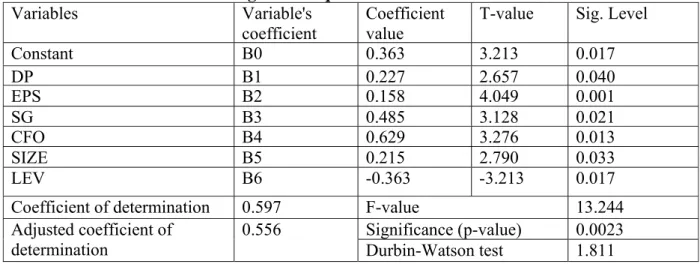
PriceI, =Β +Β DPI, +Β EPSI, +Β SGI, +Β CFOI, +Β SizeI, +Β LEVI, +ΕI, Results obtained from the above regression equation fit for manufacturing companies are presented in table 3. F-value (13.244) indicates that total regression model is significant. Coefficient of determination and adjusted coefficient of determination of the above model are equal to 59.7% and 55.6%, respectively. Therefore, it can be concluded that in the mentioned regression model, only 55.6% of risk changes of banks in this study are explained by independent and control variables.
Table 3. Results obtained from regression equation fit
Variables Variable's
coefficient
Coefficient value
T-value Sig. Level
Constant Β0 0.363 3.213 0.017 DP Β1 0.227 2.657 0.040 EPS Β2 0.158 4.049 0.001 SG Β3 0.485 3.128 0.021 CFO Β4 0.629 3.276 0.013 SIZE Β5 0.215 2.790 0.033 LEV Β6 -0.363 -3.213 0.017 Coefficient of determination 0.597 F-value 13.244 Adjusted coefficient of determination 0.556 Significance 0.0023(p-value) Durbin-Watson test 1.811
Resulted indicate that significance level of impact coefficient of cash dividend payout variable (DP) is smaller than first type error of 0.05 (p-value = 0.040) and hence, it can be accepted that the effect of cash dividend payout on future stock price of financial institutions in this study is significant. Also, considering the fact that Impact factor regression is positive, it is concluded that cash dividends payout percentage has a positive and direct effect on future stock price in these institutions. Cash dividend payout and its percentage have a justifiable effect on future stock price. With an increase in paid cash dividend percentage, shareholders' support from company's stock
Hossein Mirzaie, Hamed M Abdi
Openly accessible at http://www.european-science.com 1167 increases and future stock price also increases considering the reflection of dividend payout in capital market.
Also , based on the obtained results from both research models, it is seen that significance level of each of other independent variables of the model is smaller than the estimated first type error of 0.05 and indicates that the effect of these variables on future stock price of financial institutions is significant. Therefore, findings of these two models, based on results obtained from research secondary hypotheses, are presented as below:
1. Dividend per share of a company has a positive and significant effect at error level of 0.05 on future stock price of financial institutions. Therefore, first secondary research hypothesis is confirmed. As cash dividend payout and its percentage have a significant role in increasing future stock price, similarly, dividend per share also has a positive effect on future stock price, because one of the most basic signs of dividend per share, is profitability of the company which is expected by investors. Hence, increasing investors demans for stock of these companies is accompanied with an increase in thier stock future price.
2. Operating income growth has a positive and significant effect on future stock price of financial institutions at error level of 0.05. Therefore, second research secondary hypothesis is confirmed. Operating income growth of a company shows the correct application and use of cash in operating activities. Since, cash flow of a company motivates investment, correction application and use of these cash flows for increasing the revenue of a company also has positive effects in capital market and its first outcoems might be increased company's share price.
3. Cash flow resulting from operating activities has a positive and significant effect on future stock price of financial institutions at error level of 0.05. Therefore, third research secondary hypothesis is confirmed. In other words, when cash flow is high in these institutions and when there are signs of large cash flow and high capability of the company in investment activities, future stock price of companies and institutions increases and this is due to welcoming of large cash flow be investors in a company.
4. Company size has a significant and positive effect at error level of 0.05 on future share price of financial institutions. Therefore, fourth research secondary hypothesis is confirmed.
5. Financial leverage has a negative and significant effect on future stock price of financial institutions at error level of 0.05. For interpretation of this it can be said that for each 1 unit increase in financial leverage of financial institutions, future stock price of these institutions reduces and therefore, fifth research secondary hypothesis is rejected.
Conclusion
Dividend policy has an interesting topic from the time of emergence of Joint stock companies in financial literature. Dividends are defined as distribution of earnings (Kapoor, 2009). Dividend and Accumulated profits significantly explain changes in stock price both in banking and non-banking sectors (Joshi, 2012). Banks are dependent on certain financial indicators, while, make their decisions based on dividend policy. Dividend per share is a very important index which represents banks' performance and hence, attracts the attention of investors. Investors study a bank's dividend policy prior to make any investment in stock exchange (Bhandari & Pokharel, 2012). Order in declaring dividends also is considered as one of the main and most important elements which is effective on shares value, because, shareholders believe that regular dividend declaration leads to an increase in stock price. On the basis of these results, dividend payout, dividend growth rate and regularity in dividend declaration have considerable effect on market value (Mokaya et la., 2013). Dividend policy of a company is affected by company's liquidity condition, need to pay debt, expected level of return, profit stability, personal tax and .... (Poudel et al., 2007). There assumption
Special Issue on New Dimensions in Economics, Accounting and Management
Openly accessible at http://www.european-science.com 1168 that explain why an investor decides to pay money for something when he/she is purchasing shares from normal shares are: (1) both dividend and earnings; (2) only dividend; and (3) only earnings (Jordon, 2009). Dividend variables, earnings price ratio and financial leverage are among significant and important determining factors of share prices for all the considered sectors, that is, Automotive, healthcare and the public sectors. In addition to this, profitability is effective on stock prices only in automotive sector (Nirmala et al., 2011). In a study conducted n 2004 in Nigeria, no relationship between dividend payout and stock prices of Nigerian companies. Also, no relationship was seen between net profits and stock prices. This result might have occurred due to lack of existence of some items in yearly reports of companies which are not disclosed, but are needed for calculation of dividend prices at the time of earnings calculation (Adelfila et al., 2004). Pradhan (2003) has tried to explain the effect of dividend payout and accumulated earnings on market price of earnings in the context of Nepali companies that his finding indicate to usually strong effect of dividend and weak effect of accumulated earnings on price of stock market. It has been seen that dividends relatively have more appeal among Nepali shareholders (Aggarwal et al., 2011).
From above arguments it can be deduced that dividend payouts by different companies have a positive and significant effect and are effective on companies' value (Aggarwal et al., 2011). Foong et al., (2007) have studied the factors related to dividend which can be relied on at the time of determining the value of a company. Their findings indicate that growing companies have considerably lower dividend comparing to non-growing companies. This finding indicates that change in dividend policy have a considerable role in explaining a company's stock returns, epically for growing companies.
The aim of the present study was to study the effect of cash dividend on future stock price of financial institutions listed on Tehran Stock Exchange (in the timeframe of 2007 - 2012 that findings indicated that cash dividend payout and percentage have a positive effect (p<0.01) on future stock price of financial institutions. Based on these results, the following practical recommendations are presented:
Investors and financial analysts are recommended to consider capital structure and debt ratio of companies as a criterion for measurement and prediction of profitability of companies in their analysis.
In order to increase profitability of companies through the profit resulting from share price, it is recommended to apply a certain ratio of debt to asset ratio in capital structure of companies.
It is recommended that managers pay attention to cash dividend payout amount to shareholders from the place of The cash received from dividends.
Considering different ownership structure and changes in effective parameters on Fundamental analysis of companies, such as free floating shares and dividend, investors are recommended to considered a combination of shareholders and ownership type of companies. This variable to a great extent have the ability to solve determination of future financial restrictions and opportunism in the event of a financial crisis for companies.
References
Adefila, J.J., Oladipo J.A., & Adeoti, J.O. (2004). The Effect of Dividend Policy on the Market Price of Shares in Nigeria: Case Study of Fifteen Quoted Companies International Journal of Accounting. University of Ado-Ekiti, 2(1).
Aggarwal, R., Klapper, L., & Wysocki, P.( 2011). Portfolio Preferences of Foreign Institutional Investors. Journal of Banking and Finance, 29, 2919–2946.
Hossein Mirzaie, Hamed M Abdi
Openly accessible at http://www.european-science.com 1169 Amidu M., & Abor J. (2006).Determinants of Dividend Payout Ratios in Ghana. The Journal of
Risk Finance,. 7, 136-145.
Bhandari, B., & Pokhrrel, Y.(2012). Corporate Dividend Policy: A Study of Commercial Banks of Nepal. Journal of Administrative and Management Review, 24, 24-44.
Foong, S. S., Zakaria, N. B., & Tan, H. B. (2007). Firm Performance and Dividend-Related Factors: The Case of Malaysia. Labuan Bulletin of International Business & Finance, 5, 97-111. Hashemi, S. A., & Rasaeean, A. (2009), Studying the Effective Factors on Dividend Policy of
Companies Listed on Tehran Stock Exchange, Journal of Administrative Sciences and Economics, University of Isfahan. 20 (51), 187 - 213.
Izadinia, N. & Alinaghian, N. (2010). Identification of Effective Factors on Dividend by Using Lajit's Model. Journal of Financial Accounting Studies, 3(7), 2-12.
Jordan, B. D.(2009). Fundamentals of Investments Valuation and Management. 6th Edition, Mc Gr Hill, newyork.
Joshi, R. (2012). Effects of Dividends on Stock Prices in Nepal`. NRB Economic Review.
Kamyabi, Y., Noosh Abadi, S. Z. & Haghshenas, H. (2014). Studying the Effect of Cash Flows and Dividend in Dividends Predictions. Quarterly Journal of Accounting and Auditing knowledge management. 3 (9), 56-70.
Kapoor, S.(2009). Dividend policy – A review, Management Review. A Quarterly Journal by Delhi Management Association, September.
Mokaya S. O., Nyang`ara D., & Tintira J.L, (2013). The effect of dividend Policy on Market share value in the banking Industry. The case of National Bank of Kenya.
Nirmala, P. S., Sanju, S., & Ramach, R.(2011). Determinants of Share Prices in India. Journal of Emerging Trends in Economics and Management Sciences, 2(2), 124-130..
Poudel, R B., Baral, R., Gautam G., Dahal, B., & Rana, B. (2007). Fundamentals of Financial management. Asmita Publication, Kathmandu, Nepal, 490-514.
Vadiee, M. H. & Asiabani, S. (2008). Comparing Stock Price Transfer of Public Companies Including Privatization with Two Pricing Models of Stock Value Growth Index and Ratio of Market Value to Book Value of the Stock of Similar Companies. Journal of Monetary and financial Economics. 17 (23), 115-128.