Effective Kickstarter fundraising methods for Visual Art Projects
A Thesis
Submitted to the Faculty of Drexel University
By Yunlin Zhu
In partial fulfillment of the degree of Master of Science in Arts Administration
December 2012
Deleted: paritial Deleted: Admnistratiopn
Acknowledgement
I would like to express my greatest gratitude to the people who have helped & supported me throughout my thesis researching and writing process. I am grateful to my thesis advisor Roy A. Wilbur for his continuous support. A special thanks of mine goes to my interviewees and staff members from Kickstarter.com.
I wish to thank my parents for their undivided support, which inspired me and encouraged me.
Table of Contents
LIST OF TABLES………iv
LIST OF FIGURES………v
ABSTRACT………..vi
Chapter 1: Introduction…...………1
Chapter 2: Definition of Terms and Background………..………..3
Chapter 3: Methodology and Limitations……..………16
3.1 Data Analysis……….16
3.2 SUCCES Analysis………..18
3.3 Interview.………....19
Chapter 4: Thesis Statement…..……….20
Chapter 5: Findings……….21
5.1 Findings from the Data Analysis………...………..21
5.2 Findings from the SUCCES Analysis ……….29
5.3: Findings from the Interviews………..………30
Chapter 6: Conclusions………32
LIST OF REFERENCES……….36
APPENDIX A: “SUCCES” PRINCIPLES AND STANDARD USED FOR “SUCCES” ANALYSIS ………....………..38
List of Tables
Table 1.Annual Estimates of Aggregate Start-up Requirements and Sources…………..7 Table 2: Findings from the SUCCES analysis……….29
List of Figures Figure 1………..………...…..12 Figure 2……….…..………..…..22 Figure 3..……...22 Figure 4..………...………..……23 Figure 5 ………..………24 Figure 6.…...……….………..25 Figure 7.….………..…..……….26
Abstract
Effective Kickstarter fundraising methods for Visual Art Projects
Yunlin Zhu
Roy A Wilbur Supervisor, M.S.
For this paper, the author reviewed literatures about entrepreneurship, crowdsourcing and crowdfunding. She analyzed data collected from 20 projects’ profile pages and interviewed three project creators on Kickstarter.com (a crowdfunding website). All the projects analyzed were in the visual arts field, and the project creators interviewed were individual artists who specialize in visual art. Based on the research, the author draws conclusions on the success or failure of the projects’ fundraising campaigns on
Kickstarter.com. There were several aspects that influence a project’s fundraising results: 1. Video; 2. Ending dates; 3.Simplicity; 4. Emotion; 5. Concreteness; 6. Rewards, etc. By identifying these aspects and suggesting the connections between them, the author paints a clearer picture for artists to conduct effective fundraising campaigns on Kickstarter.com.
Chapter 1: Introduction
For ages, being an artist has not been a rosy career path parents envision for their children. Before the Renaissance, artists were simply seen as craftsmen, nowadays, artist is defined by the Merriam-Webster dictionary as “one who professes and practices an imaginative art.” (Merriam-Webster Dictionary Online, s.v.“artist,” accessed September 2nd, 2012, http://www.merriam-webster.com/) This definition makes 'artist' as a profession sound useless and even vain. It is true that there are some artists who sell their artwork for millions of dollars. However, history also tells us that in Van Gogh’s lifetime, he suffered great difficulty selling even a single piece of work. In most cases, choosing to be an artist is akin to voluntary poverty. The price of an artwork is very hard to determine since it basically only has imaginary value. Additionally, the art market does not have clear rules. These factors make the life of an artist very difficult in a financial sense. To support their art making, some artists have another job with higher pay, some rely on grants they received from government or other nonprofit organizations. However, one's bread-winning job can take up a great amount of time that was supposed to be used in creating art, and the application process for grants can also be very time consuming and extremely competitive. Under this condition, many artists start to turn their eyes to entrepreneurship.
In an article in The New York Times in 2008, Marci Alboher states: “Some artists have begun to figure out ways to make money and make art – aiming to end the notion that ‘starving’ and ‘artist’ are necessarily linked. Rather than seeing art as something to pursue in the hours when they are not earning a living, these artists are developing businesses around their talents.” (Alboher, Marci. 2008) Steve King, a member of the Small Business Trend Expert network
noted three elements that encourage the trend of artist combining entrepreneurship with art. According to King:
“1. Consumer interest in unique, one-of-a-kind or handcrafted products is growing, broadening the market for works of art.
2. The Internet is creating new and effective methods for tech savvy artists to find an audience – and for art buyers to easily find art that interests them.
3. Technology is reducing the costs of producing many types of art, allowing artists to price at levels that attract new buyers and expand the art market. Technology also gives artist
entrepreneurs the ability to create and manage small businesses with multiple revenue streams. This greatly increases the likelihood they will generate enough revenue to succeed.”( King, Steven. 2008)
The transformation from artist to entrepreneur is not just the change that happens naturally, but it has also been encouraged by organizations that give funds to artists. New York Foundation for the Arts (NYFA) hosts “Artist as Entrepreneur Boot Camp” to cultivate the business side of artists. This combination of art and entrepreneurship helps artists think outside of the box, seek out new ways to generate funds and develop their market. Kickstarter.com as a crowdfunding platform could be used as one of the nontraditional tools to help artists raise funds and expand their potential audience base, since it is less time-consuming and also less competitive than applying for grants. Therefore, it is very important for artists to understand how to use this platform most effectively in order to reach their funding goals.
Chapter 2: Definition of Terms and Background
1. Entrepreneurship and entrepreneur:
It is mentioned above that more and more artists are beginning to embrace entrepreneurship. Therefore, one has to understand entrepreneurship and who is considered an entrepreneur. The term “entrepreneur” originated in French economics as early as the 17th and 18th centuries. In French, it means someone who “undertakes,” not an “undertaker” in the sense of a funeral director, but someone who undertakes a significant project or activity. More specifically, it came to be used to identify venturesome individuals who stimulated economic progress by finding new and better ways of doing things. In the 19th century, French economist Jean Baptiste Say identified the entrepreneur as someone who “shifts economic resources out of an area of lower and into an area of higher productivity and greater yield.” In the 20th century, economist Joseph Schumpeter described entrepreneurs as the innovators who drive the “creative-destructive” process of production. He said: “The function of entrepreneurs is to reform or revolutionize the pattern of production.”(Dees, J. G. 1998)
Reynolds, in “Entrepreneurship in the United States,” summarizes that contemporary writers modified the meaning of entrepreneurship and entrepreneur based on these former definitions. Peter Drucker amplified Say’s description to focus on opportunity. He said: “The entrepreneur always searches for change, responds to it, and exploits it as an opportunity.” (Dees, J. G. 1998) Howard Stevenson, a leading theorist of entrepreneurship at Harvard Business School, added an element of resourcefulness to the opportunity-oriented definition based on research he conducted to determine what distinguishes entrepreneurial management from more common forms of “administrative” management. After identifying several dimensions of difference, he suggests defining the heart of entrepreneurial management as “the pursuit of opportunity without regard to
resources currently controlled.” (Dees, J. G. 1998) Generally speaking, to measure entrepreneurship, the following concepts deserve attention:
A. Distinctive personality trait B. High growth and capitalization C. Innovation and innovativeness D. Opportunity recognition E. Business creation (Reynolds, P. D. 2007)
2. Entrepreneurship in today’s society:
Entrepreneurship is growing quickly in United States and worldwide. The creation of new firms drives new industries and is associated with significant economic innovation. Entrepreneurship is a major source of job creation and improvements in sector productivity, and has a pervasive, consistent association with economic growth. Entrepreneurship involves one in ten in the labor force at any given time. It is pursued as an option during the careers of a substantial proportion of the labor force, as it provides a significant route for social integration and mobility. (ibid) Many people decide to become entrepreneurs because “as success is related almost entirely on the business idea and how it is implemented--and not to the nascent entrepreneur’s status or role in the preexisting social order--anybody can expect to have an unbiased opportunity to succeed.” (ibid)About 13.8 million (9.38% of the total workforce in 2004) in the United States were involved in new firm start-ups in 2004 (the total workforce of 2004 is 147.1 million); about 8.3 million (5.64% of the total workforce in 2004) were involved only in single new firm start-ups, while the other 5.5 million (3.74% of the total workforce in 2004) were the owner-managers of
new established firms. A further 5.6 million (3.8% of the total workforce in 2004)were the owners/managers of new firms and about 11.2 million (7.6% of the total workforce in 2004)were the owner-managers of existing firms. (Reynolds, P. D. 2007)
3. Entrepreneurship’s life cycle. (Startup Stage)
Even with large dose of innovation, entrepreneurship as with any other business, follows a certain life cycle. Oliver Williamson has depicted the industry life cycle as following: “Three stages in an industry’s development are commonly recognized: an early exploratory stage, an intermediate development stage, and a mature stage.” On “morebusiness.com”, the author focus on small business and break this life cycle more specifically into 5 stages: Stage one is
establishment; stage two is growth period; stage three is expansion; stage four is maturity and the final stage is decline. In this paper, I will only focus on what happens to entrepreneurs in stage one. According to “The Small Business Life Cycle”, for some, this is the only stage that a small business may see, as it is by far the most difficult to survive. Many things can go wrong at this stage. (Morebusiness.com 2008) From a series of analyses, Paul Davidson Reynolds, the author of Entrepreneurship in the United States, draws a conclusion that all the start-up activities could be reorganized into six areas:
A. Business Presence: the emphasis is on formal registration of the firm
B. Production Implementation: establishing procedures to produce the good or service
C. Organizational, Financial Structure: putting an organization and financial structure in place D. Personal Planning: the nascent entrepreneur’s efforts to prepare for the business and his or her personal involvement
E. Personal Preparation: the nascent entrepreneur’s organization of his or her personal life. Focus on Task or the Product: Attention to developing the product or service to be sold or filing for a patent, trademark or copyright. (Reynolds, P. D. 2007)
In all these areas, the activities that have the most impact appear to be the following: A. Actions devoted to implementing a process for producing the good or service B. Actions devoted to developing a presence for the new business
C. Startup team investment of funds into the process
D. Measures of business experience and particularly a background in the same industry (ibid) This paper will focus on the funding process of the startups.
4. Fundraising methods for entrepreneurs
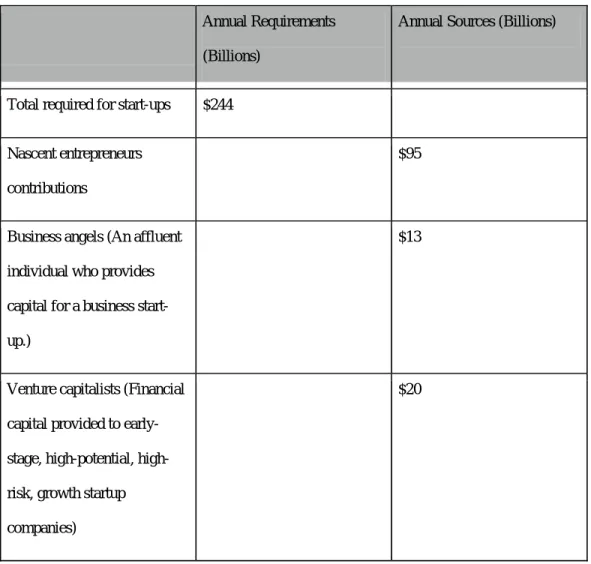
Two sources are widely promoted as sources of new firm financing: business angels and venture capitalists. Questionnaires assembled from venture angel clubs suggest that they invest about $13 billion per year in startups and seed capital, but much of venture capital funding is provided to established firms. (ibid) Banks are, of course, another option. But most of banks’ financing is provided to existing firms. Very few banks will provide working capital loans, which are based on confidence that the business will continue to operate and make the profits to repay the loan. This leaves the financial support from friends and family members, those individuals in the personal social network of the nascent entrepreneurs. As they are outside the formal financial institutional structures, they are referred to as “informal investors”. A representative sample of U.S. adults has been used to locate informal investors since the year 2000. The average amount of funding provided annually by informal investors over the 2000 to 2004 period is about $162
billion in 2004 dollars. This is obviously a major source of start-up financial support. (Reynolds, P. D. 2007) As table 1 indicates, we can clearly see the impact of informal investor’s money on the entire funding of start-ups:
Table 1 Annual Estimate of Aggregate Start-up Requirements and Sources (ibid Annual Requirements
(Billions)
Annual Sources (Billions)
Total required for start-ups $244
Nascent entrepreneurs contributions
$95
Business angels (An affluent individual who provides capital for a business start-up.)
$13
Venture capitalists (Financial capital provided to early-stage, potential, high-risk, growth startup companies)
Annual Requirements (Billions)
Annual Sources (Billions)
Informal Investors (FFFs: Friends, Family and Fans)
$162
Total annual financial support $290
Since the informal investors are so important in start-up’s financial resources, we need to better understand who these people are. As Reynolds noted, informal investors are often the friends and coworkers of the entrepreneur, so the age and race pattern is mixed. In summary, they seem to be better established professionally with higher education levels, higher incomes, and more contact with the entrepreneurial activities in their immediate social context. This would suggest that they have the knowledge, financial resources, and contacts to identify and pursue new start-ups as an investment. (Reynolds, P. D. 2007) We label this majority of informal investors as 3Fs or FFF, as it refers to friends, family and fans. The reason they are more willing to donate is because information asymmetries (The imbalance of the information received by the source and the receiver
) faced by the 3Fs are lower than those faced by other sources of capital. FFF investors tend to invest early, whether they are local or live far away; non-FFF investors tend to invest late. FFF account for approximately one third of the focal entrepreneur’s total investment for the first $500 raised and account for one fifth by the end of the fundraising cycle. They have the following giving habits on Kickstarter and websites similar to Kickstarter: 1. The FFF investor invested in the focal entrepreneur before investing in any other; 2. The FFF investor’s investment in the
focal entrepreneur is their largest investment; 3. The FFF investor invests in no more than three other entrepreneurs (i.e. the focal entrepreneur remains a key reason for being on the site). (Agrawal, A., C. Catalini, and A. Goldfarb. 2010)
Kickstarter.com is not a place for angel investors or venture capitalists to make their investments. Instead, it is a platform that relies heavily on informal investors. Also, one cannot see the funds being offered on Kickstarter as an investment, since the people who give money have no
intention to profit from it. Mostly, they just want rewards from the project’s creator to show their financial support is appreciated
5. Crowdsourcing
Kickstarter is a crowdfunding platform, and crowdfunding is a term generated from
“Crowdsourcing”. To understand crowdfunding, one has to understand crowdsourcing first. Jeff Howe and Mark Robinson have first used the term “crowdsourcing” in the June 2006 issue of
Wired, an American magazine for high technology. Kleemann et al. (2008) provide a good definition of it: “Crowdsourcing takes place when a profit oriented firm outsources specific tasks essential for the making or selling of its products to the general public (the crowd) in the form of an open call over the internet, with the intention of animating individuals to make a [voluntary] contribution to the firm’s production process for free or for significantly less than that
contribution is worth to the firm.” (Schwienbacher, A., and B. Larralde. 2010)
6. Crowdfunding.
The idea of crowdfunding is to obtain money from a large audience (the “crowd”), where each individual will provide a very small amount. Crowd-funders make voluntary financial
contributions with or without the expectation of receiving compensation. More conceptually, Lambert and Schwienbacher (2010) extend the definition of crowdsourcing provided by Klemann et al. (2008), by describing crowdfunding as “an open call, essentially through the Internet, for the provision of financial resources either in form of donation or in exchange for some form of reward and/or voting rights in order to support initiatives for specific purposes.” In simple terms, crowdfunding is the financing of a project or a venture by a group of individuals instead of professional parties (like, for instance, banks, venture capitalists or business angels). (Schwienbacher, A., and B. Larralde. 2010) It’s a bottom-up model of financing used for various purposes, from software development to political campaigns. (Gaggioli, A., and G. Riva. 2008) It is a special form of crowdsourcing, where a group of people (a social network) collects money for a particular project. Internet facilities are used for spreading information about the project and possibility to join and donate. Crowdfunding is often used to support victims of natural disasters, to help in publishing the first CD of a young musician, supporting projects coordinated by NGOs and, finally, supporting individuals in collecting resources on the way to realize dreams and plans. (Wojciechowski, A. 2009) Crowdfunding is often associated with Micro-funding. Micro-funding is the activity of investing money in start-up projects, artists etc., where in a majority of cases the supported firm (or person) allows the investor to participate in success of the financed project. It may be formally guaranteed by a contract. In this sense, micro-funding plays a role similar to the stock market; where new shares are sold to support new investments and shareholders expect a rise of stock prices in the future, as well as dividends. (ibid)
A strong advantage of this form of financing is the attention that the entrepreneur may attract on his/her project or company. This can become a vital asset for many of them, especially for artists
or entrepreneurs in need of promoting their talents and products to the “crowd” (as potential customers). (Lambert, T., and A. Schwienbacher)
7. Kickstarter.com
Kickstarter is a platform for threshold pledge funding. It is also one of a “group power” form of crowdsourcing, where the primary feature of its approach is in the strength of numbers. On the site, users pitch ideas or projects for which they need funding. A financial goal and deadline are set and users can pledge donations toward that goal. If the goal is reached or exceeded, the pledges are donated and the project goes through. Users are offered something in exchange for their contribution; as with many pledge drives, where gifts are awarded based on different tiers of donation amounts. Kickstarter is a shell, a place that enables and simplifies the pursuit of crowdfunding. As such, it provides little inherent motivation and is “more project-centric”. (Organisciak, P. 2010)
The author chooses Kickstarter instead of other fundraising websites to base her research on is because Kickstarter is the largest funding platform specifically for creative projects while other fundraising websites don’t have such focus.
By April 2011, there were 20,371 projects launched on Kickstarter, 7,496 succeeded, which made up about 43% of all the projects, and 9,700 failed. The website collected about $40 million in total.
The projects that fall into the “Art” category (which includes conceptual art, digital art, illustration, painting, performance art, sculpture, public art and mixed media) pledged
$3,184,732. Judging by the amount of money pledged, the “Art” category is the fourth largest, following film, music and design. (Strickler, Yancey. 2011)
(See Figure 1)
Figure 1
8. Motivations for people to donate
According to Kleemann et al. (2008), participants in crowdsourcing projects have either intrinsic or extrinsic motivations. Intrinsic motivation relates to the pleasure or fun of doing a particular task, whereas an extrinsic motivation calls for an external reward, such as money, goods, career benefits, learning opportunity or recognition. (Schwienbacher, A., and B. Larralde. 2010)
A. Sense of being involved with in something good:
People like to help if they believe in what they’re helping. They are motivated to contribute if they feel that the contribution is meaningful. Therefore many people are especially altruistic toward public projects, emphasizing their preference of meaningful engagement with institutional workings over symbolic outreach. In many cases even a small donation gives a feeling of participation in a project that brings happiness to other people. (Wojciechowski, A. 2009) “It brings out your inner altruist.”--A Kickstarter participant claims that he does not care about the rewards, but would fund something in which he believed. (ibid)
B. Fun:
There are numbers of sub-qualities than may motivate a user to call something fun:
1. Curiosity Satisfying: Indulging a thought or intrigue. Novel ideas seem to benefit from this, but only for a short amount of time.
2. Passing the time; break boredom: A low-impact, harmless contribution offers an easy feeling of achievement in one’s spare time. (Organisciak, P. 2010)
C. Social Reputation:
In many cases, the financial return seems to be of secondary concern for those who provide funds. This suggests that crowdfunders care about their social reputation and/or enjoy personal benefits from participating in the success of an initiative. (Lambert, T., and A. Schwienbacher. 2010)
Contributors seeking rewards for actions. Rewards for action refers to the pursuit of goals and being rewarded for reaching them. Achievements are satisfied in this way. (Organisciak, P. 2010) Many crowdsourcing projects provide utility to their contributors, which means that the
contributors could use the product or service they contributed to produce.
3). Intrinsic Motivation + Extrinsic Motivation:
The more important factor is the project while the reward is an incentive.
One crowd-funder suggested “the ones that are easy and let you create but also give something back. So you can be altruistic and greedy at the same time.” Another says: “There has to be a point for the big picture and a point for you.” (ibid)
4). Other Motivations: A.Being Asked:
Simply connecting people is not comparable to engaging them. “It is that you have to be way clearer in what you ask contributors to do. Just because they show up once doesn’t mean they will show up over and over. You have to engage them right away.” (Howe, J. 2008)
Asking users a question that they can answer is another motivator that recurred throughout this study’s findings. “People wanted to participate and liked being asked to contribute”--On Flickr Commons. (Organisciak, P. 2010)
The main reason people donated was they were asked to give by someone whom they knew well. (Wojciechowski, A. 2009) It is becoming easier to share recommendations and opinions online
and with people’s social networks, there are more opportunities for to connect with their friends. Seeing a friend recommend something, either directly or through their networks, may affect one’s desire to try it themselves. (Organisciak, P. 2010)
B. Sincerity of the project:
Sincerity is closely linked to altruism, where users are more willing to be micro-benefactors for an honest beneficiary. (ibid) Doubts about the real use of given money prevent many people from supporting a project. (Wojciechowski, A. 2009) As crowd-funders are most likely offered very little form of investor protection, trust-building is an essential ingredient for any successful crowdfunding initiative. (Lambert, T., and A. Schwienbacher.2010)
Part of the Kickstarter’s appeal is that individual donations are not processed unless the total pledged for a project surpasses the goal. This lowers the risk of funding projects. (Organisciak, P. 2010)
C. Layouts of the site/project:
An interesting motivation for some participants was well-designed sites, noticeably absent of the junk or noise. To put it another way--an obviously simple way--quality attracts users. The language of a website’s appeal for one to contribute is a complex issue that would require further research to better understand. In the survey conducted by Organisciak, one former Kickstarter visitor complained that casual discovery on the site was not easy. (ibid)
Kiva, as an example, mobilizes online participants to fund third-world business initiatives through micro-lending. Funds generally go towards improving an entrepreneur’s infrastructure, increasing their ability to make a living and, by extension, capacity to repay the loan. Like with Carrotmob and as Klandermans and Oegema suggest, the idea of critical mass is also important here. Though loans are repaid, having a greater number of lenders allows a lower barrier to entry for potential funders. Low barriers to entry and participation were cited in every single case that was examined, making it highly significant to contribution. (Organisciak, P. 2010)
E. External Indicators of Progress and Reputation:
Perhaps the most surprising finding was the strong sentiment that point systems, achievements, and leaderboards are secondary motivations. (ibid) Also entrepreneurial initiatives that yield a product tend to attract larger amounts of capital than those who offer a service. (Lambert, T., and A. Schwienbacher. 2010)
By April 2011, there were 591,773 people who backed projects, and among them, 79,658 were repeat backers who backed more than one Kickstarter project. (Strickler, Yancey. 2011)
Chapter 3: Methodology and Limitations
3.1 Data Analysis
The author chose 20 projects from Kickstarter.com. All these projects were visual art related projects, created by an individual and looking for funding below $2,500. Ten of them
successfully reached their goals on the website, the other ten did not. The author collected data from each project’s profile page. This data includes:
2) The amount of money they raised;
3) The percentage of the goal they had reached; 4) The race of the project’s creator;
5) The gender of the project’s creator; 6) The location of the project;
7) The number of projects this project’s creator had backed before launching his/her own project;
8) The number of people who “liked” the project on Facebook;
9) The presentation of the project (does it have a video or image; how long is the video; what is the music used in the video; who /what is in the video; what’s the content of the video; what the image looks like, etc.);
10) The length of the project’s summary;
11) The usage of words in the project’s summary; 12) The outline of the project’s summary;
13) The connection the project’s summary has with its video (if it has a video); 14) The number of reward tiers the project has;
15) The suggested donation for each tier; 16) The reward for each tier;
17) The number of backers for each tier; 18) The number of backers in total;
19) The number of updates the project’s creator made; 20) The numbers of comments on the project; 21) The existence of the Q&A section;
22) The project’s end date.
By collecting and analyzing this data, the author tries to find out the correlations each element has with the final success or failure of a project.
3.2 SUCCES Analysis
In The New York Times bestseller Made to Stick—Why Some Ideas Survive and Others Die, Chip Heath and Dan Heath poured over hundreds of sticky ideas and found the same six principles at work: S-Simplicity; U-Unexpectedness; C-Concreteness; C-Credibility; E-Emotion; S-Stories. The author will subjecting these projects to a SUCCES analysis. These six principles are explained in detail in the appendix section.
According to their research, sticky ideas are what are understandable, memorable, and effective in changing thought or behavior. ( Heath and D. Heath. 2010)
The author implements these six principles into her own research. She analyzed the data she collected from the profile pages of the projects by using a ranking system, giving each profile a 0-5 rank in each SUCCES section. A five means the project did very well in that section, and 0 means the project did really poorly in that section. At the end, the author made conclusions based on this form and the funding outcome of each project.
The standards on which the score given in each section is based on can also be found in the appendix section.
3.3 Interview.
To gain a deeper understanding of why a project succeeded or failed on Kickstarter.com, the author interviewed three project creators from the site. Two of them successfully reached their goal and one of them failed. The questions asked are:
1. Why choose 2. How did you set your goal on Kickstarter?
3. How did you decide the timeline of your Kickstarter campaign? 4. How did you set your reward tiers?
5. How long did you prepare for your Kickstarter campaign? 7. Did you promote your Kickstarter project? If so, how?
8. What percentage of the backers were people with whom you have a personal relationship with (e.g.: friends/family members/friends of friends, etc.)?
9. What was the percentage of backers who donated without asking for a reward?
10. What was the most popular amount of donation section (means the actual single donation, not the reward tier)? Please choose from below:
A. less than $20; B. $20--$50; C. $50--$100; D. more than $100
11. What was the largest amount you received for a single donation? What was your relationship with the backer who gave you this donation?
12. What do you think it was the main reason for the success of your Kickstarter campaign? 13. What advice do you have for future Kickstarter project creators?
14. Have you thought about using Kickstarter again in the future?
The answers to these questions provided the author with information she was unable to gain by observing the profile pages of the projects.
Even though the author used three different methods to do her research; there were still some limitations:
1. The database of the profile analysis was relatively small due to the difficulty of searching for failed projects on Kickstarter.com.
2. The rating of SUCCES was subjective because there was no precise measurement applied in the rating system.
3. The number of one-on-one interview conducted was small.
4. All the projects analyzed and all the projects’ creators interviewed were related to visual art.
Because of these limitations, there was a possibility that some of the findings might not apply to a broader range of projects.
Chapter 4: Thesis Statement
This thesis is a research paper. The author analyzed data collected from 20 Kickstarter project profile pages and conducted interviews with project creators. She tried to identify connections between certain elements and the funding outcome of a project. From the earlier literature review, she anticipated the existence and quality of the video, the number of reward tiers, the ending date of the project, and the amount of money sought would have made an impact on the funding of a project. After her research, she found that although most of the elements had the predicted effects on the funding, others did not, or had very little influence on the success or failure of a project. For example, a high-quality video definitely helps, so does the ending date of a project.
However, the number of reward tiers and the amount of money requested for a project had very little to do with its success or failure.
In this thesis, the author applied the SUCCES (C. Heath and D. Heath. 2010) principles to analyze the data of selected projects. SUCCES are the six principles that can make an idea stick in people’s minds and last. This term was invented by Chip Heath and Dan Heath in their book
Made to Stick: Why Some Ideas Survive and Others Die. These six principles are: Simple, Unexpected, Concrete, Credible, Emotion and Story. People use Kickstarter to raise money, but in order to do so they have to sell their ideas of new products. Therefore, it is reasonable to assume that how compelling one’s idea appears to others would make a great difference on the project’s funding. This assumption turned out to be correct after the research.
In sum, this thesis has proven that in order to successfully raise money on Kickstarter, one should upload a video with good-quality that conveys a clear message, design attractive rewards, write simple and direct project summaries, set the ending date of the Facebook and follow the SUCCES principles.
Chapter 5: Findings 5.1 Findings from The Data Analysis
1. One has to attract people’s attention to motivate them to give. However, it does not mean that the more attention one draws from people guarantees him/her a successful funding result. It is not difficult to see after comparing Figure 2 and 3 (In all the figures used in this paper, projects 1-10 are successful projects, projects 11-20 are failed projects) that a higher fan base on Facebook does not necessarily mean a larger percentage of funding being raised. Then again, there was an interesting trend found that 80% of the projects that successfully reached their
funding goal had more than 50 people “like” them on Facebook. For projects that failed to reach their funding goal that number drops to 50%.
0% 20% 40% 60% 80% 100% 120% 140% 160% 1 2 3 4 5 6 7 8 9 10 11 12 13 14 15 16 17 18 19 20
Percentage
of
Pledge
Raised
Figure 2
2. Generally speaking, up until a certain point, the less words one uses in his/her project’s summary, the higher chance for him/her to reach the funding goal. On average, failed projects used 52 words more than successful projects in their project’s summary. What is more, the project that had the least amount of words (44 words) in its summary raised the biggest percentage of its funding goal among all the projects researched. (Compare Figure 2 and 4)
Figure 4
3. As mentioned before, the number of “likes” on Facebook did not necessarily equate to funding success for the project. This phenomenon was also found in the number of backers for a project. More backers can bring success to the project, but it does not guarantee the project will raise a larger percentage of its funding goal just because of it. This finding contradicts with what been said in literature review about people are more likely to give if other people are giving. However, the author found that the chance for success rose if one got more than 10 backers for his/her project. Only 30% of the successful projects had less than 10 backers. For failed projects, the
percentage raised to 50%. In addition, once the number of backers increased above 10, there was no consistent correlation found between the larger amount of backers and the bigger percentage of the funds an individual raised . (Compare Figure 2 and 5)
Figure 5
4. The amount of money sought for a project had no connection with its funding outcome. On average, the failed projects requested $6.2 , (average succeed projects ask for $1,130, and average failed projects ask for $1,136.2) more than the successful projects. There is existing research by Edwin Chen stressing that unsuccessful projects tend to require a larger amount of money. (E. Chen. 2011) However, one cannot say $6.2 is a significant larger sum of money since it’s only 0.55% more. Therefore, Edwin Chen’s statement has not been confirmed in the author’s research. (Compare Figure 2 and 6)
Figure 6
5. The number of reward tiers had no impact on a project’s funding outcome. Craig Mod, who conducted a project on Kickstarter once did research on the connection between the number of reward tiers a project had and the success of its funding. . He found that a fewer number of reward tiers led to better funding outcomes.: Having too many tiers may likely put off supporters. People want to give money and one should not place them in a paradox of choice. (Mod, Craig. 2010) However, from the author’s research, this finding has not been confirmed. Since on average, the successful project had 7 reward tiers and the failed project had 6. This is not a significant difference. (Compare Figure 2 and 7)
(Figure 7)
6. $20 -- $50 was the most popular reward tier among the projects analyzed. However, there was an unusual phenomenon found in some failed projects: they only received a single large donation. Even though this donation was generous, the project was still far from reaching its funding goal.
7. The amount of updates the project’s creator made had no connection with the funding of his/her project. The author theorized that potential donors would keep a close eye on the progress of a project and the actions made by the project’s creator. However, this assumption has not been confirmed by the absence of a connection between the project updates and its funding outcome.
8. The amount and the frequency of the usage of “I, my, me” and “you, your, we, our, us” in a project’s summary had no connection with its funding outcome. The author theorized that by using words like “I, my, me”, the project’s creator developed a feeling of self-centeredness, and by using words like “you, your, we, our, us”, he/she created a feeling of inclusiveness in his/her
project. Therefore, pronoun choice would make a difference on the funding of the project. However, this has not been confirmed by the research.
9. If a project’s end date was during the weekend, it had a better chance of succeeding. The author found that 50% of the successful projects had an end date on a weekend. This percentage dropped to 20% among failed projects. The reason for this phenomenon might be due to the fact that people have more time to browse the website and make donations during the weekends than on weekdays.
10. Video quality is crucial when considering the success of a project, so is who is in the video. 80% of successful projects had videos, 60% of these videos had the projects’ creators in them. 60% of failed projects had videos and 40% of them had the projects’ creators in them. If one’s project has a video with its creator appearing on camera it will be much more likely to reach its funding goal. However, there was one exception among all the projects analyzed. While this project had a video where its creator introduced herself and her project on camera, she still raised the lowest percentage of her funding goal among all of the projects. The author suspects that the reason for this result is due to the low quality of the video: it is inconsistent, with heavy on-going background noises. One can barely hear what the project’s creator is saying.
11. The number of comments made on the project’s profile page has no connection with its funding result. The author posited that the more comments left by others on the profile page of a project shows more general interest in the project, therefore leading to a more positive funding outcome. However, this assumption has not been confirmed in this research.
12. The existence of a Q & A section on the project’s profile page is a predictor of failure. None of the successful projects had people post questions in the Q & A section. Among the failed projects, 40% of them had people submit questions. People ask questions because they care about the project. However, the author suspects that there were questions asked on the profile page of the failed projects (but not the successful ones) because after reading the summary and watching the project video, one was still unable to fully understand it. Therefore, he/she feels the need to ask further questions to gain a better understanding.
5.2 Findings from the SUCCES analysis
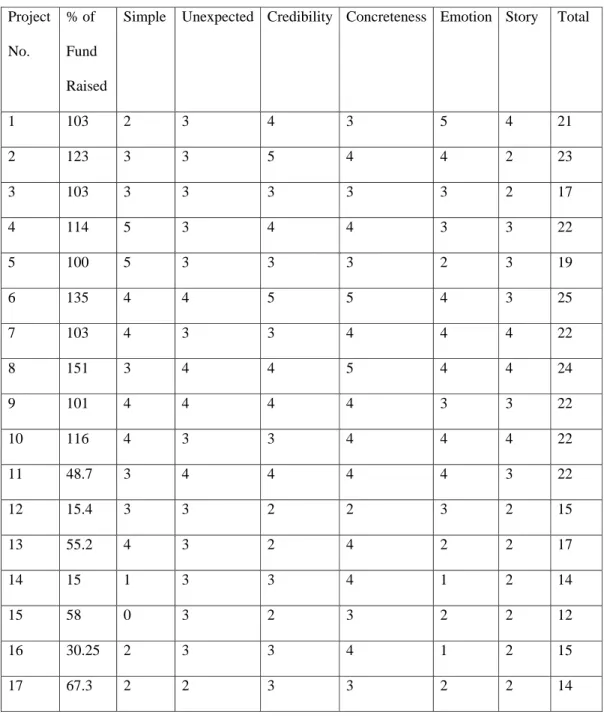
Table 2: Findings from the SUCCES analysis
Project No.
% of Fund Raised
Simple Unexpected Credibility Concreteness Emotion Story Total
1 103 2 3 4 3 5 4 21 2 123 3 3 5 4 4 2 23 3 103 3 3 3 3 3 2 17 4 114 5 3 4 4 3 3 22 5 100 5 3 3 3 2 3 19 6 135 4 4 5 5 4 3 25 7 103 4 3 3 4 4 4 22 8 151 3 4 4 5 4 4 24 9 101 4 4 4 4 3 3 22 10 116 4 3 3 4 4 4 22 11 48.7 3 4 4 4 4 3 22 12 15.4 3 3 2 2 3 2 15 13 55.2 4 3 2 4 2 2 17 14 15 1 3 3 4 1 2 14 15 58 0 3 2 3 2 2 12 16 30.25 2 3 3 4 1 2 15 17 67.3 2 2 3 3 2 2 14
18 62.4 2 3 4 4 3 3 19
19 20 3 3 4 5 3 3 21
20 21.6 4 3 2 2 1 3 15
The average score for the successful project was 21.7, and for the failed project was 16.4. The top three projects that raised the biggest percentage of their goals all had a score above 23. Two of the top three projects that raised the least percentage of their goals had a score less than 15. Therefore, it is not difficult for one to see that the SUCCES principles really apply to the Kickstarter fundraising campaigns.
5.3 Findings from the Interviews
5.3.1 Interview Results
1. 50% of the total funding the project’s creator received was from people with which he/she had no connection. Another 50% came from the FFF (Family, Friends, Fans). This figure was higher then the author suspected, considering Kickstarter’s co-founder Yancey Strickler has said that once one starts a project on Kickstarter.com, it is better for him/her to assume that all the funding will be coming from people with which he/she already has some connection. Yancey states that by thinking this way, it can give one a more realistic picture of the funding result of one’s project. In addition, in a Kickstarter forum, some people who had used Kickstarter.com to raise funds to publish books said that 70% of the funding they received came from their acquaintances.
2. $20 -- $50 tiers were the most popular reward tiers among successful projects. One interviewee whose project failed to reach the goals stated that the most popular reward tiers for her project were the ones below $20.
3. The largest single donation received by the project’s creator was from people whom he/she did not know personally. This indicates that FFF might be more inclined to give smaller donations to show their emotional support while strangers with financial resources and a greater ideological connection to one’s project were more inclined to offer bigger financial support.
4. For successful projects, the biggest single donation they received made up about 1/6 of their funding goals. Combine this finding with the previous one, one can see that although it is realistic to assume a high percentage of donations will come from people with whom you have existing connection, the role played by strangers cannot be overlooked.
5. People like rewards. The percentages of donors who donate without asking for any reward was 14%, 30% and 11%.
5.3.2 Advice Given by the Interviewees
1. Know your audience: Understand who will be interested in your project. After identifying this group of people, focus on them. Wide exposure of your project does not necessarily mean funding success. You will see a better result if you limit your energy and resources on the target group.
2. Make a good video: Once again, video is crucial. Make sure you upload a video of high quality to your project’s profile page.
3. Spread the word: Let people, especially your target audience know about your project.
4. Design interesting rewards: People will have more reasons to give if the reward you offer is appealing to them.
5. Plan your project well: Do not act impulsively when designing your project. Instead, have a plan. Think about everything in detail and don’t lose sight of the big picture. Develop a timeline.
6. Set a reasonable goal: Calculate the amount of money you actually need and have a sense of the amount you will be able to raise. A realistic goal will give the project more credibility.
7. Be clear in what you are doing. What is your plan and what do you need?, Be simple and direct in all contents of your profile page: video, summary and reward tiers. Make your message easy to understand for your audience.
Chapter 6: Conclusions
Kickstarter.com as a crowdfunding platform is a great supplement for individual artists looking to apply for grants. It is less time consuming and less selective compared to the process of grant applications. To better realize the fundraising potential of this site, one should follow the recommendations listed below:
1. Have a plan:
A. Design a reasonable goal based on the amount of money one actually needs and also the amount of money one believes they can raise from FFF (Family, Friends, and Fans). B. Develop a timeline for the project. Make sure its end date is during a weekend. Existing research by the Kickstarter team found that successful project’s creators choose a 30-day duration most frequently, while unsuccessful projects most frequently choose 45 and 90-day (the max allowed) durations. (Benenson, Fred. 2010)
C. Identify one’s target audience, understand their needs and wants.
D. Have a good marketing plan and utilize effective ways to spread the word. People engage with campaigns when they are brand new or when they are nearing a deadline, and lose interest in the middle. A project’s creator should try their best to promote his/her project during the middle phrase. There are several ways to promote your project: a steady rhythm of informative Twitter and Facebook updates; seeking relevant online media posting about the project throughout the timeline, etc.
2. Have a good video:
A. Make sure the video is well-made. This means the images are compelling, the sound is clear, the making of the video is creative, and the message is obvious.
B. Show real people in the video, especially the project’s creator. If he/she does not present him/herself in the video, at least include some other people related to the project. This will be helpful because we are bound to feel connections with real people.
People tend to give on the $20-50 level. Therefore, one should encourage this giving level by focusing on making the rewards of this level as appealing as possible.
4. Design Attractive rewards:
People like to be rewarded. Everyone loves limited editions, one-of-a-kinds, and fun experiences. (Watters, Audrey.2011)
5. Be simple and clear:
Make sure all the information about one’s project is clearly conveyed in the video, summary and reward descriptions. Alleviate any possible confusion.
6. Tell a story:
Present one’s project like a story people can easily remember. In addition, this story has to arouse emotional reactions from your viewers. While this sort of storytelling does not boost one’s professional credentials, it does give the entrepreneur a certain personal authority, and helps to connect them to donors and potential donors in a different way. The best fundraising pitches always emphasize this personal aspect. The intangibles around personality, perspectives and life experience will make potential donors more likely to believe in the project’s creator. (ibid)
7. Make one’s project credible:
Show people some evidence that one is capable of carrying out his/her project, and will use the raised funds to do what is promised. Show other support for your project if possible.
8. Make one’s project concrete:
Feed the imagination of one’s viewer, but also make what they envision concrete. Show people what one’s final product will look like.
In sum, Kickstarter is a crowdfunding platform that can serve as a great alternative of other funding sources, such as grants or business angels. It is fast, efficient and less competitive. In addition, by using it, the project’s creator cannot only raise the money he/she needs, but also reach a wider audience. Therefore, individual artists should try to use this website to its fullest potential when seeking to fulfill their artistic visions.
List of Reference
Agrawal, A., C. Catalini, and A. Goldfarb. 2010.Entrepreneurial Finance and the Flat-World Hypothesis: Evidence from Crowd-Funding Entrepreneurs in the Arts.
Dees, J. G. 1998. "The Meaning of Social Entrepreneurship." Comments and Suggestions Contributed from the Social Entrepreneurship Funders Working Group, 6pp
Gaggioli, A. and G. Riva. 2008. "Working the Crowd." Science 321 (5895): 1443. Heath, C. and D. Heath. 2007. Made to Stick: Why some Ideas Survive and Others Die, Random House.
Lambert, T. and A. Schwienbacher. 2010. "An Empirical Analysis of Crowdfunding." Louvain–la–Neuve: Louvain School of Management, Catholic University of Louvain.
Lehrer, J. 2009. How we Decide Houghton Mifflin Harcourt.
Organisciak, P. 2010.Why Bother?: Examining the Motivations of Users in Large-Scale Crowd-Powered Online Initiatives.
Reynolds, P. D. 2007. Entrepreneurship in the United States: The Future is Now, Springer New York.
Schwienbacher, A. and B. Larralde. 2010. "Crowdfunding of Small Entrepreneurial Ventures." HANDBOOK OF ENTREPRENEURIAL FINANCE, Oxford University Press, Forthcoming.
Wojciechowski, A. 2009. "Models of Charity Donations and Project Funding in Social Networks." Springer.
Howe, J. 2008. Crowdsourcing: How the Power of the Crowd is Driving the Future of Business Century.
Alboher, Marci. 2008. “Transforming Art Into a More Lucrative Career Choice”.
NYTimes.com.http://www.nytimes.com/2008/11/27/business/smallbusiness/27shift.html?_r=0
King, Steven. 2008. “Artist: Taking Business Class with that Art Training”. Openforum.com. http://www.openforum.com/idea-hub/topics/innovation/article/artists-take-business-classes-with-that-art-training-steve-king/
2008. “The Small Business Life Cycle: 5 Stages of Small Business”. Morebusiness.com.
Strickler, Yancey. 2011 “Happy Birthday, Kickstarter”.Kickstarter.com.
Chen, Edwin, 2011 “Kickstarter Data Analysis: Success and Pricing”.
Mod, Craig. 2010.“Kickstartup—Successful Fundraising with Kickstarter & the (Re)making of Art Space Tokyo”. Craigmod.vom.
Watters, Audrey.2011. “Funding Lessons from a Successful Kickstarter Campaign”. Readwrite.com.
Benenson, Fred. 2010. “Trends in Pricing and Duration”. Kickstarter.com.
Merriam-Webster Dictionary
Deleted: Princing
Deleted: Fundrasing Deleted: Kickster
Comment [AWZ1]: Please look up the appropriate way to cite a dictionary definition
APPENDIX A: “SUCCES” PRINCIPLES AND STANDARD USED FOR “SUCCES” ANALYSIS
Principle 1: Simplicity
To strip an idea down to its core, we need to relentlessly prioritize. Saying something short is not the mission— sound bits are not the ideal. Proverbs are the ideal. We must create ideas that are both simple and profound.
Principle 2: Unexpectedness
To get our audiences to pay attention to our ideas, we need to violate people’s expectations; be counterintuitive. For our idea to endure, we must generate interests and curiosity.
Principle 3: Concreteness
To make our ideas clear, we must explain our ideas in terms of human actions, in terms of sensory information. Naturally sticky ideas are full of concrete images, because our brain is wired to remember concrete data. Speaking concretely is the only way to ensure that our idea will mean the same thing to everyone in our audience.
Principle 4: Credibility
Sticky ideas have to carry their own credentials. We need ways to help people test our ideas for themselves—a “try before you buy” philosophy for the world of ideas.
Principle 5: Emotions
To get people to care about our ideas, we make them feel something. As research (J Lehrer. 2009) finds out, people are more likely to give a charitable gift to a single individual in need than to an entire impoverished region. We are wired to feel things for people, not for abstractions.
The scores given to projects in each section were based on following standards:
Simple Unexpected Credibility Concreteness Emotion Story 5 The video,
project summary and the reward tiers convey a The idea of the project was very innovative. There were outside sources proving the project’s creator There were many other images and outside resources There was strong personal feeling shown in the presentation There was a fully developed story behind the project and
very clear and direct message. The length of the project summary and description of rewards were short. There was no room for confusion.
The way the project’s creator conveys his/her idea was very creative. had completed similar projects. There was evidence showing the project creator was doing what he/she promises to do.
showing what the final product of the project will look/feel like. (video, project’s summary, etc. ) of the project and by viewing the presentation of the project, one can feel something on a strong emotional level.
by viewing the presentation of the project, one can easily remember the story.
4 The video, project summary and the reward tiers convey clear and direct messages. There was no room for confusion.
The idea of the project was innovative. The way the project’s creator conveys his/her idea was creative. There were outside sources proving the project’s creator had the ability to conduct this project. There was evidence showing the project creator was doing what he/she promises to do.
There were some other images or outside resources showing what the final product of the project will look/feel like. There were some other images or outside resources showing what the final product of the project will look/feel like.
There was a story behind the project and by viewing the presentation of the project, one can easily remember the story.
3 The video, project summary and the reward tiers convey clear messages. There was little room for confusion.
The idea of the project was new. The way the project’s creator conveys his/her idea was somewhat interesting. There were outside sources proving the project’s creator had the ability to conduct this project or there was evidence showing the project creator was doing what he/she promises to do.
There were a few other images or outside resources showing what the final product of the project will look/feel like.
There was some personal feeling shown in the presentation (video, project’s summary, etc. ) of the project, and by viewing the presentation of the project, one can feel something on an emotional level. There was a story behind the project. 2 The video, project summary and the reward tiers convey the main message. There was some room for confusion. The idea of the project was predictable. The way the project’s creator conveys his/her idea was average.
There was little evidence showing the project’s creator had the ability to conduct this project or will be doing what he/she promises to do. There were no other images or outside resources showing what the final product of the project will look/feel like.
There was some personal feeling shown in the presentation (video, project’s summary, etc. ) of the project or by viewing the presentation of the project, one can feel something on an emotional level. There was something signifying the potential for developing a story behind the project. 1 The video, project summary and the reward tiers convey the main message and some unrelated The idea of the project was predictable. The way the project’s creator
There was no evidence showing the project’s creator had the ability to conduct this project or will be doing There were no other images or outside resources showing what the final product of the project will look/feel
There were very little personal feelings shown in the presentation (video, project’s summary, etc. )
There was very little potential for the development of a story behind the project.
information. The length of the project summary and description of rewards were long. There was some room for confusion. conveys his/her idea was boring. what he/she promises to do. like. On the contrary, one had difficulty imagining the final product of the project. of the project. 0 The video, project summary and the reward tiers convey the main message and much unrelated information. The length of the project summary and description of rewards were long. There was plenty of room for confusion.
The idea of the project was boring. The way the project’s creator conveys his/her idea was boring. There was no evidence showing the project’s creator had the ability to conduct this project or will be doing what he/she promises to do. On the contrary, one might feel the idea of the project had not been fully developed yet. Therefore, there were chances that the project’s creator will not be doing what he/she promises to do. There were no other images or outside resources showing what the final product of the project will look/feel like. One would question the creation of the product. There was no personal feeling shown in the presentation (video, project’s summary, etc. ) of the project and by viewing the presentation of the project, one cannot feel anything on an emotional level. There was no potential for any development of a story behind the project.
APPENDIX B: DETAILS OF SELECTED PROJECTS (Please see attached Excel sheet “Selected Projects”)